Get new posts by email:

Archives

Currently Reading

Here are the tastingspoons players. I’m in the middle (Carolyn). Daughter Sara on the right, and daughter-in-law Karen on the left. I started the blog in 2007, as a way to share recipes with my family. I’m still doing 99% of the blogging and holding out hope that these two lovely and excellent cooks will participate. They both lead very busy lives, so we’ll see.

– – – – – – – – – – – – – – – – – – – – – –

BOOK READING (from Carolyn):

Music of Bees, Eileen Garvin. Absolutely charming book about a woman in midlife, lonely, who raises bees, also makes unlikely friends. Heart-warming and very interesting about beekeeping.

A Postcard from Paris, Alex Brown. Really cute story. Dual time line, 1940s and present day about renovating an old apartment in Paris, things discovered.

Time of the Child, Niall Williams. Oh such a good book. Very small village in Ireland, 1960s. A baby is left on the doorstep. The town all whispers and helps. I listened to an interview of the author, which made me like him and his books even more.

Sipsworth, Simon Van Booy. If you like animals you’ll swoon. An old woman who really wants to die finds a tiny mouse in her house and befriends it and finds a reason to live. Utterly charming book.

The Forger’s Spell, Edward Dolnick. True story. For seven years a no-account painter named Han van Meegeren managed to pass off his paintings as those of Johannes Vermeer.

If You Lived Here, You’d be Home by Now, Christopher Ingraham. Could hardly put it down – about a journalist who takes on a challenge to move to small town in Minnesota and write about it. He expects to hate it and the people and place, but he doesn’t. Absolutely wonderful true story.

The River We Remember, William Kent Kreuger. 1950s, Minnesota. A murder and the aftermath. Could hardly put it down. Kreuger has such a vivid imagination and writing style.

How the Lights Gets In, Joyce Maynard. An older woman returns to New Hampshire to help care for her brain-injured son. Siblings and family, lots of angst and resentments.

The Filling Station, Vanessa Miller. Every American should read this book. A novelized retelling of the Tulsa massacre in 1921. Absolutely riveting.

The Story She Left Behind, Patti Callahan Henry. Love this author. Based on a true story. A famous author simply vanishes, leaving her husband and daughter behind. She had invented a mystical language no one could translate. Present day, someone thinks he’s solved the riddle, contacts the family. Really interesting read.

The Girl from Berlin, Ronald Balson. Love anything about Tuscany. An elderly woman is being evicted from a villa there, with odd deed provenance. Two young folks go there to help unravel the mystery. Loved it.

The Island of the Colorblind, Oliver Sacks, M.D. Nonfiction. The dr is intrigued by a remote Pacific island where most of the inhabitants are colorblind. He also unravels a mystery on Guam of people born with a strange neurological problem. Medical mysteries unveiled. Very interesting.

The Bookbinder, Pip Williams. Post 1914 London. Two sisters work at a bookbindery. They’re told to not read the books. One does and one doesn’t. One has visions beyond her narrow world; the other does not. Eventually the one gets into Oxford. Lovely story.

The Paris Express, Emma Donoghue. 1895 on a train to Paris, a disaster happens. You’ll delve into the lives of many people who survived and died in the crash.

A Race to the Bottom of Crazy, Richard Grant. This is about Arizona. Author, wife and child move back to Arizona where they once lived. Part memoir, research, and reporting in a quest to understand what makes Arizona such a confounding and irresistible place.

The Scarlet Thread, Francine Rivers. A woman’s life turned upside down when she discovers the handcrafted quilt and journal of her ancestor Mary Kathryn McMurray, a young woman who was uprooted from her home only to endure harsh frontier conditions on the Oregon Trail.

A Place to Hide, Ronald Balson. 1939 Amsterdam, an ambassador has the ability to save the lives of many Jewish children. Heartwarming.

Homeseeking, Karissa Chen. Two young Chinese teens are deeply in love, but in China. Then their families are separated. Jump to current day and the two meet again in Los Angeles.

North River, Pete Hammill. He always writes such a good story. A doctor works diligently healing people from all walks of life. His wife and daughter left him years before. One day his 3-yr old grandson arrives on his doorstep.

A Very Typical Family, Sierra Godfrey. A very messed-up family. Three adult children are given a home in Santa Cruz, Calif, but only if the siblings meet up and live in the house together. A very untypical scenario but makes for lots of messes.

Three Days in June, Anne Tyler. The usual Anne Tyler grit. Family angst. This wasn’t one of my favorites, but it was entertaining and very short.

Saved, Benjamin Hall. Author is a veteran war reporter. Ukraine, 2022, he nearly loses his life to a Russian strike. Riveting story – he survives, barely.

Grey Wolf, Louise Penny. Another Inspector Gamache mystery in Quebec. She is such an incredible mystery writer.

All the Colors of the Dark, Chris Whitaker. A missing person mystery, a serial killer thriller, a love story, a unique twist on each. Could hardly put it down.

Orbital, Samantha Harvey. Winner of 2024 Booker Prize. I don’t usually like those, but I heard the author interviewed and she hooked me. This is not a normal book with a beginning, a story and an end. It’s several chapters of the day in the life of various astronauts at the ISS (Int’l Space Station). All fictional. She’s been praised by several real astronauts for “getting it” about space station everyday life.

The Blue Hour, Paula Hawkins. An island off Scotland. Inaccessible except when the tide is out. Weird goings on. An artist. A present day mystery too.

Iron Lake, William Kent Krueger. A judge is murdered and a boy is missing. Riveting mystery.

Tell the Wolves I’m Home, Carol Ricks Brunt. 1980s. A 14-yr old girl loses her beloved uncle. Yet a new friendship arises, someone she never knew about.

Four Treasures of the Sky, Jenny Zhang. 1880s, a young girl is kidnapped in China and brought to the United States. She survives with many hurdles in the path.

The Boy Who Fell out of the Sky, Ken Dornstein. Memoir, 1988. The author’s brother died in the PanAm flight that went down in Lockerbie, Scotland. A decade later he tries to solve “the riddle of his older brother’s life.”

Worse Care Scenario, T.J. Newman. Oh my. Interesting analysis of what could/might happen if a jet crashed into a nuclear plant. Un-put-downable.

Song of the Lark, Willa Cather. Complicated weave of a story about a young woman in about 1900, who has a gifted voice (singing) and about her journey to success, not without its ups and downs.

Crow Talk, Eileen Garvin. Charming story which takes place at a remote lake in Washington State, about a few people who inhabit it, the friendships made, but also revolving around the rescue of a baby crow.

The Story Collector, Evie Woods. Sweet story about some dark secrets from an area in Ireland, a bit magical, faerie life, but solving a mystery too.

A Sea of Unspoken Things, Adrienne Young. A woman investigates her twin brother’s mysterious death. She goes to a small town in California to figure it out, to figure HIM out.

The King’s Messenger, Susanna Kearsley. 1600s England, King James. About one of his trusted “messengers,” and his relationship with a young woman also of “the court.” Lots of intrigue.

In the Shadow of the Greenbrier, Emily Matchar. Interesting mystery in/around the area of the famous resort in White Sulphur Springs, West Virginia.

Isola, Allegra Goodman. Hard to describe, survival story on an island in the 1600s.

Save the Date, Allison Raskin. Rom-com, witty, LOL funny. Clever.

The Sirens, Emilia Hart. Numerous time-lines, Australia. Mysteries abound, nightmares, abandoned baby, weird allergies.

Red Clay, Charles Fancher. LOVED this book. Mostly post-Civil War story about the lives of slaves in Alabama during Reconstruction.

Stars in an Italian Sky, Jill Santopolo. Dual time line, 1946 and recent time. Love stories and a mystery.

Battle Mountain, C.J. Box. Another one of Box’s riveting mysteries. Love his descriptions of the land.

Something Beautiful Happened, Yvette Corporon. A memoir of sorts in Greece, tiny island of Erikousa, where the locals hid Jews during WWII. All elusive stories told by the author’s grandmother.

The Jackal’s Mistress, Chris Bohjalian. 1860s Virginia, about a woman who saves the life of a Union soldier. Really good story.

Song of the Magpie, Louise Mayberry. Really interesting story about Australia back in the days when it was mostly a penal colony. Gritty strength of a woman trying to thrive with her farm.

The Boomerang, Robert Bailey. A thriller that will have you gripping the book. About a lot of secrets surrounding the president (fictional novel, remember) and his chief of staff and about cancer. A cure. Such a good story.

Care and Feeding, Laurie Woolever. Really interesting memoir of a woman driven to succeed in the restaurant business. She worked for Mario Batali and then Anthony Bourdain. Gritty stories.

Everything is Tuberculosis, John Green. Maybe not a book for everyone. A real deep dive into the deadly tuberculosis infection, its history. I heard the author interviewed and found the book very interesting.

The Book Lovers Library, Madeline Martin. Fascinating read about Boots’ drug stores’ lending library. And the people who worked in them.

The Arrivals, Meg Mitchell Moore. LOL funny, about a middle-aged couple whose children (and their various family members) return to the family home and the chaos that ensues.

My Life as a Silent Movie, Jesse Lee Kercheval. About grief. A big move to Paris, finding herself a new life with a new set of real blood family.

Escape, Carolyn Jessop. Another memoir about a woman really in bondage in Utah, Mormon plural marriage.
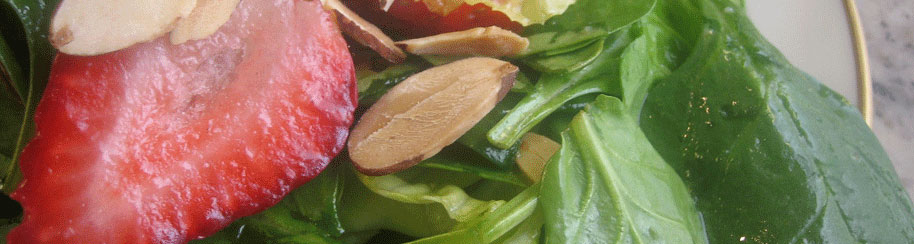

 

Tasting Spoons

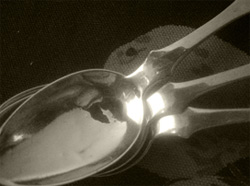
My blog's namesake - small, old and some very dented engraved silver plated tea spoons that belonged to my mother-in-law, and I use them to taste my food as I'm cooking.

Scroll down to the bottom to view my Blogroll

Posted in Chicken, on March 18th, 2010.

First I must tell you a short story about the last week in my house. Starting about 2 weeks ago my computer (5 months old, from Dell) starting bleeping to a blue screen, often called the “blue screen of death.” Then it would reboot. Some of my work was lost each time this occurred. This has been going on since January, but it got a lot worse recently. After a phone call or two to Dell, we ran a complete scan of the hard drive, trying to find out if there are hardware problems. Per the report, no. So therefore it’s software problems (I did a “clean” installation of the new Windows 7 on this computer in February). Dell handed me over to their partner, iyogi.net, a company in India. Read the rest of this entry »

Posted in Essays, on March 17th, 2010.

Recent discoveries show us that practically everything we think we know about the science of taste is wrong, wrong, wrong.

. . . by Bruce Feiler, from Gourmet, July 2008


Having just told you how I learned about the different taste receptors in the mouth (and tongue) at my first wine tasting class back in the late 1970’s, and how they affect my perception of wine taste, I ran across this article in a 2008 Gourmet article, which completely counters most of what I learned. (I’m still trying to go through a stack of magazines collecting dust in my family room.) All of this post comes from Bruce Feiler’s article.

So why this change? The human genome. But, of course. Scientists are only now discovering new information about us humans. Off the head of a pin. Hard to comprehend. And what they’ve found is that flavor chemistry is all over. It’s about how those chemicals interact with our bodies – like the fact that one person likes the taste of cilantro, for instance, and other people think it tastes like soap.

Up until recently all the food scientists worked on two basic truths: (1) there are four basic tastes – bitter, sweet, sour and salt (and they added umami later); and (2) different tastes are detected on different parts of the tongue – the “taste map,” they called it. I wrote up a previous post about those tastes. What they’ve determined is that we taste everything, everywhere in our mouths. And scientists are debunking #1 above too.

Mr. Feiler talked with biochemists, geneticists, sensory specialists and food psychologists. Consumers (like us) use the words flavor and taste interchangeably. Scientists do not. What’s important is that the tongue and mouth, assisted by the nose, are considered the body’s primary defense against poison. Ah. The human body tastes faster than it can touching, seeing or hearing – yes, we detect taste in as little as 1.5 thousands of a second, compared with 2.4 thousandths for touch, and 1.3 hundredths of a second for hearing and vision.

To be tasted a chemical must be dissolved in saliva and come in contact with tiny receptors that are grouped together in buds (taste buds, right?). They’re not just on the tongue but all over the inside of our mouths. They convert the chemical into a nerve impulse, which gets transmitted to the brain. Apparently the number of taste receptors we have has yet to be determined. Terry Acree of Cornell says it will likely be around 40 – a fixed number. Olfaction receptors, on the other hand, is much higher, around 300.

Now here’s some chemistry stuff – or the biological part – molecular biology has allowed scientists to identify which proteins, in which receptors, send which signals to the brain. Only one receptor can identify sweet . . .  but more than 20 receptors detect tastes that are bitter. Because scientists are identifying the chain of messages (receptors to the brain) they can begin to manipulate the “conversation.”

When I first read this I thought, uh-oh. We’re going to start doing unnatural things to food (well, yes, they are). It’s not exactly like genetically modifying corn (see my essay about Monsanto if you’re interested), but it’s not too far off. What Feiler did was participate in a taste test of tomato juice. He drank 4 types: (1) V-8 juice with 480 milligrams of sodium; (2) low-sodium V-8 (doubling the amount of potassium chloride, thereby cutting the amount of sodium by about two-thirds); (3) and (4) were tomato juices containing low-sodium V-8 mixed with different amounts of Betra (something that is designed to block the unpleasant aftertaste of potassium chloride). Betra is a new substance made by Redpoint Bio, a very small company in New Jersey (located in an area called the Flavor Corridor). Betra therefore, blocks that taste of potassium chloride, which is fairy awful IMHO. So I like the thought of blocking that taste, but I wonder about what that will do to our bodies over time.

The bottom line is that we all taste things differently. So suppose I serve a French, succulent long-slow-baked beef pot roast to a group of friends. If you went around the table and asked them to be brutally frank, I’d probably hear mostly good remarks, hopefully because it was prepared well. Maybe I’d hear some raves about it. But there would likely be a couple of people who would say something negative – or maybe just “it was okay,” or didn’t have much flavor. Or even, “I don’t like beef.” We’re not talking texture here, but flavor.  So even though we all have the same number of receptors, how the brain interprets what those receptors transmit can be very different (even among family members).

Did you know there are people referred to as “supertasters?” They experience almost all taste with more intensity – sugar is more sweet, Brussels sprouts more bitter, chiles hotter. Supertasters happen to also dislike plants with higher degrees of toxicity.

Now you throw into the equation culture. And they’ve identified – so far – about a dozen haplotypes (collections of persistent mutations within a particular population). How that plays out is, for instance, with lactose intolerance. Many African and Asian peoples can’t produce the enzyme lactase, which breaks down sugars in milk. Yet lactose intolerance is almost unheard of in European populations – people with traditions of herding and milking.

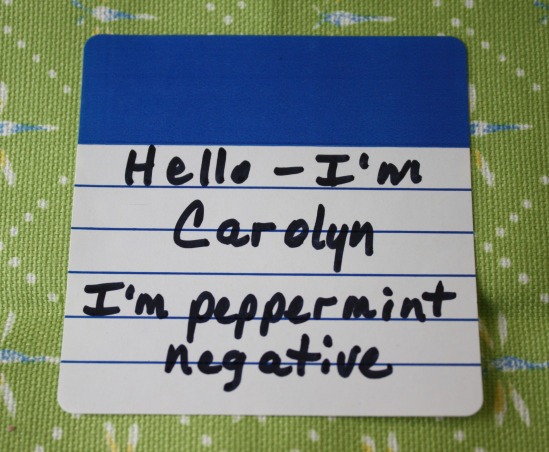
Where this leads us is that eventually every one of us will have our own food type (like a blood type). Hence the photos throughout the Gourmet article of people’s name tags – they said things like Joe – I am pumpernickel negative (meaning he can’t stand to eat it); or Stephanie – I am broccoli positive (meaning she adores it, I suppose); and lastly Frank – I am truffle negative.

Food companies are scrambling to find additives (see, this is where I don’t like the sound of this) that might improve or block particular flavors. Guess who’s paying for the research? Nestle, Coca-Cola and Campbell Soup. They want to know how to enhance the taste of sugar or salt in their packaged foods. For products that would trick the taste receptors into perceiving ingredients that aren’t there. Like sugar (expensive, and not so good for us) and salt (definitely not very good for us in the quantities most food processors use). And because the amount of this additive would be so small it could be listed on the label as “artificial flavors,” and the label wouldn’t tell you that it contains these bio-products. That part worries me a lot.

So how did the author do on the tomato juice taste test? He knew right away which one was the full-sodium V-8. The 2nd one with potassium chloride had a tinny, artificial taste, he thought (I agree, and I don’t buy it; I don’t buy V-8 either because of the high sodium). The other two, containing the bitter-flavor blocker, tasted more satisfying. The scientists can even figure out in the laboratory exactly how we’re going to like products containing these blockers. No taste tests needed – they do it all with test tubes and droplets of things.

The proponents of this (including many famous chefs like Ferran Adria at El Bulli in Spain and Heston Blumenthal of The Fat Duck near London) use chemistry and biology all the time in their chef-ing. At the London restaurant Blumenthal serves beet jelly and bacon and egg ice cream. He’s really into savory ice creams and sugar is a vital ingredient. So if the scientists have their way, the sugar would BE there, but they’d put in a sugar-blocker so we wouldn’t TASTE the sugar. Hocus-pocus, with chemistry. I’m just not convinced we should be doing this.

At the end of the article they included a short explanation about the human genome project:

Humans are 99.9% identical to one another – and to the archetype mapped and sequenced by the international Human Genome Projects (which had nothing to do with genetic engineering). The nucleus of each cell in our bodies (except mature red blood cells) contains the entire genome, and the genome’s DNA (composed of 3 billion chemical components) is arranged in 23 pairs of chromosomes, which in turn contain 20,000 to 25,000 genes. Genes only comprise about 2% of the genome; the rest serves other functions, including regulating the production of proteins, the molecules that perform most of the work of the cell. By isolating each taste receptor of the human genome, scientists can now begin to see how they react to every flavor known to humankind.

– – – – – – – – – –

And, I do happen to be peppermint negative. Almost makes me sick to my stomach. No red and white striped candy canes for me! Or mint chocolate ice cream either. And I’m mostly liver negative too – except duck liver (foix gras).

Recipes, from my archives, having nothing whatsoever to do with genomes or genes, or flavor-blockers:

A year ago today: Steak (beer marinated) with creamy peppercorn sauce
Two years ago today: Mace Cake

Posted in Breads, Desserts, on March 16th, 2010.

My friend Linda, who came up to visit last week, was telling me all about Tyler Florence, and about how much she enjoys his cookbooks (I bought her one for Christmas), his Food Network programs, and his recipes. Naturally, I had to go check him out. It’s not like I didn’t know who he was – I did – or that I’d never watched his show – I had – but somehow I’d never tried any of his recipes. So, I’ve started to Tivo his programs now, and I’m subscribed to his blog (through his website). And in the process I came across this chocolate banana bread recipe.

At a local restaurant we go to now and then, they offer a tart that always rocks my boat – it’s a very small pastry shell filled with chocolate pudding, with sliced bananas on top, then some whipped cream on top of that, with more bananas. It’s been a year or two since I’ve had one of them, so I thought maybe this chocolate banana bread would sort-of satisfy that flavor need.

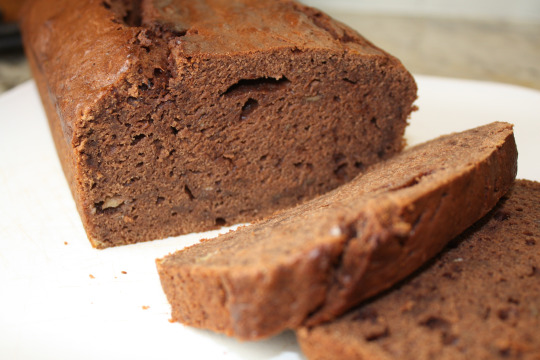
The bread is quite easy to make – you just have to have some very ripe bananas. I think Tyler mentions it in his blog piece – gotta have ultra-ripe bananas or it just doesn’t have the flavor he knows it can have. The bread calls for both cocoa – I used Penzey’s natural (which is extra dark), not Dutch processed, which weakens the flavor –  and semisweet chocolate (I used some Ghiradelli chocolate chips I had in the stash). Otherwise, the bread is typical (butter, flour, baking powder, sugar, eggs). It requires little mixing once you get everything all together and it’s baked for a little under an hour. I should have rapped the pan once on the counter (see the air bubbles in the top half of the bread in the photo above), but otherwise it was easy to remove and slice. The taste is really good – I mean really, really good. Very chocolate-y and moderately high on banana flavor too. I like it very much and would definitely make it again.

Chocolate Banana Bread

Recipe By: Tyler Florence (on his website)
Serving Size: 12

NOTES: You won’t need to butter the pan if you use a nonstick bread pan. The bread develops deep cracks during the baking process, but it does flatten some once it cools.

1/2 cup unsalted butter — (1 stick) softened, plus more for the pan
2 cups all-purpose flour
3/4 cup sugar
1/4 cup cocoa powder
1 1/2 teaspoons baking powder
1 teaspoon kosher salt
4 ounces bittersweet chocolate — melted
2 large eggs
3 whole bananas — ripe
1 teaspoon vanilla extract

1. Preheat the oven to 350°F. Butter a 9 x 5-inch loaf pan. Mix together the flour, sugar, cocoa powder, baking powder, and salt in a large bowl. In another bowl, cream the butter until lightened, then beat in the chocolate, eggs, bananas, and vanilla. Stir in the dry ingredients just until combined and no streaks of flour are visible; do not overbeat.
2. Pour the batter into the loaf pan. Drop the pan on the counter from about 2-3 inches above it (to pop any air bubbles in the batter) and bake until a toothpick stuck into the center of the bread comes out almost clean, 50 to 60 minutes. Transfer the pan to a rack and cool for at least 15 minutes before unmolding.
Per Serving: 286 Calories; 14g Fat (42.2% calories from fat); 5g Protein; 39g Carbohydrate; 3g Dietary Fiber; 56mg Cholesterol; 233mg Sodium.
printer-friendly PDF

A year ago: Corned Beef Dinner
Two years ago: Fumi Chinese Chicken Salad

Posted in Pork, on March 15th, 2010.

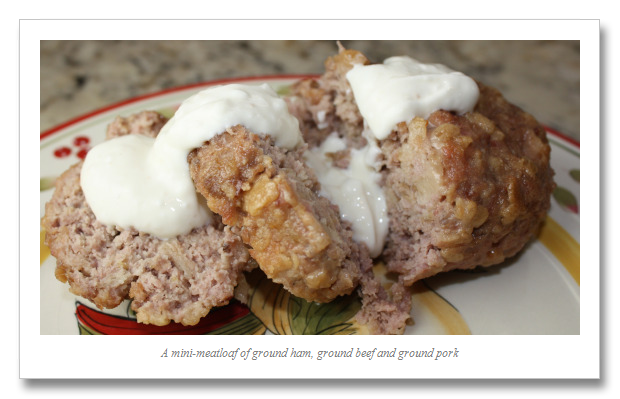
It’s been years since I even thought about this meatloaf recipe, but I had about a pound of leftover ham roast in the refrigerator that needed using and this ham loaf popped into my head. It goes back – way back – in my culinary history. It came from my mother’s friend, Nan, who served this for dinner one night when we visited her home. This would have been back in the early 1960’s. I was a young adult then and just getting into a bit of cooking, and once I tasted it, I asked Nan all about it. Nan gladly gave me the recipe.

The mixture is ham (I ground up my leftover pieces in the food processor), some very lean hormone-free ground beef and I had a package of organic ground pork. It’s mixed with a couple of eggs to hold it together, and some saltine cracker crumbs (minced up in the food processor also) plus a bit of pepper (the ham was salty enough). I made one larger loaf (put into a bread pan) and 3 smaller loaves that I put into small ramekins (that’s what you see in the photo above). Before putting it in the oven you baste it with a brown sugar/vinegar mixture, which definitely gives the meatloaf a sweetish taste. Nan always served it with a sour cream/horseradish/mustard sauce that takes all of about 30 seconds to make. I used low-fat sour cream, which works fine.

It’s delicious. A good old-fashioned kind of comfort meal. Serve with mashed potatoes (I served the Green Potatoes I posted yesterday) and a bright vegetable. It reheats well, and can also freeze (uncooked) for awhile too. If you want to make it easy to freeze, prepare the basting mixture too, and put it in a small plastic bag and insert it IN the larger freezer bag holding the meatloaf before you freeze it. Then all you have to do is defrost it, bake it and make the sour cream sauce.

Ham Loaf

Recipe By: From 1971 from a friend of my mother’s, Nan Watson.
Serving Size: 8

Notes: The basting liquid is sweet, and serving the sour cream sauce with it makes this a rich tasting dinner. Serve with a green vegetable, a salad, and an easy carb like a baked potato or rice. The proportions of beef to pork to ham can be altered a little bit – ideally, though, you’ll have more beef than either of the other two. If you bake in ramekins, they’ll bake in about 35-45 minutes.

1 1/2 pounds lean ground beef
1/2 pound ground pork
1/2 pound ham — ground
2 cups saltine cracker crumbs
1 cup milk
2 whole eggs — beaten
salt and pepper — to taste
BASTING MIXTURE:
2 teaspoons dry mustard
3/4 cup brown sugar
1/2 cup cider vinegar
SAUCE:
1 cup sour cream
2 teaspoons Dijon mustard
1 teaspoon horseradish — or to taste
salt and pepper — to taste

1. Preheat oven to 350°. Mince up the ham, or use a food processor. Combine the ham, beef and pork, then add cracker crumbs, milk, eggs. Since ham is often salty, be very gentle adding additional salt. Season with pepper and shape the mixture into a loaf shape and place in a baking dish. Pour the brown sugar mixture over the loaf.
2. Sauce: combine the sour cream, mustard, horseradish and seasonings. Cover and refrigerate for several hours before serving.
3. Bake for about an hour and fifteen minutes, basting the loaf several times with the liquid in the baking pan. Remove from oven and allow to sit for about 5 minutes. Serve with the sour cream sauce drizzled over it.
Per Serving: 595 Calories; 37g Fat (57.2% calories from fat); 30g Protein; 33g Carbohydrate; 1g Dietary Fiber; 170mg Cholesterol; 785mg Sodium.
printer-friendly PDF

A year ago: Cabbage Patch Stew (one of my fav’s)
Two years ago: Pumpkin Praline Custard (easy, low calorie too)

Posted in Veggies/sides, on March 13th, 2010.

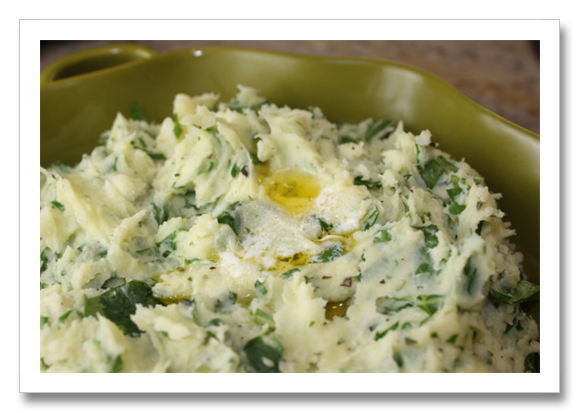
There’s nothing quite like a big mound of mashed potatoes with a little pool of melted butter in the middle. I only melted that little bit for the purpose of the photo – normally I don’t add more butter – there was butter in the potatoes already, although not much. But doesn’t that make you want to dip your spoon there and take a big mound – and snag a little bit of butter? Good stuff, this.

Fresh spinach hadn’t quite gotten used up, so I hunted for a recipe that included it. Sure enough, found one in one of my holiday cookbooks, Welcome Home for the Holidays (Gooseberry Patch) . The one that generally doesn’t get looked at except . . .during, . . . well, the holidays. But I figured there might be a plentitude of mashed potato recipes. Sure enough, there were. The book gave me an idea, but really I did my own thing here, adding buttermilk (instead of canned evaporated milk, yuk), and my own concoction of herbs (fresh rosemary, chives and Italian parsley from our garden) and a few ounces of Boursin cheese. Lots of salt and pepper, plus a couple of tablespoons of butter. Then I added in the baby spinach that I’d chopped up. It didn’t require cooking, just residing in that hot mass was enough to cook baby spinach. If you use regular spinach you might have to cook it a bit. Or, easier yet, use a box of frozen chopped spinach. And I used Yukon Gold potatoes – my go-to favorite because they’re already almost buttery-tasting.

This would be a great way to serve potatoes, which everybody likes, but make it more healthy with the addition of spinach. You could easily add even more spinach – I used half a pound. It would serve as a really nice bed for chicken, or steak, or a pork chop. Or even fish too. So, it’s very versatile. Nothing fancy. Just plain cookin’ and delicious.
printer-friendly PDF

Green Potatoes

Recipe By: Inspired by a recipe called Swedish Green Potatoes in a
cookbook – “Welcome Home for the Holidays”
Serving Size: 4

NOTES: These do stiffen up a bit if refrigerated. Just add a bit more buttermilk or milk and reheat in the microwave. And if using regular spinach, it will need to be cooked rather than just added into the hot potatoes.

1 1/2 pounds Yukon Gold potatoes — peeled
1/4 cup buttermilk — or milk
2 tablespoons unsalted butter
4 ounces boursin cheese — cut into 1″ cubes
3 cups fresh spinach — baby type, chopped
2 tablespoons fresh rosemary — chopped fine
1 tablespoon fresh chives — chopped fine
3 tablespoons Italian parsley — chopped fine
Salt and pepper to taste
Reserve a few of the herbs to sprinkle on top

1. Cut each potato into about 2-inch pieces and place in large pot with water to cover. Bring to a boil and simmer for 10-15 minutes until potatoes are tender, but not falling apart.
2. Drain and allow to sit on the stovetop (no flame) for about 3-5 minutes so they dry off.
3. Pour them into a bowl suitable for an electric mixer and whip the potatoes until they’re light and fluffy, adding the buttermilk about halfway through.
4. Add the Boursin cheese, spinach, rosemary, chives, parsley and salt and pepper. Taste for seasoning. If they’re too stiff add a bit more milk or buttermilk.
Per Serving: 318 Calories; 18g Fat (50.7% calories from fat); 7g Protein; 33g Carbohydrate; 3g Dietary Fiber; 49mg Cholesterol; 235mg Sodium.
printer-friendly PDF

A year ago: Hazelnut Chocolate Chip Cookies with Rum
Two years ago: Beef Tenderloin in Puff Pastry

Posted in Essays, on March 12th, 2010.

ebay.jpg

You see, my DH, Dave, has this book that lives in “his” bathroom. We have two bathrooms on our main living level. The half bath is where lots of people visit . . . but the full bath is really for guests who stay in the bedroom close by. Dave considers that bathroom “his.” And in that bathroom lives this book, Uncle John’s Unsinkable Bathroom Reader (Uncle John’s Bathroom Reader).  It resides on the floor just next to the  . . . ahem . . . throne. It contains a jillion snippets of stories, articles, jokes, and general miscellaneous information, suitable for a short read. My cousin Gary gave a similar book to Dave one Christmas, and it finally was so tattered and used it needed to be replaced, so last year I bought him a newer one. Thus.
So my DH brought the book out to me, as I was sitting at my kitchen computer (which I’ll just mention here, is brand new about 3 months ago and it’s already crashed and died this week, so I’m currently typing on my mini-laptop that I usually take on trips). Anyway, I was writing up a post, and he said “do you want to know how eBay got started? It’s not what you think.” I said “sure.” It was interesting. Enough so that I thought I’d share it with you.

The general myth about eBay is that Pierre Omidyar (the genius who did start e-Bay) was talking with his then fiancée (now his wife) Pamela, who was a collector and trader of PEZ candy dispensers and she said something like “wouldn’t it be great if there was a place online where people could trade?”

The real story is somewhat different. Pierre Omidyar is French-Persian, and moved to the U.S. from Paris when he was six years old. His father was attending a medical residency at Johns Hopkins University. Young Omidyar, became positively enchanted with computers and programming. Having graduated from Tufts University in Boston with a degree in computer science, he moved to Santa Clara, California. He did work as a programmer for awhile, then he and some friends started Ink Development Corp, and pen-based computer company. But he veered the company off to an area he thought would be a hot item – internet shopping. And he came up with the name eShop. It was successful (mildly so, enough that Microsoft eventually bought it). Omidyar then decided he wanted to look into starting an internet auction site. He thought that bidding on an object would create more interest, some excitement too. You can look at a more graphic history of Omidyar (and eBay) on eBay’s website.

Over Labor Day weekend in 1995, he stayed home, holed up, and wrote the computer code for an auction-based website. On September 3rd, 1995 he launched it – as ugly, clunky and awkward as it was – merely adding it to an existing website he had already for his internet consulting business. The address of that site was the company’s name, Echo Bay Technology Group. Omidyar tried to register his new “business” as EchoBay, but it was already taken by a Canadian gold mining company, so he shortened it and eBay was born.

At this point eBay was just a hobby for Omidyar. He was still working full time at his day job – until his internet provider forced him to change from a private account to a commercial one because of the volume of traffic. His fees went from $30/month to $250/month. So, he decided to start charging users a small fee – thinking that he’d hear a backlash about it. Not so – checks began arriving. So many checks he had to hire an employee to handle all the payments. By March of 1996 Auction-Web’s monthly revenue was up to $1,000. April it was $2500. May $5000. June it leaped to $10,000. That’s when he quit his day job.

Next he hired a computer geek, Jeff Skoll, who happened to have a master’s degree in Business Administration from Stanford. What he did first was make this auction web thing a stand-alone site. Up until then it still shared a website for his consulting business, and a site about the Ebola virus (yes, really). Early on, Omidyar had done just a little bit of “advertising,” if you could call it that, by mentioning his auction website on some bulletin boards. So he added a bulletin board at eBay too. Some people began asking questions on the bulletin boards – about how to use eBay, mostly answered by other, more experienced users. Thus giving eBay it’s own (free) tech support. One of the early bulletin board gurus was a man who called himself “Uncle Griff.” A curious questioner once asked him what he looked like. He responded, “I’m wearing a lovely flower print dress and I just got done milking the cows,” which put Griff (Jim Griffiths by name) into eBay lore as their “cross-dressing bachelor dairy farmer who likes to answer questions.” Uncle Griff was so respected on the bulletin boards that finally Skoll hired him as their first tech support employee.

The company was so successful it went public in 1998 – eBay was worth $2 billion that day. By 1999 it was worth over $8 billion. And somewhere in there Meg Whitman (currently hoping to run for Governor in our state) held the CEO reins for some years. What made eBay a bit more unique is that they kept updating the model – adding the feedback feature (rating the sellers) in 1998; then adding PayPal in 2002.

Omidyar and his wife Pamela are worth more than $7 billion (maybe not so much now since this book was published – I haven’t gone to look up the stock’s worth) and they devote most of their time to Omidyar Network, a philanthropic organization that helps poor people around the world get into business. They’ve pledged to give away all but 1% of their fortune over the next 18 years. Omidyar says: “My mother taught me to treat other people the way I want to be treated and to have respect for other people. Those are just good basic values to have in a crowded world.”

Amen. This certain was a departure from my usual food stories, but I hope you enjoyed reading about this as much as I did . . . Carolyn T

Posted in easy, Veggies/sides, on March 11th, 2010.

spinach rice

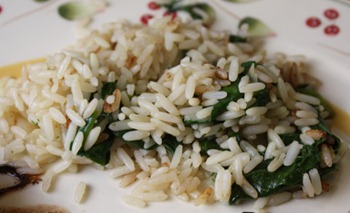
Greek cooking isn’t a cuisine I turn to very often. Not that I don’t enjoy it – I do – but I just don’t think of Greek food first. Other types of culinary culture pop up in my mind first (like Italian or French). But we were making a Greek rotisseried leg of lam for a dinner party we had the other night. I needed a side dish to go with it and the grilled vegetable salad, the Syrian pita bread salad, and the Lemon Upside Down cake I’d planned.

I don’t even own a Greek cookbook, but found this recipe in my ancient Woman’s Day Encyclopedia of Cookery. It’s a set of 12 cookbooks (you can buy them used – wow, they’re worth $86!). The set was a gift from my then father-in-law in 1966. They offer a treasure-trove of information. I turn to it every now and again and always learn something.  Although they aren’t in-depth about any one thing, there are stories and cultural tales throughout, in addition to thousands of recipes and factual and historical information. Not only can you look up specific ingredients or cooking methods (like horseradish, turnips, frog’s legs, fricassee, [how] to fold or flapjacks) but you can research cuisines (like Chinese, Turkish, German). So, I turned to the G volume for Greek, and spotted this recipe. I did change it just a bit – I didn’t sauté the rice (like for a pilaf) because I just didn’t take the time. I also added chicken broth instead of plain water. But otherwise, the recipe is the same.
And it was perfect for this meal. I made the rice in my Zojirushi Rice Cooker, which made it ever-so easy and it sat there awhile on low until the dinner was done and I was ready to serve. The rice: VERY good, considering that it’s a very simple side dish of rice, onion and spinach. The spinach is added in at the last – I used baby spinach so it took only a minute or two to cook through.

Greek Spinach and Rice

Recipe By: Adapted from Woman’s Day Encyclopedia of Cooking
Serving Size: 4

NOTES: If you want to make this a bit more tasty, add about a tablespoon of fresh squeezed lemon juice to the water.

1 cup white rice
1 medium onion — diced
2 tablespoons olive oil
2 cups chicken broth — or water
1 1/2 teaspoons salt
1 pound fresh spinach — baby spinach please

1. Saute onion in olive oil, stirring occasionally, for 10 minutes. Add rice, boiling water and salt, stir, cover and simmer for about 20 minutes.
2. Add baby spinach (or use regular spinach that’s been chopped into small bite-sized pieces) and stir in. Cover and continue simmering for another 5 minutes, or until the rice is tender.
Per Serving: 283 Calories; 8g Fat (25.7% calories from fat); 9g Protein; 44g Carbohydrate; 4g Dietary Fiber; 0mg Cholesterol; 1274mg Sodium.
printer-friendly PDF

A year ago: An essay about food trends for 2009
Two years ago: Spinach and Berries Salad (that’s the salad that’s up there at top – my Tasting Spoons photo)

Posted in Grilling, Lamb, on March 10th, 2010.

greek leg of lamb

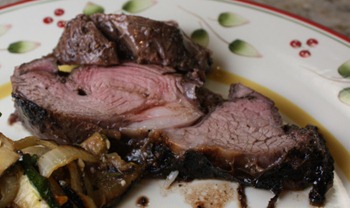
Awhile back I made this recipe, but decided to alter it just a bit from the last version. I wanted a pronounced lemon flavor, and wanted the lamb to be utterly tender, so I marinated the meat for 24 hours, turning the bag a couple of times during that period. I used a larger leg of lamb (Australian boneless, from Costco), so have changed the recipe to accommodate that. If you have a smaller roast, just reduce the marinade quantities some. The recipe is very forgiving. The lemon juice, however, helps to tenderize the meat, so it needs contact with the protein for a longer period. Steven Raichlen’s recipe is a good one, and I merely enhanced it, I believe. It comes from his book, The Barbecue! Bible, a book I turn to over and over again for grilling ideas.
The result? The meat was utterly tender and very tasty with the oregano rub and the hint of lemon. The lemon did not overpower it at all. I used our Meyer lemons, since we have so many of them right now. You have lemons? Use this recipe for a lovely meal. If you don’t have a rotisserie, just grill the roast over heat until it’s brown, then away from the heat (indirect cooking method) until it’s cooked through to your liking. Rare? Take it out at 140. Medium? Remove at 160. Our roast was not an even thickness, so we removed it at 160 and the center was still nicely red/medium rare. Delicious. The leftovers will go into my favorite Shepherd’s Pie with Chipotle Sweet Potatoes. A real treat and one Dave and I always enjoy.
printer-friendly PDF

Rotisseried Leg of Lamb with Lemons and Butter

Recipe By: Adapted from Steven Raichlen’s, The Barbecue Bible
Serving Size: 10

NOTES: If the leg of lamb has one very large lump of meat once you open it up, it’s wise to make a deep cut in the meat to create another surface or two. Don’t cut all the way through, just enough to add another valley for adding spices and lemons.

6 pounds boneless leg of lamb — butterflied
MARINADE:
1 tablespoon kosher salt
1 tablespoon freshly ground white pepper
2 tablespoons dried oregano
2 whole lemons — one halved, the other sliced
4 tablespoons unsalted butter — room temp
1/2 cup olive oil
BASTING MIXTURE:
1/4 cup olive oil
2 tablespoons fresh lemon juice
2 tablespoons dry white wine
2 cloves garlic — minced
2 teaspoons dried oregano — crushed
1 teaspoon freshly ground black pepper

1. MARINADE: Combine the salt, white pepper and oregano in a small bowl. Open out the butterflied leg of lamb on a cutting board so the inside is UP and sprinkle the meat with one third of the spice mixture. Squeeze the juice from halved lemon and spread all over the meat. Place in a Ziploc plastic bag with the olive oil and sliced lemon, seal well and place in the refrigerator for 24 hours, turning it 3-4 times. Allow it to sit out at room temp for an hour before proceeding.
2. Drain off and discard the marinade, including the lemon slices. Blot the roast with paper towels. Rub the surface of the lamb with the 4 tablespoons of butter (if it’s at room temp it really does spread easily). Fold the lamb back into its original cylindrical shape and tie it at 1-inch intervals with butcher’s string.
2. Set up the grill for rotisserie cooking and preheat to high.
3. When ready to cook, skewer the lamb roast lengthwise on the spit. Add another generous sprinkling of the spice mixture. Attach the spit to the rotisserie mechanism, cover and let the meat start rotating. Reduce heat to medium (about 350°).
4. BASTING MIXTURE: combine the oil, lemon juice, wine, garlic, oregano and pepper in a medium-sized nonreactive (plastic is good) bowl and whisk to mix.
5. After the meat has been rotating for 15 minutes, restir the basting mixture and brush it all over the lamb, using a long-handled basting brush. Cook the lamb until crusty and brown on the outside and done to taste, about 1 to 1 1/2 hours. An instant read thermometer inserted in the thickest part of the roast will register 145° for rare, or 160° for medium or 170° for well done.
6. Uncover the grill every 15 minutes to brush more basting mixture on the meat throughout its cooking time. Add more of the seasoning mixture from time to time. (If using a charcoal grill, add 10-12 fresh coals per side after one hour.)
7. Transfer the roast, on the spit, to a cutting board. Extract the spit and let the roast rest for 10 minutes tented lightly with foil. Remove string and slice.
Per Serving: 561 Calories; 35g Fat (57.6% calories from fat); 56g Protein; 3g Carbohydrate; 1g Dietary Fiber; 189mg Cholesterol; 743mg Sodium.

A year ago: Pork Ragu on Pasta
Two years ago: Triple Chocolate Torte with Raspberry Sauce

Posted in Desserts, on March 9th, 2010.

lemon upside down cake slice

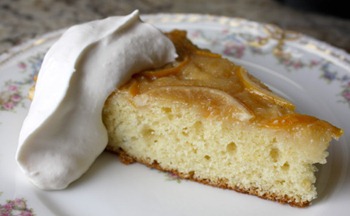
If you enjoy a tart, citrusy dessert, this one is a must fix. If you like pucker-power, but with a sweet and sour finish, you need to make this cake! I’ve made a lemon upside down cake before (with almonds), but it was a PUDDING cake, not an upside down cake. So it’s similar. But different. This one is definitely in the style of the old-fashioned pineapple upside down cakes my mother used to make, with the canned pineapple rings and a maraschino cherry in the center of each ring. Remember those? Some of you may be too young to remember them – a favorite dessert from the 1950’s.

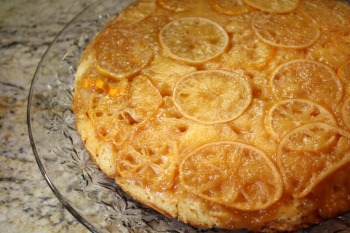
lemon upside down cake full What I have right now is lots of Meyer lemons, with probably another 30 hanging on the tree yet. So last Sunday I decided to feature lemon in every possible way. It was in all but one thing I made. Really. In the lamb marinade, in the dressing on the grilled vegetable salad, in the dressing on the Syrian pita bread salad and in this dessert. We were celebrating our friend Bud’s birthday, and he’s a particular fan of lemon anything.

Recipe warning:

This cake is VERY tart – read notes carefully for adjustments if you use regular, rather than Meyer lemons.

First you make a lemony brown sugar layer in a large nonstick frying pan (a 10-inch preferably). You add the thinly sliced lemons (devoid of seeds, of course), butter and brown sugar. That gets boiled briefly, and you carefully place the lemon slices in a decorative manner. Then you make the batter. It contains lemon zest in it, but no lemon juice. You whip up the egg whites to lighten the batter – but it’s a bit difficult since you’re only using 2 egg whites – hardly enough. But it helps. Pour (if you can) or place small globs of the cake batter on top of the lemons, and I eventually used a dampened finger to spread the batter as best I could. There isn’t enough batter to completely cover the pan. If you look at the photo above you can see some little holes all over the cake – that’s where the juicy lemon layer oozed up through the cake. Or where I couldn’t quite spread the cake batter! So then it’s baked. Simply baked. When done, you let it rest 10 minutes, then carefully turn the pan over and let it sit. It took a couple of minutes before the cake slid out onto the serving plate.

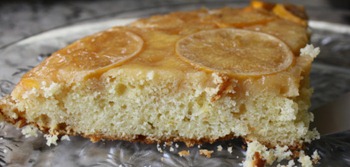
lemon upside down cake cut Ideally, serve this warm. It wasn’t warm by the time I served it (I suppose I could have re-warmed it briefly, but I didn’t). And I added a big dollop of sweetened whipped cream. I happen to think that you NEED highly sweetened whipped cream for this because the cake is SO tart. But use your own judgment. If you use regular lemons, I think you might need even more sugar in the cake. Or more brown sugar in the glaze. Or sprinkle the finished cake with a little bit of granulated sugar – or some of that pretty larger-grained sugar I’ve seen in some places. Just be aware, this cake, although sweet, is also VERY tart. Everybody liked it, though. A LOT. I’d definitely make this again. Can’t wait to eat the leftovers, actually! With more sweetened whipped cream.

Lemon Upside-Down Cake

Recipe By: Adapted from Luscious Lemon Desserts,
by Lori Longbotham (read on AZ Cookbook blog)
Serving Size: 10

NOTES: This recipe abounds around the internet, so I don’t know who originated it. There are very minor differences in nearly every recipe I read. If you use regular lemons (rather than the Meyers, which are sweeter) you may want to use more brown sugar in the lemon layer (I suggest 2 more tablespoons). If you taste it just when you’re serving it – have a bowl of sugar nearby – and it’s too tart, just sprinkle the top of the cake with some granulated sugar. Powdered sugar would dissolve, so don’t use that. It’s important to slice the lemons VERY thinly. Do not use any slices that aren’t fully round as they’ll disintegrate when cooking them.

LEMON LAYER:
3 medium lemons — Meyers (see notes if using other lemons)
1/4 cup unsalted butter — (1 1/2 sticks) at room temperature
1/4 cup packed light brown sugar
CAKE:
1 1/2 cups all-purpose flour
2 teaspoons baking powder
1/4 teaspoon salt
1/2 cup unsalted butter
1 cup granulated sugar
3 tablespoons lemon zest — finely grated
2 large eggs — separated
1/4 teaspoon vanilla extract
1/2 cup milk

1. Position a rack in the middle of the oven and preheat the oven to 350F.
2. Trim the ends from the lemons and cut the fruit into slices 1/8 inch thick with a very sharp knife or a mandoline. Discard any seeds.
3. Melt 1/4 cup of the butter with the brown sugar in an ovenproof, non-stick 10-inch skillet over medium heat. Add the lemon slices, increase the heat to high, and boil, stirring, for 1 minute. Remove the skillet from the heat and arrange the slices in an orderly pattern in the bottom of the skillet.
4. Sift the flour, baking powder, and salt together into a medium bowl.
5. Beat 1/2 cup of butter with an electric mixer on medium speed in a large bowl until light and fluffy. Add the granulated sugar and zest and beat, scraping down the side of the bowl until light and fluffy. Add the egg yolks and vanilla and beat just until blended. Reduce the speed to low and add the flour mixture alternatively with the milk, scraping down the side of the bowl after each addition and beating just until blended
6. Beat the egg whites with clean beaters on medium speed in a large bowl until stiff peaks form. Add one quarter of the whites to the batter and fold in using a whisk or a rubber spatula. Continue to gently fold in the remaining whites, one quarter at a time, being careful no to overmix. The cake batter is a bit stiff, so be gentle as you add in the whipped whites.
7. Pour the batter over the lemon slices and gently smooth the top with a rubber spatula. If you have trouble “pouring,” spoon globs of the batter all over the lemon part and gently use your dampened finger to spread the batter to cover. The cake batter may not completely cover the lemon layer. Bake for 40 to 50 minutes, until the top is golden brown and a wooden pick inserted in the center comes out clean. Let cool in the pan on a wire rack for 10 minutes.
7. Loosen the edges of the cake with a rubber spatula all around, invert it onto a heat-proof serving platter, and leave the pan over the cake for 5 minutes. Remove the pan and serve the cake warm, cut into wedges, with more-than-usually sweetened whipped cream.
Per Serving: 316 Calories; 15g Fat (42.7% calories from fat); 4g Protein; 43g Carbohydrate; 1g Dietary Fiber; 81mg Cholesterol; 176mg Sodium.

printer-friendly PDF

A year ago: “Great Coffee Cake” by Marion Cunningham
Two years ago: Lemon Sponge Pudding

Posted in Salads, Veggies/sides, on March 8th, 2010.

grilled veggie salad

You want a tasty grilled vegetable salad? Oh gosh, is this one ever good. My friend Linda T. came to visit last week and she told me all about this recipe, telling me I just HAD to make it. It fit in perfectly with a rotisserie Greek lamb dinner I made last night. I doubled this recipe, and have just a little bit leftover after serving 7 people. Everybody liked it. I loved it. The recipe came from Ellie Krieger at the Food Network. I followed it to the letter.

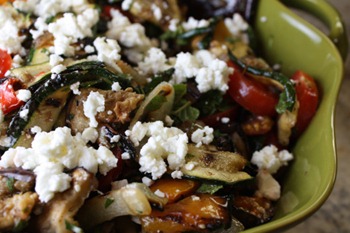
Simply put, it’s nothing but grilled vegetables (bell peppers, onions, zucchini and eggplant) with a red wine vinegar, oregano and olive oil dressing drizzled over it, with some freshly cut tomatoes and crumbled Feta cheese. And some mint. The BEST part is you can make it up a few hours ahead (Dave was busy on the barbecue for quite awhile, he was quick to tell me) and let it sit at room temp until you’re ready to dress it and get it ready for serving. I poured it into the new bowl (pictured above) that Linda gave me for Christmas (thank you, Linda). Goes perfectly with my dishes. I didn’t have one of those curly edged bowls. Now I do. And I’ve got this great recipe which would be good any time of year.

Am sure you can change the ingredients a bit – use more or less of anything. But this combo of peppers, zucchini, eggplant and onion was perfect. A winner of a recipe.
printer-friendly PDF

Grilled Vegetable Salad with Feta and Mint

Recipe By: Ellie Krieger, Food Network
Serving Size: 4

1 whole red bell pepper — cored and cut into 4 pieces
1 pound eggplant — cut across into 1/4-inch rounds
1 medium onion — cut into 1/4-inch slices
8 ounces zucchini — cut lengthwise into 1/4-inch slices
Olive oil cooking spray
5 tablespoons extra-virgin olive oil
2 tablespoons red wine vinegar
1/2 teaspoon dried oregano
Salt and freshly ground black pepper
1 cup tomatoes — grape type, halved
1/4 cup chopped fresh mint
1/2 cup crumbled feta cheese

1. Arrange the vegetables in a single layer on a tray or work surface. Lightly spray both sides with olive oil cooking spray.
2. Preheat a grill or grill pan over a medium-high heat.
3. Grill the vegetables in batches until both sides are nicely charred and the vegetables are just tender, about 10 minutes for the pepper, about 8 minutes for the eggplant and onion, and about 6 minutes for the zucchini. When the vegetables are cool enough to handle, cut into 1/2-inch pieces and transfer to a large bowl.
4. In a small bowl, whisk together the olive oil, vinegar and oregano. Pour over the vegetables and toss. Season, to taste, with salt and pepper. Gently stir in the tomatoes and mint. Divide the salad between 4 plates and sprinkle with the feta.
Per Serving: 262 Calories; 21g Fat (69.9% calories from fat); 5g Protein; 15g Carbohydrate; 5g Dietary Fiber; 17mg Cholesterol; 221mg Sodium.
printer-friendly PDF

A year ago: White Chocolate Bread Pudding
Two years ago: Seared Steak Salad

Related Posts Plugin for WordPress, Blogger...