Get new posts by email:

Archives

Currently Reading

Here are the tastingspoons players. I’m in the middle (Carolyn). Daughter Sara on the right, and daughter-in-law Karen on the left. I started the blog in 2007, as a way to share recipes with my family. I’m still doing 99% of the blogging and holding out hope that these two lovely and excellent cooks will participate. They both lead very busy lives, so we’ll see.

– – – – – – – – – – – – – – – – – – – – – –

BOOK READING (from Carolyn):

Music of Bees, Eileen Garvin. Absolutely charming book about a woman in midlife, lonely, who raises bees, also makes unlikely friends. Heart-warming and very interesting about beekeeping.

A Postcard from Paris, Alex Brown. Really cute story. Dual time line, 1940s and present day about renovating an old apartment in Paris, things discovered.

Time of the Child, Niall Williams. Oh such a good book. Very small village in Ireland, 1960s. A baby is left on the doorstep. The town all whispers and helps. I listened to an interview of the author, which made me like him and his books even more.

Sipsworth, Simon Van Booy. If you like animals you’ll swoon. An old woman who really wants to die finds a tiny mouse in her house and befriends it and finds a reason to live. Utterly charming book.

The Forger’s Spell, Edward Dolnick. True story. For seven years a no-account painter named Han van Meegeren managed to pass off his paintings as those of Johannes Vermeer.

If You Lived Here, You’d be Home by Now, Christopher Ingraham. Could hardly put it down – about a journalist who takes on a challenge to move to small town in Minnesota and write about it. He expects to hate it and the people and place, but he doesn’t. Absolutely wonderful true story.

The River We Remember, William Kent Kreuger. 1950s, Minnesota. A murder and the aftermath. Could hardly put it down. Kreuger has such a vivid imagination and writing style.

How the Lights Gets In, Joyce Maynard. An older woman returns to New Hampshire to help care for her brain-injured son. Siblings and family, lots of angst and resentments.

The Filling Station, Vanessa Miller. Every American should read this book. A novelized retelling of the Tulsa massacre in 1921. Absolutely riveting.

The Story She Left Behind, Patti Callahan Henry. Love this author. Based on a true story. A famous author simply vanishes, leaving her husband and daughter behind. She had invented a mystical language no one could translate. Present day, someone thinks he’s solved the riddle, contacts the family. Really interesting read.

The Girl from Berlin, Ronald Balson. Love anything about Tuscany. An elderly woman is being evicted from a villa there, with odd deed provenance. Two young folks go there to help unravel the mystery. Loved it.

The Island of the Colorblind, Oliver Sacks, M.D. Nonfiction. The dr is intrigued by a remote Pacific island where most of the inhabitants are colorblind. He also unravels a mystery on Guam of people born with a strange neurological problem. Medical mysteries unveiled. Very interesting.

The Bookbinder, Pip Williams. Post 1914 London. Two sisters work at a bookbindery. They’re told to not read the books. One does and one doesn’t. One has visions beyond her narrow world; the other does not. Eventually the one gets into Oxford. Lovely story.

The Paris Express, Emma Donoghue. 1895 on a train to Paris, a disaster happens. You’ll delve into the lives of many people who survived and died in the crash.

A Race to the Bottom of Crazy, Richard Grant. This is about Arizona. Author, wife and child move back to Arizona where they once lived. Part memoir, research, and reporting in a quest to understand what makes Arizona such a confounding and irresistible place.

The Scarlet Thread, Francine Rivers. A woman’s life turned upside down when she discovers the handcrafted quilt and journal of her ancestor Mary Kathryn McMurray, a young woman who was uprooted from her home only to endure harsh frontier conditions on the Oregon Trail.

A Place to Hide, Ronald Balson. 1939 Amsterdam, an ambassador has the ability to save the lives of many Jewish children. Heartwarming.

Homeseeking, Karissa Chen. Two young Chinese teens are deeply in love, but in China. Then their families are separated. Jump to current day and the two meet again in Los Angeles.

North River, Pete Hammill. He always writes such a good story. A doctor works diligently healing people from all walks of life. His wife and daughter left him years before. One day his 3-yr old grandson arrives on his doorstep.

A Very Typical Family, Sierra Godfrey. A very messed-up family. Three adult children are given a home in Santa Cruz, Calif, but only if the siblings meet up and live in the house together. A very untypical scenario but makes for lots of messes.

Three Days in June, Anne Tyler. The usual Anne Tyler grit. Family angst. This wasn’t one of my favorites, but it was entertaining and very short.

Saved, Benjamin Hall. Author is a veteran war reporter. Ukraine, 2022, he nearly loses his life to a Russian strike. Riveting story – he survives, barely.

Grey Wolf, Louise Penny. Another Inspector Gamache mystery in Quebec. She is such an incredible mystery writer.

All the Colors of the Dark, Chris Whitaker. A missing person mystery, a serial killer thriller, a love story, a unique twist on each. Could hardly put it down.

Orbital, Samantha Harvey. Winner of 2024 Booker Prize. I don’t usually like those, but I heard the author interviewed and she hooked me. This is not a normal book with a beginning, a story and an end. It’s several chapters of the day in the life of various astronauts at the ISS (Int’l Space Station). All fictional. She’s been praised by several real astronauts for “getting it” about space station everyday life.

The Blue Hour, Paula Hawkins. An island off Scotland. Inaccessible except when the tide is out. Weird goings on. An artist. A present day mystery too.

Iron Lake, William Kent Krueger. A judge is murdered and a boy is missing. Riveting mystery.

Tell the Wolves I’m Home, Carol Ricks Brunt. 1980s. A 14-yr old girl loses her beloved uncle. Yet a new friendship arises, someone she never knew about.

Four Treasures of the Sky, Jenny Zhang. 1880s, a young girl is kidnapped in China and brought to the United States. She survives with many hurdles in the path.

The Boy Who Fell out of the Sky, Ken Dornstein. Memoir, 1988. The author’s brother died in the PanAm flight that went down in Lockerbie, Scotland. A decade later he tries to solve “the riddle of his older brother’s life.”

Worse Care Scenario, T.J. Newman. Oh my. Interesting analysis of what could/might happen if a jet crashed into a nuclear plant. Un-put-downable.

Song of the Lark, Willa Cather. Complicated weave of a story about a young woman in about 1900, who has a gifted voice (singing) and about her journey to success, not without its ups and downs.

Crow Talk, Eileen Garvin. Charming story which takes place at a remote lake in Washington State, about a few people who inhabit it, the friendships made, but also revolving around the rescue of a baby crow.

The Story Collector, Evie Woods. Sweet story about some dark secrets from an area in Ireland, a bit magical, faerie life, but solving a mystery too.

A Sea of Unspoken Things, Adrienne Young. A woman investigates her twin brother’s mysterious death. She goes to a small town in California to figure it out, to figure HIM out.

The King’s Messenger, Susanna Kearsley. 1600s England, King James. About one of his trusted “messengers,” and his relationship with a young woman also of “the court.” Lots of intrigue.

In the Shadow of the Greenbrier, Emily Matchar. Interesting mystery in/around the area of the famous resort in White Sulphur Springs, West Virginia.

Isola, Allegra Goodman. Hard to describe, survival story on an island in the 1600s.

Save the Date, Allison Raskin. Rom-com, witty, LOL funny. Clever.

The Sirens, Emilia Hart. Numerous time-lines, Australia. Mysteries abound, nightmares, abandoned baby, weird allergies.

Red Clay, Charles Fancher. LOVED this book. Mostly post-Civil War story about the lives of slaves in Alabama during Reconstruction.

Stars in an Italian Sky, Jill Santopolo. Dual time line, 1946 and recent time. Love stories and a mystery.

Battle Mountain, C.J. Box. Another one of Box’s riveting mysteries. Love his descriptions of the land.

Something Beautiful Happened, Yvette Corporon. A memoir of sorts in Greece, tiny island of Erikousa, where the locals hid Jews during WWII. All elusive stories told by the author’s grandmother.

The Jackal’s Mistress, Chris Bohjalian. 1860s Virginia, about a woman who saves the life of a Union soldier. Really good story.

Song of the Magpie, Louise Mayberry. Really interesting story about Australia back in the days when it was mostly a penal colony. Gritty strength of a woman trying to thrive with her farm.

The Boomerang, Robert Bailey. A thriller that will have you gripping the book. About a lot of secrets surrounding the president (fictional novel, remember) and his chief of staff and about cancer. A cure. Such a good story.

Care and Feeding, Laurie Woolever. Really interesting memoir of a woman driven to succeed in the restaurant business. She worked for Mario Batali and then Anthony Bourdain. Gritty stories.

Everything is Tuberculosis, John Green. Maybe not a book for everyone. A real deep dive into the deadly tuberculosis infection, its history. I heard the author interviewed and found the book very interesting.

The Book Lovers Library, Madeline Martin. Fascinating read about Boots’ drug stores’ lending library. And the people who worked in them.

The Arrivals, Meg Mitchell Moore. LOL funny, about a middle-aged couple whose children (and their various family members) return to the family home and the chaos that ensues.

My Life as a Silent Movie, Jesse Lee Kercheval. About grief. A big move to Paris, finding herself a new life with a new set of real blood family.

Escape, Carolyn Jessop. Another memoir about a woman really in bondage in Utah, Mormon plural marriage.

 

Tasting Spoons

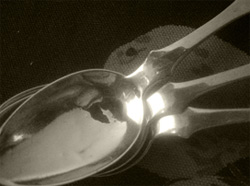
My blog's namesake - small, old and some very dented engraved silver plated tea spoons that belonged to my mother-in-law, and I use them to taste my food as I'm cooking.

Scroll down to the bottom to view my Blogroll

Posted in Soups, on March 4th, 2010.

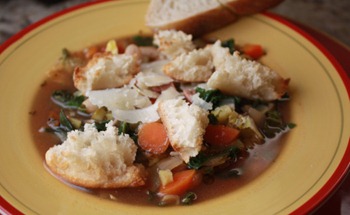
ribollita soup 2 Multi-vegetable soup, Italian style, with some rough torn bread croutons on top. Missing from the photo: the tendrils of fresh basil and cilantro that were supposed to be sprinkled all over the top.
Ribollita. Sounds like it ought to be a girl’s name. The Italian word actually means “reboiled.” So if you lived in Italy you certainly wouldn’t want to be named Ribollita! Historically it’s a Tuscan soup – a method of re-serving minestrone soup – the next day – and making it different with the bread, beans and greens. Ribollita always contains cannellini beans and some greens like kale or Swiss chard. I’ve had this at restaurants now and then, but wanted to make my own. My friend Linda stopped by for dinner after having a crown put in, and she wanted something she didn’t have to chew. This fit that need very well. And it’s very healthy (only 14 grams of fat for a 1 1/2 cup serving). Mostly it’s vegetables, although I added in some ham cubes because I had them. You could also make this without the meat.

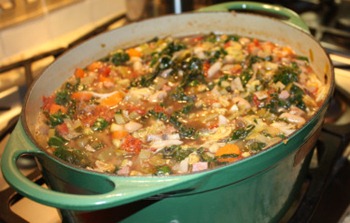
ribollita in pot The preparation – you could probably make this soup in less than 30 minutes if you had all the vegetables ready to go. There is a bit of chopping and mincing involved (onions, carrots, celery, leeks, garlic, kale, Swiss chard, mushrooms, zucchini). I used my handy-dandy Alligator Dicer which made fairly quick work of the chopping. I also rely on my favorite broth made with Penzey’s soup bases. It’s just SO easy and no storing of those big cardboard boxes of stock on your pantry shelves.

The result? It’s worth the work. I read a variety of recipes for this soup and discovered that you can just about do your own thing. So I did. I added oregano – next time I’d add some rosemary, or maybe some Herbs de Provence. I added the ham and kale. I’d read a recipe in an old Sunset Magazine for this soup and it showed the rough torn bread cubes floating on top of the soup, so I decided to do it that way too. This may not wow your audience, but it was certainly delicious and healthy. The bread cubes are essential, so don’t eliminate that part – they provide aesthetics and some crunchy texture. I had ample to send a small care package home with Linda and enough for two portions to go into my freezer’s “soup library.”
printer-friendly PDF

Ribollita (Italian Vegetable and Bread Soup)

Recipe By: My own concoction
Serving Size: 8

NOTES: buy a ciabatta loaf and roughly tear off pieces of it (large bite size) and toast in a 350 oven for about 5 minutes (use broiler if you can watch it carefully). If you want a more flavorful soup, add some rosemary, a Bay leaf, and some thyme. You can also use Parmesan cheese rinds in a soup like this (you do save them, right?). They merely flavor the soup – don’t eat them. You can also add more beans to this, and/or some rice. In the authentic version you slice off a piece of bread and put it in the bottom of the bowl and pour the soup on top. This version uses less bread and you just toast the cubes and plop them on top. The croutons don’t get totally soaked in the soup. The quantities of the vegetables are approximate – add more or less of things if it suits you or you don’t have sufficient amounts.

2 tablespoons olive oil
1 1/2 medium white onions — chopped
4 cloves garlic — minced
2 whole leeks — cleaned and chopped
3 stalks celery — chopped
3 whole carrots — peeled, chopped
2 cups ham cubes — (or use 2-3 slices of minced bacon)
32 ounces canned tomatoes — (including juice)
8 cups chicken broth — (or Penzey’s chicken soup base + water)
1 tablespoon dried oregano
3 medium zucchini — chopped
4 ounces mushrooms — sliced
4 cups Swiss chard — chopped
4 cups kale — chopped
3 cups Savoy cabbage — chopped
15 ounces canned cannelini beans — drained, rinsed Salt and pepper to taste
TOPPINGS:
2 cups croutons
1/4 cup Parmesan cheese — shaved in shards
2 tablespoons extra virgin olive oil — to drizzle on top
1/4 cup fresh basil — sliced
1/4 cup cilantro — chopped

1. In a large, heavy pot heat the olive oil. Saute the onion for about 5 minutes until it’s wilted but not browned. Add garlic and leeks and continue cooking until leeks have begun to soften. Add celery and carrots. Add ham, tomatoes, chicken broth and oregano and bring to a simmer for about 10 minutes until carrots are cooked. Add zucchini and mushrooms and continue simmering for about 5 minutes. Then add canned beans, Swiss chard, kale and cabbage. Cook for 2-4 minutes until the greens are just tender. Taste for seasoning.
2. Meanwhile, heat oven to 350 and toast the roughly torn bread cubes – using the broiler if necessary to brown them.
3. Have all the topping ingredients ready. Scoop about 1 1/2 cups of the soup into a wide soup bowl. Top with the Parmesan, basil, cilantro and the toasty-hot bread cubes and serve.
Per Serving: 347 Calories; 14g Fat (35.0% calories from fat); 20g Protein; 38g Carbohydrate; 9g Dietary Fiber; 21mg Cholesterol; 1678mg Sodium.

A year ago: Guacamole
Two years ago: Orange Jalapeno Vinaigrette

Posted in Essays, wine, on March 3rd, 2010.

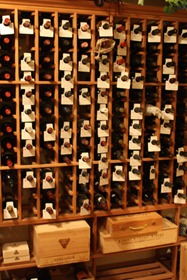
wine cellar racksThere’s another photo of our wine cellar – different angle. With a few empty wooden wine boxes on the lower shelves (they did contain wine, but we just keep them there for the looks). And if you have sharp eyes you’ll see on the left side a couple of little boxes of ScharffenBerger chocolate. I really need to bring those upstairs because they’ve likely oxidized down there in the wine cellar.

Back in my early wine-drinking heyday of the 1980’s I did drink Chardonnay. But I never really liked it – it’s too acidic for me. With the exception of one label – Kistler. That’s it. The only one, and a bottle of Kistler Chard today will set you back about $50. I think we have one bottle in our wine cellar, and it’s about 15 years old. We should be drinking it. Soon.

I also like Sauvignon Blanc, particularly Cloudy Bay (from New Zealand). And Fume Blanc from Ferrari-Carano. My DH keeps reminding me that I have a stash of Cloudy Bay (a very fresh, clean white wine from New Zealand) in the wine cellar that I need to drink.

Once in awhile we will enjoy a Riesling, as long as it’s not too sweet or acidic. Grey Riesling can be very dry, actually, so you can run the gamut of sweet to tart and low to high acid in that wine type. You can also have a sweeter Riesling that has a lot of acid. The kind that almost gives me sores on the inside of my mouth like I’ve overdosed on fresh pineapple (that happened to me once when we were in Hawaii – I had no idea that eating too much pineapple could cause mouth sores, did you? I mean, I didn’t eat THAT much!). Anyway, I seem to have a narrow spectrum of wines that appeal to me. My hubby calls me a cheap date these days. Most often when we go out I don’t even order wine.

But then there’s champagne. But I’m going to write up a separate essay about champagne, or sparkling wine .  . .

So now, down to the subject at hand. What do I use when I’m cooking:

WHITE WINE: If we happen to have some open, I’ll use that. But usually we don’t, because neither of us drink much white wine. So I go to other options. If I don’t have Vermouth available, then I’ll go hunting in the wine cellar for something – generally we have some generic kinds of white – maybe a bottle of Chardonnay (usually because somebody gave it to us since we don’t buy it). That works. Fume Blanc or Sauvignon Blanc are both almost herbal wines – they’re made from grapes – that’s not what I mean – but when you stick your nose into the glass you’ll almost smell an herb garden. I won’t use Riesling in cooking – generally it’s too sweet, and since most Rieslings are on the acidic side (even though sweet) you can’t add lemon juice with that to make it so. Just don’t use Riesling in cooking. But here’s what I DO use:

DRY VERMOUTH: First of all, I keep a bottle of Vermouth quite close to my stove. It’s nothing very expensive – somewhere I was told that Trader Joe’s vermouth is actually quite good. The best thing about Vermouth is that even though you open the bottle, it doesn’t deteriorate – it stays the same forever. With a normal bottle of wine you’d have to drink it or use it within a fairly reasonable time. Most likely Vermouth has been stabilized with some neutral spirits so it doesn’t spoil. That’s why it has a long shelf life, even when it’s been opened.

SUBSTITUTIONS: If I had neither a generic white wine or vermouth, I’d use some chicken broth. Maybe with a little added fresh squeezed lemon juice. Or if the dish could handle it, I’d use half apple juice, half water with a little lemon juice. I store a container of frozen apple juice concentrate in the freezer just for things like that. I also keep small cans of pineapple juice in the pantry to use in marinades and things like that. The other option is VERJUS – (means green juice) an unfermented grape juice from under ripe grapes. A perfect solution, I think, although it’s a bit hard to find and not inexpensive. It contains NO alcohol. And it’s on the tart side (some cooks use it in lieu of vinegar), so be careful. Use less than the quantity called for in your recipe and taste it before adding more.

There are resources abounding around the internet on this subject:

Gourmet Sleuth

About.com: Home Cooking – this site has an amazing list of substitutions for oodles of alcoholic beverages, including liqueurs.

Posted in Chicken, Pork, on March 1st, 2010.

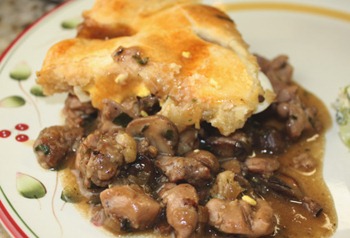
chix sausage mush pot pie The recipe came from a December, 2008 issue of Bon Appetit, in an article about the foods from the Fairmont le Chateau Frontenac in Quebec. I’m sure that’s why I stopped to read this recipe, because it came from that hotel – le Chateau Frontenac.

Read the rest of this entry »

Posted in Desserts, on February 27th, 2010.

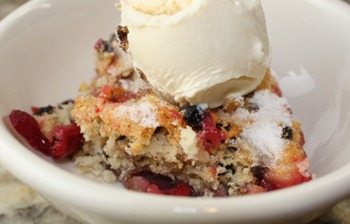
cranberry pudding cake

Do you, by chance, have a package of fresh cranberries gathering moisture in your refrigerator – – – like I did? Leftover from the holidays? I’d stuck the package down in the bottom of the produce drawer and forgot all about it. I could have frozen them, but I thought I’d make this instead. A few berries needed to be tossed, but mostly the cranberries were still in good shape, considering that they’d been in my refrigerator for about 2.5 months! I’m embarrassed to tell you that I still have a package of cranberries left over from Christmas 2008 in my freezer. Shhhh.

And what an easy recipe this is. About 8-10 years ago I found this in the cookbook owned by a friend, Janet, called The Cranberry Cookbook by Beatrice Ross Buszek (it’s out of print). I also found it on the internet, though, so it doesn’t appear to be anybody’s “original.” I do like pudding cakes – my favorite being lemon. I have Marcel Proustian memories when I think about Rita’s lemon sponge pudding cake – they’re friends who live in England. But this one is cranberry, and what a festive dish this is. And easy to make besides.

Sauce Tip:

If you don’t have enough sauce part (the cranberries on the bottom), make more sauce to begin with. In my case I didn’t think the pudding had enough saucy part, I made another batch of the sauce alone and poured some of it (warmed) over the cake, then the ice cream went on top.

First you cook up the cranberries in water (about 5 minutes), then you add sugar mixed with cornstarch, plus a little jot of freshly ground nutmeg, and cook it about a minute until it’s just nicely thickened. That gets poured into the bottom of a 8×8 glass baking dish. The cakey topping is flour, sugar, baking powder (no salt, interestingly enough), butter, milk, raisins (I used currants), dates (I didn’t have any so eliminated that part) and walnuts. Once that’s mixed up you kind of spoon small blobs of it on top of the cranberry part and into the oven it goes for about 55 minutes.

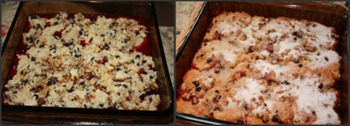
cran pudd cake collage

Above left, the cranberries on the bottom with the blobs of batter on the top, ready for the oven; right, just out of the oven, nicely golden brown.

Served with a bit of vanilla ice cream on top, this makes a very nice dessert. Homey. Comfort food. Probably more ideal for December, but it tasted pretty darned good in February. Don’t use any dish larger than an 8×8 pan as you’ll end up with more cake than pudding, and it’s the tart-sweet pudding part that makes this. I liked the chopped walnuts in it too – gave it good texture. It keeps for several days, although the topping won’t be as crispy as just baked. Ideally serve it warm.
printer-friendly PDF

Cranberry Pudding Cake

Recipe By: From The Cranberry Connection, by Beatrice Ross Buszek
Serving Size: 9

Depending on the baking dish you choose, you may not have enough sauce – if you have more cranberries, make more of the sauce and either put more in the baking dish, or pour some of the warmed sauce over the cake when served.

CRANBERRIES:
1 1/2 cups cranberries
1 1/3 cups water
1 cup sugar
2 teaspoons cornstarch
1/4 teaspoon nutmeg
1 tablespoon butter
CAKE:
1 1/4 cups flour
2 teaspoons baking powder
1/4 cup sugar
1/4 cup butter
1/2 cup milk
1/2 cup raisins
1/2 cup dates — chopped (optional)
1/2 cup walnuts — chopped
2 tablespoons sugar — (to sprinkle on top)
2 cups vanilla ice cream — optional

1. Heat oven to 325.
2. Cook cranberries with water over high heat about 5 minutes.
3. Mix 1 cup sugar and cornstarch and stir into boiling mixture. Boil rapidly one minute. Remove from heat and stir in butter and nutmeg. Pour into an 8×8 inch baking dish.
4. Sift flour, baking powder and 1/2 cup sugar into a bowl. Add shortening and cut in finely. Add milk and mix well. Stir in dates, raisins and nuts. Drop by large spoonfuls on top of cranberry mixture. Sprinkle with the extra sugar. Bake about 55 minutes or until browned and cooked through. Serve warm with ice cream.
Per Serving: 409 Calories; 14g Fat (30.3% calories from fat); 6g Protein; 69g Carbohydrate; 3g Dietary Fiber; 32mg Cholesterol; 207mg Sodium.

A year ago: Pear Cranberry (Vanilla) Crumble
Two years ago: Almond-Crusted Orange Roughy

Posted in Essays, wine, on February 26th, 2010.

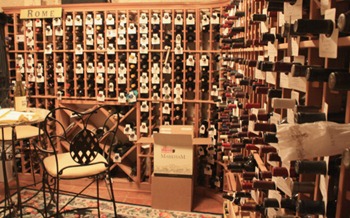
wine cellar

The above is our wine cellar. It’s about 10 x 8, I’d guess, with room for the small table you see, although we’ve yet to sit down there except to catalog some wine (the room is below ground) and sip something because it’s too gosh-darned cold. We have a special refrigeration unit that keeps the wine cellar at a consistent 58. There’s also a little low cubbyhole off to the left (out of view) that can hold about another 8 cases of boxed wine. The cellar itself (with more shelving over on the left side) holds about 900 bottles. You can see that it’s nearly full. Everything you see above is red wine. White is over on the left side, and it’s only about half full since we drink so little white wine.

Read the rest of this entry »

Posted in Veggies/sides, on February 25th, 2010.


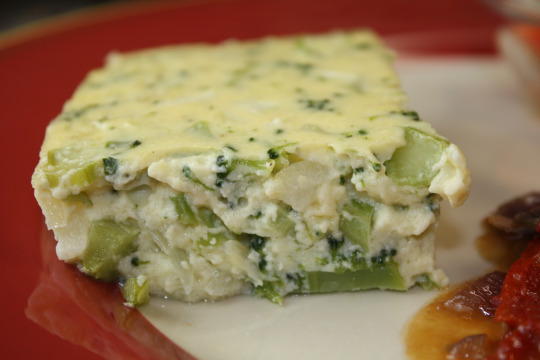
This is an oldie. But a goodie. It used to be a regular on my holiday menu – whether it be Easter, Thanksgiving or Christmas. Or even just for a dinner for guests. I’ve made it with fresh broccoli (like this time), but hey, it tastes just great with frozen chopped broccoli. So if you don’t feel like fussing with fresh, you’ll not be disappointed using frozen chopped. I decided to post it, in case you’re thinking about some easy, but different casserole to make for Easter dinner. It can be prepared ahead and popped in the oven when dinner is close. My recollection is this recipe came from an ancient Sunset Magazine. I searched their website but couldn’t find it. I got it from a distant relative, Gerry Black, a loo-ooo-ng time ago. But it’s weathered the ages. Well.

Somehow, we’ve gotten out of the habit of making cream sauce. Well, you know, maybe it’s not so good for us, especially if you use butter and cream. But, this one CAN be made with non-fat milk and a bit less butter if you want. It calls for mayo, so you can use non-fat mayo (Veganaise works well here_ if you want. So, you may alter the recipe any way it suits you.

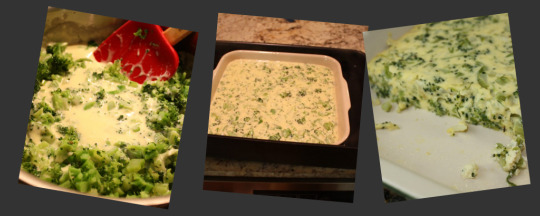
There’s the dish, L-R: Mixing in the broccoli to the cream sauce; in the hot water bath ready to go in the oven; easy serving right out of the casserole.

A note about the onion. I think I’ve mentioned here on this blog before, that when I was a young woman and still learning to cook (this, when I was in my 20’s) I was a bit loose with the herbs and spices. I figured that if a teaspoon of thyme (one of my favorite herbs, still is) was good, then 2 teaspoons would be better. It probably worked fine with thyme, maybe not so well with curry powder. Time, age and humility have set in, though. I now use what the recipe calls for first. THEN, if I want to, I’ll diddle with the proportions. Hence with this and the onion. The original called for about a tablespoon of onion. Well, I don’t know about you and onions, but with me — who uses a tablespoon of onion, for heaven’s sake? So, I started using more. But then I noticed that it tasted more like an onion casserole with a green veggie in it, instead of a broccoli casserole. That’s the humbling part of it – I learned that this recipe really doesn’t like tons of onion in it. So be gentle. But I’ll tell you that the mayo is an important component – don’t skimp on it, be it full fat or low or non. Of course, it makes it delicious.
printer-friendly CutePDF and MasterCook file (click link to open recipe)

Broccoli Casserole

Recipe By : Gerry Black, via Sunset Mag, probably about 1970
Serving Size : 6

NOTES : This can be made with egg substitutes, non-fat mayo and less butter, and it’s still quite tasty, but this is close to the original recipe (I added more onion). I also add just a tiny sprinkling of nutmeg to the cream sauce.

10 ounces chopped broccoli, frozen
3 tablespoons butter
3 tablespoons flour
1/4 teaspoon salt
1 dash pepper
1 dash nutmeg
1 cup milk
1/4 cup onion — minced (very finely minced)
3/4 cup mayonnaise
3 whole eggs — beaten

1. Preheat oven to 350°F. Cook broccoli in a little water until barely done. Drain and set aside. Meanwhile, make a white sauce: in a saucepan melt the butter, add flour, salt, pepper and then milk all at once. Stir until thickened. Add the mayo, onion and eggs. Gently stir in the broccoli and pour into a buttered baking dish.
2. Place that pan in a larger pan of hot water and bake for 30-45 minutes (depends on how deep the dish is), until knife inserted in the middle comes out clean. It may still be a little jiggly, but if the knife comes out clean it will continue cooking for several minutes.
Per Serving: 251 Calories; 24g Fat (83.3% calories from fat); 5g Protein; 6g Carbohydrate; 1g Dietary Fiber; 101mg Cholesterol; 278mg Sodium.

A year ago: Bailey’s (Irish Cream) Cream Cheese Brownies (very rich, very sweet)
Two years ago: Warm Bean & Brie Dip (very easy, a quite delish)

Posted in Chicken, easy, on February 24th, 2010.

chicken with piquillos

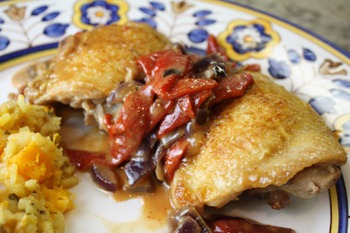
Why, oh why, don’t I go online before I try ANY recipe, to read what others have said? Well, I know why in this case . . . I’d read about piquillo peppers, a mild red pepper from Spain, and I had purchased a can of them (imported, mind you) a couple of months ago. I wanted to try them, assuming they were going to have a unique taste. Something different. Something more piquant than ordinary roasted red bell peppers. Having paid $5.00+ for the can, I truly thought they’d be extraordinary. Nope. Tasted like any old ordinary canned red bell peppers to me.

piquillo collage

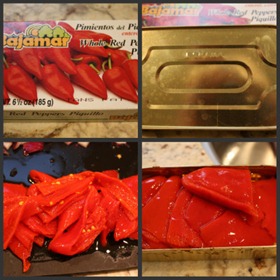
Here’s a photo collage of the peppers: clockwise from top left – in the box, the can, the whole peppers, and chopped.

The recipe came from the book Spain…A Culinary Road Trip by Mario Batali and Gweneth Paltrow. My friend Cherrie gave me the book a year or so ago for Christmas, and I had yet to try a recipe out of it. This recipe was also printed in Food & Wine awhile back, so you can read the story about it, if you so choose. Apparently the recipe is a common one in Spanish cuisine. The ingredients are simple (salt, onion, garlic, chicken, white wine and the piquillo peppers) and the preparation is also very easy. I just thought the dish would be more tasty than it was. Not that it wasn’t good – it was. It was moist, juicy. I liked the sauce. But . . . well . . . it was just chicken with red peppers.
printer-friendly PDF

Chicken with Piquillos

Recipe By: Spain: A Culinary Road Trip by Mario Batali
Serving Size: 4

4 whole chicken thighs — bone-in
2 whole garlic cloves — sliced
Kosher salt
2 tablespoons extra-virgin olive oil
1 large onion — coarsely chopped
9 ounces piquillo peppers — drained, widely sliced
1 cup dry white wine

1. Rub the chicken with the garlic and 1 tablespoon of kosher salt. Cover and refrigerate for 1 hour.
2. Heat the olive oil in a large, deep skillet. Scrape the garlic off of the chicken pieces. Add the chicken to the skillet in a single layer and cook over moderately high heat, turning occasionally, until browned all over, about 12 minutes. Transfer the chicken to a platter.
3. Add the onion to the skillet and cook over low heat, stirring occasionally, until very tender, about 10 minutes. Add the piquillo peppers and white wine and bring to a simmer, scraping up any browned bits.
4. Return the chicken and any accumulated juices to the skillet. Cover partially and cook over low heat until the chicken is tender and cooked through and the sauce is thickened, about 30 minutes. If the sauce is too thin, bring to a boil and reduce it until there is about 2-3 T. of liquid. Transfer the chicken to a platter, spoon the sauce on top and serve.
Per Serving: 328 Calories; 21g Fat (66.0% calories from fat); 17g Protein; 7g Carbohydrate; 2g Dietary Fiber; 79mg Cholesterol; 77mg Sodium.

A year ago: Slow-Cooker Tamale Pie
Two years ago: Armenian Parsley Salad

Posted in Breads, on February 23rd, 2010.

ham goat cheese biscuits

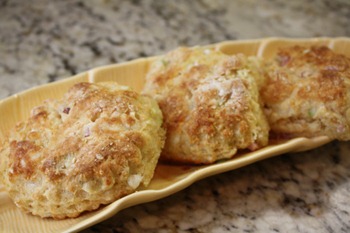
With our split pea soup dinner the other night, we surely didn’t NEED more carbs. But actually split pea soup is fairly low on the carb scale, believe it or not. And these biscuits were downright tasty – with a bit of minced-up ham (which could be eliminated if you didn’t have any) and some crumbles of goat cheese mixed through it. As with most quick breads, the least amount of stirring or kneading you can do will provide the lightest and flakiest texture. These are no exception. You can see a little blip of goat cheese in the closest biscuit on the lower right edge.

Obviously, this is a good choice if you happen to have a leftover ham (I did), some goat cheese (yes, I had that too), and some cornmeal (yup, that always lives in my pantry). These aren’t overly cornmeal-y, if there is such a word, but you definitely do get the granular kind of crunch of cornmeal with every bite. And a great accompaniment to a bowl of hot soup.
printer-friendly PDF

Cornmeal Biscuits with Ham and Goat Cheese

Serving Size: 12

As with most quick breads, the least amount of stirring or kneading you can do will provide the lightest and flakiest texture.

1 2/3 cups all-purpose flour
1/3 cup cornmeal
1 tablespoon sugar
1/2 teaspoon salt
2 1/2 teaspoons baking powder
1/2 tablespoon baking soda
3 tablespoons unsalted butter — cold, cut into chunks
1/2 cup goat cheese — crumbled
1/2 cup ham — diced
3 whole green onions — diced
2/3 cup buttermilk

1. Preheat oven to 425. Prepare a cookie sheet with Silpat or parchment paper.
2. In a medium sized bowl combine the dry ingredients.
3. Add the cubed butter and crumbled goat cheese. Using a pastry blender combine the dough until mixture resembles coarse crumbs (there will be small pieces of visible goat cheese, and that’s fine).
4. With a spatula, stir in the minced ham and green onions.
5. Make a well in the middle of the dry mixture and pour in the buttermilk. Stir gently until it comes together is a raggedy mass. (If it’s too dry to come together drizzle about a tablespoon of buttermilk in the dough until it does come together).
6. Pour out onto a lightly floured board and knead gently 3-4 times. Press the dough into a round, about 3/4 inch thick. Cut dough with a 2-inch round cutter and place biscuits on the baking sheet, leaving at least a 2 inches between each.
7. Bake for 12-14 minutes until browned and crusty. Serve hot.
Per Serving: 145 Calories; 6g Fat (34.2% calories from fat); 5g Protein; 19g Carbohydrate; 1g Dietary Fiber; 16mg Cholesterol; 454mg Sodium.

A year ago: Steak & Mushroom Soup
Two years ago: White Lady (a tasty alcoholic drink)

Posted in Soups, on February 22nd, 2010.

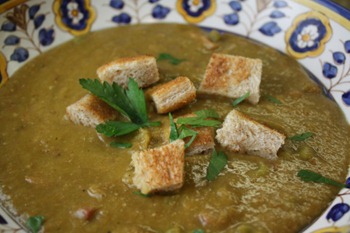
split pea soup

Is there anything much more comforting than split pea soup? I think not. I had a lovely ham bone that was just itching to provide some great flavor to something. And I had a hunk of pancetta that also needed using, so they were the flavor peak in this simple soup. With onion, leeks, celery, carrots, thyme, chicken broth and split peas there’s little else you need. The entire meal came together with about 30 minutes of simmering, but there was a bit of chopping and mincing going on – the pancetta and vegetables before, then the ham from the ham bone (plus a bit more). But I  now have several nights of hearty soup dinners in the freezer. Since the soup is thick to begin with, you can thin it down if you’d like – either with water or some added chicken broth. You can also not puree the soup as much as I did – that’s totally up to you. I like the texture contrast of the toast croutons (I just used a thick piece of whole wheat toast, toasted in the toaster, trimmed and very lightly buttered and chopped), then a little bit of green with the Italian parsley. And you’re done.
printer-friendly PDF

Split Pea Soup with Ham, Pancetta and Green Peas

Recipe By: Combined from several recipes on the internet.
Serving Size: 8

NOTES: If you like to see carrots in your soup, reserve about a cup of raw ones (dice them up fairly small) and add in after you’ve pureed the soup. Cook carrots for about 5 minutes, then add the peas and heat through. You can also use a ham bone (rather than the hock) if you have it – just leave some of the meat on the bone as it adds a lot of flavor to the broth. Once the soup is cooked, remove the bone and chop up the meat just as for the ham hock, discarding any fat. If you prefer your soup more chunky, puree about half of it and leave the remainder as-is. If you prefer your soup thinner, just add more chicken broth or water to make it the consistency you like. I cool the soup, then pour 4-cups worth (that’s 2 1/2 servings in my house) into a large Ziploc freezer bag, chill, then lay flat in the freezer until frozen solid. Then I stand it up with all the other frozen soups I have in my freezer. The ham and pancetta add a ton of flavor to this soup, but you can eliminate the pancetta if you don’t have it on hand.

3 ounces pancetta — minced
2 ounces unsalted butter — (half a cube)
1 large onion — (if small, use two), chopped
3 stalks celery — coarsely chopped
2 medium leeks — cleaned, chopped
8 cups chicken broth — (or 1 T Penzey’s soup base concentrate)
3 cloves garlic — peeled, mashed
4 whole carrots — coarsely chopped
2 tablespoons dried thyme
1 1/2 pounds ham hock — with some meat on the bone
2 cups ham — minced
2 cups frozen peas
2 whole toast slices — use thick toast if you have it, slicing off the edges
2 tablespoons Italian parsley — minced

1. Chop all the vegetables before starting to cook. Rinse the split peas well and remove any rocks or debris. Allow to drain.
2. Saute pancetta in a large, tall stockpot (use a heavy-duty pan) for about 10 minutes until some of the edges are browned. (If you want the pancetta to remain in visible pieces, remove it and set aside to add in at the end.) Add the butter, melt, then add onions, leeks and celery. Sweat for about 10 minutes. Add garlic, stir and cook for about a minute. Add the carrots, split peas, season with thyme and pepper. Bring to a boil.
3. Reduce heat, cover and simmer for about 30-45 minutes, until split peas are completely cooked through.
4. Remove ham hock and set aside to cool. Remove meat from the bone and chop into small pieces (discard the bone).
5. Allow soup to cool about 20 minutes, then 2-3 cups at a time pour into blender and puree. Don’t overfill the blender container or it will blow off the top when you begin to puree it.
6. Pour soup back into the stock pot and bring up to a simmer again. Add the reserved ham, and frozen peas. Simmer for about 5 minutes, taste for seasoning and serve in wide bowls – about 1 1/2 cups per serving. Garnish with chopped-up toast cubes (or make croutons) and a bit of Italian parsley.
Per Serving: 482 Calories; 28g Fat (53.2% calories from fat); 36g Protein; 20g Carbohydrate; 4g Dietary Fiber; 132mg Cholesterol; 1654mg Sodium.

A year ago: An explanation about Error Code 404
Two years ago: Cream of Cashew Soup

Posted in easy, Salads, Veggies/sides, on February 20th, 2010.

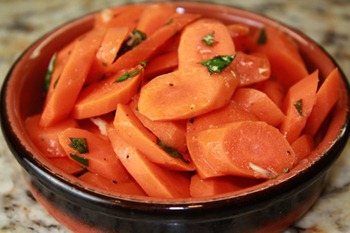
algerian carrotsIt’s been about 3 years since I posted this recipe, back in May of ‘07. And “keepers” sometimes need to be repeated – those recipes I would encourage you to make. Over and over. Cooked carrots have a bad rap sometimes. Remind people of baby food, or something.  But these little gems have a burst of flavor – from garlic, olive oil and lemon juice. And a little bit of ground cumin and brown sugar. They’re especially good if  you make them ahead and allow them to sit overnight in the dressing (chilled, of course). I like to let them sit out and get to room temp. You just need to briefly cook the carrots – you’ll want them to be just barely tender, or you can make them more crunchy if that’s your preference. The dressing is very easy to make (good at this time of year with ripe lemons filling bowls in my kitchen) and just stir it all up and let the carrots marinate. This is best with some kind of highly seasoned dinner – don’t serve this with a filet of sole, for instance. Not unless you’re making it with garlic and lemon juice. This recipe could also be made with zucchini – or maybe better yet, do both and serve them side by side. Would make a very colorful side dish.

What’s in this: carrots, olive oil, lemon juice, garlic, ground cumin, brown sugar and parsley. And a bit of salt and pepper too. That’s it. Click HERE for the write-up I did back in ‘07. I took new pictures of the carrots, and will insert this new one in the old recipe since this one is much closer and clear!

printer-friendly PDF

A year ago: A list of the 50 top blogs
Two years ago: Sugar Snap Pea Tops

Related Posts Plugin for WordPress, Blogger...