Get new posts by email:

Archives

Currently Reading

Here are the tastingspoons players. I’m in the middle (Carolyn). Daughter Sara on the right, and daughter-in-law Karen on the left. I started the blog in 2007, as a way to share recipes with my family. I’m still doing 99% of the blogging and holding out hope that these two lovely and excellent cooks will participate. They both lead very busy lives, so we’ll see.

– – – – – – – – – – – – – – – – – – – – – –

BOOK READING (from Carolyn):

Music of Bees, Eileen Garvin. Absolutely charming book about a woman in midlife, lonely, who raises bees, also makes unlikely friends. Heart-warming and very interesting about beekeeping.

A Postcard from Paris, Alex Brown. Really cute story. Dual time line, 1940s and present day about renovating an old apartment in Paris, things discovered.

Time of the Child, Niall Williams. Oh such a good book. Very small village in Ireland, 1960s. A baby is left on the doorstep. The town all whispers and helps. I listened to an interview of the author, which made me like him and his books even more.

Sipsworth, Simon Van Booy. If you like animals you’ll swoon. An old woman who really wants to die finds a tiny mouse in her house and befriends it and finds a reason to live. Utterly charming book.

The Forger’s Spell, Edward Dolnick. True story. For seven years a no-account painter named Han van Meegeren managed to pass off his paintings as those of Johannes Vermeer.

If You Lived Here, You’d be Home by Now, Christopher Ingraham. Could hardly put it down – about a journalist who takes on a challenge to move to small town in Minnesota and write about it. He expects to hate it and the people and place, but he doesn’t. Absolutely wonderful true story.

The River We Remember, William Kent Kreuger. 1950s, Minnesota. A murder and the aftermath. Could hardly put it down. Kreuger has such a vivid imagination and writing style.

How the Lights Gets In, Joyce Maynard. An older woman returns to New Hampshire to help care for her brain-injured son. Siblings and family, lots of angst and resentments.

The Filling Station, Vanessa Miller. Every American should read this book. A novelized retelling of the Tulsa massacre in 1921. Absolutely riveting.

The Story She Left Behind, Patti Callahan Henry. Love this author. Based on a true story. A famous author simply vanishes, leaving her husband and daughter behind. She had invented a mystical language no one could translate. Present day, someone thinks he’s solved the riddle, contacts the family. Really interesting read.

The Girl from Berlin, Ronald Balson. Love anything about Tuscany. An elderly woman is being evicted from a villa there, with odd deed provenance. Two young folks go there to help unravel the mystery. Loved it.

The Island of the Colorblind, Oliver Sacks, M.D. Nonfiction. The dr is intrigued by a remote Pacific island where most of the inhabitants are colorblind. He also unravels a mystery on Guam of people born with a strange neurological problem. Medical mysteries unveiled. Very interesting.

The Bookbinder, Pip Williams. Post 1914 London. Two sisters work at a bookbindery. They’re told to not read the books. One does and one doesn’t. One has visions beyond her narrow world; the other does not. Eventually the one gets into Oxford. Lovely story.

The Paris Express, Emma Donoghue. 1895 on a train to Paris, a disaster happens. You’ll delve into the lives of many people who survived and died in the crash.

A Race to the Bottom of Crazy, Richard Grant. This is about Arizona. Author, wife and child move back to Arizona where they once lived. Part memoir, research, and reporting in a quest to understand what makes Arizona such a confounding and irresistible place.

The Scarlet Thread, Francine Rivers. A woman’s life turned upside down when she discovers the handcrafted quilt and journal of her ancestor Mary Kathryn McMurray, a young woman who was uprooted from her home only to endure harsh frontier conditions on the Oregon Trail.

A Place to Hide, Ronald Balson. 1939 Amsterdam, an ambassador has the ability to save the lives of many Jewish children. Heartwarming.

Homeseeking, Karissa Chen. Two young Chinese teens are deeply in love, but in China. Then their families are separated. Jump to current day and the two meet again in Los Angeles.

North River, Pete Hammill. He always writes such a good story. A doctor works diligently healing people from all walks of life. His wife and daughter left him years before. One day his 3-yr old grandson arrives on his doorstep.

A Very Typical Family, Sierra Godfrey. A very messed-up family. Three adult children are given a home in Santa Cruz, Calif, but only if the siblings meet up and live in the house together. A very untypical scenario but makes for lots of messes.

Three Days in June, Anne Tyler. The usual Anne Tyler grit. Family angst. This wasn’t one of my favorites, but it was entertaining and very short.

Saved, Benjamin Hall. Author is a veteran war reporter. Ukraine, 2022, he nearly loses his life to a Russian strike. Riveting story – he survives, barely.

Grey Wolf, Louise Penny. Another Inspector Gamache mystery in Quebec. She is such an incredible mystery writer.

All the Colors of the Dark, Chris Whitaker. A missing person mystery, a serial killer thriller, a love story, a unique twist on each. Could hardly put it down.

Orbital, Samantha Harvey. Winner of 2024 Booker Prize. I don’t usually like those, but I heard the author interviewed and she hooked me. This is not a normal book with a beginning, a story and an end. It’s several chapters of the day in the life of various astronauts at the ISS (Int’l Space Station). All fictional. She’s been praised by several real astronauts for “getting it” about space station everyday life.

The Blue Hour, Paula Hawkins. An island off Scotland. Inaccessible except when the tide is out. Weird goings on. An artist. A present day mystery too.

Iron Lake, William Kent Krueger. A judge is murdered and a boy is missing. Riveting mystery.

Tell the Wolves I’m Home, Carol Ricks Brunt. 1980s. A 14-yr old girl loses her beloved uncle. Yet a new friendship arises, someone she never knew about.

Four Treasures of the Sky, Jenny Zhang. 1880s, a young girl is kidnapped in China and brought to the United States. She survives with many hurdles in the path.

The Boy Who Fell out of the Sky, Ken Dornstein. Memoir, 1988. The author’s brother died in the PanAm flight that went down in Lockerbie, Scotland. A decade later he tries to solve “the riddle of his older brother’s life.”

Worse Care Scenario, T.J. Newman. Oh my. Interesting analysis of what could/might happen if a jet crashed into a nuclear plant. Un-put-downable.

Song of the Lark, Willa Cather. Complicated weave of a story about a young woman in about 1900, who has a gifted voice (singing) and about her journey to success, not without its ups and downs.

Crow Talk, Eileen Garvin. Charming story which takes place at a remote lake in Washington State, about a few people who inhabit it, the friendships made, but also revolving around the rescue of a baby crow.

The Story Collector, Evie Woods. Sweet story about some dark secrets from an area in Ireland, a bit magical, faerie life, but solving a mystery too.

A Sea of Unspoken Things, Adrienne Young. A woman investigates her twin brother’s mysterious death. She goes to a small town in California to figure it out, to figure HIM out.

The King’s Messenger, Susanna Kearsley. 1600s England, King James. About one of his trusted “messengers,” and his relationship with a young woman also of “the court.” Lots of intrigue.

In the Shadow of the Greenbrier, Emily Matchar. Interesting mystery in/around the area of the famous resort in White Sulphur Springs, West Virginia.

Isola, Allegra Goodman. Hard to describe, survival story on an island in the 1600s.

Save the Date, Allison Raskin. Rom-com, witty, LOL funny. Clever.

The Sirens, Emilia Hart. Numerous time-lines, Australia. Mysteries abound, nightmares, abandoned baby, weird allergies.

Red Clay, Charles Fancher. LOVED this book. Mostly post-Civil War story about the lives of slaves in Alabama during Reconstruction.

Stars in an Italian Sky, Jill Santopolo. Dual time line, 1946 and recent time. Love stories and a mystery.

Battle Mountain, C.J. Box. Another one of Box’s riveting mysteries. Love his descriptions of the land.

Something Beautiful Happened, Yvette Corporon. A memoir of sorts in Greece, tiny island of Erikousa, where the locals hid Jews during WWII. All elusive stories told by the author’s grandmother.

The Jackal’s Mistress, Chris Bohjalian. 1860s Virginia, about a woman who saves the life of a Union soldier. Really good story.

Song of the Magpie, Louise Mayberry. Really interesting story about Australia back in the days when it was mostly a penal colony. Gritty strength of a woman trying to thrive with her farm.

The Boomerang, Robert Bailey. A thriller that will have you gripping the book. About a lot of secrets surrounding the president (fictional novel, remember) and his chief of staff and about cancer. A cure. Such a good story.

Care and Feeding, Laurie Woolever. Really interesting memoir of a woman driven to succeed in the restaurant business. She worked for Mario Batali and then Anthony Bourdain. Gritty stories.

Everything is Tuberculosis, John Green. Maybe not a book for everyone. A real deep dive into the deadly tuberculosis infection, its history. I heard the author interviewed and found the book very interesting.

The Book Lovers Library, Madeline Martin. Fascinating read about Boots’ drug stores’ lending library. And the people who worked in them.

The Arrivals, Meg Mitchell Moore. LOL funny, about a middle-aged couple whose children (and their various family members) return to the family home and the chaos that ensues.

My Life as a Silent Movie, Jesse Lee Kercheval. About grief. A big move to Paris, finding herself a new life with a new set of real blood family.

Escape, Carolyn Jessop. Another memoir about a woman really in bondage in Utah, Mormon plural marriage.

 

Tasting Spoons

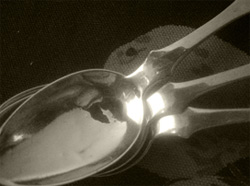
My blog's namesake - small, old and some very dented engraved silver plated tea spoons that belonged to my mother-in-law, and I use them to taste my food as I'm cooking.

Scroll down to the bottom to view my Blogroll

Posted in Veggies/sides, on March 18th, 2013.

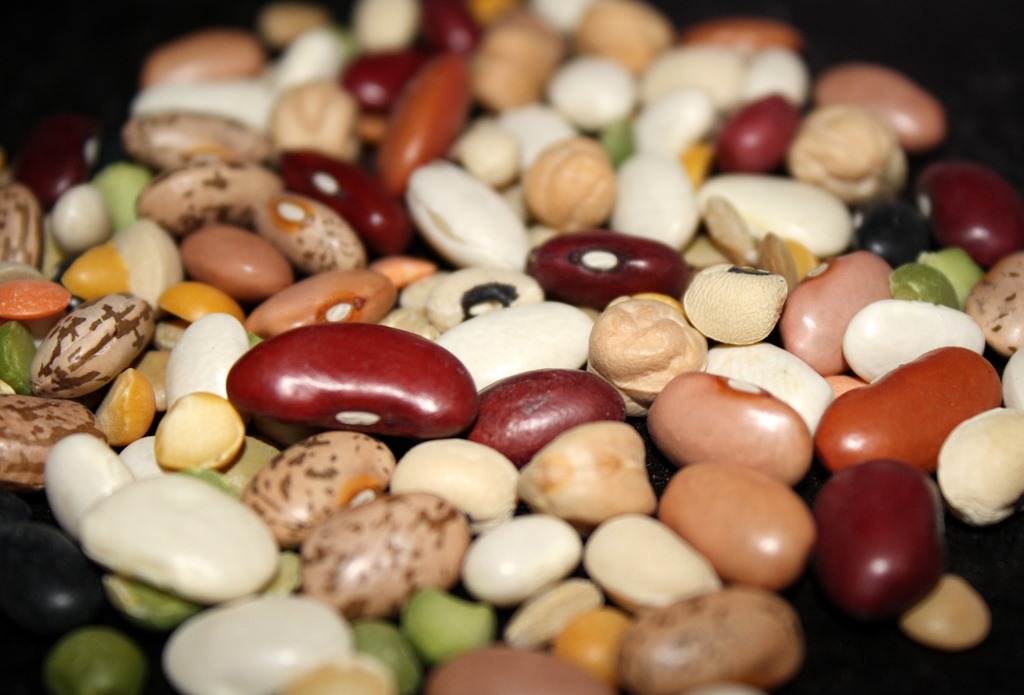
mixed_beans

Just recently I learned how easy – and I mean EASY – it is to cook raw beans in a pressure cooker. So a few weeks later I was about to cook a different kind of bean, and didn’t know how long it would take to cook, so I went online to read about it. That led me to one site, to another, and to yet another and bingo – I found a chart. A wonderful chart that lists just about every bean known to man, and what the cooking times are for traditional stove-top cooking, pressure cooker times, and slow cooker times.

beans_speckled_redI tried to save the chart and had some trouble, so I contacted the website and asked them if I could use their chart here on my blog. They were kind enough to send me a revised PDF file so you can download it and keep it on hand.
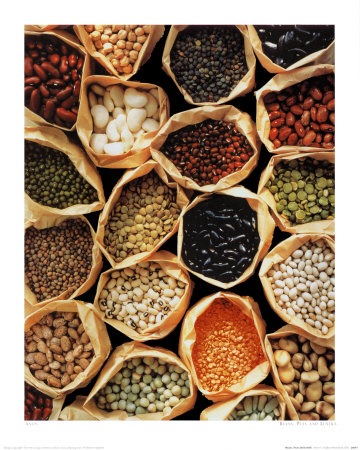
So, thanks to the folks at Delectable Planet for helping – now you, too, can have a copy to keep in your kitchen. If you want to go to the actual chart on their webpage, click here.

beans_in_bagsWhat I do is tape these kinds of things inside my kitchen cupboard doors. I have a few such must-haves – some 3×5 cards with my favorite salad dressings are there, and now this 2-pager with info about beans. Also my grilling chart graces another interior cupboard door so we never have to go far to look up what temperature to cook pork. Or chicken, etc. I don’t know about you, but I just can’t seem to remember from one time to the next, usually several weeks in between, the different temps.
printer-friendly PDF  – bean_chart was kindly provided by Delectable Planet

Posted in Fish, on March 16th, 2013.

fresh_crab_cakes

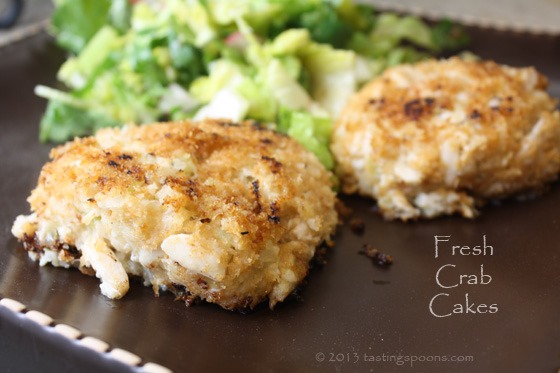
Do you like crab? I sure do, yet I don’t get it – eat it – very often. Rarely, in fact. But this, oh, yes, I could eat this every so often. It takes some doing (i.e., there’s quite a bit of prep involved) but the result is succulent, sweet, ever-so tender and nearly falling apart with deliciousness.

I do hope all of you – since you’re foodies like I am – watch America’s Test Kitchen (the TV show). I have it automatically record on my Tivo, so I never miss a program. There have been many of them recording lately (more than one a week), and every single recipe they’ve made has been something I want to try. Which means I need to remember, the next time I’m at my computer, to go online to the TV series’ website to print it out. The website is different than the regular Cook’s Illustrated website. Why? Because you can get these recipes for free, whereas all the others are only available to subscribed members.

What I had in my refrigerator was one of those plastic “cans” of fresh crab, but they’re stabilized somehow and keep for quite awhile under refrigeration. You can get it at both Costco and Trader Joe’s. They’re one pound containers, with very little liquid. So, here’s the short-list of what has to be done:

  1. Toast the panko in a nonstick skillet until the crumbs get golden brown
  2. Soak the crab meat in milk for 30 minutes
  3. Chop up some raw shrimp which is added into the mixture
  4. Chop and cook some onion, celery and garlic
  5. Combine the drained crab and shrimp with the veggies, a little jot of cream, Dijon, hot pepper sauce and lemon juice, some seasonings and form into balls and let them rest, refrigerated, for awhile
  6. Gently – oh so gently – pat the toasted panko crumbs on both sides of each one
  7. Fry the very fragile crab cakes in some vegetable oil until golden brown, turning them with 2 spatulas and serve them immediately!

It took me about an hour to do all that prep, and when I got to the final part of frying, I had a tough time keeping the crab cakes in one piece. The instructions are clear – fry over medium-high heat for 3-4 minutes with oil shimmering in the pan, turn them over (using 2 spatulas, mandatory), add a bit more oil, turn down the heat, and continue frying for another 2-3 minutes until they’re done. If you cook them long enough – and at the absolute perfect temp (whatever that is) the crumbs have turned a dark golden brown and they help hold the crab cakes together.

What there isn’t in these crab cakes is a stick of filler. No bread crumbs (the panko is just on the outside, none in the mixture), or eggs. Or flour. Nothing. So you can imagine how fragile they are. But I managed to get 5 of them to come out beautifully. The other two, not so much. But oh well, it didn’t make them taste any less delicious, so what does it matter, right? Be sure to use fresh crab, not canned. And be careful about how salty the crab is – crab meat from King crab legs are often quite salty. Soaking the crab in milk is a great step – moisture is provided and it takes away any kind of off-flavors that might be lurking in the shellfish.

What’s GOOD: the clean, fresh taste of the crab – no filler, just good flavor all around. And texture from the panko – gosh those panko crumbs do a great job providing texture. Be sure to serve these the moment they’re out of the pan – I mixed up a salad and already had it on the plate so it was easy to place the crab cakes next to it and whisk the plates to the table. Except for taking the picture you see at the top!
What’s NOT: if I had to complain about anything it would be the amount of prep. But then, some things do take awhile to prepare – you want good flavor? then sometimes it requires some elbow grease, like these did.

printer-friendly PDF (created using Cute PDF Writer, not Adobe)
MasterCook 5+ import file – right click to save file (and remember where you put it), run MC, then File|Import

* Exported from MasterCook *

Fresh Crab Cakes

Recipe By: America’s Test Kitchen TV show, Jan. 2013
Serving Size: 6

1 pound lump crab meat — picked over for shells
1 cup milk
1 1/2 cups panko bread crumbs
Salt and pepper
2 stalks celery ribs — chopped
1/2 cup chopped onion
1 garlic clove — peeled and smashed
1 tablespoon unsalted butter
4 ounces shrimp — raw, peeled, deveined, and tails removed
1/4 cup heavy cream
2 teaspoons Dijon mustard
1/2 teaspoon hot pepper sauce
1 teaspoon lemon juice
1/2 teaspoon Old Bay seasoning — [I used Mural of Flavor fom Penzey’s]
4 tablespoons vegetable oil

Notes: Fresh crab meat will make these crab cakes taste even better. With packaged crab, if the meat smells clean and fresh when you first open the package, skip steps 1 and 4 and simply blot away any excess liquid. I managed to get 7 crab cakes (recipe said it made 8). You throw out the milk, and you’ll use about 3/4 of the panko crumbs.
1. Place crab meat and milk in bowl, making sure crab is totally submerged. Cover and refrigerate for at least 20 minutes.
2. Meanwhile, place ¾ cup panko in small zipper-lock bag and finely crush with rolling pin. Transfer crushed panko to 10-inch nonstick skillet and add remaining ¾ cup panko. Toast over medium-high heat, stirring constantly, until golden brown, about 5 minutes. The finely ground panko will brown first, so keep stirring so it doesn’t burn. Transfer panko to shallow dish and stir in ¼ teaspoon salt and pepper to taste. Wipe out skillet.
3. Pulse celery, onion, and garlic in food processor until finely chopped, 5 to 8 pulses, scraping down bowl as needed. Transfer vegetables to large bowl. Rinse processor bowl and blade and reserve. Melt butter in now-empty skillet over medium heat. Add chopped vegetables, 1/2 teaspoon salt, and 1/8 teaspoon pepper; cook, stirring frequently, until vegetables are softened and all moisture has evaporated, 4 to 6 minutes. Return vegetables to large bowl and let cool to room temperature. Rinse out pan and wipe clean.
4. Strain crab meat through fine-mesh strainer, pressing firmly to remove milk but being careful not to break up lumps of crab meat.
5. Pulse shrimp in now-empty food processor until finely ground, 12 to 15 pulses, scraping down bowl as needed. Add cream and pulse to combine, 2 to 4 pulses, scraping down bowl as needed. Transfer shrimp puree to bowl with cooled vegetables. Add mustard, hot pepper sauce, lemon juice, and Old Bay seasoning; stir until well combined. Add crab meat and fold gently with rubber spatula, being careful not to overmix and break up lumps of crab meat. Divide mixture into 8 balls and firmly press into 1/2-inch-thick patties. Place cakes on rimmed baking sheet lined with parchment paper, cover tightly with plastic wrap, and refrigerate for 30 minutes.
6. Coat each cake in panko, firmly pressing to adhere crumbs to exterior. If they’re fragile, hold the crab cake in one hand and gently pat the crumbs onto the flat side, then turn it over carefully and repeat for the 2nd side. Heat 1 tablespoon oil in now-empty skillet over medium heat until shimmering. Place 4 cakes in skillet and cook without moving them until golden brown, 3 to 4 minutes. Using 2 spatulas, carefully flip cakes, add 1 tablespoon oil, reduce heat to medium-low, and continue to cook until second side is golden brown, 4 to 6 minutes. Transfer cakes to platter. Wipe out skillet and repeat with remaining 4 cakes and remaining 2 tablespoons oil. Serve immediately.
Per Serving (the numbers here seem very high to me – there is almost no oil used – you only use about 3/4 of the bread crumbs, so it’s off by that amount. Shrimp and crab aren’t high in calories. 1/4 cup of cream isn’t much divided up into 6-8 cakes, so I don’t understand, but this is what my recipe program says): 461 Calories; 18g Fat (37.1% calories from fat); 26g Protein; 44g Carbohydrate; 2g Dietary Fiber; 112mg Cholesterol; 505mg Sodium.

Posted in Cookies, on March 14th, 2013.

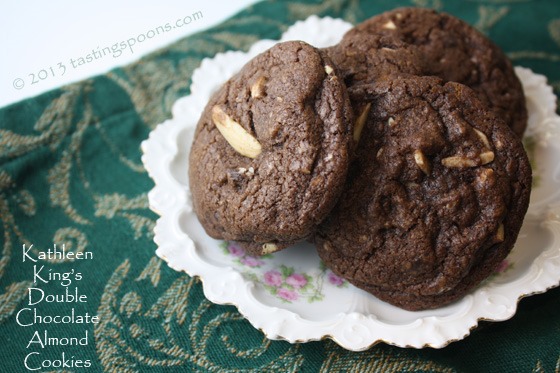
kathleen_kings_double_choc_almond_cookies

Ah, chocolate. White chocolate, dark chocolate and cocoa bound together into a light-textured cookie with some slivered almonds. Perfect with a fresh cup of coffee. Or for any chocoholic.

How many times have you made something, from a recipe on the ‘net, from a major site on the ‘net, and had it go wrong? After I mixed up this batch of cookies and had the first tray in the oven, I went about entering it into MasterCook, so I ended up at the Barefoot Contessa site on the Food Network. Saw 5 stars. Good. I copied all the ingredients and directions over, then thought I’d glance at the reviews. Oh my.

Well, there was a bunch of stuff there. Good and bad. Some people thought no wonder it failed because it’s not Ina’s recipe. It’s from Kathleen King. Some people watched the segment on TV and said that absolutely she used 2 1/2 POUNDS of butter, not 2 1/2 CUBES of butter. Big difference, obviously! Some people who made these actually put IN 2 1/2 pounds of butter and thought the cookies were just fine. Really? Others thought the dough was dry (mine was). Too dry. Still others had added in an extra egg yolk (I put in a 2nd egg). Others added some oil. Others reduced the amount of flour. My cookies were already mixed up completely, so I didn’t have a lot of options. I tasted a cookie from the first tray, and although it hadn’t completely cooled yet, I thought they might be a tad dry. So that’s when I added in the extra egg, assuming it could still be mixed up in my stand mixer. Yes, that worked. The motor was barely able to keep the beater moving and mix in. The batter was much more like a typical cookie dough. It was far too late to add in more butter – others who tried this a 2nd time added in 3 cubes of butter instead of the 2 1/2 and thought that was perfect. Others felt that using unsalted butter was just off, but I only had unsalted, and I thought the cookies were salted sufficiently. And, just so you know, some people made the recipe exactly as printed and thought it was fine, even though the cookies were slightly dry.

What surprises me, after reading about 50+ reviews, is that people at the Food Network should have double-checked the recipe and put a disclaimer or something ON the recipe, if not from the beginning, or at least after all these people have commented that there’s something wrong with the recipe. If the recipe IS correct, then put a statement there stating so. Or state that there was an error during the taping of the show, that 2 1/2 cubes is correct.  Or, is it really 2 1/2 pounds? It has been my experience that once a recipe goes up on the Food Network, it’s there and there it stays forever, without change or correction. They never (seem to) alter anything. Ever.

Fortunately, most cookies are a flexible medium. The science of them isn’t as exact as, say, a cake, or even a muffin or scone. Plus, what tastes good to one person may be awful to someone else. It could be the type of chocolate. It could be the texture. It could be the addition of nuts. It could be the sweetness. I prefer less-sweet cookies. Others think cookies need to be more like candy to suit them. So I guess you could say that cookies can be quite forgiving.

So when all was said and done, really all I did was add in another egg. The texture was much better – it had just a hint of crispy on the outside, and lovely, decadent softness on the inside. I happened to have some extra bitter chocolate chips on hand, so decided to use them here.  I used Valrhona white chocolate and chopped the pieces myself from a small block. I’m not usually a fan of white chocolate – to me, if I’m going to eat chocolate, I want real CHOCOLATE – the dark stuff, not this by-product that is called chocolate. To me it isn’t chocolate at all.

As I was making these cookies I was already writing up this post in my head. Already starting to tell the story about why I made them. That day (last Sunday) we were going to Pasadena to go out to dinner with friends there (that’s about an hour’s drive north of us). Wayne and Lucy, when they come to our house, always come bearing gifts – flowers, or some homemade basil oil Lucy’s made, or some candied nuts she’s whipped up. Something. So not having anything in my larder that would qualify, I decided to make cookies. I also have some of the wonderful Lindy’s Cheesecake left over, so I’ll probably take a couple of slices to them. It’s over a week old, and needs to be eaten or be thrown out!

What’s GOOD: oh, well, the chocolate, first and foremost. I enjoyed the extra bitter in these cookies, but regular chocolate chips would be just fine. I liked the texture from chocolate chips, the white chocolate chunks, and mainly the almonds. If you like white chocolate, this will float your boat. You could even interchange the volume of white to dark. In fact, you could put in other nuts, or peanut butter chips instead of the white. The add-ins are quite flexible. Do note that I’ve changed the recipe slightly (added an extra egg for some extra moisture).
What’s NOT: really nothing as long as you make the necessary changes to the recipe (which are in the recipe below). A good all-around chocolate cookie with lots of extras in it.

printer-friendly PDF (created using Cute PDF Writer, not Adobe)
MasterCook 5+ import file – right click to save file (and remember where you put it), run MC, then File|Import

* Exported from MasterCook *

Kathleen King’s Double Chocolate Almond Cookies

Recipe By: Ina Garten, Food Network, 2012
Serving Size: 52

2 1/3 cups all-purpose flour
3/4 cup cocoa powder — Dutch-processed if available
1 teaspoon baking soda
3/4 teaspoon salt
1 1/4 cups salted butter — (2 1/2 sticks) softened to room temperature
1 cup sugar
1 cup light brown sugar — firmly packed, or use dark brown
2 large eggs
1 teaspoon vanilla
1 cup white chocolate chips
1 1/2 cups semisweet chocolate chips — [I used extra bitter chips)
1 cup almonds — slivered, chopped

1. Preheat the oven to 350°.
2. In a medium bowl, combine the flour, cocoa powder, baking soda, and salt.
3. In the bowl of an electric mixer fitted with the paddle attachment cream the butter and sugars. Add the eggs and vanilla and mix together. Add the flour mixture and continue mixing until just combined.
4. Add the chocolates and almonds and mix until combined. Using two tablespoons or a small ice cream scoop, drop the dough two inches apart on sheet pans lined with parchment. Bake for 13 minutes.
5. Cool the cookies on the cookie sheets. The cookies should be very soft when they are removed from the oven. They will firm up as they cool.
Per Serving: 155 Calories; 9g Fat (50.0% calories from fat); 2g Protein; 18g Carbohydrate; 1g Dietary Fiber; 20mg Cholesterol; 111mg Sodium.

Posted in Brunch, Desserts, Miscellaneous, on March 12th, 2013.

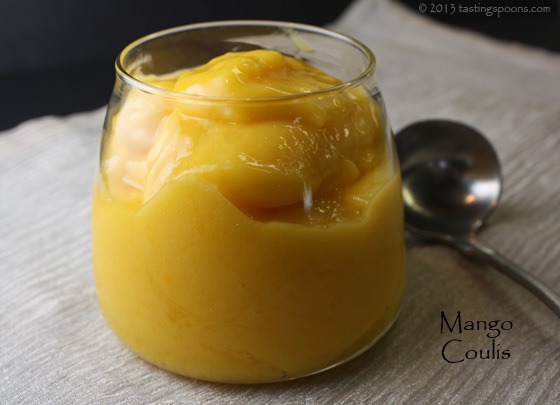
mango_coulis

The easiest of sauces – you can make it as sweet as you prefer – I made it on the tart side. It would be great on top of French toast, breakfast yogurt (I can attest to that one since the left overs have garnished several morning bowls), or as a fruit puree with a creamy dessert like cheesecake. Yum.

If you read my blog regularly, you already know that I made Lindy’s Cheesecake and wrote up a post with a very brief history of Lindy’s deli in New York City. It closed in 1957, but the famous cheesecake lives on in home kitchens, and perhaps a lot of restaurants too, since the recipe became public. It was recently listed in Saveur magazine as one of the top 100 recipes ever.

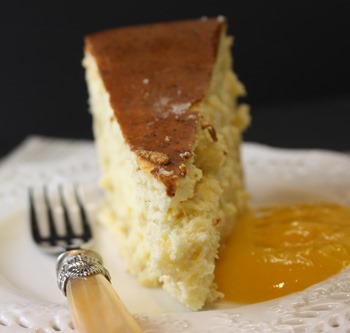
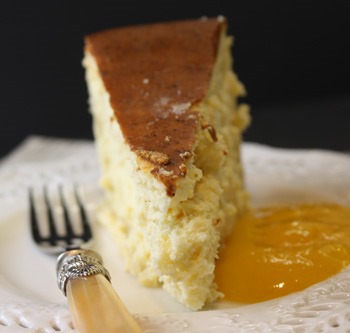
lindys_cheesecake_slice2When I made it, I decided it needed something along side – something with some color. It’s too early in the season for reliably sweet strawberries, so I decided to use mangoes. It was perfect. The recipe came straight out of the Joy of Cooking: 75th Anniversary Edition – 2006. Maybe it was in Rombauer’s earlier editions, but this is the book I own because my old one from the 1950’s was falling apart. I looked up many other recipes, and they were all the same – mangoes, sugar of some form and either lime or lemon juice. Plus just a bit of water to make the sauce almost pourable. That’s it. See? I said it was easy!
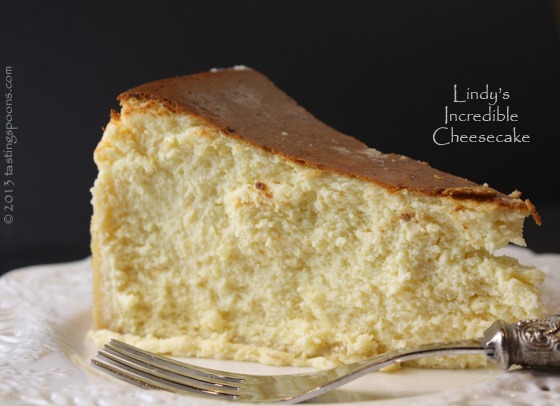
I whizzed it up in the food processor, although the blender would likely work just as well. I used the frozen mango chunks from Trader Joe’s. You could use fresh mangoes too. Do defrost the frozen ones some so they will puree. Add some citrus (the lemon juice or lime juice) and add as much sugar as you want – I used about a rounded 1/4 cup of powdered sugar. You can use regular sugar too. Either one. And then some water – the texture of the mangoes will determine how much water you’ll need – you want it thick, but not so you can’t pour it. In the photo at top you can see it’s almost the consistency of pudding, but it spread out flat once I put it on the plate with the cheesecake.

What’s GOOD: the delicious FRESH taste of mango. Citrus does that in all of its guises. I made mine on the tart side since the cheesecake was already plenty sweet, but use your own judgment based on what you’re serving it with. It keeps for several days. I think the recipe said 3, but I don’t know why it wouldn’t keep a week. It is also fantastic drizzled over Greek yogurt for our breakfast. And I just know it would taste wonderful on French toast.
What’s NOT: it was perfect for how I needed to use it, as a sauce for cheesecake.

printer-friendly PDF (created using Cute PDF Writer, not Adobe)
MasterCook 5+ import file – right click to save file (and remember where you put it), run MC, then File|Import

* Exported from MasterCook *

Mango Coulis

Recipe By: Joy of Cooking, 75th anniversary edition, 2006
Serving Size: 5

2 whole mangoes — (or use frozen chunks, about 1 1/2 cups)
1/4 cup to 1/2 cup confectioner’s sugar — or more to taste
1 tablespoon fresh lime juice — or lemon juice
About 2-3 T water

1. If using frozen mango, defrost. If using fresh, peel and core mangoes and cut into 1″ pieces.
2. In a food processor or blender combine the mangoes, lime juice and water. Blend until completely smooth, then add the sugar and blend. Add more water if it’s too thick. Taste for sweetness and add more citrus or sugar. If you’re serving this with a very sweet dessert, you can make the coulis less sweet. Refrigerate. Ideally, use up within 3 days. Add leftovers to a morning fruit smoothie or pour over fresh fruit and yogurt. Would also be delicious on top of French toast.
Per Serving (based on 1/4 cup sugar): 78 Calories; trace Fat (2.4% calories from fat); trace Protein; 20g Carbohydrate; 2g Dietary Fiber; 0mg Cholesterol; 2mg Sodium.

Posted in Desserts, on March 10th, 2013.

lindys_cheesecake_sliced

Can you just imagine the mouth-feel of a bite of that cheesecake? Smooth, rich, a little tiny bit citrusy, in between being a dry cheesecake (not a bad thing) and a wet cheesecake (some people prefer that type). This one leans more toward the dry, I suppose, but not DRY, if you get my drift.

Oh my goodness, is this cheesecake beyond delicious. It’s not something I make – hardly ever. It’s not something I even crave. Now my DH, that’s another story. Cheesecake is his #2 favorite dessert, 2nd only to carrot cake. I do have a recipe for a cheesecake here on my blog – it’s a very tall, light and airy cheesecake. I had it the first time back in about 1970, when I was living for a brief time in Oklahoma. It was called a Gourmet Cheesecake. It contains many egg whites whipped separately, so it retains height during baking. And it’s got a much different (light) texture. I do love that cheesecake. But, since I was cooking for several couples coming to dinner, I decided to try a new recipe, at Saveur.

This cheesecake, comes from the famous Lindy’s Restaurant in New York City. Not to be confused with the current-day restaurant by the same name. Lindy’s was opened in 1921 on Broadway, and it was really a Jewish deli, but they became known for sturgeon, corned beef and blintzes. And, their cheesecake. Milton Berle used to eat there nearly every day. Lots of notables ate there regularly. The owners – Lindy Lindemann and his wife Clara – ran it (and another one some blocks away) for many years.  According to Wikipedia, Lindy’s was especially well known for its cheesecake, which was at times credited as perhaps the most famous in the United States. The cheesecake was immortalized in Guys and Dolls, where Nathan Detroit and Sky Masterson sang its praises. You could even sing some of the songs from the musical while you made this. Ah, never mind. Most of you probably don’t know what Guys and Dolls was! The recipe for the cheesecake, fortunately, can live on in our own kitchens because we have the recipe. The famous recipe. The restaurant closed in 1957.

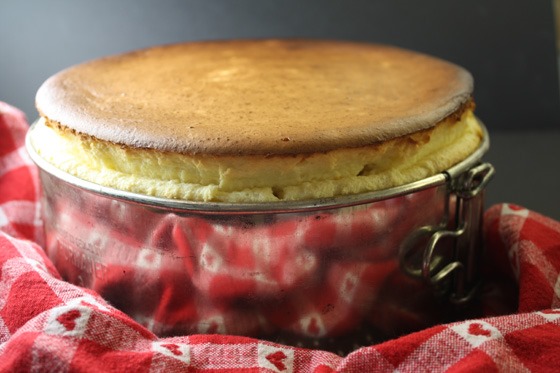
So, on to the recipe. This must – absolutely must be made in a 9-inch springform pan. Please don’t try to make it fit in an 8 incher. Or thinner in a 10-incher. In a 9-inch pan the cake rises up above the sides. When I peeked in the oven window about half way through and saw it I panicked! I thought it would spill over – not only ruining the cheesecake, perhaps, but also making a monumental mess on the floor of my oven. But no, it rose up, stayed up and peaked out about an inch above the top.

First you must make an easy crust – very similar to a pie crust – that contains the seeds from a vanilla bean, an egg yolk and lemon zest, then you chill it for an hour before pressing it with your fingertips on the bottom and all the way up the sides of the pan. The crust didn’t make it quite up to the top when I did it – but it didn’t seem to matter. Ideally, you can make the crust thin enough to go all the way up.

Then you make the filling. Do you even want to know how much cream cheese is in this? A full 2 1/2 pounds. A lot. It has a bunch of eggs and egg yolks in it too. And a little bit of orange and lemon zest. It has a little tiny amount of flour in it, vanilla and 1/4 cup of heavy cream. I can’t imagine what that little amount of cream does, but it’s added in at the very end of the mixing. Pour it into the pan and bake.

whole_cheesecake_just_baked

That was taken about 20 minutes after I took it out of the oven. I baked it to an exact 160° using an instant read thermometer. I stuck the probe into the side so there wouldn’t be a hole in the top. It took about an extra 7-8 minutes in my oven (over the 75 minutes suggested). First you bake it for about 15 minutes at 500°. Can you imagine? Yes. Then you reduce it to 200° and continue baking. The back side (you can’t quite see it in the photo above) got a little dark. I should have rotated the cake, but I was afraid it might deflate if I opened the oven door. Do try to leave ample room all around the cheesecake in the oven and don’t put it too close to the top, either.

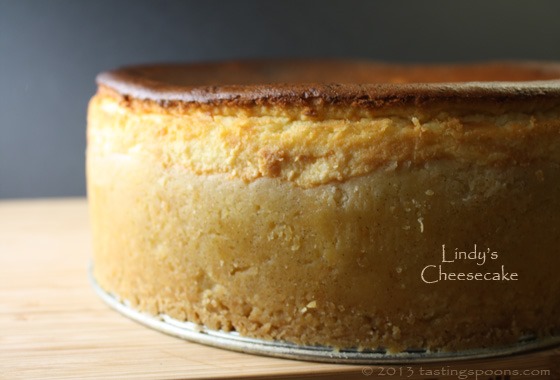
lindys_cheesecake_whole

In this photo you can see the crust is about 2/3 to 3/4 of the way up the sides. You can barely see the delineation in this photo. It took several hours to let it cool. After an hour or so, I took off the springform side – but first I used a sharp knife to make certain none of the cheesecake was sticking to the side and let it cool several more hours. The other interesting tidbit is that this cheesecake needs to chill for at least 8 hours or overnight. That was wonderful for me so I made it the day before our dinner party. I put the springform back on the cake to store it, covered well with foil.

When it’s cut, use a very thin, sharp knife and have a tall glass of hot water handy as the cheesecake wants to stick to the knife. Dip the knife in the hot water between each cut.  I used a wedge to remove it, but a knife will work too – the crust is sturdy enough to hold the piece together fairly well. The very center didn’t come out cleanly – it’s a soft filling, so a little bit of it stuck.

I made a mango puree (a coulis) to serve on it or on the side of it. I don’t think Lindy’s served it with anything. It really doesn’t need anything to adorn it, but I thought a bit of added color would be nice. I bought frozen mango pieces at Trader Joe’s and made the puree the day before also.  I’ll post that recipe tomorrow or the next day. Anyway,  dessert was all done the day ahead.

lindys_cheesecake_slice2

After sitting (chilling) for 24 hours the cheesecake had deflated some. It was then about level with the side of the springform, and the center sunk too. I know it was done, though the center was still slightly jiggly when I took it out of the oven. Obviously that means the center surely wasn’t as “done” as the outer parts, but when researching this on the ‘net, I read several places that a cheesecake should be at 160° so that’s exactly what I did.

What’s GOOD: there is everything good to say about this dessert – unctuous texture, smooth, decadent, rich, full of the cheesy taste you look for when ordering a cheesecake. It has the drier texture that is coveted by most cheesecake fans. It’s spectacular to serve – I showed our dinner guests the cheesecake before cutting it and asked everyone if they wanted the mango coulis on the side. We had left overs twice and oh, was it ever good then too. Maybe even better because we were eating it after an ordinary meal and the cheesecake absolutely stood out.

What’s NOT: there is nothing, whatsoever, I could say about this other than it’s fantastic.

printer-friendly PDF (created using Cute PDF Writer, not Adobe)

MasterCook 5+ import file – right click to save file (and remember where you put it), run MC, then File|Import

* Exported from MasterCook *

Lindy’s Cheesecake Recipe

By: From the NYC restaurant (closed in 1951) but printed in Saveur, Nov. 2012
Serving Size: 12

CRUST:
1 cup flour
8 tablespoons unsalted butter — cubed
1/4 cup sugar
1 teaspoon lemon zest
1/4 teaspoon salt
1 large egg yolk
1/2 vanilla bean — seeds scraped and reserved
FILLING:
2 1/2 pounds cream cheese — softened (use full fat)
1 1/4 cups sugar
3 tablespoons flour
1 1/2 teaspoons orange zest
1 1/2 teaspoons lemon zest
1/2 teaspoon vanilla extract
5 whole eggs — plus 2 yolks
1/4 cup heavy cream

Note: You MUST use a 9-inch pan for this cheesecake. No substitutions.
1. CRUST: Combine flour, butter, sugar, zest, salt, yolk, and vanilla seeds in a bowl; rub with fingers until dough forms. Form dough into 2 rounds; wrap each in plastic wrap. Chill for 1 hour. Press 1 dough round onto bottom of a 9″ springform pan; pull off pieces from remaining dough and press around sides of pan all the way to the top. Dough will be very thin – be sure to fill all holes and gently press completely up the sides as the cheesecake pan will be completely full. Set aside.
2. FILLING: Heat oven to 500°. Beat cream cheese, sugar, flour, zests, and vanilla in a large bowl on medium-high speed of a hand mixer until smooth. Add eggs and yolks, one at a time, beating after each addition, until smooth; stir in cream. Pour filling into pan. Place cake in center of oven with ample room all around and bake until top begins to brown, about 15 minutes. Reduce heat to 200°, and bake until just set, about 1 hour more until it has reached an internal temperature of 160°. Transfer to a rack, and let cool completely. Cover and refrigerate at least 8 hours or overnight. Remove cake from pan and cut into slices to serve. I served this with a mango coulis, but it doesn’t really need any adornment.
Per Serving: 594 Calories; 45g Fat (67.5% calories from fat); 11g Protein; 37g Carbohydrate; trace Dietary Fiber; 237mg Cholesterol; 357mg Sodium.

Posted in Veggies/sides, on March 8th, 2013.

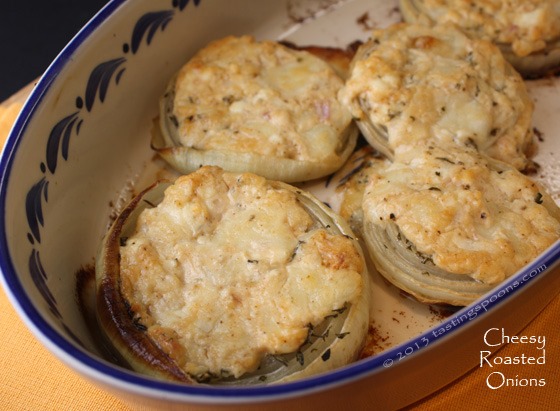
roasted_cheesy_onions

Simple, easy, tasty onions with delicious cheesy stuff on top. What could be better than that to accompany a hunk of meat?

When I read the recipe over at Kalyn’s Kitchen, I just knew I’d be trying it. I have a recipe here on my blog for Baked Onions with Thyme, that are a particular favorite of our family (that recipe came from an old Gourmet magazine). They’re quite easy too with lots of red wine added, but no cheesy topping, and they do take forever to roast – like 2+ hours. These, on the other hand, are thick slices of onions that are baked (roasted) in a hot oven for awhile, then topped with the cheesy stuff and allowed to bake longer – about another half hour – so the cheesy topping gets toasty brown and melts into deliciousness. So these take about an hour total in the oven.

Pretty much I followed Kalyn’s recipe, although I veered off slightly with the types of cheese I used. I made these twice, both times using slightly different cheeses (first: fresh mozzarella, goat cheese, Pecorino; second: regular Mozzarella, sharp cheddar, Gruyere and Parm. I preferred the 2nd grouping). Kalyn used pizza cheese and Pecorino. I think probably any mixture of cheese would work with this dish as long as you’ve got some of the soft melting cheese and some of the drier, high-flavored cheeses like Parm or Pecorino. The herbs just give the onions more flavor altogether, but you could probably vary those according to your taste, or by what you’re serving with it. If you’re doing sausages, add dill seed and fennel maybe. Italian steak or grilled Italian sausages? Add basil, thyme and rosemary. Chicken breasts are a basic palette, use whatever suits your fancy. Mexican? Add cumin and chili powder.

The cheesy mixture also has some mayo in it (to help bind it), Dijon, lemon juice, pepper, and in this version it’s fresh rosemary and fresh thyme. Those are the only two herbs still growing in my herb garden or what’s left of it from last summer. They survived our many nights of near freezing temps. As for the type of onion, I think you could use any variety – regular white or yellow, red or even Sweet onions. They’d all be just fine, although sweet onions contain more water, so they might take longer to roast (by about 5-10 minutes). The trick is to make sure the cheese mixture sort of sticks together when you mix it up. That way it will sort of stick together on the onion too. First, the thick onion slices are drizzled with oil, sprinkled with salt, pepper and herbs, then you roast them in the oven for about 15-20 minutes. The cheese mixture is stirred together and spread on the half-cooked onions, and you can add more cheese (Parm or Pecorino) on top so it will get nice and golden brown.  Back in the oven they go to finish the cooking. After 20 minutes, check to see if they’re tender – add another 5 or 10 minutes. And if the top isn’t brown enough, turn on the broiler for just a couple of minutes.

What’s GOOD: how easy they are to make – you just have to be in and around the kitchen for a little over an hour. The cheesy mixture is quite simple – use what you have on hand. Really any kind of cheeses should work. I served these to dinner guests and they were lovely, but they’re also simple enough to be a weeknight side as well. They’re great left over too.
What’s NOT: nothing I can think of. Delicious.

printer-friendly PDF (created using Cute PDF Writer, not Adobe)
MasterCook 5+ import file – right click to save file (and remember where you  put it), run MC, then File|Import

* Exported from MasterCook *

Cheesy Roasted Onions

Recipe By: adapted from Kalyn’s Kitchen, Feb. 2013
Serving Size: 6

ONIONS:
4 medium yellow onions — or sweet or red onions
1 tablespoon olive oil — for brushing onions (1 to 2)
1 teaspoon fresh rosemary — (or use 1/2 tsp. dried rosemary) finely chopped with large knife
2 tablespoons fresh thyme leaves — minced (or use 1 T. dried thyme)
GRATIN TOPPING:
6 tablespoons mayonnaise — [Kalyn used 4 T. low fat, 2 T full fat]
1 tablespoon fresh lemon juice — or lime juice
1/2 teaspoon Dijon mustard
1/3 cup mozzarella cheese — grated (or use chopped fresh Mozzarella)
1/3 cup Gruyere cheese — grated
1/3 tablespoon sharp cheddar cheese — grated (or use Pecorino)
2 tablespoons Parmigiano-Reggiano cheese — grated
2 teaspoons fresh rosemary — minced
2 teaspoons fresh thyme — minced
fresh ground black pepper to taste

Notes: if using sweet onions, the baking time might be a bit longer than in the recipe (because they contain more water). I baked them at 450 for 12 minutes, spread the topping on, then reduced the oven temp to 350 and baked them for about 25 more minutes. Both times I baked them, they required different baking times. Both times I made these I used different combos of cheese. First: small, fresh Mozzarella balls cut in half, soft goat cheese, Pecorino. Second time: Gruyere, regular Mozzarella, sharp cheddar and some Parm. I think I preferred the 2nd grouping of cheeses.
1. Preheat oven to 450°. Peel onions and cut in 1/2 inch slices. Spray or brush baking sheet with olive oil, then arrange onion slices in a single layer. Spray or brush onions with oil, then sprinkle with chopped herbs. Roast onions 15-20 minutes.
2. While onions roast, combine mayo, lemon juice, Dijon mustard, your cheeses of choice, herbs and black pepper in a small bowl. Mix together with a fork. (The mixture will be lumpy.)
3. Spray a 9″ x 13″ casserole dish with olive oil or nonstick spray. Remove baking sheet from the oven and use a turner to place onions in the casserole dish. Spread topping over onions (use a sandwich spreader if you don’t want to use your fingers). It’s okay if the mixture doesn’t cover every bit of the onions. Place casserole dish in oven and bake 25-35 minutes, or until top is golden brown and onions are slightly bubbling. Serve hot. If tops aren’t golden brown, use broiler and watch carefully so they don’t burn.
Per Serving: 203 Calories; 18g Fat (77.1% calories from fat); 5g Protein; 7g Carbohydrate; 2g Dietary Fiber; 19mg Cholesterol; 166mg Sodium.

Posted in Vegetarian, Veggies/sides, on March 6th, 2013.

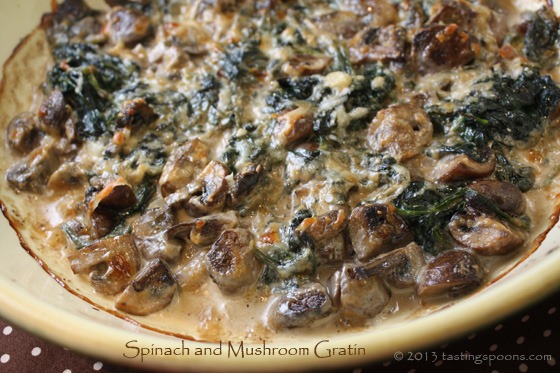
spinach_miushroom_gratin

Is a dish a gratin if you bake it in a gratin dish? Well, hardly. But once I poured this mixture of crimini mushrooms and fresh spinach into the gratin dish and sprinkled the top with Parmigiano-Reggiano cheese? Well, it became a gratin in my book, even though it wasn’t in the recipe title.

Immersing myself in planning a dinner party is always fun for me. Am I weird? My first decision is always what meat I’m serving, then everything else widens the circle of tastes for the dinner. One of our guests is bringing an appetizer – probably two since she wants to try something new. Another couple will bring a salad. So I’ll round out the meal. My focus this day was on deciding on vegetable sides, and my darling DH and I were driving somewhere and I was giving him a heads-up about the menu [oh, mistake]. He asked what sides I was going to make and I told him I hadn’t decided yet. He said, just make veggies you know and like. How about those brussels sprouts with maple syrup? I said no, I’ve made those about 3 times in the last couple of months. And I mentioned that not everyone likes brussels sprouts. He said – he said – oh, you don’t want to know what he said – he has no understanding of anybody who doesn’t like them! I told him I was going to make a Gorgonzola sauce to go on the beef tenderloin. He said, am I barbecuing it? I said no, I’m going to pan sear it and roast in the oven. Why not let me rotisserie it? I said no, I didn’t want to rotisserie a very expensive beef tenderloin. (Too risky in my book.) I could tell he was starting to get a little annoyed. I should have changed the subject right then, but we kept going. He got back to the sauce – he said to my thought on a gorgonzola sauce – what? No, that’s too heavy. I said no, I didn’t think so. He said yes, I’ve had a blue or Roquefort sauce on steak once that just masked the taste of the steak, and I want to taste the steak. Then he said oh, what’s the other sauce I love, uhm, what is that one? I said no, I’m not making a Bearnaise sauce. (He loves-loves Bearnaise sauce, and I’ve made it innumerable times, always with a butterflied leg of lamb. And over asparagus a time or two. But that last couple of times I did make it it didn’t turn out well. It separated. I followed the same recipe I’ve always done, yet it failed me. So I wasn’t going to make that one – I don’t think it goes so well with beef anyway.)

That kind of conversation is why I normally don’t discuss menus with him. One of the things I love about him is that – usually – he lets me do whatever I want for every meal I cook. I like that. I like making dinner decisions because I’m the one cooking it. Always. Dave doesn’t cook except to grill. My decision is that I’m going to make a cabernet wine sauce, but I’m also going to offer some nice, Point Reyes blue cheese for guests to sprinkle on the filet if they choose. I really did think about making two sauces, but that’s too darned much work.

The night after I made this vegetable dish my DH came up to me as I was going back and forth from my computer (looking at Eat Your Books to find a dessert sauce for the cheesecake) to my cookbook shelves about 10 feet away, and he asked me what I was doing. Are you still working on vegetables?  I said no, I was on to dessert now. So which veggies have you decided to serve?  I said both of the ones I tried (the other one is a baked onion dish coming up here on my blog in a day or two). Then I told him I’d decided to make a cabernet sauce for the steak and . . . right then he interrupted me and said honey, you serve whatever you want. I always love whatever you cook so don’t pay any attention to me. Hmmm.

Anyway,  I enjoy the searching for recipes, and wanted to try some new veggies to go with the beef. Recently I was doing lots of filing of recipes I’ve clipped from here and there, and found at least 20 I want to try. But this one came from reading blogs (Food52, specifically). Apparently it’s a recipe from Nigel Slater. I believe this dish is intended as a vegetarian entrée, although I really don’t know since I don’t have the book from which this came. The cookbook is Tender: A Cook and His Vegetable Patch. (There are 2 volumes to this – this recipe is in the 1st volume, linked here.) I think Nigel did call this a Gratin since I found some references to it online, in other places. What drew me to the recipe was how simple it was. Crimini mushrooms quartered, sautéed in some butter until they’ve given up their juices, white wine added and cooked off, then a little cream and milk added in and stirred around. It’s suggested that if time permits, allow the ‘shrooms to sit and vegetate in the cream for awhile – the cream becomes much more mushroomy. I did just that. Meanwhile, I steamed the spinach – that took about 2 seconds, squeezed out the water and then I added the spinach into the reheated mushroom mixture. A little bit of grated Parmigiano was added in then, and it was all tipped into a gratin (there’s that word) dish. There’s very little creamy mixture (it’s cream and milk). More cheese was grated all over the top and into an oven it went for about 25 minutes. In my version of the recipe below, I have added more cheese – there was barely enough to get crispy brown in the Food 52 version I made (see photo at top).
What’s GOOD: everything about this. It’s easy, really tasty, elegant – particularly elegant when you consider how easy it is to make – no sauce to make. The chunks of mushrooms have a great meaty feel (which is why this can be served as a vegetarian entrée). The cheese adds a particularly wonderful nutty taste, as Parmigiano always does. If you do make this as a vegetarian dinner, serve it over toast or English muffins and pour all that cream stuff on it so you get all the nuances of mushroom flavor.
What’s NOT: nothing other than the cream mostly runs off. It coats all the veggies, but it isn’t thickened, so it doesn’t hold together like one made with a cream sauce. It probably could be done with less cream altogether in that case!

printer-friendly PDF (created using CutePDF Writer, not Adobe)
MasterCook 5+ import file – right click to save file (and remember where you put it), run MC, then File|Import

* Exported from MasterCook *

Spinach, Mushrooms and Cream Gratin

Recipe By: Nigel Slater’s “Tender,” adapted at Food52
Serving Size: 8

1 tablespoon unsalted butter
2 tablespoons olive oil
1 pound crimini mushrooms — cleaned and quartered lengthwise
1/4 cup white wine — vermouth is fine
3/4 cup heavy cream
1/2 cup whole milk
1 pound baby spinach
1/2 cup parmesan cheese — grated (use more or less to suit your taste)
Salt and freshly ground black pepper to taste

Note: You won’t eat most of the cream – it coats all the vegetables, but most of it ends up in the bottom of the gratin dish, so the nutrition info is high. This makes 8 side-dish servings or 4 entree sized portions. If made as a dinner entree, thicken the sauce with a little cornstarch and serve this over toast or toasted English muffins.
1. Preheat the oven to 350°. Warm butter and olive oil in a medium-hot saucepan, then add the mushrooms. Stirring occasionally, saute the mushrooms until some of their liquid cooks away and they start to brown. Add the white wine and simmer for a couple of minutes. Most of the wine will bubble away in the steam in a matter of a minute. Don’t wait quite that long. Add the cream and milk and let simmer for several more minutes. Turn off the heat. (If you have time, leave this to steep; the cream and milk will get wonderfully mushroomy.)
2. Wash the spinach well and put in a saucepan over medium heat. (If you use pre-washed spinach, add it to the pan and drizzle in about 2 T. of water.) Cover the pan and let the spinach steam for just a couple of minutes – only until it’s all wilted. Then drain it and squeeze the water out.
3. Add the spinach and a couple tablespoons of parmesan to the mushroom-cream mixture. Taste and season with salt and pepper and transfer to a shallow baking dish. Rearrange the spinach if it has clumped together. Sprinkle the remaining parmesan on top. Bake for about 25-30 minutes or until golden. (If the cheese melts but does not crisp, run it under the broiler for several minutes.)
Per Serving: 170 Calories; 15g Fat (80.5% calories from fat); 4g Protein; 4g Carbohydrate; 1g Dietary Fiber; 40mg Cholesterol; 112mg Sodium.

Posted in Pork, on March 4th, 2013.

slow_cooker_pork_sirloin

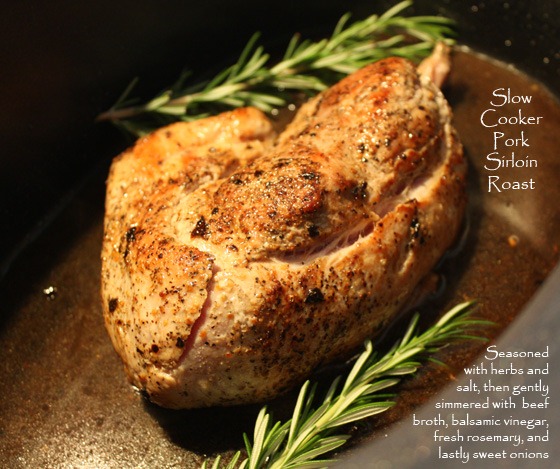
That’s the pork sirloin roast resting in my slow cooker. I hadn’t yet added the bed of beef broth and balsamic vinegar. Until recently I’d never even prepared a pork sirloin roast, but they’re available for a very reasonable price at Costco. One of these little puppies would serve a nice dinner for 4 or maybe 5.

When I opened my freezer door the other day, one of these roasts that I’d vacuum sealed just about fell off the shelf (uhm, can you tell my freezer is full?). I managed to grab it before it dented my hard wood floor! Fortunately, I’d recently read Kalyn Denny’s blog, Kalyn’s Kitchen for just this very roast (hers said sirloin tip – mine was just sirloin) done in the slow cooker. Perfect!

Her recipe is the epitome of easy. That’s what slow cookers are for, right? The pork is seasoned well, browned well, placed in the slow cooker and then you add beef broth and inexpensive balsamic vinegar. My slight changes included using a different herb and salt mixture. I added fresh rosemary sprigs, and lastly, later on, you add a bunch of thick-sliced onions to the slow cooker during the last 60-90 minutes. Kalyn had used red onions. I had sweet onions that needed to be used.

pork_sirloin_sweet_onions

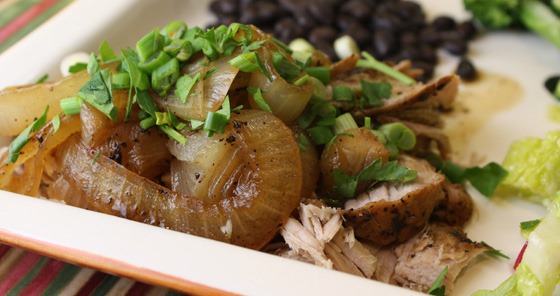
There’s the finished product. There is more pork underneath all those onions, and the brothy sauce is also moving around on the plate. It’s not a thickened gravy – just the broth, balsamic, the herbs and spices and whatever good pork flavor was picked up during the slow cooking. I garnished it with flat-leaf parsley and some fresh green onions.

The roast fell apart as soon as we started to slice it. No slicing here, just pull off some pieces and serve it with the tender and very tasty onions and a small ladle of the balsamic broth.

What’s GOOD: it’s all delicious. The onions are great – sweet, juicy. The pork is fork tender. Be careful not to over cook it or it will become dry. It depends on the size of the roast. If the roast is done, remove it and then finish cooking the onions until they’re totally limp and ready to eat. It’s such a simple recipe, too.
What’s NOT: nothing at all. A great recipe for a healthy and easy dinner.

printer-friendly PDF (created using Cute PDF Writer, not Adobe)
MasterCook 5+ import file – right click to save file (and remember where you put it), run MC, then File|Import

* Exported from MasterCook *

Slow Cooker Pork Sirloin Roast with Balsamic Vinegar, Rosemary, and Sweet Onions

Recipe By: Adapted slightly from Kalyn’s Kitchen 2/2013
Serving Size: 6

1 1/2 pounds pork sirloin roast
2 teaspoons citrus salt blend with herbs — or your choice of mixed herbs
1/2 teaspoon smoky ground pepper — (this is a Schilliing product)
1 tablespoon olive oil
1 cup beef stock
2 4-inch sprigs of rosemary
1/4 cup balsamic vinegar — (not necessary to use the good stuff)
1 large sweet onion — cut into thick slices and separated into rings

Note: If you’re an onion fan, use 2 onions.
1. Trim visible fat from the roast – there won’t be much. Rub the meat all over with the herb/spice/salt mix. Heat the oil in a large frying pan over medium-high heat and brown the pork roast well on all sides. (This will take 8-10 minutes; don’t rush the browning step.) Put the browned roast in the slow cooker.
2. Add the beef stock to the frying pan, turn the heat to high, and simmer until the stock is reduced by half, scraping any browned bits from the bottom. When it’s reduced to 1/2 cup, strain the mixture, put it back in the frying pan, add the balsamic vinegar and cook about 5 minutes more. Pour the liquid over the meat and cook on high for about 2 hours (or on low for 4-5 hours.)
3. When the meat has cooked on high for about 2 hours (or on low for 4-5 hours), peel the onion, cut into thick slices, and separate into rings. You can either remove the roast and put the onions in the bottom (for more well-done and more vinegar-flavored onions or turn the meat over and pile the onions around it (for less well done and less vinegar-flavored onions.)
4. Turn slow cooker to high if you had been cooking on low and cook with the onions added for about 60-90 minutes more. Taste the sauce and see if you’d like it a little more concentrated, and if so, remove the meat, pour the sauce into a pan, and simmer for about 20 minutes on medium-high heat (or until it is as concentrated as you’d like it.) I turned off the slow cooker but put the roast back inside it to stay warm while I reduced the liquid.
5. Slice roast across the grain into slices about 3/4 inch thick, arrange on a plate with the onions, and serve with the sauce poured over or in a bowl on the side.
Per Serving: 233 Calories; 11g Fat (44.5% calories from fat); 28g Protein; 3g Carbohydrate; 1g Dietary Fiber; 90mg Cholesterol; 494mg Sodium. Exchanges: 1/2 Vegetable; 0 Fruit; 1/2 Fat.

Posted in Soups, on March 2nd, 2013.

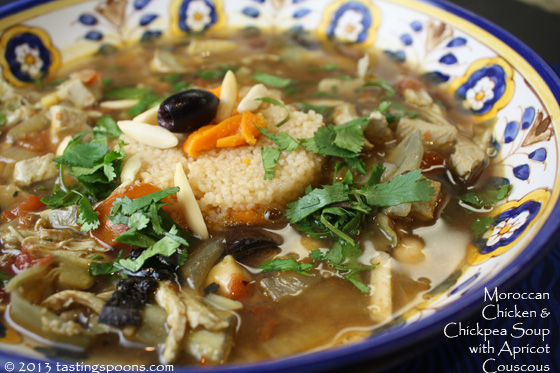
moroccan_chicken_chickpea_soup_apricot_couscous

If you like thinking outside the box when you make soup, this will tick all the items for soup-making for you. Chicken, garbanzo beans (chickpeas), artichoke hearts, Kalamata olives and couscous with an apricot hint. It’s delicious.

No credit is due me on this recipe – it’s all Phillis Carey. She was inspired by an online recipe at food.com for this, but it certainly was way outside my box, but oh-s0 good and worth it. Do not, under any circumstances, be dissuaded once you look at the ingredient list. Half of the items are spices. This soup is healthy. Hearty. Chickeny. Comforting. It could be the Moroccan version of chicken noodle soup. I might like this better than that, actually. If you make a batch for freezing, go ahead and cook the couscous, but put it in a separate plastic bag and seal it inside the larger bag of soup. You can still freeze it all in one gallon bag, but with the smaller well-sealed bag inside.

The soup (the broth part) contains onions, ginger, garlic, all the spices, some white wine, chicken broth, the garbanzo beans and a can of diced tomatoes. It needs but 10-15 minutes of simmering to be ready. Meanwhile, get all the add-ins ready (canned artichoke hearts – no, not the marinated kind – the Kalamata olives, shredded chicken) and on the side some cilantro and almonds.

Then, make the couscous in a separate pan – it uses chicken broth, a little bit of honey (yes), oil, lemon juice, zest, salt and some diced up dried apricots. Phillis did say you could use dried cranberries or currants if you don’t have or want to use apricots. Couscous takes no time at all – just add it to the hot broth mixture, cover and let sit for 5 minutes. Fluff it up just a little.

Back to the soup – add in the additions to the soup (so they heat through), get a soup bowl ready, scoop in some couscous, then, if you can and are willing to be patient, carefully pour the chicken and chickpea soup around the outside of the mound of couscous. It looks really pretty that way. Otherwise, just add the soup and couscous to a bowl and garnish with cilantro and almonds. And one Kalamata olive on top.

If you’re a lover of spices and flavor, this one is IT. If you’re intimidated by all the spices, maybe mix those up the day before and keep them fresh in a little sealed jar. Don’t make more than you need – remember, mixed spices lose their flavor after about a month.

What’s GOOD: the myriad of flavors in this soup. I love soup in all shapes and sizes. And this one – the flavors. Loved them all – the artichoke hearts, the beans, the apricot couscous. Wow. All delish.
What’s NOT: can’t think of any down side to this flavorful soup. Worth doing, even if you do have to dig out all of your spice bottles to do it!

printer-friendly PDF (created using Cute PDF Writer, not Adobe)
MasterCook 5+ import file – right click to save file (and remember where you put it), run MC, then File|Import

* Exported from MasterCook *

Moroccan Chicken and Chickpea Soup with Apricot Couscous

Recipe By: Phillis Carey, cooking instructor, author (Jan. 2013)
Serving Size: 6

SOUP:
2 tablespoons olive oil
2 cups onions — diced
2 tablespoons fresh ginger — minced or smashed and chopped
1 teaspoon paprika
1 teaspoon ground coriander
1/2 teaspoon ground cumin
1/2 teaspoon ground cinnamon
1/2 teaspoon ground cardamom
1/4 teaspoon turmeric
1/4 teaspoon ground nutmeg
1/4 teaspoon red pepper flakes
1/2 cup dry white wine — or vermouth
4 cups low sodium chicken broth
15 ounces garbanzo beans, canned — drained, rinsed
14 1/2 ounces canned tomatoes — diced, including juice
14 ounces canned artichoke heart — drained, chopped
1/4 cup kalamata olives — pitted, halved or whole
3 cups cooked chicken — shredded in bite-sized pieces
Salt and freshly ground black pepper to taste
Chopped cilantro and toasted slivered almonds for garnish
APRICOT COUSCOUS:
2 cups low sodium chicken broth
2 tablespoons honey
1 tablespoon olive oil
1 tablespoon fresh lemon juice
1 teaspoon lemon zest
1/2 teaspoon salt
1 cup couscous
1/4 cup dried apricots — diced (or use dried cranberries or currants)

NOTES: Before you start to make this soup, combine all the spices in a small bowl. If white carbs aren’t your favorite thing (remember, couscous is actually pasta), reduce the amount of it in each soup serving.
1. SOUP: Heat oil in a large pot over medium heat. Add onion and cook until softened, about 5 minutes. Add ginger, garlic and all the spices. Cook for 1 minute.
2. Stir wine into vegetables and spices and bring to a simmer. Cook until liquid is nearly evaporated. Stir in broth, garbanzos, tomatoes, artichoke hearts and olives. Bring to a boil. Add chicken, reduce heat to medium low and simmer soup for 10 minutes to combine flavors. Season to taste with salt and pepper.
3. COUSCOUS: Heat broth (or water) in a medium saucepan with honey, olive oil, lemon juice, zest and salt to a boil. Remove pan from heat, stir in couscous and apricots. Cover and let stand until water is absorbed, about 5 minutes. Fluff with a fork before serving.
4. To serve, scoop couscous into a small ramekin and gently turn it upside down in the middle of a wide soup bowl and remove ramekin. Hopefully the couscous will stand up in the middle. Gently ladle the soup mixture around the outside of the couscous mound. Sprinkle the top of each serving with fresh cilantro and almonds.
Per Serving: 562 Calories; 14g Fat (22.7% calories from fat); 43g Protein; 63g Carbohydrate; 7g Dietary Fiber; 60mg Cholesterol; 1393mg Sodium.

Posted in Chicken, on February 28th, 2013.

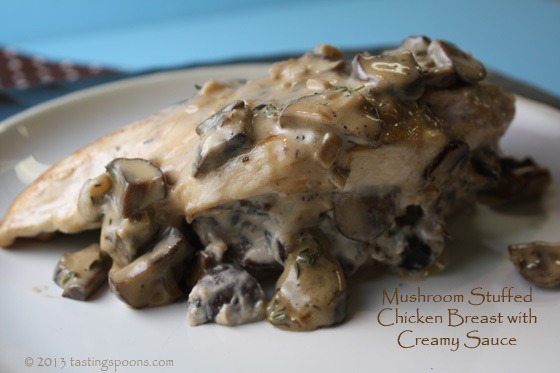
mushroom_stuffed_chicken_breast_creamy_sauce

A bit more complex than some slap-together kinds of dinners. The mushrooms need to be cleaned, chopped, cooked, then mixed with Gorgonzola cheese, shallots, wine. Most of it goes in the pocket in the chicken breast. If you have extra mushrooms they can be added in the simple pan sauce.

When I got down to it, I had forgotten to buy fresh basil, and it’s a fairly major ingredient in this recipe. I substituted fresh thyme instead, but it not only lost some of that unique flavor that basil brings to just about anything, but I also lost the beauty of tendrils of basil to garnish the top. So, if you make this, do as I tell you, not as I did! Buy basil!

The crimini mushrooms were cleaned and chopped, then cooked with garlic and shallot. Then some wine is added and reduced down before you add the cheese and some basil. The chicken breasts are carefully slit along the side to create a nice-enough pocket, the mushroom mixture is stuffed in there and you try to seal it back up. Carefully sauté the breasts in olive oil, just to brown them (all the cooking through happens in the oven), then they go onto a baking sheet and are roasted for about 12-15 minutes. Meanwhile, fix the rest of your dinner and make the sauce (wine, cream, red pepper flakes and more fresh basil). Serve quickly with the sauce spooned over the top. I had more mushrooms that I could fit inside the chicken breasts, so I added them to the sauce.

Dinner took me about an hour to make, start to finish. The chicken breasts I had were large, so I ended up cutting each breast in half. Thankfully the filling stayed put when I did that. The picture above is one breast and would make a really large serving for a hungry person. The recipe came from a cooking class with Phillis Carey last month. If you don’t like Gorgonzola, you can use goat cheese or Feta.

What’s good: the chicken is very moist and cooked through – pan browning, then baking them assures they’re cooked just enough, but not enough to dry them out. Love crimini mushrooms. And the sauce. Yum. Ideally I’d have served this with some kind of white carb like potatoes or rice, but we had roasted vegetables on the side instead. Mashed potatoes would have been lovely, especially if there was ample sauce to go on top of them.

What’s not: not a thing unless you don’t like making or eating a delicious mushroom cream sauce!

printer-friendly PDF (created using Cute PDF Writer, not Adobe)

MasterCook 5+ import file – right click to save file (and remember where you put it), run MC, then File|Import

* Exported from MasterCook *

Mushroom and Gorgonzola Stuffed Chicken Breasts with Creamy Basil Sauce

Recipe By: A Phillis Carey recipe, from a cooking class Jan. 2013
Serving Size: 4

CHICKEN:
4 pieces boneless skinless chicken breast halves
freshly ground black pepper to taste
1 tablespoon olive oil
1 clove garlic — minced
2 tablespoons shallots — minced
4 ounces mushrooms — crimini, coarsely chopped
1/4 cup vermouth — or other dry white wine
3 ounces Gorgonzola cheese — crumbled (or use goat cheese or Feta)
1 tablespoon fresh basil — minced
2 tablespoons olive oil — for browning chicken
CREAMY BASIL SAUCE:
1/4 cup vermouth — or dry white wine
1 cup heavy cream
1 pinch crushed red pepper flakes
1/2 cup fresh basil — chopped (with some for garnishing the top)

1. Preheat oven to 375° Trim chicken and cut a pocket in the thicker side/edge of each breast, by holding knife parallel to the breast and slicing to create about a 4-inch opening, Season the inside pocket with pepper.
2. FILLING: Heat 1 T. olive oil in a large skillet over medium heat. Add mushrooms and shallots and cook until tender. Add garlic during the last minute of cooking, and cook until the mushrooms are tender and most of the liquid has cooked away. Add wine and stir to scrape up any browned bits from the bottom of the pan. Pour mixture into a bowl.
3. To the mushrooms add crumbled gorgonzola and fresh basil. Stuff the chicken pockets with the mushroom mixture, pressing the outside edges together to seal (sort of). If time permits, you may refrigerate these for several hours before proceeding. If you have too much mushroom mixture, what’s remaining can be added to the sauce later.
4. Heat 2 T. oil in the skillet you used for the mushrooms and heat over a medium-high heat. Add chicken breasts and brown them 2-3 minutes per side until they’re nicely golden brown. Transfer the chicken to a baking sheet and place in the preheated oven for 12-15 minutes (depending on how big and thick they are), or until the chicken is cooked through.
5. SAUCE: Using the same skillet, add wine to the pan and cook, scraping up any browned bits from the bottom of the pan. Add the cream and red pepper flakes, then bring to a boil. Boil to reduce the sauce a little, until it’s thickened some (about 3 minutes). Stir in basil and season with salt and pepper, if needed. Serve chicken breasts on heated plates, pour and pour sauce over the top. Garnish with additional basil shreds.
Per Serving: 558 Calories; 41g Fat (69.3% calories from fat); 34g Protein; 7g Carbohydrate; 1g Dietary Fiber; 169mg Cholesterol; 406mg Sodium.

Related Posts Plugin for WordPress, Blogger...