



Get new posts by email:

Archives

Currently Reading

Here are the tastingspoons players. I’m in the middle (Carolyn). Daughter Sara on the right, and daughter-in-law Karen on the left. I started the blog in 2007, as a way to share recipes with my family. I’m still doing 99% of the blogging and holding out hope that these two lovely and excellent cooks will participate. They both lead very busy lives, so we’ll see.

– – – – – – – – – – – – – – – – – – – – – –

BOOK READING (from Carolyn):

Music of Bees, Eileen Garvin. Absolutely charming book about a woman in midlife, lonely, who raises bees, also makes unlikely friends. Heart-warming and very interesting about beekeeping.

A Postcard from Paris, Alex Brown. Really cute story. Dual time line, 1940s and present day about renovating an old apartment in Paris, things discovered.

Time of the Child, Niall Williams. Oh such a good book. Very small village in Ireland, 1960s. A baby is left on the doorstep. The town all whispers and helps. I listened to an interview of the author, which made me like him and his books even more.

Sipsworth, Simon Van Booy. If you like animals you’ll swoon. An old woman who really wants to die finds a tiny mouse in her house and befriends it and finds a reason to live. Utterly charming book.

The Forger’s Spell, Edward Dolnick. True story. For seven years a no-account painter named Han van Meegeren managed to pass off his paintings as those of Johannes Vermeer.

If You Lived Here, You’d be Home by Now, Christopher Ingraham. Could hardly put it down – about a journalist who takes on a challenge to move to small town in Minnesota and write about it. He expects to hate it and the people and place, but he doesn’t. Absolutely wonderful true story.

The River We Remember, William Kent Kreuger. 1950s, Minnesota. A murder and the aftermath. Could hardly put it down. Kreuger has such a vivid imagination and writing style.

How the Lights Gets In, Joyce Maynard. An older woman returns to New Hampshire to help care for her brain-injured son. Siblings and family, lots of angst and resentments.

The Filling Station, Vanessa Miller. Every American should read this book. A novelized retelling of the Tulsa massacre in 1921. Absolutely riveting.

The Story She Left Behind, Patti Callahan Henry. Love this author. Based on a true story. A famous author simply vanishes, leaving her husband and daughter behind. She had invented a mystical language no one could translate. Present day, someone thinks he’s solved the riddle, contacts the family. Really interesting read.

The Girl from Berlin, Ronald Balson. Love anything about Tuscany. An elderly woman is being evicted from a villa there, with odd deed provenance. Two young folks go there to help unravel the mystery. Loved it.

The Island of the Colorblind, Oliver Sacks, M.D. Nonfiction. The dr is intrigued by a remote Pacific island where most of the inhabitants are colorblind. He also unravels a mystery on Guam of people born with a strange neurological problem. Medical mysteries unveiled. Very interesting.

The Bookbinder, Pip Williams. Post 1914 London. Two sisters work at a bookbindery. They’re told to not read the books. One does and one doesn’t. One has visions beyond her narrow world; the other does not. Eventually the one gets into Oxford. Lovely story.

The Paris Express, Emma Donoghue. 1895 on a train to Paris, a disaster happens. You’ll delve into the lives of many people who survived and died in the crash.

A Race to the Bottom of Crazy, Richard Grant. This is about Arizona. Author, wife and child move back to Arizona where they once lived. Part memoir, research, and reporting in a quest to understand what makes Arizona such a confounding and irresistible place.

The Scarlet Thread, Francine Rivers. A woman’s life turned upside down when she discovers the handcrafted quilt and journal of her ancestor Mary Kathryn McMurray, a young woman who was uprooted from her home only to endure harsh frontier conditions on the Oregon Trail.

A Place to Hide, Ronald Balson. 1939 Amsterdam, an ambassador has the ability to save the lives of many Jewish children. Heartwarming.

Homeseeking, Karissa Chen. Two young Chinese teens are deeply in love, but in China. Then their families are separated. Jump to current day and the two meet again in Los Angeles.

North River, Pete Hammill. He always writes such a good story. A doctor works diligently healing people from all walks of life. His wife and daughter left him years before. One day his 3-yr old grandson arrives on his doorstep.

A Very Typical Family, Sierra Godfrey. A very messed-up family. Three adult children are given a home in Santa Cruz, Calif, but only if the siblings meet up and live in the house together. A very untypical scenario but makes for lots of messes.

Three Days in June, Anne Tyler. The usual Anne Tyler grit. Family angst. This wasn’t one of my favorites, but it was entertaining and very short.

Saved, Benjamin Hall. Author is a veteran war reporter. Ukraine, 2022, he nearly loses his life to a Russian strike. Riveting story – he survives, barely.

Grey Wolf, Louise Penny. Another Inspector Gamache mystery in Quebec. She is such an incredible mystery writer.

All the Colors of the Dark, Chris Whitaker. A missing person mystery, a serial killer thriller, a love story, a unique twist on each. Could hardly put it down.

Orbital, Samantha Harvey. Winner of 2024 Booker Prize. I don’t usually like those, but I heard the author interviewed and she hooked me. This is not a normal book with a beginning, a story and an end. It’s several chapters of the day in the life of various astronauts at the ISS (Int’l Space Station). All fictional. She’s been praised by several real astronauts for “getting it” about space station everyday life.

The Blue Hour, Paula Hawkins. An island off Scotland. Inaccessible except when the tide is out. Weird goings on. An artist. A present day mystery too.

Iron Lake, William Kent Krueger. A judge is murdered and a boy is missing. Riveting mystery.

Tell the Wolves I’m Home, Carol Ricks Brunt. 1980s. A 14-yr old girl loses her beloved uncle. Yet a new friendship arises, someone she never knew about.

Four Treasures of the Sky, Jenny Zhang. 1880s, a young girl is kidnapped in China and brought to the United States. She survives with many hurdles in the path.

The Boy Who Fell out of the Sky, Ken Dornstein. Memoir, 1988. The author’s brother died in the PanAm flight that went down in Lockerbie, Scotland. A decade later he tries to solve “the riddle of his older brother’s life.”

Worse Care Scenario, T.J. Newman. Oh my. Interesting analysis of what could/might happen if a jet crashed into a nuclear plant. Un-put-downable.

Song of the Lark, Willa Cather. Complicated weave of a story about a young woman in about 1900, who has a gifted voice (singing) and about her journey to success, not without its ups and downs.

Crow Talk, Eileen Garvin. Charming story which takes place at a remote lake in Washington State, about a few people who inhabit it, the friendships made, but also revolving around the rescue of a baby crow.

The Story Collector, Evie Woods. Sweet story about some dark secrets from an area in Ireland, a bit magical, faerie life, but solving a mystery too.

A Sea of Unspoken Things, Adrienne Young. A woman investigates her twin brother’s mysterious death. She goes to a small town in California to figure it out, to figure HIM out.

The King’s Messenger, Susanna Kearsley. 1600s England, King James. About one of his trusted “messengers,” and his relationship with a young woman also of “the court.” Lots of intrigue.

In the Shadow of the Greenbrier, Emily Matchar. Interesting mystery in/around the area of the famous resort in White Sulphur Springs, West Virginia.

Isola, Allegra Goodman. Hard to describe, survival story on an island in the 1600s.

Save the Date, Allison Raskin. Rom-com, witty, LOL funny. Clever.

The Sirens, Emilia Hart. Numerous time-lines, Australia. Mysteries abound, nightmares, abandoned baby, weird allergies.

Red Clay, Charles Fancher. LOVED this book. Mostly post-Civil War story about the lives of slaves in Alabama during Reconstruction.

Stars in an Italian Sky, Jill Santopolo. Dual time line, 1946 and recent time. Love stories and a mystery.

Battle Mountain, C.J. Box. Another one of Box’s riveting mysteries. Love his descriptions of the land.

Something Beautiful Happened, Yvette Corporon. A memoir of sorts in Greece, tiny island of Erikousa, where the locals hid Jews during WWII. All elusive stories told by the author’s grandmother.

The Jackal’s Mistress, Chris Bohjalian. 1860s Virginia, about a woman who saves the life of a Union soldier. Really good story.

Song of the Magpie, Louise Mayberry. Really interesting story about Australia back in the days when it was mostly a penal colony. Gritty strength of a woman trying to thrive with her farm.

The Boomerang, Robert Bailey. A thriller that will have you gripping the book. About a lot of secrets surrounding the president (fictional novel, remember) and his chief of staff and about cancer. A cure. Such a good story.

Care and Feeding, Laurie Woolever. Really interesting memoir of a woman driven to succeed in the restaurant business. She worked for Mario Batali and then Anthony Bourdain. Gritty stories.

Everything is Tuberculosis, John Green. Maybe not a book for everyone. A real deep dive into the deadly tuberculosis infection, its history. I heard the author interviewed and found the book very interesting.

The Book Lovers Library, Madeline Martin. Fascinating read about Boots’ drug stores’ lending library. And the people who worked in them.

The Arrivals, Meg Mitchell Moore. LOL funny, about a middle-aged couple whose children (and their various family members) return to the family home and the chaos that ensues.

My Life as a Silent Movie, Jesse Lee Kercheval. About grief. A big move to Paris, finding herself a new life with a new set of real blood family.

Escape, Carolyn Jessop. Another memoir about a woman really in bondage in Utah, Mormon plural marriage.


Tasting Spoons

My blog's namesake - small, old and some very dented engraved silver plated tea spoons that belonged to my mother-in-law, and I use them to taste my food as I'm cooking.

Scroll down to the bottom to view my Blogroll

Posted in Veggies/sides, on February 18th, 2013.

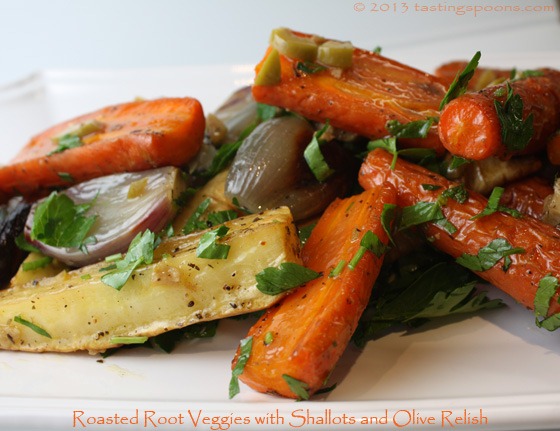
roasted_root_veggies_olive_relish_platterWhat a tangle of goodness! Parsnips, carrots and shallots roasted with a glaze of olive oil, then tossed with a relish composed of green olives, parsley, mint, vinegar and oil. Delish.

When I read this recipe at a recent cooking class, I really didn’t expect a lot. Oh, was I wrong on all fronts. It was the olive relish that kind of put me off, or so I thought, and yet, once the vegetables were roasted (and they become so sweet when they’re caramelized in the oven like these were) the olive relish with it’s slight bitterness, was a perfect counterpoint to the sweet veggies. In fact, if I could have gone back for seconds – and more of the relish – I would have. But it was all gone.

Just recently I made parsnips in an orange sauce in the pressure cooker, and was reminded, as I am every time, that parsnips have so much flavor. Why don’t I cook them more often? I should, and you should! Both the carrots and parsnips were similarly shaped – there was one honkin’ parsnip in there that was cut in half lengthwise and across, which ended up on my plate – and it was cooked through and not tough. Some parsnips have a tough core – if you cut the raw parsnip in half you can tell – the center is really  hard and the core is extra firm, sometimes even slightly separating from the rest of the outer part – if so, cut out that core part. Ideally, try to select similar sized parsnips and carrots. And I’d advise ample shallots – oh are they good!

So, I made these at home and added more of the olive relish – because it was so darned good. The recipe came from Tarla Fallgatter, but I found it at Martha Stewart online.roasted_vegs_sheet_pan I served them at room temp, just because I was in a kind of cooking flurry so I didn’t put them back in the oven. I probably should have – I think they’re better hot, but even cold they were delish.

The veggies are slicked with olive oil, salt, pepper and some miscellaneous herbs (rosemary, thyme and Greek oregano), then are roasted for about 45 minutes. Turn the pieces over at least once so more sides of the veggies are caramelized. Meanwhile, prepare the olive relish. The original cerignola_olivesrecipe calls for an olive I don’t know – cerignola – (it’s from a town in Italy – see photo at right that I found on the ‘net) but a pitted Spanish olive worked well enough. Just don’t include the pimento in the relish. Add some fresh parsley, fresh mint, some olive oil, salt, pepper and a little fruit vinegar and it’s done. Pour over the hot or warm vegetables and serve. If you want to, roast the vegetables ahead of time and at the last minute pop the pan back in the oven to reheat – just cover with foil so they don’t dry out – then toss with the relish. Serve to raves.

What’s good: every single, solitary bite. Unctuous, if you consider vegetables capable of being unctuous!
What’s not: nary a thing.

printer-friendly CutePDF
MasterCook 5+ import file – right click to save file (and remember where you put it), run MC, then File|Import

* Exported from MasterCook *

Roasted Carrots, Parsnips and Shallots with Green Olive Relish

Recipe By: Originally from Martha Stewart, adapted by Tarla Fallgatter, Feb. 2013
Serving Size: 8

1 pound carrots — scrubbed well (peeled if desired) – about 4
1 pound parsnips — scrubbed well (peeled if desired) – about 3-4
5 whole shallots — halved if large
3 tablespoons extra-virgin olive oil
Coarse salt and freshly ground pepper
2 tablespoons herbs — (rosemary, thyme, oregano)
OLIVE RELISH:
1/2 cup green olives — pitted and coarsely chopped (1 cup) Spanish olives without pimento
1 cup Italian parsley — coarsely chopped
1/3 cup extra-virgin olive oil
1/4 cup chopped fresh mint
2 tablespoons wine vinegar — use a fruity vinegar if you have one
Coarse salt and freshly ground pepper

1. Preheat oven to 450°. Toss carrots, parsnips, and shallots with oil, and season with salt and pepper. Spread mixture onto 2 baking sheets, and roast, turning sheets twice and rotating once, including turning over each vegetable once, until vegetables are golden brown and tender, about 35-40 minutes (remove shallots if cooked first). Can be baked ahead, allowed to sit at room temp for a couple of hours. Reheat in a 350° oven for 10 minutes, lightly covered in foil (so the veggies don’t dry out). Toss with the olive relish.
2. Olive Relish: Mix together olives, parsley, oil, mint, and vinegar. Season with salt and pepper.
Per Serving: 201 Calories; 15g Fat (65.7% calories from fat); 2g Protein; 16g Carbohydrate; 5g Dietary Fiber; 0mg Cholesterol; 102mg Sodium.

Posted in Soups, on February 16th, 2013.

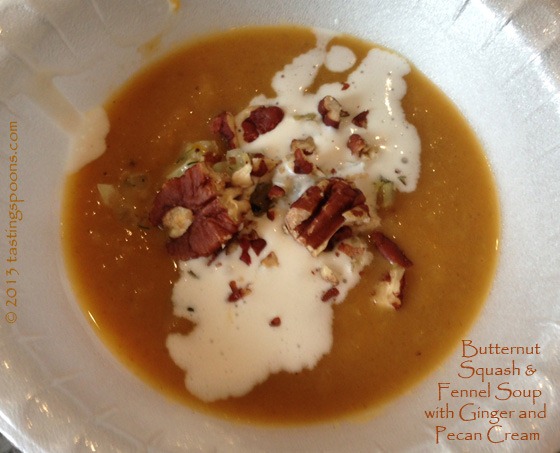
gingered_butterut_fennel_soup

Ever notice how flavorful butternut squash can be? And yet it’s such a nuisance to cut (sometimes I can’t even do it myself) and peel. But this soup is worth the hassle.

If you’ve visited Costco lately, then you likely have seen their package (2 pounds) of cubed, peeled butternut squash. Yippee for me! The only thing is – once you buy it, you need to cook it within a few days. Once cut, the squash doesn’t keep forever. So, given that, buy yourself one and make this tasty soup. Trader Joe’s also carries (sometimes) a similar package of butternut squash. And occasionally I see it frozen at some regular grocery stores. Or, if you’ve got some good muscles, do buy the fresher whole squash and do it yourself! This came from a cooking class I went to recently (Tarla Fallgatter) but I found the recipe online from Food and Wine, and it’s credited to Dean Fearing.

I happened to have some fennel on hand, so with the butternut squash all ready to go, this soup was very easy to make. The squash is roasted in the oven for 20-30 minutes (until tender). Meanwhile, gently sauté onion, fennel and fresh ginger in butter. Add the squash and chicken stock (or vegetable stock if you’d prefer a vegetarian soup) and cook until everything is tender. The soup is pureed (by blender or immersion blender), then gently reheated with the addition of a small amount of heavy cream. Toast some pecans, chop them, whip up just a little bit of heavy cream, add a sprinkle of cayenne pepper (yes, really) and dollop those on top. Makes for a lovely taste and a lovely presentation too.

At right is a photo I took at the class – see the difference in color? butternut_squash_fennel_soupWhen I made it myself, I had a couple of bulbs of fennel. I like fennel. So I decided to add one whole medium-sized fennel to this soup. It calls for half of one. And when I roasted the butternut squash, I likely didn’t roast it long enough – I cooked it through, but it adds a lot of flavor if you allow the butternut squash to caramelize. So, you’ll notice from the photo at the top, mine is a much lighter color – both from the lack of caramelization and from the addition of more fennel. But as for flavor – it was wonderful both times. The ginger – I probably added a bit more than called for and it was only mildly warm. One day I ate the soup cold (because I was just lazy) – it was wonderful! That’s the photo at top – I didn’t whip the cream, I just drizzled about a teaspoon of cream on top, then added the toasted pecans.

What’s good: the additions of the fennel and ginger give it a lovely nuanced flavor. And the topping just kind of puts in a higher realm. It would make a very nice company first course, or add a sandwich or salad and it would make a nice dinner too. The fresh ginger gives this soup just a little bit of heat – I liked that part. I really liked the texture of the soup – using an immersion blender I didn’t completely puree the soup (which was fine by me) so with the addition of the pecans, there was bit of crunch and the fennel didn’t completely disintegrate either. Lovely, really.
What’s not: nothing at all. It’s good all around.

printer-friendly CutePDF
MasterCook 5+ import file – right click to save file (and remember where you put it), run MC, then File|Import

* Exported from MasterCook *

Gingered Butternut Squash Soup with Spicy Pecan Cream

Recipe By: Dean Fearing recipe, via Food & Wine (2007), and from Tarla Fallgatter (cooking instructor) who made slight changes to the original.
Serving Size: 6

2 3/4 pounds butternut squash — halved lengthwise and seeded
1/2 tablespoon extra-virgin olive oil
1/4 cup pecans — (rounded – about 1 ounce)
1 tablespoon unsalted butter
1/2 large onion — cut into 1/2-inch dice
1/2 small fennel bulb — cored and cut into 1/2-inch dice
One 3/4-inch piece of fresh ginger, peeled and finely diced (or more if you like the heat)
3 cups chicken stock
1 cup heavy cream — or light coconut milk
Kosher salt to taste
CREAM TOPPING:
1/3 cup heavy cream — chilled
1 dash cayenne pepper
A light drizzle of hazelnut oil on each serving (optional)

Note: when I made this I used more fennel (because I like fennel) but it will provide a stronger flavor. If you roast the whole squash, it will have a dark golden color. Baking the cubes won’t do that unless you roast it until it acquires that golden hue. That will also change the color of the soup. Adding more fennel lightens the color of the soup. The fennel is barely discernible in the taste profile if you use just 1/2 of a small fennel bulb. The ginger provides just a little hint of spicy heat.
1. Preheat the oven to 350°. Rub the cut sides of the squash with the olive oil and set them, cut side down, on a large rimmed baking sheet. Bake the squash for about 1 hour, or until very tender. Remove from the oven and let stand until cool enough to handle. Spoon the squash flesh into a large bowl; discard the skins. If baking already peeled and cubed squash, bake about 30-40 minutes until ender.
2. In a pie plate, toast the pecans for about 8 minutes, or until lightly browned and fragrant; let the nuts cool.
3. In a large pot, melt the butter. Add the onion, fennel and ginger and cook over moderate heat until softened, about 8 minutes. Add the squash and the chicken stock, cover and simmer for 20 minutes, stirring occasionally. Uncover the pot and continue cooking until the squash starts to fall apart, about 10 minutes. Remove from the heat and stir in the coconut milk.
4. Meanwhile, in a food processor, pulse the pecans until they are finely chopped. In a medium bowl, beat the cream until soft peaks form. Fold in the chopped pecans, hazelnut oil and cayenne pepper and season with salt.
5. Working in batches, puree the squash soup in a blender until smooth. Season with salt. Ladle the soup into bowls, top with a dollop of the pecan cream. Drizzle with hazelnut oil if desired and serve.
6. Make Ahead: The soup can be refrigerated for up to 2 days. Reheat gently, adding a little chicken stock to thin the soup. Or freeze (without the topping) for longer storage. The original recipe included adding a little bit of lemon juice at the very end.
Per Serving: 339 Calories; 26g Fat (66.5% calories from fat); 4g Protein; 25g Carbohydrate; 4g Dietary Fiber; 78mg Cholesterol; 1111mg Sodium.

Posted in Pork, on February 14th, 2013.

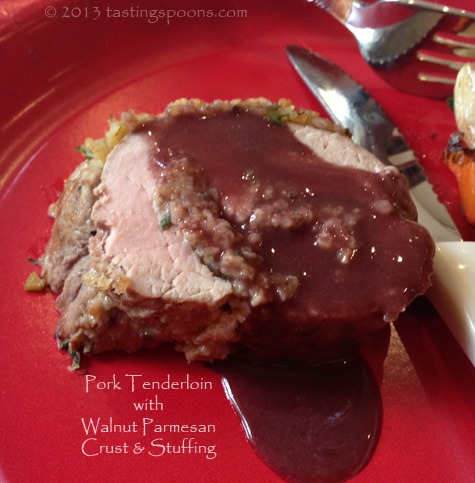
pork_tenderloin_walnut_parm_crust

Pork tenderloin can make a really nice company meal, if you’re willing to fancy-it-up a little by butterflying it and adding a tasty filling, and then making a quick red wine pan sauce to drizzle on top. Most of the work can be done hours ahead and just finish at the last minute.

I read the other day that the price of pork is going to go up – if it hasn’t already. Food in general, it seems to me, has gone up a whole lot more than than the inflation rate. Have you noticed that? Pork has been one of the best bargains in the meat world for a long time. Anyway, I buy those nice, big pork tenderloins at Costco. I bake one right away, then seal up the others in FoodSaver bags to freeze and defrost whenever I have the need. I’ve found that, especially if you stuff a tenderloin, these from Costco will feed at least 3 people, maybe even 4, as long as you don’t have a high school linebacker at the dinner table! And providing you have other dishes to round out the plate – like a carb and ample vegetables.

This recipe, adapted by Tarla Fallgatter at a recent class, came from a Food & Wine article way back in 2001. Tarla used a pork tenderloin instead of a roast. Whenever I go to a cooking class I assume that many of the instructors use or revise some older recipes, so I search online to find them – that way I don’t have to type the recipe from scratch into my recipe software.

Butterflying a pork tenderloin is perhaps a little tricky. However, you’re in luck, there’s a video on vimeo showing you exactly how to do it. Cutting the second side (latter part of the video) shows it better than the first half. Technically you cut open the tenderloin like a book, then you open each side further like a fold-out in a magazine. It’s really easy and once you’ve done it once you’ll have no difficulty repeating it. One of the nice things about this stuffed roast is that you can do most of the work ahead of time – even the day before.

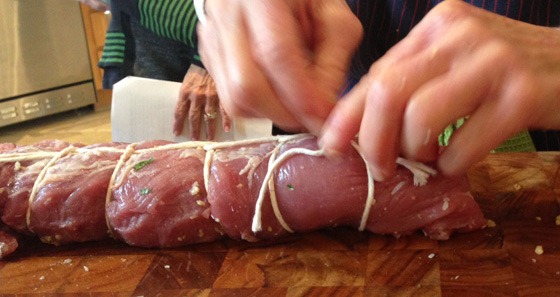
pork_roast_tiesThe stuffing and crust are composed of onion cooked in butter, walnuts, panko crumbs, parsley, fresh sage and freshly grated Parmigiano cheese. Part of that filling is set aside and is used as a crust after the tenderloin is roasted. The filling is spread throughout the butterflied meat, rolled up carefully, then tied in multiple places to keep it intact through pan-browning it. Into a roasting pan it goes with a little bit of water (to keep it from drying out), then it’s covered (with foil if that’s what’s available rather than a lid) and baked for 20 minutes. Then it’s removed to yet another pan. Stay with me here . . . The pan sauce is made on the stovetop IN the roasting pan you baked the meat in). The roast has its strings removed at this point, then is topped with that saved filling (that now becomes a top crust) you set aside earlier, then it’s broiled briefly just to give that crusty topping a golden brown glow.

Meanwhile, you’ve made the red wine sauce – it’s quite simple – red wine, reduced down, chicken broth also reduced, then it’s thickened with a cornstarch slurry, seasoned, buttered and it’s done. Carve the meat and serve! Now, as for the make-ahead part . . . you can stuff it and tie it ahead – hours before or even the day before. Have all of the other ingredients measured and ready. Just before serving you’ll need to pan-brown the meat, bake it, then make the sauce. Not exactly quick, but not difficult. If one of your guests will help, have them make the pan sauce while you finish up the rest of dinner and broil the meat.

What’s good: lovely presentation, and the meat is just pink-tender. The easy pan sauce adds a nice touch for a company meal.
What’s not: nothing, really. It’s a bit of work, but you’ll master it, then you can make it again!

printer-friendly CutePDF
MasterCook 5+ import file – right click to save file (and remember where you put it), run MC, then File|Import

* Exported from MasterCook *

Stuffed Pork Tenderloin with a Walnut-Parmesan Crust

Recipe By: Originally from Food and Wine, 2001, adapted by Tarla Fallgatter, Feb. 2013
Serving Size: 6

3/4 cup walnut halves — about 3 ounces
2 tablespoons unsalted butter
1 medium onion — minced
1/4 cup Panko bread crumbs
2 tablespoons Italian parsley — finely chopped
2 teaspoons sage — finely chopped
1/4 cup Parmesan cheese — freshly grated
Salt and freshly ground pepper
1 1/2 pounds pork tenderloin — butterflied
1 tablespoon extra-virgin olive oil
1/4 cup water
RED WINE SAUCE:
1/4 cup dry red wine
1/2 cup low-sodium chicken broth
1 teaspoon cornstarch
2 teaspoons water

1. Preheat the oven to 375°. Spread the walnuts in a pie plate and toast for about 7-9 minutes, or until golden. Let cool, then coarsely chop the nuts. Leave the oven on.
2. Melt the butter in a medium skillet. Add the onion and cook over moderately high heat until softened and lightly browned, about 5 minutes. Add the ground walnuts, bread crumbs, parsley and sage and let cool. Stir in the Parmesan and season with salt and pepper.
3. Butterfly the pork tenderloin – slice it deeply (but not clear through) down the length. Once you spread that open, cut another butterfly slice through each side which will allow you to spread it open further. Season with salt and pepper. Spread half of the walnut mixture on the pork, then roll up the roast and tie it at 1-inch intervals with cotton string.
4. In a sturdy roasting pan, heat the olive oil until shimmering. Season the roast with salt and pepper and cook over moderately high heat until browned all over, 5-6 minutes. Add water to the pan and cover loosely with foil. Roast the pork about 20 minutes until meat is done. Transfer the pork to a baking sheet.
5. Preheat the broiler. Discard the strings from the pork. Gently press the remaining ground walnut mixture onto the top of the pork and broil 10 inches from the heat for about 5 minutes, or until the nut crust is golden and crisp. Remove from broiler, cover loosely with foil and allow pork to stand while you make the sauce.
6. Set the roasting pan over high heat. Add the red wine and boil until reduced by half, scraping up any browned bits from the bottom of the pan. Add the chicken stock and any reserved pan juices and boil until reduced by one-third. Whisk the cornstarch into an equal quantity of water, then whisk the slurry into the sauce in the roasting pan and bring to a boil. Cook until the sauce is slightly thickened. Strain the sauce into a gravy boat and season with salt and pepper.
7. Carve the pork into thick slices and serve with the sauce.
8. Make Ahead: The pork can be prepared through Step 3 and refrigerated overnight.
Per Serving: 236 Calories; 12g Fat (45.3% calories from fat); 27g Protein; 4g Carbohydrate; 1g Dietary Fiber; 87mg Cholesterol; 138mg Sodium.

Posted in Desserts, on February 12th, 2013.

silky_choc_cake_whipped_cream

Silky = smooth and almost molten. Not quite, but nearly so. You can see that this cake doesn’t ooze, but can you see how shiny it is? It’s really, really moist – it’s not at all like candy, so don’t misunderstand my description – it’s just incredibly chocolaty and smooth.

At a cooking class last week Tarla Fallgatter served this unctuous chocolate dessert. Unbelievably chocolaty and rich. Smooth and addictive. If you’re still wondering what to serve for Valentine’s Day – if you’re cooking at home that night – this is your romantic ticket. If I were doing it, I’d likely cut the recipe in half and pour the cake into 4 ramekins and bake them individually. I don’t know how long they would take to bake that way, but maybe 15 minutes or so? That’s a guess.

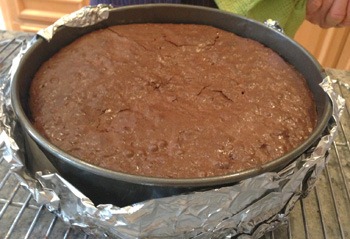
silky_choc_cake_bakedIn any case, if you’re a chocolate freak, you’ll be moaning as you spoon this into your mouth. It’s not all that difficult to make – really it’s easy – as long as you have an 8-inch springform pan – and you have bittersweet chocolate, eggs, butter, sugar, flour and a little cream to whip for the topping. It’s a 3-dish/pan dessert (saucepan to melt butter and chocolate, bowl to mix the batter in, and the springform to bake). You do have to put the springform pan (wrapped in foil) in a larger baking pan because you add hot tap silky_choc_cake_wholewater to it and it cooks in a water bath. That’s what keeps it so tender and moist – almost like pudding, except it’s definitely a cake. You’ll find this recipe in several places on the internet. This one came from Food and Wine, back some years ago.

What’s good: no question it’s the chocolaty-ness of it. Oh yes! Very decadent. Very rich. Very festive, and surely very romantic.

What’s not: as with most tortes and things of this nature, they’re not quite so good the next day. This one has to be made within about 6 hours of serving.

printer-friendly CutePDF

MasterCook 5+ import file – right click to save file (and remember where you put it), run MC, then File|Import

* Exported from MasterCook *

Silky Chocolate Cake

Recipe By: Originally from Food and Wine (2001), adapted slightly by Tarla Fallgatter, Feb. 2013
Serving Size: 8

9 ounces unsalted butter — cut into tablespoons
1 cup granulated sugar
1/2 cup water
1/2 pound bittersweet chocolate — coarsely chopped
1/2 cup all-purpose flour
3 large eggs — beaten
Confectioners’ sugar to dust top or whip 1/2 cup cream with added sugar and vanilla

Note: the cake is almost, but not quite, molten. It’s VERY soft and very wet – except the top crust which is almost crispy. This cake is all about the texture and the chocolate! Be sure to use bittersweet – if you use a semisweet, cut down on the sugar.
1. Preheat the oven to 350°. Wrap the outside of an 8-by-3-inch round springform pan in heavy-duty foil, then generously butter the inside of the pan. Set the springform in a small roasting pan.
2. In a saucepan, combine the butter with the granulated sugar and water and bring to a boil over moderate heat, stirring. Remove from the heat. Add the chocolate and stir until smooth; let cool.
3. In a medium bowl, whisk the flour with the eggs until blended. Add to the chocolate batter and whisk until smooth. Pour the batter into the prepared springform pan. Pour enough hot water into the roasting pan to reach halfway up the side of the springform. Bake the cake in the oven for about 1 hour and 15 minutes, or until the top is crusty and a cake tester inserted in the center of the cake comes out with a few very moist crumbs attached. Let the cake cool in the springform on a rack for 20 minutes. Remove the foil and the side of the pan and let the cake cool completely. Dust the cake with confectioners’ sugar or spoon whipped cream on each slice just before serving.
4. Make Ahead The cake can be prepared 6 hours ahead. Leave out at room temperature.
Per Serving: 530 Calories; 43g Fat (68.3% calories from fat); 6g Protein; 39g Carbohydrate; 5g Dietary Fiber; 149mg Cholesterol; 35mg Sodium.

Posted in Essays, on February 11th, 2013.

I’ve just gotten around to reading the January 2013 issue of Bon Appetit. It’s a very interesting issue with some edgy ideas I certainly found thought-provoking, so I’m sharing them with you. They call it the “The Cooking School” issue. That doesn’t mean a list of cooking schools to go to, or places that hold cooking classes. No, the subtitle is about learning to master some of the basic cooking school techniques. Particularly it’s about pan roasts, salads, braises, sauces and salted sweets. Normally I wouldn’t even give that a passing glance, other than breezing by some of the recipe titles, since I (think I) already know how to pan roast, braise, sauce and make sweets. But even I – an experienced home cook – found the articles interesting, informative, very explanatory – and the recipes are different.

After reading the issue, almost cover to cover, I tried a salted chocolate chunk cookie (I will share it in a day or two, even though it didn’t hit my CC cookie buttons particularly – but it might hit yours). Anyway, I will share another recipe from this cooking school section, but what I wanted to talk about was the section on salads. The title page of the sub-chapter on salads says:

Skip the lettuce and tomato. Instead, follow the lead of today’s hottest restaurants by making crisp, vibrant shaved-vegetable salads without a mesclun green in sight.

Next to that was a carrot salad that looked like the carrot pieces were shaved and crisp-roasted (actually they weren’t baked at all, but they were crisp-curled in ice water). Here’s the more thorough preface:

For years, you couldn’t go to a four-star restaurant without getting a forkful of mâche. Then there was a love affair with arugula. And we still have feelings for kale. But these days, the salads we really can’t resist don’t even have the very thing that used to define salads: the greens. Like many of the country’s most inventive chefs, we’re replacing them with other, less obvious vegetables (and nuts and herbs and seeds). Mandoline in hand, we’re shaving sturdy produce into ribbons and coins, adding outside-the-salad-bar complements, and dressing them lightly in simple vinaigrettes. The results are delicate, yet packed with bite – and without question, far more dynamic than any bowl of romaine and Ranch could ever be.

No, that’s not my baby picture . . . I just had to make a point here – I’m not crying buckets – yet – because I’ll still be making salads with greens no matter what the food experts or trends have to say. Not that I won’t dip my big toe into the arena of these newer salads, but I still love arugula, and kale and romaine. Ranch? Not so much.

On one of the pages of this multi-page chapter there is a chart of what to put in these new veggie-centric salads. It’s divided into 3 sections:

  • Foundation (thinly slice one or two of these): fennel, cucumber, celery, beets, radishes and celery root
  • Dimension (add smaller quantity of one or two of these to lend character): coarse breadcrumbs, apple, cumin seeds, red onion, Parmesan, pepitas
  • Finish (a bright element – like lots of fresh herbs): parsley, celery leaves, watercress

Lastly, I’ll share one more sidebar on one of the pages. Here’s what it said:

Balsamic is not king – and other truths about vinaigrette (3 rules for dressing a 2013 salad): (1) Rethink your vinegar [no more balsamic, instead use sherry vinegar and champagne vinegar]; (2) Easy on the oil [no more 3:1 ratio of oil to vinegar; instead lean toward 2:1 which will work with the more subtle sherry and champagne vinegars since they’re much milder, less acidic; if you find them too astringent, just add a bit more oil, but not back up to the 3:1 we have been used to.]; (3) Hands, not tongs: use your hands, not tongs . . . as it’s the best way to tell if the salad is over- or under-dressed.

I’m not so sure this will work for me, although I have pretty much stopped using balsamic vinegar in salad dressings – they’re too much, too heavy and often too acidic, even though I use better balsamics (i.e., more expensive). I use it in other things, but rarely in salads anymore. I’m also not so sure I can handle the acidity of a 2:1 oil to acid ratio in a salad dressing. That’s going to be very astringent. It might depend on the brand of sherry vinegar or champagne vinegar. I’ll have to test a few salads and see what I think.

As I write this, I’m going to make a different salad from the issue – a celery salad with celery root and horseradish. Most likely I’ll post it. I happen to love celery leaves and they’re dominant in this particular salad.

Posted in Soups, on February 10th, 2013.

creamy_cauliflower_soup

I know – this doesn’t look like much. A milky blah-looking soup. It isn’t blah. Yes, creamy – but creamy from milk, not so much cream (some half and half used). Perhaps you can vaguely see little specks of orange (carrots) and green (celery). There’s also a lot of cauliflower in it, which gives the soup a very mellow flavor and certainly a white color!

Veggie soups are a favorite of mine, and I don’t have very many that aren’t enhanced significantly with carbs – either beans, rice or potatoes. And since we do try to limit carbs around our house – when I saw this one that’s strictly veggies (except for the carrots, but there aren’t many in there), I knew I’d try it. The recipe came from The Pioneer Woman. You know, of course, that even vegetables have carbs – even ordinary ones like onions and celery. Not all that many, but some. And flour (used to thicken the soup) is pure carb, so there ARE carbs in this soup, but it’s not carb-centric. An entrée serving contains 28 grams of carbs.

Right off the bat I’m telling you this isn’t a wow kind of soup. It’s hot, it’s comforting, it’s mostly smooth (because I whizzed most of it in a blender, contrary to Ree’s recipe) and it’s filling, especially with a little open-faced toasted cheese sandwich I made on some super-thin bread. It’s tasty. But it’s not something you’re going to go raving to the world about. But yes, I’d make it again – probably with more cauliflower in it. I might add fennel to the veggie mix. Or perhaps some leeks. AND, I’d sprinkle in a bunch of grated cheese at the end and merely stir it in (no more cooking once you do that). But otherwise, it’s a fine soup. Relatively easy to make (it does require 2 pans, one for the soup and one for the creamy gravy base you add to it) too. A little bit of sour cream is added in at the end (I used Mascarpone because that’s all I had) which adds just a bit of richness. I froze half of it and will serve that later, or maybe I’ll give it to a dear friend who has just had shoulder surgery and she’ll be hard pressed to cook much in coming weeks.

What’s good: just the wholesomeness of it – simple ingredients, a good soup for a cold winter’s day. Nothing fancy, nothing difficult. Not exceptional, but it’s good.
What’s not: nothing really.

printer-friendly CutePDF
MasterCook 5+ import file – right click to save file (and remember where you put it), run MC, then File|Import

* Exported from MasterCook *

Cauliflower Soup

Recipe By: Adapted just slightly from The Pioneer Woman
Serving Size: 6

1 stick butter — divided
1/2 whole onion — finely diced
1 whole carrot — finely diced
1 stalk celery — finely diced
1 whole cauliflower — up to 2 small heads, bite-sized chop
2 tablespoons fresh parsley — chopped
2 quarts low-sodium chicken broth — or stock
6 tablespoons all-purpose flour
2 cups whole milk
1 cup half and half
2 teaspoons salt — (or up to 4 t)
1 cup sour cream — (heaping) room temp (or creme fraiche or Mascarpone)

Note: if you want chunky soup, leave veggies in larger pieces. I pureed half or more of the soup in a blender and left some chunky.
1. In a large soup pot or dutch oven, melt 4 tablespoons butter. Add the onion and cook for a few minutes, or until it starts to turn brown.
2. Add the carrots and celery and cook an additional couple of minutes. Add cauliflower and parsley and stir to combine.
3. Cover and cook over very low heat for 15 minutes. After 15 minutes, pour in chicken stock or broth. Bring to a boil, then reduce heat and allow to simmer.
4. In a medium saucepan, melt 4 tablespoons butter. Mix the flour with the milk and whisk to combine. Add flour-milk mixture slowly to the butter, whisking constantly.
5. Remove from heat and stir in 1 cup half-and-half. Add mixture to the simmering soup. Allow to simmer for 15 to 20 minutes. Check seasoning and add more salt or pepper if necessary. If desired, use an immersion blender to puree the soup. The soup is creamy-thin – if you want a thicker soup use more flour to thicken it.
6. Just before serving, place the sour cream in a serving bowl or soup tureen. Add two to three ladles of hot soup into the tureen and stir to combine with the sour cream. Pour in remaining soup and stir. Serve immediately.
Per Serving: 403 Calories; 34g Fat (65.7% calories from fat); 21g Protein; 19g Carbohydrate; 1g Dietary Fiber; 84mg Cholesterol; 1013mg Sodium.

Posted in Desserts, on February 8th, 2013.

creamiest_rice_pudding_ever

My husband said: “Wow, this pudding is fantastic!” Now, you have to understand that he’s a Type 1 diabetic, and he steers away from desserts 95% of the time, so any time he does eat dessert he thinks he’s in heaven. But I’ll attest – this rice pudding is fabulous.

You know how it is when you read some recipe somewhere and it just plain “speaks” to you? That’s what happened when I was reading Baking Banter, the baking blog from King Arthur Flour. I subscribe to their blog through Google Reader, and the varied bakers post several times a week. And I just love how they design a recipe – how they test and change, taste and change, until they finally get it right. And this recipe is just absolutely SPOT-ON! Kuddos to Mary Jane Robbins, who developed this recipe for King Arthur.

I have another recipe for rice pudding here on my blog. And in comparing this one to the other one, they’re very similar. And yet, I think this one is better (probably because of the cream added). Much better. I liked the creamy texture of this one. The little bit of bite to the rice (particularly you don’t want to overcook the rice, because then it would be mushy). The other aspect of this pudding is its focus on the vanilla. Two different types of (King Arthur) vanilla are called for here. I used two different types I had on my pantry shelf, neither of which are King Arthur. Use your best vanilla to stir in after the pudding is cooked.

stirrSurely, I should have taken a photo of the pudding as it was simmering away, with my handy-dandy Stirr device (now called a RoboStir – very inexpensive if you’re interested) jittering around inside the pan. Here at right is a picture I found online. I’ve written about it before, but it’s a battery-operated device that sits inside the pan, has silicone feet and once you turn it on (mine has 4 speeds), it jitters itself around the pan, turning in circles to keep the pot contents moving – stirring. It’s an automatic stirring device is all I can tell you, and it worked SO perfectly for this pudding! I also use it on the rare occasions I make risotto. It’s ideal for sauces.  Just an aside about this device – if you go online, lots of people don’t like it. Including Consumer Reports, who found it worked for very few things. A thick sauce will stop it cold. Some people think it’s a joke. Mine works well – have never used it except on the lowest speed. It doesn’t do dry ingredients (like toasting nuts) or frying onions as it just pushes the items out to the edges of the pan. It must have liquid to help it move the contents. It does require a pan with a sufficient flat surface AND the cooktop needs to be level. If it’s not level, the device will simply gravitate to the lowest spot and sit there, still jittering, but it won’t migrate around the pan as it’s designed to do. My dear hubby (DH) did level my range for me last year. I didn’t realize how “off” it was. I made this pudding in a pan with rounded edges – mine is a Caphalon nonstick pan – a saucier pan that Caphalon doesn’t make anymore, but a similar one would work because it has a gently rounded bottom edge – a Calphalon Unison Nonstick 4-Quart Pot with Lid. The key is the sloping edge – you don’t want a squared-off 90° angle as it’s very difficult to stir that corner (whether you’re using a stirring device or an ordinary spoon) and keep the pudding from burning. Or if you’re making a sauce, or a creamy soup. This particular pot is called a soup pot.

Okay, so here’s how you make it – you combine the whole milk, some of the cream, sugar (and not very much of it), some of the vanilla and Arborio rice (a short grain rice, which works best for rice pudding – you can also use sushi rice). Once you bring it to a simmer, reduce the heat and simmer very slowly, stirring very frequently, for about 30 minutes. At this point start tasting the rice – it still wants to have a little tiny bit of bite (toothsome-ness, I call it). Continue simmering until it’s just barely done. Remove, allow to cool, stirring it every so often so a skin doesn’t form on the top (or put a piece of plastic wrap directly down on the surface), and you add a little bit more cream and more vanilla. Done. Once cool you can put it into ramekins, or just store in a plastic container and dish out what you want later. I found that the pudding was still very VERY loose once I took it off the heat, but I was assured in the recipe that it would firm up. Yes, indeed it did! In fact, when I went to serve it, I needed to add milk to it to kind of thin it a bit. It was amply thick at that point.

In most respects, this pudding is made like a risotto, except you start off with all the liquid in the pan at the beginning rather than adding it now and then. It’s EASY to make – although you do have to keep your eye on it. I made this as part of a dinner we took to our pastor and his family since he’s recently had surgery. But I made a double batch and kept a little bit of it for ourselves. What a treat.

What’s good: every single solitary thing about it. A must make – if you like puddings, and especially rice pudding! The vanilla flavor predominates (in a very good way).

What’s not: well, it does take some patience and hovering (unless you have one of the stirring devices). I’ll definitely be making this again!

printer-friendly CutePDF

MasterCook 5+ import file – right click to save file (and remember where you put the file), run MC, then File|Import

* Exported from MasterCook *

Very Creamy Vanilla Rice Pudding

Recipe By: KAF Baking Banter, 1/2013 (Mary Jane Robbins)
Serving Size: 6 (1/2 cup servings)

2 cups whole milk
1 cup heavy cream — divided
1/4 cup sugar
1/2 cup Arborio rice — or sushi rice
1/2 teaspoon vanilla extract — King Arthur Pure Vanilla Extract preferred
1/2 teaspoon vanilla extract — Vanilla Bean Crush or King Arthur Pure Vanilla Plus
1 pinch salt

1. Place the milk, 3/4 cup cream, sugar, rice, and vanilla extract in a medium-sized saucepan over medium heat.
2. Bring to a simmer and cook, stirring frequently, for 30 minutes, until thickened. This is very similar to cooking risotto.
3. Taste the rice to ensure it’s done. You want a firm bite, but no crunchy center to the kernel. Remove from heat as soon as it reaches that perfect time.
4. Stir in the remaining 1/4 cup cream and the Vanilla Bean Crush or Pure Vanilla Plus, along with a pinch of salt. The pudding will firm up as it cools.
5. Serve warm; or refrigerate, well covered, and serve chilled. Sprinkle with a touch of ground cinnamon, if desired. 1/2 cup servings are sufficient. Stir in additional milk if the pudding is too thick.
Per Serving: 277 Calories; 17g Fat (56.3% calories from fat); 5g Protein; 26g Carbohydrate; 0g Dietary Fiber; 65mg Cholesterol; 80mg Sodium.

Posted in Pork, on February 6th, 2013.

roast_pork_loin_adobo_blackbeans_rice

Who knew a pork roast could taste so moist and flavorful, and that black beans and rice cooked underneath the pork could absorb so much flavor from the meat drippings?

My friend Cherrie gave me a cookbook called Perfect One-Dish Dinners: All You Need for Easy Get-Togethers. I hadn’t cooked anything from it, although I’d read through it and knew I wanted to. The cookbook assumes that you want to entertain occasionally, but you want to cook everything in one pot (for ease), but also have it be nice enough for guests – and tasty enough to wow them a little.

We were having Cherrie and Bud over for dinner, so it was a perfect opportunity to try something from this cookbook. I told my DH about 2 recipes – a stuffed chicken breast and a stuffed pork loin and gave him the choice. He chose the pork. He went off shopping for me (bless his heart – he loves to go grocery shopping!).

It’s kind of a long story, but my DH could not find the long, long package of boneless pork loin at Costco. He phoned me in distress – what should he do? I finally told him to buy a sirloin package he’d found instead. But truthfully, I’d never fixed a sirloin pork roast before, so didn’t know how I was going to adapt the recipe. As it turned out, it wasn’t a problem. We found an illustration of a pig (butchered), and I ended up following the directions just as if it was a boneless pork loin and it cooked the same. But instead of a longer roast in one piece, I actually cooked 2 of the sirloin roasts (way too much for 4 people – the Costco package contains 4 chubs of sirloin roast and I’d say each one easily serves 4 people).

pork roast adobo

First I made up the adobo-chorizo stuffing. I used the dry Spanish chorizo – the recipe doesn’t specify, but just called for fully-cooked chorizo. Anyway, that was cut up into chunks (after peeling off the skin). It gets whizzed up in the food processor with fresh cilantro, some garlic you’ve cooked in olive oil, some chipotle chiles in adobo, dry bread crumbs and ground cumin. I cut deep slits in the pork roast and gently opened it up to push in the stuffing.

My DH helped me tie up the roasts – you don’t want the filling to leak out. It’s a dry kind of filling, so it really shouldn’t leak, exactly.

Then you mix up some spices – also adobo style – cumin, salt, pepper, paprika, brown sugar – and gently roll the roast in those seasonings. Including the ends, which often get overlooked.  They were now ready for baking.

In the bottom photo you can see the roast is sitting on a rack and it’s in a roasting pan (mine is nonstick). It went into a 250° oven for about 1 1/2 hours – until the meat had reached about 125° (not cooked sufficiently yet). Then, you remove the meat and the rack and set it aside momentarily. Tick the oven up to 400°. Everything was all ready to go – I’d pressure cooked some black beans (11 minutes after a 1-hour water soak), measured long grain rice and opened a can of diced tomatoes. And measured out chicken broth. All that was dumped into the bottom of the pan and stirred around. There were a few – really very few drips on the pan bottom – just enough to give some flavorful Chorizo and cumin flavoring to the rice. The roast went back in with the rack, which sat just above the beans and rice below. Back into the oven it went, and the rice was done in exactly 20 minutes, just as the recipe indicated.

The pan was removed from the oven, the roast set aside for a few minutes to rest, and I covered the beans and rice with foil so it wouldn’t get cold. Meanwhile I mixed up the salad and got everything all ready. The meat was sliced and I quickly poured the beans and rice down both sides and served it. I sprinkled on some cilantro, but forgot the green onions! I didn’t make anything other than the salad.

What’s good: that it cooked all in one pan. I won’t exactly call this a cinchy, easy dish, but it’s not all that difficult, either. Much of it could be done ahead of time. The pork roast bakes untended for 90 minutes or so, and then another 20 minutes once you add the beans and rice. So the labor part can all be done at the beginning, or earlier in the day, or even the day before. It makes a lovely presentation – especially on a bright contrasting platter. And the flavor was wonderful. I’d definitely make this again and especially for guests. Next time I would probably make some kind of colorful veggie (broccoli? asparagus? red bell peppers?), although it really doesn’t need it. We just like veggies and prefer them to carbs. But oh, these carbs were delish and especially good along side the slices of pork. And even though this recipe is long and has a rather long list of directions, it’s not hard.
What’s not: absolutely nothing at all.

printer-friendly CutePDF
MasterCook 5+ import file – right click to save file (and remember where you put it), run MC, then File|Import

* Exported from MasterCook *

Roast Chorizo-Stuffed Adobo Pork Loin With Black Beans And Rice

Recipe By: Adapted from Perfect One-Dish Dinners: All You Need for Easy Get-Togethers by Pam Anderson.
Serving Size: 16
NOTES: If you can’t find a whole pork loin, you can use the chubby sirloin roasts; you’ll just need to cut a big pocket in each one to insert the chorizo filling. The cooking time is about the same.

16 large garlic cloves — peeled
6 tablespoons olive oil — divided
3/4 pound Spanish chorizo, dry — fully cooked, peeled, cut into large chunks
1 cup fresh cilantro leaves — plus 1 cup chopped
2 tablespoons chipotle chile canned in adobo — or more if you like heat
3/4 cup dry bread crumbs — plain, not flavored
3 tablespoons ground cumin — divided
1 1/2 tablespoons kosher salt — plus 2 teaspoons, divided
1 tablespoon freshly ground black pepper — plus 1 1/2 teaspoons, divided
2 tablespoons paprika
2 tablespoons light brown sugar — packed
6 pounds boneless pork top loin — (see Notes)
4 pounds canned black beans — (15 to 16 ounces each) drained
1 quart low-sodium chicken broth
2 cups long-grain rice
14 1/2 ounces diced tomatoes — undrained
1 bunch scallions — thinly sliced (about 1 cup)

1. Heat garlic cloves and 3 tablespoons oil in a small skillet over medium heat. Once garlic starts to sizzle, reduce heat to low and continue to cook, turning cloves once or twice, until soft and golden, 5 to 7 minutes.
2. Meanwhile, place chorizo, 1 cup whole cilantro leaves, chipotles, bread crumbs, and 1 tablespoon cumin in a food processor bowl. Add garlic and its oil and process until ingredients are finely ground; set aside.
3. Mix remaining 2 tablespoons cumin with 2 tablespoons salt, 1 tablespoon pepper, paprika, and brown sugar in a small bowl.
4. Adjust oven rack to lower-middle position and heat oven to 250 degrees. Lay pork loin on a sheet of plastic wrap, fat side down. Slit pork loin lengthwise down center almost — but not quite — all the way through to form a long pocket. Brush cavity with 1 tablespoon oil and sprinkle with remaining 2 teaspoons salt and remaining 1 1/2 teaspoons pepper.
5. Line cavity with sausage mixture. Tie roast crosswise with butcher’s twine at 1 1/2-inch intervals, alternating between one end and the other so stuffing remains even.
6. Brush roast with remaining 2 tablespoons oil and sprinkle all over with cumin-paprika mixture.
7. Place roast on a wire rack set over a large heavy roasting pan and roast until a meat thermometer stuck into center registers 125 to 130 degrees, about 1 1/2 hours. Increase oven temperature to 400 degrees. Remove rack with pork from pan and add beans, broth, rice, and tomatoes.
8. Stir and return rack with roast to pan and return pan to oven. Continue to roast until a meat thermometer stuck into center of pork registers 155 to 160 degrees, about 20 minutes longer.
9. Transfer to a carving board and let rest, uncovered, for 15 to 20 minutes. Meanwhile, stir scallions and remaining 1 cup chopped cilantro into beans and rice; taste for seasoning (will probably need salt) cover and keep warm. Just before serving, cut roast into 1/2-inch-thick slices, place on individual dinner plates and spoon some rice and beans alongside. Or, place slices in the center of a long platter and pour beans and rice along each side. Sprinkle with additional cilantro.
Per Serving: 467 Calories; 15g Fat (28.2% calories from fat); 42g Protein; 42g Carbohydrate; 7g Dietary Fiber; 75mg Cholesterol; 1007mg Sodium.

Posted in Healthy, Salad Dressings, Salads, on February 4th, 2013.

balsamic_fig_dressing

A luscious salad – different – healthy, really – because it doesn’t have all that much oil in it – hard to believe it could taste so good! Dried figs give it a base, and you do add some crumbled bacon.

Having been asked to bring a salad to dinner at friends recently, I ransacked my to-try file, to find something that would complement Thomas Keller’s Roast Chicken and Vegetables, which my friend Donna was going to make. Donna reads my blog (thank you, Donna!) and is always so kind to tell me how much she likes it. Music to any blogger’s ears, I’ll tell ya!

It didn’t really take much to make this dressing – it’s an interesting one – it uses dried figs, balsamic vinegar (I used a fruit-flavored one, but you can use plain too), water, chicken broth (yes, really, chicken broth), honey, shallots and fresh thyme. All things I had on hand. The figs are simmered for green_salad_bacon_cotija_pinenuts

just a minute in the balsamic vinegar and allowed to “steep” or sit while you pull together the rest of the ingredients. Then it’s all whizzed up in the blender. Meanwhile, I chopped up and fried a bunch of bacon. I made this salad twice, on consecutive nights, and used different greens. I couldn’t find arugula the first day, so I substituted Romaine, leaf lettuce and microgreens. I actually think the salad needs some bitter greens to offset the fig-sweetened dressing, so the second time my DH was able to find arugula and I used Feta cheese  that time, rather than the cotija I’d tried the first time. The original recipe (from Cooking Light) called for goat cheese, but I didn’t have any. Nor did I really want to buy a log of goat cheese when I only needed a little bit for the salad. I almost always have Feta on hand, which keeps soaking in brine for many, many weeks. I did have cotija (it’s a dry, salty Mexican cheese that’s used mostly for garnish), so I used that one time.

arugula_salad_feta_fig_dressingThe second night (pictured above) I had arugula, but not quite enough dressing, so I just added more EVOO and another little jot of balsamic vinegar to what I had left from the previous night, and it was plenty for a salad for 4.

What’s good: the low-calorie, low-fat aspect of the dressing. Of course, bacon kind of puts it over the top, but once you divide it among several people, no one has all that much bacon. I added pine nuts one night just because I thought the salad needed some kind of crunch to it. Since it doesn’t have any added vegetables, I really did think it needed some added texture.

What’s not: nothing at all – just know this isn’t any standard kind of vinaigrette – it’s sweet from the figs, but will complement lots of meals – pork for sure – often pork is accompanied by fruit.

printer-friendly CutePDF

MasterCook 5+ import file – right click to save file (and remember where you put it), run MC, then File|Import

* Exported from MasterCook *

Arugula Salad with Bacon and Balsamic Fig Dressing

Recipe By: Adapted from Cooking Light, Nov. 2008
Serving Size: 6
NOTES: Use other lettuces if preferred, but use sturdy ones like Romaine, not tender leaf lettuces which won’t stay firm with the dressing.

DRESSING:
3 tablespoons balsamic vinegar — (use fruit flavored, if available)
3 whole dried figs — chopped (stem trimmed off)
3 tablespoons water
2 tablespoons low-sodium chicken broth
2 tablespoons extra-virgin olive oil
1 1/2 teaspoons honey
1/2 teaspoon minced shallots
1/2 teaspoon chopped fresh thyme
SALAD:
4 ounces arugula — (about 8 cups), lightly chopped
1/4 cup red onion — thinly sliced, (optional)
1/4 teaspoon freshly ground black pepper
1/8 teaspoon salt
3 pieces bacon — cooked and crumbled
2 tablespoons crumbled goat cheese — or Feta, or Mexican Cotija
1 tablespoon pine nuts — toasted (optional)

1. To prepare dressing, combine balsamic vinegar and figs in a small saucepan over medium-high heat; bring to a boil. Cover, remove from heat, and let stand 15 minutes. Combine vinegar mixture, 3 tablespoons water, and next 5 ingredients (through thyme) in a blender; process until smooth. Dressing will keep for several days.
2. To prepare salad, mix arugula with onion and toss with dressing. Taste for seasonings. Divide evenly among plates. Sprinkle with bacon, cheese and nuts. Serve immediately.
Per Serving: 114 Calories; 8g Fat (58.6% calories from fat); 3g Protein; 10g Carbohydrate; 2g Dietary Fiber; 5mg Cholesterol; 109mg Sodium.

Posted in Pork, Soups, on February 2nd, 2013.

malaysian_inspired_pork_stew

When I ponder something new to fix for dinner, I can’t say that I ever think about choosing Malaysian food! I don’t know that I’ve ever had Malaysian food, for that matter, until now!

I’d defrosted some pork – one of the few remaining packages from the 4-H Berkshire pig we bought over a year ago. I still have some bacon and ham and that’s about it. Even though the package said it was country ribs, it was a very small package, so I decided to spread out the pork wealth by making something like stew. As is my usual method, I went to Eat Your Books, where I have listed nearly all of my cookbooks. I put in “pork stew” and within seconds I had a list of the dozens and dozens of recipes contained in my own cookbooks. Well no, it doesn’t really have the recipes, it just has the title and the list of ingredients (by name, not quantity), which makes it quite simple to deduce if I have the ingredients on hand. In this particular recipe, yes, I had the pork, coconut milk, onions, white wine, ginger, tomatoes, fresh mint and cilantro. I didn’t have fresh basil, but I overlooked that one.

I just love that website – it makes finding a recipe so simple. Once I chose this recipe, I glanced at what cookbook – how funny – it’s from my mostly new-favorite book – The Essential New York Times Cookbook: Classic Recipes for a New Century. And better yet, once I pulled out the book itself, I found that I had already flagged the recipe – but just hadn’t gotten around to making it! All serendipity – it was meant to be!

The cookbook version suggests Boston butt or pork shoulder. I assumed the cooking time wouldn’t be much different for the country ribs. It also has you make it all on the stovetop, whereas I had decided to use the pressure cooker, which worked like a charm. The preparation is the same – it’s just the difference of the cooking time (10 minutes by pressure cooker, and about 60-90 minutes on the stovetop).

The pork stew chunks are dredged in a spicy mixture of curry powder, cumin and paprika. I had a hot curry powder, so I didn’t add cayenne as listed in the recipe. (Although, I couldn’t really discern any heat in the finished dish, so it was more mild than anticipated.) They were browned well in oil, removed, then I sautéed the onions (it called for red, I only had a yellow one). Then you add in all the other ingredients, including garlic and simmer. That’s when I put on the lid and pressure cooked it for 9 minutes.  I had a bit of coconut milk left over (I made half of the recipe you see below) so I just added it in at the last, along with the fresh green beans. I simmered them just until they were barely cooked through. Because we limit white carbs, I only used about 2-3 T. of cooked rice in each bowl, ladled the soup around the outer rim (so we could see the rice), then sprinkled on the garnishes. The lime juice adds a really important taste element – be sure to add that part. I liked the flavor combination from the spices (paprika, cumin and curry). The garnish is a combo of fresh mint, fresh cilantro, basil (if you have it, I didn’t), peanuts (I didn’t have peanuts, but I did have sliced almonds so I chopped those up) and lime juice. That garnish adds a wonderful touch to the taste.

What’s good: just the overall flavor of the gravy or soup part – it’s loaded with taste. The pork was nicely cooked, although not overly so. It might have been able to take another minute or two in the pressure cooker. I’m sure this could be made the day ahead, even. Just make the garnishes at the last minute. And the left overs – they were wonderful.
What’s not: nothing, really.

printer-friendly CutePDF
MasterCook 5+ import file – right click to save file (and remember where you put it), run MC, then File|Import

* Exported from MasterCook *

Malaysian-Inspired Pork Stew with Traditional Garnishes

Recipe By: Adapted a little from The Essential New York Times Cookbook (Hesser), but it’s originally from Chris Schlesinger and John Willoughby
Serving Size: 6
NOTES: The original recipe called for pork shoulder or Boston butt. I used country style ribs because that’s what I had on hand. The green beans are my addition, although they were suggested as an accompaniment to the meal, so I decided to just add them into the stew itself. I served this with rice (but a very small amount). I served it more as a soup than a plated main dish. It’s certainly up to you. I liked the gravy – it was slightly thickened – if you want it more thick, simmer the mixture longer before adding in the green beans.

2 tablespoons curry powder [I used a medium-heat version]
2 tablespoons ground cumin
1 tablespoon paprika
1 tablespoon cayenne pepper — or to taste [I omitted because the curry powder had heat]
2 pounds pork country-style ribs — boneless, cut into 1-inch cubes, trimmed of excess fat [or pork shoulder]
Salt and freshly ground black pepper
5 tablespoon olive oil
2 whole red onions — thinly sliced [I used yellow]
3 tablespoons minced fresh ginger
3 tablespoons minced garlic
3 plum tomatoes — cored and cut into small dice
1/4 cup soy sauce
1 1/4 cups light coconut milk — [original used full-fat coconut milk]
1 cup dry white wine
2 cups green beans — chopped in 1-inch pieces [optional]
GARNISHES:
1/4 cup basil — roughly chopped
1/4 cup cilantro — chopped
1/4 cup fresh mint — minced
1/3 cup peanuts — roasted, chopped
2 tablespoons fresh lime juice
Dashes of Tabasco sauce to taste
Cooked rice to accompany the stew

1. Combine the curry powder, cumin, paprika, and cayenne in a large bowl. Dry the pork cubes with paper towels, sprinkle with salt and pepper, and toss with the spice mix to coat.
2. Heat 3 tablespoons oil in a 5-inch-deep Dutch oven or other heavy pot over medium-high heat until hot but not smoking. Add the pork and brown well on all sides, about 10 minutes. Transfer to a platter, and discard the oil in the pot.
3. Add the remaining 2 tablespoons oil to the pot and heat over medium-high heat. Add the onions and sauté, until golden brown, 11 to 13 minutes. When you’re browning the pork and onions, make sure you scrape up the pan drippings so they don’t burn. Add the ginger, garlic and tomatoes and sauté for 2 minutes more. Return the meat to the pot, add the soy sauce, coconut milk, and wine, and bring to a simmer. Skim any film off the surface, then cover, reduce the heat to low, and cook gently until the meat is very tender, 1 to 1-1/2 hours. [I used a pressure cooker for 9 minutes.] Taste for seasonings, then add green beans and simmer on the stove top for 3-6 minutes until the green beans are JUST cooked through.
4. Combine the basil, mint, cilantro, peanuts, lime, Tabasco (if desired), and brown sugar in a small bowl and mix well. Place a generous helping of stew in each bowl, top with a couple tablespoons of garnish, and serve accompanied by rice. Alternately you can scoop rice into the center of a soup bowl, then gently spoon the stew around the mound and garnish it all.
Per Serving: 536 Calories; 38g Fat (65.4% calories from fat); 24g Protein; 21g Carbohydrate; 6g Dietary Fiber; 71mg Cholesterol; 779mg Sodium.

Related Posts Plugin for WordPress, Blogger...