Get new posts by email:

Archives

Currently Reading

Here are the tastingspoons players. I’m in the middle (Carolyn). Daughter Sara on the right, and daughter-in-law Karen on the left. I started the blog in 2007, as a way to share recipes with my family. I’m still doing 99% of the blogging and holding out hope that these two lovely and excellent cooks will participate. They both lead very busy lives, so we’ll see.

– – – – – – – – – – – – – – – – – – – – – –

BOOK READING (from Carolyn):

Music of Bees, Eileen Garvin. Absolutely charming book about a woman in midlife, lonely, who raises bees, also makes unlikely friends. Heart-warming and very interesting about beekeeping.

A Postcard from Paris, Alex Brown. Really cute story. Dual time line, 1940s and present day about renovating an old apartment in Paris, things discovered.

Time of the Child, Niall Williams. Oh such a good book. Very small village in Ireland, 1960s. A baby is left on the doorstep. The town all whispers and helps. I listened to an interview of the author, which made me like him and his books even more.

Sipsworth, Simon Van Booy. If you like animals you’ll swoon. An old woman who really wants to die finds a tiny mouse in her house and befriends it and finds a reason to live. Utterly charming book.

The Forger’s Spell, Edward Dolnick. True story. For seven years a no-account painter named Han van Meegeren managed to pass off his paintings as those of Johannes Vermeer.

If You Lived Here, You’d be Home by Now, Christopher Ingraham. Could hardly put it down – about a journalist who takes on a challenge to move to small town in Minnesota and write about it. He expects to hate it and the people and place, but he doesn’t. Absolutely wonderful true story.

The River We Remember, William Kent Kreuger. 1950s, Minnesota. A murder and the aftermath. Could hardly put it down. Kreuger has such a vivid imagination and writing style.

How the Lights Gets In, Joyce Maynard. An older woman returns to New Hampshire to help care for her brain-injured son. Siblings and family, lots of angst and resentments.

The Filling Station, Vanessa Miller. Every American should read this book. A novelized retelling of the Tulsa massacre in 1921. Absolutely riveting.

The Story She Left Behind, Patti Callahan Henry. Love this author. Based on a true story. A famous author simply vanishes, leaving her husband and daughter behind. She had invented a mystical language no one could translate. Present day, someone thinks he’s solved the riddle, contacts the family. Really interesting read.

The Girl from Berlin, Ronald Balson. Love anything about Tuscany. An elderly woman is being evicted from a villa there, with odd deed provenance. Two young folks go there to help unravel the mystery. Loved it.

The Island of the Colorblind, Oliver Sacks, M.D. Nonfiction. The dr is intrigued by a remote Pacific island where most of the inhabitants are colorblind. He also unravels a mystery on Guam of people born with a strange neurological problem. Medical mysteries unveiled. Very interesting.

The Bookbinder, Pip Williams. Post 1914 London. Two sisters work at a bookbindery. They’re told to not read the books. One does and one doesn’t. One has visions beyond her narrow world; the other does not. Eventually the one gets into Oxford. Lovely story.

The Paris Express, Emma Donoghue. 1895 on a train to Paris, a disaster happens. You’ll delve into the lives of many people who survived and died in the crash.

A Race to the Bottom of Crazy, Richard Grant. This is about Arizona. Author, wife and child move back to Arizona where they once lived. Part memoir, research, and reporting in a quest to understand what makes Arizona such a confounding and irresistible place.

The Scarlet Thread, Francine Rivers. A woman’s life turned upside down when she discovers the handcrafted quilt and journal of her ancestor Mary Kathryn McMurray, a young woman who was uprooted from her home only to endure harsh frontier conditions on the Oregon Trail.

A Place to Hide, Ronald Balson. 1939 Amsterdam, an ambassador has the ability to save the lives of many Jewish children. Heartwarming.

Homeseeking, Karissa Chen. Two young Chinese teens are deeply in love, but in China. Then their families are separated. Jump to current day and the two meet again in Los Angeles.

North River, Pete Hammill. He always writes such a good story. A doctor works diligently healing people from all walks of life. His wife and daughter left him years before. One day his 3-yr old grandson arrives on his doorstep.

A Very Typical Family, Sierra Godfrey. A very messed-up family. Three adult children are given a home in Santa Cruz, Calif, but only if the siblings meet up and live in the house together. A very untypical scenario but makes for lots of messes.

Three Days in June, Anne Tyler. The usual Anne Tyler grit. Family angst. This wasn’t one of my favorites, but it was entertaining and very short.

Saved, Benjamin Hall. Author is a veteran war reporter. Ukraine, 2022, he nearly loses his life to a Russian strike. Riveting story – he survives, barely.

Grey Wolf, Louise Penny. Another Inspector Gamache mystery in Quebec. She is such an incredible mystery writer.

All the Colors of the Dark, Chris Whitaker. A missing person mystery, a serial killer thriller, a love story, a unique twist on each. Could hardly put it down.

Orbital, Samantha Harvey. Winner of 2024 Booker Prize. I don’t usually like those, but I heard the author interviewed and she hooked me. This is not a normal book with a beginning, a story and an end. It’s several chapters of the day in the life of various astronauts at the ISS (Int’l Space Station). All fictional. She’s been praised by several real astronauts for “getting it” about space station everyday life.

The Blue Hour, Paula Hawkins. An island off Scotland. Inaccessible except when the tide is out. Weird goings on. An artist. A present day mystery too.

Iron Lake, William Kent Krueger. A judge is murdered and a boy is missing. Riveting mystery.

Tell the Wolves I’m Home, Carol Ricks Brunt. 1980s. A 14-yr old girl loses her beloved uncle. Yet a new friendship arises, someone she never knew about.

Four Treasures of the Sky, Jenny Zhang. 1880s, a young girl is kidnapped in China and brought to the United States. She survives with many hurdles in the path.

The Boy Who Fell out of the Sky, Ken Dornstein. Memoir, 1988. The author’s brother died in the PanAm flight that went down in Lockerbie, Scotland. A decade later he tries to solve “the riddle of his older brother’s life.”

Worse Care Scenario, T.J. Newman. Oh my. Interesting analysis of what could/might happen if a jet crashed into a nuclear plant. Un-put-downable.

Song of the Lark, Willa Cather. Complicated weave of a story about a young woman in about 1900, who has a gifted voice (singing) and about her journey to success, not without its ups and downs.

Crow Talk, Eileen Garvin. Charming story which takes place at a remote lake in Washington State, about a few people who inhabit it, the friendships made, but also revolving around the rescue of a baby crow.

The Story Collector, Evie Woods. Sweet story about some dark secrets from an area in Ireland, a bit magical, faerie life, but solving a mystery too.

A Sea of Unspoken Things, Adrienne Young. A woman investigates her twin brother’s mysterious death. She goes to a small town in California to figure it out, to figure HIM out.

The King’s Messenger, Susanna Kearsley. 1600s England, King James. About one of his trusted “messengers,” and his relationship with a young woman also of “the court.” Lots of intrigue.

In the Shadow of the Greenbrier, Emily Matchar. Interesting mystery in/around the area of the famous resort in White Sulphur Springs, West Virginia.

Isola, Allegra Goodman. Hard to describe, survival story on an island in the 1600s.

Save the Date, Allison Raskin. Rom-com, witty, LOL funny. Clever.

The Sirens, Emilia Hart. Numerous time-lines, Australia. Mysteries abound, nightmares, abandoned baby, weird allergies.

Red Clay, Charles Fancher. LOVED this book. Mostly post-Civil War story about the lives of slaves in Alabama during Reconstruction.

Stars in an Italian Sky, Jill Santopolo. Dual time line, 1946 and recent time. Love stories and a mystery.

Battle Mountain, C.J. Box. Another one of Box’s riveting mysteries. Love his descriptions of the land.

Something Beautiful Happened, Yvette Corporon. A memoir of sorts in Greece, tiny island of Erikousa, where the locals hid Jews during WWII. All elusive stories told by the author’s grandmother.

The Jackal’s Mistress, Chris Bohjalian. 1860s Virginia, about a woman who saves the life of a Union soldier. Really good story.

Song of the Magpie, Louise Mayberry. Really interesting story about Australia back in the days when it was mostly a penal colony. Gritty strength of a woman trying to thrive with her farm.

The Boomerang, Robert Bailey. A thriller that will have you gripping the book. About a lot of secrets surrounding the president (fictional novel, remember) and his chief of staff and about cancer. A cure. Such a good story.

Care and Feeding, Laurie Woolever. Really interesting memoir of a woman driven to succeed in the restaurant business. She worked for Mario Batali and then Anthony Bourdain. Gritty stories.

Everything is Tuberculosis, John Green. Maybe not a book for everyone. A real deep dive into the deadly tuberculosis infection, its history. I heard the author interviewed and found the book very interesting.

The Book Lovers Library, Madeline Martin. Fascinating read about Boots’ drug stores’ lending library. And the people who worked in them.

The Arrivals, Meg Mitchell Moore. LOL funny, about a middle-aged couple whose children (and their various family members) return to the family home and the chaos that ensues.

My Life as a Silent Movie, Jesse Lee Kercheval. About grief. A big move to Paris, finding herself a new life with a new set of real blood family.

Escape, Carolyn Jessop. Another memoir about a woman really in bondage in Utah, Mormon plural marriage.

 

Tasting Spoons

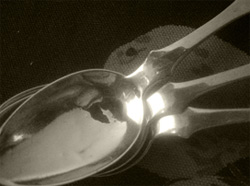
My blog's namesake - small, old and some very dented engraved silver plated tea spoons that belonged to my mother-in-law, and I use them to taste my food as I'm cooking.

Scroll down to the bottom to view my Blogroll

Posted in Soups, Vegetarian, on January 30th, 2012.

creamy_mushroom_soup

Nothing whatsoever, in any way, shape or form, like Campbell’s Cream of Mushroom Soup. Enough said!

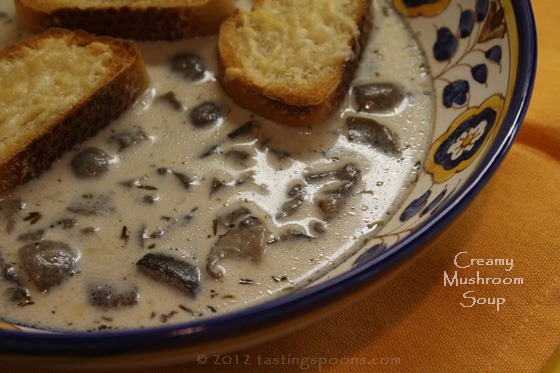
This little recipe has, for 6 servings, just 1/4 cup of heavy cream in it. If you were to eat a bowl of it, you’d be eating about a tablespoon of cream. That’s it. And that gives it a unctuous creamy quality. Not a pale-looking creamy, but a full-blown creamy. What it also has in it is a LOT of mushrooms (a full 2 pounds for those 6 servings). And a ton of flavor. If you love mushrooms like I do, then you’ll need to do yourself a favor and make this soup. What it doesn’t have in it is a lot of stick-to-your-ribs carbs or tummy fillers like potatoes or rice. It also doesn’t have any thickener in it at all. What this contains is mushrooms, broth, herbs, and a jot of brandy, along with that little tiny bit of cream. Therefore, it’s very low calorie. 190 calories per serving, actually. Probably not enough, as it is, to fill you up for lunch of dinner. I made it the other night with several baguette slices with Parmigiano cheese sprinkled on top. Very loverly, as the saying goes. The recipe came from Food52, and was one of the winners of their contest in the mushroom soup category. It’s also in that new book I was telling you about, the The Food52 Cookbook: 140 Winning Recipes from Exceptional Home Cooks.

What I liked: the really strong, full-of-character mushroom flavor. There is no question this is a mushroom soup, in other words.  Those mushrooms have to be washed, cleaned, and precisely chopped (something the soup developer, MrsWheelbarrow, suggested). But they truly offer lots of flavor – the more varieties the better. This recipe calls for crimini and whatever kind of mixed mushrooms you can buy.

What I didn’t like: I’d have liked the soup to have a bit more toothsome substance – which is why I might add just a couple of tablespoons of rice to the soup maybe. With the leftover soup I added some small bites of cooked potato (that I had leftover). Or I’d thicken it with some flour just for texture. Even so, will I make this again? Absolutely.

printer-friendly PDF

MasterCook + import file – right click to save file, run MC, then File|Import

Creamy Mushroom Soup

Recipe By: A winner of a Food52 contest
Serving Size: 6
NOTES: If you like a bit more subtance to the soup, add in a bit of rice (maybe 3 T. or so) or use some (leftover) cooked potato that you cube up and heat just at the end. Don’t COOK the potatoes in it as they’ll likely disintegrate. You don’t want that. You can also add some milk or fat-free half and half to this to make another serving or so. It doesn’t appear to dilute the flavor.

1 pound mushrooms — mixed variety, cleaned, stems separated from caps
1 pound cremini mushrooms — cleaned, stems separated from caps
1/2 cups minced shallot
6 sprigs thyme
1 sprig rosemary
1/4 cups cognac
3 tablespoons olive oil
salt & pepper to taste
4 cups chicken stock — rich homemade [I used Penzey’s soup base]
1/4 cup whipping cream
1/4 cup chopped chives

1. Rough chop the mushroom stems and simmer them, covered, in the chicken broth for about an hour.
2. In the meantime, heat the oil in a large skillet, and saute the shallots until transparent. Add the herbs and salt & pepper liberally.
3. Beautifully and precisely chop the mushroom caps into a 1/2″ dice. Add them to the shallots as they are chopped. Keep the heat very low and cook gently until the mushroom liquid is released and reabsorbed [about 20 minutes or so]. Shake the pan so they don’t stick. Remove the thyme and rosemary. [I didn’t do that step as I used dried herbs.]
4. Turn up the heat and add the cognac. Flame it if you’re feeling really chef-y. Cook the mushroom cap/shallot mixture down (after cognac) until well reduced and starting to turn a little golden on the edges.
5. Strain the mushroom stems from the chicken broth [and discard them].
6. Add the beautiful mushroom cap and shallot mixture to the strained broth and heat gently.
7. Swirl in the cream and chives and serve. Or serve in small sipping cups topped with chives and lightly whipped cream, if you want to get fancy.
Per Serving: 190 Calories; 12g Fat (59.5% calories from fat); 5g Protein; 13g Carbohydrate; 4g Dietary Fiber; 14mg Cholesterol; 1445mg Sodium (this sodium cannot be accurate – it assumes you’re using very salty chicken broth).

Posted in Fish, Soups, on January 28th, 2012.

freshwater_fish_soup_provencal

Just plain and simple fish soup – no cream – nothing all that unusual, just lots of flavorful spices, tomatoes and some delicious broth – altogether good.

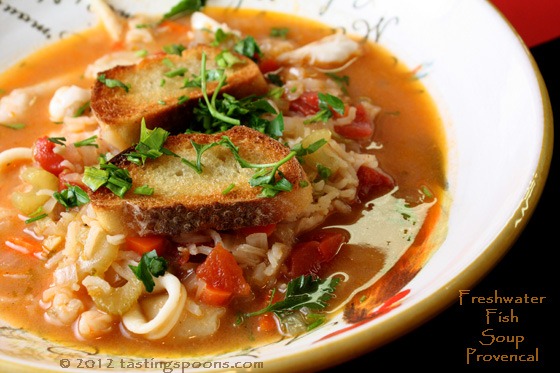
I had a number of filet of sole, individually frozen, in the freezer. And a nice piece of halibut. Plus a package of Trader Joe’s mixed shellfish. A marriage was made in this soup. My photo shows the title as Freshwater Fish Soup – well, I didn’t have the catfish and trout suggested in the recipe, so duh – it’s not really a freshwater fish soup at all. Forgive my mistake.

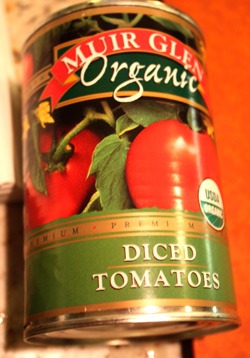
muir_glen_tomatoesWhat I did have on my pantry shelf is, however, a can of Muir Glen tomatoes. I don’t know about you, but I always keep numerous cans of different tomato products on my pantry shelves – whole tomatoes, diced organic tomatoes as you can see in the photo, the fire-roasted tomatoes that are dear to my culinary heart, tomato sauce, tomato paste and even some sun-dried tomatoes too. So this time, I grabbed the diced tomatoes and added them to this simple soup – no cutting and chopping required. And nearly all of them are Muir Glen. Most grocery stores carry one or two types of their tomatoes, rarely do you find one that carries them all, so each different store I visit, I’ll pass by that section just to see.

Recently Muir Glen offered to send me their 2011 reserve selection – a lovely 4-pack of tomatoes, including two of their premium cans of “reserve” tomatoes. Those are only available by mail order, to the best of my knowledge. I certainly don’t hide my preference for Muir Glen tomatoes, and have mentioned them numerous times in the past with recipes.

Anyway, back to soup . . . using the website Eat Your Books, I found a recipe in an old cookbook I have – Crescent Dragonwagon’s book The Dairy Hollow House Soup & Bread: A Country Inn Cookbook. The Inn (in Eureka Springs, Arkansas, Ozark country) isn’t open any longer, I discovered. We have friends who once stayed there; otherwise I’d have never discovered any of the numerous cookbooks by the author. Anyway, I own just this one book and have made soup from it numerous times (none of them since I’ve been blogging, I don’t think).
What I’ve always liked about the recipes is that they’re full of flavor. That’s my idea of a good cookbook. This recipe isn’t a difficult one – it’s really fairly straight forward. Don’t be intimidated by the long list of ingredients – it’s not all that difficult – or time consuming – to make this. I have in my frig a small container of fish soup base, that wonderful stuff made by Penzey’s. The recipe called for chicken stock, but why use that when you’ve got fish stock? The finished soup is very flavorful – it’s mostly fish, tomatoes, the soupy stock and a bit of rice. Not a lot of other vegetables, really. I added the baguette slices (they’re not in the recipe). Suit yourself – but we enjoyed that as a texture addition. The recipe has two components – the soup – and the fish. And really a third – the rice. The author fixes a pet peeve of mine – when you make fish soup, all the fish falls apart as you’re making it. Dragonwagon has you prepare the fish separately (and you use all the good broth from it in the soup so nothing’s wasted). And the rice – and not very much rice, which I liked. Only in the bowl do you co-mingle everything. A great idea, I thought. It’s a trick she developed when she ran her restaurant – people don’t like to eat fish soup with tiny flakes of fish – they want pieces. Her method works like a charm.

What I liked: this was clearly a fish soup – no waffling – there’s lots of fish in it. Good flavor; good broth. No cream. No thickening agent. Just the straight stuff. The different components are combined in the soup bowl – as long as the soup stock part is nearly boiling, you can pour it over the fish and rice and it all warms up to the right eating temperature.

What I didn’t like: nothing at all. Not very suitable for freezing, though. The fish would disintegrate, I think, in the process. So, make and eat.

printer-friendly PDF

MasterCook 5+ import file – right click to save file, run MC, then File|Import

Fish Soup Provençal

Recipe By: Dairy Hollow House Soup and Bread, by Crescent Dragonwagon
Serving Size: 6
Serving Ideas: Serve with toasted bread – either on the side, or put it on top of the fish soup when served.
NOTES: I used filet of sole, halibut and a package of frozen mixed shellfish (shrimp, scallops, calamari) for the bass, catfish or trout suggested.

4 cups fish stock — or chicken stock or bottled clam juice
1 1/2 cups dry white wine
juice of 1 lemon
3 whole cloves
3 whole black peppercorns
3 whole allspice berries
1 whole bay leaf
1 teaspoon fennel seeds
skin of 1 large onion
1/2 teaspoon salt
1/8 teaspoon cayenne pepper
1/4 teaspoon dried dill
2 1/2 pounds fish — bass, catfish or trout, cleaned and cut into pieces
Tomato sauce:
1/4 cup olive oil
1 large onion — finely chopped
2 medium carrots — scrubbed and finely chopped
2 ribs celery — chopped
1 large shallot — peeled, chopped [my addition]
2 cups canned tomatoes — drained and coarsely chopped [I used the juice]
grated zest of 1/4 orange
3 cloves garlic — peeled
4 large fresh basil leaves — (4 to 5)
tiny pinch of cayenne pepper
1 teaspoon honey — or sugar
1 tablespoon tomato paste
1 cup dry white wine
salt and freshly ground black pepper to taste
For serving:
2 1/2 cups cooked rice
finely chopped fresh Italian parsley and/or fresh basil leaves for garnish

1. In large skillet, combine all the ingredients in the first list except the fish and bring to a boil. Add the fish, turn the heat down to low, and barely simmer, covered. Poach the fish until it is firm and done, 6-8 minutes unless the fish pieces are thicker than 3/4 to 1 inch (in which case cooking will take a little longer).
2. Pour stock and fish into a colander set over a bowl; reserve both stock and fish. Discard the whole spices and the onion skin. When the fish is cool enough to handle, skin the pieces and pull out the bones; reserve the flesh.
3. Prepare the tomato sauce: In a large skillet, heat the oil over medium heat. Add the onion and saute until lightly softened, about 3 minutes. Add the carrots and celery and saute another 3 minutes. Put the tomatoes, orange zest, garlic, basil, cayenne, honey, and tomato paste in a food processor and process until the leaves are fairly chopped and the tomatoes are a chunky puree. Add this mixture, plus the wine, to the sauteed vegetables. Cook, stirring often, over medium-high heat for 10 minutes.
4. 15 to 20 minutes before serving, combine the broth and tomato sauce and simmer gently for 5-10 minutes. Taste; correct the seasoning with salt and pepper. Meanwhile have your soup bowls or cups ready, heated, if possible. In each bowl place a serving of the rice, and a generous amount of the poached fish pieces. Ladle the piping hot soup over the rice and fish (if the soup is hot enough, you won’t have to worry about reheating the rice or fish). Garnish with the chopped parsley or basil and serve at once.
Per Serving: 378 Calories; 14g Fat (42.4% calories from fat); 5g Protein; 39g Carbohydrate; 5g Dietary Fiber; 11mg Cholesterol; 514mg Sodium.

Posted in Uncategorized, on January 27th, 2012.

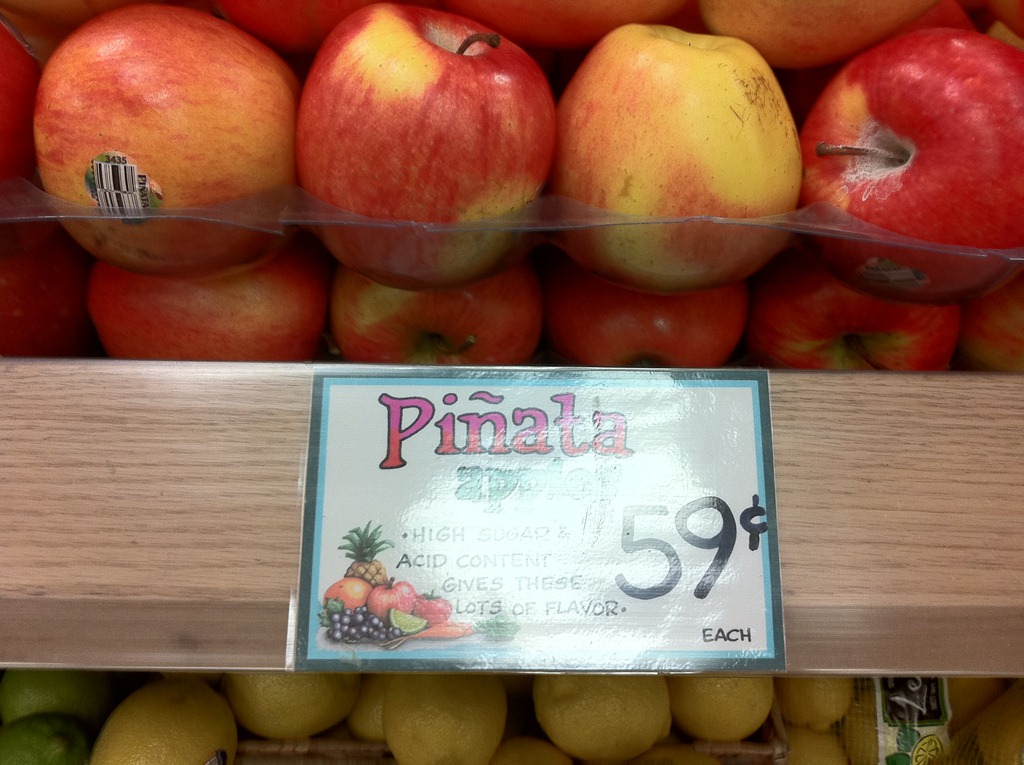
ThreePinataApplesHave you seen the new Pinata apples at your local market? I did, just the other day, at my local Trader Joe’s (see photo below).

Recently I was contacted by the producer of this apple, the Stemilt Company asking if I’d like to sample them. I said “sure.”  A week later a small package arrived containing two of these tasty apples.

I suppose we could ask – do we really need yet another apple variety to choose from? Well, we can hardly have too many, right? I don’t buy Red Delicious anymore – in fact I don’t know that they ever come to market any longer. So many tasty varieties have been developed (like Braeburn, Gala, Honeycrisp, or Fuji) that far surpass the flavor and shelf life of Red Delicious. A couple of years ago I did a long write-up here on my blog about apples, if you’re interested.

What I buy are Granny Smiths for cooking, when I want the apples to stay in their shape, and the other varieties I buy for an eating apple – one that’s crispy and sweet.

pinata_apples_traderjoesAt right is a photo I snapped with my iPhone at Trader Joe’s last week – the Pinata apples were 59¢ each. They will be available starting next month at most grocery stores.

Pinatas have an interesting heirloom parentage – it’s a cross between Golden Delicious (a truly American apple), Cox’s Orange Pippin (an English variety), and the Duchess of Oldenburg (from Russia). The apple was developed in Germany about a decade ago and was transplanted to the U.S. 6-7 years ago. The trees must now be bearing enough fruit for nationwide distribution. They’re grown in central/eastern Washington State. Good, solid apple country! We liked them. They have the flavor of the golden delicious, but the crisp texture of a pippin. The ones we sampled were just a slight bit on the tart side of sweet – if a scale existed from 1 to 5 of sweetness of this crispy sweet apple, it would be on the lower side. The Honeycrisp would be a 5. I didn’t try cooking with them – they were eaten out of hand. I’ll try more of them, though. See what you think.

Posted in Books, on January 26th, 2012.

Not every book I read ends up as an actual blog post. Most of them flit through my sidebar over on the left on my home page. Lots of books  get an honorable mention and a short write-up there and I don’t necessarily mention them here. So if you don’t actually GO to my website you’d not even know that I’ve read 5 books since Christmas. And this book I’m telling you about today isn’t one of the best written of books I’ve ever read, but it’s interesting. It’s about a subject you’d not find on very many blogs. But obviously, if I’m writing a blog post about it I found it noteworthy.

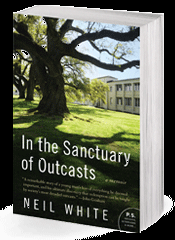
imageNeil White, the author of In the Sanctuary of Outcasts , has written a memoir of a year he spent in a prison in Louisiana. That, in itself, would hardly make this book noteworthy. But there’s a whole lot more to the story than that. Let me give you the background.
The author, prior to being sentenced to a year at this prison, was a highly successful entrepreneur. A college graduate. Smart. Likely he has some charisma thrown in too. The son of very successful parents. He was a hard worker. He was married with two young children. He led the kind of life lots of people would aspire to – he had a beautiful home, went on lavish vacations, had nice cars, dined out regularly in the best restaurants, and was well recognized in his town – lots of people wanted to know him. He thrived on the attention and accolades. He saw himself as a rising “star” in the media world. After starting up a newspaper in a medium-sized southern city (it failed, actually) he decided to become a magazine publisher. He was good at that. He was able to sell advertising – he was exceedingly good with people. There’s that charisma thing, I’m sure, although he never mentions that word. He’s an idea man too. Always thinking about where he’s going to make his name, where he’d make his “big break,” to get into the big time. He was never quite satisfied with where he was (career-wise). One more magazine, one more something. All requiring more cash to start and run. He borrowed money. He asked friends and family members to invest in his dream. They did. They believed in him. Saw no red flags.

Obviously, he wasn’t quite as good at looking at the bottom line. A few people (companies) couldn’t quite pay their advertising bills. The problem was, Neil had already spent or used the money. He factored his income in the publishing business (a common enough tactic for small companies, although not always wise); he borrowed money from Peter to pay Paul. I’d not realized until I read this book what “kiting checks” really meant (it’s fraud). He’d write checks from one account to pay another, and likewise that one to pay yet another. When you do it with different banks, it may take awhile for someone to catch on, especially since he’d do most of the transacting minutes before the close of the day. He’d convinced himself he wasn’t doing anything wrong. He got caught (rightly so) and was sentenced to a year in this low-level, minimum security prison called Carville, in Louisiana. He lost absolutely everything.

To say that Neil White had a big ego is an understatement. When he reported for his year of incarceration, he still had a pretty big ego going. He was embarrassed about what happened. He felt badly for his wife and children (and on the advice of a therapist he and his wife decided to tell their two children that Daddy was going to “camp”). He had duped a lot of people, many family members included, who all lost money in their misguided belief in him. In prison he felt like he didn’t belong – the business-dandy that he was, was “above” these uneducated prisoners from all walks of life. He never had worn an un-ironed shirt. He had been obsessive about cologne and cleanliness. He had to adjust to wrinkled uniforms, no privacy, no doors anywhere, lights on 24-hours a day. Yet within days he was already mentally scheming how he was going to do an exposé about prison life at Carville.  How would he do that? Well, he discovered right off, that this prison also housed (not imprisoned) the last survivors in the United States who have Hansen’s Disease (leprosy).

Because I think you should read this book, I don’t want to give away everything about the story. Here I’ve shared quite a bit about the author’s background. And hardly anything about the facts of leprosy, its progression, the medication now used to stop its advancement. Or about the people who live at Carville. I am telling you about the author’s abhorrence of catching the disease had him holding his breath sometimes – this, when we first arrived at the prison. And yet, eventually, with time, he learns more about the disease and befriends several of the patients and inmates in the prison. (There are inmates – like him – and patients like those with leprosy – and also there were inmate patients – prisoners who were too ill to be in some other prisons). There was a separation between the groups, but because it was a minimum security prison, it wasn’t too difficult to figure out ways to get around the rules about not fraternizing. Most of the inmates wanted nothing to do with the Hansen’s patients. They stayed clear of them for fear they’d “catch” it.

During the year, Neil White learns a whole lot about himself. Discovers how much he cares about these people – the Hansen’s patients, particularly a few special ones. They teach him a lot about life; they make him look into himself for answers; fortunately for him, he listens to them, although he’s hard-headed. It would be easy to dismiss this book as an ex-con’s way of making a living after his release, but you’d be missing the gist of the story, which is about Hansen’s Disease and what happens to all of the people who live there. These people who have no other home. It’s a story that needed telling, even if it is cloaked in a small book about one man’s prison journey. If you don’t read this book you’ll miss out on the redeeming value this book offers you, a friend, or someone in your family, perhaps, who has made a wrong-turn in life. In the process you’ll learn a whole lot about leprosy, which is something everyone should better understand. If you go to Neil White’s website, you can see a few photos of the prison. This book may not be for everyone. And, of course, since it’s a memoir, there’s no way of knowing whether everything he recounts in the book, is true. Neil White talks about that in the book – about how he was told by several people to not believe what both inmates and Hansen’s patients had told him. That they embellish or outright lie. Since truth became an important word to Neil White during his year, I’d like to think this book speaks it. I’m very glad I read it.

National Hansen’s Disease Museum (Wikipedia)

Karen’s Orphans and Forgotten Residents

Posted in easy, Veggies/sides, on January 24th, 2012.

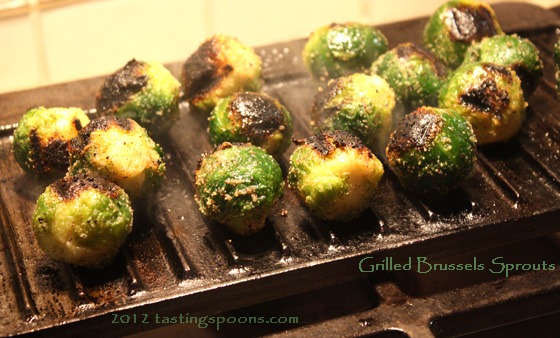
grilled_brussels_sprouts

Check out the steam wafting up from those little grilling babies? An easy side dish for a weeknight meal, or for guests – although you will want to do the grilling at the last minute if at all possible.

Another winner of a recipe from Food52. And it was a winner of a contest at the website for the best Brussels sprouts recipe. Yes, they’re delicious. I know – the food blog police are going to come after me for over-using the word delicious. I need to write down a bunch of other adverbs to help me describe the taste of things. Let’s see . . . salty, succulent, good texture, bright with flavor . . . how’s that? They were all those thing as well.

First you simmer the whole Brussels in water (with a tiny slit in the root end) for exactly 5 minutes. Not a moment longer. Why? Because after they drain and cool, you’re going to grill them for awhile to get all that good blackened flavor all over them – and they cook sufficiently more on the grill. A bit of olive oil goes all over them, then they’re rolled or tossed in a simple mixture of pepper, onion powder, garlic powder, celery salt. You might be tempted to cut the sprouts in half, but don’t. They’ll take up too much room on the grill (well, at least they would on my indoor grill you see above in the photo) and they might fall apart more readily. So control the urge and just grill them whole. Takes about 12 minutes or so and then you sprinkle them with your choice of additions – lemon zest (yes, I did that one), Parmesan cheese (I did that one too, but most of it didn’t cling to the sprouts so what was the sense of wasting the cheese?) and/or bacon (I opted not to add this one). If you have any of the seasoning mixture you can toss the sprouts in that again after grilling them. I didn’t have any so they were ready to serve. There were 4 of us for dinner that night, and everyone slicked the plates clean. I’ll be making these again.

What I liked: how easy they were, and the seasoning mixture that clings to the outside edges. Oh, and the blackened pieces were so good! Definitely worth making.

What I didn’t like: well, the only thing I’ll mention is that I thought they were too salty. The original recipe calls for 1 teaspoon of kosher salt. With the addition of celery salt too, I thought it was too much. Next time I’ll leave out the kosher salt and see how it tastes. I’ve made a note of it in the recipe. But I’m sensitive to salt in lots of things. No one else at the table noticed.

printer-friendly PDF
MasterCook 5+ import file – right click to save file, run MC, then File|Import

Grilled Brussels Sprouts

Recipe By: A winner of the Food52 contest
Serving Size: 2-3

12 medium Brussels Sprouts
2 tablespoon olive oil
1 teaspoon kosher salt — [optional – see if you find it salty enough without this]
1/2 teaspoon cracked black pepper
1/2 teaspoon onion powder
1/2 teaspoon garlic powder
1/2 teaspoon celery salt
1/4 cup bacon, cooked, crumbled (optional)
1 teaspoon lemon zest (optional)
1 tablespoon grated parmesan cheese (optional)

1. First, clean the sprouts. Trim the cut ends back without interfering with the leaves, and peel any withered leaves off the bulb. Score the bottoms; one cut will suffice.
2. Then place the sprouts in boiling, salted water for no more than five minutes. NO MORE!
3. Drain, drizzle with oil and toss in a bowl with the salt [optional], pepper, onion powder, garlic powder and celery salt.
4. When the sprouts are nice and coated, place on a hot grill (but keep the bowl handy), turning every four minutes for a total of twelve minutes.
5. Remove from the grill back to the seasoning bowl and toss to coat with any remaining seasoning.
6. If desired, add any or all of the remaining three ingredients (bacon, lemon zest, parmesan cheese).
Per Serving: 117 Calories; 9g Fat (66.5% calories from fat); 3g Protein; 8g Carbohydrate; 3g Dietary Fiber; 0mg Cholesterol; 910mg Sodium

Posted in Utensils, on January 22nd, 2012.

belkin_stand_collage

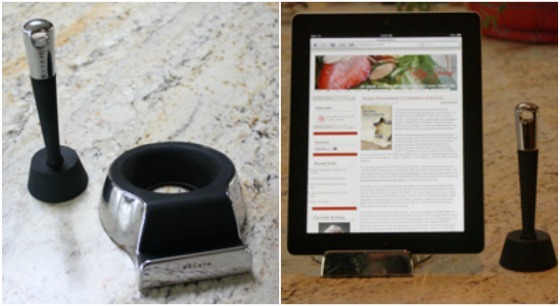
I got the niftiest thing for Christmas. And it’s interesting enough, and works so well, I thought you should know all about it. I put it on my amazon wishlist and one of our kids got it for me. It’s a stand for holding my iPad. I suppose it works for most tablet computers, and it works like a charm for me! I use it here in the kitchen – when I’m cooking and need to refer to my blog, for instance, where most of my recipes have been posted. Or, I can go anywhere online – not just my own blog, of course. My iPad lives here in our kitchen. We have a very large island and my desktop computer lives on one side and my iPad on the other (that sounds really decadent, doesn’t it – two computers in the kitchen). But, you know, the iPad won’t do a lot of things – like print anything – and it doesn’t display things in my Google Reader very well. And I don’t blog from it. But it’s fantastic for looking up things. It’s great for travel (reading email). It’s connected to our wi-fi, so I can go almost anywhere in the house with it.

And when I’m cooking, it’s such a waste of paper, these days, to print out another copy of something when I can just read the recipe online. I merely unhook my iPad from its charging cord and set it up right in front of my kitchen prep area on this stand. The rubber type wand will move the screen up/down/left/right as necessary. That way I won’t get grated cheese on the screen, or smear butter on the edges. If my hands are messy, it’s easy to clean it off the wand – a whole lot easier than getting it off the iPad screen! And I’ve set up my iPad to never go to sleep, so for the duration of my cooking time it’s “on.” It’s called a Belkin Kitchen Stand and Wand for Tablets. It’s $29.26 at the moment from amazon. A great tool for cooks, I think.
Posted in easy, Miscellaneous, Salad Dressings, on January 21st, 2012.

sweet_spicy_horseradish_dressing

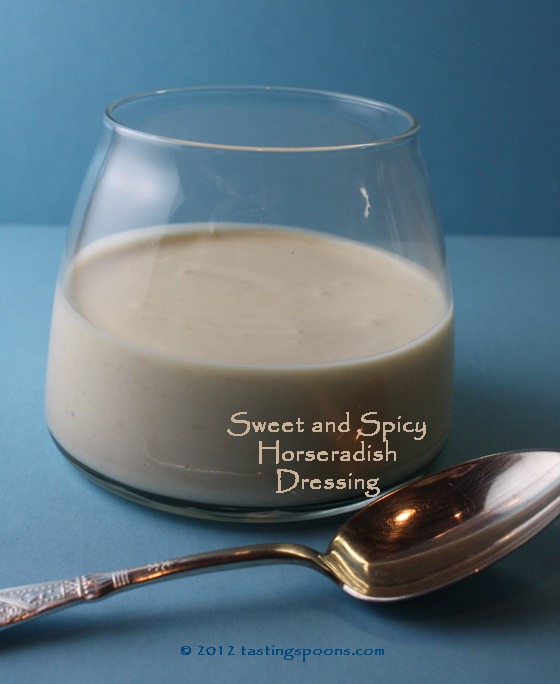
Oh my goodness. Oh my gracious goodness, are you going to like this stuff. I could hardly keep my tasting spoon – that very spoon you see in the photo – out of the cruet.

It has so many possibilities – on a salad, yes, even a green salad. Or on sliced tomatoes. On green beans. On steamed cauliflower. On broccoli – oh yes, broccoli for sure. Or on some sliced beef (fresh out of the oven or with leftovers), or some sliced leftover pork roast. Or a dunk for shrimp. Or, or, or! The list could be endless.

The venerable duo of Amanda Hesser and Merrill Stubbs have their own website. If you’re not already reading it, you should be – Food52. They’re the hard-working team who created (edited and wrote) the monstrous cookbook, The Essential New York Times Cookbook: Classic Recipes for a New Century. Sorry for mentioning that book so frequently, but I surely do love that cookbook! Anyway, after Amanda and Merrill collaborated on that book, they decided to start something else because they so enjoyed working together. That’s what Food52.com is all about. That’s food 52 weeks a year, and a good part of their blog come from contributions from home cooks just like us. This recipe included.
As a part of their blogging (and it’s an ongoing thing) they have contests for everyone’s favorites. I think the duo does most of the honing down of lists, then they ask readers to try them, taste them and vote. As a result of that contest, a book was written, The Food52 Cookbook: 140 Winning Recipes from Exceptional Home Cooks. I gave the cookbook to two of my friends for Christmas. I wanted one for myself, but I know where all the recipes are on the site, so I printed out the ones I knew I’d want to try and have already prepared two of them. So far, so good! If you want to look at the contest winners, you can do just that with this link. This particular recipe by “linzarella” won for a category they call “wildcard.”

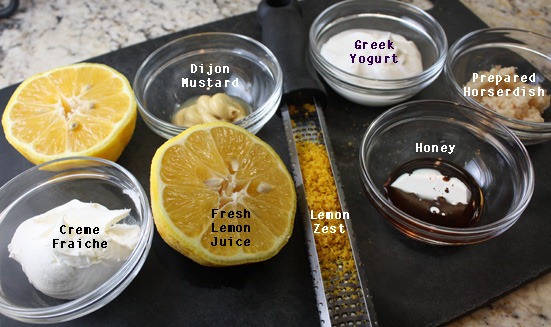
This dressing – or sauce – has such an unusual list of ingredients – it drew me in immediately. It’s yogurt, some crème fraiche, honey, lemon juice, lemon zest, Dijon, prepared horseradish, salt and pepper. That’s it. Combine it in a bowl, or even easier put it into a lidded jar and shake. Done. How easy is that?

secret_sauce_ingredients

Having read what people had to say about this recipe, I know that it’s delicious on green salad, even though that probably wasn’t its original intent. As Linzarella explained about her development of the recipe, she isn’t a fan of chiles, so she uses horseradish as a way to gives things a kick. What would it be good on? Sliced tomatoes. As a dip for artichokes. Or asparagus. It has a hint of sweetness to it, and you don’t use much on any one serving. I could even see it as a dollop on sliced oranges. You might think the horseradish would overwhelm – it doesn’t AT ALL. Unless you don’t like horseradish, in which case stop reading. It could be a dip – for vegetables even. And I’m always wanting some kind of something to put on top of leftover meat or fish – like chicken, shrimp, sliced beef (this would have a natural affinity for sliced roast beef), even pork, or lamb. Ah, halibut. My mouth is watering . . . Someone suggested it would be good with corned beef and cabbage. Sounds divine. Or if you’re wicked, just spoon it out of the bowl directly to mouth. Do note, using about a tablespoon per serving, there are just 22 calories and 1 gram of fat. This recipe is going onto my Carolyn’s Favs list, just so you know, in case that tells you anything!

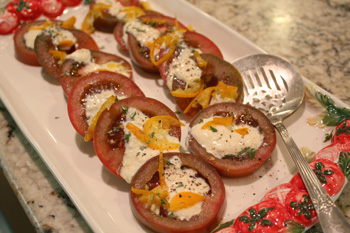
The photo at right shows some of those Kumato tomatoes (they’re really good in case you haven’t tried them) with a dollop of the sauce on top, some freshly minced rosemary and a few little pieces of kumquat. And a little pepper too. This was absolutely delicious!

What I liked: oh, ahhh, just everything about it. Can’t wait to find other things to use it on … . .

What I didn’t like: can you guess? Nothing at all!

printer-friendly PDF
MasterCook 5+ import file – right click to save file, run MC, then File|Import

Sweet and Spicy Horseradish Dressing

Recipe By: A winner of the Food52 contest (a contributor named “linzarella”)
Serving Size: 12
NOTES: Makes about a cup. Use this on just about anything – vegetables, salad, potatoes, noodles, rice.

1 whole lemon — [zest and half of the lemon juice]
3 tablespoons creme fraiche
3 tablespoons yogurt — full-fat, plain [I used Greek yogurt]
1 tablespoon honey
2 tablespoons prepared horseradish
2 tablespoons dijon mustard
1 pinch salt
1 pinch freshly ground pepper

1. Zest the lemon, then juice half of it. In a jar, combine juice & zest with remaining ingredients, stir, then cover the jar and shake.
2. Taste and adjust to make it spicier, creamier, or sweeter to your preference.
Per Serving: 22 Calories; 1g Fat (48.6% calories from fat); trace Protein; 3g Carbohydrate; trace Dietary Fiber; 4mg Cholesterol; 54mg Sodium.

Posted in Desserts, on January 19th, 2012.

sticky_chocolate_sponge_pudding

Oh my. Chocolate. Decadent. Smooth. Luscious. Lick the plate clean! Yes, indeed! Make again? Absolutely. The sooner the better if I have anything to say about it. And since I’m the #1 cook around here, that means it’ll be on my menu again soon. Maybe I’ll try making it with at least half Splenda, so my DH can have more of it. He ate very little of it since the regular version is loaded with sugar. Is it overly sweet? No, not at all, and I liked that part particularly.

We were having a group of friends over for dinner and most of the menu items were dishes I’ve prepared before. But I tried something new for dessert, and chocolate just sounded right. But as I read the recipe (a Jamie Oliver recipe – no longer available on his website or Food Network) that I had printed out a few years ago, I had some questions. For instance, the recipe said “pour the mixture into a greased baking tin.” Well, what, exactly is a “baking tin?” Is it a round cake pan? Or a rectangular baking dish? Or what?

So I went online and did a search for the recipe title, assuming I’d find other bloggers who had tried this recipe and elaborated in the directions. There were about 20 results for the pudding. But with every single website I checked the recipe had been duplicated verbatim. Most of them didn’t even have any narrative and not a single website mentioned how it was making it, or any directions. I think one said “delicious.” Well, yea! But nothing about the baking dish. They all said the very same thing – “a greased baking tin.” I checked Jamie’s website – and as I mentioned above – the recipe’s not there anymore. Not online at the Food Network either, which is where I originally found the recipe, I believe.

The other bit of research I had to do was figure out what “cooking chocolate” was. That was an easy search – it’s unsweetened chocolate. The Brits do use a few different words than we do. But I still wasn’t done with my research. The recipe called for self-raising flour. We call it self-rising, but either way, I didn’t have any. Our grocery stores don’t carry it, so I needed to find a solution to that. Answers were forthcoming as soon as I put in the Google searchbox: “how to make self rising flour.” Got several results. Answer: Add 1 1/2 teaspoons of baking powder and 1/2 teaspoon of salt to each cup of flour. That was easy – 7 ounces of flour is close to a cup, so I used those measurements. This recipe has additional baking powder, though, so I lumped the two into one measurement.

So, time to make cake. Or pudding. Or pudding cake, as it is. I’m such a fan of “pudding cakes.” My very favorite is lemon. In case you’ve never made a pudding cake, it’s the kind that you make in one batter, but as it bakes, it separates with a sauce-type layer on the bottom, and a light cake-type layer on top. When you dip a big spoon into the dish you come out with a self-pouring kind of cake and pudding. I have a whopping 5 of them on my website now: Chocolate Upside Down Baked Nut Pudding Cake, Cranberry Pudding Cake, Gingerbread Pudding Cake, Lemon Sponge Pudding (my favorite of the bunch), and Peach Pudding Cake. With this new recipe that’ll make 6 and this one will also be highlighted in red, meaning it’s a favorite.

Okay, I got distracted there. Back to making the sponge cake. I’ve left the recipe below using weight measurements rather than trying to convert them to cups. Especially with baking, it’s so important to weigh rather than measure by cups because it’s all about chemistry. You mix up sugar and butter until it’s light and fluffy, then add eggs and the flour. Meanwhile you stir 3 rounded tablespoons of cocoa into 8 tablespoons of warm water. It makes a thick slurry. That gets added to the cake batter along with some sliced almonds and about 4 ounces of unsweetened chocolate (that you chop up finely on a chopping board). See how easy that was? That’s poured into a 9-inch round cake pan (that’s what I finally decided to use – and mine is a little higher sided than the traditional 8-inch round cake pans). If you don’t have a 9-inch round cake pan I think a round or rectangular ceramic dish would be just fine – just grease it first. Don’t use a 9×13 size – that would be too big, for sure. Something smaller would work. If you use the larger size, do adjust down the baking time, though!

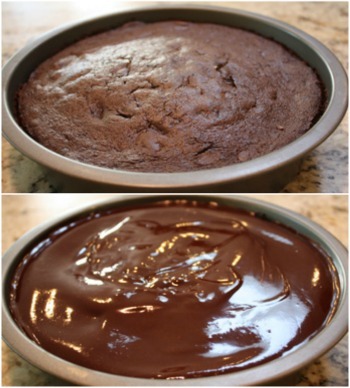
sponge_cake_collageHere are the photos of the cake. Top photo is the cake just out of the oven. The bottom photo shows the sauce just after I spread it all over the cake. The cake was still hot. Next time I make this I’m going to sprinkle more sliced almonds on top of the sauce. That will look pretty!

As for the baking . . . Jamie’s recipe said 18-20 minutes. Well, maybe he used a larger pan and 18-20 minutes was sufficient to bake the cake. With the 9-inch pan it took me about 32 minutes. But do watch the cake carefully. At 18 minutes the middle of the cake was still liquid. At 22 minutes it was slightly liquid. That’s when I added another 10 minutes and it was perfect.

The cake is an infinitely soft – sponge – cake. All that whipping up of the butter and sugar (until the mixture was a very light color) helps makes this a light texture. The additional baking powder helped too.

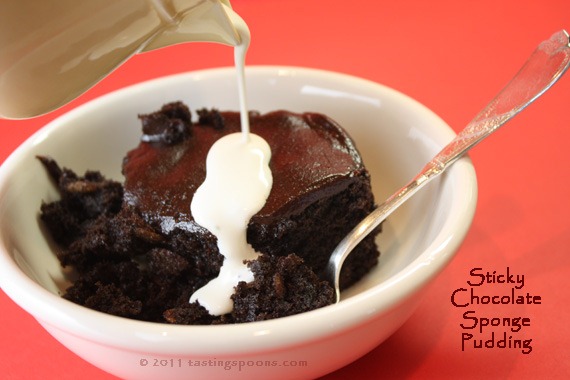
So, while the cake was baking I made the “sauce.” I didn’t have enough unsweetened chocolate to make this, so I substituted some semisweet instead and eliminated the powdered sugar that was in Jamie’s original recipe. So it was just the chocolate, a cube of butter and 4 T. of milk. When the cake came out of the oven I poured this “sauce” all over the top of the cake and spread it out to cover. It just barely covers the cake. Then I let it cool, and about an hour later I scooped out a serving, poured a little bit of heavy cream on top. The “sauce” is kind of like a frosting in a way, except that it is soft. It didn’t pool or puddle when I served it, so it isn’t exactly a pudding cake. But whatever it is, it’s great. I was in chocolate heaven. You will be too, I promise!

What I liked: absolutely every single solitary thing about it. If you’re a chocolate nut, you’ll love this recipe. Easy to make, too.

What I didn’t like: well, nothing. What could be better than an ooey-gooey chocolate cake?

printer-friendly PDF
MasterCook 5+ import file – click to run MC or right click to save file

Sticky Chocolate Sponge Pudding

Recipe: Adapted some from a Jamie Oliver recipe
Serving Size: 8
NOTES: The original recipe called for 7 ounces of self-raising (rising) flour. If using, reduce baking powder to 1 rounded teaspoon and eliminate the salt altogether. Original recipe also said bake the sponge for 18-20 minutes, but I had to add another 12 minutes or so, based on using a 9-inch round cake pan. If you don’t have that size pan, use a slightly larger ceramic dish (greased). Don’t use a 9×13 as that would be way too big. But reduce the baking time, then and check every few minutes from 18 minutes on to see if the cake is set in the middle.

CAKE:
7 ounces sugar
7 ounces butter
7 ounces flour — sifted
2 1/2 teaspoon baking powder
1/2 teaspoon salt
3 large eggs
3 tablespoons cocoa powder — rounded
8 tablespoons warm water
1/3 cup sliced almonds
4 ounces unsweetened chocolate — chopped
CHOCOLATE SAUCE:
4 ounces semisweet chocolate
4 ounces butter
4 tablespoons milk

1. Preheat oven to 350°F (180°C). Beat the sugar and butter until pale and fluffy, about 5 minutes. Sieve the flour and baking powder into the butter mixture. Add the eggs and mix it all together. Then mix the cocoa powder with 8 tablespoons of warm water, until smooth.
2. Fold the chocolate paste, almonds, and chocolate pieces into the cake mixture. Pour the mixture into a greased 9-inch round cake tin, spreading it out evenly. Bake for about 25-32 minutes or until a toothpick inserted in the middle comes out barely clean. Do not over bake. If using a larger sized pan, reduce baking time appropriately.
3. Meanwhile, melt the chocolate sauce ingredients in a bowl over some lightly simmering water. Stir until blended well. When the pudding is cooked, remove from the oven and pour the chocolate sauce on top while still cake is hot. Cool for an hour. Serve warm or cold with cream, sweetened whipped cream or vanilla ice cream.
Per Serving (yikes – but you might be able to get more than 8 servings, so it would cut it down some): 681 Calories; 49g Fat (61.7% calories from fat); 9g Protein; 60g Carbohydrate; 4g Dietary Fiber; 166mg Cholesterol; 643mg Sodium.

Posted in Veggies/sides, on January 17th, 2012.

braised_red_cabbage_apples

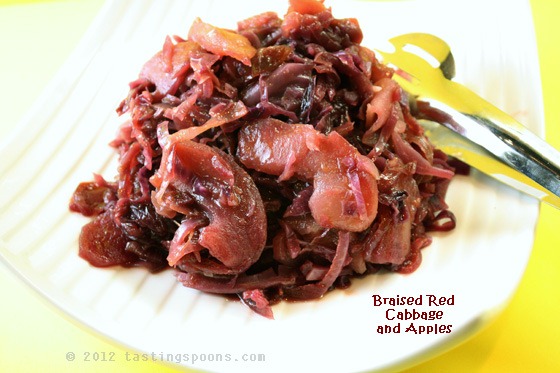
Oh, did I love this Polish rendition of braised cabbage! Nothing complicated – red onion, red cabbage, apples and a bunch of little things (including lemon juice, ketchup and brown sugar) to give it some zesty flavor. It needs to simmer, very slowly, for at least 2 hours, so do plan ahead, but it takes little time to put it together.

The recipe came from a new cookbook, one I put on my Amazon wish list a month or so ago, and one of my daughters bought it for me for Christmas. It was a really nice surprise to open the package. I’ve written a separate post about the cookbook, that gives a lengthy overview of the recipes, the stories and why you should buy Recipes Remembered: A Celebration of Survival.

So far, I’ve read about half the book. Each person remembered in the book is/was a survivor of the Holocaust. Their stories are so humbling to me. As a preface to each recipe or small group of recipes is a story about the person(s), interviewed directly, or written by adult children of the survivor(s). About how they escaped the death camps, how they met a spouse, about the DP camps in Italy, for instance. About how they managed the hard-scrabble life hiding in the depth of forests in Germany or Poland. As I sit here in my warm, comfortable kitchen, it’s hard for me to comprehend the horrors these Jewish families lived through.

This recipe was one I flagged right away, and it honors Helen Ptashnik (and her husband Henry Ptashnik) both from Stopnits (Stopnica), Poland. Their daughter tells the story about how they met in Israel at the end of the war. And about how Henry and his brother, as carpenters in one of the concentration camps, built a small hideaway in the barracks to hide some of the ill prisoners. Being ill and unable to work usually dealt a death sentence. The two brothers saved many lives. The Ptashniks actually met in Israel awhile after the war ended, and eventually emigrated to North America (I don’t know if they moved to Canada or the United States).

The Ptashnik’s daughter Meira Fleisch grew up with strong memories of this red cabbage side dish which graced many a holiday dining table. It’s a great recipe. And I’ve certainly made numerous renditions of braised cabbage over the years, but this one tops my list. There is nothing fancy or elegant about the dish – it’s just wonderful comfort food at its finest. It’s the additions that make it so good (honey, ketchup, brown sugar, tomato sauce, lemon juice). No doubt about it. And maybe it’s the long, slow cooking. It requires about 2 hours of very slow simmering. I was concerned that the cabbage would burn, but it didn’t. I used one of my Le Creuset Enameled Round Pots just because I knew it was going to sit on the stovetop for a long time. I did add just a little tiny bit of water about an hour into the cooking time. Make sure you put it on a very slow simmer setting. You could also bake this too – in a very low temp oven.

One of the interesting nugget of information I got from this cookbook is that many recipes of this era, from Holocaust survivors include ketchup. Why? Because it was something they had. Many food items these strong souls didn’t have, but ketchup was available. So it’s often included in recipes where you might think it odd.

What I liked: the subtle, mellow flavors of it all. I could have eaten an entire plate of it and forgotten the delicious Italian sausage I served alongside it. It was that good. Although the different ingredients (cabbage, onions and apples) are still visible, they all meld into one very flavorful whole. Also note that the dish, to serve 8-9 has just 2 T. of oil in it. You might be able to do it with less, even. So, very  healthy!

What I didn’t like: it’s not exactly the most beautiful of dishes – yes, it’s a purple cabbage color, but once it cooks awhile nearly every vegetable loses its vibrant color. Can’t be helped. So worth it, though.

printer-friendly PDF and MasterCook file (click link to open recipe)

Braised Red Cabbage and Apples (Helen Ptashnik’s)

Recipe By: From [Jewish] Recipes Remembered (cookbook); recipe credited to Helen Ptashnik)
Serving Size: 8-9
NOTES: This recipe came from a Polish immigrant, an Holocaust survivor, who came from Stopnits, Poland. Her daughter, Meira Fleisch, wrote the story about her parents’ escape from the death camps, about them settling in Italy, then Israel. She has fond memories of this onion-cabbage-apple dish on their family’s holiday table.

2 large red onions — thinly sliced
2 tablespoons vegetable oil
1 large red cabbage — about 2 pounds, shredded
1 tablespoon kosher salt
4 whole apples — Granny Smiths, Cortlands, or Macintoshes
1/4 cup honey
1/4 cup ketchup
2 tablespoons brown sugar
1/4 cup tomato sauce
2 small tomato — pureed or finely diced (or one large one)
1/4 cup lemon juice — freshly squeezed (approx.)

1. Heat oil in a medium saucepan, cook and stir the onions, over medium heat, until just soft, about 10 minutes.
2. While the onions cook, shred the cabbage (or very finely slice). Add the cabbage to the pot and sprinkle with salt. Using tongs, toss the onions and cabbage so the salt is evenly distributed. Continue cooking unitl the cabbage has cooked down some and begun to release its liquid, about 10 minutes.
3. Meanwhile, peel and slice the apples. Combine all the remaining ingredients in a small bowl.
4. Add apples and the sauce to the pot, stir to combine, reduce heat to low and simmer, covered, for about 2 hours, stirring every 30 minutes. Do not stir too vigorously or you will break down the apples. Season to taste with salt and pepper, or with more lemon juice if desired. Serve hot as a side dish.
Per Serving: 148 Calories; 4g Fat (21.7% calories from fat); 1g Protein; 30g Carbohydrate; 3g Dietary Fiber; 0mg Cholesterol; 847mg Sodium.

Posted in Cookbooks, on January 15th, 2012.

image

It was just last month that I read an article in our local newspaper, written by Judy Bart Kancigor, about this book. [As an aside, I have one of Kancigor’s recipes here on my blog already – one of my favorites, a Layered Hummus & Eggplant appetizer.] Hardly before I’d finished reading the newspaper article, I went to my amazon account and added the book to my wish list. Thank you, Sara, for buying it for me for Christmas!

This book, Recipes Remembered: A Celebration of Survival is a treasure; there just are no other words for it. I’m not Jewish, and I don’t necessarily cook Jewish food as such, but I am always intrigued about the stories behind ethnic dishes. One of Kancigor’s mantras is “you don’t have to be Jewish to cook Jewish.” Yes! Until now, I’ve never owned a Jewish cookbook. Now I do, and I’m glad of it. Not only because of the history contained within the book, but because I’m grateful in some small way – happy – humbled – to honor all those souls who didn’t survive the Holocaust.

So, what’s this book all about? The writer (editor and writer), June Feiss Hersch, interviewed countless families in the process of compiling the stories and recipes in this cookbook.  Earlier, she approached the Director of the Museum of Jewish Heritage (in New York City), with the germ of an idea, to publish a cookbook of stories and associated recipes from Holocaust survivors. An aside: all the proceeds from the book go to the museum. It’s already into its 4th printing.

The recipes cover a broad Eastern European geography (ethnic and physical) including Poland, Austria, Greece, Belgium, France, Germany, Hungary, Czechoslovakia, Romania, Russia and the Ukraine. And at the back is a lengthy list of Yiddish words, pages I referred to often, since I didn’t know the meaning of words like schmuts (dirt), cholent (a sacred stew prepared on Friday, baked overnight in a community bakery oven, to be eaten on Saturday), shtikel (morsel); and bashert (fated). I loved learning some of these new words (aside from other Yiddish words I did know: schlep, maven, nosh, kibbitz, mentsh, and shul).

As I write this, I’ve only read about half the book – I’m not even through reading the chapter on Poland (obviously there are more Polish recipes than those from other countries). But I’m awed by the stories. The true stories of survival, about the Crystal Night (when over 1,000 synagogues were burned to the ground and over 7,000 Jewish business destroyed), about people who hid in cupboards, cellars, forests, barns and other places to avoid the ghettos and concentration camps. But it’s also stories about people who did survive concentration camps (mostly ones who were interned there later in the war) or work camps. About those few who had skills the Nazis needed and wanted so they were fed better than some. About how prisoners hid food for others. About how they kept their spirits alive. About how they survived. About meeting other survivors, about first loves, marriages, boat trips to Israel, or America or Canada. About the yearning to live and thrive. About how some survivors would never – ever – talk about their wartime experiences – or shared them only at the end of their lives. And about how these proud Jewish people honor their loved ones by preparing the family recipes regularly.

Each country chapter contains numerous stories  (told from the actual survivor or a spouse or grown child) along with a photo or two about the family. About where they were from, their years of trying to escape, and managing to survive either in the dense forests with virtually no food, or in the concentration camps. And, thankfully, about their liberation and emigration somewhere else. Then, following that is a recipe, or two. Most of them are the actual recipes from the Holocaust survivor, or a descendant; a few are creations or re-creations from celebrated Jewish chefs (like Faye Levy, Mark Bittman, Daniel Boulud, Gale Gand, Ina Garten, Jonathan Waxman, Joan Nathan, Sara Moulton, and others).

In my copy, several recipes have been yellow-stickied already, and this week you’ll read about the first one I made from this book – a braised red cabbage and apple dish. Nothing fancy, but oh, so very delicious. Next I plan to make a Chocolate Chip Cake, and a Citrus Rice Pudding. Then maybe I’ll try one of the cholent recipes in the book. I’m intrigued about a 24-hour, slow-roasted stew.

Obviously, I highly recommend this book. If you enjoy reading stories, then a recipe to go along with it, you’ll be mesmerized by the book, as I’ve been.

Related Posts Plugin for WordPress, Blogger...