Get new posts by email:

Archives

Currently Reading

Here are the tastingspoons players. I’m in the middle (Carolyn). Daughter Sara on the right, and daughter-in-law Karen on the left. I started the blog in 2007, as a way to share recipes with my family. I’m still doing 99% of the blogging and holding out hope that these two lovely and excellent cooks will participate. They both lead very busy lives, so we’ll see.

– – – – – – – – – – – – – – – – – – – – – –

BOOK READING (from Carolyn):

Music of Bees, Eileen Garvin. Absolutely charming book about a woman in midlife, lonely, who raises bees, also makes unlikely friends. Heart-warming and very interesting about beekeeping.

A Postcard from Paris, Alex Brown. Really cute story. Dual time line, 1940s and present day about renovating an old apartment in Paris, things discovered.

Time of the Child, Niall Williams. Oh such a good book. Very small village in Ireland, 1960s. A baby is left on the doorstep. The town all whispers and helps. I listened to an interview of the author, which made me like him and his books even more.

Sipsworth, Simon Van Booy. If you like animals you’ll swoon. An old woman who really wants to die finds a tiny mouse in her house and befriends it and finds a reason to live. Utterly charming book.

The Forger’s Spell, Edward Dolnick. True story. For seven years a no-account painter named Han van Meegeren managed to pass off his paintings as those of Johannes Vermeer.

If You Lived Here, You’d be Home by Now, Christopher Ingraham. Could hardly put it down – about a journalist who takes on a challenge to move to small town in Minnesota and write about it. He expects to hate it and the people and place, but he doesn’t. Absolutely wonderful true story.

The River We Remember, William Kent Kreuger. 1950s, Minnesota. A murder and the aftermath. Could hardly put it down. Kreuger has such a vivid imagination and writing style.

How the Lights Gets In, Joyce Maynard. An older woman returns to New Hampshire to help care for her brain-injured son. Siblings and family, lots of angst and resentments.

The Filling Station, Vanessa Miller. Every American should read this book. A novelized retelling of the Tulsa massacre in 1921. Absolutely riveting.

The Story She Left Behind, Patti Callahan Henry. Love this author. Based on a true story. A famous author simply vanishes, leaving her husband and daughter behind. She had invented a mystical language no one could translate. Present day, someone thinks he’s solved the riddle, contacts the family. Really interesting read.

The Girl from Berlin, Ronald Balson. Love anything about Tuscany. An elderly woman is being evicted from a villa there, with odd deed provenance. Two young folks go there to help unravel the mystery. Loved it.

The Island of the Colorblind, Oliver Sacks, M.D. Nonfiction. The dr is intrigued by a remote Pacific island where most of the inhabitants are colorblind. He also unravels a mystery on Guam of people born with a strange neurological problem. Medical mysteries unveiled. Very interesting.

The Bookbinder, Pip Williams. Post 1914 London. Two sisters work at a bookbindery. They’re told to not read the books. One does and one doesn’t. One has visions beyond her narrow world; the other does not. Eventually the one gets into Oxford. Lovely story.

The Paris Express, Emma Donoghue. 1895 on a train to Paris, a disaster happens. You’ll delve into the lives of many people who survived and died in the crash.

A Race to the Bottom of Crazy, Richard Grant. This is about Arizona. Author, wife and child move back to Arizona where they once lived. Part memoir, research, and reporting in a quest to understand what makes Arizona such a confounding and irresistible place.

The Scarlet Thread, Francine Rivers. A woman’s life turned upside down when she discovers the handcrafted quilt and journal of her ancestor Mary Kathryn McMurray, a young woman who was uprooted from her home only to endure harsh frontier conditions on the Oregon Trail.

A Place to Hide, Ronald Balson. 1939 Amsterdam, an ambassador has the ability to save the lives of many Jewish children. Heartwarming.

Homeseeking, Karissa Chen. Two young Chinese teens are deeply in love, but in China. Then their families are separated. Jump to current day and the two meet again in Los Angeles.

North River, Pete Hammill. He always writes such a good story. A doctor works diligently healing people from all walks of life. His wife and daughter left him years before. One day his 3-yr old grandson arrives on his doorstep.

A Very Typical Family, Sierra Godfrey. A very messed-up family. Three adult children are given a home in Santa Cruz, Calif, but only if the siblings meet up and live in the house together. A very untypical scenario but makes for lots of messes.

Three Days in June, Anne Tyler. The usual Anne Tyler grit. Family angst. This wasn’t one of my favorites, but it was entertaining and very short.

Saved, Benjamin Hall. Author is a veteran war reporter. Ukraine, 2022, he nearly loses his life to a Russian strike. Riveting story – he survives, barely.

Grey Wolf, Louise Penny. Another Inspector Gamache mystery in Quebec. She is such an incredible mystery writer.

All the Colors of the Dark, Chris Whitaker. A missing person mystery, a serial killer thriller, a love story, a unique twist on each. Could hardly put it down.

Orbital, Samantha Harvey. Winner of 2024 Booker Prize. I don’t usually like those, but I heard the author interviewed and she hooked me. This is not a normal book with a beginning, a story and an end. It’s several chapters of the day in the life of various astronauts at the ISS (Int’l Space Station). All fictional. She’s been praised by several real astronauts for “getting it” about space station everyday life.

The Blue Hour, Paula Hawkins. An island off Scotland. Inaccessible except when the tide is out. Weird goings on. An artist. A present day mystery too.

Iron Lake, William Kent Krueger. A judge is murdered and a boy is missing. Riveting mystery.

Tell the Wolves I’m Home, Carol Ricks Brunt. 1980s. A 14-yr old girl loses her beloved uncle. Yet a new friendship arises, someone she never knew about.

Four Treasures of the Sky, Jenny Zhang. 1880s, a young girl is kidnapped in China and brought to the United States. She survives with many hurdles in the path.

The Boy Who Fell out of the Sky, Ken Dornstein. Memoir, 1988. The author’s brother died in the PanAm flight that went down in Lockerbie, Scotland. A decade later he tries to solve “the riddle of his older brother’s life.”

Worse Care Scenario, T.J. Newman. Oh my. Interesting analysis of what could/might happen if a jet crashed into a nuclear plant. Un-put-downable.

Song of the Lark, Willa Cather. Complicated weave of a story about a young woman in about 1900, who has a gifted voice (singing) and about her journey to success, not without its ups and downs.

Crow Talk, Eileen Garvin. Charming story which takes place at a remote lake in Washington State, about a few people who inhabit it, the friendships made, but also revolving around the rescue of a baby crow.

The Story Collector, Evie Woods. Sweet story about some dark secrets from an area in Ireland, a bit magical, faerie life, but solving a mystery too.

A Sea of Unspoken Things, Adrienne Young. A woman investigates her twin brother’s mysterious death. She goes to a small town in California to figure it out, to figure HIM out.

The King’s Messenger, Susanna Kearsley. 1600s England, King James. About one of his trusted “messengers,” and his relationship with a young woman also of “the court.” Lots of intrigue.

In the Shadow of the Greenbrier, Emily Matchar. Interesting mystery in/around the area of the famous resort in White Sulphur Springs, West Virginia.

Isola, Allegra Goodman. Hard to describe, survival story on an island in the 1600s.

Save the Date, Allison Raskin. Rom-com, witty, LOL funny. Clever.

The Sirens, Emilia Hart. Numerous time-lines, Australia. Mysteries abound, nightmares, abandoned baby, weird allergies.

Red Clay, Charles Fancher. LOVED this book. Mostly post-Civil War story about the lives of slaves in Alabama during Reconstruction.

Stars in an Italian Sky, Jill Santopolo. Dual time line, 1946 and recent time. Love stories and a mystery.

Battle Mountain, C.J. Box. Another one of Box’s riveting mysteries. Love his descriptions of the land.

Something Beautiful Happened, Yvette Corporon. A memoir of sorts in Greece, tiny island of Erikousa, where the locals hid Jews during WWII. All elusive stories told by the author’s grandmother.

The Jackal’s Mistress, Chris Bohjalian. 1860s Virginia, about a woman who saves the life of a Union soldier. Really good story.

Song of the Magpie, Louise Mayberry. Really interesting story about Australia back in the days when it was mostly a penal colony. Gritty strength of a woman trying to thrive with her farm.

The Boomerang, Robert Bailey. A thriller that will have you gripping the book. About a lot of secrets surrounding the president (fictional novel, remember) and his chief of staff and about cancer. A cure. Such a good story.

Care and Feeding, Laurie Woolever. Really interesting memoir of a woman driven to succeed in the restaurant business. She worked for Mario Batali and then Anthony Bourdain. Gritty stories.

Everything is Tuberculosis, John Green. Maybe not a book for everyone. A real deep dive into the deadly tuberculosis infection, its history. I heard the author interviewed and found the book very interesting.

The Book Lovers Library, Madeline Martin. Fascinating read about Boots’ drug stores’ lending library. And the people who worked in them.

The Arrivals, Meg Mitchell Moore. LOL funny, about a middle-aged couple whose children (and their various family members) return to the family home and the chaos that ensues.

My Life as a Silent Movie, Jesse Lee Kercheval. About grief. A big move to Paris, finding herself a new life with a new set of real blood family.

Escape, Carolyn Jessop. Another memoir about a woman really in bondage in Utah, Mormon plural marriage.

 

Tasting Spoons

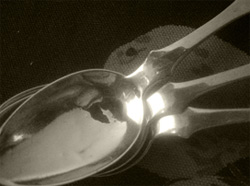
My blog's namesake - small, old and some very dented engraved silver plated tea spoons that belonged to my mother-in-law, and I use them to taste my food as I'm cooking.

Scroll down to the bottom to view my Blogroll

Posted in Salads, Veggies/sides, on October 24th, 2009.

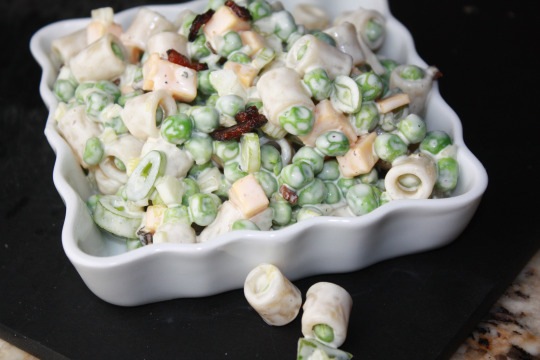
pea cheese bacon salad Does this salad ring a nostalgic bell in your head? I know my mother used to make something like this when I was very young. I think her concoction was just peas, cheese and mayo. Maybe it included some chopped-up sweet pickle. My friend Norma, who is recovering from major surgery, is trying to eat a few more things – like veggies – not just the puddings and smooth things she was eating a few weeks ago. That’s progress, I think. So I asked her what sounded good. She mentioned a pea salad with cheese cubes in it. Sure thing. She also thought green beans sounded good. So I cooked up a batch of baby green beans with bacon and onion. And I tried to create a pea salad that would intrigue her taste buds. She nixed the pickles (I only had relish, and that didn’t appeal to her).

But I added in some other things that may not have been in any of the 1950 era recipes – like bacon. A few recipes I found included macaroni, so I dug around in my pasta stash and found these baby tubes. And I included some hard boiled eggs in the salad too. I scooped out a small portion for us to eat and took the bulk of it to Norma. The salad is really good – amazing how just some simple ingredients can taste so good. Not exactly gourmet, but hey, once in awhile we need comfort food, right?
printer-friendly PDF

Peas, Cheese and Macaroni Salad

Recipe By: My own, but adapted from a lot of old-time recipes.
Serving Size: 6

1 pound frozen peas — (petite size, if possible), partially defrosted
1/3 cup sharp cheddar cheese — cubed, small
3 whole green onions — minced, including green tops
3 slices bacon — fried until crisp, minced
2/3 cup celery — diced
3/4 cup macaroni — cooked, rinsed in cold water, drained
1/2 cup mayonnaise
1 teaspoon Dijon mustard
1/2 teaspoon red wine vinegar
2 tablespoons Italian parsley — chopped
2 large eggs — hard-boiled, chopped
1/2 teaspoon dried thyme — crushed
Pepper, and perhaps some salt, to taste

1. Mix the mayonnaise, vinegar and mustard and set aside.
2. Prepare, drain and set aside the cooked bacon.
3. Combine all other ingredients. Add the dressing and season with pepper and salt, if desired and gently stir together. Garnish with bacon and additional parsley. Chill for an hour or two before serving, if time permits.
Per Serving: 313 Calories; 21g Fat (59.8% calories from fat); 11g Protein; 22g Carbohydrate; 4g Dietary Fiber; 86mg Cholesterol; 327mg Sodium.

A year ago: Chicken Chili
Two years ago: Chocolate Almond Biscotti

Posted in Brunch, on October 23rd, 2009.

egg green chiles Last weekend I enjoyed spending time with my friend Linda. She lives in Carlsbad, about halfway between where we live and San Diego, the town where I grew up. She has an adorable condo with an ocean view. We talked and talked and talked. She loves to travel, and has accompanied us on a trip to France and one to Italy (both times we rented villas for about 10 people and had a fun group, fun time). She just returned from a safari trip to Africa, and had exciting tales to tell about her adventures. She brought me a gift – a set of giraffe salad tongs and some cute giraffe small spoons for appetizers. Really useful and a conversation piece!

Other than shopping and having a nice dinner out one night at a place in Hillcrest, we just enjoyed one another’s company and talked. Linda’s a very good cook – I have several recipes of hers on this blog, including Bombay Chicken, Corned Beef & Cabbage, and her delish Carrot Cake. Now I have another one. Linda had prepared a pasta dish for us on Friday night, and on Saturday morning we lazed around for awhile enjoying several cups of coffee.

On her recent trip to Africa, she purchased an espresso set that just is SO adorable. I covet this little set. I’m going to hunt around on the internet and see if anybody has such things. She paid about $70 for the set in Capetown. As you can see, it’s decorated in bright, vibrant colors, with pictures of a guinea fowl on the side of each. Heaven knows what it would cost to ship, but I’m going to look anyway. In this picture, that little cup on the left full of espresso was consumed moments after I snapped the picture.

so africa espresso set So, back to breakfast. Linda whipped up this nice egg dish for us on Saturday morning, and we had the leftovers the next morning, just reheated in the microwave. I know I’ve had this before, some years ago. It’s not a new recipe, or anything unusual. Just canned green chiles, eggs, cheese, butter and cottage cheese. Also a bit of flour and baking powder. It doesn’t take long to whip this together, but it does need to be prepared just before baking. You can’t let a baking powder mixture get wet and then sit. Once it gets wet, it needs to do its thing soon, otherwise it just gives out, dies.
printer-friendly PDF

Green Chile Eggs

Recipe By: From my friend Linda T (and from her sister Debbie)
Serving Size: 5

6 eggs — beaten
8 ounces Monterey jack cheese
4 ounces green chiles — canned, drained
1 cup cottage cheese
1/4 cup butter — melted
1/4 cup flour
1/2 teaspoon baking powder
1/4 teaspoon salt
1/4 teaspoon freshly ground black pepper

1. Preheat oven to 350°F.
2. Combine all ingredients and pour into greased square baking pan.
3. Bake for 30-35 minutes, or until a tester comes out clean when inserted in center.
4. Serve with salsa if desired.
Per Serving: 410 Calories; 30g Fat (65.8% calories from fat); 26g Protein; 9g Carbohydrate; trace Dietary Fiber; 323mg Cholesterol; 761mg Sodium.

A year ago: Salmon with Parsnips
Two years ago: Butternut Squash Fries

Posted in Fish, on October 22nd, 2009.

tuna la scala You can count on one hand the number of recipes on this blog using canned tuna. And I don’t know about you, but mostly I use canned tuna for sandwiches, or salad, but not much else. The other day I ran across a recipe from w-a-a-ay long ago. Back to the 1950’s when my best friend Linda C. and I used to spend hours and hours every day together. We were young teens then, too young for boyfriends. So we played Parcheesi, and Monopoly, and watched Linda’s older sister get ready for dates. Linda’s mother would fix lunch for us sometimes, and occasionally I’d spend the night at her house too, and usually I was invited for dinner, or Sunday breakfast. Or both.

The Sunday breakfast was almost always waffles and homemade sausage gravy that was served on top of the waffles. Linda’s dad was the Sunday breakfast cook, and he was really proud of his waffle spread. Brings back lots of nostalgic memories thinking about that. Linda’s mother, Van, was a good cook. I have one other recipe of hers – a Lamb Curry, with about 21 condiments. It’s been years since I made that. Linda’s parents used to entertain with some regularity and the 21 curry was a favorite. Sometimes Linda and I would help in the kitchen mincing and chopping.

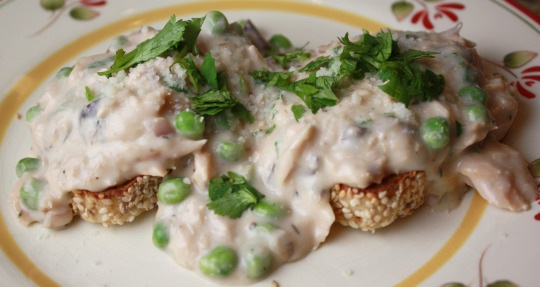
But one of their family favorites was this tuna dish. And I used to fix it every so often, although I’d lost track of the recipe until I found it in MY mother’s recipe box a few weeks ago. As you can imagine, it’s an inexpensive meal, what with just a can of tuna and some English muffins. The other things usually were readily available too. This does contain the ubiquitous cream of mushroom soup, which I keep in my pantry – you just never know when you’re going to need it. Like I did the other night when we returned home from a weekend away. We weren’t overly hungry, so as I stood in the pantry I spotted the tuna. Aha moment.

This recipe is WAY EASY. Probably takes about 10 minutes to make if you’re slow. Toast the English muffins (I used some seeded baguette thick slices that I toasted in the oven) and the tuna comes together in about 7-8 minutes, I’d say. Van’s original recipe didn’t call for peas, but somewhere along the line I added them, and have continued to use them. Her recipe also called for a huge amount of sliced black olives. They aren’t my favorite thing, so I reduce the quantity a lot and add Kalamata instead, but you can use whatever you want to. The fresh lemon juice is key – it gives the sauce a nice tang, although it really isn’t noticeable. So this recipe is a salute to my friend Linda, and her Mom, Van.
printer-friendly PDF

Tuna La Scala on Toasted English Muffins

Recipe By: From the mother of an old friend of mine, Linda C.
Serving Size: 3
NOTES: The original recipe called for 3/4 cup of sliced black olives. I don’t use that much, and prefer the Kalamata instead. I also like more lemon juice (noted in the recipe). The peas are also my addition. Back in the 1950’s when my friend’s mother would fix this, she used the dry canned Parmesan. I never – ever- use that stuff, so the recipe should be better for using the real stuff. If you prefer, use the canned. A serving was one English muffin, split in half (so, 2 halves). For very hearty appetites, this might serve just two.

1/2 small red onion — diced
1 tablespoon olive oil
7 ounces tuna — drained
10 1/2 ounces cream of mushroom soup, condensed
1/2 cup 2% low-fat milk — (or may need more, up to 1/4 cup)
1/4 cup Parmesan cheese — or Pecorino, grated
1/2 cup olives — sliced (or may use Kalamata)
2 tablespoons Italian parsley
1 1/2 tablespoons fresh lemon juice
1/4 teaspoon dried thyme
1/2 cup frozen peas
2 tablespoons Parmesan cheese — or Pecorino, for garnish
1 1/2 tablespoons Italian parsley — for garnish English muffins or thick bread, toasted

1. Heat a medium skillet and add olive oil. Add onions and saute until onions are translucent.
2. In a small bowl mix the soup and milk until it’s smooth. Add to the onions, turn down the heat and allow to hear through.
3. Drain the tuna and flake it apart with a fork. To the cream sauce add the tuna, cheese, olives, lemon juice, thyme, parsley and peas. Continue to heat through on a very low, gentle heat.
4. Meanwhile, toast whatever bread you’re using and prepare the garnishes.
5. Place bread on plate and spoon the sauce over them. Garnish with Parmesan and parsley, then serve immediately.
Per Serving: 361 Calories; 22g Fat (53.6% calories from fat); 24g Protein; 18g Carbohydrate; 3g Dietary Fiber; 37mg Cholesterol; 1263mg Sodium.

A year ago: Soup Season

Posted in Breads, Uncategorized, on October 21st, 2009.

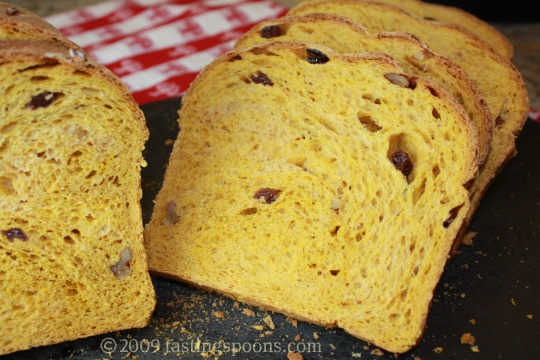
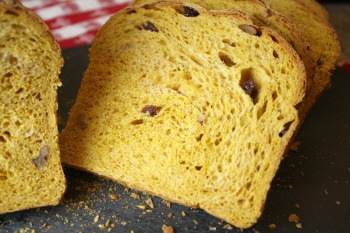
raised pumpkin bread slicedWe don’t eat a lot of bread at our house – generally a half a slice each for breakfast. Once in awhile we’ll have a sandwich, but believe it or not, most bread gets moldy before we use it up. We freeze bread some, but I’m never very happy with it after it’s been in the freezer for more than 4-5 days. I wrap it in foil, then in a freezer plastic bag and still the edges seem to dry out. A few months ago we had just started using what we could, stored at room temp and throwing it out once it got moldy. But I was tired of the grainy, seedy bread we’d been having.

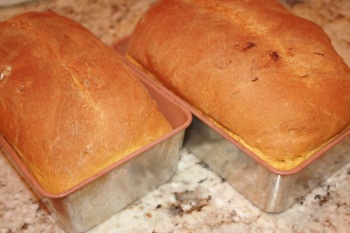
pumpkin bread yeast Since it’s Fall, I dug out my tried and true pumpkin yeast bread recipe and one day when I was home, and I made bread. Normally when you think of pumpkin bread, you likely think of a sweet quick bread. This is not that kind. This is a perfect sandwich or toasting bread. It’s NOT sweet, although it does have a little bit of sugar in it. It’s a soft bread – I use 3/4 white bread flour and 1/4 whole wheat flour. Our normal half-slice portion at breakfast has been upped to a whole slice each. It’s so nice with a little bit of butter. Here you can see the loaves just out of the oven.

If you’ve not been reading my blog for a long time, you may not know that I used to bake a whole lot of bread. When I was a young mom, trying to make some money, for a lunch out, for a babysitter now and then. I had a very small but thriving business, of sorts, baking bread once a week that I sold to friends and family. I was a stay-at-home mom, and enjoyed the process of making bread. I had a menu of about 10 varieties I made, including Stollen at Christmastime. And this bread wasn’t on the menu because I hadn’t discovered it yet.

raised pumpkin bread slice Years later, when I was working full-time, I invested in one of the first bread machines, and we enjoyed loaf after loaf when our kids were teenagers. This recipe is one that I adapted from one of the bread machine cookbooks. But I’ve found that it works best to make it by hand. Well, you can mix it in the machine for the first round, but let it rise in bread pans for the second rising. It will become a beautiful tall loaf, worthy of the finest toasters or turkey sandwiches. This time I kneaded it in the Kitchen Aid mixer with the dough hook, and did the 2nd time by hand, kneading in the raisins and nuts as I worked.

This isn’t a new recipe to my blog – I posted it first a year ago. Although I’ve been making this bread a couple times a year for about 25 years. It’s absolutely the BEST with Thanksgiving turkey leftovers in a sandwich. Don’t be intimidated by making yeast bread – as long as you have a few hours when you can tend to the bread a couple of times, this is a pretty foolproof recipe. I’ve never had it fail. If you want, add different fruit (dried apricots, craisins) or nuts (pecans). Or eliminate one or the other if you don’t have them on hand.
Click here to get to the recipe.

I’ve submitted this recipe to Yeastspotting.

A year ago: Pear Crisp (ooh, was that ever good!)
Two years ago: Twice Baked Cauliflower Take Two

Posted in Fish, Veggies/sides, on October 20th, 2009.

shrimp and grits

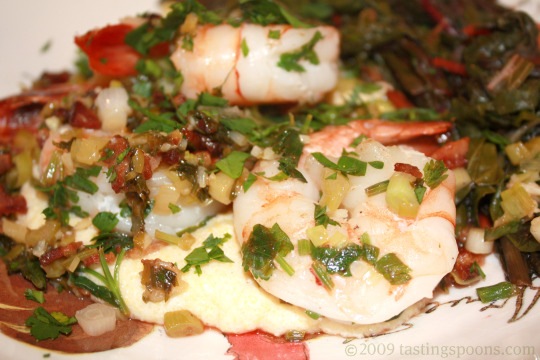
Surely over the years I’d read about shrimp and grits, but for whatever reason, it never appealed to me much. Or let’s say it didn’t appeal enough to make it; nor had I ever ordered it on the rare occasions when it might have been on a menu. But looking at what I had in the refrigerator to serve alongside some shrimp for dinner the other night, I decided I’d adapt an internet recipe from Bobby Flay. Not only was it easy, but it was downright delicious. Fabulous, actually. We both sat in contented silence relishing each bite. Until the two bowls were slicked clean.

So what exactly was it that made it so good? Well, there’s no question the butter, milk and grated sharp Cheddar cheese helped the grits (aka polenta) along the path to outstanding flavor. That served as the bed for the quickly-made shrimp with bacon, lemon juice, garlic, Italian parsley and green onions. There’s really not much else to it. I made creamy grits/polenta (using half milk, half water), and I added more lemon juice and parsley than Flay’s recipe. Actually I used fat-free half and half for the milk, but 2% milk is just fine.

I also made some sautéed Swiss chard too, thanks to Karen, our daughter-in-law who shared bounty from her garden and her sister’s veggie patch. To serve, I scooped the grits into the bottom of a wide deep bowl (a pasta bowl), then placed the shrimp on one side and the Swiss chard on the other. You can’t quite see the chard in the background of the picture, but that dark unfocused blob is it.

It helps to get all the ingredients ready before you begin – or at least while the polenta is simmering, gather up everything else since once you start cooking the shrimp it’s quick. I needed to add some water to keep the polenta creamy during the last 8 or so minutes of the 20 minutes of cooking time. The Swiss chard takes but a few minutes – we like it with some texture still remaining, so cooking it for only 4-5 minutes is max. I’ve included that recipe below – it’s ever so simple.
printer-friendly PDF for the shrimp and grits

printer-friendly PDF for the Swiss chard

Shrimp & Creamy Grits

Recipe: Adapted from a Bobby Flay recipe on the Food Network
Servings: 4
NOTES: You can mix up the grits and shrimp (together), but if you want it to look pretty, just spoon the grits in the bowl and put the shrimp mixture on top with some added chopped Italian parsley.

2 cups water
2 cups 2% low-fat milk — [I used fat-free half and half]
Salt and pepper
1 cup grits — stone-ground
3 tablespoons butter
2 cups shredded sharp cheddar cheese
1 pound shrimp — peeled and deveined
6 slices bacon — chopped
2 tablespoons lemon juice
4 tablespoons chopped parsley
1 cup scallions — thinly sliced
2 large cloves garlic — minced
1 tablespoon Italian parsley — for garnish

1. Bring water and milk to a boil. Add salt and pepper. Add grits and simmer until fluid is absorbed but it’s still creamy and soft, about 20 to 25 minutes. Add water if it thickens too quickly, as you do want to cook it for at least 20 minutes. Remove from heat and stir in butter and cheese. Cover and set aside.
2. Rinse shrimp and pat dry. Fry the bacon in a large skillet until browned; drain well. In grease, add shrimp. Cook until shrimp turn pink. Add lemon juice, chopped bacon, parsley, scallions and garlic. Saute for 3 minutes just until shrimp is cooked through – no longer.
3. Spoon grits into a serving bowl. Add shrimp mixture. Serve immediately.
Per Serving: 698 Calories; 37g Fat (48.0% calories from fat); 48g Protein; 42g Carbohydrate; 1g Dietary Fiber; 272mg Cholesterol; 831mg Sodium.


Sauteed Swiss Chard with Bacon

Servings: 4
NOTES: Do NOT pour the vinegar (alone) into the chard without mixing it with the water – you don’t want to pour it onto just one part, as the mixture needs to be drizzled all over the leaves. If you have a half of an onion, you can add that along with the bacon.

2 slices bacon — or 1 thick slice
1 pound Swiss chard leaves — center rib removed, washed well
1 1/2 teaspoons sherry vinegar
3 tablespoons water
Salt and pepper to taste

1. Slice and dice the bacon into small pieces. Saute in a very large skillet until the bacon is light brown and crisp.
2. The Swiss chard can be damp from washing – it will provide some fluid for cooking. Add the Swiss chard to the bacon, stirring and moving the chard around in the pan until it’s wilted. Mix the vinegar and water and when the water has all evaporated, add the vinegar water. Cover and simmer for 2-3 minutes or until cooked through to your taste. Season with salt and pepper. Serve immediately, when it’s piping hot.
Per Serving: 40 Calories; 2g Fat (35.1% calories from fat); 3g Protein; 4g Carbohydrate; 2g Dietary Fiber; 3mg Cholesterol; 254mg Sodium.

A year ago: Baked Eggs with chorizo & cannellini beans
Two years ago: Chicken with Lemon and Garlic Crust

Posted in Breads, on October 19th, 2009.

focaccia closeup

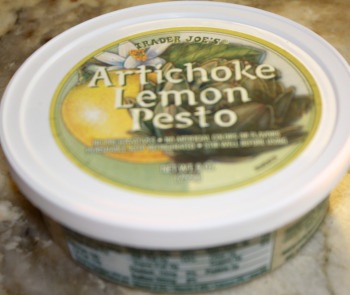
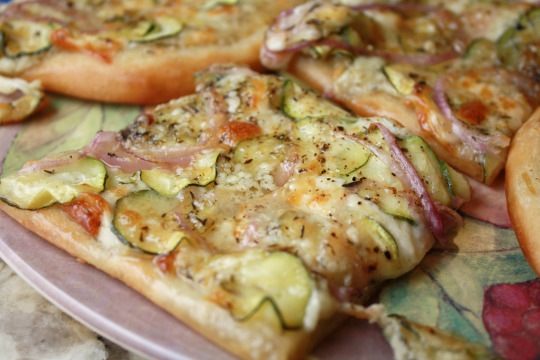
Well now. You haven’t seen very many pizza or focaccia recipes on my blog. Why? Because I don’t make them all that much as we try to limit those kinds of carbs. There is one pizza post I did about two years ago (that’s the last time I made it!) – the Chicken, Red Onion, Kalamata Olive and Pesto Pizza – and when I make pizza, that’s about the ONLY one I prepare. But when I had this focaccia a week or so ago, served with the Italian Sausage & Tomato Soup that was so off-the-charts good, I knew I wanted to make this at home. I may have used just a bit more cheese, but with that one exception, I made it exactly as Phillis made it. It’s so perfect to pair with the soup – any soup just about – but it was particularly good with the Italian flavors of the sausage and tomato soup. artichoke lemon pesto

It would really help if you live in Trader Joe’s country, though, since you buy the raw pizza dough there AND the artichoke-lemon pesto from there too. I didn’t even look at what’s contained in the pesto, but I suppose you could try to make your own with some canned, chopped artichoke hearts, some olive oil and lemon juice, maybe lemon zest. It’s kind of thick and goopy, not thin.

Pizza Dough Tip:

It’s much easier to pat raw pizza dough on a Silpat – it sticks to the Silpat so it stretches more readily and stays there!

Anyway, you pat out the pizza dough first. I learned a really important cooking tip about this – pizza dough is ever so much easier to handle if you pat and spread it out on a Silpat. Wow, what a difference from working at it on a countertop. I put the Silpat right in my big rimmed baking sheet, plopped the dough on it, sat down in front of the TV and worked away at it for about 4-5 minutes maybe, and it was done.

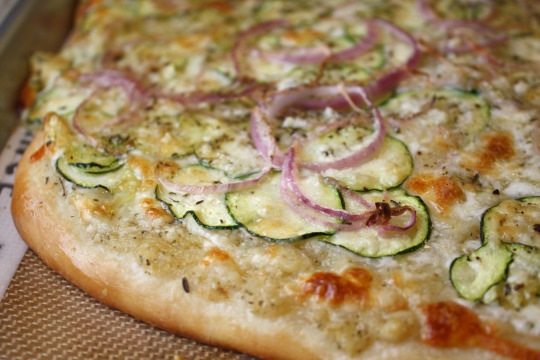
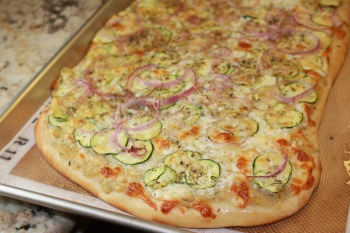
focaccia baked You spread the artichoke pesto mixture on top, then add all the Mozzarella. I used whole milk Mozzarella because that’s what I had in my refrigerator. Certainly makes for a more tasty cheese. Then you add thinly sliced rounds of zucchini and red onion to the top, some grated Parmesan (I used Pecorino, actually), and a bit of dried oregano that I scrunched up between my palms before sprinkling it evenly on the top. I’m sure I used more than 1/2 teaspoon, though. It gets baked at a high temp – 450 – and you want to serve it right out of the oven so the cheese is bubbling hot.

focaccia piece closeup To American tastes, there may not be much difference between focaccia and pizza. But going back in Italian history, focaccia is more like a snack, a bread snack. Often Italians serve it plain, with a dimpled top, sometimes with a light slick of olive oil pooling in the dimples. I well remember walking along a little side street in an Italian beach city, peering in a bakery side window with trays and trays of focaccia just baked. The baker was brushing olive oil all over the dimpled top surface. Oh the aroma was heavenly. But that was really plain – it was just bread, salt and olive oil. No cheese or herbs even. Here we often add toppings to focaccia, so it differs very little from pizza – which I consider more of an entree rather than a snack. So there’s your culinary lesson of the day!
printer-friendly PDF

Artichoke Zucchini Focaccia

Recipe: Phillis Carey
Servings: 8

1 package raw pizza dough from Trader Joe’s
1/2 cup artichoke lemon pesto from Trader Joe’s
2 cups Mozzarella cheese — grated
1 cup zucchini slices — sliced very thin
1/2 cup red onion — very thinly sliced
1/2 cup Parmigiano-Reggiano cheese — grated [or Pecorino]
1 teaspoon dried oregano — crushed between your palms

1. Preheat oven to 450.
2. Stretch (or roll out) the raw pizza dough on a Silpat-lined rimmed baking sheet, to about 8×12 inches.
3. Spread with artichoke pesto and sprinkle with Mozzarella. Scatter the zucchini and red onion over the cheese and sprinkle with Parmesan and oregano.
4. Bake for 15-18 minutes or until cheese is melted and crust is crisp and edges are turning a golden brown. Cut lengthwise, then across in rectangular strips. Serve hot.

A year ago: Wednesday Breakfast Scones
Two years ago: Almond Cranberry Cookies

Posted in Pork, Soups, on October 17th, 2009.

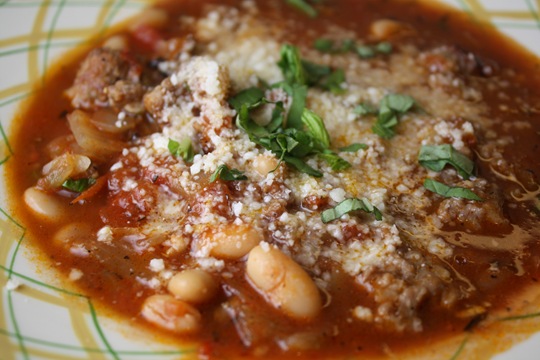
italian sausage soup closeup Lately I’m sounding like a broken record – seems like every recipe is a winner. Five star. This one is no exception. And it’s another one of those recipes that has nothing but ordinary food in it. Italian sausage, onion, garlic, canned tomatoes, broth, canned cannellini beans, orzo, then some fresh basil and Parmesan cheese. With the exception of the beans and orzo, it’s a lot like spaghetti sauce. But don’t forget that anything you make is only as good as the ingredients that go into it. That means, in this case, using good quality Italian sausage. Fresh garlic. Oh yes, there’s a bit of bacon in this too.

It doesn’t take all that long to prepare this soup, either. The recipe is yet another Phillis Carey one. Wow, that gal is one stupendously good cook. I liked this at the cooking class, and liked it almost more so when I made it myself. I used Niman Ranch no-nitrate/nitrite bacon. I used Italian specialty meat market sausage. I used high quality frozen beef broth and some of Penzey’s concentrated pork broth. Trader Joe’s canned beans. Muir Glen fire-roasted canned tomatoes. Real Parmigiano-Reggiano cheese. Fresh basil leaves. I made a double batch – made enough for entertaining friends, and two portions for freezing, and some for another meal this week. If you make this as a main course, you probably won’t get 8 servings. You’ll have no trouble getting rid of it, I guarantee.
printer-friendly PDF

Italian Sausage & Tomato Soup

Recipe: Phillis Carey cooking class
Servings: 8
NOTES: You can use turkey sausage, but the pork provides a lot more flavor. If you increase the quantity, don’t increase the amount of red pepper flakes.

2 slices bacon — thick sliced, diced
1 pound Italian sausage — sweet (or hot, if you prefer)
1 cup red onion — chopped
3 cloves garlic — minced
1/2 teaspoon dried oregano
1 pinch red pepper flakes
1 whole bay leaf
28 ounces diced tomatoes — with juice
6 cups low-sodium chicken broth
1/4 cup orzo
15 ounces cannellini beans — rinsed and drained
Salt & pepper to taste
1/2 cup fresh basil — chopped
1/2 cup Parmigiano-Reggiano cheese — grated (or more if desired)

1. Cook chopped bacon in a large pot over medium heat to render out the fat. Add the crumbled sausage and continue cooking and stirring occasionally, until sausage is browned. Add the onions to the pot and cook for 5 minutes. Add the garlic, oregano and red pepper flakes and toss for 30 seconds.
2. Stir in bay leaf, tomatoes and chicken broth. Bring to a boil, then simmer for 10 minutes. Add the orzo and cook for 5 minutes. Add the beans and simmer until heated through and orzo is tender, about 8 minutes. Season to taste with salt and pepper. Stir in the fresh basil just before serving. Ladle into bowls and sprinkle top with cheese.
Per Serving: 456 Calories; 21g Fat (38.8% calories from fat); 31g Protein; 45g Carbohydrate; 10g Dietary Fiber; 45mg Cholesterol; 490mg Sodium.

A year ago: Chicken Hamburgese
Two years ago: Heavenly Cream Cheese Brownies (yum, makes my mouth water, guess I need to make these again soon)

Posted in Beef, on October 16th, 2009.

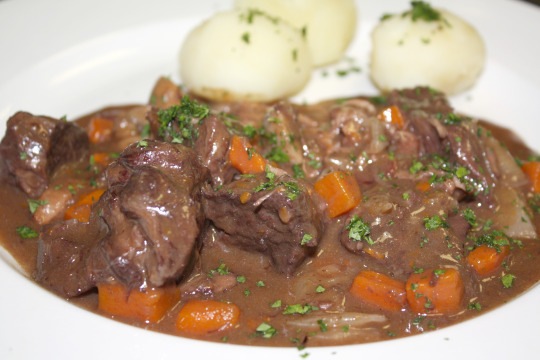
beef bourgignon

Closed:

The Pleasant Peasant, after many years, closed its doors just before Thanksgiving, 2009. A sad day for us.

A couple of weeks ago we organized a dinner out with a group of friends. A group that enjoys good food!  And we’d all talked about the movie, Julie & Julia a couple of weeks earlier. At the time we were still living in summer heat, so none of us felt much like making the Beef Bourguignon. So, I called Laurent & Lisa Ferre, the owners of a country French restaurant, The Pleasant Peasant, near the Orange County airport. Our favorite restaurant, as it so happens. It’s a country French bistro, and the prices reflect that country influence. Your dinner bill will not break the bank.

pleasant peasant sign The Pleasant Peasant has been a part of my hubby’s regular routine for about 30 years. Back to when the restaurant first opened. As Dave explains it, as a salesman (he sold computer chips for Intel Corp. for a good part of his career – and he wouldn’t say it, but I will, he was very good at it) he always needed a good restaurant where he was “known.” The kind of eatery where, if he called at 10 on Friday mornings, he could always be assured they’d make a table available for him for lunch. Even if they were full. And, having a discriminating palate, he wasn’t about to make Mimi’s, or Marie Calender’s his go-to restaurant. Heck no. He had an expense account, so usually he could manage going to a nicer, more upscale restaurant. (Can you guess, this was in the 80’s and 90’s.)

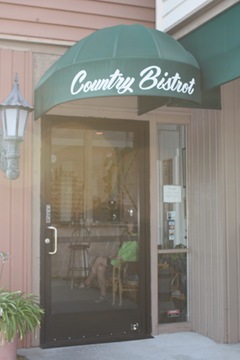
front door The way Dave tells it, if he wanted to take an electronics buyer or a design engineer to lunch, he’d call and leave a voice message, “Meet me for a chicken today?” That was code for – I’ll meet you at the Pleasant Peasant at 11:45 and we’ll share lunch and a half-liter of wine (served in a ceramic chicken).  Now Dave is retired and we mostly go there for dinner, but they’re still open for lunch Monday-Friday.

So we knew when we asked Laurent if he’d prepare Beef Bourguignon for our group, he’d do a stellar job of it. Indeed he did. The French beef stew is not available on their menu, and Laurent shook his head vigorously when I suggested he put it there, especially at the moment because of the popularity of the movie. He says it’s too labor intensive. And perhaps it is, so we were especially happy he’d prepare it for our group. He used his own recipe (probably very similar to Julia Child’s) with carrots, mushrooms and pearl onions. And a roux (butter and flour browned in a heavy skillet, which is not part of Julia’s recipe). Laurent served the beef with just perfectly steamed potatoes, and we had a little bite  of them with every bite of stew. Oh my, yum. Laurent makes his own beef stock, and probably the red wine contributed to its fabulous rich flavor. We all slurped up every bite.

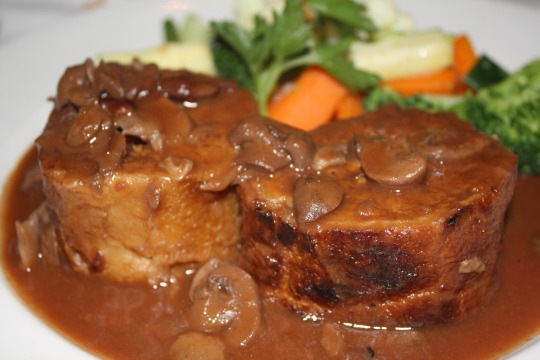
meatloaf wellington Pictured above – the Meatloaf Wellington, one of my favorite things on the menu. For all dinners, you have a choice of their delicious green salad (with grated carrot and raw beet on top) served always with their French tarragon dressing. The dressing that occasionally I buy from them just because it’s so good. (No, sadly, I don’t have the recipe.) Or their soup of the day, gazpacho or French Onion soup. Good crusty rolls along with pate butter and plain butter are part of the regular menu. The soup or salad is included with every entree.

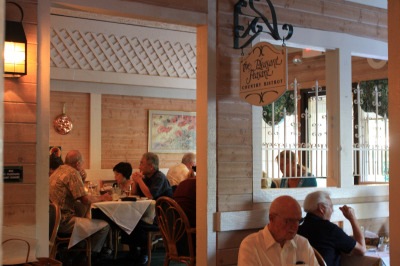
interior When Dave and I go there, we order a variety of their menu items – the fabulous Laurent-smoked salmon served with a green bean and salad side (at lunch) or a cold mixed vegetable salad (at dinner). Or one of their on-special fish (halibut, tilapia, sea bass usually) with a variety of French sauces. Or their sand dabs, which is one of the most popular items on their menu. Or the meatloaf Wellington. It’s like a beef Wellington, except Laurent makes a great meatloaf center – I don’t know what he does to that meatloaf but it’s not like any meatloaf I know how to make – it’s richer, less dense somehow – but prepared in the same manner as a fillet mignon version of the Wellington (wrapped in puff pastry). But I also like the chicken too.

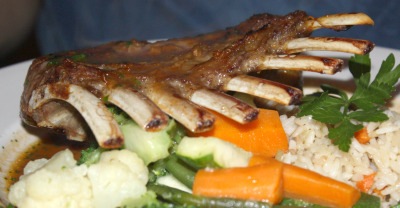
The rack of lamb rack of lamb (Dave thinks their lamb racks are the best of any place around). And a lamb shank that’s so tender you can’t believe it.  Salmon sorrel as well. A steak. Sometimes pork is on the menu in a variety of ways. And on rare occasions Laurent makes a pot roast that is better than any pot roast I’ve ever, ever made. If he has it, I always order that. There’s a smattering of pasta too on the menu, and several appetizers (including escargot). Pictured above right, the Rack of Lamb.

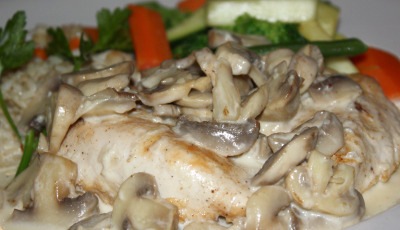
poulet champignonPictured left, the Poulet Champignon, not on the menu, but if you ask, they might make it for you.

A few years ago the restaurant critic at the Los Angeles Times wrote this about The Pleasant Peasant:

“. . . you’ll still find the same honest French cooking Ferre has been doing here all along. Ferre spent five years in the kitchens of Alain Chapel, a three-star Michelin restaurant near Lyons, and many more cooking in his native Brittany. This man isn’t trendy or creative; he’s just a solid craftsman. And his menu is a bargain. No other French restaurant around here gives you such quality for the price as the Pleasant Peasant.”

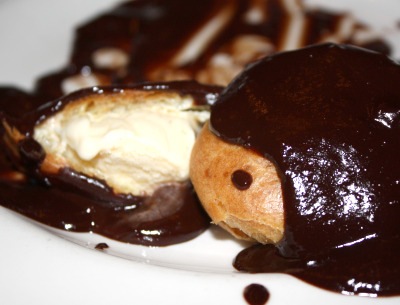
If you’re interested in dessert, about half the time we splurge and order profiteroles. Now here’s another story – – sorry this post is so long, but there’s a lot to say about the Pleasant Peasant. We’ve been ordering the profiteroles there for years and years and years. You know what they are . . . small cream puffs, top cut off, center removed and filled with rich vanilla ice cream, top replaced, then the whole thing drizzled with Laurent’s uber-rich, silky chocolate sauce. All I know is that he adds a bit of espresso to it and that he uses a good French chocolate. After all these years of going there, that’s all I know. I always wish I could lick the plate. An order of profiteroles is usually four, but if you are very nice, they might give you a smaller order.  They also have other desserts, but for us, there’s nothing else except the profiteroles.

Laurent is French born, from Brittany. He met Lisa when she was doing an internship (hotel & restaurant school at Cal Poly here in California) at a restaurant in Orleans. She brought him home with her when her internship was completed. They married shortly thereafter and have owned the Pleasant Peasant ever since. Laurent cooked under the tutelage of Alain Chapel, a very famous French chef, and that’s why Laurent is able to serve the Lamb Shanks with the Alain Chapel designation. The lamb is a regular on the menu. So, if you go there, be sure to tell them Carolyn & Dave said hello!profiteroles

The Pleasant Peasant
4251 Martingale Way
Newport Beach, California

Reservations suggested, phone: 949-955-2755

Lunch: Monday-Friday; Dinner: Monday-Saturday (the restaurant is a little hard to find, so you might look it up on a map before you go)

And in case you hadn’t seen Julia Child’s recipe for her Beef Bourguignon, here it is:
printer-friendly PDF

Julia Child’s Beef Bourguignon

Recipe: adapted from “Mastering the Art of French Cooking” by Julia Child
Servings: 6
Serving Ideas: According to Laurent at the Pleasant Peasant, this is supposed to be served with steamed whole potatoes (medium-sized red bliss, peeled), so you have a bit of potato with every bite of the beef stew.

6 ounces slab bacon — (lardons)
3 1/2 tablespoons olive oil
3 pounds beef stew meat — lean, cut into 2-inch cubes
1 carrot — sliced
1 onion — sliced
Salt and pepper
2 tablespoons flour
3 cups red wine — young and full-bodied (like Beaujolais, Cotes du Rhone or Burgundy)
2 1/2 cups beef stock — (2 1/2 to 3 1/2 cups)
1 tablespoon tomato paste
2 cloves garlic — mashed
1/2 teaspoon thyme
A crumbled bay leaf
18 small boiling onions — (18 to 24)
3 1/2 tablespoons butter Herb bouquet (4 parsley sprigs — one-half bay leaf, one-quarter teaspoon thyme, tied in cheesecloth)
1 pound mushrooms — fresh and quartered

1. Remove bacon rind and cut into lardons (sticks 1/4-inch thick and 1 1/2 inches long). Simmer rind and lardons for 10 minutes in 1 1/2 quarts water. Drain and dry.
2. Preheat oven to 450 degrees.
3. Sauté lardons in 1 tablespoon of the olive oil in a flameproof casserole over moderate heat for 2 to 3 minutes to brown lightly. Remove to a side dish with a slotted spoon.
4. Dry beef in paper towels; it will not brown if it is damp. Heat fat in casserole until almost smoking. Add beef, a few pieces at a time, and sauté until nicely browned on all sides. Add it to the lardons.
5. In the same fat, brown the sliced vegetables. Pour out the excess fat. Return the beef and bacon to the casserole and toss with 1/2 teaspoon salt and 1/4 teaspoon pepper. Then sprinkle on the flour and toss again to coat the beef lightly. Set casserole uncovered in middle position of preheated oven for 4 minutes.
6. Toss the meat again and return to oven for 4 minutes (this browns the flour and covers the meat with a light crust). Remove casserole and turn oven down to 325 degrees.
7. Stir in wine and 2 to 3 cups stock, just enough so that the meat is barely covered. Add the tomato paste, garlic, herbs and bacon rind. Bring to a simmer on top of the stove. Cover casserole and set in lower third of oven. Regulate heat so that liquid simmers very slowly for 3 to 4 hours. The meat is done when a fork pierces it easily.
8. While the beef is cooking, prepare the onions and mushrooms. Heat 1 1/2 tablespoons butter with one and one-half tablespoons of the oil until bubbling in a skillet. Add onions and sauté over moderate heat for about 10 minutes, rolling them so they will brown as evenly as possible. Be careful not to break their skins. You cannot expect them to brown uniformly. Add 1/2 cup of the stock, salt and pepper to taste and the herb bouquet. Cover and simmer slowly for 40 to 50 minutes until the onions are perfectly tender but hold their shape, and the liquid has evaporated. Remove herb bouquet and set onions aside.
9. Wipe out skillet and heat remaining oil and butter over high heat. As soon as you see butter has begun to subside, indicating it is hot enough, add mushrooms. Toss and shake pan for 4 to 5 minutes. As soon as they have begun to brown lightly, remove from heat. When the meat is tender, pour the contents of the casserole into a sieve set over a saucepan.
10. Wash out the casserole and return the beef and lardons to it. Distribute the cooked onions and mushrooms on top.
11. Skim fat off sauce in saucepan. Simmer sauce for a minute or 2, skimming off additional fat as it rises. You should have about 2 1/2 cups of sauce thick enough to coat a spoon lightly. If too thin, boil it down rapidly. If too thick, mix in a few tablespoons stock. Taste carefully for seasoning. Pour sauce over meat and vegetables. Cover and simmer 2 to 3 minutes, basting the meat and vegetables with the sauce several times.
12. Serve in casserole, or arrange stew on a platter surrounded with potatoes, noodles or rice, and decorated with parsley.
Per Serving: 938 Calories; 49g Fat (51.8% calories from fat); 63g Protein; 40g Carbohydrate; 8g Dietary Fiber; 167mg Cholesterol; 1655mg Sodium.

A year ago: Brown Sugar Cake
Two years ago: Leek, Kielbasa & Sausage Soup

Posted in Desserts, on October 15th, 2009.

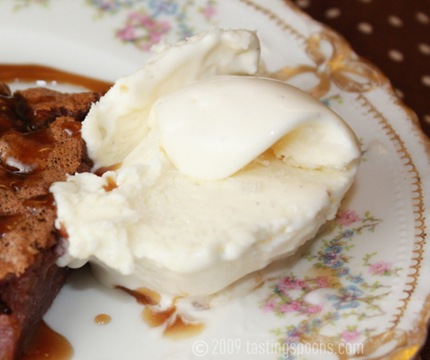
sour cream ice cream

Doesn’t look like all that much, does it? Like maybe vanilla ice cream. But oh, it’s not. Nothing like vanilla. Other than the color. My friend Cherrie brought this a week or so ago when we had the Woodford Pudding. It was just PERFECT with it. You see, the sour cream ice cream, as you might imagine, has a bit of a tangy edge to it, just like the sour cream does. It’s mostly sour cream in the mix, after all. The recipe came from the Food Network, from a Gale Gand show, apparently. It has 4 ingredients: sour cream, half and half, sugar and lemon juice. No eggs, no egg yolks, not even vanilla! No time spent making a custard. If you have a good ice cream machine, you can make this up in no time flat.  You don’t even have to chill the mixture, just whisk it together in a bowl and pour it into the ice cream machine. My thought: this is best served WITH a dessert, not all by itself. Although it’s sweet like ice cream, that sour cream twang might put off some appetites if you ate it solitary. But try it!
printer-friendly PDF

Quick Sour Cream Ice Cream

Recipe: A Gale Gand recipe from the Food Network
Servings: 8
NOTES: Ideally, serve this with a sweeter-type dessert – the sourness of the sour cream does help temper the sugar.

1 pound sour cream
1 cup half and half
1 2/3 cups sugar
2 tablespoons lemon juice

1. In a large bowl combine the sour cream and half and half. Whisk in the sugar and add the lemon juice until well combined.
2. Process in an ice cream machine, then freeze until solid.
Per Serving: 323 Calories; 15g Fat (41.7% calories from fat); 3g Protein; 46g Carbohydrate; trace Dietary Fiber; 36mg Cholesterol; 43mg Sodium.

A year ago: Mexican Rice and Chicken Tacos
Two years ago: Grilled Mozzarella Bread Skewers

Posted in Pork, on October 14th, 2009.

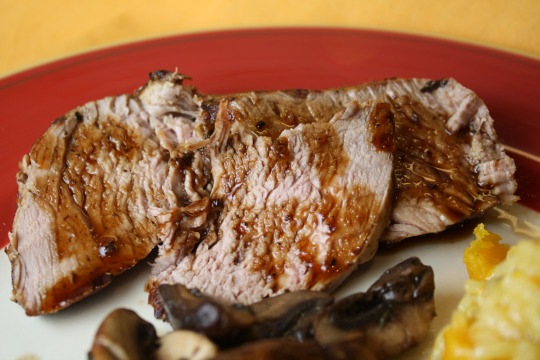
pork tenderloin cider vinegar maple sugar sauce

Pork tenderloin is a favorite of ours. It’s lean. Tender. Quick to cook. Not as much flavor as some of the more fatty cuts of the pig, but good if prepared correctly (read: not overcooked) and usually with some kind of sauce on top or a salsa/relish on the side.  Phillis Carey prepares it often in her cooking classes. This recipe is a keeper. It meets all the criteria – lean, quick, flavorful, and has a sauce/gravy to go with it. An easy pan sauce using apple cider vinegar and maple syrup.

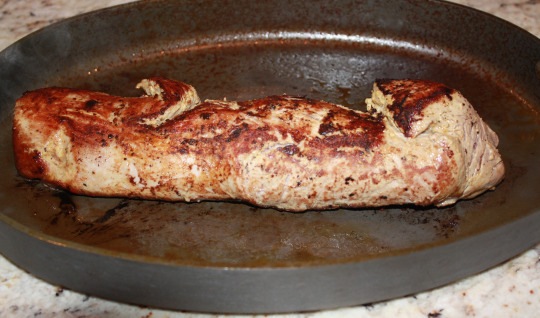
Soooo, here’s what you do: rub a bunch of Dijon mustard on the pork tenderloin, along with some salt and pepper. Into a hot pan it goes – to brown on as many sides as the tenderloin seems to have. Here’s a picture of that step.

pork tenderloin pan browned

Once browned, insert a meat thermometer in it, kind of angled in so the tip of the point is – hopefully – in the center of the thickest part of the meat. It goes into a very hot (425) oven to roast for a very short time – like 15-20 minutes. Meanwhile get the ingredients together for the sauce – some cider vinegar, more Dijon and some good (real) maple syrup. You remove the pork when it reaches 150 (for pink). If you like it cooked more, then continue until it reaches 155. The meat rests briefly (tented with foil) while you deglaze the pan with the vinegar. Then you add the mustard and maple syrup. Be SURE to use a whisk to break up the mustard – if you don’t you’ll have bunches of cooked clumps of mustard in the sauce. Not good! Slice the meat and drizzle the sauce on top.

My friend Cherrie prepared this dish a few nights ago and she made a couple of changes to the sauce – she added a bit of cream to the sauce and also a touch of arrowroot, which thickened it. I also think that when I make it again – which I will – I’ll make half again more sauce. There wasn’t quite enough, I thought, so I increased it in the recipe below.
printer-friendly PDF

Pork Tenderloin with Maple Syrup Mustard & Vinegar Sauce

Recipe: Phillis Carey cooking class
Servings: 6 (or less if guests have big appetites)

PORK:
2 whole pork tenderloin
2 tablespoons Dijon mustard
Salt & pepper to taste
1 1/2 tablespoons vegetable oil — (don’t use olive oil)
SAUCE:
3/4 cup apple cider vinegar
1/2 cup maple syrup — (the real stuff)
6 tablespoons Dijon mustard
1 1/2 tablespoons fresh sage — chopped

1. Preheat oven to 425.
2. Trim fork of fat and silverskin. Combine 2 T. mustard with salt and pepper and rub all over the pork.
3. Heat oil in a skillet over medium-high heat. Add the pork tenderloin and brown on all sides, about 6 minutes total. Transfer pork to a parchment-lined baking sheet (or use Silpat) and roast until the internal temperature reaches 150 (155 if you want it at medium), about 20-25 minutes. Remove from oven (do not rinse the pan).
4. Use roasting pan (if it can go on the stovetop) and place on low heat. Add the vinegar and boil, scraping up any browned bits from the bottom of the pan. Whisk in the maple syrup and mustard and bring to a boil. Use a whisk to mix all the mustard smoothly into the sauce. Reduce heat and simmer until sauce has thickened, about 5 minutes. Add the sage and remove from heat.
5. Meanwhile, slice the pork on the diagonal, about 1/2 inch thick slices. Serve on a heated plate (it gets cold very quickly) and drizzle with the maple mustard sauce.
Per Serving: 209 Calories; 7g Fat (29.3% calories from fat); 17g Protein; 21g Carbohydrate; 1g Dietary Fiber; 49mg Cholesterol; 291mg Sodium.

A year ago: Dinner at Bistro 33 near Folsom
Two years ago: Pumpkin Cake in a Mold (pumpkin shape)

Related Posts Plugin for WordPress, Blogger...