Get new posts by email:

Archives

Currently Reading

Here are the tastingspoons players. I’m in the middle (Carolyn). Daughter Sara on the right, and daughter-in-law Karen on the left. I started the blog in 2007, as a way to share recipes with my family. I’m still doing 99% of the blogging and holding out hope that these two lovely and excellent cooks will participate. They both lead very busy lives, so we’ll see.

– – – – – – – – – – – – – – – – – – – – – –

BOOK READING (from Carolyn):

Music of Bees, Eileen Garvin. Absolutely charming book about a woman in midlife, lonely, who raises bees, also makes unlikely friends. Heart-warming and very interesting about beekeeping.

A Postcard from Paris, Alex Brown. Really cute story. Dual time line, 1940s and present day about renovating an old apartment in Paris, things discovered.

Time of the Child, Niall Williams. Oh such a good book. Very small village in Ireland, 1960s. A baby is left on the doorstep. The town all whispers and helps. I listened to an interview of the author, which made me like him and his books even more.

Sipsworth, Simon Van Booy. If you like animals you’ll swoon. An old woman who really wants to die finds a tiny mouse in her house and befriends it and finds a reason to live. Utterly charming book.

The Forger’s Spell, Edward Dolnick. True story. For seven years a no-account painter named Han van Meegeren managed to pass off his paintings as those of Johannes Vermeer.

If You Lived Here, You’d be Home by Now, Christopher Ingraham. Could hardly put it down – about a journalist who takes on a challenge to move to small town in Minnesota and write about it. He expects to hate it and the people and place, but he doesn’t. Absolutely wonderful true story.

The River We Remember, William Kent Kreuger. 1950s, Minnesota. A murder and the aftermath. Could hardly put it down. Kreuger has such a vivid imagination and writing style.

How the Lights Gets In, Joyce Maynard. An older woman returns to New Hampshire to help care for her brain-injured son. Siblings and family, lots of angst and resentments.

The Filling Station, Vanessa Miller. Every American should read this book. A novelized retelling of the Tulsa massacre in 1921. Absolutely riveting.

The Story She Left Behind, Patti Callahan Henry. Love this author. Based on a true story. A famous author simply vanishes, leaving her husband and daughter behind. She had invented a mystical language no one could translate. Present day, someone thinks he’s solved the riddle, contacts the family. Really interesting read.

The Girl from Berlin, Ronald Balson. Love anything about Tuscany. An elderly woman is being evicted from a villa there, with odd deed provenance. Two young folks go there to help unravel the mystery. Loved it.

The Island of the Colorblind, Oliver Sacks, M.D. Nonfiction. The dr is intrigued by a remote Pacific island where most of the inhabitants are colorblind. He also unravels a mystery on Guam of people born with a strange neurological problem. Medical mysteries unveiled. Very interesting.

The Bookbinder, Pip Williams. Post 1914 London. Two sisters work at a bookbindery. They’re told to not read the books. One does and one doesn’t. One has visions beyond her narrow world; the other does not. Eventually the one gets into Oxford. Lovely story.

The Paris Express, Emma Donoghue. 1895 on a train to Paris, a disaster happens. You’ll delve into the lives of many people who survived and died in the crash.

A Race to the Bottom of Crazy, Richard Grant. This is about Arizona. Author, wife and child move back to Arizona where they once lived. Part memoir, research, and reporting in a quest to understand what makes Arizona such a confounding and irresistible place.

The Scarlet Thread, Francine Rivers. A woman’s life turned upside down when she discovers the handcrafted quilt and journal of her ancestor Mary Kathryn McMurray, a young woman who was uprooted from her home only to endure harsh frontier conditions on the Oregon Trail.

A Place to Hide, Ronald Balson. 1939 Amsterdam, an ambassador has the ability to save the lives of many Jewish children. Heartwarming.

Homeseeking, Karissa Chen. Two young Chinese teens are deeply in love, but in China. Then their families are separated. Jump to current day and the two meet again in Los Angeles.

North River, Pete Hammill. He always writes such a good story. A doctor works diligently healing people from all walks of life. His wife and daughter left him years before. One day his 3-yr old grandson arrives on his doorstep.

A Very Typical Family, Sierra Godfrey. A very messed-up family. Three adult children are given a home in Santa Cruz, Calif, but only if the siblings meet up and live in the house together. A very untypical scenario but makes for lots of messes.

Three Days in June, Anne Tyler. The usual Anne Tyler grit. Family angst. This wasn’t one of my favorites, but it was entertaining and very short.

Saved, Benjamin Hall. Author is a veteran war reporter. Ukraine, 2022, he nearly loses his life to a Russian strike. Riveting story – he survives, barely.

Grey Wolf, Louise Penny. Another Inspector Gamache mystery in Quebec. She is such an incredible mystery writer.

All the Colors of the Dark, Chris Whitaker. A missing person mystery, a serial killer thriller, a love story, a unique twist on each. Could hardly put it down.

Orbital, Samantha Harvey. Winner of 2024 Booker Prize. I don’t usually like those, but I heard the author interviewed and she hooked me. This is not a normal book with a beginning, a story and an end. It’s several chapters of the day in the life of various astronauts at the ISS (Int’l Space Station). All fictional. She’s been praised by several real astronauts for “getting it” about space station everyday life.

The Blue Hour, Paula Hawkins. An island off Scotland. Inaccessible except when the tide is out. Weird goings on. An artist. A present day mystery too.

Iron Lake, William Kent Krueger. A judge is murdered and a boy is missing. Riveting mystery.

Tell the Wolves I’m Home, Carol Ricks Brunt. 1980s. A 14-yr old girl loses her beloved uncle. Yet a new friendship arises, someone she never knew about.

Four Treasures of the Sky, Jenny Zhang. 1880s, a young girl is kidnapped in China and brought to the United States. She survives with many hurdles in the path.

The Boy Who Fell out of the Sky, Ken Dornstein. Memoir, 1988. The author’s brother died in the PanAm flight that went down in Lockerbie, Scotland. A decade later he tries to solve “the riddle of his older brother’s life.”

Worse Care Scenario, T.J. Newman. Oh my. Interesting analysis of what could/might happen if a jet crashed into a nuclear plant. Un-put-downable.

Song of the Lark, Willa Cather. Complicated weave of a story about a young woman in about 1900, who has a gifted voice (singing) and about her journey to success, not without its ups and downs.

Crow Talk, Eileen Garvin. Charming story which takes place at a remote lake in Washington State, about a few people who inhabit it, the friendships made, but also revolving around the rescue of a baby crow.

The Story Collector, Evie Woods. Sweet story about some dark secrets from an area in Ireland, a bit magical, faerie life, but solving a mystery too.

A Sea of Unspoken Things, Adrienne Young. A woman investigates her twin brother’s mysterious death. She goes to a small town in California to figure it out, to figure HIM out.

The King’s Messenger, Susanna Kearsley. 1600s England, King James. About one of his trusted “messengers,” and his relationship with a young woman also of “the court.” Lots of intrigue.

In the Shadow of the Greenbrier, Emily Matchar. Interesting mystery in/around the area of the famous resort in White Sulphur Springs, West Virginia.

Isola, Allegra Goodman. Hard to describe, survival story on an island in the 1600s.

Save the Date, Allison Raskin. Rom-com, witty, LOL funny. Clever.

The Sirens, Emilia Hart. Numerous time-lines, Australia. Mysteries abound, nightmares, abandoned baby, weird allergies.

Red Clay, Charles Fancher. LOVED this book. Mostly post-Civil War story about the lives of slaves in Alabama during Reconstruction.

Stars in an Italian Sky, Jill Santopolo. Dual time line, 1946 and recent time. Love stories and a mystery.

Battle Mountain, C.J. Box. Another one of Box’s riveting mysteries. Love his descriptions of the land.

Something Beautiful Happened, Yvette Corporon. A memoir of sorts in Greece, tiny island of Erikousa, where the locals hid Jews during WWII. All elusive stories told by the author’s grandmother.

The Jackal’s Mistress, Chris Bohjalian. 1860s Virginia, about a woman who saves the life of a Union soldier. Really good story.

Song of the Magpie, Louise Mayberry. Really interesting story about Australia back in the days when it was mostly a penal colony. Gritty strength of a woman trying to thrive with her farm.

The Boomerang, Robert Bailey. A thriller that will have you gripping the book. About a lot of secrets surrounding the president (fictional novel, remember) and his chief of staff and about cancer. A cure. Such a good story.

Care and Feeding, Laurie Woolever. Really interesting memoir of a woman driven to succeed in the restaurant business. She worked for Mario Batali and then Anthony Bourdain. Gritty stories.

Everything is Tuberculosis, John Green. Maybe not a book for everyone. A real deep dive into the deadly tuberculosis infection, its history. I heard the author interviewed and found the book very interesting.

The Book Lovers Library, Madeline Martin. Fascinating read about Boots’ drug stores’ lending library. And the people who worked in them.

The Arrivals, Meg Mitchell Moore. LOL funny, about a middle-aged couple whose children (and their various family members) return to the family home and the chaos that ensues.

My Life as a Silent Movie, Jesse Lee Kercheval. About grief. A big move to Paris, finding herself a new life with a new set of real blood family.

Escape, Carolyn Jessop. Another memoir about a woman really in bondage in Utah, Mormon plural marriage.

 

Tasting Spoons

My blog's namesake - small, old and some very dented engraved silver plated tea spoons that belonged to my mother-in-law, and I use them to taste my food as I'm cooking.

Scroll down to the bottom to view my Blogroll

Posted in easy, Fish, on February 19th, 2010.

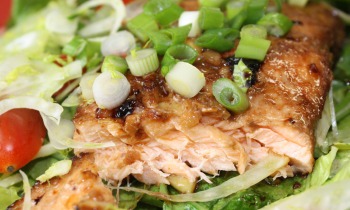
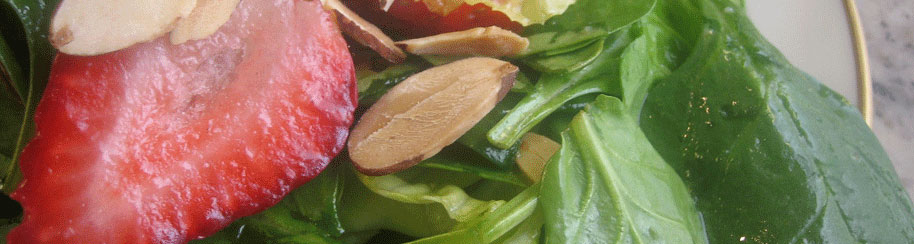
salmon salad

A couple of nights ago when I made this, I’d been working on our income taxes all day long. I mean all – day – long. We needed to eat dinner in a big fat hurry because it was Ash Wednesday and we were singing in the choir at services that night, with a 6:20 call time. Whew. At 5:10 I entered the kitchen.  Five minutes were used up finding a recipe. I started prep at 5:15 and I had dinner ON the table by 5:35 and we were out the door at 5:55. So, does that tell you that this recipe is FAST and EASY?

salmon salad cut The second part is that the taste was sensational. I mean, absolutely fabulous. I think I’m going to create a new category here on my blog for EASY. Not that I have all that many recipes that would qualify, since normally I don’t mind spending time chopping, dicing, mixing, etc. The marinade came from a Steven Raichlen recipe. He’s the barbecue king, multi-cookbook author and has his own TV series, Primal Grill which will show again sometime this year. This recipe, though, came from Food and Wine, in June of ‘07. Other than the marinade, I altered all the rest of the recipe. I had no time to make a vegetable, or a carb, but I did have the makings of a salad. His recipe called for grilling the steaks. I didn’t have time to heat the barbecue. His recipe called for marinating the salmon. Oops, no time for that either except for the 5 minutes or so I took gathering and chopping all the salad ingredients. But I thought, what the heck, at least the marinade will provide some flavor. And indeed it did!
So if you’d like to grill the dish Raichlen’s way, just click over to the Food and Wine version. In the headnotes to the recipe Steven said each year he works on “one embarrassingly simple recipe, but incredibly versatile.” This was the one from ‘07. It will become a regular on my menu. AND, it would be a great company meal. Really! I had some beautiful Norwegian wild salmon (from that same home delivery meat company). And oh yes, indeed, the salmon was so flavorful. Meaty. And the sauce, although it’s a marinade, I added in at the end of cooking and it became a drizzle on the salad too. Serve the salmon with a non-tannic Pinot Noir, if you’re serving wine. If you work at it, you might be able to beat my time of start-to-finish dinner on the table in less than 20 minutes. That even beats Rachel Ray’s timing!
printer-friendly PDF

Arugula Salad with Salmon Steaks and Soy-Maple Glaze

Recipe By: Adapted from a Steven Raichlen recipe, Food & Wine, 6/07
Serving Size: 4
NOTES: Use your own choice of salad ingredients. No arugula? Use all Romaine. Just don’t use a real soft butter lettuce type or the hot salmon will wilt it to nothing. Add just enough salad dressing so the salad is barely slick – you’ll pour the marinade over the top as well.

SALMON and MARINADE:
1/4 cup soy sauce
3 tablespoons maple syrup
3 tablespoons Asian sesame oil
24 ounces salmon steaks — 4 steaks – 1/2 inch to 3/4 inch thick
One 2-inch piece of fresh ginger—peeled — thinly sliced and smashed
2 whole garlic cloves — peeled, smashed
SALAD:
4 cups arugula
2 cups Romaine lettuce — chopped
1/2 cup fennel — very thinly sliced
2/3 cup sugar snap peas — trimmed, sliced
1/4 cup vinaigrette
GARNISH:
16 whole cherry tomatoes — halved
2 whole scallions — thinly sliced

1. In a large, shallow dish, whisk the soy sauce with the maple syrup and sesame oil. Add the salmon steaks and turn to coat. Press the ginger and garlic onto both sides of the steaks. If time permits, cover and refrigerate for 2 hours, turning the salmon a few times.
2. Prepare the salad ingredients (and dressing) and set aside. Chop and set aside the garnishes.
3. Heat to medium-high a nonstick skillet (large enough to hold all 4 salmon steaks) and add a light coating of olive oil. Remove the salmon from the marinade (reserving the marinade) and saute them to sear both sides, about 2 minutes total. Reduce heat to medium-low, cover and cook the salmon until just barely done to your liking (about 3-5 minutes depending on thickness). Add the reserved marinade, cover and simmer for one minute.
3. Lightly dress the salad with your choice of vinaigrette dressing, pour out onto serving plates and place the salmon on top of the salad. Garnish with tomatoes and green onions and serve.
Per Serving: 446 Calories; 24g Fat (49.1% calories from fat); 37g Protein; 20g Carbohydrate; 3g Dietary Fiber; 88mg Cholesterol; 1166mg Sodium.

A year ago:  Chocolate Sponge Roll (decadent chocolate and whipped cream)
Two years ago: Almond Bar Cookies

Posted in Breads, on February 18th, 2010.

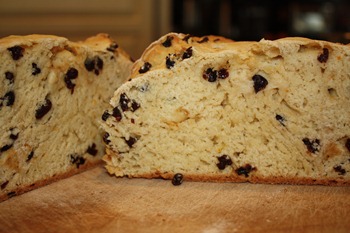
irish soda bread

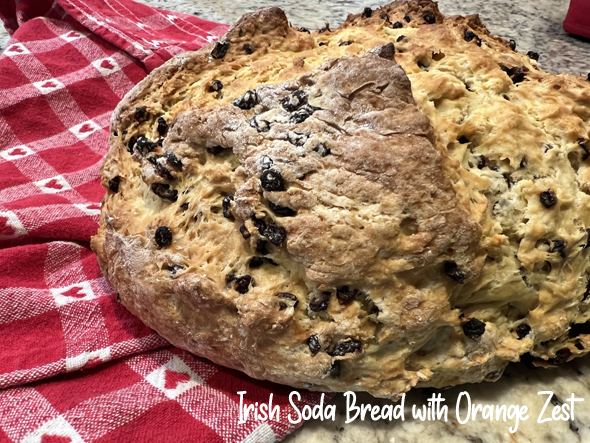
Is there some salivating going on looking at that photo of Irish Soda Bread? Should be. Especially if you were here on my end of the camera and you could smell the fresh-out-of-the-oven aroma of this bread. There surely are lots of ISB recipes out there. I even have one here on my blog. But it wasn’t as good as this one –  THIS recipe from Ina Garten. And it’s not all that different (it is made with buttermilk just like the other one) except that it contains some grated orange zest and a bit more butter. Orange zest is non-traditional, but Ina was kind of cute and cheeky when I watched her make this a week or so ago on her show when she said she likes orange zest, and so what if it’s non-traditional. It tastes good, and that’s all that’s necessary to make the addition! You can see a little bit of the orange in the bread if you look closely.

I’ve updated this post – with a new picture above. It’s very easy to make. Really it is. Almost no handling at all. Ina recommended mixing it up in a stand mixer, although surely it could be done by hand, even. Once all the ingredients are added the wet dough is rolled out onto a floured board and you literally knead it about 4-5 times adding a bit more flour if needed (mine didn’t except to keep it from sticking to the countertop), shape it into a round (I did an oblong kind of shape – this isn’t an exact thing) and into a 375 oven it goes for 45-55 minutes. I took it out at 45 and it was plum-perfect! Not only did we eat it with our ham dinner, but we had some with an elegant cheese course which was served afterwards.

Ina mentioned how fabulous this bread is as morning toast. We did have one small end leftover from our Sunday dinner and we had it for breakfast. Oh my yes. Loved it.
printer-friendly PDF and MasterCook file (click link to open recipe)

Irish Soda Bread with Grated Orange Zest

Recipe By: Ina Garten
Serving Size: 12

4 cups all-purpose flour — plus extra for currants
4 tablespoons sugar
1 teaspoon baking soda
1 1/2 teaspoons kosher salt
4 tablespoons cold unsalted butter — (1/2 stick) cut into 1/2-inch dice
1 3/4 cups buttermilk — cold, shaken
1 whole extra large egg — lightly beaten
1 teaspoon orange zest — grated
1 cup dried currants

1. Preheat the oven to 375 degrees F. Line a sheet pan with parchment paper.
2. Combine the flour, sugar, baking soda, and salt in the bowl of an electric mixer fitted with the paddle attachment. Add the butter and mix on low speed until the butter is mixed into the flour.
3. With a fork, lightly beat the buttermilk, egg, and orange zest together in a measuring cup. With the mixer on low speed, slowly add the buttermilk mixture to the flour mixture. Combine the currants with 1 tablespoon of flour and mix into the dough. It will be very wet.
4. Dump the dough onto a well-floured board and knead it a few times into a round loaf. Place the loaf on the prepared sheet pan and lightly cut an X into the top of the bread with a serrated knife. Bake for 45 to 55 minutes, or until a cake tester comes out clean. When you tap the loaf, it will have a hollow sound.
5. Cool on a baking rack. Serve warm or at room temperature.
Per Serving: 257 Calories; 5g Fat (17.6% calories from fat); 7g Protein; 47g Carbohydrate; 2g Dietary Fiber; 32mg Cholesterol; 386mg Sodium.

A year ago: About my Kindle
Two years ago: Coriander Lime Shrimp (oh yes, delish)

Posted in Veggies/sides, on February 17th, 2010.

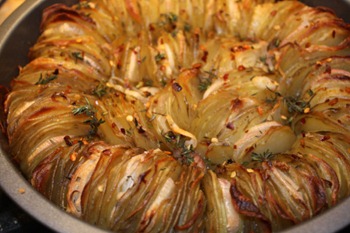
crispy potato roast

Thanks goodness for photography. I might never have made this side dish had I not seen the photo of it. Isn’t it unusual? I always like unusual. Anybody can make scalloped potatoes. Or mashed, or home fries. So somebody at Martha Stewart obviously thought outside the box – standing thinly sliced potatoes on their sides.

Read the rest of this entry »

Posted in Veggies/sides, on February 16th, 2010.

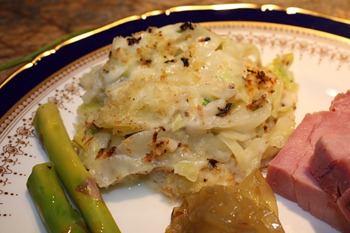
cabbage leek gratin

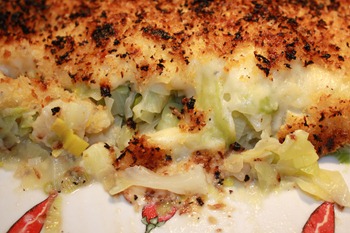
Cabbage isn’t the most photogenic blossom on the block, I’ll admit. And the leeks hiding inside didn’t much poke their heads above range, so what we have is a kind of beige looking glob. But the taste – well, that’s all that matters, isn’t it?

When I read about this recipe over at Marie’s blog, I knew my DH would love it – he adores cabbage in almost any way, shape or form. So with the addition of leeks, a cheesy cream sauce and a breadcrumb topping, I knew he’d be in seventh heaven. And he was. It’s a simple recipe, really. Just needs to be made in steps: (1) cooking the sliced cabbage and leeks in boiling water; (2) making the traditional cream sauce with butter, flour and low-fat milk, with some grated cheese and a smidgen of grated nutmeg added; and (3) preparing the buttered crumbs to sprinkle on top. I made everything the day before – just didn’t do the crumb topping until the last minute.

cabbage gratin closeup And I must tell you a story. I took this dish to our son and daughter-in-law’s home on Sunday for a festive family Valentine’s dinner. In the photo at top – – I brought the Berkshire ham you can see on the plate at right, the potatoes you can see in the foreground, and Karen made fresh asparagus. So I popped this casserole in the oven 35 minutes before serving time. Right on time I opened the oven and the casserole was still very pale looking, so I turned on Karen’s broiler. And within about a minute the infrared broiler element had set the bread crumbs on fire. I mean flames. Our son saved the day by pulling out the casserole from the oven and extinguishing the fire, fortunately. And at that point I was looking at this blackened – a la flambé – mess. Not the kind of flambé that you want, though. But once I took a flat edge to the casserole I was able to scrape all the blackened crumbs to one end and we ate it without mishap. In the picture above you can definitely see the result of my broiler mishap. But you know what? Those blackened crumbs tasted just fine! And the casserole itself was delicious. Definitely a make-again dish. Everybody loved it, me included. A keeper. Marie had suggested cheese as an addition, which I did. I used some imported England sharp cheddar, and Parmigiano-Reggiano. I also put some additional grated cheese on top of the cream sauce too, then the crumbs were sprinkled on top of that.
printer-friendly PDF

Cabbage and Leek Gratin

Recipe By: Marie, A Year from Oak Cottage blog, 2/10
Serving Size: 8

1 head cabbage
3 medium leeks
3 tablespoons butter
3 tablespoons flour
1/2 teaspoon salt
1/4 teaspoon freshly ground black pepper
freshly grated nutmeg to taste
a dash of hot pepper sauce
1 1/2 cups milk — 2% is fine
9 ounces cheese — cheddar or Gruyere and Parmesan, grated
1 cup fresh bread crumbs — (I used panko)
2 tablespoons butter — melted

1. Remove any old leaves from the outside of the cabbage. Cut it into quarters and remove the core. Shred or slice coarsely.
2. Trim the leeks, cut in half and wash them thoroughly. Shred them coarsely as well. Mix them into the cabbage.
3. Bring a large pot of lightly salted water to the boil. Add the vegetables. Bring back to the boil, and then reduce the heat to a simmer and cook them for about 5 to 6 minutes, just until barely tender. Drain in a colander and allow to sit for a brief time to drain – to get as much water out as you can. You don’t want any of the water to dilute the cream sauce.
4. Preheat the oven to 180*C/375*F.
5. Make cream sauce by melting the 3 T butter in a saucepan. Stir in the flour and cook, stirring over medium heat, for about one minute. Slowly whisk in the milk and cook, whisking constantly, until smooth and nicely thickened. Season to taste with some salt, pepper and grated nutmeg. Add a splash of hot pepper sauce to taste. Add the shredded cheese (reserving a bit of it to sprinkle on the top).
6. Put the cabbage mixture into a buttered shallow dish. Pour the cream sauce over the top and allow it to soak in for a few minutes, while you make the crumbs for on top. Sprinkle the cream sauce with the reserved grated cheese.
7. Melt the 2 T of butter and then stir in the bread crumbs, mixing all together well. Sprinkle the buttered crumbs evenly over the top of the casserole. Bake in the preheated oven for 25 to 30 minutes, until nicely bubbling and the crumbs are lightly browned on top. If the top isn’t browned, put under the broiler for a few minutes until golden brown. Watch carefully so it doesn’t burn.
Per Serving: 141 Calories; 9g Fat (56.8% calories from fat); 3g Protein; 13g Carbohydrate; 1g Dietary Fiber; 26mg Cholesterol; 268mg Sodium.

A year ago: Mushroom Bread Pudding (a real stunner of a side dish)
Two years ago: Fish Chowder with a Thai Twist

Posted in Beef, on February 15th, 2010.

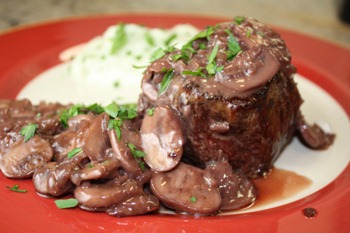
fillet mignon wine mushroom sauceOh my. Yum. Wow. Delicious. Any other superlatives you need to read before you try this? Definitely a meal worthy of a special evening. Like Valentine’s Day. Or a birthday. Or an anniversary. Naturally, just buying filet mignon is enough of an expense so you want to make the preparation worthy of the price, right?

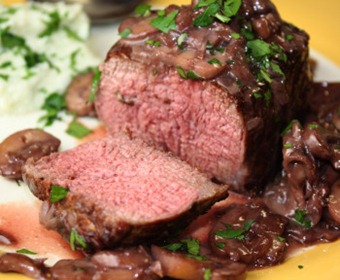
fillet mignon cut If you use this method of searing the meat, then baking it, you’re assured of an evenly-cooked piece of beef. I never knew how restaurants managed to do that. When my DH used to just grill it on the barbecue, straight over the coals, you only had a center strip that was nice and juicy red. Now we’re able to get them to have a nice brown crusty edge and a perfectly cooked pink, or rare piece of steak.

The sauce is mostly composed of mushrooms, but accented with both red wine, port wine, shallots, some beef broth, and a touch of cream. Oh yes, a bit of olive oil and butter too.

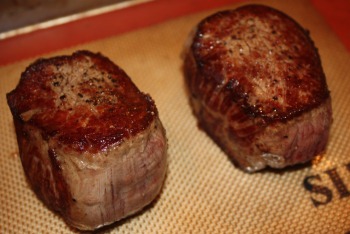
fillet mignonSo, there’s a shot of the filets at left. All I’d done at this point was sear them in a medium-hot nonstick skillet for about 2 minutes per side. I also briefly seared them on the two long sides as well. Just because they look prettier that way. So the meat is totally raw inside at this point. I placed them on a Silpat-lined small baking sheet and they went into a 400 oven for about 7-8 minutes. How long they bake depends on how thick the filets are –  mine were truly thick. If they’re not so, then 5-6 minutes will probably do it. But whatever you do, use a meat thermometer and take them OUT of the oven when they reach about 123° to 125°. They’ll continue to rise in temp just sitting on your kitchen counter while you finish up the sauce and serving. Ideally, tent them for 3-5 minutes to allow the juices to be reabsorbed. I put my dinner plates into the hot oven at that point and watched them carefully. But I definitely wanted to serve these premium filets on hot plates.

Meanwhile, while the steaks were baking, I whipped up the sauce. Just make certain you have everything all prepped before you start – you won’t have time to cut or dice, or measure anything. The shallots are sautéed a bit, sliced mushrooms are added and sautéed for several minutes, then you add the port and red wine and stir and let it bubble away until the liquid has reduced way down. Then you add the beef broth and simmer that until it’s reduced down some. Then a tad of Dijon mustard is added, along with some heavy cream and you’re done.

The recipe came from a cooking class with Phillis Carey – probably several years ago. A very good recipe, and perfect for guests. We bought these filets frozen from a home-delivery meat company last week, so I was anxious to try them. Oh were they ever tender. Probably could have cut them with a fork. Almost. And this preparation was just delish.
printer-friendly PDF

Fillet Mignons with Mushroom Port Sauce

Recipe By: Phillis Carey, from a cooking class
Serving Size: 4

3 tablespoons olive oil
24 ounces fillet mignon — 1 1/2 inches thick, 4 slices
SAUCE:
3 tablespoons unsalted butter
3 tablespoons shallots — minced
1/2 pound button mushrooms — sliced
1/3 cup port wine — Tawny variety
2/3 cup dry red wine — Merlot or Cab preferred
1 cup beef broth
1 1/2 teaspoons Dijon mustard
1/2 cup heavy cream
1/2 cup parsley — minced, for garnish

1. Preheat oven to 400. For fillets, heat 2 T. of oil in a heavy skillet over medium-high heat until hot, but not smoking. Season steaks with salt and pepper and sear on each side for about 2 minutes. Transfer meat to a baking sheet and roast the filets for 5-6 minutes until medium rare. Ideally, use a probe thermometer and remove the steaks exactly when they reach 125 degrees F for medium rare. Rare is about 120. The meat will rise in temp after it’s removed from the oven – tent gently with foil if the sauce isn’t quite ready – allowing meat to sit for about 5 minutes before serving on very hot plates.
2. SAUCE: Pour off any fat remaining in the skillet and add the remaining olive oil and butter. Saute the shallots until tender, about 2 minutes. Add the mushrooms and cook until softened, about 4 minutes.
3. Add the port and red wine and boil until mixture is reduced by about 2/3. Add the beef broth and boil until it is reduced by half. Use a wire whisk to add the mustard. It will clump up if not whisked in carefully and quickly. Bring to a boil and whisk in any juices that accumulated with the steak and season with salt and pepper if needed. Serve sauce spooned over each steak. Garnish with parsley.
Per Serving: 842 Calories; 69g Fat (77.7% calories from fat); 35g Protein; 9g Carbohydrate; 1g Dietary Fiber; 184mg Cholesterol; 470mg Sodium.

A year ago: Gorgonzola, Grape & Pine Nut Crostini
Two years ago: Orzo Carbonara

Posted in Cookies, on February 13th, 2010.

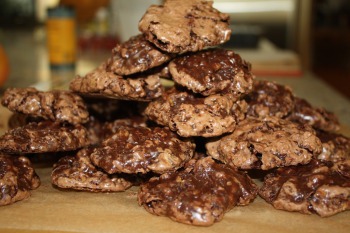
chocolate puddle cookies

I’m a fan of Heidi Swanson’s blog, 101 cookbooks. In fact her blog was one of the first ones I began reading about 4-5 years ago. She stresses healthy cooking, forsaking meat for vegetarian fare, and rarely does she include desserts. Especially ones without some kind of whole grain inclusion or healthy ingredient. So, I was surprised when she posted this gluten-free (no flour) meringue-like cookie that not only contain pure sugar (albeit powdered) but chocolate. I suppose the saving grace here is that the cookies contain almost no fat (no butter, no egg yolks, no solid chocolate either). And as is often the case, when I read the write-up about the cookies, she had me hooked. I still have cookies in the freezer from the last two small batches I’ve made. Both the Triple Ginger cookies and the (chocolate) Midnight Crackles aren’t edible from a frozen state – they nearly break my teeth. Yes, yes, I know, why can’t I defrost them? Because then I’d eat too many. And when I’m craving just one cookie, I want it right now, and that means eating from a frozen state. So, the other cookies are still in the freezer and I’m left “wanting.” What to do except try these.

choc pudd cookies stack The ingredients are certainly different from a traditional cookie containing flour – this has chopped, toasted walnuts, powdered sugar, dry cocoa, a pinch of salt and egg whites (not whipped, mind you) and vanilla. That’s it. Took no time at all to stir these up. Heidi cautioned that these cookies spread out. And that every batch could come out a bit differently. Mine didn’t exactly look like hers (hers were flatter). Mine didn’t spread as much as hers either. Heidi says to bake these for 12-15 minutes. She mentioned that it may take a batch or two – using your oven, pans, etc. – before you find your groove. The first 2 pans I baked for 12 minutes. Too soft in the middle even after cooling for 15 minutes. Second batch I baked 3 minutes longer, and they were just perfect! And I got 36 cookies from mine (hers made 18 – much larger cookies, obviously), using a cookie scoop that was about 2 tablespoons. So perhaps her scoop was about 3-4 tablespoons each.

So, how are they? SO chocolate-y. Light as a feather. But the interior is kind of like slightly soft fudge – or not quite as loose as a lava cake ooze. I think Heidi mentioned they were something between a meringue and fudge. Yup. And they ARE sweet. Actually sweeter than I prefer a cookie to be. But the crunchy texture (from the toasted walnuts) helps balance the sugar. I wouldn’t begin to know how to make them less sweet without altering the chemistry of dry to wet ingredients. Do drink a glass of ice-cold milk with it. Or a nice cup of hot Earl Gray tea on a cold afternoon as I did, writing up this post.
printer-friendly PDF

Chocolate Puddle Cookies GF

Recipe By: Heidi Swanson from 101 cookbooks blog
Serving Size: 36
NOTES: Using deeply toasted walnuts makes for a much more intense, nutty cookie. Lightly toasted walnuts can sometimes be mistaken for chocolate chips, and make for a much more mild cookie. Both good! Also, cooking time – you don’t want to over or under bake here – over bake, and your cookies will cool to a crisp; under bake, and they are too floppy and crumbly. Also, underbaking makes it more difficult to remove the cookies from the parchment paper after baking – you get the swing of it after a batch or two. Try baking just one tray first until you find the right timing. Use large eggs – using extra-large will make the batter too fluid and you’ll have to compensate with more powdered sugar. My cookies had some with glossy tops, and some with a more whitish crackly top. There didn’t seem to be any difference in taste, although the whiter ones may have been closer to the pan edges.

3 cups walnuts — / 11 oz / 310 g, toasted & cooled
4 cups powdered sugar — / 1 lb / 453 g.
1/2 cup unsweetened cocoa powder — plus 3 tablespoons / 2 oz / 60 g
scant 1/2 tsp fine grain sea salt
4 large egg whites — room temperature (do not whip them)
1 tablespoon vanilla extract — good-quality

1. Preheat oven to 320F / 160C degrees and position racks in the top and bottom third. Line two (preferably rimmed) baking sheets with parchment paper. Or you can bake in batches with just one pan.
2. Make sure your walnuts have cooled a bit, then chop coarsely and set aside. Sift together the confectioner’s sugar, cocoa powder, and sea salt. Stir in the walnuts, then add the egg whites and vanilla. Stir until well combined.
3. Spoon the batter onto the prepared sheets in mounds of about 2 tablespoons each, allowing for PLENTY of room between cookies. Don’t try to get more than 6 cookies on each sheet (I made smaller cookies and could get 12 on a sheet without too much crowding), and try to avoid placing the batter too close to the edge of the pan. Bake until they puff up. The tops should get glossy, and then crack a bit – about 12 -15 minutes. Have faith, they look sad at first, then really blossom. Rotate the pans top/bottom/back/front halfway during baking time.
4. Slide the cookies still on parchment onto a cooling rack, and let them cool completely. They will keep in an airtight container for a couple days or freeze.
Per Serving: 121 Calories; 6g Fat (42.5% calories from fat); 3g Protein; 15g Carbohydrate; 1g Dietary Fiber; 0mg Cholesterol; 7mg Sodium.

A year ago: Valentine Dinner Planning
Two years ago: Adobe Stew (my version of a local restaurant, the Gypsy Den’s, spicy vegetable soup)

Posted in Fish, on February 11th, 2010.

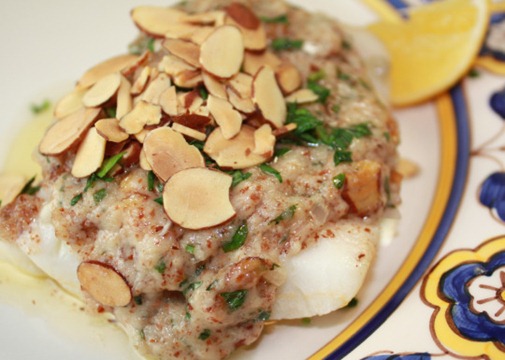
sole with almond sauce My DH requested some fish for dinner the other night. We had some in our freezer, some we’d purchased recently from a home-delivery meat company. I’m usually skeptical about frozen fish, always preferring to buy fresh, but this fish looked so good and everything else we’ve had from this company has been exceptionally good (premium price, too, of course). We were not disappointed.

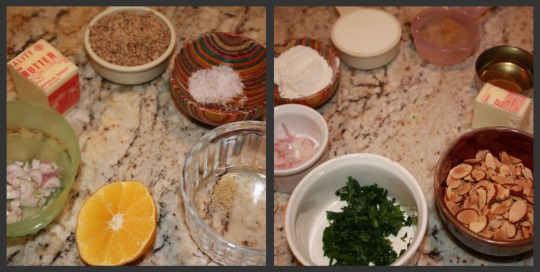
I needed to prepare the sole in some special way, so I looked through oodles of recipes before deciding to try a Julia Child French method. From her book From Julia Child’s Kitchen. What I will tell you first off is that this requires more than a moderate amount of food prep – more than usual – and I don’t usually shirk from kitchen detail. It also dirties a whole bunch of dishes. And I decided to get everything in place first (that’s called mis en place) since I could tell by reading the recipe that everything kind of comes together at the end and I needed to be ready, not off at the chopping board mincing something. So here’s what I did:

sole collageOn the left is the ALMOND FLAVORING/SAUCE: clockwise from the left at 8:00, minced shallots, butter, almond meal, flake salt, ground white pepper and fresh lemon. On the right the FINISHING SAUCE from 8:00, minced shallot, all-purpose flour, heavy cream, fish stock, white wine, butter, toasted sliced almonds, and minced parsley.

So, you get my drift – there’s a bit of food prep here. I should have added more lemon juice over on the right combination, too. I suggest you get out the dish you want to use, have the waxed paper buttered and sized to fit the pan, have the oven preheated (and your second oven – if you have one – heated at 200 to keep the fish and serving plates warm later on), and get all of the above ready. AND, I’ll also suggest you have all the rest of your dinner ready to go too, as you’ll have no time to do that once the fish comes out of the oven. I asked Dave to help me at the end because our vegetable needed reheating in the microwave (cauliflower prepared like mashed potatoes that I had made half an hour before), and I had an avocado ready to slice for our salad. He did those things while I whisked, stirred, poured, thinned and garnished.

So, how was it? Fabulous. Dave mmmm-d all through dinner. A good sign. I savored every bite, but then with all the butter in it, how could it not be good? (Actually, I have reduced the amount of butter in this recipe because the sauce could not hold the amount called for.) The only thing I’d change is to pulse the almonds myself next time, rather than use almond meal. I think the almond meal is too finely ground for this. Once I made the finishing sauce it was too thick. I really didn’t want to add more cream (it already had enough fat in the sauce already – so I added  bit more lemon juice). But in the big picture, it didn’t matter – it was good even if it was too thick! Will I make it again? I might. Perhaps not for guests only because it’s such concentrated cooking at the end. I think it’s hard to make this kind of dish for guests when you need to be on top of everything at the last minute.
printer-friendly PDF

Filet of Sole with White Wine and Almond Butter

Recipe By: Adapted from the cookbook: From Julia Child’s Kitchen
Serving Size: 4

ALMOND FLAVORING:
1/2 cup sliced almonds — (reserve a few for garnish)
2 tablespoons shallots — peeled, minced
4 tablespoons unsalted butter
1/2 cup ground almonds — (I used almond meal)
salt and white pepper to taste
1 teaspoon fresh lemon juice — (an approximation)
FISH & SAUCE:
1 3/4 pounds sole fillets
1 tablespoon shallots — minced
1/2 cup white wine — dry rather than sweet, if possible
1/2 cup fish stock — (or clam juice)
2 tablespoons all-purpose flour
1 1/2 tablespoons butter — softened
1/2 cup heavy cream — or more if needed
4 sprigs Italian parsley

1. ALMOND SAUCE: Preheat oven to 350. Spread almonds on a cookie sheet and bake the almonds for about 8-10 minutes until they’re toasty brown. Watch carefully so they don’t burn. Cool and set aside.
2. Using 2 tablespoons of the butter, melt it in a medium saucepan and saute the shallots for just a couple of minutes. (Note: remove 2 T. of raw shallots to use on top of the fish). Remove the shallots from the heat and add the almond meal (ground almonds – you can whiz whole or sliced almonds in a blender or food processor) and the remaining butter. Season to taste with salt, white pepper and lemon juice. Pour this mixture into a small bowl and set aside. You may use this pan later.
3. FISH: Season the milky side (whiter side) of the fish fillets with salt and pepper. Spread about a teaspoon of the almond flavoring/sauce mixture on top of each fillet (the remaining almond sauce goes into the finishing sauce). If you have extra-thin (real) sole fillets, fold the fillets end to end (to make a thicker piece of fish).
4. Arrange the fish fillets in an ovenproof casserole, slightly overlapping the thinner edges. Sprinkle with the reserved raw shallots, and dust lightly with salt and pepper.
5. In a small saucepan bring the wine and fish stock to a boil. Pour the liquid around the fish fillets and cover the dish with a heavily buttered piece of waxed paper.
6. Bake the fish for 8-10 minutes until the fish is just squishy to the touch (i.e., not overcooked). Remove fish from oven and using a spatula to hold the fish in place, pour the juices into the medium saucepan (used in step 2 above). Place the fish in a warm place still covered with the waxed paper (do not put back in the hot oven.) Bring the liquid to a boil and reduce liquid to about 1/2 cup (about half of the total liquid you start with).
7. In a small bowl mix the soft butter and flour together (this makes a beurre manie). Stirring constantly with a whisk, add this butter mixture in small pieces to the boiling liquid. It will thicken rapidly. Reduce heat as necessary. When it’s thoroughly blended in, add the cream – the sauce should be thin enough to coat a spoon. If it’s thicker than that, add more cream and/or fish stock to thin it out. Season with salt and pepper if needed (taste it!) and more drops of lemon juice. Add the almond slices. If there is any additional liquid in the fish baking dish add it to the sauce. Fold in the almond flavoring sauce and heat until it’s hot. Place fish fillets on a pre-heated plate and pour over the fish and garnish with parsley and the reserved sliced, toasted almonds. Serve immediately. Fish cools quickly so do serve it immediately.
Per Serving: 699 Calories; 48g Fat (62.5% calories from fat); 49g Protein; 16g Carbohydrate; 5g Dietary Fiber; 181mg Cholesterol; 287mg Sodium.

A year ago: About Penzey’s, the herb store (also online)
Two years ago: Crunchy Shrimp on Couscous with Sauce (a real winner, a favorite)

Posted in Desserts, on February 10th, 2010.

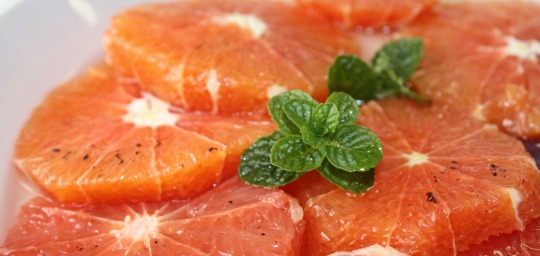
oranges vanilla syrup

The other day, when I was writing up the post all about oranges, the simple recipe Russ Parsons included in his book How to Pick a Peach- The Search for Flavor from Farm to Table, sounded so easy. I had a Cara Cara orange on hand. Even had a pink grapefruit (bottom left in the photo above). It took about 1 minute to measure water, add sugar and a vanilla bean. I worked on peeling and slicing the oranges while the vanilla syrup simmered for 10 minutes. I removed the vanilla bean, allowed the syrup to cool down to room temp and poured it over the oranges, then chilled them for awhile. Meanwhile my DH grilled some thick pork chops and we enjoyed these slices after dinner. With a few sprigs of mint from our garden. The recipe makes more syrup than you’ll need, so you could halve it and there will be plenty to pour over 3-4 oranges.

They were so refreshing. Loved the color of them. Loved the ease of making them. I felt virtuous while enjoying a very nice dessert. With one of the triple ginger cookies I made last week.
printer-friendly PDF

Oranges in Vanilla Syrup

Recipe By: From a recipe by Russ Parsons, in his book How to Pick a Peach
Serving Size: 4
Serving Ideas: The vanilla syrup can be used a second time if you do it soon. Use it to drizzle over strawberries, any other kind of berry, or a piece of pound cake.

1 1/2 cups water
1 cup sugar — (or sweetener of choice – honey, Splenda)
1 whole vanilla bean
3 whole Navel oranges — peeled, sliced crosswise
3 sprigs fresh mint

1. Make a vanilla-scented syrup by boiling water and sugar with a split vanilla bean until the syrup is clear, about 10 minutes. Cool and refrigerate.
2. Peel the oranges and slice into a bowl, then pour the cold syrup over the top. Remove the vanilla bean. (Stick the vanilla bean, once dried, in your sugar canister where it will make vanilla-sugar).
3. Serve the oranges with fresh mint sprinkled over the top and with crispy cookies.
Per Serving (assumes you’ll consume all the syrup, which you won’t): 244 Calories; trace Fat (0.4% calories from fat); 1g Protein; 63g Carbohydrate; 2g Dietary Fiber; 0mg Cholesterol; 5mg Sodium.

A year ago: Chicken Bamako (a family favorite)
Two years ago: Peas with Pancetta

Posted in Pork, Soups, on February 9th, 2010.

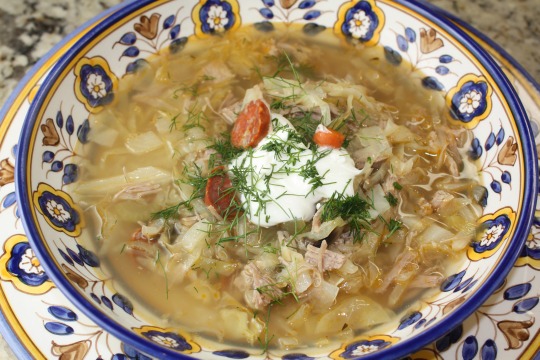
cabbage shchi

The day I made this soup it rained nearly all day. Last Saturday. A kind of day when we lit the fireplace, turned the thermostat up, and kept watching the drain lines around our house. We managed to get by without any flooding in the house, but we stayed on top of it all day. And I stayed close to the kitchen nearly all day too, working on this soup.

A hearty meat-laden and vegetable soup was what appealed to me. With a big chunk of pork shoulder from the freezer and cabbage as the mainstays, it wasn’t hard to make this, although it does take some chopping and mincing. And some slicing and sautéing. The recipe started from James Peterson’s book, Splendid Soups: Recipes and Master Techniques for Making the World’s Best Soups. Really making this began with the fact that I had not one, but two cabbage heads in the refrigerator. I had onions, celery, carrots and sauerkraut. From that, though, I weaved a bit off track with a few extra additions.

The pork (actually the original recipe called for beef, but Peterson said in his after-notes that he often makes it with pork instead) I cooked up in the crockpot for about 5 hours, until it was fall-apart tender. Once that was done I used the broth from the pork (strained of all its now spent vegetables) to start the soup. It comes together in a jiffy – you just have to chop everything (mushrooms, more onion, celery, carrots, turnips, and the cabbage). And at the end you add in some fresh sauerkraut, the cubed pork and some spicy sausage of some kind. I happened to have some imported Spanish dry (salami-type) chorizo which I cubed up to add flavor. But you do NOT want to put the sausage in earlier because it will give up all of its flavor to the soup and not have any taste.

The recipe is based on an old-world everyday soup from Russia. It’s called shchi in Russian. I went online hunting for how to pronounce the word. Some say it’s something like she, others sh-chi. But any way you want to say it, it’s a cabbage soup. With sauerkraut added in at the end too. And full of flavor. And healthy with all the veggies. It is mostly veggies. The pork I used was very lean and produced almost no fat whatsoever. You can see some of it in the photo, but I probably didn’t have 2 1/2 pounds as I’ve indicated in the recipe. Probably more like 1 1/2 pounds. But, you know, soup is very forgiving that way. I needed to add more liquid to the soup, so I added water and a dollop of Penzey’s pork soup base (a broth concentrate). You may remember that I’m a big fan of Penzey’s soup bases (I have small jars of beef, chicken, turkey, pork, ham, seafood and vegetable) that I use very frequently. You could substitute chicken broth granules or canned broth too. The soup can be made ahead – maybe even tastes better the next day.

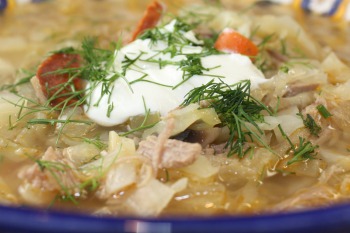
cabbage shchi closeup What I will tell you – beyond the fact that the soup is downright scrumptious –  is that you don’t want to omit the sour cream (I used light) and fresh dill for the garnish. As good as the soup was, it made it over-the-top, as far as I’m concerned, with the dollop of sour cream and a bit of dill in every bite. Eventually, as we ate the soup, the sour cream dissipated throughout the broth, and the dill floated on top. So, for me, just remember the sour cream and dill, okay?  I think this likely serves more than 10 people – more like 12 – in 2-cup servings. I froze dinner-size portions (two of them), gave away another two-portion container, and still had enough for us for another 2 meals. So, however you pronounce shchi, just make this, okay? Hearty, healthy and comforting.
printer-friendly PDF

Russian-Style Cabbage (and Pork and Sausage) Soup

Recipe: Inspired by a recipe in Splendid Soups by James Peterson
Serving Size: 10-12
NOTES: I used a spicy Spanish dry chorizo, but ordinary Polish sausage would be fine, or even ground Italian sausage (cook about 10 minutes first). The sour cream and fresh dill are the capper to this soup – don’t eliminate it as you’ll be missing some of the authenticity and flavor of this soup. The pork broth concentrate comes from Penzey’s spices (online). They produce a line of broth concentrates that are amazing, low in salt, and keep for months in the refrigerator. If you want to remove some of the fat from the pork shoulder, chill the broth and remove the congealed fat before continuing with the soup. Do not use canned sauerkraut.

PORK:
2 1/2 pounds pork shoulder — boned, trimmed
1 large onion — peeled, halved
2 whole carrots
2 stalks celery — cut in 3-inch pieces
2 teaspoons dried thyme
2 teaspoons dried rosemary
1 teaspoon freshly ground black pepper
1 teaspoon salt
2 quarts water — (or more if needed)
SOUP:
1/2 pound fresh mushrooms — cleaned, chopped
4 tablespoons unsalted butter
1 large onion — chopped
2 stalks celery — chopped
2 whole turnips — peeled, cubed
1 large head of cabbage — thinly sliced, then crossways in about 2-inch lengths
2 cups sauerkraut — rinsed
1/2 pound smoked sausage — cubed
2 teaspoons pork soup base and water — (or chicken concentrate or a quart of meat broth)
salt and pepper to taste
2/3 cup sour cream
fresh dill, chopped, for garnish (do not omit the garnish!)

1. PORK: Combine the pork, vegetables and herbs in a 4-quart pot. Pour over enough cold water to cover the meat by an inch. Bring the pot to a slow simmer. Ladle off any froth and fat that floats to the top. Simmer for 2-3 hours, until the meat is completely tender so that a knife inserted into the meat offers no resistance, adding water as needed to make up for any evaporation. Allow mixture to cool for an hour, then strain out the vegetables (and discard them), reserving all of the meat and broth. When the meat is cool enough, chop it up into 1-inch pieces. (Can also be made in the crockpot for about 4-5 hours)
2. SOUP: In a large soup pot melt the butter and sauté the mushrooms for 2-4 minutes. Add the onion, turnips, carrots, celery and garlic, then add all the broth from the pork. Bring to a simmer and cook for 5 minutes. Add the cabbage. If there is not sufficient liquid, add some water or chicken broth (or the Penzey’s pork soup base) and continue cooking for another 10 minutes or until the cabbage is just barely tender. Then add the rinsed sauerkraut, the cooked pork and the sausage. Simmer very slowly just until heated through. Season with salt and pepper.
3. Serve about 2 cups of soup mixture in a wide bowl (heated bowls, preferably) with a dollop of sour cream on top and sprinkled with fresh dill.
Per Serving: 414 Calories; 31g Fat (65.6% calories from fat); 21g Protein; 15g Carbohydrate; 5g Dietary Fiber; 96mg Cholesterol; 863mg Sodium.

A year ago: Chicken a l’Orange
Two years ago: Borscht with Andouille Sausage

Posted in Cookies, on February 8th, 2010.

triple ginger cookies

Wanting to take something to friends who had invited us over for dinner, I grabbed the December issue of Bon Appetit and decided to make these cookies that contain ground ginger, fresh ginger and crystallized ginger. They’re easy to make, requiring only that you make small balls and roll them in granulated sugar before baking. When they bake they get that wonderful crackly edge, yet the interior remains soft. Even when they’ve cooled, they’re still soft in the center. Yummy. Obviously, you need to like ginger. These are good. And since they were in a holiday issue, I’d say they’d be perfection for Christmas. Our friends insisted that I not bring something to help with dinner, so these made a very nice little gift.

Read the rest of this entry »

Related Posts Plugin for WordPress, Blogger...