Get new posts by email:

Archives

Currently Reading

Here are the tastingspoons players. I’m in the middle (Carolyn). Daughter Sara on the right, and daughter-in-law Karen on the left. I started the blog in 2007, as a way to share recipes with my family. I’m still doing 99% of the blogging and holding out hope that these two lovely and excellent cooks will participate. They both lead very busy lives, so we’ll see.

– – – – – – – – – – – – – – – – – – – – – –

BOOK READING (from Carolyn):

Music of Bees, Eileen Garvin. Absolutely charming book about a woman in midlife, lonely, who raises bees, also makes unlikely friends. Heart-warming and very interesting about beekeeping.

A Postcard from Paris, Alex Brown. Really cute story. Dual time line, 1940s and present day about renovating an old apartment in Paris, things discovered.

Time of the Child, Niall Williams. Oh such a good book. Very small village in Ireland, 1960s. A baby is left on the doorstep. The town all whispers and helps. I listened to an interview of the author, which made me like him and his books even more.

Sipsworth, Simon Van Booy. If you like animals you’ll swoon. An old woman who really wants to die finds a tiny mouse in her house and befriends it and finds a reason to live. Utterly charming book.

The Forger’s Spell, Edward Dolnick. True story. For seven years a no-account painter named Han van Meegeren managed to pass off his paintings as those of Johannes Vermeer.

If You Lived Here, You’d be Home by Now, Christopher Ingraham. Could hardly put it down – about a journalist who takes on a challenge to move to small town in Minnesota and write about it. He expects to hate it and the people and place, but he doesn’t. Absolutely wonderful true story.

The River We Remember, William Kent Kreuger. 1950s, Minnesota. A murder and the aftermath. Could hardly put it down. Kreuger has such a vivid imagination and writing style.

How the Lights Gets In, Joyce Maynard. An older woman returns to New Hampshire to help care for her brain-injured son. Siblings and family, lots of angst and resentments.

The Filling Station, Vanessa Miller. Every American should read this book. A novelized retelling of the Tulsa massacre in 1921. Absolutely riveting.

The Story She Left Behind, Patti Callahan Henry. Love this author. Based on a true story. A famous author simply vanishes, leaving her husband and daughter behind. She had invented a mystical language no one could translate. Present day, someone thinks he’s solved the riddle, contacts the family. Really interesting read.

The Girl from Berlin, Ronald Balson. Love anything about Tuscany. An elderly woman is being evicted from a villa there, with odd deed provenance. Two young folks go there to help unravel the mystery. Loved it.

The Island of the Colorblind, Oliver Sacks, M.D. Nonfiction. The dr is intrigued by a remote Pacific island where most of the inhabitants are colorblind. He also unravels a mystery on Guam of people born with a strange neurological problem. Medical mysteries unveiled. Very interesting.

The Bookbinder, Pip Williams. Post 1914 London. Two sisters work at a bookbindery. They’re told to not read the books. One does and one doesn’t. One has visions beyond her narrow world; the other does not. Eventually the one gets into Oxford. Lovely story.

The Paris Express, Emma Donoghue. 1895 on a train to Paris, a disaster happens. You’ll delve into the lives of many people who survived and died in the crash.

A Race to the Bottom of Crazy, Richard Grant. This is about Arizona. Author, wife and child move back to Arizona where they once lived. Part memoir, research, and reporting in a quest to understand what makes Arizona such a confounding and irresistible place.

The Scarlet Thread, Francine Rivers. A woman’s life turned upside down when she discovers the handcrafted quilt and journal of her ancestor Mary Kathryn McMurray, a young woman who was uprooted from her home only to endure harsh frontier conditions on the Oregon Trail.

A Place to Hide, Ronald Balson. 1939 Amsterdam, an ambassador has the ability to save the lives of many Jewish children. Heartwarming.

Homeseeking, Karissa Chen. Two young Chinese teens are deeply in love, but in China. Then their families are separated. Jump to current day and the two meet again in Los Angeles.

North River, Pete Hammill. He always writes such a good story. A doctor works diligently healing people from all walks of life. His wife and daughter left him years before. One day his 3-yr old grandson arrives on his doorstep.

A Very Typical Family, Sierra Godfrey. A very messed-up family. Three adult children are given a home in Santa Cruz, Calif, but only if the siblings meet up and live in the house together. A very untypical scenario but makes for lots of messes.

Three Days in June, Anne Tyler. The usual Anne Tyler grit. Family angst. This wasn’t one of my favorites, but it was entertaining and very short.

Saved, Benjamin Hall. Author is a veteran war reporter. Ukraine, 2022, he nearly loses his life to a Russian strike. Riveting story – he survives, barely.

Grey Wolf, Louise Penny. Another Inspector Gamache mystery in Quebec. She is such an incredible mystery writer.

All the Colors of the Dark, Chris Whitaker. A missing person mystery, a serial killer thriller, a love story, a unique twist on each. Could hardly put it down.

Orbital, Samantha Harvey. Winner of 2024 Booker Prize. I don’t usually like those, but I heard the author interviewed and she hooked me. This is not a normal book with a beginning, a story and an end. It’s several chapters of the day in the life of various astronauts at the ISS (Int’l Space Station). All fictional. She’s been praised by several real astronauts for “getting it” about space station everyday life.

The Blue Hour, Paula Hawkins. An island off Scotland. Inaccessible except when the tide is out. Weird goings on. An artist. A present day mystery too.

Iron Lake, William Kent Krueger. A judge is murdered and a boy is missing. Riveting mystery.

Tell the Wolves I’m Home, Carol Ricks Brunt. 1980s. A 14-yr old girl loses her beloved uncle. Yet a new friendship arises, someone she never knew about.

Four Treasures of the Sky, Jenny Zhang. 1880s, a young girl is kidnapped in China and brought to the United States. She survives with many hurdles in the path.

The Boy Who Fell out of the Sky, Ken Dornstein. Memoir, 1988. The author’s brother died in the PanAm flight that went down in Lockerbie, Scotland. A decade later he tries to solve “the riddle of his older brother’s life.”

Worse Care Scenario, T.J. Newman. Oh my. Interesting analysis of what could/might happen if a jet crashed into a nuclear plant. Un-put-downable.

Song of the Lark, Willa Cather. Complicated weave of a story about a young woman in about 1900, who has a gifted voice (singing) and about her journey to success, not without its ups and downs.

Crow Talk, Eileen Garvin. Charming story which takes place at a remote lake in Washington State, about a few people who inhabit it, the friendships made, but also revolving around the rescue of a baby crow.

The Story Collector, Evie Woods. Sweet story about some dark secrets from an area in Ireland, a bit magical, faerie life, but solving a mystery too.

A Sea of Unspoken Things, Adrienne Young. A woman investigates her twin brother’s mysterious death. She goes to a small town in California to figure it out, to figure HIM out.

The King’s Messenger, Susanna Kearsley. 1600s England, King James. About one of his trusted “messengers,” and his relationship with a young woman also of “the court.” Lots of intrigue.

In the Shadow of the Greenbrier, Emily Matchar. Interesting mystery in/around the area of the famous resort in White Sulphur Springs, West Virginia.

Isola, Allegra Goodman. Hard to describe, survival story on an island in the 1600s.

Save the Date, Allison Raskin. Rom-com, witty, LOL funny. Clever.

The Sirens, Emilia Hart. Numerous time-lines, Australia. Mysteries abound, nightmares, abandoned baby, weird allergies.

Red Clay, Charles Fancher. LOVED this book. Mostly post-Civil War story about the lives of slaves in Alabama during Reconstruction.

Stars in an Italian Sky, Jill Santopolo. Dual time line, 1946 and recent time. Love stories and a mystery.

Battle Mountain, C.J. Box. Another one of Box’s riveting mysteries. Love his descriptions of the land.

Something Beautiful Happened, Yvette Corporon. A memoir of sorts in Greece, tiny island of Erikousa, where the locals hid Jews during WWII. All elusive stories told by the author’s grandmother.

The Jackal’s Mistress, Chris Bohjalian. 1860s Virginia, about a woman who saves the life of a Union soldier. Really good story.

Song of the Magpie, Louise Mayberry. Really interesting story about Australia back in the days when it was mostly a penal colony. Gritty strength of a woman trying to thrive with her farm.

The Boomerang, Robert Bailey. A thriller that will have you gripping the book. About a lot of secrets surrounding the president (fictional novel, remember) and his chief of staff and about cancer. A cure. Such a good story.

Care and Feeding, Laurie Woolever. Really interesting memoir of a woman driven to succeed in the restaurant business. She worked for Mario Batali and then Anthony Bourdain. Gritty stories.

Everything is Tuberculosis, John Green. Maybe not a book for everyone. A real deep dive into the deadly tuberculosis infection, its history. I heard the author interviewed and found the book very interesting.

The Book Lovers Library, Madeline Martin. Fascinating read about Boots’ drug stores’ lending library. And the people who worked in them.

The Arrivals, Meg Mitchell Moore. LOL funny, about a middle-aged couple whose children (and their various family members) return to the family home and the chaos that ensues.

My Life as a Silent Movie, Jesse Lee Kercheval. About grief. A big move to Paris, finding herself a new life with a new set of real blood family.

Escape, Carolyn Jessop. Another memoir about a woman really in bondage in Utah, Mormon plural marriage.

 

Tasting Spoons

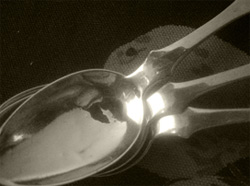
My blog's namesake - small, old and some very dented engraved silver plated tea spoons that belonged to my mother-in-law, and I use them to taste my food as I'm cooking.

Scroll down to the bottom to view my Blogroll

Posted in Miscellaneous, Pork, Sous Vide, on April 3rd, 2012.

pulled_pork_sous_vide_131

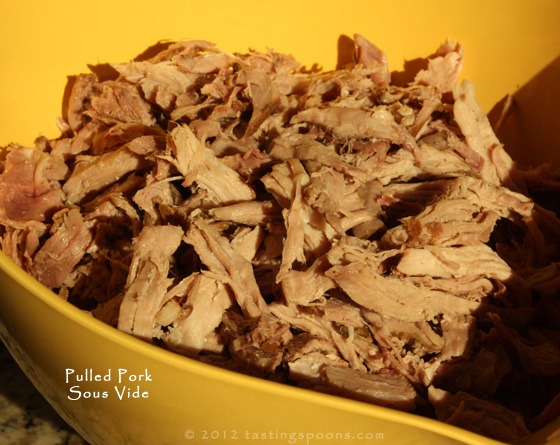
Another experiment with sous vide cooking. This time I made pork shoulder (pork butt), cooked it at 140° for 48 hours. And I served it with a very tart North Carolina vinegar sauce instead of the usual ketchup-based barbecue sauce that’s more typical. Mostly I did that because my DH is a diabetic and very rarely eats pulled pork because the traditional BBQ sauce just sends his blood sugar skyrocketing.

At least once a week I’m experimenting with my SousVide Supreme Sous Vide Water Oven. Not every dish I’ve made has made it to a post on my blog, as I’m not experienced enough yet. One pork dish I made was not very good (pork chops were too thin, I think, so it overcooked). I’m liking the long, slow cooking for more things – the less tender cuts. Not steaks and such – they are best with relatively little sous vide cooking. I had a big chunk of pork in the freezer – I’d purchased a gigantic pork shoulder a month or so ago, at a great price and cut it up into smaller cooking portions. But I didn’t have a sous vide cooker then. So the meat was just vacuum sealed with nothing whatsoever in it. I decided to just go with it that way. Nothing else in the pouch but the meat. No salt. No pepper. No onions or seasonings of any kind. I knew I’d need to doctor it up with seasonings later.

So I did some reading about barbecue sauces. Goodness, but there are a lot of different types. I knew there was a Memphis style, and St. Louis style, but that was about it. Referring to one of my Steven Raichlen books, Barbecue! Bible: Sauces, Rubs, and Marinades, Bastes, Butters, and Glazes, I hunted through all the dozens of possible permutations, trying to find one that was low on sugar. We’re mostly tuned into such sauces containing lots and lots of ketchup. Then I read about the sauce that is the favorite with folks in North Carolina. It’s a vinegar sauce and has nary a teaspoon of tomato in it – like ketchup or tomato paste.

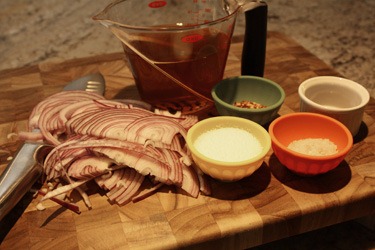
pig_picker_pucker_sauce_ingredientsSo here’s what’s in it – onions sliced thin, apple cider vinegar, water (not pictured), red chili flakes, sugar, salt and pepper. It’s not cooked. You merely combine the ingredients in a bowl (non-reactive) and stir it up. I made it ahead because I wanted the onions to soften a bit in there, which they did. Not only did they soften in texture, but the soaking takes away some of the fresh astringency from raw onions. I covered it and just let it sit out on the counter for several hours.
What you need to know about this sauce is that you combine it with the shredded pork and the meat just absorbs a lot of the vinegar sauce. No, it’s not sour (because the meat has a lot of sweetness to it). You’d think it would be sour. I was unsure enough about this sauce that I took a piece of pork and gingerly dipped it into the sauce to sample it. Oh my. GOOD. Amazing, I thought.

I cut up some green cabbage and put just a little bit of the vinegar sauce on it and served that with the sliders – to put onto the sandwich itself. The meat – so tender and juicy. I added about a cup of the onions and vinegary sauce to it and let it sit for about 5 minutes before I set out the slider buns, the meat, the cabbage. I let everyone make their own sliders. I also made a delicious cabbage salad which I’ll post in a couple of days.

What I liked: the texture and taste of the pulled pork. It was incredibly tender after 48 hours of sous vide. The vinegar sauce was outstanding. I loved it! For left overs I put out regular barbecue sauce (bottled) and some eaters had some of that too.

What I didn’t like: nothing. It was really, really good.

printer-friendly PDF
MasterCook 5+ import file – right click to save file, run MC, then File|Import

Pig Picker Pucker Sauce

Recipe By: Steven Raichlen’s Barbecue Bible: Sauces, Rubs and Marinades, 2000
Serving Size: 12
Serving Ideas: This sauce is best with pulled or chopped barbecue pork (this amount will saturate about 4-8 pounds of meat). If desired, reserve just a little bit to pour and mix over some chopped cabbage (which you can pile onto the sandwiches). This style of tart sauce is from North Carolina, an area that has no interest in sweet tomato or ketchup-based barbecue sauces.

1 1/2 cups cider vinegar
3/4 cup cold water
2 tablespoons sugar — or to taste (I used Splenda)
1 tablespoon hot pepper flakes
1 small onion — thinly sliced
1 1/2 tablespoons kosher salt — or to taste
1/2 teaspoon freshly ground black pepper

1. Combine all the ingredients in a ceramic or glass (not metal) bowl. Stir to dissolve dry ingredients.
2. Can be made ahead, but can also be made just before using. It’s best added to the meat and allowed to soak in some before serving. If it’s allowed to sit awhile it will mellow-out the onions a little bit.
Per Serving: 16 Calories; trace Fat (0.8% calories from fat); trace Protein; 5g Carbohydrate; trace Dietary Fiber; 0mg Cholesterol; 706mg Sodium.

. . .This recipe hardly even deserves an entire recipe box listing – it’s just pork shoulder, vacuum sealed, done in the sous vide for 48 hours. Done.

Pulled Pork Sous Vide 140°

Serving Size: 8

3 1/2 pounds pork shoulder

1. Preheat sous vide to 140°.
2. Vacuum seal the pork and place in sous vide. Cook for a minimum of 24 hours, and up to 48 hours (do the 48 if you can).
3. Remove meat, trim away visible fat and shred pork by hand or with a fork.
Per Serving: 352 Calories; 27g Fat (70.2% calories from fat); 26g Protein; 0g Carbohydrate; 0g Dietary Fiber; 106mg Cholesterol; 97mg Sodium.

Posted in Desserts, Miscellaneous, on April 1st, 2012.

lemon_curd_ATK

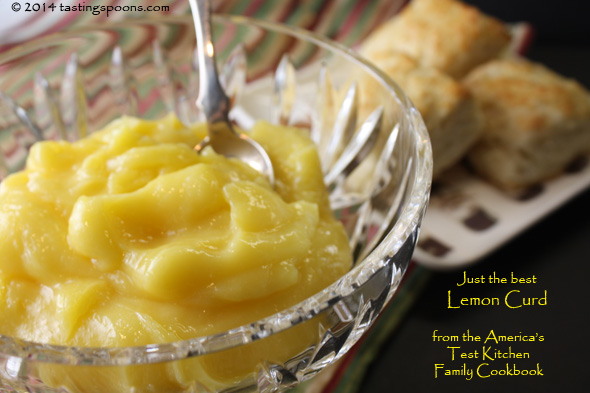
Have you made lemon curd before? I’ve made it oodles of times, but not since last March. I wrote it up here on my blog then. I read a description of lemon curd in the America’s Test Kitchen Family Cookbook – they called some versions teeth-achingly sweet. Gosh, yes. That’s what mine was in 2011. The folks at ATK decided to fix it, and yes, they did. This is my new go-to lemon curd recipe. I didn’t enhance the photo at all – it’s all the egg yolks that give it that deep golden color.

I’d offered to take lemon curd to a friend’s home for a St. Patrick’s Day book group meeting. Each year the hostess and her wonderful husband make an Irish repast for our group. And mid-way through our book meeting they also serve multiple desserts. They make raisin scones too, and it’s for the scones that I usually offer to make lemon curd.

Remembering that last year’s version was too sweet, I pulled out cookbook after cookbook and compared the recipes. Some had nearly double the amount of sugar per lemon juice quantity of others. Whoa! No wonder I was overwhelmed with the sweetness! I should have just gone to my well-used The America’s Test Kitchen Family Cookbook. Every recipe turns out superbly from that cookbook. With copious lemons on our Meyer trees, it came together in a hurry. I really liked the addition of a few tablespoons of heavy cream at the end. It just smooths it out, somehow. I chose not to strain it (to remove the bits of lemon zest and any eggy things). I chilled it in a bowl over ice and gave it to the hostess. But not without a couple of teaspoons to taste, of course! It’ll be my forever favorite, I suspect.

What I liked: it’s easy. Delicious. Just the right amount of sugar to lemon ratio. It will keep for several weeks too, if it were to last that long. I gave all of it to my friend, so there isn’t any left over here at my house! Guess I’ll just have to make it again. I scaled down the recipe to use 4 egg yolks and 1 whole egg, FYI.

What I didn’t like: nothing at all. Perfection.

printer-friendly PDF
MasterCook 5+ import file – right click to save file, run MC, then File|Import

Lemon Curd (America’s Test Kitchen)

Recipe: America’s Test Kitchen Family Cookbook
Serving Size: 12 (maybe a lot more)
NOTES: This really takes no time to make and it’s SO much better than the store-bought type. I also like this recipe because it’s not teeth-achingly sweet. It’s “just right.”

7 large egg yolks
2 large eggs
1 cup sugar — + 2 tablespoons
2/3 cup fresh lemon juice
1/4 cup lemon zest
1/8 teaspoon salt
4 tablespoons unsalted butter — cut in 1/2 inch pieces
3 tablespoons heavy cream

1. Whisk the egg yolks, whole eggs and sugar together until just combined. Whisk in the lemon juice, zest and salt.
2. Transfer the mixture to a medium nonreactive saucepan, add butter, and cook over medium-low heat, stirring constantly, until the curd thickens to a thin sauce-like consistency, about 5 minutes.
3. Strain the curd immediately through a fine-mesh strainer into a clean nonreactive bowl and stir in the cream. Cool and chill completely.
Per Serving (probably high as I think this will serve more than 12 scones!): 163 Calories; 9g Fat (48.8% calories from fat); 3g Protein; 18g Carbohydrate; trace Dietary Fiber; 175mg Cholesterol; 37mg Sodium.

Posted in Beef, Sous Vide, on March 30th, 2012.

mustard_sauce_on_corned_beef

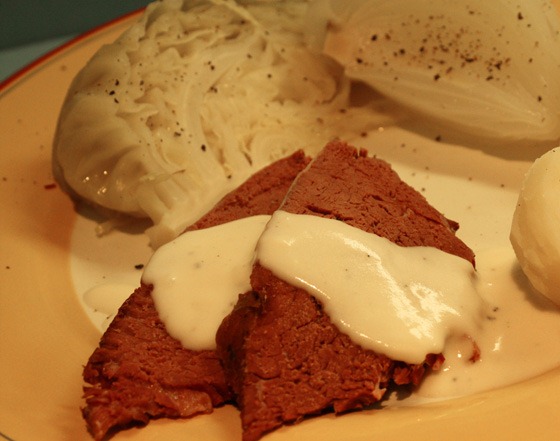
Even if you don’t own a sous vide, you could make this in your slow cooker on low. And in either case, make the microwave creamy mustard sauce to serve on the side.

It seems that the only time of year I make a corned beef is in March, near to St. Patrick’s Day. Otherwise if they’re available in the markets I just don’t “see” them. I bought mine at Trader Joe’s. And if you haven’t noticed, corned beef is mighty pricey! I was shocked. My small 3-pound corned beef was nearly $17. And it would barely serve 6 people. But I wanted to try cooking it in my SousVide Supreme Sous Vide Water Oven. For those of you who aren’t into sous vide, just skip down below to the sauce part if that’s what interests you.

Consulting a variety of sources about the sous vide corned beef (2 cookbooks and about 3-4 online recipes, plus a phone call to my sous vide expert, Russ), I finally decided to cook it for 10 hours close to 180°. By the time I decided what to do, it had gone past the point that I could cook it for 48 hours. I was down to 24, so obviously I did the 10-hour cook. Actually I set the temp to 178°.

To say that I had some difficulty would be an understatement. I’m new enough to sous vide that I was in alien territory when I came into the kitchen, 3 hours into the 10 hour cooking and found the lid of the Supreme standing nearly upright, tipped up at about 75°. At 8 that morning I’d pressed the corned beef into the Supreme’s accompanying rack, and placed the rack in Supreme, with the meat on the bottom rung, put the lid on top and left the house. In the interim time, somehow, fluid had rendered out of the corned beef which creates a gas, so there was a whole lot of air in the pouch. The gas/air was a lot stronger than the rack in holding the roast underwater and it had actually turned the rack upside down, hence popping off the top of the machine. So, the beef was more or less floating on top. Not exactly what sous vide is all about.

I had to manhandle the darned thing to get it turned back down-under, on went the lid and I put a bunch of book on top of the lid. No more mishaps exactly. BUT, after 10 hours I dismantled everything and lo and behold, the roast had come loose again and had pushed itself toward the top. About an inch of the roast was up above water line. Sigh. But, since I cooked it at 178° I knew the meat was done. No fluid had leaked out of the bag – at all – and no water had leaked into the roast. It’s a chemistry thing, though, about the gas. Next time I will have to figure out a way to weight-down the meat – something heavy that will sit on top of the meat and not have enough room to roll over when the gas creates inside. I have one particular casserole dish in mind that will probably work. Or maybe I’ll need to put a real honest brick, wrapped in foil and put into a Ziploc bag to place on top – except that a brick might turn on its side, so that probably won’t work. It would have to a a big cement paver just the right size as the interior of the Supreme!

The roast rested a bit while I made the veggies and the delicious mustard cream sauce. The meat was sliced (easily) and served on heated plates, along with some simmered potatoes, cabbage and onions. The SAUCE: it was quick to make – in the microwave. It’s all the usual steps to make a cream sauce (half and half and chicken broth for the liquid), but just requires opening the door of the microwave through several steps. It took about 4-5 minutes to make it, though. Easy enough.

What I liked: perfect texture, still moist, sliced easily, good red meat color. I’ll probably try it again at long, slow cooking, but I liked this one just fine. The SAUCE: oh gosh. Delicious. I liked it a lot as an accompaniment to corned beef. It was also just fine on the left overs.

What I didn’t like: nothing, really. I’d make them both again.

CORNED BEEF printer-friendly PDF
MICROWAVE MUSTARD SAUCE printer-friendly PDF
CORNED BEEF MasterCook 5+ import file – right click to save file, run MC, then File|Import
MICROWAVE MUSTARD SAUCE MasterCook 5+ import file – right click to save file, run MC, then File|Import

Corned Beef Sous Vide 178°

Recipe By: From a combination of online recipes.
Serving Size: 6
Serving Ideas: Serve with mustard, or make a mustard cream sauce to spoon over the meat.
NOTES: This recipe assumes you’ll buy a ready-brined corned beef that’s already packaged with spices. No additional seasoning is necessary. If you prefer, buy a beef brisket and brine/season it yourself, allowing 3-5 days to do so.

3 pounds corned beef brisket — (brined by meat packer)
1 whole onion — peeled, sliced
VEGETABLES:
1 whole cabbage head — leave root intact
2 whole yellow onions — peeled, leave root end intact
4 whole carrots — peeled
6 whole russet potatoes — peeled
5 cups low-sodium chicken broth — use concentrate, diluted in water
salt and pepper to taste

1. Open and drain the corned beef. Wash under cold running water to remove all of the seasonings.
2. Place corned beef in a large bowl and cover with cold water. Add about a cup of ice to the water and allow to sit for 30 minutes (this purges some of the salt brine from the meat).
3. Drain and dry the corned beef with paper towels. Place in a vacuum bag and add the sliced onions, half on each side or along edges. Vacuum seal.
4. Meanwhile, preheat Sous Vide to 178°. Place sealed corned beef in the sous vide machine, making sure it’s held under the water securely.
5. Cook for 10 hours, remove and cut open pouch. Place on cutting board, lightly tent with foil (if you’re not serving it immediately). Use a knife to remove some of the more visible fat, if desired.
6. During last 30 minutes prepare the vegetables. Heat a large pot of chicken stock. When boiling, add vegetables. Cut the cabbage into 8ths, leaving part of the core attached so each piece will remain intact. Peel potatoes and half of quarter them. Peel and chop carrots into 1-inch pieces. Cut onions into quarters, leaving part of the root end intact as well. Add vegetables and cook until all are cooked through, about 15 minutes. Test potatoes with a fork. Remove vegetables and drain for about 30 seconds in a colander. Serve on heated plates with corned beef, sliced across the grain about 1/4 inch.
Per Serving: 609 Calories; 36g Fat (50.4% calories from fat); 47g Protein; 33g Carbohydrate; 7g Dietary Fiber; 121mg Cholesterol; 358mg Sodium.

. . .

Microwave Mustard Sauce

Recipe By: From Sumptuous Sauces in the Microwave, by Patricia Tennison
Serving Size: 6
NOTES: Ideally, I’ve learned, that when cooking a roux, it’s better to have just a little bit more butter than flour – that way you won’t have any lumps.

2 tablespoons unsalted butter (I use a tiny bit more)
2 tablespoons all purpose flour
1 cup chicken broth
1/2 cup heavy cream
2 tablespoons Dijon mustard — smooth, not grainy
1/4 teaspoon salt
1/8 teaspoon freshly ground pepper — preferably white, but black is fine too

Note: all the timing mentioned here is a guess-timate – it all depends on your own microwave oven’s power.
1. In a 4-cup glass or microwave-safe container melt the butter for 30-60 seconds until it’s melted and bubbly.
2. Remove from microwave and whisk in the flour – making sure you see no visible white flour. Return to microwave and cook for about a minute, stopping twice to whisk again and break up any possible lumps, as the roux is bubbling furiously.
3. Remove from microwave again and thoroughly whisk in the chicken broth and cream. Return to microwave and cook for about 2 minutes until there are solid bubbles all around the edge of the sauce. Whisk again.
4. Continue cooking (you could lower the power level at this point, if you can) and watch the sauce very carefully until it’s boiling and thickens enough to coat a spoon. Taste the sauce for texture and thickness – continue cooking if needed, until it’s thick enough to your liking.
5. Remove from microwave and add the mustard, salt and pepper. Taste and adjust seasonings. Serve.
Per Serving: 122 Calories; 12g Fat (84.5% calories from fat); 2g Protein; 3g Carbohydrate; trace Dietary Fiber; 38mg Cholesterol; 287mg Sodium.

Posted in Uncategorized, on March 29th, 2012.

I know, not all of you live near a Trader Joe’s. Too bad! It is just the greatest store. We shop there for most of our food products these days. Today I just want to mention a couple of their newer items that I’d recommend. As you may know already, if products don’t “take off,” they simply stop stocking them. Period. I can’t tell you how many of their things have disappeared from their shelves – because people just didn’t buy enough of them, I suppose. So, since I want these two things to stay on their shelves, you might want to help me keep them there . . .

mac_n_cheese_bites

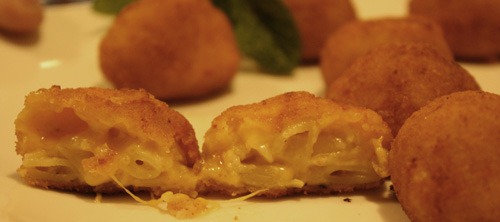
There are the Mac ‘n Cheese Bites. They’re little rounds (see the uncut ones in the picture) of mac ‘n cheese, lightly battered or crumbed, fried and frozen. You bake them (from a frozen state) in a hot oven for 10 minutes, let them rest a few minutes (otherwise you’d burn your mouth for sure) and serve. I cut one in half so you could see the interior. Absolutely delicious. If you like mac ‘n cheese, you will just love these little guys. They might also work well for picky children or grandchildren. Our grandson was very enamored with these, as I expected he would be. The adults were too. I think there are 10 in a package and they disappeared in a flash.

chile_spiced_mango

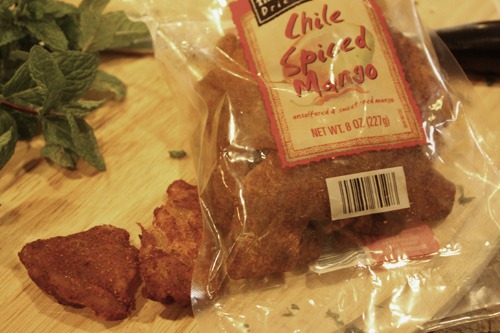
Here’s the other product. Our daughter-in-law, Karen, introduced us to these. Ordinarily I buy very little dried fruit. However, they do make a great snack item. These are pressed with a ground chile mixture. And no, the pieces are not overly hot. Spicy yes. Hot, not really. Tasty? Oh my yes. Look for the Chile Spiced Mango next time you visit. The bites were delicious with some cheese, I’ll tell you!

Posted in Salads, on March 28th, 2012.

romaine_salad_oranges_walnuts_pecorino

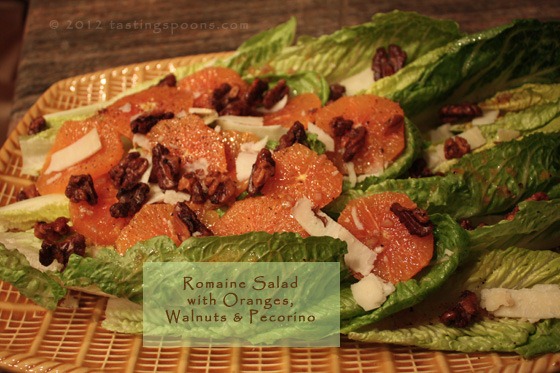
A salad that’s a bit different – different because you leave the Romaine leaves whole (and you could actually pick these up by hand if you composed the salad carefully), drizzle them with a walnut oil and sherry vinegar dressing, then garnish with slices of bright orange slices (I used Cara Cara, a type of Navel), Pecorino cheese and some easy glazed walnuts.

We were going to the home of friends for dinner and I was asked to bring a salad. The only thing I knew was that we were having pasta. I could have made a regular green salad, but since I had 3 Cara Cara oranges that needed to be used, I used a Joanne Weir recipe instead. From her cookbook, Joanne Weir’s More Cooking in the Wine Country. I knew this salad would showcase the oranges beautifully, and I assumed the relatively simple walnut oil dressing would go well enough with pasta. My only deviation from Joanne Weir’s recipe was to use Pecorino cheese (she suggested Manchego from Spain, or Parmigiano-Reggiano). I had a nice wedge of Pecorino with truffles in it and it worked very well with this. I used a lot less cheese than called for – and I didn’t use all the dressing, either (great, some leftover for another day!).
The Romaine leaves (using the hearts only) were separated gently (I trimmed off the base, up about 2 to 2 1/2 inches) and sort of flattened them as best I could onto a large platter. Next I used a big spoon to strategically drizzle some of the dressing on each and every leaf. In case any of the guests ate it in hand, you’d want each leaf to be dressing-enhanced. Next I grouped most of the oranges at one end of the platter (that was the way to cookbook’s photo showed it). If I were truly making this finger food I’d have cut the oranges into much smaller pieces and placed the equivalent of about 1/2 of a slice on each leaf. I wasn’t, so I didn’t. Therefore when serving (using a pie wedge, actually, which worked well), each person took a leaf or two and an orange slice or two. Then I shaved the Pecorino cheese all over and lastly added the glazed walnuts (they’re tossed with walnut oil, sugar, salt and pepper and oven roasted) on top.

THE MAKE AHEAD PART: The walnuts can be baked ahead. The Romaine can be prepped ahead and left chilled in a plastic bag. The cheese could be shaved ahead, but really I think doing it at the last minute was just as easy. The dressing can be made several hours ahead too (and left at room temp). So it was easily assembled at someone else’s home.

What I liked: the fact that the salad was different looking; that the dressing was composed with some walnut oil (I like walnut oil); the oranges, definitely. They added a really deliciousness to the salad. Oh, how could I forget the walnuts? They were good too – great texture addition.

What I didn’t like: nothing at all. I’ll be making it again for sure.

printer-friendly PDF

MasterCook 5+ import file – right click to save file, run MC, then File|Import

Romaine Salad with Oranges, Walnuts and Pecorino

Recipe By: Adapted slightly from Joanne Weir’s More Cooking in the Wine Country
Serving Size: 6
Serving Ideas: Alternatively, you could compose this salad to be eaten out of hand – if so, place leaves on the platter and drizzle with dressing, a bit of cheese and nuts. Cut the oranges into small pieces and evenly space them along the leaf as best as possible. You could also chop up the walnuts into much smaller pieces and sprinkle them the full length of each leaf too.
NOTES: My changes: I used 3 oranges, a lot less cheese. I added pepper to the nuts and I used less dressing on the whole salad than suggested. 

TOASTED WALNUTS:
3/4 cup walnut halves
1 tablespoon walnut oil
1 tablespoon sugar
1/4 teaspoon salt
2 pinches freshly ground black pepper
SALAD DRESSING:
1 teaspoon orange zest
3 tablespoons fresh orange juice — (squeezed from one of the oranges listed below)
2 tablespoons sherry vinegar
3 tablespoons extra virgin olive oil
1 tablespoon walnut oil
1 medium shallot — finely minced
SALAD:
2 small romaine lettuce heads — outside leaves removed (use only hearts)
4 whole oranges — Cara Cara or Navel
3 ounces Pecorino Romano cheese — shaved for garnish (or use Manchego or Parmigiano-Reggiano cheese)
Salt and freshly ground black pepper to taste

1. TOASTED NUTS: Preheat oven to 375°. Place walnuts in a small bowl, add the oil and toss to coat. Add sugar, salt and pepper. Spread nuts on a baking sheet, in one layer (line pan with foil for easy cleanup) and bake until they are just turning a medium brown (don’t burn!), about 6-8 minutes. Set aside to cool.
2. SALAD: Grate enough zest from an orange to measure 1 teaspoon. Cut orange in half and squeeze the juice (use some in the dressing below).
3. With remaining 3 oranges cut off ends, then using a paring knife carefully trim off all the peel. Turn orange on its side and slice 8-9 slices per orange. Set aside.
4. DRESSING: In a small jar combine the orange zest, orange juice, walnut oil, olive oil, sherry vinegar, shallot, salt and pepper. Shake and set aside. You may leave this at room temp for a few hours; otherwise refrigerate. Return to room temp before serving.
5. ASSEMBLY: On a large platter place the Romaine lettuce leaves (flattening them slightly, if possible). Using a spoon, drizzle each leaf with the well mixed dressing. Add the orange slices at the base end, and garnish entire salad with the Pecorino cheese and walnuts. Serve immediately with a pie wedge so each person can lift a complete leaf to a plate.
Per Serving (not accurate because you probably won’t use all the dressing): 222 Calories; 16g Fat (62.7% calories from fat); 7g Protein; 14g Carbohydrate; 2g Dietary Fiber; 11mg Cholesterol; 353mg Sodium.

Posted in Cookies, Desserts, on March 26th, 2012.

chewy_rich_brownies

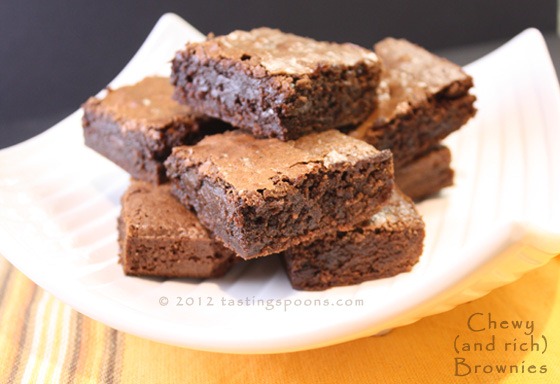
If you’re the kind of person who likes the TASTE and TEXTURE of boxed-mix brownies, but really want to make them from scratch, to give them more chocolaty flavor, this will hit all your buttons.

Surely I’ve mentioned before that when I go to sleep at night I usually plug into my iTouch, using my earbuds, to podcasts that I’ve subscribed to through iTunes. About every 2 weeks or so I need to re-charge it and download all the oodles of new podcasts that are in my queue. Recently I heard or read that Cook’s Illustrated, well actually the folks at America’s Test Kitchen decided to start doing a radio show and podcast with Chris Kimball and Bridget Lancaster. I immediately signed up through iTunes. Each episode is about an hour (no commercials on podcasts, either). When I’m ready to drift off to sleep I generally set my iTouch to play for about 15 minutes and 99% of the time I’m asleep by then. The next night I may go back and replay it if I have no recollection of what I listened to.

Anyway, this new podcast is really interesting. I’m liking it a LOT, actually, and it was on a recent show that they talked about brownies. Through some survey they did, it was discovered that many people like the texture – the chewiness – of box-mix brownies. But the chocolate flavor is muted. Certainly not enough chocolate is contained in those mixes. So the C.I. people began a search for the perfect chewy brownie (you do have to have a free membership with C.I. in order to get to the recipe, but that’s the link) with that wonderful crackly top that is so reminiscent of those box mix types. But one that contained some really good, true flavor of chocolate. I enjoyed listening to all the steps they went through to finally discern that they were completely on the wrong track about the fats – they needed to use more oil than butter. They used a combination of Dutch-process cocoa and unsweetened chocolate in the batter and a few ounces of chocolate bits folded in at the end. They also tried baking the brownies on a pizza stone (somewhere they read that increasing the heat on the bottom of the brownie pan helped make a chewy texture). Their tests said no. Another recommendation was to add caramel sauce to the batter, to add chewiness. Nope, that didn’t work either. And lastly, they were advised to put the cooked pan in an ice bath; they didn’t find that was successful in making a chewy brownie either. It took a visit to their science editor to learn more about ratios of fat and they finally got on the right track.

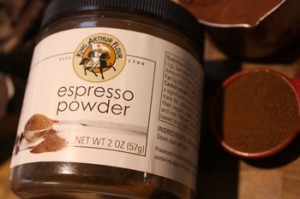
These LOOK like box mix brownies. And they definitely DO have the texture like box mix brownies. And chocolate – that’s in there too. Plus some espresso powder – I just LOVE the King Arthur espresso powder – it’s a fine grind dried espresso – never clumps or spoils (as I write this, their website says they’re out of it . . . check back). What it does is enhance the flavor of chocolate – they just go together like Jamocha Almond Fudge! I watched the interior temp carefully – the directions said to use a toothpick halfway between the edges and middle. I actually took the internal temp there. At 30 minutes it was 208°. I baked another 5 minutes and removed them without taking the temp again. Maybe I should have. I preferred the brownies from the outer edges – they had just a bit of drying edges, which I liked. The interior pieces were on the wet/moist side. Dense, although they weren’t under done by any means. Kind of like in between brownies and fudge almost.

What I liked: all of the things I was supposed to like about this type of chewy brownie – texture, chocolate flavor, crumb and appearance! Will it become my new favorite – probably not (and that doesn’t mean you shouldn’t try it, it’s just that I think I prefer a little less sweet brownie and one with a slightly drier texture). I do like those box-mix brownies, although I’ve only made one of them once in many years, so I’m glad I tried these.

What I didn’t like: nothing, really, if you prefer this type of brownie. That almost sounds like it’s a negative comment – it’s not meant to be. I might possibly bake them to 212° next time just to see what happens since at 210° the interior pieces were still very moist for my taste.

printer-friendly PDF
MasterCook 5+ import file – right click to save file, run MC, then File|Import

Chewy Brownies

Recipe By: America’s Test Kitchen
Serving Size: 24

1/3 cup Dutch process cocoa powder
1 1/2 teaspoons espresso coffee — dry granule type (optional)
1/2 cup boiling water — plus 2 tablespoons
2 ounces unsweetened chocolate — finely chopped (see note)
4 tablespoons unsalted butter — (1/2 stick) melted
1/2 cup vegetable oil — plus 2 tablespoons
2 large eggs
2 large egg yolks
2 teaspoons vanilla extract
2 1/2 cups sugar — (17 1/2 ounces)
1 3/4 cups all purpose flour — (8 3/4 ounces)
3/4 teaspoon table salt
6 ounces bittersweet chocolate — cut into 1/2-inch pieces

1. Adjust oven rack to lowest position and heat oven to 350 degrees. Referring to directions in Making a Foil Sling (related), make sling using the following steps: Cut 18-inch length foil and fold lengthwise to 8-inch width. Fit foil into length of 13 by 9-inch baking pan, pushing it into corners and up sides of pan; allow excess to overhang pan edges. Cut 14-inch length foil and fit into width of pan in the same manner, perpendicular to the first sheet (if using extra-wide foil, fold second sheet lengthwise to 12-inch width). Spray with nonstick cooking spray.
2. Whisk cocoa, espresso powder (if using), and boiling water together in large bowl until smooth. Add unsweetened chocolate and whisk until chocolate is melted. Whisk in melted butter and oil. (Mixture may look curdled.) Add eggs, yolks, and vanilla and continue to whisk until smooth and homogeneous. Whisk in sugar until fully incorporated. Add flour and salt and mix with rubber spatula until combined. Fold in bittersweet chocolate pieces.
3. Scrape batter into prepared pan and bake until toothpick inserted halfway between edge and center comes out with just a few moist crumbs attached, 30 to 35 minutes (until the interior temperature is 210°). Transfer pan to wire rack and cool 1½ hours.
4. Using foil overhang, lift brownies from pan. Return brownies to wire rack and let cool completely, about 1 hour. Cut into 2-inch squares and serve. Will keep 2 days (covered) at room temp. Otherwise, freeze them.
Per Serving: 235 Calories; 13g Fat (45.7% calories from fat); 3g Protein; 31g Carbohydrate; 2g Dietary Fiber; 41mg Cholesterol; 82mg Sodium.

Posted in Fish, Salads, on March 24th, 2012.

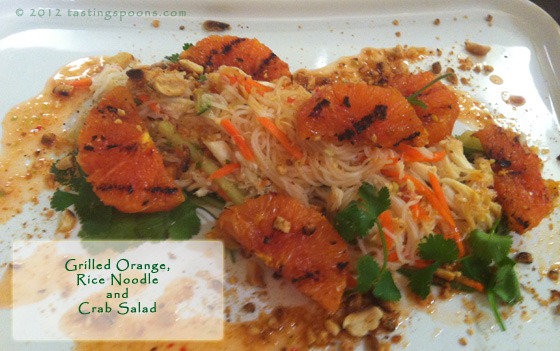
grilled_orange_rice_noodle_crab_salad

A so-very refreshing salad made with some grilled Cara Cara orange segments, some of those ultra-thin rice noodles, crab (or you could use chicken, or shrimp even) with a tangy citrus, garlic, lemon grass dressing. Add veggies of your choice (this one contains cucumber, carrots and mint).

It’s really quite fun cooking when somebody else has done all the sous-chef work, the grunt work. At the class I attended (sponsored by Sunkist, to introduce me to the cara cara oranges), they set up little work stations including one of those free-standing induction cooktops for each group of 3, so we grilled the oranges for this salad (I’d not done that before), made the dressing and put the salad together right there. We added in cucumber, a bunch of julienned carrots, a bunch of fresh mint and topped the salad with some chopped peanuts.

The oranges are drenched in a bit of the dressing, then grilled just long enough to get pretty grill marks on them, then they can be removed. This could be made ahead of time as the oranges don’t need to be served hot. The point is just to make them attractive! The rice noodles could be made an hour or so ahead of time too, although when they sit, they start getting sticky and it’s much harder to separate the strands. You don’t want big clumps of noodles that are very hard to eat. When you toss the dressing into the noodle mixture, mix it around – best method is your hands, although we didn’t do that!  – and separate the noodles as much as you can.

Over the years I’ve learned that it’s best to mix the main ingredients together and leave out the protein (crab, shrimp, chicken) and put those on each serving, so each person gets the same amount. Put a little bit of dressing on the crab too so all of the salad is dressed. You could add some sugar snap peas, some snow peas, some blanched asparagus cut up in pieces, even some very small florets of broccoli. It might not be quite so authentic, but it would be good! Put the pretty oranges on top, decoratively and you’re set. A bunch of green onions would be good in this too, including some of the dark green part.

What I liked: It was such a beautiful salad – the color contrasts were gorgeous (I suppose that’s the artist’s eye in me). The taste: really yummy. I liked the different textures and particularly liked the addition of the citrus.

What I didn’t like: really nothing. We don’t eat many carb-centric dishes, however, so it would be a special treat. I liked the crab and also think shrimp would be a great alternative. Worth making.

printer-friendly PDF
MasterCook 5+ import file – right click to save file, run MC, then File|Import

Grilled Orange, Rice Noodle and Crab Salad

Recipe By: Robert Danhi, consulting chef for Sunkist Growers
Serving Size: 6
NOTES: Next time I make this I’ll be using some snow peas, or sugar snap peas, more carrots, some green onions. Make certain you add enough dressing as the noodles will soak it up! Their recipe thought this would feed 4, but I think it would serve more, so I’ve guess-timated 6.

DRESSING:
6 ounces fresh lime juice
6 ounces fresh orange juice — Cara Cara, or any sweet orange
6 ounces Thai sweet chili sauce
2 ounces fish sauce
1/4 cup fresh garlic — minced
1/4 cup lemon grass — only the white part, finely miinced
SALAD:
1/2 pound rice noodles — (dry)
3 ounces cucumber — julienned
3 oou fresh carrots — julienned
1/4 cup fresh mint — chopped
1 pound lump crabmeat — (not snow crab)
ORANGES and GARNISH:
5 whole oranges — sweet, like Navel or Cara Cara
1/2 cup fresh cilantro — chopped
3/4 cup peanuts — chopped

1. DRESSING: Combine all ingredients in a bowl and whisk. (You may not use all the dressing.)
2. SALAD: Soak noodles in warm water (about 90°) for 15 minutes. Drain well. In a gallon of boiling water, cook noodles for about 2 minutes. Drain and rinse under cool tap water.
3. In a large bowl combine the noodles, cucumber, carrots and mint. Add a small amount of the dressing to the crab meat and set aside.
4. ORANGES: After cutting off the peel, cut each orange into about 6 wedges (these are not individual orange segments, but wedges – you need some of the connecting membranes to hold the orange pieces together during grilling). Gently toss the orange pieces with about 2 ounces of the dressing. Heat a grill (stovetop is fine) to medium high and oil it, then add the orange segments on both cut surfaces for about 30 seconds per side, just long enough to get some grill marks on them. Do not over cook them! Remove and set aside.
5. Add dressing to the noodle mixture (enough to suit your taste) and toss. Place portions out on plates, then top with the crab meat (and any dressing on it), grilled oranges, cilantro, and peanuts. Serve.
Per Serving: 481 Calories; 11g Fat (21.0% calories from fat); 21g Protein; 76g Carbohydrate; 6g Dietary Fiber; 60mg Cholesterol; 444mg Sodium.

Posted in Grilling, Pork, on March 22nd, 2012.

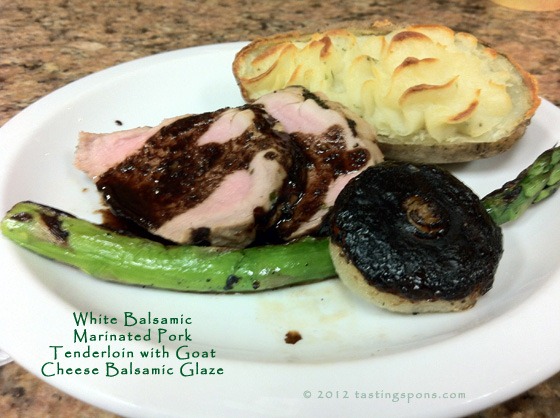
balsamic_pork_tenderloin

Shall I just tell you that if I’d had a spoon, mine would have been in the pot of sauce, eating spoonful after spoonful of that balsamic and goat cheese combination; it was THAT good. What you see on the right front is a grilled cipollini onion – a VERY grilled cipollini. You might think it’s burned – nope! Absolutely meltingly tender.

A couple of weeks ago I attended a cooking class with James Clark, the chef at Croce’s Restaurant and Jazz Bar in San Diego. He was a very charming man and had all of us 50+ students nearly eating out of his hand (well, not literally). With a few stories interspersed throughout his monologue, this recipe was a real standout. And as I mentioned above, if I could have had a little BOWL of the sauce on the side, it would have been eaten straight. It was just addictive. The class was busy – well, I mean HE was busy. First he made soup, the Croce’s Mulligatawny Soup. Then he made twice-baked potatoes (I probably won’t write up that one just because it’s so simple: to the whipped potatoes, just add butter, goat cheese, parsley, salt and pepper and half and half and put them back into the potato skin; bake them about 15 minutes, along with the cipollini onions), he prepped the asparagus and the cipollini, made the glaze, the marinade. And he made the salad – I’ve written that up already: Pear, Arugula and Fennel Salad. That one was so good. I have one more recipe to go, as well, the dessert. You’ll get all the recipes from this class eventually.

The pork is marinated for 2-3 hours (no longer, no overnight marinade), grilled, then baked in the oven. It rests 5 minutes then it’s sliced and served with the cipollini onions and asparagus. AND the fabulous balsamic goat cheese glaze drizzled all over it. Make it, okay?

What I liked: the sauce, the sauce, the sauce. And the onions too. Pork was lovely too.

What I didn’t like: nothing – it looked easy to do, and some of the work can be done ahead.

printer-friendly PDF
MasterCook 5+ import file – right click to save, run MC, then File|Import

White Balsamic-Marinated Pork Tenderloin

Recipe By: From James Clark, chef at Croce’s
Restaurant and Jazz Bar, San Diego
Serving Size: 6

WHITE BALSAMIC MARINADE:
1/2 cup white balsamic vinegar
1 cup olive oil
1 tablespoon minced garlic
1 tablespoon fresh parsley — minced
1 tablespoon fresh basil — minced
1 tablespoon fresh oregano — minced
Kosher salt and freshly ground black pepper
2 pounds pork tenderloin — (about 1 pound each), trimmed of fat and silverskin
GOAT CHEESE BALSAMIC GLAZE:
1 cup balsamic vinegar
1/4 cup sugar
1/4 cup goat cheese — soft, Chevre type
1 tablespoon fresh thyme — minced
VEGETABLES:
1 pound fresh asparagus — trimmed of root ends (if they are very large, par-boil them for 2-3 minutes and finish them on the grill)
12 whole cipollini onions — peeled, left whole

1. Combine all the ingredients in a freezer-weight Ziploc bag and add the pork tenderloin. Seal, squish it around, turn it over and refrigerate for 2-3 hours (do not leave this overnight). Remove meat from marinade and pat dry with paper towels.
2. GLAZE: Combine the balsamic vinegar and sugar in a medium sized saucepan. Bring to a boil and simmer the sauce until it has reduced by half. Add the crumbled goat cheese and fresh thyme. Keep warm on very, very low heat until ready to serve. (Can be made a few hours ahead.)
3. GRILL and BAKE: Preheat a convection oven (if you have that option) to 350° and heat an outdoor grill to medium-high. Season the pork and vegetables with salt and pepper. Cook the pork tenderloin first, until you have grill marks on all sides then remove to the oven and cook until it reaches an internal temp of 125° to 135° (medium-rare at the low temp, toward medium at the higher temp). Remove and allow to rest for 5 minutes, loosely covered with foil. Meanwhile, grill the vegetables. The onions will take longer, but grill them until they are blackened (about 15 minutes). Slice the meat and serve with the balsamic goat cheese glaze drizzled over the pork. Place vegetables on the side.
Per Serving: 600 Calories; 43g Fat (64.1% calories from fat); 35g Protein; 19g Carbohydrate; 2g Dietary Fiber; 103mg Cholesterol; 225mg Sodium.

Posted in Soups, on March 20th, 2012.

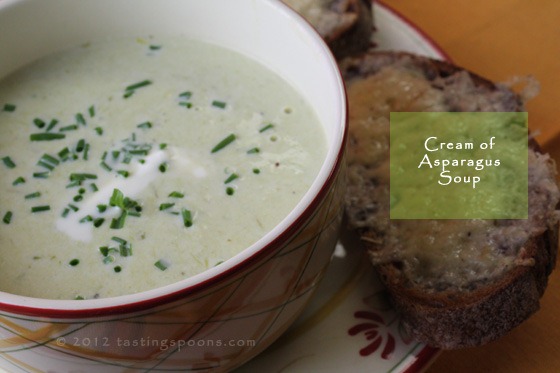
cream_of_asparagus_soup

This creamy asparagus soup was our dinner the other night – ‘tis the season for asparagus and I had a big bunch to use up. Nothing very different about it – just a good old-fashioned thick and creamy soup with some crème fraiche and fresh chives.

What I needed was an asparagus soup recipe that didn’t require me to go to the market, so I went to Eat Your Books and found one right away, in Dorie Greenspan’s book, Around My French Table: More Than 300 Recipes from My Home to Yours. I didn’t cleave to her recipe exactly, but close enough that I can say my recipe below was inspired by hers. But then, asparagus soup can only have so many ingredients, right? Asparagus, either onion or leeks, maybe garlic, maybe not, some cream or half and half (I used both), chicken broth, maybe shallots. This recipe doesn’t disappoint. Our fresh chives are just growing to beat the band lately, so I used a bunch for garnish. And the crème fraiche for a little blob of goodness on top.

Her recipe called for 2+ pounds of asparagus. I didn’t have that much – we’d already had one or two meals with asparagus, so this was about 1 1/4 pounds. But you know what? Soup is very forgiving. If you have a pound – use that. If you don’t have garlic, eliminate it. No leeks? Well, use more onion. No chicken broth? Use vegetable broth or water. Wing it – that’s what I do all the time. This recipe also uses the asparagus root ends to add extra flavor. I liked that part – asparagus is such a subtle, delicate flavor that it’s nice to have more of it! It’s a bit of a nuisance to do because those parts gets scooped out and discarded. I re-arranged the recipe to make it easier. I think Dorie’s recipe has you make the entire soup in one pot, but I wanted to speed up the process and used two.

What I liked: the consistency – I didn’t strain the soup, so it had plenty of texture from the asparagus, leeks and onions. It is whizzed up in the blender (I used my immersion blender in the pot) so it’s a smooth soup. Loved the dollop of crème fraiche too.

What I didn’t like: nary a thing. Just that I didn’t make enough of it! Wish I’d had more asparagus.

printer-friendly PDF
MasterCook 5+ import file

Cream of Asparagus Soup

Recipe By: Adapted from Dorie Greenspan’s Around My French Table
Serving Size: 6

1 1/2 pounds fresh asparagus
2 quarts water
1 teaspoon kosher salt
2 tablespoons oil
2 tablespoons unsalted butter
1 whole onion — diced
2 whole leeks — cleaned, chopped
2 whole shallots — peeled, diced
1 large garlic clove — peeled, mashed
1 teaspoon chicken soup base — (the concentrate) [I used my Penzey’s base]
2 cups half and half
1/3 cup heavy cream
2 tablespoons unsalted butter — added at the end (optional)
4 tablespoons creme fraiche — for garnish
1 tablespoon fresh chives — for garnish

1. ASPARAGUS: wash and clean. Pull the top of each spear down, holding the stem with your other hand. It will break off where it should. Place tops in one pile; the bottoms in another pile.
2. Add water to a large soup pot and bring to a boil. Add the asparagus bottoms. Simmer for about 10 minutes until the asparagus is cooked through. Remove with a slotted spoon and discard. Add the top parts of the asparagus to the water and simmer for about 4 minutes.
3. Meanwhile, in another pot add oil and butter and heat until bubbling. Add the leeks, onions and shallots and saute over low heat for about 10 minutes. Do not burn. Add this mixture to the asparagus mixture. Add chicken soup base. Simmer for about 10 minutes.
4. Use an immersion blender (or pour mixture in batches into a standing blender) to puree. You can pour this pureed mixture through a sieve to remove any of the vegetable fiber (I like it with the texture). Add the half and half and heavy cream. Taste for seasoning. Heat mixture JUST below a simmer, about 5 minutes, and serve. Do not boil this mixture or it will separate. Add butter at the end if desired.
5. Scoop about 1 1/2 cups of soup into each bowl and garnish with creme fraiche and chives.
Per Serving: 342 Calories; 30g Fat (74.7% calories from fat); 6g Protein; 16g Carbohydrate; 3g Dietary Fiber; 77mg Cholesterol; 476mg Sodium.

Posted in Books, Essays, on March 18th, 2012.

extravirginitybook

First I must tell you I actually haven’t read this book, Extra Virginity: The Sublime and Scandalous World of Olive Oil . I have 3 books going right now and there’s definitely not time in the near future for me to add another. But I would like to read it (I’ve ordered it actually), especially after reading the review of it in the Los Angeles Times  last weekend. It’s the review that prompted me to go searching further on the subject. And to write up this post about it.

If you do a search for the title of the book you’ll find any number of links, to amazon of course, but also to NPR who did a review of it. Also a couple of naysayers who have olive oil blogs or websites. And I’m no expert – I’m only telling you about what I read in the article in the Times.

Russ Parsons (the Time’ reviewer), a long time writer for the newspaper, and major food/recipe contributor, is someone I trust. I like the way he writes. I like what he writes. In this article he talked about how, in 1985, he heard from a friend who had just returned from Tuscany, that there had been a major freeze there, which cracked most of the producing olive trees in half, killing them. So Parsons jumped to the conclusion that there would [surely] be a deep shortage of Tuscan olive oil the following year. Indeed, the Tuscan trees were devastated. But that next year, using a little-known fact about the agricultural system in Italy, the olive oil producers in Tuscany merely imported oil from Spain and Algeria. It didn’t matter how much “real” Tuscan oil was in the can or bottle – they could use mostly Spanish and Algerian for that matter and still call it extra virgin Italian (Tuscan) olive oil. It’s also supposed that there was a lot – a LOT of cottonseed oil added to the olive oil too (also okay by Italian regulations).

What we may know as “light” olive oil is actually (most likely anyway) low grade olive oil mixed with cottonseed oil to thin it out, making it less olive-y, less pungent. So why not just use vegetable oil? Indeed!

So based on that, I’m paying heed to Mueller’s points. So who is Tom Mueller? He’s a writer for the New Yorker,  but he lives in Liguria amidst his large olive tree farm. Over the years, he obviously has done a lot of research about olive oil – probably a real eye-opener when he discovered that the Italian rules are rather lax about the derivation of their olive oil. And incidentally, that phrase about “first press” or “cold press” oils – that’s all bunk, because really nobody actually uses an olive press anymore – they use more modern equipment.

I did a bit of sleuthing and found this quote from his very interesting website.

[During the writing of the book, I] immersed myself in olive oil. I’ve traveled on 4 continents, meeting olive millers and oil-bottlers, lipid chemists and fraud investigators, oil-making monks and oil crooks, chefs and government regulators and oil sommeliers, as well as countless eager consumers, some of them life-long experts, others enjoying their first taste of great oil. In the process I’ve learned a lot about one of humankind’s most magnificent foods, this essence of health and flavor. I’ve met olive growers and oil-makers whose divine nectars deserve to be celebrated around the world, treated with reverence and gratefulness. And I’ve seen that they’re losing their shirts.

The book, I’m supposing from the article, tells you which olive oil producers are the fraudsters (his word) and which are reputable. We all know we can buy very expensive olive oil, and we can buy the cheap stuff at the grocery store. Those cheap brands likely contain a significant amount of cottonseed oil and little actual olive oil. Price doesn’t always indicate quality, either, although it should go some distance that way. If I paraphrase the article, it does indicate you should choose an extra virgin olive oil that indicates an expiration date – the better producers do that – they’ll provide a lot number and a use-by date.

Until the book arrives and I have time to read it, I’ll just have to use my trusted brands. I think I read recently that Costco’s Kirkland brand is a fairly good olive oil – I use it for some things. I have several others than are better oils. I also visit a little olive oil store about 20 miles from our house (they carry just oils and vinegars, under their own labels, mostly infused with herbs, spices, and fruits). You probably know already that you don’t need to use EVOO for frying – you never garner the flavor from it for frying – use a vegetable oil (in fact my most recent Cook’s Illustrated, they tested brands of oil and Crisco’s Natural Blend was the clear #1. I don’t know that I’ve ever seen it in any market. Anyway, their test was preparing home made mayonnaise and using the oil for frying. All the oils preformed differently depending on the use, but this one, the Crisco Natural Blend, brought the best flavor to the mayo, as well as frying. Anyway, don’t waste good EVOO for anything unless the flavor is going to come through. You’re paying for that flavor, be it bland or peppery, herby or floral, and you might as well taste it. So that would mean relatively plain salad dressings or drizzles on things. Don’t use it for frying, for baking, or in your favorite carrot cake. Use a very bland oil instead, like the one above. So there’s your olive oil lesson for the day!

Related Posts Plugin for WordPress, Blogger...