Get new posts by email:

Archives

Currently Reading

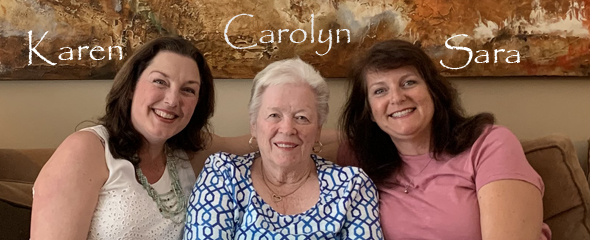
Here are the tastingspoons players. I’m in the middle (Carolyn). Daughter Sara on the right, and daughter-in-law Karen on the left. I started the blog in 2007, as a way to share recipes with my family. I’m still doing 99% of the blogging and holding out hope that these two lovely and excellent cooks will participate. They both lead very busy lives, so we’ll see.

– – – – – – – – – – – – – – – – – – – – – –

BOOK READING (from Carolyn):

Music of Bees, Eileen Garvin. Absolutely charming book about a woman in midlife, lonely, who raises bees, also makes unlikely friends. Heart-warming and very interesting about beekeeping.

A Postcard from Paris, Alex Brown. Really cute story. Dual time line, 1940s and present day about renovating an old apartment in Paris, things discovered.

Time of the Child, Niall Williams. Oh such a good book. Very small village in Ireland, 1960s. A baby is left on the doorstep. The town all whispers and helps. I listened to an interview of the author, which made me like him and his books even more.

Sipsworth, Simon Van Booy. If you like animals you’ll swoon. An old woman who really wants to die finds a tiny mouse in her house and befriends it and finds a reason to live. Utterly charming book.

The Forger’s Spell, Edward Dolnick. True story. For seven years a no-account painter named Han van Meegeren managed to pass off his paintings as those of Johannes Vermeer.

If You Lived Here, You’d be Home by Now, Christopher Ingraham. Could hardly put it down – about a journalist who takes on a challenge to move to small town in Minnesota and write about it. He expects to hate it and the people and place, but he doesn’t. Absolutely wonderful true story.

The River We Remember, William Kent Kreuger. 1950s, Minnesota. A murder and the aftermath. Could hardly put it down. Kreuger has such a vivid imagination and writing style.

How the Lights Gets In, Joyce Maynard. An older woman returns to New Hampshire to help care for her brain-injured son. Siblings and family, lots of angst and resentments.

The Filling Station, Vanessa Miller. Every American should read this book. A novelized retelling of the Tulsa massacre in 1921. Absolutely riveting.

The Story She Left Behind, Patti Callahan Henry. Love this author. Based on a true story. A famous author simply vanishes, leaving her husband and daughter behind. She had invented a mystical language no one could translate. Present day, someone thinks he’s solved the riddle, contacts the family. Really interesting read.

The Girl from Berlin, Ronald Balson. Love anything about Tuscany. An elderly woman is being evicted from a villa there, with odd deed provenance. Two young folks go there to help unravel the mystery. Loved it.

The Island of the Colorblind, Oliver Sacks, M.D. Nonfiction. The dr is intrigued by a remote Pacific island where most of the inhabitants are colorblind. He also unravels a mystery on Guam of people born with a strange neurological problem. Medical mysteries unveiled. Very interesting.

The Bookbinder, Pip Williams. Post 1914 London. Two sisters work at a bookbindery. They’re told to not read the books. One does and one doesn’t. One has visions beyond her narrow world; the other does not. Eventually the one gets into Oxford. Lovely story.

The Paris Express, Emma Donoghue. 1895 on a train to Paris, a disaster happens. You’ll delve into the lives of many people who survived and died in the crash.

A Race to the Bottom of Crazy, Richard Grant. This is about Arizona. Author, wife and child move back to Arizona where they once lived. Part memoir, research, and reporting in a quest to understand what makes Arizona such a confounding and irresistible place.

The Scarlet Thread, Francine Rivers. A woman’s life turned upside down when she discovers the handcrafted quilt and journal of her ancestor Mary Kathryn McMurray, a young woman who was uprooted from her home only to endure harsh frontier conditions on the Oregon Trail.

A Place to Hide, Ronald Balson. 1939 Amsterdam, an ambassador has the ability to save the lives of many Jewish children. Heartwarming.

Homeseeking, Karissa Chen. Two young Chinese teens are deeply in love, but in China. Then their families are separated. Jump to current day and the two meet again in Los Angeles.

North River, Pete Hammill. He always writes such a good story. A doctor works diligently healing people from all walks of life. His wife and daughter left him years before. One day his 3-yr old grandson arrives on his doorstep.

A Very Typical Family, Sierra Godfrey. A very messed-up family. Three adult children are given a home in Santa Cruz, Calif, but only if the siblings meet up and live in the house together. A very untypical scenario but makes for lots of messes.

Three Days in June, Anne Tyler. The usual Anne Tyler grit. Family angst. This wasn’t one of my favorites, but it was entertaining and very short.

Saved, Benjamin Hall. Author is a veteran war reporter. Ukraine, 2022, he nearly loses his life to a Russian strike. Riveting story – he survives, barely.

Grey Wolf, Louise Penny. Another Inspector Gamache mystery in Quebec. She is such an incredible mystery writer.

All the Colors of the Dark, Chris Whitaker. A missing person mystery, a serial killer thriller, a love story, a unique twist on each. Could hardly put it down.

Orbital, Samantha Harvey. Winner of 2024 Booker Prize. I don’t usually like those, but I heard the author interviewed and she hooked me. This is not a normal book with a beginning, a story and an end. It’s several chapters of the day in the life of various astronauts at the ISS (Int’l Space Station). All fictional. She’s been praised by several real astronauts for “getting it” about space station everyday life.

The Blue Hour, Paula Hawkins. An island off Scotland. Inaccessible except when the tide is out. Weird goings on. An artist. A present day mystery too.

Iron Lake, William Kent Krueger. A judge is murdered and a boy is missing. Riveting mystery.

Tell the Wolves I’m Home, Carol Ricks Brunt. 1980s. A 14-yr old girl loses her beloved uncle. Yet a new friendship arises, someone she never knew about.

Four Treasures of the Sky, Jenny Zhang. 1880s, a young girl is kidnapped in China and brought to the United States. She survives with many hurdles in the path.

The Boy Who Fell out of the Sky, Ken Dornstein. Memoir, 1988. The author’s brother died in the PanAm flight that went down in Lockerbie, Scotland. A decade later he tries to solve “the riddle of his older brother’s life.”

Worse Care Scenario, T.J. Newman. Oh my. Interesting analysis of what could/might happen if a jet crashed into a nuclear plant. Un-put-downable.

Song of the Lark, Willa Cather. Complicated weave of a story about a young woman in about 1900, who has a gifted voice (singing) and about her journey to success, not without its ups and downs.

Crow Talk, Eileen Garvin. Charming story which takes place at a remote lake in Washington State, about a few people who inhabit it, the friendships made, but also revolving around the rescue of a baby crow.

The Story Collector, Evie Woods. Sweet story about some dark secrets from an area in Ireland, a bit magical, faerie life, but solving a mystery too.

A Sea of Unspoken Things, Adrienne Young. A woman investigates her twin brother’s mysterious death. She goes to a small town in California to figure it out, to figure HIM out.

The King’s Messenger, Susanna Kearsley. 1600s England, King James. About one of his trusted “messengers,” and his relationship with a young woman also of “the court.” Lots of intrigue.

In the Shadow of the Greenbrier, Emily Matchar. Interesting mystery in/around the area of the famous resort in White Sulphur Springs, West Virginia.

Isola, Allegra Goodman. Hard to describe, survival story on an island in the 1600s.

Save the Date, Allison Raskin. Rom-com, witty, LOL funny. Clever.

The Sirens, Emilia Hart. Numerous time-lines, Australia. Mysteries abound, nightmares, abandoned baby, weird allergies.

Red Clay, Charles Fancher. LOVED this book. Mostly post-Civil War story about the lives of slaves in Alabama during Reconstruction.

Stars in an Italian Sky, Jill Santopolo. Dual time line, 1946 and recent time. Love stories and a mystery.

Battle Mountain, C.J. Box. Another one of Box’s riveting mysteries. Love his descriptions of the land.

Something Beautiful Happened, Yvette Corporon. A memoir of sorts in Greece, tiny island of Erikousa, where the locals hid Jews during WWII. All elusive stories told by the author’s grandmother.

The Jackal’s Mistress, Chris Bohjalian. 1860s Virginia, about a woman who saves the life of a Union soldier. Really good story.

Song of the Magpie, Louise Mayberry. Really interesting story about Australia back in the days when it was mostly a penal colony. Gritty strength of a woman trying to thrive with her farm.

The Boomerang, Robert Bailey. A thriller that will have you gripping the book. About a lot of secrets surrounding the president (fictional novel, remember) and his chief of staff and about cancer. A cure. Such a good story.

Care and Feeding, Laurie Woolever. Really interesting memoir of a woman driven to succeed in the restaurant business. She worked for Mario Batali and then Anthony Bourdain. Gritty stories.

Everything is Tuberculosis, John Green. Maybe not a book for everyone. A real deep dive into the deadly tuberculosis infection, its history. I heard the author interviewed and found the book very interesting.

The Book Lovers Library, Madeline Martin. Fascinating read about Boots’ drug stores’ lending library. And the people who worked in them.

The Arrivals, Meg Mitchell Moore. LOL funny, about a middle-aged couple whose children (and their various family members) return to the family home and the chaos that ensues.

My Life as a Silent Movie, Jesse Lee Kercheval. About grief. A big move to Paris, finding herself a new life with a new set of real blood family.

Escape, Carolyn Jessop. Another memoir about a woman really in bondage in Utah, Mormon plural marriage.

 

Tasting Spoons

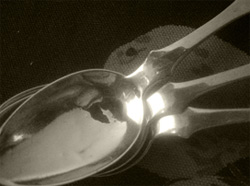
My blog's namesake - small, old and some very dented engraved silver plated tea spoons that belonged to my mother-in-law, and I use them to taste my food as I'm cooking.

Scroll down to the bottom to view my Blogroll

Posted in Salad Dressings, on April 26th, 2010.

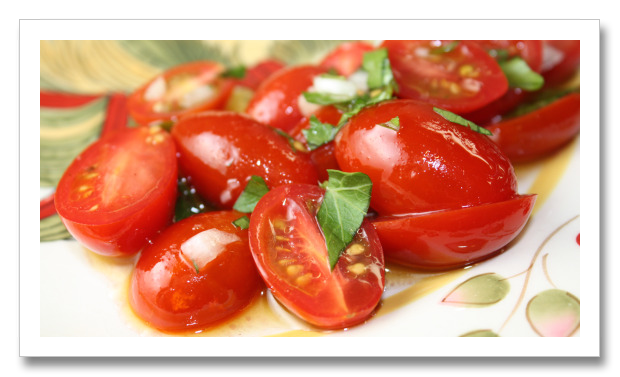
There’s not much of anything more boring than looking at a photo of a salad dressing sitting in a jar. So I opted to show you how I used it instead. I was making a quick dinner, but didn’t want to make a green salad. I had these little bitty tomatoes begging to be eaten, so I chopped them in half and let them marinate with the dressing. I had some extra minced shallots and Italian parsley on my chopping board so they got sprinkled on top.

The dressing recipe came from Martha Stewart Living, the 12/09 issue. From a woman who works for Omnimedia, Lucinda Scala Quinn. She’s just printed a cookbook called Mad Hungry: Feeding Men and Boys. The magazine had several of her recipes (that she feeds her male-dominant family, including two ravenous sons) but she prefaced this one with the story that it’s her mother Rose’s recipe, and a favorite of her dad’s. With that kind of testimony I had to try it. I can’t say that I was exactly wowed by it, but it was good. Keep reading . . . .

Sometimes salad dressings need to sit and veg for awhile before the flavors marry. I made the dressing, shook it up and promptly poured it on the tomatoes. Good, but not great.
But, when I tossed it with a green salad the next day it was wonderful! I liked it a LOT.  And I might try the option of using garlic instead of shallot, or maybe both. I’ll make this again, but I definitely will let it sit overnight first.
printer-friendly PDF

Rose’s Vinaigrette

Recipe By: From Martha Stewart Living, 12/09
Serving Size: 16

1 tablespoon shallot — minced (or use garlic clove)
1 teaspoon Dijon mustard
1 teaspoon light brown sugar
3/4 teaspoon coarse salt
1/4 teaspoon freshly ground black pepper
1/4 teaspoon Worcestershire sauce
2 1/2 tablespoons red wine vinegar
2 tablespoons fresh lemon juice
3/4 cup extra-virgin olive oil

1. In a clean jar, mash together the shallot, mustard, brown sugar, salt, pepper, and Worcestershire sauce.
2. Pour in the vinegar, lemon juice, and olive oil. Cover tightly and shake well to combine and emulsify. Add salt and pepper to taste. Use immediately or Store in the refrigerator overnight.
Per Serving: 92 Calories; 10g Fat (97.1% calories from fat); trace Protein; 1g Carbohydrate; trace Dietary Fiber; 0mg Cholesterol; 93mg Sodium.

A year ago: Graham Cracker Chewy Pecan Bars
Two years ago: Indian Pepper Chicken

Posted in Chicken, on April 24th, 2010.

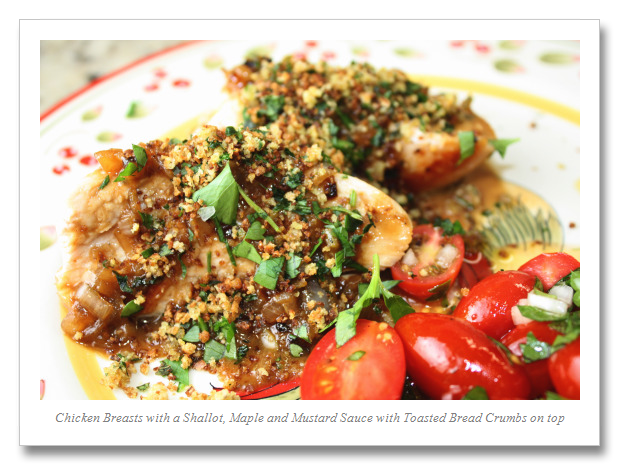
When I made this a couple of days ago I was pressed for time, but I had long enough to go searching for some new recipe, rather than winging it. I’d clipped a recipe from Food & Wine’s January issue, and decided to fiddle with it to make it more my own. Their recipe called for baking the chicken (with skin) at 450° for about 7 minutes. Nah. Didn’t want to do that. I should have pounded the breasts a bit, but I decided to try a different technique. So here’s what I did:

First I browned the bread crumbs (fresh ones – I had a package of Roman Meal multi-grain hot dog buns at hand, so I whizzed up two of them in the food processor) in a tablespoon of butter. Those were set aside, then the chicken breasts were browned on both sides. I cooked them briefly, but not all the way through. I cut them into wide slices and set them aside while I made the pan sauce. First I sautéed a shallot, then added the jot of maple syrup (you do keep a bottle of the real stuff in your refrigerator, don’t you?), sherry vinegar and some chicken broth. The chicken pieces were added back in (and turned over in the sauce so all edges had some sauce on them) and I covered the pan for 3-5 minutes until the chicken was just cooked through. The chicken went out onto heated plates. Then I added the Dijon mustard to the sauce and heated it through. That’s it. Spoon or pour it over the chicken and garnish with the toasty bread crumbs and more Italian parsley. You’ll enjoy some of the sauce with each bite. This was really delicious. I’ll be making this recipe again. The bread crumbs make the dish, in my estimation. The sauce is really good – that is an essential part too, but the crispy crumbs give the chicken a great texture. Note that this is a fairly low calorie dinner.
printer-friendly PDF

Chicken Breasts with Maple Mustard Sauce and Toasted Breadcrumbs

Recipe By: Adapted from a recipe in Food and Wine, Jan. 2010
Serving Size: 4

1 tablespoon unsalted butter
1 cup fresh bread crumbs
1 tablespoon Italian parsley
Salt and freshly ground pepper
1 tablespoon extra-virgin olive oil (to brown chicken)
4 boneless skinless chicken breast halves
1 tablespoon extra-virgin olive oil (to saute shallots)
1/4 cup shallot — minced
2 tablespoons maple syrup — (not imitation)
1 tablespoon sherry vinegar
1/2 cup chicken stock
2 tablespoons Dijon mustard
2 tablespoons Italian parsley — for garnish

1. Lay the chicken breasts (shiny side up) between two pieces of plastic wrap and pound the breasts until they are thinner, about 1/2 inch thick. Don’t pound the thin end area.
2. In a large ovenproof skillet, melt the butter. Stir in the bread crumbs and cook over moderate heat until golden, about 4-6 minutes. Stir in the parsley and season with salt and pepper. Transfer to a plate and let cool. Wipe out the skillet.
3. Add the olive oil to the skillet and heat until shimmering. Season the chicken with salt and pepper and add it to the skillet. Cook over moderately high heat until the chicken is golden brown, 3 minutes. Turn pieces over and brown on the other side. Allow the chicken to continue cooking for about 3-4 minutes, then remove the pieces from the pan and place on a cutting board. Using tongs to hold the chicken, slice the breasts into 2-3 pieces each and let them rest.
4. Return the skillet to the burner. Add the second tablespoon of olive oil and add the minced shallot. Cook over medium heat until the shallots are just turning golden (don’t burn). Add the maple syrup, chicken broth and vinegar to the pan; bring to a boil. Place the chicken pieces back into the pan, cover and simmer for 3-4 minutes until the chicken is cooked through. Remove the chicken to warmed plates. Add the mustard to the juices in the pan and season with salt and pepper. The sauce will thicken up beautifully while the mustard heats. Spoon the sauce over the chicken. Top with the bread crumbs with more Italian parsley sprinkled on, and serve.
Per Serving: 288 Calories; 12g Fat (37.9% calories from fat); 29g Protein; 15g Carbohydrate; 1g Dietary Fiber; 76mg Cholesterol; 504mg Sodium.

A year ago: Mint Juleps with Agave Nectar
Two years ago: Caramelized Onion Sage Puffs

Posted in Cookies, on April 23rd, 2010.

For a long time I’ve had a recipe I clipped out of the King Arthur Flour catalog (if you’re a baker and don’t receive the catalog already, you should). The close-up picture of these cookies (in the catalog) was so unusual, with the finger-dents in each cookie (not in my photo because I had a hard time getting finger-dents.

As usual, I should have done some reading online before I started baking. But hopefully I made a purse out of sow’s ears once I doctored up the recipe. The advice from other bakers was that you need to use King Arthur Flour’s 10-ounce tin of almond paste. That it makes a world of difference. I had what’s available at my local grocery store (Odense, imported from Denmark).

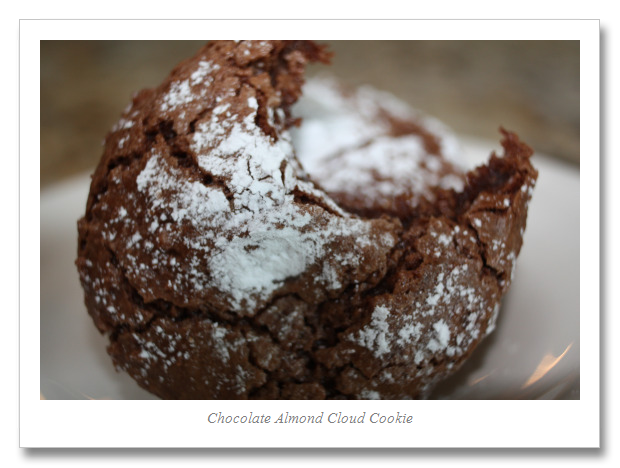
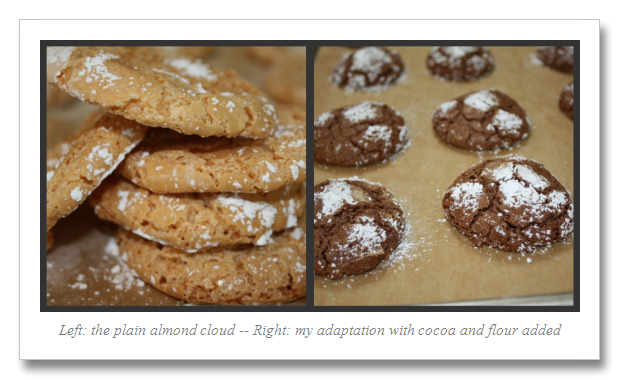
I already had a measurement problem because the Odense brand almond paste comes in a 7-ounce tube. But my recipe software will scale recipes, so it was not difficult to make the adjustment. I blithely went along to make this simple cookie – almond paste, sugar, egg whites and flavorings (note, there’s no fat in this recipe at all). Seemed really easy to me. Well, I thought the batter was rather loose when I made it, but hey, I didn’t know what it was supposed to look and feel like. I did decide to do just one tray full (12) first. And this is what I got (photo below left). Flat, and nicely tasting, I guess. No finger-dents visible because the cookie had spread out quite thinly. And it was a bit too sweet for my taste, but good tasting. THEN I went online and started reading and discovered other bakers’ problems using store-bought almond paste.

What to do? I knew I needed to add something to thicken-up the dough. I debated about adding fine polenta meal, but because the almond paste has a grainy texture all on its own, I wasn’t sure the polenta would add enough stability. So, I added some cocoa powder and just a little bit of flour to the bowl. It gave the dough just a bit more heft and form. That’s powdered sugar on the top of the cookies, not flour. Then I continued with the recipe as it was. No other changes.

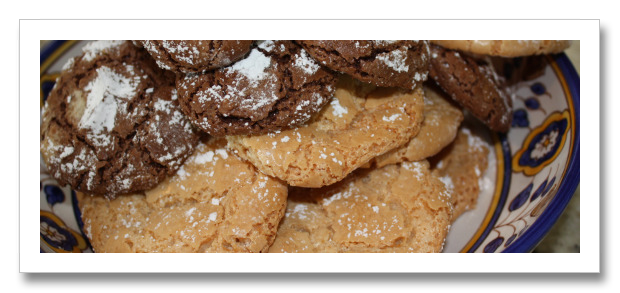
What these are, are very sweet chocolate almond cookies. They have the texture of macaroons, but no coconut. Some people may like these – because of their zero fat, but for me, they’re just too, too sweet. And I’m not overly crazy about a cookie that’s chewy, either.  They are light as a feather (from the egg whites) but crispy/chewy (because of no egg yolks). Almond flavoring is a great addition to almost any baked good in my book, so I liked that part right off the bat. Actually I couldn’t taste the orange oil I added – probably because the chocolate overpowered it – so you could easily add vanilla, I think. In the end I didn’t get any finger-dents either, even in the doctored-up recipe – so they still don’t look like the KAF version. But they’re good. So, I’ve tinkered with it a bit more and reduced the sugar in the recipe below. I have also added a couple more tablespoons of flour to the dough, which should make it a bit more sturdy. If you want to try to make the original ones, just use the first link in the first sentence at top to get to KAF’s recipe.
printer-friendly PDF

Chocolate Almond Cloud Cookies

Recipe By: Adapted from a recipe in the King Arthur Flour catalog.
Serving Size: 15

7 ounces almond paste
2/3 cup sugar — plus 1 tablespoon
2 small egg whites — lightly beaten
2 tablespoons cocoa powder
4 tablespoons all-purpose flour
1/8 teaspoon almond extract
1/16 teaspoon orange oil — or lemon oil, or bitter almond oil (or VANILLA)
Powdered sugar for topping

1. Preheat oven to 325. Lightly grease (or line with parchment paper) two baking sheets.
2. In a stand mixer combine the almond paste and sugar until the mixture forms fine crumbs. Add egg whites gradually, while mixing, to make a smooth paste. Then add flour and cocoa and mix just until blended. Add flavorings.
3. Scoop dough by heaping tablespoons onto prepared pans. Sprinkle the cookies heavily with powdered sugar, then use 3 fingers to press an indentation into the center of each cookie.
4. Bake the cookies for 20-25 minutes, until they’re brown around the edges. Allow them to cool on the pan.
Per Serving: 107 Calories; 4g Fat (30.8% calories from fat); 2g Protein; 17g Carbohydrate; 1g Dietary Fiber; 0mg Cholesterol; 9mg Sodium.

A year ago:  Creole Jambalaya
Two years ago: Roasted Carrots and Parsnips

Posted in Desserts, on April 22nd, 2010.

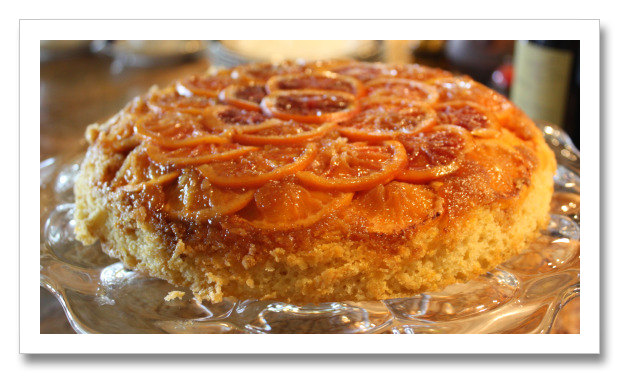
Gosh, isn’t that just gorgeous? I can say that because I didn’t make it, but enjoyed a slice of it. Our daughter-in-law Karen made this delicious cake for Easter Sunday dinner, and we all thought it was fantastic. That’s blood oranges there (Karen got them from her Uncle Ron who grew them), and this cake was a perfect way to show them off. The color was just as brilliant as you see in the photos.

I can’t speak much for the making of this, but Karen said she had no problems with it. It’s made in a 10-inch cast iron frying pan – first the caramel with the wafer-thin blood orange slices, then the cake is spooned in on top of the oranges (after you’ve nicely arranged them, slightly overlapping in concentric circles) and baked. Then you turn it out, upside down and those lovely orange slices take center stage. Karen said her oranges were not consistently red all the way through, so she used the darker slices in the middle and worked outward with the slices that were more orange.

The texture was lovely – the cake has just a few tablespoons of polenta (cornmeal) in it, which gives the cake just a little bit of toothsome crunch. I made a lemon upside down cake about a month ago, which was also really good, but it didn’t contain any polenta or cornmeal. Upside down cakes, which were all the rage back in the 1950’s, maybe even the late 1940’s, have suddenly become very popular again. Back then the only kind anyone made contained canned pineapple slices and a maraschino cherry plopped in the center of each pineapple ring. I’m enjoying the current variations. And this cake was a winner – we all thought it was wonderful.
printer-friendly PDF

Blood Orange Polenta Upside-Down Cake with Whipped Crème Fraîche

Recipe By: Bon Appetit, 3/2010
Serving Size: 8
NOTES: The cake gets baked in the same skillet you use to make the caramel. Here are a few key assembly points to keep in mind after you follow the recipe to make the syrup. (1) As soon as the syrup turns golden amber, take the skillet off the heat; (2) Arrange the orange slices as pictured, overlapping slightly, in concentric circles atop the caramel; (3) Mix the batter and drop it by large spoonfuls atop the orange slices in the skillet, then spread evenly. (Don’t pour the batter; you risk jostling the oranges.)

CAKE:
7 tablespoons sugar — divided, plus 3/4 cup sugar
3 tablespoons water
8 tablespoons unsalted butter — (1 stick) room temperature, divided
3 whole blood oranges — unpeeled, small to medium sized
3/4 cup all-purpose flour — plus 3 tablespoons
3 tablespoons polenta — or coarse yellow cornmeal (preferably stone-ground)
1 1/2 teaspoons baking powder
1/4 teaspoon kosher salt — coarse
3/4 teaspoon vanilla extract
2 large eggs — separated
6 tablespoons whole milk
WHIPPED CREME FRAICHE:
1 cup creme fraiche — chilled
2 tablespoons sugar

1. CAKE: Position rack in center of oven and preheat to 350°F. Combine 6 tablespoons sugar and 3 tablespoons water in 10-inch diameter ovenproof skillet with 8-inch diameter bottom and 2 1/2-inch-high sides. Stir over medium heat until sugar dissolves. Increase heat and boil without stirring until syrup is golden amber (not dark amber), occasionally brushing down sides of skillet with wet pastry brush and swirling skillet, about 4 minutes. Remove skillet from heat and whisk 2 tablespoons butter into caramel. Set aside.
2. Cut off both rounded ends of each orange so that ends are even and flat. Using sharp knife, cut oranges into 1/16- to 1/8-inch thick rounds. Remove and discard any seeds. Arrange orange slices, overlapping slightly, in concentric circles atop caramel in bottom of skillet.
3. Using electric mixer, beat 3/4 cup sugar, remaining 6 tablespoons room-temperature butter, and vanilla in another medium bowl until light and fluffy. Add egg yolks 1 at a time, beating well after each addition. Add flour mixture in 3 additions alternately with milk in 2 additions, beating batter just until incorporated.
4. Using clean dry beaters, beat egg whites in large bowl until soft peaks form. Add remaining 1 tablespoon sugar and beat until stiff but not dry. Fold 1/3 of egg whites into batter to lighten, then fold in remaining egg whites in 2 additions. Drop batter by large spoonfuls atop orange slices in skillet, then spread evenly.
5. Bake cake until tester inserted into center comes out clean, about 45 minutes. Cool cake in skillet 10 minutes. Run small knife around cake to loosen. Place platter atop skillet. Using oven mitts, hold platter and skillet firmly together and invert, allowing cake to settle onto platter. Rearrange any orange slices that may have become dislodged. Cool cake completely at room temperature.
Crème Fraîche:
1. Using electric mixer, beat chilled crème fraîche and 2 tablespoons sugar in medium bowl until mixture thickens.
Cut cake into wedges and serve with dollop of whipped crème fraîche.
Per Serving: 354 Calories; 22g Fat (54.6% calories from fat); 5g Protein; 36g Carbohydrate; 2g Dietary Fiber; 112mg Cholesterol; 189mg Sodium.

A year ago: Pickled Grapes
Two years ago: Yucatecan Pickled Onions

Posted in Desserts, on April 21st, 2010.

Our friends, Sue & Lynn, invited us over for dinner the other night, and I always offer to make something. After Sue told me she was making a Persian dinner I read about this recipe at David Lebovitz’ blog. It sounded like a perfect ending to a Persian meal. Although the recipe is actually Moroccan. But the pantry of a Persian kitchen is probably much like one in Morocco, so I hoped it would work.

Anyway, if you don’t already read Lebovitz’ blog, you should. He’s written several cookbooks, but lives in Paris and makes the most interesting things. This recipe came from a cookbook from the Moro Restaurant in London. And perhaps there are lots of similar recipes out there. This one was relatively easy, and so much comfort-food-like.

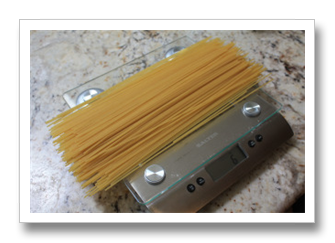
First you toast the noodles in butter. I measured out the correct amount on my hand-dandy scale. Then they were broken into jillions of pieces. And if there is anything I’d add to the recipe directions (I did below) it’s to break the noodles into smaller pieces. It’s not like you’re eating pasta to twirl around on your fork. So you want the pieces to be small enough to curl into the bowl of a spoon.

It doesn’t take long to brown the noodles, and you do need to watch them so they don’t burn. This step is much like making pilaf – when you brown both raw rice and raw pasta. Anyway, once the noodles are properly browned you add the whole milk and evaporated milk (with sugar, salt and ground cardamom). That mixture is simmered for about 10-15 minutes. Keep tasting the pasta until it’s just barely cooked through then remove from the heat. Then you add the orange oil. The original recipe calls for orange flower water, or rose flower water. I had one of those, but it was old, and had zero taste, so I opted for Lebovitz’ other option, which was orange (olive) oil.

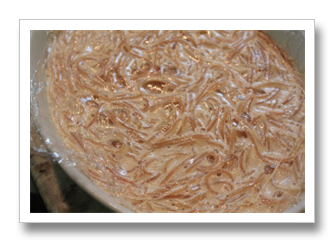
So there’s the photo of the cooked pudding. After it had cooled some, I put a piece of plastic wrap directly on the noodles so the milk/pudding part wouldn’t get a film. Once it had cooled to room temp, then it went into the refrigerator for several hours. The pudding thickens during this process – it seems to be quite milky at first, but I suppose the pasta thickens it some naturally.

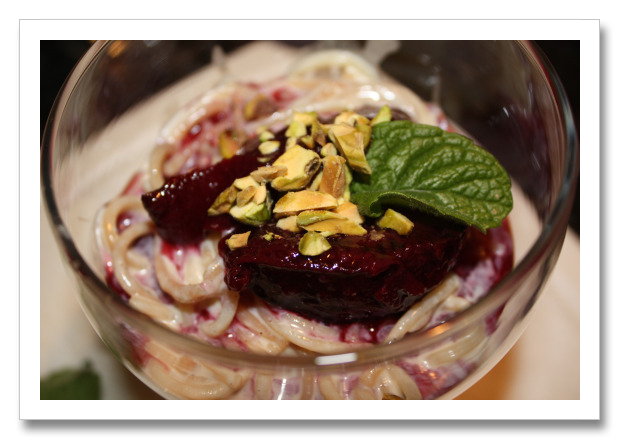
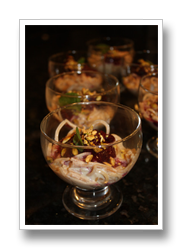
David Lebovitz suggested topping the pudding with some reconstituted sour cherries. I was going to do that, but remembered I had some wine-cooked plums (a Plum Compote) in the refrigerator that I’d made a couple of weeks ago. They weren’t overly sweet, so I used those, which gave the dish some vivid color, that’s for sure. And then I chopped up some pistachios to sprinkle on top. It wasn’t in the recipe, but I added a mint leaf also just for color.

This went so well with Sue’s dinner of beef and onion shish kebabs over Persian rice, a lovely green salad and green beans too.
printer-friendly PDF

Moro’s Vermicelli Noodle Pudding

Recipe By: Adapted from Moro East (Ebury) by Sam and Sam Clark
Serving Size: 6 (small servings)

2 tablespoons unsalted butter
4 ounces vermicelli noodles — or angel hair
2 3/4 cups whole milk
3/4 cup evaporated milk — plus 2 tablespoons
1/2 cup sugar
1 pinch salt
1/2 teaspoon ground cardamom
2 teaspoons orange oil
2 tablespoons pistachio nuts — coarsely chopped (unsalted)
plumped sour dried cherries (or a brightly colored plumped fruit)
Garnish: mint leaves

1. Melt the butter in a large saucepan or skillet. Break the noodles into small pieces and add them to the pan (if using nests, break them up first), then cook over moderate heat, stirring vigilantly, for about five minutes, until well-browned.
2. Add the whole milk, evaporated milk, sugar, salt, and cardamom and cook, stirring occasionally, for about ten minutes or so, until the noodles are completely cooked through.
3. Remove from heat and let cool to room temperature. Add the orange oil (or rosewater or orange flower water). Cover with plastic wrap, allowing it to cling to the pudding itself, then refrigerate until thick.
4. Spoon the pudding into individual bowls or glasses and top with coarsely chopped pistachios and plumped dried plums or cherries, if you like. Garnish with fresh mint.
Storage: The pudding will keep in the refrigerator for up to three days. If it becomes too thick, once cool, stir in a little milk to loosen it up.
Per Serving: 309 Calories; 13g Fat (37.6% calories from fat); 9g Protein; 40g Carbohydrate; 1g Dietary Fiber; 35mg Cholesterol; 113mg Sodium.

A year ago: Lemon Buttermilk Pie
Two years ago: Herb Crusted Beef Tenderloin

Posted in Lamb, on April 20th, 2010.

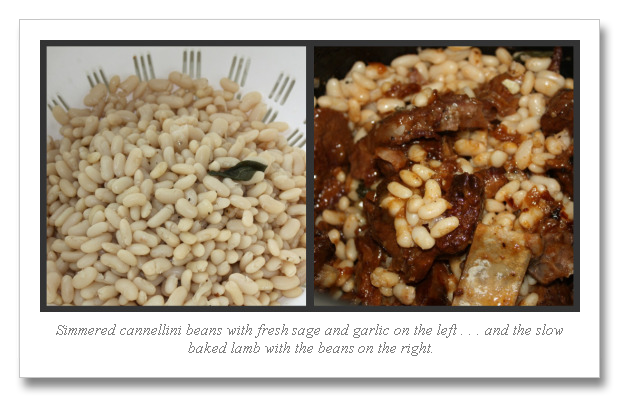
Oh yes, yummy this was. When we got to our second home in the desert last week, after eating out for more than a week, I was looking forward to making a home cooked meal. I enjoy glancing through the cookbooks I keep there since they don’t get as much use as the ones at home, and some of them I’ve not explored very much. As I looked through Marcella Hazan’s book, Marcella’s Italian Kitchen, this recipe talked to me. Lamb shoulder, onions, braised, baked, combined with cannellini beans with some pungent raw garlic and chopped parsley on top. Yep. Sounded like a winner, and it was.

We visited Bristol Farms (an upscale market that has a great meat department, with great expensive prices for everything on their shelves). But I wanted good, meaty lamb shoulder and I wasn’t even sure any of the supermarkets would HAVE lamb shoulder. Anyway, I made the cannellini beans myself rather than use canned. No reason why, just that I had time to do them, and I prefer the texture of homemade simmered beans rather than the almost mushy canned ones.

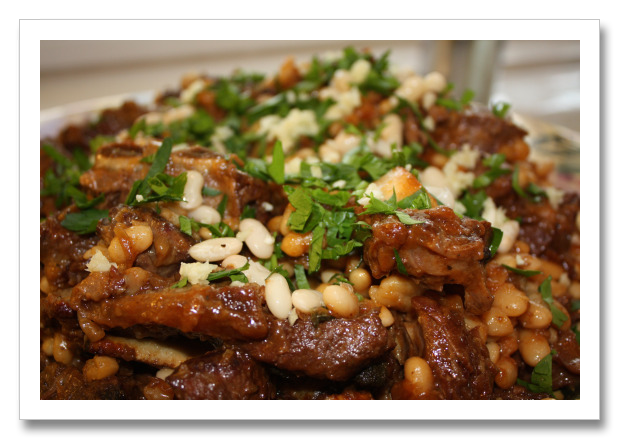
The recipe is relatively simple, really. The lamb pieces are floured and browned in vegetable oil, then set aside. A generous amount of thinly sliced onions are sautéed, then you add some white wine and beef broth, with tomato paste and fresh sage. That’s about it. The cannellini beans were made separately, with some garlic and fresh sage added to the water. Then, in Marcella’s recipe she said adding the raw minced garlic as a garnish is an important element – not cooked garlic – but the raw stuff. Gives it some bite. You can, if you study the photo at the top, see a few little snips of garlic. I saved a few of the cannellini beans out to add to the top of the finished dish – just because I wanted a bit more contrast in the photo. The mixed-in beans you’ll notice are darker with the extra-tasty sauce. Don’t skimp on the salt – the beans require a good measure of it. Do taste the finished dish and perhaps sprinkle a bit of salt all over the top. Delicious, all of it.
printer-friendly PDF

Braised Lamb Stew with Cannellini Beans

Recipe By: Adapted from Marcella’s Italian Kitchen
Serving Size: 6 (not huge portions)

1 tablespoon vegetable oil
3 pounds lamb shoulder, bone-in, cut in 3-inch pieces
2/3 cup all-purpose flour
3 tablespoons extra virgin olive oil
2 1/2 cups onions, sliced thin
6 fresh sage leaves (or 1 tsp dried)
Salt and pepper to taste
1 cup dry white wine
2 teaspoons tomato paste
1 cup beef broth, (use a concentrate with water)
1 1/2  cups cannellini beans, dry
4 cups water
2 whole garlic cloves, sliced in half
3 fresh sage leaves
Salt and pepper to taste
Garnish for meat:
2 teaspoons fresh garlic, finely minced
3 tablespoons Italian parsley, chopped

1. Pour enough vegetable oil into a skillet to cover the bottom completely and turn on the heat to medium high.
2. When the oil is hot, dredge the lamb pieces in the flour, one by one, and add gently to the pan. Do not crowd the pieces. Brown the meat on all sides, then transfer the to a plate, adding more lamb pieces, until all the lamb has been browned. Pour off the grease but keep the fond that’s on the bottom – add that to the stew once it’s mixed and ready to go in the oven.
3. Preheat oven to 350°.
4. Choose a large, lidded pot (large enough to hold all the meat and the beans), and preferably one that can go from oven to rangetop. Into this large pot add the olive oil, sliced onions, and sage. Turn heat to medium and cook onions, uncovered, stirring occasionally, until it becomes a light brown (but not burned).
5. Add the meat, turning it 2-3 times and heat until the meat begins to sizzle, then add salt, some grindings of ground black pepper and the white wine.
6. Meanwhile, dissolve the tomato paste in the beef broth and set aside. Simmer at medium-high heat the onions and wine and when almost all of the wine has boiled off, add the beef broth mixture and the fond from the frying pan. Bring back to a simmer, then cover and place the pot in the oven for 1 1/2 hours, removing it every 30 minutes and stirring it.
7. Meanwhile, prepare the beans: Add the beans to a stockpot, add water to cover and bring to a boil, turn off heat and let sit for an hour. Drain beans, then add twice as much water as you have beans (I’ve estimated at 4 cups, but it might be more). Add the garlic cloves and sage leaves. Bring to a boil, cover and reduce to a low simmer for about an hour, until the beans are just barely cooked through. Don’t over cook them or they’ll be mushy.
8. Drain the beans and taste for seasoning (salt and pepper). You’ll find these need more salt than you think. Pour the beans into the lamb stew pot and gently stir. Cover and bake another 15 minutes, until the mixture is warmed through. Remove any of the bones that have loosened completely and discard.
9. Pour the stew out onto (or into) a large heated platter or bowl and sprinkle top with the raw garlic and the chopped parsley.

A year ago: Chewy-Crispy Choc Chip Cookies
Two years ago: Pork Tenderloin with Figs & Port Wine

Posted in Salads, Veggies/sides, on April 19th, 2010.

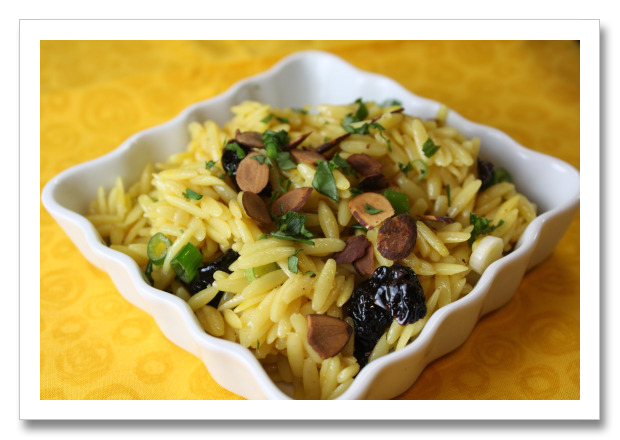
This is a kind of a salad. Well, or a side dish. What do you call a pasta dish that’s served at room temperature? In any case, this was a very easy one to make and had lovely fragrances (saffron and basil). I think the clipping I have is from an ancient Gourmet article, but I’m not sure. I’ve changed it some anyway. Not a lot, but a little. And the best part is that you can make this ahead. We were entertaining the night before Easter, and I needed to take a carb for Easter dinner too. So I made a big portion and divided it in half. Just remember to add the garnishes (almonds, green onions and basil) just before serving. I had some extra fresh squeeze orange juice, so I drizzled that into the salad just before serving.
printer-friendly PDF

Orzo with Dried Cherries and Almonds

Recipe By: Adapted from a recipe in Gourmet
Serving Size: 4
NOTES: If you squeeze extra orange juice, save it until just before serving and drizzle it over the pasta. It gives it a new little jolt of flavor. And if you make this as a part of a large dinner, it will serve more than 4 people.

1 cup orzo
1/4 teaspoon saffron threads — crumbled
2 teaspoons orange zest
2 tablespoons fresh orange juice
3 tablespoons olive oil
1/3 cup dried cherries
2 tablespoons slivered almonds — toasted
2 whole green onion — sliced thin diagonally
1/2 cup fresh basil — minced

1. In a saucepan, boil the orzo in 6 cups boiling water with the saffron for 8 minutes, or until the pasta is al dente. Drain it and rinse under cold water.
2. In a bowl stir together the zest, orange juice and salt to taste, adding the oil in a stream, whisking, and whisk until it is emulsified.
3. In a bowl toss the orzo (drained well), with the dressing, the cherries and half of the green onions. Just before serving garnish with almonds and the extra scallion. Serve the orzo at room temperature.
Per Serving: 320 Calories; 13g Fat (37.1% calories from fat); 7g Protein; 44g Carbohydrate; 2g Dietary Fiber; 0mg Cholesterol; 7mg Sodium.

A year ago: Pork Tenderloin with Pears and Mustard and Port Wine Sauce
Two years ago: Coffee Walnut Cookies

Posted in Pork, on April 17th, 2010.

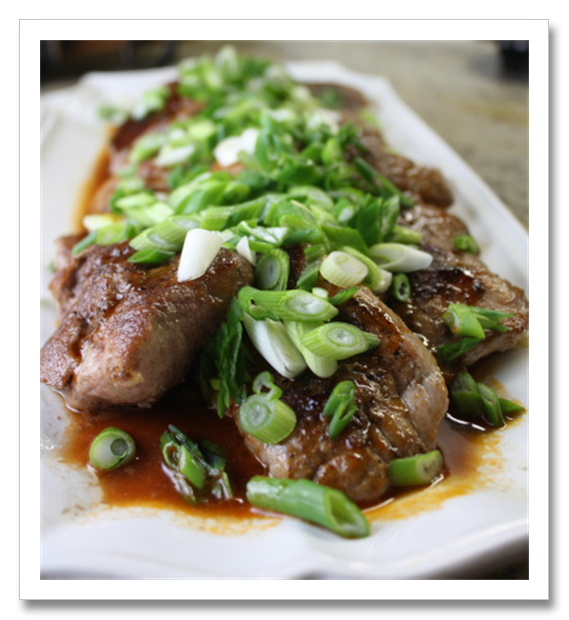
Oh my, was this ever sensational. If you’re a regular reader of this blog, then you’ll understand when I say this recipe is going onto my Carolyn’s Favs list. I’ve posted about 550+ recipes here on this blog – to date – and I have a list of about – oh, 40-50 of them that rank as 5-star, or blue ribbon worthy, or whatever superlative you’d like to use. This one, and it’s a simple one at that, is going onto the list.

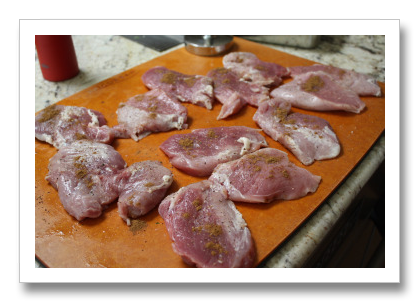
This was the entree I served to friends who came to dinner a couple of nights before we left on this last 2-week trip. It starts with a pork tenderloin. Our Costco carries tenderloins and I usually bring them home, open up the package and seal them individually and freeze them. There were 5 of us for dinner that night, and two tenderloins were just enough.

Here’s another photo – I sliced the meat, a little bit on the diagonal, then pounded the pieces a little. Pork tenderloin is a very lean and soft piece of meat to begin with, so it took only a couple of flat pounds for each piece. Don’t make it super-thin, just thinner. Each tenderloin was cut into 6 slices (above) and pounded.

The sauce was SO simple. Since the pork did have to be cooked just before guests were served, I got everything all ready ahead of time – for the sauce – so once I cooked the meat I could make the sauce in a jiffy. Then it’s garnished with the sliced green onion. Everybody raved about this dish, me included. It had been in my to-try file since 2007 (Bon Appetit). I’m so glad I did. The only caution is about the red chili sauce – if you’re at all sensitive about spice-heat, reduce the amount. When I made it, I adjusted down the amount (to the tablespoon listed below) so it’s really spicy if you were to use the full amount. Taste as you go – that would be best!
printer-friendly PDF

Pork Medallions with Chili-Maple Sauce

Recipe By: Bon Appétit | April 2007
Serving Size: 3

NOTES: Be sure to reduce down the chicken broth until it’s started to thicken. Otherwise it’s too watery. And be careful about the amount of chili-sauce you use – it’s hot. Add it sparingly until it suits your taste.

12 ounces pork tenderloin
1/2 teaspoon Chinese five spice powder
1 tablespoon vegetable oil
3/4 cup low-sodium chicken broth
1 1/2 tablespoons maple syrup — (the real stuff)
1 tablespoon chili-garlic sauce
1 whole green onion — chopped

1. Cut tenderloin crosswise into 6 slices. Using meat mallet, pound medallions between 2 sheets of plastic wrap to 1/2-inch thickness (this doesn’t take all that many swings with the flat mallet). Sprinkle with salt, pepper, and five-spice powder.
2. Heat oil in large skillet over high heat. Add pork; cook until brown and cooked through, about 3 minutes per side. Transfer to platter. Add next 3 ingredients to skillet. Boil until reduced to scant 1/4 cup, about 2 minutes. Pour sauce over pork; sprinkle with green onion.
Per Serving: 212 Calories; 9g Fat (37.4% calories from fat); 27g Protein; 8g Carbohydrate; trace Dietary Fiber; 74mg Cholesterol; 193mg Sodium.

A year ago: Blueberry Lemon Drop
Two years ago: Sopa de Calabacitas (a Southwestern style vegetable soup)

Posted in Travel, on April 16th, 2010.

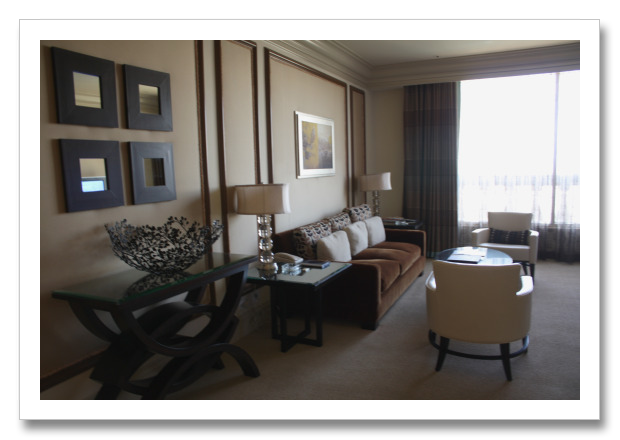
The other day I posted a quick story about our one night at the Bellagio in Las Vegas. About getting upgraded, big time, to a gorgeous suite. But I didn’t include any photos. Here you go:

That’s half of the living room. The other half included a large credenza and a very large HDTV. Behind me was a guest half bath and a large entryway. And the room had automatic drapes (two sets, the sheers showing here) and attractive heavy ones over that to black out the room.

There’s the bedroom – large, roomy. Dave was just swinging my suitcase up on the luggage rack for me. This room had another large TV, and TWO bathrooms, a his and hers. Plus a large closet. The large windows were off to the left with another set of the push-button sheers and heavy blackout drapes. We left them open all night. We had dinner at Todd English’s Olives there in the Bellagio. I orderd steak (very pricey) and the rapini on the side was raw. Not good. I should have complained. Dave ordered crab-stuffed arctic char with an asparagus risotto. And we shared a really delicious Caesar salad. It was exceptional.

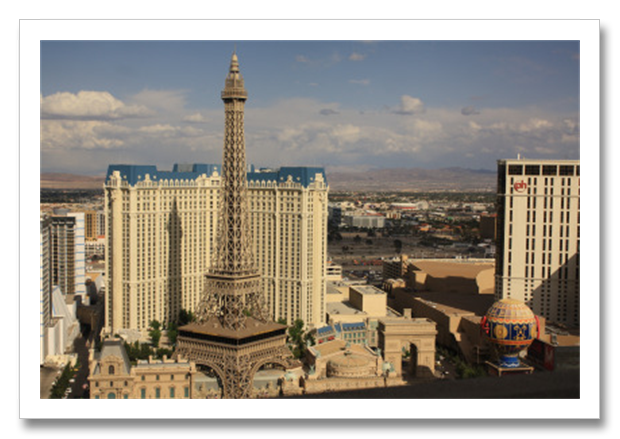
We considered having breakfast delivered to the room, but decided instead that we’d walk to one of the restaurants in the hotel. Good choice. The eggs Benedict were superb, we thought. The waitress was a delight and gave us good advice about the menu. Good coffee too. Then we were off after leisurely packing. We weren’t even there quite 24 hours, but it was lovely. Except for my side of the bed. This room supposedly goes for $450 a night (I think). If we’d paid $450 I’d have complained – on the far side there was a huge big butt-dent in the mattress. It was bad enough that I had to use a pillow on the outside edge to keep me from nearly rolling out of the bed. I let the check-out folks know about it. But other than that, the stay was superb. Here’s a photo of the view out our window:

So now we’re in Palm Desert, at our 2nd home there. We rented our house for 3 months, and the nice couple (who also rented from us last year) just left, so we’re going to try to get in a bit of time here before it gets too hot. We had to replace one of the two air conditioners here, so that just got done yesterday. Only $3300. Sigh.  And that was the smaller of the two systems. When the 2nd one goes, it’ll be even more! We’re driving home this evening after dinner (when the traffic has slowed down). We’ve had a great trip. But, you know, it’s always good to get home. I have some great recipes to share (from a dinner I did just before we left home) so look for recipes starting tomorrow.

– – – – – – – – – –

A year ago: Glover’s Mixture (a beef skillet dish)

Two years ago: Warm Honey Gingerbread

Posted in Travel, on April 15th, 2010.

We spent a night in Flagstaff, just because it was on the way between Sedona and Grand Canyon. Staying at the available hotels in Grand Canyon didn’t appeal. I’d wanted to stay at the El Tovar, but it was totally booked.  So we stayed in a small cottage in Flagstaff – it was a complete little home (Comfi Cottages, in case you’re interested). Dinner that night, in Flagstaff, was at Brix – great meal from beginning to end. If you ever find yourself in Flagstaff, seek it out. We didn’t feel like buying breakfast food to cook in, so drove north. We ended up having breakfast at the El Tovar in the Park – and were very disappointed. We had a sullen waitress who kind of spoiled the mood. The restaurant is dark (as the entire hotel is, since it’s constructed of dark painted logs) and very expensive. Now I have no desire to stay there. But the scenery? Gorgeous. See below.

Read the rest of this entry »

Related Posts Plugin for WordPress, Blogger...