


Get new posts by email:

Archives

Currently Reading

Here are the tastingspoons players. I’m in the middle (Carolyn). Daughter Sara on the right, and daughter-in-law Karen on the left. I started the blog in 2007, as a way to share recipes with my family. I’m still doing 99% of the blogging and holding out hope that these two lovely and excellent cooks will participate. They both lead very busy lives, so we’ll see.

– – – – – – – – – – – – – – – – – – – – – –

BOOK READING (from Carolyn):

Music of Bees, Eileen Garvin. Absolutely charming book about a woman in midlife, lonely, who raises bees, also makes unlikely friends. Heart-warming and very interesting about beekeeping.

A Postcard from Paris, Alex Brown. Really cute story. Dual time line, 1940s and present day about renovating an old apartment in Paris, things discovered.

Time of the Child, Niall Williams. Oh such a good book. Very small village in Ireland, 1960s. A baby is left on the doorstep. The town all whispers and helps. I listened to an interview of the author, which made me like him and his books even more.

Sipsworth, Simon Van Booy. If you like animals you’ll swoon. An old woman who really wants to die finds a tiny mouse in her house and befriends it and finds a reason to live. Utterly charming book.

The Forger’s Spell, Edward Dolnick. True story. For seven years a no-account painter named Han van Meegeren managed to pass off his paintings as those of Johannes Vermeer.

If You Lived Here, You’d be Home by Now, Christopher Ingraham. Could hardly put it down – about a journalist who takes on a challenge to move to small town in Minnesota and write about it. He expects to hate it and the people and place, but he doesn’t. Absolutely wonderful true story.

The River We Remember, William Kent Kreuger. 1950s, Minnesota. A murder and the aftermath. Could hardly put it down. Kreuger has such a vivid imagination and writing style.

How the Lights Gets In, Joyce Maynard. An older woman returns to New Hampshire to help care for her brain-injured son. Siblings and family, lots of angst and resentments.

The Filling Station, Vanessa Miller. Every American should read this book. A novelized retelling of the Tulsa massacre in 1921. Absolutely riveting.

The Story She Left Behind, Patti Callahan Henry. Love this author. Based on a true story. A famous author simply vanishes, leaving her husband and daughter behind. She had invented a mystical language no one could translate. Present day, someone thinks he’s solved the riddle, contacts the family. Really interesting read.

The Girl from Berlin, Ronald Balson. Love anything about Tuscany. An elderly woman is being evicted from a villa there, with odd deed provenance. Two young folks go there to help unravel the mystery. Loved it.

The Island of the Colorblind, Oliver Sacks, M.D. Nonfiction. The dr is intrigued by a remote Pacific island where most of the inhabitants are colorblind. He also unravels a mystery on Guam of people born with a strange neurological problem. Medical mysteries unveiled. Very interesting.

The Bookbinder, Pip Williams. Post 1914 London. Two sisters work at a bookbindery. They’re told to not read the books. One does and one doesn’t. One has visions beyond her narrow world; the other does not. Eventually the one gets into Oxford. Lovely story.

The Paris Express, Emma Donoghue. 1895 on a train to Paris, a disaster happens. You’ll delve into the lives of many people who survived and died in the crash.

A Race to the Bottom of Crazy, Richard Grant. This is about Arizona. Author, wife and child move back to Arizona where they once lived. Part memoir, research, and reporting in a quest to understand what makes Arizona such a confounding and irresistible place.

The Scarlet Thread, Francine Rivers. A woman’s life turned upside down when she discovers the handcrafted quilt and journal of her ancestor Mary Kathryn McMurray, a young woman who was uprooted from her home only to endure harsh frontier conditions on the Oregon Trail.

A Place to Hide, Ronald Balson. 1939 Amsterdam, an ambassador has the ability to save the lives of many Jewish children. Heartwarming.

Homeseeking, Karissa Chen. Two young Chinese teens are deeply in love, but in China. Then their families are separated. Jump to current day and the two meet again in Los Angeles.

North River, Pete Hammill. He always writes such a good story. A doctor works diligently healing people from all walks of life. His wife and daughter left him years before. One day his 3-yr old grandson arrives on his doorstep.

A Very Typical Family, Sierra Godfrey. A very messed-up family. Three adult children are given a home in Santa Cruz, Calif, but only if the siblings meet up and live in the house together. A very untypical scenario but makes for lots of messes.

Three Days in June, Anne Tyler. The usual Anne Tyler grit. Family angst. This wasn’t one of my favorites, but it was entertaining and very short.

Saved, Benjamin Hall. Author is a veteran war reporter. Ukraine, 2022, he nearly loses his life to a Russian strike. Riveting story – he survives, barely.

Grey Wolf, Louise Penny. Another Inspector Gamache mystery in Quebec. She is such an incredible mystery writer.

All the Colors of the Dark, Chris Whitaker. A missing person mystery, a serial killer thriller, a love story, a unique twist on each. Could hardly put it down.

Orbital, Samantha Harvey. Winner of 2024 Booker Prize. I don’t usually like those, but I heard the author interviewed and she hooked me. This is not a normal book with a beginning, a story and an end. It’s several chapters of the day in the life of various astronauts at the ISS (Int’l Space Station). All fictional. She’s been praised by several real astronauts for “getting it” about space station everyday life.

The Blue Hour, Paula Hawkins. An island off Scotland. Inaccessible except when the tide is out. Weird goings on. An artist. A present day mystery too.

Iron Lake, William Kent Krueger. A judge is murdered and a boy is missing. Riveting mystery.

Tell the Wolves I’m Home, Carol Ricks Brunt. 1980s. A 14-yr old girl loses her beloved uncle. Yet a new friendship arises, someone she never knew about.

Four Treasures of the Sky, Jenny Zhang. 1880s, a young girl is kidnapped in China and brought to the United States. She survives with many hurdles in the path.

The Boy Who Fell out of the Sky, Ken Dornstein. Memoir, 1988. The author’s brother died in the PanAm flight that went down in Lockerbie, Scotland. A decade later he tries to solve “the riddle of his older brother’s life.”

Worse Care Scenario, T.J. Newman. Oh my. Interesting analysis of what could/might happen if a jet crashed into a nuclear plant. Un-put-downable.

Song of the Lark, Willa Cather. Complicated weave of a story about a young woman in about 1900, who has a gifted voice (singing) and about her journey to success, not without its ups and downs.

Crow Talk, Eileen Garvin. Charming story which takes place at a remote lake in Washington State, about a few people who inhabit it, the friendships made, but also revolving around the rescue of a baby crow.

The Story Collector, Evie Woods. Sweet story about some dark secrets from an area in Ireland, a bit magical, faerie life, but solving a mystery too.

A Sea of Unspoken Things, Adrienne Young. A woman investigates her twin brother’s mysterious death. She goes to a small town in California to figure it out, to figure HIM out.

The King’s Messenger, Susanna Kearsley. 1600s England, King James. About one of his trusted “messengers,” and his relationship with a young woman also of “the court.” Lots of intrigue.

In the Shadow of the Greenbrier, Emily Matchar. Interesting mystery in/around the area of the famous resort in White Sulphur Springs, West Virginia.

Isola, Allegra Goodman. Hard to describe, survival story on an island in the 1600s.

Save the Date, Allison Raskin. Rom-com, witty, LOL funny. Clever.

The Sirens, Emilia Hart. Numerous time-lines, Australia. Mysteries abound, nightmares, abandoned baby, weird allergies.

Red Clay, Charles Fancher. LOVED this book. Mostly post-Civil War story about the lives of slaves in Alabama during Reconstruction.

Stars in an Italian Sky, Jill Santopolo. Dual time line, 1946 and recent time. Love stories and a mystery.

Battle Mountain, C.J. Box. Another one of Box’s riveting mysteries. Love his descriptions of the land.

Something Beautiful Happened, Yvette Corporon. A memoir of sorts in Greece, tiny island of Erikousa, where the locals hid Jews during WWII. All elusive stories told by the author’s grandmother.

The Jackal’s Mistress, Chris Bohjalian. 1860s Virginia, about a woman who saves the life of a Union soldier. Really good story.

Song of the Magpie, Louise Mayberry. Really interesting story about Australia back in the days when it was mostly a penal colony. Gritty strength of a woman trying to thrive with her farm.

The Boomerang, Robert Bailey. A thriller that will have you gripping the book. About a lot of secrets surrounding the president (fictional novel, remember) and his chief of staff and about cancer. A cure. Such a good story.

Care and Feeding, Laurie Woolever. Really interesting memoir of a woman driven to succeed in the restaurant business. She worked for Mario Batali and then Anthony Bourdain. Gritty stories.

Everything is Tuberculosis, John Green. Maybe not a book for everyone. A real deep dive into the deadly tuberculosis infection, its history. I heard the author interviewed and found the book very interesting.

The Book Lovers Library, Madeline Martin. Fascinating read about Boots’ drug stores’ lending library. And the people who worked in them.

The Arrivals, Meg Mitchell Moore. LOL funny, about a middle-aged couple whose children (and their various family members) return to the family home and the chaos that ensues.

My Life as a Silent Movie, Jesse Lee Kercheval. About grief. A big move to Paris, finding herself a new life with a new set of real blood family.

Escape, Carolyn Jessop. Another memoir about a woman really in bondage in Utah, Mormon plural marriage.


Tasting Spoons

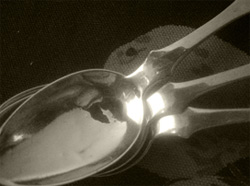
My blog's namesake - small, old and some very dented engraved silver plated tea spoons that belonged to my mother-in-law, and I use them to taste my food as I'm cooking.

Scroll down to the bottom to view my Blogroll

Posted in Beef, Grilling, on May 13th, 2012.

grilled_skirt_steak

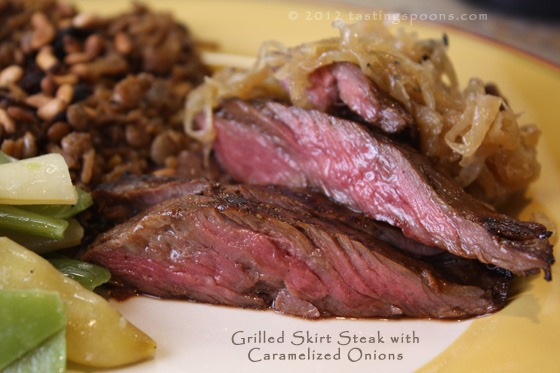
Skirt steak! Not something I make with any regularity. But it was FULL of good, beefy flavor. It marinated for just about an hour in an oil/soy sauce mixture and grilled for 2-3 minutes per side. Topped with some caramelized onions. Really good stuff! I forgot to remind my hubby to slice it across the grain – but it really didn’t matter much because the meat was super-tender.

The other night I opened the freezer door and stared in there, wondering what to fix for dinner. You ever do this too? Chorizo? No, not for dinner. Must have bought that 6 months ago when our son-in-law was coming down, then I didn’t use it (he loves chorizo, obviously). Andouille sausage? No; I usually use that with something else, not as an entrée; not time for that. Chicken breasts? No, tired of those. Oh, what’s that package? Skirt steak. Well, why not? It had been in the freezer for well over a year, probably longer than that, and it had gotten tucked under something else so I hadn’t noticed it. My normal method of defrosting meat is to put it in a big bowl filled mid-way with water, and weighted down so the meat stays under the water (and therefore stays quite cold). This is assuming it’s in a Ziploc bag or vacuum sealed, of course. In a few hours it was completely defrosted.

I have a recipe for Mexican style skirt steak on my blog, but it’s part of a multi-dish ethnic dinner. Way too much work – besides I already had the side dishes picked out (also items from the freezer). I could have gone to Eat Your Books to hunt for recipes within my own cookbook collection, but I was in a hurry, so I just did a Google search for “skirt steak,” and one of the early search results was this recipe, from She Wears Many Hats, a blog I wasn’t familiar with. Amy’s recipe was very easy – the marinade went together in a hurry (some oil, soy sauce, a little bit of rice wine vinegar, ginger, garlic, S & P and it was done. It went right into the Ziploc bag I had used in the freezer. I squished it around a bit so all the surfaces of the skirt steak were saturated with the marinade and I plopped it in the refrigerator for awhile.

We were on a timetable (gosh, I hate those nights sometimes – have to sit down to eat by 6 in order to be at choir rehearsal by 7). We prefer to eat at about 6:30 or 7 on most nights. It’s just the routine we’re into.

I’ll include the recipe for the caramelized onions too. I made these a week or so ago, using a new recipe that included a little bit of dark rum and thyme, and served it with something else. But those little puppies go a long way, so I had sufficient for another meal. It was just perfect with the steak. The sweetness of the onion blended so well with the steak. My DH grilled the meat in no time at all – probably just 2-3 minutes per side – as we wanted it to be rare to med-rare in the middle. I got dinner on the table before 6 and dishes were done and put away in ample time.

What I liked: the flavor of the beef – the marinade isn’t overpowering at all. The soy sauce is mellow in this as well – I used Trader Joe’s low-sodium. Also loved the caramelized onions on top. Make a bunch so you can have left overs. My plan as I write this, is to serve the leftover beef on top of a Greek salad.

What I didn’t like: nothing at all. Delicious. I’d make this again.

printer-friendly PDF for the steak
MasterCook 5+ import file – right click to save file, run MC, then File|Import

Grilled Skirt Steak

Recipe By: Amy at http://shewearsmanyhats.com/2011/06/skirt-steak/
Serving Size: 4
Serving Ideas: Because I had some on hand, I served the steak with a large spoon of caramelized onions. The sweetness of the onions was wonderful with the steak. Although the marinade contains soy sauce, the flavor does not predominate.

1 pound skirt steak
2 tablespoons extra virgin olive oil
3 teaspoons soy sauce
1/2 teaspoon ground ginger
1/4 teaspoon garlic powder
1/4 teaspoon pepper
2 teaspoons rice vinegar — [I used seasoned because it’s what I had in my pantry]

1. Mix all ingredients together in a zip top bag, adding skirt steak last. Squish it around some to coat well and marinate refrigerated until ready to cook. Marinate for at least 30 minutes if time allows.
2. In an iron skillet over medium-medium high heat place the skirt steak. Slightly press down to create sear. For medium rare, cook for 3 minutes. Flip steak and cook for an additional 3 minutes. Alternately you can barbecue on an outdoor grill for the same period of time.
3. Let steak rest about 10 minutes tented with foil, then cut narrow slices across the grain.
Per Serving: 264 Calories; 19g Fat (64.4% calories from fat); 22g Protein; 1g Carbohydrate; trace Dietary Fiber; 58mg Cholesterol; 336mg Sodium.

. . .
printer-friendly PDF for onions
MasterCook 5+ import file – right click to save file, run MC, then File|Import

Caramelized Onions with Dark Rum and Thyme

Recipe By: The America’s Test Kitchen Family Cookbook
Serving Size: 12 (that’s just a guess – makes about a cup)

2 pounds yellow onions — thinly sliced
1 tablespoon vegetable oil
1 tablespoon unsalted butter
1 teaspoon light brown sugar
1 tablespoon water
Salt and freshly ground black pepper to taste
2 teaspoons dark rum
1 teaspoon fresh thyme — minced
1/2 teaspoon cider vinegar

1. Have all the onions sliced and ready.
2. Melt the butter and oil in a large nonstick skillet over high heat. Stir in the onions, brown sugar and about 1/2 tsp salt. Cook, stirring occasionally, until softened, about 5 minutes. [You may need to turn the heat down to prevent the onions from burning.]
3. Reduce heat to medium and cook, stirring frequently, until the onions are deeply browned, about 40 minutes.
4. Add the rum, thyme and vinegar and stir well, off heat. Taste for salt and pepper.
Per Serving: 47 Calories; 2g Fat (41.6% calories from fat); 1g Protein; 6g Carbohydrate; 1g Dietary Fiber; 3mg Cholesterol; 2mg Sodium.

Posted in Fish, on May 11th, 2012.

salmon_leeks_maple_orange

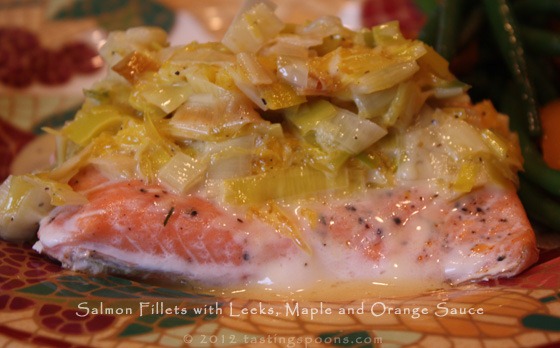
Luscious leeks in a bit of butter, a little jot of maple syrup, some orange juice, orange zest and some orange supremes over a salmon fillet and you’ve got a little salmon magic.

The photo doesn’t do this justice. The salmon fillet there on the bottom, is lapped with all those delicious morsels of leeks, maple syrup and orange segments. Oh my. This dish was absolutely fantastic. And EASY besides. I can’t take all the credit for this, as Phillis Carey devised the original recipe. I just did a riff on it and made up my own proportions. I added maple syrup and I added orange zest and the supremes as well.

The salmon almost cooked too long – it’s so hard to tell with salmon – I couldn’t have simmered it for more than about 5 minutes and already the white collagen had begun to seep up through the top layer, so I knew it was truly DONE. Quick like I took out the fish and finished the sauce with the addition of the zest, the orange supremes and a bit of cream. Really not very much – just enough to give the leek mixture some “sauce” consistency. Piled it on top of the fish and it was served.

Be sure to have everything else for your dinner completely finished before you start, as it comes together that quickly. Please make this!

printer-friendly PDF

MasterCook 5+ import file – right click to save file, run MC, then File|Import

Salmon Fillets with Leeks and Orange Sauce

Recipe By: My own creation
Serving Size: 2
NOTES: If you want to use more orange zest, you may – it will be VERY orangey, however. The maple syrup counteracts any bitterness, but I think half the zest is sufficient.

12 ounces salmon fillets
2 small leeks — trimmed, cleaned, halved, sliced
1 tablespoon unsalted butter
Zest of 1/2 orange
2 tablespoons orange juice — (from the orange you zested)
1 tablespoon maple syrup — (the real stuff, not the fake type)
1/4 cup orange supremes — (also from the one orange you’re using)
3 tablespoons heavy cream
Salt and fresh ground black pepper to taste

1. Zest the orange first and set aside. Cut off the peel and pith, then cut out the little orange supremes. Set those aside. Then squeeze the orange of any remaining juice which you’ll use later on.
2. Rinse and pat dry the salmon fillets. Rest on a paper towel to absorb any additional moisture, while you prepare and cook the leeks.
3. In a medium-sized, nonstick skillet heat the butter over medium heat. Add the leeks and stir frequently as they cook, about 10 minutes. When they’re soft, add the orange juice and maple syrup and stir to combine.
4. Move most of the leeks to one side and add the salmon fillets. Cover the pan, reduce heat and simmer for 6-8 minutes (or longer), depending on the thickness of the salmon. When you can begin to see the white collagen seeping up to the top of the salmon, it’s done. Remove salmon to heated plates and loosely cover in foil.
5. Raise the heat in the pan and add the cream and orange zest. Allow to simmer gently until the cream has reduced by half. Add the orange sections, cover and simmer for about a minute, until the oranges are heated through. Pour the leek mixture over the salmon and serve immediately.
Per Serving: 412 Calories; 20g Fat (44.2% calories from fat); 36g Protein; 21g Carbohydrate; 2g Dietary Fiber; 135mg Cholesterol; 142mg Sodium.

Posted in Desserts, on May 9th, 2012.

craggy_chocolate_cake

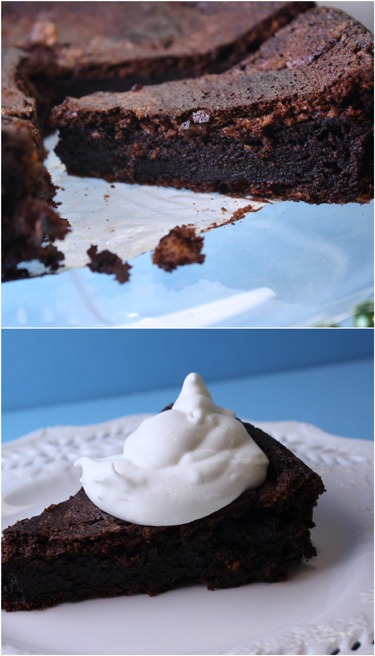
Well, you chocoholics out there, this one’s for you! Biting into this very chocolatey cake has you biting down on chocolate air. It’s so very light. Veddy French too.

You know, there’s just something about chocolate and whipped cream. Together as a pair –  it’s made in heaven in my book. In my culinary opinion! I was pretty sure I was going to like this cake when I watched Laura Calder make it (she has the show on the Cooking Channel called French Cooking at Home). I was having a chocolate craving (which occurs with some regularity but I don’t succumb to it very often). In any case, when I went online to read the recipe on the network’s site, Laura described at the end to “serve with a drift of whipped cream.” That did it for me. The word drift. It conjured up all kinds of mouth-watering visions of a bite of chocolate heaven. Had to try it.

It’s not difficult at all to make, although it does require one bowl to whip up the egg yolk mixture, another bowl to whip the egg whites, and a pan to melt the chocolate and butter (a double boiler, or a bowl set on top of softly simmering water). Then it requires the 8-inch springform pan, of course. Parchment papered on the bottom, then greased and floured too. So it takes a few dishes, I’ll admit.

craggy_choc_cake_collageWanting to make it sugar-friendly for my DH, I used half sugar and half Splenda, which worked out just fine. But then there’s also sugar in the chocolate. I’m glad my MasterCook program will tell me/him how many carbs are in a slice.

I suppose this cake is a kind of sponge cake (because egg whites are whipped) but it’s not really the same proportions. It’s kind of like a soufflé cake too. At any rate, you combine the chocolate/butter mixture and the egg yolks, then gently fold in the whipped egg whites and pour it into the prepared springform pan. I left just a few wisps of egg white visible, and they baked a different color – you can see it toward the top of the cake in the upper photo. So make sure you stir in all the whites so none are visible.

Once baked you can almost watch the cake sink in the middle as it cools – that’s when some of those craggy top pieces are formed. I let it sit for about an hour (after I’d swiped a thin blade around the outside edge so none of the cake would stick). It was still warm when I hand-whipped just a little bit of whipped cream and set that drift on top. It was heavenly. Absolutely heavenly. Even with half Splenda – I couldn’t tell the difference.

What I liked: oh my – the heavenly SOFT texture of the cake. It’s almost molten when it’s warm, but yet it’s not liquid at all. Served warm it just slips into lightness in your mouth. Not literally, because it has a distinctly chocolate feel to it. The next day, though, the cake was more like a tender soufflé cake. I’d definitely eat it warm – for me anyway, it was infinitely better. With the leftovers I heated each slice in the microwave for 15 seconds. Just right.

What I didn’t like: only one thing and it was my own fault – I didn’t quite mix the egg whites in thoroughly enough – those areas cooked differently and had a different texture. Just mix thoroughly, that’s all. No streaks of egg white.

printer-friendly PDF
MasterCook 5+ import file – right click to save file, run MC, then File|Import

Craggy Chocolate Cake

Recipe By: Linda Calder, French Cooking at Home (cooking channel)
Serving Size: 8
NOTES: The top of the cake will sink as it cools – no worries – that’s also the way it’s supposed to.

7 ounces chocolate — 70%, chopped
7 ounces butter — softened
4 large eggs — separated
1 cup sugar — [I used half Splenda}
Sweetened or flavored whipped cream

1. Heat the oven to 375°. Line with parchment, grease, and flour an 8-inch springform pan.
2. Melt the chocolate gently over a water bath, and then beat in the butter a piece at a time until smooth. In a separate bowl, beat the yolks with 1/2-cup sugar until thick, pale, and ribbony. In yet another bowl, beat the whites to soft peaks. Scatter over the remaining 1/2-cup sugar and beat to a stiff meringue.
3. Slowly whisk the chocolate mixture into the yolk mixture. Stir in a spoonful of beaten egg whites, then pour the chocolate mixture over the egg whites and gently fold together with a spatula. Definitely fold thoroughly – no streaks of white as they will bake differently. Pour the batter into the prepared pan and bake 50 minutes.
4. Remove from the oven. Run a knife around the outside edge, then let sit until cool. It will sink down and the top will crack, appealingly. Serve with a drift of slightly sweetened whipped cream, flavored with vanilla, rum, or orange flower water.
Per Serving: 437 Calories; 31g Fat (61.2% calories from fat); 4g Protein; 40g Carbohydrate; 1g Dietary Fiber; 160mg Cholesterol; 244mg Sodium.

Posted in Chicken, on May 7th, 2012.

lemon_chicken_breasts

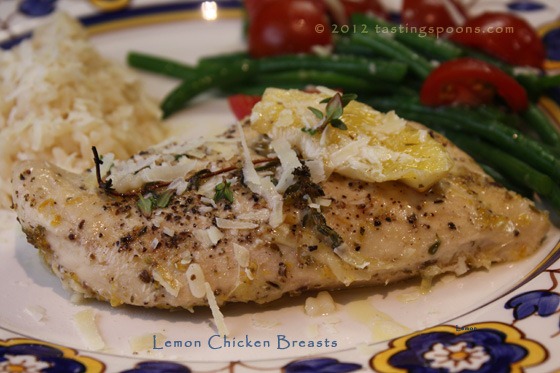
If lemon is a flavor you like, these chicken breasts will put you in lemon nirvana! This is a quick and easy baked chicken dish (you don’t even have to brown them first) that’s even worthy of a company meal.

Don’t you have nights when you need to get dinner on the table in a big-fat hurry? Even though I enjoy cooking most of the time, there are days when I just don’t seem to get myself into the kitchen until about 5:30 or so and realize we need to be out of the house in an hour. So, with lemons still loading down our Meyer lemon trees, I quick-like went in search of a lemon chicken recipe. Going to Eat Your Books, I looked at their list, scanning about 30 or more recipes amongst my cookbooks (which lists the main ingredients) before I found a simple and quick recipe that I thought sounded really good. It came from Ina Garten’s book Barefoot Contessa How Easy Is That?

Reading through the recipe completely I heated the oil, added the garlic and just let it mellow in there for a minute. Off the heat I added the dry white wine, lemon juice and lemon zest, oregano and thyme. The chicken breasts I used were skinless (that’s all I had), and I think breasts with skin would definitely be better (because it would protect the top from over baking), but when you’re in a hurry you don’t quibble over chicken skin. I did pound the chicken slightly. While I worked on the rest of my meal, I let the chicken just marinate in that stuff for about 20 minutes. Also waited for the oven to heat up. I made this for 2 servings, so I had part of a lemon which was cut into wedges and snuggled in with the chicken pieces. I checked the chicken early – good thing – as the chicken was done in about 25 minutes. I probably could have removed it at 20 minutes. The recipe indicates to tent with foil once you take it out of the oven and let it sit for 10 minutes. During that time the temp will rise about 5-10 degrees, so you DO want to take it out early.

I suppose professional chefs just know the finished temperature of cooked chicken. Because the chicken was just slightly overcooked, I thought, I needed to research this. Today I went on the ‘net and read several websites, just because I wanted to know. The USDA has apparently recently put out there that chicken breasts need to be cooked to 165°. And especially if you have any health or immune system issues, you’d want to make sure it’s cooked sufficiently. It used to be higher, but in recent years they reduced the temp to 160° and now changed it to 165°. SO, if I were making this again, I’d bake it to exactly 160° and take it out of the oven then. And tent it for 5-10 minutes before serving. Here’s what I found at one website:

Many experts recommend that chicken breast meat must be cooked to an internal temperature of 170 degrees F, but others say 160 degrees F is fine. You will have moister chicken if you cook to 160 degrees F. According to Dr. O. Peter Snyder, the chicken has to reach a temperature of 160 degrees F for 5.2 seconds to kill pathogens. Now the USDA is recommending that, because of bird flu fears, chicken should be cooked to a temperature of 165 degrees F. Remember that the meat will continue to cook after it’s removed from the heat; the internal temperature will rise about 5-10 degrees in the first few minutes it’s off the heat.

Now – once it was baked – it looked really nice – just a bit golden brown. I sprinkled just a little bit of grated Parm on top (because I’d made some risotto where I needed it anyway) and garnished it with one sprig of fresh thyme and a wedge of the cooked (and mellowed) lemon. My DH ate all of the lemon, peel and all. What I DID do, though, was spoon the pan juices into tiny little ramekins (not in the picture, because I did it afterwards) and put those on our plates. With each bite of chicken, we dipped it into the jus. It was good. I liked the chicken a lot – but I might reduce the temp by 25° next time. And, I would be very precise about removing the chicken when it reaches 160°, so I’d want to use a probe in the chicken.

What I liked: the very lemony chicken flavor. Loved dipping the chicken into the ramekin of jus. Liked how easy it was to make – with fresh thyme in my garden, and lemons on our trees, I’ll almost always be able to make this. I think the addition of lemon zest was an important step – it just steps up the lemony-ness. Thank you, Ina.

What I didn’t like: not much of anything – I’d be very careful about cooking it JUST to 160°. And if I had chicken breasts with skin, I’d use them. I usually don’t, however.

printer-friendly PDF
MasterCook 5+ import file – right click to save fine, run MC, then File|Import

Lemon Chicken Breasts

Recipe By: Ina Garten, How Easy is That?
Serving Size: 4
NOTES: The nutrition info assumes you’ll eat the skin. If you don’t, the fat and calorie numbers will go down significantly. Mostly the chicken skin is kept on to protect the chicken from drying out.

1/4 cup olive oil
3 tablespoons minced garlic — (9 cloves)
1/3 cup dry white wine
1 tablespoon lemon zest — (2 lemons)
2 tablespoons fresh lemon juice
1 1/2 teaspoons dried oregano
1 teaspoon fresh thyme leaves
Kosher salt and freshly ground black pepper
4 chicken breast halves — skin on (6 to 8 ounces each)
1 whole lemon

1. Preheat the oven to 400°. [My suggestion: try 375° instead and definitely use a probe-in thermometer.]
2. Warm the olive oil in a small saucepan over medium-low heat, add the garlic, and cook for just 1 minute but don’t allow the garlic to turn brown. Off the heat, add the white wine, lemon zest, lemon juice, oregano, thyme, and 1 teaspoon salt and pour into a 9 by 12-inch baking dish.
3. Pat the chicken breasts dry and place them skin side up over the sauce. Brush the chicken breasts with olive oil and sprinkle them liberally with salt and pepper. Cut the lemon in 8 wedges and tuck it among the pieces of chicken.
4. Bake for 30 to 40 minutes, depending on the size of the chicken breasts, until the chicken is done and the skin is lightly browned. The internal temperature should be about 160° Once removed from the oven, it will continue to cook and will rise in temp about 5-10 degrees. If the chicken isn’t browned enough, put it under the broiler for 2 minutes. Cover the pan tightly with aluminum foil and allow to rest for 10 minutes. Sprinkle with salt and serve hot with the pan juices. [My suggestion: there is a lot of lemony juice in the bottom of the baking dish – spoon it out into individual mini-ramekins and serve alongside the chicken and invite your diners to dip each piece of chicken into the jus before eating.]
Per Serving: 399 Calories; 27g Fat (62.8% calories from fat); 31g Protein; 5g Carbohydrate; 1g Dietary Fiber; 93mg Cholesterol; 94mg Sodium.

Posted in Soups, on May 5th, 2012.

sweet_corn_soup_mushrooms_spinach_pesto

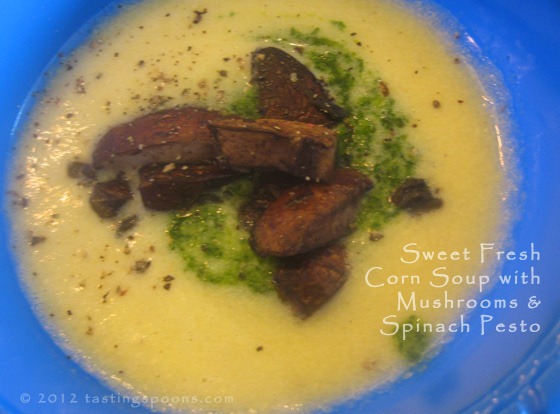
If you were to double the size, this could be an entrée type soup. As it is, it will make 6 smallish servings. Those are sliced baby portobellos in the center, with a drizzle of a freshly made spinach pesto on top. The corn soup is the star – it’s really not cooked – it’s freshly shucked corn mixed with chicken broth and pureed – then just heated through to serve. The fresh corn flavor predominates.

I wouldn’t call this soup simple, exactly. With 3 different parts to it, it’s a bit more complicated than many soups. What it is, is really tasty – a standout in the crowd of corn soups, I’d say – what with all the umami flavor going on: (1) from the very fresh corn flavor; (2) the almost meaty flavored mushrooms; and (3) the garlicky spinach pesto on top. Each bite containing all of those things will sort of burst in your mouth!

When Tarla Fallgatter made this soup at a recent cooking class we remarked on the fresh corn. I don’t know where it came from – probably Mexico or South America anyway – since it’s definitely not corn season around here. Yet. The corn was really tasty and it stands up and shouts at you with its fresh flavor. Tarla didn’t cook the corn – it was merely pureed with some chicken broth and heated enough to serve. So it retained its fresh-corn flavor completely. The mushrooms give the soup some substance. Then the spinach pesto added some piquant taste to the entire thing. When you find fresh corn, try this. If you don’t want to make it with spinach pesto, you can use basil pesto, but I liked the mellow-ness of the spinach rather than the pungency of basil.

What I liked: sorry for repeating it so many times, but I loved the fresh corn flavor. All of it. Very tasty and definitely worth making.

What I didn’t like: well, it does take a bit of work and dirties up several pans and the blender too.

printer-friendly PDF

MasterCook 5+ import file – right click to save file, run MC, then File|Import

Sweet Fresh Corn Soup with Mushrooms and Spinach Pesto

Recipe By: Tarla Fallgatter, cooking instructor, 2012
Serving Size: 6
NOTES : If you don’t have mushrooms, red bell peppers could be used instead.

3 cups corn kernels — (from about 9 ears)
1 1/2 cups chicken stock
3 tablespoons heavy cream — (optional)
Salt and freshly ground black pepper to taste
1 cup baby portobello mushrooms — stemmed, cut in 1/2″ slices
1/2 cup olive oil — a citrus flavored oil is fine too, divided use
1 1/2 cups fresh spinach
2 cloves garlic — crushed

1. In a blender or food processor puree the corn kernels with about 1/2 cup of chicken stock until it’s smooth. Set aside.
2. In a medium saute pan over high heat add 1-2 T. of olive oil. Add mushroom slices and saute until tender. Set aside.
3. Heat 1-2 T. olive oil in a medium saute pan over medium heat; Add the garlic and stir for 1 minute. Add the spinach, coarsely chopped, and saute for a few minutes, just until the spinach is wilted. Transfer to a blender and add 4-6 T. olive oil and process until smooth. Season the spinach pesto with salt and pepper to taste.
4. Heat the corn puree and heavy cream in a large pan and as soon as it is sufficiently hot, pour servings into bowls (only about 1/2 cup per serving). Meanwhile, reheat the mushrooms and place them in the middle of the soup, then drizzle the top with the spinach pesto.
Per Serving: 269 Calories; 21g Fat (68.1% calories from fat); 4g Protein; 19g Carbohydrate; 3g Dietary Fiber; 10mg Cholesterol; 551mg Sodium.

Posted in Chicken, on May 3rd, 2012.

saffron_chicken_curry

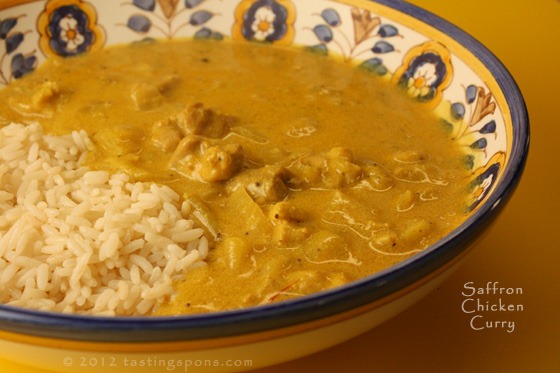
With chicken thigh meat (skinless, boneless) in my refrigerator, I decided to try my hand at some authentic Indian chicken curry. Over a cup of ginger tea in my Indian friend Kunda’s kitchen, I’d asked her if she makes chicken curry the same way she makes lamb curry. Kunda had given me some of her lamb curry a week or so ago and I loved it, but have never made it myself. I will, though – just in a few weeks. She said basically yes, but handed me the book, Royal Hyderabadi Cooking,  opening it to the chicken curry recipe she usually uses. The book is written (in English) by two chefs – but Sanjeev Kapoor is the more famous one – he’s kind of like the Emeril of Indian TV, Kunda explained.

She’d loaned me this cookbook before and I’d copied out 8-10 recipes, but not this one. She’d explained to me that the Hyderabadi people are considered the more gourmet of all the Indian cuisine regions. At one time it was a royal cities, hence the traditions of Hyderabadi cooking (for royals) have been handed down. Hyderabad is in southern Indian, kind of in south central, so to speak. It’s very near all the high tech Google and Microsoft facilities, and is more upscale than some Indian cities.

The recipe was in grams for some things and in tablespoons for others (not both sadly, in any case I found it odd), but I just punted my way through it. I added more spices to the recipe, and more yogurt. It called for a kind of nut we don’t have here (chironji or charoli), so I used pine nuts instead. And when I was done, the sauce was too thin for my taste, so I mixed up a little flour and water to thicken it a bit. I don’t think that’s done in Indian cooking, but I didn’t know what else to do. Sometimes recipes will add some ground almonds to thicken, but this already had some ground nuts in it. Usually Greek yogurt will help thicken a sauce, but it wasn’t enough. So the recipe below is my riff on the authentic Hyderabad recipe.

The dinner came together in a jiffy – that I liked a lot! Not a whole lot of chopping required (onions) and just a moderate amount of spice measuring required. The two nuts (almonds and pine nuts) along with the poppy seeds were whizzed together in my spice blender. Ideally it should have been enough to thicken the sauce. For whatever reason, it wasn’t. The addition of saffron gave it an exotic taste, I thought, although there wasn’t all that much saffron. I served it alongside some rice (just plain) which soaked up all the delicious sauce. We ate it all with a soup spoon.

What I liked: the sauce/gravy was delicious especially with all the flavor from the spices. I liked that it didn’t take a lot of chicken (I used less than the recipe indicated because that was all I had on hand). I didn’t add any other veggies to it (like green beans or sugar snap peas) but I could have to make it totally a one dish meal – with rice.

What I didn’t like: nothing, really. I adapted the recipe, which surely isn’t Indian-authentic, but what the heck! I did it anyway.

printer-friendly PDF
Files: MasterCook 5+ and MasterCook 14 – click link to open recipe in run MC

Saffron Chicken Curry

Recipe By: Adapted from Royal Hyderabadi Cooking by Sanjeev Kapoor and
Harpal Singh Sokhi
Serving Size: 4
NOTES: If you use low fat or fat free Greek yogurt, don’t bring the mixture to a boil or it will separate – it won’t taste bad, but it won’t look very attractive! I added the flour/water mixture because the curry sauce was just too thin for my tastes. If yours thickens sufficiently, eliminate that step. Or, you can add some nut flour to the curry to thicken it also.

1/4 cup olive oil
14 ounces boneless skinless chicken thighs
1/4 cup almonds
1 tablespoon pine nuts
1/2 tablespoon poppy seeds
1 large onion — chopped
1 tablespoon ginger — smashed or grated
2 large garlic cloves — minced
1/4 teaspoon red chili flakes
1 teaspoon turmeric
1 teaspoon curry powder — mild or medium heat
1 cup Greek yogurt, full-fat
1/2 teaspoon saffron, dissolve in 1 T warm water
3 cups chicken stock
2 tablespoons flour — mixed with about 4 tablespoons water [my addition]
1 teaspoon garam masala
Rice to serve with or under the curry

1. In a spice blender (or mortar and pestle) grind the almonds, pine nuts and poppy seeds together. Set aside.
2. Heat oil in a large saute pan and add onions. Cook until onions are golden brown. Add ginger and garlic and saute briefly. Stir in chili flakes, turmeric and curry powder and stir for about one minute.
3. Add chicken pieces to the pan and saute for about 5 minutes, turning the chicken as it browns. Do not allow it to burn.
4. Add yogurt, saffron, ground nut mixture and cook for 5 minutes, stirring continuously. Add chicken stock and bring to a boil. Lower heat, cover and simmer for 20 minutes, or until the chicken meat is tender.
5. If using, mix up the flour with water, shake vigorously and stir into the curry. Simmer for 2-3 minutes until thickened. Add the garam masala and stir in. Serve on or next to plain rice. Garnish with some cilantro if you have some.
Per Serving: 410 Calories; 29g Fat (61.9% calories from fat); 25g Protein; 15g Carbohydrate; 3g Dietary Fiber; 99mg Cholesterol; 1864mg Sodium.

Posted in Breads, Soups, Vegetarian, on May 1st, 2012.

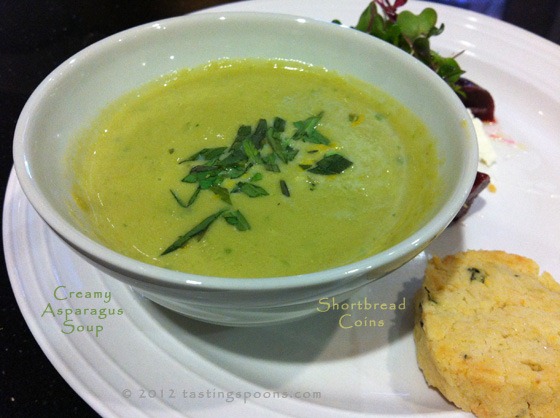
creamy_asparagus_soup_tarragon

Before asparagus goes out of season this year, make time to prepare this soup. And make a batch of the delicious savory cookies (cheese, thyme and Parmesan) to go along with it. Neither recipe is difficult – you can even make the soup the day ahead and the cookie log could be made weeks ahead and frozen – then sliced and baked before serving.

Oh yes, this is worth making. Definitely! Worth making 2-3 batches of it and freeze for a later date – when we won’t have asparagus at all. A “batch” of this requires 1 1/2 pounds of asparagus. So I’d buy 3 pounds and make one big soup pot of it, then freeze in 1 or 2 cup portions. This isn’t the kind of soup you’d use as a full meal – it’s light and there’s nothing of the stick-to-the-ribs ingredients. There are a few peas in this, just to give the soup a little more of a green-y color, but unless someone told you there were peas in it, I’m not sure you’d know. This would make a lovely lunch dish!

Do make sure you have some tarragon on hand – it’s an important flavor ingredient here. We’ve been unable to grow tarragon in our garden, gosh darn it – so nearly every time I’m shopping I look for a little plastic box of it. More often than not, it’s not there. When you need tarragon, well, you just need it. Dried tarragon will work in an absolute pinch, but it doesn’t have the flavor components (to me, anyway) that fresh has.

Then there are the little savory cookies. These are so good – rich and crumbly, and they go perfectly with this soup. Do start them a few hours before you need them (or even bake them a few hours ahead). They could easily be made a week ahead and frozen. Slice off what you need and bake them. If a cookie contains a goodly amount of butter, you’ll not have trouble slicing them when they’re frozen. That’s the case here. The savory cookies are almost like shortbread, but instead of sweetness, they contain cheese and thyme. These are the kind of “cookies,” if you will, that could always reside in the freezer for times when you suddenly need an appetizer. Years ago I used to have plenty of those things, that lived in the freezer, always at-the-ready for impromptu guests. I think today most people don’t do impromptu dropping-in on people.

Both of these came from Linda Steidel, a cooking instructor, although she got the recipes from Food & Wine magazine in 2011.

What I liked: the asparagus flavor – and it seems like the addition of the frozen peas just enhances the asparagus – the same kind of affinity that chocolate desserts have when you add a little jot of coffee or espresso. An easy soup to make, for sure. The cheese shortbread cookies are sensational too. It’s all delish. The soup could be a vegetarian one if you substitute vegetable stock for the chicken stock.

What I didn’t like: absolutely nothing. Will be making again. Both of them.

printer-friendly PDF (soup)
printer-friendly PDF (cheese cookies)

MasterCook 5+ import file – (soup) – right click to save file, run MC, then File|Import
MasterCook 5+ import file – (cheese cookies) right click to save file, run MC, then File|Import

Asparagus Soup with Tarragon

Recipe By: From chef/instructor Linda Steidel, 2012 (also from Food & Wine, 2011)
Serving Size: 6

2 tablespoons unsalted butter
1 medium onion — thinly sliced
1 1/2 pounds asparagus — cut in 1″ pieces
1 quart chicken stock
1/4 cup fresh tarragon — plus more for garnish
1 tablespoon Italian parsley
1/2 cup frozen peas — baby peas, thawed
1/4 cup heavy cream
Salt and freshly ground WHITE pepper to taste
Finely grated lemon zest for garnish

1. In a large pot melt the butter. Add onion, cover and cook over moderate heat, stirring, until softened, about 5 minutes. Add asparagus and cook for a minute. Add broth and simmer until asparagus is tender, about 10 minutes.
2. Add the 1/4 cup tarragon, parsley and peas. Working in batches, puree the soup in a blender. Return soup to the pot, add cream and rewarm. Season with salt and white pepper to taste, then garnish each bowl with more tarragon leaves and the lemon zest.
Per Serving: 114 Calories; 8g Fat (63.7% calories from fat); 3g Protein; 7g Carbohydrate; 2g Dietary Fiber; 24mg Cholesterol; 1451mg Sodium.

. . .

Parmesan Shortbread Coins

Recipe By: From chef/instructor Linda Steidel, 2012 (also from Food & Wine, 2011)

1 1/2 cups all-purpose flour
1 1/2 cups freshly grated Parmigiano-Reggiano cheese — (6 ounces)
1 teaspoon dried thyme
1 teaspoon finely grated lemon zest
1 teaspoon kosher salt
1 1/2 sticks unsalted butter — softened
2 large egg yolks

1. In a standing electric mixer fitted with the paddle, combine the flour, cheese, thyme, lemon zest and salt. Add the butter and egg yolks and beat at medium speed until lightly moistened crumbs form. Gather the crumbs and knead to form a 2-inch-thick log. Wrap in plastic and refrigerate until chilled, about 30 minutes.
2. Preheat the oven to 325° and line 2 baking sheets with parchment. Slice the log 1/4 inch thick (or maybe 1/3 inch) and arrange on the baking sheets. Bake for about 20 minutes, until golden around the edges; let cool on the sheets.

Posted in Salad Dressings, on April 29th, 2012.

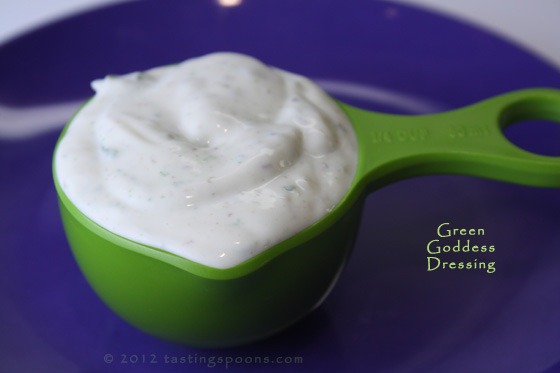
green_goddess_dressing

If you’ve never had Green Goddess, you’re missing out. Of course, you need to like a creamy dressing to begin with. Instead of the cloying taste of ranch dressing (which I do rarely eat), this has a bright herby flavor, some piquant additions from anchovy and wine vinegar. Plus a bit of Worcestershire (which you don’t taste, but it adds lots of umami).

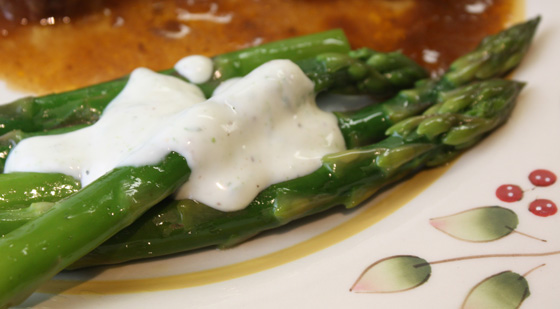
Making green goddess isn’t hard. You just need to have a bunch of fresh herbs, tarragon amongst them and mayo. Some recipes include sour cream. Ina Garten’s version includes basil (instead of tarragon). There’s also a buttermilk version too (which would be lower in calorie). I use low-fat sour cream if I have it on hand. But the original recipe called for only mayo, and that’s this recipe, which I like very much. This time I made a very small batch as I only wanted enough to nap on some fresh asparagus.

But even at that, I had left over dressing, so the next night I used it as a dip for artichokes. Worked just great. I probably won’t make it again for many months. It’s rich (obviously). But I do love the herbs (particularly the tarragon, which predominates) and the bite from the fresh garlic. This recipe came from The New York Times. They did an article back in 2008 about it in which they related the origin of green goddess (a cook/chef the Palace Hotel in San Francisco in the early 1920’s, who created it to honor the actress in a then-play by the same name). The Times 2008 article used a recipe from  “The California Cookbook,” by Callahan. Supposedly the Palace Hotel (on Montgomery Street), to this day, still serves 200+ green goddess salads every day of the week!

What I liked: well, I’ve always liked green goddess, so it’s not new to me. Love the herbal taste and the variety of things I can do with it other than just toss with Romaine lettuce.

What I didn’t like: nothing at all!

printer-friendly PDF
MasterCook 5+ import file – right click to save file, run MC, then File|Import

Green Goddess Dressing

Recipe By: Adapted from the New York Times, 2008, and they quoted it from ‘The California Cook Book,’ by Genevieve Callahan

Serving Size: 6

1 clove garlic — minced
1/3 cup mayonnaise
1 tablespoon white wine vinegar
1 tablespoon Worcestershire sauce
2 teaspoons minced chives
6 anchovy fillets — (in oil) drained and finely chopped
1 tablespoon oil — from the anchovy tin
Cracked pepper
1 tablespoon chopped parsley
1 tablespoon chopped tarragon (optional)

1. Place the garlic in a bowl. Using a whisk, blend in the mayonnaise, vinegar, Worcestershire sauce, chives, anchovies and anchovy oil. Add cracked pepper to taste.
2. Let stand at room temperature for an hour or longer to help meld the flavors. [Actually, I wouldn’t do that because mayo is subject to salmonella bacteria if left at room temp for very long, so make it in a small bowl and CHILL it for an hour or so.]
Per Serving: 120 Calories; 13g Fat (93.0% calories from fat); 1g Protein; 1g Carbohydrate; trace Dietary Fiber; 8mg Cholesterol; 241mg Sodium.

Posted in Desserts, on April 27th, 2012.

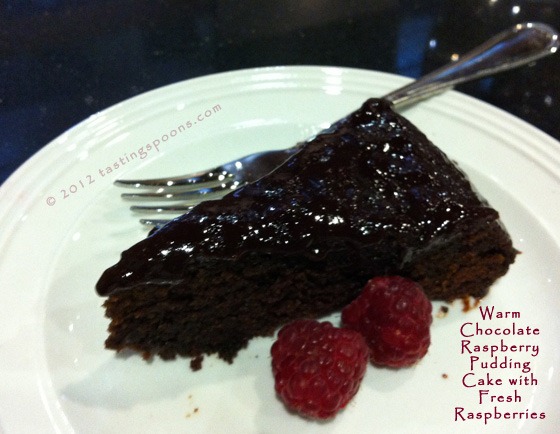
choc_rasp_pudding_cake

When I was served this cake the other day at a cooking class my mind went “ding-ding.” I’ve had this before. I’ve made this before. Surely it’s already on my blog? When I got home from the class I went to my recipe index to look. Hmmm. No, couldn’t find it. That was odd. It should be on my blog since it’s such a great dessert. A layer of chocolate stuff on the bottom (that becomes a kind of frosting once you invert it), then a rich and tasty chocolate cake. Chocolate sinfulness!

Well, the next day I was on the phone with my friend Linda, and mentioned it. She said, “oh yes, you made that cake for me once and gave me the recipe.” In fact, Linda has made it a couple of times herself. Sure enough, I found the recipe – it was right where it should be, but it had no photo attached. That meant just one thing – I’d gotten this recipe before I started my blog. So, we’re fixing that error right now. I compared the two recipes – from Tarla Fallgatter (the older recipe I already had) and the new one from Linda Steidel, the instructor from the class I attended last week. Identical except for a couple of words in the instructions.

So, here you are, with this outstanding recipe for a cake that has its own frosting of sorts. First you make that part (melted chocolate, seedless raspberry jam and cream) and pour it into the bottom of a round cake pan. Then you make the chocolate cake – nothing unusual other than more seedless raspberry jam in it. It’s got the usual stuff – butter, cocoa, eggs, sugar, flour, leavening, etc. The cake batter is poured on top of the “frosting” layer in the pan. Once baked, you leave it sit for 10 minutes then invert it onto a cake plate (with a raised edge) and the “frosting” oozes slightly onto the plate. Gorgeous. Delicious.

This is best served warm, but if you want to make it earlier in the day, that’s fine. Let it sit out, then when you’re ready to serve, warm it in a 350° oven for about 10 minutes. 15 minutes at the most. Cut into wedges, add a few fresh raspberries (and whipped cream if you want decadence) and serve immediately. To raves. The recipe is going onto my favorites list if that tells you whether you need to make this or not!

What I liked: the intense chocolaty flavor – from the chocolate in the frosting and the cocoa in the cake itself. It’s very tender and “just right” with the oozing frosting on it.

What I didn’t like: absolutely nothing. Perfection as it is!

printer-friendly PDF

MasterCook 5+ import file – right click to save file, run MC, then File|Import

Warm Chocolate Raspberry Pudding Cake

Recipe By: From cooking instructor Tarla Fallgatter
Serving Size: 8
Serving Ideas: Garnish with fresh raspberries and mint leaves, or sprinkle powdered sugar on the top and a few large dollops of whipped cream
NOTES: Do not used Dutch process cocoa for this dish. Do not chill this cake – it will keep 2-3 days at room temperature. If doubling the recipe, make in two separate pans. You can make this cake one day ahead – cool it completely, cover and leave at room temp. Reheat cake uncovered at 350° for 10-15 minutes.

3 ounces bittersweet chocolate — cut in pieces
1/2 cup raspberry jam — seedless
1/2 cup heavy cream
CAKE BATTER:
1/2 cup boiling water
1/3 cup unsweetened cocoa powder — plus 2 teaspoons
1/4 cup whole milk
1/3 cup raspberry jam — seedless
1/2 cup unsalted butter
1/3 cup packed light brown sugar
1/3 cup sugar
2 large eggs
1 cup flour
3/4 teaspoon baking soda
1/4 teaspoon salt
Fresh raspberries for garnish
1 cup heavy cream — whipped to soft peaks

1. Preheat oven to 350° and generously butter a 9 by 2 inch round cake pan. Make sure you butter all the top edges as this rises well above the pan.
2. FROSTING: (pudding): In a small pan bring chocolate pieces, jam and heavy cream to a simmer, stirring occasionally, until smooth. Pour into cake pan.
3. CAKE: In a bowl whisk together boiling water and cocoa powder until smooth (use a whisk and a large bowl) then add milk, vanilla and jam. In a large bowl with an electric mixer beat together the butter and sugars until light and fluffy and add eggs, one at a time, beating well after each addition. In another bowl sift together the flour, baking soda and salt and add to egg mixture in batches alternately with cocoa mixture, beginning and ending with flour mixture and beating well after each addition.
4. Pour batter EVENLY over frosting mixture. Bake in the middle of the oven for 30-35 minutes. Use a cake tester in the center of the cake – but don’t poke down into the “frosting” mixture. The frosting on the bottom will still be liquid. Cool cake on a rack for about 10-20 minutes.
5. Run a thin knife around the edge of the pan and twist pan gently back and forth on a flat surface to loosen the cake – it should almost float in the frosting – otherwise you won’t be able to get the cake out of the pan. Invert a cake plate with a slight lip over the cake pan and, holding the pan and plate together with both hands, quickly invert cake onto the plate. Frosting will cover the cake and run onto the plate. Serve with additional whipped cream and a few fresh raspberries on the side.
Per Serving: 547 Calories; 36g Fat (56.0% calories from fat); 7g Protein; 57g Carbohydrate; 4g Dietary Fiber; 146mg Cholesterol; 244mg Sodium.

Posted in Veggies/sides, on April 25th, 2012.

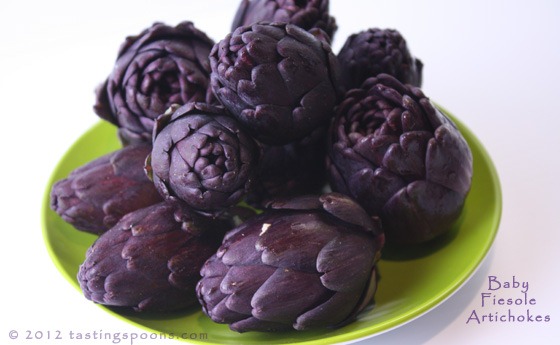
baby_fiesole_artichokes_raw

Aren’t those just the most beautiful things ever? Of course, the green plate with the purple artichokes are favorite colors  of mine anyway. When I began the setup for the photo I immediately grabbed my yellow-green plate, knowing the green would just make those babies pop. I didn’t alter a single thing in the photograph except resize it for the web.

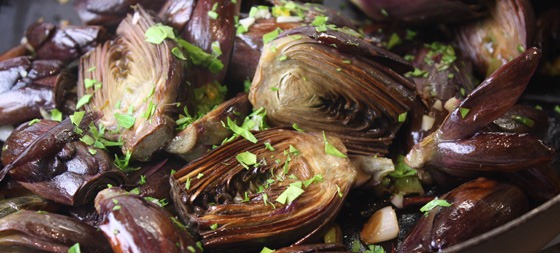
Now, here’s a photo of the finished dish – sautéed artichokes with green onions, garlic, parsley, white wine, lemon zest. What’s there not to like about that combo?

baby_fiesole_artichokes_saute

A few weeks ago the folks at Freida’s Produce contacted me, as they do now and then, to ask if I’d like to try a new artichoke variety just coming available (at Ralph’s, April 25th through May 6th in case you want to find these). Since I love artichokes I said yes-yes-yes! In the post came a little box with 2 globe type artichokes (one red and one purple) and a 1-pound bag of baby artichokes, these little Baby Purple Fiesoles. If you’d like to learn more about them, click over to Freida’s artichoke page.

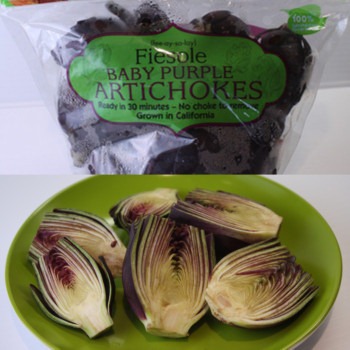
baby_artichokes_collageTurning to Deborah Madison’s cookbook, Vegetarian Cooking for Everyone, she has one recipe for baby artichokes and it was quite easy. First I trimmed up the artichokes, cutting off the tops (about 1/3 to 1/2 inch), trimming the base some, and removing the outer leaves – at least one full layer or two. More of the artichoke will be edible that way, although you can’t really eat it all. But the choke is invisible and the bottom 2/3 of each baby artichoke was edible.

There the photo of the little plastic bag and the artichokes cut in half (raw). Deborah’s recipe has you steam the artichokes whole, but I cut them in half as those were the instructions on the Freida’s bag.  If you want to prevent them from turning brown on the edges, drop the halves into acidulated water (water and lemon juice).  Anyway, I steamed them for about 10 minutes (Madison’s recipe indicated 6-8 minutes as whole ones). They were drained and cooled, while I prepped the other ingredients and the rest of our dinner.

When I was minutes away from serving our salmon and salad, I heated olive oil in a large, wide frying pan, added the artichokes (cut side down so you’d see the browned edges) and cooked them over moderately high heat for about 4 minutes until they’d taken on some color. Then I turned them over and added half of the gremolata (chopped parsley, fresh garlic and lemon zest) to the pan. Then I added some white wine (I used vermouth). Once that simmered off, water is added and the pan is covered for a short time to finish cooking. This step wouldn’t be needed if you’d cooked the artichokes completely. Mine were nearly done, so I only cooked them about 2-3 minutes.

I drizzled some lemon juice over them all, and added the last of the gremolata. And actually, I did something else with them – – I had some salad dressing out to mix with the sliced tomatoes we were eating, and I drizzled just a little bit of the dressing over the artichokes. In case you want to do that last step, make my Garlic VIP Dressing  to replicate it. I’ve not included that in the recipe below. When you eat these you just put the stem/bottom end in your mouth, about 2/3 of the way up each artichoke, bite down and draw it out. You’ll get one nice mouthful of deliciousness!

What I liked: well, the artichokes themselves were wonderful. Pretty too. Easy to prep. Relatively quick to steam and sauté. Definitely a do-again recipe.

What I didn’t like: nothing, really. These aren’t the easiest things to eat – you need to use your hands, and they’ll get a bit greasy. Have out a bowl to toss the inedible parts, and give each diner a second napkin for wiping hands!

printer-friendly PDF
MasterCook 5+ import file – right click to save file, run MC, then File|Import

Baby Artichoke and Scallion Sauté

Recipe By: Adapted from Deborah Madison’s Vegetarian Cooking for Everyone
Serving Size: 4

1 pound artichokes — baby [I used purple] about 18-22
1/3 cup lemon juice — diluted in a big bowl of water
2 tablespoons extra virgin olive oil
1 bunch scallions — including an inch of the greens, thickly sliced
GREMOLATA:
3 tablespoons parsley — chopped
1 whole garlic clove
2 teaspoons lemon zest
1 tablespoon fresh tarragon — chopped (or basil)
Salt and freshly milled pepper

1. Trim the artichoke tops about 1/3 inch or more and pulling off at least one layer of the outer leaves. Cut in half lengthwise. Put them in a bowl with the lemon juice and water to cover as you work. Drain, then steam them about 10 minutes, then drain. This can be done ahead of time.
2. Heat the oil in a large skillet over high heat. Add the artichokes, cut side down, and sauté until they begin to color in places. After several minutes, turn and add the scallions and wine. When the wine boils off, add 1 cup water and half the gremolata and tarragon. Lower the heat and cook until the artichokes are fully tender, between 5 and 10 minutes, then add tarragon and season with salt and pepper. Tip them, with their juices, onto a serving plate. Garnish with the remaining gremolata. Serve while hot.
Per Serving: 90 Calories; 7g Fat (62.6% calories from fat); 2g Protein; 7g Carbohydrate; 3g Dietary Fiber; 0mg Cholesterol; 45mg Sodium.

Related Posts Plugin for WordPress, Blogger...