Get new posts by email:

Archives

Currently Reading

Here are the tastingspoons players. I’m in the middle (Carolyn). Daughter Sara on the right, and daughter-in-law Karen on the left. I started the blog in 2007, as a way to share recipes with my family. I’m still doing 99% of the blogging and holding out hope that these two lovely and excellent cooks will participate. They both lead very busy lives, so we’ll see.

– – – – – – – – – – – – – – – – – – – – – –

BOOK READING (from Carolyn):

Music of Bees, Eileen Garvin. Absolutely charming book about a woman in midlife, lonely, who raises bees, also makes unlikely friends. Heart-warming and very interesting about beekeeping.

A Postcard from Paris, Alex Brown. Really cute story. Dual time line, 1940s and present day about renovating an old apartment in Paris, things discovered.

Time of the Child, Niall Williams. Oh such a good book. Very small village in Ireland, 1960s. A baby is left on the doorstep. The town all whispers and helps. I listened to an interview of the author, which made me like him and his books even more.

Sipsworth, Simon Van Booy. If you like animals you’ll swoon. An old woman who really wants to die finds a tiny mouse in her house and befriends it and finds a reason to live. Utterly charming book.

The Forger’s Spell, Edward Dolnick. True story. For seven years a no-account painter named Han van Meegeren managed to pass off his paintings as those of Johannes Vermeer.

If You Lived Here, You’d be Home by Now, Christopher Ingraham. Could hardly put it down – about a journalist who takes on a challenge to move to small town in Minnesota and write about it. He expects to hate it and the people and place, but he doesn’t. Absolutely wonderful true story.

The River We Remember, William Kent Kreuger. 1950s, Minnesota. A murder and the aftermath. Could hardly put it down. Kreuger has such a vivid imagination and writing style.

How the Lights Gets In, Joyce Maynard. An older woman returns to New Hampshire to help care for her brain-injured son. Siblings and family, lots of angst and resentments.

The Filling Station, Vanessa Miller. Every American should read this book. A novelized retelling of the Tulsa massacre in 1921. Absolutely riveting.

The Story She Left Behind, Patti Callahan Henry. Love this author. Based on a true story. A famous author simply vanishes, leaving her husband and daughter behind. She had invented a mystical language no one could translate. Present day, someone thinks he’s solved the riddle, contacts the family. Really interesting read.

The Girl from Berlin, Ronald Balson. Love anything about Tuscany. An elderly woman is being evicted from a villa there, with odd deed provenance. Two young folks go there to help unravel the mystery. Loved it.

The Island of the Colorblind, Oliver Sacks, M.D. Nonfiction. The dr is intrigued by a remote Pacific island where most of the inhabitants are colorblind. He also unravels a mystery on Guam of people born with a strange neurological problem. Medical mysteries unveiled. Very interesting.

The Bookbinder, Pip Williams. Post 1914 London. Two sisters work at a bookbindery. They’re told to not read the books. One does and one doesn’t. One has visions beyond her narrow world; the other does not. Eventually the one gets into Oxford. Lovely story.

The Paris Express, Emma Donoghue. 1895 on a train to Paris, a disaster happens. You’ll delve into the lives of many people who survived and died in the crash.

A Race to the Bottom of Crazy, Richard Grant. This is about Arizona. Author, wife and child move back to Arizona where they once lived. Part memoir, research, and reporting in a quest to understand what makes Arizona such a confounding and irresistible place.

The Scarlet Thread, Francine Rivers. A woman’s life turned upside down when she discovers the handcrafted quilt and journal of her ancestor Mary Kathryn McMurray, a young woman who was uprooted from her home only to endure harsh frontier conditions on the Oregon Trail.

A Place to Hide, Ronald Balson. 1939 Amsterdam, an ambassador has the ability to save the lives of many Jewish children. Heartwarming.

Homeseeking, Karissa Chen. Two young Chinese teens are deeply in love, but in China. Then their families are separated. Jump to current day and the two meet again in Los Angeles.

North River, Pete Hammill. He always writes such a good story. A doctor works diligently healing people from all walks of life. His wife and daughter left him years before. One day his 3-yr old grandson arrives on his doorstep.

A Very Typical Family, Sierra Godfrey. A very messed-up family. Three adult children are given a home in Santa Cruz, Calif, but only if the siblings meet up and live in the house together. A very untypical scenario but makes for lots of messes.

Three Days in June, Anne Tyler. The usual Anne Tyler grit. Family angst. This wasn’t one of my favorites, but it was entertaining and very short.

Saved, Benjamin Hall. Author is a veteran war reporter. Ukraine, 2022, he nearly loses his life to a Russian strike. Riveting story – he survives, barely.

Grey Wolf, Louise Penny. Another Inspector Gamache mystery in Quebec. She is such an incredible mystery writer.

All the Colors of the Dark, Chris Whitaker. A missing person mystery, a serial killer thriller, a love story, a unique twist on each. Could hardly put it down.

Orbital, Samantha Harvey. Winner of 2024 Booker Prize. I don’t usually like those, but I heard the author interviewed and she hooked me. This is not a normal book with a beginning, a story and an end. It’s several chapters of the day in the life of various astronauts at the ISS (Int’l Space Station). All fictional. She’s been praised by several real astronauts for “getting it” about space station everyday life.

The Blue Hour, Paula Hawkins. An island off Scotland. Inaccessible except when the tide is out. Weird goings on. An artist. A present day mystery too.

Iron Lake, William Kent Krueger. A judge is murdered and a boy is missing. Riveting mystery.

Tell the Wolves I’m Home, Carol Ricks Brunt. 1980s. A 14-yr old girl loses her beloved uncle. Yet a new friendship arises, someone she never knew about.

Four Treasures of the Sky, Jenny Zhang. 1880s, a young girl is kidnapped in China and brought to the United States. She survives with many hurdles in the path.

The Boy Who Fell out of the Sky, Ken Dornstein. Memoir, 1988. The author’s brother died in the PanAm flight that went down in Lockerbie, Scotland. A decade later he tries to solve “the riddle of his older brother’s life.”

Worse Care Scenario, T.J. Newman. Oh my. Interesting analysis of what could/might happen if a jet crashed into a nuclear plant. Un-put-downable.

Song of the Lark, Willa Cather. Complicated weave of a story about a young woman in about 1900, who has a gifted voice (singing) and about her journey to success, not without its ups and downs.

Crow Talk, Eileen Garvin. Charming story which takes place at a remote lake in Washington State, about a few people who inhabit it, the friendships made, but also revolving around the rescue of a baby crow.

The Story Collector, Evie Woods. Sweet story about some dark secrets from an area in Ireland, a bit magical, faerie life, but solving a mystery too.

A Sea of Unspoken Things, Adrienne Young. A woman investigates her twin brother’s mysterious death. She goes to a small town in California to figure it out, to figure HIM out.

The King’s Messenger, Susanna Kearsley. 1600s England, King James. About one of his trusted “messengers,” and his relationship with a young woman also of “the court.” Lots of intrigue.

In the Shadow of the Greenbrier, Emily Matchar. Interesting mystery in/around the area of the famous resort in White Sulphur Springs, West Virginia.

Isola, Allegra Goodman. Hard to describe, survival story on an island in the 1600s.

Save the Date, Allison Raskin. Rom-com, witty, LOL funny. Clever.

The Sirens, Emilia Hart. Numerous time-lines, Australia. Mysteries abound, nightmares, abandoned baby, weird allergies.

Red Clay, Charles Fancher. LOVED this book. Mostly post-Civil War story about the lives of slaves in Alabama during Reconstruction.

Stars in an Italian Sky, Jill Santopolo. Dual time line, 1946 and recent time. Love stories and a mystery.

Battle Mountain, C.J. Box. Another one of Box’s riveting mysteries. Love his descriptions of the land.

Something Beautiful Happened, Yvette Corporon. A memoir of sorts in Greece, tiny island of Erikousa, where the locals hid Jews during WWII. All elusive stories told by the author’s grandmother.

The Jackal’s Mistress, Chris Bohjalian. 1860s Virginia, about a woman who saves the life of a Union soldier. Really good story.

Song of the Magpie, Louise Mayberry. Really interesting story about Australia back in the days when it was mostly a penal colony. Gritty strength of a woman trying to thrive with her farm.

The Boomerang, Robert Bailey. A thriller that will have you gripping the book. About a lot of secrets surrounding the president (fictional novel, remember) and his chief of staff and about cancer. A cure. Such a good story.

Care and Feeding, Laurie Woolever. Really interesting memoir of a woman driven to succeed in the restaurant business. She worked for Mario Batali and then Anthony Bourdain. Gritty stories.

Everything is Tuberculosis, John Green. Maybe not a book for everyone. A real deep dive into the deadly tuberculosis infection, its history. I heard the author interviewed and found the book very interesting.

The Book Lovers Library, Madeline Martin. Fascinating read about Boots’ drug stores’ lending library. And the people who worked in them.

The Arrivals, Meg Mitchell Moore. LOL funny, about a middle-aged couple whose children (and their various family members) return to the family home and the chaos that ensues.

My Life as a Silent Movie, Jesse Lee Kercheval. About grief. A big move to Paris, finding herself a new life with a new set of real blood family.

Escape, Carolyn Jessop. Another memoir about a woman really in bondage in Utah, Mormon plural marriage.

 

Tasting Spoons

My blog's namesake - small, old and some very dented engraved silver plated tea spoons that belonged to my mother-in-law, and I use them to taste my food as I'm cooking.

Scroll down to the bottom to view my Blogroll

Posted in Desserts, on September 4th, 2007.

(photo taunton.com)

Almost nothing heralds Fall more than gingerbread and pumpkin cake, pie. Cool weather would help too, but alas, here in Southern California we’re in the low 100’s every day. But, back to Fall cooking here. Until I tried this cake, I thought a gingerbread is a gingerbread is a gingerbread. Sure, you could have a more dry one, maybe a moist one, one more highly spiced than another. But I doubt I would have thought a gingerbread could be something I’d really rave about.

Then Cherrie and I went to a cooking class at one of our favorite cooking school haunts, Our House South County, and Sarah made this fabulous cake. It just went right over the top for me. I’ve made it several times since. The apples make it different. I’d just never had apple gingerbread before. But then you add the “caramelized” part of it and it really did shoot through the moon. This cake isn’t hard, although it does take a bit of extra time to cook the apples and make the caramel. What a terrific accompaniment to a tummy warming dinner tied to fall flavors. If you make this, I guarantee you, you’ll have a hard time staying out of it.
printer-friendly PDF

Caramelized Apple Gingerbread

Recipe: Our House, South County Cooking School (now closed)
Servings: 10
COOK’S NOTES: Ideally you should serve this cake when it’s warm. If you want to make it earlier in the day, leave it in the cake pan once you take it from the oven. Once cool cover with foil, then when you’re ready to serve it, gently reheat for about 10-15 minutes at 250°, then invert onto the serving platter as indicated. This cake is not as sweet as you might think. Be sure to cook the apples until they’re almost falling apart because they do retain their shape in the cake pan and don’t cook much more.

POACHED APPLES:
6 whole apples — baking type – Pippin or Granny Smith
1/2 cup sugar
1 teaspoon vanilla
CARAMEL SAUCE:
4 tablespoons butter
1/2 cup corn syrup
1/2 cup brown sugar
GINGERBREAD:
6 tablespoons unsalted butter — softened
1/2 cup sugar
1 large egg
2/3 cup dark molasses
2 cups all-purpose flour
2 teaspoons baking powder
1/2 teaspoon baking soda
1 1/2 teaspoons ground cinnamon
2 teaspoons ground ginger
3/4 cup sour cream

1. Preheat oven to 350°.
2. POACHED APPLES: Peel, core and halve the apples, then place in a large stock-pot style pan large enough to hold all of them in one layer. Add sugar, vanilla and water to cover them. Bring to a boil over medium-high heat, reduce heat and simmer until apples are just beginning to soften, but barely still retain their shape, about 8-10 minutes. If using Granny Smith apples, it may take longer. With a slotted spoon, remove apples from poaching liquid and reserve.
3. CARAMEL SAUCE: Melt butter in a 9-inch nonstick round cake pan on a very low burner. Add the corn syrup and brown sugar. Stir with a wooden spoon until sugar is completely melted, then remove from heat. Gently turn the apple halves flat side down on top of the caramel mixture.
4. GINGERBREAD: Cream butter and sugar with mixer. Add the egg and mix completely. Add molasses and mix in completely. Meanwhile, sift together the flour, baking powder and soda, cinnamon and ginger. Add the dry ingredients and sour cream alternately to the butter/sugar mixture until mixed in thoroughly. Pour this over the apples and level with a spatula. Place cake pan on the center rack in the oven and bake for 50 minutes to one hour. When a toothpick comes out clean, remove from oven and cool on a rack for 10-15 minutes.
5. Serving: Invert cake onto a serving platter and top each slice with lightly sweetened whipped cream.
Per Serving: 499 Calories; 16g Fat (28.4% calories from fat); 4g Protein; 88g Carbohydrate; 3g Dietary Fiber; 60mg Cholesterol; 256mg Sodium.

Posted in Grilling, Veggies/sides, on September 3rd, 2007.


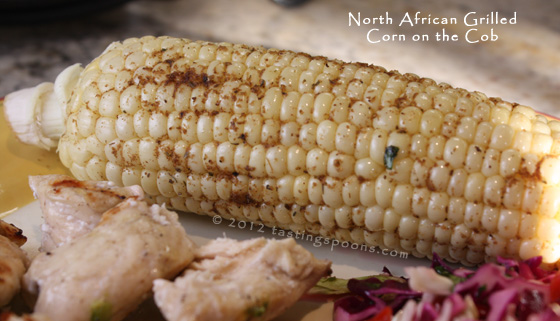
My notes say I made this in 2000. It came from Cooking Light. I’d been to a grilling cooking class in the previous month and the instructor had talked about how easy it is to grill corn. I’d grilled corn before, but when I read this recipe it sounded so different. Worth trying, I thought.

Here’s what you do: you pull the husks down – but you don’t pull them off. Some nearly always fall off anyway, you just can’t help that, but you want enough husks to completely cover all the corn. No kernels peeking through if at all possible. You remove all the silk, spread with a little butter or olive oil spray, season the cobs with this herb and spice combination, very gently pull the husks back into place covering the corn and carefully take a loose, long piece of husk and tie the husks at the top, like a topknot, a ponytail. Grill about 15-20 minutes. Remove all the husks and EAT. Really, really delicious.

There’s nothing hard about making this. But it does take a bit of time to make up the dry rub. Since I’ve made this so many times now, whenever I’m out of the rub I make up another BIG batch. Well, usually enough to last the summer season. They say that once spices are combined with others they tend to lose their effectiveness, their flavor. So just make up enough so you’ll use it up in a couple of months. It’s just as easy to make this for 2-3 batches than for one. As long as you like seasoning and lots of it, you’ll be certain to like this corn.

You can smear the raw corn with some butter if you’d like. I usually spray it heavily with olive oil spray instead. Then you sprinkle on the spice and herb rub, covering it very liberally. You need the butter or olive oil spray so the spices will stick to the corn. And if you’re just too weary to do all the tie-up-the-husks routine, you can put the corn in foil packets instead. Maybe not quite as good, but nearly so. Before corn is totally gone for the season, I recommend this.
printer-friendly PDF

North African Grilled Corn on the Cob

Recipe: Cooking Light, 2000
Servings: 9
COOK’S NOTES: This corn is absolutely sensational. When corn is in season, fresh from the garden, this could be a meal (well, not really). I always serve this with jerk chicken, and adding a salad, it makes a complete meal. I do combine the dry rub mixture in advance – in a larger quantity – and put into small plastic bags (labeled) so I don’t have to mix up the mixture every time I prepare this. It is really worth the effort and although the corn is spicy, it isn’t “hot,” as there’s nothing in the mixture to give any chili type heat.

4 1/2 teaspoons ground cumin
4 1/2 teaspoons ground coriander
2 1/4 teaspoons dried oregano
1 1/8 teaspoons ground ginger
1 1/8 teaspoons salt
1/2 teaspoon ground cinnamon
1/2 teaspoon black pepper
2 1/4 dashes ground cloves
9 each corn on cob, whole
4 1/2 teaspoons butter — or olive oil spray

1. Combine dry ingredients and set aside. Pull husks back from each cob, leaving most of the husks attached. Remove silk and discard. Lightly spray the corn with olive oil spray, or use softened butter and lightly rub on the corn (so the seasoning will stick to it). Sprinkle with the herb & spice combination. Gently tug husks back into place over the cob, leaving the top tassels if at all possible. Tie with a long strip of husk just at the top of the ear to keep husks intact. Or, use cooking string (regular string most likely will burn off).
2. Place on the grill and cook until just done, turning at least once. Estimate: 15 minutes – maybe 20 at the most.
Per Serving (this assumes you use butter): 103 Calories; 3g Fat (26.0% calories from fat); 3g Protein; 19g Carbohydrate; 3g Dietary Fiber; 5mg Cholesterol; 302mg Sodium.

Posted in Pasta, Vegetarian, on September 2nd, 2007.

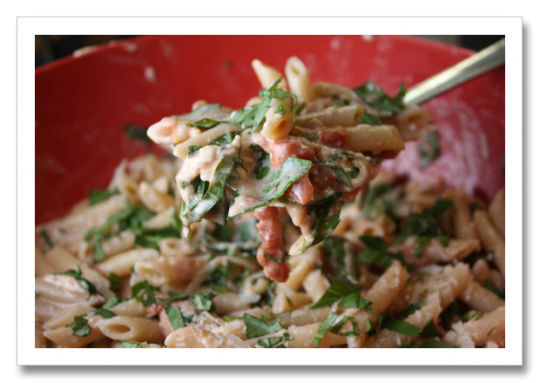
pastatomatocreamsauceIt was a few years ago and we flew from California to Philadelphia to attend the wedding of a young couple, friends. They’d met in San Diego, actually sailed with us on our boat one afternoon soon after they’d met. He was, is, a Navy pilot and close with dear friends of ours from Philadelphia. We thought they made a fine couple and wished them much happiness. The groom’s mother prepared a lovely feast for the rehearsal dinner. There were many hands helping in the kitchen, mine among them, and I fell in love with this incredibly easy side dish (or, it could be a main dish as is, or add some protein of some kind too).

I watched as MaryAnn made this sauce – she opened cans of chopped tomatoes, cubed up some cream cheese, chopped some basil, added a tad of wine vinegar, fresh garlic, and olive oil. All this was stirred up in a very large bowl, covered with plastic wrap and left to sit out for about 6 hours. The flavors developed, obviously and the cream cheese kind of dissolved, sort of. At serving time she made a heap of hot penne, combined the sauce and poured it onto a very large platter with additional basil and sprinkled the real-thing Parmesan cheese and it was done. The total amount of actual work in this is about 5 minutes. (I’m not counting the time to cook the pasta, of course.) Maybe 10 max. If you need to hold the sauce for longer, put it in the refrigerator. Just bring it back to room temp before serving. The dish can be served at room temp, actually, but I think it’s best hot.

And I’ll tell you, this is absolutely fabulous. I’ve made it many, many times since. It’s a cinch for guests. Tastes beyond wonderful.  Thank you, MaryAnn.

What’s good: well, that it’s so incredibly easy to make. You and your guests will rave about it. And yes, you DO leave it out at room temp. I think the acid in the tomatoes must be what keeps the dairy (cream cheese) from developing bacteria. It’s also delicious as left overs. A must make.
What’s not: nothing whatsoever.

printer-friendly (CutePDF Writer) PDF
MasterCook 5+ import file – right click to save file, run MC, then File|Import

Pasta with Tomato Cream Sauce

Recipe: MaryAnn Quinn, a friend of a friend in Philadelphia
Serving Size : 10 (as a side dish, 4 as main dish)
COOK’S NOTES: This takes about 5 minutes to prepare the sauce and it’s DONE! You can use any kind of pasta, but choose one that will hold some of the sauce (i.e., not linguine or spaghetti) in its crevices. These days it seems odd to let food sit at room temp for several hours, but when I was first served this, it was left out and later served to 30 people without a problem. A double batch was JUST enough (small servings) for 30 with an entree, green salad and ample appetizers. My favorite tomatoes are Muir Glen fire roasted, but any brand will really be fine. Muir Glen is carried at Whole Foods.

28 ounces tomatoes, canned — diced with juice
8 ounces cream cheese — cubed
2 cloves garlic — minced
1 bunch basil — minced
2 tablespoons red wine vinegar
1/2 cup olive oil
1 cup shredded Parmesan cheese
1 pound penne pasta

1. Combine all ingredients (except pasta and cheese) in a large bowl, cover and allow to sit for several hours at room temperature.
2. Boil pasta just until barely tender, drain, add sauce to pasta, stir and pour into a large serving bowl. Sprinkle cheese on top and additional basil, if desired.
Per Serving: 383 Calories; 22g Fat (50.8% calories from fat); 11g Protein; 36g Carbohydrate; 2g Dietary Fiber; 31mg Cholesterol; 239mg Sodium.

Posted in Brunch, on September 1st, 2007.

Back in May my friend Cherrie and I attended Ramekins Cooking School in Sonoma. We stayed at the B&B which is part of the school, and attended two cooking classes, the 2nd one a brunch class. Considering the menu, which included peaches and cream mimosas, scrambled eggs with pancetta and chive biscuits, blueberry and sour cream pancakes, smoked salmon and spinach salad, lemon biscuits AND this eggs benedict dish, I shudder to think how many calories and grams of fat we consumed that morning. I was positively astounded when my MasterCook software told me just now how many calories are in this benedict version. Oh — —! It can’t be possible. (Can it?) So I’m not going to tell you what it said. I’ll just say that this was wonderful. And if I make this sometime I’ll be certain to prepare some very low calorie sides, maybe just fruit.

I’ve always enjoyed Eggs Benedict. Usually the traditional type with ham or Canadian bacon, English muffins, poached eggs, of course, and Hollandaise on top. But this version is made with chorizo, molded into patties. It’s also made on a cornbread round (the size of English muffins), topped with a simple poached egg, and then topped with a delicious zesty chipotle Hollandaise sauce.

Usually I’m successful with Hollandaise – made in the blender. But I learned a bit about making it at this class, even though I’ve made it dozens of times. If the mixture gets too hot (using boiling butter, for instance) it will cause the Hollandaise to break – it separates, most likely never to be reunited in a homogeneous sauce. Also, if you keep it warm for awhile before serving, if it gets too hot there, it may also separate.

And maybe the most significant skill I learned at this class was how to make perfectly cooked poached eggs. These are techniques that must be a regular part of a chef’s skills, but I’d never heard them before.

• First, you BUTTER the skillet you’ll cook them in. You’d think why bother – you boil water in it – why would buttering it make any difference. But it does. Who knew?

• Then, to get the egg into the simmering water without it spreading all over everywhere. . . such a simple thing – you crack the egg into a small bowl (like a half a cup size) and gently lower the BOWL into the simmering water – about 1/3 of the bowl under water – and allow the water to swirl around the back of the egg, while the egg still remains IN the bowl to kind of surround it. It begins to cook. Fifteen seconds later you gently tip the egg out of the bowl into the water.

• The third trick was to undercook the poached egg just a little bit and remove it to a bowl of cool water. It can sit there for up to an hour, while you finish the rest of the breakfast or brunch. Then, when everything is nearly ready, you spoon the eggs back into the simmering water to just reheat them, then place them on the finished plate. How easy it was.

printer-friendly PDF

Southwestern Eggs Benedict

Recipe: Ramekins Cooking School, Sonoma
Servings: 6

1 pound chorizo — bulk, or removed from casings
2 tablespoons vegetable oil
2 tablespoons cilantro — finely minced
POACHED EGGS:
12 whole eggs — poached
2 teaspoons butter
4 cups water
2 tablespoons white vinegar
A bowl of cold water
CORNBREAD:
2 cups yellow cornmeal
2 cups all-purpose flour
1 tablespoon double-acting baking powder
1 teaspoon baking soda
2 teaspoons salt
4 large eggs
2 1/2 cups buttermilk
8 tablespoons unsalted butter — melted and cooled
CHIPOTLE HOLLANDAISE:
6 whole egg yolks
2 tablespoons warm water
2 tablespoons lime juice
1 teaspoon chipotle chile canned in adobo
kosher salt and freshly ground black pepper
8 ounces unsalted butter

1. CHORIZO: Form the bulk sausage into 12 flat, round patties. Heat 1 T. of oil in a medium skillet over medium heat. Fry half of the sausage patties for about 4 minutes per side. Remove from pan and repeat with the remaining oil and sausage patties. Do not overcook.
2. CORNBREAD: Preheat oven to 425 Grease a sheet pan generously. In a bowl whisk together the cornmeal, flour, baking powder, baking soda and the salt. In a small bowl whisk together the eggs, buttermilk and the butter. Add the buttermilk mixture to the cornmeal mixture and stir the batter until JUST combined.
3. Heat the greased pan in the oven for 3-5 minutes, or until it is very hot, add the batter, spreading evenly and bake the cornbread in the middle of the oven for 15-20 minutes, or until the top is pale golden and the sides just begin to pull away from the edges of the pan. Let the cornbread cool for 5 minutes, turn it out onto a rack and let it cool completely. Using a round 2 1/2-inch to 3-inch cutter, cut the cornbread into 12 rounds.
4. CHIPOTLE HOLLANDAISE: Set a small saucepan with water on the stove and bring to a simmer. Reduce heat to lowest possible setting. In another pan warm the butter until melted and skim off any foam on top. Combine the yolks, 2 T. warm water, lime juice, chipotle, kosher salt and freshly ground black pepper in blender. With the blender running, drizzle in the warm butter VERY slowly until it is all incorporated. Transfer to a stainless bowl and place on top of the saucepan filled with warm water to keep it warm. Do NOT let the sauce get too hot, as it can cause the sauce to “break.”
5. POACHED EGGS: Lightly butter the bottom of a deep skillet. Fill the pan with 4 cups of water and bring to a gentle simmer over medium high heat. Add 2 T. white vinegar to the water and a large pinch of salt. Crack each egg into a small bowl. Gently lower one edge of the bowl – about 1/3 of the bowl itself – into the simmering water and allow the water to swirl around the entire egg for about 10-15 seconds, then gently pour the egg out into the water completely. Repeat with remaining eggs. Adjust the heat as necessary to keep the water at a very low simmer. Cook for about 3-4 minutes or until the whites are set and the yolks are still soft. Remove with a slotted spoon to a bowl of COLD water. Reheat them in a pan of gently simmering water to gently re-warm them before serving.
6. ASSEMBLY: Use 2 cornbread rounds for each serving. Top each piece with a sausage patty, a poached egg and then cover with chipotle hollandaise sauce. Garnish with some finely chopped cilantro.

Posted in Uncategorized, on August 31st, 2007.

A very brief update: I am free to walk SOME. The broken bone is mostly healed, but not entirely. But the doctor gave me my “walking papers,” so to speak. However, I can barely stand up, let alone walk. The foot and muscles and tendons have all forgotten what to do and it hurts to put weight on that foot – just because it hasn’t had to perform that function for 7 weeks. And my left foot (the good foot) has developed tendonitis from all the extra work it’s had to do in recent weeks, so it hurts more than the broken foot does. I’m nowhere near trying to cook. Or really walk more than about 20 very-slow-paces and that with a cane. Hopefully this will improve with practice in the next week.

Posted in Salads, on August 30th, 2007.


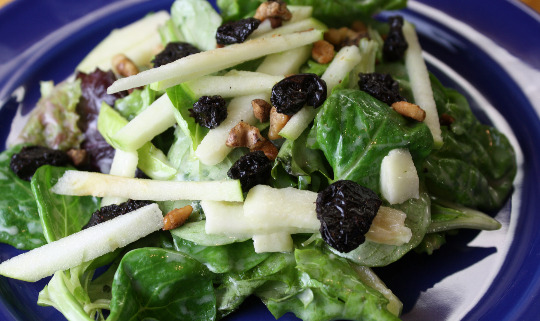
There’s maple syrup in this salad dressing. Sounds way too sweet, doesn’t it? Well, it is on the sweet side for a green salad, I’ll admit. But there is something seductive about the mixture of mayo, maple syrup and champagne wine vinegar. You counter the sweet with the vinegar, and it’s sublime. Usually I serve this in the Fall, and we’re steamy here in So. California these days, so I’m waiting for the new crop of apples to come in before I make this again. Although Granny Smiths are good year around, I know. This is kind of reminiscent of a waldorf salad, except there isn’t any celery in it. So think of this as a waldorf-ish green salad maybe.

This came from a cooking class with Phillis Carey, a cooking instructor I’ve mentioned before on this blog. She has such a creative culinary mind. I’m not that inventive – sure, I can put something together if the ingredients are plopped down in front of me, but I’d never have thought to make a salad dressing with mayo and maple syrup. And the combo of the apples, dried cherries and walnuts too.

I think there are too many apples in this salad, although maybe Phillis wanted the apples to be predominant. I prefer to make the lettuce the star (I use more greens than noted) and the dressing shines through. Then the fruit comes in as secondary. The recipe below is exactly as Phillis made it, with my notes in parens. But, as you start thinking about apples, maybe you’ll think about this salad. It’s excellent in whatever proportion you choose to use!
printer-friendly CutePDF

Files: MasterCook 5+ and MasterCook 14 (click link to open in MC – 14 contains photo)

Apple, Dried Cherry and Walnut Salad

Recipe: From a cooking class with Phillis Carey
Servings: 8

Notes: This has a sweet tinge, obviously, with the maple syrup as a sweetener, but it’s very tasty and easy. It helps if you have a mandoline to do the julienne apple strips.

DRESSING:
6 tablespoons mayonnaise
6 tablespoons maple syrup
4 1/2 tablespoons champagne wine vinegar
1 tablespoon sugar
3/4 cup vegetable oil
SALAD:
10 ounces baby lettuce leaves (I use more)
4 whole Granny Smith apple — or pears (I use 1, not 4)
3/4 cup dried cherries — not sweetened
3/4 cup chopped walnuts — toasted

1. Dressing: whisk mayonnaise, syrup, vinegar and sugar in a medium bowl to blend. Gradually whisk in oil mixture, until it is slightly thickened. Season to taste with salt and pepper. Will keep in refrigerator for 2-3 days.
2. In a large salad bowl combine the lettuce, cherries and half of the toasted nuts. It is not necessary to peel the apples or pears, but you may if you choose. Cut the apples into julienne strips and add to the salad, then toss with enough dressing to coat the salad.
3. Divide salad equally onto 8 plates and sprinkle with remaining walnuts.

Posted in Desserts, on August 29th, 2007.


(photo wholefoodsmarket.com)

Maybe I’ll have a photo of this special dessert this summer. But only if I can still find apricots in the market by the time I’m able to walk again.

Several years ago I attended a cooking class taught by Susan Hermann Loomis. She’s an American woman who took a left turn in her life and went to Paris. Attended culinary school, found jobs here and there cooking for wealthy families, met a Frenchman, married, bought a home in Normandy, settled down, had two children, then wrote a cookbook. And opened her home for cooking classes. And no, I didn’t attend a class at her home in Normandy. Maybe one day.

Susan’s a fun personality, and her cooking is quite straightforward. She cooks rustic. Country French. Seasonal. But oh, so delicious. This was the one recipe from her class that I made as soon as it was apricot season. I bought her cookbook and memoir On Rue Tatin and read it cover to cover as soon as I brought it home from the class. It’s not currently in print, but you can find used copies. But, I very much enjoyed her breezy style, and learning more details about her life. I can’t say that I’ve made very many of the dishes (you know, so many cookbooks, so little time, especially with a broken FOOT!), but I loved reading about them. I tagged the book in many places to remind me of the things I want to make.

I don’t cook with apricots very often. They have such a short season, after all. But they’re very much a celebrated fruit in Normandy, the region where Susan lives. She obviously subscribes to the Slow Food movement, using only local and seasonal ingredients. Some apricot varieties cook better than others – if you’re not careful they become mush. But if you have a good source, and they are full of flavor, by all means, this would make a super end to a meal. Be sure to make this in a baking dish that’s got at least 1/2 inch of space once you add all the ingredients, or it may bubble over in your oven. My notes remind me that it’s the topping that makes the dish. Otherwise it would be a fruit with a custard on top, I suppose. But this has a simple eggy topping that adds a piquant taste to it. Goes very well with those perfectly baked apricots.
printer-friendly PDF

Normandy Apricot Custard

Recipe: Susan Herrmann Loomis, chef and author
Servings: 8
COOK’S NOTES: The topping mixture is what makes this dish. Can be made several hours ahead of serving. Whatever bowl you bake this in, be sure to leave at least 1/2 inch of space below the edge, as it may overflow. Use a tall bowl, not a wide flat one. Vanilla sugar is simply regular sugar to which you have added a vanilla bean, cut in half. It will exude some scent to the sugar. Remove after a couple of months. When you add new sugar to your canister, add another vanilla bean. Since apricot season is so short, maybe this could be made with pluots instead.

FRUIT LAYER:
3 tablespoons unsalted butter
2 pounds apricots — slightly under-ripe
1/4 cup light brown sugar
CUSTARD LAYER:
6 tablespoons sugar — infused with vanilla
2 tablespoons unsalted butter
2 large eggs
3/4 cup all-purpose flour
1 teaspoon baking powder
3/4 cup milk
TOPPING LAYER:
1/3 cup sugar — infused with vanilla
4 tablespoons unsalted butter
1 large egg

1. Preheat oven to 400°. Thoroughly butter and flour a 2-quart round baking dish about 4 inches deep. You may also use 1-cup ramekins.
2. Fruit Layer: Melt butter in medium wide skillet over medium heat. Add apricots and brown sugar, stir and saute until they are hot through and sugar has melted and begun to caramelize, about 8 minutes. Remove from heat and set aside.
3. Custard Layer: In a large bowl mix together the sugar and 2 T. of butter until the mixture is pale yellow and light, about 3-5 minutes. Mix in eggs one at a time until thoroughly combined. Use a whisk on the mixture until it is light and pale yellow. Sift the flour and baking powder over the bowl, whisking as you do, so it incorporates smoothly into the mixture. Then whisk in the milk. Fold in the warm apricots and the cooking juices, then pour the entire mixture into the prepared mold. Bake in center of oven until it begins to puff and look golden, about 30 minutes.
4. Topping Layer: While the custard is baking, whisk together vanilla sugar and remaining 4 T. butter until light and fluffy. Whisk in the egg until combined. Remove the baked apricot custard from the oven and spread this topping over it. Return it to the oven and bake until golden and bubbling, an additional 20 minutes. Remove from the oven and let cool to room temperature before serving.
5. Serve with a rosemary sprig as garnish.
Per Serving: 335 Calories; 16g Fat (41.9% calories from fat); 6g Protein; 44g Carbohydrate; 2g Dietary Fiber; 118mg Cholesterol; 103mg Sodium.

Posted in Chicken, on August 28th, 2007.


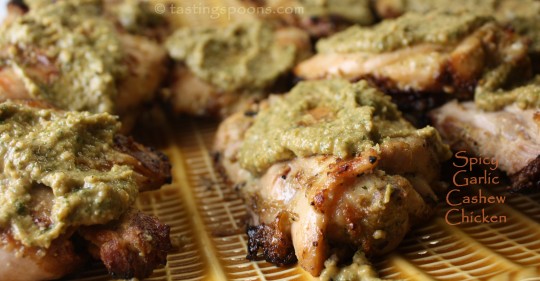
Thanks to my DH, he managed to make a nice chicken dinner the other night. Albeit, we only had one chicken thigh and some frozen asparagus each, but it worked. The freezer-burned asparagus was over the hill – but the chicken was scrumptious. We have leftovers, which is a good thing, and I would definitely make this again. The recipe came from Elise, over at Simply Recipes. I’ve made several of her recipes in the last 6 months, and have enjoyed them all. This one is a stand-out, for sure. The marinade and sauce (one in the same) is just delicious. You could eat it right out of the bowl it’s so tasty. Her recipe was adapted from an article in the New York Times, she said. The recipe is very simple – you make a cashew-based marinade in the food processor, with cilantro, garlic, soy sauce, brown sugar, lime juice and some fresh chiles. Some of this is reserved to scoop on top at serving time, but you marinate the chicken in this stuff for at least an hour, then grill or broil or bake and serve. Even my DH, who doesn’t cook, found this fairly easy to make. That’s saying a lot from him!

This marinade kind of resembles pesto, except rather than basil and pine nuts, this is cilantro and cashews. My recipe will include a few changes: (1) next time I’ll use boneless, skinless thighs (because I don’t like to eat the fatty chicken skin and most of the thick marinade sticks to the skin); (2) we used one small jalapeno and a part of a poblano chile, and I’d definitely do that again; and maybe if baking these (3) I’ll pat a bit of Panko crumbs on top of the chicken (I like the crunch of Panko); (4) I’ll make more of the sauce since it’s just so unbelievably yummy (I’d like to try it on other things – like a grilled pork chop – or as a spread on a sandwich, maybe even as a salad dressing – we both just l-o-v-e-d the sauce; and (5) I substituted brown sugar Splenda for the brown sugar just because we try to limit sugar in our diets. Although the recipe says to marinate just an hour or two, most likely it would be fine up to 24 hours. No more, though, or the chicken will begin to “cook” with the lime juice in it.

printer-friendly PDF
MasterCook 5+ import file

Spicy Garlic Cashew Chicken Recipe

Recipe: From Simply Recipes food blog and she got it from the New York Times
Servings: 6

1 cup cashews — salted
6 Tbsp cilantro — chopped with stems
1/4 cup olive oil — or grapeseed oil
4 whole garlic cloves — roughly chopped
2 tablespoons soy sauce
2 teaspoons brown sugar — or Splenda brown sugar
1 whole jalapeño peppers — seeded, chopped
1/2 poblano chile, seeded, chopped
2 tablespoons lime juice
Kosher salt and freshly ground black pepper
2 1/2 pounds chicken thighs — boneless, skinless

1. In a blender or food processor, blend together the cashews, cilantro, oil, garlic, soy sauce, brown sugar, chiles, lime juice, and 2 tablespoons of water. Blend until a smooth paste. Add salt and pepper to taste. Reserve a third of the marinade for serving with the chicken. Use the rest for coating the chicken.
2. Sprinkle salt and pepper all over the chicken pieces. Coat the chicken pieces with the marinade. Chill for an hour or two. Bring to room temperature before cooking.
3. Preheat broiler or grill. Broil or grill chicken, turning frequently, until golden and crisp and a meat thermometer reads 175°F when inserted into the thickest part of the thigh (not touching a bone), or when the juices run clear (not pink) when cut into with a knife. About 20 to 30 minutes. Serve with lime wedges, reserved marinade, and cilantro.
Per Serving: 600 Calories; 47g Fat (70.0% calories from fat); 35g Protein; 10g Carbohydrate; 2g Dietary Fiber; 151mg Cholesterol; 487mg Sodium.

Posted in Pasta, Salads, on August 27th, 2007.

sicilian-tuna-salad

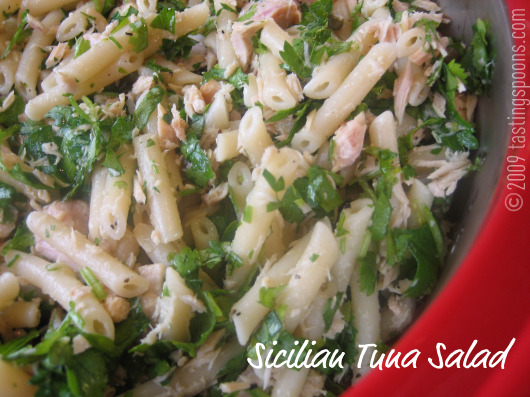
It’s the capers, of course, that make this uniquely Sicilian. Whether the Sicilians were the first to utilize the little buds, I don’t know. I buy a giant economy sized bottle of capers at my local Italian market. A large jar isn’t cheap, but I’ve had this jar for about 5 years, I think. Caper berries are also available – they’ve just been allowed to mature to a bigger size, hence they’re berries, rather than buds. I do like capers a lot, but only in small quantity. I once ordered chicken piccata at some restaurant and it had so darned many of them, and probably a bit of the pickle juice, I couldn’t eat it. But in moderation, they add a kind of piquant character to any dish in which you choose to use them. Just be sure to rinse them a little before using them.

I think capers are not common in tuna salad, but when I had this, it was just really, really good. There’s nothing else in it that is that unusual. I’ve never been able to put my finger on why this combination is so darned good, but maybe it’s the capers and lemon juice together that bring something different to the equation. And the fact that you use imported tuna packed in oil. And there’s no mayo in it. There’s just lots of flavor there.

sicilian-tuna-salad-closeupSicily abounds with lemons. There are lemons on trees obviously, lemons in the market, lemons in art, lemons in ceramics, lemons even in the ancient carvings. If you buy dinnerware, often it will contain pictures of lemons. The early people obviously found every possible way to utilize the citrus. Sicilians use lemon juice in lieu of vinegar, so it’s found in every avenue of their cuisine. And how could I forget Limoncello? Oh, so good is that liqueur.

But we’re talking about a pasta salad here . . . this came from a Joanne Weir cooking class some years ago. I’d have gone right on by this recipe had I not tasted it, figuring what’s one more cold pasta salad with tuna. But this was just different. Better. Tastier. Tangier. Every time I’ve made this it has renewed my enjoyment of it.
printer-friendly PDF

Sicilian Tuna Salad

Recipe: Joanne Weir, author and instructor
Servings: 4
COOK’S NOTES: Buy the oil-packed tuna, since the flavor is significantly better. The salad is really good and can be made up ahead. It keeps for 4-5 days with little or no deterioration. It is a fairly dry pasta salad – you can add more oil if you want to. If it’s summer and you can find good tomatoes, they are a wonderful addition to the top of the salad or on the plate with it.You can use different pasta if you would prefer.

6 ounces tuna in oil — drained
1 1/2 teaspoons salt
1/2 pound penne pasta
2 tablespoons lemon juice — must be fresh
2 tablespoons extra virgin olive oil
1/2 teaspoon freshly ground black pepper
2 teaspoons capers — rinsed and drained
1/4 cup Italian parsley — chopped
1/4 cup fresh basil — chopped
1/4 cup fresh cilantro — chopped

1. Drain the tuna as much as possible. Place tuna in a large bowl and using a fork break it into flakes. Set aside.
2. Bring a large pot of water to a boil. Add a teaspoon of salt, then add the penne, stir well, and cook ONLY until pasta is “al dente,” firm to the tooth. This will be about 10-12 minutes depending on the brand. Drain well.
3. Meanwhile, into the bowl add the lemon juice, olive oil, remaining salt, and the pepper. Then add the hot, drained pasta and stir well.
4. Add the capers, parsley, basil, and cilantro and mix gently. Taste and adjust for seasonings. Cover and refrigerate for at least an hour before serving.
5. Transfer the salad to a serving bowl or divide amount individual plates. It is better if it is served at near room temperature. Garnish with additional Italian parsley sprigs or basil leaves.
Per Serving: 359 Calories; 11g Fat (28.4% calories from fat); 20g Protein; 44g Carbohydrate; 2g Dietary Fiber; 8mg Cholesterol; 970mg Sodium.

Posted in Beef, on August 26th, 2007.


(photo from thatsanice.com)

We went to an Italian restaurant the other night – Vessia – in Irvine. One of the chefs from Prego opened it a couple of years ago. Good food. We’d been there when it first opened and were disappointed, but last night was a big improvement. My DH ordered their Braesiola.

When I looked at the word on the menu I wondered if it was something similar to the Braciole that I’ve made for years. Or if it was a completely different dish. Reading the fine print it sounded very similar. Why the different spelling, I wonder? Maybe some reader of mine who is Italian, or knows Italian cuisine can tell me why a dish can have so many different spellings? I did an internet search and found several also. Confusing to me! I think the meat roll is Sicilian in origin, but it’s claimed by all Italians, now.

So, I decided to take a look again at my version of this standby, Braciole – I think it’s pronounced brah-jol. Our Mexican waiter butchered the word big time as well as every other Italian word he tried to pronounce. I think I previously asked an Italian how to pronounce it.

Anyway, today I read online of many variations on the braciole theme. I liked reading about the addition of pine nuts, garlic, Pecorino-Romano cheese, parsley too. Here’s one version I liked. And I also like the option of cooking it on a bed of tomato sauce. I may have to try some of those options next time I make this. My recipe dates back to the 1960’s.

Because refrigerators with large freezers were a new fangled thing back then, there were lots of books and articles in magazines about how to use your freezer. Hard to imagine but I even bought a small BOOK about how to freeze. It seems like second nature now. But back then we didn’t have plastic bags. And initially we didn’t even have plastic containers (boxes) to store or freeze in either. You just used the ceramic (lidded Pyrex) or metal containers things were cooked in. Hard to believe, I know.

Because I still have the original clipping from this recipe, it was from an article about freezing meals ahead. About buying a larger amount of meat, prepping it, then fixing half and freezing half. Seemed like a logical thing to do. Have done it every since when I make this dish.

At the time I’m sure the refrigerator manufacturers probably paid marketing writers to punch out lots of material about why we needed to have these new-fangled refrigerator-freezers so they’d have umpteen more customers. Freezers had been around for awhile, but they were tiny little cubby-holes nested inside the top of the refrigerator. And they weren’t frost-free. Far from it. I remember many a time on a weekend putting bowls of hot-hot water inside the freezer unit trying to hurry-up the process of defrosting the thing. Using an ice pick to pry the chunks of ice off the sides. The opening was so clogged with ice and frost that you could hardly store anything in it. Or what was in it was completely enveloped in ice so you couldn’t remove it to use it. Then there were the piles of towels you needed to use to mop of the dripping water. And sponges and bowls to mop up the water on shelves below the freezer. It was an awful process. I hated it. Hated it. Hated it. But do it every homemaker did; otherwise the freezer was a useless feature.

But then they came out with frost-free. I wasn’t exactly first in line because such refrigerator/freezers were pricey and beyond the budget, but I do remember, in about 1967 finally getting one. Oh, was I excited! I can hardly believe it now, but my former husband, always pinching pennies, gave me a choice (I was a stay-at-home wife) of getting an old used car of my very own OR a new frost-free refrigerator freezer. We had one car only and he used it to go to and from work. Twice a week I took him to work and used those days for errands, shopping, etc. Then I had to pick him up from work too. The other days of the week I was at home all day. Baking, cooking, cleaning, writing letters, reading, etc. Anyway, I chose the refrigerator/freezer. I was greedy: I wanted both. But both I could not have. It was probably 5 more years before I finally had a car of my own.

So, back to freezing food and braciole. However you pronounce it, it’s a very simple stuffed meat roll. You start out with round steak, cut 1″ thick, then you butterfly it to make a big flat surface. Then it’s filled and rolled with Italian sausage, red bell pepper strips, some cheese and a bit of bread stuffing. You tie it, bake it, adding some additional cheese near the end. Remove, let sit briefly, then slice to serve.
printer-friendly PDF

Italian Braciole

Recipe: Magazine recipe from 1960’s
Serves: 12
COOK’S NOTES: The magazine article from which this recipe came was about freezing entrees for ease of serving later. This entree will keep in the freezer well and can be baked right out of the freezer. Do not add the cheese until the last or it will drip off the meat.
Serving Ideas: Wonderful with corn casserole, garlic bread, green salad.

2 whole round steaks — 1″ thick, butterflied
1 lb Italian sausage — hot or sweet
1 whole onion — sliced, separated
1 c herb-seasoned stuffing cubes — Pepperidge Farms
1 whole egg
1/4 c water
1 whole red bell pepper — strips
8 oz Mozzarella cheese — packaged, sliced

1. Ask the butcher to split the steaks butterfly fashion, but not all the way; open each steak to 1 large piece. Pound both steaks with mallet until somewhat thin and tenderized. Cut pieces of kitchen string about 12-14″ long and lay underneath meat at 2″ intervals.
2. Cook the sausage meat briefly in a large skillet, drain well and spread meat on both steaks. Briefly sauté onions and red pepper strips in pan and spread on meat. Add stuffing mix to pan, then egg mixed with water and mix well. Do not cook stuffing. Add to steaks. Remove one slice of cheese, chop and save. Halve lengthwise remaining cheese and lay on steaks. Roll each steak carefully, keeping stuffing inside and tie meat carefully, but not too tight as meat and filling expand as they bake.
3. If cooking immediately: Place rolls in shallow baking pan large enough to hold steak and pour 3/4 cup water over rolls. Bake in moderate oven (350) for 40 minutes, basting occasionally. Sprinkle reserved chopped cheese over rolls. Bake 10 minutes longer, or until cheese melts. Remove to serving or cutting board and remove strings, then slice. Serve immediately.
4. If freezing: wrap uncooked rolls in foil; label & freeze. To bake frozen rolls: unwrap, place in baking pan and pour 3/4 cup water over. Bake in 350 oven for 1 hour and 40 minutes, basting occasionally. Sprinkle cheese on top and bake 10 minutes longer.
Per Serving: 246 Calories; 19g Fat (70.7% calories from fat); 14g Protein; 4g Carbohydrate; trace Dietary Fiber; 74mg Cholesterol; 436mg Sodium.

Related Posts Plugin for WordPress, Blogger...