Get new posts by email:

Archives

Currently Reading

Here are the tastingspoons players. I’m in the middle (Carolyn). Daughter Sara on the right, and daughter-in-law Karen on the left. I started the blog in 2007, as a way to share recipes with my family. I’m still doing 99% of the blogging and holding out hope that these two lovely and excellent cooks will participate. They both lead very busy lives, so we’ll see.

– – – – – – – – – – – – – – – – – – – – – –

BOOK READING (from Carolyn):

Music of Bees, Eileen Garvin. Absolutely charming book about a woman in midlife, lonely, who raises bees, also makes unlikely friends. Heart-warming and very interesting about beekeeping.

A Postcard from Paris, Alex Brown. Really cute story. Dual time line, 1940s and present day about renovating an old apartment in Paris, things discovered.

Time of the Child, Niall Williams. Oh such a good book. Very small village in Ireland, 1960s. A baby is left on the doorstep. The town all whispers and helps. I listened to an interview of the author, which made me like him and his books even more.

Sipsworth, Simon Van Booy. If you like animals you’ll swoon. An old woman who really wants to die finds a tiny mouse in her house and befriends it and finds a reason to live. Utterly charming book.

The Forger’s Spell, Edward Dolnick. True story. For seven years a no-account painter named Han van Meegeren managed to pass off his paintings as those of Johannes Vermeer.

If You Lived Here, You’d be Home by Now, Christopher Ingraham. Could hardly put it down – about a journalist who takes on a challenge to move to small town in Minnesota and write about it. He expects to hate it and the people and place, but he doesn’t. Absolutely wonderful true story.

The River We Remember, William Kent Kreuger. 1950s, Minnesota. A murder and the aftermath. Could hardly put it down. Kreuger has such a vivid imagination and writing style.

How the Lights Gets In, Joyce Maynard. An older woman returns to New Hampshire to help care for her brain-injured son. Siblings and family, lots of angst and resentments.

The Filling Station, Vanessa Miller. Every American should read this book. A novelized retelling of the Tulsa massacre in 1921. Absolutely riveting.

The Story She Left Behind, Patti Callahan Henry. Love this author. Based on a true story. A famous author simply vanishes, leaving her husband and daughter behind. She had invented a mystical language no one could translate. Present day, someone thinks he’s solved the riddle, contacts the family. Really interesting read.

The Girl from Berlin, Ronald Balson. Love anything about Tuscany. An elderly woman is being evicted from a villa there, with odd deed provenance. Two young folks go there to help unravel the mystery. Loved it.

The Island of the Colorblind, Oliver Sacks, M.D. Nonfiction. The dr is intrigued by a remote Pacific island where most of the inhabitants are colorblind. He also unravels a mystery on Guam of people born with a strange neurological problem. Medical mysteries unveiled. Very interesting.

The Bookbinder, Pip Williams. Post 1914 London. Two sisters work at a bookbindery. They’re told to not read the books. One does and one doesn’t. One has visions beyond her narrow world; the other does not. Eventually the one gets into Oxford. Lovely story.

The Paris Express, Emma Donoghue. 1895 on a train to Paris, a disaster happens. You’ll delve into the lives of many people who survived and died in the crash.

A Race to the Bottom of Crazy, Richard Grant. This is about Arizona. Author, wife and child move back to Arizona where they once lived. Part memoir, research, and reporting in a quest to understand what makes Arizona such a confounding and irresistible place.

The Scarlet Thread, Francine Rivers. A woman’s life turned upside down when she discovers the handcrafted quilt and journal of her ancestor Mary Kathryn McMurray, a young woman who was uprooted from her home only to endure harsh frontier conditions on the Oregon Trail.

A Place to Hide, Ronald Balson. 1939 Amsterdam, an ambassador has the ability to save the lives of many Jewish children. Heartwarming.

Homeseeking, Karissa Chen. Two young Chinese teens are deeply in love, but in China. Then their families are separated. Jump to current day and the two meet again in Los Angeles.

North River, Pete Hammill. He always writes such a good story. A doctor works diligently healing people from all walks of life. His wife and daughter left him years before. One day his 3-yr old grandson arrives on his doorstep.

A Very Typical Family, Sierra Godfrey. A very messed-up family. Three adult children are given a home in Santa Cruz, Calif, but only if the siblings meet up and live in the house together. A very untypical scenario but makes for lots of messes.

Three Days in June, Anne Tyler. The usual Anne Tyler grit. Family angst. This wasn’t one of my favorites, but it was entertaining and very short.

Saved, Benjamin Hall. Author is a veteran war reporter. Ukraine, 2022, he nearly loses his life to a Russian strike. Riveting story – he survives, barely.

Grey Wolf, Louise Penny. Another Inspector Gamache mystery in Quebec. She is such an incredible mystery writer.

All the Colors of the Dark, Chris Whitaker. A missing person mystery, a serial killer thriller, a love story, a unique twist on each. Could hardly put it down.

Orbital, Samantha Harvey. Winner of 2024 Booker Prize. I don’t usually like those, but I heard the author interviewed and she hooked me. This is not a normal book with a beginning, a story and an end. It’s several chapters of the day in the life of various astronauts at the ISS (Int’l Space Station). All fictional. She’s been praised by several real astronauts for “getting it” about space station everyday life.

The Blue Hour, Paula Hawkins. An island off Scotland. Inaccessible except when the tide is out. Weird goings on. An artist. A present day mystery too.

Iron Lake, William Kent Krueger. A judge is murdered and a boy is missing. Riveting mystery.

Tell the Wolves I’m Home, Carol Ricks Brunt. 1980s. A 14-yr old girl loses her beloved uncle. Yet a new friendship arises, someone she never knew about.

Four Treasures of the Sky, Jenny Zhang. 1880s, a young girl is kidnapped in China and brought to the United States. She survives with many hurdles in the path.

The Boy Who Fell out of the Sky, Ken Dornstein. Memoir, 1988. The author’s brother died in the PanAm flight that went down in Lockerbie, Scotland. A decade later he tries to solve “the riddle of his older brother’s life.”

Worse Care Scenario, T.J. Newman. Oh my. Interesting analysis of what could/might happen if a jet crashed into a nuclear plant. Un-put-downable.

Song of the Lark, Willa Cather. Complicated weave of a story about a young woman in about 1900, who has a gifted voice (singing) and about her journey to success, not without its ups and downs.

Crow Talk, Eileen Garvin. Charming story which takes place at a remote lake in Washington State, about a few people who inhabit it, the friendships made, but also revolving around the rescue of a baby crow.

The Story Collector, Evie Woods. Sweet story about some dark secrets from an area in Ireland, a bit magical, faerie life, but solving a mystery too.

A Sea of Unspoken Things, Adrienne Young. A woman investigates her twin brother’s mysterious death. She goes to a small town in California to figure it out, to figure HIM out.

The King’s Messenger, Susanna Kearsley. 1600s England, King James. About one of his trusted “messengers,” and his relationship with a young woman also of “the court.” Lots of intrigue.

In the Shadow of the Greenbrier, Emily Matchar. Interesting mystery in/around the area of the famous resort in White Sulphur Springs, West Virginia.

Isola, Allegra Goodman. Hard to describe, survival story on an island in the 1600s.

Save the Date, Allison Raskin. Rom-com, witty, LOL funny. Clever.

The Sirens, Emilia Hart. Numerous time-lines, Australia. Mysteries abound, nightmares, abandoned baby, weird allergies.

Red Clay, Charles Fancher. LOVED this book. Mostly post-Civil War story about the lives of slaves in Alabama during Reconstruction.

Stars in an Italian Sky, Jill Santopolo. Dual time line, 1946 and recent time. Love stories and a mystery.

Battle Mountain, C.J. Box. Another one of Box’s riveting mysteries. Love his descriptions of the land.

Something Beautiful Happened, Yvette Corporon. A memoir of sorts in Greece, tiny island of Erikousa, where the locals hid Jews during WWII. All elusive stories told by the author’s grandmother.

The Jackal’s Mistress, Chris Bohjalian. 1860s Virginia, about a woman who saves the life of a Union soldier. Really good story.

Song of the Magpie, Louise Mayberry. Really interesting story about Australia back in the days when it was mostly a penal colony. Gritty strength of a woman trying to thrive with her farm.

The Boomerang, Robert Bailey. A thriller that will have you gripping the book. About a lot of secrets surrounding the president (fictional novel, remember) and his chief of staff and about cancer. A cure. Such a good story.

Care and Feeding, Laurie Woolever. Really interesting memoir of a woman driven to succeed in the restaurant business. She worked for Mario Batali and then Anthony Bourdain. Gritty stories.

Everything is Tuberculosis, John Green. Maybe not a book for everyone. A real deep dive into the deadly tuberculosis infection, its history. I heard the author interviewed and found the book very interesting.

The Book Lovers Library, Madeline Martin. Fascinating read about Boots’ drug stores’ lending library. And the people who worked in them.

The Arrivals, Meg Mitchell Moore. LOL funny, about a middle-aged couple whose children (and their various family members) return to the family home and the chaos that ensues.

My Life as a Silent Movie, Jesse Lee Kercheval. About grief. A big move to Paris, finding herself a new life with a new set of real blood family.

Escape, Carolyn Jessop. Another memoir about a woman really in bondage in Utah, Mormon plural marriage.

 

Tasting Spoons

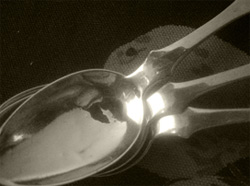
My blog's namesake - small, old and some very dented engraved silver plated tea spoons that belonged to my mother-in-law, and I use them to taste my food as I'm cooking.

Scroll down to the bottom to view my Blogroll

Posted in Beef, Grilling, on March 16th, 2009.

beef-marinated-steak-peppercorn

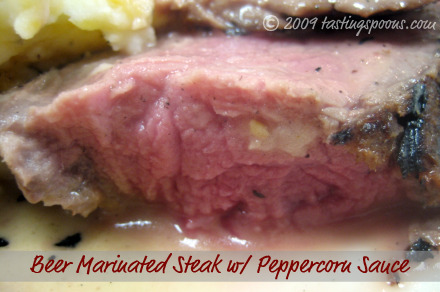
If you’re a beer lover, then this steak will be right down your alley. I don’t drink beer, but recognize its value for marinating and in stews and braises. You won’t really know there even IS beer in the marinade, but it helps to tenderize any meat and give it a deeper flavor.

The recipe came from the cooking class (thanks to Cherrie for faxing me her copy of the recipes) last week, with Phillis Carey, one of my most favorite cooking teachers. The steaks we enjoyed at the class only marinated for a very short time, and they definitely weren’t very tender, but the flavor was good. (Just make sure you buy better-quality steaks if/when you make this.) Phillis is a master of creating pan sauces to go with just about any kind of meat, be it chicken breasts, beef, pork, fish or lamb.

The steaks go into a whole-grain mustard and beer-enhanced marinade – overnight, if possible. While the steaks grill, you prepare a white wine and peppercorn based pan sauce to which you add some heavy cream at the end. If you prefer a thicker sauce (this one is quite thin) you might want to add about 2 teaspoons of flour to the shallot mixture before you add the broth, so you’ll end up with a slightly thickened sauce. If you like sauce, you might want to make a larger quantity of it (more than indicated in this recipe) so you’ll have ample to drizzle on the side potatoes too. I’ll be posting a recipe for mashed potatoes that went with this perfectly, also prepared at the class.
printer-friendly PDF

Beer Marinated Steaks with
Peppercorn Sauce

Recipe: Phillis Carey
Servings: 6
NOTES: Be SURE to use low-sodium broth for the sauce, because once you reduce that sauce, it will concentrate the salt. It would be inedible if you used regularly salted broth.

6 whole steaks — New York or Ribeyes
12 ounces dark beer
1/2 cup dark brown sugar
5 tablespoons fresh lime juice
3 tablespoons onion — minced
6 whole garlic cloves — minced
2 tablespoons Worcestershire sauce
2 tablespoons whole grain mustard
2 tablespoons olive oil
1 tablespoon fresh ginger — peeled, minced
1/2 teaspoon hot pepper sauce
SAUCE:
1/2 cup white wine
1 whole shallot — chopped
2 tablespoons peppercorns — mixed colors, crushed
1 3/4 cups low-sodium chicken broth
1 3/4 cups low-sodium beef broth
1/2 cup whipping cream

1. Place steaks in a single layer in a glass baking dish. Whisk beer, sugar, lime juice, onion, garlic, Worcestershire, mustard, oil, ginger and hot pepper sauce in large bowl to blend. Pour marinade over steaks. Cover tightly with plastic wrap and refrigerate overnight, turning once. (May also be made in a ziploc plastic bag, turning bag at least once during the overnight marinating time.)
2. In a heavy, medium-sized saucepan bring white wine, shallot and the crushed peppercorns to a boil; simmer until mixture is reduced by half, about 10 minutes. Add chicken stock and beef stock and boil until it is reduced to 1 1/2 cups, about 25 minutes. Add the whipping cream and cook until the sauce coats a spoon. Set aside at room temp, then strain out the peppercorns.
3. Prepare barbecue to medium-high heat. Remove steaks from marinade and allow to sit out at room temp for about 30 minutes. Slather grapeseed oil on grill grates to prevent sticking. Blot the steaks with paper towel, then grill to desired done-ness, about 4 minutes per side for medium-rare. If using a meat thermometer, remove at about 123 degrees. Meanwhile, bring peppercorn sauce (strained) to a simmer. Drizzle the sauce over the steak and potatoes.
Per Serving: 534 Calories; 35g Fat (58.7% calories from fat); 26g Protein; 30g Carbohydrate; 2g Dietary Fiber; 96mg Cholesterol; 216mg Sodium.

Posted in Beef, Soups, on March 15th, 2009.

 cabbage-patch-stew

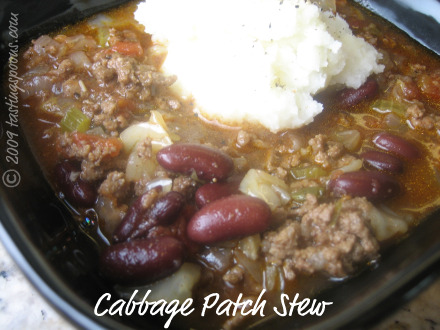
It took about a nanosecond for me to decide to make this today – one of my all-time favorite recipes. My friend Norma who isn’t feeling all that great, asked for comfort food. I knew just the recipe. A kind of soup/stew thing I’ve been making for about 45 years (yikes) with ground beef, celery, onions, cabbage, kidney beans, garlic, cumin, chili powder, then served with a little mound of mashed potatoes in a soup bowl. Just the ticket I hope, for her to eat many little bowls of it, to give her strength. I make this several times a year, and don’t blog about it much because I already HAVE blogged about it. More than once, I think. But since I made it today, tasted it, and we’re having it for dinner, I just thought I’d share it. Again. This is such a simple recipe. Can be made in quantity. Freezes well. Even the mashed potatoes (freeze separately). And in today’s tough economy, it’s an inexpensive meal too. You can make it with ground turkey if you’d prefer, or eliminate the meat altogether. Very adaptable. Make it up and keep it in the refrigerator for days on end. Easy to heat up in the microwave, even with the mashed potatoes on top, scooped right out of the cold container, plopped on top.

cabbage-patch

If you want to read the first posting about this recipe and to print out the PDF recipe only, go to Cabbage Patch Stew.

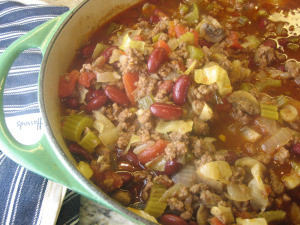
See all that good stuff in that pot – the red kidney beans, tomato chunks, cabbage shreds, celery, mushrooms, onion, ground beef. Yummy is all I can say.

A year ago: Pumpkin Praline Custard (easy and VERY low cal)

Posted in Cookies, on March 14th, 2009.

A dear friend of mine is going through a tough patch right now with her health, and because of medication she’s taking, her appetite is about zilch, and the only thing that sounds good to eat, and that she nearly CAN eat, is chocolate chip cookies. With nuts. Soft chocolate chip cookies with nuts to be exact.

I’m faced with a dilemma – I prefer crispy cookies, so anytime my friend wants cookies, she has had to dunk them in coffee to make them palatable. I figured that needs to change. I CAN make cookies that are softer. And since I’m giving her ALL of the cookies (except for the one or two my DH and I ate just after baking them) I needn’t worry that my crispy-cookie-craving will be troubled! We still have cookies in the freezer from the last batch of my favorite One Bowl Thin & Buttery CC cookies from a couple of weeks ago.

These cookies came from a Rick Malgieri cookbook called Chocolate. But I read about them at Jennifer’s blog, Bake or Break. Hazelnuts are definitely on my radar, and with the addition of Frangelico (I used rum just because I didn’t have any Frangelico), a delish combo was made. Jennifer said that the cookies had a crispy edge, but were softer and mounded in the middle. Perfect.

Definitely easy to make, these came together in no time flat. I heated the cube and a half of butter in the microwave for about 15 seconds to get it to perfect soft mixing consistency. I forgot to toast the hazelnuts, but hey, they tasted just great anyway. I used dark rum (more flavor), and enjoyed the little zing it gave the batter. The rum is very, very subtle, so you needn’t worry that it will taste like alcohol.
printer-friendly PDF

Hazelnut Chocolate Chip Cookies

Recipe: Nick Malgieri’s cookbook, Chocolate, via Bake or Break blog
Servings: 40

1 1/2 sticks unsalted butter — softened
1 cup light brown sugar
1 tablespoon dark rum — or Frangelico
1 whole egg
1 whole egg yolk
1 2/3 cups all-purpose flour
1 teaspoon baking soda
1/2 teaspoon salt
1 cup hazelnuts — toasted, coarsely chopped
2 cups semisweet chocolate chips

1. Preheat oven to 375.
2. Beat the softened butter and brown sugar, then add and beat in the rum or Frangelico, egg and egg yolk.
3. Mix together the flour, baking soda and salt and stir into the butter and sugar mixture. Blend in hazelnuts and chocolate chips.
4. Drop batter (about a tablespoon each) onto a Silpat or parchment-lined baking sheet and bake for 12 minutes (or up to 15, depending on your oven). Cool completely on baking pan (about 5 minutes), then remove and continue baking.
Per Serving: 130 Calories; 8g Fat (56.0% calories from fat); 2g Protein; 13g Carbohydrate; 1g Dietary Fiber; 20mg Cholesterol; 63mg Sodium.

Posted in Uncategorized, on March 12th, 2009.

shoreline in La Jolla, California
Last Fall I spent a day in San Diego and had a few hours to kill. I drove out to La Jolla. This is another photo I took there. It was a cloudy, overcast sky, so it’s not as beautiful as it could be with sunshine. The furthest reef out there was probably about 100 feet away. No cooking going on in my kitchen today – I’m going to a cooking class tonight, though, so perhaps I’ll have something to post tomorrow. I’ve been diligently working on our income taxes and have had no time to toil in the kitchen at all.

Posted in Essays, on March 11th, 2009.

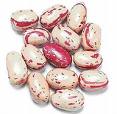
borlotti-beans-fm-beanieswholefoodscouk

In the newest issue of Cooking Light, Michael Ruhlman (a food writer of the first order) wrote an article about the new ingredients, dishes and techniques that have the attention of foodies, mostly the leaders of the top chefs. And starting off the lineup was a word I didn’t even recognize:

1. Chaat. Okay? Not chai (tea). Chaat. It’s Indian street food – a variety of small plates, using a mixture of spicy and acidic, salt and sweet, soft and crunchy. According to Krishnendu Ray, assistant professor of food studies at New York University, “chaats carry lively, fresh flavors, overflowing with chiles, cilantro, coconut, and tamarind.” An example in the article suggested boiled cubed potatoes with a topping of spring onions, lime and tamarind sauce. Hmmm. Or a salad of avocados, strawberries, plums, cucumbers and pineapple with a squeeze of lemon or lime and a sprinkling of chaat masala (Indian spice blend).

2. Heritage Meats. Those derived from old strains of rare breeds of livestock (which produces better intra-muscular marbling and enhances taste). Whole Foods is one source. Others: Heritage Foods USA, Hoye Brothers Farm in Missouri (no website, but email: hoyebrothersfarm at gmail dot com), La Cense Beef in Montana (grass fed), Lava Lakes Lamb (Idaho grass-fed); and Local Harvest (a web directory of small sustainable farms that lets you search for heritage meat purveyors in your area. My only experience, really, is with the Berkshire (Kurobuta) ham I ordered last Spring. It was stupendous. I can’t say enough superlatives about it.

3. Agave Nectar. A substance much like honey, but is the sap from the agave plant. Its most notable feature is that it’s a low-glycemic carb. It’s sweeter than sugar, so you can use less (generally 25% less than sugar). Comes in three varieties: light, amber, and raw (the latter two taste more like maple syrup). Most supermarkets carry this now (at least they do in my area).

4. Allspice & Nutmeg. Oh, good. I like those a lot. But the new twist, if you can call it that, is to use it in savory dishes rather than sweet (like gnocchi, game meat, pork). All of these ideas are coming from the exposure to world cuisines.

5. Heirloom Beans. Why, you ask, are heirloom beans so popular? Experts say they taste better. Some varieties actually have a kind of potato-like consistency, or creamy. Beans like borlotti, Christmas limas, runner beans. You may have to grow your own, or seek out farmer’s markets to find these. They’re not all that common . . . yet.

In the article there were a couple of other trends to watch: pressure cooker and induction cooking, plus natural food preservation (dry curing, salting, pickling).

All information above from Cooking Light, March 2009. Photo at top of borlotti beans from beanieswholefoods.co.uk

Posted in Pasta, Pork, on March 10th, 2009.

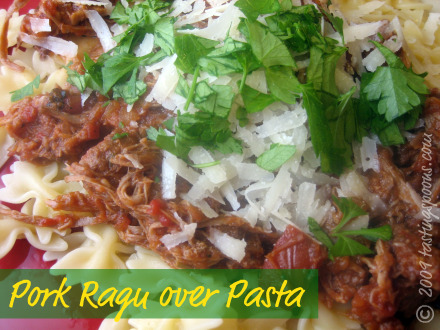
pork-ragu

So I was reading the blog post over at 5 second rule (cute blog, enjoy it very much) and when Cheryl Sternman Rule (she’s a Silicon Valley food writer by profession) posted the recipe for this pork ragu, my mouth watered. Sure sign that I need to try the recipe. When my DH offered to go grocery shopping for me I asked him to go to Costco for a big pork shoulder. WELL! Can you imagine 11 pounds of pork shoulder?  Certainly more than I wanted for this dish, but when I opened the package it divided itself almost into two equal pieces. The other one is frozen for another day. The recipe came from a cookbook, Big Night In, by Domenica Marchetti, a book geared towards Italian family meals for a large group. If this recipe is any indication, I may be investing in yet another cookbook!

My friend Cherrie and I offered to take dinner to our son and family a week or so ago – that way Cherrie and her husband could see the huge remodeling our son and his wife had done to their home (completed about 9-10 months ago). Karen’s sister and husband came too. Karen made dessert, I made guacamole and this pasta dish, Cherrie made a crispy mixed green salad. And Janice brought some bolognese she’d made the previous night. What a feast!

Now I happened to make this in my slow cooker, but the directions are for stove-top simmering. You can do it either way. If you slow cook, do it for about 7-8 hours and it will be meltingly fall-apart pork. The dish is very easy to make – the most tedious part was pulling the pork apart, and waiting long enough for the pork to cool down so I could even PULL it.

This version of ragu is actually mild on the seasoning side (I might add a bit more spices next time). It does have some Italian sausage in it (next time I might try adding some sausage to the mixture in the last 15 minutes of cooking, just because sausage gives up its flavor to the juice around it, I think, when it’s been cooked that long  . . . just a thought). I really, really enjoyed this concoction. I liked it better the next day, so that’s another suggestion – make it ahead and refrigerate overnight. Cheryl over at 5 second rule called this “Pork Ragu for a Crowd.” Yes, indeed. Since I used nearly 6 pounds of pork (double the below recipe), there was ragu for everyone to take home.
printer-friendly PDF

Pork Ragu for a Crowd

Recipe: Big Night In by Domenica Marchetti via 5 second rule blog
Servings: 12
NOTES: Domenica Marchetti indicates that this recipe serves 12 — or enough for 3 pounds of pasta. Cool any leftovers, and freeze, if desired, in quart-sized containers.

3 pounds Boston butt roast — (pork shoulder, boneless) in one or two pieces
Kosher salt and freshly ground black pepper
1/4 cup extra virgin olive oil
3 large yellow onions — diced (5 cups)
4 cloves garlic — minced
1 cup dry red wine
7 cups canned tomatoes — chopped, with their juices
4 whole bay leaves
A sprig or two of rosemary
1 pound Italian sausage — mild
Cooked short pasta — your choice
Freshly grated Parmesan cheese
Italian parsley chopped, for garnish

1. Season the pork shoulder well with salt and pepper. Heat the oil in a large, heavy-bottomed Dutch oven over medium-high heat. Brown the pork on all sides, 3 to 4 minutes per side, until it is evenly seared. This will take a good 15 minutes. Remove pork to a large bowl or plate.
2. Reduce heat to medium and add the onions and garlic, stirring well to coat with the oil. Saute until translucent, about 10 minutes. Add the pork back to the pot, raise the heat to medium-high, and pour in the wine. Let it boil for a minute before adding the tomatoes, bay leaves, and rosemary. Reduce the heat to medium-low.
3. If using bulk sausage, break it into little clumps and add it to the pot. If using sausage links, remove the casings and squeeze the meat into the pot, breaking it up well. Give a good stir, cover, and simmer very gently for 2-1/2 to 3 hours, or until the meat is fork tender. If using a slow cooker, set for 7-8 hours or so until it’s fork tender. Remove the meat to a cutting board, allow it to cool for 20 minutes or so, then shred it. Discard any wayward globs of fat still attached to the meat. Return the meat to the pot and heat the ragu through. Adjust the salt if desired. Add pepper if you’d like.
4. Serve with cooked pasta and top with grated Parmesan cheese and some Italian parsley.
Per Serving (does not include the pasta): 400 Calories; 26g Fat (60.0% calories from fat); 29g Protein; 9g Carbohydrate; 2g Dietary Fiber; 106mg Cholesterol; 578mg Sodium.

A year ago: Chocolate Grand Marnier Decadence Cake

Posted in Brunch, Desserts, on March 9th, 2009.

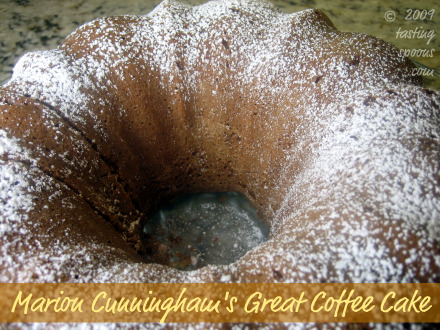
great-coffee-cake-whole

I’m feeling much, much better, after being down flat for 5 days with a bad head cold. (Thanks to those of you who sent me kind get well wishes.) Finally yesterday I returned to the land of the living. I had this write-up done last week, but just didn’t feel up to posting it. The photo was still in my camera, and it would have taken too much energy to combine the two. But today, here it is.

Since I don’t have the cookbook, The Breakfast Book by Marion Cunningham, from whence this came, I don’t know the story behind its name. Is this a great (delicious) coffee cake, or is it a great (large) coffee cake? Either one will probably do, as it was certainly large enough, and it was very nice to eat too. I was reading an article in the newest issue of Gourmet, and in it was mentioned this coffee cake, and that it’s Ruth Reichl’s favorite. And the favorite of any number of other significant foodies. That was all the information I needed. The recipe is on the Gourmet website.

We’re having a meeting (a Bible study, actually) here at our house for the next 5 Tuesday nights, so as hostess I thought it appropriate to bake something. I never need much of a nudge to bake. Since this recipe was foremost on my mind, why not make a coffee cake for an evening get-together.

If tasting the batter was any indication, this coffee cake was going to be sensational. I always taste cake batter (yes, I know, raw eggs, etc. but it’s never hurt me yet), and must say this one tasted just super. Great. Really smooth batter, and it was super-easy to put together – butter and sugar, eggs, flour, baking powder and soda, salt and sour cream. What could be simpler? Bake for 50 minutes in a Bundt pan, cool 5 minutes, unmold, cut and serve. It has many of the ingredients of a pound cake, or a sour cream pound cake.

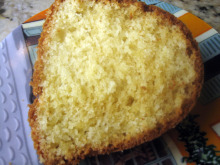
great-coffee-cakeThe recipe also included a number of variations (raisin and spice, dried fig and almond, apple and walnut, and vanilla).  Those are in the PDF recipe you will get if you print it out from the link at the bottom. But for the first time around I wanted to make this true to the original. The coffee cake was plain. Good kind of plain. A very tender crumb. Next time I make this I’ll try one of the variations.

If you like Marion Cunningham, you might want to try another recipe I have of hers, the Feather Dumplings, which were served with Stewed Chicken. I waxed on and on when I made those in 2007.
printer-friendly PDF

Marion Cunningham’s Great Coffee Cake

Recipe: From The Breakfast Book by Marion Cunningham
Servings: 12

1/2 pound butter — (2 sticks) room temperature
1 cup sugar
3 eggs — at room temperature
2 1/2 cups all-purpose flour
2 teaspoons baking powder
1 teaspoon baking soda
1 teaspoon salt
1 cup sour cream

1. Preheat the oven to 350°F. Grease and flour a 10-inch tube pan or Bundt pan.
2. Put the butter in a large mixing bowl and beat for several seconds. Add the sugar and beat until smooth. Add the eggs and beat for 2 minutes, or until light and creamy. Put the flour, baking powder, baking soda, and salt in a bowl and stir with a fork to blend well. Add the flour mixture to the butter mixture and beat until smooth. Add the sour cream and mix well.
3. Spoon the batter into the pan. Bake for about 50 minutes, or until a straw comes out clean when inserted into the center. Remove from the oven and let rest for 5 minutes in the pan. Invert onto a rack and cool a little bit before slicing. Serve warm.
Per Serving: 355 Calories; 21g Fat (52.4% calories from fat); 5g Protein; 38g Carbohydrate; 1g Dietary Fiber; 103mg Cholesterol; 548mg Sodium.
printer-friendly PDF

A year ago: Plate & Utensil Etiquette in Europe

Posted in Uncategorized, on March 7th, 2009.

head-cold-wall

In doing a search on the internet for some funny graphic about  a head cold I came across this (from St. John’s University in England). Kind of describes how my head feels. Clenched in bands of stone, pressing on my sinus cavities.

This is day four of a gosh-darned miserable head cold. No cooking going on in Carolyn’s kitchen. Nothing fun. Unhappy husband because no great meals are coming out of the kitchen for him, although he’s trying his best to “cook” for me. I’ll be back as soon as I’m better.

Posted in Desserts, on March 6th, 2009.

van-choc-bread-pudd

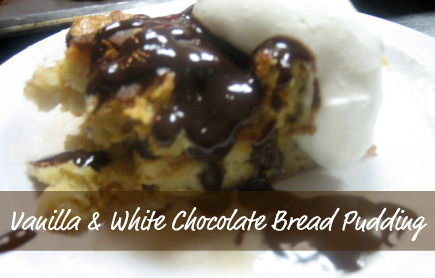
At the cooking class last week, one of the desserts that I didn’t make, but certainly tasted (and nearly licked the plate), was this bread pudding. So very much comfort food to the ultimate. The photo (sorry it’s a bit blurry) shows mostly the chocolate sauce, but the bread pudding is hiding underneath. The recipe indicated to serve it with whipped cream (which would be good), or creme anglaise, but since there was a chocolate sauce made that night, and since there wasn’t any dark chocolate in this pudding, I decided to drizzle THAT on the pudding. (The whipped cream you see there is sitting on top of another dessert that’s on the back side of the plate.) I enjoyed this bread pudding immensely. And pretty-much, I profess to not like white chocolate. Well, maybe just part of the time. Given a choice, I’d always choose regular (dark) chocolate. However, this was very good. In either case, if you don’t want a chocolate sauce, the whipped cream would be a good second choice as a topper.

This dessert is really quite easy. The bread (an eggy bread, brioche or challah) is soaked in the milk mixture with cinnamon and vanilla, then you combine it with the eggs, white chocolate and pour it all into a 9×13 pan. Bake. Cool slightly. Serve. How much easier could that be? All the students brought home leftovers from the class, and I think my DH liked this one best. Note that there is relatively little sugar in this dish – just 2/3 of a cup for 14 servings. There is sugar in the white chocolate, of course,but still not all that much. Just serve it after a dinner that’s light on carbs, since this is almost completely carbs! Yet, because it uses an eggy bread, it has a light texture to it. I will make this at home. I might even use dark chocolate in lieu of the white. Either, I think, would be delicious.
printer-friendly PDF

Vanilla & White Chocolate Bread Pudding

Recipe: The Blackmarket Bakery
Servings: 14

4 1/2 cups brioche bread
2 1/4 cups heavy cream
2 1/4 cups whole milk
3 whole eggs — lightly beaten
3 whole egg yolks — lightly beaten
2/3 cup sugar
1 tablespoon vanilla extract
1 teaspoon cinnamon
1 pinch salt
1 cup white chocolate — chopped

1. Preheat oven to 350. Lightly grease a 9×13 pan or baking dish.
2. Place bread cubes in a large mixing bowl.
3. In a separate bowl combine the cream, milk, eggs, sugar, yolks, vanilla, cinnamon and salt. Pour mixture over bread cubes and let stand 10 minutes to absorb. Fold in white chocolate and spoon into the prepared pan. Dust top with a little confectioner’s sugar and cinnamon.
4. Bake 30-45 minutes, just until pudding is set. Serve warm or at room temp.
5. May be served with sweetened whipped cream, creme anglaise, or with a drizzle of chocolate. If desired, garnish each serving with additional cinnamon and powdered sugar.
Per Serving: 528 Calories; 28g Fat (46.9% calories from fat); 12g Protein; 59g Carbohydrate; 1g Dietary Fiber; 188mg Cholesterol; 437mg Sodium.

You might want to check out MY regal chocolate sauce.
A year ago: Sour Cream Coffeecake with Chocolate Streusel

Posted in Appetizers, on March 4th, 2009.

guacamole

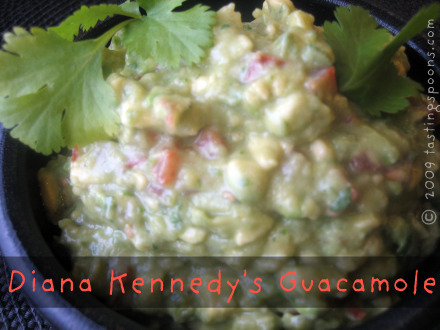
There were a few years in there when I didn’t even make guacamole because of the cost of the avocados. Here in California, where most people were raised on the stuff, if not at home, in Mexican restaurants, that’s almost sacrilegious! Normally I don’t follow a recipe, but just add in ingredients to the avos (in case you live in an avocado free zone of the world, the shortened word is pronounced A-voh). Those add-ins are minced green onion, jalapeno, lime or lemon juice, sometimes tomatoes, sometimes sour cream, or mayo. But even I know that some of those ingredients are not true to the Central Mexican heritage of the dish.

But, since Costco has avos year ’round, and at a reasonable price, I pick up a bag (usually 5 of them) now and then. Mostly they’re used in salads around my house, but since we were going to our son’s home for dinner and I still had 4 of them in the fridge, well, hey, guac here we come.

Turning to Diana Kennedy’s tome, The Essential Cuisines of Mexico, about all things Mexican food, I learned that the word guacamole is a combination of two Mexican words that mean avocado and mixture or concoction. Well, yes, that’s exactly what it is. I learned that in Mexico it’s always served immediately upon making it – no sitting around the the refrigerator at all, with the pit in it. And they make it in a molcajetemolcajete, (pictured right, from Wikipedia) that big, round stone mortar and pestle used all over Mexico to mash things (spices, beans, or whatever). Not owning a molcajete, I turned to my food processor instead. Kennedy suggests using a blender for the base mixture (white onion, chile peppers and cilantro), but no way would my blender grind up a bunch of dry-ish ingredients like that. My food processor did a fairly adequate job of mincing up the base, then I chopped in the avos by hand, added some salt and pepper. Then, because I was making this ahead, I added some lemon juice. Not much, and that isn’t in Kennedy’s recipe at all.

Surprisingly, there is no garlic in the authentic version. I was quite surprised. And really, I was surprised there wasn’t lime juice in it from the get-go. But what I’ll tell you is that it was fabulous. Absolutely off the charts delicious. So, if Costco carries avos in your part of the country, get some and make this. Then, of course, you have to serve it with really good, high-fat fried tortilla chips. Make your own if you can; otherwise packaged chips will do. And if you can, make it just before serving.
printer-friendly PDF

Guacamole by Diana Kennedy

Recipe: Adapted slightly from Diana Kennedy’s book, The Essential Cuisines of Mexico
Servings: 8-12 (a guess – makes 2 1/2 cups)
Serving Ideas: Serve with crispy tortilla chips.

2 tablespoons white onion — chopped
4 whole serrano pepper — or substitute other chiles of choice
4 tablespoons cilantro — chopped salt to taste
3 large avocados — Hass, preferably
4 ounces tomatoes — diced finely
1/2 whole lime — juice only (optional – not in the Kennedy recipe)
GARNISH:
1 tablespoon white onion — minced
2 tablespoons cilantro — minced

1. Grind together the onion, chiles, cilantro and salt to a paste. (Alternately, pulse to a fine mince in a food processor. Not authentic, but okay.)
2. Cut the avocados in halves, remove pits and squeeze the flesh out of the shells and mash into the chile base, to a textured consistency. This should not be a smooth mixture, but still have some chunkiness to it.
3. Add all but a tablespoon of the tomatoes. Taste for seasoning. (Add pepper if desired.)
4. Scoop out into a serving bowl and garnish with the tomatoes, and the white onion and cilantro. Guacamole does not keep, so eat it up the same day as it’s made.
Per Serving: 131 Calories; 12g Fat (72.7% calories from fat); 2g Protein; 8g Carbohydrate; 2g Dietary Fiber; 0mg Cholesterol; 12mg Sodium.

Related Posts Plugin for WordPress, Blogger...