


Get new posts by email:

Archives

Currently Reading

Here are the tastingspoons players. I’m in the middle (Carolyn). Daughter Sara on the right, and daughter-in-law Karen on the left. I started the blog in 2007, as a way to share recipes with my family. I’m still doing 99% of the blogging and holding out hope that these two lovely and excellent cooks will participate. They both lead very busy lives, so we’ll see.

– – – – – – – – – – – – – – – – – – – – – –

BOOK READING (from Carolyn):

Music of Bees, Eileen Garvin. Absolutely charming book about a woman in midlife, lonely, who raises bees, also makes unlikely friends. Heart-warming and very interesting about beekeeping.

A Postcard from Paris, Alex Brown. Really cute story. Dual time line, 1940s and present day about renovating an old apartment in Paris, things discovered.

Time of the Child, Niall Williams. Oh such a good book. Very small village in Ireland, 1960s. A baby is left on the doorstep. The town all whispers and helps. I listened to an interview of the author, which made me like him and his books even more.

Sipsworth, Simon Van Booy. If you like animals you’ll swoon. An old woman who really wants to die finds a tiny mouse in her house and befriends it and finds a reason to live. Utterly charming book.

The Forger’s Spell, Edward Dolnick. True story. For seven years a no-account painter named Han van Meegeren managed to pass off his paintings as those of Johannes Vermeer.

If You Lived Here, You’d be Home by Now, Christopher Ingraham. Could hardly put it down – about a journalist who takes on a challenge to move to small town in Minnesota and write about it. He expects to hate it and the people and place, but he doesn’t. Absolutely wonderful true story.

The River We Remember, William Kent Kreuger. 1950s, Minnesota. A murder and the aftermath. Could hardly put it down. Kreuger has such a vivid imagination and writing style.

How the Lights Gets In, Joyce Maynard. An older woman returns to New Hampshire to help care for her brain-injured son. Siblings and family, lots of angst and resentments.

The Filling Station, Vanessa Miller. Every American should read this book. A novelized retelling of the Tulsa massacre in 1921. Absolutely riveting.

The Story She Left Behind, Patti Callahan Henry. Love this author. Based on a true story. A famous author simply vanishes, leaving her husband and daughter behind. She had invented a mystical language no one could translate. Present day, someone thinks he’s solved the riddle, contacts the family. Really interesting read.

The Girl from Berlin, Ronald Balson. Love anything about Tuscany. An elderly woman is being evicted from a villa there, with odd deed provenance. Two young folks go there to help unravel the mystery. Loved it.

The Island of the Colorblind, Oliver Sacks, M.D. Nonfiction. The dr is intrigued by a remote Pacific island where most of the inhabitants are colorblind. He also unravels a mystery on Guam of people born with a strange neurological problem. Medical mysteries unveiled. Very interesting.

The Bookbinder, Pip Williams. Post 1914 London. Two sisters work at a bookbindery. They’re told to not read the books. One does and one doesn’t. One has visions beyond her narrow world; the other does not. Eventually the one gets into Oxford. Lovely story.

The Paris Express, Emma Donoghue. 1895 on a train to Paris, a disaster happens. You’ll delve into the lives of many people who survived and died in the crash.

A Race to the Bottom of Crazy, Richard Grant. This is about Arizona. Author, wife and child move back to Arizona where they once lived. Part memoir, research, and reporting in a quest to understand what makes Arizona such a confounding and irresistible place.

The Scarlet Thread, Francine Rivers. A woman’s life turned upside down when she discovers the handcrafted quilt and journal of her ancestor Mary Kathryn McMurray, a young woman who was uprooted from her home only to endure harsh frontier conditions on the Oregon Trail.

A Place to Hide, Ronald Balson. 1939 Amsterdam, an ambassador has the ability to save the lives of many Jewish children. Heartwarming.

Homeseeking, Karissa Chen. Two young Chinese teens are deeply in love, but in China. Then their families are separated. Jump to current day and the two meet again in Los Angeles.

North River, Pete Hammill. He always writes such a good story. A doctor works diligently healing people from all walks of life. His wife and daughter left him years before. One day his 3-yr old grandson arrives on his doorstep.

A Very Typical Family, Sierra Godfrey. A very messed-up family. Three adult children are given a home in Santa Cruz, Calif, but only if the siblings meet up and live in the house together. A very untypical scenario but makes for lots of messes.

Three Days in June, Anne Tyler. The usual Anne Tyler grit. Family angst. This wasn’t one of my favorites, but it was entertaining and very short.

Saved, Benjamin Hall. Author is a veteran war reporter. Ukraine, 2022, he nearly loses his life to a Russian strike. Riveting story – he survives, barely.

Grey Wolf, Louise Penny. Another Inspector Gamache mystery in Quebec. She is such an incredible mystery writer.

All the Colors of the Dark, Chris Whitaker. A missing person mystery, a serial killer thriller, a love story, a unique twist on each. Could hardly put it down.

Orbital, Samantha Harvey. Winner of 2024 Booker Prize. I don’t usually like those, but I heard the author interviewed and she hooked me. This is not a normal book with a beginning, a story and an end. It’s several chapters of the day in the life of various astronauts at the ISS (Int’l Space Station). All fictional. She’s been praised by several real astronauts for “getting it” about space station everyday life.

The Blue Hour, Paula Hawkins. An island off Scotland. Inaccessible except when the tide is out. Weird goings on. An artist. A present day mystery too.

Iron Lake, William Kent Krueger. A judge is murdered and a boy is missing. Riveting mystery.

Tell the Wolves I’m Home, Carol Ricks Brunt. 1980s. A 14-yr old girl loses her beloved uncle. Yet a new friendship arises, someone she never knew about.

Four Treasures of the Sky, Jenny Zhang. 1880s, a young girl is kidnapped in China and brought to the United States. She survives with many hurdles in the path.

The Boy Who Fell out of the Sky, Ken Dornstein. Memoir, 1988. The author’s brother died in the PanAm flight that went down in Lockerbie, Scotland. A decade later he tries to solve “the riddle of his older brother’s life.”

Worse Care Scenario, T.J. Newman. Oh my. Interesting analysis of what could/might happen if a jet crashed into a nuclear plant. Un-put-downable.

Song of the Lark, Willa Cather. Complicated weave of a story about a young woman in about 1900, who has a gifted voice (singing) and about her journey to success, not without its ups and downs.

Crow Talk, Eileen Garvin. Charming story which takes place at a remote lake in Washington State, about a few people who inhabit it, the friendships made, but also revolving around the rescue of a baby crow.

The Story Collector, Evie Woods. Sweet story about some dark secrets from an area in Ireland, a bit magical, faerie life, but solving a mystery too.

A Sea of Unspoken Things, Adrienne Young. A woman investigates her twin brother’s mysterious death. She goes to a small town in California to figure it out, to figure HIM out.

The King’s Messenger, Susanna Kearsley. 1600s England, King James. About one of his trusted “messengers,” and his relationship with a young woman also of “the court.” Lots of intrigue.

In the Shadow of the Greenbrier, Emily Matchar. Interesting mystery in/around the area of the famous resort in White Sulphur Springs, West Virginia.

Isola, Allegra Goodman. Hard to describe, survival story on an island in the 1600s.

Save the Date, Allison Raskin. Rom-com, witty, LOL funny. Clever.

The Sirens, Emilia Hart. Numerous time-lines, Australia. Mysteries abound, nightmares, abandoned baby, weird allergies.

Red Clay, Charles Fancher. LOVED this book. Mostly post-Civil War story about the lives of slaves in Alabama during Reconstruction.

Stars in an Italian Sky, Jill Santopolo. Dual time line, 1946 and recent time. Love stories and a mystery.

Battle Mountain, C.J. Box. Another one of Box’s riveting mysteries. Love his descriptions of the land.

Something Beautiful Happened, Yvette Corporon. A memoir of sorts in Greece, tiny island of Erikousa, where the locals hid Jews during WWII. All elusive stories told by the author’s grandmother.

The Jackal’s Mistress, Chris Bohjalian. 1860s Virginia, about a woman who saves the life of a Union soldier. Really good story.

Song of the Magpie, Louise Mayberry. Really interesting story about Australia back in the days when it was mostly a penal colony. Gritty strength of a woman trying to thrive with her farm.

The Boomerang, Robert Bailey. A thriller that will have you gripping the book. About a lot of secrets surrounding the president (fictional novel, remember) and his chief of staff and about cancer. A cure. Such a good story.

Care and Feeding, Laurie Woolever. Really interesting memoir of a woman driven to succeed in the restaurant business. She worked for Mario Batali and then Anthony Bourdain. Gritty stories.

Everything is Tuberculosis, John Green. Maybe not a book for everyone. A real deep dive into the deadly tuberculosis infection, its history. I heard the author interviewed and found the book very interesting.

The Book Lovers Library, Madeline Martin. Fascinating read about Boots’ drug stores’ lending library. And the people who worked in them.

The Arrivals, Meg Mitchell Moore. LOL funny, about a middle-aged couple whose children (and their various family members) return to the family home and the chaos that ensues.

My Life as a Silent Movie, Jesse Lee Kercheval. About grief. A big move to Paris, finding herself a new life with a new set of real blood family.

Escape, Carolyn Jessop. Another memoir about a woman really in bondage in Utah, Mormon plural marriage.


Tasting Spoons

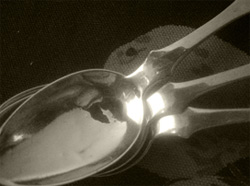
My blog's namesake - small, old and some very dented engraved silver plated tea spoons that belonged to my mother-in-law, and I use them to taste my food as I'm cooking.

Scroll down to the bottom to view my Blogroll

Posted in Books, Uncategorized, on July 31st, 2010.

It’s been awhile since I started using Eat Your Books, and thought it was about time I told you something about it. So you can check it out yourself. If you’re an avid cook (well, you must be or you wouldn’t be reading my blog, right?) and have a whole collection of cookbooks and never know where or which book has what, this website is right up your alley.

The other night I wanted to fix cauliflower. This provides a perfect example of how you’d use EYB for cooking at your house. At Eat Your Books, or EYB for short. Somebody mentioned it on his/her blog a couple of months ago, and the website was offering a lower-priced sign-up bonus. Which I did. It wasn’t exactly cheap, but I hope to use it day in and day out for years to come (here’s hoping the website is successful and stays in biz!).

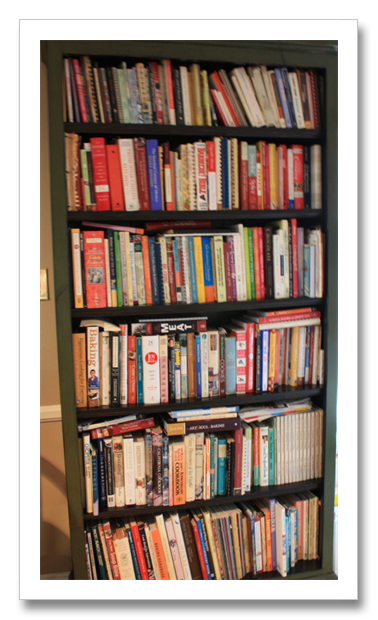
Here’s what EYB is all about. Once you sign up for an account (30 days for free at the moment), you enter the names of all of the cookbooks you own. In an ideal world, they would have listings for all the books I have on my bookshelves. Not so, but they had about 75% of them. As an aside, the books they didn’t have listings for are ones I own that are really old, a bit obscure, several books from England, and one Indian cookbook. It also didn’t have several new books I own. Go figure. So I individually entered the titles of all the books that matched up with their list. Their server grinds through and pops up the book. I add it to my cookbook collection at EYB. It did take me awhile (maybe 1 1/2 hours) to do this, but then I own a huge collection of cookbooks. What I did, actually, was stand in front of my cookbook collection and write down all the titles with the author’s last name. That was all I needed for all but a couple of books. Here’s what my EYB bookshelf says now:

You have (147) Cookbooks and (16,480) Recipes on your bookshelf.

THEN, here’s the good part – I was ready to cook something (cauliflower this time, remember) – I went to EYB and typed in the word cauliflower. Up it came with a listing of where, in my cookbook collection, recipes exist for cauliflower. (It doesn’t give you the recipes, it just gives you the recipe titles they’ve gathered from the recipe titles or indexes of the cookbook library.) It gave me about 12 choices. From the recipe titles I could tell several of them were not something I wanted to make (like cauliflower with pasta, cauliflower and peas, cauliflower and rice, cauliflower in a salad), but there were about three that met my initial criteria as a dinner side dish. And the one that sounded most interesting was in Deborah Madison’s book, Vegetarian Cooking for Everyone. Time elapsed: It took me about 3 minutes to type in the search term, get the results and hone in on the recipe I wanted to investigate, and about 30 seconds to find the cookbook and go to the right page. A whole lot less time than standing in front of my cookbooks and staring at the titles wondering which one(s) might contain an appropriate recipe for a side dish cauliflower.

There are other functions at EYB too. Like advanced searches for ethnic, or by category. Or maybe gluten-free (I’ll use that one next time my cousin comes to visit), or sugar-free. If the cookbook has been fully indexed it will show you a page with all the ingredients in that dish (so you might eliminate it if it contained something you didn’t have, or didn’t want to go shopping to get).  Only 880 cookbooks at EYB are fully indexed. That means that you would be able to use a cookbook’s intuitive index (like a recipe titled just Provencal Summer Squash Casserole, for instance, might be listed under Squash, Summer Squash, French, vegetables, sugar-free, and gluten-free).

You can also mark recipe titles with a favorites icon, or a do-later one, in case you run across one as you’re doing a search. Like the pasta with cauliflower and peas I spotted on this search. It wasn’t appropriate for this meal, but it sounded interesting for later. I haven’t tried those functions yet, but they sound like great ideas. It will also help you with menu planning if you want, and help create a shopping list (without quantities, though). I used to store my myriad cookbooks in two or three places (now I have just one area), but if you have multiple locations, you can flag the cookbooks in “My Locations” as you enter the info about them, to indicate “kitchen,” or “dining room,” or “garage” perhaps to save time when you need to run and find one. You can also rate (with stars) your own cookbooks. There’s a user forum too, and you can make friends with other EYB members if you want to, like Facebook for cookbook users.

If you want to get a quick tour of EYB, go check it out for yourself. And right now they do have a 30-day free trial. I’m quite pleased with the resources so far. The website was founded/developed by three women who live in far parts of the world. Amazing how the web levels the playing field. I wish these gals success in the venture. Makes perfect sense to me that I can go to the web to find my recipes. Just differently!

– – – – – – – – –
A year ago: Blueberry & Ginger Salsa (so very good with pork)
Three years ago: Peppered Pecans (a favorite)

Posted in Fish, Grilling, on July 30th, 2010.

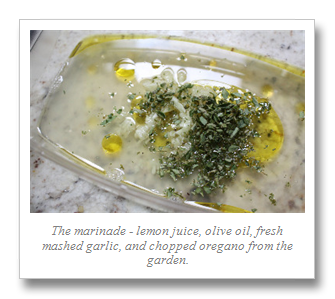
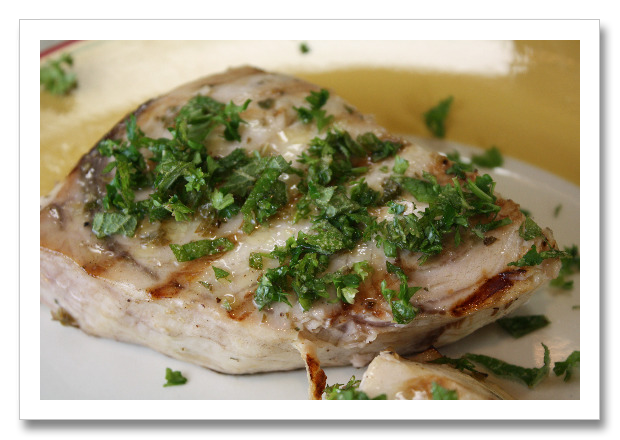
Swordfish is one of the fishes that I truly enjoy. Mostly, I’d say, it’s a texture thing. I like that’s it’s more firm, almost meat-like. And swordfish has a distinctive taste. In this preparation the swordfish shines through but is accented with the Greek type additions – lemon juice, fresh oregano, white wine, garlic and olive oil. We don’t have swordfish often – it’s one of the fishes that’s highest in mercury, so we definitely do NOT want to eat it with any frequency. And pregnant mothers or women who might become pregnant are advised not to eat swordfish. With that in mind, I don’t eat it but a couple of times a year.

The fish steaks were washed gently and dried. Then they were marinated for a few hours in the refrigerator (or 30 minutes at room temp). My DH grilled them about 4-6 minutes per side until they were just tender. Well, a correction –  he took them off the grill, we sat down to eat and discovered they were still quite firm and chewy. I cut my steak in half and touched my finger to the center – it was just lukewarm. Back they went on the grill – for a very short time – and then the fish flaked easily with a fork. Now, it won’t flake as easily as halibut, for instance. It’s a firmer fish to begin with – it’s more dense. Maybe that’s a better way to describe it. Anyway, the lemon juice just highlighted the fish altogether. My DH professes to not like swordfish very much. It’s not that he won’t eat it, but he says he’d never order it out. He just prefers other fish. But he admitted this was really good, and he’d have it anytime the way I made it. I have another 4 or 6 swordfish steaks in the freezer, so we’ll be having this again, for sure. In six months.

printer-friendly PDF

Grilled Swordfish Souvlaki

Recipe By: Adapted from Steven Raichlen’s The Barbecue! Bible
Serving Size: 4

1 1/2 pounds swordfish steaks — about 1 1/2 inches thick
3 tablespoons olive oil
3 tablespoons fresh lemon juice
3 tablespoons dry white wine
2 cloves garlic — minced
1 tablespoon fresh oregano — chopped
1 teaspoon lemon zest
1 teaspoon salt
1/2 teaspoon freshly ground black pepper
3 tablespoons fresh parsley — minced
1 tablespoon fresh mint — minced
lemon wedges for serving

1. Trim skin from fish (if any). Rinse under cold water, then drain and blot dry with paper towels.
2. Combine the oil, lemon juice, wine, garlic, oregano, lemon zest, salt and pepper in a large nonreactive bowl, pan or plastic bag. Whisk mixture until blended and the salt is dissolved. Taste the marinade – it should be highly seasoned. Add the fish, turning to cover all surfaces. Marinate in the refrigerator for 2 hours, or at room temp for 30 minutes, turning the fish several times.
3. Preheat grill to high heat.
4. Oil the grill grate. Place swordfish on the grill, over direct heat. Grill for 3-5 minutes per side, basting the fish with additional marinade (not during the last two minutes). The fish should just flake easily when you try to cut it. If the fish is firm, and almost chewy, it’s not quite cooked enough. Remove to plates, sprinkle with parsley and mint and serve with lemon wedges.
Per Serving: 311 Calories; 17g Fat (51.4% calories from fat); 34g Protein; 2g Carbohydrate; trace Dietary Fiber; 66mg Cholesterol; 689mg Sodium.

A year ago: Bing Cherry Compote (oh, was that ever good – it’s cherry season so I should make it again)
Two years ago: Irish Cream Brownies
Three years ago: Pasta a la Puttanesca (a big family favorite)

Posted in Appetizers, Soups, on July 29th, 2010.

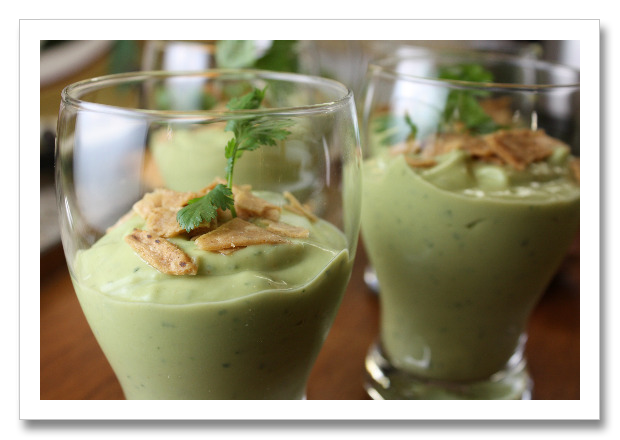
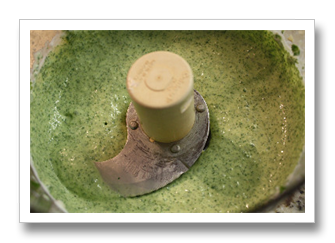
Looks like guacamole, doesn’t it? Wrong. It’s a smooth, unctuous spoon-able soup. Lovely on a hot, summer evening, in small glasses with some crushed tortilla chips on top and a little sprig of cilantro. It was VERY easy to make in the food processor. You just have to have some ripe avocados and some buttermilk. Very delicious.

Read the rest of this entry »

Posted in Grilling, Lamb, Miscellaneous, on July 28th, 2010.

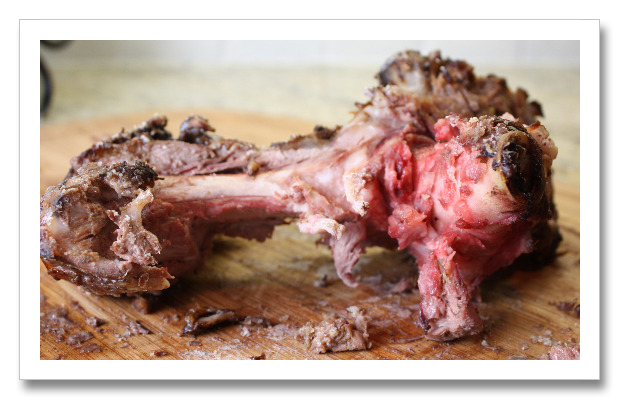
Ah yes. You will believe me when I say it was delicious, right? When all you can see is the pitiful bone left after serving a big dinner to guests? And you’ll forgive me for not taking a photo of the finished roast? I hope so!

If it were cooler weather I’d have made some kind of soup with the bone, but alas, it’s too hot in the kitchen or our outdoor patio dining area to make or eat hot soup. So this bone got chucked in the trash. But the meat that came from it was quite good. Good enough that I’d make it again. Easy enough too.

I turned to one of my favorite barbecue cookbooks of late, Steven Raichlen’s The Barbecue! Bible. You don’t find all that many recipes for barbecued lamb anywhere. Raichlen has several in this book (well, the cookbook has 500+ barbecue recipes). Anyway, I had all the ingredients on hand  (always a good sign). All it took was to buy a bone-in leg of lamb and making the relatively simple marinade. And cutting a bunch of slits in the meat to stuff in little slivers of garlic and fresh ginger.
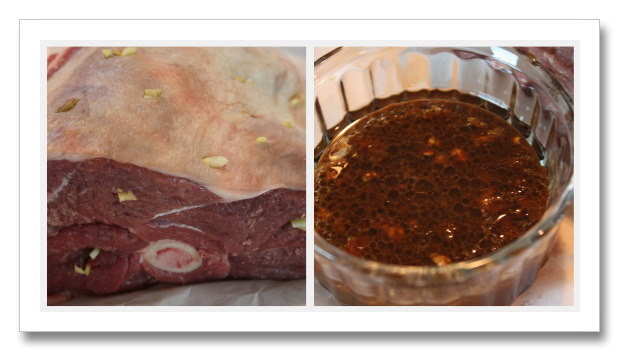
There you can see all the little studs of garlic and ginger. And the Worcestershire and soy marinade. The meat sat in the frig for about 8 hours with the marinade. Once drained, it went onto the barbecue with indirect heat (no searing of any of the meat) with a drip pan below the grates. It stayed there for about 2 hours, until the meat thermometer hit 160°.  This meat wants moderate heat, not high heat. It’s a roast, you know! It sat for about 10 minutes lightly tented with foil before we sliced and served it.

With the pineapple relish stuff Raichlen recommends in the book. Raichlen has traveled the world over for ethnic recipes, and he certainly adheres to the adages in the book, The World Is Flat 3.0: A Brief History of the Twenty-first Century. If you haven’t read it, Thomas Friedman dissects how, in our global economy, we can so easily buy (now) a Thai urn, kites from China, saffron from Spain, lentils from Morocco. Or talk to a computer expert in India as if he or she is 20 miles away. And the products are all available at our local stores. In this case Raichlen doesn’t care that the meat preparation is a South African method, and the relish served with it is Vietnamese. And he suggests it be served with Persian-steamed rice. I don’t actually know what that means, Persian rice that’s steamed, or is it a particular cooking method that makes rice steamed in the Persian style. Anyway, it doesn’t matter. I didn’t serve it.
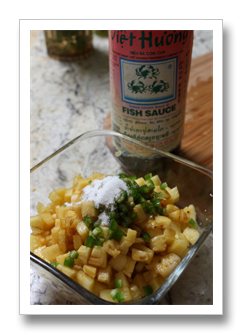
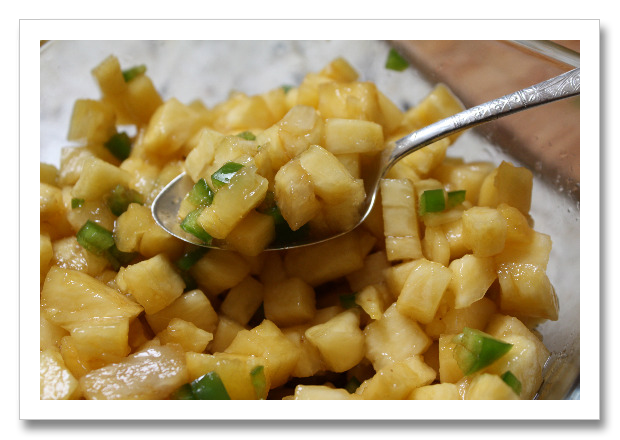
Back to the Achar. It’s a relish composed of fresh, diced pineapple mixed with a bit of Vietnamese fish sauce. Now, I can already see you turning up your noses! Here in Southern California we’re used to fish sauce because we have a sizable Vietnamese community near us. And oodles of Vietnamese restaurants too. We’ve learned to appreciate all the different foods from that country. But almost everything is seasoned with fish sauce. It’s even standard in regular (non-ethnic) grocery stores. It’s like soy sauce to the Japanese, paprika in all forms to the Hungarians (they don’t even put black pepper on the table, just salt and paprika), salsa or pico de gallo to the Mexicans. So, there’s fish sauce for the Vietnamese. It’s a condiment served on every Vietnamese table. And it doesn’t taste like fish. You’d think it would, being called “fish” sauce and all, but it’s a salty liquid that comes from anchovies. In the picture, the bottle of fish sauce is there in the background. In the center of the bottle label is a graphic of three crabs – Anglos call it the “Three Crabs” fish sauce. It’s the premium brand. Below you can see the relish – with the chiles and sugar. This mixture doesn’t require any marinating time – just mix it up and serve it.

It went really well with the lamb, even though it IS a Vietnamese relish served with a South African barbecue lamb dish! The only thing I’d change next time – I think I’d do a butterflied leg of lamb instead. There wasn’t enough meat on the roast I bought. I know that the bone-in is a better way to roast, but the boneless is so much easier.

printer-friendly PDF for the lamb and pineapple achar

Lamb Leg Capetown Style

Recipe: Steven Raichlen’s The Barbecue! Bible
Serving Size: 12

LAMB:
7 pounds leg of lamb — bone-in
6 whole garlic cloves — cut into thin slivers
6 slices fresh ginger — cut into thin slivers
MARINADE:
1/4 cup Worcestershire sauce
1/4 cup soy sauce
1/4 cup firmly packed brown sugar
1/4 cup Dijon mustard
1 tablespoon dry mustard
1/4 cup fresh lemon juice — and zest
3 tablespoons vegetable oil
3 whole garlic cloves — minced
1 tablespoon minced fresh ginger
salt & freshly ground black pepper — to taste
PINEAPPLE ACHAR:
1 tablespoon Asian fish sauce
1 tablespoon fresh lime juice — or more, to taste
1 tablespoon sugar
3 cups fresh pineapple — diced
1 whole jalapeno chile pepper — seeded, ribs removed, finely minced

1. Using the tip of a sharp paring knife, make slits about an inch deep all over the surface of the lamb, spacing them about an inch apart. Insert a sliver each of garlic and ginger into each slit.
Place the lamb in a non-reactive roasting pan and set aside while you prepare the Marinade.
2. Combine the Worcestershire sauce, soy sauce, sugar, both the mustards, lemon juice, oil, garlic, ginger, scallions, red pepper flakes,coriander, and cumin seeds in a small, heavy saucepan and bring to a boil over medium heat, stirring to dissolve the sugar. Cook until thick and syrupy, about 3 minutes, stirring frequently to prevent sticking. Remove from the heat and taste for seasoning, adding salt and pepper as necessary. Let cool to room temperature.
3. Pour half the cooled marinade over the lamb in the roasting pan, brushing to coat on all sides. Cover and let marinate, in the refrigerator, for 3 to 8 hours.
4. Set up the grill for indirect grilling (check in the grilling forum about inderect heat). placing a large drip pan in the center, and preheat to medium. When ready to cook, place the lamb on the hot grate over the drip pan and brush with more glaze. Cover the grill and cook the lamb until done to taste, 2 to 2 1/2 hours; an instant-read meat thermometer inserted in the thickest part of the leg (but not touching the bone) will register 16Q`F for medium. Brush the leg with glaze two or three times during cooking. If using a charcoal grill, add 10 to 12 fresh coals per side every hour.
5. Transfer the lamb to a cutting board and brush one last time with marinade, then let stand for 10 minutes before carving. While the lamb stands, heat any remaining marinade to serve as a sauce with the lamb.
PINEAPPLE ACHAR: Combine in a bowl all ingredients and taste for seasoning, adding more fish sauce, sugar or lime juice. The mixture should be sweet, fruity, tart and a bit salty. Serve immediately.
Per Serving (assumes you eat all the meat and pineapple): 578 Calories; 40g Fat (62.3% calories from fat); 39g Protein; 15g Carbohydrate; 1g Dietary Fiber; 144mg Cholesterol; 576mg Sodium.

One year Ago: Peach Cobbler
Two years ago: Barbecued Beans
Three years ago: Crisp Apple Pudding (my all-time favorite, my mother’s recipe)

Posted in Appetizers, easy, on July 27th, 2010.

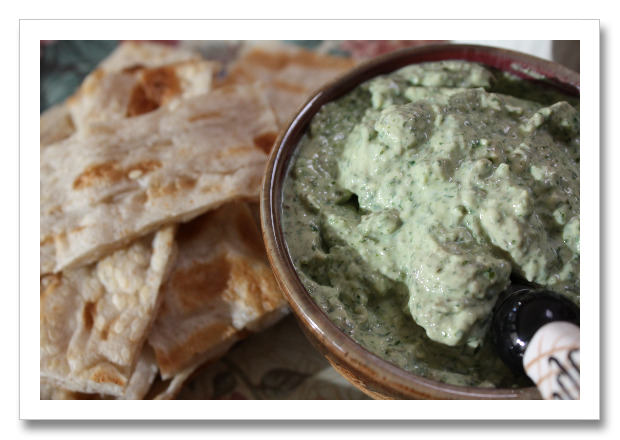
Oh my goodness, was this good. And it’s so simple! It took about 5 minutes (well, maybe 8 or 9) to make it in the food processor – I did have to crush and chop fresh garlic, and run out to my kitchen garden to harvest some fresh mint, and mince a jalapeno (I didn’t want anyone to get a big hunk of jalapeno in their mouths, so I minced it up really fine to begin with, not trusting the food processor to do it). But the rest of it went into the processor and I touched the pulse button for about 15-20 seconds and it was done. I poured it out into a serving bowl, covered it with plastic wrap and pulled it out before serving.

The herbs absolutely make this. Since I love fresh cilantro any day, any time, and I’m in love with fresh mint these days, the combo of both herbs was a perfect marriage for me. The sour cream is nothing more than a neutral palate (like a piece of toasted bread is to a bit of jam) to mix with the herbs. Using light sour cream likely made no difference to the taste.

You could serve this with little baguette slices (toasted would be best), or the recipe suggested pappadums (an Indian fried bread) or some kind of crisp flatbread. I opted to serve it with some fresh sangak bread. People could tear off a piece of the thin, soft and chewy bread and spoon a bit onto it. My DH made a special trip to Wholesome Choice just to pick up a fresh flat of this delicious bread.

printer-friendly PDF

Cilantro Mint Dip

Recipe By: From Gourmet magazine, 8/2007
Serving Size: 8

1 cup light sour cream
2 cups cilantro — use a packed measure
2/3 cup fresh mint — use a packed measure
1 tablespoon green onion — chopped
1 tablespoon jalapeno pepper — seeded and minced
1/2 teaspoon fresh ginger — peeled and chopped
salt and pepper to taste

1. Place all ingredients into blender (or food processor).
2. Puree until the mixture is evenly green with just tiny flecks of the herbs. Pour out into a serving bowl, cover and refrigerate for at least an hour.
3. Serve with crackers, pita chips, a flatbread, or Indian pappadums. Or, if you have a source for Iranian sangak bread, use that.
Per Serving: 34 Calories; 1g Fat (21.1% calories from fat); 2g Protein; 6g Carbohydrate; 1g Dietary Fiber; 2mg Cholesterol; 25mg Sodium.

A year ago: Cherries (everything you’d ever want to know about them)
Two years ago: KFC coleslaw (no, it’s not their recipe, and nowhere near as good as theirs)
Three years ago: Grilled Salmon on Watercress Salad (one of our family favorites)

Posted in easy, Salads, on July 26th, 2010.

Did you ever taste something – way back in your youth – and you never knew how to make it? And you’ve still not found out? Even though you’re a foodie? And you cook a lot? And you read a lot of cookbooks? And you know how to do internet searches? And you’ve still not found the recipe? That’s what this post is all about.

Read the rest of this entry »

Posted in Desserts, on July 24th, 2010.

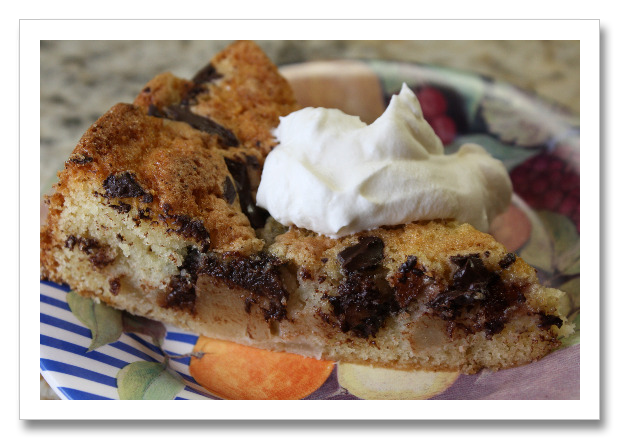
Lately I seem to be on a roll with chocolate mixed up with something else like bread pudding (the Chocolate Banana Croissant Bread Pudding, for instance). This time it’s a cake, made in a springform pan, with chocolate and fresh pear.

The recipe came from a restaurant in Brooklyn, called Al Di La, and I read about it over at Smitten Kitchen’s blog some time back. I printed it out and knew there would come a time to try it. If you’re interested to read about all the people who have made this cake, the pitfalls and successes, do read all of the comments. They go on, and on, and on!

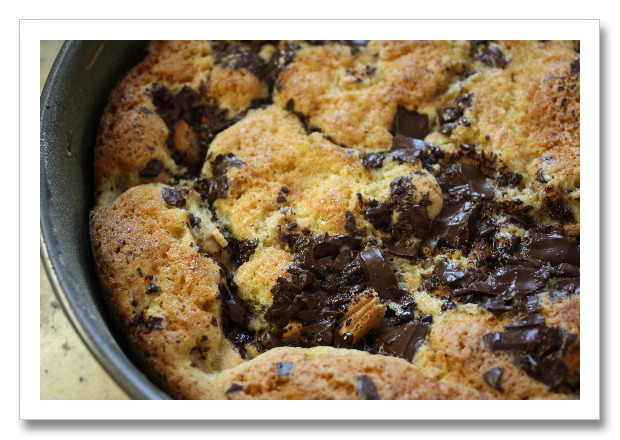
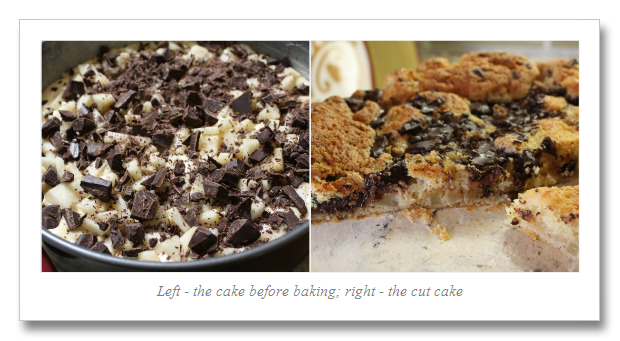
The making of this cake is not difficult – you do have to whip up the eggs for many, many minutes. You would not want to do this with a hand mixer, trust me. You’ll want a stand mixer. It took about nine minutes to get the eggs to a light yellow ribbony thickness. Meanwhile you brown some butter (that’s a different technique for a cake, eh?) and once that’s done you gently mix in sugar. Then you alternately add a flour/baking powder/salt mixture with the warm-to-hot browned butter. Quickly it goes into a buttered and floured springform pan and the freshly cubed pear and chunked-up bittersweet (I had to use semisweet because that’s all I had on hand) chocolate pieces are sprinkled all over the top. That’s it. It’s baked for about 35-40 minutes (or more if you have a particularly wet batter). Some of the chocolate stays on top, but the pears all sink inside the batter.

As soon as I tasted the raw batter I knew this recipe was going to be a winner. I could really taste the richness of the browned butter. What a combo! In a cake! Browned butter is something that does take a little extra time – and I caution you – do NOT leave the stove for even a second while you’re making it or you may have burned butter, okay? Use a heavy duty pan – preferably one that’s light colored. If you use a nonstick pan, you cannot see when the butter has turned brown. Trust me on this! A stainless pan is best! I have one other great recipe here on my blog using browned butter – a Pear Crisp with Vanilla Browned Butter.

You can see the pear cubes toward the bottom in this picture. And the outer edge is just deliciously crispy. Loved that part. Then there’s the whipped cream – flavored with almond extract. Oooh, that was luscious. Everything about this cake was wonderful. The light texture of the cake (from all that whipping), the good chocolate chunks, the pears, and the topping. This recipe is a keeper.

printer-friendly PDF

Bittersweet Chocolate and Pear Cake

Recipe By: Courtesy of Al Di La Restaurant in Park Slope, Brooklyn
Serving Size: 10
NOTES: DO use pears that are barely under-ripe, and still firm. A soggy batter is your enemy here. If you use juicy pears, you’ll have a soggy pear mass in the bottom that won’t bake through. If you have large (like Bosc), use just two pears, not three. You can also serve this with vanilla ice cream, or creme fraiche.

1 cup all-purpose flour
1 tablespoon baking powder
1/4 teaspoon salt
3 large eggs — at room-temperature
4 ounces unsalted butter
3/4 cup sugar
3 whole pears — peeled, in a small dice (just under-ripe and firm, not juicy)
3/4 cup bittersweet chocolate — chopped in chunks

WHIPPED CREAM:
1 cup heavy cream
2 teaspoons powdered sugar
1/2 teaspoon almond extract

1. Preheat the oven to 350°F. Butter a 9-inch springform pan and dust with breadcrumbs or flour (tap out any excess), and set aside.
2. Sift the flour, baking powder and salt together, set aside. Chop the chocolate and set aside. While the eggs are whipping (step 3), peel, core and chop the pears. Left open to the air they will turn brown – you can drop them into a bowl of Squirt (carbonated beverage), which will keep them fresh. When ready to use, drain and roll pears out onto a paper towel to soak up any excess moisture.
3. Using a mixer fitted with the whisk attachment, whip the eggs on high speed until pale and very thick. (In a professional Kitchen Aid, it takes at least five minutes; on a home machine, it will take nine minutes to get sufficient volume.)
4. While the eggs are whipping, brown the butter. Melt the butter in a medium saucepan (because it will foam a lot) and cook it until the butter browns and smells nutty (about 6 to 8 minutes). It helps to frequently scrape the solids off the bottom of the pan in the last couple minutes to ensure even browning. Remove from the flame but keep in a warm spot.
5. Add the sugar to the eggs and whip a few minutes more.
6. Just as the egg-sugar mixture is starting to loose volume, turn the mixture down to stir, and add the flour mixture and brown butter – add one third of the flour mixture, then half of the butter, a third of the flour, the remaining butter, and the rest of flour. Whisk until just barely combined – no more than a minute from when the flour is first added – and then use a spatula to gently fold the batter until the ingredients are combined. It is very important not to over-whisk or fold the batter or it will lose volume.
7. Pour into prepared pan. Sprinkle the pear and chocolate chunks over the top, and bake until the cake is golden brown and springs back to the touch, about 30-50 minutes, or a tester comes out clean.
8. Serve it with barely whipped whipped cream with a drop of almond extract in it, At the restaurant they serve it with buttermilk ice cream.
Per Serving: 374 Calories; 25g Fat (57.9% calories from fat); 5g Protein; 37g Carbohydrate; 3g Dietary Fiber; 121mg Cholesterol; 233mg Sodium.

A year ago: Beef and Biscuit Casserole
Two years ago: Balsamic Onion Marmalade (a condiment)
Three years ago: Buttermilk Scones (my all-time favorite scones)

Posted in Appetizers, easy, on July 23rd, 2010.

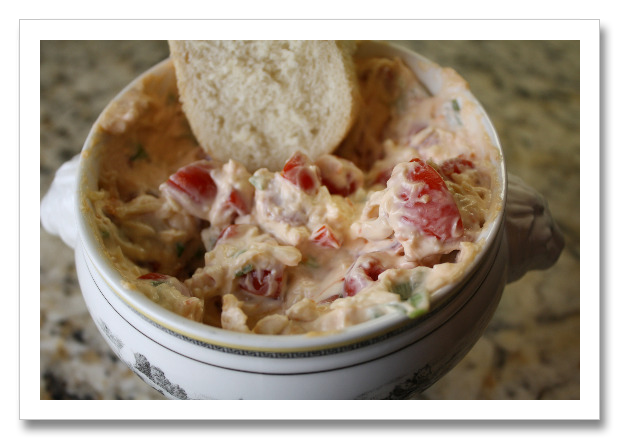
A couple of weeks ago we invited a long-time friend over, who brought her new BF to meet us. Donna brought along not only Mark, but a delicious appetizer too. This stuff is scrumptious. It’s the cream cheese that makes it, I think. Well, and the bacon. And there isn’t anything in it that’s healthy, but if you want an easy and really tasty dip that you can make a few hours ahead (in fact it should be made a couple of hours ahead of time), this is it.

Donna said she found the recipe on the internet somewhere. Ah, I found it at about.com. That site that offers lots of information. Kind of like Wikipedia, but it’s different. And they have some recipes too.

Anyway, you just mix up cream cheese and mayo, then add in the cooked and crumbled bacon, Parmigiano-Reggiano grated, a dash of garlic powder, some green onions, then gently stir in some chopped cherry tomatoes. It gets refrigerated for a couple of hours and you’re ready to go.

We really enjoyed Mark – he’s a keeper, as they say in dating circles. So is she, for that matter! Donna was one of the first employees I hired at the first ad agency I worked for. This was back, oh, 1977, I’m guessing. She only worked for me for a year, then she got pregnant and quit. But we stayed friends, through many jobs for her, through her divorce. That’s what being girlfriends is all about. Donna is a sweetheart and I love her to pieces. She’s a grade school teacher now. She e-mailed the recipe and said it was okay to share it on my blog. This, too, is a keeper.

printer-friendly PDF

Bacon Cherry Tomato Dip

Recipe By: From my friend Donna, who found it at about.com
Serving Size: 8

8 slices bacon — cooked, crumbled
8 ounces cream cheese
1/2 cup mayonnaise
1/2 cup Parmigiano-Reggiano cheese — grated
1/8 teaspoon garlic powder
1/3 cup green onion — minced
1 cup cherry tomatoes — chopped

1. Combine the cream cheese and mayonnaise in a bowl. Mix well, until it’s thoroughly combined.
2. Add the Parmigiano, garlic powder, bacon and green onion. Stir to combine, then gently stir in the cherry tomatoes.
3. Cover and chill for 1-2 hours. Serve with breadsticks, crackers or toasted French bread (the best).
Per Serving: 262 Calories; 26g Fat (87.2% calories from fat); 7g Protein; 2g Carbohydrate; trace Dietary Fiber; 45mg Cholesterol; 358mg Sodium.

Three years ago: Citrus Gazpacho

Posted in Chicken, on July 22nd, 2010.

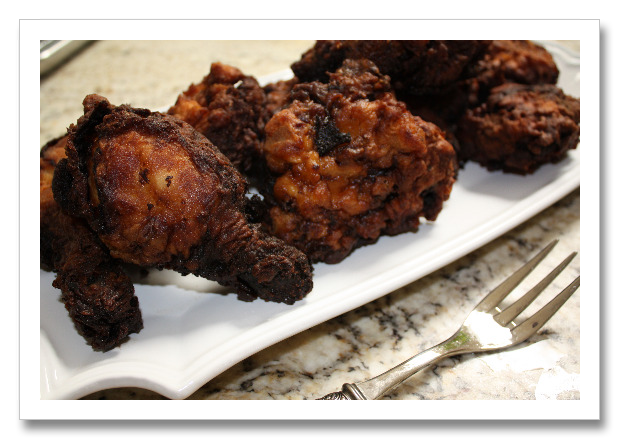
On one hand I can count the number of times I’ve made fried chicken. And I just about never order it when we’re out. I’m totally indoctrinated with the chicken skin=fat, fat=bad. Of course, here in Southern California, very few restaurants would even serve fried chicken. But it is making a resurgence in food circles. It’s been featured in several of the foodie magazines in the last year too. So I finally succumbed.

And the answer is yes, I cooked them a tad too long. But, it didn’t make a whit of difference to the taste – they were tender and juicy. The coating was crispy and tender.

My only trouble was I couldn’t control the temperature of the deep fat. I used my tall-sided Le Creuset pot (recommended, or a Dutch oven) because it would splatter less that way and help hold the oil temp. I have a candy thermometer and it perched on the edge of the pan with no difficulty. But the temp on the thermometer was either way up or way down. I think I didn’t have enough oil in the pot, so the temp meter wasn’t submerged sufficiently. I finally gave up and just used my gut feel about it. The recipe was quite specific about what temp the finished thigh or drumstick meat should be – 175°. Well, in trying to cook enough for 11 people I had no time to be testing temps.

Trusting the folks at Cook’s Illustrated as I do, I had turned to their America’s Test Kitchen TV cookbook and found a long, explanatory recipe. The recipe is not available online except by premium membership. I did change it slightly, but not noticeably.

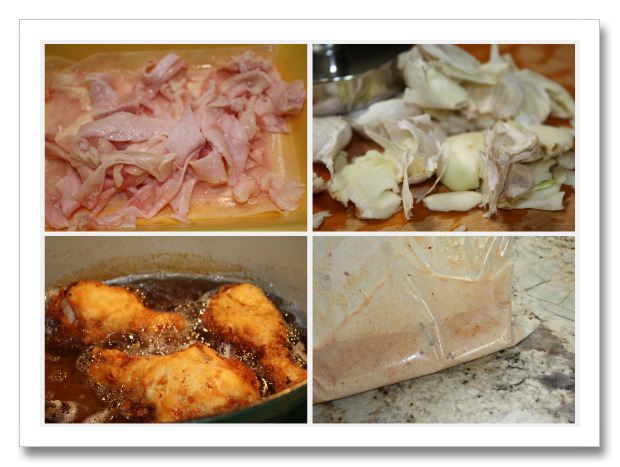
First thing was to snip off all the excess fat from the drumsticks and thighs (top left). Then I made the buttermilk marinade (oodles of garlic, top right, and the finished mixture in a plastic bag, bottom right). I managed to snap one photo of the first batch of frying drumsticks (bottom left).

The chicken pieces are marinated for 2-3 hours, is all. But the marinade contains a lot of mashed garlic, sugar, salt, paprika, and crumbled bay leaves. It’s a cross between a marinade and a brine (there was a lot of table salt in it!). The pieces are removed and placed on a rack to drain for awhile. Then they’re dipped into flour, then an egg/baking soda/baking powder/buttermilk mixture (different than the marinade, which is tossed out), and again back into the flour before being plopped (carefully) into the boiling fat. You were supposed to maintain the oil temp at 325. And if you cooked only 3 pieces at a time you were able to maintain that fairly well.

Initially you heat the oil to 375° because once you add the room temp chicken it lowers quickly to 325°. If you let the oil reheat briefly between frying batches, you hopefully won’t have too much trouble. BUT, the whole process (marinating, draining/drying, dipping, draining again, and frying) will take you a fair number of hours (up to about 6). None of it is intense (well, except the frying part – I got a bit frantic then), but there just are a number of steps to making it.

What I changed about the recipe was the volume of the marinade/brining. It called for 7 cups of buttermilk for 4 pounds of chicken pieces. I had 5 pounds and divided the chicken between two freezer bags and was fine with half that marinade quantity. So I’ve changed the recipe below.

And the result? Well, as I mentioned above – it was VERY juicy and tasty. I know there is some magical temperature that if you deep fry, you’ll have almost no absorption of oil. I’d guess that’s at about 350° or as low as 325°. I don’t know if I hit that number or not. I’d like to try making this again when I’m not so pressed for time (I made this for a lunch we had, and there weren’t enough hours from the time I started the marinating in the early morning to getting it all done by 12:30 when our guests arrived).  I did slip the fried chicken into a 200° oven (on a rack over a tray) for about half an hour before we served the lunch at about 1:00. They kept perfectly warm. According to the recipe, maintaining that deep fat temp is key to the success. If I were to make this very often, I’d need to invest in a deep fryer. But since fried chicken is a big treat, I won’t be doing that! I could try it in my electric skillet – it has fairly high sides. Maybe I’ll just have to do that . . . and I’ll let you know.

printer-friendly PDF

Old Fashioned Crispy Fried Chicken

Recipe By: Adapted slightly from America’s Test Kitchen Cookbook
Serving Size: 6

CHICKEN:
1/4 cup table salt
1/4 cup sugar
1 tablespoon paprika
3 1/2 cups buttermilk
1 1/2 heads garlic — cloves separated and smashed
1 1/2 whole bay leaves — crumbled
2 pounds chicken drumsticks
2 pounds chicken thighs
3 quarts peanut oil or vegetable oil for frying
COATING:
4 cups unbleached flour
1 large egg
1 teaspoon baking powder
1/2 teaspoon baking soda
1 cup buttermilk

1. Into 2 freezer-type plastic bags divide the salt, sugar, paprika, garlic and bay leaves. Divide the buttermilk into each bag and seal, rolling it around to dissolve the sugar and salt. Add the chicken pieces. Seal well and refrigerate for 2-3 hours.
2. Rinse the chicken well and place the pieces in a single layer on a wire rack set over a rimmed baking sheet. Refrigerate the pieces for 2 hours. At this point the chicken can be covered with plastic wrap and refrigerated for up to 6 more hours.
3. Adjust an oven rack to the middle position and heat the oven to 200°.
4. In a large Dutch oven heat 2 inches of oil over medium-high heat to 375°.
5. COATING: Place the flour in a shallow dish. In a separate bowl or plate whisk the egg, baking powder and soda together, then whisk in the buttermilk. Mixture will bubble and thicken.
6. Working with 3 pieces at a time, dredge the chicken in the flour, then in the egg mixture, then back in the flour, covering each piece well and shaking off the excess. Return to the wire rack.
7. When the oil is hot add the 3 chicken pieces, skin side down, cover, and fry until deep brown, 7-11 minutes, adjusting the heat as necessary to maintain the 325° temp. Rearrange pieces and turn to brown all the pieces evenly. Check the chicken temperature – breasts, if you were to use them, must be cooked to 160° – drumsticks and thighs to 175°. Drain the chicken briefly, then transfer the pieces to a clean wire rack set over a rimmed baking sheet and keep warm in the oven.
8. Continue cooking remaining chicken in small batches, bringing the oil temp back up to 375° in between batches. Serve while warm.

Two years ago: Chicken with Poblano Peppers
Three years ago: Balsamic Fig Sorbet

Posted in Desserts, easy, on July 21st, 2010.

At a restaurant near us, they offer an absolutely luscious little tart – a single serving tart with a flaky crust, a chocolate pudding interior (rich, likely made with heavy cream and dark chocolate), fresh bananas, then topped with real whipped cream. The first time I had it, I really thought I’d died and gone to heaven. It’s just off the charts delicious. I haven’t had it in a couple of years – but I crave it now and then. I just don’t indulge my craving. But I think the flavors that are in that tart are mostly in this dessert. That’s probably why I saved the recipe.

It’s been a couple of years ago that I read Haalo’s recipe for this dessert. And I tucked it away in my to-try file. It just sounded right for the gathering of friends we had over the other day. We didn’t want much quantity of dessert, but I wanted chocolate! My DH went grocery shopping for me. Had I been there I’d have known the croissants he chose (from a local bakery – they’re delicious – but they’re very small) would not be enough. I didn’t want him to make another trip, so I made do with 4 small croissants.

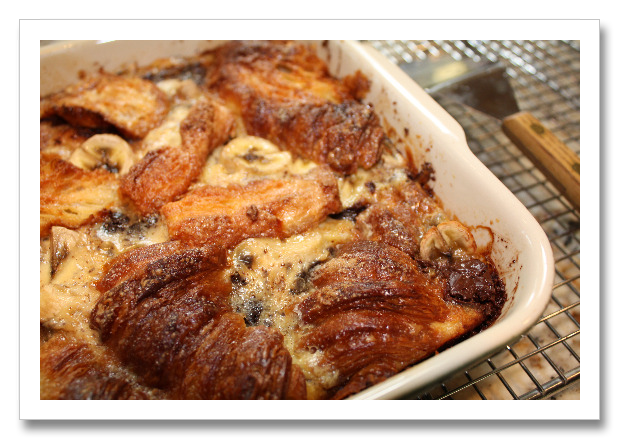
You can see that I didn’t quite have enough croissants, or filling. Haalo made hers in a round cake pan, so perhaps I’ll try that next time. Push any banana pieces down into the custard (they get kind of hard if they float to the top). The dish is baked for 30-40 minutes – about. Look to see if the center of the custard is still jiggly – if so, add another minute or two until it’s barely firm. Cool, then cut into squares (or spoon scoops if you use the round pan) and serve.  I served 11 people (small portions) from this little dish. Delicious. And decadent. But so very tasty!

printer-friendly PDF

Banana & Dark Chocolate Croissant Bread Pudding

Recipe By: Adapted slightly from Cook Almost Anything Once blog
Serving Size: 9
NOTES: If the croissants are large, 3 are enough. If they’re small, you’ll need at least 4, maybe 5. If you want to be really decadent, add a little dollop of sweetened whipped cream to the top.

4 whole croissants — stale
2 tablespoons butter — softened
1 whole banana — halved lengthwise and sliced
6 ounces dark chocolate
2 whole eggs
2/3 cup cream
2/3 cup milk
1/4 cup granulated sugar

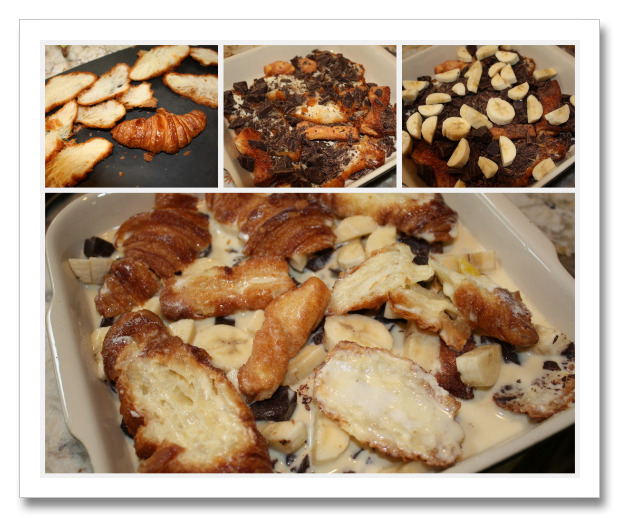
1. If you buy large croissants, you’ll be able to slice them into 4 thin slices. If they’re smaller ones, maybe 3. If they’re really small, you may only be able to slice them in half. You want enough croissant slices to cover an 8×8 pan in at least 2 layers, preferably 3. So use that as your guide when you buy the croissants. Lightly butter each of these slices.
2. In a 9×9 pan (or a high-sided round cake pan) place the first layer, using the bottom and top pieces of croissant, reserving the internal slices for the top layer.
3. Scatter half the banana slices and dark chocolate chunks all over the croissants.
4. Add another layer of croissants, then repeat with the remaining bananas and chocolate. Top with a layer of buttered croissant.
5. Whisk the eggs, cream, milk and sugar until just combined and pour all over the croissants, moistening everything well. Push any bananas down into the liquid (exposed bananas will get hard).
6. Sprinkle top with a little extra sugar.
7. Place the baking dish onto a baking tray and bake in a preheated 180°C/350°F oven until golden and puffed, around 30 – 45 minutes. [Mine took about 42 minutes.]
Per Serving: 320 Calories; 20g Fat (53.3% calories from fat); 6g Protein; 33g Carbohydrate; 2g Dietary Fiber; 89mg Cholesterol; 248mg Sodium.

A year ago: Brown Sugar Berry Shortcakes
Two years ago: A San Francisco weekend with my daughter
Three years ago: Butternut Squash Soup with Jalapeno and Ginger

Related Posts Plugin for WordPress, Blogger...