Get new posts by email:

Archives

Currently Reading

Here are the tastingspoons players. I’m in the middle (Carolyn). Daughter Sara on the right, and daughter-in-law Karen on the left. I started the blog in 2007, as a way to share recipes with my family. I’m still doing 99% of the blogging and holding out hope that these two lovely and excellent cooks will participate. They both lead very busy lives, so we’ll see.

– – – – – – – – – – – – – – – – – – – – – –

BOOK READING (from Carolyn):

Music of Bees, Eileen Garvin. Absolutely charming book about a woman in midlife, lonely, who raises bees, also makes unlikely friends. Heart-warming and very interesting about beekeeping.

A Postcard from Paris, Alex Brown. Really cute story. Dual time line, 1940s and present day about renovating an old apartment in Paris, things discovered.

Time of the Child, Niall Williams. Oh such a good book. Very small village in Ireland, 1960s. A baby is left on the doorstep. The town all whispers and helps. I listened to an interview of the author, which made me like him and his books even more.

Sipsworth, Simon Van Booy. If you like animals you’ll swoon. An old woman who really wants to die finds a tiny mouse in her house and befriends it and finds a reason to live. Utterly charming book.

The Forger’s Spell, Edward Dolnick. True story. For seven years a no-account painter named Han van Meegeren managed to pass off his paintings as those of Johannes Vermeer.

If You Lived Here, You’d be Home by Now, Christopher Ingraham. Could hardly put it down – about a journalist who takes on a challenge to move to small town in Minnesota and write about it. He expects to hate it and the people and place, but he doesn’t. Absolutely wonderful true story.

The River We Remember, William Kent Kreuger. 1950s, Minnesota. A murder and the aftermath. Could hardly put it down. Kreuger has such a vivid imagination and writing style.

How the Lights Gets In, Joyce Maynard. An older woman returns to New Hampshire to help care for her brain-injured son. Siblings and family, lots of angst and resentments.

The Filling Station, Vanessa Miller. Every American should read this book. A novelized retelling of the Tulsa massacre in 1921. Absolutely riveting.

The Story She Left Behind, Patti Callahan Henry. Love this author. Based on a true story. A famous author simply vanishes, leaving her husband and daughter behind. She had invented a mystical language no one could translate. Present day, someone thinks he’s solved the riddle, contacts the family. Really interesting read.

The Girl from Berlin, Ronald Balson. Love anything about Tuscany. An elderly woman is being evicted from a villa there, with odd deed provenance. Two young folks go there to help unravel the mystery. Loved it.

The Island of the Colorblind, Oliver Sacks, M.D. Nonfiction. The dr is intrigued by a remote Pacific island where most of the inhabitants are colorblind. He also unravels a mystery on Guam of people born with a strange neurological problem. Medical mysteries unveiled. Very interesting.

The Bookbinder, Pip Williams. Post 1914 London. Two sisters work at a bookbindery. They’re told to not read the books. One does and one doesn’t. One has visions beyond her narrow world; the other does not. Eventually the one gets into Oxford. Lovely story.

The Paris Express, Emma Donoghue. 1895 on a train to Paris, a disaster happens. You’ll delve into the lives of many people who survived and died in the crash.

A Race to the Bottom of Crazy, Richard Grant. This is about Arizona. Author, wife and child move back to Arizona where they once lived. Part memoir, research, and reporting in a quest to understand what makes Arizona such a confounding and irresistible place.

The Scarlet Thread, Francine Rivers. A woman’s life turned upside down when she discovers the handcrafted quilt and journal of her ancestor Mary Kathryn McMurray, a young woman who was uprooted from her home only to endure harsh frontier conditions on the Oregon Trail.

A Place to Hide, Ronald Balson. 1939 Amsterdam, an ambassador has the ability to save the lives of many Jewish children. Heartwarming.

Homeseeking, Karissa Chen. Two young Chinese teens are deeply in love, but in China. Then their families are separated. Jump to current day and the two meet again in Los Angeles.

North River, Pete Hammill. He always writes such a good story. A doctor works diligently healing people from all walks of life. His wife and daughter left him years before. One day his 3-yr old grandson arrives on his doorstep.

A Very Typical Family, Sierra Godfrey. A very messed-up family. Three adult children are given a home in Santa Cruz, Calif, but only if the siblings meet up and live in the house together. A very untypical scenario but makes for lots of messes.

Three Days in June, Anne Tyler. The usual Anne Tyler grit. Family angst. This wasn’t one of my favorites, but it was entertaining and very short.

Saved, Benjamin Hall. Author is a veteran war reporter. Ukraine, 2022, he nearly loses his life to a Russian strike. Riveting story – he survives, barely.

Grey Wolf, Louise Penny. Another Inspector Gamache mystery in Quebec. She is such an incredible mystery writer.

All the Colors of the Dark, Chris Whitaker. A missing person mystery, a serial killer thriller, a love story, a unique twist on each. Could hardly put it down.

Orbital, Samantha Harvey. Winner of 2024 Booker Prize. I don’t usually like those, but I heard the author interviewed and she hooked me. This is not a normal book with a beginning, a story and an end. It’s several chapters of the day in the life of various astronauts at the ISS (Int’l Space Station). All fictional. She’s been praised by several real astronauts for “getting it” about space station everyday life.

The Blue Hour, Paula Hawkins. An island off Scotland. Inaccessible except when the tide is out. Weird goings on. An artist. A present day mystery too.

Iron Lake, William Kent Krueger. A judge is murdered and a boy is missing. Riveting mystery.

Tell the Wolves I’m Home, Carol Ricks Brunt. 1980s. A 14-yr old girl loses her beloved uncle. Yet a new friendship arises, someone she never knew about.

Four Treasures of the Sky, Jenny Zhang. 1880s, a young girl is kidnapped in China and brought to the United States. She survives with many hurdles in the path.

The Boy Who Fell out of the Sky, Ken Dornstein. Memoir, 1988. The author’s brother died in the PanAm flight that went down in Lockerbie, Scotland. A decade later he tries to solve “the riddle of his older brother’s life.”

Worse Care Scenario, T.J. Newman. Oh my. Interesting analysis of what could/might happen if a jet crashed into a nuclear plant. Un-put-downable.

Song of the Lark, Willa Cather. Complicated weave of a story about a young woman in about 1900, who has a gifted voice (singing) and about her journey to success, not without its ups and downs.

Crow Talk, Eileen Garvin. Charming story which takes place at a remote lake in Washington State, about a few people who inhabit it, the friendships made, but also revolving around the rescue of a baby crow.

The Story Collector, Evie Woods. Sweet story about some dark secrets from an area in Ireland, a bit magical, faerie life, but solving a mystery too.

A Sea of Unspoken Things, Adrienne Young. A woman investigates her twin brother’s mysterious death. She goes to a small town in California to figure it out, to figure HIM out.

The King’s Messenger, Susanna Kearsley. 1600s England, King James. About one of his trusted “messengers,” and his relationship with a young woman also of “the court.” Lots of intrigue.

In the Shadow of the Greenbrier, Emily Matchar. Interesting mystery in/around the area of the famous resort in White Sulphur Springs, West Virginia.

Isola, Allegra Goodman. Hard to describe, survival story on an island in the 1600s.

Save the Date, Allison Raskin. Rom-com, witty, LOL funny. Clever.

The Sirens, Emilia Hart. Numerous time-lines, Australia. Mysteries abound, nightmares, abandoned baby, weird allergies.

Red Clay, Charles Fancher. LOVED this book. Mostly post-Civil War story about the lives of slaves in Alabama during Reconstruction.

Stars in an Italian Sky, Jill Santopolo. Dual time line, 1946 and recent time. Love stories and a mystery.

Battle Mountain, C.J. Box. Another one of Box’s riveting mysteries. Love his descriptions of the land.

Something Beautiful Happened, Yvette Corporon. A memoir of sorts in Greece, tiny island of Erikousa, where the locals hid Jews during WWII. All elusive stories told by the author’s grandmother.

The Jackal’s Mistress, Chris Bohjalian. 1860s Virginia, about a woman who saves the life of a Union soldier. Really good story.

Song of the Magpie, Louise Mayberry. Really interesting story about Australia back in the days when it was mostly a penal colony. Gritty strength of a woman trying to thrive with her farm.

The Boomerang, Robert Bailey. A thriller that will have you gripping the book. About a lot of secrets surrounding the president (fictional novel, remember) and his chief of staff and about cancer. A cure. Such a good story.

Care and Feeding, Laurie Woolever. Really interesting memoir of a woman driven to succeed in the restaurant business. She worked for Mario Batali and then Anthony Bourdain. Gritty stories.

Everything is Tuberculosis, John Green. Maybe not a book for everyone. A real deep dive into the deadly tuberculosis infection, its history. I heard the author interviewed and found the book very interesting.

The Book Lovers Library, Madeline Martin. Fascinating read about Boots’ drug stores’ lending library. And the people who worked in them.

The Arrivals, Meg Mitchell Moore. LOL funny, about a middle-aged couple whose children (and their various family members) return to the family home and the chaos that ensues.

My Life as a Silent Movie, Jesse Lee Kercheval. About grief. A big move to Paris, finding herself a new life with a new set of real blood family.

Escape, Carolyn Jessop. Another memoir about a woman really in bondage in Utah, Mormon plural marriage.

 

Tasting Spoons

My blog's namesake - small, old and some very dented engraved silver plated tea spoons that belonged to my mother-in-law, and I use them to taste my food as I'm cooking.

Scroll down to the bottom to view my Blogroll

Posted in Beef, on January 31st, 2009.

flemish-beef-carbonnade1

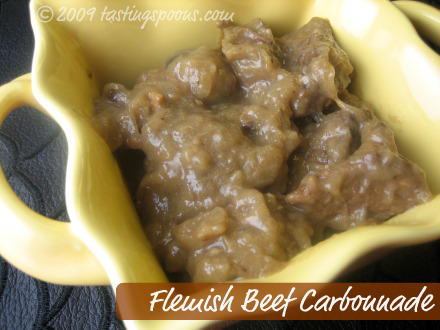
Flemish Beef Carbonnade - serve over egg noodles

The title sounds kind of pretentious, doesn’t it? Well, it really isn’t. The Belgians aren’t noted for very much in their cuisine (except chocolates, perhaps) and this dish. If some of you readers are Belgian, my apologies to your cuisine, but I’ve just not heard about much else. Oh, well, maybe Belgian Endive. That is certainly something worth remembering.

I first had this dish back in the 1960’s, and was dutifully impressed with the flavor. It comes from the dark searing of the meat and the addition of beer. But in actuality, it’s not much more than a beef stew with beer. I wasn’t able to put my hands on the old-old recipe I used to use, but had two others that were very similar (beef, beer, onions), so I just used a combination of 3 different recipes. One called for thyme. Another for bay leaves, and the third for thyme and nutmeg. I used the latter combo.

We were taking dinner to our adult kids who live nearby, and I only had a few hours, so decided to make this in the pressure cooker. It was scrumptious, if I do say so myself. You don’t have to own a pressure cooker to prepare this, though. Just cook it longer on the stovetop (or oven), that’s all. I added mushrooms to it, although it’s not traditional. I did not include them in the recipe below, but you can certainly add them into the pressure cooker if you like them.

First you render a bit of bacon, then sear the beef cubes in the bacon fat (or some added butter and olive oil) until they’re all nice and brown on many sides. It took me three batches to brown 3 pounds of beef. Meanwhile I chopped up one heck of a lot of onions. I must say, although I’m certainly an experienced cook, 3 pounds of onions is a LOT, and I decided not to guess, but to weigh them.

Once you add the onions and cook the whole thing, the onions nearly disappear into the sauce. I cooked the whole thing in the pressure cooker for 20 minutes, then did the last fillip of adding the butter/flour mixture (to gravy-ize the liquid) while it bubbled on the stovetop. We served it over noodles, because that’s the Flemish way, but you could serve it over potatoes too if you’d prefer them. And in case you’ve never cooked with beer, there is absolutely no TASTE of beer. Just a rich sauce. This is a homey kind of dish, but would be perfectly acceptable for guests.
printer-friendly PDF

Flemish Beef Carbonnade

Recipe: A combination of several recipes.
Servings: 8

2 slices bacon — minced
3 pounds chuck roast — cut into 1″ cubes
3 cloves garlic — minced
3 pounds yellow onions — sliced thinly or chopped
2 teaspoons kosher salt
1 teaspoon freshly ground black pepper
1 tablespoon Worcestershire sauce
1/4 teaspoon freshly ground nutmeg
1 tablespoon dried thyme — crushed
3 tablespoons beef concentrate (Trader Joe’s little sticks)
20 ounces light beer
1 tablespoon light brown sugar
3 tablespoons flour
3 tablespoons soft butter
1/4 cup Italian parsley — minced

1. Add the minced bacon to a heavy duty lidded pan and render until the bacon is brown. Remove bacon and drain. To the drippings in the pan add the pieces of beef. Do not crowd the pieces as you don’t want them to steam, but to brown. Keep the heat moderately hot while you brown the meat. Turn the pieces over at least once and brown one more side before removing to a plate and reserve. Repeat process until you’ve browned all the meat.
2. If there is no more fat in the pan add a little butter and olive oil as needed. Add the sliced onions and stir and cook until the onions have begun to brown just a bit. Don’t burn them. Cook about 5 minutes or so. Add the garlic and cook for an additional 1-2 minutes.
3. Add the salt, pepper, Worcestershire, nutmeg, thyme, beef concentrate, sugar and beer. Bring to a boil, add a lid, turn down heat and simmer for about 2-3 hours. Test the meat occasionally to see if it’s tender. Do not overcook it.
PRESSURE COOKER: If using a pressure cooker, for step 3 bring the pot up to pressure and cook for 20 minutes. Remove from heat and allow to cool down gradually. Continue on without using pressure.
4. For either method of cooking: Mix the soft butter and flour together in a small bowl and drop by small bits into the stew. Turn on the heat and allow to simmer just until the flour/butter mixture has disappeared and stew is thickened. Serve over egg noodles and garnish with a generous amount of Italian parsley.
Per Serving: 494 Calories; 31g Fat (58.3% calories from fat); 30g Protein; 19g Carbohydrate; 3g Dietary Fiber; 108mg Cholesterol; 1019mg Sodium.

A year ago: Pork Chops with Apple Cider Sauce

Posted in Appetizers, on January 30th, 2009.

avo-pecan-cheese

A week or so ago we were entertaining for dinner, and I had some avocados that needed using. They’re in season at the moment (mine came from Costco), and they were just gosh-darned delicious. I made two avocado appetizers that night, of which this is one. Some preferred this one; others preferred the other one. Both were good. Both were different. This one has cream cheese as it’s main ingredient. And I used pecans, although if I make this again, I’ll use the pistachios called for in the recipe, or walnuts. The pecans didn’t blend well with the avocado, I don’t think. But I liked the cheesy mixture very much.

The recipe came from one of my favorite cooking instructors, Phillis Carey. And from her cookbook Fast & Fabulous Entertaining Menus. As printed, you mix this up by hand, but I decided to make a shortcut and let the food processor help me instead. It was an easy cheese log to make, therefore – with the avocado and cream cheese, some garlic, Jack cheese (nobody could taste it), some nuts and a squirt of Worcestershire. The hardest part was forming this stuff into a log shape. Even after it had chilled for awhile, it was still quite soft, but I was able to get it to sort-of roll it out onto a serving platter, then put a knife in it for easy spreading onto toasted baguette slices. Don’t keep it for more than a few days, though as it begins to turn brown.
printer-friendly PDF

Avocado Cheese Roll with Nuts

Recipe: From Phillis Careys’ book Fast & Fabulous Entertaining Menus
Servings: 8

1 whole avocado — ripe
1/2 cup nuts — pistachios or walnuts, toasted
8 ounces cream cheese — softened
1/4 cup Jack cheese — grated
1 teaspoon fresh lime juice — or lemon juice
1 small garlic clove — minced
1/4 teaspoon Worcestershire sauce
1/4 teaspoon salt
1 pinch cayenne
1/4 cup nuts — pistachios or walnuts

1. Peel avocado and dice. Rinse in cool water to delay the color change. Transfer to a small bowl and mash with a fork. Mix in the toasted nuts, cream cheese, Jack cheese, lime juice, Worcestershire, garlic, salt and cayenne. Stir to combine. Cover and chill mixture for about 30 minutes until the cream cheese firms up a bit.
2. Scoop the mixture out onto a long piece of plastic wrap. Shape into a log about 1 1/2 to 2 inches in diameter. Cup the remaining nuts in your palm and press onto the mixture and more or less cover it. Wrap up, wrap again in foil and chill for 2 hours or more, or overnight. Serve with baguette slices or crackers and a knife for spreading. Eat within a day or two.
Per Serving: 223 Calories; 21g Fat (81.9% calories from fat); 5g Protein; 6g Carbohydrate; 2g Dietary Fiber; 31mg Cholesterol; 156mg Sodium.

A year ago: Mashed Potatoes with Mascarpone Cheese

Posted in Essays, on January 29th, 2009.

red-rose

There is no doubt in my mind that Abraham Lincoln is smiling proudly that so many people are more aware of his Presidency than ever before. That more people are reading biographies about him than ever before. And that roses named after him are blooming right now too. My DH went out into the rain to cut this rose to fragrance our kitchen. I dashed immediately to my photo area and snapped a few pictures of this rose. There’s nothing like raindrops to make one admire a rose.

A year ago: Red Cabbage with Apples

Posted in Chicken, on January 28th, 2009.

crock-chix-paprikash

Each time we’ve been to Hungary I’ve purchased paprika. (And tablecloths, and napkins, and spices, and a face cream only available there.) The last time I was there I purchased something called half-sharp paprika. It’s a combo of their standard-issue paprika and hot paprika. Hence they call it half-sharp. Here in the U.S. I’ve purchased the hot smoky paprika that adds such a huge boost of flavor to dishes. Supposedly paprika doesn’t last all that long, but I keep my paprika in the refrigerator always, and I still have one bag of both types of regular paprika in my pantry, unopened. I really enjoy paprika, and didn’t know how much until I used well-grown and flavorful paprika. The junk mostly available in our grocery stores is not very flavorful, and probably is best used just for color, not flavor.

Anyway, there are two parts to this story. One is about (1) my newest kitchen toy, and the other is  (2) the recipe.

(1) My New Crockpot
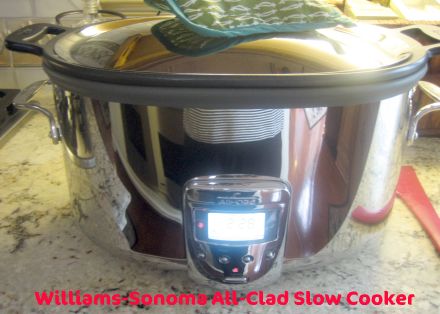
crockpotMy old – and I mean OLD – crockpot dating from the early 1970’s finally bit the dust a few days ago. I’d noticed a hairline crack developing in the ceramic bowl/insert, but thought perhaps it wouldn’t grow. Well, it did. Actually, I was gleeful, since it gave me the reason to buy a new one. And because I have heard my friend Cherrie talking about how much she loves her All-Clad stainless insert slow cooker so much, I knew what I’d be buying. I called her to verify she was still happy with it (yes) and I snooped on the internet hoping to find a better price (uh, no).
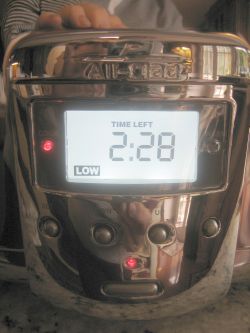
crockpot-timerIt’s only available from Williams-Sonoma. There are other models of the All-Clad Slow Cooker, but the one with the nonstick coated aluminum insert is only available from Williams-Sonoma. (Well, e-bay had a couple, but I decided I wasn’t up to the game of bidding on them – I never seem to get what I want.) New, at Williams-Sonoma, it’s $279. I really needed to WANT this thing to pay that for a crockpot. But oh, is it ever fun. There are two important reasons to buy this: (a) you can brown food in this insert – it’s a metal pan. It can go right on the stovetop and can stay on the stovetop if you want; and (b) the crockpot housing has a programmable control on it – for high heat, low heat and warm, and can be changed to cook for as many hours as you want it to. Well, maybe there’s an upper limit, but if so I don’t recall reading it. It has a lighted LCD control panel on it so you know when it’s on. Once you’ve cooked for as many hours as you’ve selected, it switches to the warm setting for awhile in case you’re late.

(2) The Chicken Paprikash
The first night I cooked in it, it truly was a one-pot dinner. I sauteed onion, red bell peppers, mushrooms and garlic for awhile on the stovetop (in the insert), then put it into the crockpot base, added some chicken broth, sliced up raw chicken thighs, and the paprika, and let it stew away for about 5 or 6 hours. Using the recipe I had, I added some light sour cream mixed with flour to the crockpot mixture and let it sit for awhile. But it took longer to come to a simmer again, so I merely removed the insert and put it back on the range to bring it to a slow simmer until it reached the degree of thick that I wanted. SO easy. And really good, deep flavor. The paprika combination I used has a bit of heat to it, but not a lot. Adjust to suit your tastes. You can buy good paprika at penzeys.com, or perhaps at other specialty spice merchants.
printer-friendly PDF

Crockpot Chicken Paprikash

Recipe: Adapted from Kristen T at www.a-crock-cook.com
Servings: 4
NOTES: If you don’t have the varieties of paprika mentioned, just use what you have. You can buy the smoky paprika in upscale groceries here in the U.S.
Serving Ideas: Can be served over rice as an entree (as long as the paprikash gravy is thick enough) or as a thickened kind of paprikash soup without rice or carbs.

3 cups mushrooms — washed and sliced
2 medium onions — chopped
3 whole garlic cloves — minced
1 whole red bell pepper — chopped
1 1/2 teaspoons paprika — use half-sharp if you have it
1/2 teaspoon smoky paprika — if you have it
3/4 teaspoon salt
1/2 teaspoon black pepper
1 cup chicken broth
1 pound boneless chicken thighs — skinless
3 tablespoons all-purpose flour — approximately
1 cup low-fat sour cream

1. Heat a nonstick skillet. Add mushrooms, onion, garlic and pepper; sauté 5 minutes. Stir in paprika, salt and pepper; cook 30 seconds more. Spoon mixture into a 4- to 5-quart slow cooker; add broth.
2. Cut each chicken thigh into long strips; add to slow cooker. Cover and cook on low setting for 5 to 6 hours.
3. Stir together flour and sour cream in a small bowl; stir into chicken mixture.
4. Turn crockpot to high, cover and cook on low until the mixture is thick and hot, about 10-20 minutes more. Yields about 1 1/2 cups per serving. Great served as a sort of thick soup, or over rice!
Per Serving: 273 Calories; 9g Fat (31.6% calories from fat); 23g Protein; 23g Carbohydrate; 3g Dietary Fiber; 66mg Cholesterol; 719mg Sodium.

A year ago: Hot, Spicy Tofu Herb Dip (you’d think it was made with sour cream – honest)

Posted in Pork, Soups, on January 27th, 2009.

pork-chile-verde

What you see in the photo above is leftover strips of pork from the roast with spicy apricot sauce & glaze I made last week. I don’t know about you, but I am perplexed with what to do with leftover pork roast. You have that trouble too? We are able to eat the leftover roast slices a time or two (we’ve had two dinners so far), but – then what? So my friend Cherrie said she makes a crockpot full of chile verde. Wow, what a good idea!

I made a chile verde from scratch last year sometime, and although it was good, I thought it was a lot of work and over-done with the anaheim and poblano chiles. So I wanted to try a different recipe. I went to the ‘net and found a Susan Feniger and Mary Sue Milliken recipe from the Food Network. I just adapted it to the crockpot since Cherrie told me 8-10 hours would not dry out the meat. And indeed it didn’t.

All I did was pile in the fresh chopped vegetables to the crockpot (onion, anaheims, poblanos, tomatillos and garlic, and no, I didn’t skin or roast the chiles), then I added chicken broth (as always, I used Penzey’s chicken soup base concentrate and boiling water), cumin, oregano and a bit of salt. After it stewed for awhile at high temp (probably an hour), I added the pork (tossed with just a bit of flour to help thicken the broth) and cilantro. I stirred it a few times during the hours it crockpot-ted away, and in about 7 hours it was done. The savory aromas floating around the house were wonderful, making me go taste the soupy liquid in the pot. I did have to add some salt, but that was it. The chiles used are not fiery hot ones – poblanos have a wonderful deep flavor – I don’t eat them raw – but once cooked they’re quite mild. I actually forgot to add the jalapenos to the stew and didn’t miss it. It had enough heat without it.

Chile Verde is traditionally served over rice, but not wanting to eat the carbs, I merely served it in a wide soup bowl as a kind of stew/soup. I didn’t miss the rice at all. I scooped portions into freezer bags and they’re all ready to go into my frozen soup and stew library. The lean, very lean pork probably doesn’t have that much fat in it, so I think this qualifies as a healthier meal. I liked this version much better than the last one. My DH isn’t all that crazy about Mexican food, generally, so this wasn’t his favorite, but I enjoyed it a LOT. There wasn’t a speck of fat that congealed once it had chilled, and it was very filling, even without rice. If you’re sensitive to hot chiles, use less of all of them. When I served this meal the second time we ate it like soup, with some low-fat sour cream in a little blog in the middle, with some crumbled-up tortilla chips on top. My DH liked that much better – he thought the sour cream cut some of the pepper-ness of the mixture.
printer-friendly PDF

Crockpot Pork (from leftovers) Chile Verde

Recipe: Adapted from a Food Network recipe by Mary Sue Milliken & Susan Feniger, 1997
Servings: 8
NOTES: This recipe makes a fairly large amount – you’ll need a large sized crockpot if you make the full recipe. Once I filled the crockpot with the onions and chiles, it was full, so needed to wait until some of the vegetables had cooked down a bit before I added the cooked pork.

3 pounds pork loin, lean, boneless — cooked, trimmed of any fat
3 tablespoons flour
CHILE VERDE:
3 whole yellow onions — chopped
3 whole Anaheim chili peppers — cut into 1-inch cubes, or narrower strips
3 whole Poblano chiles — cut into 1-inch cubes
2 whole jalapenos — seeds removed, and finely chopped (optional)
3 whole garlic cloves — peeled and finely chopped
1 pound tomatillos — roasted, peeled and chopped
1 tablespoon dried oregano
2 teaspoons ground cumin
2 tablespoons coriander seeds — crushed and soaked in a scant amount of water
2 whole bay leaves
1 bunch cilantro — cleaned and chopped
4 cups chicken stock

1. Into the crockpot place the onions, chiles, tomatillos and garlic. Add the cumin, oregano and coriander seeds and stir well. Add the bay leaf. Add the chicken stock (heated, or use a concentrate and boiling water) and allow to simmer for about an hour or two.
2. Toss the pork slices in the flour and add to the crockpot (cut up whatever way you’d like, but bite-sized chunks are good) and the cilantro. Stir this in to the chile mixture, put on the lid and allow to simmer for 6-7 hours.
3. Adjust the seasoning to taste with salt and pepper. Serve with rice, if desired. Serving Serving Ideas: Ideally this should be served with rice. If you are watching carbs, serve it in a wide soup bowl without any carbs at all. Dollop with sour cream and tortilla chips if desired.
Per Serving: 278 Calories; 9g Fat (28.7% calories from fat); 33g Protein; 15g Carbohydrate; 3g Dietary Fiber; 77mg Cholesterol; 1142mg Sodium.

Posted in Pasta, Salads, Travel, Veggies/sides, on January 26th, 2009.

curry-pasta-salad

The story about this recipe is certainly unusual. (I love these kinds of providences.) My friend Joan H. brought this pasta salad to our investment club Christmas potluck last month. In my effort to pass on carbs, I chose the protein and green salads instead. Then somebody raved about the pasta salad, and someone else told me that I really needed to try it because it was different. Oh my, was it ever! The group eating at my table determined right away there was curry in it, but it took me a few bites before I detected chutney. It was later that I learned it was Joan’s contribution, so I immediately sought her out at our gathering. Knowing that Joan frequently makes her own chutney, I thought perhaps this was a new recipe from her native South Africa. Well, no, it wasn’t. In case you’re interested, I have one of Joan’s recipes on my blog already – her South African Bobotie – a kind of ground beef casserole that is served with chutney.

cottage-namibia

Joan (pictured right with another friend, Jackie) and her husband Scott put together an extensive trip to Africa some months ago. It was while their group was staying at a lodge in Namibia that they had a buffet dinner at the n’Kwazi Lodge Randu, on the Caprivi Strip of the Okavongo River. One of the owners of the lodge, Valerie Peypers, provided the recipe for Joan. The curry proportion below is a namibia-resortguesstimate, as the original, pencil-scribbled recipe said one spoonful. Well, how big a spoonful is that? In a Namibia kitchen for a much larger quantity that could have been a huge soup spoon. Or, who knows. The curry flavor, however, was quite prominent, so 1 1/2 tsp. may be quite insufficient to your tastes. Use your own judgment on how much to add and taste it as you go! I’ve cut down the sauce part by half to make it a bit more manageable for a home kitchen, but still the quantity of curry powder is up to you. So is the quantity of pasta to sauce mix, but Joan uses the below proportions.

entertainmentAbove left is a photo of the resort itself. The photo at right shows the evening entertainment. Thanks, Scott, for the photos!
printer-friendly PDF

Curry Sauce Pasta Salad

Recipe: n’Kwazi Lodge Randu, Namibia
1/2 cup vinegar
1/2 cup fruit chutney (Joan used store-bought this time)
1/2 cup vegetable oil
1/2 cup sugar
1/2 cup tomato sauce
1 1/2 teaspoons curry powder (or more, to taste)
3/4 cup cherry tomatoes, halved
1 pound pasta of your choice, cooked and drained

1. Combine all dressing ingredients and allow to sit for an hour before adding to your choice of cooked and cooled pasta. Save a little bit of dressing to add just before serving. Joan used corkscrew pasta, which was nice so the little bits of chutney could cling to the crevices.
2. Add some chopped tomatoes or other vegetables if you choose, either in the salad or as a garnish. Refrigerate until cold. Taste for seasoning (salt, perhaps) and just before serving add just a little bit more sauce and serve.
Per Serving: 270 Calories; 8g Fat (25.3% calories from fat); 6g Protein; 45g Carbohydrate; 2g Dietary Fiber; 0mg Cholesterol; 53mg Sodium.

Posted in Uncategorized, on January 25th, 2009.

This report comes from Epicurious. It’s already gone missing from the website, so I can’t give credit where it’s due, other than to tell you that’s where it came from a few days ago. The links contained within this are ones provided by epicurious. My comments are in blue.

1.    “Value” is the new “Sustainable”
These days, the economy dictates our cooking and shopping decisions: Bargains are in, no matter where they come from. [Think fast food, cheap food. Yuk.]

2.    The Compost Pile is the new Flower Garden
Growing your own now refers to vegetables, not just herbs, and that will in turn help feed the gardener’s compost pile. Live worm garnishes, however, will not make it to the house salad. [I do have herbs in my garden.]

3.    Peruvian is the new Thai
You thought Peruvian cuisine was all about seviche, maybe? Guess again: Peru boasts culinary influences from Spanish, Basque, African, Chinese, Japanese, Italian, French, and British immigrants. Pisco Sour, anyone? [I don’t think we have Peruvian in our neck of the woods, but maybe I’ll have to go look.]

4.    Noodle Bars are the new Sushi Joints
With some seafood being suspect or overfished and raw fish prices high, noodles make complete sense. If there’s no ramen, udon, or soba shop in your neck of the woods, there will be soon. [Here in Southern California, Vietnamese Pho -soup – shops are extremely popular and most contain noodles.]

5.    Ginger is the new Mint
Move over, mojitos. Ginger beers and ginger cocktails(like the Ginger Rogers, Gin Gin Mule, and Ginger Smash) are bubbling up at places like The Violet Hour in Chicago, the Clock Bar in San Francisco, and Matsugen in New York. [I’ve been on the ginger bandstand for years and years.]

6.    Smoking is the new Frying
You know how everything tastes better fried? Well, almost everything tastes better smoked, too, and that includes cocktails. Bartenders are smoking their bourbons (Eben Freeman at Tailor,for example), and chefs, recognizing the national craze for BBQ, are smoking more than just salmon and ribs: nuts, salts, even smoked steelhead roe (at Chicago’s Alinea). Who says smoking’s bad for you? [Oops, we don’t own a smoker . . . ]

7.    Regional Roasters are the new Starbucks
It’s come full circle. What started as a local coffee phenomenon migrated to other cities and turned Americans into java junkies. Then the chain overexpanded and overreached, and the little neighborhood coffee roasters thrive again, like Stumptown (Portland, OR), Bluebottle (San Francisco), and La Colombe (Philly). [Well, we’re fans of Peet’s coffee beans, actually and I prefer their coffee drinks – they do awesome foam – to any others.]

8.    Portland (Maine) is the new Portland (Oregon)
Abundance of great chefs, restaurants, and local foodies? Check, check, and check. Want examples? Visit Five Fifty-Five, Hugo’s, and Fore Street to start.

9.    Rustic Food is the new Molecular Gastronomy
Wacky-weird-science cuisine that requires fancy-schmancy equipment doesn’t necessarily make food taste better, and more often than not it adds needless complexity (there are exceptions). Most importantly, no one really wants to do this at home. Expect to see comfort food stage a comeback. Again. [They say that recessions and other financial problems bring on our cravings for comfort foods.]

10.  “Top-Rated” is the new “Critic’s Pick”
Power to the people; single critics are a dying breed. Why believe what one person says when you can read and reflect on what hundreds think? [I’ve used zagat and other restaurants guides and sites for years, particularly in new locations.]

Posted in Cookies, on January 24th, 2009.

obama-cookie

Cooking is cooking, and I don’t let politics influence my interest in all-things-cooking or baking. So since it’s timely and history-making, I’m sharing this recipe for Michelle Obama’s shortbread cookies. This week I attended my usual monthly book club meeting and the co-hostess had brought these cookies to share. We have a few very vocal Obama fans in our group. It was the day after the inauguration, and she announced to us all that we needed to do our part. No problem!

Family Circle Magazine has done this interesting poll for several presidential elections, I found. They asked the wives of both candidates to submit their favorite cookie recipe and the reading audience votes online for which cookie they liked. In each case, for several elections, the poll on cookies has picked the winner of the elections. Guess we’ll  never know whether the voting was rigged! Anyway, Michelle Obama’s recipe won against Cindy McCain’s oatmeal butterscotch cookies. I’m not a particular fan of shortbread, actually (usually too rich), but these were quite good, all things considered. I liked the hazelnuts on it.

Apparently (one of the web sites I searched had comments) the shortbread recipe comes from a Fannie Farmer Cookbook, and has just minor changes to it. I thought the cookies were quite good. Our book club co-hostess added currants and hazelnuts in hers, but you can add your choice of nuts or fruit. The Ritz-Carlton served these cookies (with almonds on top) on Tuesday, inauguration day.
printer-friendly PDF

Michelle Obama’s Shortbread Cookies

Servings: 72
NOTES: Sleuthing on the internet says the recipe doesn’t make 72 cookies (2 x 3 inches each). Some found the dough crumbly and it broke apart. If yours is too crumbly, try adding a bit more amaretto or a bit of water.

1 1/2 cups unsalted butter — (3 sticks) softened
1 1/2 cups sugar — plus 2 tablespoons for top
2 whole egg yolks
2 tablespoons amaretto — or almond flavoring plus water to = 2 T.
1/2 teaspoon orange zest
1/2 teaspoon lemon zest
3 cups cake flour — not self-rising flour
1/4 teaspoon salt
1 whole egg white — beaten
1/2 cup dried currants — or your choice of dried fruit
1/2 cup hazelnuts — or your choice of nuts
1. Heat oven to 325°F. Line a 17 x 12 x 1-inch baking pan with nonstick foil. In large bowl, cream together butter and 1-1/2 cups of the sugar.
2. Slowly add egg yolks, and beat well until smooth. Beat in Amaretto and zest.
3. Stir in flour and salt until combined.
4. Spread dough evenly into prepared pan, flattening as smoothly as possible.
5. Brush top of dough with egg white; sprinkle with nuts or fruit (if using) and with remaining 2 tablespoons sugar.
6. Bake at 325°F for 25 minutes or until brown, turn off oven and allow cookies to sit in oven (with door ajar) for 15 minutes. Cut while slightly warm.
Per Serving: 78 Calories; 5g Fat (52.4% calories from fat); 1g Protein; 9g Carbohydrate; trace Dietary Fiber; 16mg Cholesterol; 9mg Sodium.

A year ago: Carrot Ginger Slaw

Posted in Veggies/sides, on January 23rd, 2009.

wild-brown-rice

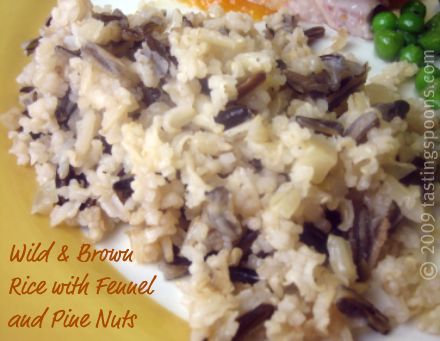
For a dinner party last weekend I wanted a fairly neutral carb. Not some highly seasoned or distracting kind of carb that wouldn’t complement the pork roast with spicy apricot glaze I was serving for a main dish. Rice seemed like the right fit. I turned to a cookbook that I don’t refer to very often – the San Francisco Chronicle Cookbook. Now, brown rice isn’t exactly my favorite thing. It is nutty. Chewy. Healthier for us. But it doesn’t have any flavor to me. White rice is bland too, but with some salt and pepper, and maybe a tetch of butter, I could enjoy some white rice. I mostly don’t fix rice anymore (carbs that I don’t need). But cooking brown  rice that same way kind of leaves me cold. But it’s what I had on the shelf. So I mixed the basmati brown rice with wild rice, onion and fennel, and topped it with pine nuts and Italian parsley.

Nobody at the dinner party said much about the rice – but then the vegetables were festive and tasty, the salad was a big hit, and the pork was amazing, so the fact that nobody said much about the rice is okay. That’s sort of how it should be, I think. I don’t know that I’d add the fennel if I made it again – I couldn’t even taste it. Seems like a waste of a big bulb of fennel to cook the whole thing and not know you ate it, right? The leftovers were tasty enough too. But next time I’d make it with white rice.
printer-friendly PDF

Wild & Basmati Rice Pilaf with Fennel & Pine Nuts

Recipe: From the San Francisco Chronicle Cookbook
Servings: 8

1/4 cup pine nuts
1/2 cup wild rice
4 cups cold water
Salt to taste (it may need more than you think)
1/2 whole onion — diced
1 small fennel bulb — diced (optional)
2 tablespoons butter — plus more at the end
1 tablespoon olive oil
3 whole garlic cloves — minced
1/2 cup vermouth
1 1/2 cups basmati rice — or brown basmati
1/4 teaspoon freshly ground black pepper
2 1/4 cups boiling water
1/4 cup Italian parsley — chopped

1. In a dry nonstick skillet, toast the pine nuts until they’re golden brown, about 5 minutes. Set aside.
2. Rinse the wild rice for a minute under cold water. Bring the 4 cups of water to a boil in a large pot, add some salt to the water and then add the wild rice. Bring to a boil, then cover and simmer for about 35-45 minutes, or until tender. Do NOT overcook it. There is a very short time between just done and overdone when the rice kernels pop open.
3. Meanwhile, saute the onion and fennel in the butter and olive oil over medium heat; season with some salt. When the vegetables begin to soften add the garlic for one minute, then add the wine. Cook for about 5 minutes, until the wine reduces. Add the basmati rice and saute for 5 minutes, stirring frequently. Add more salt if needed, the pepper and the boiling water. Bring back to a boil and simmer, covered, for about 20 minutes until the liquid has evaporated.
4. Drain the wild rice.
5. Toss the pilaf with the cooked wild rice, the pine nuts and parsley. Season with more salt and pepper and serve immediately. You may also put this into a casserole dish (covered) and bake for about 40 minutes at about 300 degrees.
Per Serving: 253 Calories; 8g Fat (29.0% calories from fat); 6g Protein; 36g Carbohydrate; 2g Dietary Fiber; 8mg Cholesterol; 79mg Sodium.

Posted in Pork, on January 22nd, 2009.

pork-apricot-glaze

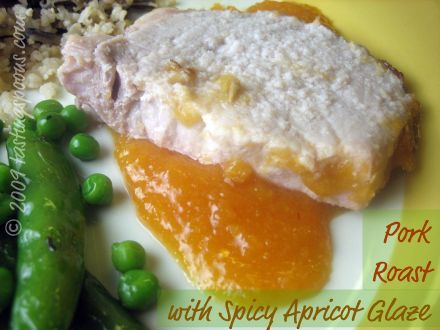
Pork these days, as you probably know, is so lean you have to use some more extreme measures to make sure it’s tender and juicy. We had a group of friends for dinner recently and I decided to do a pork roast. Dave did the shopping for me and bought a Costco boneless roast. Having had these before I knew it might be dry and tough if I didn’t make it otherwise. He bought a really large roast (much larger than the recipe calls for) so it took longer to roast, and I have lots of leftovers of the very tender, juicy meat.

What did I do? (1) I brined the pork roast for 24 hours; (2) I made a spicy apricot glaze and sauce to give it some zip; and (3) I used a meat thermometerto make sure we didn’t overbake it. All successful, I’m glad to report.

The recipe came from Hugh Carpenter’s book, Hot Barbecue. This guy, Hugh, is one helluva-good recipe creator. I’ve made apricot sides and sauces for pork before, but never with the flavor and zip this one had. This likely will be my new go-to recipe for pork. Everybody raved about it and I did too. I actually forgot to add the sesame seeds, green onions and cilantro to the sauce. It was great without, but if I made it again, I’ll definitely do so. The sauce is zippy hot (from the ginger and the Asian chile sauce added). I think the sauce would go well with chicken too.

The recipe indicated to remove the roast at 160°, but I took it out at about 152° and let it sit for about 15 minutes tented lightly with foil. The center of the loin was still medium-pink, but it was ever-so-juicy. It was 157° when I removed the meat thermometer and we began slicing.
printer-friendly PDF

Pork Loin (Roast) with Spicy Apricot Glaze & Sauce

Recipe: Hugh Carpenter, Hot Barbecue
Servings: 4
NOTES: If you purchase a much larger pork roast to make this, don’t make more sauce, as this portion makes ample for probably 8-10 people. If you’re sensitive to spicy heat, reduce the chile sauce by half. This roast can also be done on a grill (also at 350°), or smoked (at 220°). Remove when meat has reached 155° to 157°.

1 1/2 pounds pork loin
Cooking oil to brush on grill rack, if grilling
SPICY APRICOT GLAZE AND SAUCE:
16 whole dried apricots — Turkish preferred (Trader Joe’s)
1 1/2 cups apricot nectar
3/4 cup sugar
1/2 cup distilled vinegar
1/2 cup water
1 tablespoon Asian chile sauce — or less, not more
1 teaspoon salt
1/3 cup minced ginger
3 whole garlic cloves — minced
2 tablespoons sesame seeds
2 whole green onions — minced
1/4 cup cilantro — chopped

1. If desired, brine the meat first, for 24 hours (I do). Several hours before cooking remove pork from brine and dry off with paper towels. Let sit out at room temp.
2. Trim off and discard any excess fat from the pork.
3. APRICOT SAUCE: In a non-reactive saucepan combine the apricots, nectar, sugar, vinegar, water, chile sauce, salt, ginger and garlic. Bring to a low boil, reduce the heat to a simmer, cover, and cook for 30 minutes. Let cool to room temp, then puree in a blender until completely smooth. Transfer to a bowl. Place the sesame seeds in a dry skillet and toast over medium heat until golden. Add the sesame seeds, green onions and cilantro to the glaze. Can be made ahead and refrigerated, but don’t add the sesame seeds, onions and cilantro until just before serving.
4. Make sure the pork has reached 60 degrees F before baking. Use about 1/3 of the apricot glaze to slather over the roast during the last hour before cooking.
5. Preheat oven to 350°. Insert a meat thermometer into a thick part of the meat, not touching any fat or bone. Brush the pork with a bit more of the apricot glaze a couple of times during the roasting process. Roast pork until the internal temperature reaches 155° degrees F, remove and allow to sit for about 10 minutes tented lightly with foil.
6. Place each slice of pork on a bed of the apricot sauce and pass the remainder in a bowl at the table. Be SURE to either heat all the plates; otherwise the pork will be cold by the time people begin to eat it.
Per Serving (assumes you consume all the glaze/sauce, which you won’t – note that each serving only has 11 grams of fat, so the high calories is in the carbs – the sugar and fruit – and you only use about 2 tablespoons or so per serving): 1626 Calories; 11g Fat (5.4% calories from fat); 42g Protein; 378 grams Carbohydrate; 48g Dietary Fiber; 53mg Cholesterol; 640mg Sodium.

Related Posts Plugin for WordPress, Blogger...