Get new posts by email:

Archives

Currently Reading

Here are the tastingspoons players. I’m in the middle (Carolyn). Daughter Sara on the right, and daughter-in-law Karen on the left. I started the blog in 2007, as a way to share recipes with my family. I’m still doing 99% of the blogging and holding out hope that these two lovely and excellent cooks will participate. They both lead very busy lives, so we’ll see.

– – – – – – – – – – – – – – – – – – – – – –

BOOK READING (from Carolyn):

Music of Bees, Eileen Garvin. Absolutely charming book about a woman in midlife, lonely, who raises bees, also makes unlikely friends. Heart-warming and very interesting about beekeeping.

A Postcard from Paris, Alex Brown. Really cute story. Dual time line, 1940s and present day about renovating an old apartment in Paris, things discovered.

Time of the Child, Niall Williams. Oh such a good book. Very small village in Ireland, 1960s. A baby is left on the doorstep. The town all whispers and helps. I listened to an interview of the author, which made me like him and his books even more.

Sipsworth, Simon Van Booy. If you like animals you’ll swoon. An old woman who really wants to die finds a tiny mouse in her house and befriends it and finds a reason to live. Utterly charming book.

The Forger’s Spell, Edward Dolnick. True story. For seven years a no-account painter named Han van Meegeren managed to pass off his paintings as those of Johannes Vermeer.

If You Lived Here, You’d be Home by Now, Christopher Ingraham. Could hardly put it down – about a journalist who takes on a challenge to move to small town in Minnesota and write about it. He expects to hate it and the people and place, but he doesn’t. Absolutely wonderful true story.

The River We Remember, William Kent Kreuger. 1950s, Minnesota. A murder and the aftermath. Could hardly put it down. Kreuger has such a vivid imagination and writing style.

How the Lights Gets In, Joyce Maynard. An older woman returns to New Hampshire to help care for her brain-injured son. Siblings and family, lots of angst and resentments.

The Filling Station, Vanessa Miller. Every American should read this book. A novelized retelling of the Tulsa massacre in 1921. Absolutely riveting.

The Story She Left Behind, Patti Callahan Henry. Love this author. Based on a true story. A famous author simply vanishes, leaving her husband and daughter behind. She had invented a mystical language no one could translate. Present day, someone thinks he’s solved the riddle, contacts the family. Really interesting read.

The Girl from Berlin, Ronald Balson. Love anything about Tuscany. An elderly woman is being evicted from a villa there, with odd deed provenance. Two young folks go there to help unravel the mystery. Loved it.

The Island of the Colorblind, Oliver Sacks, M.D. Nonfiction. The dr is intrigued by a remote Pacific island where most of the inhabitants are colorblind. He also unravels a mystery on Guam of people born with a strange neurological problem. Medical mysteries unveiled. Very interesting.

The Bookbinder, Pip Williams. Post 1914 London. Two sisters work at a bookbindery. They’re told to not read the books. One does and one doesn’t. One has visions beyond her narrow world; the other does not. Eventually the one gets into Oxford. Lovely story.

The Paris Express, Emma Donoghue. 1895 on a train to Paris, a disaster happens. You’ll delve into the lives of many people who survived and died in the crash.

A Race to the Bottom of Crazy, Richard Grant. This is about Arizona. Author, wife and child move back to Arizona where they once lived. Part memoir, research, and reporting in a quest to understand what makes Arizona such a confounding and irresistible place.

The Scarlet Thread, Francine Rivers. A woman’s life turned upside down when she discovers the handcrafted quilt and journal of her ancestor Mary Kathryn McMurray, a young woman who was uprooted from her home only to endure harsh frontier conditions on the Oregon Trail.

A Place to Hide, Ronald Balson. 1939 Amsterdam, an ambassador has the ability to save the lives of many Jewish children. Heartwarming.

Homeseeking, Karissa Chen. Two young Chinese teens are deeply in love, but in China. Then their families are separated. Jump to current day and the two meet again in Los Angeles.

North River, Pete Hammill. He always writes such a good story. A doctor works diligently healing people from all walks of life. His wife and daughter left him years before. One day his 3-yr old grandson arrives on his doorstep.

A Very Typical Family, Sierra Godfrey. A very messed-up family. Three adult children are given a home in Santa Cruz, Calif, but only if the siblings meet up and live in the house together. A very untypical scenario but makes for lots of messes.

Three Days in June, Anne Tyler. The usual Anne Tyler grit. Family angst. This wasn’t one of my favorites, but it was entertaining and very short.

Saved, Benjamin Hall. Author is a veteran war reporter. Ukraine, 2022, he nearly loses his life to a Russian strike. Riveting story – he survives, barely.

Grey Wolf, Louise Penny. Another Inspector Gamache mystery in Quebec. She is such an incredible mystery writer.

All the Colors of the Dark, Chris Whitaker. A missing person mystery, a serial killer thriller, a love story, a unique twist on each. Could hardly put it down.

Orbital, Samantha Harvey. Winner of 2024 Booker Prize. I don’t usually like those, but I heard the author interviewed and she hooked me. This is not a normal book with a beginning, a story and an end. It’s several chapters of the day in the life of various astronauts at the ISS (Int’l Space Station). All fictional. She’s been praised by several real astronauts for “getting it” about space station everyday life.

The Blue Hour, Paula Hawkins. An island off Scotland. Inaccessible except when the tide is out. Weird goings on. An artist. A present day mystery too.

Iron Lake, William Kent Krueger. A judge is murdered and a boy is missing. Riveting mystery.

Tell the Wolves I’m Home, Carol Ricks Brunt. 1980s. A 14-yr old girl loses her beloved uncle. Yet a new friendship arises, someone she never knew about.

Four Treasures of the Sky, Jenny Zhang. 1880s, a young girl is kidnapped in China and brought to the United States. She survives with many hurdles in the path.

The Boy Who Fell out of the Sky, Ken Dornstein. Memoir, 1988. The author’s brother died in the PanAm flight that went down in Lockerbie, Scotland. A decade later he tries to solve “the riddle of his older brother’s life.”

Worse Care Scenario, T.J. Newman. Oh my. Interesting analysis of what could/might happen if a jet crashed into a nuclear plant. Un-put-downable.

Song of the Lark, Willa Cather. Complicated weave of a story about a young woman in about 1900, who has a gifted voice (singing) and about her journey to success, not without its ups and downs.

Crow Talk, Eileen Garvin. Charming story which takes place at a remote lake in Washington State, about a few people who inhabit it, the friendships made, but also revolving around the rescue of a baby crow.

The Story Collector, Evie Woods. Sweet story about some dark secrets from an area in Ireland, a bit magical, faerie life, but solving a mystery too.

A Sea of Unspoken Things, Adrienne Young. A woman investigates her twin brother’s mysterious death. She goes to a small town in California to figure it out, to figure HIM out.

The King’s Messenger, Susanna Kearsley. 1600s England, King James. About one of his trusted “messengers,” and his relationship with a young woman also of “the court.” Lots of intrigue.

In the Shadow of the Greenbrier, Emily Matchar. Interesting mystery in/around the area of the famous resort in White Sulphur Springs, West Virginia.

Isola, Allegra Goodman. Hard to describe, survival story on an island in the 1600s.

Save the Date, Allison Raskin. Rom-com, witty, LOL funny. Clever.

The Sirens, Emilia Hart. Numerous time-lines, Australia. Mysteries abound, nightmares, abandoned baby, weird allergies.

Red Clay, Charles Fancher. LOVED this book. Mostly post-Civil War story about the lives of slaves in Alabama during Reconstruction.

Stars in an Italian Sky, Jill Santopolo. Dual time line, 1946 and recent time. Love stories and a mystery.

Battle Mountain, C.J. Box. Another one of Box’s riveting mysteries. Love his descriptions of the land.

Something Beautiful Happened, Yvette Corporon. A memoir of sorts in Greece, tiny island of Erikousa, where the locals hid Jews during WWII. All elusive stories told by the author’s grandmother.

The Jackal’s Mistress, Chris Bohjalian. 1860s Virginia, about a woman who saves the life of a Union soldier. Really good story.

Song of the Magpie, Louise Mayberry. Really interesting story about Australia back in the days when it was mostly a penal colony. Gritty strength of a woman trying to thrive with her farm.

The Boomerang, Robert Bailey. A thriller that will have you gripping the book. About a lot of secrets surrounding the president (fictional novel, remember) and his chief of staff and about cancer. A cure. Such a good story.

Care and Feeding, Laurie Woolever. Really interesting memoir of a woman driven to succeed in the restaurant business. She worked for Mario Batali and then Anthony Bourdain. Gritty stories.

Everything is Tuberculosis, John Green. Maybe not a book for everyone. A real deep dive into the deadly tuberculosis infection, its history. I heard the author interviewed and found the book very interesting.

The Book Lovers Library, Madeline Martin. Fascinating read about Boots’ drug stores’ lending library. And the people who worked in them.

The Arrivals, Meg Mitchell Moore. LOL funny, about a middle-aged couple whose children (and their various family members) return to the family home and the chaos that ensues.

My Life as a Silent Movie, Jesse Lee Kercheval. About grief. A big move to Paris, finding herself a new life with a new set of real blood family.

Escape, Carolyn Jessop. Another memoir about a woman really in bondage in Utah, Mormon plural marriage.

 

Tasting Spoons

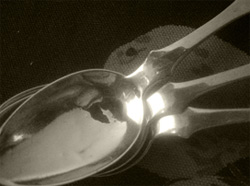
My blog's namesake - small, old and some very dented engraved silver plated tea spoons that belonged to my mother-in-law, and I use them to taste my food as I'm cooking.

Scroll down to the bottom to view my Blogroll

Posted in Veggies/sides, on January 21st, 2009.

pea-pods-and-peas

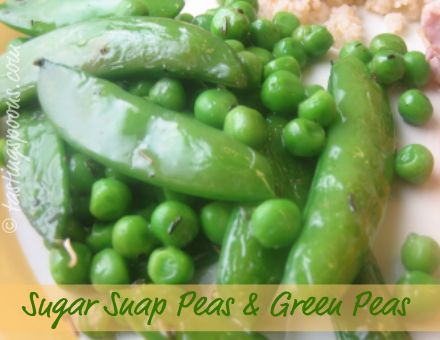
When you want a very tasty, VERY green, and very EASY side dish, this will fill the bill. The only hitch is that it must be made at the last minute in order to keep the peas fresh and bright green. Peas can go from perfect to over-the-hill in no time flat. These were seasoned with some crumbled thyme (dried) and a couple of pinches of sugar. Some salt and pepper and you’re done. I sauteed them in a mixture of extra virgin olive oil and butter.
printer-friendly PDF

Sugar Snap Peas & Petite Green Peas

Recipe: Adapted from Phillis Carey’s book, Fast & Fabulous Entertaining Menus
Servings: 6

1 tablespoon unsalted butter
1 tablespoon extra virgin olive oil
1 pound sugar snap peas — stems trimmed
1/2 teaspoon dried thyme
1/2 teaspoon sugar
1 pound frozen peas — petite peas only, defrosted
Salt and pepper to taste

1. Melt butter and oil in a large skiillet over medium heat. Add the sugar snap peas and stir-fry until they’re just bright green, about 2-3 minutes. Add the thyme and sugar and stir to combine.
2. Add the defrosted peas and continue cooking for 2-3 minutes, just until the peas are heated through. Season with salt and pepper to taste. Serve absolutely immediately as these cool fast!
Per Serving: 128 Calories; 4g Fat (31.4% calories from fat); 6g Protein; 16g Carbohydrate; 5g Dietary Fiber; 5mg Cholesterol; 90mg Sodium.

Posted in Salads, on January 20th, 2009.

radicchio-belgian-endive-salad

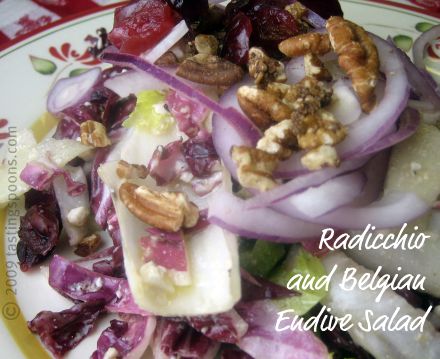
You’re going to l-o-v-e this salad. I really mean it. It’s worth every second of effort to make it. The pecans need to be seasoned and caramelized a little bit, you need to soak the dried cranberries in bourbon (or omit this step if you don’t want the alcohol – soak them in orange juice instead), and you need to chop up all the salad stuff. And, the apple needs to be sliced just before serving. And you have to make the vinegar and oil dressing (easy, however).

This recipe has been in my to-try file for many years. What’s funny about it is the real title – “Even Men Love This Salad.” I found it on the recipe bulletin board at Martha Stewart’s website 15 years or so ago.  (I was unable to locate the recipe there now.) The contributor, Susan (no last name given) said that every time she served it men told their wives to get the recipe. She mentions that yes, indeed, there are lots of flavors floating around in this salad, but she says when you put it all together, it’s sublime. I absolutely agree.

I did make just a few minor changes to the recipe – Susan used black raisins – I used dried cranberries instead. She added frisée greens to her salad. I thought there was enough salad quantity without it (there was) so I omitted the frisée. There’s a LOT of celery in it. Don’t eliminate that – it’s an essential ingredient somehow. The pecans are just mildly warm from the cayenne, but they are wonderful in this salad, or for nibbling if you have leftovers. Susan didn’t soak the onion – I do, to remove some of the harshness, the sharpness of raw onion. I actually tossed everything together except the pecans, but her recipe indicated adding the cranberries, Feta and pecans on top when it’s served. If you eat radicchio and Belgian endive very often, you know that they have a slight bitterness to them. The caramelized pecans and the dried cranberries totally balance that. MAKE THIS SALAD! Okay?
printer-friendly PDF

Radicchio & Belgian Endive Salad with Spicy Pecans

Recipe: adapted from a recipe found on Martha Stewart’s bulletin board, about 1995
Servings: 8

1/2 cup dried cranberries
3 tablespoons bourbon (or orange juice)
PECANS:
1 cup pecans — chopped
1 tablespoon brown sugar
1/2 teaspoon cayenne
1/2 teaspoon ground cumin
SALAD DRESSING:
1/4 cup red wine vinegar — better the quality the better the dressing
1 tablespoon Dijon mustard
3/4 cup extra virgin olive oil
Salt and pepper — to taste
SALAD STUFF:
2 heads radicchio
3 heads Belgian endive — leaves separated, chopped
1/2 medium red onion — thinly sliced
2 medium Granny Smith apple — peeled, sliced
2 cups celery — chopped
1/4 cup Feta cheese — crumbled
1 head
frisée lettuce — (optional)

1. Soak cranberries in bourbon for 2+ hours. You can reuse the bourbon multiple times.
2. Place the sliced onions in cold water and set aside (removes some of the sharpness).
3. In a medium nonstick skillet combine the pecans, sugar, cayenne and cumin. Heat until the pecans are lightly toasted and brown sugar has caramelized. These nuts are not highly caramelized, so don’t expect a coating of sugar.
4. In a jar or small bowl combine the vinegar and mustard. Use a whisk to mix well, and then drizzle in the olive oil until it’s thickened. Season with salt and pepper to taste. Refrigerate dressing until ready to serve. (You will probably use all the dressing.)
5. Chop up the radicchio, Belgian endive, red onion (drained and blotted dry with paper towels), apple and celery and combine with the salad dressing (taste it to make sure you don’t use too much dressing). If using the frisée, add it also. Serve on salad plates and top with cranberries, pecans and Feta cheese.
Per Serving: 331 Calories; 31g Fat (83.1% calories from fat); 3g Protein; 11g Carbohydrate; 3g Dietary Fiber; 4mg Cholesterol; 109mg Sodium.

Posted in Desserts, on January 19th, 2009.


Why don’t I make crème brûlée more often? It’s not hard. Doesn’t take all that much time, either. Maybe it’s because it requires a water bath – that’s a bit of a nuisance – and when you broil them to caramelize the sugar-dusted tops, you need to pack the ramekins in an ice-crowded pan. But other than that, they’re a very simple dessert. And much beloved by most people.

My former business partner, Audré, found this recipe and raved about it. She was in a ginger stage, if there is such a thing, back in the early 80’s. At the time, she liked and wanted ginger in all different kinds of foods, and she told me I just had to make this. I did. Oh my yes. Wonderful.

Some years later I attended a cooking class taught by Hugh Carpenter, and he prepared a type of crème brûlée in which he dotted the bottom of each ramekin with a small glob of raspberry jam. I was enamored with the taste contrast of the raspberry and the crystallized ginger, so have made it that way ever since. But I didn’t have any raspberry jam in the pantry, so I opted to use some ginger jam, spiced ginger jam, to be exact. The tiny pieces of crystallized ginger and the jam stay on the bottom of each ramekin, so you get a nice little surprise when you finally get to the nether reaches of the ramekin.

The ginger lightly perfumes the crème brûlée , but it isn’t until you get into it that you realize the ginger is even there. Be sure to make this in time to chill the finished ramekins so the custard sets up to its smooth goodness.
printer-friendly PDF

Ginger Crème Brûlée

Recipe: Hugh Carpenter’s ‘Pacific Flavors’
Servings: 5

4 large egg yolks
5 1/2 tablespoons sugar
2 cups heavy whipping cream
1 1/4 teaspoons vanilla extract
4 tablespoons crystallized ginger — thinly sliced or minced
2 tablespoons raspberry jam — or ginger preserves (optional)

1. Preheat oven to 350°. In a 2-quart mixing bowl beat yolks with 3-1/2 T of sugar until mixture turns a pale yellow and the sugar is completely absorbed. Use a stand mixer for this if you prefer. Add cream and vanilla and beat well.
2. Place a few slices of the paper-thin sliced crystallized ginger in the bottom of 4 ramekins (or custard cups). Place a large dot of jam in the center of each. Carefully ladle cream mixture into the cups. Place cups into a baking dish which is just large enough to hold them. Add enough warm water to the baking dish to come halfway up the sides of the cups. Bake for 50 minutes. The top of the custard will become golden brown. Remove from oven and cool slightly. Keep in the refrigerator until ready to serve, at least 3 hours or up to overnight.
3. Place 1 T of granulated sugar on the top of each custard and spread to cover. Using a propane torch and a fireproof cooking mitt on your hand, hold tray of custard cups at an angle and caramelize the sugar – about 10-15 seconds. Place on small plate and serve immediately.
4. If you don’t have a propane torch, place cups in baking dish and surround with ice, then broil 2 inches from element, until sugar has browned and is bubbling, about 30 seconds.
Per Serving: 480 Calories; 39g Fat (72.4% calories from fat); 4g Protein; 29g Carbohydrate; trace Dietary Fiber; 301mg Cholesterol; 50mg Sodium.

Posted in Desserts, on January 17th, 2009.

Oooh, were these ever tasty. It’s been some months ago that I made these for a dinner party. In reading through the “recipes to try” in my copious stack, I found this. I’d read about it over at Serious Eats. It’s actually a Daniel Boulud recipe, from one of his cookbooks, was written up by Dorie Greenspan on her own site, but the recipe is over at Serious Eats, a food blog in which she participates.


Here’s a photo of the coffee bean/cardamom/sugar mixture before it began to caramelize.

This dessert is a bit on the complicated side, I will admit. It’s not really difficult, but yes, a bit time consuming. Worth the time? Well, yes, for me it was. The result was a seductive custard, a pot de creme style with this elusive taste of cardamom and the delicious creamy coffee. But it was the cups that attracted me to the recipe at first – seeing the cute little espresso cups Dorie used. I mean, how many of us have espresso cups we rarely use? Eh? I certainly do.

Here are the details: you grind up cardamom pods (I had green ones) in the food processor, then chunk up coffee beans in there too. Not too finely. Then you add that to a heavy-duty saucepan with sugar and heat it, stirring constantly, until the sugar melts. My arm got a tad tired during the stirring process, but you don’t want to burn it, so you have to stir and stir. Finally it began to melt. You continue to stir until the sugar begins to darken, and caramelize. I had some difficulty seeing exactly when that was because I was using a dark colored, nonstick Calphalon pan. Eventually the coffee began smoking, so I figured it was caramelized enough. The stuff is a kind of glumpy dark mass at that point. Then you carefully pour in cream and milk (don’t burn yourself) and heat it until the glumpy mass breaks down and the sugar melts into the milk. You let this mixture steep for about 20 minutes, then strain out the solids (beans & pods). It was a glorious dark coffee latté color.

Meanwhile, you heat up the oven to 300°, and whisk together egg yolks and sugar until they’re pale and thickened. Then you slowly add the coffee mixture and stir until combined. It does make a bit of foam, which needs to be scooped off. I ate the foam right then and there, which was quite delicious.

The mixture is poured into espresso cups and you bake them in a water bath for about 40 minutes. These can be made ahead and refrigerated. I made them earlier in the day and left them out at room temp for about 3 hours. I served them with a small dollop of very lightly sweetened whipped cream on top.

printer-friendly PDF

Coffee-Cardamom Pots de Crème

Recipe: Daniel Boulud, via Serious Eats, via Dorie Greenspan
Servings: 6 (maybe 5)
Cook’s Notes: I used decaffeinated coffee beans because I didn’t want the caffeine in a dessert. Would have kept me up half the night. If possible, use a light colorored pan for the caramel, so you can tell when the sugar caramelizes to the dark amber color required. Have all the caramel ingredients ready at hand when you start – because you can’t leave your post to get something. Measure quantities carefully, as you want to pour the right amount into each espresso cup. I doubled the recipe, used 4-ounce cups, but somehow I didn’t have as much quantity as I should have. This recipe should make 24 ounces (the 3 cups of liquid in the recipe). Measure your espresso cups, but if they’re 4 ounces, you should have exactly 6 servings. Somehow I didn’t get 6 servings, but more like 5. Anyway, take that into consideration when making this.

2 tablespoons cardamom pods
3 ounces coffee beans — (1 cup) preferably an espresso roast
3/4 cup sugar
2 cups heavy cream — (approximately)
1 cup whole milk
7 large egg yolks

1. Have all ingredients at the ready before beginning the caramel. Put the cardamom pods in the workbowl of a food processor and pulse on and off several times to roughly chop, not grind them. Then add the coffee beans to the workbowl and continue to pulse until the beans are rough chopped. Turn the chopped beans and pods into a medium saucepan and add 1/2 cup of the sugar. Put the pan over medium heat and cook, stirring constantly with a wooden spoon, until the sugar starts to melt. Patience-this will take a few minutes. Once the sugar has melted, continue to cook, still stirring without stop, until the sugar caramelizes-you want the color of the caramel to be deep amber. But do not burn the coffee, either. Now, standing away from the stove so you don’t get splattered, slowly pour in 1 cup of the cream and the milk. Don’t panic-the caramel will immediately seize and harden-it will all smooth out as the liquids warm and the sugar melts again. Bring the mixture to a boil and, when the sugar has melted and everything is smooth again, pull the pan from the heat. Cover the pan (we do this with plastic wrap at the Café to get a good seal) and allow the mixture to infuse 20 minutes.
2. Center a rack in the oven and preheat the oven to 300°F.
3. Working in a bowl that’s large enough to hold all the ingredients, whisk the yolks and remaining 1/4 cup sugar together until the mixture is pale and thick. Strain the coffee-cardamom liquid into a measuring cup (discard the beans and pods) and add enough heavy cream to bring the liquid measurement up to 2 cups. Very gradually and very gently-you don’t want to create air bubbles-whisk the liquid into the egg mixture; skim off the top foam, if there is any.
4. Arrange six 4-ounce espresso or custard cups in a small roasting pan, leaving an even amount of space between the cups, and fill each cup nearly to the top with the custard mixture. (If you like, line the roasting pan with a double thickness of paper towel or a kitchen towel to steady the cups.) Carefully slide the pan into the oven; then, using a pitcher, fill the roasting pan with enough hot water to come halfway up the sides of the espresso cups. Cover the pan with plastic wrap (don’t worry – it can stand the heat) and poke two holes in two diagonally opposite corners. Bake the custards for about 40 minutes, or until the edges darken ever so slightly and the custards are set but still jiggle a little in the center when you shake them gently.
5. Remove the pan from the oven and let the custards sit in the water bath for 10 minutes. Peel off the plastic wrap, lift the cups out of the water and cool the custards in the refrigerator. (The pots de creme can be prepared a day ahead and, when cool, covered with plastic wrap and stored in the refrigerator.)
To serve: The pots de creme are at their best at room temperature, so remove them from the refrigerator and keep them on the counter for about 20 minutes before serving.
Per Serving: 465 Calories; 37g Fat (69.9% calories from fat); 6g Protein; 29g Carbohydrate; 0g Dietary Fiber; 362mg Cholesterol; 58mg Sodium.

Posted in Chicken, on January 16th, 2009.

A few days ago I purchased about 5+ pounds of ground turkey at Costco. Definitely a bargain, as long as you have plans as to how to use it all. Half of it went into making some turkey breakfast sausages which now reside in the freezer. The other half I used to make turkey meatballs. I’d seen a Kalyn’s Kitchen recipe for them, and decided to use her formula as my jumping off point. We’re trying to cut down on calories and fat in our house, so making turkey meatballs was a good plan. I just wanted them to be full of flavor.

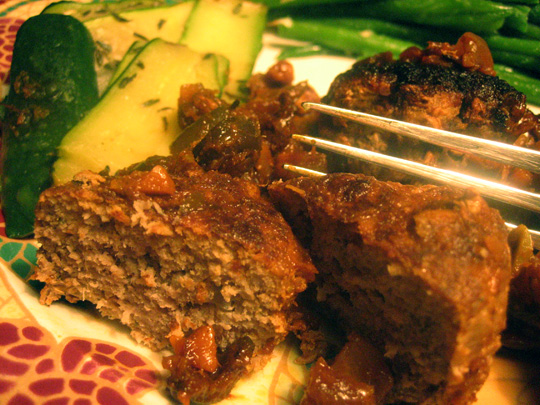
I made very few changes to Kalyn’s recipe. I used fresh garlic, but you could easily use granulated garlic as she did in her recipe. I added some salt and pepper too. Since I had egg whites in the refrigerator, I used those instead of whole eggs, but that’s not any big deal. I added a nip of cayenne too. And, I added some olive oil to the turkey mixture because I found that really added some moisture to the turkey breakfast sausage. I may have used a tiny bit more cheese (I had pecorino in my refrigerator) too. The result? Wonderful. I happened to not have any cucumbers or tzatziki sauce or anything similar, so I opted to use a vegetable/tomato kind of chunky sauce on them instead. We liked them a lot. And now I have about 4 more dinners in the freezer. I made larger meatballs than Kalyn did, so we’ll just eat fewer of them, that’s all.
printer-friendly PDF

Turkey Meatballs with Italian Cheese and Herbs

Recipe: adapted slightly from Kalyn’s Kitchen blog
Servings: 6

1 1/2 pounds ground turkey
1/2 cup Romano cheese — or Parmesan or Pecorino
2 large garlic cloves — finely minced
1 teaspoon sage — rubbed
1 tsp. rosemary — dried
1 tsp. thyme — dried
1/4 teaspoon cayenne
1/4 teaspoon freshly ground black pepper
1/2 teaspoon salt
2 egg whites — or whole eggs, beaten lightly
2 tsp. Worcestershire sauce
2 tablespoons olive oil — plus more for sauteing the meatballs

1. Take ground turkey out of the refrigerator, put into medium-sized plastic bowl, and let come to room temperature for 20-30 minutes. While turkey is warming, use a spice grinder to pulse the dried herbs: sage, rosemary, cayenne and dried thyme (or use a mortar and pestle) and grind until it’s fairly fine. (If you’re making these meatballs for kids, Kalyn recommends a smaller amount of herbs, especially the sage and rosemary, since those are fairly strong flavors.)
2. When meat is room temperature, sprinkle ground herbs and your cheese of choice over the meat. Beat together egg and Worcestershire sauce, and pour over, plus the salt and pepper, minced garlic and olive oil. Wash hands, then use your hands to mix everything into the turkey. (Try not to overmix, just squeeze together until it’s combined and there are no more streaks of herbs visible)
3. Use a spoon (or a cookie scoop) to scoop out same-size pieces of meat and form into individual meatballs (about 30) by rolling them between your hands. (The mixture will be soft, but it will firm when the turkey is cooked.) When all meatballs are rolled, heat 1 T olive oil in a large non-stick frying pan, making several batches, as needed. Do not crowd the meatballs or they will be too difficult to turn over (they’re very soft until they cook).
4. Fry meatballs over medium heat, turning every few minutes to a new side or edge, until all meatballs are well browned and done through, about 15 minutes. Cut one in half to be sure the inside is done, or test with a meat thermometer to be sure the temperature is at least 165F for ground turkey. Serve hot. These would taste great with Tzatziki Sauce or a Creamy Cucumber Sauce.
Per Serving: 255 Calories; 16g Fat (59.1% calories from fat); 24g Protein; 2g Carbohydrate; trace Dietary Fiber; 99mg Cholesterol; 431mg Sodium.

Posted in Beef, Essays, on January 15th, 2009.

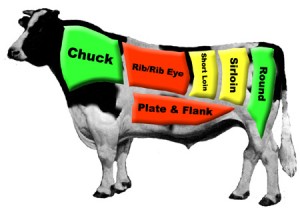
I was reading through a rather lengthy article in the January/February issue of Cooking Light, and was quite fascinated by some of the info. No matter how much I think I know, there’s always more to be learned about the different cuts, the methods of cooking, and how lean or fatty any cut is . . .

The article was titled “How to buy the best beef,” and was written by Aliza Green, the author of a new book titled Field Guide to Meat. Photo at left is from the article itself.

How about these factlets: (1) we Americans consume 63 pounds of beef a year (wow, no kidding?);(2) In 1976 we ate 89 pounds per person per year (yikes); (3) 90% of the beef we eat is grown right here in the U.S., with most of the balance coming from Canada; (4) cattle weigh about 1000 pounds at slaughter, and are 18-24 months old.

The article went on to explain about what info you can get from the new labeling laws. I knew most of that part. But it also gave a more detailed explanation of grain-finished– cattle fattened on grain, usually corn, during the 3-6 months before slaughter. Problem is that cattle don’t instinctively eat corn, so when they do they experience “stress” and other ailments, therefore they’re routinely fed antibiotics. And they also receive growth hormones (remember DES?) to increase their size (larger cattle = higher weight = more profits into pockets of producers). Grain-finished, however, means more value for our consumer dollar. Then there are the grass-finished. These cattle forage on grasses and legumes and the meat is leaner, lower in saturated fat, cholesterol and calories. This meat generally has a more gamy flavor. Problem: it’s more time consuming to raise, which therefore increases the expense. Most of such beef is imported from Canada, Australia, New Zealand, Argentina and Brazil. Many people believe that grass-fed cattle are a more sustainable choice. Lastly, there is dry-aging. It’s a traditional process preferred by many steak lovers. It concentrates, or intensifies flavors, as it hangs in temp- and humidity-conrolled rooms for 10 days to 2 weeks (longer the better). Most dry-aged meat is sold in large vacuum-packed packs. The time in-bag is called “wet aging.”

The article also stressed budget-friendly, lean and flavorful cuts. In addition to the usual that we probably know about already (tenderloin, flank and sirloin) it recommended the Bottom Round (best if marinated); Hanger Steak (rich and beefy, for searing, grilling or broiling); Tri-Tip (rich flavor, affordable, for roasting or grilling whole, then sliced); Shoulder Tender (like pork loin, to be sliced into medallions for grilling); and Shoulder Center Steak(moderately tender, to be served whole or sliced). Since I go for ribeyes, I generally don’t even look further, but perhaps I should.

Lastly, I was intrigued with the list of the top-selling cuts of beef. I think they did not include ground beef (60% of our beef dollars go to ground beef), since the list below is about “cuts” of beef:
(1) top round steak, boneless
(2) ribeye steak, lip on, bone in (yes!)
(3) ribeye steak, boneless
(4) loin top sirloin steak, boneless
(5) bottom round roast, boneless
(6) chuck under blade pot roast, boneless

Posted in Uncategorized, on January 13th, 2009.


sunset-1-jan-3-09


We do, sometimes, here in Southern California, get the absolutely most gorgeous sunsets in the world. The other night was no exception. It’s one of the benefits of living on a hill. Even a night or two later there was a completely different, but nearly equally gorgeous sunset too. No recipes today, just some reminders of God’s glorious world. And a jog to the mind that we need to take the time, now and then, to see his creation and smell the roses, so to speak.

Posted in Beef, Veggies/sides, on January 12th, 2009.

steak-and-gr-beans

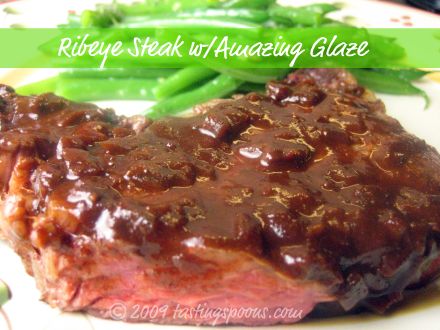
You know, this blog thing is always fun for me. I like to write. I enjoy cooking. And not that this post wasn’t fun – it was – once I got past the angst over wanting to write up this dinner at all. So you say, what’s the problem? Well – I’ve already written up these two. Instead of making something new and different, I craved the tried and true. Two of my/our favorite things. The Amazing Glaze steaks and the garlic green beans. You see, we food bloggers are somewhat driven – to keep making new and different things, to keep you, our loyal readers, interested. But just in case you haven’t made these two recipes from my previous postings, I’m telling you again, YOU NEED TO MAKE THESE TWO DISHES. Okay. Whew. Got that off my chest.

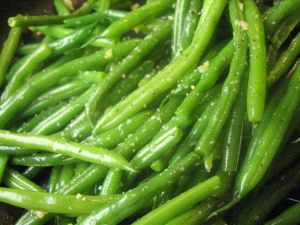
garlic-gr-beansTHE GREEN BEANS: they’re so easy. So garlicky. So delicious I have a hard time keeping my fingers out of the skillet after dinner is all overwith. Even when the green beans are room temp cold. The other night was no exception. I can eat these refrigerator cold too. Since they’re coated in extra virgin olive oil, they’re just as easy to eat chilled as room temp, or hot. But hot is my favorite. These call for an abundance of garlic, smashed and minced with salt on the chopping board, then lightly sauteed in a big skillet. The green beans are simmered in water until they’re just under-done, drained, and added to the garlicky skillet. Cook until the beans are done and serve hot with just a tiny glitter of kosher salt on top. Click HERE for the write-up about them.

THE RIBEYE STEAK: nothing short of awesome. I spotted some USDA Prime ribeyes at Costco the other day and that’s all it took. Had to have them. And there was no question what I’d do with them. Amazing Glaze. The best part is that I still have some of the sauce (the glaze) leftover from months and months ago when I made them last. It hasn’t even been in the freezer – just in a small container in the refrigerator. In all its barbecue-y, smoky chipotle goodness. My DH fired up the grill, and he used the Hugh Carpenter method of grilling the steaks – over the heat long enough to get grill marks on both sides, then on a rack on a pan off the heat for a few more minutes until the ribeye registers 123° or 124° on the meat thermometer. Briefly it rested under a foil tent (and I spread some of the amazing glaze over the steaks while they rested and re-absorbed all their juices), then we dug in. Click HERE for the write-up about the steaks and the amazing AMAZING GLAZE.

Posted in Brunch, Chicken, on January 12th, 2009.

turkey-sausage-cooked

For about 2-3 years my DH Dave and I have been eating a breakfast that consists of one pork sausage link, about 1/3 cup of Greek yogurt (2%) and a half a piece of grainy bread with a thin slather of peanut butter on it. I’ve never added up the calories or fat grams of that breakfast, but we’ve decided to try limiting, even more, the carbs we eat. And to eat more healthy fats. That meant trying to make some kind of (tasty) turkey breakfast sausage.

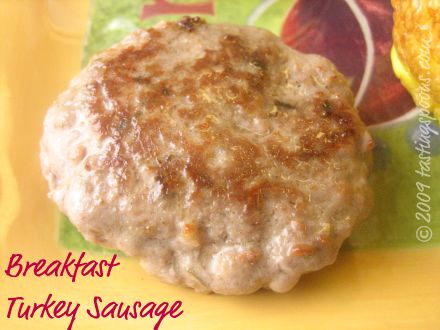
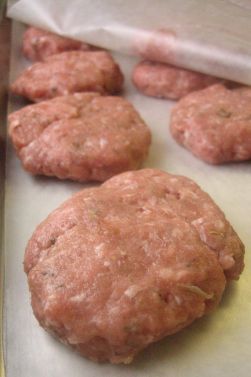
turkey-sausage-pattiesEating turkey sausage will be ever-so-much better for us than eating higher fat pork every morning. Note that one patty (which was all we needed) has 4 grams of fat. And we’re probably going to eat more eggs than we have in the past. So, I did a lengthy search on the internet and my own cookbooks for seasoning mixes for breakfast sausage. Knowing that ground turkey has so little taste all by itself I knew I wanted a fairly high-spiced combination. Finally found one that I liked the sound of, over at recipeczar.com. But never satisfied with just one recipe, I took some ideas I found in some other recipes: one suggested adding olive oil to the turkey mixture (great idea, I thought, to give the meat more moisture); another mentioned finely minced red onion (I used onion powder) and some ground ginger.
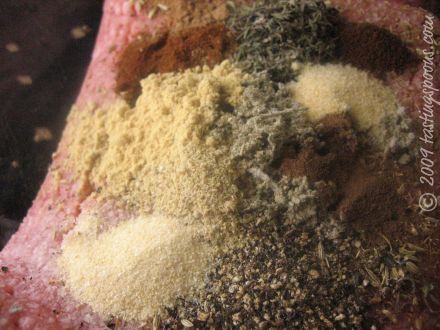
turkey-sausage-herbsI bought a big quantity of ground turkey at Costco and mixed up the sausage by hand. The photo at right shows the mounds of herbs and spices added. Once mixed up thoroughly, I patted them out into small patties and put them on a waxed-paper lined cookie sheet and froze them. Once frozen they went into a plastic bag for easy retrieval every day we want them. The plan is to remove them the day or night before, and just defrost enough for that next day. I know that ground turkey spoils very quickly, so they will stay in the freezer until needed. The photo above shows the patties – they’re much smaller than they appear – each one is about 1 3/4 inches in diameter, maybe 2 inches. And they’re quite thin.


Several recipes for turkey breakfast sausage cautioned about not overcooking the patties. After all, we know that turkey meat is very lean – and it will go from just right to overdone (meaning dry and inedible) in no time at all. So if you make these, keep that in mind. The first time you cook them, designate one as a test patty (cut it open to determine how long it really takes to be “done” on your stove and in your skillet). Then make a mental note of how many minutes that was – likely it will be less than you think. They definintely take less time than pork. And don’t saute them at a high temp. I heated the pan first, drizzled about a teaspoon of olive oil in the pan then set the patties in the pan. They lightly sizzled for about a minute on each side, then I put the lid on and allowed them to steam for about another minute or two.  Done. The texture isn’t as firm as pork, but it was so tasty I didn’t miss it.

I don’t recommend you pan fry them from a frozen state – by the time you get the inside cooked through the outsides will be dry and overdone. Not good. If you cook these right they’ll be tender and moist inside. If they are dry, you’ve cooked them too long or at too high a temp. My evaluation? Absolutely great. We both really liked them. Liked the flavorings. Just enough cayenne to give it some oomph. And hints of all kinds of other things, none of which you could pick out.
printer-friendly PDF

Turkey Breakfast Sausage

Recipe: Adapted from recipeczar.com
Servings: 10 (2 patties per person)

1 pound ground turkey
1 teaspoon salt
2 teaspoons sage — crushed
1 teaspoon fennel seeds — ground
1 teaspoon dried thyme — crumbled
1 teaspoon black pepper — ground
1/2 teaspoon white pepper — ground
1/2 teaspoon cayenne
1/4 teaspoon garlic powder
1/2 teaspoon onion powder
1/8 teaspoon ground cloves
1/8 teaspoon ground nutmeg
1/8 teaspoon ground allspice
1/4 teaspoon ground ginger
3 tablespoons extra virgin olive oil

1. Grind herb seeds (fennel and white peppercorns and sage) in a mortar and pestle, or use a spice grinder. Combine all the spices in a small bowl and set aside.
2. Place ground turkey in a large mixing bowl. Sprinkle spices on top and drizzle olive oil over all. Using your hands, mix well until you see no streaks of herbs. Form into 20 small flat patties, gently reshaping (by pushing them in a bit) any edges that are too thin. You want patties to be of a fairly even thickness. Place on waxed paper lined cookie sheet. Freeze until frozen solid, then place in heavy-duty plastic bags and keep in freezer until ready to use.
3. Remove patties and defrost in refrigerator for about 24 hours. Saute in a nonstick skillet until browned on both sides. You may want to drizzle a bit of olive oil in the pan before cooking. DO NOT OVERCOOK, or they will be dry and inedible.
Per Serving (two patties): 107 Calories; 8g Fat (66.8% calories from fat); 8g Protein; 1g Carbohydrate; trace Dietary Fiber; 36mg Cholesterol; 256mg Sodium.

Posted in Uncategorized, on January 10th, 2009.


snow-on-mountains-12-18-08

Just before Christmas we had a real cold snap. The first morning after we’d had significant rain down here in the lowlands, our close mountains were just blanketed in snow. We don’t see this all that many times a year, so it’s always spectacular when it happens. I don’t have a telephoto lens, so with my point and shoot Canon I zoomed as much as I could. We live near the top of a hill, and in the foreground are other hills in an area called Lemon Heights. Those are close – you can see the houses. The snow covered mountains in the background are about 30-40 miles away, to the north of us, mountains that ring the north side of the San Gabriel Valley.

snow-mountains-12-18-08

The mountains are kind of pinkish because the sun was just coming up. The sun hadn’t peeked over the very top of the hill we live on, so the houses in the foreground were still in moderate darkness. Because of the weather, the main freeway from here to Las Vegas was closed for a part of several days from snow and ice. The Grapevine was closed briefly too, the major artery that connects the big basin of Los Angeles from the San Joaquin (wah-keen) Valley to the north, where so much of the fruits, nuts and vegetables are grown that supply a lot of our nation.

Related Posts Plugin for WordPress, Blogger...