Get new posts by email:

Archives

Currently Reading

Here are the tastingspoons players. I’m in the middle (Carolyn). Daughter Sara on the right, and daughter-in-law Karen on the left. I started the blog in 2007, as a way to share recipes with my family. I’m still doing 99% of the blogging and holding out hope that these two lovely and excellent cooks will participate. They both lead very busy lives, so we’ll see.

– – – – – – – – – – – – – – – – – – – – – –

BOOK READING (from Carolyn):

Music of Bees, Eileen Garvin. Absolutely charming book about a woman in midlife, lonely, who raises bees, also makes unlikely friends. Heart-warming and very interesting about beekeeping.

A Postcard from Paris, Alex Brown. Really cute story. Dual time line, 1940s and present day about renovating an old apartment in Paris, things discovered.

Time of the Child, Niall Williams. Oh such a good book. Very small village in Ireland, 1960s. A baby is left on the doorstep. The town all whispers and helps. I listened to an interview of the author, which made me like him and his books even more.

Sipsworth, Simon Van Booy. If you like animals you’ll swoon. An old woman who really wants to die finds a tiny mouse in her house and befriends it and finds a reason to live. Utterly charming book.

The Forger’s Spell, Edward Dolnick. True story. For seven years a no-account painter named Han van Meegeren managed to pass off his paintings as those of Johannes Vermeer.

If You Lived Here, You’d be Home by Now, Christopher Ingraham. Could hardly put it down – about a journalist who takes on a challenge to move to small town in Minnesota and write about it. He expects to hate it and the people and place, but he doesn’t. Absolutely wonderful true story.

The River We Remember, William Kent Kreuger. 1950s, Minnesota. A murder and the aftermath. Could hardly put it down. Kreuger has such a vivid imagination and writing style.

How the Lights Gets In, Joyce Maynard. An older woman returns to New Hampshire to help care for her brain-injured son. Siblings and family, lots of angst and resentments.

The Filling Station, Vanessa Miller. Every American should read this book. A novelized retelling of the Tulsa massacre in 1921. Absolutely riveting.

The Story She Left Behind, Patti Callahan Henry. Love this author. Based on a true story. A famous author simply vanishes, leaving her husband and daughter behind. She had invented a mystical language no one could translate. Present day, someone thinks he’s solved the riddle, contacts the family. Really interesting read.

The Girl from Berlin, Ronald Balson. Love anything about Tuscany. An elderly woman is being evicted from a villa there, with odd deed provenance. Two young folks go there to help unravel the mystery. Loved it.

The Island of the Colorblind, Oliver Sacks, M.D. Nonfiction. The dr is intrigued by a remote Pacific island where most of the inhabitants are colorblind. He also unravels a mystery on Guam of people born with a strange neurological problem. Medical mysteries unveiled. Very interesting.

The Bookbinder, Pip Williams. Post 1914 London. Two sisters work at a bookbindery. They’re told to not read the books. One does and one doesn’t. One has visions beyond her narrow world; the other does not. Eventually the one gets into Oxford. Lovely story.

The Paris Express, Emma Donoghue. 1895 on a train to Paris, a disaster happens. You’ll delve into the lives of many people who survived and died in the crash.

A Race to the Bottom of Crazy, Richard Grant. This is about Arizona. Author, wife and child move back to Arizona where they once lived. Part memoir, research, and reporting in a quest to understand what makes Arizona such a confounding and irresistible place.

The Scarlet Thread, Francine Rivers. A woman’s life turned upside down when she discovers the handcrafted quilt and journal of her ancestor Mary Kathryn McMurray, a young woman who was uprooted from her home only to endure harsh frontier conditions on the Oregon Trail.

A Place to Hide, Ronald Balson. 1939 Amsterdam, an ambassador has the ability to save the lives of many Jewish children. Heartwarming.

Homeseeking, Karissa Chen. Two young Chinese teens are deeply in love, but in China. Then their families are separated. Jump to current day and the two meet again in Los Angeles.

North River, Pete Hammill. He always writes such a good story. A doctor works diligently healing people from all walks of life. His wife and daughter left him years before. One day his 3-yr old grandson arrives on his doorstep.

A Very Typical Family, Sierra Godfrey. A very messed-up family. Three adult children are given a home in Santa Cruz, Calif, but only if the siblings meet up and live in the house together. A very untypical scenario but makes for lots of messes.

Three Days in June, Anne Tyler. The usual Anne Tyler grit. Family angst. This wasn’t one of my favorites, but it was entertaining and very short.

Saved, Benjamin Hall. Author is a veteran war reporter. Ukraine, 2022, he nearly loses his life to a Russian strike. Riveting story – he survives, barely.

Grey Wolf, Louise Penny. Another Inspector Gamache mystery in Quebec. She is such an incredible mystery writer.

All the Colors of the Dark, Chris Whitaker. A missing person mystery, a serial killer thriller, a love story, a unique twist on each. Could hardly put it down.

Orbital, Samantha Harvey. Winner of 2024 Booker Prize. I don’t usually like those, but I heard the author interviewed and she hooked me. This is not a normal book with a beginning, a story and an end. It’s several chapters of the day in the life of various astronauts at the ISS (Int’l Space Station). All fictional. She’s been praised by several real astronauts for “getting it” about space station everyday life.

The Blue Hour, Paula Hawkins. An island off Scotland. Inaccessible except when the tide is out. Weird goings on. An artist. A present day mystery too.

Iron Lake, William Kent Krueger. A judge is murdered and a boy is missing. Riveting mystery.

Tell the Wolves I’m Home, Carol Ricks Brunt. 1980s. A 14-yr old girl loses her beloved uncle. Yet a new friendship arises, someone she never knew about.

Four Treasures of the Sky, Jenny Zhang. 1880s, a young girl is kidnapped in China and brought to the United States. She survives with many hurdles in the path.

The Boy Who Fell out of the Sky, Ken Dornstein. Memoir, 1988. The author’s brother died in the PanAm flight that went down in Lockerbie, Scotland. A decade later he tries to solve “the riddle of his older brother’s life.”

Worse Care Scenario, T.J. Newman. Oh my. Interesting analysis of what could/might happen if a jet crashed into a nuclear plant. Un-put-downable.

Song of the Lark, Willa Cather. Complicated weave of a story about a young woman in about 1900, who has a gifted voice (singing) and about her journey to success, not without its ups and downs.

Crow Talk, Eileen Garvin. Charming story which takes place at a remote lake in Washington State, about a few people who inhabit it, the friendships made, but also revolving around the rescue of a baby crow.

The Story Collector, Evie Woods. Sweet story about some dark secrets from an area in Ireland, a bit magical, faerie life, but solving a mystery too.

A Sea of Unspoken Things, Adrienne Young. A woman investigates her twin brother’s mysterious death. She goes to a small town in California to figure it out, to figure HIM out.

The King’s Messenger, Susanna Kearsley. 1600s England, King James. About one of his trusted “messengers,” and his relationship with a young woman also of “the court.” Lots of intrigue.

In the Shadow of the Greenbrier, Emily Matchar. Interesting mystery in/around the area of the famous resort in White Sulphur Springs, West Virginia.

Isola, Allegra Goodman. Hard to describe, survival story on an island in the 1600s.

Save the Date, Allison Raskin. Rom-com, witty, LOL funny. Clever.

The Sirens, Emilia Hart. Numerous time-lines, Australia. Mysteries abound, nightmares, abandoned baby, weird allergies.

Red Clay, Charles Fancher. LOVED this book. Mostly post-Civil War story about the lives of slaves in Alabama during Reconstruction.

Stars in an Italian Sky, Jill Santopolo. Dual time line, 1946 and recent time. Love stories and a mystery.

Battle Mountain, C.J. Box. Another one of Box’s riveting mysteries. Love his descriptions of the land.

Something Beautiful Happened, Yvette Corporon. A memoir of sorts in Greece, tiny island of Erikousa, where the locals hid Jews during WWII. All elusive stories told by the author’s grandmother.

The Jackal’s Mistress, Chris Bohjalian. 1860s Virginia, about a woman who saves the life of a Union soldier. Really good story.

Song of the Magpie, Louise Mayberry. Really interesting story about Australia back in the days when it was mostly a penal colony. Gritty strength of a woman trying to thrive with her farm.

The Boomerang, Robert Bailey. A thriller that will have you gripping the book. About a lot of secrets surrounding the president (fictional novel, remember) and his chief of staff and about cancer. A cure. Such a good story.

Care and Feeding, Laurie Woolever. Really interesting memoir of a woman driven to succeed in the restaurant business. She worked for Mario Batali and then Anthony Bourdain. Gritty stories.

Everything is Tuberculosis, John Green. Maybe not a book for everyone. A real deep dive into the deadly tuberculosis infection, its history. I heard the author interviewed and found the book very interesting.

The Book Lovers Library, Madeline Martin. Fascinating read about Boots’ drug stores’ lending library. And the people who worked in them.

The Arrivals, Meg Mitchell Moore. LOL funny, about a middle-aged couple whose children (and their various family members) return to the family home and the chaos that ensues.

My Life as a Silent Movie, Jesse Lee Kercheval. About grief. A big move to Paris, finding herself a new life with a new set of real blood family.

Escape, Carolyn Jessop. Another memoir about a woman really in bondage in Utah, Mormon plural marriage.

 

Tasting Spoons

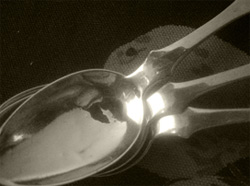
My blog's namesake - small, old and some very dented engraved silver plated tea spoons that belonged to my mother-in-law, and I use them to taste my food as I'm cooking.

Scroll down to the bottom to view my Blogroll

Posted in Salads, Veggies/sides, on July 31st, 2007.


My mother was a fairly simple cook. She was raised on a farm, as was my dad, in the central valley of California. During the depression. As they grew up, mostly they ate meatless meals with an occasional chicken dinner on Sundays, at noontime, from one of the young hens in the chicken pen. So when I was growing up my mother followed her mother’s tradition – we had simple meals too – a small portion of meat (mostly beef), a vegetable, a salad maybe, and some kind of carb (Minute Rice was a new product – my mother thought it was marvelous, so we had it often).

My recollection of brussels sprouts from my youth is not a particularly good one. Overcooked baby cabbages don’t ring any culinary bells for me. And that’s most often how my mother cooked them. They were freshly cooked. But with nothing to embellish them except some salt and pepper, they had nothing to make them appetizing. My dad and mom both loved them, though. Fixed just that way. Often. Blah. Yuck.
But I did and do like cabbage in many guises. I just didn’t think I liked brussels sprouts. So many years later I decided to buy some fresh brussels sprouts – sold on the stalk – and found a recipe in Sunset Magazine. It may have been the recipe that inspired me to try it again. Lo and behold? I liked them. And I do prepare them in the fall and winter months, steamed, still with some bite to them, with a little butter, salt and pepper. Very good. I must admit.

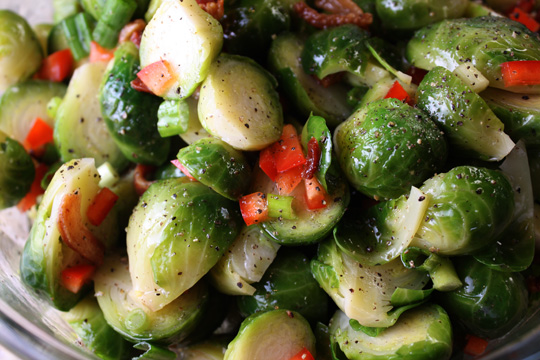
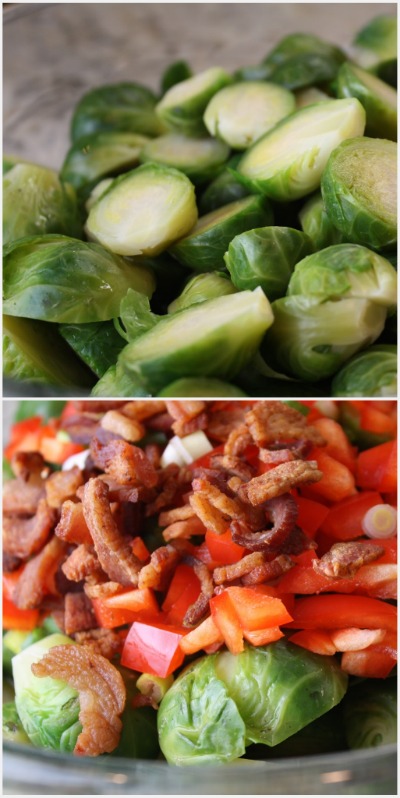
Our kids didn’t think they liked brussels sprouts either, until I made this version below. The recipe takes the lowly sprout to a higher level. You steam or boil them until barely done, then toss with a dressing and let them marinate for a few hours. It’s the tart, piquant bacon dressing that makes them taste so darned good. I believe what I’ve printed below is the recipe from Sunset from years ago. I don’t add but a couple of slices (not 6) of bacon to this, and they are still very good. This makes a great side dish – it could qualify as a salad, I suppose. One of the good things about this is you can make it the day ahead too. They’re good hot or cold, but I prefer them cold or room temperature. Maybe this will motivate you to try it too.
printer-friendly PDF

Marinated Brussels Sprouts

Recipe: Adapted from an old recipe in Sunset Magazine
Servings: 6
NOTES: This is best if allowed to marinate for a few hours or overnight. This is something that can be made ahead and keeps well for several days. I use thick sliced bacon, cut up into small pieces.

1 1/2 pounds Brussels sprouts
1/3 cup vegetable oil — or olive oil
3 tablespoons white wine vinegar — or lemon juice
2 tablespoons green onions — thinly sliced
2 slices bacon — fried crisp, crumbled
1/4 cup red bell pepper — minced
salt and pepper

1. Trim stems and tear away discolored or torn leaves from brussels sprouts. Cut a small X into the stem of the sprout – about 1/4 inch or less deep. Bring a large quantity of water to a boil and add sprouts, return to a boil and simmer, uncovered, for about 7 minutes until just tender when pierced with a sharp knife or fork.
2. Drain well, cut each sprout in half lengthwise and place in a salad bowl. Add oil and vinegar, then add onion, bacon, red pepper, salt and pepper to taste. Stir gently but thoroughly, and stir again just before serving. May be served hot, if desired. Otherwise, place in covered container and refrigerate for several hours, stirring a couple of times so all of the sprouts are tossed with the dressing.
Per Serving: 191 Calories; 16g Fat (69.1% calories from fat); 5g Protein; 10g Carbohydrate; 4g Dietary Fiber; 5mg Cholesterol; 127mg Sodium.

Posted in Pasta, Vegetarian, on July 30th, 2007.


About 20 years ago a wonderful restaurant opened near our home, called Zov’s Bistro. Owned by Zov (pronounced like the letter oh) Karamardian, it was open for weekday lunches and a few nights a week for dinner. As the restaurant grew, and Zov’s well-executed Mediterranean food became more well known, they opened every day but Sunday. Zov is a wonderful philanthropist in our community, and loves to share her native Armenian cooking, although she has broadened the scope to include recipes from many different cultures around the Mediterranean. Now the restaurant houses the bistro, a bakery and a she’s opened a couple of other locations as well.

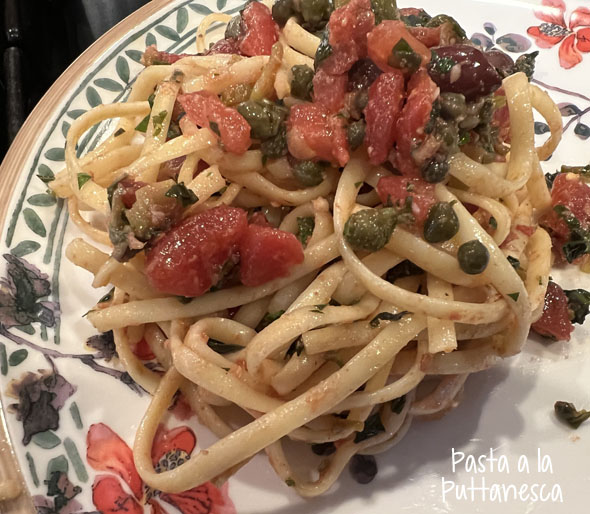
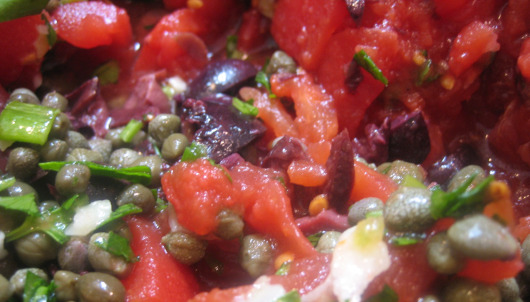
puttanesca-sauceBut back in the earlier days of the Bistro, Zov taught a cooking class starring some of her family favorites, of which this recipe was one. It’s not on the restaurant menu, unfortunately, or I would have it more often. I have no recollection what else she made that night, but I fell in love with this simple pasta dish, and have been making it ever since. You need to enjoy garlic, as it plays a prominent role. And the sauce needs to sit for awhile (at least an hour, or up to 2-3 hours) to develop its flavors. You can make this any time of year – it’s nothing more complicated than canned tomatoes, garlic, green onions, olives, capers and olive oil tossed with hot pasta and sprinkled with real Parmesan. It has some other things in it too that enhance the flavor, and you garnish with a lot of fresh basil. The anchovies (buy good ones if you can find them . . . they have so much more flavor than the cheap cans at the supermarket . . . go to an Italian deli if you have one) give it some character, but you never know they’re there. This is a great meal for a warm summer night.
So, I have a fun story to relate about this recipe. We had dinner with our son, Powell, and his wife the other night, and I mentioned that I had written up this recipe, which has always been a favorite of his. I’d forgotten that when he first met Karen he offered to help her with catering food for an art event a couple of weeks later. She wasn’t a caterer, but had offered to help a friend and was happy to have some help with it. Powell enjoyed cooking and loved entertaining when he was a bon vivant bachelor. Anyway, back then Powell had phoned me to ask advice on what recipes I had that might work for such an event where they could do no actual cooking, so they’d have to make everything ahead. This recipe was a standout for doing ahead, no question.

According to Karen, she was mightily impressed when Powell made this in a very large quantity for her event. According to Karen, her thoughts were along the lines of wow, this guy may be a keeper. It was a black-tie event, and the two of them served this dish and a bunch of others to the crowd of people. Toward the end, with Powell standing nearby in his tux, a businessman approached him and asked for his card. Probably Powell looked at him askance. Uhm. The guy said, we’d like you to cater something for us at our home. Powell laughed and said, we really don’t DO catering, etc. The guy said, well, what do you do and Powell explained that he is in the investment banking/bond biz. The guy looked at him and said what in the world are you doing here? Powell & Karen had a good laugh over that. So, a romance was made that night, according to them, over a big bowl of Pasta a la Puttanesca.
Printer-friendly PDF

Pasta a la Puttanesca

Recipe from Zov Karamardian, of Zov’s Bistro, Tustin, California
Servings: 10

1 bunch green onions — chopped
6 cloves garlic — minced
1 tablespoon extra-virgin olive oil
4 cups tomatoes, canned — drained
1/2 c parsley — minced
1/2 c basil, fresh — minced
1/2 c capers
1/2 c olives — black, Mediterranean
1/2 c extra virgin olive oil
2 ea anchovies — mashed
1/2 c Parmesan cheese — imported, grated
1/4 tsp hot chili flakes
1/8 tsp black pepper — cracked
2 pounds pasta of your choice (I prefer small spaghetti or linguine)

1. Heat the small quantity of olive oil in a small skillet and add green onions. Cook for 2-3 minutes, then add minced garlic. Allow to cook together gently for 2-3 minutes. Do not brown.
2. In a large, non-metallic bowl combine the tomatoes, pitted olives, capers, anchovies and add the onion/garlic mixture. Add parsley, basil, chili flakes, pepper. Slowly stir in olive oil and allow to sit at room temperature for about an hour. Fold in cheese just before serving. Can be made a day or so ahead, but add fresh basil and cheese at last minute.
3. Cook pasta of your choice, drain, and pour into large bowl. Pour room temperature puttanesca sauce on top and sprinkle with additional cheese. Serve immediately adding strips of chicken on the top if desired. Recipe says you can serve it warm or cold. Or, place a serving size of hot pasta on a plate and add about 1/2 cup of mixture on top. Traditionally you should use Kalamata olives in this, but any other kind of Mediterranean cured olive will do.

Posted in Beef, Pork, on July 29th, 2007.


We may be one of the few cultures to make baked meatloaf. Lots of other cuisines include a ground meat stuffed something (pastry, cabbage, etc.) or small orbs of some kind of chopped meat, but we Americans appear to have invented meatloaf (really, we did), meaning we started with finely chopped raw meat. Mostly I learned, earlier cooks used cooked meat to make any kind of chopped meat dish. I wanted to know more about the history of the dish, and found this:

  • The raw, ground meat commonly used to make today’s American meat loaf has a humble heritage. In the 19th century, we know the Industrial Revolution made it possible for ground meat to be manufactured and sold to the public at a very low cost. At first, many Americans were slow to purchase raw ground meat products and generally regarded them with suspicion. Cooks continued to mince their meat (often already cooked, as was the practice for centuries) by hand. Companies selling meat grinders to home consumers at the turn of the century endeavored to change this practice by providing recipe

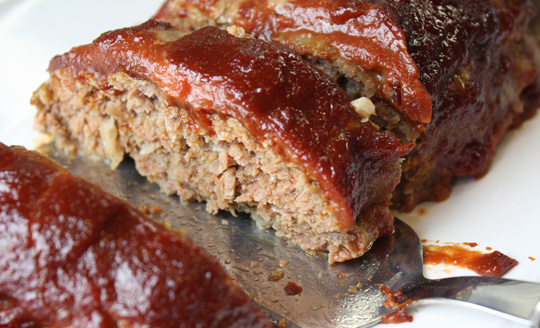
Regarded as the ultimate comfort food, there are certainly lots of types of meatloaf. Some with fillers and additions (bread crumbs, cracker crumbs, carrots, onions, eggs, red bell pepper) and many variations of toppings (savory tomato, catsup type, even teriyaki style). But the most common is with a tomato-based sauce on top. I’m no different than the crowd, so this may not be one of the recipes you’re going to try since you may already have a favorite sauce. But for me it’s simply the sweet and sour sauce that is a must here. The recipe came from one of my old 1960’s era military officer’s wives cookbooks, and since I first made it, this has been the standard by which any and all meatloaves are measured. In our family, this is THE recipe, and mashed potatoes on the side are an absolute must. No rice. No pasta. It must be mashed potatoes.

And generally I increase the sauce because everybody loves to put more sauce on the potatoes. So early on I began doubling it. No problem. It’s easy enough to make. I’ve made this with partly ground turkey, and it’s also very good. I think my daughter Sara makes it with all turkey and her family loves it that way. When I make it now I use 50/50 beef and ground turkey. That gives the meatloaf a little firmer texture, which is what we (and most people, I surmise) miss about eating ground turkey. It just doesn’t have the “tooth” to it that beef does. I’ve made this using Splenda (it’s fine) and with Brown Sugar Twin (also fine). So we can still have this but with less carbs.

Back when our children were teenagers we asked each of the kids to choose a weeknight and be responsible for preparing dinner for the family. (We’re a blended family, so between DH and I we have 3 children, two daughters and a son, all in their late 30’s now and for most of their teenage years we all lived together.) We had to plan ahead so the ingredients were on hand, and mostly the kids were pretty good about it. They got to fix one of their favorite meals, and we were all appreciative (at least I think we were). I will tell you that this item was a real “regular” on the menu. Everyone in our family loves this meatloaf and they all learned how to make it because they had to do it.
printer-friendly PDF

Meatloaf with Sweet & Sour Sauce

Recipe from a Military Wives’ Cookbook from the 1960’s
Servings: 6
Notes: Over the years I began to double the sauce recipe because we loved to spoon the sauce over the mashed potatoes, and we never seemed to have enough sauce. The original recipe said you could use either tomato paste or sauce, but we prefer the sauce. If using paste, increase the water in the sauce as it will be too thick. You want the sauce to stick some to the meatloaf, although most of it drips down into the pan.

MEATLOAF:
1 1/2 pounds lean ground beef or mixed with ground turkey
1 whole egg — beaten
1/2 cup bread crumbs
2 ounces tomato sauce
1 medium onion — minced
1/2 teaspoon salt
1/4 teaspoon pepper
2 teaspoons Italian herbs
SAUCE:
4 ounces tomato sauce
1/4 cup water
1 tablespoon vinegar
2 tablespoons brown sugar
2 teaspoons Dijon mustard
1 tablespoon Worcestershire sauce

1. Preheat oven to 375. In a large bowl combine beef, egg, crumbs, tomato sauce, onion and spices. Mix just enough to combine the ingredients; no more. Mound into a loaf shape and place in baking dish somewhat larger than the meatloaf with at least 1-inch sides. It’s better to use a higher sided dish than a lower, flatter dish.
2. In same bowl combine the sauce ingredients: tomato sauce, water, vinegar, sugar, mustard and Worcestershire. Mix to blend in the brown sugar, then gently pour over the meatloaf. Bake for 1 hour and 10 minutes. Allow to cool for 5 minutes, then slice and serve with more sauce on each slice.
Per Serving: 378 Calories; 25g Fat (60.3% calories from fat); 23g Protein; 14g Carbohydrate; 1g Dietary Fiber; 120mg Cholesterol; 564mg Sodium.

Posted in Desserts, on July 28th, 2007.


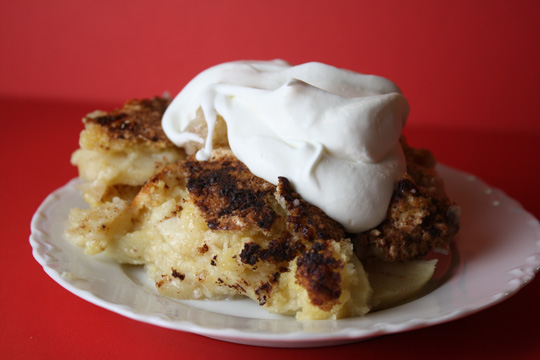
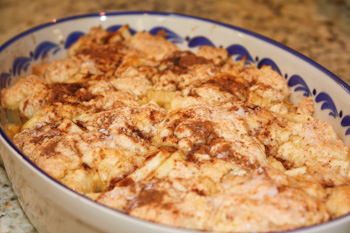
apple crispI would be ever so negligent if I didn’t post one of my favorite recipes, my mother’s Crisp Apple Pudding. I’ve been making this for as long as I’ve been cooking (that began in 1962). It was written out in my mother’s small recipe journal, something she began when SHE got married in the 1930’s, a recipe from her mother. And she passed this recipe on to me when I got married. My mother is gone now. Bless her heart. I loved her so much. But she lives on in this recipe for sure. I think of her every time I fix this.
Technique:

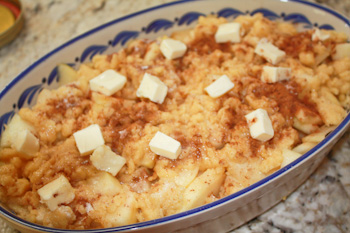
This recipe has something unique – after mixing up the crumbly topping and sprinkling it over the apples, you gently sprinkle cold water over the top. When baked the top is nice and crunchy tender.

I believe – but I’m not sure – that this recipe came from a vintage (probably 1930’s version) Betty Crocker Cookbook. Or maybe it was a Better Homes & Gardens. Did they publish cookbooks back in the 1930’s? I think one time in a used book store I saw a very old, stained copy of one of those books and glanced in it, and sure enough, it looked like this recipe. It has one very unique technique that I’ve not seen in any recipes I’ve studied. Even today. I did a search just now, and after looking at probably 40-50 apple crisp recipes, with variations of toppings (this one has no oatmeal or brown sugar in it), not a single one of them sprinkles the flour/sugar topping with water. That’s what gives this apple dessert its crispness, a different texture for sure. I love it – of course, it’s what I grew up having when my mother made this, so it’s what I think is the “right” kind of apple crisp. Note that this dessert has a whopping 5 grams of fat per serving.

apple crisp before bakingOne year either Bon Appetit or Gourmet did a very in-depth article about crisps, buckles, pandowdies and slumps. They are all similar, but not quite the same. And this technique was not in there, either. I even wrote a letter to the writer of that article about it. Never heard from her. Oh well. Her loss!
So, here is my mother’s recipe: Sliced apples, piled into a 8×8 Pyrex or metal baking dish, with a floury-egg-sugar based crumbly topping, dotted with a little butter, and sprinkled with cinnamon and a bit more sugar. THEN, it’s sprinkled with water to give that topping an honest-to-goodness crust. Once baked the topping melds together into a crust, and rises a little bit since it has baking powder in it. Allow to cool about an hour, then serve with warm cream or whipped cream. Ice cream is okay too, but whipped cream is better, I think. I’ve cut down a little on the sugar – I think originally it called for 1 cup, so if you like it sweeter, go ahead and add the full amount. And I hate to say this, but in a pinch, this is marvelous for breakfast.
printer-friendly PDF

Crisp Apple Pudding

Recipe: From an ancient Betty Crocker cookbook, I believe, but via my mother.
Servings: 6-8
NOTES: The preparation of this apple dish is a little different because of the water sprinkled over the top. It gives the pudding a wonderful crispy top. This travels well, although it’s best eaten the day it’s made. Can be served with whipped cream or Cool-Whip.

1 cup flour
7/8 cup sugar
1 teaspoon baking powder
1 whole egg — beaten
1 teaspoon cinnamon
1 teaspoon nutmeg
2 tablespoons butter
1/4 cup water
2 tablespoons sugar
4 large apples — peeled and sliced

1. Preheat oven to 350.
2. Spread sliced apples into an 8×8 pan. Sift together the flour, sugar and baking powder. Add the egg and mix well. Spread this mixture over the top of the apples, spreading as evenly as possible. Sprinkle the top with the spices and the 2 T. of sugar. Using your fingers or a small spoon, sprinkle water over the topping, sprinkling as evenly as possible. Dab the butter on top, in small pieces.
3. Bake for 35-45 minutes, or until top is brown. Allow to cool about an hour, or until it’s room temperature.
Per Serving: 309 Calories; 5g Fat (15.1% calories from fat); 3g Protein; 64g Carbohydrate; 3g Dietary Fiber; 46mg Cholesterol; 133mg Sodium.

Posted in Fish, on July 27th, 2007.

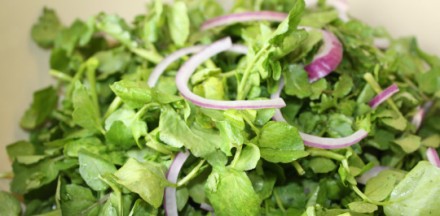
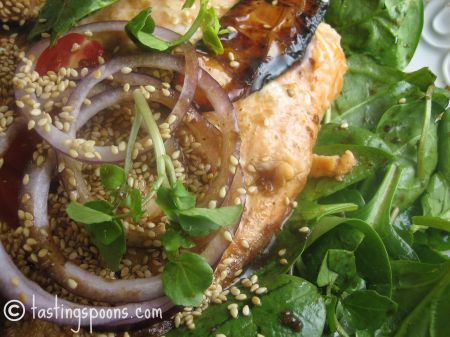
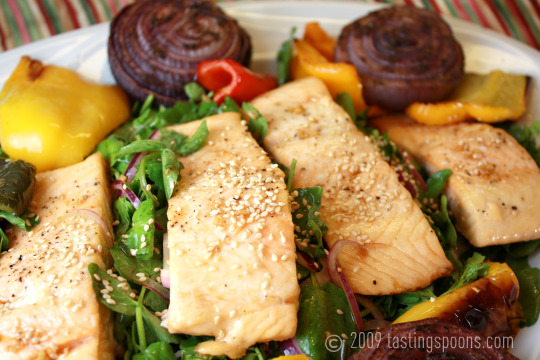
grilled salmon on watercress salad

If I owned a restaurant, this would probably be my signature dish. I’ve made this so often that I might be able to make it in my sleep. And it is my one-and-only recipe for which I can buy the ingredients in the late afternoon and have dinner on the table by 6:30 or 7:00 – for guests. This is a one dish meal – well, clarify that . . . it’s a grill in one meal. Except for dessert and appetizers, if you’re serving them, you can make this in no time at all. It may be the only recipe in my entire personal cookbook that qualifies. So, take note, if you’d like a company meal with little effort.

My friend Stacey is a good cook, but doesn’t really like spending hours in prep, nor does she have time anymore with two little ones getting into mischief. But after I made this at their house in the Bay Area one weekend several years ago, she said they invited lots of friends over and she got a lot of entertaining done – serving this for every one. So, Stacey, this one’s dedicated to you! You’re my hero!

salmon watercress saladI’ve told you before about Chris Schlesinger. His book, The Thrill of the Grill, is one of my favorite cookbooks. This recipe came from there. This is the fellow I spoke to, telling him my favorite recipe from his book was the Asian Slaw and he gave me this face. If you haven’t read that story, click here. When he signed my cookbook, I hadn’t prepared this salmon dish yet. I just wish Chris was reading my blog and he’d know that this is my favorite recipe to date. And I’ve amplified on his recipe too. I’ve thought about writing to him tell tell him all about what I’ve done to his recipe. But oh well. He’s a famous chef and all. I think I won’t.
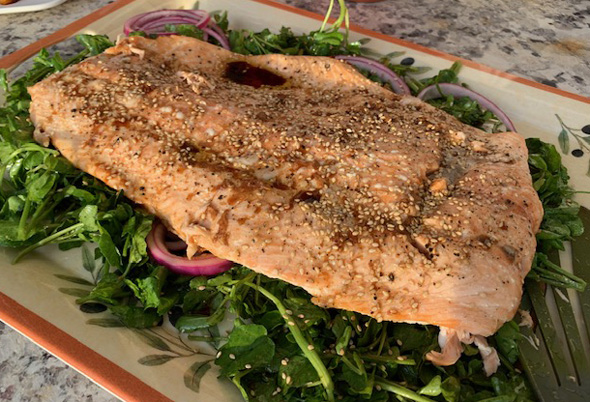
For awhile, some years ago, I cut down the amount of the dressing on this salad, to reduce the total fat grams, but have since decided that the full amount is needed; it’s an important component of the dish so it covers the salad sufficiently and you have enough left over to pour a little over the salmon itself. And if you grill vegetables to go with, like I do, then you need a bit more for them too. Salmon has plenty of fat in its tissues, but it’s good fat, so don’t be thrown by the fat content on this one. I’ve done the math and the salad dressing is fairly inconsequential.

watercress saladI do need to talk a bit about watercress. It’s a little hard to find – at least it is here in California. Whole Foods sells some funny kind of young watercress still growing in vermiculite covered in a little root ball. It has different roundish leaves. And has almost no flavor. This is NOT what you want for this. You need the real thing, the kind of watercress that’s actually grown in water. It has fattish stems (which you don’t use in the salad) and wonderful crinkly leaves. The taste is peppery, not to everyone’s taste, I suppose. I love it, though. So seek out good, fresh watercress.

Costco sells this huge slab of boneless salmon. It is farm-raised; not my favorite thing anymore, but I will buy it on occasion. I prefer wild caught now, and if you can find it, by all means do so! You wipe it off, spray it with olive oil spray, then place it on two large pieces of greased heavy-duty aluminum foil, crimp up the edges around the salmon (you don’t seal it or cover it). Add a bit of salt and pepper. Meanwhile, you fire up your grill and start working on the vegetables, whichever ones you decide to use. I like putting something red with this dish – the color is just glorious on a large platter. So, you need red bell peppers for sure, even yellow or orange ones too. Asparagus works also. And zucchini too. In a pinch I’ve also thrown a large quantity of halved cherry tomatoes on the platter at the end (not grilled, of course). And DH’s favorite is small red onions, halved. All the vegies need to be well oiled, then grilled. Then you put on the salmon and it’s done when you begin to see some white foam seep up through the middle of the salmon. At the last minute toss the watercress salad with some of the dressing, spread it down the middle of the large platter, then slide the salmon off the foil and on top of the salad and add the grilled vegies (that you’ve kept hot) around the edges. Serve immediately to raves. Guaranteed.
printer-friendly PDF

Grilled Salmon with Watercress Salad

Recipe: adapted from “The Thrill of the Grill” cookbook
Servings: 6
COOK’S NOTES: This is also excellent made with halibut or swordfish. The salmon is the best, however.
Serving Ideas: Good for a hot, summer night. I’ve served this with asparagus, simply dressed with seasoned rice wine vinegar sprinkled over the spears, or green beans. Sometimes I also decorate the platter with halved cherry tomatoes, to give it some color. If you do the peppers, grill them before you put on the salmon, then push them off to the side when you put the salmon on. This is really a fairly simple dish. Everything can be done ahead except grilling the fish.

2 1/2 lb salmon fillet — max 1″ thick
SALAD & DRESSING:
2 bunches watercress
1/2 medium red onion — thinly sliced
2 tablespoons sesame oil
1 teaspoon sugar
2 tablespoons soy sauce
1 tablespoon fresh ginger root — minced
2 tablespoons rice wine vinegar
2 tablespoons red wine vinegar
4 tablespoons olive oil salt and pepper — to taste
2 tbsp sesame seeds — toast in teflon pan
VEGGIES (optional):
3 whole red onions — peeled, halved or quartered
2 pounds asparagus
4 whole red bell pepper — quartered

1. Heat a non-stick pan and toast the sesame seeds, stirring occasionally, until golden brown. They tend to burn quickly, so stir often when they start to brown.
Salad: wash well the bunches of watercress and pull the small stems off and discard the large stems. Dry in a towel. Place watercress and red onion in a plastic bag and keep until ready to serve.
2. Vinaigrette: combine the oil, sugar, soy sauce, ginger, vinegars, olive oil and salt and pepper to taste. It is best if this is allowed to sit for a few hours, refrigerated, before dressing the salad.
3. If using vegetables, prepare them, oil them, then grill to your taste, being careful not to burn. Move to the side before they’re completely done and add the salmon.
4. Fish: Spray the top of the salmon with olive oil spray. Using either heavy-duty foil, or two layers of regular foil, spray the foil with olive oil spray, then place fillet on foil and curl up edges to make a sort of a “pan.” Place on grill for 12-20 minutes, or until the inner juices of the salmon have begun to bubble up in the meat (whitish fluid).
5. Immediately before serving, in a large bowl combine the watercress and onion and add most of the vinaigrette to taste – really, taste it to make sure it’s right. Sometimes I add green and/or red leaf lettuce to the salad mixture as well. Pour the salad out onto a large platter and place the hot, grilled fish on top. Pour the remaining vinaigrette over the top of the salmon and sprinkle with the toasted sesame seeds and serve. It says this is excellent served cold although we’ve never done it that way.
Per Serving: 441 Calories; 22g Fat (44.4% calories from fat); 42g Protein; 20g Carbohydrate; 6g Dietary Fiber; 98mg Cholesterol; 481mg Sodium.

Posted in Brunch, on July 26th, 2007.

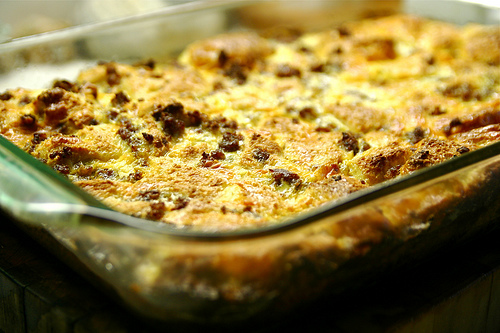
egg casserole
Back when I was still working full time, had teenage children at home, had fewer hours of time for anything, I seemed to be able to squeeze in more entertaining than I do now. I loved spending 8-10 hours in the kitchen prepping all the dishes for a brunch for 10 people for the next day. Now that I’m retired, have more time on my hands (no, I’m rarely bored), I don’t entertain as often. Why is that? Must be because I’ve slowed down my hectic pace. I must have been far more organized than I am now. And today I don’t choose to spend so many hours in kitchen prep either.

But in those days Dave and I often entertained, either at home or on our sailboat. At least once a month we had brunches or dinners on the boat for 6-10 people, motoring around Newport Harbor, usually dropping a short anchor in one of the very chichi private lagoons, just long enough to tip a few glasses of wine or champagne, have brunch or dinner, then we’d motor again as we enjoyed coffee and dessert, glancing into the gorgeous multi-million dollar homes that line Newport Harbor. In the evenings, the houses were lit up and looked so beautiful. Back then we kept our boat on a mooring (for the non-boaters, that’s a permanent anchoring place that’s not at a dock, but sits offshore about 100-200 feet) in Newport, so we had to row a rotted old fiberglass dinghy from the shore to the boat, remove all the paraphernalia we used to TRY to keep the seagulls from defecating all over the decks, because they thought the boat was their private hanging-out place when we weren’t on board, motor it to our small yacht club (a 30-minute ride) to wash and scrub the decks, then get ready for entertaining. Now our boat is in San Diego, at a dock and we don’t have to do that – we drive about 80 minutes and we’re on board at a comfy dock. More gasoline to drive there, but a heck of a lot less work and stress.

So, brunch dishes became a staple in my cooking repertoire, and I was always on the lookout for something new and different. Something that could be made ahead, too, since the galley on our 38-foot sailboat isn’t exactly roomy. It’s certainly functional, but it isn’t luxurious. It has a small double sink, hot water, a propane 4-burner stove, an oven plus a narrow but deep refrigerator.

I have a number of different egg casseroles I’ve made over the years, and I’ll likely share most of them here in time. But this one is a favorite of all the choices. I’ve made this for Christmas morning when we’ve had a houseful of people. Have all the ingredients all ready, then mix it up just before baking. And I’ve made it for numerous brunches at home as well. It’s not difficult. The Italian sausage is what makes it, though. Please don’t substitute, although you could use turkey Italian sausage. But not the pre-cooked type – use only fresh sausage. The recipe came from Bon Appetit magazine. I don’t know when, but at least 20 years ago! But it’s still just as good this many years later.
printer-friendly PDF

Brunch Gratinée Eggs

Recipe from Bon Appetit Magazine
Servings: 10
NOTES: This makes a lovely dish for the holidays, as everything could be made ahead and mixed at the last minute and popped into the oven.

1 lb Italian sausage — sweet or hot
1 tbsp butter
8 med mushrooms — sliced
1 med red onion — chopped
12 lg eggs — beaten
1 cup milk
8 oz mozzarella cheese — shredded
2 med tomatoes — peeled & chopped
1/2 tsp salt
1/2 tsp ground pepper — fresh ground
1/2 tsp oregano — crumbled

1. Preheat oven to 400. Generously grease large ovenproof skillet or large, shallow baking dish; set aside. Crumble sausage into skillet and fry over medium-high heat, stirring constantly, until sausage is no longer pink. Drain well and transfer to large bowl.
2. Wipe out skillet. Add butter and melt over medium heat. Add mushrooms and onion and sauté until onion is soft, but not brown. Stir into sausage. Blend in remaining ingredients, mixing thoroughly. Turn into prepared dish. Bake until knife inserted in center comes out clean, about 30-35 minutes.
Per Serving : 359 Calories; 28g Fat (70.6% calories from fat); 20g Protein; 6g Carbohydrate; 1g Dietary Fiber; 316mg Cholesterol; 644mg Sodium.

Posted in Breads, on July 25th, 2007.

buttermilk scones
If you’re a connoisseur of scones, as I am, then you already know that there are about as many variations on the scone theme as flowers in the universe. I became a scone lover about 20 years ago. They popped up on the food scene, I guess, because of the proliferation of “afternoon tea” in various places. My friend Cherrie and I liked trying different afternoon tea locations as often as we thought we could fit it in, maybe every 2-3 months. We went on Saturdays because we both worked full time back then. But then scones became part of the coffee bar circuit too – Starbuck’s, Peet’s. Wherever you went for morning coffee, they all had scones. Dry scones. Not very tasty scones in my book. I usually left disappointed.

But in the intervening years, Cherrie and I have tried about 15 or more tea places within easy driving distance of our homes. We enjoy the whole event – from the tea itself (usually Earl Gray) to the tea sandwiches, the scones, jam, clotted cream (not whipped cream, mind you) and little tasty sweets. We enjoyed the whole package so much that she and I took a “Tea Tour” in England one year and had a ball. It was a 10 or 12 day trip with Penelope Carlavato, a proper English lady who lived in Southern California and led tours in England every year. There were about 12 of us on the trip and we had afternoon tea 5 times in 10 days, I believe. After that, I didn’t have an afternoon tea for at least a year! On that trip we sampled scones of all varieties. British scones are drier than mine. Thicker too, I think.

Recipe Tip:

This is one of my favorite recipes – a “signature” dish if I had such a thing.

But I’m spoiled. I like my own scones too much. It’s so easy to make your own and get just the kind of texture you want in your own home made ones. I’ve made them for Christmas morning – I get all the ingredients gathered up the night before and can whip them out in a hurry in the morning. I don’t make them often – they’re a special occasion treat for me. The last time I had afternoon tea was in Paris, a year ago May, when I was there alone (DH couldn’t go because of a leg injury) and friends I was meeting invited me to join them at Mariage Freres for lunch. Very special indeed.

Once a year a group of girlfriends of mine (we’ve been meeting for breakfast about every other week for the last 30 years) get together to celebrate a Christmas breakfast. We move from house to house, year to year. We exchange gifts, talk about our children, our grandchildren, and what we’re doing for the holidays. Once I started making these, though, they’ve become a regular on the menu, at whoever’s home we’re meeting. I take the ingredients and make them there.

My scones are more like rich Southern biscuits – American Southern Biscuits. They’re buttery, with layers of tender dough. These are not on the dry theme at all. If that’s what you prefer, you won’t like this version one bit. Stop right here. But if you like rich and buttery, then these are for you. I got the recipe from a Canadian friend of mine (my former business partner), who got it from a Canadian friend of hers, who got it from Canadian Living magazine in 1991. Since I tried these the very first time they’ve been my one and only scone. Hope you enjoy them. The original recipe called for currants. I didn’t have any, so began using golden raisins. Other than that, I usually fix the recipe exactly as shown.

Follow the directions to a T, except where noted that you can. These don’t keep well – if you don’t eat them right away, cool and freeze immediately. You can also substitute different dried fruit, or make them plain. I’ve shared this recipe with many of my friends over the years. Hope you enjoy them as much as I do. Try with a bit of clotted cream and jam. They hardly need butter, but I always serve it anyway.
printer-friendly PDF

Buttermilk Scones with Golden Raisins

Recipe: Adapted from Canadian Living Magazine, June 1991
Servings: 10
NOTES: Variations are easy with this recipe. Sometimes I substitute 1/2 cup of rolled oats for 1/2 cup of flour. Or, if you prefer, substitute other dried fruits: currants, dried cherries, cranberries, blueberries, or apricots. You could also add about 1 cup of shredded cheese (omit sugar and currants). Do NOT substitute any margarine in this recipe. These scones are a rich, buttery biscuit type, not dry, as some people prefer them. I particularly like scones using buttermilk as it makes a very tender crust.

2 1/4 cups all-purpose flour [generally I use Gold Medal unbleached]
2 tablespoons sugar
2 1/2 teaspoons baking powder
1/2 teaspoon baking soda
1/2 teaspoon salt
1/2 cup butter — cold, cubed
1/2 cup golden raisins
1 cup buttermilk
1 whole egg — lightly beaten
2 tsp lemon rind — finely grated

1. Preheat oven to 425. In a large bowl stir together flour, sugar, baking powder, soda and salt. Using pastry blender, cut in butter until mixture resembles coarse crumbs. Stir in raisins and lemon rind.
2. Add buttermilk to mixture all at one time, stirring with fork to make soft, sticky dough. With very lightly floured hands, press dough into ball and on a lightly floured board knead gently 10 times (NO MORE!). Gently pat dough into 3/4 inch thick round. Using a floured biscuit cutter, cut out rounds (about 1-1/2 inches across) and place on ungreased baking sheet. Gather up scraps and form into more biscuit shapes.
3. Brush tops of scones with beaten egg and bake for 12-15 minutes or until golden brown. Remove to racks or serve immediately. Or, allow to cool and place in plastic bags and freeze. These scones stale quickly, so don’t allow them to sit out for more than a few hours. Reheat in microwave, if necessary, for 15-20 seconds each.
4. Hints: When mixing ingredients, stir in liquid only until combined; overworking the dough makes it tough. Knead dough gently and pat out scraps only once to yield flaky results. Instead of throwing out the scraps, press them together into “cook’s scones” – the not-so-perfect ones that YOU get to eat! Also, if you use a different brand of flour (like King Arthur), you may find the scones will be too dry, so alter recipe accordingly. The dough needs to be fairly sticky. Most of the time I eliminate the egg wash.
Per Serving: 236 Calories; 10g Fat (38.5% calories from fat); 5g Protein; 32g Carbohydrate; 1g Dietary Fiber; 47mg Cholesterol; 419mg Sodium.

Posted in Uncategorized, on July 24th, 2007.

With my foot mending, my DH is cooking all the meals. He’s starting to get into it. He actually likes to go grocery shopping. His family used to own a gourmet grocery store in Ocean City New Jersey. It still is a summer resort kind of town, and 80% of their annual business was conducted in those summer months. It was a small, family-run business, originally part of DH’s mother’s side of the family, then for about 18 years his parents owned it and the name was changed to Thurston’s Market. So, growing up in the late 40’s and early 50’s, DH helped out in the store all summer long. The wealthy customers would phone in an order, and he or others would box up the order and he’d ride shotgun in the delivery truck since he was too young to drive. Anyway, he learned some about butchering, about cheese, a lot about produce, stocked shelves, helped bag the 1-pound private label coffee (in special bags marked “Thurston’s Market Coffee”) and in the winter (slower) he was a checker sometimes. He swept floors and the most hated job was sorting out potatoes from the huge bin to wipe it out with a wet rag. (We all know what rotting potatoes smell like, don’t we?) He loved going with his father on rare occasions to the daily wholesale market (that opened at 1:00 am) in Philadelphia.
Grocery shopping is in his blood, I think. Therefore, going to the market these days is an almost everyday occurrence. He loves to go. He hops into his 11-year old teal blue convertible, with the top down, of course, and zips off. Give him a shopping list and he’s a happy camper. He’s learned over the years that I normally buy name brands, not the grocery generic brands of cottage cheese, sour cream, etc. Our cell phones are busy when Dave goes shopping as he still has questions now and then. Yesterday he phoned me twice. Often he has to go to at least 2 markets – Trader Joe’s and Whole Foods. Neither market carries everything we like. About every 10 days we buy a loaf of grainy Harvest bread from the Corner Bakery, so that’s another stop in a different direction. That gets repackaged at home in small foil wraps and frozen. And about once a week he has to go to our regular grocery store as well. Some meats come from a small, independent market in another direction, where they also make sensational fresh tomato salsa. Then there’s the occasional Costco run too.
But, we’re talking about salads here, weren’t we? When I make green salads I fill them with all kinds of vegies (carrots, celery, fennel, radishes, tomatoes, sugar snap peas, etc.). And a variety of lettuces, of course. And usually some Greek feta cheese too. Then it gets tossed with one of my home made dressings.
A couple of days ago DH and I discussed that we needed salad makings. These days his M.O. for dinner is a protein and maybe a salad. We eat low carb anyway, but he tends to not want to fix a vegetable. But he doesn’t really like chopping up the salad vegies either. Too much trouble. I keep encouraging him, though. He did saute some zucchini and yellow squash the other night, along with some red onion. It was mostly edible. He forgot to stir it, so about 25% of it was burned black. We ate it anyway. 🙂
So yesterday, on his grocery list was salad greens. I usually buy Romaine and head lettuce and supplement with some of the fancy greens. He prefers to buy bagged salad. He also was to buy a few other vegies. Dinner time arrived. As usual, he doesn’t even think about dinner until about 6:30 or 7:00. I kept quiet; didn’t want to nag. 🙂 Last night he rooted around in the refrigerator and found two Italian sausages. He thought we’d have a sausage and a salad. He began taking things out of the refrigerator to make the salad, arranging stuff, opened the bag and read out loud what he’d bought – mixed greens. Oops. Those are the greens like kale, chard, red chard, collards etc. Oh —-, he said. I piped up. No problem, honey, just saute them. He actually loves all those kinds of things.
So, with me coaching him all the way through, he managed just fine – he cooked the onion in olive oil, added garlic at the end, then cut up all the greens and added them. He popped a lid on top and let it simmer for awhile. I wheeled around and poured in a little bit of red wine vinegar toward the end. I suggested he add about 2-3 tablespoons of water – he was going to put in more oil. It worked out fine with water. He forgot the salt and pepper, but that was easily added at the table. Meanwhile, he fried up the two sausages and nearly burned them completely, but they were edible. He was too busy working on the greens to watch the sausages on the burner one inch away. 🙂 He made a salad with what he could rummage out of the vegie bin and tossed it with a very inedible fat-free dressing I’d bought some time ago that I’d tried once and never used again. I never learn – I keep hoping I’m going to find some bottled salad dressings that I really like. (He threw it out later. He says he’s going to make some home made salad dressing today if I’ll tell him how.) But overall, the dinner was fine. Just not very much of it, that’s all.
Therefore, DH was hungry after dinner was finished. Hmmm. I kept quiet. 🙂 So he found the last of the home made apricot ice cream and scooped out rather large bowls. Smiles all around.

Posted in Soups, on July 23rd, 2007.


Oh, do I have a recipe for you. What’s more summery than a cool bowl of gazpacho? One day soon I’ll post my other, traditional recipe for gazpacho, but this one has a citrus twist. And it’s easier, actually, than the regular one.

Here’s the scoop. Some years ago, on one of the trips I’ve made to Santa Fe, we were a group of 10-12 people on a culinary tour. There were four of us (all gals from Southern California, as it happened) who just hit it off and tried to squeeze in as much fun as possible, in between the spectacular meals, museums, galleries, etc. And we had some really fabulous meals. But eating at Cafe Pasqual’s isn’t something for a group. The restaurant is too small. And maybe they don’t work with groups, even though ours was only about 12 people altogether. So our leader recommended we all go there for some other meal. But if any of you have been there, you know there’s nearly always a line outside the door waiting for a table. Their website says they do take reservations now, for dinner. That would help. They didn’t take them at the time I was there, this particular trip.

Katherine Kagel owns Cafe Pasqual’s, and she’s made a real name for herself with nouvelle Southwestern food. She takes mostly old New Mexican favorites, everything from enchiladas, to stews, to desserts, and gives them her unique touch. So far as I know, she’s never expanded. It’s still the one restaurant, the same, small kitchen they cook in, and the same small dining room. And it’s still going strong. She’s published two cookbooks. (Can you believe it? I don’t own either one of them!) Her first, the earlier book, Cafe Pasqual’s Cookbook, was printed in 1993. I went to the library back then and hunted for this recipe. Nope. That’s why I didn’t buy the book. Plus, we have such good Mexican food here, I rarely cook it myself. I don’t know if the recipe is in her newest book. I may have to order it to find out. It’s Cooking with Cafe Pasqual’s, published in 2006. Address: 121 Don Gaspar, Santa Fe, New Mexico. Later note: the recipe IS in her 2nd book, and it does differ some. I’ll have to post it one of these days.
So anyway, the 4 of us sat down – squeezed around a table really meant for 2 people, and ordered. Two of us decided to try the Citrus Gazpacho. Oh my goodness was it ever good. I got out a piece of paper and a pen and tried my best to figure out what was in it. We all sampled sips, dissecting it as much as possible.

Upon returning home, I tried to recreate it. We think it was made with canned juice, probably V-8 [wrong on that one]. You can make your own base if you would like to, but we thought it had a greater density of flavor than just pureed fresh tomatoes and or canned tomato juice. It had a sweet side to it – we picked out that there was some fruit in it, but when I tried to make it at home, it wasn’t sweet enough with just the fruit and some of the juice squeezed from the pulp and membranes, so I added the apple juice concentrate [wrong on that one too]. Remember to taste as you make this so you don’t add too much concentrate. I did that once, and learned my lesson. We knew what was in the garnish because it was visible, but which kinds of peppers (poblano and serrano?) I couldn’t tell. You could substitute other types. Be cautious about the salt. If you want, buy the low salt V-8 and salt up as you like. Regular V-8 contains a lot of sodium.

So, even though this recipe isn’t really Cafe Pasqual’s version, I’m quite happy with the result.
printer-friendly PDF

Citrus Gazpacho

Recipe: A Carolyn T original recipe
Servings: 8
NOTES: This is based on what was tasted at Cafe Pasqual’s, in Santa Fe, New Mexico about 1990. It’s very similar to traditional, Spanish gazpacho, but with citrus overtones. It’s a tad on the sweet side with the apple juice concentrate in it.

SOUP:
46 ounces V-8® vegetable juice
1/2 cup grapefruit sections — from fresh fruit
1/2 cup orange sections — from fresh fruit
1/2 whole cucumber — hothouse, minced
1/2 whole red onions — minced
1/2 whole red bell pepper — minced
1/2 cup yellow bell pepper — minced
4 whole tomatoes — chopped
3 tablespoons extra virgin olive oil
6 ounces apple juice, frozen concentrate — defrosted
GARNISH:
1/2 whole green bell pepper — minced
4 whole scallions — minced
1 whole serrano pepper — minced
1 whole poblano chile — minced
3 dashes white pepper salt to taste (or not at all)
1/2 cup fresh cilantro — chopped

1. Using a food processor, chop up all the vegetables: cucumber, onions, peppers and tomatoes. If you wish to offer the garnishes in separate bowls, process each of the garnish vegetables separately and refrigerate until ready to serve. In a very large plastic container combine the V-8 juice, the fresh fruit sections (including any juice you can squeeze from the fruit too), cut into small pieces, the food processed vegetables, tomatoes, olive oil. Then add the apple juice concentrate slowly. Do not add it all, but taste the soup for sweetness. Depending on the sweetness of the fruit, you may not want to add all of the juice concentrate. Allow to chill for several hours or overnight.
2. Scoop out servings into bowls and pass the condiments for people to add as they choose. The soup base will keep for about a week.
Per Serving: 152 Calories; 6g Fat (31.0% calories from fat); 3g Protein; 26g Carbohydrate; 4g Dietary Fiber; 0mg Cholesterol; 609mg Sodium.

Posted in Desserts, on July 22nd, 2007.


Calimyrna Figs. Not very good looking, are they?

I do wonder sometimes, how a recipe name evolves? If we look at this from the ethical side, the FDA side, then a food, a dish, should be named for its weight or volume substances, like the nutrition labels must show all the ingredients in descending order. But that doesn’t always tell the right story, does it? Even though Balsamic Vinegar is a very, very small part of this recipe, as you know, it has a very strong flavor. I would guess that’s how this sorbet came to have its name as BALSAMIC Fig Sorbet. But, really, chai tea is a more major ingredient by volume. But, well, is it really? If you just measure the dry chai tea in its bags, it would comprise the next to the last ingredient (balsamic brings up the rear). But when you brew chai tea with WATER, then the chai component becomes hefty. So, maybe this should be called CHAI Fig Balsamic Sorbet. Somehow, that doesn’t have the right ring to it, does it? Or, WATER Chai Balsamic Fig Sorbet. Oh my, much too big a dilemma for my brain this morning.

What I do know for sure, is that this sorbet is something other worldly. It’s sensational. And I really don’t like figs most of the time. My parents had a fig tree in the backyard when I was growing up, and mostly we ate the figs fresh off the tree. My mother made fig jam sometimes from it, and that I didn’t like one bit. I would eat them fresh, though. But my Dad loved Fig Newtons, and I can almost barf thinking of sinking my teeth into those millions of little seeds in a Newton. Yuck. Maybe it was really the jammy, stick goo that’s mixed with the seeds that turned me off of Newtons. So for any number of years I really thought I didn’t like figs. Certainly I didn’t like dried figs from whence Newtons were made. Fresh ones are a bit hard to find these days, although I’ve seen them at our very upscale markets at a very upscale price.

So, I went to a cooking class a few years ago and bingo, Andrew Schloss served this sorbet.

Never would I have prepared this by looking at the recipe or the title. I do drink tea, if you’ve read my post about making a “proper tea,” awhile back, you already know this about me. I like chai tea also. Occasionally I order a chai tea latte at Starbucks. Except they’re too sweet for me. Chai tea all by itself has just a hint of sweetness, a sweet underlayer all by itself provided by all those spices. It almost doesn’t need any sugar. But I probably wouldn’t have ever purchased the Bengal Spice tea (by Celestial Seasonings) without having it served to me in this sorbet. It is a necessary ingredient, so don’t be tempted to substitute black tea. The sorbet needs this spicy tea component. There may be some other chai teas that would work equally well, however; it’s just that this is what the chef used and I was absolutely delighted with it. You’ll notice this sorbet has a kind of brown tinge. It’s the tea and figs that do it. Well, and the balsamic too. Don’t be turned off by the color. Serve it on a pretty plate or bowl and try a cookie beside it.

I don’t know anything about Andrew Schloss other than the fact that he wrote this cookbook called “Almost From Scratch.” He was an engaging instructor, and I’ve referred to his cookbook several times (of course I bought the cookbook, right?). But this is the recipe that will maintain his name in my brain cells. The book is already out of print. Amazon’s raters gave it 5 stars. Hmm. Maybe I need to go look at that cookbook again for some other ideas.

So unless you just hate the actual taste of figs, or cannot abide chai tea I highly encourage you to try this. I’ve served it several times to family and friends. My suggestion is: don’t tell them what it is. Just tell them it’s a sorbet. Or a chai sorbet. That should be sufficient. The chai tea gives the sorbet this heavenly fragrance. It just roams around amongst your taste buds, then you begin to get the fig (maybe) and then the hint of balsamic. The sorbet doesn’t require an ice cream machine – it’s all done in your freezer and with a food processor. Several times I’ve thought about making this with milk, just to see what it would taste like. Hmm. Then it would be an ice milk, or an ice cream. Or a gelato. Let’s see: Chai Milk Fig Balsamic Gelato. Maybe I need to go back to the drawing boards for recipe names on this one. But either way, the recipe is easy, really. And whatever you name it, make it.
printer-friendly PDF

Balsamic Fig Sorbet

Recipe from Almost From Scratch by Andrew Schloss
Servings: 6
Serving Ideas: Serve a small portion, and add a cookie or biscotti to the plate.
NOTES: This sounds like a kind of a ho-hum dessert, but it definitely is NOT! The chai tea mixture adds an incredible richness and elegance to the sorbet. The spices in the tea definitely come through. The figs add a viscosity to the sorbet that is unusual (thicker). The color, a kind of beige to brown color, is a little off-putting, but one taste and you’ll be hooked.

3 cups water
1 cup sugar
3 bags Celestial Seasoning’s Bengal Spice tea bags
6 whole dried figs — Calimyrna type
2 teaspoons balsamic vinegar

1. Combine the water and sugar in a saucepan and bring to a boil. Add the tea bags, remove from the heat and steep for 2 minutes. Remove tea bags.
2. Remove stems from dried figs and add to the hot tea water. Allow to steep for about 20-30 minutes, until figs are soft. Puree the mixture in a blender or food processor. If using the food processor, place figs in the workbowl, add about 1/4 cup of tea liquid and pulse until figs are completely pureed. Add remaining tea liquid and balsamic vinegar and blend thoroughly.
3. Pour mixture into a shallow pan and freeze until solid, about 4 hours or longer. Cut into cubes and puree in food processor until creamy. Store in a tightly sealed container in the freezer for up to one week. If the mixture should become solid, puree it again before serving.
Per Serving: 178 Calories; trace Fat (1.1% calories from fat); 1g Protein; 46g Carbohydrate; 2g Dietary Fiber; 0mg Cholesterol; 6mg Sodium.

Related Posts Plugin for WordPress, Blogger...