Get new posts by email:

Archives

Currently Reading

Here are the tastingspoons players. I’m in the middle (Carolyn). Daughter Sara on the right, and daughter-in-law Karen on the left. I started the blog in 2007, as a way to share recipes with my family. I’m still doing 99% of the blogging and holding out hope that these two lovely and excellent cooks will participate. They both lead very busy lives, so we’ll see.

– – – – – – – – – – – – – – – – – – – – – –

BOOK READING (from Carolyn):

Music of Bees, Eileen Garvin. Absolutely charming book about a woman in midlife, lonely, who raises bees, also makes unlikely friends. Heart-warming and very interesting about beekeeping.

A Postcard from Paris, Alex Brown. Really cute story. Dual time line, 1940s and present day about renovating an old apartment in Paris, things discovered.

Time of the Child, Niall Williams. Oh such a good book. Very small village in Ireland, 1960s. A baby is left on the doorstep. The town all whispers and helps. I listened to an interview of the author, which made me like him and his books even more.

Sipsworth, Simon Van Booy. If you like animals you’ll swoon. An old woman who really wants to die finds a tiny mouse in her house and befriends it and finds a reason to live. Utterly charming book.

The Forger’s Spell, Edward Dolnick. True story. For seven years a no-account painter named Han van Meegeren managed to pass off his paintings as those of Johannes Vermeer.

If You Lived Here, You’d be Home by Now, Christopher Ingraham. Could hardly put it down – about a journalist who takes on a challenge to move to small town in Minnesota and write about it. He expects to hate it and the people and place, but he doesn’t. Absolutely wonderful true story.

The River We Remember, William Kent Kreuger. 1950s, Minnesota. A murder and the aftermath. Could hardly put it down. Kreuger has such a vivid imagination and writing style.

How the Lights Gets In, Joyce Maynard. An older woman returns to New Hampshire to help care for her brain-injured son. Siblings and family, lots of angst and resentments.

The Filling Station, Vanessa Miller. Every American should read this book. A novelized retelling of the Tulsa massacre in 1921. Absolutely riveting.

The Story She Left Behind, Patti Callahan Henry. Love this author. Based on a true story. A famous author simply vanishes, leaving her husband and daughter behind. She had invented a mystical language no one could translate. Present day, someone thinks he’s solved the riddle, contacts the family. Really interesting read.

The Girl from Berlin, Ronald Balson. Love anything about Tuscany. An elderly woman is being evicted from a villa there, with odd deed provenance. Two young folks go there to help unravel the mystery. Loved it.

The Island of the Colorblind, Oliver Sacks, M.D. Nonfiction. The dr is intrigued by a remote Pacific island where most of the inhabitants are colorblind. He also unravels a mystery on Guam of people born with a strange neurological problem. Medical mysteries unveiled. Very interesting.

The Bookbinder, Pip Williams. Post 1914 London. Two sisters work at a bookbindery. They’re told to not read the books. One does and one doesn’t. One has visions beyond her narrow world; the other does not. Eventually the one gets into Oxford. Lovely story.

The Paris Express, Emma Donoghue. 1895 on a train to Paris, a disaster happens. You’ll delve into the lives of many people who survived and died in the crash.

A Race to the Bottom of Crazy, Richard Grant. This is about Arizona. Author, wife and child move back to Arizona where they once lived. Part memoir, research, and reporting in a quest to understand what makes Arizona such a confounding and irresistible place.

The Scarlet Thread, Francine Rivers. A woman’s life turned upside down when she discovers the handcrafted quilt and journal of her ancestor Mary Kathryn McMurray, a young woman who was uprooted from her home only to endure harsh frontier conditions on the Oregon Trail.

A Place to Hide, Ronald Balson. 1939 Amsterdam, an ambassador has the ability to save the lives of many Jewish children. Heartwarming.

Homeseeking, Karissa Chen. Two young Chinese teens are deeply in love, but in China. Then their families are separated. Jump to current day and the two meet again in Los Angeles.

North River, Pete Hammill. He always writes such a good story. A doctor works diligently healing people from all walks of life. His wife and daughter left him years before. One day his 3-yr old grandson arrives on his doorstep.

A Very Typical Family, Sierra Godfrey. A very messed-up family. Three adult children are given a home in Santa Cruz, Calif, but only if the siblings meet up and live in the house together. A very untypical scenario but makes for lots of messes.

Three Days in June, Anne Tyler. The usual Anne Tyler grit. Family angst. This wasn’t one of my favorites, but it was entertaining and very short.

Saved, Benjamin Hall. Author is a veteran war reporter. Ukraine, 2022, he nearly loses his life to a Russian strike. Riveting story – he survives, barely.

Grey Wolf, Louise Penny. Another Inspector Gamache mystery in Quebec. She is such an incredible mystery writer.

All the Colors of the Dark, Chris Whitaker. A missing person mystery, a serial killer thriller, a love story, a unique twist on each. Could hardly put it down.

Orbital, Samantha Harvey. Winner of 2024 Booker Prize. I don’t usually like those, but I heard the author interviewed and she hooked me. This is not a normal book with a beginning, a story and an end. It’s several chapters of the day in the life of various astronauts at the ISS (Int’l Space Station). All fictional. She’s been praised by several real astronauts for “getting it” about space station everyday life.

The Blue Hour, Paula Hawkins. An island off Scotland. Inaccessible except when the tide is out. Weird goings on. An artist. A present day mystery too.

Iron Lake, William Kent Krueger. A judge is murdered and a boy is missing. Riveting mystery.

Tell the Wolves I’m Home, Carol Ricks Brunt. 1980s. A 14-yr old girl loses her beloved uncle. Yet a new friendship arises, someone she never knew about.

Four Treasures of the Sky, Jenny Zhang. 1880s, a young girl is kidnapped in China and brought to the United States. She survives with many hurdles in the path.

The Boy Who Fell out of the Sky, Ken Dornstein. Memoir, 1988. The author’s brother died in the PanAm flight that went down in Lockerbie, Scotland. A decade later he tries to solve “the riddle of his older brother’s life.”

Worse Care Scenario, T.J. Newman. Oh my. Interesting analysis of what could/might happen if a jet crashed into a nuclear plant. Un-put-downable.

Song of the Lark, Willa Cather. Complicated weave of a story about a young woman in about 1900, who has a gifted voice (singing) and about her journey to success, not without its ups and downs.

Crow Talk, Eileen Garvin. Charming story which takes place at a remote lake in Washington State, about a few people who inhabit it, the friendships made, but also revolving around the rescue of a baby crow.

The Story Collector, Evie Woods. Sweet story about some dark secrets from an area in Ireland, a bit magical, faerie life, but solving a mystery too.

A Sea of Unspoken Things, Adrienne Young. A woman investigates her twin brother’s mysterious death. She goes to a small town in California to figure it out, to figure HIM out.

The King’s Messenger, Susanna Kearsley. 1600s England, King James. About one of his trusted “messengers,” and his relationship with a young woman also of “the court.” Lots of intrigue.

In the Shadow of the Greenbrier, Emily Matchar. Interesting mystery in/around the area of the famous resort in White Sulphur Springs, West Virginia.

Isola, Allegra Goodman. Hard to describe, survival story on an island in the 1600s.

Save the Date, Allison Raskin. Rom-com, witty, LOL funny. Clever.

The Sirens, Emilia Hart. Numerous time-lines, Australia. Mysteries abound, nightmares, abandoned baby, weird allergies.

Red Clay, Charles Fancher. LOVED this book. Mostly post-Civil War story about the lives of slaves in Alabama during Reconstruction.

Stars in an Italian Sky, Jill Santopolo. Dual time line, 1946 and recent time. Love stories and a mystery.

Battle Mountain, C.J. Box. Another one of Box’s riveting mysteries. Love his descriptions of the land.

Something Beautiful Happened, Yvette Corporon. A memoir of sorts in Greece, tiny island of Erikousa, where the locals hid Jews during WWII. All elusive stories told by the author’s grandmother.

The Jackal’s Mistress, Chris Bohjalian. 1860s Virginia, about a woman who saves the life of a Union soldier. Really good story.

Song of the Magpie, Louise Mayberry. Really interesting story about Australia back in the days when it was mostly a penal colony. Gritty strength of a woman trying to thrive with her farm.

The Boomerang, Robert Bailey. A thriller that will have you gripping the book. About a lot of secrets surrounding the president (fictional novel, remember) and his chief of staff and about cancer. A cure. Such a good story.

Care and Feeding, Laurie Woolever. Really interesting memoir of a woman driven to succeed in the restaurant business. She worked for Mario Batali and then Anthony Bourdain. Gritty stories.

Everything is Tuberculosis, John Green. Maybe not a book for everyone. A real deep dive into the deadly tuberculosis infection, its history. I heard the author interviewed and found the book very interesting.

The Book Lovers Library, Madeline Martin. Fascinating read about Boots’ drug stores’ lending library. And the people who worked in them.

The Arrivals, Meg Mitchell Moore. LOL funny, about a middle-aged couple whose children (and their various family members) return to the family home and the chaos that ensues.

My Life as a Silent Movie, Jesse Lee Kercheval. About grief. A big move to Paris, finding herself a new life with a new set of real blood family.

Escape, Carolyn Jessop. Another memoir about a woman really in bondage in Utah, Mormon plural marriage.

 

Tasting Spoons

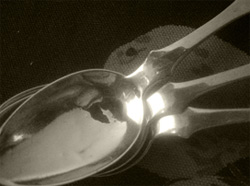
My blog's namesake - small, old and some very dented engraved silver plated tea spoons that belonged to my mother-in-law, and I use them to taste my food as I'm cooking.

Scroll down to the bottom to view my Blogroll

Posted in Uncategorized, on October 31st, 2008.

Alfred Hitchcock had declared his profession “producer” when a customs officer could not contain his curiosity and further questioned him.
What do you produce?” the officer inquired.
Gooseflesh,” Hitchcock replied.

Hitchcock, whose gourmandising produced his own flesh, too, was once a guest at a dinner party where food was hardly in profusion. While serving the coffee, his hostess said,
I do hope you will dine here again, Mr. Hitchcock.”
By all means,” he replied. “Let’s start right now.”
  . . . from The Ravenous Muse, by Karen Elizabeth Gordon
  . . . photo from networkedweekend.com

In time for Halloween – the temperatures are finally abating today. Good thing since goblin and ghost costumes don’t generally come in summer weight. Yesterday I spent the entire day in San Diego. First I attended a cooking class taught by Carissa Giacalone, one of the finalists in the TV Food Network’s “The Next Food Network Star” back a few years ago. She lives in San Diego and has a catering business. I’ll have several recipes to share from that class. Maybe starting tomorrow. Then, since I was already there, I met up with my friend Linda from Carlsbad, and she and I attended a Phillis Carey class in the evening. There were 52 people in that class! Whew. Phillis prepared a very ambitious menu (four meat entrees and a dessert). I’ll be sharing some of those recipes as well in coming days. I took a bunch of photos so you’ll get to see what all the dishes look like. So, stay tuned.

Posted in Miscellaneous, on October 30th, 2008.


Until I decided to write up this recipe, I can’t say that I knew much about Auguste Escoffier, other than he was a famous French chef. And that he wrote a cookbook or two which are considered sacrosanct by lots of chefs and foodies in France and abroad. He lived from 1846 to 1935 and spent his life in the French food arena, beginning when he was apprenticed to his uncle’s restaurant in Nice at the ripe age of 12. He revolutionized (streamlined) the running of top-drawer kitchens, and implemented new techniques of canning when he was the Chef de Cuisine for the French Army during one of France’s wars. So there’s your little food history lesson of the day.

I’ll just comment briefly that as I was growing up (I think I’ve mentioned it here before) both grandmothers always served lots of pickles and relishes with meals. They likely did lots of canning since they grew their own vegetables, so they had lots of cucumbers, tomatoes and peppers to use up every season. But then, pickles and relishes were just de rigueur. My mother served her fair share of them too, and I can’t say that I was all that enamored with them as a child. Actually, salsa is a similar kind of condiment, and I certainly eat plenty of THAT. Once I ventured into making fruit salsas (my mango or pineapple salsa being a particular family favorite), I must have reacquainted my palate to the kind of sweet and sour mingling that goes on with pickles and relishes. I also have that Mexican onion relish that is so good too. And remember my write-up about the piquante peppers from South Africa? They have a very similar taste, although this pepper condiment has many more layers of flavor with the addition of onions, garlic and spices. The South African peppers are just pickled somehow.

My fellow blogger, Luisa, the Wednesday Chef, wrote up this recipe, having read it in the Los Angeles Times (no longer available online). In her post she used many, many superlatives. I usually stand up and notice when bloggers use words like fabulous, fantastic, can’t keep my spoon out of them. That kind of language. Since I had some leftover meatloaf (obviously cold), this recipe seemed like a cinchy combination. I had everything on hand except the red bell peppers, and that was easily rectified.


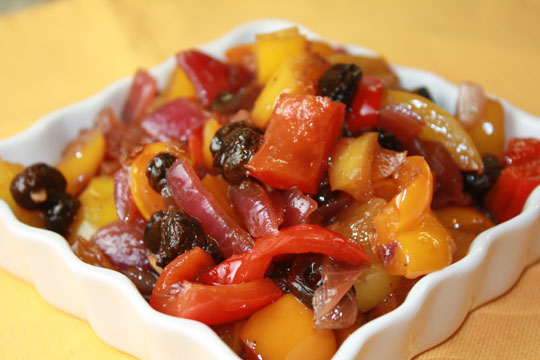
This recipe is SIMPLE. Really. It took about 20 minutes to chop and cook, then it bubbled away on the stove for an hour or so. I had golden raisins instead of dark, but that was the only substitution I made in this recipe. I didn’t weigh the peppers – I used 4 peppers. The picture above is the combination of ingredients to make the peppers. Nothing all that unusual. And the second photo shows the spices used. They made a very attractive pile on my cutting board, so I decided to photograph them for you. The only thing a bit different here is the freshly grated nutmeg. I almost never use jarred pre-ground nutmeg. The flavor of the fresh is just so much better. Years and years ago I bought a nutmeg grinder (less than $10 then) that has served me well all these years.

The verdict? Fabulous. This relish would be wonderful with just any kind of meat (roasts, chops) and even chicken. Even some kinds of fish. So often leftover meat from a pork roast, for instance, loses that juiciness once it’s cooled down and chilled, so you need something to moisten every bite. I can see this as a great condiment in sandwiches too. I can’t wait to try this on a turkey or meatloaf sandwich. I don’t know that I’ll be eating it straight out of a bowl because it does have a vinegary sharpness. Muffled by the sugar, though. Overall: delicious. And did I tell you it was EASY?

This little note is being added nearly a month later . . . I still have these peppers in the refrigerator. They’re fine. Just fine. I served it recently as a side with grilled sausages for dinner. All that vinegar in them  must keep them preserved well.
printer-friendly PDF

Files: MasterCook 5+ and MasterCook 14 (click link to open recipe in MC)

Peppers for Cold Meats a la Escoffier

Recipe: Auguste Escoffier via the Wednesday Chef blog
Servings: 16 (makes about 4 cups)

4 tablespoons olive oil
1 medium onion — minced
1 pound red bell peppers — washed, cored, seeds removed, chopped
1/2 teaspoon salt
1/2 teaspoon ground ginger
1/2 teaspoon mixed spices (allspice and nutmeg)
1 pound ripe tomatoes — drained (most of a 28-ounce can of diced tomatoes works)
1 clove garlic — minced
1/2 cup raisins [I used golden]
1/4 cup sugar
2/3 cup red wine vinegar

1. Put the oil in a saucepan. Chop the onion very fine, add to the pan and fry over low heat until softened. Add the peppers, salt, ginger and mixed spices, and cook for 10 minutes.
2. Stir in the tomatoes, garlic, raisins and sugar. Add the vinegar; cook over very lot heat, covered, for 1 hour and 15 minutes, stirring occasionally. Uncover the pot and cook with the lid off for 5 to 10 more minutes.
Per Serving (approximately 1/4 cup): 72 Calories; 4g Fat (41.2% calories from fat); 1g Protein; 11g Carbohydrate; 1g Dietary Fiber; 0mg Cholesterol; 70mg Sodium.

Posted in Uncategorized, on October 29th, 2008.


This photo was taken quite a few months ago. You can’t see much of the horizon (the Pacific Ocean, out there about 10 miles), but in the far distance is Catalina Island, and off on the right side is Palos Verdes, a ridge of low hills right along the coast northwest of Long Beach.>

We’re experiencing a week of warm temperatures. Again. Usually I say to myself that by Halloween we’ve finally cooled down to Fall temps. We’ve had some cooler days, but then it heats right back up again. It was close to 90 yesterday. At least the humidity is low, so we don’t feel it as much. We’ve had some fires in Southern California, but nothing near us, thank goodness. But then, over the last couple of years nearly everything that could burn within 10-20 miles of us has already burned.

As many issues as we have had with our property (house) in the last year, our jacuzzi developed a new leak. Actually two. These are the 3rd and 4th ones in about 3+ months. Yesterday and the day before the leak detection people repaired them (the major one was a copper pipe about 20 feet away, near the filtration equipment), and they had to dig down about 6 feet, including jackhammering about a 2.5 x 8 foot length of cement walkway. The second one was near the jacuzzi itself. Sigh. We are so gosh-darned tired of fixing these leaks. Not including being tired of having to PAY for the repairs.  But then, our house is 40 years old. And, if we’ve found and repaired these two leaks, that means it’s less water that is draining out into the soil on our hill. One of these leaks, probably a slow leak,  may have been there for a very long time undetected. The bigger one – well, we knew we had a problem when the jacuzzi was losing 3-5 inches of water a day. Isn’t home ownership wonderful?

Posted in Soups, on October 28th, 2008.

Thai pumpkin, shrimp and coconut milk soup
Recently I went with a couple of my watercolor class friends to a Thai restaurant for lunch. I enjoyed my lunch so much I decided to try to recreate it at home. My entrée was a special that day, a creamy (coconut milk-based) sauce with fresh pumpkin cubes and shrimp. It had enough of the sauce/gravy to serve over a bed of rice. It was absolutely out of this world fabulous. I tried to close my eyes and analyze the flavors floating around in my mouth. I hoped it wouldn’t be too difficult to figure out how to make it.

Seeing sugar pie pumpkins at the market reminded me I wanted to try to prepare the dish. I did sleuth on the internet for a recipe, and found one that was similar, but different. I decided to make mine a soup without rice rather than the shrimp entrée sauce over rice I’d had at the restaurant. Since there were already carbs in the dish (the pumpkin) I thought it would be healthier for us anyway. The internet recipe called for shrimp paste (I used a fish soup base) and dried shrimp (I didn’t have them, nor did I buy it). It called for “green chiles,” so I used one Poblano (probably not traditionally Thai, but it was what I had) and one jalapeno. It had a perfect degree of heat for my taste. This other recipe called for basil. I used spinach instead. So I really changed the recipe all around, different proportions of most things and added ingredients plus deleted others.

The seafood soup base I bought from Penzey’s. You’ve read about them here before – their soup bases are just the greatest. I’m generous with how much I use. They don’t keep forever anyway. I’ve had my three jars for about 5 months now and they’re still just fine (stored in the refrigerator).

As I was making the soup I kept tasting the broth. Finally, after I added a jar of Thai red curry sauce I was pleased. The sauce came from Trader Joe’s, but I believe there are other brands out there . . . just seek them out. I purchased frozen already-cooked extra-large shrimp which got added to the soup at the very end. They slow-simmered just long enough to defrost and heat through. The coconut milk gets added at the very last also because it does not like to be boiled. I added the spinach and merely stirred it into the soup minutes before serving. The flavor comes from all the other stuff you put into the broth, though. The garlic, shallots, lemongrass (I used a paste from a tube since I can’t always find fresh lemongrass in my markets), the chiles, Thai fish sauce, and the soup base. There’s also just a tad of sugar in this. The soup is quite versatile – you could easily change the ingredients to ones of your choice. Don’t like pumpkin? Use butternut squash. Don’t like shrimp? Use chicken. Don’t like coconut milk? Use regular cow’s milk or soy (although the flavor will be really different). Don’t like chiles? Add green or red bell pepper instead. But, if you enjoy Thai flavors, this is one fantastic soup. My DH thought it was wonderful too.
printer-friendly PDF

Thai Pumpkin, Shrimp and Coconut Milk Soup

Recipe: Inspired by but significantly changed from a recipe on dlife.com
Servings: 5
NOTES: You can use your own choice of chiles. I happened to use one poblano and one jalapeno. Neither was very hot on the Scoville rating. If you don’t mind being un-authentic, add some frozen peas and mushrooms to the soup too.

3 cups pumpkin — fresh, peeled, cubed (don’t use the large carving-type pumpkins for this)
2 whole garlic cloves — crushed
2 large shallots — finely chopped
1 teaspoon seafood soup base — or chicken soup base
2 tablespoons lemongrass — fresh, chopped or lemongrass paste
2 whole green chiles — seeded (see notes for explanation)
4 cups chicken stock
16 ounces shrimp — fresh, shelled
11 ounces Thai red curry sauce
1 tablespoon Thai fish sauce
1 teaspoon granulated sugar — or more if desired
4 ounces spinach — baby type
1/2 cup canned pumpkin — optional
2 cups coconut milk — canned
Salt and ground black pepper

1. With a sharp knife or very sturdy peeler, peel the pumpkin, and cut into quarters. Scoop out the seeds with a teaspoon and discard. Cut the flesh into chunks (about 3/4 inch) thick and set aside.
2. Put the garlic, shallots, fish soup base, lemongrass, and green chiles in the food processor. Process to a paste, stopping periodically to scrape down the sides of the workbowl. Continue to process until it’s a smooth paste.
3. In a large, heavy pot, bring the chicken stock to a boil. Add the ground paste and stir well to dissolve. Add the pumpkin chunks and bring to a simmer. Simmer for 10-15 minutes or until the pumpkin is tender. Don’t overcook.
4. Stir in the shrimp, bottled Thai red curry sauce and spinach, bring to a simmer and cook 1-2 minutes. Add the coconut milk, then bring the soup back to simmer. Be careful not to let it boil. Add a bit of water if you want more quantity (up to about 2 cups). Add the fish sauce, canned pumpkin, sugar and ground black pepper to taste. Add more salt if needed. Cook (below a simmer) for 2-3 minutes. Serve in warmed soup bowls. Since the spinach floats to the top, it provides a lovely garnished LOOK to the soup. No need to garnish with anything else unless you want to sprinkle some shredded spinach on top.
Per Serving: 645 Calories; 39g Fat (52.8% calories from fat); 29g Protein; 50g Carbohydrate; 4g Dietary Fiber; 139mg Cholesterol; 3972mg Sodium.

Posted in Desserts, on October 27th, 2008.

traditional pumpkin pie with cinnamon whipped cream
Have you ever given much thought to what it must have been like as a pioneer woman? Maybe not the kind who could whip up a pumpkin pie after a day in the covered wagon traversing Kansas, but the kind who lived in New England during the early days of our country’s history? The kind of pioneer woman who had to build a fire first, keep it stoked, make and mend clothes, be capable of shooting a coyote who got too close to the chicken coop, perhaps feed all the farm animals in between doing laundry in a big huge cauldron outside the cabin? The kind of pioneer woman who had to make large meals every day, day in and day out, three times a day, often needing to feed not only the family, but also the farmhands. The kind who made biscuits, eggs, bacon, fresh bread, pancakes, stews, soups, and everything in between every single day. Who didn’t have a refrigerator to store leftovers. The kind of pioneer woman who didn’t have much cinnamon in her pantry (because it was precious and expensive), who had to harvest, cut and peel every bit of pumpkin she ever used in cooking? The kind of pioneer woman who didn’t ever go to a cooking class to learn how to use yeast. Or how to butcher a steer. It had to have been grueling work, being a pioneer housewife. And she did it in long-sleeved, full-length dresses and layers of undergarments. Because that’s just the way it was. I envy her not. Me with my ipod, double oven, bread machine, crockpot, washing machine, cell phone and two refrigerators and freezers. Well, you get my drift. My hat is off to those women who met the challenge, all for love and/or family.

Seems like I remember reading that the Native Americans taught the European settlers how to grow and harvest pumpkin because they’d never seen such things before. (The picture at the right is the sugar pumpkin I used for a soup – not for the pumpkin pie.) I’ve probably mentioned it here before that I’m a huge fan of pumpkin. Pumpkin pie is my favorite pie, bar none. And I have to talk to myself (you know, self talk in my head) about not making it more than once or twice a year. Because I can eat plenty of pumpkin pie if it’s around. My dad also adored pumpkin pie. It was his favorite as well. It’s also our son’s favorite pie, and he considers the hostess (whether it’s his wife, me, or any other hostess) stingy if he doesn’t get a whole pie all to himself on Thanksgiving. He laughs and cajoles, pleads and begs, tells the women in his life what wonderful cooks they are, just so he can have his whole pie. As a teenager he literally ate a whole pie on Thanksgiving Day. And wanted more the next morning for breakfast. I think his wife has weaned him down to one whole pie. Period.

Generally we celebrate Thanksgiving out at our desert house. We have a 3-bedroom house there, and if all three of our kids and their families come to visit it’s spillover time with people and children sleeping all over. But there’s lots to do. Entertainment for the kids. A big pool next door. A golf cart to ride around in, just to check out the pathways around the two 18-hole golf courses. And with just a single refrigerator my kitchen there is taxed to the max storing all the food and stuff to serve a big dinner, and breakfast, and lunches and snacks for thirteen people. So I always want to make pumpkin pie that doesn’t need to be refrigerated. There’s absolutely no room in the frig. Sometimes one of the daughters will make pies (Sara loves to bake, so she often offers). Karen likes to bake too, but with a little toddler she doesn’t have quite so much time these days. I have succumbed to buying pies a couple of times, but I’m never very satisfied. Store-bought pumpkin pie is usually too sweet for me. I’m certain I’ve mentioned here before that I think Thanksgiving dinner is the hardest work of any American holiday. I make my own everything, the stuffing, the brine, the vegetables, the mashed potatoes, cranberry relish, gravy, pie. Everything. In some years I’ve been so exhausted by the time I sat down to dinner I hardly wanted to eat anything. So little of Thanksgiving can be made ahead, either. One year I made Rachel Ray’s apple stuffin’ muffins. They were very good, actually. Last year I made Italian Spicy Sausage Stuffing which was just wonderful. I wrote raves about that dressing last November. I’ll write up a post sometime in the next couple of weeks with a list of my recipes that are suitable for Thanksgiving dinner. And for the leftovers too.Back to pumpkin . . . I was raised on Libby’s recipe off the label on the can. And despite trying many other versions, I generally like Libby’s recipe best. However, the other day I was perusing one of my cookbooks – one that lives out at our desert house. It’s Pumpkin: A Super Food for 12 Months of the Year. I bought it last year. And in it were several pumpkin pie recipes. So as I looked at this one, titled simply “Traditional Pumpkin Pie,” I thought, yea, just a regular pumpkin pie. No different than lots of others. But then I read the intro blurb. The author, DeeDee Stovel wrote “This is the best pie I’ve ever had.” Now, considering that she must be a really great cook, and that she has a successful pumpkin cookbook under her belt, when someone speaks those words, I listen. I looked at the ingredient list . . . nothing all that unusual other than fresh ginger rather than powdered. Hmmm. Different. But then I glanced at the directions. You have to caramelize the pumpkin. Huh? How the heck do you do that with canned pumpkin?

So, there was nothing for it except I had to try it. I don’t think I can last until Thanksgiving to get my first pumpkin pie fix, anyway. So, I bought some of Trader Joe’s ready-to-bake pie crust shells and partially baked one. Blind with pie weights, for 10 minutes just until the shell would hold its shape. Meanwhile I started in on the filling. Well, it was hard to tell when the pumpkin flesh was caramelized, or ready. If it started to brown, then there were little crusty pieces in it. So I reduced the heat and just kept smushing it around the pan until it was a thick, drier mush, rather than a wet mush. It’s a bit difficult to judge, I’d say. There’s about 25% or more of water in canned pumpkin – at least when you get done caramelizing it, instead of a cup, your yield is ¾ of a cup. That gets mixed with all the custard part, the spices (and the freshly grated ginger). But then there’s another twist – you sprinkle 2 T. of sugar and 1 T. of flour (mixed together) over the bottom of the piecrust before you pour in the custard (see photo). My guess is that it keeps the crust from getting soggy. But that certainly is a different technique I’ve not used before.

Cook’s Notes: My verdict? The pie is very good. Maybe more than “very good.” As good as Libby’s? Well, hmmm, I’m not sure. This pie has a lighter, fluffier texture. Libby’s is a more dense pie just redolent with spices. (It’s possible that’s from using Trader Joe’s organic canned pumpkin, though, rather than Libby’s.) This one is more subtle.  But I will tell you, adding that layer of flour and sugar in the bottom of the pie shell protected the bottom shell from getting soggy. That technique absolutely worked! The cinnamon in the whipped cream was also a really nice touch. The pie is light in the spices (I’d probably add more next time), but I liked it. A lot. I also had to bake the pie an additional 12-15 minutes, so maybe the filling really needs 3 eggs instead of 2.
printer-friendly PDF

Traditional Pumpkin Pie with Caramelized Pumpkin

Recipe: from Pumpkin: A Super Food for 12 Months of the Year by DeeDee Stovel. She was inspired by Louise Andrews Kent, from an old Vermont cookbook
Servings: 8

PUMPKIN:
1 teaspoon butter
1 cup canned pumpkin
1 tablespoon all-purpose flour
2/3 cup sugar
CUSTARD:
1 teaspoon butter
2 cups milk
2/3 cup heavy cream
1 teaspoon fresh ginger — peeled, grated
1/2 teaspoon ground cinnamon
1/4 teaspoon ground nutmeg — freshly ground if possible
1/4 teaspoon salt
2 whole eggs — beaten
PIECRUST:
1 whole pie crust (9 inch) — partially baked (10 minutes)
1 tablespoon all-purpose flour
2 tablespoons sugar

1. PUMPKIN: Melt the butter in a heavy skillet under medium heat. Add the pumpkin and cook until the moisture is reduced and the pumpkin is lightly browned, about 5 minutes. You will have about 3/4 cup of smooth, thick (dry-ish) and slightly caramelized pumpkin.
2. Heat the oven to 450.
3. Sprinkle the tablespoon of flour and the sugar over the pumpkin in a large bowl and stir to combine, mashing out any lumps.
4. CUSTARD: Grease the bottom of a medium saucepan with the teaspoon of butter and heat the milk over medium heat until little bubbles form around the edges. Pour the milk, cream, ginger, cinnamon, nutmeg and salt over the pumpkin and stir until well combined. Use a whisk to dissolve any cinnamon clumps. Mix in the eggs and stir well.
5. PIECRUST: Mix the flour and sugar together in a small dish and sprinkle in the bottom of the partially baked piecrust. Use a small spoon to spread it evenly over the bottom. Pull the oven shelf out and place the piecrust on the shelf. Gently pour the pumpkin mixture into the shell. Carefully push the rack back into the oven.
6. Bake pie for 15 minutes at 450, then reduce heat to 325 and continue baking for an additional 30 minutes. (Mine took 10-15 minutes longer.) The pie should jiggle slightly in the middle when it is done.
7. Make a topping of whipped cream and add powdered sugar and cinnamon, then serve on top or alongside the pie.
Per Serving: 328 Calories; 18g Fat (48.0% calories from fat); 6g Protein; 37g Carbohydrate; 2g Dietary Fiber; 91mg Cholesterol; 279mg Sodium.

Posted in Uncategorized, on October 26th, 2008.

A rat who obviously didn’t know how to read nevertheless loved books. So he set up house in a library where no one went any longer. He would walk on the books, between them, run along them, contemplate them with a tear in his eye, and his mouth watering. It was his home, he was happy there; these are my books, he said.Occasionally, he’d stop to nibble at a part of one book or another.

Phew! The new books stink of glue and ink, and their pages are flimsy and damp and stick to the palate.

Instead, he regaled himself with the most ancient pages, the dry and yellowed ones, which were very crunchy, for example his old edition of Diderot’s Encyclopedia; he would always remember the article consecrated to God, which he made quite a feast of.
There’s also a telephone book dating from 1916, full of names of dead people and obsolete addresses which he offers bites from to his buddies when they come to visit him and which they highly prize.

His salon is furnished in paperbacks, colored and pliant. The bathroom is behind the Letters of Madame de Sévigné. An incunable* bound in vellum whose cover is buckling serves as his bed; recently, he had a nightmare in which he was taught to read.

. . . François Hébert, le Dernier Chant de l’avant-dernier dodo (the last song of the next-to-last dodo), printed in The Ravenous Muse, by Karen Elizabeth Gordon

* incunabulum: 1. A book printed before 1501; an incunable. 2. An artifact of an early period.

Posted in Cookbooks, on October 25th, 2008.

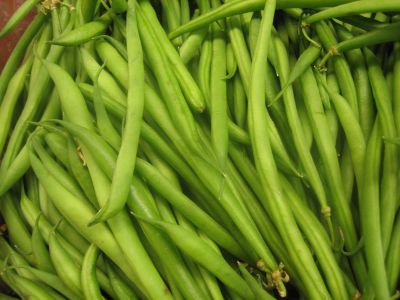
fresh green beans
All the information here about green beans comes from one of the chapters in Russ Parsons’ book titled How to Pick a Peach.

What I learned:

  • That cooks all around continue trying to find ways to keep green beans green. The chemistry involved is interesting: every green vegetable goes through three stages of green: (1) raw, the vegetable is a deep but dull green; (2) in the early stages of cooking the color turns bright and vibrant (this change occurs as the cell walls soften and tiny amounts of oxygen are driven off while other gases cloud the pure color of the chlorophyll); (3) the green turns to olive drab because of a chemical change in the chlorophyll – partly due to an enzymatic action, but mostly due to acids released during cooking.
  • Some of the age-old methods for keeping beans green are myths (like using baking soda in the water – – makes the texture slimy, though; cooking in heavily salted water – – no scientific basis that that method works).
  • The best method for keeping green beans green is to cook them in plenty of water (so less acids are released to each bean) – quickly – no slow heat-up here – the less time beans are in the water the better – cook just until they’re done to your liking – then plunge them into ice water. [This is the method I’ve used for about 15 or so years, I guess – probably learned it at a cooking class].
  • Green beans we buy are actually immature beans – as a legume they grow for the seeds inside, which if left to mature, become nugget sized and the pods will toughen.
  • There are two types of green beans – the round (Blue Lake and haricots verts), the more traditional green bean; the flat (like Italian Romano) are more meaty and assertive, and are cooked much longer. They even seem to improve with lengthier cooking.
  • Green beans come in a variety of colors. So they really shouldn’t just be called “green” beans. The old term was “string beans,” but the strings were bred out of beans in recent years (except heirloom varieties). A more likely name is “snap beans.” If beans are fresh, they should snap (not just bend) in half.
  • You should remove the stem end, but removing the tail-end is not necessary [I always leave them on because they’re very tender and look better].

How to Choose & Store:

  • They begin to lose moisture as soon as they’re picked, so eat them soon.
  • There should be no sign of wilting or mold.
  • Store tightly wrapped in the crisper drawer of your refrigerator.
  • Russ Parsons gives his favorite green bean quick cook method – boil them for about 7 minutes, plunge into ice water, pat dry, then dress with olive oil, lemon juice and just a bit of garlic just before serving (lemon juice will turn the beans gray if allowed to sit). In the book, he also includes two other recipes: a Chicken Salad with Green Beans and Basil Mayonnaise, and another for using the Romano style beans, called Overcooked Green Beans.
  • Here in California I never – ever – see the flat Romano beans at grocery stores or farmer’s markets. I’m going to have to look more closely – maybe they’re there and I’ve just never noticed. I have two real favorite recipes for green beans. I hope you’ll try them.
  • Green Beans with Garlic (a real favorite of ours)
    Green Beans with Shallots & Balsamic Glaze

    Posted in Chicken, on October 24th, 2008.

    chicken chili

    I wrote up this post before we left on our trip in September, and I’ve posted a bunch of stories in the interim. No matter, read on . . . I kid you not, folks. I am in l-o-v-e with Penzey’s Soup Bases. You just won’t believe how flavorful your soups and stews will be when you add just a bit of this to them. And I seem to be riding on the tails of the successful chicken posole I made last a few weeks ago. I must not have made enough of that – I’m craving more. So . . . since I was making dinner for us to take to our local kids and grandson, and decided it was cool enough yesterday (in the 70’s) that it felt almost, sorta, kinda like Fall,  chili and cornbread sounded like the ticket to me. I didn’t want to go buy stuff at the grocery store. Sure enough, I had everything to make this chili.
    Researching, I read a recipe on the Food Network (from Ina Garten’s section) and used it as a kind of guideline. This particular version doesn’t have any beans in it, but you could certainly add them. I might add a can of kidney beans, just to give it some dramatic color. It has a bunch of corn in it (I had a plastic bag of Trader Joe’s fire-roasted corn in the freezer) so probably doesn’t need beans.

    Frozen chicken breasts I had, canned tomatoes (yep), red bell peppers (yep, two left in the crisper) and onions. Everything else was just icing on the cake – yep, had some cheddar cheese, a little container of sour cream, and some about-to-be-stale tortilla chips. Hooray. No trip to the grocery store!

    The chili came together very quickly – really. I made it my own with omission of a few things (basil, yellow bells, cayenne). I had some cute little chile peppers from our garden (the four-legged squirrel and ground critters don’t like chiles, I’ve learned – hooray). They weren’t jalapenos, but something close, so the recipe below indicates jalapenos. You can use your chiles of choice for the heat you’d prefer! And I added my Penzey’s turkey stock concentrate and some chipotle chile in adobo sauce, plus some ancho chili powder. And the corn. Garnishes can be of your own choosing. I used grated cheddar, sour cream, tortilla chips and cilantro. Green onions? Fritos? Jack cheese? Yogurt instead of sour cream? Lots of choices here.
    printer-friendly PDF

    MasterCook 5+ import file – right click to save file, run MC, then File|Import

    Chicken Chili

    Recipe: Inspired by a recipe on the Food Network
    Servings: 6 (a guess)

    2 medium onions — peeled, chopped
    2 tablespoons olive oil
    3 cloves garlic — minced
    1 1/2 tablespoons ground cumin
    1 whole jalapeno chile pepper — or more if you’d like more heat
    2 whole red bell pepper — seeded, chopped
    4 cups water
    1 1/2 teaspoons Penzey’s turkey soup base — or chicken dry granules
    2 teaspoons Kosher salt
    1 tablespoon chipotle chile canned in adobo — minced, or more to taste (hot)
    1 tablespoon chili powder
    1 tablespoon ancho chile powder — (adds flavor, no heat)
    3 cups Trader Joe’s fire-roasted corn — or canned or frozen
    2 pounds canned tomatoes
    3 pieces chicken breast halves — boned, skinned, cubed (raw)
    3 tablespoons flour
    1/2 cup heavy cream — optional
    GARNISHES: (optional)
    1 cup grated cheddar cheese
    8 tablespoons sour cream
    1 cup tortilla chips — crushed
    1/2 cup cilantro — minced

    1. Heat the olive oil in a large pot and add the cubed onion. Sauté, stirring frequently, until it’s turned nearly translucent.
    2. Meanwhile, chop up the red bell peppers and add to the onions, continuing to stir frequently for about 2 more minutes.
    3. Add the minced garlic and cook for one minute only. Add the water and bring the pan up to a boil.
    4. Add the cumin, the turkey or chicken soup base, the chipotle chile, salt and chili and ancho chile powders. Bring up to a boil and add the corn.
    5. Place half of the canned tomatoes in the jar of a blender and puree until smooth. Add both tomatoes to the pot and bring up to a simmer, then reduce heat and allow to bubble gently for about 5 minutes.
    6. Meanwhile, chop up the chicken into small pieces and place in a bowl. Add the flour to the chicken and stir until the flour has all adhered to the chicken. Gently add it to the pot and allow the mixture to simmer until the chicken is fully cooked, about 5-10 minutes. Taste for seasonings.
    7. If desired, add the heavy cream and stir. If time permits, allow to cool, and reheat when ready to serve.

    Per Serving (includes consuming all the garnishes): 634 Calories; 40g Fat (55.6% calories from fat); 27g Protein; 45g Carbohydrate; 7g Dietary Fiber; 102mg Cholesterol; 1275mg Sodium.

    Posted in Fish, Veggies/sides, on October 23rd, 2008.

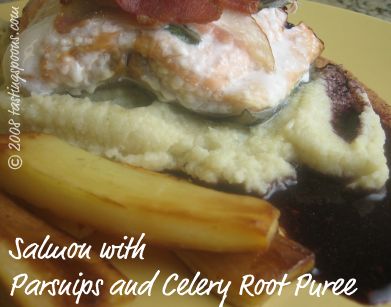
    salmon on a bed of celery root puree and served with parsnips

    A few weeks ago I was watching Martha when she had several famous New York chefs on the show. Seems like they all made fish of some kind, and this particular recipe just sounded interesting. Since Fall is in the air, a more hearty meal piqued my curiosity. The recipe is from Chef Daniel Boulud, certainly one of the pre-eminent chefs out there today. His method is more French than anything else. This recipe isn’t for a night when you’re trying to get dinner on the table in a hurry. It would be more appropriate for guests or a special evening at home. I have changed the recipe just a little. Originally it served 6. I cut it down to serve 2 (shown below). I couldn’t find salsify at the market, so I substituted parsnips. I hadn’t fixed celery root in years, but most markets here in California carry it regularly. I love the subtle taste of celery in this root vegetable.

    So, here’s the gist of the recipe. First you make the wine and port sauce. It boils down to next to nothing (I actually left the shallot in the sauce, and I forgot to add the peppercorns altogether). Meanwhile, you peel and cube the celery root. Be sure to use a sturdy peeler if you have one. A light-weight one probably couldn’t pull the heavy peel off. Dig out any eyes and remove most of the very dark swirly parts (the part that’s actually the peel) by just peeling an additional layer or two. Cut into cubes and then you poach the root in milk to which you’ve added some seasonings. That takes about 20 minutes. I pureed it in the food processor (the actual recipe has more steps) and didn’t use all the milk, but just about.


    The fish is fairly straight forward – you place some fresh sage leaves (from my garden) on the salmon fillets, then top them with one or two slices of bacon. I wanted to use one slice rather than two, but use your own judgment. It will be harder to turn the salmon if you lay the bacon on top (as I did) rather than wrapping two slices around the middle (so the bacon will stick to itself where the ends meet). I actually baked my salmon in the oven, but the done-ness was much harder to judge (it was overcooked, even though I used a thermometer), so I recommend you stick to the recipe below pan sautéing it.

    The results: Absolutely delicious. The celery root puree with its moderately subtle celery flavor was a great pairing with the hearty salmon. The SAUCE is what makes it, though. I wish I’d made more. You want to take each bite that includes a bit of the celery root, salmon, bacon and sauce.
    printer-friendly PDF

    Salmon with Parsnips and Celery Root Puree

    Recipe: Chef Daniel Boulud, Bar Boulud, NYC
    Servings: 2

    WINE SAUCE:
    3 whole black peppercorns — crushed
    1 sprig fresh thyme
    1 sprig fresh savory — or substitute sage
    1 small garlic clove — smashed
    1/2 cup Syrah wine — or other full-bodied red wine
    2 tablespoons port wine
    1 small shallots — finely minced
    2 cups low-sodium beef stock
    PARSNIPS:
    1 tablespoon butter
    1 tablespoon olive oil
    1/2 pound parsnips — trimmed, peeled, rinsed, dried, and cut into equal stick-sized pieces
    SALMON:
    4 sage leaves
    3/4 pound salmon fillets — skinless
    2 slices bacon salt and freshly ground black pepper
    CELERY ROOT PUREE:
    1 whole garlic clove — smashed
    1 sprig fresh sage
    1 sprig fresh thyme
    3/4 pound celery root — peeled, cut into 1-inch pieces (about one large)
    2 cups milk
    2 tablespoons unsalted butter
    1 tablespoon fresh chives — or minced Italian parsley
    Salt and pepper to taste

    1. SAUCE: Place peppercorns, thyme, savory, and garlic in a piece of cheesecloth; tie with kitchen twine to enclose. Transfer to a medium saucepan, along with, Syrah, port, and shallots. Bring to a simmer over low heat and cook until liquid has reduced by three-quarters. Add beef stock and continue cooking until liquid has reduced by two-thirds and lightly coats the back of a spoon. Remove cheesecloth bundle from saucepan and discard; set sauce aside and keep warm.
    2. PARSNIPS: Heat butter and olive oil in a large skillet over medium-high heat. Add parsnips, season with salt and pepper, and cook, stirring occasionally, until golden and tender, about 10-15 minutes. Remove from heat and keep warm.
    3. SALMON: Place 2 sage leaves across the length of each piece of salmon; wrap each with 1 slices bacon to secure. Heat 2 tablespoons olive oil in a large skillet. Season salmon with salt and pepper and add to skillet. Cook, turning once, until bacon is crisp, fish is golden, and its internal temperature reaches 130 degrees on an instant-read thermometer, about 4 minutes per side.
    4. Divide celery root puree evenly between 6 serving plates. Serve with a few pieces of parsnips and a piece of salmon. Garnish with bacon and crispy sage leaves. Drizzle sauce around plate and serve immediately.
    5. CELERY ROOT PUREE: Place garlic, sage, and thyme in a piece of cheesecloth; tie with kitchen twine to enclose. Place in a medium saucepan along with celery root and enough milk to cover (you may not need to use all the milk). Bring to a simmer over medium heat; continue simmering until celery root is tender, 20 to 30 minutes. Strain mixture through a fine mesh sieve set over a medium bowl, reserving 1/2 cup of milk and discarding cheesecloth bundle.
    6. In a small saucepan, melt butter over medium-high heat until nut-brown in color, about 8 minutes. Remove pan from heat and pour butter into a bowl, leaving any burned sediment behind.
    7. Transfer one-third of the celery root, reserved milk, and browned butter to the jar of a blender; blend until smooth. Slightly mash remaining celery root with a wooden spoon or a potato masher. Stir in pureed celery root mixture and chives; season with salt and pepper. Serve immediately.
    Per Serving (assuming you eat every speck of the celery root and parsnips, which we didn’t): 812 Calories; 43g Fat (50.7% calories from fat); 48g Protein; 45g Carbohydrate; 10g Dietary Fiber; 174mg Cholesterol.

    Posted in Soups, on October 22nd, 2008.

    collage of 4 soups

    Waiting for the weather to turn Fall-ish seems to take forever here in Southern California. On our recent driving trip we even got up to snow level (in Mt. Lassen), and endured 4 days of rain in Oregon, but as soon as we headed south again it was back into Indian Summer. The air conditioning has been running some hours nearly every day. But, it does cool off at night, thankfully. It’s not warm enough to eat outside in the evening (besides, by the time we eat it’s pitch dark now), and because I’ve been very busy trying to catch up on “things,” I’ve done some quick and easy dinners of late. Whenever the weather turns cool, my mind turns to soup. Soup is probably my most favorite food to cook, believe it or not. I even considered naming my blog something related to soup. But then, I cook a little bit of everything, so that would have been quite misleading and far fewer people would read my blog.

    As I was baking Dana’s recent birthday cakes, my granddaughter Taylor asked me what was my favorite thing to cook. When I told her it was soup she gave me a funny look. When she comes to visit us I usually bake with her (cookies, cakes, desserts – I mean, what kid doesn’t love desserts . . . I always hope that one of my grandaughters or grandsons will have an interest in cooking).  So she was a bit mystified, I guess, that I said soup! Her mother (my daughter) doesn’t eat soup. Period. I don’t know where I went wrong there – she doesn’t eat eggs (or breakfast, for that matter), mushrooms or soup. Nor does she drink coffee or tea. Or wine. Or beer for that matter. Oh well. We eat/drink almost all of them. Back to soups . . . I’ve even written up a post about my soup “library” in my freezer – the vertical stack of flattened freezer bags full of soup. Twice this week I’ve pulled out bags from my inventory. I’m getting ready to start firing up the burners for a new season of soups.

    I read somebody else’s blog this morning which gave me the idea that maybe some of you haven’t been reading my blog all that long. And maybe you haven’t read some of my older posts about my favorite soups. If you haven’t looked at my RECIPE INDEX, you can always go there and view a list of all of the recipes of all types that I’ve posted since I started my blog.

    This soup list below isn’t all-inclusive . . . I’m only telling you about my favorite hot soups. The ones I make year after year after year. The ones I crave. Here you go:

    Cabbage Patch Stew –  Kind of a cross between soup and stew. Simple to make and served with a topping of freshly made mashed potatoes. This is one of my all-time favorites because of the combination of hearty soup and the potatoes. Freeze the potatoes separately.

    Cream of Tomato Soup –  From a cooking class I took last year up in Sonoma. Oh so much better than Campbell’s. This is the first soup I’ll be making very soon. I crave this soup, especially with a half of a toasted sharp cheddar cheese sandwich made on grainy wheat bread.

    Roasted Butternut Squash Soup – a rather complicated fresh butternut squash soup. It also contains onions and apples, all oven roasted before concocting the soup itself. Succulent and a bit sweet. Freezes really well.

    Roasted Poblano Asiago Soup –  the recipe I researched after going to Cindy’s Backstreet Kitchen and having a similar soup. I crave this soup too.

    Butternut Squash with Ginger & Jalapeno – a completely different soup than the above one – spicy, smooth and quite simple to make.

    Tuscan Chicken Soup –  not a chicken soup at all. Very easy soup with ground beef and greens.

    Sopa de Calabacitas – a favorite because I just l-o-v-e calabacitas (a Southwestern combo of corn, poblano chiles, onion, zucchini and cilantro). Usually served as a side vegetable, I like the mixture so much I made it into a soup.  

    And just because I’m writing up a post about soups, here are two cold soups that are particular favorites too, which I probably won’t be making again until next spring sometime:

    Cream of Cucumber Soup –  A cold summer soup from my friend Jackie. I must have made it 5 times over this last summer.

    Strawberry Gazpacho –  from a cooking class a couple of years ago. Simply scrumptious. When strawberries come in season in the spring I’ll be making this right away quick.

    I created the photo collage from photos in my archive. Once I finished it I realized the top left isn’t soup, it’s salsa. From the tiny thumbnail, it looked like tortilla soup. But the rest are soup photos from my recent cooking.

    Related Posts Plugin for WordPress, Blogger...