(3 Comments)
Archive for May, 2008
Joanne is Swedish by heritage, and the last I heard, she was living outside
Zahtar is to the
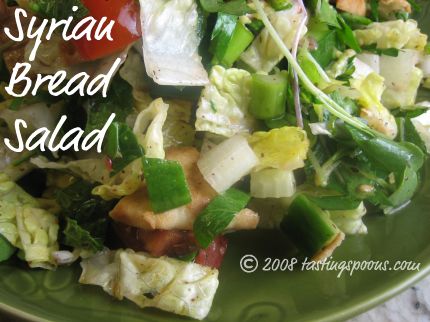
Syrian Pita Bread Salad
Recipe adapted from: Joanne H.
Serving Size: 6
1 large pita bread round — separated, chopped, toasted
1 small clove garlic
1 teaspoon salt
1/2 cup olive oil
1/4 cup lemon juice — or more if preferred
1/2 teaspoon ground allspice
1 tablespoon zahtar
1 head Romaine lettuce or other salad greens
1 cup cucumber — diced
2 whole scallions — minced
1 cup Italian parsley — chopped
1/2 cup fresh mint — chopped
4 medium tomatoes — chunks
1. In a blender container combine garlic clove and salt. Blend and allow to sit while you gather other ingredients. This draws out the garlic flavor, makes it more prominent.
2. Add allspice and zahtar, then oil and lemon juice to blender bowl and blend until thoroughly combined. Pour into a container. You may not use all the dressing in the salad.
3. In a large salad bowl combine all the remaining ingredients. Pour dressing over the salad and taste. May need additional salt. I also add pepper, although it’s not in the original recipe.
I know, the name is odd, isn’t it? I suppose I could just change the name and claim the recipe as my own, but that’s not fair to the originator of this sauce, so I’ve always referred to it by her title. It’s not just any old spaghetti sauce, as we’d be likely to call it, and surely Camille Stagg meant for us to take notice. This isn’t your ordinary red – either the wine OR the sauce. Camille Stagg is a well-known journalist, travel writer, and must live in Chicago , as she’s written a book about gourmet haunts in that town. She consults with some wineries and wine distributors (clubs), as I found other recipes listed by her in a couple of places on the internet.
Many years ago we used to have two bottles of wine delivered to us each month by a small company up in Emeryville , California . And each month the wine purveyor included a write-up about the wines in the box, AND a recipe suitable for that wine. Likely this recipe came in with a box of zin, since it calls for the wine in the recipe. It sounded so intriguing, I had to try it. We were going to have a wine tasting at our home a week or so later, and I asked each guest couple to bring a bottle of wine and food to serve with it. Specifically, they were to bring something that would complement their wine type. We stood around our kitchen island with 4 (small) glasses of wine in front of us, and sampled food with each wine. It was fun, and we really liked this sauce.
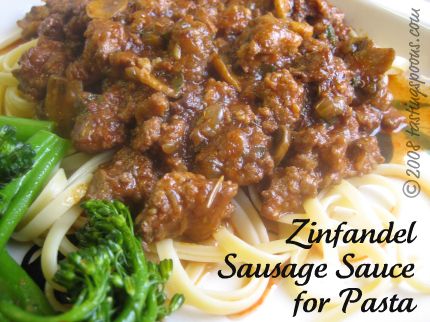
Having not made this for several years, I had to refresh my memory about what was different about it (it uses nearly a whole bottle of zin for 5 pounds of sausage). Once you combine the sausage, onions, mushrooms, garlic and seasonings, you can either simmer it on the range, or put it in a crockpot for long, slow simmering. I did the latter and kept it at high for about 4 hours to help boil off the wine. The sauce is thin to start, and must be simmered down to reduce it. Obviously, it’s a heavy sauce, redolent with the winy taste, and complemented with a large quantity of mushrooms. It’s an extremely dark-colored sauce – zin wine certainly stains nearly anything it touches anyway, so the meat takes on the dark red color as well. You can use your own combination of sausage – the recipe calls for half hot and half sweet. It’s zesty, I’ll give you that! Zinfandel is a zesty wine in and of itself - most people describe it as spicy. And the hot/spicy sausage ups the ante. If you don’t like spicy sausage, use all sweet Italian. This freezes well. Over the years I’ve increased the recipe volume - you can certainly halve it easily enough. I like to have leftovers to freeze. Linguine is my pasta of choice for this. I also increased the amount of wine in the recipe, but not by much. I caution you about one thing, though: canned tomato sauce - most are very, very high in sodium. When this sauce reduces down, the sauce will be too salty, so I recommend you use a low or no added sodium tomato sauce. Read the label!
Zinfandel Sausage Sauce for Pasta
Recipe By: adapted from one by Camille Stagg
Serving Size: 15
2 1/2 lb Italian sausage — hot
2 1/2 lb Italian sausage — sweet
3 whole onions — minced
1 1/2 lb mushrooms — sliced
4 c red wine — Zinfandel style
48 oz tomato sauce — low sodium
1/2 c Italian parsley
6 cloves garlic — minced
3 tbsp fresh basil
3 tbsp dried oregano
3 tbsp dried rosemary
Salt & pepper to taste, or no salt at all depending on the sodium in the tomato sauce
3/4 cup grated parmesan cheese
1. In a large, heavy skillet, slowly brown the crumbled sausage; drain off fat. Add onion and sauté until limp, then add garlic and mushrooms. Continue cooking for 2-3 minutes.
2. Add Zinfandel wine, tomato sauce, herbs and spices. Bring to a boil, partially cover pan, and reduce to a simmer.
3. Cook for 2-3 hours, stirring occasionally, until the sauce is reduced to a thick consistency. Taste and adjust seasonings. Serve over cooked pasta and top with grated parmesan. This freezes well. It is best if prepared a day ahead.
Per Serving: 641 Calories; 49g Fat (73.4% calories from fat); 26g Protein; 14g Carbohydrate; 3g Dietary Fiber; 118mg Cholesterol; 1775mg
printer-friendly pdf recipe
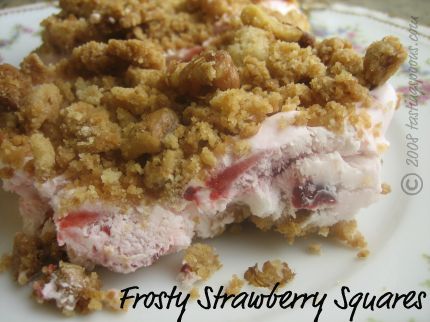
Strawberries are on the wane here in Southern California . They’re really at a peak of ripeness and sweetness, though. So I bought two big boxes of berries to use for a company dinner. First I made my much-loved Strawberry Gazpacho. Since I’ve written it up before, you can click on the recipe title above and get to the original posting for it. With super ripe berries, the gazpacho had a wonderful sweet taste.
The remaining I used in the dessert. No longer do I have the original recipe for this. My notes, though, tell me it was in a Sunset Magazine. Since I found it listed in one of my military officer’s wives’ cookbooks dating back to about 1968, I know it’s at least that old. I even remember when I first made it – I was living at Whidbey Island , Washington – learning to cook and enjoying the compact kitchen I had in the small but new home I was living in at the time. Strawberries make their entrance there in late May or early June (my recollection anyway) and once the main crops were picked, the fields near Oak Harbor opened up for people to pick their own “jam” berries. But even those were very tasty; they were just small. Perfectly ripe, however.
Making this over the years (but not for at least 15-20) I’d forgotten some of the procedures, and had to refresh my memory. My typed up recipe also contained an error; fortunately, however, I recognized something was missing and went to look it up on the internet. I found several sources for this recipe, and with the exception of two ingredients, they were all the same. The differences were in the original recipe too, as I recall. This can be made with frozen berries if you want – in which case you decrease the amount of sugar. A more recent version suggested using Cool Whip instead of heavy cream if you prefer, so I included that in my recipe, although I’ve never made it that way.
First you make a sweet crumb mixture. While it’s baking you can work on the filling (strawberries, lemon juice, egg whites and heavy cream or Cool Whip). Once the baked mixture is cooled and crumbled up well, 2/3 of it is sprinkled on the bottom of a 9×13 pan. I stuck that in the freezer while I finished up the filling. The recipes all said to combine the berries, the egg whites, sugar and lemon juice and whip it all up until soft peaks form. I thought that sounded so very odd – the sliced berries would be totally decimated. I wanted them to remain in a more solid form, so I only folded in the berries at the end. Then you combine the whipped cream or Cool Whip with it, carefully spoon it over the crumbs in the pan, sprinkled the remaining crumbs on top and freeze. When ready to serve, you can decorate the square with some additional strawberries, even drizzle some strawberry juice around the plate.
What I did forget was that once frozen, this dessert needs to defrost a little bit before you even attempt to cut it up. Ten minutes out didn’t seem to be enough time. It still cracked in odd directions, and is hard to eat. It still tasted good, but with mostly frozen chunks of berries in it, it really needs that defrosting time to make it easily edible. None of the recipes I found online indicate that, and it’s been too many years since I made this to remember. So, whatever method you use, fresh or frozen berries, cream or Cool Whip, this is a refreshing dessert, and really quite easy to make.
Frosty Strawberry Squares
Recipe By: From an old Sunset magazine
Serving Size: 12
CRUST:
1 cup flour
1/4 cup brown sugar
1/2 cup walnuts — chopped
FILLING:
2 whole egg whites
1/2 cup unsalted butter — melted
1 cup sugar — or 2/3 cup if using frozen berries
2 tablespoons lemon juice
2 cups strawberries — sliced
1 cup heavy cream, whipped or 16 ounces Cool Whip® — defrosted
1. Preheat oven to 350 degrees F (175 degrees C).
2. To make the crust: combine flour, nuts, and brown sugar. Add melted butter, tossing to combine the ingredients. Spread the mixture evenly in a 9×13 inch pan.
3. Bake the crust at 350 degrees F (175 degrees C) for 15 minutes, stirring occasionally until lightly browned. Remove from pan and set aside to cool. Sprinkle 2/3 of the crust mixture in a 9×13 inch pan. Reserve the remaining crust mixture for the top.
4. Filling: In large bowl whip the egg whites until firm, then add the strawberries, sugar and lemon juice. Fold whipped topping into the mixture. Carefully spoon filling over the crust mixture. Sprinkle the remaining crust mixture on top. Cover and freeze for 6 hours or until firm. (You will need the full 6 hours). Allow pan to sit at room temperature for 10-20 minutes before serving.
Per Serving: 342 Calories; 18g Fat (48.6% calories from fat); 3g Protein; 40g Carbohydrate; 1g Dietary Fiber; 21mg Cholesterol; 22mg Sodium. Exchanges: 1/2 Grain (Starch); 0 Lean Meat; 0 Fruit; 3 1/2 Fat; 2 Other Carbohydrates.
printer-friendly pdf recipe
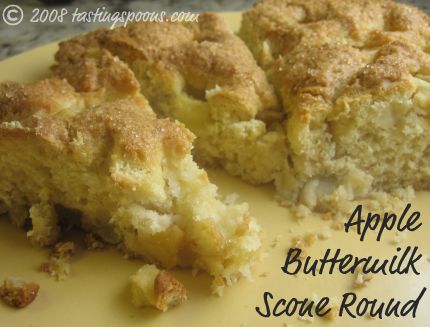
It was time, again, for me to bake something for my DH(dear husband)’s Bible study group. I flipped through the options and came upon this one, which was very simple. That’s what I needed, as I was short on time. And I had one big Braeburn apple waiting to be utilized in something. I was supposed to use a Granny Smith, but I didn’t have one. Braeburn would have to do! There was only one problem. The recipe was mostly in metric (milliliters and grams). I managed, primarily because I have a kitchen scale that will convert the two. Good thing since I was rushing.
But for you, my friends, I’ve made it easy. I went to a website and did all the conversions for you, so you needn’t worry about having a special scale to compute the measurements.
As for the scone, it was very nice. A drier kind of scone, but since this is from a European blogger, she likely likes a drier type recipe. I tend to prefer a more tender crumb but that’s just my personal preference. Don’t misunderstand – it was delicious. I liked it. And I liked that I just plopped it onto a large baking tray (Silpat lined) and scored the top. Didn’t have to pat it out and cut rounds. The apple contained within the dough (which is mushed into it after it’s mixed up in the food processor – see, I told you it was easy) gave it a nice moistness. The fellows nearly ate the whole thing, but we had enough for breakfast instead of toast. I’d make this again just because it’s so very easy.
The recipe came from a blog I read regularly – Buerre et pain – and she got it from Morning Bakes, a breakfast baking cookbook by Linda Collister. I did have to make another adjustment – I didn’t have any whole wheat flour, so substituted additional all-purpose. I’ve altered the recipe for that, but you can substitute about ½ cup of the whole wheat if you’d like. And I’ve included just a tad more butter in the mixture than was called for in the original. Once the round is patted out, you sprinkle the top with some demerara sugar – I used turbinado. That gave each wedge a nice little crunch. I liked that part. I’ll make this again! You can also split a wedge and toast it, although the scone is very crumbly - even more so the second day.
Apple buttermilk scone round
Recipe By: Linda Collister’s Morning Bakes, via Buerre et pain blog
Serving Size: 8
1 large apple — Granny Smith preferably
2 1/4 cups all-purpose flour — plus extra for dusting
1 teaspoon soda
1/3 cup sugar — plus extra for sprinkling
6 tablespoons unsalted butter — chilled and diced [I increased this amount slightly]
1/2 cup buttermilk — plus 4 teaspoons, and extra for brushing [converting this quantity from ml to cups doesn’t come out as an easy fluid measure]
1. Peel, core and coarsely chop the apple into 1/3 inch chunks. Mix the flours, soda and sugar in a food processor. Add the chilled cubes of butter and process until the mixture looks like fine crumbs. With the machine running, add the buttermilk through the feed tube to make a soft but not sticky dough. [My dough mound was rather sticky.]
2. Turn out onto a floured surface and knead in the apple chunks to form coarse and bumpy dough. Shape into a ball and put in the middle of the prepared baking sheet. With floured fingers, pat into a 9-inch round. Brush lightly with buttermilk or milk to glaze, then sprinkle with a little demerara sugar to give a crunchy surface. Using a sharp knife, score the round into 8 wedges. Bake in a preheated oven at 400° F. for about 20-25 minutes until lightly golden and firm to the touch.
3. Cool on a wire rack. Eat warm, immediately or within 24 hours. The scones are also good split and toasted. When thoroughly cooled, they can be wrapped then frozen for up to one month.
Per Serving: 227 Calories; 6g Fat (24.9% calories from fat); 4g Protein; 39g Carbohydrate; 1g Dietary Fiber; 16mg Cholesterol; 18mg Sodium. Exchanges: 2 Grain (Starch); 0 Fruit; 0 Non-Fat Milk; 1 Fat; 1/2 Other Carbohydrates.
COOK’S NOTES: Don’t overcook this as it will get too dry. Original recipe called for some whole wheat flour - if you choose to use it, substitute about 1/2 cup whole wheat for 1/2 cup all-purpose white. You can chop the apples into smaller dice if you’d like. The dough is kind of lumpy, bumpy. And fyi, here is the original metric ingredient list: 1 large apple, 200 g all-purpose flour, 80 g whole wheat flour, 1 t soda, 75 g sugar, 75 g unsalted butter, 140 ml buttermilk, with extra sugar and buttermilk for the top.
printer-friendly pdf recipe
You won’t find very many recommendations on this blog for frozen foods. Especially fish. Although Trader Joe’s stocks a wide variety of frozen fish, I’m usually disappointed. The fish is usually watery and cooks up dry and not all that tasty. But I was stopped in my tracks when I saw this box of Morey’s Wild Caught Alaska Salmon (I think I bought it at Trader Joe’s, not Costco). I rarely buy farm raised salmon, or hardly any other farm-raised fish. After watching a documentary some years ago about how those poor creatures are raised in very confined beds, having to eat their own poop, I consciously decided not to buy the stuff. So, when I see a label that says wild caught, I home in.
In the photo above you can see the cooked product (larger photo). In the photo that I inset at the left you can see the exterior of the box and down below are two of the individually sealed fillets. When you defrost it, it’s ready to cook, marinated and everything. There are six in a box. Remove the fillet from the plastic sack and place on a baking sheet (I lined it with foil), bake 15-22 minutes and you’re done. It was very nice. I overcooked it a little bit (18 minutes), but the flavor was delicious. I suggest you try it, if it’s available near you.
And now I’ll tell you about another product I buy via mail order. Albacore Tuna. For some years we’ve been warned about the mercury in tuna, so I started buying tuna from Carvalho Fisheries (Pacific Northwest ) because they only catch small albacore tuna. These fish are still young, so haven’t ingested as much mercury. Carvalho’s tuna is deliciously tasty stuff. It’s what I use when I make Joanne Weir’s Sicilian Tuna Salad.
Yes, it’s expensive. Certainly more money than we pay at the grocery store for albacore (the albacore hold more mercury than other of the tuna species). But their tuna contains a fraction of the mercury as we’d get from the grocery store brands. I buy it by the case and it lasts me many months. But then, I only make tuna salad sandwiches every couple of months. I also buy Carvalho’s smoked albacore. A special treat. I have fond memories of time with family friends years ago. He used to catch tuna and have it smoked. It was a frequent offering for appetizers – with small rings of red onion and Ritz crackers. Delish. (tuna photo from Carvalho website)
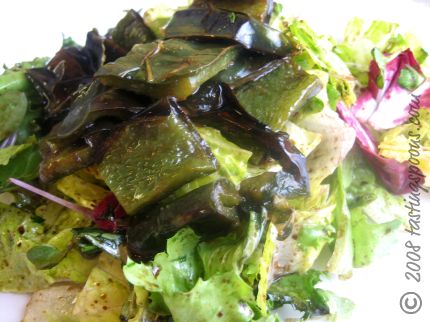
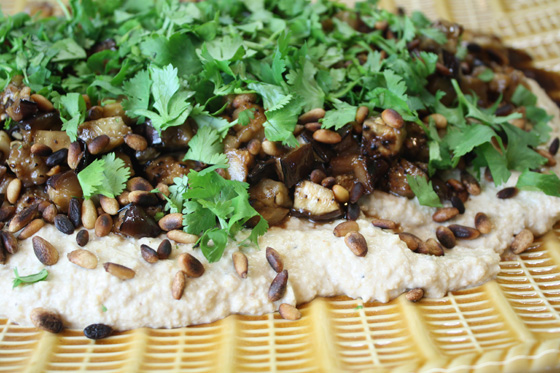
Last week we invited a friend over for dinner. She’s trying to eat healthy, so I decided to skip the main course and make a hearty appetizer, a soup, a salad, and low calorie dessert. In the last few days I’ve posted all the recipes from that dinner: Layered Hummus & Eggplant Appetizer, a cool Cream of Cucumber Soup, this salad, and Lemon-Ginger Frozen Yogurt served with the cookies that Kathleen brought along to share with us - Cashew Caramel Cookies. I had a stack of salad recipes to choose from, but thinking through the flavors and textures in the other dishes, I decided this salad was the best fit. I had several poblano (also called pasilla) chiles in the produce drawer that needed to be used.
The salad itself is cinchy. It’s just the poblano chiles that take a bit of time, but not all that much. I cut them into large semi-flat pieces, removed the stems and seeds, laid them flat on a foil covered tray. I sprayed them with olive oil spray, then broiled them for about 8 minutes on the first side, and about 3-4 on the 2nd side. Once roasted, let them cool so you can handle them, then cut up into bite-sized pieces. The recipe indicated peeling them; I didn’t. Set aside and add later. The salad itself is nothing but greens with a simple salad dressing (balsamic and oil, cumin and coriander) that takes no time at all to concoct.
The recipe comes from Katherine Kagel, the owner of Café Pasqual’s in Santa Fe , New Mexico . One of my very favorite restaurants.
If I make this again I will add some other texture to the salad – it was too “soft” for me. I like crunchy stuff in my salad. But I didn’t think this one wanted radishes or celery or carrots. You want to taste the chiles – they are the star player in this salad. But I think I would add some peppered pecans, which I make every once in awhile anyway. If I’d had some on hand, I’d have added them. They’re so very simple to make. The salad was very good - I liked it. Relatively easy too.
Field Greens with Fire-Roasted Poblano Chiles in Balsamic Vinaigrette
Recipe By: salad, Cafe Pasqual’s, Santa Fe , New Mexico ; pecans from Cathy Thomas, Food Editor Orange County Register
Serving Size: 6
1/4 cup balsamic vinegar — use a good brand, not the cheap stuff
1/3 cup vegetable oil — plus 1 tablespoon
2 tablespoons olive oil
1/2 teaspoon ground cumin — scant
1/2 teaspoon ground coriander — scant
1/2 teaspoon kosher salt
1/4 pound poblano chile — roasted, seeded, cut into 1/2 inch pieces, about 1/3 cup
8 cups field greens — or other fancy lettuces
PEPPERED PECANS: [my suggested addition to this recipe]
2 tablespoons sugar
1/2 teaspoon kosher salt
1/2 teaspoon freshly ground black pepper — coarsely ground
1/2 cup pecan halves
1. In a small bowl combine the vinegar, oils, cumin, coriander and salt. Mix in the prepared poblano chiles.
2. Place the field greens in a salad bowl and pour the dressing and chiles over the top. Toss well, then place onto individual plates.
3. Sprinkle peppered pecans on top and serve.
PEPPERED PECANS:
1. Before you start, place a baking sheet or jelly roll pan next to your cook top.
2. In a small bowl combine sugar, salt and pepper and stir to combine.
3. Heat a large wok or skillet over high heat. Add pecans and toss until pecans are warm, about one minute.
4. Sprinkle pecans with HALF the sugar mixture and toss until the sugar melts. Add remaining sugar mixture and toss again until sugar melts, then immediately pour our onto the baking sheet. Spread nuts apart (with tongs or fork) and allow to cool. Will keep, stored in a plastic bag, for 3-4 weeks.
NOTES: The pecans were not a part of the original recipe. You can omit if you’d prefer. You can also add other ingredients to the salad, but remember that the chiles are the star of the dish.
Per Serving: 238 Calories; 23g Fat (82.8% calories from fat); 2g Protein; 9g Carbohydrate; 2g Dietary Fiber; 0mg Cholesterol; 320mg Sodium. Exchanges: 0 Grain (Starch); 0 Lean Meat; 1/2 Vegetable; 0 Fruit; 4 1/2 Fat; 1/2 Other Carbohydrates
Printer-friendly PDF recipe
Admittedly, I’m a fan of ice cream. I came to this anomaly honestly. My Dad was an out-and-out obsessive-compulsive about the stuff. I grew up eating dessert after nearly every dinner, and I can still remember (and hear it in my head) my Dad’s spoon against the side of the bowl, systematically scraping around to get the very last possible speck of it. After going around once, he’d change the angle of the spoon and scrape around one more time. Remember, my Dad was an engineer, so methodical was his middle name. His favorite dessert was vanilla ice cream with chocolate sauce, or rocky road, just plain.
We go for periods of time with no ice cream in the freezer. As summer months approach, though, and the last of our home grown Meyer lemons reach mid-to-past maturity, I need to use some of that lemon juice. So, a new recipe streaked past the recipe trove – from Bon Appetit, May, 2008. It sounded delicious. And indeed it was.
You simmer water, sugar and freshly grated ginger, strain out the ginger, then chill. Add the yogurt, buttermilk, fresh lemon juice and some grated zest and freeze in your ice cream maker. Freeze further for a couple of hours and serve.
The ginger flavor does not predominate at all. In fact, if you weren’t TOLD it was there, you might not be able to identify it. I adored the elusive flavor. A lot. Enough that the next time I make this I’m going to use a bit more ginger, but not much. The frozen yogurt/ice cream has more of the texture of sorbet – to me anyway – although it does have more dairy (buttermilk and yogurt) than water. It was very, very refreshing, and with a bit of crystallized ginger on top (and maybe mango as suggested in the recipe), it’s an easy dessert to make. Next time I may try using 2% yogurt, just to see if there’s any difference. In any case, it’s a very low-calorie dessert, but lovely enough for guests. I’ll be making this again.
Lemon-Ginger Frozen Yogurt
Recipe: Bon Appetit, May 2008
Serving Size: 6
3/4 cup water
3/4 cup sugar
1/4 cup light corn syrup
2 teaspoons fresh ginger — finely grated peeled [next time, I’ll use 3 tsp]
1 cup plain nonfat yogurt — or use 2% if you’d like richer
1 cup buttermilk — low fat or regular
1/4 cup fresh lemon juice
1 teaspoon lemon peel — finely grated
Bring water, sugar, light corn syrup, and grated ginger to boil in medium saucepan, stirring until sugar dissolves. Boil 2 minutes. Strain into medium bowl and chill until cool. Whisk in yogurt, buttermilk, lemon juice, and lemon peel. Process in ice cream maker according to manufacturer’s instructions; cover and freeze.
Per Serving: 176 Calories; trace Fat (2.1% calories from fat); 4g Protein; 41g Carbohydrate; trace Dietary Fiber; 2mg Cholesterol; 90mg Sodium. Exchanges: 0 Vegetable; 0 Fruit; 1/2 Non-Fat Milk; 0 Fat; 2 1/2 Other Carbohydrates.
Printer-friendly PDF recipe
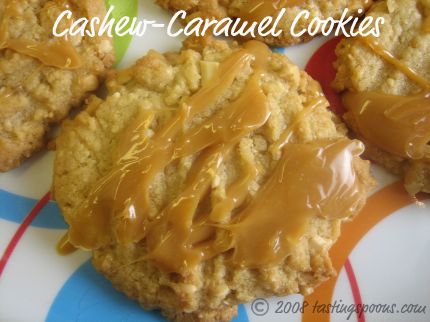
Don’t know if you’re aware that Martha Stewart has just published a new cookbook – called Martha Stewart’s Cookies. A really thick tome, it contains 175 new recipes with super photos. This one was delicious! My friend Kathleen brought them the other night when she came to our home for dinner. Kathleen’s a good writer, so I asked her if she’d like to guest-write this posting. Happily for me, she agreed. You can find the recipe on Martha’s site. I wrote up another of Kathleen’s recipes some time back – if you’re interested, check out her Almond Custard. Here’s Kathleen’s write-up about the cookies:
I am a Martha Stewart junkie. Even her checkered past doesn’t dampen my enthusiasm for everything Martha; I just can’t get enough. I also love technology, especially if somebody else installs and troubleshoots it. So here’s how technology connected me to Martha’s Cashew Caramel Cookies:
I listen in my car to Everyday Food Editor Sandy Gluck’s show on the Martha Stewart channel on Sirius radio. Sandy raved about Martha’s latest book, Martha Stewart’s Cookies, so I previewed it on Martha’s website, logged on to amazon.com and ordered it. It’s great to get exactly what you want without ever having to set foot inside a store. I guess I’m the perfect example of someone who is fully plugged into the Martha Stewart distribution network. I even asked my husband to record all of Martha’s television shows for me so that I can watch them in the evening.
So far, each recipe that I have tried has been simple to prepare and delicious. When relatives recently came to visit, they loved the cookies so much that they even ate them for breakfast. I sent the book to my niece and she is having similar successful results. I hope you enjoy your copy of Martha Stewart Cookies as much as I do mine. I swear that I am not on her payroll, though perhaps I should be!
The cookies have a salty tang to them (because you use roasted, salted cashews) and the drizzle of caramel on the top is just a lovely finale to each cookie. They look wonderful, and taste wonderful. Thanks, Kathleen!
Cashew-Caramel Cookies
Recipe By: Martha Stewart’s Cookies
Serving Size: 36
1 2/3 cups all-purpose flour
1/2 teaspoon salt
2 1/2 cups cashews — roasted, salted
2 tablespoons canola oil — plus 1 teaspoon
1 stick unsalted butter — (8 tablespoons) softened
3/4 cup light brown sugar — packed
1/2 cup granulated sugar
1 large egg
1 teaspoon vanilla extract
24 cubes caramel candy — 7 ounces, soft type
1/4 cup heavy cream
1. Preheat oven to 350 degrees. Sift flour and salt together. Coarsely chop 1 cup cashews; set aside. Process remaining 1 1/2 cups cashews in a food processor until finely chopped. Pour in oil. Process until mixture is creamy, about 2 minutes.
2. Put cashew mixture, butter, and sugars in the bowl of an electric mixer fitted with the paddle attachment; mix on medium speed until fluffy, about 2 minutes. Mix in egg and vanilla. Reduce speed to low; gradually add flour mixture. Mix in reserved chopped cashews.
3. Shape dough into 1 1/2-inch balls; space 2 inches apart on 2 parchment-lined baking sheets. Bake 6 minutes; gently flatten with a spatula. Bake until bottoms are just golden, 6 to 7 minutes more. Let cool completely on sheets on wire racks.
4. Melt caramels with cream in a small saucepan over low heat, stirring. Let cool. Using a spoon, drizzle caramel over cookies; let set. Store airtight in single layers.
NOTES: Plastic wrap and foil both stick to the caramel topping. Ideally, freeze these individually on a large cookie sheet, then place in a plastic bag so they won’t stick together. Someone on the Martha website suggested reducing the amount of heavy cream to eliminate the stickiness. Don’t know if that would work or not.
Per Serving: 155 Calories; 9g Fat (50.6% calories from fat); 3g Protein; 17g Carbohydrate; 1g Dietary Fiber; 15mg Cholesterol; 50mg Sodium. Exchanges: 1/2 Grain (Starch); 0 Lean Meat; 0 Non-Fat Milk; 1 1/2 Fat; 1/2 Other Carbohydrates.
Printer-friendly PDF recipe
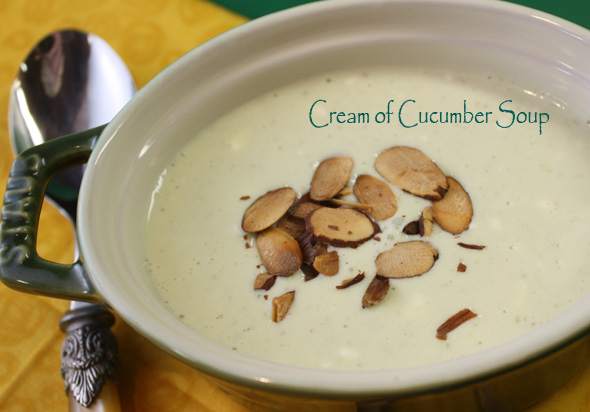
It’s been years – eons even – that I’ve been making cold cucumber soup. And I always thought my recipe was just the greatest. Well . . . until I tasted my friend Jackie’s soup recently. It was a lovely bridal shower at her home, and this cold cucumber soup was served as a first course. It was absolutely wonderful. Smooth. Extra smooth, with a different texture than mine has. Jackie graciously shared the recipe with me (thank you, Jackie!), and come to find out this is a COOKED soup (mine is a raw soup only, although it also has buttermilk added). And this one has the addition of Cream of Wheat (just a little bit) to thicken it very slightly. You have no idea it’s there, but that’s what the elusive texture was.
You cook up some green onions with butter, then add chicken broth, vinegar and dill weed (fresh), also some Cream of Wheat and finally the chopped-up cucumbers. The soup is smoothed twice in the blender and sour cream is added at the end. Then you garnish it with a bit more dill weed. I did make it with full-fat sour cream. Next time I might try it with low-fat just to see how it tasted. A lovely soup. Try it. Highly recommended.
Cream of Cucumber Soup
Recipe: From my friend, Jackie P.
Serving Size: 8
1/2 cup green onions — minced
3 tablespoons butter
6 cups chicken broth
1 1/2 teaspoons white wine vinegar
1/2 teaspoon dill weed
1 1/2 pounds cucumbers — peeled, seeded, chopped fine
4 tablespoons Cream of Wheat — (farina)
salt and pepper — to taste
2 cups sour cream
2 tablespoons dill weed — for garnish
1. In a large saucepan melt butter over medium heat and add green onions. Sauté for 3-4 minutes. Add chicken broth, vinegar and dill weed. Bring to a boil, add the Cream of Wheat and the chopped cucumbers. Simmer, partially covered, for 20-25 minutes.
2. In batches, blend soup mixture in a blender (hold lid and don’t overfill or the heat will blow off the top). Add salt and pepper to taste. Allow to cool completely, then refrigerate for a few hours or overnight.
3. Blend soup again with the addition of sour cream. This can be done up to an hour before serving. Whisk soup just before serving. Serve cold sprinkled with dill weed on top.
Per Serving: 225 Calories; 18g Fat (69.5% calories from fat); 7g Protein; 11g Carbohydrate; 1g Dietary Fiber; 37mg Cholesterol; 652mg Sodium. Exchanges: 1/2 Grain (Starch); 1/2 Lean Meat; 1/2 Vegetable; 0 Non-Fat Milk; 3 1/2 Fat; 0 Other
Carbohydrates.
Printer-friendly PDF recipe
Posted In: Uncategorized