Get new posts by email:

Archives

Currently Reading

Here are the tastingspoons players. I’m in the middle (Carolyn). Daughter Sara on the right, and daughter-in-law Karen on the left. I started the blog in 2007, as a way to share recipes with my family. I’m still doing 99% of the blogging and holding out hope that these two lovely and excellent cooks will participate. They both lead very busy lives, so we’ll see.

– – – – – – – – – – – – – – – – – – – – – –

BOOK READING (from Carolyn):

Music of Bees, Eileen Garvin. Absolutely charming book about a woman in midlife, lonely, who raises bees, also makes unlikely friends. Heart-warming and very interesting about beekeeping.

A Postcard from Paris, Alex Brown. Really cute story. Dual time line, 1940s and present day about renovating an old apartment in Paris, things discovered.

Time of the Child, Niall Williams. Oh such a good book. Very small village in Ireland, 1960s. A baby is left on the doorstep. The town all whispers and helps. I listened to an interview of the author, which made me like him and his books even more.

Sipsworth, Simon Van Booy. If you like animals you’ll swoon. An old woman who really wants to die finds a tiny mouse in her house and befriends it and finds a reason to live. Utterly charming book.

The Forger’s Spell, Edward Dolnick. True story. For seven years a no-account painter named Han van Meegeren managed to pass off his paintings as those of Johannes Vermeer.

If You Lived Here, You’d be Home by Now, Christopher Ingraham. Could hardly put it down – about a journalist who takes on a challenge to move to small town in Minnesota and write about it. He expects to hate it and the people and place, but he doesn’t. Absolutely wonderful true story.

The River We Remember, William Kent Kreuger. 1950s, Minnesota. A murder and the aftermath. Could hardly put it down. Kreuger has such a vivid imagination and writing style.

How the Lights Gets In, Joyce Maynard. An older woman returns to New Hampshire to help care for her brain-injured son. Siblings and family, lots of angst and resentments.

The Filling Station, Vanessa Miller. Every American should read this book. A novelized retelling of the Tulsa massacre in 1921. Absolutely riveting.

The Story She Left Behind, Patti Callahan Henry. Love this author. Based on a true story. A famous author simply vanishes, leaving her husband and daughter behind. She had invented a mystical language no one could translate. Present day, someone thinks he’s solved the riddle, contacts the family. Really interesting read.

The Girl from Berlin, Ronald Balson. Love anything about Tuscany. An elderly woman is being evicted from a villa there, with odd deed provenance. Two young folks go there to help unravel the mystery. Loved it.

The Island of the Colorblind, Oliver Sacks, M.D. Nonfiction. The dr is intrigued by a remote Pacific island where most of the inhabitants are colorblind. He also unravels a mystery on Guam of people born with a strange neurological problem. Medical mysteries unveiled. Very interesting.

The Bookbinder, Pip Williams. Post 1914 London. Two sisters work at a bookbindery. They’re told to not read the books. One does and one doesn’t. One has visions beyond her narrow world; the other does not. Eventually the one gets into Oxford. Lovely story.

The Paris Express, Emma Donoghue. 1895 on a train to Paris, a disaster happens. You’ll delve into the lives of many people who survived and died in the crash.

A Race to the Bottom of Crazy, Richard Grant. This is about Arizona. Author, wife and child move back to Arizona where they once lived. Part memoir, research, and reporting in a quest to understand what makes Arizona such a confounding and irresistible place.

The Scarlet Thread, Francine Rivers. A woman’s life turned upside down when she discovers the handcrafted quilt and journal of her ancestor Mary Kathryn McMurray, a young woman who was uprooted from her home only to endure harsh frontier conditions on the Oregon Trail.

A Place to Hide, Ronald Balson. 1939 Amsterdam, an ambassador has the ability to save the lives of many Jewish children. Heartwarming.

Homeseeking, Karissa Chen. Two young Chinese teens are deeply in love, but in China. Then their families are separated. Jump to current day and the two meet again in Los Angeles.

North River, Pete Hammill. He always writes such a good story. A doctor works diligently healing people from all walks of life. His wife and daughter left him years before. One day his 3-yr old grandson arrives on his doorstep.

A Very Typical Family, Sierra Godfrey. A very messed-up family. Three adult children are given a home in Santa Cruz, Calif, but only if the siblings meet up and live in the house together. A very untypical scenario but makes for lots of messes.

Three Days in June, Anne Tyler. The usual Anne Tyler grit. Family angst. This wasn’t one of my favorites, but it was entertaining and very short.

Saved, Benjamin Hall. Author is a veteran war reporter. Ukraine, 2022, he nearly loses his life to a Russian strike. Riveting story – he survives, barely.

Grey Wolf, Louise Penny. Another Inspector Gamache mystery in Quebec. She is such an incredible mystery writer.

All the Colors of the Dark, Chris Whitaker. A missing person mystery, a serial killer thriller, a love story, a unique twist on each. Could hardly put it down.

Orbital, Samantha Harvey. Winner of 2024 Booker Prize. I don’t usually like those, but I heard the author interviewed and she hooked me. This is not a normal book with a beginning, a story and an end. It’s several chapters of the day in the life of various astronauts at the ISS (Int’l Space Station). All fictional. She’s been praised by several real astronauts for “getting it” about space station everyday life.

The Blue Hour, Paula Hawkins. An island off Scotland. Inaccessible except when the tide is out. Weird goings on. An artist. A present day mystery too.

Iron Lake, William Kent Krueger. A judge is murdered and a boy is missing. Riveting mystery.

Tell the Wolves I’m Home, Carol Ricks Brunt. 1980s. A 14-yr old girl loses her beloved uncle. Yet a new friendship arises, someone she never knew about.

Four Treasures of the Sky, Jenny Zhang. 1880s, a young girl is kidnapped in China and brought to the United States. She survives with many hurdles in the path.

The Boy Who Fell out of the Sky, Ken Dornstein. Memoir, 1988. The author’s brother died in the PanAm flight that went down in Lockerbie, Scotland. A decade later he tries to solve “the riddle of his older brother’s life.”

Worse Care Scenario, T.J. Newman. Oh my. Interesting analysis of what could/might happen if a jet crashed into a nuclear plant. Un-put-downable.

Song of the Lark, Willa Cather. Complicated weave of a story about a young woman in about 1900, who has a gifted voice (singing) and about her journey to success, not without its ups and downs.

Crow Talk, Eileen Garvin. Charming story which takes place at a remote lake in Washington State, about a few people who inhabit it, the friendships made, but also revolving around the rescue of a baby crow.

The Story Collector, Evie Woods. Sweet story about some dark secrets from an area in Ireland, a bit magical, faerie life, but solving a mystery too.

A Sea of Unspoken Things, Adrienne Young. A woman investigates her twin brother’s mysterious death. She goes to a small town in California to figure it out, to figure HIM out.

The King’s Messenger, Susanna Kearsley. 1600s England, King James. About one of his trusted “messengers,” and his relationship with a young woman also of “the court.” Lots of intrigue.

In the Shadow of the Greenbrier, Emily Matchar. Interesting mystery in/around the area of the famous resort in White Sulphur Springs, West Virginia.

Isola, Allegra Goodman. Hard to describe, survival story on an island in the 1600s.

Save the Date, Allison Raskin. Rom-com, witty, LOL funny. Clever.

The Sirens, Emilia Hart. Numerous time-lines, Australia. Mysteries abound, nightmares, abandoned baby, weird allergies.

Red Clay, Charles Fancher. LOVED this book. Mostly post-Civil War story about the lives of slaves in Alabama during Reconstruction.

Stars in an Italian Sky, Jill Santopolo. Dual time line, 1946 and recent time. Love stories and a mystery.

Battle Mountain, C.J. Box. Another one of Box’s riveting mysteries. Love his descriptions of the land.

Something Beautiful Happened, Yvette Corporon. A memoir of sorts in Greece, tiny island of Erikousa, where the locals hid Jews during WWII. All elusive stories told by the author’s grandmother.

The Jackal’s Mistress, Chris Bohjalian. 1860s Virginia, about a woman who saves the life of a Union soldier. Really good story.

Song of the Magpie, Louise Mayberry. Really interesting story about Australia back in the days when it was mostly a penal colony. Gritty strength of a woman trying to thrive with her farm.

The Boomerang, Robert Bailey. A thriller that will have you gripping the book. About a lot of secrets surrounding the president (fictional novel, remember) and his chief of staff and about cancer. A cure. Such a good story.

Care and Feeding, Laurie Woolever. Really interesting memoir of a woman driven to succeed in the restaurant business. She worked for Mario Batali and then Anthony Bourdain. Gritty stories.

Everything is Tuberculosis, John Green. Maybe not a book for everyone. A real deep dive into the deadly tuberculosis infection, its history. I heard the author interviewed and found the book very interesting.

The Book Lovers Library, Madeline Martin. Fascinating read about Boots’ drug stores’ lending library. And the people who worked in them.

The Arrivals, Meg Mitchell Moore. LOL funny, about a middle-aged couple whose children (and their various family members) return to the family home and the chaos that ensues.

My Life as a Silent Movie, Jesse Lee Kercheval. About grief. A big move to Paris, finding herself a new life with a new set of real blood family.

Escape, Carolyn Jessop. Another memoir about a woman really in bondage in Utah, Mormon plural marriage.

 

Tasting Spoons

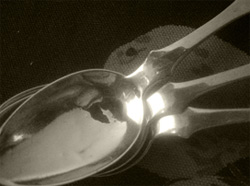
My blog's namesake - small, old and some very dented engraved silver plated tea spoons that belonged to my mother-in-law, and I use them to taste my food as I'm cooking.

Scroll down to the bottom to view my Blogroll

Posted in Desserts, on May 20th, 2008.

almond pound cake with limoncello

In my recent frenzy to dispose of some old magazines, I read and sorted about 20 old issues of my regular pile of food-oriented magazines. And normally I wouldn’t have stopped at a recipe for almond pound cake. But the word “limoncello” was a part of the title, so I read the story. It was included in the monthly Barbara Fairchild letter from the editor, of Bon Appetit. She explained that Inga Swenson (the actress from the tv series Benson), a friend of hers, gave her the recipe. Swedish, I would guess from her name. Then I glanced at the ingredients – almond paste, light olive oil and limoncello. Well, it got my attention because the ingredients were so unusual.

Limoncello didn’t hit my radar until a few years ago when we visited Sicily and other parts of Italy. Lemons are an integral part of the Italian – and particularly the Sicilian – food landscape. They eat them, juice them, paint them and sculpt them. And decorate everything in between (like tablecloths, napkins, plates, even silverware).

So, with a friend coming for dinner, I pulled out this recipe and my DH made a trip to the grocery store (I never keep almond paste around because it gets hard as a rock if you don’t use it very soon). The cake batter isn’t all that unusual, actually, except that you add in about 10 ounces of the almond paste (crumbled up in little pieces). I do not think – my humble opinion – that the cake portion meets the qualification of “pound” cake (used to be a pound of flour, a pound of eggs, a pound of butter). This is more like a cake-cake. It has a lighter crumb than pound cake, although the almond paste does give it a heavier texture than a cake.

After baking and cooling the cake, you slather it all over with limoncello, the lemon-flavored (vodka) liqueur that is ubiquitous in Italy. Then serve it in narrow slices. I’d serve it with whipped cream or table cream or vanilla ice cream, and maybe some berries for decoration. I didn’t have any berries or I’d have done so. Whatever the décor, this cake is scrumptious. The three of us scarfed down that cake in nothing flat. You do need to like almond as the flavor predominates through the cake. Wonderful. Worth making.
printer-friendly PDF

Almond Pound Cake with Limoncello

Recipe By: Inga Swenson, via Barbara Fairchild, Bon Appetit, March, 2006
Serving Size: 12

3/4 cup all-purpose flour
1 teaspoon baking powder
1/4 teaspoon salt
3/4 cup sugar
1/3 cup light olive oil
5 tablespoons unsalted butter — softened
10 1/2 ounces almond paste — 1 1/2 tubes, finely crumbled
2 tablespoons lemon peel — finely grated
4 large eggs
1/3 cup limoncello liquer
2 teaspoons powdered sugar — for garnish

1. Preheat oven to 325 F. Butter and flour a 9-inch springform pan. In a bowl whisk flour, baking powder and salt.
2. Using a mixer, beat the 3/4 cup of sugar, the oil and soft butter until light and fluffy, about 3-4 minutes. Add the almond paste and lemon peel. Beat until smooth. Add eggs, one at a time, beating well after each addition. Add flour mixture; stir to blend. Transfer to prepared springform pan.
3. Bake cake until golden brown on top and cake tester inserted into center comes out clean, about 45-50 minutes. Cook cake on a cake. Can be made one day ahead. Cover and store at room temp.
4. Remove sides from cake. Brush top of cake with limoncello liqueur and sprinkle top with powdered sugar. Store at room temp, covered. Will keep about a week!
Per Serving: 313 Calories; 19g Fat (54.6% calories from fat); 5g Protein; 31g Carbohydrate; 2g Dietary Fiber; 84mg Cholesterol; 112mg Sodium.

Posted in Veggies/sides, on May 19th, 2008.

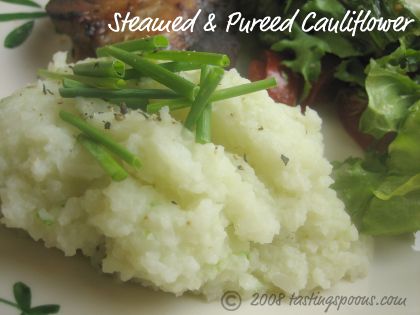
steamed pureed cauliflower

We’ve been eating out a lot lately. For a variety of reasons. So I haven’t cooked much for several days. Also, I had only one “story” in the bank – the blog bank – so to speak – a post I wrote up last week, but haven’t yet posted. But yesterday I thought – hmmm – I need to use up some of the frozen stuff in the garage freezer.

You see, in July we’ll have a quarter of a 4-H pig arriving, so I simply MUST make room for this new part of a pig in my freezer. My kitchen Sub-Zero freezer, which is amply sized, is absolutely jamb-packed full. So, there’s trouble in river city. I need to make a conscientious effort to cook some freezer items. If you haven’t read my previous post about the 4-H pigs we’ve had over the years, you may want to read about it.

Therefore, I looked around at what was in there – a couple of pork roasts, some pork chops, a steak or two, a pan of lasagna from last fall and also found a flattish package that appeared to be meat, but the writing on it was smudged so I couldn’t read it. Oh well, defrost it anyway. My friend Cherrie calls these “mystery meat” dinners. And yes, this was mystery meat in some kind of sauce.

Once defrosted it appeared to be country ribs, already prepared in a thick marinade. So, I baked them, made a salad, and scrounged around in the refrigerator for any vegetables I might have. Sure enough, there was a whole head of cauliflower about a week old. What to do. Lacking key ingredients for nearly every recipe I looked up, I decided to wing it. And it was delicious.

Here’s what you do:

Steamed & Pureed Cauliflower

1. Steam the cauliflower florets until they are tender (along with a bit of onion chopped up), about 10-15 minutes
2. Have ready at the food processor some butter, some truffle salt and Italian parsley (quantities are up to you)
3. Drain the cauliflower and pour into the processor bowl
4. Add some butter, the salt and parsley and process until smooth and serve with chives on top, if you have them

Now, is that not easy? I scooped some out onto our plates, added some freshly ground black pepper and plopped some chives on top.

The mystery meat? Well, it was country ribs. They had been in the freezer for way too long, and I baked them a tad too long. But they were edible. With a lovely green salad, it was a simple, but delicious meal. I liked the cauliflower best – the truffle salt added a nice undertone that was undefinable, elusive, but very tasty.
No recipe for this one – it’s too easy.

Posted in Beef, on May 16th, 2008.

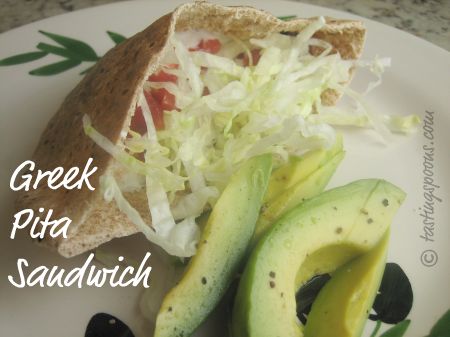
greek beef steak pita sandwich
Back in the 1970’s, pita bread kind of appeared in West Coast restaurants. In fact, back then you couldn’t buy pita bread anywhere, but some restaurants did serve it. They didn’t sell the bread. So Sunset magazine did an article about it, with a recipe. Since I was a bread maker anyway, making pita didn’t intimidate me at all, and in fact I made them many times, back then. But I will admit, I had trouble with the bread opening up evenly – some parts would stick a bit. And if you couldn’t stuff the bread, well, what else could you do with them? So I had some waste.

It wasn’t long, though, before the grocery stores started carrying pita. And now we can buy whole wheat pita as well as regular. Even some flavored types on occasion as well.

Vividly I can remember, like Marcel Proust and his madeleines, the first lamb pita sandwich I had. It was a potluck at someone else’s home, and a couple I didn’t know brought lamb meatball pita sandwiches with a dark brown, rich, wine gravy to go with it. Oh my. It was so out of this world. Unfortunately for me, the guy was a chef, owned a restaurant (which I didn’t know), and was moderately offended when I asked if he’d share the recipe.

Ever since that day I’ve tried to find a recipe that would try to recreate that dish. I have tried lamb meatballs, attempted after the above incident, to figure out how to make them, and the sauce. Now I suspect it was probably an intense veal and red-wine stock that enriched the gravy.

So way back in 1973 I saw a steak pita sandwich recipe in Better Homes & Gardens (the magazine). Over the years I’ve changed it a little bit to try to make it as close to that meatball recipe as I could (but using steak instead of lamb). Marinating the sirloin steak (or a lamb steak) in a red wine-garlic-oregano mixture helps. Then you pan-fry the steak with the red onion until it’s barely done. Ahead of time you will have prepared the condiments (chopped tomato, lettuce, cucumber, and mixed the yogurt-sour cream sauce which contains some minced up green onions). Heat the pita if you’d like, but whenever I make this, the bread is back to room temp by the time you doctor up your pita with all the toppings and are ready to take your first bite.

This particular time I made it, I had some leftover rib eye steak. The steak was quite rare to start with, so I marinated the meat in the red wine-garlic mixture just as above, but when I sautéed it in the frying pan, I just barely cooked it, so the meat was warmed through, but still slightly pink when it was served. You could easily adapt this with leftover roast beef or roast lamb – just slice really thin pieces and marinate it in some red wine to give it moisture and heat it through. The original recipe didn’t serve cheese with it, but I have on occasion done so, but a typical Greek style would be crumbled Feta as another condiment, which I’ve also done, so that’s added into the recipe too. Feta may be Greek, but it might not be typical for this sandwich. I just like the texture and saltiness added to the combination.
printer-friendly PDF

Greek-Style Beef or Lamb Sandwiches

Recipe By: Adapted from Better Homes & Gardens, 1973
Serving Size: 4
NOTES: I prefer to marinate the meat for about 24 hours; you may also use flank steak for this, although then you definitely need to marinate the meat for 24 hours. You can also make this with LAMB steak, using same technique. The oregano is an important element in the marinade, so use ample (more if you like the herb).

MARINADE:
1/2 cup dry red wine
1 large garlic clove — minced
1/2 teaspoon oregano
1/2 teaspoon salt
1 dash black pepper
1/2 large red onion — thinly sliced
MEAT:
1 pound beef sirloin steak — 1/2″ thick, trimmed of visible fat
1 tablespoon butter
PITA & CONDIMENTS:
4 whole pita breads, whole-wheat
3 cups lettuce — shredded
1 cup fresh tomato — diced
1/2 cup Feta cheese, crumbled
1 cup cucumber — diced
1/2 cup low-fat sour cream
1/2 cup yogurt — plain
2 tablespoons green onion — minced

1. In a sturdy, sealable plastic bag combine the wine, oil, garlic, oregano, onion and salt & pepper. Cut the steak into strips about 2 inches long and 1/4 inch wide. Allow to marinate for about an hour at room temperature. If marinating for longer period, refrigerate it.
2. Combine the low-fat sour cream and yogurt, with minced green onions and allow to sit in refrigerator for several hours.
3. Remove the meat and onion from the marinade and dry on paper towels. Melt the one T. of butter in a hot pan and cook the meat, a little bit at a time (so it doesn’t steam rather than brown), stirring to brown all sides. Keep meat hot while preparing the remaining meat. Add the red onion and sauté until all the onion is wilted, but not mushy.
3. Have small bowls ready into which you put the lettuce, tomatoes, cucumber, Feta and the sour cream and yogurt mixture.
4. As chef, you can add the meat to each pita and then serve condiments for people to add as they wish. Or just pass everything.
Per Serving: 554 Calories; 23g Fat (38.4% calories from fat); 36g Protein; 47g Carbohydrate; 7g Dietary Fiber; 101mg Cholesterol; 777mg Sodium.

Posted in Desserts, on May 15th, 2008.


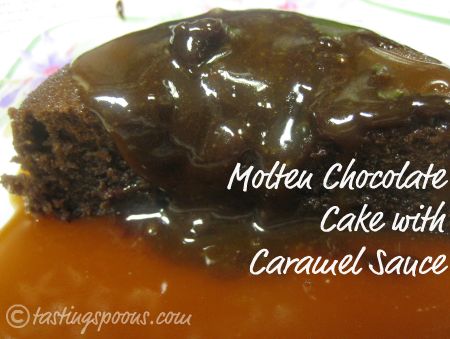
molten chocolate cake (lava cakes) with caramel sauce

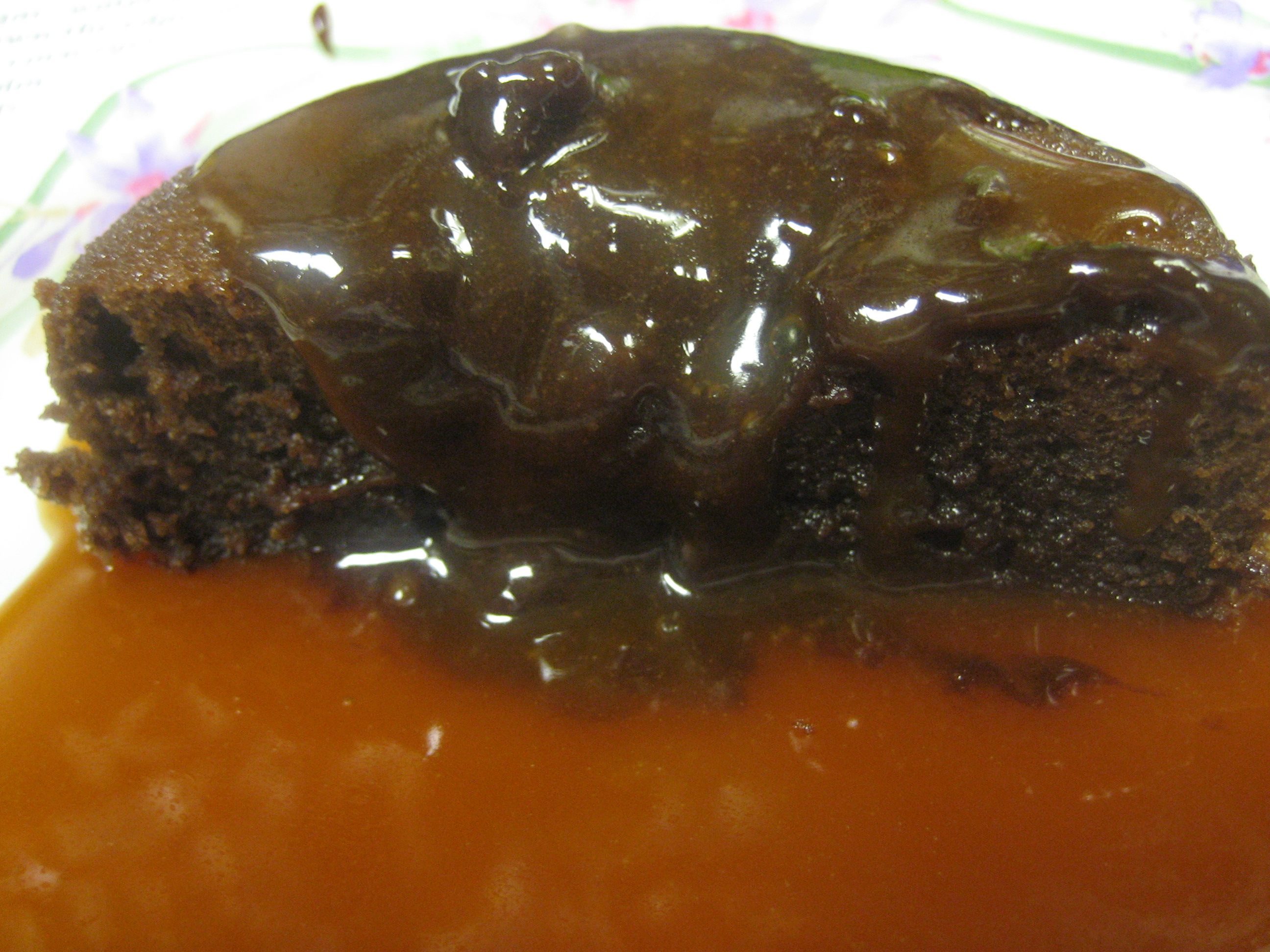
There are probably 1001 recipes out there for molten chocolate cake, or lava cake. Meaning that some of the batter doesn’t quite get cooked through, so when you press your fork or spoon into it, some of the center, hot batter oozes out and becomes a sauce. I have made these before, but not often, since I rarely make a heavy-duty chocolate dessert for guests. I do serve chocolate, but not usually a really heavy dose of it because the caffeine in chocolate affects me, so I assume it affects others too. I’m sensitive to caffeine. A half a cup of regular coffee and I’m feeling jittery in a matter of 15 minutes and regular coffee would probably prevent me from sleeping all night.

When this was served at the cooking class last week I hesitated. Should I really eat this? I don’t want to be up half the night playing mindless games on the computer. But my will power was weak. Especially when each of these cakes was cut in half, so I was only getting a half portion. I dug in. Ah, yes, it was good. Very good.

It’s a relatively simple recipe. The batter can be made up ahead of time, poured into ramekins and refrigerated. Then you can pop the pan into the oven about 15 minutes before you want to eat them. You could bake them just as you’re getting up from the dinner table perhaps. The only thing I learned from this version was dusting the buttered ramekins with granulated sugar before pouring in the batter. You could also use powdered cocoa (that’s what I’ve done in the past) but the granulated sugar is probably a better option. Dusting the ramekins with one or the other helps when it comes time to unmold the cakes. And make the caramel sauce ahead of time – it will keep for several weeks in the refrigerator.

The good news is that I slept just fine, thank you!
printer-friendly PDF

Molten Chocolate Cake with Caramel Sauce

Recipe: Deb Buzar, professional chef
Serving Size: 4

MOLTEN CAKES:
4 ounces semisweet chocolate
1/2 cup butter
1 cup powdered sugar
2 large eggs
2 large egg yolks — whole, reserve whites for another use
6 tablespoons flour
CARAMEL SAUCE:
8 ounces sugar
1/8 cup water
1/4 teaspoon lemon juice
1 tablespoon light corn syrup
3/4 cup heavy cream
2 tablespoons butter
GARNISH:
2 cups vanilla ice cream or whipped cream
Fresh berries to decorate plates

CAKE:
1. Preheat oven to 425 F. Butter and sugar 4 custard cups or ramekins. Place on cookie sheet and set aside.
2. Place chocolate and butter in a heatproof bowl and set over a bowl of simmering water (do not let bowl touch water), and stir occasionally until chocolate and butter are melted. Stir to combine, then add sugar. Remove from heat and mix until combined. Blend in eggs and egg yolks with a wire whisk. Stir in flour until no flour streaks are visible. Pour batter equally into the four cups.
3. Bake for 13-15 minutes, or until sides are firm but the centers are still soft and jiggly. Let them stand for one minutes. Take a small knife and loosen cake from sides of ramekins. Invert cakes onto dessert plates. It may take a fairly solid bang onto the plate to get them to release. Or, serve them in the ramekin. Serve immediately with topping of your choice, and with vanilla ice cream or whipped cream and berries for garnish.
SAUCE:
1. Place sugar, water and lemon juice in a small saucepan and gently bring to a boil. Brush down the edges of the pot with a wet, clean pastry brush. Add the corn syrup and continue to cook until the caramel turns a golden amber color. Do not stir even once.
2. Remove from heat and whisk in the butter. Carefully pour in the cream, whisking gently but constantly. May be done ahead and kept covered in the refrigerator for several weeks.
I purposely have not included the nutrition count on this as the recipe assumes you eat all of the caramel sauce, which you won’t do. The numbers would scare anybody away from ever making this!

Posted in Beef, on May 14th, 2008.

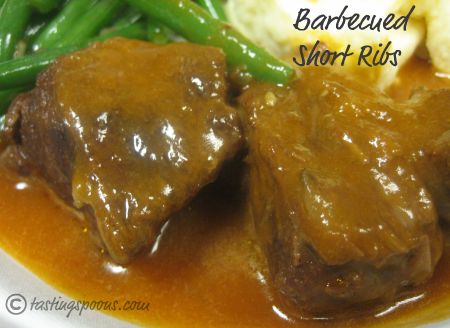
barbecued short ribs
I don’t know about you, but I’ve always loved short ribs. My mother used to prepare them with some frequency, because our family all liked them. I don’t remember now how my mother prepared them. Over the years I’ve made them in numerous ways myself, but this recipe (new to me, but probably an old rendition) is so awesome. So perfect for this cut of meat.

Over the last few days I’ve mentioned a cooking class I attended last week about comfort food. Well, this recipe is the all-star winner in that category. The chef who prepared this, Deb Buzar, credited her mother-in-law for this recipe. As a professional chef, Deb said she tried countless versions of short ribs, but every time she kept going back to her mother-in-law’s recipe, and finally decided this is her favorite. She no longer even looks at other recipes. She said the sauce “made” the dish, and I wholeheartedly agree. You do want to serve this with a carb that will take the sauce, though – like mashed potatoes – she served it with the Mashed Potatoes with Caramelized Shallots and Truffle Oil that I posted recently. You could use rice, but mashed potatoes are just the perfect side for these.

The chef started off the class by laughing, saying “bet you thought I was crazy to choose short ribs to make for a 2+ hour cooking class.” Then she slid a pressure cooker over for us to see. She’d brought her own – a 10-quart Fagor she uses annually for canning and in between for lots of other things too. She loves her pressure cooker and uses it very often.

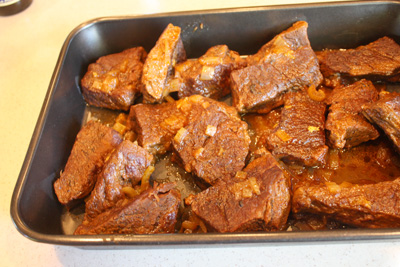
The cooked short ribs set aside while I whizzed up the sauce.

I don’t own one anymore. I was given one back in the 1960’s as a wedding gift. I did use it for some years until I burned the bottom of it when I dashed outside for some reason and left artichokes cooking away in it. An hour later the artichokes of course, were burned to a crisp inside and the pan had bowed such that it was no longer usable. I felt very guilty about that and kept the darned pan for years hoping somebody could figure out how to fix it. Nope. Nada. Finally tossed it out about 15 years ago. Meanwhile, some cookware manufacturers have come out with new versions. They work infinitely better than the older variety with the rocking gadget on the top. Now there are electric models too, but from reading reviews about them I’d say the stovetop ones appear to have more control. At least for now they do. The chef and the store owner both recommended the Fagor brand (made in Spain) as the best. Later note: I’ve since bought a pressure cooker, and use it frequently!

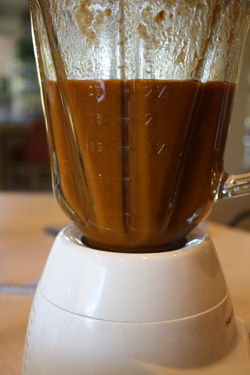
All the sauce gets whizzed up – if you have time, chill the stuff overnight and remove the fat – otherwise it gets homogenized into the sauce.

The sauce is so very easy – chopped celery and onion (raw) combined with water, white vinegar, ketchup, sugar, salt, Worcestershire sauce and dry mustard. You brown the chunks of boneless short ribs (silverskin removed and cut into large 2-inch pieces) on two sides, then combine the sauce and meat. If you have a pressure cooker, it takes 28 minutes to process. If you bake it in a 350 F. oven, it takes about 2 hours, maybe 2 ¼ hours. It can also be done in a crock pot for about 8-10 hours too.

The calories and fat on this recipe are outrageous. I’d forgotten how bad this meat is for us. Short ribs are just riddled with fat. They used to be a cheap cut of meat. Not so much anymore. I purchased the boneless ones at Costco. The chef recommended this be made a day or two ahead, refrigerated, then you can remove the fat from the top of the sauce. It’s so gosh-darned good. And yes, more comfort food at its finest. Technically this should serve 8 people. But if they’re hungry and they like this, well, 4 pounds of meat won’t feed more than 6.
printer-friendly PDF

Barbecued Short Ribs

Recipe By: Deb Buzar, professional chef
Serving Size: 8

4 pounds short ribs [boneless, if possible]
2 medium onions — diced
1 cup water
1/2 cup vinegar
2 cups ketchup
1 cup celery — diced
4 tablespoons sugar [optional, but is in the original recipe]
1 teaspoon salt
6 tablespoons Worcestershire sauce
2 teaspoons dry mustard

1. Dice the onions and celery into approximately similar size quarter-inch pieces. Set aside in a large bowl.
2. Measure water, vinegar, ketchup, sugar, salt, Worcestershire sauce and dry mustard and add to bowl. Stir until well mixed. Set aside.
3. Trim meat of all silverskin. Cut ribs between the bones or in 2-inch pieces if using boneless. If using bone-in ribs, tie around meat with kitchen twine (each piece). Season with salt and pepper. In a large roasting pan pour a small amount of olive oil and sear ribs on top and bottom only, just long enough to brown nicely, then remove to a plate. Do not crowd meat. Continue browning meat until all pieces are finished. Do not burn the meat as you’ll have to discard the nice fond on the bottom of the pan and clean it well in order to continue.
4. Pour sauce into the pot, then add the ribs. Bring to a simmer, reduce heat to a very low simmer and bake at 350 for 2 hours or until fork tender. Transfer meat to a hot platter. Puree remaining sauce in blender (don’t overfill or it will blow the lid off). Serve meat with sauce. May be made up to several days ahead and reheated. After cooling the sauce, you may easily remove any hardened fat from the sauce and discard before reheating.

Posted in Veggies/sides, on May 13th, 2008.

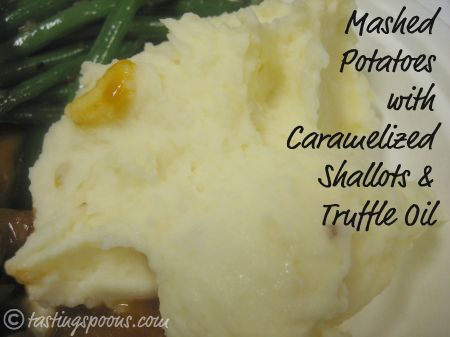
mashed potatoes with caramelized shallots and truffle oil

How did the word “yum” ever come into being? It’s not a very pleasant sounding one, to my ears, and yet I do use it. Probably too often. I don’t even like the look of the word in print, either. And yet, it conveys the meaning very well. Maybe I liked it better before Rachel Ray started using the word “yum-o,” which I think is really a rank permutation of a not-very-good word. Makes me think we can’t come up with adjectives to describe something that tastes really, really good. Something that wakes up the taste buds, or soothes them, whichever the case may be.

And surely, mashed potatoes are mashed potatoes, after all. I do enjoy them immensely. More than rice. More than pasta even, but now we know they’re not all that good for us because they’re a high glycemic carb. That means they digest quickly, turn into sugar which pours into our bloodstream faster than we’d like food to do – we want food that sticks to the ribs, but in the low glycemic way – like grains do – to sustain energy, to keep us going for hours before another meal. Like brown rice does. So these days, mashed potatoes are a real, honest-to-goodness treat. I try to slap my hands when I reach for a 3-lb. bag of Yukon Gold at the market. Once in awhile I succumb, though.

Last week I attended a cooking class about comfort foods. I’d signed up for the class months ago, and didn’t even recall the subject until my friend Cherrie and I arrived at the class. Ah yes, “comfort on a plate” it was titled. We got four recipes altogether (short ribs, these mashed potatoes, green beans, and a chocolate dessert). They were all relatively simple to make, but they sure did rate high on that comfort factor. The short ribs and mashed potatoes with the sauce from the ribs poured over the potatoes . . . oh yes. Comfort for sure.

This recipe is nothing all that different as far as prep. While the potatoes are simmering (starting with COLD water, by the way) you sauté the shallots under low, low heat, so they turn golden brown, but not burned. The potatoes are riced, if possible, tossed with a bit of cream and butter and truffle oil is poured in at the end. That’s it. Nothing more. Nothing less.

One of the students in the class asked with a low voice and eyes downcast, if the chef would remove her portion before she added the truffle oil. You don’t like truffle oil? the chef blurted out. No, she said, I don’t like mushrooms. The chef said, there’s nothing in truffle oil that even remotely tastes like mushrooms.

We know that truffles are a mushroom. A much-prized one I might add – to the tune of several hundred dollars per mushroom. But they have the most elusive, yet unique flavor. But one tablespoon of truffle infused oil in a big pot of mashed potatoes? To tell you the truth, I couldn’t even TASTE the truffle oil. But anyway, the chef said she’d give her a small portion of both so she could taste the difference. Most of the rest of us were teasing the poor young woman. She did speak up later and said she liked the one with truffle oil, so she would never disparage a truffle again! So, in case you’ve never had truffle oil, I heartily suggest you try it. You can buy very small bottles of it in some places. Or larger bottles as well.

Prior to this above dialog, one of the other students in the class asked why the chef would put chocolate in mashed potatoes? She’d only seen truffle candy and couldn’t quite get the incongruity of mashed potatoes mixed up with chocolate. We all got a good laugh about that.

But oh so good are these potatoes. Delicious. Smooth. Comforting. Hot. And yes, yummy.
printer-friendly PDF

Mashed Potatoes with Caramelized Shallots and Truffle Oil

Recipe By: Deb Buzar, professional chef
Serving Size: 4

2 pounds Yukon Gold potatoes
1/4 cup heavy cream — warmed
3 tablespoons unsalted butter — softened
1 tablespoon truffle oil salt and pepper — to taste
2 tablespoons Italian parsley — chopped

1. Peel the potatoes if desired, cut them into quarters and place in a large pot. Cover by 3 inches with COLD, salted water and bring to a boil, then cook under simmering heat until potatoes are fork tender.
2. Drain potatoes and place back on the stove top (no heat) or in a warm oven and allow potatoes to dry out for 5-10 minutes. Once dry, push potatoes through a potato ricer or food mill and back into the pot. Add warmed cream and softened butter and stir until desired consistency is achieved. Add more cream or butter if needed. Add any herbs you’d like, or parsley and mix in. Add truffle oil and mix well. Add salt and pepper to taste and serve immediately.
Per Serving: 345 Calories; 18g Fat (46.0% calories from fat); 6g Protein; 41g Carbohydrate; 3g Dietary Fiber; 44mg Cholesterol; 21mg Sodium.

Posted in Salads, on May 12th, 2008.


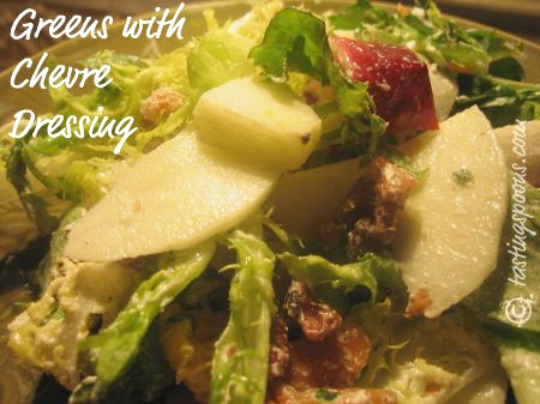
Goat cheese is one of those comforting foods that always hits the spot with me. I like it anytime as an appetizer, either plain with crackers, or with a topping of chutney or some fruit thing. And one of my favorite things to order in restaurants is any green salad with coins of chèvre. My all-time favorite use of chèvre is when the goat cheese coins have been covered in some chopped nuts and warmed before being put on a salad. I have a goat cheese cookbook; although I must sheepishly admit I’ve never made anything in it.

So anytime I see goat cheese or chèvre anywhere, I usually look more closely at said recipe or menu. This time it was in Food and Wine magazine, May of 2006. More sheepish looks here, but I just got around to reading it. I took a trip to France in May of ’06 and there were a bunch of my magazines that didn’t get read for about 2 months before and at least several months after. My DH had major surgery just a month later, so I lost many months of recipe clipping. I’ve been making a diligent effort lately to get a few stacks of magazines read and tossed out.

When I was planning a large dinner party for this last week, I knew I wanted to make salmon, so worked on rounding out the menu. This clipping spoke to me more than others. And the recipe itself is really quite different. In the explanation about it the article described the dressing as similar to ranch, but goat cheese instead. I wouldn’t have described it anywhere close to ranch except in color and opaqueness. It’s much thicker than ranch dressing and has a totally different taste and texture.

The room temp cheese is mixed by hand with some garlic, salt, white wine vinegar, a splash of water even, then some olive oil and walnut oil. Oh yes, and some fresh, chopped thyme. The salad is composed of light lettuces (they called for Belgian endive, frisee and arugula). Visiting 3 local grocery chains produced no frisée, except a few sprigs in a lettuce combo package. So I used arugula, both regular and red Belgian endive plus the combo lettuces. The salad is also dressed with some sliced apple and toasted walnuts.

I liked it a lot, actually. Our guests didn’t take much per serving, so we had leftovers, and they tasted pretty good the 2nd day (normally I toss out salads that have been dressed since I don’t like soggy salad) but for whatever reason, this didn’t soggify much. (You like that new word, soggify?)

Maybe you’ll have better luck finding frisee, but if not, just use whatever light lettuces you can find.
printer-friendly PDF

Greens with Chèvre Dressing

Recipe By: Food & Wine, May 2006
Serving Size: 4

3/4 cup walnuts — halved
1 small garlic clove — smashed
Kosher salt to taste
3 ounces soft goat cheese — chèvre, at room temperature
1 1/2 teaspoons white wine vinegar
1 1/2 tablespoons water
1 tablespoon extra-virgin olive oil
1 tablespoon walnut oil
1/2 teaspoon fresh thyme leaves — chopped
Freshly ground pepper
2 heads Belgian endive — cored and leaves halved lengthwise
1 head frisée — torn into bite-size pieces
1 cup arugula — baby arugula if possible
1 whole Granny Smith apple — cored and thinly sliced

1. Preheat the oven to 350 degrees F. Spread the walnuts in a pie plate and bake for 8 minutes, or until toasted. Transfer to a plate and cool.
2. Meanwhile, on a work surface, sprinkle the garlic with a pinch of salt and mash to a paste with the side of a large, heavy knife. Transfer the garlic paste to a bowl and whisk in the goat cheese, then the vinegar and water. Add the olive and walnut oils, thyme and pepper and whisk until blended.
3. In a large bowl, toss the endive, frisée, arugula and apple slices with the walnuts and some of the dressing. Taste the salad and add more dressing or salt and pepper if needed. Serve at once. If you have leftovers, bring it to room temp before using it – it becomes very firm when chilled and impossible to toss in a salad.
Per Serving (the nutrition info assumes you use all of the dressing, which you may not): 290 Calories; 25g Fat (72.7% calories from fat); 11g Protein; 10g Carbohydrate; 4g Dietary Fiber; 10mg Cholesterol; 104mg Sodium.

Posted in Veggies/sides, on May 11th, 2008.

lemony rice pilaf

I seem to be on a run lately with rice and pilafs. Sometimes I go for months, literally, without eating a grain of rice. I’ve had it several times in the last 30 days. A few weeks ago I made a real oldie, an Armenian Rice and Pasta Pilaf similar to Rice-a-Roni. It was scrumptious. Then, just for fun I made the real packaged Rice-a-Roni. Oh, it was icky. My DH is so spoiled – he ate one bite and left the rest. The leftovers were tossed in the garbage. That’ll teach me to try to cut corners.

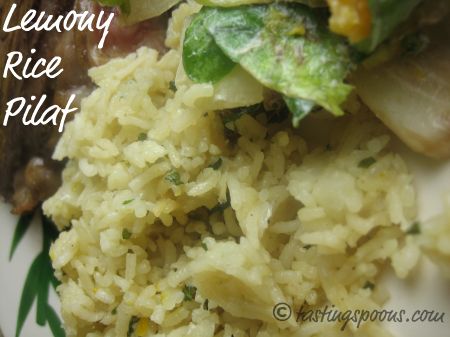
For this side dish I wanted something lighter – pilaf can become a major component of the meal, and I didn’t want the rice to stand out. But just plain boiled rice is way too boring for me. I turned to my favorite chef, Phillis Carey, and her book, The Casual Gourmet Presents Fast and Fabulous Entertaining Menus and found this lemony rice that fit the bill entirely.
Salmon was on the menu, and it has a lovely sauce on the side, so wanted rice to complement it. This side is flavored with onion, saffron, lemon zest and just a bit of Parmigiano-Reggiano cheese. Since I was making a huge portion to feed 12 (actually I think I had enough to feed about 20 since no one took very large portions), I gathered up all the ingredients ahead of time – I did a mis en place – the tray to “put in place” or “everything in place” for this. The onion was chopped in a bowl, lemon zested in a covered little bowl, salt and pepper measured, saffron also in its own tiny bowl, the quart container of chicken broth, the rice measured and sitting in a bowl and the timer all set to the minutes needed, just waiting for me to tap the top to start the clock ticking. All these items were on a tray beside the range, ready to go. That’s the mis en place. The pan was already on the range with the measured butter in it. So, when our guests arrived I was able to quickly make this and set the timer – without having to refer to the recipe time and again.

It was easy to do – sauté the onion, then add the rice and sauté that briefly. Then you add the broth, saffron, (and I added a jot of lemon juice), seasonings and you simmer it covered for a short time until just barely tender. Toss with the lemon zest, cheese and garnish with Italian parsley. Done.
printer-friendly PDF

Lemony Rice Pilaf

Recipe By: Phillis Carey, Fast & Fabulous Entertaining Menus
Serving Size: 8

1/4 cup unsalted butter
1 1/2 cups onions — chopped
2 cups long-grain white rice
4 cups chicken broth
1 tablespoon fresh lemon juice [my addition]
1 pinch saffron threads
1/2 teaspoon salt
1/2 teaspoon freshly ground black pepper
1 tablespoon lemon zest — finely grated
1/3 cup Parmigiano-Reggiano Cheese
1/4 cup Italian parsley — chopped finely

1. Melt butter in a heavy 3-quart saucepan (with lid) over medium high heat. Saute the onions until tender, about 5 minutes. Add the rice and toss over medium heat for about 2 minutes (or longer if you’d like the rice to have a more golden color).
2. Add the broth, saffron, lemon juice, salt and pepper and bring to a boil. Stir, cover, reduce heat and simmer for 18-22 minutes or until rice is tender. Don’t overcook.
3. Fluff rice and toss in the lemon zest, half the parsley and all of the cheese. Serve rice with a spoon or pack into a small mold or ramekin and turn out onto each plate. Sprinkle remaining parsley on top.
Per Serving: 252 Calories; 7g Fat (24.7% calories from fat); 6g Protein; 41g Carbohydrate; 1g Dietary Fiber; 16mg Cholesterol; 520mg Sodium.

Posted in Veggies/sides, on May 10th, 2008.

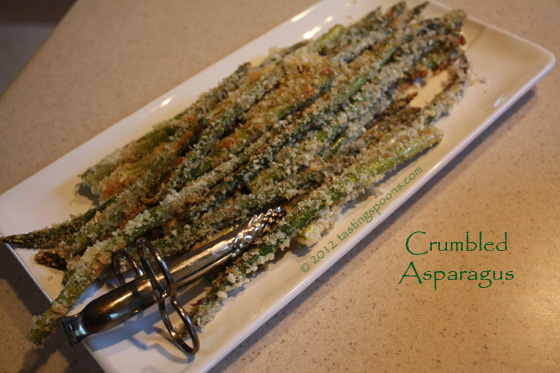
Without much of any equivocation, I can say that asparagus is one of my favorite vegetables. I like it  just about any way it comes – even raw – but the best prep for me is oven roasted. So when I was reading a posting over at A Year from Oak Cottage, a blog I read regularly, and Marie talked about preparing her crumbled asparagus, I perked up, printed out the recipe, and tried it.

The greatest of superlatives are needed here. Fabulous. Delicious. Moist. Pretty. Perfect. All those things. I made these for a dinner party last night, and I’d say the winning recipes of the evening were the dessert (yes, I’ll post it in a few days) and this asparagus. I made two pounds of asparagus, and there are maybe 4 spears left. Of course, I was serving 12 people, but everybody loved these, with me included.

Yes, I’ll be making these again. And again. They’re that good. I did change the recipe just a little bit – only the proportions – because I ended up with too much mayo left over, but this isn’t one of those exact kinds of recipes anyway. If you want to use less mayo altogether, as long as you rub each spear with enough mayo so the crumb mixture will stick, do so. Nobody will know it’s rubbed with mayo – it isn’t visible. Maybe you could coat the spears with olive oil and it would work too. You dip the spears in the mayo (rubbing it on with your fingers worked best), then my DH helped by rolling the spears in the panko crumb-cheese mixture. It does help to have two sets of hands since you muck up your fingers in the mayo and further muck them up if you go back and forth to the crumbs.

So, I suggest you get yourself to your local farm stand or market and make these right away quick. Asparagus season is almost over, and I’ll be making these again soon. Buy plenty because you’ll eat more of these than you anticipate!
printer-friendly PDF

Crumbled Asparagus

Recipe By: Marie’s blog, A Year at Oak Cottage
Serving Size: 6

1 pound asparagus
1/3 cup mayonnaise
1 cup panko — or dry seasoned bread crumbs
1 cup Parmigiano-Reggiano Cheese — finely grated

1. Pre-heat the oven to 400*F. Lightly spray a shallow baking tray with some cooking spray or line sheet with silicone pad (Silpat) and set aside.
2. Wash asparagus and dry it really well. To prepare spears for cooking, grasp at either end and pull the tip end over and down. The stalk will break naturally at the point where it starts to get tough and stringy. Use the fibrous ends for stock or for your compost pile. If the asparagus is thick-skinned or fibrous (take a small bite to test), peel the spears from just under the head to the stem end. If serving guests, you might want to cut off the ends – a straight cut – which will look a little prettier.
3. Combine the dry bread crumbs and the cheese in a shallow dish and set aside.
4. Rub each spear of asparagus with the mayonnaise, making sure each one is well coated (use your fingers for this), then carefully roll it in the bread crumb mixture to coat. Place on the prepared baking sheet. Repeat with the remaining spears.
5. Bake in the heated oven for 12 to 19 minutes (depends on the size of the asparagus), until the crumbs are nicely crisped and the asparagus is crispy tender. Serve.
Cook’s Notes: I did peel off the outer skin of the asparagus for about the lowest inch or two on each spear. Give the asparagus room on the baking sheet so the spears don’t touch (otherwise they steam rather than crisp). Watch the time as you don’t want to overcook them. Test one for just crisp tenderness. They get cold quickly, so serve immediately
Per Serving: 134 Calories; 11g Fat (68.5% calories from fat); 2g Protein; 9g Carbohydrate; 1g Dietary Fiber; 4mg Cholesterol; 100mg Sodium.

Posted in Fish, on May 9th, 2008.

trout fillets with mayonnaise caper topping

My history with trout goes way back. I believe I told the story here before that when I was young (between about age 5-12) my family always went tent camping for our annual summer vacation. We camped in the California Sierras – Virginia Lakes, sometimes on the Sonora (west) side, but most often on the eastern side in a variety of campgrounds. My dad made plans a year ahead as to which campground we’d go to. My mom planned for weeks ahead, thinking about what meals she’d prepare on the kerosene camp stove (two burners) usually three meals a day. Because there wasn’t much to do there, food played a vital role in the entertainment. But for many, many meals we ate the trout my dad (and sometimes my mother or I) caught in the rivers and lakes.

My mom had only one way she prepared the trout – dipped whole (tail and head intact, including the eyes of course, which for me was a big yuk factor) in egg, cornmeal and pan fried in bacon grease (leftover from the bacon and egg breakfasts we ate every morning in the chilly filtered light coming through the pine trees, with a stream gurgling nearby – the stream lulled me to sleep every night, and I’ve never forgotten that sound).

But, we ate trout. And more trout. And more trout. So much trout that after about 3 days of it I couldn’t eat another bite. My mother either. Even my dad tired of eating trout. We even had to eat it for breakfast some mornings. More yuk. But what I disliked the most were the bones. And I’ve never wavered in my aversion to fish bones. I never, ever order fish at a restaurant unless it’s a boneless fillet. And usually I’ll discuss the bones with the waiter/waitress to make sure somebody has paid close attention to the removal of them.

Yet I do enjoy the flavor – the delicate flavor – of trout. So, the other evening we had dinner at a restaurant some miles from our home, and the waitress happened to mention that her son often catches fresh trout near Mammoth Lakes and brings them home to her. But she doesn’t like trout. Won’t eat it. Would we like some, she asked? Free. She wanted to get it out of her freezer. Sure, we said. My DH met her at the restaurant the next day and she happily handed him two freezer bags of trout fillets. I did have to use needle-nosed pliers to remove about another 40-50 pin bones from the 5-7 fillets in the first bag. Even one of those would have ruined the dinner for me.

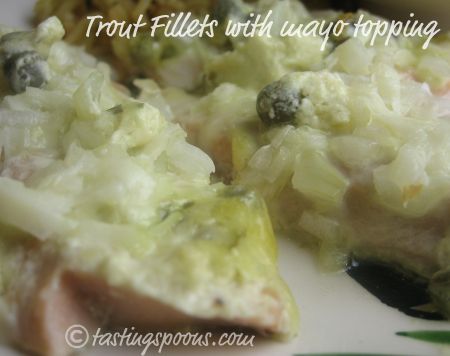
Because this trout was already filleted, I couldn’t have prepared it in my mother’s tried and true method. So I baked the slim fillets with a mayo based topping. It took but a few minutes to cook them through. The resulting fish was tender and moist from the topping. And the flavor was mostly hidden, actually, from the strong flavors of capers and the Pecorino cheese. I might have liked to taste more of the fish, so if you prefer the fish flavor I’d recommend you eliminate the capers and use a milder cheese. In any case, the preparation takes little time and the mayo sauce is quite forgiving if you lack one thing or another in the recipe. This isn’t a wow recipe. My DH didn’t care for it much, but he thought it was the fish, not the preparation. But I had not one single bone!
printer-friendly PDF

Trout Fillets with Mayo-Caper Topping

Serving Size: 4

3/4 pound trout fillet — skinned, deboned, patted dry
1/3 cup mayonnaise
1 1/2 tablespoons capers
1 1/2 tablespoons Dijon mustard — with tarragon
1/2 whole onion – finely minced
1/4 cup Pecorino cheese – or Parmigiano-Reggiano

1. Preheat oven to 400 degrees F.
2. In a small bowl combine the mayo, capers and mustard. Stir to combine. With a spreader knife, spread less than half of the mayo mixture on the bottom of each trout fillet. Place in a Silpat or parchment lined pan, mayo side down. Use remaining mayo mixture to cover the tops of all the fillets. Sprinkle the minced onion on top, then sprinkle each fillet with the grated Pecorino cheese.
3. Bake fillets for 10 minutes. Serve with a colorful vegetable (broccoli, asparagus, zucchini) and a simple vinaigrette-dressed salad.
Per Serving: 281 Calories; 22g Fat (70.1% calories from fat); 19g Protein; 2g Carbohydrate; trace Dietary Fiber; 59mg Cholesterol; 242mg Sodium.

Related Posts Plugin for WordPress, Blogger...