Get new posts by email:

Archives

Currently Reading

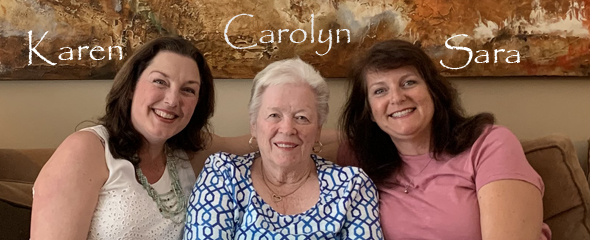
Here are the tastingspoons players. I’m in the middle (Carolyn). Daughter Sara on the right, and daughter-in-law Karen on the left. I started the blog in 2007, as a way to share recipes with my family. I’m still doing 99% of the blogging and holding out hope that these two lovely and excellent cooks will participate. They both lead very busy lives, so we’ll see.

– – – – – – – – – – – – – – – – – – – – – –

BOOK READING (from Carolyn):

Music of Bees, Eileen Garvin. Absolutely charming book about a woman in midlife, lonely, who raises bees, also makes unlikely friends. Heart-warming and very interesting about beekeeping.

A Postcard from Paris, Alex Brown. Really cute story. Dual time line, 1940s and present day about renovating an old apartment in Paris, things discovered.

Time of the Child, Niall Williams. Oh such a good book. Very small village in Ireland, 1960s. A baby is left on the doorstep. The town all whispers and helps. I listened to an interview of the author, which made me like him and his books even more.

Sipsworth, Simon Van Booy. If you like animals you’ll swoon. An old woman who really wants to die finds a tiny mouse in her house and befriends it and finds a reason to live. Utterly charming book.

The Forger’s Spell, Edward Dolnick. True story. For seven years a no-account painter named Han van Meegeren managed to pass off his paintings as those of Johannes Vermeer.

If You Lived Here, You’d be Home by Now, Christopher Ingraham. Could hardly put it down – about a journalist who takes on a challenge to move to small town in Minnesota and write about it. He expects to hate it and the people and place, but he doesn’t. Absolutely wonderful true story.

The River We Remember, William Kent Kreuger. 1950s, Minnesota. A murder and the aftermath. Could hardly put it down. Kreuger has such a vivid imagination and writing style.

How the Lights Gets In, Joyce Maynard. An older woman returns to New Hampshire to help care for her brain-injured son. Siblings and family, lots of angst and resentments.

The Filling Station, Vanessa Miller. Every American should read this book. A novelized retelling of the Tulsa massacre in 1921. Absolutely riveting.

The Story She Left Behind, Patti Callahan Henry. Love this author. Based on a true story. A famous author simply vanishes, leaving her husband and daughter behind. She had invented a mystical language no one could translate. Present day, someone thinks he’s solved the riddle, contacts the family. Really interesting read.

The Girl from Berlin, Ronald Balson. Love anything about Tuscany. An elderly woman is being evicted from a villa there, with odd deed provenance. Two young folks go there to help unravel the mystery. Loved it.

The Island of the Colorblind, Oliver Sacks, M.D. Nonfiction. The dr is intrigued by a remote Pacific island where most of the inhabitants are colorblind. He also unravels a mystery on Guam of people born with a strange neurological problem. Medical mysteries unveiled. Very interesting.

The Bookbinder, Pip Williams. Post 1914 London. Two sisters work at a bookbindery. They’re told to not read the books. One does and one doesn’t. One has visions beyond her narrow world; the other does not. Eventually the one gets into Oxford. Lovely story.

The Paris Express, Emma Donoghue. 1895 on a train to Paris, a disaster happens. You’ll delve into the lives of many people who survived and died in the crash.

A Race to the Bottom of Crazy, Richard Grant. This is about Arizona. Author, wife and child move back to Arizona where they once lived. Part memoir, research, and reporting in a quest to understand what makes Arizona such a confounding and irresistible place.

The Scarlet Thread, Francine Rivers. A woman’s life turned upside down when she discovers the handcrafted quilt and journal of her ancestor Mary Kathryn McMurray, a young woman who was uprooted from her home only to endure harsh frontier conditions on the Oregon Trail.

A Place to Hide, Ronald Balson. 1939 Amsterdam, an ambassador has the ability to save the lives of many Jewish children. Heartwarming.

Homeseeking, Karissa Chen. Two young Chinese teens are deeply in love, but in China. Then their families are separated. Jump to current day and the two meet again in Los Angeles.

North River, Pete Hammill. He always writes such a good story. A doctor works diligently healing people from all walks of life. His wife and daughter left him years before. One day his 3-yr old grandson arrives on his doorstep.

A Very Typical Family, Sierra Godfrey. A very messed-up family. Three adult children are given a home in Santa Cruz, Calif, but only if the siblings meet up and live in the house together. A very untypical scenario but makes for lots of messes.

Three Days in June, Anne Tyler. The usual Anne Tyler grit. Family angst. This wasn’t one of my favorites, but it was entertaining and very short.

Saved, Benjamin Hall. Author is a veteran war reporter. Ukraine, 2022, he nearly loses his life to a Russian strike. Riveting story – he survives, barely.

Grey Wolf, Louise Penny. Another Inspector Gamache mystery in Quebec. She is such an incredible mystery writer.

All the Colors of the Dark, Chris Whitaker. A missing person mystery, a serial killer thriller, a love story, a unique twist on each. Could hardly put it down.

Orbital, Samantha Harvey. Winner of 2024 Booker Prize. I don’t usually like those, but I heard the author interviewed and she hooked me. This is not a normal book with a beginning, a story and an end. It’s several chapters of the day in the life of various astronauts at the ISS (Int’l Space Station). All fictional. She’s been praised by several real astronauts for “getting it” about space station everyday life.

The Blue Hour, Paula Hawkins. An island off Scotland. Inaccessible except when the tide is out. Weird goings on. An artist. A present day mystery too.

Iron Lake, William Kent Krueger. A judge is murdered and a boy is missing. Riveting mystery.

Tell the Wolves I’m Home, Carol Ricks Brunt. 1980s. A 14-yr old girl loses her beloved uncle. Yet a new friendship arises, someone she never knew about.

Four Treasures of the Sky, Jenny Zhang. 1880s, a young girl is kidnapped in China and brought to the United States. She survives with many hurdles in the path.

The Boy Who Fell out of the Sky, Ken Dornstein. Memoir, 1988. The author’s brother died in the PanAm flight that went down in Lockerbie, Scotland. A decade later he tries to solve “the riddle of his older brother’s life.”

Worse Care Scenario, T.J. Newman. Oh my. Interesting analysis of what could/might happen if a jet crashed into a nuclear plant. Un-put-downable.

Song of the Lark, Willa Cather. Complicated weave of a story about a young woman in about 1900, who has a gifted voice (singing) and about her journey to success, not without its ups and downs.

Crow Talk, Eileen Garvin. Charming story which takes place at a remote lake in Washington State, about a few people who inhabit it, the friendships made, but also revolving around the rescue of a baby crow.

The Story Collector, Evie Woods. Sweet story about some dark secrets from an area in Ireland, a bit magical, faerie life, but solving a mystery too.

A Sea of Unspoken Things, Adrienne Young. A woman investigates her twin brother’s mysterious death. She goes to a small town in California to figure it out, to figure HIM out.

The King’s Messenger, Susanna Kearsley. 1600s England, King James. About one of his trusted “messengers,” and his relationship with a young woman also of “the court.” Lots of intrigue.

In the Shadow of the Greenbrier, Emily Matchar. Interesting mystery in/around the area of the famous resort in White Sulphur Springs, West Virginia.

Isola, Allegra Goodman. Hard to describe, survival story on an island in the 1600s.

Save the Date, Allison Raskin. Rom-com, witty, LOL funny. Clever.

The Sirens, Emilia Hart. Numerous time-lines, Australia. Mysteries abound, nightmares, abandoned baby, weird allergies.

Red Clay, Charles Fancher. LOVED this book. Mostly post-Civil War story about the lives of slaves in Alabama during Reconstruction.

Stars in an Italian Sky, Jill Santopolo. Dual time line, 1946 and recent time. Love stories and a mystery.

Battle Mountain, C.J. Box. Another one of Box’s riveting mysteries. Love his descriptions of the land.

Something Beautiful Happened, Yvette Corporon. A memoir of sorts in Greece, tiny island of Erikousa, where the locals hid Jews during WWII. All elusive stories told by the author’s grandmother.

The Jackal’s Mistress, Chris Bohjalian. 1860s Virginia, about a woman who saves the life of a Union soldier. Really good story.

Song of the Magpie, Louise Mayberry. Really interesting story about Australia back in the days when it was mostly a penal colony. Gritty strength of a woman trying to thrive with her farm.

The Boomerang, Robert Bailey. A thriller that will have you gripping the book. About a lot of secrets surrounding the president (fictional novel, remember) and his chief of staff and about cancer. A cure. Such a good story.

Care and Feeding, Laurie Woolever. Really interesting memoir of a woman driven to succeed in the restaurant business. She worked for Mario Batali and then Anthony Bourdain. Gritty stories.

Everything is Tuberculosis, John Green. Maybe not a book for everyone. A real deep dive into the deadly tuberculosis infection, its history. I heard the author interviewed and found the book very interesting.

The Book Lovers Library, Madeline Martin. Fascinating read about Boots’ drug stores’ lending library. And the people who worked in them.

The Arrivals, Meg Mitchell Moore. LOL funny, about a middle-aged couple whose children (and their various family members) return to the family home and the chaos that ensues.

My Life as a Silent Movie, Jesse Lee Kercheval. About grief. A big move to Paris, finding herself a new life with a new set of real blood family.

Escape, Carolyn Jessop. Another memoir about a woman really in bondage in Utah, Mormon plural marriage.

 

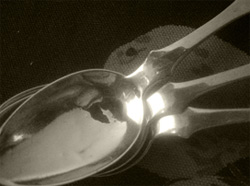
Tasting Spoons

My blog's namesake - small, old and some very dented engraved silver plated tea spoons that belonged to my mother-in-law, and I use them to taste my food as I'm cooking.

Scroll down to the bottom to view my Blogroll

Posted in Salads, Veggies/sides, on June 30th, 2007.

I’m always looking for different ways to serve vegetables or sides for warm, summer barbecue dinners. I must have been watching Bobby Flay last summer when he prepared this. I made it right away and liked it a LOT. It’s not difficult to prepare, although you do have to bake (or cook somehow) the sweet potatoes, then you pare them, slice and grill them, along with the green onions, then make the dressing and toss it together. It can be served hot, room temp or chilled, and it keeps for about a week.
Printer-friendly PDF

Grilled Sweet Potato and Scallion Salad

Recipe: Bobby Flay of the Food Network
Servings: 8

4 large sweet potatoes
8 whole scallions
3/4 cup olive oil — divided use (1/4 cup for grilling, balance for dressing)
2 tablespoons Dijon mustard
1/2 cup cider vinegar
1/4 cup balsamic vinegar
2 teaspoons honey
Salt and freshly ground pepper
1/4 cup Italian parsley — coarsely chopped

1. Bake potatoes in a 350 oven for about 40-50 minutes until JUST barely done. Remove and allow to cool, then peel and cut into 1/2 inch lengthwise slices.
2. Preheat grill to high. Brush potatoes and scallions with 1/4 cup oil and arrange on grill. Grill potatoes for 3 to 4 minutes on each side, or until just tender. Grill scallions until softened and marked. Remove scallions from the grill and cut into thin slices.
3. In a large bowl, whisk together 1/2 cup olive oil, the mustard, vinegars, and honey. Season with salt and pepper, to taste. Add potatoes, scallions, and parsley and toss until potatoes are well coated. Transfer to a platter and serve.
Per Serving: 264 Calories; 21g Fat (68.2% calories from fat); 2g Protein; 20g Carbohydrate; 3g Dietary Fiber; 0mg Cholesterol; 59mg Sodium. Exchanges

Posted in Desserts, on June 26th, 2007.


If you haven’t ever had Panna Cotta, you’re missing a big treat. And, if you’ve never had it, it’s hard to describe: it’s not custard; it’s not like mousse either; it’s not clotted cream; nor is it like a pie filling. But it is creamy, yummy. I guess you’ll just have to try it to find out. I’ve had it out and I’ve made it before, although this time I made it in muffin cups. I wanted to use ramekins, but I didn’t have enough for the family crowd we had over. A shopping expedition to Target didn’t yield any ramekins, either. I wasn’t about to drive to Williams-Sonoma just for ramekins. So I bought this new-fangled kind of silicone muffin tin. Each of the silicone cups are removable and they slide easily into their custom muffin tray. Since they’re small, however, I filled them right up to the top, which yields one half cup. So because of that, the recipe made 12 pannas using this recipe.

Strawberries are at their peak and waning, so I wanted to use berries with it. In the past I’ve made a Joanne Weir recipe for panna cotta, but I thought I’d try Ina Garten’s recipe instead, which uses more yogurt. Dave and I are stuck on Fage yogurt (Trader Joe’s, $3.60 low fat). It’s a strained (thicker) yogurt. It comes in non-fat, low fat and full fat. Interestingly, I had a hard time getting the pannas out of the muffin cups – you might not know the difference if you’ve never had this – the blobs of panna aren’t as perfect as you’d have at a restaurant. But, it made no difference whatsoever in the taste.

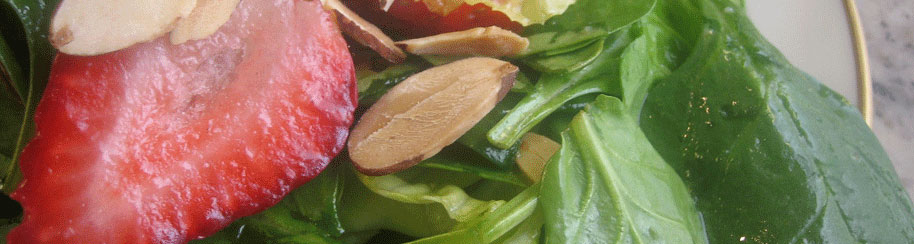
It’s very easy to make (must be made ahead, though) and spends some time resting in the refrigerator. An hour before serving the berries were sliced and balsamic added and the black pepper. Actually, since I wasn’t sure people would really like the pepper, we added it as a garnish on the berries rather than adding it to the berries in the bowl.

A note about the balsamic – I’m embarrassed to tell you that I have at least 4 bottles of balsamic vinegar on my pantry shelf. One bottle is cheap. Not very good either, but I use it in salad dressings or marinades only. Another is a middle grade, a bit thicker in texture and much more tasty. I use it in cooking when I know I’ll be able to tell the difference. A third bottle is a very expensive one, an aged balsamic I bought in Italy from a unique little shop that only carried wine and balsamic – it’s the cream of the crop, is almost the consistency of a light syrup. You could sip it from a spoon it’s so good. That one is reserved for the occasions when a drizzle is truly a garnish on a dish that prides itself on the balsamic quality. And, I had a bottle of pear balsamic on my shelf too. I don’t even remember where I got it, but I took a tiny taste before using it to see if it was appropriate for this dish. Since this was a fruit dessert, I thought it would be ideal. Loved it. Will I make this recipe again? You betcha.
Printer-friendly PDF

Panna Cotta with Balsamic Strawberries

Recipe: Barefoot Contessa at Home
Servings: 8
NOTES: Splenda or other sugar substitute may be used in lieu of the sugar in this dish. I used a fruit balsamic (pear in my case) rather than regular. Just don’t use a cheap grocery store balsamic as it’s too harsh. Buy one bottle of “good” balsamic to use for special occasions, and this is one of them. You can also do a different proportion of heavy cream to yogurt if you use the thicker Greek yogurt, Fage. Greek yogurt is very creamy already, so you can use 3 cups of that with lesser of the heavy cream. It may be a bit harder to get out of the ramekins, however, as yogurt doesn’t “gel”-up as easily as heavy cream. In that case, you may choose to serve this in the ramekin.

1 package unflavored gelatin
3 cups heavy cream
2 cups yogurt — plain, whole milk
1 1/2 teaspoons vanilla extract
1 whole vanilla bean
3/4 cup sugar
8 cups strawberries — sliced
5 tablespoons balsamic vinegar — good quality
2 tablespoons sugar
1/2 teaspoon freshly ground black pepper — yes, really
fresh grated lemon zest

1. In a small bowl, sprinkle the gelatin on 3 T. of cold water. Stir and set aside for 10 minutes to allow gelatin to dissolve.
2. Meanwhile, in a medium bowl, whisk together 1 1/2 cups of the cream, the yogurt and vanilla extract. Split the vanilla bean and use the tip of a knife to scrape the seeds into the cream. Heat the remaining 1 1/2 cups cream and the sugar in a small saucepan and bring to a simmer over medium heat. Off the heat, add the softened gelatin to the hot cream and stir to dissolve. Pour the hot cream-gelatin mixture into the cold cream-yogurt mixture and stir to combine. Pour into 8 (6-8 ounces) ramekins or custard cups and refrigerate uncovered until cold. When the panna cottas are thoroughly chilled, cover with plastic wrap and refrigerate overnight.
3. Thirty minutes to an hour before serving, combine the strawberries, balsamic vinegar, sugar and pepper. Set aside at room temperature.
4. To serve, run a small knife around each dessert and dip the bottom of each ramekin quickly in a bowl of hot tap water. Invert each ramekin onto a dessert plate and surround the panna cotta with strawberries. Dust lightly with freshly grated lemon zest and serve.
Per Serving: 519 Calories; 36g Fat (59.8% calories from fat); 6g Protein; 48g Carbohydrate; 3g Dietary Fiber; 130mg Cholesterol; 91mg Sodium.

Posted in Chicken, Grilling, on June 24th, 2007.

The Los Angeles Times’ Food Section happens to be one of the better ones in the country. Maybe I should qualify that. It used to be one of the best. So few major newspapers are devoting money and staff to the sections anymore, but you can access the food sections of many newspapers on the net now (click on this link for a list of newspaper food sections available online). But this recipe was in the “good old days,” when the food section was quite large. The recipe comes from a restaurant in Los Angeles called Cha Cha Cha and was printed about 7-8 years ago. I’ve never been to the restaurant, but I guess they do a lot of highly seasoned Caribbean foods, this being one of them. Jerk seasoning was new to U. S. cooking circles back then, and having never had it, I was intrigued to try it. It’s been a summertime regular ever since. And I want you to read the nutritional analysis this time (a very good-for-you dish).

Recipe Tip:

Just remember: once you mix up the spices, they only keep for about a month.

You need to have a sizable repertoire of herbs and spices in order to concoct the herb/spice mixture. I make it up in quantity. I think I’ve read that once you combine herbs or spices their lifetime diminishes considerably. My stash of this mixture is from last summer, so I hope it lasts a few more months.

The chicken breasts are marinated in a combination of the herb/spice mixture, canned pineapple juice, orange juice and Worcestershire sauce. Ideally for 24 hours, but I’ve done it in far less when I haven’t planned ahead to make this. It’s very simple once you have the dry mix ready; I always marinate meat/chicken/fish in a plastic bag – one of the freezer types so there’s no chance of puncturing it. Or at least very little chance of a chicken bone or something poking a hole in the bag. When I am unsure about how safe the bag is, I’ll put it into the bag, then in a large plastic bowl. Just in case.

The only other info about this chicken that is different is how it’s cooked. It is done on direct heat, but after grilling for a fairly short time on the grill, you remove the breasts and slice them into strips, dip in the marinade again, then finish cooking. The batch pictured above didn’t get that last step because the head griller had already turned the meat over and it was deemed “too late” to do the slice. So we just slathered more of the marinade on it and allowed it to cook that way. It’s very moist as long as you don’t overcook it. Remove the chicken when it reaches about 150-155 degrees, allow to sit a few minutes then slice and serve. Discard the marinade as it’s contaminated.

You could boil the marinade down if you wanted to and make it a sauce, but it might take longer than you have to devote to it since the chicken cooks in nothing flat. I’m going to try that sometime. The chicken is extremely low in fat because the marinade has no oil in it at all. None. So it’s just the fruit juices that help it retain moisture. Our family from Placerville was here, and they deemed it good. My daughter Dana has made this a few times and recommends buying the pineapple orange combination juice (Dole makes it) instead of using separate canned juices. Makes good sense to me. I may stock up on that, because I never have pineapple juice on hand.

The original recipe called for double the ingredients for the marinade, but I’ve been perfectly happy with a smaller quantity and if it’s marinated in a plastic bag, you can turn it over and back, and all the chicken is in contact with the liquid.
Printer-friendly PDF

Cha Cha Cha Jerk Chicken

Recipe: From the Cha Cha Cha restaurant in L.A.
Servings: 8
NOTES: Be sure to read this recipe all the way through before you begin. It is best if allowed to marinate for 24 hours, although I’ve done it in 6 hours (not as good!). When I make up the herb/spice mixture, I prepare a 4x batch, and store in small plastic bags with a label inside. It’s a bit of a nuisance to make the mixture as there are so many different ones. But, this is a very tasty dish and worth the effort. If you add more marinade to the chicken during the grilling time, be sure it COOKS, since the raw chicken was marinated in it and it will contain raw-chicken bacteria.

DRY MIXTURE:
1/4 teaspoon ground allspice
2 teaspoons salt
4 teaspoons chili powder
1 tablespoon black pepper
1 1/2 tablespoons dried thyme
2 tablespoons minced garlic
4 teaspoons red pepper flakes
1 teaspoon garlic powder
1/2 teaspoon cayenne
1 teaspoon turmeric
1 teaspoon curry powder
1 teaspoon ground ginger
1 teaspoon ground coriander
1 tablespoon dried oregano
MARINADE:
2 cloves garlic — minced
1/2 cup Worcestershire sauce
1 cup orange juice
1 cup pineapple juice
8 boned and skinned chicken breast halves, tender removed

1. Prepare the dry mixture first.
2. In a large heavy-duty plastic bag, combine the dry mixture, adding the fresh garlic, Worcestershire sauce, orange juice and pineapple juice. Mix it up a bit, then add the chicken breasts. Seal the bag and marinate overnight if time permits, turning the bag a few times in that time.
2. Remove chicken from marinade and drain briefly, then place on grill heated to medium heat, and cook about 4 minutes. Remove from the heat (jerk chicken is always cooked twice). Cut each breast half in half lengthwise and use a brush to apply more marinade to each piece. Return to grill and cook until chicken is cooked through – about 4-5 minutes, brushing frequently with more marinade to keep it moist.
Per Serving: 193 Calories; 2g Fat (9.7% calories from fat); 29g Protein; 14g Carbohydrate; 2g Dietary Fiber; 68mg Cholesterol; 772mg Sodium.

Posted in Salad Dressings, on June 23rd, 2007.

On previous posts I’ve mentioned the cooking school in San Juan Capistrano, Our House, South County. It’s been in business several years now, but unfortunately the owners are planning (trying) to sell it. Perhaps it will remain a cooking school and event venue; perhaps not. I am very sad to contemplate the closure of Our House.

What’s unusual about it? It’s particularly charming for a variety of reasons. It’s owned by 3 people: Carole & Craig (a couple) and Sarah. Read more below about them, or go to their website (link above). Carole & Sarah try to serve people something to eat soon after arriving for the class. The room for the students (it’s all a demonstration class) is festively decorated, Carole and Sarah talk about the food, prepare some part of it, then the helpers whisk plates of food in front of us. One of these days I’m going to write up something about why it is I go to cooking classes, but that will be another day . . .

Carole is very talented, creative and fun. She MC’s the “show” so to speak, talking about the food. She knows how to stage tables and serving, and has quite a knack for decorating. And maybe more than anything, she buys lots of house kinds of stuff that are placed all over the house and the barn – items that are for sale. Things we never seem to see in other stores. Things I buy. Lots of things I buy.

Sarah, her cohort in crime, so to speak, is as cute as can be. Scottish by birth, Sarah was hired by Carole & Craig as a nanny, many years ago. The children are now grown and mostly gone, but Sarah has stayed. Sarah also became the family cook, chef, and bottle washer, most likely, but she’s a complete member of the family. She and Carole have a wonderful repartee.

The recipes they do are usually easy, but very high on flavor.

They serve plenty of food – you never go away hungry, that’s for sure. And usually they serve at least 2 desserts, sometimes 3, with one being a take-away one to remember them by.

The summer barbecue classes were great fun – Cherrie and I included our husbands, and we invited our son and his wife also. We all had a good time.

The subject here is salad dressings. I guess I’m a sucker for one more recipe. I don’t much like bottled dressings. Whether it’s the additives they have to include to give them shelf life, or something else, but they never seem to taste anywhere near as good as home made salad dressings. I do have one bottled one I keep in the refrigerator – Brianna’s Blush Wine Vinaigrette – but I only use it when I’m out of home made and don’t feel like making any. Carole & Sarah made this vinaigrette at the last class, and I enjoyed it very much. It has a little bit of honey, which makes it different than most totally savory vinaigrettes. That tiny amount of honey makes a big difference in the overall taste of the dressing. I’ve made it twice since then, and like it a lot. It’s not necessary to use the blender – I make it in a lidded jar and just shake it up. Just mush up the garlic well – you don’t want chunks of it, especially if it hasn’t been allowed to sit and mellow for several hours or overnight.
Printer friendly PDF

White Wine Vinaigrette

Recipe: Our House, South County cooking school (since closed)
Servings: 8

1/4 cup Champagne wine vinegar
1 tablespoon Dijon mustard
1 whole garlic clove — minced
1 teaspoon honey
1/2 cup olive oil
salt and pepper to taste

In a lidded jar combine all ingredients and shake vigorously. Taste for seasoning. Store in refrigerator.
Per Serving: 125 Calories; 14g Fat (95.2% calories from fat); trace Protein; 1g Carbohydrate; trace Dietary Fiber; 0mg Cholesterol; 24mg Sodium. Exchanges: 0 Lean Meat; 0 Vegetable; 2 1/2 Fat; 0 Other Carbohydrates.

Posted in Desserts, on June 22nd, 2007.

The extra, beautifully ripe apricots were languishing in the refrigerator, so I needed to use them up. I made a small batch of ice cream using David Lebovitz’s recipe from his book, The Perfect Scoop. I’ve mentioned his cookbook before – click here for my previous post about his Roasted Banana Ice Cream. I’m fortunate to have a wonderful ice cream machine that doesn’t require you to freeze the bowl first – it’s a commercial style machine made by Cuisinart – but manufactured for the home kitchen. I’ve been in love with this machine since Dave bought it for me about 3 years ago.

I read several other recipes before I decided which to use. But, everything I’ve had and heard about Levobitz’s recipes led me to believe that his would be especially good. First you poach the apricots in a little water, add sugar, puree them in a blender, and add heavy cream, a hint of almond extract and another hint of lemon juice. I don’t think I’ve ever made a recipe that called for 3 drops of any kind of extract – food coloring yes, extract, no. Hence the almond flavor mostly disappears in the mixture. The same with the lemon juice. It calls for a few drops of lemon juice, but my recipe program doesn’t allow for “a few” as a measurement, so I changed it to 1/2 teaspoon, although I added more than that since I just squeezed a bit – probably more like 2 teaspoons at least. Then I poured it into the machine and 50 minutes later it was done. I didn’t even chill the mixture first as it says in the recipe. So, how is it? Sinfully delicious. The intense apricot flavor slides right on through in your mouth. We haven’t technically eaten it yet, although I licked the beater just to make sure it was okay (grin).
Printer friendly PDF

Apricot Ice Cream

Recipe: The Perfect Scoop by David Lebovitz
Servings: 5

1 pound apricots — fresh, very ripe
1/3 cup water
1/2 cup sugar
1 cup heavy cream
3 drops almond extract
1/2 teaspoon lemon juice

1. Slice open the apricots, remove pits and any brown spots or stems, then cut each apricot into sixths. Cook the apricot pieces in water in a covered, medium, nonreactive saucepan over medium heat until tender, about 8 minutes, stirring occasionally. Remove from heat and stir in sugar until dissolved. Let cool to room temperature.
2. Once cool, puree the apricots and liquid in a blender of food processor until smooth. Taste a big spoonful; if there are any small fibers, press the mixture through a mesh strainer to remove them. Stir in the cream, almond extract and lemon juice.
3. Chill mixture thoroughly in refrigerator, then freeze per manufacturer’s directions.
Per Serving: 282 Calories; 18g Fat (55.1% calories from fat); 2g Protein; 31g Carbohydrate; 2g Dietary Fiber; 65mg Cholesterol; 19mg Sodium.

Posted in Chicken, on June 21st, 2007.

I don’t suppose this looks all that appetizing, does it? I forgot the lemon zest and chives garnish, which really helps, but I’ll tell you, the recipe is very good. I attended a cooking class some years ago taught by Nicole Aloni. She’s a well-known caterer and cookbook author among the Hollywood set. She worked for many years as the catering director at the L.A. Music Center, then opened her own business. Her reason for writing cookbooks was a statistic: that 98% of people love the idea of giving a dinner party, but only 2 % of people enjoy doing it. So, she decided to write books about how to entertain.

Her first book, Secrets from a Caterer’s Kitchen ($12.89 on Amazon), is mostly about how to plan a dinner party. The logistics, the recipe decisions, the serving aspects, decorating ideas, and most importantly how to plan ahead so you aren’t cooking in the kitchen the entire day of the party. And there are lots of recipes in there too. Subsequently she published another cookbook, called Cooking for Company (also $12.89). It’s more along the food-only line, with over 200 pages of recipes for entertaining. All with the idea that you want to do as much advanced prep as possible.

So now, back to the cooking class. She prepared a meal that night that was relatively easy, but high on flavor, and definitely with the do-ahead factor. I like to entertain. Surely I’m not in the 2% of that statistic. And generally I enjoy the cooking too, although as I’ve gotten older I find that standing and prepping food for 7-8 hours the day of a party is getting harder. My feet hurt. My back hurts, etc. So I do try to make some things ahead. And I also try to buy store-bought something – usually the appetizer – rather than make it myself. So, this recipe is a good one for that.

This dish is an easy one to make, and I’d say this dish has Greek origins. The recipe didn’t say. You’ll notice a long list of ingredients. Don’t be put off by it – nothing in the list is a problem – except the preserved lemon. Most people don’t have that on the pantry or refrigerator shelf. I bought mine at Sur la Table, although other better grocery stores should carry it too. Or if you have a Middle Eastern market near you, they’ll surely have it at half the price. Preserved lemons are ones that have been packed in salt and left to sit for a couple of months.

Most Middle Eastern cooks make their own. I tried it once, but because I’d never had them before, I wasn’t sure if mine turned out correctly and have never bothered to make them since. If you’re interested, and you have a bountiful lemon tree, you might want to make them – they’re certainly easy to do – click here for a recipe. You never use much of the finished preserved lemon – they’re quite pungent and very tart. And salty. So it’s almost like a garnish, although this is put into the sauce itself. You wouldn’t want to use it as a garnish – for all those same reasons – too pungent, tart and salty.

You make a savory sauce – broth, balsamic vinegar, shallots, Dijon, tarragon, preserved lemon and kalamata olives. It has bitter overtones with the Dijon, balsamic, kalamata olives and the preserved lemon. That’s the part that can be done ahead. Be sure you use low sodium broths, though, because you reduce the broth to half and it will be very salty – way too salty – if you use regular sodium broths. Then you grill the chicken breasts that have been marinated in balsamic vinegar for a couple of hours, and once finished, you slice the chicken into strips. And serve it with some kind of carb – like linguine or rice – because you want something to soak up the sauce as well as what you spoon over the chicken. The recipe is also very low calorie and low fat, but as Nicole said that night – “it’s so good – you don’t need to tell anybody that.”
Printer-friendly PDF

Chicken with Artichokes & Olives

Recipe: Nicole Aloni, author and caterer
Servings: 8
Serving Ideas : You will want to serve this with some kind of starch that will absorb the wonderful sauce – like fettucine or rice. If serving this on a buffet, cut the chicken into chunks small enough so they don’t require a knife to cut and top each chicken piece with a bit of sauce and garnish with the chives, lemon zest and additional kalamata olives. Put more sauce on the side so guests can ladle more to suit their tastes.
NOTES: This dish doesn’t have striking prettiness since it’s kind of beige all over, so it’s important that you garnish with ample lemon zest and chives to give it some color. This is a very healthy dish – but you don’t have to tell anybody that.

1 1/2 cups beef stock — reduced sodium
3 cups chicken stock — reduced sodium
2 1/2 pounds chicken breast, no skin, no bone, R-T-C
5 tablespoons balsamic vinegar
2 pounds artichoke hearts — frozen, defrosted
1 1/2 tablespoons butter
1/4 cup shallots — minced
5 tablespoons Dijon mustard
4 1/2 ounces kalamata olives — pitted, minced
3 tablespoons fresh tarragon
2 tablespoons Preserved Lemons — chopped
GARNISH:
2 Tablespoons lemon zest
4 tablespoons chives — minced or parsley

1. In a large saucepan, combine the beef and chicken stock and bring to a boil. Continue to boil until reduced by half (about 2 cups) and set aside.
2. Trim the chicken breasts of any excess fat or skin. Pound the thicker ends of the breasts so they’re more evenly thinner. Set in a shallow bowl or plate and drizzle on about 2 T. of balsamic vinegar and rub into the breasts. Cover and refrigerate for 2 hours.
3. In a medium sauté pan over medium heat cook the shallots in butter until translucent, about 4-7 minutes. Add the reduced stock, mustard and vinegar and simmer gently for about 10 minutes. Make sure to whisk the ingredients well so the mustard is disbursed evenly. Add the artichoke hearts with the olives and tarragon and simmer gently for about 5 minutes. Add the preserved lemon pieces, remove from heat. You can make this ahead to this point and refrigerate. Just rewarm the sauce when you’re ready to serve it.
4. Preheat the barbecue grill to medium high. Dust one side only of each chicken breast with freshly ground black pepper. Place chicken pepper side UP on the hot grill. Cook for about 8 minutes on the first side, turn and grill an additional 3-5 minutes. The flesh should slightly give when pressed.
5. Slice the chicken breasts diagonally into 2 or 3 pieces. Top each chicken breast with a generous ladle of sauce and garnish with lemon zest and chopped chives.
Per Serving: 313 Calories; 11g Fat (31.1% calories from fat); 37g Protein; 17g Carbohydrate; 7g Dietary Fiber; 92mg Cholesterol; 1810mg Sodium.

Posted in Desserts, on June 20th, 2007.

This is the height of apricot season, folks. I bought a small flat of them at Costco last week, and I mean to tell you, they are perfect. I let them sit out on the kitchen counter for 3 days and they reached the peak of ripeness. Half I used in the above cake, and the other half are in the refrigerator and I may try apricot ice cream. In any case, I’ll cook those remaining apricots today or tomorrow before they’re over the hill. As you probably know, apricots have a short time of perfection. Too green and they have no taste. Too ripe and they’re mushy and they go downhill in rapid order from there. So, remember this recipe, either right NOW, or wait until next year.

Another cooking instructor who has provided me with any number of favorite recipes is Tarla Fallgatter. Here’s a blurb I found about her on the internet:

Tarla Fallgatter is a well-known Orange County caterer, chef, teacher, restaurant consultant and kitchen tool manufacturer. She trained at Paris’ Cordon Bleu, La Varenne, and Ecole Lenotre cooking schools, and was the first foreign woman to cook in the kitchens of Maxim’s. She has traveled to over 60 countries throughout the world, “sampling” the local cuisine. She markets her “Tarla” all-copper rolling pin in fine cookware shops.

Tarla used to teach at the Irvine Fine Arts Center (fairly elementary classes). She still teaches at A Store for Cooks, and she also teaches a private group of wives who live in Coto de Caza (a very upscale, gated neighborhood in south Orange County). My friend Cherrie was invited to attend one of those classes about 5 years ago through a friend of hers, and as a substitute, I’m invited too. I can choose to attend or not. This recipe came from one of the Tarla classes I attended.

So, I have a funny story to tell about almond paste. When I went to make this the other day, I knew I had some almond paste. I found 3 boxes. How about that. All imported from Denmark. All hard as rocks. (Now you also need to know that at the class about this cake, Tarla told all of us that we couldn’t substitute marzipan for almond paste – okay – got that – and she told us that almond paste doesn’t store well. It’s not that it spoils. It gets hard, and there’s no recovering it once it gets that way.)

Okay, so I have these 3 boxes in my pantry. No dates on any of them. Guess what? All hard. Uhm. What do I do. I really didn’t want to make another trip to the store, so I thought – maybe I can recover the almond paste. I’ll put it in the microwave with a bowl of hot water and let it steam a bit. Surely that would help, right? Wrong. Five minutes later all I got was hot, hard almond paste. My dear hubby saved the day – he said he’d go to the market for me. Here’s what almond paste looks like.

Ideally you bake the cake and the apricots at the same time (saves energy, obviously). So I got the apricots all ready to roast, then I went to work on the cake. Cautions about the cake:

1. make sure you use an 8-inch cake pan, not 9-inch (cake will be too shallow).

2. make certain you finely chop or tear off almond paste pieces – you don’t want little nuggets of almond paste in the cake.

3. don’t forget the parchment paper step in the cake pan – it needs it – even in a nonstick pan.

The apricots are easy to make and the sauce is delish. The cake is extremely moist and the almond flavor is not subtle – it’s right there – but that is what makes the cake so good. Try it.
Printer friendly PDF

Almond Cake with Roasted Apricots


Recipe: Tarla Fallgatter
Servings: 8
NOTES: You need to use fresh apricots for this. Choose firm ones, but still ripe. And don’t over bake them.
Serving Ideas: Instead of creme fraiche, you could also use lightly sweetened whipped cream.

ALMOND CAKE:
4 ounces unsalted butter — room temperature
Additional butter to grease pan
3/4 cup sugar
1/2 cup almond paste — broken in small pieces
1 tablespoon orange zest
3 large eggs
1/2 cup flour
1/4 teaspoon baking powder
1/4 teaspoon salt
1 cup creme fraiche — plus sugar to taste
3 teaspoons powdered sugar
8 sprigs mint leaves
1 cup almonds — use sliced almonds, toast half of them
ROASTED APRICOTS:
10 whole apricots — firm, ripe, halved, pitted
1 whole vanilla bean — split lengthwise, seeds scraped
1/4 cup honey
1/4 cup Amaretto — or apricot brandy

1. APRICOTS: Place apricot halves in a large baking dish and gently toss with vanilla bean and the seeds, with the honey. Pour 1/4 cup water over and the Amaretto and toss again. Bake along with the cake, until the apricots are tender when pierced with the tip of a knife, 15-20 minutes. The timing will depend on the ripeness of the fruit.
2. ALMOND CAKE: Preheat oven to 325°. Butter an 8-inch round cake pan (do not use a 9-inch pan as it will be too flat). Line with parchment paper and additional butter on the parchment paper.
3. Cream butter and sugar in food processor until fluffly. Add almond paste and beat until smooth and fluffy. Add the orange zest and eggs, one at a time. Beat until well blended. Mix flour, baking powder and salt together and pulse in. Scrape mixture into the prepared pan, smooth top and sprinkle 1/2 cup untoasted sliced almonds on top. Bake in the middle of the oven for about 30 minutes, until the edges are golden brown and pulling away from the pan. Remove and set on a rack to cool.
4. In a small bowl combine the creme fraiche and a little bit of sugar. Invert the cake onto a cake plate and peel off parchment paper. Turn the cake back over again so the almonds are on the top. Lightly dust with sifted powdered sugar. Cut the cake into 8 pieces and put on plates. Top each slice with the roasted apricots, a dollop of creme fraiche, then sprinkle the top with the additional sliced almonds, and decorate with mint sprigs.
Per Serving: 561 Calories; 35g Fat (55.8% calories from fat); 10g Protein; 53g Carbohydrate; 4g Dietary Fiber; 137mg Cholesterol; 128mg Sodium.

Posted in Veggies/sides, on June 19th, 2007.


Doesn’t look like much, does it?
A chicken breast smothered with sour cream and crushed canned onion rings? Yuk.
A piece of white fish with grated carrot and sprinkled with toasted pine nuts? Yuk.
It’s actually a potato side dish that’s really flavorful. Really decadent.
And did I say easy? Oh, yes.

I had a similar dish at some friends a week or so ago (thanks, Penny, for the idea). I liked her casserole so well that I searched for it on the internet. Found a number of variations, and most of them contain a similar list of ingredients: frozen hash brown potatoes, defrosted, sour cream, chopped onion, cream of chicken or cream of mushroom soup, grated cheddar or sharp cheddar cheese, potato chips or corn flakes and butter.

I found several versions at http://www.cooks.com/ and finally selected this one because it suggested sharp cheddar cheese, AND it listed a half of a package of dry ranch dressing mix. I also added some fresh rosemary from my garden. I think this casserole needs the sharp cheddar, not mild cheddar, for the extra flavor boost along with the Ranch dressing mix.

Because I’d never made it before, I more or less followed the directions. I did add the rosemary. (We were having barbecued butterflied leg of lamb, so I thought the rosemary would be a nice complement.) I also cooked the onions first, which wasn’t mentioned in the original recipe. And I cut down on the amount of butter by about half.

The finished dish was wonderful. Next time I will try it with low-fat sour cream, the reduced fat soup, but I don’t think I’ll stint on the cheese. It took about 7-8 minutes to put together the ingredients. I finally used my hands to mix it up – it just seemed easier than fumbling with two big spoons. It’s a little awkward getting the soup and sour cream to mix in thoroughly. You don’t want clumps of condensed soup anywhere. Then you pour it into a casserole dish, add 45 minutes to bake, and it’s done. This may have been the first time in my life I ever bought frozen hash browns, but they sure did make it simple. I’ll definitely make this again for a big crowd. I doubled the recipe and it served 9 for one meal and probably would serve another 4-6 for another meal.
Printer friendly PDF

Hash Brown Casserole

Source: http://www.cooks.com/ with changes
Serves 8

Potatoes:
2 pounds frozen hash brown potatoes
6 T. melted butter, divided use
1 tsp. salt
1/4 tsp. pepper
1/2 cup finely chopped onion
1 cup Cream of Chicken soup, or Cream or Mushroom
1 pint sour cream
1/2 package powdered Ranch dressing mix
1 tbsp. chopped fresh rosemary
2 cups grated sharp cheddar cheese
Topping:
2 cups crushed potato chips or Corn flakes
(and remainder of butter)

1. Defrost potatoes.
2. Saute the onion in a little olive oil until tender but not browned.
3. Preheat oven to 350. Combine in large mixing bowl the potatoes and half the butter. Add the sour cream, soup, grated cheese, rosemary and Ranch dressing mix. Mix gently but thoroughly without breaking up the potatoes. Taste for seasoning and add salt and pepper as needed (it doesn’t need any salt, in my opinion). Pour into a buttered 3 quart casserole. Topping: mix remaining butter with either potato chips or Corn flakes and sprinkle over potatoes. Bake for 45 minutes, or until potatoes are done.

Posted in Salads, on June 18th, 2007.

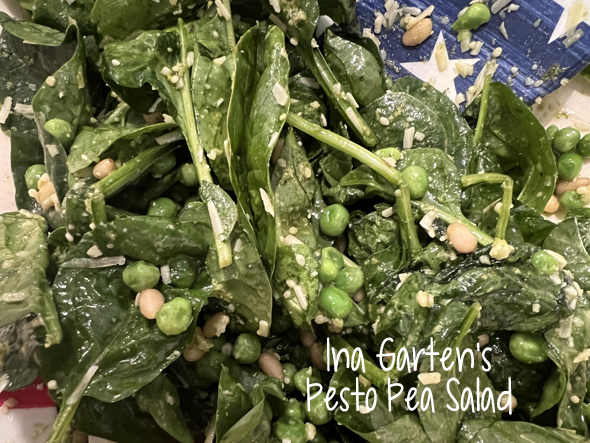
I saw Ina Garten demonstrate this on her food network program, probably 2 years ago. It’s from her book, Barefoot Contessa at Home. Maybe the peas and spinach seem like an unlikely combination, but it sure works. Over the years I’ve used pesto in pasta dishes, of course, and to dollop on the top of certain soups, and as a dip, but never would have considered it as a salad dressing. I had some homemade pesto in the refrigerator, so this was a simple dish to throw together. Trader Joe’s carries a baby spinach, which is preferable here. Regular spinach is just too big for a salad – the pieces are too large without cutting them. I suppose you could do that, but the baby spinach just makes it so simple. I do tear off some of the larger stems, but most of them stay in the salad.

I find this salad goes so very well with a grilled dinner – chicken, steaks, pork chops, even fish. I hate to sound redundant, but this salad is SO simple. You just have to toast the pine nuts (I use a nonstick frying pan) and I caution you if you haven’t done this before – watch the pan very very carefully or they will burn. Pine nuts contain a high percentage of oil, so they burn very rapidly. I keep pine nuts in the freezer at all times, so just remove what you need for a meal.

And, the other thing I do is add more Parmesan cheese (that’s my addition to Ina’s recipe). Often, I believe, when you buy ready-made pesto, it doesn’t contain as much cheese as your own homemade variety, so I add some to the salad itself. It adds some color contrast too.
Printer friendly PDF

Pesto Pea (Spinach) Salad

Recipe: Barefoot Contessa at Home by Ina Garten
Servings : 4

2 cups frozen peas — baby peas, if possible
2 tablespoons pine nuts
2 1/2 cups spinach leaves — baby spinach, if possible
4 tablespoons pesto sauce
2 tablespoons grated Parmesan cheese

1. If you’re in a hurry, run hot water over the peas; otherwise, defrost them in the refrigerator for several hours.
2. Toast the pine nuts in a frying pan until golden brown. Watch them carefully as they burn quickly.
3. Place the spinach leaves in a salad bowl. Sprinkle with peas. Add pesto and toss. Sprinkle Parmesan and pine nuts on top and serve.
Notes: If you want to make Ina Garten’s pesto for this: In a food processor combine 1/4 cup walnuts, 1/4 cup pine nuts and about 9 medium garlic cloves, peeled. Process for about 30 seconds. Add 5 cups of basil leaves, 1 tsp kosher salt and 1 tsp black pepper. With the processor running, slowly pour in 1 1/2 cups good olive oil through the feed tube and process until the pesto is finely pureed. Add 1 cup Parmesan cheese and puree for about 30 more seconds, stopping once to scrape down the sides. Pour into a tall container and float a little olive oil on top and store in refrigerator. Makes about 2 cups – a lot more than you need for the salad recipe. This salad likes a generous amount of pesto – the tendency is to not do enough. However, there’s a fine line – don’t add too much, either. So, taste as you go.
Per Serving: 171 Calories; 10g Fat (52.3% calories from fat); 9g Protein; 12g Carbohydrate; 4g Dietary Fiber; 6mg Cholesterol; 245mg Sodium.

Posted in Desserts, on June 17th, 2007.

When I was in Berkeley 2 weeks ago Cherrie and I went on a tour of the Scharffen Berger chocolate factory. It was just a few blocks from our hotel near the waterfront and my GPS drove us right to the door in the industrial section of town. The factory itself was a big surprise – it’s quite small. Having once visited the Nestle plant in Pennsylvania, I was expecting something dramatic, especially with the panache garnered by the Scharffen Berger line.

As I think I explained before, John Scharffenberger (spelling intentional) came to some reknown as a winemaker. After a couple of decades producing some very fine sparkling wine (a favorite of mine, his to be specific), he sold the business. Then he was approached by Robert Steinberg, a friend, and now his partner in Scharffen Berger, and they decided to start a chocolate manufacturing company, but only producing a high quality – European style – product. They purchased European, i.e. old, equipment. They wanted to capitalize on the known Scharffenberger name, but John had sold the rights to it with the winery. So, they merely added a space between the n and the b and made it into Scharffen Berger. It wasn’t quite building a business in a garage, but close to it.

They don’t make chocolate every day. Although likely some pieces of equipment are running most days. The roaster (the red thing right) was in a separate room (warm and if running, very noisy). The building probably isn’t 300 feet long and about 200 feet wide, and not only housed the factory floor, but offices, a restaurant and a store. Did I spend money in there? Well, to be sure. Did we taste chocolate? Oh yes, indeed. Probably the most important thing I learned there was about how to eat a piece of chocolate: put it into your mouth, hold it on the middle of your tongue, up against the roof of your mouth, and allow it to completely melt on your tongue. Don’t chew. Don’t move it around. You’ll savor the flavors far better, and it’ll last longer besides. Kind of like how you taste wine.

To the left is the photo of the cocoa bean crusher. A huge cauldron – I mean huge – of swirling, melting chocolate and the crusher rolling around in the middle. So, it was on a blog a few months ago that I read about a recipe in the new cookbook published by the Scharffen Berger partners, The Essence of Chocolate. Liking chocolate as I do, I made it and oh – my – goodness.
What flavor. Not all that difficult. I like bundt cakes, and this one doesn’t require anything but the cake itself. It does have a caramel sauce that is poured over the hot-out-of-the-oven cake, but otherwise, nothing else. No garnishes, although you could serve with a bit of vanilla ice cream. It’s rich enough, however, as it is. I will include the nutritional information about the cake, but for heaven’s sake, whatever you do, don’t read it. I’m going to put it in the smallest type available on this blog.
Printer friendly PDF

Banana Caramel (Chocolate) Cake with Caramel Sauce

Recipe: Essence of Chocolate by Robert Steinberg and John Scharffenberger.
Serving: 12 – I think it will serve at least 16
Note from Carolyn: I think the caramel is too thick – it doesn’t drip down into the cake like I think it should, so I’ve been adding more milk to the sauce so it’s thinner.

CAKE:
2 cups all-purpose flour
1 tsp. cinnamon
1/2 tsp. nutmeg
1/4 tsp. cloves
1 tsp. salt
1 tsp. baking soda
3 large eggs
1 1/4 cups vegetable oil
1 3/4 cups sugar
1 tbsp. vanilla extract
3/4 cup chopped pecans
3 ounces chocolate — broken into small pieces (size of chips)
3 whole bananas — diced
CARAMEL:
1/2 cup firmly packed brown sugar
2 tbsp. whole milk
4 tbsp. unsalted butter — cut into pieces

1. Butter and flour a tube pan or a bundt pan that can hold 12 cups. Preheat the oven to 350°.
2. Sift together the dry ingredients (flour, cinnamon, nutmeg, cloves, salt and baking soda).
3. In the bowl of a stand mixer, combine the eggs, oil and sugar. With the paddle attachment, mix on medium speed for 2 to 3 minutes. Scrape down the sides of the bowl to ensure that the sugar has been incorporated. Add the vanilla extract and mix for another 30 seconds. With the mixer on low speed, add the dry ingredients a bit at a time. Scrape down the sides of the bowl every now and then to ensure everything is incorporated. Once the dry ingredients have been added, remove the bowl from the stand mixer and add the pecans, chocolate and bananas. Gently fold them in with a spatula or a wooden spoon. Don’t over mix.
4. Spoon the batter into the prepared pan. Bake for 50 minutes and then test the cake to see if it’s done by poking a toothpick or cake tester into the center of the cake. If it comes out clean, it’s done. If not, bake the cake for another 5 to 10 minutes. In my oven, this cake took 55 minutes.
5. About 5 to 10 minutes before the cake is done, make the caramel by combining all the ingredients in a small pan. Bring to the boil and stir occasionally to ensure that it doesn’t burn. Let it boil for about 5 minutes and then turn off the heat. The caramel needs to be thin, so add more milk if needed. Once the cake is out of the oven, poke holes all over the cake with a skewer. Immediately pour the caramel over the cake, stopping every now and then to let the caramel sink in. If the caramel pools in spots, poke more holes to allow it to sink in. Gently push cake away from sides to add more caramel.
6. Let the cake cool in the pan on a wire rack. Once it’s cool, loosen the cake from the sides of the pan and then unmold it onto a plate. If most of the caramel pooled on the top (in the pan) you may want to turn the cake back over so the wide side is on top.
Per Serving: 595 Calories; 36g Fat (52.7% calories from fat); 5g Protein; 67g Carbohydrate; 2g Dietary Fiber; 64mg Cholesterol; 308mg Sodium.

Related Posts Plugin for WordPress, Blogger...