

Archives
Recent Posts
Currently Reading
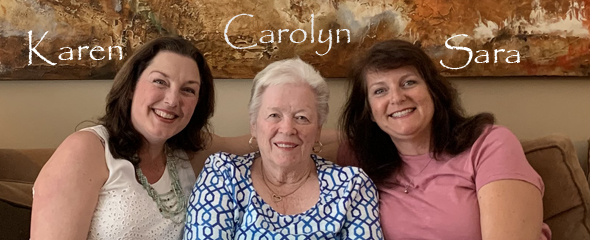
Here are the tastingspoons players. I’m in the middle (Carolyn). Daughter Sara on the right, and daughter-in-law Karen on the left. I started the blog in 2007, as a way to share recipes with my family. I’m still doing 99% of the blogging and holding out hope that these two lovely and excellent cooks will participate. They both lead very busy lives, so we’ll see.
– – – – – – – – – – – – – – – – – – – – – –
BOOK READING (from Carolyn):
Music of Bees, Eileen Garvin. Absolutely charming book about a woman in midlife, lonely, who raises bees, also makes unlikely friends. Heart-warming and very interesting about beekeeping.
A Postcard from Paris, Alex Brown. Really cute story. Dual time line, 1940s and present day about renovating an old apartment in Paris, things discovered.
Time of the Child, Niall Williams. Oh such a good book. Very small village in Ireland, 1960s. A baby is left on the doorstep. The town all whispers and helps. I listened to an interview of the author, which made me like him and his books even more.
Sipsworth, Simon Van Booy. If you like animals you’ll swoon. An old woman who really wants to die finds a tiny mouse in her house and befriends it and finds a reason to live. Utterly charming book.
The Forger’s Spell, Edward Dolnick. True story. For seven years a no-account painter named Han van Meegeren managed to pass off his paintings as those of Johannes Vermeer.
If You Lived Here, You’d be Home by Now, Christopher Ingraham. Could hardly put it down – about a journalist who takes on a challenge to move to small town in Minnesota and write about it. He expects to hate it and the people and place, but he doesn’t. Absolutely wonderful true story.
The River We Remember, William Kent Kreuger. 1950s, Minnesota. A murder and the aftermath. Could hardly put it down. Kreuger has such a vivid imagination and writing style.
How the Lights Gets In, Joyce Maynard. An older woman returns to New Hampshire to help care for her brain-injured son. Siblings and family, lots of angst and resentments.
The Filling Station, Vanessa Miller. Every American should read this book. A novelized retelling of the Tulsa massacre in 1921. Absolutely riveting.
The Story She Left Behind, Patti Callahan Henry. Love this author. Based on a true story. A famous author simply vanishes, leaving her husband and daughter behind. She had invented a mystical language no one could translate. Present day, someone thinks he’s solved the riddle, contacts the family. Really interesting read.
The Girl from Berlin, Ronald Balson. Love anything about Tuscany. An elderly woman is being evicted from a villa there, with odd deed provenance. Two young folks go there to help unravel the mystery. Loved it.
The Island of the Colorblind, Oliver Sacks, M.D. Nonfiction. The dr is intrigued by a remote Pacific island where most of the inhabitants are colorblind. He also unravels a mystery on Guam of people born with a strange neurological problem. Medical mysteries unveiled. Very interesting.
The Bookbinder, Pip Williams. Post 1914 London. Two sisters work at a bookbindery. They’re told to not read the books. One does and one doesn’t. One has visions beyond her narrow world; the other does not. Eventually the one gets into Oxford. Lovely story.
The Paris Express, Emma Donoghue. 1895 on a train to Paris, a disaster happens. You’ll delve into the lives of many people who survived and died in the crash.
A Race to the Bottom of Crazy, Richard Grant. This is about Arizona. Author, wife and child move back to Arizona where they once lived. Part memoir, research, and reporting in a quest to understand what makes Arizona such a confounding and irresistible place.
The Scarlet Thread, Francine Rivers. A woman’s life turned upside down when she discovers the handcrafted quilt and journal of her ancestor Mary Kathryn McMurray, a young woman who was uprooted from her home only to endure harsh frontier conditions on the Oregon Trail.
A Place to Hide, Ronald Balson. 1939 Amsterdam, an ambassador has the ability to save the lives of many Jewish children. Heartwarming.
Homeseeking, Karissa Chen. Two young Chinese teens are deeply in love, but in China. Then their families are separated. Jump to current day and the two meet again in Los Angeles.
North River, Pete Hammill. He always writes such a good story. A doctor works diligently healing people from all walks of life. His wife and daughter left him years before. One day his 3-yr old grandson arrives on his doorstep.
A Very Typical Family, Sierra Godfrey. A very messed-up family. Three adult children are given a home in Santa Cruz, Calif, but only if the siblings meet up and live in the house together. A very untypical scenario but makes for lots of messes.
Three Days in June, Anne Tyler. The usual Anne Tyler grit. Family angst. This wasn’t one of my favorites, but it was entertaining and very short.
Saved, Benjamin Hall. Author is a veteran war reporter. Ukraine, 2022, he nearly loses his life to a Russian strike. Riveting story – he survives, barely.
Grey Wolf, Louise Penny. Another Inspector Gamache mystery in Quebec. She is such an incredible mystery writer.
All the Colors of the Dark, Chris Whitaker. A missing person mystery, a serial killer thriller, a love story, a unique twist on each. Could hardly put it down.
Orbital, Samantha Harvey. Winner of 2024 Booker Prize. I don’t usually like those, but I heard the author interviewed and she hooked me. This is not a normal book with a beginning, a story and an end. It’s several chapters of the day in the life of various astronauts at the ISS (Int’l Space Station). All fictional. She’s been praised by several real astronauts for “getting it” about space station everyday life.
The Blue Hour, Paula Hawkins. An island off Scotland. Inaccessible except when the tide is out. Weird goings on. An artist. A present day mystery too.
Iron Lake, William Kent Krueger. A judge is murdered and a boy is missing. Riveting mystery.
Tell the Wolves I’m Home, Carol Ricks Brunt. 1980s. A 14-yr old girl loses her beloved uncle. Yet a new friendship arises, someone she never knew about.
Four Treasures of the Sky, Jenny Zhang. 1880s, a young girl is kidnapped in China and brought to the United States. She survives with many hurdles in the path.
The Boy Who Fell out of the Sky, Ken Dornstein. Memoir, 1988. The author’s brother died in the PanAm flight that went down in Lockerbie, Scotland. A decade later he tries to solve “the riddle of his older brother’s life.”
Worse Care Scenario, T.J. Newman. Oh my. Interesting analysis of what could/might happen if a jet crashed into a nuclear plant. Un-put-downable.
Song of the Lark, Willa Cather. Complicated weave of a story about a young woman in about 1900, who has a gifted voice (singing) and about her journey to success, not without its ups and downs.
Crow Talk, Eileen Garvin. Charming story which takes place at a remote lake in Washington State, about a few people who inhabit it, the friendships made, but also revolving around the rescue of a baby crow.
The Story Collector, Evie Woods. Sweet story about some dark secrets from an area in Ireland, a bit magical, faerie life, but solving a mystery too.
A Sea of Unspoken Things, Adrienne Young. A woman investigates her twin brother’s mysterious death. She goes to a small town in California to figure it out, to figure HIM out.
The King’s Messenger, Susanna Kearsley. 1600s England, King James. About one of his trusted “messengers,” and his relationship with a young woman also of “the court.” Lots of intrigue.
In the Shadow of the Greenbrier, Emily Matchar. Interesting mystery in/around the area of the famous resort in White Sulphur Springs, West Virginia.
Isola, Allegra Goodman. Hard to describe, survival story on an island in the 1600s.
Save the Date, Allison Raskin. Rom-com, witty, LOL funny. Clever.
The Sirens, Emilia Hart. Numerous time-lines, Australia. Mysteries abound, nightmares, abandoned baby, weird allergies.
Red Clay, Charles Fancher. LOVED this book. Mostly post-Civil War story about the lives of slaves in Alabama during Reconstruction.
Stars in an Italian Sky, Jill Santopolo. Dual time line, 1946 and recent time. Love stories and a mystery.
Battle Mountain, C.J. Box. Another one of Box’s riveting mysteries. Love his descriptions of the land.
Something Beautiful Happened, Yvette Corporon. A memoir of sorts in Greece, tiny island of Erikousa, where the locals hid Jews during WWII. All elusive stories told by the author’s grandmother.
The Jackal’s Mistress, Chris Bohjalian. 1860s Virginia, about a woman who saves the life of a Union soldier. Really good story.
Song of the Magpie, Louise Mayberry. Really interesting story about Australia back in the days when it was mostly a penal colony. Gritty strength of a woman trying to thrive with her farm.
The Boomerang, Robert Bailey. A thriller that will have you gripping the book. About a lot of secrets surrounding the president (fictional novel, remember) and his chief of staff and about cancer. A cure. Such a good story.
Care and Feeding, Laurie Woolever. Really interesting memoir of a woman driven to succeed in the restaurant business. She worked for Mario Batali and then Anthony Bourdain. Gritty stories.
Everything is Tuberculosis, John Green. Maybe not a book for everyone. A real deep dive into the deadly tuberculosis infection, its history. I heard the author interviewed and found the book very interesting.
The Book Lovers Library, Madeline Martin. Fascinating read about Boots’ drug stores’ lending library. And the people who worked in them.
The Arrivals, Meg Mitchell Moore. LOL funny, about a middle-aged couple whose children (and their various family members) return to the family home and the chaos that ensues.
My Life as a Silent Movie, Jesse Lee Kercheval. About grief. A big move to Paris, finding herself a new life with a new set of real blood family.
Escape, Carolyn Jessop. Another memoir about a woman really in bondage in Utah, Mormon plural marriage.
Tasting Spoons
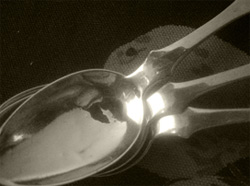
My blog's namesake - small, old and some very dented engraved silver plated tea spoons that belonged to my mother-in-law, and I use them to taste my food as I'm cooking.
Scroll down to the bottom to view my Blogroll


Posted in Salads, Vegetarian, Veggies/sides, on July 16th, 2007.
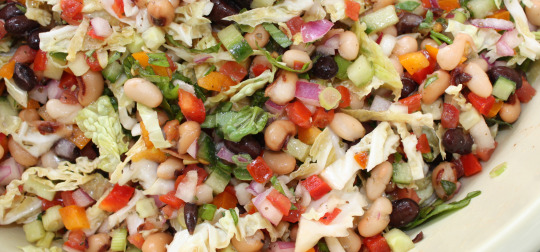
The summer of 1989, I was reading the Los Angeles Times food section, and this recipe jumped out and said “fix me, fix me.” It’s a Paul Prudhomme recipe – he had written the short article about it, and said this was a family favorite, especially for outdoor, barbecue dinners. That’s exactly what I use it for, and have done so multiple times over those ensuing years. I’ve made a few changes to it. The original called for bok choy. I use Napa Cabbage instead. And I use my own combination of beans – usually whatever I happen to have on the pantry shelf. Additionally, bacon was added on top, when served. I eliminated that because it was just fine without it. If stored for a day, the bacon gets limp and wet – not very appetizing.
It’s really quite easy to make, although it does take some assembly time, and some prepping of the vegies. But the bulk of it is canned beans – a variety of them, and you whisk up the dressing and pour over. The dressing is mostly vinegar – cider vinegar – and you’d think that with vinegar as the main ingredient, you’d have a hard time eating it. Not so. Once it sits for a while, something chemical happens when you pour acid and oil over carbs. It mellows the beans and completely eliminates the acidity of the vinegar. It just leaves a little tang and permeates the entire salad. It must be left to marinate for at least several hours, though, so don’t be tempted to eat it right away. Otherwise that chemical action doesn’t have time to occur. Although this probably is used mostly as a side kind of salad, it also can make the meal itself. It’s satisfying enough. It has some protein with all the beans, and it’s filling. It’s the dressing that makes it special. It keeps for a few days, but then the Napa cabbage begins to wilt significantly, so eat it up within 2-3 days after preparation.
And I want you to pay attention to the fat content this time – it’s almost nil. Note that there are only 2 T. of oil in the entire salad to serve 12. I highly recommend this.
printer-friendly PDF
The BEST Bean Salad
Recipe: Adapted from a Paul Prudhomme recipe
Servings: 12
NOTES: This recipe is SO low in fat it hardly even registers fat grams. At first you might think there’s a misprint with the amount of vinegar, but it is correct. The beans absorb the vinegar, which lightens the bean’s heaviness. According to Paul Prudhomme, combining oils and acids make the heaviest starches disappear on your palate. If you prefer, you can add raw chopped zucchini, green bell pepper instead of the red, or a combination, and if desired, cooked, crumbled bacon bits could be added as well if you don’t mind the extra fat. Any combination of beans will work. The original recipe called for bok choy, but the first time I made the recipe the market didn’t have it so I bought Napa cabbage instead and have decided I like it better.
Serving Ideas: Could be a meal on its own. Wonderful with grilled meat.
SALAD:
16 ounces black beans — canned, drained
16 ounces white beans — canned, drained
16 ounces blackeyed peas — canned, drained
2 cups tomato — chopped
1 cup cucumber — seedless, chopped
3/4 cup Napa cabbage — sliced
3/4 cup red bell pepper — chopped
3/4 cup red onion — diced
1 1/2 teaspoons garlic powder
DRESSING:
3/4 cup apple cider vinegar
2 tablespoons olive oil
15 whole basil leaves — minced
2 tablespoons brown sugar — or brown sugar substitute
3/4 teaspoon black pepper
1 teaspoon dried oregano — crushed
1. In a large non-metal bowl, toss together the drained beans (I use low-salt beans when possible), tomatoes, cucumbers, Napa cabbage, bell peppers, onions and garlic powder.
2. In a blender combine the vinegar, oil, basil, brown sugar, black pepper and oregano and blend until combined. Pour the dressing over the bean mixture, stir, cover and chill for several hours. Will keep for several days. Makes about 2 quarts.
Per Serving: 426 Calories; 4g Fat (7.6% calories from fat); 27g Protein; 75g Carbohydrate; 16g Dietary Fiber; 0mg Cholesterol; 18mg Sodium.

Posted in Veggies/sides, on July 15th, 2007.

I’m a fan of Kalyn Denny, a fellow food blogger of the highest order. I’ve mentioned her before, over at Kalyn’s Kitchen, and her success with the South Beach Diet. So this was a recipe posted some months back, and since I’d tried another of her cauliflower recipes, the one with bacon and mushrooms, I was sure this one would be a winner too. She got it from The Low Carb Gourmet by Karen Barnaby.
The first time I made this I thought my DH was going to lick the baking dish. He thought it was that good. So last night, with me in a wheelchair in a cast with my fractured foot, and a cauliflower in the refrigerator, I suggested he could make this. It was a simple meal otherwise – citrus salt rubbed grilled pork chops, green salad and the cauliflower.
Well, let’s just say the whole meal was a challenge for him. He’s never been much of a cook. Put him behind a barbecue and he’s king. And in front of the sink with a heap of dirty dishes, and he’s a master. But put him in front of a recipe with a head of cauliflower, and he becomes frozen in place. He invited a friend, Bob, to come over and join us. His wife is out of town. Now Bob admitted he’s not much of a cook, either, but he admirably made the green salad. I cut up the cauliflower, leaving tatters of it on the floor all around the wheelchair. But Dave was required to put together the rest of the vegetable dish. And you need to know that Dave didn’t start the dinner until the doorbell rang.
Normally I wouldn’t go into such detail about this, but I can only laugh about it. We didn’t have any sour cream. I suggested plain yogurt, which we had. He forgot to add it. You’re supposed to add the green onions to the cooked cauliflower. He put the green onions in with the raw cauliflower to boil/simmer, so it completely boiled off the flavor, I would assume. He couldn’t find the cream cheese, so we used some of the Boursin herb cheese spread we had out as an appetizer. We had cheddar, so Dave grated that up with no problem. He couldn’t find the Parmesan, even though I told him exactly what size plastic bag it was in the cheese drawer, so that was eliminated. And he’d completely cooked the cauliflower and added everything else before he remembered he had to prepare the bacon (in little frozen rolls in the freezer), chop it up and cook it crisp. Short 10-15 minute delay there. Where was I during most of this? My foot was aching, so I was laid out on the sofa 20 feet away with my leg elevated above my heart.
Dave reminded me of the phrase – a one-armed paperhanger. He kept saying the instructions weren’t there on the recipe. He read it clear through – aloud I might add, but he was distracted, making conversation with our guest, trying to juggle getting things out of the refrigerator, thinking about setting the table outside, firing up the barbecue, getting the chops on the grill, me working the temperature probe, then him not overcooking the chops, keeping the temp in the barbecue at the right level, washing dishes in between (which he’d much rather do than cook), talking some more, with me piping in advice all the way through. (Welcome to the everyday world of cooking, my darling.) He got very frustrated – at me for giving him advice – and more likely at himself.
All I can do is laugh. He said, as we were finishing our meal (which was delicious, and Bob said the cauliflower was to die for), that he has a whole new appreciation for what it takes to cook even a simple meal! (YES!!!) This cauliflower dish is NOT hard to make. I assure you, it isn’t. It just sounds like it from my description of my DH preparing it. He might beg to differ with me about that, but if you’re even a basic cook, this will not throw you. And what it tastes like is those fabulous mounds of baked potato with all the trimmings. The bacon makes it, in my book, but you can reduce how much you use (recipe below shows less bacon than Kalyn’s version). So, once again, thank you Kalyn.
printer-friendly CutePDF
Files: MasterCook 5+ and MasterCook 14 (click link to open in MC – 14 contains photo)
Twice Baked Cauliflower
Recipe: adapted from one at Kalyn’s Kitchen, a food blog, originally from The Low Carb Gourmet by Karen Barnaby
Servings: 4
COOK’S NOTES: Apparently this recipe came about from the South Beach Diet since it consists of a vegetable, fats, but no carbs. The original recipe called for double the amount of cream cheese, sour cream, onions, Parmesan and bacon. The only ingredients left as is are the cauliflower and the Cheddar cheese. This dish is very flexible – if you don’t have every ingredient, just substitute. No sour cream? Use plain yogurt. No Parmesan? Use more cheddar. No green onions, cook up 1/2 cup of yellow onions, chopped. No cream cheese? Use Boursin herb cheese instead. Or leave it out.
1 head cauliflower
2 ounces lowfat cream cheese, or Boursin herb cheese
1 Tbsp. butter
1/4 cup lowfat sour cream
1/4 cup minced green onions
1/4 cup Parmesan cheese — grated
2 slices bacon — cooked and crumbled
1 cup shredded cheddar cheese
Preheat oven to 350°. Cut out stem and core from cauliflower, and cut into small pieces. Cook in large pot of boiling water until cauliflower is tender, but not overly soft. Drain well and mash with potato masher, leaving some chunks. Mix in cream cheese, butter, sour cream, green onion, Parmesan, and 3/4 of the bacon. Spread evenly in an 8 X 8 inch glass casserole dish. Sprinkle with cheddar cheese and reserved bacon. Bake 20-30 minutes, or until hot and bubbly. Or heat in microwave for about 7-8 minutes, covered.
Per Serving: 239 Calories; 19g Fat (69.8% calories from fat); 13g Protein; 5g Carbohydrate; 1g Dietary Fiber; 55mg Cholesterol; 472mg Sodium.

Posted in Desserts, Miscellaneous sides, on July 14th, 2007.
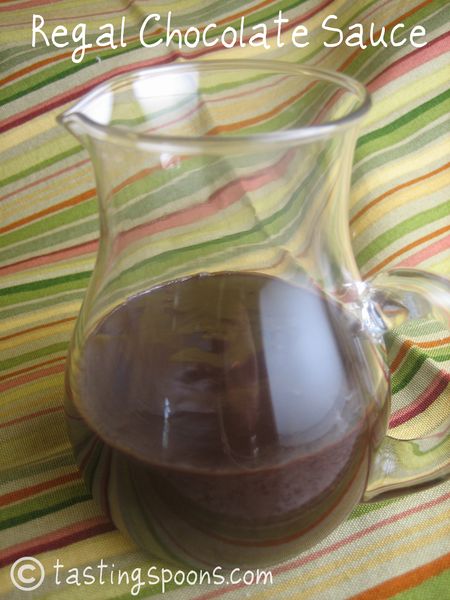
As a confirmed chocoholic, I know my chocolate. And chocolate sauces. I don’t buy ready-made. Why bother to buy it when you can make it so easily? Maybe twice a year I make this sauce, my favorite, Regal Chocolate Sauce, and when it’s gone, it’s gone. When the grandkids visit I sometimes buy the Hershey’s squirt bottle, which they love. But, this sauce is far and away my favorite.
Year ago I was in a Newcomer’s Club, and the group decided to publish a cookbook of members’ recipes. A couple of my recipes are in the book, plus this one, from a friend I made in the club. Over the years I’ve tried several of variations. The Los Angeles Times did an in-depth investigation into home made chocolate sauces some years ago and I tried a couple of them. Nope. Didn’t measure up in my book. I have tried recipes using heavy cream, a lot more butter, corn syrup instead of sugar, and various types of chocolate including milk. A friend shared her mother-in-law’s coveted recipe. Nope. Not that one, either. Why do I bother to try all these others? I have the best recipe already. It’s incredibly easy. What I like about it is that it doesn’t get chalky as it ages in the refrigerator. And you can make it in the microwave in a Pyrex measuring bowl, or heat it on the range if you want to have more control. You never want to overcook pure chocolate. Then pour it into a glass container, cool and refrigerate. Then when I need it, I merely remove the lid and heat briefly – very briefly – in the microwave, until it’s just thin enough to pour and you’re done.
I’ve even tried the recipe using Scharffen Berger chocolate, and Valrhona too. They are good, and you can certainly substitute them for the German chocolate. What is it about the German chocolate? I’d forgotten what was unique about it:
- German’s Chocolate dates back to 1852, when an American named Sam German created a sweet baking chocolate bar for the Baker’s Chocolate Company. This new chocolate had sugar added to it, as a convenience for bakers. But that all important apostrophe and “s” were soon dropped from “German’s.” In 1828, Dutch chocolate maker C. J. Van Houten invented the cocoa press. This machine squeezed cocoa butter out of the beans and treated the cocoa with an alkalizing agent to improve the color and flavor. The process became known as “dutching,” and cocoa processed this way is called Dutch chocolate.
So, Dutch chocolate, because of the use of an alkalizing agent is a milder form of chocolate. I’m a dark chocolate fan, so it’s interesting that I prefer the milder chocolate in this sauce. And speaking of Dutch chocolate, you may not have heard about this fabulous liqueur, Vermeer Dutch Cream. It’s very similar to Bailey’s, but it’s chocolate based  rather than coffee/chocolate. It is made with Dutch chocolate. You have to seek out a retailer for it, as it’s a bit hard to find. It would make a great gift to a friend who is a chocoholic, or try it yourself. (As with Bailey’s, you should keep it refrigerated, and shake it up each time you intend to use it.) Note that the bottle has a Vermeer painting on the front The Girl with the Pearl Earring,
So, back to chocolate sauce – try my Regal Chocolate Sauce. You can use any form of chocolate you like. Try it on a little bit of good-quality vanilla ice cream with a few toasted almonds on top. Oh yes. (Photo at bottom from Vermeer Dutch Cream’s website.)
MasterCook 5+ import file – click link to run MC or right click to save file
Regal Chocolate Sauce
Recipe from a friend I met in the 1970’s
Servings: 6
COOK’S NOTES: It keeps in the refrigerator for months, and is easy to reheat (at medium power setting) in the microwave.
4 ounces German chocolate squares
3 tablespoons water
1/4 cup sugar
1 tablespoon butter
1 dash salt
1/4 teaspoon vanilla
In a heavy-bottomed saucepan, combine chocolate, water, sugar and salt. Cook and stir over low heat until sauce is smooth. Remove from heat and stir in butter and vanilla. Serve hot or cold over ice cream. Makes 3/4 cup.
Per Serving: 144 Calories; 9g Fat (48.7% calories from fat); 1g Protein; 20g Carbohydrate; 1g Dietary Fiber; 5mg Cholesterol; 65mg Sodium.

Posted in Uncategorized, on July 13th, 2007.
 That’s my kitchen pantry. Back more than a year ago now, when I first began reading some food blogs, I was tickled to see photos of people’s kitchens. It’s kind of like peeking into somebody’s clothes closet when they’re not looking. At the time we were just starting the remodel of our kitchen, and although I was too far along to make changes, I was still intrigued to see how other people, other food lovers, set up their kitchens. When we began this project of our remodel, I used sketches, pored over remodeling magazine ideas, made lists, and played a paper-doll kind of thing, sliding little snippets of paper around on top of graph paper where I’d marked off the walls, trying to make everything fit. I lived and breathed it. I dreamed about it and woke up frantic sometimes – did I remember this or that. As time goes on I’ll post some additional pictures of my finished kitchen.
 This is the Butler’s Pantry. When I was first drawing in walls on the graph paper, I wanted to create a Butler’s pantry too. I’d begun seeing them in some of the upscale homes here in Southern California. I’d always thought that was such a nice thing – a staging area for entertaining, etc. Well, I worked it in. It’s not all that large, but certainly bigger than a closet. Room enough for our coffee equipment and my warming drawer, which you can vaguely see below the counter. Plus some glassed cupboards to display some pretty stuff. And, behind the Butler’s Pantry there was a perfect space for a built-in kitchen pantry. California homes haven’t had walk-in pantries much until recent years. I’d had a tiny one many years ago and loved it, so it was a must-have in the new kitchen. In my new spacious pantry (picture at top), there’s another wall on the right with nearly as much space for storage as you can see on the left. The rear wall backs up to the Butler’s Pantry. In the pantry, all of the left side is for canned goods shelving. You can see my multiple cans of San Marzano tomatoes at the closer end. The right side contains a more eclectic variety – baskets for fresh root vegetable storage and a lot of boxed goods. I also have a row of about 10 plastic octagonal containers with dry stuff – everything from Corn Flakes, cornmeal, rice, risotto rice, a few unusual flours, etc. as well. I vowed when I moved everything into the pantry that I wasn’t going to put hardly anything on the floor. Thought it looked neater that way. Well, that’s gone by the wayside.


So, back those many months ago when I was finding blogs that I liked to read, and people were posting pictures of their kitchens and storage areas, I happened upon two postings. Both written by the same blogger, Mrs. D over at Belly Timber.
Here’s the first one about her kitchen. Now, it may take you a few minutes to read it – look at all the photos and the diagrams, etc. I found it laugh-out-loud funny. I love Mrs. D’s blog.
Then, a few weeks later there came a second one, a sequel. I did send an email message of one of these to a bunch of my friends back then, so if you glance at it and it rings a bell, you can stop reading! Hope you enjoy these as much as I did. If you haven’t read Belly Timber before, you might want to check out Mrs. D.

Posted in Uncategorized, on July 12th, 2007.

No, this isn’t some new kitchen implement. I wish. You like my pretty purple cast? Could this be one for a mastadon, as big and bulky as it looks. Yesterday, my doctor’s office told me I had a minor broken toe. The foot doctor says oh no, my dear, you have a fractured foot. It’s actually the outside metatarsul bone, but it’s broken in a very strategic place – along the outside edge, broken halfway through the bone. And two tendons attach to it, this long bone, and every step I was taking was pulling on the fracture in two different directions, even though I was only putting weight on my heel. And my foot needs to be immobilized for 6+ weeks. Sigh. And he also said this is the hardest bone to heal of all the multiple bones in the foot. Great news.
So, it’s a cast. I can’t walk on it at all. I can’t drive. And getting in and out of our house is difficult. It’s not wheelchair friendly. Sigh. More sighs. We’ll be sleeping in our one downstairs guestroom, I think. Where’s that darned shower seat?
A friend picked me up at the doctor’s office (thanks, Joan) and delivered my car home later on. And she and Tom fetched the wheelchair in the garage. I tried crutches. Oh my goodness, was I ever unstable on those things. And I tried Dave’s walker that he “lived in” while his leg was healing last year. That’s hard work, let me tell you.
My DH is returning early from his trip, will arrive late tonight. Don’t know what this may mean about cooking. He loves to barbecue, and he’s a pro at breakfast. But other meals? No, he’d rather go out. Or buy out. Maybe I can teach him a few things about cooking in the coming weeks. Whether or not we’ll be able to do the kind of cooking we’re used to in this house remains to be seen. Dave loves good food, but whether he’ll want to actually make it himself? Well, I don’t know. I’m sure I can do a lot of the sous chef kind of work, but he’ll have to do the cooking itself. Last summer when we were under kitchen demolition we created a makeshift kitchen in our front entry hall and I did a lot of cooking in a new Cuisinart electric frypan. Guess he’ll need to dig that thing out again and maybe I can make a few skillet dishes.
So, stay tuned. I’ll let you know how things are going. 🙂

Posted in Lamb, on July 12th, 2007.
 Ah, Shepherd’s Pie. A favorite of mine. But not something that particularly comes to mind when the temperature is in the 80’s, does it? I made a batch of this last winter and one lone casserole was still languishing in the freezer awaiting a night when I can’t cook. I’ve been diagnosed with a broken toe (1) and a very severe ankle sprain, and have been advised to use R.I.C.E.: R(est), I(ce), C(ompression), and E(levation). So, frozen Shepherd’s Pie was a godsend last night.
So, just what is Shepherd’s Pie? Traditionally it’s a ground or minced lamb dish with some vegetables, always some peas, a bit of gravy or sauce, topped with mashed potatoes and baked until hot. Its lineage is British. Cottage pie means it’s made with ground beef. Here’s a bit of history from HGTV (yes, really):The magic of pies dates back to King Henry VIII. Legend has it that the British ruler was livid when he found out that one of his abbots was building an elaborate and expensive kitchen. The wise abbot took the wind out of the King’s anger by sending him a delicious, warm pie. Early pies were predominantly made with meat. Two early examples were shepherd’s pie and cottage pie. Shepherd’s pie was made with lamb and vegetables, and the cottage pie was made with beef and vegetable. Both are topped with potatoes.
I had Shepherd’s Pie when I visited England for the first time in 1977. Fell in love with it at first bite. It’s comfort food, to be sure. Kind of a casserole, if you will, but delicious. Great made with leftovers; in fact, I think that may be part of its origin too, since our Shepherd’s Pie doesn’t include a crust, just the thick layer of mashed potatoes. You have a leftover lamb roast and mashed potatoes? What better use of it than to make a leftovers Shepherd’s Pie.
I had Shepherd’s Pie when I visited England for the first time in 1977. Fell in love with it at first bite. It’s comfort food, to be sure. Kind of a casserole, if you will, but delicious. Great made with leftovers; in fact, I think that may be part of its origin too, since our Shepherd’s Pie doesn’t include a crust, just the thick layer of mashed potatoes. You have a leftover lamb roast and mashed potatoes? What better use of it than to make a leftovers Shepherd’s Pie.
So, some years back I read a recipe in Cooking Light for a jazzed-up version of the dish, and tried it. It added zucchini among other things and contained quite a few vegetables; probably more than the original version would have. It may have used ground chicken, but over the years I’ve reverted back to the lamb. But what’s unique about this is the addition of chipotle pepper AND the use of sweet potato and regular potatoes mixed together. I always – always – make a large batch of this because it’s a great dish to freeze. If you’re not so sure you’ll like it, just make a half a recipe and you’ll have sufficient for several people. If you like Shepherd’s Pie, then you’ll undoubtedly love this dish. If you’re not crazy about hot, spicy food, leave out the chipotle. It’ll be fine that way, just not quite as zippy. The sweet potatoes and Maui onion add a sweetness to the overall dish and some people are turned off by meat tasting sweet. If that’s your M.O., just use white potatoes and regular onions and you’ll have a traditional pie with a zip. I’ve served this to guests on more than one occasion, to great raves.
Printer-friendly PDF and MasterCook file (click link to open recipe)
Lamb Shepherd’s Pie with Chipotle Sweet Potatoes
 Recipe: adapted considerably from Cooking Light, 2002
Servings: 18 (makes 3 casseroles)
Preparation Time: 1:30
NOTES: Shepherd’s Pie has been a favorite of mine since my first trip to Britain in 1977, so anytime I find a new version of it I’m glad to try it. Historically, in Britain, the Pie is made with lamb, but it can be made with ground beef as well. If you use the very leanest beef, it won’t have a whole lot of flavor, unfortunately. I usually increase the amount of vegetables called for in this. If you use the Maui onions, you’ll notice a sweetness to the meat and vegetable section, so you may prefer to use traditional yellow or white onions instead. The original recipe called for just sweet potatoes on top, but I thought that might be a bit too sweet, so mixed them, using about half of each. That, combined with the chipotle chile, gives the potatoes a very rich color.
FILLING:
2 1/2 pounds ground lamb — lean cut
2 whole sweet onions — Maui or other type, chopped
1 1/2 cups carrot — chopped
5 cloves garlic — minced
2 whole zucchini — minced
1 cup celery — chopped
1 1/2 cups mushroom — chopped
2 1/2 cups frozen peas — defrosted
1 cup chopped tomato — canned, in juice
1/3 cup fresh parsley — minced
1/4 cup Worcestershire sauce
3 tablespoons tomato paste
1/2 teaspoon cracked black pepper
1 teaspoon salt — or to taste
POTATO TOPPING:
2 whole chipotle chiles canned in adobo — minced
2 1/2 pounds potatoes — Yukon Gold preferred
1 pound yam — or sweet potatoes
1 cup milk
2/3 cup ricotta cheese
1. Bring a large pot of water to a boil and add chunks of the potatoes and yam; reduce heat and simmer until yam is done and remove those pieces. Continue boiling the potatoes until they are tender, then drain and set aside to cool slightly.
2. While the potatoes are simmering, in a large frying pan heat a little olive oil and add the onion, celery and carrot and sauté for about 7-10 minutes. Cut up the zucchini, mushrooms and garlic and add to the pan, and cook for another 5-10 minutes until zucchini is barely done. Add the parsley, tomatoes, tomato paste, season with salt and pepper and cook for just a few minutes. Remove the vegetables to a bowl and set aside. Drain the frying pan and add the ground lamb and sauté it until it is thoroughly cooked. Drain the meat onto a paper towel if any grease needs to be blotted. Clean out the pan a little bit with paper towels, then add back the lamb and Worcestershire sauce. Bring to a simmer, then add all of the vegetables and heat through.
3. Combine the yam and potatoes and using a mixer, whip them until there are no visible lumps. Add the milk, chipotle chiles and ricotta cheese and mix until just combined. Season with salt and pepper to taste. To the meat mixture, add the peas, then spoon the lamb mixture equally into 3 casserole dishes. Spoon the potato mixture on top and using a spatula or flat spoon, push into the corners and more or less “seal” the potatoes to the sides of the casserole dish. This last step really isn’t required, but it keeps the meat and vegetable portion from drying out. You may, if you want, add some grated Cheddar cheese to the top of the potatoes, but it’s not really necessary.
4. If baking immediately, bake for 30 minutes at 400°. If you refrigerate the dish first, it will take nearly an hour to heat it through. Sprinkle the top with additional parsley when serving it. If heating leftovers, it doesn’t take all that long to heat – about 2 minutes in the microwave for a serving.
Serving Ideas : This casserole is easy for freezing ahead. Sometimes potatoes get a bit soft and runny when they’ve been frozen, but once they’ve been heated again they’ll be just fine. If you are freezing one or more of these casseroles, put a piece of plastic wrap directly onto the potatoes and push it in so it’s touching everywhere, even in the corners. This will prevent freezer burn from sitting on the potatoes.
Per Serving 321 Calories; 17g Fat (46.6% calories from fat); 16g Protein; 27g Carbohydrate; 4g Dietary Fiber; 53mg Cholesterol; 275mg Sodium.

Posted in Utensils, on July 11th, 2007.
 Since I’m on a nostalgia thing at the moment, thought I’d tell you about this lid. Funny looking thing, isn’t it? Doesn’t look at all like the trendy All-Clad or Calphalon heavy lids you’re used to viewing. I think cooks take lids for granted. You just think they all have to match and look pretty. Am sure some of you have grabbed a lid that really didn’t fit that pan, but it worked. It performed the job for which it was intended. Maybe it didn’t fit tight, that’s all. And they certainly do vary in composition, though. There are stainless ones, aluminum, fancy alloys, copper, glass, bamboo and even some homely variations like the one above made of thin tinny aluminum. And lids have so many uses. They can sit squarely (hmm, roundly?) on their corresponding pans, they can sit slightly ajar to allow steam to escape. Or they can sit widely ajar and consequently drip condensation from the cooking pot onto your counter or cooktop (oh, joy). A lid can be used as a weight (like in a large, tall pot on top of the stuffed cabbage leaves with a brick sitting centered atop the lid, covered in foil) too. I suppose this lid I have could be used as a frisbee as well since it’s so light weight. The photo doesn’t reveal to you the dents around the outer rim. This baby’s seen a few rides – from cooktop to floor.
And its culinary uses, of course, are endless, but what a lid does best – what a lid does for a living is help us cooks retain heat and moisture in whatever we’re cooking. So, here’s to the lowly lid!
So back to this particular lid. It’s precious to me because it was my mother’s – we use it nearly every day. I don’t actually know how old the lid is, but I would guess it’s from the 1930’s, maybe the 20’s. My parents both grew up during the Depression and were children of farming families in and around Turlock, Modesto and Ceres in the San Joaquin Valley (Central California). My grandfather raised tomatoes and a variety of other salad bowl foods. He tried nuts once, too. Money was very hard to come by and my mother quit college to work so she could send money home to keep the farm from going under. How many of our kids would do that today?
My DH cooks breakfast most mornings (that was one of the new jobs he got when he retired – oh happy day – breakfast was never a meal I loved to prepare anyway), and we cook up a single sausage link for each of us. The lid fits perfectly in our Farberware Millenium nonstick pan (that came sans lid) that is used for said sausage. As an aside, the Farberware pan was recommended in Cooks Illustrated some years back when they did a test of nonstick pans. This pan won for the budget category, but they highly recommended it, even if you have to replace it every few years, since it cost a mere $19.95 at Bed, Bath & Beyond. There are two sizes and I have both, but the smaller one is the workhorse in my house. If interested, click on the Farberware link above to view.
So, after my mother passed away, when I found this ugly-duckling lid in the miscellaneous mish-mash of ancient pots and pans in my mother’s kitchen (all put to good use, I assure you), I put it aside for me. You can never have too many lids, right? That’s what I thought. But this lid had one additional problem – other than its age. That is its funny little handle ring. Barely big enough to put a finger through. It’s more like what we’d now buy at the hardware store for 49 cents as a key ring. And gosh-darned difficult to lift up, especially if the lid is HOT. And with today’s big, plushy hot pads, it was impossible.
So now we get to the second part of the story. The other day I wrote a long story about why I attend cooking classes, and one of the items listed was that even though I go to a class based on the menu, or an interesting technique to learn, I almost always learn something, even if I don’t come away with ground-breaking recipes.
A year ago May we had a small group of friends who spent a week in a gorgeous farmhouse in Provence. During our stay, a few of us gals attended a cooking class nearby in St. Remy. We met the chef/wife at the local market in town and for over an hour we paraded through the stalls, where she pointed out better vendors, showed us how to choose the freshest of fish, the best of the spices, and shared her favorite food and non-food artisans of the region. Then we exited to her lovely home a mile or so away and helped prepare a meal for the group which was served as the twilight waned, when some of the husbands arrived to partake of the day’s labors. It was a very, very expensive class. Far more than I would normally have spent for a cooking class; albeit, this went from about 9:30 in the morning until about 9:30 at night. And I didn’t really come away with a single recipe that I’ve made in the interim, because I’d made most of the menu items before. But the class was fun. She was engaging and entertaining.
 But in the process of the class she pointed to a lid on one of her pots and what was there, but a cork. It was a very nice, elegant lid, with a similar flat Calphalon handle that I have on several of my Calphalon pans. Nowadays lots of the upscale manufacturers make cool (not hip, but non-heating) handles. Mine are older and don’t have that added convenience. So, she or her husband had whittled a wine cork (note that the bottom 1/5 has been sliced off to lay flat and slide ever-so-snugly inside the handle ring) to tuck under the handle and that’s what she grabs
when she wants to remove it. That little tidbit stayed with me until I got home and the first bottle of wine we opened, a Mayo Merlot, the cork became the new handle for my favorite old lid. So, you see, you never know from whence wisdom will come. The most unlikeliest of places, perhaps.

Posted in Beverages, on July 10th, 2007.

A couple of months back when my dear hubby was away on his sailing trip, I drove to Carlsbad (that’s a town about halfway between Los Angeles and San Diego on the Southern California coast) to spend the weekend with my friend, Linda. Our friendship goes way back – to about 1987, I’d guess. She used to work for the Los Angeles Times and called on the ad agency I co-owned. The ad agency was sold in 1995, I retired, but over all those years, Linda and I became friends and have been ever since. She’s even traveled with us to Italy and to France.We had two different small groups (all friends of ours) who rented a villa for a week – Villa Catola – in Tuscany. Then, in 2006 a slightly different group went to Provence and rented a fabulous Mas (farmhouse) near Aix-en-Provence. Great fun both times. (If anybody wants more info about either of our European rentals, email me separately.) Linda and I can talk for hours and hours about family, friends, food, cooking, restaurants, books. So, we never lack for conversation when we get together.
Last month, though, in Carlsbad, I requested we go to eat at George’s at the Cove in La Jolla. It’s Linda’s favorite restaurant. We arrived early and sat out on the terrace to enjoy the view. It was lovely. It was warm but not hot, and I wanted something refreshing rather than wine. Normally I’d order wine, but this day I ordered a mojito. They make a good one.
Mojito recipes abound on the internet. I’ve made it at home and ordered the drink in various restaurants, but now I’m enough of a connoisseur that I won’t order it if they use sweet/sour mix. I want real-live-lime and freshly picked mint plus simple syrup. Otherwise I order something else. I’ve even had some interesting variations a time or two.
The history of the mojito is very interesting [who would know?]. It dates back to the 1500’s in Havana when Sir Francis Drake, the pirate, could have devastated the island. He didn’t, but one of his subordinates, Richard Drake, invented this cocktail, called the Draque, Drak, or Drac. During his adventures to seize and conquer other Spanish ports, Drake introduced this concoction (of his own invention) to different Spanish citizens. The Draque, made originally by combining aguardiento (a forerunner of rum), sugar, lime and mint, was served with a wooden spoon and a cock’s tail handle. Mostly it was consumed for medicinal purpose [really, I ask, incredulously?]. In the 1800’s the drink was modified to include rum. The name Mojito comes from the African word mojo, which means to place a little spell.
It still is a rum based drink with lime juice, sugar, mint and some soda water. Mild. Lazy. Easy. Minty. And did I say refreshing? I found the coolest video on how to make a mojito at the Bacardi website. If you’ve never made one, go check this out. Here’s the direct link, and you have to enter your birthday to prove that you’re over 21 to continue (yea, right, from a website?). If that link doesn’t work go to the main Bacardi website to get to it. It’s even got some swinging music to go along with. As I write this it’s still morning, so it’s a tad too early to make a mojito right now, but maybe later today I’ll plunk-me-down on our patio and have a long, slow slurp and give myself a little spell. With my foot up, I know.
Printer-friendly PDF
Bacardi Original Cuban Mojito
Serves: 1
1/2 jigger sugar, or to taste
1 jigger Bacardi rum
3 jiggers soda water
12 mint leaves
1/2 lime, squeezed
Ice
Directions: In a tall glass pour in the sugar and part of the mint leaves. Using a muddler (pictured at right) or some kind of flat implement, mash the mint and sugar together a little bit, then add the rum, soda water, ice, a small wedge of lime and garnish with additional mint. Serve to smiles.

Posted in Uncategorized, on July 9th, 2007.

What’s in a name, you ask? Well, you didn’t ask, but I’ll tell you anyway. With my lame ankle resting high, I’m feeling a bit frustrated and cheeky today. A name means a lot. It either grabs your attention, or it doesn’t. Before I started this blog, I considered about 30 different names. With an advertising background, I’m very tuned into words. How they lead you in different directions. How they can mislead just as easily. How they can “hook” you into reading more. That’s one of the secrets of writers but particularly with literature writers – getting you to read more than the first page. Or the first paragraph. That’s one of the things I admire about the novelist Jodi Picoult. She grabs me in the first few sentences. She did with My Sister’s Keeper, and she did again with Plain Truth. My daughter, Dana, is hooked on her books at the moment, and she has purchased and read most every one she’s written, so I have a stack waiting for me as soon as I can get to them.
But, I digress. We’re talking about blog names, aren’t we? I wrote down all these names. Considered them. Scratched some out. Edited some more. Added additional ones because I wasn’t pleased with my short list. Then I Google searched on those names. As I worked my way down my list I had to scratch off the first one. The second one. And that one. Darn, that one too. My list shortened up in a hurry! It wasn’t that they were all food blogs, but they were product names or tags, or somebody’s personal website or book. I was a tad discouraged. Since there are hundreds of food blogs out there in the blogosphere, I had to find something that was me. But not like everybody else. One of the things I’ve learned is that if I want to keep this site going, the name has to be something that people remember. So it couldn’t be all that complicated. Carolyn Cooks is the name of a book already.
So you can have a little laugh, here are some of the other names I considered: The Recipe File (too blah sounding); The Adventurous Fork (I really liked that one, but it’s already used); The Imperfect Recipe (think anybody would really want to read that?); Feed the Soul with Wine & Food (too long and I’m not much into Zen either); Food Sketches (oops, she’s a food artist); The Recipe Stack (BORing); Knife & Fork (sorry, that’s a store); Reading, Writing Cook (blah); Recipe Redux (I like it, but do you think people would remember how to spell it?); So Many Recipes, So Little Time (catchy, but don’t know if people would remember such a long name); Have Fork, Will Travel (I like that one still, but it implies that I travel all the time and that it’s more about restaurant eating than cooking, don’t you think?); and It’s All About Taste (well, that might work, but not very exciting). So, I chose Tasting Spoons. So, tell me, did I make the right choice?
I came up with the name Tasting Spoons before I considered, really, any further meaning other than it related to food. But as I contemplated it, I remembered that in a drawer inches away from my Dacor gas range I have a nest of these beautiful, small, silver-plated spoons. And a couple of forks. They don’t all match, but they all belonged to my dear hubby’s mother Helen. Some of them have a beautiful scrolled T on the shank. The others have some lovely viney leaf whirls with no initial. They’re probably the old fashioned kind of tea spoons. I polish them up now and then, but they get a lot of use. As I cook, I taste. Often. Does it need more salt? Pepper? A dash of thyme? A little sprinkle of my fancy salts perhaps? Rather than keeping these spoons closed up in the felt-lined case with all the other miscellaneous table silver pieces we own and almost never use, I decided to be more practical. I use them, and have done so for about 10 years. I love these spoons, and I often think about Dave’s mother as I dip and sip. Helen was a gracious lady, and I think she’d be very happy that a blog was named after her spoons, mismatched as they are. She wouldn’t have a clue what a blog is, but as she watches us from her perch in heaven, I think she likes it. If you have some odd spoons in your closet, dig them out and use them as your Tasting Spoons, won’t you?


Leave a Comment!