Get new posts by email:

Archives

Currently Reading

Here are the tastingspoons players. I’m in the middle (Carolyn). Daughter Sara on the right, and daughter-in-law Karen on the left. I started the blog in 2007, as a way to share recipes with my family. I’m still doing 99% of the blogging and holding out hope that these two lovely and excellent cooks will participate. They both lead very busy lives, so we’ll see.

– – – – – – – – – – – – – – – – – – – – – –

BOOK READING (from Carolyn):

Music of Bees, Eileen Garvin. Absolutely charming book about a woman in midlife, lonely, who raises bees, also makes unlikely friends. Heart-warming and very interesting about beekeeping.

A Postcard from Paris, Alex Brown. Really cute story. Dual time line, 1940s and present day about renovating an old apartment in Paris, things discovered.

Time of the Child, Niall Williams. Oh such a good book. Very small village in Ireland, 1960s. A baby is left on the doorstep. The town all whispers and helps. I listened to an interview of the author, which made me like him and his books even more.

Sipsworth, Simon Van Booy. If you like animals you’ll swoon. An old woman who really wants to die finds a tiny mouse in her house and befriends it and finds a reason to live. Utterly charming book.

The Forger’s Spell, Edward Dolnick. True story. For seven years a no-account painter named Han van Meegeren managed to pass off his paintings as those of Johannes Vermeer.

If You Lived Here, You’d be Home by Now, Christopher Ingraham. Could hardly put it down – about a journalist who takes on a challenge to move to small town in Minnesota and write about it. He expects to hate it and the people and place, but he doesn’t. Absolutely wonderful true story.

The River We Remember, William Kent Kreuger. 1950s, Minnesota. A murder and the aftermath. Could hardly put it down. Kreuger has such a vivid imagination and writing style.

How the Lights Gets In, Joyce Maynard. An older woman returns to New Hampshire to help care for her brain-injured son. Siblings and family, lots of angst and resentments.

The Filling Station, Vanessa Miller. Every American should read this book. A novelized retelling of the Tulsa massacre in 1921. Absolutely riveting.

The Story She Left Behind, Patti Callahan Henry. Love this author. Based on a true story. A famous author simply vanishes, leaving her husband and daughter behind. She had invented a mystical language no one could translate. Present day, someone thinks he’s solved the riddle, contacts the family. Really interesting read.

The Girl from Berlin, Ronald Balson. Love anything about Tuscany. An elderly woman is being evicted from a villa there, with odd deed provenance. Two young folks go there to help unravel the mystery. Loved it.

The Island of the Colorblind, Oliver Sacks, M.D. Nonfiction. The dr is intrigued by a remote Pacific island where most of the inhabitants are colorblind. He also unravels a mystery on Guam of people born with a strange neurological problem. Medical mysteries unveiled. Very interesting.

The Bookbinder, Pip Williams. Post 1914 London. Two sisters work at a bookbindery. They’re told to not read the books. One does and one doesn’t. One has visions beyond her narrow world; the other does not. Eventually the one gets into Oxford. Lovely story.

The Paris Express, Emma Donoghue. 1895 on a train to Paris, a disaster happens. You’ll delve into the lives of many people who survived and died in the crash.

A Race to the Bottom of Crazy, Richard Grant. This is about Arizona. Author, wife and child move back to Arizona where they once lived. Part memoir, research, and reporting in a quest to understand what makes Arizona such a confounding and irresistible place.

The Scarlet Thread, Francine Rivers. A woman’s life turned upside down when she discovers the handcrafted quilt and journal of her ancestor Mary Kathryn McMurray, a young woman who was uprooted from her home only to endure harsh frontier conditions on the Oregon Trail.

A Place to Hide, Ronald Balson. 1939 Amsterdam, an ambassador has the ability to save the lives of many Jewish children. Heartwarming.

Homeseeking, Karissa Chen. Two young Chinese teens are deeply in love, but in China. Then their families are separated. Jump to current day and the two meet again in Los Angeles.

North River, Pete Hammill. He always writes such a good story. A doctor works diligently healing people from all walks of life. His wife and daughter left him years before. One day his 3-yr old grandson arrives on his doorstep.

A Very Typical Family, Sierra Godfrey. A very messed-up family. Three adult children are given a home in Santa Cruz, Calif, but only if the siblings meet up and live in the house together. A very untypical scenario but makes for lots of messes.

Three Days in June, Anne Tyler. The usual Anne Tyler grit. Family angst. This wasn’t one of my favorites, but it was entertaining and very short.

Saved, Benjamin Hall. Author is a veteran war reporter. Ukraine, 2022, he nearly loses his life to a Russian strike. Riveting story – he survives, barely.

Grey Wolf, Louise Penny. Another Inspector Gamache mystery in Quebec. She is such an incredible mystery writer.

All the Colors of the Dark, Chris Whitaker. A missing person mystery, a serial killer thriller, a love story, a unique twist on each. Could hardly put it down.

Orbital, Samantha Harvey. Winner of 2024 Booker Prize. I don’t usually like those, but I heard the author interviewed and she hooked me. This is not a normal book with a beginning, a story and an end. It’s several chapters of the day in the life of various astronauts at the ISS (Int’l Space Station). All fictional. She’s been praised by several real astronauts for “getting it” about space station everyday life.

The Blue Hour, Paula Hawkins. An island off Scotland. Inaccessible except when the tide is out. Weird goings on. An artist. A present day mystery too.

Iron Lake, William Kent Krueger. A judge is murdered and a boy is missing. Riveting mystery.

Tell the Wolves I’m Home, Carol Ricks Brunt. 1980s. A 14-yr old girl loses her beloved uncle. Yet a new friendship arises, someone she never knew about.

Four Treasures of the Sky, Jenny Zhang. 1880s, a young girl is kidnapped in China and brought to the United States. She survives with many hurdles in the path.

The Boy Who Fell out of the Sky, Ken Dornstein. Memoir, 1988. The author’s brother died in the PanAm flight that went down in Lockerbie, Scotland. A decade later he tries to solve “the riddle of his older brother’s life.”

Worse Care Scenario, T.J. Newman. Oh my. Interesting analysis of what could/might happen if a jet crashed into a nuclear plant. Un-put-downable.

Song of the Lark, Willa Cather. Complicated weave of a story about a young woman in about 1900, who has a gifted voice (singing) and about her journey to success, not without its ups and downs.

Crow Talk, Eileen Garvin. Charming story which takes place at a remote lake in Washington State, about a few people who inhabit it, the friendships made, but also revolving around the rescue of a baby crow.

The Story Collector, Evie Woods. Sweet story about some dark secrets from an area in Ireland, a bit magical, faerie life, but solving a mystery too.

A Sea of Unspoken Things, Adrienne Young. A woman investigates her twin brother’s mysterious death. She goes to a small town in California to figure it out, to figure HIM out.

The King’s Messenger, Susanna Kearsley. 1600s England, King James. About one of his trusted “messengers,” and his relationship with a young woman also of “the court.” Lots of intrigue.

In the Shadow of the Greenbrier, Emily Matchar. Interesting mystery in/around the area of the famous resort in White Sulphur Springs, West Virginia.

Isola, Allegra Goodman. Hard to describe, survival story on an island in the 1600s.

Save the Date, Allison Raskin. Rom-com, witty, LOL funny. Clever.

The Sirens, Emilia Hart. Numerous time-lines, Australia. Mysteries abound, nightmares, abandoned baby, weird allergies.

Red Clay, Charles Fancher. LOVED this book. Mostly post-Civil War story about the lives of slaves in Alabama during Reconstruction.

Stars in an Italian Sky, Jill Santopolo. Dual time line, 1946 and recent time. Love stories and a mystery.

Battle Mountain, C.J. Box. Another one of Box’s riveting mysteries. Love his descriptions of the land.

Something Beautiful Happened, Yvette Corporon. A memoir of sorts in Greece, tiny island of Erikousa, where the locals hid Jews during WWII. All elusive stories told by the author’s grandmother.

The Jackal’s Mistress, Chris Bohjalian. 1860s Virginia, about a woman who saves the life of a Union soldier. Really good story.

Song of the Magpie, Louise Mayberry. Really interesting story about Australia back in the days when it was mostly a penal colony. Gritty strength of a woman trying to thrive with her farm.

The Boomerang, Robert Bailey. A thriller that will have you gripping the book. About a lot of secrets surrounding the president (fictional novel, remember) and his chief of staff and about cancer. A cure. Such a good story.

Care and Feeding, Laurie Woolever. Really interesting memoir of a woman driven to succeed in the restaurant business. She worked for Mario Batali and then Anthony Bourdain. Gritty stories.

Everything is Tuberculosis, John Green. Maybe not a book for everyone. A real deep dive into the deadly tuberculosis infection, its history. I heard the author interviewed and found the book very interesting.

The Book Lovers Library, Madeline Martin. Fascinating read about Boots’ drug stores’ lending library. And the people who worked in them.

The Arrivals, Meg Mitchell Moore. LOL funny, about a middle-aged couple whose children (and their various family members) return to the family home and the chaos that ensues.

My Life as a Silent Movie, Jesse Lee Kercheval. About grief. A big move to Paris, finding herself a new life with a new set of real blood family.

Escape, Carolyn Jessop. Another memoir about a woman really in bondage in Utah, Mormon plural marriage.

 

Tasting Spoons

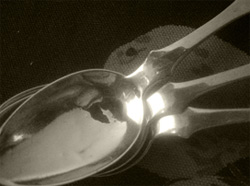
My blog's namesake - small, old and some very dented engraved silver plated tea spoons that belonged to my mother-in-law, and I use them to taste my food as I'm cooking.

Scroll down to the bottom to view my Blogroll

Posted in Uncategorized, on December 14th, 2007.

Last night, it was absolutely great fun to meet with friends of ours, Marty & Julie, to attend a performance at our gorgeous Concert Hall here in Orange County, CA. The acoustics are amazing in this place. I probably wouldn’t have gone to the trouble to buy the tickets for this show, knowing very little about the Von Trapp group other than they are descendants of the famous Sound of Music family. But our friends did, and asked us to go along with them. I’m so glad they did…
here, you’ll learn all about them, their tour schedule, etc. In case you’re interested. If you’d like to read an outsider’s article about the facts behind the Von Trapp family, read Movie vs. Reality: The Real Story of the von Trapp Family, by Joan Gearino from the National Archives.

It was a wonderful program. Our Pacific Symphony played for the first half, a combination of secular and non-secular music of the season. Even a sing-along was included. Then the Von Trapps arrived on stage. The four children, ranging in age from 13 to 19, are the four grandchildren of Kurt, one of the imps you’ll likely remember from the movie. These four, great grandchildren of Georg Von Trapp, billed The Von Trapp Family Children, have their own CD’s and have traveled the world over giving performances. They’re adorable. They’re sweet, with lovely, mostly undeveloped voices, although certainly professionally trained voices. The 13-year old, the boy, has a near soprano voice. So far. He was and is the imp, I guess. All the children performed in native Austrian dress, including using coins as buttons, which were ones Maria and Georg brought with them on the escape. They’re singing was good. Very good. They sang some of the tunes from the musical, told stories about themselves and their family (they live in Montana, one of the few Von Trapps who live outside of Vermont, where the family’s inn is located in Stowe), and sang Christmas carols and other songs which got us all in the Christmas spirit. If you go to their website

We did learn that the musical compressed the Von Trapp story into a mere 3 months of time with Georg and Maria. By doing some online snooping today from the National Archives story above, I learned more about the true facts: in actuality, they met in 1926, when Maria was hired to be a tutor to one of the Von Trapp daughters who had contracted scarlet fever. Georg fell in love with Maria. Maria fell in love with the children. When Georg asked her to marry him, he specifically asked that she become the mother to the children. She wasn’t in love with Georg, but agreed, because she adored the children. She eventually fell in love with Georg too. So, by 1938, they had been married for 11 years, and had two of their own children, before escaping in 1938, by train to Italy (and then on to the United States). The family says that Georg was not the tyrant portrayed in the movie; he was actually a very loving and kind man, also extremely musical. Nor was Maria quite the sweet young, demure thing portrayed by Julie Andrews. Maria was a strong woman, knew what she wanted in life, and even had a temper.

Oh yes, the children also told us that Maria never did make clothes out of drapes. Poof. Another myth blown into thin air.

Posted in Brunch, on December 14th, 2007.

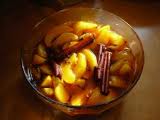
It was one Christmas about 10+ years ago and I needed some kind of fruit to serve with Christmas morning’s breakfast. I always try to have food partially prepared ahead of time. I didn’t want to be stuck in the kitchen cutting up fresh fruit while everybody else was around the tree passing presents around, and missing out on the joy of all that. So I found this recipe for a spiced fruit, and having prepared it several times I’ve made a few changes to it, but haven’t tinkered too much with the basic concoction. It’s mostly canned fruit, you combine it and let it marinate for a couple of days, then I usually add in some sliced apples the night before or the morning of. It can be served hot or cold. It might depend on what you’re serving for breakfast as to which you’d want. I usually serve it cold, since it’s a nice contrast to whatever hot breakfast dish I’m serving.

Because my DH is a diabetic, I always use Splenda or some kind of artificial sweetener for part of it. He really enjoys this side dish, so I like to make it so he can enjoy a little bit of it. I’ve tried to make it with all Splenda, but it doesn’t taste right, so I just use some Splenda. By all means, use all sugar if you’re able to.

Just remember that it should be made ahead (a good thing in my book) and you can vary the canned fruit you add to it. Don’t use soft fruits (like apricots) because after a week or so they kind of become mush. I have used canned cherries, but the juice is dark and it colors the liquid significantly. I prefer a clear juice. I’m not making Christmas breakfast this year, so don’t have a photo of it. I found the one above on the internet.
printer-friendly PDF

Spiced Fruit

Serving Size: 12

1 cup cider vinegar
1/2 cup sugar
29 ounces canned pears — light syrup
29 ounces peach slices — canned, light syrup
16 ounces canned pineapple chunks — in own juice
8 ounces prunes — dry pack, pitted
1 large cinnamon stick
8 whole cloves
3 packages Splenda (or use more sugar)

1. In small saucepan combine vinegar, sugar, cinnamon stick and cloves and bring to boil and simmer until sugar is completely dissolved and spices have had some time to blend. Allow to cool slightly. In a large refrigerator container (with lid) pour the juices from all of the fruit, stir, add artificial sweetener, then add the pickling mixture. Add canned fruit and stir.
2. Cover and store in refrigerator. Will keep for several weeks (maybe even months). If you served just the fruit and almost no juice, you should be able to just add more canned fruit without remaking the pickling mixture.
Per Serving: 169 Calories; 1g Fat (5.2% calories from fat); 2g Protein; 44g Carbohydrate; 6g Dietary Fiber; 0mg Cholesterol; 14mg Sodium.

Posted in Cookies, on December 13th, 2007.

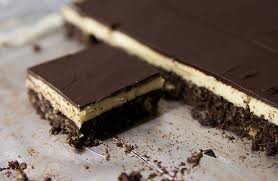
Oh, just looking at the photo of these makes my mouth water. This is an older picture in my archive, and I don’t think I took this one, but yep, that’s them. In some parts of the world these are known as Nanaimo Bars (Nanaimo is a small city in western British Columbia). Some recipes contain mint. Mine do not. I don’t like the mint version at all. But if that intrigues you, do a Google search for Nanaimo Bars and you’ll find lots of variations. I haven’t made these yet this year, but didn’t want to dilly-dally around waiting in case you wanted to make them.

I got this recipe in 1963. My first husband and I had moved to Washington, D.C. and stayed briefly with family friends of my parents who lived in Virginia. The wife introduced me to a neighbor of hers, who told this unbelievable story about this recipe. It bears a resemblance to other stories you may have heard. But in this case I MET the woman who’d been “done in,” so to speak. She and her husband had celebrated a milestone anniversary and had gone to New York. They’d stayed at the Waldorf Astoria, and had dinner in their fine restaurant. After dinner, she’d ordered this dessert, titled on the menu as New York Special Slices, and was blown away by the taste, so asked the waiter for the recipe. The chef said, through the waiter, get her address and he’d send it to her. It arrived, but with a bill for $200. Now back in the 1960’s, a $200 recipe would set anybody back more than just a little bit. So, this woman consulted her attorney, found out it was useless to argue. Pay it, he said. So, she gave it away to anybody she could find. Our friends served these bars to us, and I fell in love. Right there, on the spot.

These aren’t hard to make, although they do take a bit of time in or around the kitchen because you need to chill the layers in between creating them. Overall, though, these will come together in a jiffy. They need to be refrigerated – you can’t leave them out at room temp for very long or the unsweetened chocolate on the top layer gets soft. And it will come off in your hands if you pick it up.

These became a Christmas tradition in my family from then on. You can cut them into very small pieces, or into large squares to serve as a dessert. They’re very rich, very chocolatey, so might not be appropriate to serve at the end of a very heavy, rich meal. I usually serve them as you would a cookie, allowed to warm up at room temp for just 5-10 minutes only. I recommend that these be cut into bars ahead of time, as they’re a bit tricky to cut. Best not to do that while your guests are waiting at the dinner table.

First you make a graham cracker, coconut and chocolate base, chill it. Then you make a custard filling. Bird’s Dessert Mix (Powder) is a dry mix, similar to instant pudding mixes we’d buy at our local market, BUT, Bird’s does not have any sugar or butter in it. My local Ralph’s carries it, and I’ve found it at some specialty markets too. It’s British in origin if that helps you find it. If you can’t find Bird’s powder, use instant pudding mix, but don’t add the sugar or butter, just the milk noted in the filling ingredients. You’re after a thick filling, not a soupy one, so be careful and don’t add too much milk. That gets spread on top of the base, and is then chilled. Wait a bit for the next step, then gently melt some unsweetened chocolate and a bit of butter, cool it a few minutes, then pour it over the custard and carefully spread it over the the top, filling in any spots. There is just barely enough chocolate to cover. Chill again, then use a knife dipped in hot water to cut the cookies. They will keep in the refrigerator for several weeks.
printer-friendly PDF

New York Special Slices (aka Nanaimo Bars)

Recipe: Supposedly from the Waldorf Astoria Hotel, New York City
Servings: 32 small squares
Notes: If you can’t find Bird’s Dessert Powder, use instant vanilla pudding (the powder)

BASE LAYER:
2 ounces semisweet chocolate
1/4 pound butter
1 whole egg — beaten
1 teaspoon vanilla
2 cups graham cracker crumbs
1 cup coconut flakes
1/2 cup walnuts — chopped
FILLING:
4 tablespoons butter
2 cups powdered sugar
2 tablespoons Bird’s Dessert Powder (see notes below)
4 tablespoons milk
TOPPING:
3 ounces unsweetened chocolate
1 tablespoon butter

1. Melt semi-sweet chocolate with butter. Add the egg, vanilla, coconut, nuts and graham cracker crumbs. Press this mixture into the bottom of a 9×9 greased pan. Refrigerate.
2. Melt the 4 T of butter and add it to the powdered sugar, mixed with the Bird’s Dessert Powder and milk. Pour this mixture over the first layer and refrigerate again for about an hour.
3. Then, melt the 3 squares of bitter chocolate and 1 T butter. Pour this carefully over the top layer and spread to cover it all. Chill again. Cut into small squares to serve, and if you have trouble, dip the knife into a tall glass of very hot water. Keep the squares refrigerated, although they can be left at room temperature for a little while.

Posted in Beverages, on December 12th, 2007.

At least 20 years ago I was wanting a hot drink to serve when we went up to our local mountains for Thanksgiving, to a cabin we had rented for the weekend. I had enjoyed hot buttered rum, although it seemed like the butter floated on top (which I didn’t like since that got sipped first). I guess I found it “wanting.” So, as I was glancing through an issue of Bon Appetit (don’t know the date), this recipe popped up.

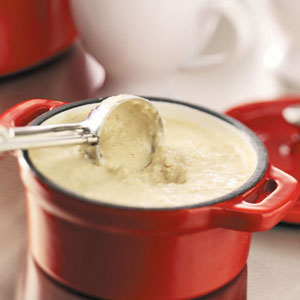
This is hot buttered rum, but it’s taken to a different dimension altogether. Maybe when I read the ingredient list in the recipe I was a bit dumbfounded that this would be anything like hot buttered rum. Mixing ice cream with brown and white sugar and butter? What is this? The picture shown (found at taste of home) is exactly what the “mix” looks like.

Recipe Tip:

This can be made weeks and weeks ahead of time – just store in the refrigerator and pop it out for guests.

Well, what I’ll tell you is this mixture just WORKS. The mix can be made ahead and just refrigerated. And this keeps for absolutely months. Amazing, but true. Even without any alcohol in it, it’s just dandy for a long time. It would also make a lovely gift for friends, or to take to someone’s home if you’re celebrating there. According to the recipe, it originated at a Montana ski resort in Big Sky. You scoop some of this mixture into a mug and pour in some rum and hot water. Done. I may yet make it this year, but I don’t have a photo of it. However, I wanted to post it for the holidays, since it makes such a delicious Christmas seasonal beverage.

This drink is just scrumptious – soothing on a cold day, and particularly festive around the holidays. My only caveat is: It’s very filling, so don’t plan a heavy meal to follow. If you’d like a little toddy before dinner, this makes a lovely one. And I never add the whipped cream. It doesn’t need it.

If the mixture isn’t hot enough, warm the mug with the cream mixture and rum in the microwave briefly before adding the hot water.
printer-friendly PDF

Big Sky Hot Buttered Rum

Recipe: Bon Appetit Magazine
Servings: 16

2 cups vanilla ice cream
1 1/3 cups powdered sugar
1 1/3 cups brown sugar — firmly packed
1 cup butter
18 tablespoons dark rum
3 cups hot water
1/2 cup whipping cream
fresh grated nutmeg

1. For batter: Combine ice cream, sugars and butter in medium saucepan. Melt over low heat, stirring occasionally. Cool and store in airtight container until ready to use. Will keep in the refrigerator for months.
2. For each serving, pour boiling water into coffee mugs to heat the mug. Pour out water. To each mug add 3 tablespoons of batter. Add 3 tablespoons of rum to each mug, then add about 1/2 cup of boiling water. Stir to dissolve batter. Top with a dollop of whipped cream, sprinkle with nutmeg and serve.
Per Serving: 281 Calories; 16g Fat (57.6% calories from fat); 1g Protein; 26g Carbohydrate; 0g Dietary Fiber; 48mg Cholesterol; 139mg Sodium.

Posted in Vegetarian, on December 11th, 2007.


cheese fondue
Everybody knows cheese fondue. But recipes do vary, based on parts of the world from which they come (using local cheeses) and because people are wont to make changes. Not me. Uh-uh. I’ve stuck with this recipe almost from day one, when I had this version. And that’s at least 40 years ago. A friend, Sandy Jenkins, served this to me, lo these many years ago. I liked the combination of the Gouda and Swiss. Often fondue is strictly Swiss, and I think Swiss has a sharp edge on it, that almost gives it a sour taste. Not liking that, but wanting to stay somewhat true to the origin of fondue (Switzerland and Swiss cheese), I like the mellowing characteristics of the Gouda with it. And I generally buy Emmental cheese for the Swiss. It’s more expensive, but it’s probably the original fondue cheese. Whatever you do, don’t buy domestic grocery store, generic Swiss. It’s just awful in this.

Back in the 1960’s and 70’s it was a popular thing to serve fondue for dinner. I was given a pot a long time ago (a ceramic one, can only be used for cheese or chocolate, not for oil for beef fondue) that came from Switzerland. It’s weathered the years, thank goodness, and has nary a chip on it. It uses Sterno for heat. I bring the cheese mixture to a simmer on the kitchen stove (to totally melt the cheese) and then pour it into the fondue pot and deliver it to the entertaining location, usually on a coffee table in front of the fireplace.

This became a family tradition back in the 1980’s in our family because on Christmas Eve, generally, my DH and I sang in one of the three church services that are held at our Presbyterian church we belong to. So preparing a traditional dinner that night was difficult. Yet we had 5 hungry mouths that needed some sustenance. And it was Christmas Eve, a festive night, and I wanted it to be special. So, I was able to get a lot of the prep work done ahead of time. I usually double the recipe. If you have hungry eaters, they may eat more than their fair share. I’ve also made a 1 & 1 /2 scaling of the recipe, which was about right for our family.

Recipe Tip:

Do everything ahead of time (chopping, grating, cubing bread) and when you’re ready to serve, just heat the cheese.

I chop or grate the cheese, sprinkle in the little bit of flour, nutmeg and paprika and put that in a plastic bag and leave it at room temperature. Next is to cut up the French bread. Having made this a lot of times, I’ve become very particular about the French Bread I use. It can’t be the cheap grocery store variety (the bread doesn’t hold us in the thick cheese, plus it has zero taste), but it can’t be really hard-crust artisanal bread either (because it’s just way too hard, and you poke your finger trying to get the fondue fork through the crust). So, you need to scout out your bread source and find something that’s in between. Discard any bread that doesn’t have a bit of crust on it since those generally get lost in the cheese anyway and bag those up too. The seasonings would be all ready by the stove, including the bottle of white wine, measuring cup at hand. I’d set up the fondue burner, napkins, plates, etc. in front of the fireplace, so it was only a matter of melting the cheese and we’d be ready to eat. We’d try to sing at the early service, at 7:00, would be back home by a few minutes after 8:00 and dinner would be on the coffee table within about 20 minutes.

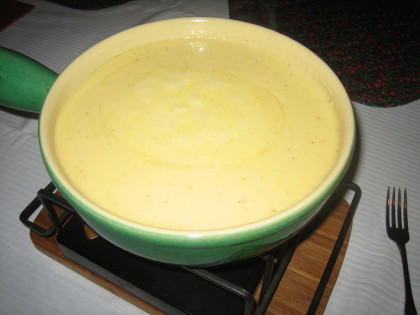
Our daughter, Sara, has made this a Christmas Eve tradition for her family too, and she’s added a nice touch – she puts out some blanched vegies to dip also (broccoli and carrots mostly), in addition to the bread. For Christmas this year, we’re going to our daughter Dana’s home in Placerville (the old gold country of Northern California). She wants to do fondue too, so I’m going to take my pot along, and she’s going to do chocolate fondue in her pot. The kids will like that, to be sure. I’ll try to take a photo of the fondue so I can update this posting with MY photo, rather than Cabot Cheese Co.’s.
printer-friendly PDF

Cheese Fondue

Recipe: Sandy Jenkins, a friend I knew in the 60’s
Servings: 4

1/2 pound Swiss cheese — prefer imported
1/2 pound Gouda cheese
1 tablespoon flour
1 cup dry white wine
1 clove garlic
5 tablespoons sherry
1/4 teaspoon nutmeg — prefer fresh grated
1/4 teaspoon paprika
1 large French bread loaf — (see notes below)

1. If time and your patience permits, grate the cheese. Otherwise, cut both cheeses into small cubes (as small as you have time to make them), which makes for easier melting. Place grated/cubed cheese in a large plastic bag and add flour, nutmeg and paprika and mush around a little. This much can be done ahead and refrigerated or left out at room temperature if it’s to be made within a few hours.
2. Select a very heavy saucepan and rub the cut garlic clove around the bottom of the pan. Add white wine and garlic clove to the pot and bring to a boil. Remove garlic. Add cheese mixture and stir until cheese is melted and smooth. Add sherry and stir. Pour into cheese fondue pot and serve with chunks of bread.
3. Note about bread: I’m very particular about what kind of bread to buy for the fondue. Hard baguettes are too hard, and some of the grocery store french breads are simply too soft (like Weber’s bread). So, select a loaf which has a medium crust and is long and narrow. If you buy a big fat loaf, the cubes of bread from the middle of the loaf have a tough time in the thick cheese. The crust makes it easier to hold it onto the fondue fork.
Per Serving: 801 Calories; 35g Fat (42.3% calories from fat); 41g Protein; 66g Carbohydrate; 4g Dietary Fiber; 117mg Cholesterol; 1307mg Sodium.

Posted in Uncategorized, on December 10th, 2007.

Posted in Desserts, on December 10th, 2007.


Now then. This is about chocolate. A chocolate dessert suitable for Christmas Dinner. A dessert not too difficult. A do-ahead one, at that. And it’s gluten-free, actually, low in sugar (yes, really), and serves a whopping 12 people if you’re judicious in slicing it.To explain the background on this recipe, I should back up and reiterate about how I detest fruitcake. Never have liked it. One Fall, back about 1964 or so, my former father-in-law took a trip to England and brought back a suet fruitcake from Fortnum & Mason (a bastion of fine food, coffees and teas) – a suet pudding I believe it was – and was so proud of bringing it to our house for Christmas. I’m sure I smiled brightly and thought, oh dear, what do I do now? Serve it with a smile and give myself just one bite, smother it in sauce and pretend it’s wonderful. I didn’t like the suet pudding. It even came with a can of hard sauce too. But, when my teeth hit those bits of tiny fig seeds, I cringed. Even raisins can get those little bits of dry seedy things.

The following year I determined to give myself at least a steamed pudding that I liked. This recipe just popped up, very timely, and I’ve made it umpteen times since. It came out of Gourmet Magazine, back in the years when they wrote every single recipe in sentence form, so you had to hunt through for the ingredients. They weren’t even highlighted in different type. Many a time I missed some items because I skimmed the sentences. This one was in the letters page, because I have the original clipping – a woman from England, Mrs. M.E. Pout, of Worplesdon, submitted it, thanking the magazine for its interesting and inspiring articles. Having never heard of chocolate steamed pudding, I thought I was onto a winner. Way back in the 1960’s it was difficult even finding a steamed pudding mold. Where I bought this thing, I don’t recall, but I DO remember that it was expensive. But I splurged. It’s seen a lot of wear. Because it sits in water once a year, it has developed a kind of mineral dusty exterior because of our hard water, and I see a few signs of rust. But it’s served me well, all these 40+ years. Now, if you decide you want to make this, and you don’t have a pudding mold, don’t despair. Just use a medium-sized ceramic bowl (higher sides preferred) and a lip that you can somehow secure foil to. Cover it with a piece of cloth (a thin towel, or a dishtowel, cut just to cover it and over the edges). What you don’t want is for the steam to get INSIDE the bowl (the steam turns into water and drips onto the top of the pudding), so that’s why you want to tie the foil down as securely as you can. If the bowl sides are too slanted, you’ll never get it to stay, so straighter sides are better.

The ingredients in this pudding are simple: butter, sugar, eggs, chocolate and almonds. That’s it. The butter and sugar get whipped up, you add egg yolks and grated chocolate, then the ground almonds. It’s a thick batter, as you can see above. Lastly you fold in the whipped egg whites. I happened to have added an additional 3 egg whites to this (because I had some languishing in the refrigerator), to I actually used 7 egg whites. But 4 are sufficient. If you want a lighter pud, add a couple more. Pour it into a mold, cover, simmer it in water and that’s it.

Here’s the finished pudding, just out of the oven, resting, cooling.

About the chocolate: It must be finely grated. In some years past I’ve chopped it finely, and I suppose that would suffice, but grated is far better. It takes awhile to grate chocolate – this 4 ounces probably took me 10-15 minutes. I tried a coarser microplane, but settled on the thin one, the one I use mostly for grating citrus zest. It made a heavy dust of chocolate. I used Scharffen Berger’s unsweetened chocolate that comes in a 9+ ounce bar.

About the almonds: in years past I’ve always whizzed the almonds up in the food processor. And if you don’t have a Trader Joe’s in your town, that method will work, although it does leave some little bits of almond, so you actually chew a bit of almonds now and then. It’s what I did for years, so am sure it would continue to work. But Trader Joe’s carries a package of “Just Almond Meal,” which makes it so very easy. It’s a finer grind – almost like flour, actually. Maybe you can find almond meal in other stores as well.

Once you finish preparing the batter, you pour it into the mold, cover, and put into a pot large enough to hold the mold, plus some, as you fill the pot about 2/3 of the way up the sides of the mold. I weighted mine with something heavy to keep the mold from floating. It takes 90 minutes to steam the pud, then you carefully remove it, unveil it, let it cool a bit, then remove from the mold. It’s best served warm, but I’ve always made it ahead of time, so just cool, chill, then warm it in the oven (wrapped in foil) for about 15-20 minutes at 200. So, if you’re looking for something a bit different this year, this may be your ticket. It makes a nice traditional dessert for Christmas Dinner, but it’s not all that traditional in taste.
printer-friendly PDF

Steamed Chocolate Pudding (and Gluten-Free)

Recipe: Mrs. M. E. Pout of
Servings: 12
NOTES: Be sure to grind up the almonds very finely, but not so much that they turn into glue. If possible, buy already ground almond meal/flour.
Serving Ideas: If you prefer, this can be served with a rum or brandy sauce (1/2 cup softened butter, 1 1/2 cups powdered sugar and about 2 T. of rum or brandy, chill before serving).

1/2 cup unsalted butter — at room temperature
1/2 cup sugar
4 whole eggs — separated
[2 additional egg whites, optional, added to the other egg whites]
1 cup ground almonds

4 ounces unsweetened chocolate — grated
Butter for greasing the mold
1 cup whipping cream — whipped

1. Beat the egg whites until stiff and able to hold peaks. Don’t over beat.
2. In a large bowl combine the butter and sugar until mixture is creamy. Stir in the 4 egg yolks which have been lightly beaten, the ground almonds and the unsweetened chocolate. Combine until it’s smooth.
3. Gently fold in the beaten egg whites and stir and fold until there are no major streaks of egg white showing.
4. Pour the mixture into a well-buttered steam mold (or use a heavy ceramic bowl and tie several thicknesses of foil around the top).
5. Stand the mold in a large kettle and add hot water to reach 2/3 of the way up the outside of the mold. Bring the pot to a low simmer and steam the pudding for 90 minutes. Remove from water, dry it off on the outside, then gently remove the steamed pudding from the mold. Cut into thin slices to serve, with a mound of whipped cream on the side.
Per Serving: 230 Calories; 21g Fat (75.1% calories from fat); 5g Protein; 10g Carbohydrate; 2g Dietary Fiber; 89mg Cholesterol; 26mg Sodium.

Posted in Uncategorized, on December 9th, 2007.


Is this not gorgeous? There it was, all wet and dewy from the rain we’d had on Thursday night. My DH cut this very last rose on Friday morning and brought it to me, all trimmed and vased to set in front of me here at my kitchen computer. He’s the gardener in the family. I positively have a black thumb. His specialty, I’d say, is roses. And this one, a hybrid tea rose, a Mr. Lincoln by name, is so very fragrant, even here in December. Even though I don’t garden, I know what I like when it comes to roses. I love the hybrid teas. Our favorite is the Chrysler Imperial, for its fragrance. It’s similar to Mr. Lincoln. On the rare occasions when we visit some gorgeous commercial gardens, I usually have a notepad in hand, stopping to admire the varieties and to smell each one, making notes about the more fragrant ones to add to our small collection. In this house where we live now we have few places to grow roses, but we’ve hollowed out a little space about 6 feet square and it houses a few plants.

But this Mr. Lincoln, we’ve both stopped to admire, to smell it’s glorious aroma several times since. Thank you, Lord, for bringing us the beauty of nature to admire and enjoy.

Posted in Soups, on December 8th, 2007.


My friend Cherrie and I went to yet another cooking class this week. You’d think we’d get tired of doing this, but no. We went further afield than usual (about 1 1/2 hours away, to San Diego). Where there’s a cooking school and cookware store called Great News. It’s in Pacific Beach, about 2 miles from I-5. We drove south, stopping in Oceanside for lunch and to watch the wind and the waves, then shopped at a fabulous meat market called Tip Top Meats (that also has the glorious sausages, and tons of imported grocery items from Greece, Scandinavia, Germany – it’s introduced as a German meat market). Spent 45 minutes wandering the aisles and buying some fresh sausages (those wonderful Nuremburger ones, like we had IN Nuremburg last month). Check this link to information about Tip Top Meats .

Then we went further south to Little Italy (very near downtown San Diego) and shopped at Mona Lisa, a very old-school kind of Italian delicatessen. Oh, the wonderful aromas from cheeses and salamis. An Italian friend of ours who lives in Fallbrook, says he does all of his Italian foodstuffs shopping at this market (and restaurant). Lots of Italian wine you don’t find even in wine stores. Fresh vegetables too, including really large fennel bulbs and cardoons. A small gem of a store. I bought some pasta, some fresh Italian sausages (with cheese and their own herb mixture) and some herby olives.The class, titled “Entertaining with Style,” was taught by one of Cherrie’s and my favorite teachers, Phillis Carey. She lives in San Diego, but commutes to Orange County to teach occasional classes, which is how we learned about her. She’s very fun, witty, cute, and is a fantastic cook. An author of several cookbooks too. Phillis recognizes us now, we’ve been to so many of her classes. Great News is her favorite teaching venue, and I certainly can understand why: a gorgeous designer kitchen with a prep counter that must be 18 feet long, all granite. Lovely facility.

We had time to shop before in their incredible store – it has more merchandise than nearly any cookware store I’ve ever been in, and at intermission. You get a 10% discount on purchased items if you attend a class.So, this was the first course of our 4-course meal – soup, salad, entree [and sides] and dessert. It was a delicious evening, and contained recipes I will make. Maybe every one of them. So, on to soup. This is very, very simple to make, although it does require a few steps:

• create the soup (stock, cream, onion, cauliflower, garlic)

• blanche the leeks

• saute the scallops

• chop the chives

But, these are not hard, not a one of them. I’ll be making this soup soon. My DH really likes scallops, although you undoubtedly could substitute shrimp. Or ham, Phillis suggested, instead of the scallop. I did learn a bit about a muscle attachment on a scallop – called the “foot.” I am certain I’ve had scallops that still had this muscle (where the scallop itself attaches itself to its shell) still attached. It’s very chewy, so Phillis showed us how to find it and remove it. You run your finger around the outside edge of the scallop until you find a slight nub – it will usually open to a small flap. That’s it – and you use a sharp knife to remove it (and discard). Don’t dig into the scallop flesh much – just remove the nub portion. Go for it.
printer-friendly PDF

Cauliflower Soup with Seared Sea Scallops

Recipe: Phillis Carey, author, cooking instructor
Servings: 6
NOTES: If you don’t know how to find the “foot” on the scallop, feel around the outside edge until you find a little bump or edge that sticks out (this is the part that attaches to the shell). It’s a firmer kind of muscle meat and should be removed. Use a knife to cut it and discard.

3 tablespoons canola oil — divided use
1 cup onion — chopped
1 clove garlic — minced
1 head cauliflower — about 3 3/4 cups
1 1/2 cups low-sodium chicken broth
1 1/2 cups whipping cream coarse sea salt to taste white pepper to taste
1 whole leek
6 whole sea scallops — “foot” removed, patted dry
1 teaspoon lemon zest
1 1/2 tablespoons chives — minced

1. Heat 2 T. of oil in heavy, large saucepan over medium heat. Add onion and saute about 4 minutes. Add minced garlic and continue cooking until onion is soft. Do not burn the garlic. Add cauliflower, broth and cream. Bring soup to a simmer. Reduce heat to low, partly cover it and simmer gently until cauliflower is tender, about 18 minutes. Puree soup in small batches in blender (don’t overfill, or it will blow the lid off the blender), until smooth. Return soup to same saucepan, season with salt and pepper. Can be made one day ahead to this point. Cover and chill. Rewarm before serving.
2. Cut and thoroughly wash the leek, discarding all but the white and just a little bit of the green. Cut leek into 1/8 inch slices. Blanch the leek in a small saucepan of boiling water, about one minute. Drain. Place a small mound of leek in each wide, flattish soup bowl (not white, preferably). The scallop will sit on top of this mound.
3. Heat remaining 1 T. of oil in a medium, nonstick skillet over high heat. Sprinkle scallops with salt, pepper and lemon zest. Sear until brown and JUST opaque in the center, about 1 1/2 minutes per side. Immediately place the scallop on top of the leek mound and ladle the hot soup AROUND the scallop (not on). Sprinkle the soup with chives and serve.
Per Serving: 306 Calories; 30g Fat (82.2% calories from fat); 7g Protein; 8g Carbohydrate; 1g Dietary Fiber; 85mg Cholesterol; 57mg Sodium.

Posted in Lamb, on December 7th, 2007.


I don’t know about you, but I don’t cook lamb all that often. It’s expensive, for one thing. And it doesn’t appeal to everyone’s taste. We’ve been known to barbecue a butterflied leg of lamb on many a family get-together, but it makes a lot, and I never seem to do well with the leftovers. Cold barbecued lamb just doesn’t lend itself very well, to me, to very many recipes. I haven’t made that in a long time.

But I was reading Food and Wine the other day and a Catalan lamb stew recipe jumped out at me. You know how that is – it just literally jumped off the page with my scissors and demanded to be made. Whole Foods had some nice boneless shoulder roasts, at $5.99 a pound, so that was an easy decision. It’s New Zealand organic lamb, which is even better. Although I do like our Colorado lamb a lot too.

In case you don’t know about Catalan cooking – it’s an area of Spain that borders on France. And it contains the city of Barcelona (pronounced bar-tha-lona). Much of the area is mountainous. Lots of sheepherders. Therefore, lots of lamb, I’m certain. Lots of fish also since the lower triangle of Catalonia is the coastline containing Barcelona. My DH and I spent 4 days in Barcelona some years ago. All by ourselves. It’s a very cosmopolitain city – and European. The restaurants of Catalonia are legend, with many world-renowned chefs having come from there.

Having grown up in San Diego, right on the Mexican border, I assumed Spanish food was much like Mexican. Altogether wrong I was about that. Spanish cuisine is based a lot on fish, actually, but with fairly simple preparation of things, and not a lot of seasoning.

The core of Catalan cuisine still comes from the trio of ingredients introduced into the region by the Romans. The trinity of bread, wine and oil has been used ever since in daily life. In Medieval times Arab influences were also to leave their mark on Catalonia and classic Moorish combinations of sweet and sour can still be seen today in favourite dishes such as rabbit with pears and duck with fruit. (from ezinearticles.com)

What’s important from this culture to this recipe is the combination of meat and fruit. Very common there. One trip to France introduced me to the affinity of meat and prunes. Prunes are a very common filling for a whole roast chicken. So I was very open to the suggestion of prunes with lamb.

This stew was relatively easy to make – you do have to tediously brown the lamb chunks so they get browned on all sides (I made nearly a double recipe), and not crowded in the pan, either, or they steam rather than brown. But once that was done, it’s a very simple amount of preparation (onions, garlic, red wine, carrots, prunes and pine nuts). And a little sprinkling of ground ginger and ground cloves, plus some grated lemon zest.

It was absolutely delicious. I made it a day ahead, separated the meat from the broth to chill it, then was able to remove all the fat before reheating it and adding vegetables (I used carrots and parsnips). Confession time: I forgot to brown the pine nuts, but they added a nice little crunch to the finished dish. I liked the way they looked in the bowl. I added water to the stew when reheating in order to get the vegetables under liquid to finish cooking. The broth was very flavorful (helped, I am sure, by the overnight chilling) and it was nice to thin it a bit. I’ll definitely make this again.
printer-friendly PDF

Aromatic Braised Lamb with Prunes and Pine Nuts

Recipe: From Spanish Food & Wine (A Crash Course), Food & Wine, Oct. ’07
Servings: 4

3 tablespoons extra-virgin olive oil
2 pounds boneless lamb shoulder — cut into 1 1/2-inch cubes
Salt and freshly ground pepper
3 garlic cloves — minced
1 medium onion — finely chopped
1/2 cup dry red wine
1/2 cup water
One 1-inch strip of lemon zest — minced
1 Pinch ground clove
1 Pinch ground ginger
1 cup pitted prunes
1 cup boiling water
2 medium carrots — thinly sliced
[I added 3 parsnips — peeled, sliced]
1/4 cup pine nuts

1. In a large saucepan, heat the olive oil. Add half of the lamb, season with salt and pepper and cook over moderately high heat until browned on 2 sides, about 3 minutes per side. Transfer to a plate and repeat with the remaining lamb.
2. Add the garlic and onion to the saucepan and cook over moderately low heat, stirring, until softened, 5 minutes. Stir in the wine, 1/2 cup of water, lemon zest, cloves and ginger. Return the lamb to the saucepan and bring to a boil. Cover and simmer over low heat until very tender, about 1 1/2 hours.
3. Meanwhile, in a heatproof bowl, cover the prunes with the boiling water. Let stand until softened, about 10 minutes. Add the prunes with their cooking liquid and the carrots to the stew. Cover and simmer until the carrots are tender, about 20 minutes.
4. In a medium skillet, cook the pine nuts over moderate heat, shaking the pan a few times, until the nuts are toasted, about 4 minutes. Let cool.
5. Season the stew with salt and pepper and spoon into bowls. Sprinkle with the toasted pine nuts and serve.
Per Serving: 189 Calories; 15g Fat (74.2% calories from fat); 3g Protein; 8g Carbohydrate; 2g Dietary Fiber; 0mg Cholesterol; 36mg Sodium.

Related Posts Plugin for WordPress, Blogger...