


Get new posts by email:

Archives

Currently Reading

Here are the tastingspoons players. I’m in the middle (Carolyn). Daughter Sara on the right, and daughter-in-law Karen on the left. I started the blog in 2007, as a way to share recipes with my family. I’m still doing 99% of the blogging and holding out hope that these two lovely and excellent cooks will participate. They both lead very busy lives, so we’ll see.

– – – – – – – – – – – – – – – – – – – – – –

BOOK READING (from Carolyn):

Music of Bees, Eileen Garvin. Absolutely charming book about a woman in midlife, lonely, who raises bees, also makes unlikely friends. Heart-warming and very interesting about beekeeping.

A Postcard from Paris, Alex Brown. Really cute story. Dual time line, 1940s and present day about renovating an old apartment in Paris, things discovered.

Time of the Child, Niall Williams. Oh such a good book. Very small village in Ireland, 1960s. A baby is left on the doorstep. The town all whispers and helps. I listened to an interview of the author, which made me like him and his books even more.

Sipsworth, Simon Van Booy. If you like animals you’ll swoon. An old woman who really wants to die finds a tiny mouse in her house and befriends it and finds a reason to live. Utterly charming book.

The Forger’s Spell, Edward Dolnick. True story. For seven years a no-account painter named Han van Meegeren managed to pass off his paintings as those of Johannes Vermeer.

If You Lived Here, You’d be Home by Now, Christopher Ingraham. Could hardly put it down – about a journalist who takes on a challenge to move to small town in Minnesota and write about it. He expects to hate it and the people and place, but he doesn’t. Absolutely wonderful true story.

The River We Remember, William Kent Kreuger. 1950s, Minnesota. A murder and the aftermath. Could hardly put it down. Kreuger has such a vivid imagination and writing style.

How the Lights Gets In, Joyce Maynard. An older woman returns to New Hampshire to help care for her brain-injured son. Siblings and family, lots of angst and resentments.

The Filling Station, Vanessa Miller. Every American should read this book. A novelized retelling of the Tulsa massacre in 1921. Absolutely riveting.

The Story She Left Behind, Patti Callahan Henry. Love this author. Based on a true story. A famous author simply vanishes, leaving her husband and daughter behind. She had invented a mystical language no one could translate. Present day, someone thinks he’s solved the riddle, contacts the family. Really interesting read.

The Girl from Berlin, Ronald Balson. Love anything about Tuscany. An elderly woman is being evicted from a villa there, with odd deed provenance. Two young folks go there to help unravel the mystery. Loved it.

The Island of the Colorblind, Oliver Sacks, M.D. Nonfiction. The dr is intrigued by a remote Pacific island where most of the inhabitants are colorblind. He also unravels a mystery on Guam of people born with a strange neurological problem. Medical mysteries unveiled. Very interesting.

The Bookbinder, Pip Williams. Post 1914 London. Two sisters work at a bookbindery. They’re told to not read the books. One does and one doesn’t. One has visions beyond her narrow world; the other does not. Eventually the one gets into Oxford. Lovely story.

The Paris Express, Emma Donoghue. 1895 on a train to Paris, a disaster happens. You’ll delve into the lives of many people who survived and died in the crash.

A Race to the Bottom of Crazy, Richard Grant. This is about Arizona. Author, wife and child move back to Arizona where they once lived. Part memoir, research, and reporting in a quest to understand what makes Arizona such a confounding and irresistible place.

The Scarlet Thread, Francine Rivers. A woman’s life turned upside down when she discovers the handcrafted quilt and journal of her ancestor Mary Kathryn McMurray, a young woman who was uprooted from her home only to endure harsh frontier conditions on the Oregon Trail.

A Place to Hide, Ronald Balson. 1939 Amsterdam, an ambassador has the ability to save the lives of many Jewish children. Heartwarming.

Homeseeking, Karissa Chen. Two young Chinese teens are deeply in love, but in China. Then their families are separated. Jump to current day and the two meet again in Los Angeles.

North River, Pete Hammill. He always writes such a good story. A doctor works diligently healing people from all walks of life. His wife and daughter left him years before. One day his 3-yr old grandson arrives on his doorstep.

A Very Typical Family, Sierra Godfrey. A very messed-up family. Three adult children are given a home in Santa Cruz, Calif, but only if the siblings meet up and live in the house together. A very untypical scenario but makes for lots of messes.

Three Days in June, Anne Tyler. The usual Anne Tyler grit. Family angst. This wasn’t one of my favorites, but it was entertaining and very short.

Saved, Benjamin Hall. Author is a veteran war reporter. Ukraine, 2022, he nearly loses his life to a Russian strike. Riveting story – he survives, barely.

Grey Wolf, Louise Penny. Another Inspector Gamache mystery in Quebec. She is such an incredible mystery writer.

All the Colors of the Dark, Chris Whitaker. A missing person mystery, a serial killer thriller, a love story, a unique twist on each. Could hardly put it down.

Orbital, Samantha Harvey. Winner of 2024 Booker Prize. I don’t usually like those, but I heard the author interviewed and she hooked me. This is not a normal book with a beginning, a story and an end. It’s several chapters of the day in the life of various astronauts at the ISS (Int’l Space Station). All fictional. She’s been praised by several real astronauts for “getting it” about space station everyday life.

The Blue Hour, Paula Hawkins. An island off Scotland. Inaccessible except when the tide is out. Weird goings on. An artist. A present day mystery too.

Iron Lake, William Kent Krueger. A judge is murdered and a boy is missing. Riveting mystery.

Tell the Wolves I’m Home, Carol Ricks Brunt. 1980s. A 14-yr old girl loses her beloved uncle. Yet a new friendship arises, someone she never knew about.

Four Treasures of the Sky, Jenny Zhang. 1880s, a young girl is kidnapped in China and brought to the United States. She survives with many hurdles in the path.

The Boy Who Fell out of the Sky, Ken Dornstein. Memoir, 1988. The author’s brother died in the PanAm flight that went down in Lockerbie, Scotland. A decade later he tries to solve “the riddle of his older brother’s life.”

Worse Care Scenario, T.J. Newman. Oh my. Interesting analysis of what could/might happen if a jet crashed into a nuclear plant. Un-put-downable.

Song of the Lark, Willa Cather. Complicated weave of a story about a young woman in about 1900, who has a gifted voice (singing) and about her journey to success, not without its ups and downs.

Crow Talk, Eileen Garvin. Charming story which takes place at a remote lake in Washington State, about a few people who inhabit it, the friendships made, but also revolving around the rescue of a baby crow.

The Story Collector, Evie Woods. Sweet story about some dark secrets from an area in Ireland, a bit magical, faerie life, but solving a mystery too.

A Sea of Unspoken Things, Adrienne Young. A woman investigates her twin brother’s mysterious death. She goes to a small town in California to figure it out, to figure HIM out.

The King’s Messenger, Susanna Kearsley. 1600s England, King James. About one of his trusted “messengers,” and his relationship with a young woman also of “the court.” Lots of intrigue.

In the Shadow of the Greenbrier, Emily Matchar. Interesting mystery in/around the area of the famous resort in White Sulphur Springs, West Virginia.

Isola, Allegra Goodman. Hard to describe, survival story on an island in the 1600s.

Save the Date, Allison Raskin. Rom-com, witty, LOL funny. Clever.

The Sirens, Emilia Hart. Numerous time-lines, Australia. Mysteries abound, nightmares, abandoned baby, weird allergies.

Red Clay, Charles Fancher. LOVED this book. Mostly post-Civil War story about the lives of slaves in Alabama during Reconstruction.

Stars in an Italian Sky, Jill Santopolo. Dual time line, 1946 and recent time. Love stories and a mystery.

Battle Mountain, C.J. Box. Another one of Box’s riveting mysteries. Love his descriptions of the land.

Something Beautiful Happened, Yvette Corporon. A memoir of sorts in Greece, tiny island of Erikousa, where the locals hid Jews during WWII. All elusive stories told by the author’s grandmother.

The Jackal’s Mistress, Chris Bohjalian. 1860s Virginia, about a woman who saves the life of a Union soldier. Really good story.

Song of the Magpie, Louise Mayberry. Really interesting story about Australia back in the days when it was mostly a penal colony. Gritty strength of a woman trying to thrive with her farm.

The Boomerang, Robert Bailey. A thriller that will have you gripping the book. About a lot of secrets surrounding the president (fictional novel, remember) and his chief of staff and about cancer. A cure. Such a good story.

Care and Feeding, Laurie Woolever. Really interesting memoir of a woman driven to succeed in the restaurant business. She worked for Mario Batali and then Anthony Bourdain. Gritty stories.

Everything is Tuberculosis, John Green. Maybe not a book for everyone. A real deep dive into the deadly tuberculosis infection, its history. I heard the author interviewed and found the book very interesting.

The Book Lovers Library, Madeline Martin. Fascinating read about Boots’ drug stores’ lending library. And the people who worked in them.

The Arrivals, Meg Mitchell Moore. LOL funny, about a middle-aged couple whose children (and their various family members) return to the family home and the chaos that ensues.

My Life as a Silent Movie, Jesse Lee Kercheval. About grief. A big move to Paris, finding herself a new life with a new set of real blood family.

Escape, Carolyn Jessop. Another memoir about a woman really in bondage in Utah, Mormon plural marriage.


Tasting Spoons

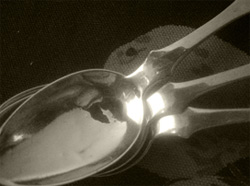
My blog's namesake - small, old and some very dented engraved silver plated tea spoons that belonged to my mother-in-law, and I use them to taste my food as I'm cooking.

Scroll down to the bottom to view my Blogroll

Posted in Cookies, on December 6th, 2007.


If you’ve never done a cookie exchange, you should. I’ve done more of them than I can count, and these days I try NOT to have too many cookies around, because then, guess who eats them? We don’t have floods of friends or family in the house during December like we used to, unless we host a party ourselves, so it’s best that I just make a few of our family favorites and call it quits with the cookie baking.

These cookies are just as pretty as the picture and would make a great cookie exchange contribution. They look like you’ve slaved, but you really didn’t. They aren’t hard to make, although they do take a bit of patience to roll up. It’s a 2-step process to make the dough (the cookie dough and the filling), then you have to create the rolls, and freeze them. You defrost the rolls a bit before slicing and baking. It’s a good cookie to make over a 2-day period. Make the dough and filling, roll them up and freeze them the first day, then the next day slice and bake them. Only one caution: don’t over bake the cookies. If you do, the chocolate filling turns into hard candy and is not easy to eat or very tasty either. You need to allow the cookies to cool on the baking sheet. If you try to remove them early, you’ll smear the filling and they may break apart. (Trust me, I know this from experience – grin.)
harlequinpinwheelscollage
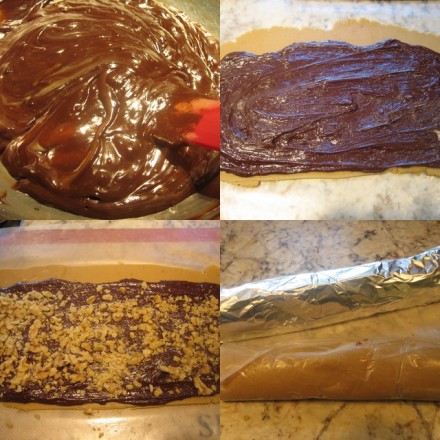
Clockwise top left: the filling melting in bowl over hot water, the filling spread on top of the cookie dough, the finished rolls ready to freeze, and the dough with nuts, before rolling up.

A former employee of mine, Vicki, brought these to our office cookie exchange many years ago, and from then on, each year she had to bring them again. She wasn’t much of a cook or a baker, but this was her mother’s favorite Christmas cookie. It’s become one of mine, too. They’re not decorated, and they’re not prissy or fancy. Chocolate? Yes! They don’t keep long once baked – I stick all my cookies in the freezer once they’re baked so I don’t have to worry about the shelf life of the cookies. But because the filling becomes almost candy-like, you need to defrost these for 10 minutes or so, before eating them.
printer-friendly PDF

Harlequin Pinwheels

Servings: 72
NOTES: If sealed well, the frozen dough will keep for several weeks. The dough is fragile, however if it dries out. When I made it this time each of the 3 balls of dough weighed 10 1/2 ounces. It helps to have them all the same size.

COOKIE DOUGH:
3 cups flour
3/4 teaspoon baking powder
1 1/2 cups brown sugar
3 whole egg yolk
1 1/2 teaspoons vanilla
3/4 cup unsalted butter — softened
FILLING:
18 ounces chocolate chips
3 tablespoons butter
12 ounces sweetened condensed milk
3 teaspoons vanilla
1 1/2 cups walnuts — chopped

1. Cookie mixture: Using a mixer, beat together the brown sugar and butter, then add egg yolks and vanilla. Combine the flour and baking powder, then add to mixture and beat until smooth. When finished, the dough is a bit on the dry side, so use your hands to pull it into a solid piece.
2. Divide the dough into 3 parts (use a scales to make them equal) and roll each between two pieces of waxed paper to an approximate 12″ x 7″ rectangle. Each piece needs to have its own waxed paper. If you have a Silpat, position the dough, on its paper, on top of the Silpat. It helps to keep it from sliding. Do not try to make the dough larger – measure if you need to. Cover with waxed paper or a damp towel while preparing the chocolate filling.
3. Filling: In a heatproof bowl or large measuring cup combine the chocolate chips and butter. Place over a simmering pot of water. The bowl should be OVER the water, not in it. Cook until chocolate chips are just barely melted. Add the sweetened condensed milk and 3 teaspoons of vanilla. Stir well.
4. Spread the chocolate mixture over the 3 pieces of cookie dough. Leave one long side with little chocolate so you can sort of seal the edge. Allow the chocolate to cool slightly on the dough – while you go chop up the nuts – then sprinkle the tops with chopped walnuts and gently press them into the filling. Roll up, starting along the 12″ side, lifting gently with the waxed paper. Do not peel off the waxed paper, but use it to help you make the full round. If you remove the waxed paper, some of the dough may crack where it’s not supported by the paper. Wrap them carefully with aluminum foil (with the waxed paper) and freeze.
5. When ready to bake, preheat oven to 350°. Allow dough roll to sit out for 10-30 minutes, then remove waxed paper and foil, before slicing into thin rounds. Cut all cookies in uniform thickness, and cut with the edge on top, so you can hold it together as you slice. Otherwise, the outside cookie may fall apart. Place on foil covered cookie sheets and bake approximately 10 minutes. Do not over bake – allow them to get just golden brown. The chocolate part continues to cook after you’ve removed them from the oven. If you over bake these, the chocolate parts become more like candy (hard). You can remove the foil sheets to a rack. Allow the cookies to cool completely before removing them from the foil.
Per Serving: 120 Calories; 7g Fat (47.7% calories from fat); 2g Protein; 14g Carbohydrate; 1g Dietary Fiber; 17mg Cholesterol; 19mg Sodium.

Posted in Fish, on December 5th, 2007.

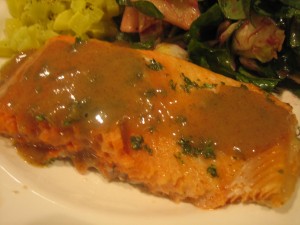
salmonmaplethyme1
I’m on a mission. Clean out the freezer, or else throw some stuff out. I have a huge freezer, and I’m real good about saving this and that. It seems good at the time, but 6 months or 2 years later I’ve lost track of what’s in there. Originally I tried to keep all the meat products in one place, vegetables in other, other things in door. About the only thing I’m consistent about are the soups. They stand up in just one place. I’ve written before about my soup library. I’ve just added two new bags to the library so there’s even less room on that shelf.

So anyway, in rooting around for something for dinner, I found chicken breasts (no, didn’t want those), tuna steaks from 2002 (tossed), shrimp that was hidden in a back corner and packed with ice crystals (tossed) and this package of Copper River Salmon that I froze a few months ago (YES!). Generally I don’t like frozen fish. At least fish that I have frozen. It never seems to taste as good as if you buy it fresh. But if the fisherman freezes it, it’s marginally better. This package I froze, and it was actually very good.

I dug out a recipe I’d been holding for just such a piece of fish. It was in Bon Appetit some years ago. It’s simple-easy. Nice enough for guests, no question, but easy enough for a weeknight meal even. Salmon lends itself so well to some kind of sweet – honey or maple syrup in this instance, or brown sugar. The salmon has two parts to it – one glaze that goes on the fish before it goes in the oven – and a second one that becomes a sauce for the finished product. Both very nice; both very different, but they complement one another. I eliminated the brown sugar and used less maple syrup than the recipe indicated. I also didn’t use the water in the sauce as I didn’t think it was necessary.
printer-friendly PDF

Salmon With Maple-Thyme Glaze

Recipe: Bon Appetit
Servings: 6

1/2 cup dijon mustard
4 1/2 tablespoons maple syrup — pure, not the fake stuff
3 1/2 tablespoons water – – optional
2 tablespoons prepared horseradish
1 1/2 pounds salmon fillets
1 1/2 tablespoons light brown sugar — optional
1 1/2 tablespoons chopped fresh thyme

1. Preheat oven to 350 degrees F.
2. Whisk mustard, 3 TBS maple syrup, 3 1/2 TBS water, and horseradish in small bowl to blend.
3. Arrange salmon on baking sheet. Spread thyme mixture evenly over salmon.
4. Whisk 1 1/2 tablespoons maple syrup, sugar and thyme in another small bowl to blend.
5. Bake until salmon is just opaque in center, about 14 minutes.
6. Spoon mustard-horseradish sauce over and serve.
Per Serving: 197 Calories; 5g Fat (22.5% calories from fat); 24g Protein; 14g Carbohydrate; 1g Dietary Fiber; 59mg Cholesterol; 345mg Sodium.

Posted in Soups, on December 4th, 2007.

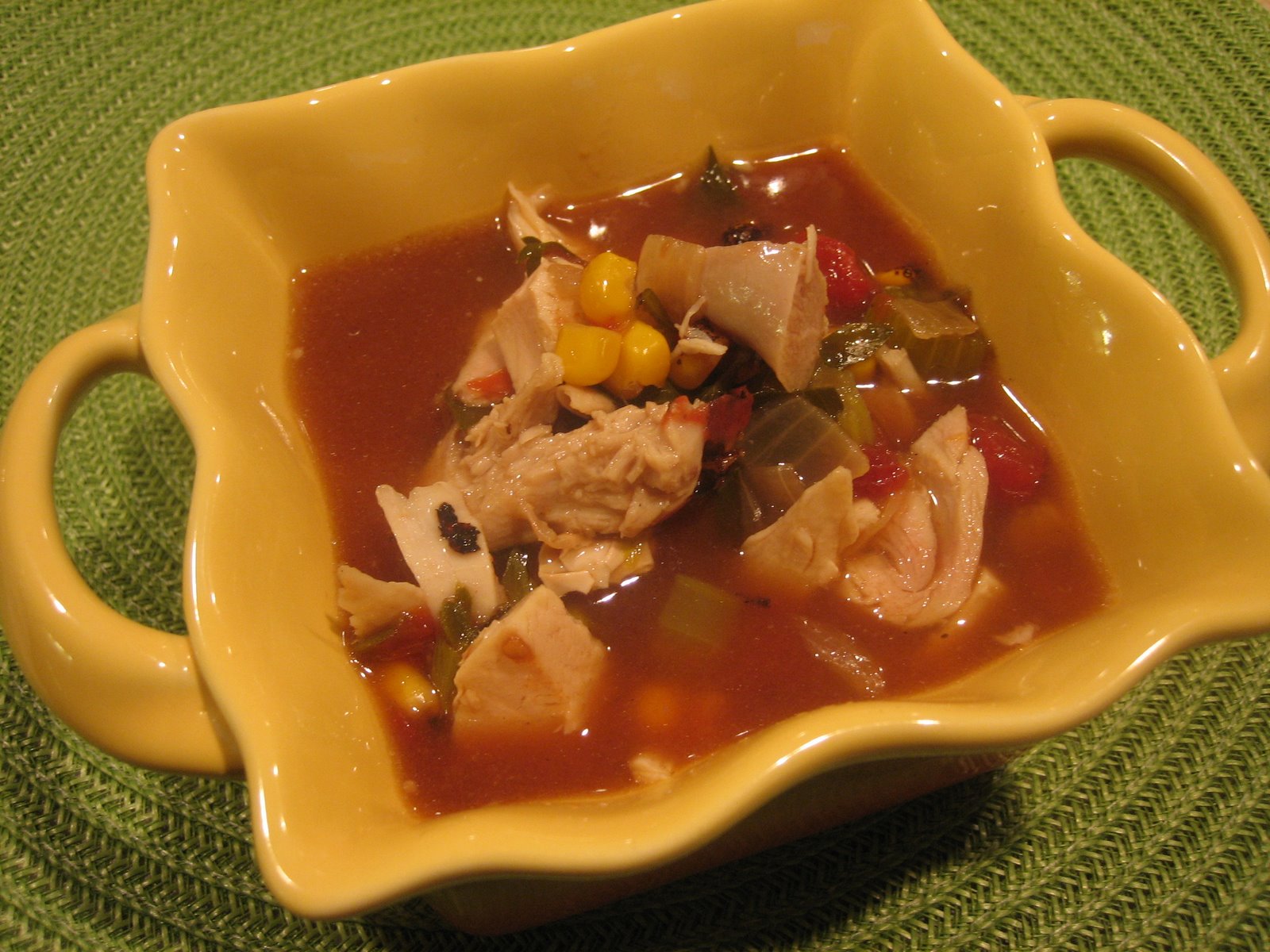
The other day when Cherrie and I attended a cooking class, we were served Tortilla Soup. That got me to thinking that all my leftover turkey could be put to good use in a big batch of this soup. Sarah’s soup was very easy, requiring only about 45 minutes of preparation, perhaps. I liked her soup very much – it hit the spot on a nice, cool day. But having made Tortilla Soup many times before, I decided to pull together several recipes that I have. My usual go-to recipe is from America’s Test Kitchen, and I’ve made it lots of times. At the moment, the recipe is available, but you have to register (free) to use their site. Their recipe is a bit more complex than this soup, but the flavors are similar. I like a variety of vegetables in my tortilla soup, so this time I added corn, and celery. If I’d had some zucchini, I’d have added that too.

If you still have some turkey in the freezer, from Thanksgiving, this would make a lovely use for it. It’s delicious. You can make your own tortilla chips, if you have the tortillas fresh. Otherwise, just use packaged, but crush them up a little bit on top of the soup when it’s served. I had about a quart of drippings and stock from the turkey. All that went into my soup pot with the fat scraped off. That gave a little different depth of flavor to the soup. The dried chiles I chose are ones that give more flavor than heat – guajillo and ancho. Since I have a collection of dried chiles in my pantry, I make notes on the package so I know which ones lend heat and which ones do not. Then I added a single Jalapeno chile at the end to give the soup some heat. If you don’t have any fresh Jalapeno on hand, use a little bit of chipotle instead.

If I haven’t mentioned it before, once I open a can of chipotle in adobo sauce, I put little mounds of it on foil, then pop it in the freezer. Once frozen, I pull the little mounds off the foil and chuck the whole batch in a freezer bag and back in the freezer. That way I can pull out as much as I want. Chipotle goes a looooong ways, so be careful if you’ve not used it before.

If you don’t want heat, eliminate the Jalapeno and remove all the seeds from the dried chiles (if there’s any heat in them, most of it will come from the seeds). With fresh chiles, a lot of the heat is in the ribs, but once chiles dry, most of the ribs disappear.

This soup was just outstanding. Probably because of the flavorful turkey broth. Here’s one of my big helpful hints: whenever you serve turkey, remove most of the turkey meat first and set aside. Break up the bones and put in a tall stockpot. Add water (and an onion, a carrot or two, a clove of garlic, some parsley) to cover. Heat it on the stove until it’s a simmer, cover, then put into a 225 oven (yes, 225). You want the pot to just barely simmer for hours and hours. The lid is on, so you won’t lose any of the fluid. Bake overnight – or for about 18 hours. Or 12. Or 10. Whatever your overnight timing needs to be. Remove from oven, take lid off and allow it to cool. Remove all the bones, strain, then place on the stove and bring to boiling. Continue to boil until the liquid has reduced by at least half or 3/4. I usually end up with about 3-5 cups of concentrated turkey broth. Cool, chill, remove the fat. Then you’re ready to use it.
printer-friendly CutePDF

Files: MasterCook 5+ and MasterCook 14 (click link to open in MC; 14 contains photo)

Turkey Tortilla Soup

Servings: 12
For the Soup:
Source: a compilation of several recipes

3 tablespoons vegetable oil, or olive oil
3 cups onions, diced
2 cups celery, diced
2 cups frozen corn, Trader Joe’s “roasted”
6 cloves garlic, minced
8 cups chicken broth, or turkey broth, or combination
29 ounces canned tomatoes, diced
2 large guajillo or ancho chile peppers, dried, broken up (remove seeds if desired)
1 jalapeno chile, seeded, diced (optional)
4 cups turkey, diced or shredded
Garnishes:
1 cup Monterey Jack cheese, shredded
2 whole limes, cut in wedges
2 whole avocadoes, ripe, diced
1 cup fresh cilantro, chopped
3 cups tortilla chips
Sour cream (optional)

1. Dice up the onions, celery and garlic. Heat the oil in a large stockpot and saute the onions for about 3-5 minutes, then add celery. Continue cooking for about 5 minutes, then add garlic and stir frequently for about 1 minute.
2. Add the turkey or chicken broth, canned tomatoes with their juice and the dried chiles. Bring to a boil and simmer for about 15 minutes, then add the roasted corn. Simmer for 5 minutes, remove from heat and allow to cool. If possible make this one day ahead to this point.
3. Reheat soup. Meanwhile, chop up all the garnishes. You may either serve the garnishes on the side and allow people to add what ones they prefer, on top, or you may put the desired garnishes in the bowl first, then pour hot soup on top. Sprinkle with tortilla chips (crushed in your hands first) on top with a little bit of cilantro.
Per Serving: 619 Calories; 35g Fat (48.9% calories from fat); 27g Protein; 55g Carbohydrate; 7g Dietary Fiber; 55mg Cholesterol; 1063mg Sodium.

Posted in Breads, on December 3rd, 2007.

bishops bread slices

I’ve been waiting for months and months to give you this recipe. Since I only make this at Christmas-time, I didn’t think it appropriate to share it when the temps outside were in the 90’s. Although this is not my original recipe, I will tell you I’ve been making this for about 40 years, and this is one of those recipes – if you’re a regular reader of my blog – that I say – “now, listen up! I’m about to share something important.” Hence it is. Important. My mother’s friend Mary gave me this recipe, back in about 1969 or 1970. We had a group of us – 4 women: my mother, Fay, and two of her friends, Esther and Mary, both near her age. And me. We played the Japanese version of Mah Jong about every 2 weeks or so, and one of us provided lunch. It had to coincide with when my daughter, Dana, went down for her nap, so more often than not, it was at my house. After eating the repast we’d then play the game for a couple of hours.

So, Mary brought this, one Mah Jong day, when it was close to Christmas. My mother (and dad both) liked fruitcake. But I never did. Still don’t. I’ve been known to try a nibble, with somebody’s prized recipe, thinking that maybe my taste buds have changed, that I’ve matured somehow. Or that somebody has found some unique new way to make fruitcake palatable. Sorry. No. I still don’t like fruitcake. I detest citron, and anything close to it. So, when Mary brought this over, explaining that it was something like fruitcake, I was suspicious. However, she quickly said she didn’t like fruitcake, either. Oh good. I became a bishop’s bread convert from the first bite. SO:

• I do like maraschino cherries. Certainly I don’t eat them 11 months of the year. I mean, where do we ever even SEE maraschino cherries anymore except on some caterer’s platter or in a Shirley Temple. I went through a stage in the 1970’s when red dye was an anathema, but that didn’t keep me from making bishop’s bread, I’m sorry to say. So much for my dedication to the shrine of a healthy body! But now they don’t use the bad red dye (supposedly), so I hope that since this is only consumed by me for these few, short weeks, maybe I’ll live another day.

• And, I like chocolate too. You all already know that. You can use Nestle’s chips, or cut up your own, or use some other brand. The better the brand the better the bread. You could use milk chocolate too, I suppose.

• And, I like walnuts.

• But, I don’t like fruitcake.

• Enter, ta da: Bishop’s Bread!

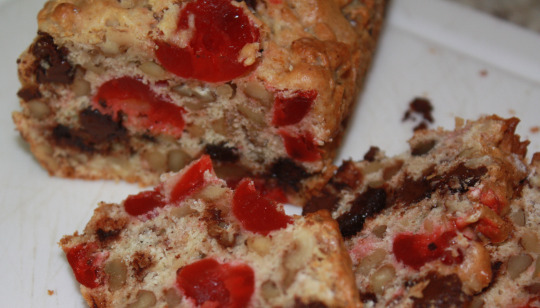
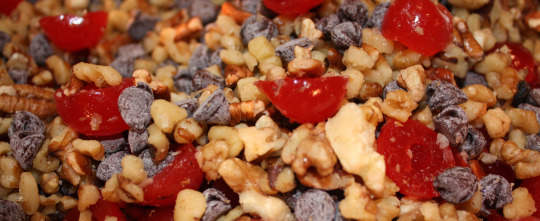
So, on to this recipe. If you’re going to be a stickler for detail, I suppose this does bear some resemblance to fruitcake – it has a similar consistency – chunks of goodies glued together with a basic cake recipe. Kind of like pound cake. But, instead of citron and dried fruit (lemon, lime, orange, red candied cherries, dates, figs, etc) this has nothing but chocolate chips, walnuts and maraschino cherries. The cherries maintain their moistness, and you combine them with walnuts and chocolate, and it’s a marriage made in heaven, I say. Yes, it’s a bread-like shape, and you slice it like fruitcake, but it isn’t. I promise. On my honor.

Here’s how it’s made:
bishops bread mixThere’s the walnuts, chocolate chips and masarschino cherries all mixed with all the dry ingredients (flour, baking powder and salt). The sugar goes into the egg mixture, which is added next.
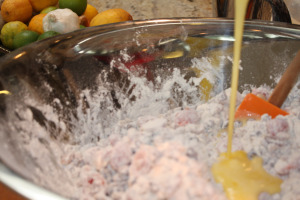
bishops bread eggsYou add in the eggs and sugar mixture to the dry ingredients. Stir with a spatula until everything is well coated AND you can’t see any white flour bits anywhere.
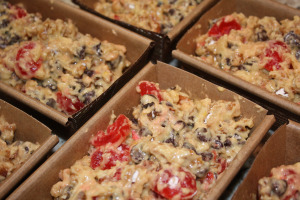
bishops bread in pansThere’s the raw batter spooned into the pans – this time I used pretty paper pans, so I didn’t have to use the buttered waxed paper on the bottom because you tear off the “box.”
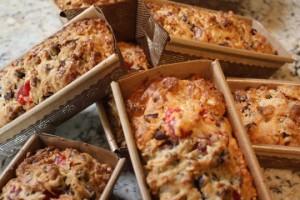
bishops bread baked 540There they are, just baked and cooled. They make lovely gifts for people at this time of year.
You can bake it in bread pans, so you’ll have just one loaf using the recipe below. Or, if you’re a Bishop’s Bread lover, then you bake in large quantity. Today I made a quadruple batch. It would make 4 bread pans full, but I had some smaller, cute little cardboard ones that are perfect for giving away (picture above). I made seven of them and one loaf pan. I’ll keep the loaf sized one and very judiciously give away the others. Only to very special friends. You can interchange nuts if you’d prefer something different. And if you don’t like maraschino, then substitute apricots, perhaps, or dried cranberries maybe. But it won’t be the same.

bishops bread fruitnuts closeup

Over the years I’ve tried to find out the history of this bread/cake. The internet hasn’t been of much help other than to give me several similar recipes (purportedly dating to the 1950’s) with candied cherries, sometimes almonds or pecans, chocolate, and dates. I did see a couple with maraschino cherries, so this must have been somebody’s interpretation. Obviously, the way-back origin must be religious in some way with the word “bishop” in the title. I did find this, though:

Any purchased or homemade cake decorated with the bishop’s name and a tiny mitre can be used on the feast of a bishop-saint, the traditional cake is Bischofsbrot or “Bishop’s Bread.” (this was from a Catholic Church website)

It probably did have candied cherries in it at one time. Whatever it is, I adore this bread. And if you’re a regular reader of my blog, and you like my recipes, then I sincerely request that you make this bread. Post Haste.
printer-friendly CutePDF
Files: MasterCook 5+ and MasterCook 14 (click link to open in MC)

Bishop’s Bread

Recipe: a dear friend from the 1970’s, Mary Wilfert
Servings: 20 (slices)

FLOUR MIXTURE:
1 1/2 cups flour
1 1/2 teaspoons baking powder
1/4 teaspoon salt
CHOCOLATE, NUT & FRUIT MIXTURE:
1 1/2 cups chocolate chips
2 cups walnuts — chopped
1 cup maraschino cherries — drained, halved
1 cup sugar
3 whole eggs

NOTES:  You could also make these in smaller pans (and bake a shorter time) and give as gifts to friends and neighbors. The proportion of nuts, chips and cherries can vary to your taste. If you don’t like maraschino cherries, substitute dried cranberries, for instance. Prefer pecans? Or maybe macadamia nuts? The original recipe I was given also included dates.
1. Preheat oven to 350°F. Grease a bread pan and line the bottom with waxed paper (yes, it’s important). Sift dry ingredients (this is to make certain the baking powder and salt are evenly distributed) into a large bowl. Add chocolate chips, walnuts and cherries and stir to coat the items, particularly the cherries.
2. With an electric mixer combine eggs and sugar and beat until thoroughly mixed, then add to fruit-flour mixture and stir gently, but well, until combined. You don’t want to see any pockets of flour. Pour into prepared pan(s) and place on middle rack in the oven. Reduce oven temp to 325°F. Bake for 60-75 minutes, testing in center with an instant read thermometer, until it reaches about 210°F. If you use a toothpick to test for done-ness, and the tester goes into a chocolate chip, it’s hard to tell it’s done. Continue baking as needed and test at 5-minute intervals. Remove pan(s) to a rack and allow to cool in the pan. When cool, remove from pan, remove waxed paper from the bottom, then wrap well in plastic wrap and foil, or preferably in plastic bags and refrigerate. Slice about 1/4 inch thick. Eat with gusto. [Makes 1 regular sized bread pan loaf; more if using miniature bread pans .]
Per Serving: 255 Calories; 13g Fat (42.8% calories from fat); 6g Protein; 33g Carbohydrate; 2g Dietary Fiber; 32mg Cholesterol; 82mg Sodium.

Posted in Salad Dressings, on December 2nd, 2007.

Hello. My name is Carolyn. And I’m an oil, vinegar and dishes addict. I need a 12-step program, I think. They come out with some new flavored oil or vinegar and I’m a sucker. Hand it to me. Gotta have it. I’m embarrassed to say that I have way too many, and more often than not, when I’m making a complex salad dressing (I usually make my own, since I dislike most bottled dressings) I don’t even GO to my cabinets for these specialty oils or vinegars because I think the flavor will be wasted (as well as the money I paid for them) in the dressing.

So, now you know. I’m flawed. It’s a good thing I don’t really have a food budget. My DH probably wishes I did. I do remember the days when I really had to watch what I spent, but thankfully life has been good to us. I do look at prices, but if I want some kind of food item, I’ll usually buy it. The only time DH complains is when I buy dishes. I do love buying new dishes. I have to just slap my hands sometimes when I get into a TJMaxx store or Home Goods and I see some darling little set of 4 plates. No salad plates with them. Maybe 2 bowls. Or, maybe a couple more soup bowls would be nice. I just have to talk to myself. Where will I put them. Will I really, really use them? I walked in the door the other evening with a set of 8 salad plates. Since DH washes almost all of the dishes, I couldn’t fool him by hiding them somewhere and pulling them out in a couple of weeks. He’d know. So I confessed right up front. WHAT?, he said. This wasn’t a what, dear, kind of response. It was a loud WHAT? Then I reminded him that our little set of 4 dark green salad plates that kind of went with our everyday dishes now was a set of 3. We can’t use a set of 3 plates. They’re going out into the donation bag in the garage, I said. So these are to replace those. But why 8, he said? Well, because when I bought the other four, that’s all they had. The new ones had 8, so I bought them all. They were only $2.99 each, I said. As if that would make much difference. He sighed. And washed them. I reminded him that I don’t have many vices. Buying books and cookbooks maybe. Spending time on the computer, yes. And probably this blog too. I think I’m forgiven. I think.

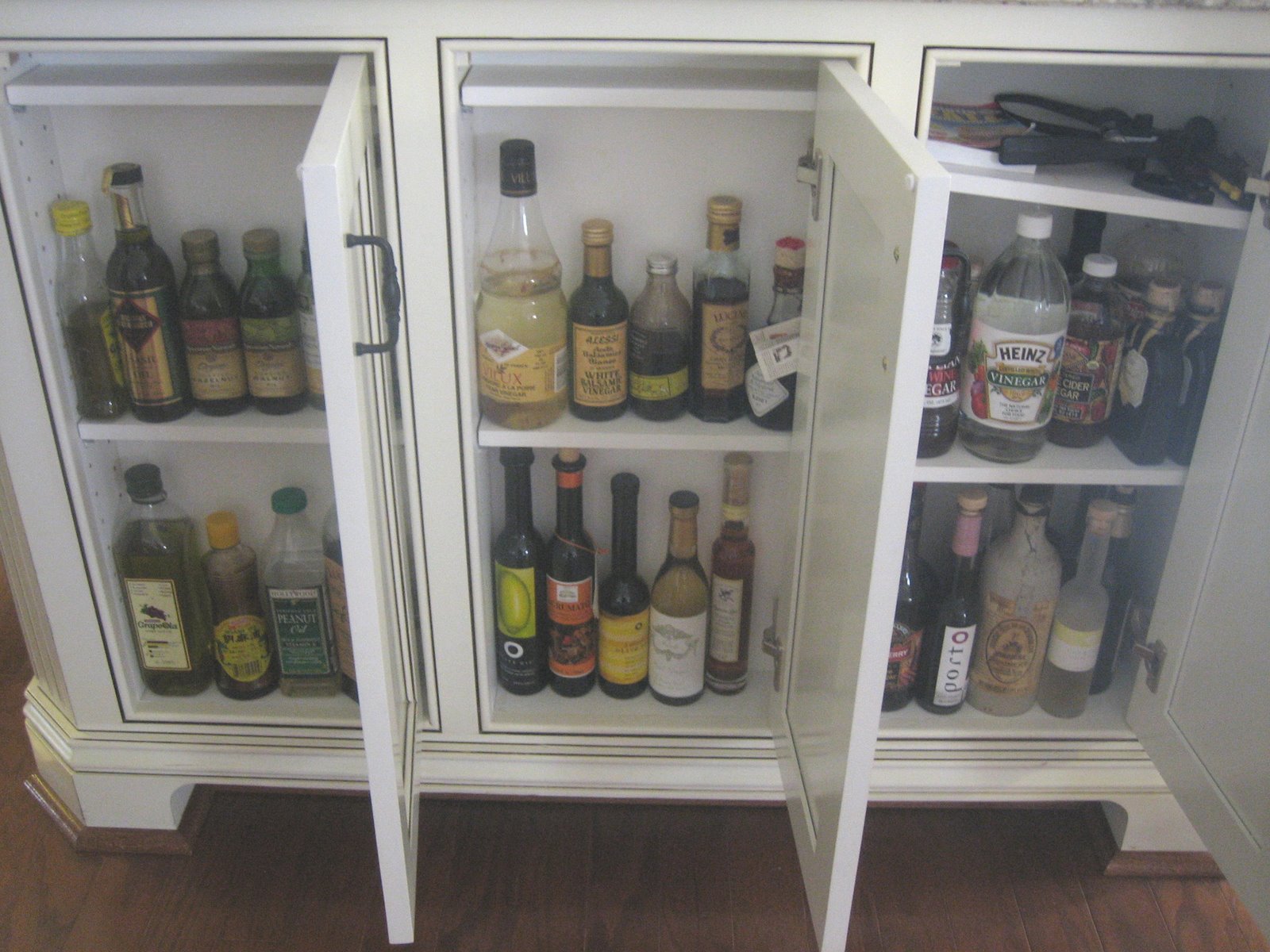
So what brought this all to mind was making a salad dressing yesterday. I’d read about the dressing over at Culinary Fool, and thought it was so festive and holiday-ish. So I got out all the ingredients and went to my vinegar cupboard. You want to see?

Yup, those are ALL oils (mostly in the left two) and vinegars (mostly right). The shelf at top right is awry because it’s where DH stores his wine essentials (corkscrew, cap remover) so it sits cattywampus because I need the height for the bottles below.

When we had our kitchen remodeled there was this space at one end of the island, facing our family room. The cabinet maker was going to just put in blind ends there. They’d have looked pretty, but I knew there was about 4-5 inches of depth in there. Crying out for just the right things to store on shelves. Aha. Oils and vinegars. Perfect home for them. One cupboard is a bit deeper, so I can get 2 layers in there. I made the cabinet maker put in cupboards. I don’t want to know how much extra that was. I’m very happy with my oil and vinegar cupboards.

Recipe Tip:

Use this up right away – it doesn’t keep.

But, I’ve digressed; back to the salad dressing: Searching through the vinegar options, I found a citrus vinegar, a specialty one. Perfect, I thought, to go with the orange juice in the dressing and the cranberries. I like all the pretty shaped bottles they use for vinegars these days. I have a couple of balsamic bottles that are too tall for these cupboards, so they have to live in the walk-in pantry. But I forget about them in there.

This dressing isn’t appropriate for every salad. With the fruit (cranberries) and juice (orange) it’s best suited for a simple salad. I used half sugar and half Splenda, to keep the carbs down a bit. Apples, just a few, sliced in a simple salad would be nice. Or pears. Dried cranberries are so popular to toss into salads, but I think they’d be too sweet in this case. Certainly some toasted nuts would go well. I added walnuts. My salad came together, then, with arugula, head lettuce even, sliced apple and walnuts. Very yummy. Thanks to Culinary Fool for this one. It’s a keeper. It’s better used up immediately.
printer-friendly PDF

Cranberry Vinaigrette

Recipe: Dishing with Kathy Casey: Food, Fun, and Cocktails from Seattle’s Culinary Diva, via Culinary Fool blog
Servings: 12

2/3 cup fresh cranberries — or frozen
1/4 cup sugar — [I used half sugar, half Splenda]
1/2 cup white wine vinegar — or distilled vinegar [I used citrus vinegar]
1 tsp. Dijon mustard
1/4 cup orange juice — or other citrus juice
3/4 cup vegetable oil
1/4 tsp salt
1/4 tsp black pepper

1. Place cranberries, sugar and vinegar in small saucepan and heat over medium heat until cranberries pop, 5 – 10 minutes.
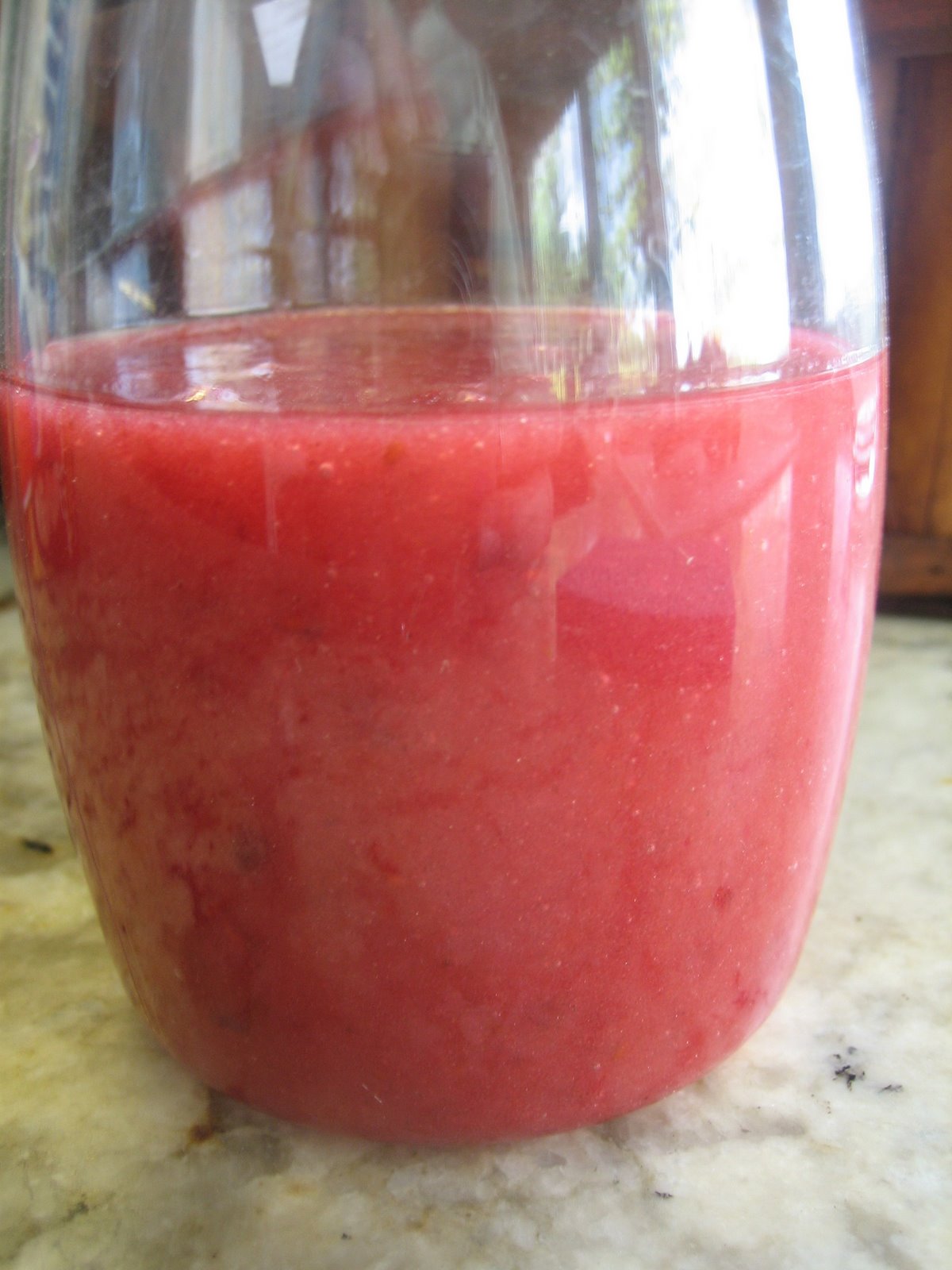
2. Let cranberries cool slightly and then transfer to a blender. Puree (being careful to make sure the top doesn’t pop off if they are still warm) the mixture until fairly smooth – there will still be pieces of bright red skin. Add the mustard and orange juice and lightly mix.
3. Transfer the mixture to a medium bowl. Slowly, slowly add the oil while continuously whisking until all oil has been incorporated and the mixture is emulsified.
4. Use immediately or store in the refrigerator.
Per Serving: 143 Calories; 14g Fat (83.5% calories from fat); trace Protein; 6g Carbohydrate; trace Dietary Fiber; 0mg Cholesterol; 50mg Sodium.

Posted in Soups, on December 1st, 2007.

Parsnips are a hugely under-rated vegetable. My mother never served them. In fact, until I was an adult I thought a parsnip was another one of those root veggies like turnips and rutabagas, i.e. round, globe shaped, which I didn’t like, really. But parsnips are a completely different animal. They look like anemic carrots, but they’re very firm. But also extremely tasty. I forget to buy them. But then, my local grocery store doesn’t carry them except on an occasional basis. Probably because lots of other people THINK they don’t like them, either. Or, they don’t know how to prepare them. Parsnips have a lovely, sweet taste when cooked, kind of like carrots do. They blend beautifully into soups, as a matter of fact, and add another layer of flavor if you’re making a carrot or potato soup. They also make a very nice vegetable (a carb, albeit) to serve with a roast or a grilled piece of meat. You can mash it just like potatoes once they’re cooked. Just peel well, simmer and mash with a little butter and salt and pepper.


I’ve had parsnips several times when I’ve visited places in the United Kingdom. The Brits know all about parsnips. I think our friend Pam once served us a parsnip soup as a first course for a lovely Sunday dinner. Sometimes you’ll see them in long quarters beside a big juicy roast – like we’d serve carrots.

So, when Cherrie and I were served this apple and parsnip soup the other day (at a cooking class at Our House, South County in San Juan Capistrano), we both did our best to lick the inside of the cups clean. We couldn’t quite, but we tried. It’s a simple soup, really, with a nice gentle undercurrent of curry powder (eliminate it if you don’t like curry). This would freeze well, except for the garnish, although you could toast the pecans and put them in a small plastic bag inside the soup bag.

Everyone at our table raved about the soup too. It was a stunner. The winner in my book, if there was one, of all the recipes in the class. It was served with a cheddar and apple panini (pictured with the soup, above). My hats off to Sarah, the chef at the cooking school (who reads my blog, she told me!). Well done, Sarah! I’ll be making this soup next week without a doubt.
printer-friendly PDF

Apple and Parsnip Soup

Servings: 6

SOUP:
1/2 cup unsalted butter
2 large onions, sliced
2 large parsnips, scrubbed and cubed
1 clove garlic, chopped
1 pound apples, Granny Smith, peeled, cored, cubed
2 teaspo0ns curry powder
6 1/4 cups chicken stock
1/4 cups half and half
GARNISH:
1 cup pecans, chopped
1 teaspoon unsalted butter
2/3 cup creme fraiche

1. Melt the butter in a large soup pot and saute the onions and garlic over a moderate heat until the onions are translucent. Stir in the parsnips and apple, and saute for about 3 minutes, stirring occasionally. Stir in the curry powder and cook for one minute. Pour on the chicken stock, bring to a boil, cover and simmer for 20 minutes.
2. Puree the soup in a blender in batches and return to the pot. Stir in the cream, season and reheat gently.
3. Garnish: Melt the butter in a saute pan and add the pecans. Saute over a medium heat for 5 minutes. Swirl the creme fraiche on top of the soup, and sprinkle pecans on top.
Per Serving (about 1 1/2 cups): 538 Calories; 42g Fat (69.7% calories from fat); 6g Protein; 35g Carbohydrate; 8g Dietary Fiber; 85mg Cholesterol; 2280mg Sodium.

Posted in Uncategorized, on November 30th, 2007.


Lemon and regular thyme soaking in the rain


What is it about rain that’s so soothing? Whenever it rains here (which isn’t often during most winters), I always hope I get to spend the day IN. In the warmth of my house. In my comfortable kitchen. And most times when I have a day like this, my thoughts turn to baking. In some ways I wish it didn’t, because I then eat whatever it is I bake. When we got up this morning (this is Friday) it was drizzling. It continued drizzling for several hours, then it turned to rain. Not pelting. Not a downpour. Just solid, steady rain. We so badly need the rain. After all the wildfires this Fall, we desperately need the rain. But the worry, always, is that after such a dry summer, houses on hills are subject to mud, runoff and in some areas, mudslides. We don’t live in a mudslide area, but we do live on a hill. Because of problems with our sprinkler system, some of the vegetation on our hill is sparse or dead. And we always have problems with our drains.

I didn’t know all about this stuff when we moved into this house on the hill. We have outside drains, on all sides of our house (a total of 13), that help funnel any water or rain runoff down the hill and into the sewer. Over the 5 years we’ve been here, we’ve had several floods in our house, in a guest bedroom that had a vulnerable wall. Not like Katrina or anything. Just water that backs up and leaks into the house. We hope all those pesky problems are repaired, so even if the drains back up, it wouldn’t ever get IN the house again.

But whenever we get our first real rain of the winter – that would be today – my DH is out surveying the property, scraping leaves out of the outside drains, making sure we don’t have a problem. During the 8-9 months of the year when we don’t have rain, the little bit of water that goes through those outside drains (they start in the rear of our house, the uphill part) and route water underground to the main drains (the slope on the far downhill part of our property) is not a problem. It’s the heavier rains that could cause us grief. Periodically tree roots wriggle their way into the joints, so we must have a Roto-rooter guy over to clear things out. Our house is about 35 years old, and those drain pipes likely have settled, perhaps, maybe even broken in places. We are, supposedly, on a regular schedule of having the drain lines cleared out. No waiting until after the rains begin. We need it done regularly, so we DON’T have a problem. Just another budget item that we didn’t know about when we bought the house on the hill.

So, I’m here in the kitchen. It’s chilly outside, though not stormy. It’s not a thundering kind of rain, just that lovely, gentle type that usually doesn’t cause problems. Maybe our slope plants will enjoy the long, steady gulp of water today. My herbs certainly will, those that have survived (Italian parsley, rosemary and thyme).

Sometimes a stay-home-to-watch-the-rain kind of day calls for soup. But we’re going out to dinner (2 hours away, without traffic issues, which we likely will have) tonight. Californians generally don’t know how to drive in rain, so our streets and highways become clogged with super-cautious people, or those who think the opposite – that they can still drive 75 with not a care in the world, until somebody veers, slides or has an accident. We’re going to Fallbrook to celebrate our good friend Tony’s birthday at his home. He didn’t want any gifts, so about an hour ago I just decided to bake cookies for him instead. He’s a widower, and although he cooks, I doubt he does much baking. Actually he’s a very good cook (Italian by blood), but I only know that he makes big pots of soup or stews, pasta sauces, etc.

My house smells so wonderful, and the rain continues to pitter-pat outside. I’m content. Thankful for my happy life. My home. My family. Friends. And all of you, a few I know, most I don’t, who read my blog. Bless you, my online friends.

Posted in Utensils, on November 30th, 2007.


No, this isn’t ebay. (Although, click here if you’re interested in looking at what ebay sellers have in the Nespresso D300.) Since I had to make some espresso for my coffeecake a day or so ago, I thought you might want to know what I use. This is a very prized “baby” in my kitchen. I’ve had espresso machines over the years. At least 20 years ago I even saved up for a long time to buy one of the fancy Pavonis from Italy. It was a fortune, back then, nearly $500 for a hand-pull machine. I used it for several years, but it required a trip to a very inconvenient Italian type espresso machine repair store about once every 2 years for new gaskets (expensive) and I found it very messy to use. The coffee also wasn’t reliably the same. I tried measuring each time, tamping just so, pulling the handle down slower, faster, etc. Nothing seemed to produce a reliably similar cup of espresso. I kind of stopped using it.

My friend Cherrie introduced me to the Nespresso. Soon after buying it, she made me a cup. Oh. My. Goodness. I was in love. I vowed to buy one, using one of my 10% off coupons from Sur la Table. These machines are pricey, so 10% off was enough to make it worthwhile (you get coupons when you attend classes there). You can buy them directly from the company, or they are available in some high-end cookware retail stores. They don’t manufacture this model anymore – they have a different one with a newer, sexier shape. You can buy used, but reconditioned D300’s (with warranty) for about $300 (I paid $400 new).

I’ve had mine, now, for about 3 years. Maybe 4. And it gets used every single day. It’s so very easy to make a good always-the-same espresso each time. This machine does use pods (all their models use the same coffee pods). They’re small light weight foil things, carefully constructed so the pod is pierced exactly the same each time. I always thought that buying a machine that required me to have coffee pods shipped to me would be such a big waste. Expensive. A nuisance to do. But I’m a total convert since I bought the Nespresso. The pods were about $.50 apiece (in sleeves of 10 each), but they just raised prices, so they’re likely more like $.60 each. When I order them, I order a big batch of them. Cherrie and I order them together, too. Still a bargain compared to Starbucks or Peet’s.

One of the other features of this machine – other than the precision in which it’s made – it’s a simple press of a button to make an espresso size or a somewhat larger 1/2 cup – is the fact that the Nespresso gives any cup it makes a lovely head of foam. Without using milk and the steamer nozzle. So I don’t have to dirty up my steamer pot to make a latte. I just heat up the cream in the Bodum cup in my microwave, stick it under the Nespresso spout and press the button. How easy is that? This machine is a real workhorse, and has a very important place in my kitchen.

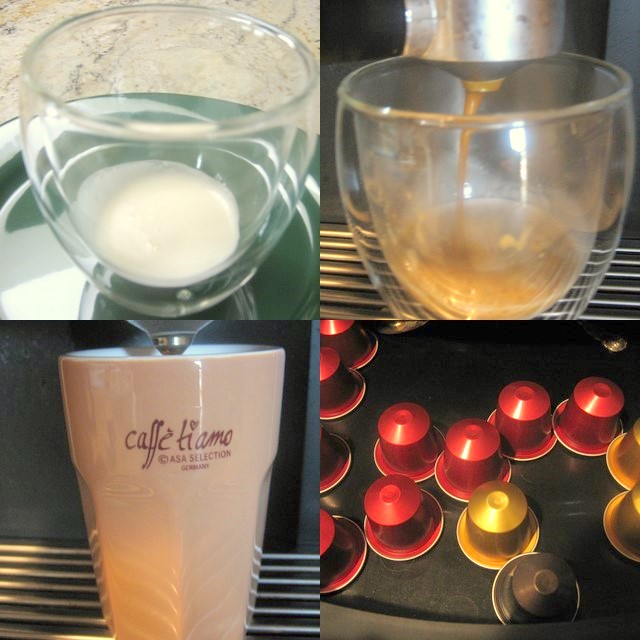
clockwise, from top left: the Bodum thermal cup that’s my go-to cup every morning, because it keeps the espresso hot longer (it’s filled with about a tablespoon of cream); espresso streaming in; a cute little espresso cup I use sometimes; the coffee pods.

Posted in Breads, on November 29th, 2007.


Sometimes my DH doesn’t give me much notice that the guys are coming to our home the next morning for Bible Study. He knew two weeks ago but neglected to tell me. So, yesterday afternoon about 3:00 he just happened to mention it in passing. I said, when were you going to tell me about this, dearest? He said, well, I just did [big, apologetic grin].

So, wanting to do something new (the guys have had all of my regular repertoire of morning coffee cakes more than once) I swiftly turned to my latest favorite baking book, Dorie Greenspan’s Baking: From My House to Yours. I do love that book. Not wanting to make a trip to the grocery store, I actually found several “Morning Cakes” I could make, but settled on this one.


Out came all the ingredients and this pulled together fairly quickly. I liked the crumb topping – it’s a bit different – well, similar to others – but different because of the orange zest – and the espresso powder in it. Oops, I opened my jar of espresso powder that’s been languishing in the pantry for at least a year without any use, and uh, it’s a solid mass. Oh, da–! Usually I’ll just make some very strong espresso instead to substitute in a recipe, but this was in a dry topping, so I couldn’t do that. What to do? I had no instant coffee (we don’t drink the stuff). So, out came the Dutch-process cocoa. It worked just fine, although I suppose Dorie might not like my substitution. She obviously was going for a cardamom and coffee pairing here. The batter is hand mixed, which gives the finished cake a little bit of irregular texture – not a bad thing. It’s not like a dessert cake that’s beat with a mixer until totally smooth.

The coffeecake/crumb cake was very nice. This isn’t a wow kind of cake – just good home made flavors, perfect with a hot cup of coffee. Luckily there were leftovers, so when the boys come next week I’ll pop it in the oven for a little re-heat.
printer-friendly PDF

Cardamom Crumb Cake

Recipe: Dorie Greenspan – Baking: From My House to Yours
Servings: 9
NOTES : This cake is best served warm the day it’s baked. If you must make it ahead, freeze it. Defrost and reheat in a 350 degree oven for a few minutes to warm it.

CRUMB TOPPING:
1/2 cup all-purpose flour
1/2 cup walnuts — coarsely chopped
1/3 cup sugar
1 tablespoon orange zest — finely grated
1/2 teaspoon instant coffee granules — preferably espresso [or cocoa]
1/2 teaspoon ground cardamom
4 tablespoons unsalted butter — at room temperature
CAKE BATTER DRY INGREDIENTS:
2 cups all-purpose flour
2 teaspoons baking powder
1/4 teaspoon salt
1 1/4 teaspoons ground cardamom
1 teaspoon instant coffee granules — preferably espresso [or cocoa]
2/3 cup sugar
CAKE BATTER WET INGREDIENTS:
2 tablespoons orange zest — finely grated
8 tablespoons unsalted butter — melted and cooled
2 large eggs
1/2 cup whole milk
1/2 cup espresso coffee — cooled
1 1/2 teaspoons vanilla extract

1. Preheat oven to 400 and arrange rack in center of oven. Butter an 8-inch square baking pan, dust the inside with flour and tap out the excess. Put the pan on a baking sheet.
2. CRUMBS: Put all the ingredients except butter in a bowl and toss them together with a spatula just to blend. Add the butter, in small little pieces, and using your fingers or spatula, mix everything together until you’ve got crumbs of different sizes. It’s nice to have a few big pieces, so don’t overdo it. Set the crumbs aside (up to 3 days ahead).
3. CAKE: Whisk together the flour, baking powder, salt, cardamom and espresso powder in a large bowl. Turn the dry ingredients out onto a sheet of waxed paper, and put the sugar and zest in the bowl. Rub them together with your fingers until the sugar is moist and the fragrance of orange strong, then return the dry ingredients to the bowl and whisk to blend.
4. Put the remaining ingredients in another bowl and whisk them to blend. Pour the wet ingredients over the dry and stir – DON’T BEAT – to mix. Stir ONLY until you’ve got an evenly moistened batter. Scrape the batter into the prepared pan and top with a thick, even layer of the crumbs. Pat the crumbs ever so gently into the top of the batter.
5. Bake for 30-35 minutes, or until the cake has risen (it will crown the pan), the crumbs are golden brown and a thin knife inserted into the center comes out clean.
6. Transfer to a rack to cool in the pan, before serving warm or at room temperature.
7. You can unmold the cake if you want to, but you’ll lose some of the crumbs when you turn it over. I prefer to cut the cake in the pan, taking care not to nick the surface of the pan with my knife. Use a silicone spatula if possible.
Per Serving: 422 Calories; 21g Fat (44.6% calories from fat); 7g Protein; 52g Carbohydrate; 1g Dietary Fiber; 90mg Cholesterol; 195mg Sodium.

Posted in Breads, on November 28th, 2007.

While our whole family was here over last week, there were a lot of meals and snacks being prepared at all hours. Our grandchildren spent many, many hours in and out of our large, heated jacuzzi, and would beg for snacks like apples and cheese, soft drinks, juice (and towels, oh my, the towels). The refrigerator was bursting at the seams with leftovers and other stuff for a variety of meal types. And early on Saturday morning, our daughter Sara was already baking. She loves to bake. I mean it. SHE. LOVES. TO. BAKE. Sara usually prefers to bring desserts or baked items when we have a potluck meal. She’s a very good cook in general, and her daughter Sabrina, aged 11, is already a very good baker too. She’s been helping her mom since she stood next to her mom’s elbow on a stool at the kitchen counter.

My standby Buttermilk Scones are more like a very rich biscuit. The ingredients, however, are very, very similar. Mine have less sugar, less butter (which surprised me), but more buttermilk. Amazing what a little addition of buttermilk can make to a baked good. Sara’s have a little drier crumb (guess that’s the buttermilk at work there), but they were absolutely delicious. I may try her recipe next time I bake scones. There are a precious few of these in the freezer, which we’ll dole out for special occasions in the next couple of weeks. Thank you, Sara.
printer-friendly PDF

Sara’s Cranberry Orange Scones

3 c flour
1/3 c sugar
2 t baking powder
3/4 t baking soda
½ t salt
3/4 c cold butter
½ c dried cranberries
zest from 1 orange
1 c buttermilk
milk
a little cinnamon and sugar

Preheat oven to 425. Mix together the flour, sugar, baking powder and salt, then add the cold butter. Blend with knives or a pastry blender. Then add in the cranberries and orange zest. Pour in the cold buttermilk and gently stir dough until it holds together. Pour out onto a floured surface and press dough to about a 12 inch round and cut into shapes and place on a large baking sheet. Brush tops with milk and sprinkle lightly with cinnamon and sugar. Bake for 10-12 minutes until golden brown. Remove to cool for about one minutes. Serve immediately.
Per Serving: 247 Calories; 12g Fat (43.8% calories from fat); 4g Protein; 31g Carbohydrate; 1g Dietary Fiber; 32mg Cholesterol; 389mg Sodium. The nutrition count depends on how large you make the scones. This recipe makes about 14 or 15 large scones.

Related Posts Plugin for WordPress, Blogger...