Get new posts by email:

Archives

Currently Reading

Here are the tastingspoons players. I’m in the middle (Carolyn). Daughter Sara on the right, and daughter-in-law Karen on the left. I started the blog in 2007, as a way to share recipes with my family. I’m still doing 99% of the blogging and holding out hope that these two lovely and excellent cooks will participate. They both lead very busy lives, so we’ll see.

– – – – – – – – – – – – – – – – – – – – – –

BOOK READING (from Carolyn):

Music of Bees, Eileen Garvin. Absolutely charming book about a woman in midlife, lonely, who raises bees, also makes unlikely friends. Heart-warming and very interesting about beekeeping.

A Postcard from Paris, Alex Brown. Really cute story. Dual time line, 1940s and present day about renovating an old apartment in Paris, things discovered.

Time of the Child, Niall Williams. Oh such a good book. Very small village in Ireland, 1960s. A baby is left on the doorstep. The town all whispers and helps. I listened to an interview of the author, which made me like him and his books even more.

Sipsworth, Simon Van Booy. If you like animals you’ll swoon. An old woman who really wants to die finds a tiny mouse in her house and befriends it and finds a reason to live. Utterly charming book.

The Forger’s Spell, Edward Dolnick. True story. For seven years a no-account painter named Han van Meegeren managed to pass off his paintings as those of Johannes Vermeer.

If You Lived Here, You’d be Home by Now, Christopher Ingraham. Could hardly put it down – about a journalist who takes on a challenge to move to small town in Minnesota and write about it. He expects to hate it and the people and place, but he doesn’t. Absolutely wonderful true story.

The River We Remember, William Kent Kreuger. 1950s, Minnesota. A murder and the aftermath. Could hardly put it down. Kreuger has such a vivid imagination and writing style.

How the Lights Gets In, Joyce Maynard. An older woman returns to New Hampshire to help care for her brain-injured son. Siblings and family, lots of angst and resentments.

The Filling Station, Vanessa Miller. Every American should read this book. A novelized retelling of the Tulsa massacre in 1921. Absolutely riveting.

The Story She Left Behind, Patti Callahan Henry. Love this author. Based on a true story. A famous author simply vanishes, leaving her husband and daughter behind. She had invented a mystical language no one could translate. Present day, someone thinks he’s solved the riddle, contacts the family. Really interesting read.

The Girl from Berlin, Ronald Balson. Love anything about Tuscany. An elderly woman is being evicted from a villa there, with odd deed provenance. Two young folks go there to help unravel the mystery. Loved it.

The Island of the Colorblind, Oliver Sacks, M.D. Nonfiction. The dr is intrigued by a remote Pacific island where most of the inhabitants are colorblind. He also unravels a mystery on Guam of people born with a strange neurological problem. Medical mysteries unveiled. Very interesting.

The Bookbinder, Pip Williams. Post 1914 London. Two sisters work at a bookbindery. They’re told to not read the books. One does and one doesn’t. One has visions beyond her narrow world; the other does not. Eventually the one gets into Oxford. Lovely story.

The Paris Express, Emma Donoghue. 1895 on a train to Paris, a disaster happens. You’ll delve into the lives of many people who survived and died in the crash.

A Race to the Bottom of Crazy, Richard Grant. This is about Arizona. Author, wife and child move back to Arizona where they once lived. Part memoir, research, and reporting in a quest to understand what makes Arizona such a confounding and irresistible place.

The Scarlet Thread, Francine Rivers. A woman’s life turned upside down when she discovers the handcrafted quilt and journal of her ancestor Mary Kathryn McMurray, a young woman who was uprooted from her home only to endure harsh frontier conditions on the Oregon Trail.

A Place to Hide, Ronald Balson. 1939 Amsterdam, an ambassador has the ability to save the lives of many Jewish children. Heartwarming.

Homeseeking, Karissa Chen. Two young Chinese teens are deeply in love, but in China. Then their families are separated. Jump to current day and the two meet again in Los Angeles.

North River, Pete Hammill. He always writes such a good story. A doctor works diligently healing people from all walks of life. His wife and daughter left him years before. One day his 3-yr old grandson arrives on his doorstep.

A Very Typical Family, Sierra Godfrey. A very messed-up family. Three adult children are given a home in Santa Cruz, Calif, but only if the siblings meet up and live in the house together. A very untypical scenario but makes for lots of messes.

Three Days in June, Anne Tyler. The usual Anne Tyler grit. Family angst. This wasn’t one of my favorites, but it was entertaining and very short.

Saved, Benjamin Hall. Author is a veteran war reporter. Ukraine, 2022, he nearly loses his life to a Russian strike. Riveting story – he survives, barely.

Grey Wolf, Louise Penny. Another Inspector Gamache mystery in Quebec. She is such an incredible mystery writer.

All the Colors of the Dark, Chris Whitaker. A missing person mystery, a serial killer thriller, a love story, a unique twist on each. Could hardly put it down.

Orbital, Samantha Harvey. Winner of 2024 Booker Prize. I don’t usually like those, but I heard the author interviewed and she hooked me. This is not a normal book with a beginning, a story and an end. It’s several chapters of the day in the life of various astronauts at the ISS (Int’l Space Station). All fictional. She’s been praised by several real astronauts for “getting it” about space station everyday life.

The Blue Hour, Paula Hawkins. An island off Scotland. Inaccessible except when the tide is out. Weird goings on. An artist. A present day mystery too.

Iron Lake, William Kent Krueger. A judge is murdered and a boy is missing. Riveting mystery.

Tell the Wolves I’m Home, Carol Ricks Brunt. 1980s. A 14-yr old girl loses her beloved uncle. Yet a new friendship arises, someone she never knew about.

Four Treasures of the Sky, Jenny Zhang. 1880s, a young girl is kidnapped in China and brought to the United States. She survives with many hurdles in the path.

The Boy Who Fell out of the Sky, Ken Dornstein. Memoir, 1988. The author’s brother died in the PanAm flight that went down in Lockerbie, Scotland. A decade later he tries to solve “the riddle of his older brother’s life.”

Worse Care Scenario, T.J. Newman. Oh my. Interesting analysis of what could/might happen if a jet crashed into a nuclear plant. Un-put-downable.

Song of the Lark, Willa Cather. Complicated weave of a story about a young woman in about 1900, who has a gifted voice (singing) and about her journey to success, not without its ups and downs.

Crow Talk, Eileen Garvin. Charming story which takes place at a remote lake in Washington State, about a few people who inhabit it, the friendships made, but also revolving around the rescue of a baby crow.

The Story Collector, Evie Woods. Sweet story about some dark secrets from an area in Ireland, a bit magical, faerie life, but solving a mystery too.

A Sea of Unspoken Things, Adrienne Young. A woman investigates her twin brother’s mysterious death. She goes to a small town in California to figure it out, to figure HIM out.

The King’s Messenger, Susanna Kearsley. 1600s England, King James. About one of his trusted “messengers,” and his relationship with a young woman also of “the court.” Lots of intrigue.

In the Shadow of the Greenbrier, Emily Matchar. Interesting mystery in/around the area of the famous resort in White Sulphur Springs, West Virginia.

Isola, Allegra Goodman. Hard to describe, survival story on an island in the 1600s.

Save the Date, Allison Raskin. Rom-com, witty, LOL funny. Clever.

The Sirens, Emilia Hart. Numerous time-lines, Australia. Mysteries abound, nightmares, abandoned baby, weird allergies.

Red Clay, Charles Fancher. LOVED this book. Mostly post-Civil War story about the lives of slaves in Alabama during Reconstruction.

Stars in an Italian Sky, Jill Santopolo. Dual time line, 1946 and recent time. Love stories and a mystery.

Battle Mountain, C.J. Box. Another one of Box’s riveting mysteries. Love his descriptions of the land.

Something Beautiful Happened, Yvette Corporon. A memoir of sorts in Greece, tiny island of Erikousa, where the locals hid Jews during WWII. All elusive stories told by the author’s grandmother.

The Jackal’s Mistress, Chris Bohjalian. 1860s Virginia, about a woman who saves the life of a Union soldier. Really good story.

Song of the Magpie, Louise Mayberry. Really interesting story about Australia back in the days when it was mostly a penal colony. Gritty strength of a woman trying to thrive with her farm.

The Boomerang, Robert Bailey. A thriller that will have you gripping the book. About a lot of secrets surrounding the president (fictional novel, remember) and his chief of staff and about cancer. A cure. Such a good story.

Care and Feeding, Laurie Woolever. Really interesting memoir of a woman driven to succeed in the restaurant business. She worked for Mario Batali and then Anthony Bourdain. Gritty stories.

Everything is Tuberculosis, John Green. Maybe not a book for everyone. A real deep dive into the deadly tuberculosis infection, its history. I heard the author interviewed and found the book very interesting.

The Book Lovers Library, Madeline Martin. Fascinating read about Boots’ drug stores’ lending library. And the people who worked in them.

The Arrivals, Meg Mitchell Moore. LOL funny, about a middle-aged couple whose children (and their various family members) return to the family home and the chaos that ensues.

My Life as a Silent Movie, Jesse Lee Kercheval. About grief. A big move to Paris, finding herself a new life with a new set of real blood family.

Escape, Carolyn Jessop. Another memoir about a woman really in bondage in Utah, Mormon plural marriage.

 

Tasting Spoons

My blog's namesake - small, old and some very dented engraved silver plated tea spoons that belonged to my mother-in-law, and I use them to taste my food as I'm cooking.

Scroll down to the bottom to view my Blogroll

Posted in Cookbooks, on June 14th, 2008.

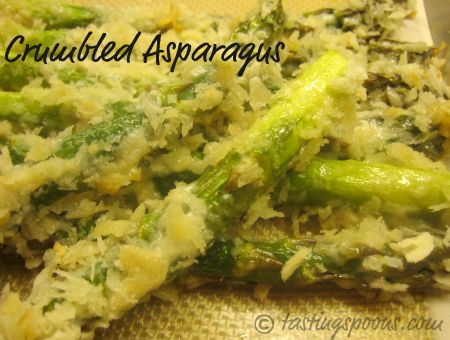
crumbled asparagus

I‘ve already posted the recipe for the Crumbled Asparagus (see link at bottom); I’m just using the photo as a way to introduce talking about asparagus. And by the way, I’ve had any number of people email me about how luscious this recipe is, in case  you haven’t tried it (see link at bottom).

This is the beginning of a series I’m going to write about fruits and vegetables. Most of the fact type information comes from Russ Parsons’ book titled How to Pick a Peach. I know, the season for asparagus is mostly over, but I wanted to start with it, since it’s probably my favorite vegetable. 80% of all asparagus in the U.S. is grown is California, mostly in the Sacramento – Stockton area (that’s about 75-100 miles east of San Francisco).

What I Learned:

  • That a single asparagus plant produces both thinner and fatter stalks – the fatter ones toward the center (the first to grow) and the thinner ones around the outside of the same plant.
  • That there are asparagus fanatics out there who swear their thinner, peeled ones are better than the fatter, that the best flavor is in the bases, plus those who just quibble over peeling or no. [Sometimes I do; sometimes I don’t. If they’re bigger ones, often I do. And just because you need to be reminded, don’t ever put asparagus bases or peels in a garbage disposal.]
  • In Parson’s opinion, buy big fat ones when you’re making a “vegetable statement.” When you want a big platter of them to be a significant part of the meal. If the asparagus will be used in another dish – say – in a risotto or pasta dish – then for the mixtures, use the thinner ones. The thinner ones are a little crisper and have a brighter color.
  • As for white asparagus, we rarely see it here in the U.S. [It’s far more common in Europe where we once saw a guard with a gun patrolling fields of them to prevent poaching.] In season, white asparagus – in Europe – looms large on menus in restaurants. They’re white because the stalks have never seen the light of day – they’re carefully covered over with soil to prevent the sun from reaching them, the sun would create chlorophyll, thus turning the asparagus green.
  • That some people are actually interested in the aroma of their urine after eating asparagus. Even Marcel Proust credited asparagus with “transforming my chamber pot into a vase of aromatic perfume.” [Hmmm. Really? I must have missed that when I read Proust. Or else I thought “ew!”]
  • After some research on the matter, scientists have determined that the unique odor in canned asparagus is caused by a chemical called methoxypryrazine, which incidentally, is also an aroma associated with Sauvignon Blanc. [Yes, really.]

How to Choose & Store:

  • Check that the tips are tightly furled (whether fat or thin spears) – remember, this is a fern. The tips are the first part of the plant to break down after cutting.
  • Check the bases – they should be moist. The best storage is sitting in a pan of water (so the bases can stay wet). Do the same when you get them home – sitting upright in a little water with a plastic bag over the top to create a moisture trap.

Recipes: In the book, Parsons included a recipe for Asparagus Wrapped in Crisp Prosciutto, Asparagus & Shrimp Risotto (and a 3-page in-depth explanation about how to make perfect risotto), and Asparagus with Sauce Mimosa. If and when I make any of these, I’ll post them. Here are my favorite asparagus recipes that I’ve posted:
Asparagus & Ham Frittata

Crumbled Asparagus

Roasted Asparagus with Chile Citrus Butter

Posted in Salads, on June 13th, 2008.

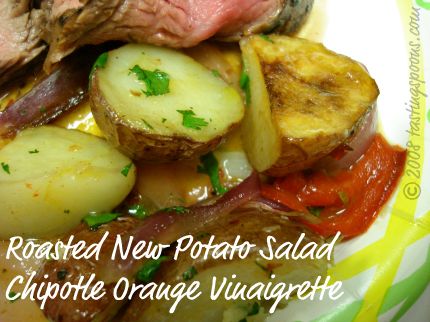
roasted new potato salad with chipotle orange vinaigrette

If you’re looking for something totally different for the Fourth of July (other than the typical hamburgers, hot dogs, steaks or ribs with traditional potato salad) this might be your ticket. This came from a Phillis Carey cooking class last month. And it’s just delicious. Obviously, the chipotle vinaigrette makes the dish. No question! The original recipe called for more dressing, but it’s more than you need, so I halved that part of it. This is best served warm or at room temp – you need to give the potatoes time to absorb the dressing anyway.
printer-friendly PDF

Roasted New Potato Salad with Chipotle Orange Vinaigrette

Recipe By: Phillis Carey
Servings: 8
COOK’S NOTES: If potatoes are 1 inch in diameter or larger, cut them into fourths. The original recipe contained double the ingredients for vinaigrette, but you don’t need all the dressing. You’ll like it served on other vegetables if you want to make more.

4 pounds red potatoes — tiny size, cut in halves
2 medium red onions — sliced, 1/2 inch strips
1 large red bell pepper — strips 2″ x 1/4 inch
2 tablespoons olive oil
2 tablespoons cilantro — chopped
VINAIGRETTE:
1/2 teaspoon orange zest
1/2 cup fresh orange juice
2 tablespoons white wine vinegar
1 1/2 teaspoons chipotle chile canned in adobo — minced, canned
3/4 teaspoon salt
1 teaspoon garlic — minced
1/2 teaspoon brown sugar
1/2 cup extra virgin olive oil

1. Preheat oven to 400 F. In a large flat roasting pan toss potatoes, onions, red peppers and olive oil to coat. Season with salt and pepper. Roast for 35-40 minutes or until tender and brown.
2. Combine vinaigrette ingredients in a blender and puree. Ross vinaigrette with the warm potatoes and vegetables. Sprinkle cilantro over the top and serve warm or at room temperature. Allowing it to sit for 25-35 minutes before serving allows vinaigrette to soak into the vegetables.
Per Serving: 358 Calories; 17g Fat (42.2% calories from fat); 6g Protein; 48g Carbohydrate; 5g Dietary Fiber; trace Cholesterol; 219mg Sodium.

Posted in Beef, on June 12th, 2008.

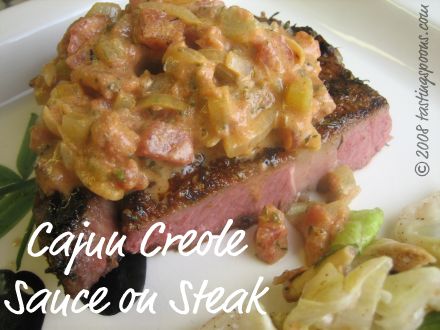
cajun rubbed filet mignon with creamy creole sauce

Another winner of a Phillis Carey recipe. I get a kick out of the titles she gives her recipes – she doesn’t want you to miss a thing when you hear or read the recipe title. You need to know that it has Cajun spices. You need to know that it’s a filet mignon. And lastly, that it has this delicious, scrumptious Creole sauce – with cream – in it too. She laughs at herself when she talks about the recipe titles – even she gets them mixed up sometimes when she’s demonstrating them in a cooking class. But with the recipe in front of us, the students, we take notes, adding her little quips to the process.

Several weeks ago my friend Cherrie and I went to a cooking class (entrees for entertaining) and this recipe was one of them. Phillis used a filet mignon. When I made this sauce a few nights ago, I only had frozen New York steaks, so I used them instead. So I just made the sauce in a separate pan, and my DH grilled the steaks on the outdoor barbecue. He’s got the drill down-pat. Sear, mark the meat, both sides, put on a rack not over direct heat, stick in the meat thermometer and remove the steak at 122 degrees F. The meat was solidly pinky-red all the way through except for the flat sides, which were appealingly grilled brown.

The sauce, meanwhile, was a snap to mix up. I had everything on hand except green bell peppers (a staple in the Creole diet), but I just used some extra celery instead. No biggie. I even had the fresh herbs in our garden and used more than was called for. My DH just loved the sauce. Wanted to know exactly what was in it and how I made it. Every so often he asks detailed questions about something I’ve made. I used to think – aha, he’s going to surprise me and fix a full meal some night. Uh, no. He thinks sometime he might entertain some of his friends when he spends the night on our boat and whip out this great sauce. But he never remembers what I’ve told him.

At any rate, this steak and the sauce were delicious. And yes, they’d be quite suitable for a company meal. The sauce doesn’t make all that much, actually. If you really like sauce, I’d increase it by 50% so you’ll have more.
printer-friendly PDF

Cajun Rubbed Filet Mignon with Creamy Creole Sauce

Recipe By: Phillis Carey
Servings: 4 (probably more)

STEAK & RUB:
2 1/2 tablespoons paprika
2 tablespoons kosher salt
2 tablespoons garlic powder
1 tablespoon freshly ground black pepper
1 tablespoon onion powder
1 tablespoon dried oregano
1 tablespoon dried thyme
1 teaspoon cayenne
2 pounds fillet mignon — 4 steaks, 1 1/4 inches thick
2 tablespoons vegetable oil
CREOLE SAUCE:
2 tablespoons unsalted butter
1/4 cup onions — diced
1/4 cup celery — diced
1/4 cup green bell pepper — diced
1 teaspoon Cajun Creole spice (from rub recipe above)
1 teaspoon sugar
1/4 cup dry vermouth
14 1/2 ounces diced tomatoes — drained
1 teaspoon hot sauce
1/2 cup heavy cream
1 tablespoon fresh oregano
1 tablespoon fresh thyme

1. STEAKS: Combine all the rub ingredients in a small bowl. Reserve 1 tsp. for the sauce. Coat the steaks well and let stand at room temp for 45 minutes.
2. Heat a heavy skillet over high heat until very hot. Brush both sides of the steaks with olive oil and add to the hot skillet. Cook 4-6 minutes per side to desired doneness, lowering heat towards the end to prevent burning. Steaks may also be grilled.
1. SAUCE: Melt butter in a medium skillet over medium high heat. Add onions, celery and bell pepper and cook until tender, stirring occasionally, about 5 minutes. Stir in the reserved Cajun Creole spice and the sugar. Add the dry vermouth and bring to a boil.
2. Stir in tomatoes, hot sauce and cream and bring to a simmer. Cook until mixture reduced slightly and thickens, about 10 minutes. May be made ahead to this point.
3. Stir in fresh herbs, season to taste with salt, pepper and hot sauce. Serve spooned over steaks.
Per Serving (I think this would serve more than 4 people, but this is the original recipe and Phillis thinks everyone would eat 8 full ounces of meat): 945 Calories; 77g Fat (73.4% calories from fat); 44g Protein; 19g Carbohydrate; 4g Dietary Fiber; 216mg Cholesterol; 2995mg Sodium.

Posted in Soups, on June 11th, 2008.

When my friend Cherrie and I divided up the food prep for our luncheon tea last week, she opted to make the chilled soup. And what a lovely one it was. The recipe came from an article in the Los Angeles Times food section, and was a soup served at the St. Regis Monarch Beach Resort, a very luxury resort right on the Pacific Ocean in Dana Point, here in Southern California. When the resort first opened some years ago, Cherrie and I had breakfast there, and another time we went for lunch. But we ate in the café, which is pricey, to say the least. For a café. They did have a dinner restaurant there, called Aqua, but it’s since been replaced by another restaurant, Stonehill Tavern. I haven’t eaten at either one, but while the chef, Alan Ashkinaze was at Aqua, he provided this recipe.

The soup is so low in calorie it’s almost non-existent (yes, really, just 67 calories), it has zero fat, and is so refreshing. You make simple syrup with lemongrass as a subtle undercurrent. The soup itself is watermelon, cantaloupe, peach and blueberries. Then it’s also accented with cayenne, Cointreau, champagne, fresh mint, orange juice and club soda. Does that not sound unusual? I just loved it. Not everyone did, however (don’t know why, and certainly wouldn’t ask). But if you enjoy fruit, and you like some unusual combinations, try this. Sorry for the blurry picture – I had to snap it in a big rush as the ladies were about to sit down.


printer-friendly PDF

Watermelon Blueberry Soup

Recipe By: Chef Alan Ashkinaze of now-defunct Aqua, St.Regis Monarch Beach Resort
Servings: 8

1/4 cup sugar
1 cup water
2 tablespoons white wine
1 stalk lemongrass
1 1/4 cups watermelon — peeled, cubed
1/4 cup peach — peeled, cubed
1/2 cup cantaloupe — peeled, cubed
1/4 cup blueberries — divided use
1/4 cup fresh orange juice
1 1/2 teaspoons mint — cut in chiffonade (tiny shreds)
1 pinch cayenne
1 1/2 teaspoons Cointreau
6 tablespoons champagne — or sparkling white wine
3 tablespoons club soda

1. Combine the sugar, water, white wine and lemongrass in a saucepan. Bring to a boil. Lower the heat and gently simmer, uncovered, for 20 minutes. Turn off heat and let mixture steep for at least 1 hour. Strain and set aside.
2. In a blender, combine the watermelon, peach, cantaloupe and HALF the blueberries. Puree until smooth. Strain the mixture through a chinois or fine sieve (if you have a juicer, you can use it instead of a blender and skip this step because a juicer will strain the fruit.) Add the orange juice and some of the lemongrass simple syrup to taste, about 1-2 tablespoons. Chill the mixture.
3. Just before serving, cut the remaining blueberries in half and place in a small bowl. Add the mint, ground cayenne pepper, a pinch of salt and 1/4 teaspoon of Cointreau. Stir gently and divide among 8 demitasse cups or small glasses.
4. To the watermelon mixture, stir in 1 1/4 teaspoons Cointreau, the champagne and club soda. Divide the mixture among the cups, pouring over the blueberries. Serve immediately.
Per Serving: 67 Calories; trace Fat (3.3% calories from fat); 1g Protein; 14g Carbohydrate; trace Dietary Fiber; 0mg Cholesterol; 5mg Sodium.

Posted in Desserts, on June 10th, 2008.

ginger scones ready for baking

My problem is: I love “afternoon tea.” It’s just so fun. And I love the food that is typical of such a tea. So it was that my friend, Cherrie, and I joined hostess forces and invited 10 of our friends to tea at my house last week. We started planning it a couple of months ago, and within about 5 minutes we’d decided on the menu and who would be invited. The date was set, invitations were mailed, and we both did an ample amount of cooking. Anyone who says doing an “afternoon tea” is easy is crazy. Even with both of us cooking and preparing the food, and with one of the guests helping an hour ahead and at hour after (thanks again, Joan), it was a tremendous amount of work. We made everything (except the fruit tarts) ourselves. I got to dig out all of my grandmother’s fancy frilly china plates and teacups and saucers. And used some beautiful pink hydrangeas from our garden as a centerpiece.

We had decided to do it at lunchtime, so we called it a “Luncheon Tea.” But the menu was typically English tea. We had:

Pink Champagne with Strawberry Puree Ice Cubes
(I didn’t take a photo of that – oh darn – but it was VERY pretty and everybody loved it – no recipe for this one)

Watermelon Blueberry Soup
(delicious – just delicious – most people liked it, although not all)

Chicken Salad Sandwiches
(different, with chopped smoked almonds on the outside edges)

Ham Mousse Sandwiches
(very different – with whipped cream in the filling)

Smoked Salmon Sandwiches with Dill
(just buttered bread, smoked salmon and fresh dill peeking out of the edges –
no recipe for this one as it’s so easy)

Mini Fruit Tarts
(the only thing we purchased)

Sarah’s Ginger Scones
(uses candied ginger pieces in the batter)

Golden Raisin Scones
(my tried and true favorite, posted long ago)

Chocolate Scones
(posted recently, also well liked)
(All of the scones were served with lemon curd, clotted cream and black currant jam)

Chocolate Ribbon Dessert
(like a chocolate pie but in a 9×13 pan, cut into small squares)

Earl Grey Tea
Lemon Rose Tea (herbal, from Peet’s)
Marco Polo Tea (a blend from Mariage Freres in Paris)
(from when I was there 2 years ago, and this was the hands-down favorite)

In the next week I’ll likely post most of these recipes. The only one I’m missing is the ham mousse (from a cooking class herrie has it and I’ll get it from her.

The ginger scones are Sarah’s recipe – from a cooking class in San Juan Capistrano. Sarah is from Scotland, and over the years we enjoyed several of her family favorites on the cooking school menu. These are easy to make, and I decided to do something totally different – I made the scones and froze them all raw the day before the tea. Gosh, why didn’t I do this years ago? All you have to do is take them out of the freezer about 20 minutes ahead of baking (when you turn on the oven) and increase the baking time by a few minutes (maybe 5 or so). I may never, ever, make them fresh again – just pop one or two out of the freezer when I want them for breakfast. Or a bunch when I need to serve something for my DH’s Bible Study Group. Of course, they won’t keep indefinitely in the freezer, but will likely be fine for a couple of months!
printer-friendly PDF

Sarah’s Ginger Scones

Recipe By: Sarah at Our House South County cooking school
Serving Size: 12 (maybe 14)
Serving Ideas: Be SURE to serve with clotted cream (Devon cream) and ginger preserves.

4 cups all-purpose flour
1/4 cup sugar
1 teaspoon salt
2 tablespoons baking powder
1/2 cup unsalted butter — cold, cut in tiny bits
1 3/4 cups buttermilk
1/4 cup candied ginger — chopped, or more if desired (also called crystallized ginger)
1 whole egg
1 teaspoon sugar — for top glaze

1. Preheat oven to 375 F.
2. Prepare silpat (or parchment) lined baking sheet (one large or two smaller ones). In a large mixing bowl, sift together the flour, sugar, baking powder and salt. Add butter and blend with a pastry cutter, or work the butter into the dry ingredients with your fingertips. Do this until it forms fine crumbs. (Alternately, use a pastry blender and cut and mix until the mixture is like fine crumbs.) Add the candied ginger and combine uniformly. Add the buttermilk and stir with a fork just until it comes together and forms a dough.
3. Turn the dough out onto a lightly floured work surface and knead for about one minute. Roll out to thickness desired (about 3/4 inch is best). Use biscuit cutter to cut rounds. Pat together the scraps and reroll to cut more. Place scones on the baking sheet and brush tops with egg mixed with the sugar.
4. Bake for 20-25 minutes until puffed and golden on top. Serve immediately. These may also be frozen raw. Defrost at room temp for 20 minutes and bake about an additional 5 minutes.
Per Serving: 271 Calories; 9g Fat (29.3% calories from fat); 6g Protein; 42g Carbohydrate; 1g Dietary Fiber; 40mg Cholesterol; 467mg Sodium.

Posted in Desserts, on June 9th, 2008.

chocolate ribbon dessert - chocolate pie
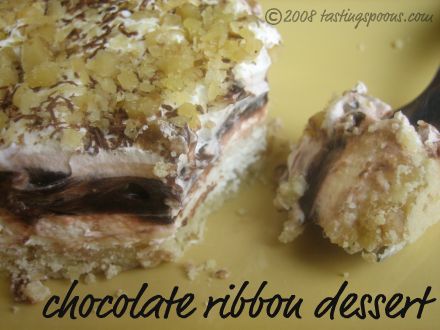
My mother came from the era of 3×5 cards for her recipes. And when I was searching for just the right chocolate dessert to serve at the tea the other day (more about the tea later), this recipe floated out of the stack. It’s not an old-time recipe (probably it’s from the 1970’s), after the advent of Cool Whip and instant chocolate pudding anyway. I found some other versions on the internet, but none by this exact name. So I have no idea of the origin of this one. It’s basically a layered chocolate (and whipped cream) pie with walnuts.

The crust is a simple press-in bottom layer in a 9×13 pan (walnuts, flour, butter). Once that’s baked and cooled, you make a cream cheese layer (with powdered sugar, Cool Whip and the cream cheese), then a thick chocolate pudding layer. Then it’s topped with more Cool Whip and chocolate shavings and more nuts on top. This is a VERY simple and easy dessert. And it could feed a big crowd if you don’t cut very big pieces. It went well with the tea because I could cut it up into smaller pieces to look more like “tea” sized servings. We had ample leftover. It is best made the day ahead, and actually keeps for several days.
printer-friendly PDF

Chocolate Ribbon Dessert

Recipe By: Unknown, handed down to me by my mother in about 1980.
Serving Size: 16

PASTRY-NUT CRUST:
1 cup flour
1/2 cup unsalted butter
1/2 cup walnut — minced
CREAM CHEESE LAYER:
8 ounces cream cheese — at room temperature
1 cup powdered sugar
8 ounces Cool Whip®
CHOCOLATE PUDDING LAYER:
6 ounces chocolate pudding mix — instant, regular or sugar-free
2 1/2 cups 2% low-fat milk
TOPPING:
4 ounces Cool Whip®
1 tablespoon chocolate curls — or more as needed
1/3 cup walnuts — minced

1. CRUST: Combine flour, butter, nuts and mix together. Press into bottom of a 9×13 pan. Bake for 10-15 minutes at 350 until just slightly golden brown. Cool.
2. CREAM CHEESE LAYER: Beat together the cream cheese, powdered sugar and Cool Whip. Mixture is a little stiff, so be careful as you slather it over the prepared crust. Gently push into corners without lifting up the crust. Chill if you have time; otherwise leave out while you prepare the pudding.
3. PUDDING LAYER: Mix the large package of instant chocolate pudding with the milk. Beat vigorously with a wire whisk until completely smooth. Pour over cream cheese and spread into corners. Cover and chill completely.
4. TOPPING: Once dessert is chilled, spread the Cool Whip over the pudding layer, spreading into the corners. Chill again. Sprinkle top with shaved chocolate and nuts (or coconut, if you’d prefer). May be made a day ahead, but not longer than that.
Per Serving: 348 Calories; 21g Fat (54.7% calories from fat); 5g Protein; 34g Carbohydrate; 1g Dietary Fiber; 34mg Cholesterol; 106mg Sodium.

Posted in Books, Cookbooks, on June 7th, 2008.

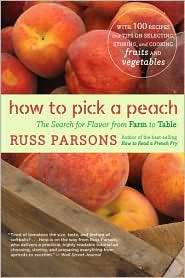
Russ Parsons’ book, How to Pick a Peach

It’s been six months or so ago that somebody, on another blog, mentioned Russ Parsons’ most recent book, “How to Pick a Peach:.” I always enjoy reading his columns in the Los Angeles Times, but hadn’t looked at the book. Visiting the library recently, it was there and I checked it out. This isn’t a memoir. It isn’t exactly a cookbook, either. It is, however, an excellent guide and history about the most popular/common of the produce we eat on a day-to-day basis. I really expected to be bored to tears. Wrong. I started reading at the beginning and read it all the way through.
Parsons has included recipes with every chapter, his favorites for that particular vegetable or fruit.

The history and story parts about each one are fascinating. Now, I’ll admit, this isn’t exactly like reading Robert Ludlum, but if you’re a foodie, and you enjoy choosing and EATING better tasting produce, you might want to read this book.

I don’t know about you, but I have a hard time – sometimes – choosing the best produce. Even celery, for goodness’ sake. What IS it with celery lately – seems like I keep choosing heads that are air and hollow within the stalks. Heavy with strings. Seems like more than ever. Even lettuce – every 3-4 heads I buy, once I cut into it, it’s got rust inside. And tomatoes. I adore tomatoes, but rarely do I buy anything except vine-ripened anymore, or the little tiny ones. And then there’s apricots. I’ve been so disappointed the last couple of summers with really poor tasting apricots – mealy flesh and not good to eat. Even peaches and nectarines are spotty at best. So, that’s why I picked up the book in the first place. I hoped to find answers. Only time will tell whether the advice is useful for shopping in a traditional grocery store. Farmers’ markets usually offer better choices and fresh ones too, but it’s not always convenient.

So after finishing the book I got to thinking about how I could possibly remember all the advice offered in the book. I can’t exactly carry the book around with me every time I shop. I thought about using a big yellow pad and writing down the crux of each one (refrigerate, not refrigerate, picking large vs. small, the coloring of fruits, why to buy one variety over another). You know, that kind of thing. But I realized this written thing was going to be quite long and detailed. Not something I’d haul around with me in my purse when I go to the grocery story or farmer’s market. What to do, what to do? I could put it into my Palm pilot which goes with me most places. That actually might work; I’d just have to navigate to that file and then find the right section describing the produce I’m pondering. And I may just do that. Or, I could try to write just the barest of details onto 3×5 cards that could live in my purse. I already carry around 3 such cards with slaps of paint on them with the wall colors in our home, so adding 2-3 more would not be a big deal.

So what did I do? Well, I haven’t written it up for my Palm yet, but I will. Nor have I written up the 3×5 cards, either. But first I went out and bought the paperback edition of this book so I can mark up the pages however I wish. There were 8-10 recipes in the book that I wanted to keep anyway of the 100 in the entire book.

What I did decide to do, though, is share some of the information with you. And in the process, I’ll synopsize each chapter with the shortest of details you and I will need to buy the best stuff. And I’ll include some of the interesting facts about the different fruits and vegetables in Parsons’ book. You’ll learn something, and I’ll maybe retain more of the information in my brain if I have to write it up! That’s my plan. I’ll need to take my camera with me to the grocery store next time to take photos of lots of different kinds of vegetables and fruits. Especially the summer fruits that we only see some months of the year anyway. So, stay tuned.

Posted in Desserts, on June 6th, 2008.

panna cotta, easy, Dr. Oetker Panna Cotta

The other day I walked into my pantry – I have nice, big walk-in type – and glanced around at the bulging shelves. What to fix? I was looking for something else, but my eyes landed on this box mix for panna cotta that I bought many months ago.

I don’t know about you, but I’m a sucker for any jars and bottles of things, like pickled onions, relishes, chutneys, toppings for cheese, or fruit. Even occasionally a sauce. But this was a box, and even those who don’t know me well, will perhaps recognize early on that I rarely use a box mix for anything.

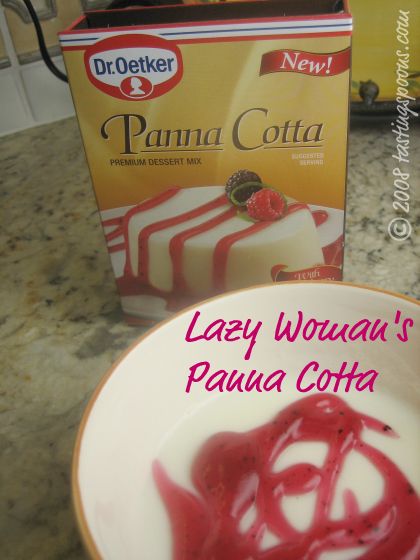
Panna cotta happens to be one of my favorite desserts. It’s relatively easy to make, but when I read the ingredients in this little Canadian Dr. Oetker panna cotta box mix, there wasn’t really anything suspicious in it. And it looked like it took no time at all to make. Even less time than the real thing, and it didn’t have to bake or cook except for heating milk and water.

Sure enough, it was absolutely cinchy easy. It took less than 10 minutes to make the entire thing. You heat up a cup of milk to a simmer, remove from the heat, and stir in the contents of one of the little packages in the box. Once whisked in, you add a cup of heavy cream and whisk some more. Pour into serving bowls and cool, then chill. Meanwhile, the other package contains a nice raspberry sauce. This dry mix is combined with a half a cup of boiling water, and it’s done too.

I didn’t have time to chill the pannas for 2 hours, as suggested, so I put them in a pan surrounded by ice cubes and they were well enough chilled to serve (I did it in the little bowls instead of turning them out onto a serving plate) in about 45 minutes. I was amazed. They were delicious. I may need to have one of these boxes on hand for those occasions when I need a dessert – quick like. I bought it at Cost Plus World Market for $2.49. Probably last year. It’s Dr. Oetker brand. I’d recommend it, believe it or not!

Posted in Grilling, Pork, on June 5th, 2008.


rosemary grilled pork loin

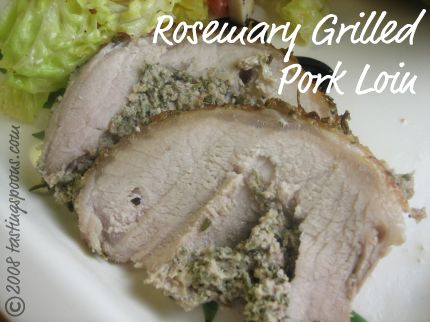
Needing to clean out my freezer in preparation for receiving a quarter of a 4-H pig in a month, I’ve been working diligently to discard old stuff that I’ll never use and cook up things that have been hiding in corners. I had this nice 2-pound boneless pork loin roast, but what to do with it? I turned to my newest favorite grilling book: The Barbecue Bible by Steven Raichlen. Sure enough, he had several pork loin recipes. This one fit the bill since it didn’t require me to run to the grocery store. All I needed was garlic (yup), rosemary (yup, out of the garden, in abundance), salt, pepper and olive oil. How cinchy is that?

Ideally you’ll want to marinate this roast for a few hours with the herb-garlic mixture all over it, but I didn’t have the time. I’d forgotten to defrost the roast until about noon the other day, so soaked it in cold water (all sealed up) for several hours. Some parts of the middle were still a bit on the frosty side, so I opened up the roast (which is a procedure in the recipe anyway) and let it sit at room temp for about 20 minutes.

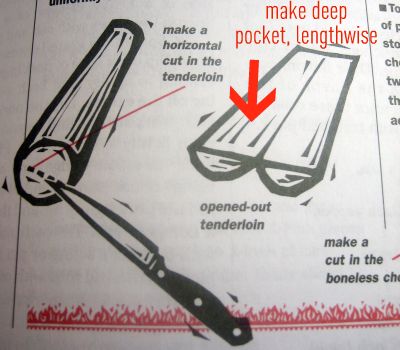
how to butterfly a pork roast or tenderloin
photo, from Raichlen’s The Barbecue Bible, showing how to butterfly a pork tenderloin. I used the same technique for a pork roast.

The recipe indicates using a mortar for grinding up the herb mixture, but I had frozen little cubes of garlic to use (pureed) and it took no time at all to mince the fresh rosemary. I just minced and minced and minced with my long santoku knife, then mashed in the garlic, salt, pepper, and finally the oil. It took no time at all to make. I’m including a photo of a page in the cookbook about butterflying the meat. The meat I had was from Costco, and it was already rolled. I opened it up (it was already butterflied), but then you cut shorter pockets in each side (in the fat side of the loins) – not all the way through, and leaving ½ inch at each end. So it’s a kind of slot. To stuff the herbs into. You slather half of the mixture on the inside edges, reform the roast, tie it up (I used those nifty reusable baking rubber bands), then slather the remaining herbs on the outside.
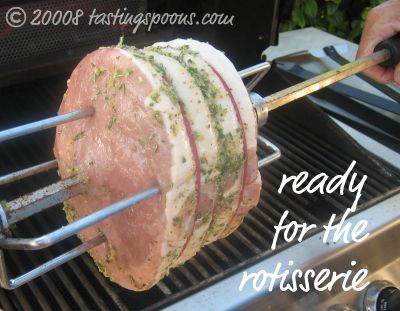
rosemary grilled pork loin ready for the rotisserie

We decided to rotisserie the roast. My DH warmed the grill to high, and between us we positioned the rotisserie prongs in the meat and started it up. You can also do this over indirect heat on the grill itself (positioning a drip pan under the grill, however). It took about 70 minutes for our roast to reach 160 degrees F. We removed it, let it rest for about 5 minutes while I quick-like arranged the artichoke half I’d just pressure-cooked, and a nice green salad. I had meat from the inside of the roast – it was delicious – absolutely mouth-filling with the garlic and rosemary. Loved it. DH had a slice from the outside, and he thought it was a bit overdone. Next time I’d remove the roast at 155 degrees F. and let it sit. And I’d push the pocket to almost the end, so only the very outside slice would be without some of the herb mixture in it. I might also make a sauce to serve with this – a pan sauce would be easy enough to do. Maybe just chicken broth, rosemary and garlic, perhaps some chopped up dried apricots. Boiled and thickened, then with some added butter just at the end. Just a thought. I’ll be making this again, in any case.
printer-friendly PDF

Rosemary Grilled Pork Loin

Recipe By: The Barbecue Bible by Steven Raichlen
Serving Size: 4

6 cloves garlic — peeled
1/4 cup fresh rosemary leaves — minced
1 tablespoon kosher salt
1 tablespoon freshly ground black pepper
2 tablespoons olive oil
2 pounds boneless pork top loin roast

1. Combine the garlic, rosemary, salt and pepper in a mortar and pound to a smooth paste with the pestle, then work in the oil. Alternately you may use a spice mill or mini chopper and process until it’s a puree.
2. Using a long, sharp knife, cut the pork roast almost in half lengthwise (butterfly it). Open out the meat, then carefully cut a pocket in each side (lengthwise). Do not cut all the way through or at each end, either. It should make a small oval space, leaving about 1/2 inch at each end. Spread half of the herb mixture on the inside of the meat, then reassemble the meat and tie with kitchen twine in 1-inch intervals, then spread the remaining herb mix on all sides of the outside of the roast. If time permits, allow this to marinate in a plastic bag for 2-4 hours. Allow to sit at room temp while you fire up the grill.
3. ROTISSERIE: Preheat the grill to high and set it up for rotisserie. Skewer the roast lengthwise and insert into the grill. Allow it to rotate until it’s well browned and cooked through, to 160 degrees F. Or, you may remove it at 155 degrees and allow to sit for 10 minutes until it reaches 160.
4. INDIRECT GRILLING: Set up grill for indirect grilling, placing a drip pan in the center. Preheat the grill to medium, grease the grill with oil, then place the roast on the grill over the drip pan, cover and cook until internal temperature registers as above, about 1 to 1 1/2 hours. Remove to a cutting board, remove string and cut roast into thin slices crosswise. Serve, hot, warm or at room temperature (the way they do it in Italy).
Per Serving: 329 Calories; 16g Fat (46.3% calories from fat); 40g Protein; 3g Carbohydrate; 1g Dietary Fiber; 100mg Cholesterol; 1494mg Sodium.

Posted in Beef, Grilling, on June 4th, 2008.

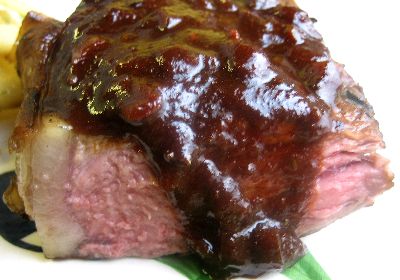
ribeye steaks with amazing glaze

So, there was a blurb by John Willoughby in June’s issue of Gourmet that almost missed my radar. Here’s the blurb quoted from the magazine:

Myth: Searing meat at the beginning of cooking helps seal in the juices.

Facts: Despite its impressive heritage (Escoffier himself espoused the concept), this well-known axiom is completely false. In his book The Curious Cook, food scientist Harold McGee explains how he cooked a series of identical steaks with and without initial searing, then measured the moisture loss from each. The results were clear – the seared steaks actually lost a bit MORE juice during cooking. There is, however, a very good reason to give meat a nice, hard sear when it first goes into the pan. Thanks to a chemical process called the Maillard reaction, it creates literally hundreds of new flavor compounds that give the meat a much deeper and more complex flavor.

 Thank goodness for that last sentence; otherwise we’d be eating gray meat from hereon in. But, they missed one other ascetic – meat just plain LOOKS better when it’s been marked or seared, don’t you think? Photo above is our favorite grilled beef: Ribeye Steaks with Amazing Glaze.

Related Posts Plugin for WordPress, Blogger...