


Get new posts by email:

Archives

Currently Reading

Here are the tastingspoons players. I’m in the middle (Carolyn). Daughter Sara on the right, and daughter-in-law Karen on the left. I started the blog in 2007, as a way to share recipes with my family. I’m still doing 99% of the blogging and holding out hope that these two lovely and excellent cooks will participate. They both lead very busy lives, so we’ll see.

– – – – – – – – – – – – – – – – – – – – – –

BOOK READING (from Carolyn):

Music of Bees, Eileen Garvin. Absolutely charming book about a woman in midlife, lonely, who raises bees, also makes unlikely friends. Heart-warming and very interesting about beekeeping.

A Postcard from Paris, Alex Brown. Really cute story. Dual time line, 1940s and present day about renovating an old apartment in Paris, things discovered.

Time of the Child, Niall Williams. Oh such a good book. Very small village in Ireland, 1960s. A baby is left on the doorstep. The town all whispers and helps. I listened to an interview of the author, which made me like him and his books even more.

Sipsworth, Simon Van Booy. If you like animals you’ll swoon. An old woman who really wants to die finds a tiny mouse in her house and befriends it and finds a reason to live. Utterly charming book.

The Forger’s Spell, Edward Dolnick. True story. For seven years a no-account painter named Han van Meegeren managed to pass off his paintings as those of Johannes Vermeer.

If You Lived Here, You’d be Home by Now, Christopher Ingraham. Could hardly put it down – about a journalist who takes on a challenge to move to small town in Minnesota and write about it. He expects to hate it and the people and place, but he doesn’t. Absolutely wonderful true story.

The River We Remember, William Kent Kreuger. 1950s, Minnesota. A murder and the aftermath. Could hardly put it down. Kreuger has such a vivid imagination and writing style.

How the Lights Gets In, Joyce Maynard. An older woman returns to New Hampshire to help care for her brain-injured son. Siblings and family, lots of angst and resentments.

The Filling Station, Vanessa Miller. Every American should read this book. A novelized retelling of the Tulsa massacre in 1921. Absolutely riveting.

The Story She Left Behind, Patti Callahan Henry. Love this author. Based on a true story. A famous author simply vanishes, leaving her husband and daughter behind. She had invented a mystical language no one could translate. Present day, someone thinks he’s solved the riddle, contacts the family. Really interesting read.

The Girl from Berlin, Ronald Balson. Love anything about Tuscany. An elderly woman is being evicted from a villa there, with odd deed provenance. Two young folks go there to help unravel the mystery. Loved it.

The Island of the Colorblind, Oliver Sacks, M.D. Nonfiction. The dr is intrigued by a remote Pacific island where most of the inhabitants are colorblind. He also unravels a mystery on Guam of people born with a strange neurological problem. Medical mysteries unveiled. Very interesting.

The Bookbinder, Pip Williams. Post 1914 London. Two sisters work at a bookbindery. They’re told to not read the books. One does and one doesn’t. One has visions beyond her narrow world; the other does not. Eventually the one gets into Oxford. Lovely story.

The Paris Express, Emma Donoghue. 1895 on a train to Paris, a disaster happens. You’ll delve into the lives of many people who survived and died in the crash.

A Race to the Bottom of Crazy, Richard Grant. This is about Arizona. Author, wife and child move back to Arizona where they once lived. Part memoir, research, and reporting in a quest to understand what makes Arizona such a confounding and irresistible place.

The Scarlet Thread, Francine Rivers. A woman’s life turned upside down when she discovers the handcrafted quilt and journal of her ancestor Mary Kathryn McMurray, a young woman who was uprooted from her home only to endure harsh frontier conditions on the Oregon Trail.

A Place to Hide, Ronald Balson. 1939 Amsterdam, an ambassador has the ability to save the lives of many Jewish children. Heartwarming.

Homeseeking, Karissa Chen. Two young Chinese teens are deeply in love, but in China. Then their families are separated. Jump to current day and the two meet again in Los Angeles.

North River, Pete Hammill. He always writes such a good story. A doctor works diligently healing people from all walks of life. His wife and daughter left him years before. One day his 3-yr old grandson arrives on his doorstep.

A Very Typical Family, Sierra Godfrey. A very messed-up family. Three adult children are given a home in Santa Cruz, Calif, but only if the siblings meet up and live in the house together. A very untypical scenario but makes for lots of messes.

Three Days in June, Anne Tyler. The usual Anne Tyler grit. Family angst. This wasn’t one of my favorites, but it was entertaining and very short.

Saved, Benjamin Hall. Author is a veteran war reporter. Ukraine, 2022, he nearly loses his life to a Russian strike. Riveting story – he survives, barely.

Grey Wolf, Louise Penny. Another Inspector Gamache mystery in Quebec. She is such an incredible mystery writer.

All the Colors of the Dark, Chris Whitaker. A missing person mystery, a serial killer thriller, a love story, a unique twist on each. Could hardly put it down.

Orbital, Samantha Harvey. Winner of 2024 Booker Prize. I don’t usually like those, but I heard the author interviewed and she hooked me. This is not a normal book with a beginning, a story and an end. It’s several chapters of the day in the life of various astronauts at the ISS (Int’l Space Station). All fictional. She’s been praised by several real astronauts for “getting it” about space station everyday life.

The Blue Hour, Paula Hawkins. An island off Scotland. Inaccessible except when the tide is out. Weird goings on. An artist. A present day mystery too.

Iron Lake, William Kent Krueger. A judge is murdered and a boy is missing. Riveting mystery.

Tell the Wolves I’m Home, Carol Ricks Brunt. 1980s. A 14-yr old girl loses her beloved uncle. Yet a new friendship arises, someone she never knew about.

Four Treasures of the Sky, Jenny Zhang. 1880s, a young girl is kidnapped in China and brought to the United States. She survives with many hurdles in the path.

The Boy Who Fell out of the Sky, Ken Dornstein. Memoir, 1988. The author’s brother died in the PanAm flight that went down in Lockerbie, Scotland. A decade later he tries to solve “the riddle of his older brother’s life.”

Worse Care Scenario, T.J. Newman. Oh my. Interesting analysis of what could/might happen if a jet crashed into a nuclear plant. Un-put-downable.

Song of the Lark, Willa Cather. Complicated weave of a story about a young woman in about 1900, who has a gifted voice (singing) and about her journey to success, not without its ups and downs.

Crow Talk, Eileen Garvin. Charming story which takes place at a remote lake in Washington State, about a few people who inhabit it, the friendships made, but also revolving around the rescue of a baby crow.

The Story Collector, Evie Woods. Sweet story about some dark secrets from an area in Ireland, a bit magical, faerie life, but solving a mystery too.

A Sea of Unspoken Things, Adrienne Young. A woman investigates her twin brother’s mysterious death. She goes to a small town in California to figure it out, to figure HIM out.

The King’s Messenger, Susanna Kearsley. 1600s England, King James. About one of his trusted “messengers,” and his relationship with a young woman also of “the court.” Lots of intrigue.

In the Shadow of the Greenbrier, Emily Matchar. Interesting mystery in/around the area of the famous resort in White Sulphur Springs, West Virginia.

Isola, Allegra Goodman. Hard to describe, survival story on an island in the 1600s.

Save the Date, Allison Raskin. Rom-com, witty, LOL funny. Clever.

The Sirens, Emilia Hart. Numerous time-lines, Australia. Mysteries abound, nightmares, abandoned baby, weird allergies.

Red Clay, Charles Fancher. LOVED this book. Mostly post-Civil War story about the lives of slaves in Alabama during Reconstruction.

Stars in an Italian Sky, Jill Santopolo. Dual time line, 1946 and recent time. Love stories and a mystery.

Battle Mountain, C.J. Box. Another one of Box’s riveting mysteries. Love his descriptions of the land.

Something Beautiful Happened, Yvette Corporon. A memoir of sorts in Greece, tiny island of Erikousa, where the locals hid Jews during WWII. All elusive stories told by the author’s grandmother.

The Jackal’s Mistress, Chris Bohjalian. 1860s Virginia, about a woman who saves the life of a Union soldier. Really good story.

Song of the Magpie, Louise Mayberry. Really interesting story about Australia back in the days when it was mostly a penal colony. Gritty strength of a woman trying to thrive with her farm.

The Boomerang, Robert Bailey. A thriller that will have you gripping the book. About a lot of secrets surrounding the president (fictional novel, remember) and his chief of staff and about cancer. A cure. Such a good story.

Care and Feeding, Laurie Woolever. Really interesting memoir of a woman driven to succeed in the restaurant business. She worked for Mario Batali and then Anthony Bourdain. Gritty stories.

Everything is Tuberculosis, John Green. Maybe not a book for everyone. A real deep dive into the deadly tuberculosis infection, its history. I heard the author interviewed and found the book very interesting.

The Book Lovers Library, Madeline Martin. Fascinating read about Boots’ drug stores’ lending library. And the people who worked in them.

The Arrivals, Meg Mitchell Moore. LOL funny, about a middle-aged couple whose children (and their various family members) return to the family home and the chaos that ensues.

My Life as a Silent Movie, Jesse Lee Kercheval. About grief. A big move to Paris, finding herself a new life with a new set of real blood family.

Escape, Carolyn Jessop. Another memoir about a woman really in bondage in Utah, Mormon plural marriage.


Tasting Spoons

My blog's namesake - small, old and some very dented engraved silver plated tea spoons that belonged to my mother-in-law, and I use them to taste my food as I'm cooking.

Scroll down to the bottom to view my Blogroll

Posted in Desserts, on July 28th, 2009.

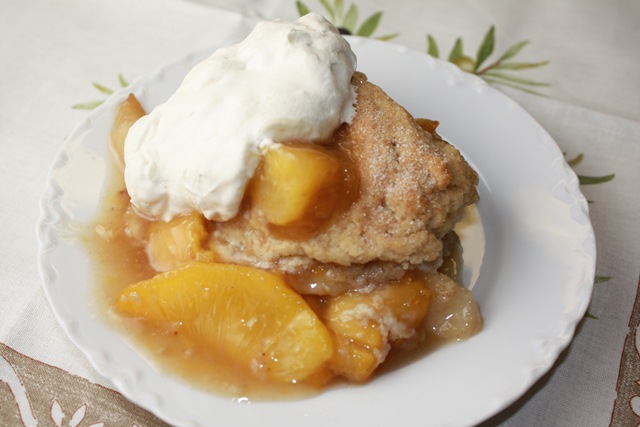
peach cobbler 1

My friend Norma (for whom I’ve been making puddings and custards for a few months) thought maybe she was improved enough that she could tackle some peach cobbler. As long as the topping wasn’t too bready, too dry. Swallowing is still an issue for her. No problem for me to find something to fill that request. I don’t like cobblers with lots of topping either.

My America’s Test Kitchen Family Cookbook has a full-page chart for making fruit cobblers. It suggests 9 different fruit variations, with how much fruit to start with, always using a 9-inch deep dish pie plate, how much sugar to add, how much cornstarch and what flavorings to use. Very helpful. I’ll be referring to this chart again. One of the things I like the best about this cookbook (and Cook’s Illustrated, and America’s Test Kitchen recipes in general) is that they explain why they do some things in recipes. Things that might be contrary to established practice.

In this case it was about baking the peaches for half an hour before adding the biscuits. They found that if you put the biscuits on top of the peaches from the beginning, the bottom part of each biscuit didn’t get baked sufficiently (not enough heat from underneath). So, they completely heated the peaches first by baking them for 20-30 minutes, THEN placed the scoops of biscuit dough on top. Ideally, I suppose, you would eat this all at the first sitting. I don’t know what the biscuits will be like refrigerated for a day or two. Maybe a bit soggy. The recipe also said they’d tried adding oatmeal to the biscuit mixture, and definitely eliminated that option. The oatmeal was too distinctive (overpowering flavor).
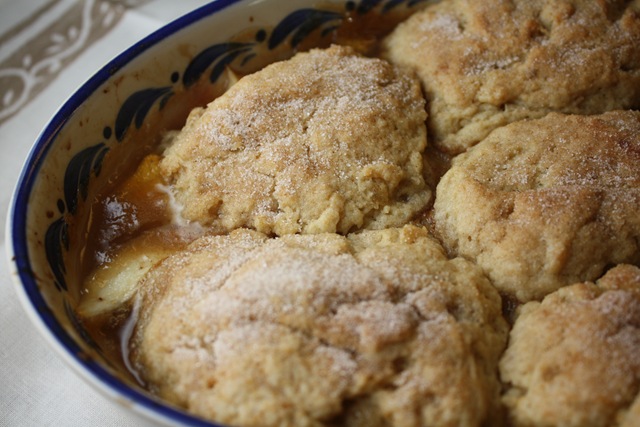
peach cobbler closeup 1

This recipe recommended 4-5 peaches. I wanted more peach to cobbler ratio, so I upped it to about 7. I used a tad more cornstarch too, the lower amount of sugar (it mentioned 1/4 to 1/3 cup). Then it suggested ground cloves, vanilla and brandy. I knew my friend Norma wouldn’t want the brandy, so I made hers without. Since I doubled this recipe, I was able to add the brandy to the one I made for us. As it turned out, the one I made for Norma just happened to have a lot more fluid in it – hopefully just what Norma will like. You may need to flex the cornstarch ratio – if the peaches are really ripe and juicy, the cobbler likely needs a bit more cornstarch.
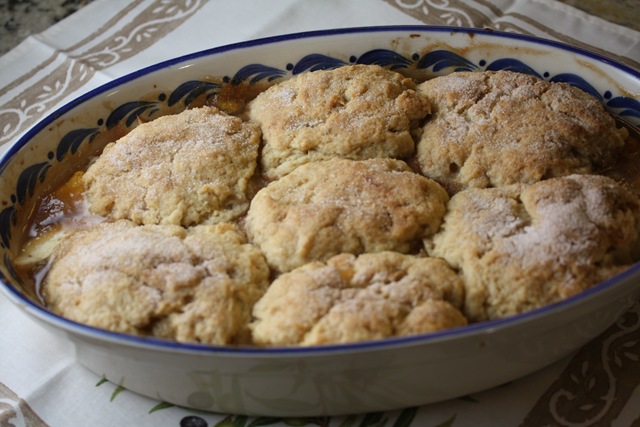
peach cobbler lg 1

The cookbook recipe also suggested a variation with ground and crystallized ginger added to the biscuits. I threw caution to the wind and added the ginger AND the vanilla (and there were ground cloves in the peaches too). Why not, I thought? We liked this a LOT. The sweetness was at a moderate level (I don’t happen to like overly sweet desserts anyway). The buttermilk biscuits? Yum. I liked them a lot. Tender and tasty with the ginger inside. I like that variation a lot, actually. And the little sprinkling of sugar and cinnamon on top? Liked that part too. There wasn’t anything I didn’t like about this cobbler. It may become my new go-to recipe.
printer-friendly PDF

Fresh Peach Cobbler

Recipe: Mostly a recipe from America’s Test Kitchen Family Cookbook
Servings: 8
NOTES: If the fruit is very juicy, it may need a bit more cornstarch. Just add another 1/2 teaspoon. If using frozen fruit, double the quantity of cornstarch.

PEACHES:
2 pounds peaches — peeled, pitted, sliced
3 teaspoons cornstarch
1 pinch ground cloves
1/3 cup sugar — or up to 1/2 cup
BISCUITS:
1 cup all-purpose flour
1/4 cup sugar
2 teaspoons baking powder
1/4 teaspoon baking soda
1/4 teaspoon salt
1/3 cup buttermilk
4 tablespoons unsalted butter — melted and cooled
1/2 teaspoon vanilla
1/4 cup crystallized ginger — minced
1/2 teaspoon ground ginger
TOPPING:
2 teaspoons sugar
1/4 teaspoon cinnamon

1. Preheat oven to 400.
2. Prepare the fruit and place in a large bowl. Add the cornstarch and sugar, stir well. Pour into a 9-inch deep-dish pie plate. Place it on a foil-lined rimmed baking sheet (curl up the foil edges in case of spillover).
3. Bake fruit for about 20-30 minutes until the fruit begins to release liquid.
4. Meanwhile, whisk the flour, sugar, baking powder, soda. salt, crystallized ginger and ground ginger together in a large bowl. In a separate bowl whisk the buttermilk, melted butter and vanilla together. In a third bowl toss together the topping of sugar and cinnamon and set aside.
5. Remove the peaches from the oven. Then add the buttermilk and butter mixture to the dry mix. Stir just until all the loose flour is incorporated. Using a spoon, make about 8 small globs of biscuit mix. Flatten very slightly, then place them on top of the hot fruit.
6. Sprinkle the tops of the biscuits with the cinnamon-sugar mix, then place the pie plate back in the oven for another 15-20 minutes, until the biscuits are golden brown.
7. Remove from sheet pan and cool. Serve warm with whipped cream or ice cream.
Per Serving: 233 Calories; 6g Fat (22.9% calories from fat); 3g Protein; 44g Carbohydrate; 2g Dietary Fiber; 16mg Cholesterol; 243mg Sodium.

A year ago: Barbecued Beans
Two years ago: Crisp Apple Pudding (my mother’s recipe, one of my very favorite recipes ever)

Posted in Desserts, Essays, on July 27th, 2009.

IMG_0525

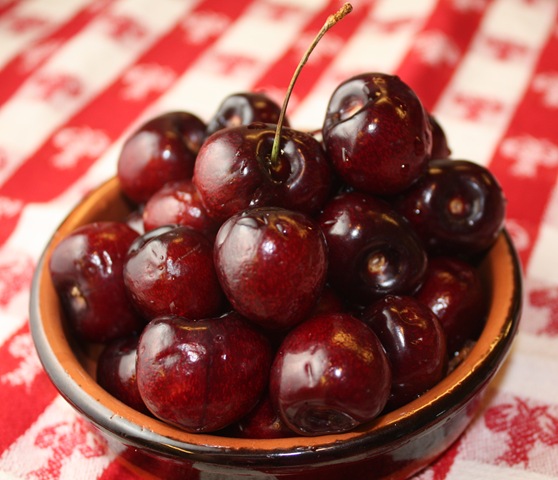
On our recent driving trip through California, Oregon and Washington, we saw a multitude of roadside stands hawking cherries. Bings. A few Rainiers. The season is short, as we probably all know. It wasn’t always that way, apparently. Back in the day (probably the 1800’s) a plentiful variety ripened at different times. But somebody, in their infinite wisdom (?) decided it would be better to choose one variety and have them all harvest at the same time (more efficient . . . they decided). Hence the Bing. Our favorite national cherry.

Well, except in Michigan, where they grow about 240 MILLION pounds of sour cherries. But would you believe that 239 million of them end up in cans? Yup. Only about a million of them end up being eaten fresh, and only in Michigan.

Most cherries are grown on the West Coast (Washington, Oregon and California), and they make up about 65% of the marketable cherries in the U.S. I like how Russ Parsons (all this data comes from his book, How to Pick a Peach) describes the flavor:

  • [A Bing] “is about as good as any cherry variety that has ever been grown – crisp on the outside, with a melting center that saves it from being crunchy; dark and sweet, with a nice tart backbone.”

It’s the “tart backbone” that I like. But anyway, so the legend goes, the Bing variety was found in 1875 on the farm of eastern Washington agricultural pioneer Seth Lewelling – by a Chinese workman named Ah Bing. Isn’t that just too cute? Now, there are 4 cherry categories (Bigarreaux (or Black, of which Bing is one), Dukes, Hearts and Sours. Hearts and Dukes are very soft cherries (can’t be shipped) and exist mostly in home gardens. Blacks (Bing, Royal Ann and Rainier) dominate the fresh cherry market. Royal Ann & Rainiers are the ones used to make maraschino cherries.

Interestingly, the Japanese are huge consumers of American cherries. And the “gold rush” of cherry farming is getting the first fruit of the season to the Asian market – jet-freighted to Japan and Hong Kong, where they charge 10x as much as they do here. And marketers, doing what they do, have begun growing Bings further south where the weather patterns aren’t always cherry partners. You see, cherries need at least 700 hours of winter temps at or below 45 degrees. Now THAT is a little factlet you can pop out at your next dinner party, right? But because of the more temperate climate in California, sometimes that doesn’t happen. Without the winter nap, Parsons calls it, the cherry trees simply don’t have enough energy to produce fruit. The other factlet is that cherries don’t like rain (they crack and split). And because winters in California can be rainy, more risk is involved each winter when California farmers attempt to get an early ripening.

In 1988, though, the University of California developed a new cherry – the Brooks (a cross between a Rainier and a Burlat, an heirloom variety). It is more resistant to warm weather flaws and can be picked about 10 days earlier than Bings. As a result of many California farmers shifting to the Brooks, California now grows more than a third of fresh cherries in the U.S.

One of Russ Parsons recommendations is that if you have a batch of cherries that are just barely past their prime, add a nip of balsamic vinegar to them when cooking. That will balance out the flavor. Don’t overdo it, though.

Choosing Cherries: sort through them if you can and choose the darkest – mahogany red – if possible. Make sure they’re shiny. A matte color means they’re over the hill. No shriveling or wilting, of course. Doubles and spurs mean they’ve had too much heat on the tree.

Storing: Plastic bag, coldest part of the refrigerator. Don’t wash until ready to eat. They’ll last 2-3 weeks.

In Parsons’ book he includes 3 recipes: Cold Spiced Cherry Soup, a Red Wine-Poached Cherry Dessert, and Cherry-Almond Cobbler.

A year ago: Supposedly a rendition of KFC’s Cole Slaw (not one of my better recipes)
Two years ago: Sicilian Tuna Salad (a real favorite of mine)

Posted in Uncategorized, on July 25th, 2009.

leftovers 2

Our grandkids’ entourage left yesterday (4 of them). After breakfast. We did a bunch of cleanup all around. Dave did about 4 loads of wash (including 17 towels, he made a point of telling me) and he was ambitious enough to polish all the granite in our kitchen (bless him!). Me? I did almost nothing. Checked email. Did some re-arranging around the house. Sat in front of the TV catching up on some of my favorite Tivo’d shows that I haven’t watched for a month. Took a nap watching older “CBS Sunday Morning” shows.

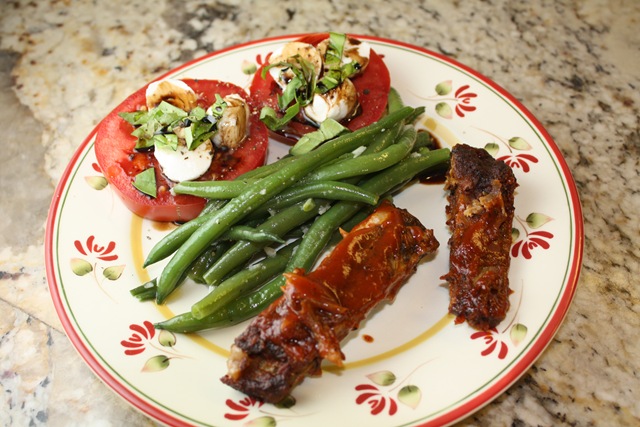
So when dinnertime came, what to fix? We had leftovers – ribs from our favorite rib joint (Scottie’s, a local place). Had more fresh tomatoes from friends’ gardens. Had fresh mozzarella and fresh basil. And we had just enough left of my favorite green beans – the Garlic Green Beans. They’re briefly cooked, then briefly sautéed in olive oil and garlic. Even the grandchildren ate more than one serving of them when I served the beans the night before last.

Before dinner last night I made myself a drink – a cocktail type drink with Aperol, some apricot brandy and Squirt. Dave had a glass of wine. We sat out on our patio enjoying the sunset, relaxing. Enjoying the summer flowers rimming our patio. And the view. And the pink/red sky. Being thankful for the life we have, and saying it was wonderful having the No. California family with us, but it was nice when they went home, too. Maybe there will be some more inventive cooking going on in Carolyn’s kitchen in coming days.

A year ago: Cucumbers (everything you ever wanted to know about them)

Two years ago: Buttermilk Scones (my all-time favorite buttery scones)

Posted in Beef, on July 24th, 2009.

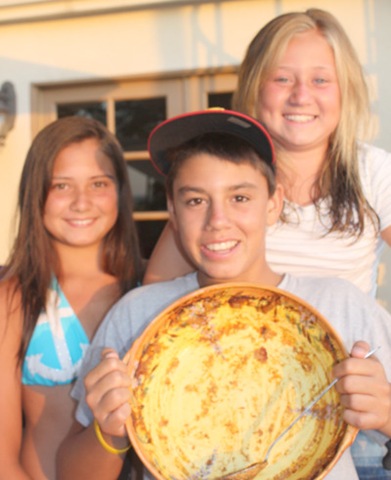
Our granddaughter, Taylor (at right in the picture), asked: “What’s for dinner, Grandma?”
I said: “A ground beef casserole with biscuits on top.”
kids with bowl
Logan, our grandson (center in the picture) said, after a long pause: “Grandma . . . what’s a casserole?”

We all chuckled that Logan didn’t recognize the word. It’s not that he hasn’t had one – Taylor even reminded him of the last casserole I made a couple of months ago when they visited – he just didn’t know it by that name. Even Mikayla (Taylor’s friend, also in the picture at left, who came along for this visit) knew about casseroles.

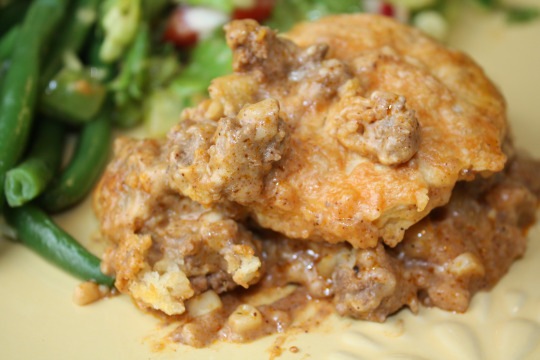
To say that this casserole was a roaring success is visible in the very few sticky remains in the deep casserole. The kids were all over it. Wanted seconds and thirds if they could have had them. Most of the adults at the dinner had seconds also. My DH was limited only by the fact that his first serving was large enough. Good thing since the kids wanted more and more of it.

This recipes goes w-a-a-a-y back in my repertoire. I’ve tweaked it over the years, and this time I tweaked it some more. Now, this isn’t anything gourmet. And you really can’t make it ahead of time because of the biscuits. But you can make the meat mixture ahead, then just reheat it before you compose the casserole.

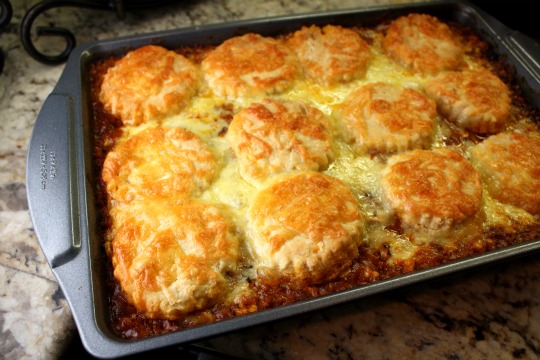
The meat is ground beef (and you could just as easily use ground turkey), with onion, garlic, green chiles (canned), a bit of corn (I used canned because I had an open can), tomato sauce, and chili powder. Then you add some light sour cream and a goodly amount of shredded Jack cheese. The trick to this casserole is the biscuits. Now my guess is this recipe may have come about when Pillsbury first came out with the canned (tube) biscuits. The original recipe is in lots of places on the internet. And that’s the way I used to make this (and you can too if you choose). I might have this time except I didn’t want to make another trip to the regular grocery store for the biscuits, so I made them from scratch. Took very little time since I had the buttermilk on hand. I simply went to my own blog and found my favorite recipe for Drop Biscuits and made them – but I rolled them out instead.

biscuit casserole

The casserole has a bunch of horizontal biscuit halves on the bottom of the casserole. Then you spoon in all the meat mixture, top that with the other half of the biscuits, sprinkle with some Jack cheese and you’re ready to bake. All I did was divide the biscuit batter in half and rolled out each half to make about 12 thin biscuits – half goes on the bottom, the other half of the batter makes more to go on the top. It was really very easy. But if you want to make it super easy, then use the tube biscuits (with this recipe you’ll likely need 2 tubes) – the kind with visible layers, so you CAN separate them into thin halves.

What’s different about my recipe? I add fresh garlic. I also add corn. Sometimes I add shredded Cheddar if I don’t have Jack cheese. I also eliminated an egg in the meat mixture that was in the original recipe. Didn’t seem to be needed as far as I was concerned. So, if you haven’t ever made this, it’s a crowd pleaser. Especially children. For me, it’s the biscuits.

What’s GOOD: this dish is just comfort food at its finest. When you crave something ooey, gooey, cheesy, and you don’t mind the casserole concept, well, this is the one! All of our grandkids just love-love this dish. Me too.

What’s NOT: not one single thing. It’s certainly not low calorie, though. But it’s not wicked, if you understand what I mean. Definitely worth making for a big crowd.
printer-friendly PDF

MasterCook 5+ file and MasterCook 14 file

Ground Beef & Corn Casserole with Biscuits

Servings: 10

1 large yellow onion — chopped
2 cloves garlic — chopped or mashed
2 pounds lean ground beef
4 ounces diced green chiles — canned (mild)
16 ounces tomato sauce — canned
3 cups Jack cheese — shredded, divided use
4 teaspoons chili powder
1 1/2 cups corn — canned (drained) or frozen (thawed)
1 cup light sour cream
BUTTERMILK BISCUITS:
2 cups all-purpose flour
2 teaspoons baking powder
1/2 teaspoon baking soda
1 teaspoon sugar
3/4 teaspoon salt
1 cup buttermilk — VERY cold
8 tablespoons unsalted butter — melted, cooled

MEAT MIXTURE:
1. In a large skillet brown onion in a bit of olive oil. Add ground beef and continue until all the meat has lost its pink color. Add green chiles, tomato sauce, garlic, chili powder and corn and continue cooking gently for about 5-10 minutes. Add the sour cream and most of the Jack cheese and stir to combine. Set aside. (The meat mixture can be made ahead to this point and refrigerated.)
BISCUITS:
2. Adjust oven rack to middle position and heat oven to 375. Whisk flour, baking powder, baking soda, sugar and salt in a large bowl. (Or, you can sift it together.)
3. In a medium bowl (at least 1 1/2 cups or larger) combine the cold buttermilk and the melted and slightly cooled butter. Stir until buttermilk forms clumps.
4. Add buttermilk mixture to dry ingredients and stir with rubber spatula until just incorporated and batter pulls away from side of the bowl.
5. Using a bit of flour on your hands, divide the biscuit dough in half.
ASSEMBLY:
6. With first half of biscuit dough, roll out to about 1/2 inch thick. Carefully place biscuits into an ungreased 9×13 pan.
7. Spoon the meat mixture on top of the biscuits and spread to level the meat.
8. Roll out the remaining biscuit dough and cut more biscuits. Place on top of the meat. Sprinkle with the reserved Jack cheese.
9. Place casserole in oven and bake for about 30-35 minutes, until the tops of the biscuits are golden brown. Remove and allow to sit for about 5 minutes. Serve.
Per Serving: 478 Calories; 29g Fat (55.3% calories from fat); 22g Protein; 32g Carbohydrate; 2g Dietary Fiber; 96mg Cholesterol; 720mg Sodium.

Posted in Uncategorized, on July 23rd, 2009.

hydrangea 1

Muggy: oppressively humid; damp and close.

Flowers love it. Humans? Not so much. And little or no cooking going on in my kitchen these days, even with A/C. Temps in the high 80’s and low 90’s.

Picture? From our garden, awhile back.

Posted in Desserts, on July 21st, 2009.

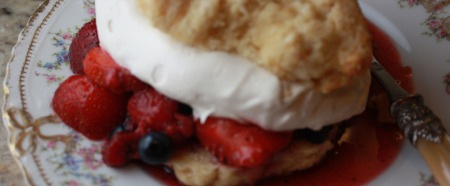
berry shortcakeYou know why bloggers rarely write l-o-v-e, like it should be written? Because not-nice people out there do searches all over the internet for such words hoping they’ll find unsavory websites. And then they leave unsavory messages. Maybe I should go find my thesaurus and find some alternative words I could use here on my blog to describe a passion for something. Hmmm.

What’s more American summer than strawberry shortcake, I ask you? Our daughter-in-law Karen brought this fab dessert the other night to a family birthday celebration. It was SO good. You might think “what’s another shortcake recipe.” Well, I’m tellin’ ya, this tastes different. It’s all in the brown sugar. There’s brown sugar in the shortcakes, brown sugar in the berries, and best of all, there’s brown sugar (and a bit of sour cream) in the whipped cream. Makes for an altogether different taste sensation.

The recipe came from America’s Test Kitchen in 2007. Nothing about the recipe is difficult. You’re missing something if you don’t try it. Karen and I agreed that the shortcakes could be made a bit smaller (this makes a very large portion if you use a generous amount of berries and whipped cream). So you might feed 7 or maybe even 8.
printer-friendly PDF

Brown Sugar Berry Shortcake

Recipe: America’s Test Kitchen
Servings: 6-8
NOTES: Preparing Berries: fresh strawberries — hulled, halved, and sliced; fresh raspberries — whole; fresh blackberries — halved; fresh blueberries — whole; currants — whole.

FRUIT:
6 cups mixed berries
4 tablespoons packed light brown sugar — (4 to 6) see notes
SHORTCAKES:
2 cups all-purpose flour
3 tablespoons packed light brown sugar
1 tablespoon baking powder
1/2 teaspoon table salt
8 tablespoons unsalted butter — cut into 1/2-inch pieces and chilled, plus 2 tablespoons unsalted butter, melted (for brushing on shortcakes)
1 large egg
1/2 cup sour cream
2 tablespoons granulated sugar
BROWN SUGAR CREAM TOPPING:
1 cup heavy cream
1/4 cup sour cream
1/4 cup packed light brown sugar

1. For the fruit: Crush 2 cups berries and brown sugar in large bowl with potato masher. Fold in remaining 4 cups berries and let sit at room temperature until sugar has dissolved and berries are juicy, about 30 minutes.
2. For the shortcakes: Adjust oven rack to upper-middle position and heat oven to 375 degrees. Line rimmed baking sheet with parchment paper. Pulse flour, brown sugar, baking powder, and salt in food processor until no lumps of sugar remain. Scatter chilled butter pieces over top and pulse until mixture resembles coarse meal, about 7 pulses. Transfer to large bowl.
3. Whisk egg and sour cream together in small bowl. Stir into flour mixture with rubber spatula until large clumps form. Using hands, knead lightly until dough comes together and no dry flecks of flour remain.
4. Using a large (#10) ice cream scoop, scoop 6 dough rounds onto baking sheet. Brush tops with melted butter and sprinkle with granulated sugar. Bake until golden brown, 25 to 30 minutes, rotating baking sheet halfway through baking time. Cool shortcakes on baking sheet 10 minutes. (Cooled shortcakes can be wrapped tightly in plastic wrap and kept on counter for up to 24 hours.)
5. For the topping: With electric mixer, beat heavy cream, sour cream, and brown sugar to stiff peaks. Split each shortcake in half using serrated knife and place bottoms on individual plates. Spoon portion of fruit over bottoms, top with whipped cream, and cap with shortcake tops. Serve.
Per Serving: 654 Calories; 38g Fat (50.9% calories from fat); 8g Protein; 74g Carbohydrate; 4g Dietary Fiber; 144mg Cholesterol; 494mg Sodium.

Two years ago: Butternut Squash Soup with Jalapeno & Ginger

Posted in Salads, Veggies/sides, on July 20th, 2009.

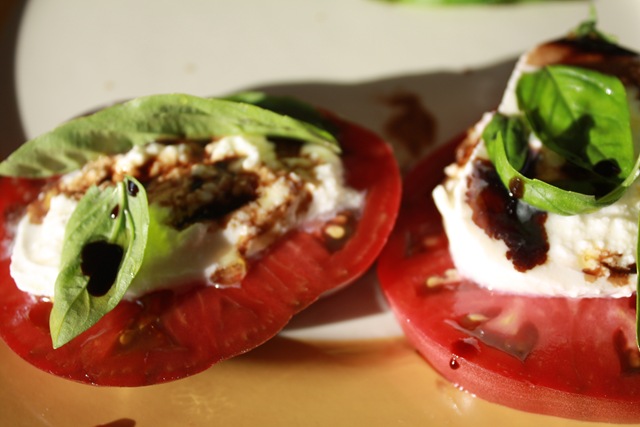
IMG_0503 1. Thick slices of heirloom tomatoes.

2. Thick slices of fresh mozzarella burratta on top of the tomatoes

3. Freshly picked basil right out of the garden

4. Drizzles of Spanish extra virgin olive oil

5. Little drizzles of strawberry balsamic vinegar

6. Oops, forgot the grind of salt and pepper. Didn’t miss it, did we?

IMG_0506

Posted in Salad Dressings, on July 18th, 2009.

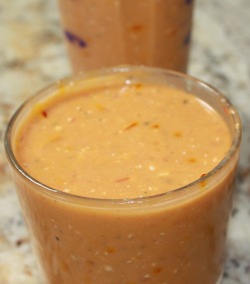
tomato blue saffron vinaigrette

For years I’ve been trying to find a recipe something like the tomato vinaigrette served at the Soup Plantation. (The dressing isn’t on their website anymore, so perhaps they don’t serve it any longer.) It’s mostly canned tomatoes with a vinaigrette dressing around it. But it’s served as part of their salad dressing options. I’ve searched for recipes in my own copious files (nothing), looked in all my cookbooks for anything similar (nothing) and looked several times on the internet for something similar (nothing). In the deep pan at Soup Plantation it looks almost like plain canned tomatoes, except that the top is shiny with oil – the oil isn’t exactly visible, just shiny, so you know there’s oil there.

I’ve never tried starting out with a can of tomatoes and attempting to concoct a dressing. I know there must be oil and vinegar in it, and sugar. And the tomatoes. Not sun dried. Nor oven charred. Not even fresh, I think, but canned. The tomatoes must be added in at the end because they’re still in small chunks, like right out of the can. It doesn’t have balsamic vinegar in it, either. But that’s all I can determine. Every time I find a tomato based vinaigrette in a magazine or online, I save it.

For this dressing (which isn’t really like Soup Plantation’s, sorry to say) I started with an old recipe I found online, years and years ago. It was credited to a tavern in Annapolis, Maryland. After I got through making it I decided it needed something else, so added some blue cheese to it. Note if you look closely at the picture, you can see some saffron threads floating in it, as well as a few crumbles of the blue cheese.
printer-friendly PDF

Tomato, Blue Cheese and Saffron Vinaigrette

Servings: 16

1 1/2 tablespoons Dijon mustard
1 1/2 teaspoons saffron threads
3 tablespoons shallots — cut in chunks
1/2 cup Champagne wine vinegar
1/2 cup diced fresh tomatoes
2 teaspoons fresh tarragon
Salt and pepper to taste
1 cup extra virgin olive oil
3 tablespoons blue cheese

1. In the bowl of a blender add the mustard, saffron, shallots, vinegar, salt and pepper, diced tomatoes (skin and all), and tarragon.
2. Blend until mixture is smooth, then slowly drizzle in the olive oil through the top.
3. Crumble in the blue cheese and blend briefly until the chunks have just barely pureed (you still want to see a few of the pieces). Refrigerate for an hour or so before serving.
Per Serving: 129 Calories; 14g Fat (95.0% calories from fat); trace Protein; 1g Carbohydrate; trace Dietary Fiber; 1mg Cholesterol; 37mg Sodium.

Two years ago: Asian (cole) Slaw (a family favorite with grilled meats)

Posted in Salads, Veggies/sides, on July 16th, 2009.

IMG_0495

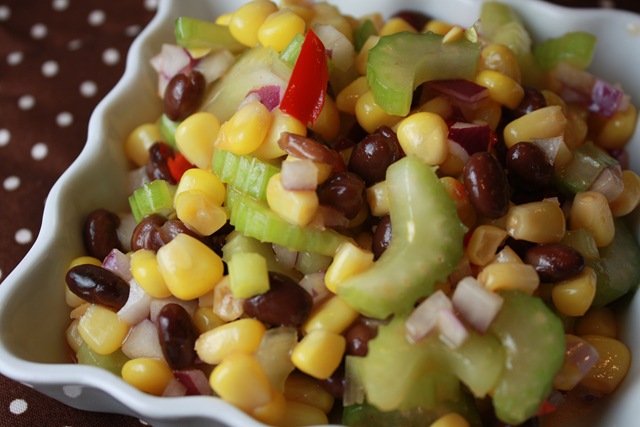
Since I was just talking about corn yesterday, this seems like a perfectly appropriate time to share a corn salad recipe. There must be as many variations for such as shells in the sea. This one is on the sweet side (sugar – or Splenda – in the dressing) and it’s marinated for a minimum of 8 hours.

When we visited our friends at Cardwell Hill (the winery in Oregon) a few days ago, Nancy served this salad for our late lunch. It was SO good, I asked her for the recipe. It popped into my email inbox yesterday.

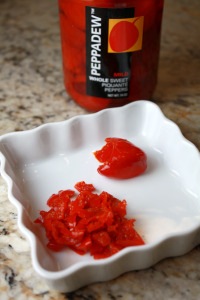
peppadew peppers The recipe calls for canned corn (shoe peg actually, but my DH did the shopping and he couldn’t find any shoe peg white corn) so this is just ordinary canned corn. You could easily use fresh corn too. Instead of pimientos, I used peppadew peppers. There’s a picture (left) of the jar, one whole pepper, and several of them minced up. I’ve talked about peppadew peppers before – they’re favorites of mine and are grown in South Africa. Some olive bars at upscale markets have them. They’re sweet and tart at the same time.

I didn’t have any green bell pepper (could have used some red, yellow or orange just as easily).

Because I try to reduce sugar anywhere I can, I used less than the original recipe called for – and I used Splenda – so if you think it tastes too vinegar-y, by all means add more sweetener. It’s really tasty – can be made up ahead – and likely will keep for several days. The dressing can also be used again, so don’t throw it out – just add different veggies to it for a 2nd rendition.

So thanks, Nancy, for this great recipe.
printer-friendly PDF

Corn & Black Bean Salad

Recipe: Adapted from my friend Nancy Chapel of Cardwell Hill Winery
Servings: 8
NOTES: You could use fresh corn, but one of the nice things about this salad is that if you have the cans on hand, it can be made any time of year.

DRESSING:
1/2 cup sugar — or Splenda [I used less]
1/2 cup vegetable oil
1 tablespoon red wine vinegar
1 1/2 teaspoons soy sauce
1/4 teaspoon salt
1/4 teaspoon paprika
1/8 teaspoon pepper
1/4 teaspoon garlic powder
1/2 teaspoon dry mustard
SALAD:
11 ounces white shoepeg corn — drained
11 ounces black beans — drained, rinsed
4 ounces pimiento — or Peppadew peppers if available
1 large green bell pepper — or red pepper
1 large onion — chopped
1 cup celery — sliced

1. DRESSING: In a food processor combine all ingredients except the oil. Turn on processor and add oil in a steady stream until emulsified. Refrigerate.
2. SALAD: In a large ziploc bag combine the salad ingredients with the dressing and refrigerate for about 8 hours (or up to 24), if possible to let flavors develop. Drain salad before serving.
Serving Ideas: The salad dressing can be reused – i.e., add more cans of corn and black beans (or corn and other kinds of beans, even green beans) to make the dressing.
Per Serving: 319 Calories; 15g Fat (39.4% calories from fat); 10g Protein; 40g Carbohydrate; 7g Dietary Fiber; 0mg Cholesterol; 232mg Sodium.

A year ago: Flank Steak with Orange Marinade
Two years ago: The BEST Bean Salad (a family favorite, low calorie, but you’d never guess it)

Posted in Veggies/sides, on July 16th, 2009.

fresh white corn

We’re home from our trip. I’m definitely not back into the cooking groove yet. Have been to two grocery stores to stock up on essentials, but what we’re both craving is more simple foods. I baked a chicken for dinner our first night home and had it along with a panful of button mushrooms sauteed in butter with some fresh thyme. And some tomatoes from our own bushes with some fresh mozzarella cheese. Last night’s dinner was more of the same. Except that I’d purchased some fresh white corn, so we had some of that too. It’s so good to be home.

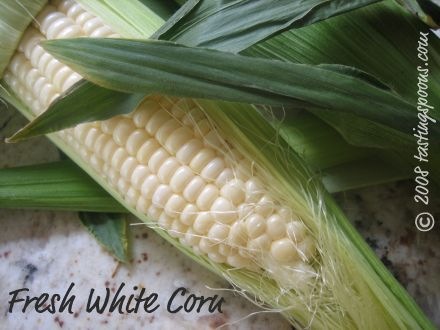
Probably some of you know far more about corn than I do. But fresh corn-on-the-cob is at all the farmstands these days – the delish white sweet corn. So I thought I’d post something from my go-to book on fruits and vegetables, Russ Parsons’ tome How to Pick a Peach. He also has another book under his belt (that I don’t own) called How to Read a French Fry. So, synopsized from the Peach book is all you’ve ever wanted to know about corn, from the consumer’s point of view.

It used to be that fresh corn on the cob, once it was pulled from the plant, started to go to starch right away. The sugar in the corn converted to starch very fast. But genetics being what they are these days, the researchers were very busy for several decades nnow developing strains of corn that overcame many of those early types. These newer and more improved varieties are almost all you can buy nowdays. Some people (Parsons included) aren’t altogether sure it’s been for the best as they believe there is a lot more to corn flavor than just the sweetness.

Corn is a grain, of course, which is why it’s a carb rather than a vegetable. We eat corn in an immature state – grown to maturity, corn is as hard a wheat kernels. Much of the corn grown is such (and used for many industrial applications like sweeteners, textiles and automotive fuels). The corn WE eat is picked within a month of pollination.

The oldest “improved” variety of corn is referred to by its shorthand – SU – for sugary. Actually mentioned in seed journals as early as the 1820s. Farmers merely selected seed from the plants that produced the sweetest eating corn. But it still had the problem of converting to starch, losing 2/3 of its sugar within 24 hours, even if refrigerated.

The next variety was SE – for sugar-enhanced. It actually starts converting sugar to starch right away, but because the corn variety was sweeter than most, it could take up to a week before the sweetness level fell down to the level of normal corn.

Then we get to what Parsons refers to as the King Kong of corn. Called SH2 because of the way the kernels shrivel and appear shrunken after drying. They contain 30-45% more sugar than traditional corn. Only trouble is these seeds are very expensive, so most farmers won’t buy it and consumers don’t want to pay the price.  Instead, farmers allowed the normal kind of evolution of breeding seeds from the tallest and sweetest producing seeds. A kind of natural mutation I guess you could say.

According to the article the flavor is basically the same from white, yellow or bicolor corn. (Could have fooled me, I’m a convert to white sweet corn which is the first corn available here in Southern California.) The farmers have done all kinds of genetics to the SH2 with adding good corn flavor from the SE and SU.  Now I’ve never seen “Silver Queen” corn. It must not be grown where I live. But per the chapter on corn, lots of people claim it’s the Cadillac of corn, but in blind taste tests consumers prefer the new SE and SH2 varieties, and that if farmers claim they’re selling Silver Queens, they’re likely not.

Where they’re grown: More than half the U.S. production comes from Florida, California and New York.

Choosing: Husks should be fresh and green, no drying. Silk golden and fresh. Check the corn tips – kernels should be well filled-out and evenly spaced. Pop a kernel with your thumbnail – it should spurt milky juice. (Just don’t let the produce dept. catch you doing that!)

Storing: refrigerate whole (husked, etc.) and eat as soon as possible.

Preparing: Shuck and cook corn just before serving. [I’ve found that using a paper towel helps a lot to get the silk off the cobs.] To Grill: soak whole, unhusked cobs in water for 20+ minutes, then pop on the grill. Grill over hot fire until they are a dark yellow and well marked by the grill, about 25-30 minutes. Don’t worry if the husks start to char; that just adds to the smoky flavor. The silk is much easier to remove after grilling.

Russ Parsons’ recipes in the book: Fresh Corn Blini with Crema Fresca; Grilled Corn and Arugula Salad; and Shrimp and Sweet Corn “Risotto.”

– – – – –

Recipes here on my blog where corn plays a starring role:

North African Grilled Corn on the Cob
Gulliver’s Creamed Corn
Sweet Corn Cakes
Southwest Squash & Corn
Calabacitas (a southwest staple vegetable mixture)
Custard-Filled Cornbread

Related Posts Plugin for WordPress, Blogger...