Get new posts by email:

Archives

Currently Reading

Here are the tastingspoons players. I’m in the middle (Carolyn). Daughter Sara on the right, and daughter-in-law Karen on the left. I started the blog in 2007, as a way to share recipes with my family. I’m still doing 99% of the blogging and holding out hope that these two lovely and excellent cooks will participate. They both lead very busy lives, so we’ll see.

– – – – – – – – – – – – – – – – – – – – – –

BOOK READING (from Carolyn):

Music of Bees, Eileen Garvin. Absolutely charming book about a woman in midlife, lonely, who raises bees, also makes unlikely friends. Heart-warming and very interesting about beekeeping.

A Postcard from Paris, Alex Brown. Really cute story. Dual time line, 1940s and present day about renovating an old apartment in Paris, things discovered.

Time of the Child, Niall Williams. Oh such a good book. Very small village in Ireland, 1960s. A baby is left on the doorstep. The town all whispers and helps. I listened to an interview of the author, which made me like him and his books even more.

Sipsworth, Simon Van Booy. If you like animals you’ll swoon. An old woman who really wants to die finds a tiny mouse in her house and befriends it and finds a reason to live. Utterly charming book.

The Forger’s Spell, Edward Dolnick. True story. For seven years a no-account painter named Han van Meegeren managed to pass off his paintings as those of Johannes Vermeer.

If You Lived Here, You’d be Home by Now, Christopher Ingraham. Could hardly put it down – about a journalist who takes on a challenge to move to small town in Minnesota and write about it. He expects to hate it and the people and place, but he doesn’t. Absolutely wonderful true story.

The River We Remember, William Kent Kreuger. 1950s, Minnesota. A murder and the aftermath. Could hardly put it down. Kreuger has such a vivid imagination and writing style.

How the Lights Gets In, Joyce Maynard. An older woman returns to New Hampshire to help care for her brain-injured son. Siblings and family, lots of angst and resentments.

The Filling Station, Vanessa Miller. Every American should read this book. A novelized retelling of the Tulsa massacre in 1921. Absolutely riveting.

The Story She Left Behind, Patti Callahan Henry. Love this author. Based on a true story. A famous author simply vanishes, leaving her husband and daughter behind. She had invented a mystical language no one could translate. Present day, someone thinks he’s solved the riddle, contacts the family. Really interesting read.

The Girl from Berlin, Ronald Balson. Love anything about Tuscany. An elderly woman is being evicted from a villa there, with odd deed provenance. Two young folks go there to help unravel the mystery. Loved it.

The Island of the Colorblind, Oliver Sacks, M.D. Nonfiction. The dr is intrigued by a remote Pacific island where most of the inhabitants are colorblind. He also unravels a mystery on Guam of people born with a strange neurological problem. Medical mysteries unveiled. Very interesting.

The Bookbinder, Pip Williams. Post 1914 London. Two sisters work at a bookbindery. They’re told to not read the books. One does and one doesn’t. One has visions beyond her narrow world; the other does not. Eventually the one gets into Oxford. Lovely story.

The Paris Express, Emma Donoghue. 1895 on a train to Paris, a disaster happens. You’ll delve into the lives of many people who survived and died in the crash.

A Race to the Bottom of Crazy, Richard Grant. This is about Arizona. Author, wife and child move back to Arizona where they once lived. Part memoir, research, and reporting in a quest to understand what makes Arizona such a confounding and irresistible place.

The Scarlet Thread, Francine Rivers. A woman’s life turned upside down when she discovers the handcrafted quilt and journal of her ancestor Mary Kathryn McMurray, a young woman who was uprooted from her home only to endure harsh frontier conditions on the Oregon Trail.

A Place to Hide, Ronald Balson. 1939 Amsterdam, an ambassador has the ability to save the lives of many Jewish children. Heartwarming.

Homeseeking, Karissa Chen. Two young Chinese teens are deeply in love, but in China. Then their families are separated. Jump to current day and the two meet again in Los Angeles.

North River, Pete Hammill. He always writes such a good story. A doctor works diligently healing people from all walks of life. His wife and daughter left him years before. One day his 3-yr old grandson arrives on his doorstep.

A Very Typical Family, Sierra Godfrey. A very messed-up family. Three adult children are given a home in Santa Cruz, Calif, but only if the siblings meet up and live in the house together. A very untypical scenario but makes for lots of messes.

Three Days in June, Anne Tyler. The usual Anne Tyler grit. Family angst. This wasn’t one of my favorites, but it was entertaining and very short.

Saved, Benjamin Hall. Author is a veteran war reporter. Ukraine, 2022, he nearly loses his life to a Russian strike. Riveting story – he survives, barely.

Grey Wolf, Louise Penny. Another Inspector Gamache mystery in Quebec. She is such an incredible mystery writer.

All the Colors of the Dark, Chris Whitaker. A missing person mystery, a serial killer thriller, a love story, a unique twist on each. Could hardly put it down.

Orbital, Samantha Harvey. Winner of 2024 Booker Prize. I don’t usually like those, but I heard the author interviewed and she hooked me. This is not a normal book with a beginning, a story and an end. It’s several chapters of the day in the life of various astronauts at the ISS (Int’l Space Station). All fictional. She’s been praised by several real astronauts for “getting it” about space station everyday life.

The Blue Hour, Paula Hawkins. An island off Scotland. Inaccessible except when the tide is out. Weird goings on. An artist. A present day mystery too.

Iron Lake, William Kent Krueger. A judge is murdered and a boy is missing. Riveting mystery.

Tell the Wolves I’m Home, Carol Ricks Brunt. 1980s. A 14-yr old girl loses her beloved uncle. Yet a new friendship arises, someone she never knew about.

Four Treasures of the Sky, Jenny Zhang. 1880s, a young girl is kidnapped in China and brought to the United States. She survives with many hurdles in the path.

The Boy Who Fell out of the Sky, Ken Dornstein. Memoir, 1988. The author’s brother died in the PanAm flight that went down in Lockerbie, Scotland. A decade later he tries to solve “the riddle of his older brother’s life.”

Worse Care Scenario, T.J. Newman. Oh my. Interesting analysis of what could/might happen if a jet crashed into a nuclear plant. Un-put-downable.

Song of the Lark, Willa Cather. Complicated weave of a story about a young woman in about 1900, who has a gifted voice (singing) and about her journey to success, not without its ups and downs.

Crow Talk, Eileen Garvin. Charming story which takes place at a remote lake in Washington State, about a few people who inhabit it, the friendships made, but also revolving around the rescue of a baby crow.

The Story Collector, Evie Woods. Sweet story about some dark secrets from an area in Ireland, a bit magical, faerie life, but solving a mystery too.

A Sea of Unspoken Things, Adrienne Young. A woman investigates her twin brother’s mysterious death. She goes to a small town in California to figure it out, to figure HIM out.

The King’s Messenger, Susanna Kearsley. 1600s England, King James. About one of his trusted “messengers,” and his relationship with a young woman also of “the court.” Lots of intrigue.

In the Shadow of the Greenbrier, Emily Matchar. Interesting mystery in/around the area of the famous resort in White Sulphur Springs, West Virginia.

Isola, Allegra Goodman. Hard to describe, survival story on an island in the 1600s.

Save the Date, Allison Raskin. Rom-com, witty, LOL funny. Clever.

The Sirens, Emilia Hart. Numerous time-lines, Australia. Mysteries abound, nightmares, abandoned baby, weird allergies.

Red Clay, Charles Fancher. LOVED this book. Mostly post-Civil War story about the lives of slaves in Alabama during Reconstruction.

Stars in an Italian Sky, Jill Santopolo. Dual time line, 1946 and recent time. Love stories and a mystery.

Battle Mountain, C.J. Box. Another one of Box’s riveting mysteries. Love his descriptions of the land.

Something Beautiful Happened, Yvette Corporon. A memoir of sorts in Greece, tiny island of Erikousa, where the locals hid Jews during WWII. All elusive stories told by the author’s grandmother.

The Jackal’s Mistress, Chris Bohjalian. 1860s Virginia, about a woman who saves the life of a Union soldier. Really good story.

Song of the Magpie, Louise Mayberry. Really interesting story about Australia back in the days when it was mostly a penal colony. Gritty strength of a woman trying to thrive with her farm.

The Boomerang, Robert Bailey. A thriller that will have you gripping the book. About a lot of secrets surrounding the president (fictional novel, remember) and his chief of staff and about cancer. A cure. Such a good story.

Care and Feeding, Laurie Woolever. Really interesting memoir of a woman driven to succeed in the restaurant business. She worked for Mario Batali and then Anthony Bourdain. Gritty stories.

Everything is Tuberculosis, John Green. Maybe not a book for everyone. A real deep dive into the deadly tuberculosis infection, its history. I heard the author interviewed and found the book very interesting.

The Book Lovers Library, Madeline Martin. Fascinating read about Boots’ drug stores’ lending library. And the people who worked in them.

The Arrivals, Meg Mitchell Moore. LOL funny, about a middle-aged couple whose children (and their various family members) return to the family home and the chaos that ensues.

My Life as a Silent Movie, Jesse Lee Kercheval. About grief. A big move to Paris, finding herself a new life with a new set of real blood family.

Escape, Carolyn Jessop. Another memoir about a woman really in bondage in Utah, Mormon plural marriage.

 

Tasting Spoons

My blog's namesake - small, old and some very dented engraved silver plated tea spoons that belonged to my mother-in-law, and I use them to taste my food as I'm cooking.

Scroll down to the bottom to view my Blogroll

Posted in Appetizers, easy, on February 28th, 2014.

crostini_grape_leaves_olives

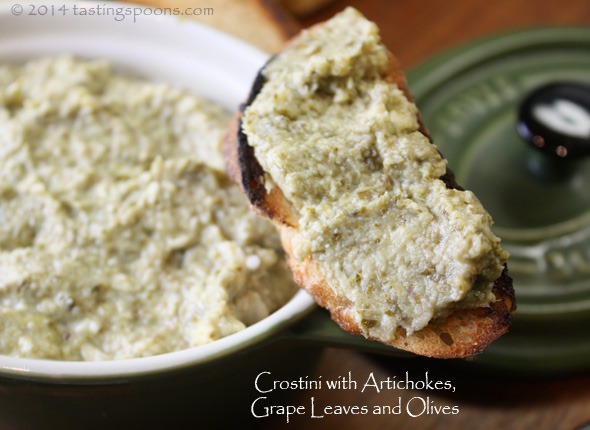
Need an easy artichoke heart mixture to serve to guests that’s tasty and very quick to put together? And has no mayo or sour cream in it?

This recipe has been in my arsenal for years, from a decades-ago class I took from Joanne Weir. I’d forgotten all about it, but noticed that it didn’t have a photo attached to it (this in my MasterCook software program I use for all my recipes). That’s an automatic signal that I took the class long before I began taking a quick pix of the food when I attended the class. It also meant I’d not written it up here on my blog either! Since it’s an easy recipe to make, I chose to include it for a dinner party we were having recently.

Making it the day before is no problem – in fact it helped me to get at least one dish done ahead of time. This topping/dip keeps for about a week or so. In the class Joanne just chopped up the ingredients on a cutting board. It calls for canned or defrosted artichoke hearts, not marinated type, a few brined grape leaves, garlic, green olives –  Joanne called for picholine but I couldn’t find that type the day I went shopping so I used a plain green olive – some Parmigiano cheese, lemon juice and just a little bit of EVOO to smooth it out. That’s IT. Easy, huh? Changing the type of olive in this would likely change the flavor profile a little bit. Don’t use kalamata – they would overpower the mixture. Don’t use ripe olives, and don’t use the green stuffed olives either.
When I made this I used the food processor – I was into “easy” that day. If you’d prefer a bit more texture to the spread, then definitely do the mince and chop version. Do allow the mixture to refrigerate for a few hours – so the garlic isn’t so harsh and it has time to permeate it all.

What’s GOOD: how easy it is to make, plus it keeps for awhile. Make it 2 days ahead – that’s fine too. Very tasty – you definitely know it’s artichoke hearts but you can’t exactly pick out the grape leaves (it adds just a little bit of sharpness) along with the lemon juice. Very delish appetizer that I’ve made over and over.
What’s NOT: you might not have brined/jarred grape leaves on hand (I didn’t) but I found them easily enough at my local upscale market. And you might not have the right olives – but I substituted some other small green olives instead.

printer-friendly CutePDF
Files: MasterCook 5+ and MasterCook 14 (click link to open in MC)

* Exported from MasterCook *

Crostini with Artichokes, Grape Leaves and Olives

Recipe By: From a cooking class with Joanne Weir
Serving Size: 8

6 large artichoke hearts — frozen, defrosted (or canned, drained)
4 whole grape leaves — bottled, rinsed
1/3 cup green olives — Picholine, pitted, chopped
1 clove garlic — minced
1/2 teaspoon grated lemon peel
8 shaves Parmigiano-Reggiano cheese — crumbled
1 1/2 tablespoons extra virgin olive oil
1 tablespoon lemon juice
Salt and pepper to taste
24 pieces French baguette sliced
lemon wedges for garnish

Notes: This can be made ahead, but don’t add garlic until just before serving. Use a country bread – coarse textured, about 2 inches in diameter. You can also grill the bread slices rather than bake them. I made this in a food processor until it was smooth, so I didn’t do quite so much mincing and chopping and let the processor do all the work.
1. Remove the stems from the grape leaves before mincing.
2. In a bowl combine the chopped artichoke hearts, grape leaves, olives, cheese, garlic and lemon zest. Pour mixture onto a cutting board and continue to chop together until coarsely chopped. Place mixture back in the bowl and add cheese, olive oil, lemon juice, salt and pepper to taste. Use plenty of salt, as once you put it on bread, it dilutes the salt. Taste for additional lemon juice as well. If made ahead, allow mixture to sit out at room temp for at least 30 minutes.
3. Coat the thin bread slices with olive oil and a little salt, then bake in a 400° oven until just crisp. Do not overbake. Serve crostini with a thin slather of the artichoke mixture.
Per Serving: 292 Calories; 7g Fat (21.3% calories from fat); 11g Protein; 47g Carbohydrate; 6g Dietary Fiber; 4mg Cholesterol; 709mg Sodium.

Posted in Soups, on February 26th, 2014.

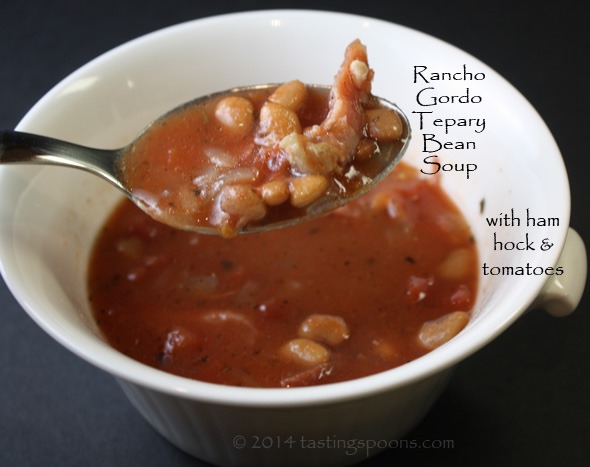
rancho_gordo_brown_tapary_bean_soup

It’s been some years now that I’d been reading about Rancho Gordo beans. About how they’re just the best out there. Fresh dried. Premium beans. Heirloom beans and worth the price to mail order them. I had to find out, and this is the first soup I’ve made from them.

You’ve probably read about them just as I have. Rancho Gordo. A company out of Napa, California. They are a small company with a mission – from their website they explain . . .

Heirloom beans are the foundation of Rancho Gordo. I remember the first time I ate a Rio Zape and was shocked at how much better it was than the average pinto bean. I did a little more research and soon realized that I hadn’t even scratched the surface. There are hundreds of heirloom beans waiting to be discovered. My thinking is the best way to save these beans is by eating them and letting people see that even though the yields are lower and they aren’t as uniform as industrial red kidneys, they are more than worth the bother. [. . . from Steve Sando, founder of Rancho Gordo]

My friend Cherrie agreed to share the order with me – I think I bought 4 varieties of their heirloom beans. I read about all of them and decided to try a few first before I placed another order. They produce lots of different types, and when they run out; well, they’re gone until next season. As I make anything with the other varieties I ordered, I’ll tell you about it. As of this writing, the beans are $5.95 a pound, and they charge a flat fee of $10-12 to ship, so it’s best to buy several and make that shipping fee count.

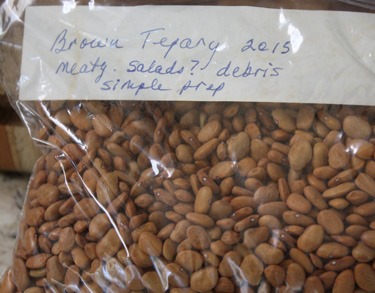
brown_tepary_beans_dried

Each package weighed a pound. So with sharing, I ended up with 1/2 pound, which was just fine for my first heirloom bean soup.

I wrote a note on the baggie about the tepary bean – on the shipping packet it said they were a meaty bean, great in salads, to look for debris and to use a simple preparation. Also it said they’d keep until 2015.

On their website it says this about the tepary bean:

Teparies are indigenous to North America and were developed by Native Americans to be drought-tolerant. Higher in protein and fiber than other beans (which are already super foods), what more can you ask for in food? Flavor and texture? You got it! The small beans plump up a bit but keep a meaty, dense texture. Can you tell we’re smitten? The beans are savory but the white version tends to be slightly sweet. Tepary beans look like lentils but they have nothing in common with lentils other than their small, compact size. In fact, they take as long to cook as an average-sized bean.

So, I made soup. I allowed the beans to soak in cold water overnight. I drained the water off and added them to the soup I started. I made the soup in my new Breville Risotto Cooker, on the slow cooker/low setting – this after I’d sautéed some onion, added garlic for just a minute, then added a bunch of stock. Now, I happened to use Penzey’s soup base because I always have it on hand. I used pork, but chicken is probably more common. I had a ham hock from our Berkshire pig that had almost NO meat on it, but it provided ample flavor, which was a good thing. I added dried thyme and dried oregano too, plus a big can of tomatoes and let that sit in the slow cooker for a few hours. I kept testing the beans because no way was I going to let them over cook and get mushy! I wanted texture, and that’s exactly what I got.

What’s GOOD: love the chewy texture of the bean. If you overwhelm it with spices or seasonings, you’re not going to taste the bean at all, in which case you might as well use a grocery-store red bean. These are slightly smaller, kind of flat-ish, which is why they describe them as lentil-like, but only in appearance, not in taste or cooking. I liked these beans a lot and I’d order them again when/if I do place another order. The soup was delish – good for a cold winter’s day. Nothing exceptional; just good, old-fashioned stick-to-your-ribs simple soup.
What’s NOT: for some, buying mail order dried beans may sound ridiculous (and expensive). But I’m always interested in buying things that are DIFFERENT, and these surely fit that description.

printer-friendly CutePDF
Files: MasterCook 5+ and MasterCook 14 (click link to open in MC)

* Exported from MasterCook *

Rancho Gordo Tepary Bean, Ham and Tomato Soup

Recipe By: My own concoction
Serving Size: 6

8 ounces dried beans — Rancho Gordo Brown Tepary type (or see note below)
2 tablespoons grapeseed oil
1 large onion — peeled, chopped
2 cloves garlic — chopped
2 teaspoons dried thyme — crushed between your palms
2 teaspoons dried oregano — crushed between your palms
4 cups chicken stock — or pork stock, approximate (I use Penzey’s soup base)
1 pound ham hock
56 ounces canned diced tomatoes — with juices
Salt and freshly ground black pepper to taste

NOTES: I used Rancho Gordo brand beans because I had them on hand – they’re an heirloom, premium dried bean. You can use any kind of dried red bean or white, but not lentils or split peas. This is a fairly brothy kind of soup. If you like, you may add more beans from the get-go. If you want to, remove some at the end and mash or use an immersion blender just a little bit to give the soup some thicker texture. You may also add a variety of other vegetables like zucchini, green beans. You could also add about 1/2 cup dried pasta 10-15 minutes before serving.
1. Wash and rinse the beans under running water to find and discard any debris. If time permits, soak the beans overnight in cold water. Drain the beans before adding to the soup mixture. Otherwise, soak the beans for an hour in cold water and discard the water.
2. In a large pot warm the oil over medium heat. Add the chopped onion and saute for about 8-10 minutes until the onions are translucent. Add the garlic and continue cooking another minute. Add the thyme and oregano and stir in. Add the beans, stock, canned tomatoes and ham hock. Bring to a boil, reduce heat to low, cover and simmer for about 45-55 minutes, or until the beans are just barely cooked through. Do not over cook them – you want them to have texture.
3. Remove the ham hock and allow to cool on a plate. Pick over the hock and remove any ham meat and chop into small pieces or shreds and add back into the soup. Discard the bone and fat from the hock.
4. Add salt and pepper to taste. Serve immediately, or cool and allow to refrigerate overnight (soup is always better the next day). Reheat to serve. SLOW COOKER: This can be made in a slow cooker, if preferred. Use a low setting if possible and cook for 4-5 hours. If using a high setting, it may take only an hour or two for the beans to cook through if you’ve soaked them first.
Per Serving: 459 Calories; 20g Fat (38.6% calories from fat); 30g Protein; 39g Carbohydrate; 14g Dietary Fiber; 80mg Cholesterol; 2389mg Sodium.

Posted in Vegetarian, Veggies/sides, on February 24th, 2014.

champagne_asparagus_risotto

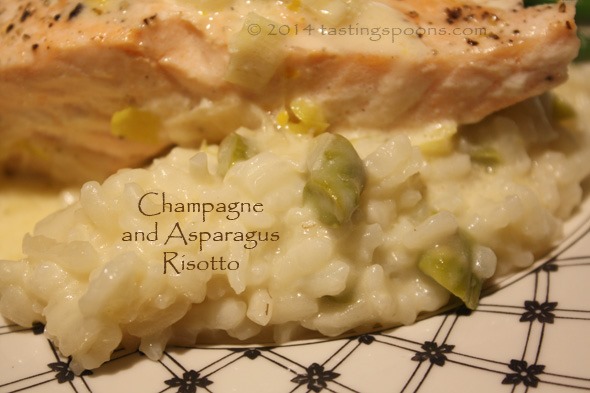
Although this picture may not wow you with its color artistry, all I can tell you, bottom line, it’s ultimately a creamy, smooth, oozing risotto, filled with umami flavors. I served it with salmon, but it could be a meal unto itself.

Below you will find this recipe in two versions – one made on the stovetop, which is what most people will do – and another revised slightly for the Breville risotto cooker that I used. This recipe is one I’ve made for at least 3 decades, and was my first introduction to risotto, way back in the early 1980s. I can’t say that I’ve made it more than a dozen times, just because risotto is so high in carbs and it (used to) require so MUCH standing at the stove, stirring and stirring.

At the time, I had attended a cooking class at a then-popular cooking school called Ma Cuisine, and Tarla Fallgatter taught the class, and made risotto as well as osso buco (a recipe I’ve never posted, and suppose I should!). I’d read about risotto, never had it, and merely said to myself “no way” would I stand in front of the stove for 30-45 minutes, stirring and adding broth until it was just done. Arborio rice was very, very hard to find back then – only one upscale market carried it and at a very hefty price. Champagne, then, was a splurge, and to think of using it in rice was almost over-the-top. But when the class was served the results – oh my gosh, it was just SO good. I became a convert, and made this many times, usually when someone was visiting, who would help with the stirring. Our friend Russ was a frequent visitor for dinner then, and he was a willing helper, being the one to get a spa facial as he stood over the big frying pan stirring.

Jump forward to 2014. My DH bought me for Christmas (at my suggestion) the Breville BRC600XL The Risotto Plus Sautéing Slow Rice Cooker and Steamer. A splurge, for sure, for a device to make risotto, but I’ve used it to make rice (just regular stuff) and I’ve used it as a slow cooker too to make a bean soup (it has a slow cooker low and high function). It also has a sauté function which means you can cook the onions or leeks or shallots or whatever, in the same pan without dirtying up more dishes.
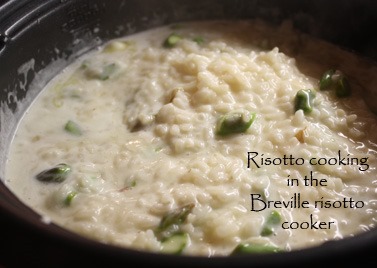

champagne_asparagas_risotto_cookingTo make this risotto in the Breville risotto cooker I did all the same steps, really, except I reduced the amount of broth I added – although I ended up adding almost all of it by the time it was served. What I didn’t want was too-soupy risotto and having not made this in the Breville before, I was hesitant to add it all at once. It’s easy enough to ADD more fluid. Not possible to remove any! I don’t use expensive champagne or sparkling wine – just something drinkable, and certainly not a bottle worth $1.99 either. Usually I use Prosecco (because we usually have some on hand and it’s very inexpensive). You want a dry taste, though, not something sweet. Some Proseccos would be too sweet – so watch that.

When the Risotto Cooker is in the cooking process (on the Risotto setting) it boils furiously. In fact, it boils so fast I wonder each time if it’s not going to be ruined. But it isn’t. Certainly it boils at a full rolling boil – a much higher heat than you’d use if you were making it the traditional way. And yet, when it’s done, well, it’s just absolutely PERFECT. The asparagus was partially pre-cooked, so I added it into the risotto about 2/3 of the way through its 30-minute cooking. Next time I’d cook the asparagus completely and add it in at the very end, just long enough to heat it through. As soon as the risotto cooker gives a warning, it switches to low and that’s when I added the little bit of cream, butter, and Parmesan. (You don’t know how long it’s going to cook – there isn’t a timer to view, but you can estimate 30 minutes.) Every time I’ve made risotto in this, it’s been at that perfection stage immediately when it dings – and I wish I’d been absolutely ready to serve up plates. It took me another 5 minutes or so to toss the green salad with Garlic VIP Dressing, dish up the garlic green beans and finish the sauce for the Salmon with Orange and Leeks that I served with it. I added about another 1/3 cup of hot broth to the risotto to get it back to that almost soupy texture and dinner was served.

This could easily be an entrée unto itself, if you choose to; I made it to accompany a meal. I made it to serve 8, but since we served buffet style, people didn’t take as much risotto as I’d anticipated, so we still have at least another 4 or more servings left over. I may make risotto cakes out of them. Once cooled, the rice is fairly thick and the creaminess has totally disappeared. To reheat, you’ll need to add more broth to thin it out. It certainly won’t be as good as the first round, but it’s actually okay for a family meal.

What’s GOOD: what’s there not to like about risotto? It was delicious, as it’s been every time I’ve ever made this. You’ll enjoy the asparagus in it and probably won’t be able to identify any other flavors except the Parmesan cheese. If you serve this to risotto fans, I guarantee they’ll like it. By making it in my Breville Risotto Cooker, I was able to work on other last-minute things.
What’s NOT: really nothing. Not exactly healthy, though – there is butter and cream in this, albeit, not a lot. If you make it the traditional way, have someone else help do the stirring and adding of the broth. It’s not difficult work to do, but requires someone to be there all the time, hovering.

printer-friendly CutePDF for traditional method
Files: MasterCook 5+ and MasterCook 14 (click link to open in MC)

* Exported from MasterCook *

Champagne and Asparagus Risotto

Recipe By: Tarla Fallgatter, cooking instructor
Serving Size: 8-10

1 pound asparagus — lower stems removed
1/2 cup onion — finely minced
4 ounces unsalted butter
2 cups Arborio rice
1 cup champagne — (yes, really)
6 cups low-sodium chicken broth
1 cup Parmigiano-Reggiano cheese — grated
3 tablespoons heavy cream
1 tablespoon unsalted butter — softened
Salt and freshly ground black pepper to taste

NOTES: As a side dish this will serve about 8-10 people. If making as a main dish, it will serve about 5.
1. Remove tough stems from asparagus and discard. Remove tips from asparagus and set those aside. Cut remaining asparagus stems into small pieces and cook in chicken broth for a few minutes, until they are still slightly undercooked, adding the asparagus tips during the last minute of cooking. Drain and set aside.
2. In a large, heavy pan saute the onion in butter until soft. Add the rice and stir until well coated with the butter. Add the champagne (it’s okay if it’s a day or two old and lost its fizz) and simmer, stirring, until the champagne has evaporated.
3. Meanwhile, bring the chicken stock to a simmer in another pan. With a ladle, add about a cup of stock to the rice and stir constantly until most of the liquid is absorbed. Add another cup of broth, and continue adding another cup, cooking and stirring very often until it’s absorbed. Begin tasting the rice after you have added 5 cups. Stir in the asparagus, cheese, cream and softened butter. You want it to be just barely oozing on the plate – soft, but not runny. You can add more broth as needed to get that consistency. Season with salt and pepper to taste. Serve immediately!
Per Serving: 325 Calories; 16g Fat (43.2% calories from fat); 13g Protein; 34g Carbohydrate; 1g Dietary Fiber; 40mg Cholesterol; 183mg Sodium.

printer-friendly CutePDF for Breville Cooker
Files for Breville Cooker: MasterCook 5+ and MasterCook 14 (click link to open in MC)

* Exported from MasterCook *

Champagne and Asparagus Risotto in the Breville Risotto Cooker

Recipe By: Tarla Fallgatter, cooking instructor, from a class in the 1980s
Serving Size: 8-10

1 pound asparagus — lower stems removed
1/2 cup onion — finely minced
4 ounces unsalted butter
2 cups Arborio rice
1 cup champagne — (yes, really)
6 cups low-sodium chicken broth
1 cup Parmigiano-Reggiano cheese — grated
3 tablespoons heavy cream
1 tablespoon unsalted butter — softened
Salt and freshly ground black pepper to taste

NOTES: As a side dish this will serve about 8-10 people. If making as a main dish, it will serve about 5.
1. Remove tough stems from asparagus and discard. Remove tips from asparagus and set those aside. Cut remaining asparagus stems into small pieces. Start risotto cooker on the Saute function, add a bit of broth and cook until the asparagus is nearly cooked. Add the asparagus tips and continue cooking until they’re just barely done. Pour out into a dish and set aside. Drain off any excess broth.
2. Heat risotto cooker on Saute and add butter, then the onion. Cook until the onion is fully translucent and cooked through. (May be prepared ahead an hour or so to this point.) While still in the saute function, add the rice and stir until well coated with the butter. Add the champagne (it’s okay if it’s a day or two old and lost its fizz) and simmer, stirring, until the champagne has evaporated.
3. Meanwhile, heat the chicken stock to a simmer in the microwave or another pan. Pour in about 5 cups of the broth. Continue on the saute setting until the broth has started to bubble around the edges. Change setting to Risotto, put lid on. Stir the risotto once or twice during the next 25 minutes. If the risotto is too dry, add more hot broth.
4. When the bell rings on the risotto cooker the risotto should be very creamy, almost like thick soup. Stir in the asparagus, cheese, cream and softened butter. You want it to be just barely oozing on the plate – soft, but not runny. You can add more broth as needed to get that consistency. Season with salt and pepper to taste. Serve immediately! If you must allow the risotto to sit for a few minutes, you may need to add a bit of hot tap water to thin it out.
Per Serving: 325 Calories; 16g Fat (43.2% calories from fat); 13g Protein; 34g Carbohydrate; 1g Dietary Fiber; 40mg Cholesterol; 183mg Sodium.

Posted in Cookies, on February 22nd, 2014.

nancy_silvertons_choc_chip_cookies

Just guessing here, but I suppose nearly every well known chef, especially those who are bakers, need to have their own chocolate chip cookie recipe. One that’s just slightly different than others. One that’s either a little more crispy or soft. A little more light colored or dark. Or with caramel, or sea salt. Maybe different nuts. These aren’t that much different than lots of others.

Chocolate chip cookies are mostly a staple around our house. Normally I have a stash of them in the freezer. My DH knows where they hang out and when his blood sugar goes really low, he’s been known to go grab one. But I haven’t had any in the freezer for months. Instead of making one of the usual ones (my favorites – see them highlighted down below), I thought I’d try a new one. This one I got from the Amateur Gourmet blog, but it is Nancy Silverton’s recipe.

What’s different in these? (1) they have more butter in proportion than most; (2) they use bittersweet chocolate rather than semisweet; (3) they require refrigeration before baking; and (4) they’re baked at a lower temperature than most.

As for the taste – you’ll notice the bittersweet flavor – which I like, actually. But even with that, I thought these cookies were too sweet. At least they’re too sweet for me. If I made them again (but I probably won’t) I’d reduce the white sugar. On the rare occasions when I buy or am offered a high-end bakery chocolate chip cookie I notice – almost always – they’re sweeter than even the Tollhouse recipe. Regular (more low-end, like grocery store) bakeries use more sugar to compensate for using inferior or low-end butter, shortening or margarine. Somehow I think they rationalize that if the cookies are sweeter we won’t notice the inferior taste. That’s not the case here, as these use more butter than usual.

The original recipe makes a cookie that is really large – the recipe below was written to serve 24 cookies. I made the cookies smaller (more normal sized) just because when I grab a cookie, I don’t want to eat a ginormous cookie. So I got about 45 cookies, or so.

What’s GOOD: well, they were just okay. I did like the bittersweet chocolate in them, but that’s really about all I liked about them. I’d still go back to my favorite CC cookie recipes (why didn’t I this time, I wonder?), the Chocolate Chip Cookie from Silver Moon Bakery, or the One Bowl Thin Chocolate Chip Cookie recipe. The former is a higher mounded cookie, and the 2nd one is quite thin. Both have my preferred proportion of butter to brown and white sugar in them. Both are more reminiscent of Tollhouse, I think, but I prefer them both to the Tollhouse recipe. This cookie has less brown sugar, yet they’re still too sweet, so they’re more like a white batter CC cookie, which isn’t my preferred type, for sure.

What’s NOT: read above.

printer-friendly CutePDF

Files: MasterCook 5+ and MasterCook 14 (click link to open in MC)

* Exported from MasterCook *

Nancy Silverton’s Chocolate Chip Cookies

Recipe By: Very slightly adapted from a Nancy Silverton recipe, from Amateur Gourmet blog, 2013
Serving Size: 48

6 ounces walnut halves — (1 1/2 cups)
8 ounces bittersweet chocolate — (about 1 1/2 cups)
2 1/4 sticks unsalted butter — (9 ounces)
1 cup granulated sugar
3/4 cup light brown sugar — packed
1 extra large egg
1 teaspoon pure vanilla extract
1 1/4 cups all-purpose flour
1 1/4 cups cake flour — [my change]
1/2 teaspoon baking soda
1/2 teaspoon baking powder

NOTE: Since the original recipe called for using all-purpose OR pastry flour, I used half all-purpose and half cake flour, which is almost identical to pastry flour. You may use all all-purpose if that’s all you have. The original also has you make much larger cookies – just 24 for this batch. If you make larger, they’ll take longer to bake.
1. When ready to bake these, preheat the oven to 325° F.
2. Spread the walnuts on a baking sheet. Toast the nuts on the top rack for about 5 to 6 minutes. Shake the pan about halfway through to ensure that the nuts toast evenly. Take care not to overly color the nuts, as that will produce a bitter flavor. Remove the baking pans from the oven, remove the nuts from the baking pans and allow to cool.
3. Using a sharp knife, chop the chocolate into rough 3/8-inch pieces and reserve in a cool place. Then chop the walnut halves coarsely.
4. Fill the bowl of the electric mixer with warm water and let stand for 2 to 3 minutes. Empty the warm water from the mixing bowl and wipe dry with a kitchen towel.
5. Using the paddle attachment, starting on low speed, cream the butter; as it starts to soften, increase the speed to medium. Cream the butter until smooth, about 1 to 2 minutes, scraping the sides of the bowl down as needed. Add the granulated sugar and the brown sugar, mixing until well blended, about 1 minute.
6. In a small mixing bowl, whisk together the egg and the vanilla extract. Then add that mixture, in 2 portions, to the butter mixture, mixing on medium speed between each addition.
7. In a dry, large mixing bowl, stir together the flour, baking soda, and baking powder to combine thoroughly. Add half the flour mixture to the creamed butter, and mix on medium speed for about 1 minute; then add the remaining half and mix until just combined, about 1 more minute.
8. Add the chopped walnuts and the chocolate pieces and mix just until incorporated. Cover the mixer bowl with plastic wrap and refrigerate for one hour.
9. Using a cookie scoop, make 1-inch balls and place on parchment lined cookie sheets and flatten them slightly. (You can sprinkle with sea salt here too, if you’d like.) Bake what you want now, freeze the rest. The cookies take about 12-15 minutes and are done when golden brown around the edges.
10. The cookies are very fragile right out of the oven – carefully remove them to a cooling rack and allow to cool fully before eating.
Per Serving: 112 Calories; 7g Fat (53.8% calories from fat); 1g Protein; 12g Carbohydrate; 1g Dietary Fiber; 17mg Cholesterol; 22mg Sodium.

Posted in Veggies/sides, on February 20th, 2014.

caribbean_sweet_potatoes_bananas

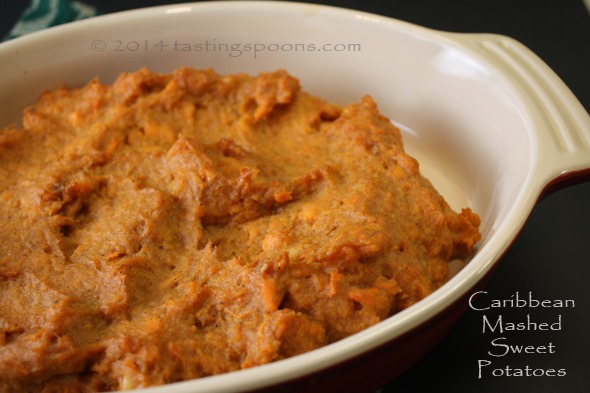
A very easy side dish – and a great way to use up an over-the-hill banana, if you happen to have one in your kitchen.

Different cultures use different ingredients in their cuisine. In the Caribbean, obviously, they grow tons of bananas, even some different varieties of them, so it’s kind of logical that they would combine sweet potatoes with bananas to make a side dish.

This rendition of them came from a cooking class my cyber-friend Nance went to, back about 20 years ago in the Chicago area. Some people might think any dish like this should only be served near Thanksgiving (it does have some recipe-similarity with a sweet potato casserole, although this surely has no marshmallows on top, nor does it contain pecans). I served it with a juicy grilled steak. It was so darned easy – I baked the sweet potatoes (the orange fleshed type) in my handy-dandy Breville toaster oven (love that thing!) for about 40 minutes. I let them cool for 10-15 minutes as they were hot as the dickens. In a bowl that had somewhat of a flat bottom I mashed them up with the banana that I’d cut into coin-chunks. I added butter, nutmeg and cinnamon. The recipe indicated adding brown sugar, but on tasting this, I decided they were already super-sweet already, probably because of the very-much over-the-hill banana. I added a little salt and it was done.

Since we weren’t eating that very second, I put them in the casserole dish you see above and put them in the toaster oven at 250°F. The only thing I discovered was that if these sit awhile – like the 15 minutes mine did – they almost get firm, so in the recipe below I’ve added in one little hint to add some milk to them if you’re going to try to keep them at all before serving. Thanks for the recipe, Nance.

What’s GOOD: how easy these were to make. And very, very tasty with the banana. I used 2 large sweet potatoes and 1 small banana, and you definitely could taste the banana. If you reduced slightly the banana proportion, you might not be able to pick out the banana flavor. You do need a ripe banana, or it would not mash well. I scaled down the spices a little bit too – I thought just a little bit was plenty for us, and it tasted delicious. I’ll definitely make this again.

What’s NOT: nothing really, unless you don’t have the ripe banana on hand.

printer-friendly CutePDF

Files: MasterCook 5+ and MasterCook 14 (click on link to open in MC)

* Exported from MasterCook *

Caribbean Sweet Potatoes

Recipe By: From my cyber friend Nance, and she got it at a cooking class
Serving Size: 8

3 pounds sweet potatoes
2 medium bananas
4 tablespoons unsalted butter
brown sugar to taste (optional)
1 1/2 teaspoons ground nutmeg — [I used less]
1 tablespoon ground cinnamon — [I used less]
Salt to taste
2 tablespoons milk — (or chicken broth or coconut milk) use only if making ahead (may need more)
1 teaspoon fresh lime juice — also use only if making ahead (may need more)

1. Bake potatoes at 375° F for 35-45 minutes, until tender to the touch. Allow to cool just enough so you can handle them; remove peel and chop coarsely in a flat-bottomed bowl.
2. Add bananas (cut into chunks), butter, brown sugar (if using), nutmeg and cinnamon. Using a potato masher, mix and mash the mixture until you can’t see any banana. Taste for salt and pepper. Serve immediately at this point.
3. Can be made ahead also (refrigerate for a few hours). If so, add a bit of milk to smooth out the mixture and a little squirt of lime juice (to keep the bananas from turning brown). Scoop mixture into a casserole dish and refrigerate for 2-3 hours. Allow to return to room temperature and and bake for 20 minutes or so at 250°F just to heat through. Could also reheat in microwave. Serve immediately.
Per Serving: 214 Calories; 7g Fat (26.8% calories from fat); 3g Protein; 38g Carbohydrate; 5g Dietary Fiber; 16mg Cholesterol; 19mg Sodium.

Posted in Miscellaneous, on February 18th, 2014.

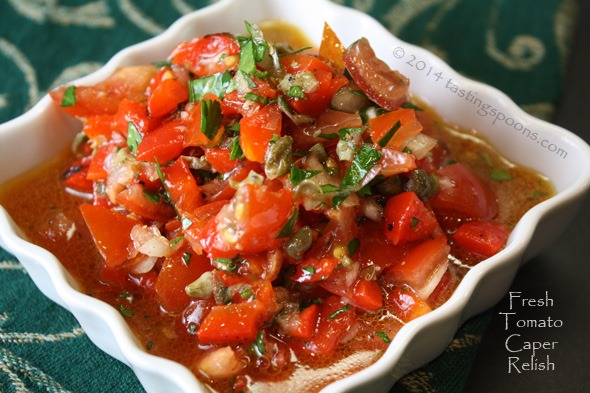
tomato_caper_relish

A sauce – a relish – a kind of a salsa – to serve over fish, chicken or even beef. Made with fresh tomatoes, canned roasted red bell  peppers and a bunch of aromatic stuff, plus some capers.

The other night my DH and our friend Joe wanted a steak for dinner. I defrosted some filet mignon steaks for them (I had a salad instead), but thought since Joe was providing a really nice bottle of Cabernet, I should do something a little extra, so I made this relish.

Ideally, I think this relish would go best with fish or chicken, but there’s no reason it’s not good with beef or pork either. The recipe came from a cyber friend of mine, Nance, who sent me a 200-page pdf the other day of recipes she had compiled from attending cooking classes back in the 1990’s. I slowly went through the full 200 pages and printed out about 30 or so that included recipes I wanted to try. This being one of them.

The recipe made a big batch, with some rather vague measurements, so I kind of guessed at reducing this down to an amount to serve 4 people. Actually, I think this relish is a bit forgiving in some respects. It came from a brewery in Barrington, Illinois called Millrose Brewery. So the notes said, their favorite is to serve this with swordfish. The notes said the most important aspects of this relish are CAYENNE, LEMON JUICE and GARLIC. So once you make it, taste it, and add more of those 3 things if you think it’s lacking anything. The relish comes together in a flash – if you have some jarred roasted red bell peppers. I buy those small on-the-vine tomatoes this time of year for sure, and they were quite tasty in this. It took about 7-8 minutes to make, if that.

What’s GOOD: how quick it was to make. How tasty it was on the beef. But it all depends on the quality of the tomatoes (important). Do use fresh lemon juice. And the capers, of course, add tons of flavor to anything. It will keep for 7-10 days, but ideally it’s best a few hours after making it.

What’s NOT: nothing at all.

printer-friendly CutePDF

Files: MasterCook 5+ and MasterCook 14 (click on link to open in MC)

* Exported from MasterCook *

Tomato Caper Relish

Recipe By: From my cyber friend Nance, and she got it at a cooking class, from Millrose Brewing Company
Serving Size: 4

1/2 cup fresh tomatoes — chopped small
2 teaspoons shallot — finely minced
1 tablespoon fresh parsley — minced
1 small garlic clove — smashed & minced
1/2 tablespoon capers — if large, chop them a little
1 whole red bell pepper — roasted (bottled) finely chopped
1/2 tablespoon white wine — vermouth is okay too
1/2 tablespoon fresh lemon juice
Salt and pepper to taste
1/8 teaspoon sugar — (optional)
1 dash cayenne — or more
2 tablespoons extra virgin olive oil

1. Combine all ingredients, adding olive oil last. Taste for seasoning – the most important ingredients are: cayenne, garlic and lemon juice – so add more if needed.
2. Will keep, refrigerated, for 7-10 days. Serve on fish, chicken or even beef. It’s particularly good on swordfish.
Per Serving: 78 Calories; 7g Fat (77.6% calories from fat); 1g Protein; 4g Carbohydrate; 1g Dietary Fiber; 0mg Cholesterol; 13mg Sodium.

Posted in Veggies/sides, on February 16th, 2014.

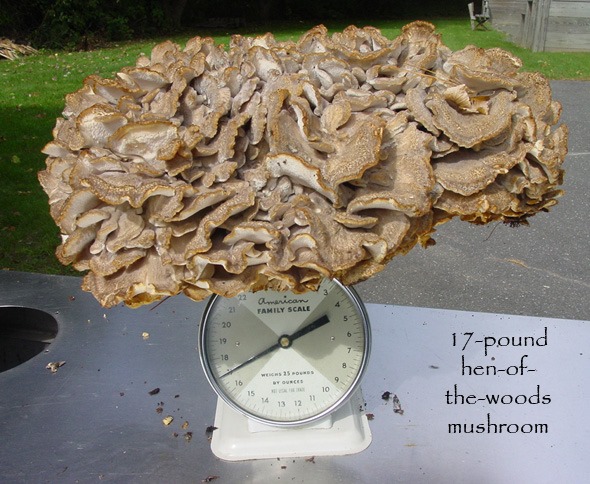
17_lb_mushroom_scale

Hen-of-the-wood(s) mushrooms don’t grow everywhere – this one and the others pictured here were grown in Massachusetts. They’re delicious if you didn’t know . . .

We  have a very dear friend, Joe Casali, who comes to stay with us regularly when he’s calling on customers in our area. He’s great fun to have around, and I usually cook a nice dinner when he’s here. Joe enjoys good food (and he and Dave are always chit-chatting about wine, which is an important part of every evening meal, but particularly so when Joe is here). This time he brought a gorgeous bottle of 1995 Markham Cabernet and a package of his mushrooms, and there’s quite a story here. My DH and Joe go sailing together often on our boat in San Diego, sometimes with Joe’s wife Yvette too  (I don’t go because I get seasick). Joe and Dave were once in business together, decades ago, and they roomed together back in the late 1970s for awhile. Both were jolly bachelors at the time.

Joe is Italian. Very Italian. He grew up in Massachusetts. His grandparents came over from the old country in the early 1900s and settled in Springfield, Mass., in the Italian district there, then later to East Longmeadow. Growing up in the 1950s Joe watched his grandmother Paulina and his mother Viola as they cooked food from their region in Italy – Emilia-Romagna. The family was from Piacenza (actually the town of Morfasso, in the mountains nearby) where the town is mostly made up of Casalis and Rigolis. It was at his Grandmother Paulina’s knee that he learned all about the mushrooms. Hen-of-the-wood is a Grifola frondosa polypore mushroom if you’re interested in the etymology. Over time in Joe’s family the mushroom name got kind of scrambled, and they call them grafoni.

Sometimes, apparently, in the East, in October, you can buy these mushrooms at Whole Foods. The last time Joe knew, they were charging $40/pound for them. See why they’re prized? – except that most people don’t know that much about them.

Hen-of-the-woods mushrooms are both revered and reviled (the latter only because some don’t know what a delicacy they really are and because some view them as eyesores in their pristine yards). If you go online and do a search for the mushrooms and click on images, you’ll find hundreds of pictures of them in all their delicate glory, nestled on or at the base of big trees, mostly oaks.  Joe doesn’t know if these mushrooms also grow in the region of his family in Italy, but for

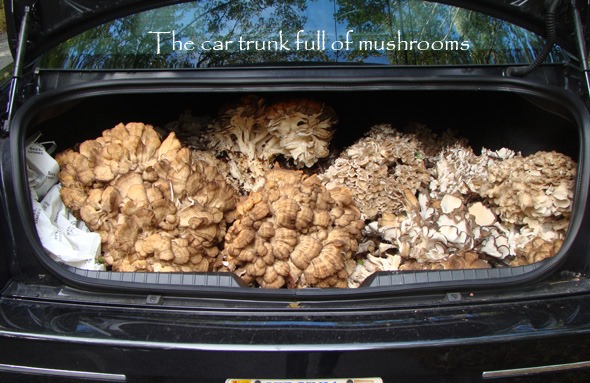
sure these immigrants learned to use them in Massachusetts. For years Joe has been flying to Mass. every September or October, to harvest hundreds and hundreds of pounds of these amazing mushrooms. Joe borrows a friend’s car and heads out to hunt mushrooms. Joe has an Excel spreadsheet that he’s developed over the years of locations of these mushrooms (because they grow in the same place year after year – he showed it to me awhile back – he has notes about taking this footpath, go 50 feet to this tree, cross the stream, turn left, etc.). He’s made friends with a few people within a 20-30 mile radius of his family home there and they leave the mushrooms intact waiting for Joe’s trip to harvest. Most of them are in forests and glades, or a vacant lot studded with trees. Joe’s dad knew the locations of these mushrooms and over the years Joe has found more and more of them.

Joe’s father was a member of an an Italian club – a club that actually still has a clubhouse. Can you tell there is a strong Italian population there? Joe is allowed to use the kitchen (he’s a member in good standing, though he only goes there once a year) to fix his mushrooms. Joe hardly joe_holding_big_mushroomssleeps during this several day period – he harvests a trunk full of them, goes to the clubhouse and starts cooking and cooks late into the night. Then the next day he goes out for more and repeats. He has a freezer there, too, that is used for his mushroom harvest. When he’s done he packs the frozen plastic containers in dry ice in a couple of big ice chests and flies home with his mushroom haul to California. One year he prepared 61 quart containers of cooked mushrooms.

There’s Joe with the 17-pounder. He ever so carefully cleans and slices them. The center is also used completely. He cooks them in individual batches. Joe has kindly given me the recipe he uses.

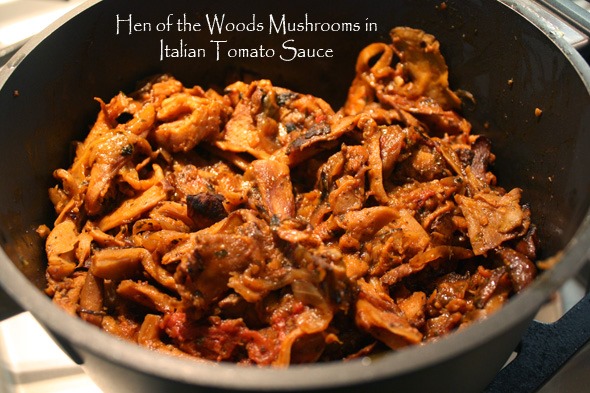
hen_of_the_woods_in_tomato_sauce

The other night he brought one container from his last harvest – it’s enough to feed about 8 people. Dinner was steak, sweet potatoes, these mushrooms, green salad, and some of that wonderful Dario’s Olive Oil Cake for dessert.

The sauce – well, it’s simple enough to make. Joe carefully cleans, trims and cuts the mushrooms into jillions of pieces. He sautés garlic and onions, then adds all the mushrooms, then canned Roma tomatoes with a little bit of juice. It’s seasoned with lots of fresh basil (that he quick dry roasts in the oven) added in just at the end of cooking. The mushrooms aren’t swimming in sauce – the minimal amount of canned tomatoes are there just to flavor them. They’re packed up in containers almost dry, but not quite. Above you can see there is some liquid – but very, very little. You reheat them over very low heat and serve as a side dish. Thank you, Joe, for sharing the story and the recipe. I hope your mother and grandmother would be proud!

What’s GOOD: harvesting your own food of any kind is cool. I can’t take credit for any of that. Joe did all the work. The mushrooms are very tasty – chewy, but not overly so. The sauce is not overwhelming at all – what is there is flavoring only. It’s all about the mushrooms, for sure.
What’s NOT: well, since we don’t live in an area to get these, too bad for us! We’ll have to rely on our friend Joe to bring us one of his precious stock.

printer-friendly CutePDF
Files: MasterCook 5+ and MasterCook 14 (click on link to open in MC)

* Exported from MasterCook *

Casali Family Italian Mushrooms

Recipe By: Our friend Joe Casali’s family recipe, from his Grandmother Paulina.
Serving Size: 8

7 cups hen-of-the-wood mushrooms — * see instructions below
6 tablespoons olive oil
1 tablespoon fresh garlic — minced
2 medium onions — halved, sliced thinly
1 cup canned tomatoes — Roma variety, crushed by hand, drained (about 5+)
1/4 cup tomato juice — from the canned tomatoes
Salt and freshly ground black pepper to taste
2 cups fresh basil — left whole

MUSHROOMS: Clean all dirt, bug areas, wormy areas off the base. Soak the mushroom(s) in warm salted water (warm water removes more of the dirt than cold water). Roll the mushroom under water so you remove as much dirt and debris as possible. Drain and refill the tub at least twice, repeating the process. If you’re doing many, wear rubber gloves. Gently drain mushroom and dry somewhat with paper towels. Cut mushroom into quarters, then you start pulling the pieces off, including all of the center stem portion. Some of it is cut, and parts are gently pulled to remove small ribbon-like shreds about 3 inches long and 1 inch wide or so. It takes patience.
1. Bring a large pot of water to a boil and add salt. Place mushrooms (already cleaned and sliced) in the water and simmer for about 7-9 minutes. Drain in a colander and set aside.
2. In a very large skillet heat olive oil. Add garlic and saute over low-medium heat (do not burn) until golden. Add onion and continue cooking until onion is golden brown also. Add the mushrooms and cook for about 10 minutes over medium heat. You want the onions to get a dark golden brown.
3. Add canned Roma tomatoes, crushed in your hand (remove center core and discard), and continue cooking over medium heat until the mushrooms are almost brown, another 5-10 minutes. Add 1/4 cup of the canned juices, and even more if the mushrooms start to burn. Taste mushrooms and continue to cook until they’re tender. They will never been quite SOFT, but they’ll be chewy and cooked through. Season with salt and pepper to taste.
4. Pour mushroom mixture into a colander and drain off the oil.
5. Meanwhile, preheat oven to 200° F. Snip off the stems on all the basil, then place on a large baking sheet and roast for about 7-8 minutes – only until the basil has dried and turned slightly brown. Remove immediately and set aside.
6. Using your hands, crush the basil (it will be almost like dust) between your palms and add all of it to the mushroom mixture and stir until combined. You may serve the mushrooms at this point, or pour them into freezer containers and freeze. Once defrosted, reheat gently over low heat until hot and serve along side grilled meat, poultry, pork, sausages.
Per Serving: 127 Calories; 11g Fat (70.6% calories from fat); 2g Protein; 8g Carbohydrate; 2g Dietary Fiber; 0mg Cholesterol; 76mg Sodium.

Posted in Desserts, on February 14th, 2014.

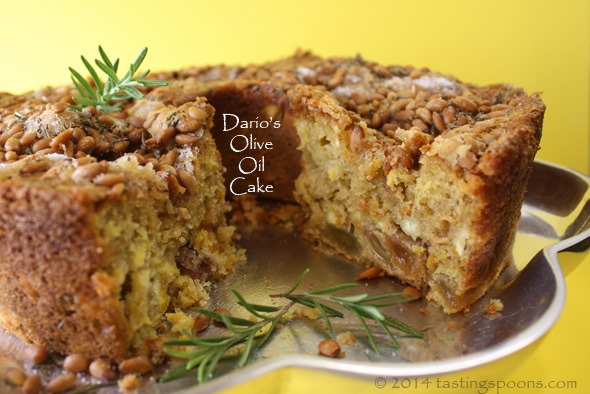
darios_olive_oil_cake

So far this year I haven’t urged you, fervently, to cook or bake anything I’ve written up. This recipe is my first fervent call! Oh my goodness, this cake is so darned good. No wonder it was featured in the 2013 L.A. Times top recipe round-up. Read on . . .

The Los Angeles Times may be the only daily newspaper that still has a working test kitchen. As an institution, newspaper test kitchens have kind of slid into oblivion with the cost-cutting going on at nearly every major daily in the country. It’s so sad. I used to look forward to reading the big – really big – food section back a couple of decades ago. The Times still has a food section, but oh, it’s so small. I do read it online occasionally. Most newspapers rely on a bevy of written offerings from a variety of free lance food writers who prepare short stories and provide pictures. So the food editors need only pick and choose, within budget, to include this article, that article, decide which one to “feature,” which ones to discard.

Our more local newspaper, the Orange County Register, doesn’t have a test kitchen. The kitchen shown in occasional articles is the Food Editor’s home kitchen, with photos taken usually by one of the staff photographers. And my guess is that her budget doesn’t allow that very often.

But fortunately, the L.A. Times still tests recipes, still writes articles and has a small coterie of writers who write only for that paper. Like Russ Parsons. Who is likely reaching retirement age. I’ll be sad not to read his short stories when that happens. One of the food writing events at the Times is the annual best-recipe contest. The food section staff cook and bake the “best” recipes from the previous year and narrow them down and down and down. And the results are published in late January to great fanfare.

Anyway, back to this cake. The origin of it is Dario Cecchini’s butcher shop and restaurant deep in the heart of Tuscany – in Panzano in Chianti. It’s a cake his trusty baker Simonetta has been preparing daily for decades. Many people have written about it and there are a few recipes “out there” of a similar style. But this one – oh yes. This one that Nancy Silverton (of La Brea Bakery fame, and now Mozza restaurant) has revised and made possible for a home kitchen. Her recipe makes 2, so I tuned it down, dialed it back and made it for just ONE cake. Although – I’m telling you – maybe you should make TWO and freeze the other one. You’ll be glad . . . . .

Having made it and eaten it, I’ll just say there are very distinct things that are different about this cake: (1) naturally, that it’s made with olive oil as the fat, and GOOD extra virgin olive oil, at that; (2) that it contains 1 1/2 whole oranges, chopped up, peel, pith and all; and (3) the topping is different – sugar, pine nuts and fresh rosemary. And certainly this is a dessert cake, but somehow the pine nuts and fresh rosemary give it a savory tone. And it’s divine.

Raisins are in this cake – and you soak them in Vin Santo, if you have it. That’s an Italian dessert wine, and can vary a lot in sweetness from one winery to another. It’s a common little treat given to nearly everyone after dinner in restaurants in Italy. Well, I didn’t have any, so I scanned my liquor closet and finally settled on a very old bottle of tawny Port. It had faded to a light sherry color and had all kinds of lees in the bottle. I poured it through a sieve and had enough to soak the raisins for awhile. The raisins I have on hand right now are really large – jumbo size and from several varieties of grape, so they’re different colors – in the picture at top you can see one or two that had settled to the bottom of the batter. In the photo at top you can see the orange pith – but you absolutely don’t know you’re eating pith – it comes through clean and sweet.

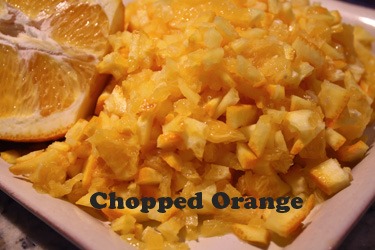
oranges_choppedThe oranges are Navels, and I cut off the ends, cut them in half, then sliced into half-rounds and chopped to get a very nice mound of chopped orange stuff. I did that ahead. There at right was the plate full of oranges. It’s not necessary to do this in the food processor, although you can if you’d prefer. Just don’t pulverize them – it’s nice to bite into a little chunk of orange now and then in the finished cake.

The recipe calls for pastry flour. Since I didn’t have that on hand, I went online to read about it – all it means is flour that has lower protein, but not as low as cake flour, which is 7-8%. So, I mixed half all-purpose (10-12%) and half cake flour, to reach an approximate 9% protein, which is the level for pastry flour.

Mixing up the cake wasn’t difficult – eggs, the leavening and sugar were combined for several minutes in the stand mixer, then very slowly you pour the extra virgin olive oil down the side of the bowl and into the batter. If you go too fast it spatters anyway, and it might separate. Slow-slow. Then you add the soaked raisins and the flour mixture in 3 separate batches. Once that’s mixed, you turn off the mixer and use a spatula to fold in the oranges.

At this point you do something else a bit different – you let the batter rest for 10 minutes. Why, I don’t know. The only thing I can think of is that the batter is fairly thick, and in order to get the fruit (oranges and raisins) to not sink to the bottom of the tube pan (which they might do anyway) if they’re allowed to sink in the mixing bowl first, then when you pour it into the tube pan they’ll be at the top and perhaps not sink to the bottom before the lifting/leavening keeps them suspended. At any rate, the batter is poured into a buttered and floured tube pan.  You probably could use a olive_oil_cake_ready2_bakespringform pan, but the recipe indicates a tube pan – since the cake is dense (but not really heavy) it will cook more evenly in a tube pan. A Bundt pan will not work because those pans assume you’ll turn the cake upside down, and the top here IS the top in the finished cake. The cake top is sprinkled with granulated sugar (a really nice touch and you do taste it’s crunch in the finished cake), then toasted pine nuts and lastly you sprinkle on minced fresh rosemary, which sticks in the little crevices.

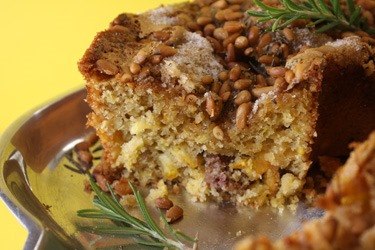
The baking was simple enough – but requires you to visit the oven every 10 minutes. It’s baked for 10 minutes at 400°, then you turn it down to 325° and bake another 10. Turn the pan around, and olive_oil_cake_slicedanother 10, and another 10, until it’s baked a total of about 40 minutes. I should have measured the internal temp, but didn’t. The cake is cooled in the pan, then you’ll want to run a knife around the inner tube, and a spatula slid around the bottom to make sure the cake releases completely. Then you very, ever-so carefully turn the cake out onto your outstretched hand and forearm and carefully place it on a platter or cake plate. You will lose some of the pine nuts and sugar. The cook gets to eat those flying pine nuts (I only had about 10-15 of them fly off). My cake did have a few indentations – I suspect it’s from the amount of fruit. It did not detract one iota from the flavor. You’ll not care a bit.

At Mozza, Nancy Silverton makes this and serves it with olive oil gelato she’s developed. I’ll be trying that. It’ll be posted here if it’s good. Stay tuned. Meanwhile, I’m going to go cut myself another sliver of this outstanding cake.

What’s GOOD: oh gosh. Every single, solitary thing about this cake is exceptional. The taste – the oranges, the texture of the cake, which is light, surprisingly, the rosemary I loved, the pine nuts, and the sprinkling of sugar on the top that becomes slightly crunchy. Divine. Next time I am going to make sure I use small raisins – or I’ll chop the raisins – they were heavy so I think they did sink.
What’s NOT: nothing except you do need to have fresh oranges, and if you can find Vin Santo, fine. Otherwise use white port or a light port. Don’t use sherry – it would come through in the flavor. Do use really good olive oil too – this isn’t exactly a cheapo cake!

printer-friendly CutePDF
Files: MasterCook 5+ and MasterCook 14 (click link to open in MC)

* Exported from MasterCook *

Dario’s Olive Oil Cake

Recipe By: Adapted slightly from a Nancy Silverton recipe, that she adapted from Dario Cecchini in Panzano, Chianti, Italy
Serving Size: 12

1/2 cup raisins
3 tablespoons Vin Santo wine — [I used tawny port]
1 1/2 whole oranges — (including the peel, etc.)
2 large eggs
1/2 cup granulated sugar — plus 2 tablespoons
1/2 cup extra-virgin olive oil — plus 1 tablespoon (use VERY good EVOO)
1 1/2 teaspoons baking soda
1 1/2 teaspoons baking powder — SCANT
14 ounces pastry flour — [I used half all-purpose and half cake flour]
TOPPING:
1/4 cup granulated sugar
1/3 cup pine nuts — toasted
1 tablespoon fresh rosemary

1. Bring the raisins and the Vin Santo to a simmer in a small saucepan, then immediately remove from the heat. Let stand at least 30 minutes, up to overnight. If you are using very large raisins, chop them into smaller pieces before cooking and plumping them.
2. Heat the oven to 400° F. Prepare a (10-inch) angel food cake (tube) pan by generously spraying with cooking spray and dusting with flour.
3. Trim off the ends of the oranges. Halve them through the stem and slice into one-fourth-inch thick sections. Remove any seeds and coarsely chop.
4. In the bowl of an electric mixer fitted with the whisk attachment, mix the eggs, sugar and the leavening over medium high speed until thickened, 3 to 4 minutes.
5. With mixer on medium speed, slowly add olive oil in a slow, steady stream down the side of the bowl until emulsified. Turn the mixer to low and add the flour and soaked raisins (with any remaining liquid) alternately in 3 batches, scraping down the sides of the bowl as needed. The batter should be thick.
6. Remove the bowl from the mixer. Using a rubber spatula, fold chopped oranges into mixture. Set the batter aside for 10 minutes, then pour into the prepared pan.
7. Add topping: sprinkle the pinenuts and sugar over the cake, then add rosemary.
8. Bake the cakes for 10 minutes, then lower the oven temperature to 325° F and continue to bake, rotating the cake every 10 to 15 minutes, until golden brown and a toothpick inserted comes out clean, an additional 30 to 35 minutes. Set pan on a rack and allow to cool to room temp.
9. Run a knife around the inside of the pan and carefully invert it over a large plate to release the cake. Carefully turn it over and transfer it to a large serving plate or cake stand.
Per Serving: 314 Calories; 12g Fat (33.8% calories from fat); 5g Protein; 47g Carbohydrate; 1g Dietary Fiber; 35mg Cholesterol; 451mg Sodium.

Posted in Breads, Brunch, easy, on February 12th, 2014.

apricot_jam_pastry

Oh my goodness, is this ever fantastic. The problems with this are: (1) finding good, tender and rich brioche bread; and (2) keeping your fingers out of the finished pastry. They are just so delicious. The base is a thick slice of brioche bread (the one above is about 1/2 inch thick, maybe just slightly thicker), spread with a ground almond and butter mixture (an almond cream, it’s called), spread with a little bit of apricot jam, some almonds sprinkled on top and baked briefly, then generously sprinkled with powdered sugar.

The other morning we were at one of my book group meetings, at our friend Peggy’s establishment, (Peggy & Gary own it along with their son) Mead’s Green Door Café in old-town Orange. Every other month we meet at their little café and enjoy a latte or cappucino and some lovely treat Peggy has baked while we discuss our current book selection. Peggy and her husband used to own a restaurant in Orange, but sold it a few years ago and bought a derelict building and spent over a year renovating it to the Café it is now. Cute as a bug, Old-world style, country-ish, eclectic, offbeat, catering a lot to the young Chapman University crowd nearby. They serve vegetarian and vegan food only, with usually at least one GF item too. They specialize in breakfast and lunch. Peggy does 90% of the baking. Peggy’s #1 seller (of her pastries) is her sweet potato scone, which is delish also, I can attest!

This little number, which blew me away, is so easy to make. Disclaimer here – I didn’t make the one you see above – Peggy did. But it’s so very easy, I was fairly certain you wouldn’t mind me showing you hers. If I made this now, I’d be gobbling it down. The recipe came from Sunset Magazine (earlier last year). First you must start with good brioche. Maybe one of our local bakeries (like Panera or Corner Bakery) will have it – I’ll have to look. You slice it thick (the recipe said 1-inch; I think Peggy sliced hers closer to 1/2 inch. Anyway, thick brioche. Then you spread the top with a little apricot jam, then a mixture of butter, granulated sugar, salt, egg, and half-and-half that’s been whizzed  up in the food processor. Then the top is sprinkled with almonds and sugar. Baked for 20 minutes or so, sprinkled with powdered sugar. Done. Very easy. Very special.

What’s GOOD: certainly the taste is first and foremost! These things are just delish. Worth making. You can make the almond cream ahead and it will keep for several days. The almond cream makes more than what you’ll use to make 8 – so perhaps cut down on the quantity first time.

What’s NOT: really nothing.

printer-friendly CutePDF

Files: MasterCook 5+ and MasterCook 14 (click link to open in MC)

* Exported from MasterCook *

Almond and Jam Pastries

Recipe By: Sunset Magazine, March, 2013
Serving Size: 8

ALMOND CREAM: (you’ll have more than is needed)
1 cup sliced almonds
1/2 cup granulated sugar — divided
2/3 cup unsalted butter
1/4 teaspoon kosher salt
1 large egg
2 tablespoons half and half — or milk
TOASTS:
8 slices brioche — or challah bread, 1/2 in. thick or thicker
1/2 cup apricot jam — or other flavor
2 cups sliced almonds — about 2 T per toast
Powdered sugar

1. Preheat oven to 350°. Whirl 1 cup almonds with 1/4 cup granulated sugar in a food processor until finely ground. Transfer mixture to a bowl.
2. Blend butter and remaining 1/4 cup granulated sugar in a food processor until smooth. Add salt, egg, and half-and-half and pulse just to blend. Add reserved ground almonds and blend until mixture is smooth.
3. Line a baking sheet with parchment paper. Spread about 1 tbsp. jam, then 2 tbsp. almond cream, on each slice of bread (you’ll have almond cream left over). Sprinkle each with about 2 tbsp. sliced almonds.
4. Bake until almond cream is golden brown and almonds are toasted, about 20 minutes. Sprinkle with powdered sugar.
5. Make ahead: Chill extra almond cream airtight up to 2 weeks and use for making more pastries.
Per Serving (not accurate because you make more almond cream than you’ll use): 831 Calories; 55g Fat (57.6% calories from fat); 20g Protein; 71g Carbohydrate; 5g Dietary Fiber; 141mg Cholesterol; 371mg Sodium.

Posted in Fish, Pasta, on February 10th, 2014.

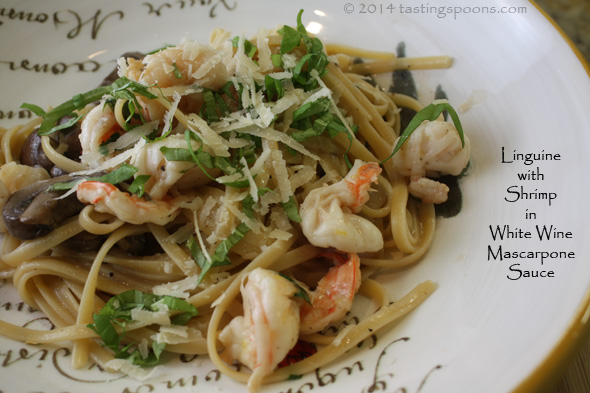
linguine_shrimp_mascarpone_sauceIt’s a little hard to tell there’s a sauce on this but the mascarpone is what gives the pasta a shine (a shine in food means either fat or sugar). When this says “sauce” it doesn’t exactly mean it’s a “cream sauce” as in a cooked, thickened sauce made with cream. The mascarpone is the only creamy substance in this and it’s so very easy to just stir it (and toss and toss) into the hot pasta. It just melts. Yum.

There’s something about shrimp and pasta. They’re one of those matches that just work in the culinary world. The palate and taste rule here. Or maybe in this case it’s the mascarpone cheese which provides the bridge between the two. Whatever it is, it works. If you’re looking for something nice to fix for Valentine’s Day, this would be a good one. It satisfies, for sure, with the pasta, and the shrimp (especially if you buy big ones) make it a treat. The dish is NOT hard to make at all – just get everything ready ahead of time.

One unique thing here is the use of sliced garlic. At the cooking class with Phillis Carey, she explained that sliced garlic is her new go-to method. It doesn’t brown as fast (however, you do need to cook it over medium heat – higher than that and the garlic, no matter sliced or not – will burn, and that you don’t want). I have this gadget – Chef’n Garlic Slice. The photo I found at Williams-Sonoma, though the link is to amazon. It’s about $12.00, I think. Anyway, the peeled garlic cloves go into the top, you put the lid on and begin turning the top and thin, perfect slices come out the bottom. Bingo!

The sliced garlic isn’t quite as intense in flavor, either. So you can use a bit more than usual and not overwhelm the dish or someone’s palate.

Anyway, back to this dish. Shrimp are cleaned, deveined and if you choose, slice them in half (through the back so you have 2 perfect halves that curl up so cute when you cook them. Phillis calls them swans when they do that. Okay. Anyway, the shrimp are tossed with lemon zest, salt and pepper while they wait to be called to the pan. First you heat some butter in a nonstick pan (use a big one because everything goes in there eventually). The garlic is added and a tiny bit of red chili flakes and it’s cooked for a whopping minute. Then you add the shrimp and cook that for about 3 minutes, then add the dry white wine (Phillis used Pinot Grigio) and lemon juice briefly. I added some mushrooms to this – because I had them – and because I thought they’d taste good in this dish.

Meanwhile you will have cooked the linguine in very salted water until it’s just barely done but still with a bite (because you cook it some more in the pan). And it’s here where you must save some of the pasta cooking water because it’s used in conjunction with the mascarpone cheese to make the sauce. Lastly you add the pasta to the shrimp mixture, toss and toss and toss, then garnish with lemon zest and fresh basil, salt (maybe, but probably not) and pepper. This dish requires more salt than usual – if you don’t heavily salt the water, then add salt at the end.

Here’s where I detoured – I did add some Parmesan cheese. Just because I can. It added a nice fillip to the dish, I think. But you don’t have to. I also used a whole lot more basil because the original recipe calls for just 2 T of basil shreds. Definitely not enough. If you prefer, you could add Feta cheese to the pasta instead of Parm. That would be a very interesting combo – and a good one, I think. And I also added some sauteed mushrooms too – I cooked them in a separate pan in a little bit of butter, then re-added them to the finished dish to heat them through before adding the mascarpone, etc.

What’s GOOD: You don’t get the feeling (taste) that you’re eating a creamy pasta. This is nothing like using heavy cream, or a carbonara. There is just 1/2 cup in the entire dish that serves at least 3 people. It’s different – loved it with the shrimp. If you’re a bit light on the shrimp, cut them into pieces, but it looks quite pretty to serve it with the cute shrimp curls. Altogether delicious.
What’s NOT: nothing, really. I liked it from the get-go.

printer-friendly CutePDF
Files: MasterCook 5+ and MasterCook 14 (click link to open recipe in MC)

* Exported from MasterCook *

Linguine with Lemon-Garlic Shrimp in Mascarpone Sauce

Recipe By: Slightly adapted from a Phillis Carey recipe, 2014
Serving Size: 3

1/2 pound linguine — thin type, if possible
1 1/4 teaspoons lemon zest
1/4 teaspoon salt — plus more to taste
1/4 teaspoon freshly ground black pepper — plus more to taste
1 pound extra large shrimp — (approx 25-30 per pound)
2 tablespoons unsalted butter
3 cloves garlic — thinly sliced
1/8 teaspoon red chili flakes — (if you double the recipe, do not double the chiles)
1/4 cup Pinot Grigio wine — or other dry white wine (preferably not chardonnay) like sauvignon blanc or vermouth
2 tablespoons fresh lemon juice
1/2 cup mascarpone cheese
4 tablespoons fresh basil — finely sliced
1/3 cup Parmigiano-Reggiano cheese — grated [not in the original recipe]

Notes: Be sure to save some of the pasta water as you use it to thin the sauce at the end. Traditionally, Italians would not serve this with cheese on top, but if you like it, do it! I also added mushrooms (sliced), cooked them in a little butter and added them in just at the end of the shrimp-cooking part.
1. SHRIMP: Trim the cleaned and deveined shrimp, removing tails and slicing each shrimp in half through the back. Add lemon zest to the shrimp and set aside for up to 20 minutes (otherwise, refrigerate the shrimp until you’re ready to cook them).
2. PASTA: Cook the linguine in boiling and heavily salted water until the pasta is al dente, about 6-8 minutes, depending on the type used. Remove a cup or so of the pasta cooking water, set aside and drain pasta in a colander.
3. SAUCE: Meanwhile, melt butter in a large nonstick skillet over medium heat (hot high). Add garlic and red pepper (the garlic should just barely get brown at this cooking temperature) and cook for about a minute. Add shrimp and cook until just done, about 3 minutes, stirring often. The shrimp will curl up. Add the wine and lemon juice and bring to a simmer; cook until the sauce is slightly reduced, about a minute.
4. If you have enough room in the pan, toss in the drained pasta, mascarpone cheese and about 1/2 cup of the cooking water. (If your pan isn’t large enough, pour everything into a large bowl and mix everything there.) Toss well, using tongs, adding more cooking water as needed, until the pasta and shrimp are coated and the sauce looks creamy. As you toss, there should be just a little bit of the thin pasta water/sauce in the bottom. Remove from heat and toss in remaining lemon zest and fresh basil. Season to taste – particularly pepper – and serve immediately with Parmigiano-Reggiano cheese on top if desired.
Per Serving: 657 Calories; 23g Fat (32.5% calories from fat); 45g Protein; 61g Carbohydrate; 2g Dietary Fiber; 284mg Cholesterol; 587mg Sodium.

Related Posts Plugin for WordPress, Blogger...