


Get new posts by email:

Archives

Currently Reading

Here are the tastingspoons players. I’m in the middle (Carolyn). Daughter Sara on the right, and daughter-in-law Karen on the left. I started the blog in 2007, as a way to share recipes with my family. I’m still doing 99% of the blogging and holding out hope that these two lovely and excellent cooks will participate. They both lead very busy lives, so we’ll see.

– – – – – – – – – – – – – – – – – – – – – –

BOOK READING (from Carolyn):

Music of Bees, Eileen Garvin. Absolutely charming book about a woman in midlife, lonely, who raises bees, also makes unlikely friends. Heart-warming and very interesting about beekeeping.

A Postcard from Paris, Alex Brown. Really cute story. Dual time line, 1940s and present day about renovating an old apartment in Paris, things discovered.

Time of the Child, Niall Williams. Oh such a good book. Very small village in Ireland, 1960s. A baby is left on the doorstep. The town all whispers and helps. I listened to an interview of the author, which made me like him and his books even more.

Sipsworth, Simon Van Booy. If you like animals you’ll swoon. An old woman who really wants to die finds a tiny mouse in her house and befriends it and finds a reason to live. Utterly charming book.

The Forger’s Spell, Edward Dolnick. True story. For seven years a no-account painter named Han van Meegeren managed to pass off his paintings as those of Johannes Vermeer.

If You Lived Here, You’d be Home by Now, Christopher Ingraham. Could hardly put it down – about a journalist who takes on a challenge to move to small town in Minnesota and write about it. He expects to hate it and the people and place, but he doesn’t. Absolutely wonderful true story.

The River We Remember, William Kent Kreuger. 1950s, Minnesota. A murder and the aftermath. Could hardly put it down. Kreuger has such a vivid imagination and writing style.

How the Lights Gets In, Joyce Maynard. An older woman returns to New Hampshire to help care for her brain-injured son. Siblings and family, lots of angst and resentments.

The Filling Station, Vanessa Miller. Every American should read this book. A novelized retelling of the Tulsa massacre in 1921. Absolutely riveting.

The Story She Left Behind, Patti Callahan Henry. Love this author. Based on a true story. A famous author simply vanishes, leaving her husband and daughter behind. She had invented a mystical language no one could translate. Present day, someone thinks he’s solved the riddle, contacts the family. Really interesting read.

The Girl from Berlin, Ronald Balson. Love anything about Tuscany. An elderly woman is being evicted from a villa there, with odd deed provenance. Two young folks go there to help unravel the mystery. Loved it.

The Island of the Colorblind, Oliver Sacks, M.D. Nonfiction. The dr is intrigued by a remote Pacific island where most of the inhabitants are colorblind. He also unravels a mystery on Guam of people born with a strange neurological problem. Medical mysteries unveiled. Very interesting.

The Bookbinder, Pip Williams. Post 1914 London. Two sisters work at a bookbindery. They’re told to not read the books. One does and one doesn’t. One has visions beyond her narrow world; the other does not. Eventually the one gets into Oxford. Lovely story.

The Paris Express, Emma Donoghue. 1895 on a train to Paris, a disaster happens. You’ll delve into the lives of many people who survived and died in the crash.

A Race to the Bottom of Crazy, Richard Grant. This is about Arizona. Author, wife and child move back to Arizona where they once lived. Part memoir, research, and reporting in a quest to understand what makes Arizona such a confounding and irresistible place.

The Scarlet Thread, Francine Rivers. A woman’s life turned upside down when she discovers the handcrafted quilt and journal of her ancestor Mary Kathryn McMurray, a young woman who was uprooted from her home only to endure harsh frontier conditions on the Oregon Trail.

A Place to Hide, Ronald Balson. 1939 Amsterdam, an ambassador has the ability to save the lives of many Jewish children. Heartwarming.

Homeseeking, Karissa Chen. Two young Chinese teens are deeply in love, but in China. Then their families are separated. Jump to current day and the two meet again in Los Angeles.

North River, Pete Hammill. He always writes such a good story. A doctor works diligently healing people from all walks of life. His wife and daughter left him years before. One day his 3-yr old grandson arrives on his doorstep.

A Very Typical Family, Sierra Godfrey. A very messed-up family. Three adult children are given a home in Santa Cruz, Calif, but only if the siblings meet up and live in the house together. A very untypical scenario but makes for lots of messes.

Three Days in June, Anne Tyler. The usual Anne Tyler grit. Family angst. This wasn’t one of my favorites, but it was entertaining and very short.

Saved, Benjamin Hall. Author is a veteran war reporter. Ukraine, 2022, he nearly loses his life to a Russian strike. Riveting story – he survives, barely.

Grey Wolf, Louise Penny. Another Inspector Gamache mystery in Quebec. She is such an incredible mystery writer.

All the Colors of the Dark, Chris Whitaker. A missing person mystery, a serial killer thriller, a love story, a unique twist on each. Could hardly put it down.

Orbital, Samantha Harvey. Winner of 2024 Booker Prize. I don’t usually like those, but I heard the author interviewed and she hooked me. This is not a normal book with a beginning, a story and an end. It’s several chapters of the day in the life of various astronauts at the ISS (Int’l Space Station). All fictional. She’s been praised by several real astronauts for “getting it” about space station everyday life.

The Blue Hour, Paula Hawkins. An island off Scotland. Inaccessible except when the tide is out. Weird goings on. An artist. A present day mystery too.

Iron Lake, William Kent Krueger. A judge is murdered and a boy is missing. Riveting mystery.

Tell the Wolves I’m Home, Carol Ricks Brunt. 1980s. A 14-yr old girl loses her beloved uncle. Yet a new friendship arises, someone she never knew about.

Four Treasures of the Sky, Jenny Zhang. 1880s, a young girl is kidnapped in China and brought to the United States. She survives with many hurdles in the path.

The Boy Who Fell out of the Sky, Ken Dornstein. Memoir, 1988. The author’s brother died in the PanAm flight that went down in Lockerbie, Scotland. A decade later he tries to solve “the riddle of his older brother’s life.”

Worse Care Scenario, T.J. Newman. Oh my. Interesting analysis of what could/might happen if a jet crashed into a nuclear plant. Un-put-downable.

Song of the Lark, Willa Cather. Complicated weave of a story about a young woman in about 1900, who has a gifted voice (singing) and about her journey to success, not without its ups and downs.

Crow Talk, Eileen Garvin. Charming story which takes place at a remote lake in Washington State, about a few people who inhabit it, the friendships made, but also revolving around the rescue of a baby crow.

The Story Collector, Evie Woods. Sweet story about some dark secrets from an area in Ireland, a bit magical, faerie life, but solving a mystery too.

A Sea of Unspoken Things, Adrienne Young. A woman investigates her twin brother’s mysterious death. She goes to a small town in California to figure it out, to figure HIM out.

The King’s Messenger, Susanna Kearsley. 1600s England, King James. About one of his trusted “messengers,” and his relationship with a young woman also of “the court.” Lots of intrigue.

In the Shadow of the Greenbrier, Emily Matchar. Interesting mystery in/around the area of the famous resort in White Sulphur Springs, West Virginia.

Isola, Allegra Goodman. Hard to describe, survival story on an island in the 1600s.

Save the Date, Allison Raskin. Rom-com, witty, LOL funny. Clever.

The Sirens, Emilia Hart. Numerous time-lines, Australia. Mysteries abound, nightmares, abandoned baby, weird allergies.

Red Clay, Charles Fancher. LOVED this book. Mostly post-Civil War story about the lives of slaves in Alabama during Reconstruction.

Stars in an Italian Sky, Jill Santopolo. Dual time line, 1946 and recent time. Love stories and a mystery.

Battle Mountain, C.J. Box. Another one of Box’s riveting mysteries. Love his descriptions of the land.

Something Beautiful Happened, Yvette Corporon. A memoir of sorts in Greece, tiny island of Erikousa, where the locals hid Jews during WWII. All elusive stories told by the author’s grandmother.

The Jackal’s Mistress, Chris Bohjalian. 1860s Virginia, about a woman who saves the life of a Union soldier. Really good story.

Song of the Magpie, Louise Mayberry. Really interesting story about Australia back in the days when it was mostly a penal colony. Gritty strength of a woman trying to thrive with her farm.

The Boomerang, Robert Bailey. A thriller that will have you gripping the book. About a lot of secrets surrounding the president (fictional novel, remember) and his chief of staff and about cancer. A cure. Such a good story.

Care and Feeding, Laurie Woolever. Really interesting memoir of a woman driven to succeed in the restaurant business. She worked for Mario Batali and then Anthony Bourdain. Gritty stories.

Everything is Tuberculosis, John Green. Maybe not a book for everyone. A real deep dive into the deadly tuberculosis infection, its history. I heard the author interviewed and found the book very interesting.

The Book Lovers Library, Madeline Martin. Fascinating read about Boots’ drug stores’ lending library. And the people who worked in them.

The Arrivals, Meg Mitchell Moore. LOL funny, about a middle-aged couple whose children (and their various family members) return to the family home and the chaos that ensues.

My Life as a Silent Movie, Jesse Lee Kercheval. About grief. A big move to Paris, finding herself a new life with a new set of real blood family.

Escape, Carolyn Jessop. Another memoir about a woman really in bondage in Utah, Mormon plural marriage.


Tasting Spoons

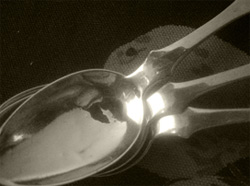
My blog's namesake - small, old and some very dented engraved silver plated tea spoons that belonged to my mother-in-law, and I use them to taste my food as I'm cooking.

Scroll down to the bottom to view my Blogroll

Posted in Breads, Vegetarian, on May 11th, 2013.

cucumber_sandiwiches

Well. There are tea sandwiches, and then there are THESE tea sandwiches. Oh gosh were they delicious. As I’m writing this – and it’s breakfast time this moment – I’d eat these for breakfast if I had any of them!

Our daughter Sara decided to throw a tea for a group of her girlfriends. Her rule: no children allowed – it was going to be a time for her friends, all busy moms – to sit and relax. Since we were driving there to visit them that evening, she asked if I’d come early. Of course! I’m always up for tea! At home, I made two kinds of cookies to help her – the Baked Cinnamon Toasts I’ve already raved about here and the Moravian Sugar Cookies, although my recipe calls them Almond Spice Wafers. I also made lemon curd, and couldn’t believe it when we got all done and realized we’d forgotten to put it out! Oh, so sad. Sara made the middle cookies you can see below, rich chocolate shortbread kind of cookies pillowed with a chewy caramel layer. cookies_for_teaSara made 2 kinds of tea – a rooibos, which is her day to day favorite decaf tea, and a pot of Earl Grey. She also put out some gorgeous spring strawberries, sugar, milk, teacups and saucers, some crème fraiche that I sweetened with a little bit of sugar (this was in lieu of clotted cream), and napkins, of course.
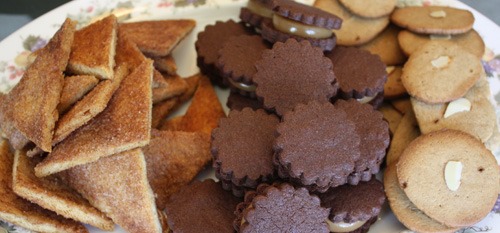
The COOKIES: Baked Cinnamon Toasts are on the left, Sara’s chocolate caramel filled cookies in the middle and the Almond Spice Wafers on the right. Sara thought the Cinnamon  Toasts were the hit of the cookie category. I agree. I had about 5-6 of them I kept at home and within a day they were gone – even my DH, who rarely eats anything sweet – gobbled down 2-3 of them. Guess I’ll have to make them again.

I’ll write up a post in the next day or so with the two scones we made. One an apricot-orange and the star of the show, a lavender white chocolate chip.

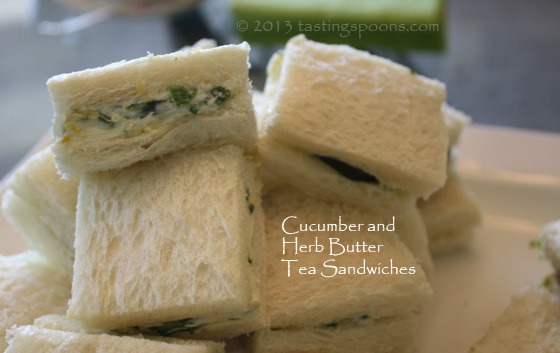
The winner of the tea sandwich category at Sara’s tea was this cucumber one. I mean, what would a ladies’ tea be without some cucumber sandwiches? Sara found some tea sandwich suggestions at this website. For this sandwich it said:  Cucumber-Butter – Mix 4 tablespoons softened butter, 1/2 teaspoon grated lemon zest and 1 tablespoon chopped fresh herbs. Spread on white bread and sandwich with sliced cucumber. Trim the crusts and cut into pieces.   We were making 5 whole sandwiches (which made 4 little quarters each), so we had 20 of each sandwich we made. I added minced chives, lemon zest, some salt and a teaspoon or so of fresh minced thyme leaves. I used 1 cube of butter for the 5 sandwiches and it was just enough.

Over the years, I’ve learned that you need to get just the right proportion of filling to bread.

Tea Sandwich Advice:

Make one tiny test sandwich with the filling and taste to see if it’s too bready, or too buttery or has too much filling. Adjust and taste again until you get it just right!

So in this case, with our first taste test, there wasn’t enough butter. The butter needed salt too. And the cucumber wasn’t quite thick enough. Obviously start with very soft butter, add the flavorings and taste. Cut off the crusts on the bread. We chose not to make round cutouts (too much trouble), so I generously buttered both sides of the bread and placed 4 cucumber rounds on each sandwich. We chose to cut just one slice rather than use many ultra-thin slices as I knew the multiple slices would slip and the sandwich would come apart from the moisture in the cucumbers. So one slice – in our case the cucumber was about 1/8 inch+ thick. The bread used was some very, very soft white sandwich bread we bought here in our local village at a Japanese bakery called Cream Pan. They make the softest and fluffiest white sandwich bread. Kind of like Weber’s bread, but a whole lot more tasty. With the cucumber in place the other bread slice was very carefully positioned, then I gently – oh so gently – cut the sandwich into 4 squares, trying not to cut into any of the cucumbers.

The sandwiches went onto a nice serving tray and Sara covered the platter with a dampened tea towel, which kept them very fresh for the hour prior to the start of the tea. We didn’t refrigerate them – but there wasn’t anything like mayo in anything, so that worked just fine.

prosciutto_pea_puree_sandwichesThe other tea sandwich was just okay. I probably wouldn’t make them again, but it was certainly different. Sara really wanted sandwiches containing some prosciutto, so the website suggestion said: Pea-Prosciutto: puree 1/2 cup thawed frozen peas with 1 tablespoon each olive oil and water in a blender; season with salt and pepper. Spread inside a split loaf of focaccia and fill with prosciutto and shaved parmesan. Cut into squares. 

My suggestion had been to use ham instead of prosciutto, but Sara really wanted the prosciutto, so I bought some imported less-salty prosciutto from our local Italian deli. Sara made the pea puree, which was cinchy easy. I spread the bread with the pea puree, then we took small strips of the prosciutto and layered about 3 ultra-thin slices on each sandwich, added some shaved Parmigiano-Reggiano (very thin). My other suggestion to Sara had been that we chop up the prosciutto instead of laying it in strips (ribbons, really) in the sandwich, but Sara wanted to SEE the prosciutto. Cutting this sandwich was more of a challenge because of the grain of the meat, cut the long way it was easy, but across the prosciutto grain was difficult. For sure use a serrated knife, like a bread knife and use a gentle repetitive sawing motion. Even she agreed later that it would have been easier to eat if we’d chopped it up. Prosciutto has a tendency to be kind of stringy – very do-able if you’re eating a slice out of hand, but not so easy when it pulls apart a dainty tea sandwich! But overall, we were unimpressed with this sandwich. It needed something moist in it – like a thin-thin slice of tomato maybe, or lettuce? And I think I would have added some mayo to the pea puree. I don’t think anybody went back for seconds on this sandwich, but that’s mostly because the cucumber one was SO delicious.

What’s GOOD: well, the herb butter just “made” the sandwich, I think. And the combo of the so very soft thin white bread [it was so perfect for this . . . too bad white bread isn’t all that healthy!] with the crispy cucumber slice, and the lemon zest. It was all just fantastic!
What’s NOT: nothing at all – just know you can’t make this very far in advance – an hour or so. Enlist someone’s help with it so if you’re the hostess you can be doing other things like stirring up scones and boiling water for the tea, setting the table, etc.

printer-friendly PDF – created using Cute PDF Writer, not Adobe
MasterCook 5+ import file – right click to save file (remember where), run MC, File|Import

* Exported from MasterCook *

Cucumber Herb-Butter Tea Sandwiches

Recipe By: foodnetwork.com
Serving Size: 10
Description: Makes 20 small quarter-sandwiches.

10 slices sandwich bread — (very fresh)
1/2 cup unsalted butter — softened to room temp
1 1/2 tablespoons fresh chives — finely minced
2 teaspoons fresh thyme — finely minced
1 teaspoon fresh lemon zest
Salt to taste
20 slices cucumber — cut slightly more than 1/8″ thick

NOTES: Advice – make one small sandwich to get the proportion of butter- to bread – to cucumber, until it tastes right.
1. In a small bowl combine the butter, chives, thyme, lemon zest and salt. If time permits, allow this to sit for 2-3 hours (or overnight) to blend flavors.
2. Cut crusts off the bread. Working on one sandwich at a time (to keep the bread ultra fresh) spread a generous amount of the herb butter on one side of each piece of bread.
3. Place 4 cucumber slices on the sandwich, separated and not overlapping. Place second piece of bread over and very gently slice the sandwich into 4 small squares.
4. Place sandwiches on a serving platter and cover with a moderately damp tea towel for up to about an hour. Re-dampen the towel if it dries out too much.
Per Serving: 230 Calories; 11g Fat (40.1% calories from fat); 6g Protein; 31g Carbohydrate; 5g Dietary Fiber; 25mg Cholesterol; 163mg Sodium.

Posted in Essays, on May 9th, 2013.

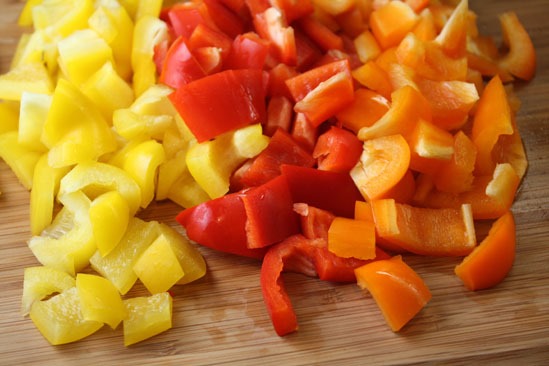
peppers_mixed

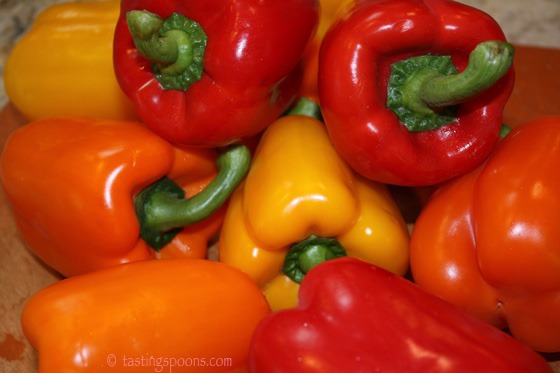
If you’re not all that interested in knowing more about bell peppers, well, I understand. Come back in a couple of days and there will be a recipe up again on the blog. The “food scientist” in me wants more info sometimes, just better knowledge about the food products I buy, even if they’re something I’ve been purchasing for decades.

Prior to about 1980, there was only one kind of bell pepper available – GREEN. Which is why I didn’t like them much. My Dad loved stuffed green peppers (filled with a ground beef and rice mixture and served with tomato sauce). I thought these were vile – I could eat the filling, but the pepper part was bitter, acidic. That stuffed pepper style was very popular during the 1950-70 time frame.

Somewhere around 1960 shoppers were offered a choice of colors –  and bell pepper sales soared. I do remember when they first began appearing in grocery stores – the ones from Holland. But oh, were they ever expensive – way beyond my food budget. In the 30 years after that our per capita consumption of bell peppers quadrupled. According to the USDA, on any given day, about a quarter of Americans were eating some amount of a bell pepper, which is double the amount we’d eat of a French fry. Well, that’s a good thing! The same percentage increase occurred with chile peppers too, although it’s leveled off in the last 20 years. All the credit is due to the Dutch, who figured out how to outsmart nature. You probably already know this – all peppers start out green, and it’s only because they are left on the bush or vine that the colors develop.

Why do Bell Peppers Turn Color?

The scientific explanation – as fruits begin to mature and develop sugar, the sweetness alters their chemical makeup and the chlorophyll start to break apart, which then permits the underlying colors to develop.

Because peppers are a very tender product, they’re very susceptible to bugs and viruses (who knew? viruses? really?). Only very careful farming can produce a fully ripe and colored bell pepper without it developing blemishes and soft spots. Holland’s farmers raise all of theirs in greenhouses, which is why they’re so pristine (and expensive).

Our taste buds really only recognize two tastes in peppers – sweet or hot. Well, I’ll add a 3rd one – bitter, which is what is in green bells – to me, anyway. There are 22 wild varieties of peppers out there and 5 domesticated ones. Most peppers are grown in California and Florida. Chile peppers mostly come from Mexico, where there are at least 3 varieties that grace nearly every Mexican family’s table with regularity. I’m guessing those are: jalapeno, serrano, and poblano. We can find those at our grocery stores every day here in Southern California.

bellpepper2What makes a chile pepper hot is capsaisin (cap-SAY-eh-sun), and if you remember nothing else from this little write-up, the heat in peppers comes MOSTLY from the ribs. Not the seeds. That’s not to say that if you bite into a piece of the green of a jalapeno, you won’t taste heat – you will, but the real heat is in the little whitish/yellowish rib membrane inside the pepper. Remove those and you’ll have a much milder pepper experience. Unless, of course, you WANT the heat, in which case leave it in! Different peppers contain different concentrations of capsaicin (like habanero, the hottest, to the bell pepper which has the least) . And the heat is caused by a recessive gene. That was news to me! What’s interesting is that the heat in chiles can vary not only by variety, but also from peppers on the same bush. Little Japanese shishito peppers (at left) are the most variable – about one in every dozen will be hot enough to blow off the top of your head. Figuratively, of course.

CHOOSING PEPPERS: With the bell peppers, choose the heaviest ones, the ones that are the most filled out and the darkest in color. They’re the sweetest. The recommendation is to choose the peppers that have the boxiest shape with the flattest sides. And obviously, don’t buy one that has a blemish or a soft spot anywhere. Chile peppers should be average size and also unblemished and definitely firm. No soft ones at all.  The best prices on all peppers is in the mid-summer when they are available in abundance.

STORING PEPPERS: They’ll keep best if wrapped well and stored in the refrigerator at about 45°. That’s the temp of most refrigerators. No colder than that, though, or the peppers will start to break down.

Nearly all this information came from Russ Parsons’ book How to Pick a Peach: The Search for Flavor from Farm to Table.

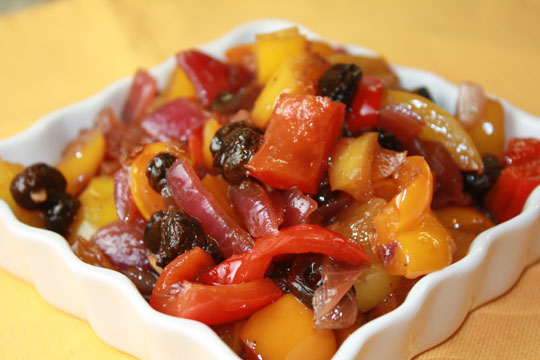
Peppers for Cold Meat – my favorite recipe you’ll find here on my blog that showcases bell peppers – it’s a sweet and sour kind of relish that’s just a match made in heaven for almost any kind of meat. It’s easy to make and keeps for weeks and weeks.

Posted in Salads, on May 7th, 2013.

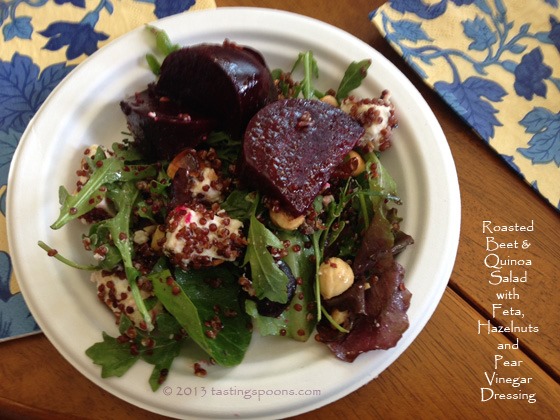
roasted_beet_salad_feta_hazelnuts

There isn’t a single thing in this salad that I didn’t just l-o-v-e. Freshly roasted beets, mildly salted Feta cheese, quinoa, arugula (or fresh greens), roasted hazelnuts and a just a little bit sweet pear vinegar dressing. Oh yum!

If you want to try a different kind of salad – this one with quinoa (a high protein grain) and fresh roasted beets – is worth making. Oh gosh, it was really nice.

Toasted Hazelnuts:

Sometimes you can buy them already skinned and toasted. If not, toast in a 350° oven for 10-15 minutes, stirring once or twice until golden brown. Remove, cool a minute or two then wrap them in a tea towel, wind it up firmly and rub on a countertop or in your hands (just make sure the edge doesn’t come loose) and most of the skins will come off.

The Bulgarian Feta is less salty than some, so you can eat slightly bigger chunks of it in a salad. Seek it out, if you have sources for something other than the usual high sodium Feta. You do need to toast the hazelnuts (they’re so much better if you toast them), and if they still have the skins on them, rub vigorously with a terrycloth towel after you toast them and most of the skins will come off. I can never get all the skin off, but enough so the nuts don’t have an overall bitter taste.

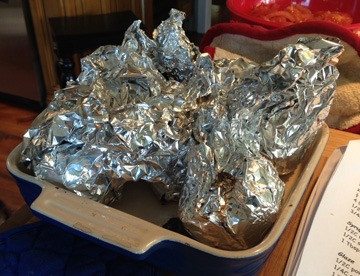
beets_in_foilIn all the years of cooking beets, I’ve never done them this way, the way Tarla Fallgatter made them at the cooking class. She bought beets all of about the same size (making for more even baking) and cut off all but about 2” of the stems on each one – leaving the tail on them too – if you cut the tail, the beet will bleed a lot more of its juices – same with cutting off the tops. Anyway, each beet is wrapped separately in foil, sealed up fairly well and placed in a RIMMED baking sheet or casserole dish. Something that’s just a little bit bigger than the beets are.  It may be hard to see – but those are about 5 separate foil packets, standing upright. Tarla strongly believes that beets roasted this way have a much more intense flavor – sweeter – and with a better texture. She’s a graduate of the Cordon Bleu School in Paris, so she ought to know!

Once baked, you need to open them up so they’ll cool a bit, then remove the skin, root end and stems. Allow to cool a bit more if they’re still hot. Wear a pair of plastic gloves if you’d prefer not to get your hands and fingernails purple for the rest of the day.

While the beets roast, work on the quinoa. This was a new way of preparing quinoa too – Tarla toasted the dry quinoa in a skillet for 2-3 minutes until the tiny grains were lightly toasted. They actually began to pop a little in the pan (like spices do); then you add the chicken stock and simmer covered for 15 minutes or so, or until they’re just tender.

The dressing is very simple – pear vinegar and sherry vinegar, honey mustard, olive oil and seasonings. The greens or arugula are tossed with some of the dressing, the beets (quartered) are tossed with a bit of the dressing (in a separate bowl), the cheese is cut up in cubes and when you add the quinoa, the quinoa sticks to the cheese – I thought it made a really beautiful looking salad. It’s easier to add the beets on top – that way each person will get an equal amount of beets.

What’s GOOD: every single thing about it – tasty, pretty, healthy. Worth making.
What’s NOT: just that it does take a bit of time to make everything (about an hour for the beets, 15 minutes or so for the quinoa, 10-15 for the hazelnuts. But I think you’ll hear raves.

printer-friendly PDF (created using Cute PDF Writer, not Adobe)
MasterCook 5+ import file – right click to save file (remember where), run MC, File|Import

* Exported from MasterCook *

Roasted Beet and Quinoa Salad

Recipe By: From Tarla Fallgatter, cooking instructor, 2013
Serving Size: 6

4 medium beets — tops cut, but 2″ of stems remaining
1/2 cup red quinoa
1 cup chicken stock
3 cups salad greens — or arugula
1/2 cup hazelnuts — roasted, skin rubbed off, coarsely chopped
4 ounces Feta cheese — Bulgarian preferred, or other lower-salt type
VINAIGRETTE:
3 tablespoons pear vinegar
1 tablespoon sherry vinegar
2 teaspoons honey mustard
6 tablespoons olive oil
Salt and pepper to taste

1. Preheat oven to 350°. Wrap each beet individually in foil, stems up. Place on a rimmed cookie sheet or baking dish and bake until tender, about 50 minutes. Test with sharp point of a knife to make sure beets are tender. Unwrap beets and allow to cool for 10-15 minutes, then rub the skin off the beets. Cut into wedges.
2. Saute quinoa for 2-3 minutes in a dry skillet, until they’re lightly toasted. They will begin to pop and jump around in the pan. Add chicken stock and bring mixture to a simmer. Cover and cook over very low heat for 15 minutes, or until quinoa is tender. Drain off any excess liquid.
3. In a small bowl or jar combine the dressing ingredients and shake to combine.
4. Toss the greens with some of the vinaigrette until coated. Add the quinoa and toss again. Add hazelnuts and cubed Feta, tossing very lightly. The quinoa will stick to the Feta.
5. Drizzle more of the dressing on the wedged beets. Spoon salad mixture onto individual plates and add beets on top.
Per Serving: 331 Calories; 26g Fat (68.4% calories from fat); 8g Protein; 19g Carbohydrate; 4g Dietary Fiber; 17mg Cholesterol; 640mg Sodium.

Posted in easy, Soups, on May 5th, 2013.

red_pepper_bisque_corn

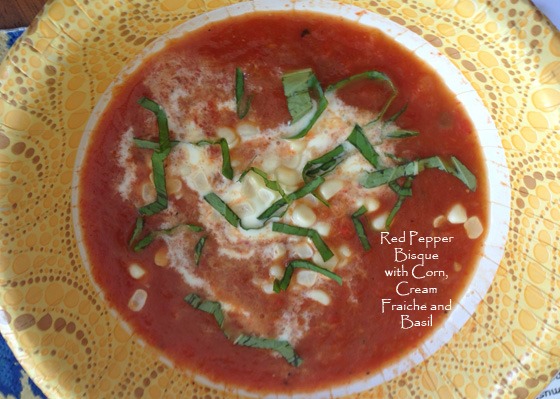
Really tasty red pepper soup (there’s no cream IN the soup, just drizzled on top) that’s very easy to make, and it’s topped with fresh basil shreds, some fresh corn, and then the drizzle of crème fraîche.

Sometimes when I’ve made a red pepper soup, the pepper part was just too acidic, or on the bitter side. It’s not the capsaicin, since that’s the hot factor, and bell peppers have just about nil of that. I don’t know what it is. But THIS soup didn’t have that, which was a good thing! Maybe it was the peppers themselves – their source, the soil, the time of year? Anybody an expert on bell peppers?

Well, that got me to thinking about a book I have that is a wealth of information about fruit and veggies. I’ll do a write-up on Tuesday about peppers in general. Glancing at the chapter on peppers I see 4 recipes: roasted red peppers stuffed with tuna, salad of roasted peppers and ricotta salata, peperonata (a kind of bell pepper sauce), and chile and zucchini braised in cream. I’ll make one of those. The author recommends the first recipe.

Roasting Tip:

Cut peppers into flat-ish pieces, oil them and bake at 400° for 20-30 minutes, turning them over a couple of times.

Back to the soup. It was so easy, except for roasting the red peppers and jalapeno. If you want to make it easier, cut the peppers into flat-type pieces, lay on foil, oil them a bit and bake them at 400° for 20-30 minutes, turning them a couple of times. Let them cool so you can handle them, then peel off the skins and trim the ribs off, plus discarding the seeds if there are any remaining.

While the peppers are roasting start the soup: sauté the onions, adding the garlic toward the end, then add the seasonings. You can use fresh tomatoes if they’re really in season – otherwise use super-tasty canned tomatoes (I like San Marzano, Muir Glen or Cento from Italy). The soup is simmered for a short time (30 minutes) then pureed in the blender. Reheat it, taste for seasoning, then pour out into serving bowls. The best part about this soup is the garnish – fresh corn cut off the cobb, fresh basil shreds and a drizzle of crème fraîche.  This recipe came from a cooking class with Tarla Fallgatter.

What’s GOOD: the fresh taste from the red bells and the garnishes. Loved the corn. Also the little bit of heat from the jalapeno pepper. Altogether delicious.
What’s NOT: absolutely nothing.

printer-friendly PDF (created with Cute PDF Writer, not Adobe)
MasterCook 5+ import file – right click to save file (remember where), run MC, then File|Import

* Exported from MasterCook *

Roasted Red Pepper Bisque with Corn, Basil and Creme Fraîche

Recipe By: From Tarla Fallgatter, cooking instructor, 2013
Serving Size: 6

3 whole red bell peppers — roasted, peeled, seeded, deveined, chopped
1 whole jalapeno pepper — roasted, peeled, seeded, deveined, chopped (or use a half of a poblano pepper)
3 tablespoons olive oil
1 large onion — peeled, chopped
3 whole garlic cloves — peeled, minced
1 teaspoon smoked paprika
1 1/2 teaspoons kosher salt
Freshly ground black pepper to taste
1 1/2 pounds tomatoes — or 28 ounce can peeled, seeded tomatoes
6 cups chicken stock
2 tablespoons fresh basil — cut in fine threads
6 tablespoons creme fraiche
1/2 cup fresh corn — cut from a cob
2 tablespoons fresh basil — cut in fine threads for garnish

NOTES: This can be served hot or cold. If you want to make this a main dish, prepare toasted cheese sandwiches. Remove them from the pan while they’re piping hot, and using a big chef’s knife chop the sandwiches into small pieces. Place these bite-sized pieces on top of the soup and serve.
1. Saute onion in the oil until translucent. Add garlic, paprika, salt and pepper and cook 5 minutes. Stir in tomatoes and simmer 15 minutes.
2. Add peppers, chicken stock and 2 T. of basil. Simmer 30 minutes.
3. Puree soup until smooth and return to the same pot to reheat. Season to taste and divide among warmed bowls. Spoon a dollop of creme fraiche into each bowl, then sprinkle with additional basil shreds, corn and freshly ground black pepper. Serve immediately
Per Serving: 183 Calories; 12g Fat (59.2% calories from fat); 3g Protein; 15g Carbohydrate; 3g Dietary Fiber; 13mg Cholesterol; 2637mg Sodium.

Posted in Desserts, easy, on May 3rd, 2013.

rhubarb_upside_down_cake_whole

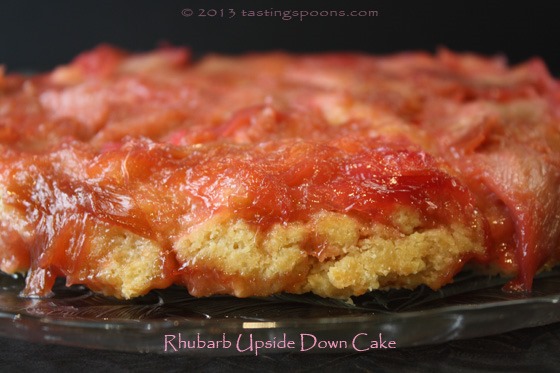
Love rhubarb, like I do? You’ll want to try this biscuit-style upside down cake that’s as easy as can be to make. You’ll just need fresh rhubarb and everything else is likely in your pantry.

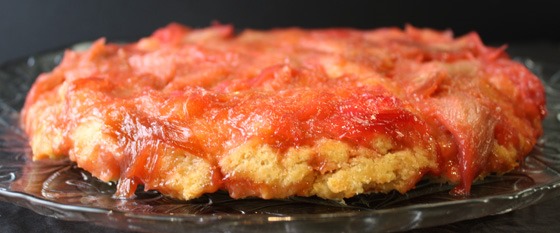
My latest issue of Saveur Magazine arrived recently and I read it cover-to-cover. An article about rhubarb captured my interest, though, when I saw some of the photos. With rhubarb in season, I decided to make this recipe first. They explained that this method of making an upside down cake is rhubarb_cookingmore reminiscent of an apple tarte tatin since you cook the juicy rhubarb in a cast iron skillet as you would with a tarte tatin (photo at left), then add the biscuit batter on top (see photo at right below) and bake it. As soon as you take it out of the oven you place a plate on top of the iron skillet and very carefully and quickly turn it upside down and plot, it all comes out as you see above. rhubarb_cake_before_bakingI used hot pads and was very quick about turning it over. There wasn’t any liquid to spill out, fortunately, or it could burn you. It’s all absorbed by the biscuit batter.

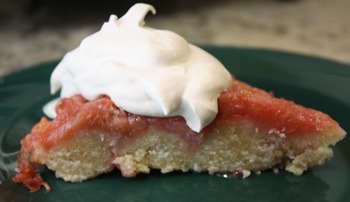
We ate it warm, which is the best way, I think. And since the cake part is more biscuit than it is cake, it’s most likely best eaten the day it’s made. I ended up with left rhubarb_upside_down_cake_sliceovers which I portioned out into 3” wedges, wrapped in plastic, then in foil. If I find out it’s not good defrosted I’ll add a note here later.

Do serve it with ice cream or whipped cream, as the mixture needs something to cut the sweet of the rhubarb and moisten the biscuit cake. It’s not overly dry – that isn’t what I mean – but left more than a day, I’d think it might. Biscuits don’t keep well.

rhubarb_upside_down_cake_whole_wide

What’s GOOD: the rhubarb, for sure. But then, I love rhubarb in most of its guises. The cake wasn’t my favorite part, but that doesn’t mean it wasn’t good. It was. It was a light dessert, I thought, although the calorie count doesn’t indicate so. Very tasty and a lovely presentation.

What’s NOT: really nothing except that you probably should eat this up the day you bake it.

printer-friendly PDF – created using Cute PDF Writer, not Adobe
MasterCook 5+ import file – right click to save file (and remember where, run MC, File|Import

* Exported from MasterCook *

Rhubarb Upside Down Cake

Recipe By: Saveur Magazine, Apr. 2013
Serving Size: 9

RHUBARB:
3/4 pound rhubarb — trimmed and cut into 1 ½” pieces on an angle
1 cup sugar
4 tablespoons unsalted butter — plus 6 tbsp. cut into ½” cubes and chilled
1 tablespoon fresh lemon juice
2 teaspoons vanilla extract
1/4 teaspoon kosher salt
BISCUIT CAKE:
2 1/2 cups all-purpose flour
1/2 cup sugar
2 teaspoons baking powder
1/4 teaspoon kosher salt
6 tablespoons unsalted butter — chilled, cut in 1/2″ cubes
1/2 cup vegetable shortening
1/3 cup milk
2 large eggs
Vanilla ice cream or whipped cream — for serving (optional)

1. Heat oven to 375°. Combine rhubarb, 1 cup sugar, 4 tbsp. butter, lemon juice, vanilla, and salt in a 9″ cast-iron skillet over medium heat. Cook, stirring occasionally, until sugar is melted and rhubarb is tender and slightly caramelized, 8-10 minutes.
2. Meanwhile, whisk together remaining sugar and salt, plus flour and baking powder in a bowl. Add remaining butter and the shortening and, using your fingers, rub into flour mixture to form coarse pea-size pieces. Add milk and eggs and stir until a soft, sticky dough forms.Using your hands, lightly flatten pieces of the sticky dough and place on top of the rhubarb. Fill in spaces as needed – it does not have to be completely smooth or covered – just do the best you can. If you want, smooth top with a nonstick spatula.
3. Bake until the crust is golden and cooked through, about 30 minutes. Remove skillet from oven; place a large flat serving platter on top of the skillet and invert very carefully and quickly. If a few pieces of rhubarb stick to the pan, use a spoon to fill in any spaces on the top. Serve warm or at room temperature with ice cream or whipped cream, if you like.
Per Serving: 503 Calories; 26g Fat (46.2% calories from fat); 6g Protein; 62g Carbohydrate; 1g Dietary Fiber; 83mg Cholesterol; 237mg Sodium.

Posted in Chicken, Grilling, on May 1st, 2013.

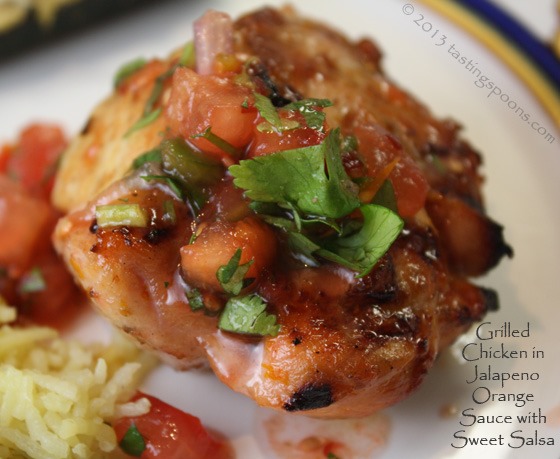
grilled_chix_orange_jalapeno_sauce

Make this. Oh yes, make this! It’s healthy, relatively simple to prepare, and it’s just loaded with flavor. You need to like chiles, however, and spicy food.

Many years ago I must have gotten the original of this recipe from Phillis Carey. My old print-out says it’s hers, but I didn’t find the recipe in any of her 3 cookbooks. And actually, the original was for Cornish game hens, not chicken. But my notes about this recipe said it was really delicious, so I made some changes to it, decided to grill the chicken rather than bake it, and I changed-up the sauce to serve with it too. So let’s just say the recipe was inspired by Phillis!

The photo above shows a half of a chicken breast – bone in – in its finished form. The chicken was marinated for awhile in an orange juice, oil and chipotle mixture, seared on the grill, moved to indirect heat to cook through, then served with a quick sweet salsa at the end.  The salsa was the royal crown of the dish, I’d say. I bought fresh salsa and after melting a little bit of red jalapeno jelly on the range, and allowing it to cool, I added it to the chilled salsa and it was spooned over the top. I wanted to lick the plate – and it’s not that there’s anything so unusual in it – except that you don’t expect salsa to be sweet. Yet it is, and it’s just perfect on the chicken!

What’s GOOD: it’s a really different taste – the chicken is moist, since you take it off the grill when it just reaches 155°. And the salsa. Well, that’s the best part.

What’s NOT: nothing for me – I liked it, but you do need to appreciate a bit of heat and sweet with the chicken to enjoy it fully!

printer-friendly PDF – created with Cute PDF Writer, not Adobe

MasterCook 5+ import file – right click to save file (and remember where, run MC, then File|Import

* Exported from MasterCook *

Grilled Chicken with Jalapeno Jelly Salsa

Recipe By: Inspired by a recipe from Phillis Carey, cooking instructor
Serving Size: 4

4 chicken breast halves — bone-in preferred
3/4 teaspoon chipotle chile canned in adobo
1/4 cup jalapeno jelly
2 teaspoons orange zest
3 tablespoons fresh orange juice
2 tablespoons olive oil
SWEET SALSA:
2 tablespoons jalapeno jelly
1/2 cup fresh salsa
3 tablespoons fresh cilantro — minced, for garnish

1. MARINADE: Melt the jalapeno jelly, cool for 2-3 minutes, then pour Into a Ziiploc bag with the orange zest, juice, oil and chipotle chile in adobo. Seal and squish the bag to mix the ingredients, particularly the chipotle chiles. Add chicken and seal. Refrigerate for about an hour, or longer if time permits.
2. Remove chicken from marinade (save the marinade) and blot with paper towels. Preheat an outdoor grill to medium-high. Briefly sear the chicken on both sides – enough to get grill marks, then place it over indirect heat, reduce heat to medium and continue cooking (using the glaze at least once) until the interior of the chicken reaches 155°, about 15-20 minutes. Remove to a cutting board and cover with foil for about 5 minutes.
3. Meanwhile, pour marinade into a small saucepan. Heat marinade and allow to simmer until it has reduced by half (there won’t be a lot) or until it thickens some. During the grilling, brush the chicken with the glaze.
4. SALSA: In a small saucepan, melt jalapeno jelly. Set aside to cool for at least 5 minutes, then add to the fresh salsa. Spoon the salsa over the chicken and garnish with cilantro.
Per Serving: 402 Calories; 20g Fat (45.5% calories from fat); 31g Protein; 24g Carbohydrate; 1g Dietary Fiber; 93mg Cholesterol; 246mg Sodium.

Related Posts Plugin for WordPress, Blogger...