Get new posts by email:

Archives

Currently Reading

Here are the tastingspoons players. I’m in the middle (Carolyn). Daughter Sara on the right, and daughter-in-law Karen on the left. I started the blog in 2007, as a way to share recipes with my family. I’m still doing 99% of the blogging and holding out hope that these two lovely and excellent cooks will participate. They both lead very busy lives, so we’ll see.

– – – – – – – – – – – – – – – – – – – – – –

BOOK READING (from Carolyn):

Music of Bees, Eileen Garvin. Absolutely charming book about a woman in midlife, lonely, who raises bees, also makes unlikely friends. Heart-warming and very interesting about beekeeping.

A Postcard from Paris, Alex Brown. Really cute story. Dual time line, 1940s and present day about renovating an old apartment in Paris, things discovered.

Time of the Child, Niall Williams. Oh such a good book. Very small village in Ireland, 1960s. A baby is left on the doorstep. The town all whispers and helps. I listened to an interview of the author, which made me like him and his books even more.

Sipsworth, Simon Van Booy. If you like animals you’ll swoon. An old woman who really wants to die finds a tiny mouse in her house and befriends it and finds a reason to live. Utterly charming book.

The Forger’s Spell, Edward Dolnick. True story. For seven years a no-account painter named Han van Meegeren managed to pass off his paintings as those of Johannes Vermeer.

If You Lived Here, You’d be Home by Now, Christopher Ingraham. Could hardly put it down – about a journalist who takes on a challenge to move to small town in Minnesota and write about it. He expects to hate it and the people and place, but he doesn’t. Absolutely wonderful true story.

The River We Remember, William Kent Kreuger. 1950s, Minnesota. A murder and the aftermath. Could hardly put it down. Kreuger has such a vivid imagination and writing style.

How the Lights Gets In, Joyce Maynard. An older woman returns to New Hampshire to help care for her brain-injured son. Siblings and family, lots of angst and resentments.

The Filling Station, Vanessa Miller. Every American should read this book. A novelized retelling of the Tulsa massacre in 1921. Absolutely riveting.

The Story She Left Behind, Patti Callahan Henry. Love this author. Based on a true story. A famous author simply vanishes, leaving her husband and daughter behind. She had invented a mystical language no one could translate. Present day, someone thinks he’s solved the riddle, contacts the family. Really interesting read.

The Girl from Berlin, Ronald Balson. Love anything about Tuscany. An elderly woman is being evicted from a villa there, with odd deed provenance. Two young folks go there to help unravel the mystery. Loved it.

The Island of the Colorblind, Oliver Sacks, M.D. Nonfiction. The dr is intrigued by a remote Pacific island where most of the inhabitants are colorblind. He also unravels a mystery on Guam of people born with a strange neurological problem. Medical mysteries unveiled. Very interesting.

The Bookbinder, Pip Williams. Post 1914 London. Two sisters work at a bookbindery. They’re told to not read the books. One does and one doesn’t. One has visions beyond her narrow world; the other does not. Eventually the one gets into Oxford. Lovely story.

The Paris Express, Emma Donoghue. 1895 on a train to Paris, a disaster happens. You’ll delve into the lives of many people who survived and died in the crash.

A Race to the Bottom of Crazy, Richard Grant. This is about Arizona. Author, wife and child move back to Arizona where they once lived. Part memoir, research, and reporting in a quest to understand what makes Arizona such a confounding and irresistible place.

The Scarlet Thread, Francine Rivers. A woman’s life turned upside down when she discovers the handcrafted quilt and journal of her ancestor Mary Kathryn McMurray, a young woman who was uprooted from her home only to endure harsh frontier conditions on the Oregon Trail.

A Place to Hide, Ronald Balson. 1939 Amsterdam, an ambassador has the ability to save the lives of many Jewish children. Heartwarming.

Homeseeking, Karissa Chen. Two young Chinese teens are deeply in love, but in China. Then their families are separated. Jump to current day and the two meet again in Los Angeles.

North River, Pete Hammill. He always writes such a good story. A doctor works diligently healing people from all walks of life. His wife and daughter left him years before. One day his 3-yr old grandson arrives on his doorstep.

A Very Typical Family, Sierra Godfrey. A very messed-up family. Three adult children are given a home in Santa Cruz, Calif, but only if the siblings meet up and live in the house together. A very untypical scenario but makes for lots of messes.

Three Days in June, Anne Tyler. The usual Anne Tyler grit. Family angst. This wasn’t one of my favorites, but it was entertaining and very short.

Saved, Benjamin Hall. Author is a veteran war reporter. Ukraine, 2022, he nearly loses his life to a Russian strike. Riveting story – he survives, barely.

Grey Wolf, Louise Penny. Another Inspector Gamache mystery in Quebec. She is such an incredible mystery writer.

All the Colors of the Dark, Chris Whitaker. A missing person mystery, a serial killer thriller, a love story, a unique twist on each. Could hardly put it down.

Orbital, Samantha Harvey. Winner of 2024 Booker Prize. I don’t usually like those, but I heard the author interviewed and she hooked me. This is not a normal book with a beginning, a story and an end. It’s several chapters of the day in the life of various astronauts at the ISS (Int’l Space Station). All fictional. She’s been praised by several real astronauts for “getting it” about space station everyday life.

The Blue Hour, Paula Hawkins. An island off Scotland. Inaccessible except when the tide is out. Weird goings on. An artist. A present day mystery too.

Iron Lake, William Kent Krueger. A judge is murdered and a boy is missing. Riveting mystery.

Tell the Wolves I’m Home, Carol Ricks Brunt. 1980s. A 14-yr old girl loses her beloved uncle. Yet a new friendship arises, someone she never knew about.

Four Treasures of the Sky, Jenny Zhang. 1880s, a young girl is kidnapped in China and brought to the United States. She survives with many hurdles in the path.

The Boy Who Fell out of the Sky, Ken Dornstein. Memoir, 1988. The author’s brother died in the PanAm flight that went down in Lockerbie, Scotland. A decade later he tries to solve “the riddle of his older brother’s life.”

Worse Care Scenario, T.J. Newman. Oh my. Interesting analysis of what could/might happen if a jet crashed into a nuclear plant. Un-put-downable.

Song of the Lark, Willa Cather. Complicated weave of a story about a young woman in about 1900, who has a gifted voice (singing) and about her journey to success, not without its ups and downs.

Crow Talk, Eileen Garvin. Charming story which takes place at a remote lake in Washington State, about a few people who inhabit it, the friendships made, but also revolving around the rescue of a baby crow.

The Story Collector, Evie Woods. Sweet story about some dark secrets from an area in Ireland, a bit magical, faerie life, but solving a mystery too.

A Sea of Unspoken Things, Adrienne Young. A woman investigates her twin brother’s mysterious death. She goes to a small town in California to figure it out, to figure HIM out.

The King’s Messenger, Susanna Kearsley. 1600s England, King James. About one of his trusted “messengers,” and his relationship with a young woman also of “the court.” Lots of intrigue.

In the Shadow of the Greenbrier, Emily Matchar. Interesting mystery in/around the area of the famous resort in White Sulphur Springs, West Virginia.

Isola, Allegra Goodman. Hard to describe, survival story on an island in the 1600s.

Save the Date, Allison Raskin. Rom-com, witty, LOL funny. Clever.

The Sirens, Emilia Hart. Numerous time-lines, Australia. Mysteries abound, nightmares, abandoned baby, weird allergies.

Red Clay, Charles Fancher. LOVED this book. Mostly post-Civil War story about the lives of slaves in Alabama during Reconstruction.

Stars in an Italian Sky, Jill Santopolo. Dual time line, 1946 and recent time. Love stories and a mystery.

Battle Mountain, C.J. Box. Another one of Box’s riveting mysteries. Love his descriptions of the land.

Something Beautiful Happened, Yvette Corporon. A memoir of sorts in Greece, tiny island of Erikousa, where the locals hid Jews during WWII. All elusive stories told by the author’s grandmother.

The Jackal’s Mistress, Chris Bohjalian. 1860s Virginia, about a woman who saves the life of a Union soldier. Really good story.

Song of the Magpie, Louise Mayberry. Really interesting story about Australia back in the days when it was mostly a penal colony. Gritty strength of a woman trying to thrive with her farm.

The Boomerang, Robert Bailey. A thriller that will have you gripping the book. About a lot of secrets surrounding the president (fictional novel, remember) and his chief of staff and about cancer. A cure. Such a good story.

Care and Feeding, Laurie Woolever. Really interesting memoir of a woman driven to succeed in the restaurant business. She worked for Mario Batali and then Anthony Bourdain. Gritty stories.

Everything is Tuberculosis, John Green. Maybe not a book for everyone. A real deep dive into the deadly tuberculosis infection, its history. I heard the author interviewed and found the book very interesting.

The Book Lovers Library, Madeline Martin. Fascinating read about Boots’ drug stores’ lending library. And the people who worked in them.

The Arrivals, Meg Mitchell Moore. LOL funny, about a middle-aged couple whose children (and their various family members) return to the family home and the chaos that ensues.

My Life as a Silent Movie, Jesse Lee Kercheval. About grief. A big move to Paris, finding herself a new life with a new set of real blood family.

Escape, Carolyn Jessop. Another memoir about a woman really in bondage in Utah, Mormon plural marriage.

 

Tasting Spoons

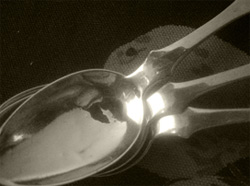
My blog's namesake - small, old and some very dented engraved silver plated tea spoons that belonged to my mother-in-law, and I use them to taste my food as I'm cooking.

Scroll down to the bottom to view my Blogroll

Posted in Appetizers, on February 25th, 2008.


I know, I can hear it already in your thoughts. What is this? Bean dip? Brie? Huh? What kind of nonsense is this? In a word: EASY. In another word: TASTY. Believe it or not, this is really very good. And ever so easy to make. I’ll insert the full recipe below, but it’s nothing more than a can of bean dip mixed up with little tiny cubes of brie (rind removed), and microwaved for about a minute. Serve.

It does take a little bit of time to cut off the rinds, but that’s the hardest part. You can serve it with tortilla chips, but it makes it a bit more elegant if you serve it with crackers. I made lavash crisps from a post the other day for Coriander Lime Shrimp. Using crackers might make your guests think you didn’t just open a can of bean dip and add cheese.

There’s the photo of it in a ceramic bowl, ready for its minute of melting in the microwave. I didn’t get an after picture, but I have some leftovers, so maybe I’ll add another photo to this post later.

If you are in a hurry and want something really good and really quick, this is your ticket. The recipe came from Andrew Schloss, a chef and author, from his book Almost From Scratch. He taught a cooking class a few years ago. His schtick is about how to make things ahead, and make entertaining easier on yourself. He certainly scored on both counts.
printer-friendly PDF

Warm White Bean and Brie Dip

Recipe: Andrew Schloss, chef & author, from a cooking class
Servings: 6

8 ounces Brie — chilled
8 ounces bean dip — canned

1. Remove rind from cheese and chop up into small pieces. Place the cheese and bean dip in a microwave-safe bowl. Microwave at full power for one minute, or until cheese is completely melted. Stir with a fork until well combined.
2. Serve warm with tortilla chips, bread or crackers.
Per Serving: 169 Calories; 12g Fat (62.5% calories from fat); 10g Protein; 6g Carbohydrate; 1g Dietary Fiber; 38mg Cholesterol; 422mg Sodium.

Posted in Salads, on February 24th, 2008.

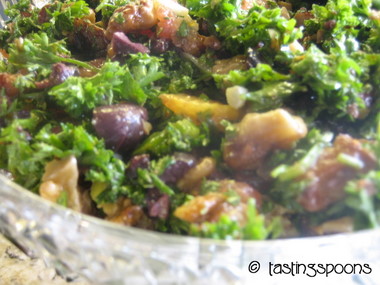
armenian parsley and walnut salad

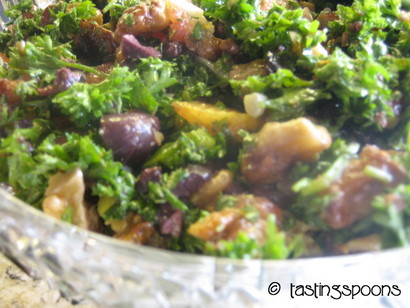
When entertaining last weekend, we did a mixed grill: racks of lamb (3), Sicilian-Italian sausage with cheese in it (about 2 pounds), and some marinated chicken breasts too. We had grilled provolone cheese (I’ll post the recipe soon) and some wonderful coriander lime shrimp as appetizers, so wanted a fairly simple side to serve with the meat.

This salad came to mind as it’s just wonderful with grilled meats, and it has a kind of Italian bent with the Mediterranean olives mixed in.The recipe came from Nicole Aloni, a Hollywood caterer and cookbook author. She taught a cooking class some years ago, and we all enjoyed the food, but her stories about entertaining the celebs in Hollywood was most interesting. She kind of became a caterer to the stars by default – lucky, I guess – but her food is very good. Nothing healthy about it, usually, although this salad isn’t a bad choice. She particularly works at preparing food the day before a party.

A disclaimer: You’ve GOT to love parsley, or you won’t like this salad one bit since it’s mostly composed of the curly type and toasted walnuts. But it’s accented with Kalamata olives, green onions and fresh tomatoes, then tossed with a cumin, lemony dressing. Oh, and a bit of red chile flakes.

Cook’s Notes: You could easily change the proportions of these items to suit your tastes, but the parsley needs to be the featured green. Ideally, make this one day ahead, but any longer than that and the parsley wilts down to nothing. Once you’ve made the salad, taste it and decide if you’d like to add more tomatoes, or parsley. Or perhaps more olives. Chop the olives fairly small, as they can overpower your taste buds if you get much of it in one bite. And don’t skip the walnut toasting step – they add a wonderful grace note to the flavor in the overall salad.
printer-friendly PDF

Armenian Parsley & Walnut Salad

Recipe: Nicole Aloni, author and caterer
Servings: 8
NOTES: If the tomatoes are out of season, add just a teaspoon of sugar to sweeten them. You can also add mint to this salad if that is a flavor you enjoy. Be sure to use regular curly parsley (not Italian flat leaf) as it gives the salad some “lift.” This improves if made a day ahead.

1 cup walnuts — chopped, toasted, or almonds
2 bunches parsley — regular curly, coarsely chopped
3/4 cup kalamata olives — pitted, minced
1/2 cup scallion — minced
1 cup fresh tomatoes — peeled, seeded, chopped
1/3 cup extra virgin olive oil
1/3 cup fresh lemon juice
1/2 teaspoon cumin powder
1/2 teaspoon red pepper flakes
Kosher salt and pepper to taste

1. Toast nuts at 325° for about 10 minutes. Cool completely before using in the recipe.
2. Remove stems from the parsley and coarsely chop. Do not use a food processor for this as they will be too fine.
3. Chop the olives, walnuts and green onions, then combine all ingredients, tossing with the dressing. Add salt and pepper to taste. Chill.
Per Serving: 248 Calories; 24g Fat (82.7% calories from fat); 5g Protein; 7g Carbohydrate; 2g Dietary Fiber; 0mg Cholesterol; 365mg Sodium.

Posted in Beverages, on February 23rd, 2008.

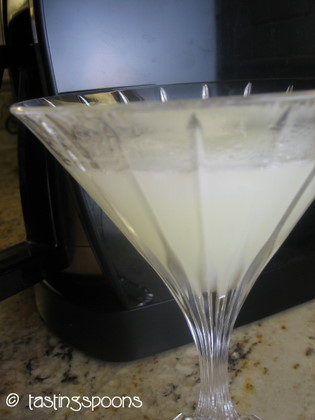
white lady cocktail, gin, lemon juice, egg whiteThis looks like some sweet cream-based blended cocktail. It’s not. And it’s not really all that sweet, either. What it has in it is egg white (raw) which is shaken with the other ingredients, so when it’s first poured it does have a bit of a cloudy look. This is kind of a martini. Or kind of like a margarita, in a way.

I had all the ingredients standing ready, and you could easily make two of them at a time. You need fresh lemons, triple sec (or Cointreau, which is what I had), very good gin (Cherrie brought Bombay Sapphire, which in the opinion of many, the best out there), egg whites (which I very slightly whipped so I could actually use a measuring spoon to dip into it) and some ice. The ingredients go into a shaker and you pour it out. The recipe said to strain out the ice, but this is one gutsy drink, so I left the ice cubes in the drink. Your choice.

Several people had two of these cocktails, they were that good. The recipe came from Bon Appetit, January 2006. And it’s a drink concocted by the Pegu Club (a bar) in New York City.

At the dinner party last weekend, we decided to offer not only wine, but a cocktail too. This was yet another recipe that found its way to the top of the “try me” file. And it was scrumptious, if you can describe a cocktail by that word. I’m looking forward to making it again. Even just for myself. The glasses are my friend Cherrie’s. I don’t own any martini type glasses. I need to look for some, but oh, dear. Where in the world am I going to store them? They’re an awkward shape to store with any efficiency.
printer-friendly PDF

White Lady

Recipe: Bon Appetit, Jan. 2006
Servings: 1

1/4 cup gin — Tanqueray, or Bombay Sapphire
2 tablespoons Triple Sec — or Cointreau
1 1/2 tablespoons fresh lemon juice
1 tablespoon egg white

1. Combine all ingredients in a shaker filled with ice cubes. Shake well. Strain into a cocktail or martini glass. Garnish with lemon slice if desired.
Per Serving: 265 Calories; 0g Fat (0.0% calories from fat); 2g Protein; 12g Carbohydrate; trace Dietary Fiber; 0mg Cholesterol; 26mg Sodium.

Posted in Soups, on February 22nd, 2008.

The photo is a bit distorted – the glass isn’t really that bowl shaped at the top. I served the soup in these small 4-ounce glasses, with a small spoon. Even though it was served hot, you could hold onto the bottom or top of the glass without burning your fingers.

My theory must have been, back when I clipped this recipe from Bon Appetit, that it was unusual, therefore, I’d like to try it. Unusual it is. Good? A resounding YES. Perhaps it’s not the right first course for just any dinner, but it made a big hit at our recent dinner party. I made it two days ahead, then reheated it, added the cornstarch thickener (so little of it, I hardly think it mattered) and the Armagnac. The recipe comes from a now-defunct restaurant in Oxford, Maryland, called Mathilda’s.

In case you don’t know about Armagnac, here’s the lowdown from Wikipedia: Armagnac pronounced ar-mahn-yak] is a distinctive kind of brandy or eau de vie, made of mainly the same grapes as cognac and undergoing the same aging in oak barrels, but mainly with column still distillation (cognac and part of armagnac is distilled in pot stills.

It comes from the mountainous regions in France near the Pyrenees. I always thought Armagnac had some affinity with apples, but no, it’s all grapes. It’s just the method of distillation and barreling that differentiates it. Much of the soil is rocky. Anyway, Armagnac is not an everyday staple in liquor stores, so you may have to seek it out. But you could also use Cognac or brandy instead. Just don’t use some $4.99 bottle of rot-gut. The flavor does come through in this soup.
printer-friendly PDF

Cream of Cashew Soup with Armagnac


Recipe: Mathilda’s, Oxford, Maryland (restaurant is now closed), via Bon Appetit
Servings: 6
Cook’s Notes: I didn’t find unsalted cashews, so I used the lightly salted ones from Planter’s. But, I did use low-sodium chicken broth. That way you can add salt if you would like to. If doing the cornstarch thing doesn’t interest you, just eliminate it. I could not discern a bit of difference in the consistency of the soup after adding it. The chives add a nice touch – since the soup is definitely BEIGE, it needs a tad of color.

1/4 cup butter
1 tablespoon peanut oil
2 cups cashews — roasted, unsalted
1/3 cup shallots — chopped
28 ounces low-sodium chicken broth
1/4 cup cream sherry
2 cups half and half — or fat-free half and half
1/2 cup heavy cream
2 tablespoons water
1 teaspoon cornstarch
2 tablespoons cognac — or Armagnac (preferred)
2 tablespoons fresh chives — minced

1. Melt butter with oil in heavy, large pot over medium heat. Add cashews and shallots. Cook until shallots are golden brown, stirring occasionally, about 10 minutes. Add broth and Sherry; increase heat to high and bring to a boil. Add the half and half and cream. Reduce heat to medium/low and simmer uncovered, until cashews are tender, about 20 minutes. Allow soup to cool about 20 minutes before continuing.
2. Working in batches, puree soup in blender until VERY smooth. Strain soup into a large saucepan, discarding solids left in strainer.
3. Whisk the water with cornstarch in a small bowl to blend. Bring soup to a boil, whisk cornstarch mixture into soup, stirring until soup thickens, about 2 minutes. Stir in Armagnac. Season with salt and pepper to taste. Divide among soup bowls or short glasses, sprinkle with chopped chives and serve.
Per Serving: 546 Calories; 49g Fat (75.7% calories from fat); 16g Protein; 19g Carbohydrate; 3g Dietary Fiber; 78mg Cholesterol; 148mg Sodium.

Posted in Chicken, on February 21st, 2008.

You know what I mean when it’s 6:00 and you need to get something on the table for dinner? Like right NOW. I have a go-to chicken recipe – it’s not a 4-star winner, but it’s certainly better than okay. My DH always says it’s good, and I think it is too, as long as you know your purpose is to eat quickly.

It’s nothing but this:

This is a can – a spice mix. It’s imported from Hungary, although everything on the can is in English. The brand is “Pride of Szeged,” “The World’s Best Chicken Rub.” It contains garlic, basil, paprika, oregano, salt and “spices.” It can be purchased at some specialty grocery stores. The recipe on the back of the can suggests the following:

  • Mix 1/4 cup of seasoning mix with 4 T. oil. Add 2 T. lemon juice or vinegar. Brush entire mixture on chicken [it doesn’t say how much chicken]. Grill, bake or broil. For best result, refrigerate chicken in seasoning for 2-6 hours.

When I’m in a hurry I do nothing but sprinkle the spice mixture on chicken pieces and pan fry them in a bit of olive oil. That’s it. Sometimes after the chicken has browned on both sides, I’ll pour in a splash of vermouth, or red wine, sometimes a squeeze of lemon juice, as suggested in the above recipe. Then I may put a lid on the pan to just steam the chicken completely. Serve.

This time I had boneless, skinless chicken thighs, and some Siciliana Sauce (a sweet and sour, cold, chunky tomato based sauce I blogged about last year) that is absolutely great with chicken. Our friends, Sue & Lynn, brought some over when they came for dinner a week ago. But I’ve often served the chicken with nothing but this rub.

I bought the chicken rub at a German deli (in 2005), but I’ve seen it other places. And I did find it online also at a mailorder site. There is a website for the product, but it’s not displaying. Don’t know what that means. The company also makes other rubs, but this is the only one I’ve found. I’m not posting a printer friendly recipe for this since it’s so simple. As long as you have the spice mix.
 
For your information, I served this with brussels sprouts that I cut in half and simmered in a bit of chicken broth and thyme. They were ready at the same time the chicken was ready. From start to finish I had dinner on the table in about 25 minutes.

Posted in Veggies/sides, on February 20th, 2008.

A week or so ago we visited the farmer’s market by UCI (Univ. of California, Irvine) near us. It’s the largest in our area, but about 6 miles away, so we don’t visit this one very often. I’m glad we did, though. All the vegies I bought that day were so very fresh. Certainly fresher than what I buy at the grocery store. There was a lot of repetition, of course, because of the winter season – lots of carrots, root vegetables, cauliflower, winter squashes, apples, oranges and pears. But at one stand they had all different kinds of greens. The proprietor said, in her halting Asian accented English, that this bunch of green stuff was the tops of sugar snap peas. They were such a beautiful color. I should have snapped a photo of the before picture. A huge bunch was just enough for two servings.

I hadn’t a clue what to do with them. A search on the internet for “sugar snap pea tops” disclosed nary a hit. So, I did what I thought was the best thing: first I washed them thoroughly. The larger stems were big enough that I thought they might be tough, so I pinched them off, leaving me with a huge mound of the pure tops, leaves and tendrils. I thoroughly enjoyed tossing them (for a total of about 3 -4 minutes) in a hot pan with a bit of olive oil, garlic and butter. I hit them with a shot of salt and pepper, and served. We both lapped it up in nothing flat. DH wanted seconds. Sorry, honey, all gone.

Posted in Appetizers, on February 19th, 2008.

Another fabulous Phillis Carey cooking class recipe. Shrimp in a marinade (which also is a dipping sauce), made with fresh lime juice, cilantro (fresh coriander, hence the coriander in the title), soy sauce, garlic and marmalade. The shrimp are quick fried in a nonstick skillet and you serve it with the wonderful, tasty, tender lavash crisps on the side. The lavash crisp doubles as a little “plate” to put the shrimp upon. One nice mouthful of deliciousness. After learning about this recipe at a class, my friend Cherrie brought this to a dinner party at our home the other night. She brought 3 pounds of shrimp; there were 8 people in attendance; we ate all but a smidgen. Does that tell you how good it was?
printer-friendly PDF

Coriander Lime Shrimp

Recipe: Phillis Carey, cookbook author & instructor
Servings: 6
Cook’s Notes: if you don’t like cilantro, substitute Italian parsley with a bit of oregano instead. Be sure to reserve some of the marinade before you put the shrimp into it to marinate.

MARINADE & DIPPING SAUCE:
1/2 cup fresh lime juice
1/4 cup orange marmalade
3 large cloves garlic — minced or mashed
1 teaspoon salt
1/2 cup cilantro — chopped
3 tablespoons olive oil
1 tablespoon soy sauce
1/2 teaspoon red pepper flakes
SHRIMP:
1 pound shrimp — raw, 16-20 per pound, with tails
1 tablespoon olive oil
2 tablespoons cilantro sprigs — for garnish
LAVASH CRISPS:
1 package lavash Armenian cracker bread — fresh, not dried crackers
1/2 cup butter — melted
2 tablespoons sesame seeds

1. In a measuring cup whisk together lime juice, marmalade, garlic paste, cilantro, 3 T. of oil, soy sauce, red pepper flakes, and salt and pepper to taste. RESERVE 1/3 CUP MIXTURE FOR DIPPING.
2. In a large sealable plastic bag or bowl combine shrimp with the remaining marinade. Chill, tossing occasionally, to coat shrimp, for about 45 minutes or up to 3 hours. Drain shrimp and pat dry between paper towels.
3. In a large nonstick skillet, heat HALF of the 1 T. of oil and saute HALF the shrimp until golden brown and cooked through, about 1 1/2 minutes per side. Saute remaining shrimp in the remaining oil in same manner. Garnish shrimp with coriander sprigs and serve with reserved dipping sauce and crisps.
4. LAVASH CRISPS: Preheat oven to 375. Cut lavash bread in half lengthwise and then across into 2-inch wide strips. Brush tops with melted butter and sprinkle with sesame seeds. Arrange on baking sheets and bake 8-10 minutes, or until crispy. Cool slightly before serving. Will keep for a few hours.
Per Serving: 385 Calories; 28g Fat (64.3% calories from fat); 18g Protein; 17g Carbohydrate; 2g Dietary Fiber; 156mg Cholesterol; 828mg Sodium.

Posted in Desserts, on February 18th, 2008.

The photo doesn’t do justice to this delicious dessert. As some other blogger wrote recently, “beige” food doesn’t photograph well. Beige (pear) ice cream. Beige pears. Beige tart pastry. The only contrast is the chocolate horizontal stripe you can barely see at the bottom. That’s not just a shadow, but chocolate. Good chocolate. We were entertaining guests for dinner, and I didn’t take the dessert dish over to my good light (see photo below) I’ve put in the butler’s pantry. It’s just adjacent to the dining room. I didn’t want to disturb our guests sitting but a few feet away. This blogging business is a bit distracting sometimes. Distracting to our guests. Distracting even to me sometimes. So I took a photo with ambient light.

This doesn’t look like much, but it’s my new Lowel EGO blogging light. It lives in my butler’s pantry (for now anyway). It’s kind of innocuous looking, although larger than I’d thought. I’d like to hide it, but for now it lives out there in the open. It creates a very bright but diffused light to get better photos of the food. All for you, dear readers.

I know the drill! A picture is worth a thousand words, and I know photos make a food blog interesting. Photos make people read on. So, through hectic food prep, making merry, washing dishes and everything else that goes along with producing a dinner party, I gotta have PICTURES! Fortunately, our family & friends who had dinner with us were patient with me. They may be thinking I’m totally NUTS doing what I’m doing – maybe even rude. Hope not, but it’s possible! They all know I have a food blog, but it’s one thing to talk about it, another to pause and prop pictures in the midst of a party.

So, back to this dessert. Which is delicious, if I didn’t mention that before. I know I did – I’m just repeating it for emphasis. It’s a subtle dessert – cooked pears aren’t exactly bold, and there are just 8 ounces of chocolate in this, so you don’t get a huge punch of it. But the combination of the two, with the tender pastry and the cool frosty ice cream on the side, make for one great dessert. This dessert is NOT difficult to make, despite the list of ingredients, and the long list of instructions. It’s just that the steps are a bit detailed. You also need to have some Poire William, or pear brandy. Here’s a photo of my bottle of Poire William, purchased some years ago. It was dear, that I remember, but you only use a little bit at a time. Do note the pear in the bottom of the bottle. How do they do that, you ask? They place the bottle over the pear when it’s teeny tiny, somehow strap it to the tree branch, put an opaque cover over the top (otherwise the pear would burn in the sunshine), then let the pear mature.

This liqueur is not sweet – it’s not really for sipping. Although perhaps the French do. I only use it for cooking, and the rare item, to be sure.

So, where’d the recipe come from? Another cooking class. From Kate Hill, an American woman, who moved to France probably 20 years ago. She bought an old barge, the Julia Hoyt, from Holland and sailed it down to Southern France where she parks it on the side of a canal. She bought a small cottage there, and even takes paying guests on the barge now and then. She’s written a cookbook, called A Culinary Journey in Gascony, about her experiences, and with lots of peasant style recipes. She taught a cooking class about 5 years or so ago, right after her cookbook was published. This was the dessert she prepared. She has a blog, in case you’re interested in reading. She posts recipes occasionally, but mostly the blog is about her life. Her day to day, with her adorable dog Bacon.

Cook’s Notes: There are a few things to mention here. First, and most important, be certain your pears are the right stage of ripeness. I seem to have the toughest time with pears. The day they finally ripen, is not the day I’m ready to cook them. One day more and they’ve become grainy and inedible. So, this particular time I bought the pears 4 days before the event, and they were just the perfect shade of ripe. Thank goodness. Also, don’t roll the dough too thin, as it will break when you try to pull up the sides. If you do that, the cream fraiche topping will ooze out all over everywhere. Take it from someone who knows from first hand experience about that! So read the directions carefully.
printer-friendly PDF

Pear and Chocolate Tart

Recipe: Kate Hill, author
Servings: 8

PASTRY:
1 cup flour
1 tablespoon sugar
8 tablespoons unsalted butter
1 whole egg
1 tablespoon ice water
CHOCOLATE:
8 ounces dark chocolate — Valrhona or Sharffen Berger
PEARS:
4 large fresh pears — peeled and halved, not Bartlett
2 tablespoons Poire William — or pear brandy
CREAM LAYER:
1 cup creme fraiche
1 whole egg
1/2 teaspoon vanilla
1 tablespoon vanilla sugar

1. Pastry: mix flour and sugar together and work in the butter in your fingers, until the butter is flaked and broken into the flour. Don’t overhandle the dough. If it’s a warm day, dip your hands in some icy water periodically, as the heat from your hands can begin to melt the butter.
2. Make a well in the center of the flour, then add egg and water. Mix with fork until most of the flour is absorbed. Knead lightly with your hand to form a smooth ball. This dough should be very “wet” and soft. Don’t be tempted to add more flour because it’s too sticky. It needs to be just barely manageable. Cover with a cloth and rest while you prepare the filling. Preheat oven to 425°.
3. Pear Filling: Slice the pears into a bowl to which you add the 2 T. of Poire William. Gently roll the pears in the liquid to keep them from discoloring.
4. Chocolate: Melt the chocolate over very low heat, or a double boiler with 3 T. of pear syrup (from the bowl of pears) or water.
5. Roll out the pastry to a rough rectangle. Try to make this fit onto a large baking sheet, approximately 11 x 14 inches, fitted with a Silpat or parchment paper. It is not necessary to have even edges and do not trim the edges. Try not to have any thin spots – if you do, cut from a fuller area and patch. Dough is very soft and will allow you to do this easily.
6. Spread the chocolate mixture onto the pastry, leaving about 1 1/2 to 2 inches of pastry all around the edge (this is the edge that gets folded inward). Spread as evenly as possible.
7. In a small bowl stir the creme fraiche, egg, vanilla and Poire William juice that is poured off from the pears. You may need to add another 2-3 tsp. of Poire William to make the mixture thickly pourable.
8. Place the pear slices on top of the chocolate in a decorative manner. Spoon a little bit of the cream mixture around the outer edges of the pears, but not so much that it dribbles out onto the outer dough. Carefully fold the pastry edge up over the chocolate pear mixture. Don’t pull the dough – you do not want the dough to break anywhere or the filling will ooze out in the baking. The edges do not meet – in fact you need to leave space because the creamy mixture goes in the center, and on top of the pears.
9. Gently pour or spoon the creme fraiche mixture into the center area – not on the pastry. If necessary, carefully lift up the edges of the pastry a little bit, to spoon into crevices. Try to cover most or all of the chocolate. Sprinkle with (vanilla) sugar and bake in the top half of your oven for 20-25 minutes, or until pastry is golden brown.
Per Serving: 450 Calories; 30g Fat (57.5% calories from fat); 6g Protein; 45g Carbohydrate; 4g Dietary Fiber; 111mg Cholesterol; 36mg Sodium.

Posted in Cookies, on February 17th, 2008.


Another recipe I decided to try, from my recent filing spree. And I learned something with this particular one from Gourmet. If a recipe comes from that source, there are some advantages:

Firstly, you can go to Epicurious to read or find the recipe. (For recipes that are older, most are now on Gourmet’s own website. Going back decades.)

And secondly, people who have tried the recipe upload comments and reviews of the recipes.

This latter – reading comments – would have been very important to this recipe, had I done that. I would have learned that others who had made these found them way too greasy, but a simple reduction of butter would have helped. I didn’t go to Epicurious, so, ended up with a cookie that is good, but just as many said, way, WAY too greasy. If you want to read the comments, click here.

Almonds are good, in my book. Almond paste adds a wonderful richness – and tenderness actually – to baked goods. When whipping up the batter/dough for this, it had a wonderful lightness to it, yet the cookies are solid with almond flavor. It wasn’t hard to make. Just wished I had thought through the chemistry of 1 1/4 cups of flour and 2 whole cubes of butter. Too much, for only 25-30 pieces. The cookies are delicious, but a little bit goes a long way. I probably will try these again, heeding the advice of others. You line the 8×8 or 9×9 pan with foil, BUTTER the foil (I question why that last step), then prepare the dough and spread it with an offset spatula in the readied pan, then brush with egg white so the sliced almonds will stick to the top. Bake. Easy.
printer-friendly PDF

Almond Bar Cookies

Recipe: Gourmet Magazine, Dec. 2004
Servings: 25

1/2 cup almond paste — not marzipan
1/2 teaspoon salt
3/4 cup sugar
3/4 cup unsalted butter — softened [reduced from 1 cup in original recipe]
1 large egg — separated
1 1/4 cups all-purpose flour
1 teaspoon almond extract

1. Preheat oven to 350 degrees.
2. Butter a 9 x 9 pan, line with foil, then butter the foil.
3. In food processor, pulse almond paste until broken in small bits, then add 1/4 c sugar and salt, processing 1 minute more. In a large bowl, beat together butter and remaining sugar, 3 minutes. Add almond mixture, egg yolk, and almond extract, beat 2 minutes more. Reduce speed, then add flour. Mix until combined.
4. Spread batter evenly in pan and brush with egg white. Bake 35-40 minutes.
5. Cool in pan 1 hour. Cut into 25 squares.
Per Serving: 119 Calories; 7g Fat (52.5% calories from fat); 1g Protein; 13g Carbohydrate; trace Dietary Fiber; 23mg Cholesterol; 47mg Sodium.

Posted in Soups, on February 16th, 2008.


Even though I live in a city, close by there aren’t any independent fish markets. Our grocery stores carry fresh fish, but I don’t like it much. The flesh is soft. Makes me think the fish has been treated somehow. And I never think the fish is truly fresh. The cardinal rule is that if fish smells fishy, it probably isn’t fresh. Even though I know they aren’t supposed to. I’m leery of a lot of shrimp I see, because of the horror tv programs I’ve watched about the dirty, filthy pens they’re raised in, mostly along Asian coasts, and how vegetation won’t even grow near these pens because the water has been so destroyed from the detritus from the shrimp. Shrimp is the number one desired fish among Asian consumers, apparently. Shrimp caught in our waters aren’t all that great, either, with moderate levels of mercury.

Our closest independent fish market (that presumably carries fish and shellfish from reputable sources and not the endangered species – although they did have Chilean Sea Bass, which I didn’t buy) is about 10 miles away, and it’s down a busy freeway that clogs with traffic unless you return before about 11:00 am. So I don’t go there very often. But yesterday I had to drive about 13 miles that direction to buy the very best Italian sausage and stopped at this fish market on the way back.

Freezing fresh fish isn’t what I like to do, either, so I buy only what we can eat immediately. I bought about a pound of “chowder chunks” (halibut, swordfish, cod, tilapia) and some rock shrimp. I told the fish monger I didn’t want any salmon or tuna in the mixture, which he was kind enough to do. For me, the addition of tuna and salmon overpowers a fish stew. Also bought some ready-made ceviche that we enjoyed with lunch, along with about 5 ounces of fresh Dungeness crabmeat which went on a lovely green salad.

I used a couple of recipes to concoct this fish stew/chowder. It took about 35 minutes to put together, start to finish. First I sauteed a bit of pancetta in olive oil (you could use bacon and next time I will), then added a large onion, chopped, two small leeks, chopped, about 2 cups of chopped celery, also some fresh spring garlic (look like green onions, but they’re young garlic and you could just add one clove of regular garlic, minced) a bit of jalapeno, and some mushrooms. Then I added some seafood stock (mine came from Penzey’s, and it’s a concentrate you mix with water) but you could use clam juice instead, or even chicken broth. A can of light coconut milk, some red bell pepper minced, and 4 stalks of lemon grass, cut in half lengthwise. That stewed for a bit, then I removed the lemon grass, added a bit of thyme, and about a cup of fat-free half and half (or use the real thing) and a big splash of heavy cream. Once that came to a simmer I added all the chowder chunks (cut into smaller bite-sized pieces) and the shrimp (snipped into smaller pieces) and allowed it to just rumble even below a simmer for 3-4 minutes. Done. I was all out of cilantro, otherwise I would have sprinkled some on top. This recipe makes a thin broth, yet creamy. And the fish chunks were lovely. It was an easy dinner, served with a couple of slices of fresh sourdough bread. The best part is that I have enough for another dinner as leftovers. I’ll reheat it very gently so the fish doesn’t break apart. This wasn’t a “wow,” over the top kind of dish, but it was warm and tasty for a cold winter’s night.
printer-friendly PDF

Fish Stew with a Thai Twist

Servings: 6

2 tablespoons olive oil
1/2 cup pancetta — chopped, or bacon
1 large onion — peeled, chopped
2 cups celery — chopped
2 small leeks — trimmed, chopped
1/3 cup red bell pepper — chopped
1 whole garlic clove — minced
1 small jalapeno chile pepper — minced, optional
1/2 cup mushrooms — sliced
3 stalks lemon grass — trimmed, halved lengthwise
6 cups fish stock — or clam juice
14 ounces light coconut milk
1 cup half and half — or use fat-free
1/2 cup heavy cream
1 pound fish fillets — chopped in bite-sized pieces
1/2 cup fresh shrimp — chopped
1 teaspoon dried thyme

1. Warm the olive oil in a large stock pot, then add the pancetta. When it’s just begun to brown, add the onion, celery and leeks. Saute for a few minutes, then add the garlic, jalapeno, mushrooms and lemon grass stalks. Lastly add the red bell pepper.
2. Add the fish stock and bring to a simmer, reduce heat and continue to bubble lightly for about 15 minutes. Remove lemon grass and discard.
3. Add the coconut milk, half and half and heavy cream and bring back to a simmer. Add the thyme, then add the fish chunks and gently bring back to a simmer. Allow to cook for just 3-5 minutes just BELOW a simmer. Serve.
Per Serving: 492 Calories; 29g Fat (54.9% calories from fat); 28g Protein; 25g Carbohydrate; 3g Dietary Fiber; 134mg Cholesterol; 901mg Sodium.

Related Posts Plugin for WordPress, Blogger...