Get new posts by email:

Archives

Currently Reading

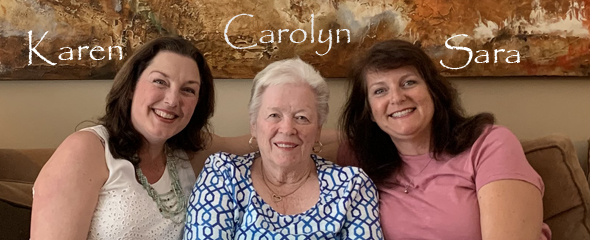
Here are the tastingspoons players. I’m in the middle (Carolyn). Daughter Sara on the right, and daughter-in-law Karen on the left. I started the blog in 2007, as a way to share recipes with my family. I’m still doing 99% of the blogging and holding out hope that these two lovely and excellent cooks will participate. They both lead very busy lives, so we’ll see.

– – – – – – – – – – – – – – – – – – – – – –

BOOK READING (from Carolyn):

Music of Bees, Eileen Garvin. Absolutely charming book about a woman in midlife, lonely, who raises bees, also makes unlikely friends. Heart-warming and very interesting about beekeeping.

A Postcard from Paris, Alex Brown. Really cute story. Dual time line, 1940s and present day about renovating an old apartment in Paris, things discovered.

Time of the Child, Niall Williams. Oh such a good book. Very small village in Ireland, 1960s. A baby is left on the doorstep. The town all whispers and helps. I listened to an interview of the author, which made me like him and his books even more.

Sipsworth, Simon Van Booy. If you like animals you’ll swoon. An old woman who really wants to die finds a tiny mouse in her house and befriends it and finds a reason to live. Utterly charming book.

The Forger’s Spell, Edward Dolnick. True story. For seven years a no-account painter named Han van Meegeren managed to pass off his paintings as those of Johannes Vermeer.

If You Lived Here, You’d be Home by Now, Christopher Ingraham. Could hardly put it down – about a journalist who takes on a challenge to move to small town in Minnesota and write about it. He expects to hate it and the people and place, but he doesn’t. Absolutely wonderful true story.

The River We Remember, William Kent Kreuger. 1950s, Minnesota. A murder and the aftermath. Could hardly put it down. Kreuger has such a vivid imagination and writing style.

How the Lights Gets In, Joyce Maynard. An older woman returns to New Hampshire to help care for her brain-injured son. Siblings and family, lots of angst and resentments.

The Filling Station, Vanessa Miller. Every American should read this book. A novelized retelling of the Tulsa massacre in 1921. Absolutely riveting.

The Story She Left Behind, Patti Callahan Henry. Love this author. Based on a true story. A famous author simply vanishes, leaving her husband and daughter behind. She had invented a mystical language no one could translate. Present day, someone thinks he’s solved the riddle, contacts the family. Really interesting read.

The Girl from Berlin, Ronald Balson. Love anything about Tuscany. An elderly woman is being evicted from a villa there, with odd deed provenance. Two young folks go there to help unravel the mystery. Loved it.

The Island of the Colorblind, Oliver Sacks, M.D. Nonfiction. The dr is intrigued by a remote Pacific island where most of the inhabitants are colorblind. He also unravels a mystery on Guam of people born with a strange neurological problem. Medical mysteries unveiled. Very interesting.

The Bookbinder, Pip Williams. Post 1914 London. Two sisters work at a bookbindery. They’re told to not read the books. One does and one doesn’t. One has visions beyond her narrow world; the other does not. Eventually the one gets into Oxford. Lovely story.

The Paris Express, Emma Donoghue. 1895 on a train to Paris, a disaster happens. You’ll delve into the lives of many people who survived and died in the crash.

A Race to the Bottom of Crazy, Richard Grant. This is about Arizona. Author, wife and child move back to Arizona where they once lived. Part memoir, research, and reporting in a quest to understand what makes Arizona such a confounding and irresistible place.

The Scarlet Thread, Francine Rivers. A woman’s life turned upside down when she discovers the handcrafted quilt and journal of her ancestor Mary Kathryn McMurray, a young woman who was uprooted from her home only to endure harsh frontier conditions on the Oregon Trail.

A Place to Hide, Ronald Balson. 1939 Amsterdam, an ambassador has the ability to save the lives of many Jewish children. Heartwarming.

Homeseeking, Karissa Chen. Two young Chinese teens are deeply in love, but in China. Then their families are separated. Jump to current day and the two meet again in Los Angeles.

North River, Pete Hammill. He always writes such a good story. A doctor works diligently healing people from all walks of life. His wife and daughter left him years before. One day his 3-yr old grandson arrives on his doorstep.

A Very Typical Family, Sierra Godfrey. A very messed-up family. Three adult children are given a home in Santa Cruz, Calif, but only if the siblings meet up and live in the house together. A very untypical scenario but makes for lots of messes.

Three Days in June, Anne Tyler. The usual Anne Tyler grit. Family angst. This wasn’t one of my favorites, but it was entertaining and very short.

Saved, Benjamin Hall. Author is a veteran war reporter. Ukraine, 2022, he nearly loses his life to a Russian strike. Riveting story – he survives, barely.

Grey Wolf, Louise Penny. Another Inspector Gamache mystery in Quebec. She is such an incredible mystery writer.

All the Colors of the Dark, Chris Whitaker. A missing person mystery, a serial killer thriller, a love story, a unique twist on each. Could hardly put it down.

Orbital, Samantha Harvey. Winner of 2024 Booker Prize. I don’t usually like those, but I heard the author interviewed and she hooked me. This is not a normal book with a beginning, a story and an end. It’s several chapters of the day in the life of various astronauts at the ISS (Int’l Space Station). All fictional. She’s been praised by several real astronauts for “getting it” about space station everyday life.

The Blue Hour, Paula Hawkins. An island off Scotland. Inaccessible except when the tide is out. Weird goings on. An artist. A present day mystery too.

Iron Lake, William Kent Krueger. A judge is murdered and a boy is missing. Riveting mystery.

Tell the Wolves I’m Home, Carol Ricks Brunt. 1980s. A 14-yr old girl loses her beloved uncle. Yet a new friendship arises, someone she never knew about.

Four Treasures of the Sky, Jenny Zhang. 1880s, a young girl is kidnapped in China and brought to the United States. She survives with many hurdles in the path.

The Boy Who Fell out of the Sky, Ken Dornstein. Memoir, 1988. The author’s brother died in the PanAm flight that went down in Lockerbie, Scotland. A decade later he tries to solve “the riddle of his older brother’s life.”

Worse Care Scenario, T.J. Newman. Oh my. Interesting analysis of what could/might happen if a jet crashed into a nuclear plant. Un-put-downable.

Song of the Lark, Willa Cather. Complicated weave of a story about a young woman in about 1900, who has a gifted voice (singing) and about her journey to success, not without its ups and downs.

Crow Talk, Eileen Garvin. Charming story which takes place at a remote lake in Washington State, about a few people who inhabit it, the friendships made, but also revolving around the rescue of a baby crow.

The Story Collector, Evie Woods. Sweet story about some dark secrets from an area in Ireland, a bit magical, faerie life, but solving a mystery too.

A Sea of Unspoken Things, Adrienne Young. A woman investigates her twin brother’s mysterious death. She goes to a small town in California to figure it out, to figure HIM out.

The King’s Messenger, Susanna Kearsley. 1600s England, King James. About one of his trusted “messengers,” and his relationship with a young woman also of “the court.” Lots of intrigue.

In the Shadow of the Greenbrier, Emily Matchar. Interesting mystery in/around the area of the famous resort in White Sulphur Springs, West Virginia.

Isola, Allegra Goodman. Hard to describe, survival story on an island in the 1600s.

Save the Date, Allison Raskin. Rom-com, witty, LOL funny. Clever.

The Sirens, Emilia Hart. Numerous time-lines, Australia. Mysteries abound, nightmares, abandoned baby, weird allergies.

Red Clay, Charles Fancher. LOVED this book. Mostly post-Civil War story about the lives of slaves in Alabama during Reconstruction.

Stars in an Italian Sky, Jill Santopolo. Dual time line, 1946 and recent time. Love stories and a mystery.

Battle Mountain, C.J. Box. Another one of Box’s riveting mysteries. Love his descriptions of the land.

Something Beautiful Happened, Yvette Corporon. A memoir of sorts in Greece, tiny island of Erikousa, where the locals hid Jews during WWII. All elusive stories told by the author’s grandmother.

The Jackal’s Mistress, Chris Bohjalian. 1860s Virginia, about a woman who saves the life of a Union soldier. Really good story.

Song of the Magpie, Louise Mayberry. Really interesting story about Australia back in the days when it was mostly a penal colony. Gritty strength of a woman trying to thrive with her farm.

The Boomerang, Robert Bailey. A thriller that will have you gripping the book. About a lot of secrets surrounding the president (fictional novel, remember) and his chief of staff and about cancer. A cure. Such a good story.

Care and Feeding, Laurie Woolever. Really interesting memoir of a woman driven to succeed in the restaurant business. She worked for Mario Batali and then Anthony Bourdain. Gritty stories.

Everything is Tuberculosis, John Green. Maybe not a book for everyone. A real deep dive into the deadly tuberculosis infection, its history. I heard the author interviewed and found the book very interesting.

The Book Lovers Library, Madeline Martin. Fascinating read about Boots’ drug stores’ lending library. And the people who worked in them.

The Arrivals, Meg Mitchell Moore. LOL funny, about a middle-aged couple whose children (and their various family members) return to the family home and the chaos that ensues.

My Life as a Silent Movie, Jesse Lee Kercheval. About grief. A big move to Paris, finding herself a new life with a new set of real blood family.

Escape, Carolyn Jessop. Another memoir about a woman really in bondage in Utah, Mormon plural marriage.

 

Tasting Spoons

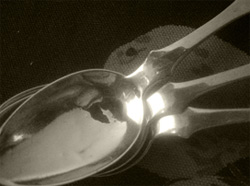
My blog's namesake - small, old and some very dented engraved silver plated tea spoons that belonged to my mother-in-law, and I use them to taste my food as I'm cooking.

Scroll down to the bottom to view my Blogroll

Posted in Salad Dressings, on August 4th, 2008.

The Silver Palate’s Basic Vinaigrette

For those of you who don’t write your own food blog, you likely don’t realize how difficult it is to photograph some foods. Notorious amongst the toughies: any food, absolutely any food that is brown. It’s blah. Indifferent. No pep or vigor to it. The trick is to get some contrast – light and dark, forward and backward interest. Color, etc. I do think about it when I’m photographing food for the blog. And then there are those times when nothing I do seems to work. Take this time.

We had salad for dinner. And yes, I have some salad dressings in the refrigerator (a store-bought mango dressing that doesn’t seem to go well on greens), and the lemonade one I made last weekend. It’s very good, and we’ve eaten it several times in the last 8 days, but it’s sweet. I wanted something savory. A quick perusal of my recipe binders and I decided on one of The Silver Palate’s staples – their Basic Vinaigrette. I’ve made it innumerable times, and always liked it. It seemed like a good fit for the clean-out-the-produce-drawer salad we had. (We attended our youngest grandson’s baptism today and had an ample lunch afterward, so we weren’t hungry for a full-blown dinner.)

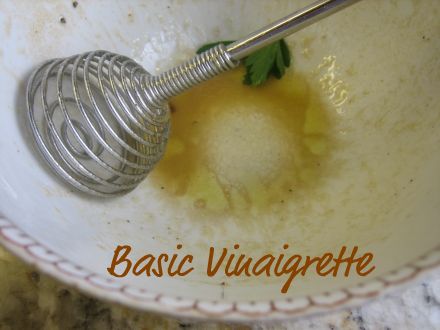
I whipped up the dressing in a bowl – using my favorite O (brand) cabernet vinegar, and good French Maille Dijon mustard. I added salt, pepper, a bit of sugar (actually Splenda), some parsley (Italian) and then I drizzled in some Lucini brand olive oil. Using a whisk, I whipped until the dressing had emulsified. I haven’t looked it up, but emulsified means until it thickens – it’s when the oil and the vinegar come together and become one, like homogenizing milk.

All was going well, and then I decided I needed to photograph it. Yeah, sure. So, I poured it into a plastic bottle and did a couple of side shots of it (photo below). Blah. Brownish dressing, some smeared on the side of the jar. Not very appetizing! I poured it out on the salad, and took a picture of the salad itself. Great shot of a salad, but you would have no idea what the dressing looked like. After dinner I glanced at the empty bowl I used to whisk up the dressing, and snapped a photo of that. Perhaps more interesting than the bottle.
I’ll give you both, however. No matter what you think of the photo, the dressing is just great. Perfect for my mixed greens (watercress, some spring mix, thinly shaved fennel, radishes, celery finely minced, radicchio sliced thinly, and a bit of Greek feta cheese). We had some leftover rib-eye steak which I sliced thinly and lapped that on top of our salad. Okay, so I’m done ranting now about photographing brown food. Tell me you got the picture? Comments are always appreciated!
printer-friendly PDF

Basic Vinaigrette

Recipe: The Silver Palate Cookbook

1 tablespoon Dijon mustard
4 tablespoons red wine vinegar — preferably cabernet vinegar
1 teaspoon sugar
1/2 teaspoon salt
1/2 teaspoon freshly ground black pepper
2 tablespoons parsley — or Italian parsley
1/2 cup extra virgin olive oil

1. Measure mustard into a bowl. Whisk in vinegar, sugar, salt, pepper and herbs to taste.
2. Continue to whisk mixture while slowly dribbling in olive oil until mixture thickens. Adjust seasoning to taste.
3. Cover until ready to serve. Whisk again just before serving.

Posted in Desserts, on August 2nd, 2008.

peach pudding cake or nectarine pudding cake

It intrigues me, always, when I read a recipe and find some new or different technique. Such was the case with this recipe. It’s not exactly an innovative instruction, but normally you don’t cover a cobbler or cake while it’s baking. In this case, you cover it with oiled foil for half the baking and uncover for the second half. And this fruit pudding cake requires about 80-90 minutes of baking. That’s a heck of a long time.

Before we get to the recipe itself, I want to talk about peaches and nectarines for a minute . . . I know (because Carolyn knows all, tee, hee) that some of you, my good readers, who subscribe or use a reader, chose not to read my instructional pieces about how to buy great fruit and vegetables (I’ve done two so far – peaches/nectarines, and cucumbers). I suppose in the big scheme of things, I shouldn’t care, but I’m merely telling you, it’s worth the reading. Really it is. (If you want to read it now, just click on the links above to go to each of those posts.) I’ve learned things from the book this info has come from. In this case, when I was shopping for peaches, I remembered what Russ Parsons had told me – and I’m doing this from memory – firstly that peaches and nectarines are interchangeable, for all intents and purposes, (okay, good so far, so I chose nectarines) – then he said choose the white-fleshed fruit if it’s available (check), and choose fruit that has less rosy tinges to them – in other words, choose the more yellow skinned rather than the red skinned (I did my best, check). Once home, I placed them on the kitchen counter (check) for about 4 days, actually, until they were perfectly ripe. That day wasn’t one when I could use them, so I popped them in a plastic bag and into the refrigerator (check). It’s been 3 or 4 more days since I did that, and amazingly, they were perfectly okay once I removed them from cold storage. I’m a happy camper.

I haven’t done much cooking of late. No particular reason, other than I’ve been busy doing other things (like painting, for instance, going to my weekly art class, shopping, going out to lunch with friends, movie-going to see Mama Mia). And, we had lots of leftovers in the refrigerator. I don’t mind leftovers at all, and my DH is wonderful about eating them. In fact he rags on me something fierce whenever we have to throw out something. Alas, we do now and then. But our refrigerator, finally, is more or less bare. Well, that’s not exactly a truthful statement. If you opened my frig you’d find nearly all shelves half full – of bottles and jars of things that have to be refrigerated all the time (pickles, dressings, marinades, mustards, some liqueurs, crème fraiche, still some Devon cream leftover from the tea about 6 weeks ago, oils, jams, condiments, hot peppers, and on and on it goes). The vegetable drawer is crammed full too, as well as the shallow cheese/salami drawer. Of course, there’s also some milk, fat-free half and half, some cream, sour cream, fresh salsa, and lots of Greek yogurt too.

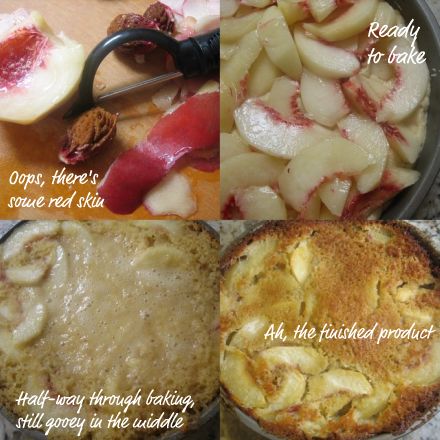
So, now we get to talk about the recipe. Sorry for the diversion . . . I went to my recipe trove and searched for something to do with the nectarines. Out popped this recipe. I adore pudding cakes – you’ll find that I posted a lemon sponge cake and a gingerbread pudding cake in months past, both really tasty. I’d never made a peach (well, nectarine) one. First I peeled and sliced (and measured) the nectarines. I took two little slices to taste – oh my goodness were they fabulous. Now, a slight confession: the original recipe called for 4 cups of sliced fruit. I had 4 rather smallish nectarines, and I thought I’d be lucky to have 3 cups. Actually, it was a bit over 2 cups. So, I halved the recipe. The list of ingredients, when halved, was difficult (I hate it when you have to measure 7/8 of a cup or 3/8 of a cup). So, the recipe you’ll see below is the full 9×13 size, since I didn’t think you guys would want to have to do all the odd-estimating measurements, either. I baked mine in an 8-inch round cakepan. I don’t own an 8-inch square pan (just a 9-er), so figured the 8-inch round cakepan would be a better use of the volume/space.

The recipe appeared in Bon Appetit, in August of 2007. It was in the column where people write in to ask for restaurant recipes. When I searched online for it, it wasn’t AT the epicurious website (odd), but I did find it at somebody else’s food blog. Before I made it I wanted to read what others thought of it. Several people who have eaten at the restaurant, and had moved away from Austin, were thrilled to find the recipe online (per the comments to the blog). Apparently the pastry chef at this restaurant is Asian, as the recipe on the menu is called Wom Kim’s Peach Pudding.

collage of peach pudding cake

Remember, pudding cake is a unique chemistry – the batter separates into a pudding layer, and also has a second layer more resembling a cake. When this pudding cake was sliced and served, it didn’t have much ooze left (probably because I baked it too long). In this particular recipe you spread the batter into the baking dish, then spoon the freshly sliced peaches/nectarines on top. Once baked, the fruit has settled (mostly) to the bottom and the cake is on top. In my instance, since I was using a smaller vessel, I cut down the baking time. Next time I’ll bake it less time. You can see from the collage of pictures, the one with the shiny center is halfway through the baking – from then I probably needed to bake it about 30 minutes and check it with my tester in 5-minute increments. And next time I’ll know to make the full 9×13 glass pan full, and to have at least 8 peaches or nectarines on hand to make it!

The results? It was delicious (is that my most favorite word on this blog? sorry . . .). Ahem. It was very good, but I think the cake overpowered the delicate flavor of the nectarines, though. If you want straight, unadulterated peach or nectarine flavor, cut them up and serve with cream or eat out of hand. If you don’t mind the mingling of flavors (the cake part was a bit crunchy on top – which was a great texture  . . . I liked it, it was perfectly baked, a bit darkened around the outside edges from sugar caramelization, just as the recipe recommended). I served it with a small globe of vanilla ice cream rather than whipped cream – I wanted the cold contrast.
printer-friendly PDF

Peach Pudding Cake

Recipe: Wom Kim at Hyde Park Bar & Grill, Austin, TX
Servings: 12

4 cups sliced peaches — peeled, or nectarines
CAKE BATTER:
1 3/4 cups all-purpose flour
2 tablespoons all-purpose flour
2 1/4 teaspoons baking powder
3/4 teaspoon kosher salt
1/2 teaspoon baking soda
1 1/2 sticks unsalted butter
1 3/4 cups sugar — or less
2 tablespoons vanilla extract
2 large eggs
3/4 cup buttermilk
Sweetened whipped cream for garnish

1. Preheat oven to 350. Spray an 9×13-inch glass dish with vegetable oil spray and set aside.
2. In a bowl whisk the flour (both quantities), baking powder, salt and soda.
3. In an electric mixer beat butter until smooth. Gradually beat in sugar. Add vanilla, then eggs one at a time, incorporating both well. Using low speed, add flour mixture, alternating with the buttermilk in three additions each, beating well between each addition.
4. Transfer batter to baking pan/dish, spreading evenly. Arrange peach or nectarine slices over batter, overlapping slightly as needed. Spray a sheet of aluminum foil with vegetable oil spray; cover cake with foil, spray side down and seal edges.
5. Bake for 45 minutes, then remove foil covering. Return to oven and continue baking until top is golden brown, edges are crusty, AND a cake tester inserted into the center comes out clean, about 40 more minutes. Cool for one hour, then serve with whipped cream.
Per Serving: 335 Calories; 13g Fat (33.8% calories from fat); 4g Protein; 52g Carbohydrate; 2g Dietary Fiber; 67mg Cholesterol; 291mg Sodium.

Posted in Uncategorized, on July 31st, 2008.

main-pool.jpg
Our newly replastered pool, and the view to the west.

In case you hadn’t heard, we had a significant 5.4 magnitude earthquake here in Southern California on Tuesday. At 11:42 am. It lasted for about 15 seconds, although the most severe portion was only about 8 -10 seconds, then it gradually faded after that. If you’ve never been in an earthquake, it’s hard to describe. It is a very deep roaring-wrenching sound first – you hear it initially, in the half second before you feel the earth start to shift. I was near a major beam in the house, so I didn’t move. Light fixtures swayed, the water in both our pool and spa began sloshing around, although no water lapped over the edges. (Ten minutes later the pool water was still moving.)  The wrenching noise continues. It feels like forever. It’s frightening, yes. The fear, of course, is that maybe this is going to be the BIG one, the one that’s going to bring down the house. Sometimes I run to a doorway; other times, depending on the severity, I’m frozen, in suspense, listening for sounds that indicate major damage. glass breaking, pictures falling and shattering, or worse. Part of the wrenching sound is the house itself, the structure, the beams and wood screaming against the bolts and screws, leaning from the nails that hold a house together and to a cement slab foundation.

People who don’t live here wonder why we’d possibly live in earthquake country. Well, for me, this is paradise. We’re some miles away from the San Andreas (an-DRAY-us) Fault, the deep, underground schism that the experts tell us has been caused by thousands of years of shifting ground, where the greatest amount of movement comes. There are many other fault lines here in California too, but that’s the major one, the San Andreas. We, perhaps, delude ourselves, that since we’re so many miles away from the Fault, therefore we’ll be immune from significant damage.

In response, I ask – why do people live along the shores of Florida, Georgia, the Carolinas, in known hurricane country? Why do people live in the midwest in the land of tornados? There are negatives, I suppose, about lots of places to live. For us, it’s earthquakes.

Did we have damage? Yes and no. Yes, we had some damage, but no it wasn’t major as far as we know. During the hardest wrenching when the noise was near-deafening, we didn’t even hear the cans and bottles fly off the shelves in the pantry just 10 feet away (albeit behind a stained-glass door). They landed in piles, some shattered – jam, jelly, salsas, oozing out on the hardwood floor and glass shards flew in every direction. About 10 bottles made huge dents in the wood floor as they broke. Sardines in a tin were hit with something which made a hole in the metal, so the area smelled of fish for awhile. Sigh. Dave made a quick survey upstairs – nothing major. Later I did discover about 15 books had fallen off shelves in my office upstairs. Drawers throughout the house (except in the kitchen where they’re held by a magnet) were ajar. No windows broke. No pictures fell off walls. But we had aftershocks for hours. About 2 hours later I was sitting at my office computer. The screen has a partial reflection of the window across the room. Although I couldn’t feel it at first, suddenly the screen/reflection began shaking. Concentrating, yes, I could feel the movement. We had several of those.

Our biggest concern was our newly replastered pool and spa. Fortunately there appears to be no change there; no drop in water level. The picture above is of our main pool and the view toward the ocean. You can vaguely see the mound of fog way out there, that usually bothers us in June, not July, coming in from the sea. [And yes, I know, I need to write up a post about our back yard . . . I’ve had a couple of people email me privately asking about the status of our leaning flagpole and our hill/patio/leaks. I promise, I will do it soon . . . just when I think we’re “done” with our back yard, something else happens, and we’re not finished with our 6 months and counting problems.]

The epicenter was about 15 miles away as the crow flies, about due north, in an area called Chino Hills. There, there were broken water mains, some ceiling falls, a Macy’s had to close because of water damage, broken windows in businesses and homes. But I haven’t heard that anyone was injured. Thank goodness.

As a native Californian, I read, years and years ago, a fascinating book called The Last of the Late, Great State of California. It’s a novel, based on an earthquake aftermath when the western half of California sinks in the ocean after the BIG one. It addressed issues (some immediate, most long term) that one wouldn’t think about. Huge problems. Financial and political mostly. I thought the author was brilliant in analyzing how such a big one would affect those left behind.

We have earthquake insurance for 3 of our 4 houses (2 homes we live in and 1 rental home are covered; the rental condo isn’t covered) – a very expensive proposition, I’ll tell you! But if we did have a big one, once we paid the huge deductible, we’d be covered. Most people don’t have it. I understand why, because it’s so costly. Life has returned to normal here, however. For now. Until the next one, which we know is coming.

Posted in Cookies, on July 30th, 2008.

irish cream brownies

Once a month I get together with two friends for about three hours of Scrabble. The hostess serves, usually, some cookies, fruit and hot tea, even in the summertime. (Of course, the A/C is running, so it’s comfortable inside, but it’s part of our ritual – we have TEA.) So, I needed to fix something to serve with the tea – maybe something different this time. I scrounged around looking at my heap of recipes to try, and this one stood out – it required some Bailey’s Irish Cream, which I happened to have in my refrigerator. The recipe came from Cooking Light in October, 2006, and dozens and dozens of people who made it gave these high marks. Providing you cut them in 16 pieces, it’s just 6 grams of fat each. They’re very fudgy and chocolatey. The author cautioned readers not to overbake them – they need to be slightly underdone, so they’ll be soft in the middle. The recipe has been altered to 18 minutes baking time (my oven bakes hot, so I reduced it to 340).

My DH and I enjoyed one small brownie with a small scoop of vanilla ice cream after dinner last night. The photo is a tad bit misleading – the brownie is quite small – but on that small plate and with the globe of ice cream, it looks gigantic. It wasn’t. But certainly ample. The Bailey’s is very subtle – in fact I don’t think you can exactly detect it, but these are delish. Yes, I’d make them again.
printer-friendly PDF

Irish Cream Brownies

Recipe: Ann Pittman, Cooking Light, October 2006
Servings: 16

1 cup all-purpose flour — (about 4 1/2 ounces)
1/2 cup unsweetened cocoa
1/4 teaspoon baking soda
1/4 teaspoon salt
1/3 cup semisweet chocolate chips
1/4 cup butter
1/4 cup Bailey’s Irish Cream
1 cup sugar
1/2 cup egg substitute — or 2 eggs, beaten
1 teaspoon vanilla extract
Cooking spray

1. Preheat oven to 350°.
2. Lightly spoon flour into a dry measuring cup; level with a knife. Combine flour, cocoa, baking soda, and salt in a small bowl, stirring with a whisk.
3. Place the chocolate chips and the butter in a large microwave-safe bowl. Microwave at HIGH 1 1/2 minutes or until the chocolate chips and butter melt, stirring every 30 seconds. Cool slightly. Add sugar and next 3 ingredients (through vanilla extract), stirring well with a whisk. Microwave at HIGH 1 minute or until sugar dissolves, stirring every 30 seconds. Fold in the flour mixture, stirring just until moist. Spread batter in a thin layer into a 9-inch square baking pan coated with cooking spray. Bake at 350° for 20 18 minutes or until a wooden pick inserted in center comes out almost clean. Cool on a wire rack.
Per Serving: 155 Calories; 6g Fat (33.2% calories from fat); 3g Protein; 23g Carbohydrate; 1g Dietary Fiber; 8mg Cholesterol; 103mg Sodium.

Posted in Salads, on July 29th, 2008.

summer lemony green salad with peppered pecans

Every time our family gets together for a big confab, there are always logistics – the date, the time, who can bring what, and what’s convenient for which family, depending on soccer games, and traveling requirements. Originally our daughter Sara and her family were going to bring salad, but with the heat and a two hour drive, she thought that likely wasn’t a good idea, so we switched – she bought a big fancy sheet birthday cake (and tried to keep it out of the sun in the back of their car) and I made the salad, but used her recipe.

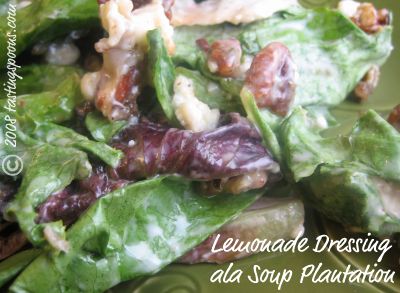
Although we eat at Soup Plantation now and then (their salad bar is par excellence), I’d never had their summer lemon salad. Sara had raved about it last summer, but somehow we missed the window of opportunity and it was gone by the time we went there. Sara had the recipe in her head: spring mix (“you know, Mom, that big bag from Costco” she said), pecans (“I make your recipe, Mom, for the peppered pecans instead), dried cranberries and gorgonzola and this lemonade dressing. She said 1 ½ cups mayo, 1 cup of lemonade concentrate, sugar and Dijon. That’s it. She didn’t give me specifics on the sugar and Dijon, so she added more mustard once she tasted it. I added too much sugar, I think, but it was fine. I found the recipe today on the ‘net, and it has more specific quantities and uses a spicy candied pecan. It’s a “copycat” recipe, so we don’t know for sure if it’s Soup Plantation’s version, although on the ‘net it indicates the recipe came from an institutional restaurant magazine.

It was easy enough to put together. The dressing took about 2 minutes to mix up. I did make my peppered pecans (took about 10-12 minutes, I’d suppose). After crumbling the blue cheese (I had that on hand, so didn’t buy Gorgonzola) it was a simple matter of tossing it together just before serving. It’s a delicious salad – everybody loved it – there was none left. We had friends over for dinner the next night and served it again, with the leftovers from the big family dinner. I still have dressing, and will make this salad again in the next few days. I’ll add some regular head lettuce to it, though. The spring mix is so fragile – I think the dressing could stand to have some more sturdy lettuces. After 5 minutes the salad is wilted, so really do toss it the very last thing before dishing it up. It’s tart and sweet and crunchy. A lovely side for a summer’s evening.

Summer Lemony Green Salad

Recipe By: Supposedly a Soup Plantation recipe, served only in the summer months.
Servings: 10

8 cups lettuce leaves — fancy spring mix, or a mixture
1/2 cup pecans — “peppered pecans”
1/2 cup Gorgonzola cheese — crumbled, or blue cheese
1/4 cup dried cranberries
SUMMER LEMONADE DRESSING:
1 1/2 cups mayonnaise
1 cup frozen lemonade concentrate — thawed
1 tablespoon Dijon mustard
1 tablespoon sugar

1. In a bowl combine the dressing ingredients and whisk (wire whisk) until completely mixed. Refrigerate until ready to serve.
2. In a large salad bowl combine the lettuces and crumbled cheese, then pour on some dressing. Sprinkle the pecans on top. Don’t add too much dressing – try less and taste as you go. Serve immediately!
I’m not including the nutrition on this one – it’s not bad, but it assumes you use all of the dressing on a small salad, so it’s waaaay off.
printer-friendly pdf

Posted in Veggies/sides, on July 28th, 2008.

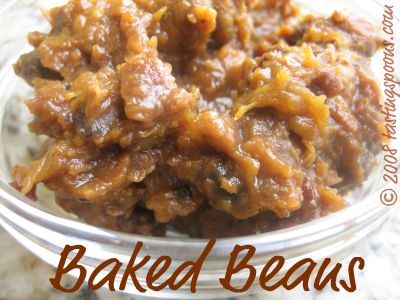
baked beans

Very rarely do I fix the kind of old-fashioned summer outdoor dinner menu for which our fore-mothers are so remembered – can’t you just picture them in their long dresses and bonnets, stirring the fire? Adding more wood to the indoor range? Whether they made hamburgers or not, I don’t know. Likely hot dogs didn’t come into existence until the last 1800’s. But the menus I’m talking about include hamburgers, hot dogs, fried chicken, cole slaw, potato salad, pickles, baked beans, strawberry shortcake and watermelon. You know, that kind of thing. Preparing that hasn’t appealed to me for several decades. The outdoor part, the barbecuing . . . all that’s just fine. I guess the food is just a bit too . . . uh, something. I’d be happy to have it at someone else’s house, but to fix it myself? No.

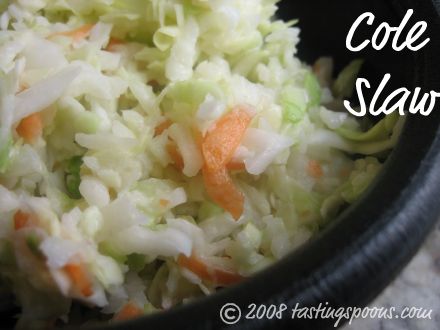
So, when I was planning our family’s annual 5-birthday get-together (we have five immediate family birthdays between July 26th and August 9th), as I mentioned a day or so ago, I didn’t want to do all the cooking for this crowd (ended up being 18). So we purchased ready-made Que and I made the sides. The day before, I made and posted the story about KFC’s cole slaw. I had made this before – and in case any of you printed the recipe – it’s NOT the same as KFC’s, but it’s close. Close enough? Well, only you can judge. I decided this time that maybe 4-6 hours of marinating is enough – by the next day the cabbage seemed kind of wilted. By yesterday it was over the hill.

Then I made a really nice green type salad I’ll post tomorrow from a recipe brought by my daughter, Sara. It’s supposedly a Soup Plantation version. I like it, whatever it is, although it’s also on the sweet side. I also made the oh-so-tasty watermelon with feta and mint that my friend Kathleen fixed for us last month. It was a big hit at this party – it mostly disappeared, and it’s so darned easy, and amazing how the combination of the salty feta and the sweet watermelon and mint is like a marriage made in heaven. I added more feta and more mint than Martha’s recipe indicated, as you can see from this picture.

And then I opted to make one high-carb side that just seemed right for the menu – baked beans. In my book there are two kinds of baked beans – barbecue type and sweet baked beans. Barbecue beans are more savory tasting. With things like onions, garlic, celery maybe, some tomato sauce perhaps, ham hocks or bacon for flavor. And probably some herbs or spices to liven it up. Baked beans, on the other hand, were developed in New England during the early frontier days of America’s founding. The early settlers must have found good land for growing beans, and they discovered the sweet syrup from maple trees. Combine them and you have “Boston baked beans.” Over the hundreds of years since, maple syrup leaned toward molasses (the early settlers probably had molasses too, brought in from the Caribbean). I don’t know any of these things for sure; it’s just my conjecture. Year ago I bought an old New England style bean pot (crockery type), and used it for a long while. I made baked beans in it many a time. I don’t recall what happened to it – maybe it cracked? People who live in New England and make baked beans regularly swear by the crockery style pot – they believe the flavor is immensely enhanced by using that vessel.

I’ll wager that I hadn’t made this in 20+ years. In my old recipe book, it’s written out in longhand, with cryptic notes (no measurements). Here’s what the list says:

1 huge can B&M baked beans
brown sugar
cinnamon
ground cloves
salt pork

Then, in red ink, I’d written in on the side:
Pineapple (crushed)

So, you see, although this little list comprises mostly ingredients for sweet beans, I added salt pork (from the savory side). Never let it be said that I prepared any recipe (except baked goods) exactly as written. I tampered. When I made it this time, I used bacon instead of salt pork. I added some onion. I left out the ground cloves and the brown sugar (because I thought the canned beans were sweet enough as is). Rather than keep them simmering on the stovetop, I opted to put them in the oven. And because they were quite soupy, I left the lid off. Probably a mistake. They lost way too much fluid, even though the oven temp was about 250. So they were almost dry and had almost reached the point of mush by the time dinner was served. I will say, though, that everybody ate them with relish – there are only a few spoonfuls left. Enough for leftovers. And you know what? They tasted even better the next day. To me anyway.
printer-friendly PDF

Baked Beans

Recipe: my own concoction
Servings: 8

44 ounces B & M baked beans
10 ounces crushed pineapple — drained
3 ounces bacon — or salt pork, chopped
1/2 cup onion — minced
1/2 teaspoon ground cinnamon [and ground cloves if you’d like to add it, probably ¼ tsp]
1/2 tablespoon Dijon mustard

1. In a large pot (I used my deep Le Crueset covered roasting pan) sauté the bacon until it’s rendered out its fat. You
may discard the fat in the pan if you choose to. Add the chopped onion and continue frying it until it’s begun to brown. Add the canned beans, pineapple, cinnamon and mustard. Stir to combine.
2. Bring to a simmer on the stovetop and cover. This can heat in a low oven (250 or so), covered, for a couple of hours, or you can just simmer it on the stove for an hour or so to blend the flavors and cook the onion through. Use a slotted spoon to serve if it’s still too soupy. If you bake it at a higher temperature or longer, it will cook out most of the liquid and reduce it to a thicker mush consistency. Serve. Add brown sugar if you would prefer a sweeter dish.
Per Serving: 290 Calories; 8g Fat (23.8% calories from fat); 12g Protein; 44g Carbohydrate; 10g Dietary Fiber; 15mg Cholesterol; 658mg Sodium.

Posted in Salads, on July 26th, 2008.

KFC’s cole slaw

I’m old enough to remember when Kentucky Fried Chicken (KFC) first opened doors around here in California. And for lots of years since then we never knew how they made their chicken (a combo of pressure cooked and fried, I believe I read or heard), how much fat was in the food (more than we’d like), or what they put in their fabulous cole slaw. We don’t eat there except on a rare occasion when I’m desperate, but every once in awhile we’ll go buy just the cole slaw, because it’s so darned good.

Over the years, though, the mysteries of the KFC’s calories, methods and ingredients were revealed here and there. I once found a recipe that purported to be KFC’s cole slaw, and it contained a lot of grated apple and apple juice concentrate. It seemed possible, since it’s quite sweet. But it didn’t taste the way I thought it should. Then some months ago I was sent an email with lots of restaurant recipes, and this one was included. The results? Good, but it’s definitely not the real thing. I think theirs is a bit sweeter, so sometimes I add some apple juice concentrate to the dressing, or some additional sugar.

When I make it, I put all the grated cabbage and carrots in a large plastic bag, make the dressing and pour it in the bag. That way I can roll the bag around a little bit to marinate the cabbage. It’s much better if allowed to sit for 24 hours, providing you have the time.

We’re having a big dinner at our house for 17 (actually 18 if you include the 11 1/2 month old baby) today, so I made this yesterday. Cooking for that many people is just more than I wanted to tackle, so we’re buying barbecued pork, beef brisket and smoked sausage from a local restaurant (The Beach Pit, in case you’re interested), and I’m making the sides (my old tried and true baked beans, a huge green salad with peppered pecans, watermelon salad and this cole slaw). The bean recipe will get posted, and the green salad, which is a new recipe. The watermelon/feta/mint salad I posted a few weeks ago. Somebody else is bringing appetizers, and we’re having a ready-made cake. Every summer around this time, our family celebrates a bunch of birthdays. Today is my DH’s, next weekend is mine, and two of our grandchildren’s, and the following weekend it’s our daughter’s. We couldn’t possibly have 5 birthday parties in two weeks, so we have a combined one.
printer-friendly PDF

KFC Cole Slaw (supposedly, but not)

Recipe: Found on the internet with the above title
Servings: 10

8 cups cabbage — grated in food processor
1/4 cup carrot — grated in food processor [I use 4-5 carrots, just because]
DRESSING:
1/3 cup sugar [or more, or apple juice concentrate too]
1/2 teaspoon salt
1/8 teaspoon pepper
1/4 cup milk
1/2 cup mayonnaise
1/4 cup buttermilk
1 1/2 tablespoons white vinegar
2 1/2 tablespoons lemon juice

1. Combine cabbage and carrots in a large bowl.
2. Mix dressing ingredients and stir to make sure all the sugar has dissolved.
3. Pour dressing over cabbage and toss well. Refrigerate at least two hours or overnight.
4. Stir well before serving.
Per Serving: 131 Calories; 10g Fat (62.0% calories from fat); 2g Protein; 12g Carbohydrate; 2g Dietary Fiber; 5mg Cholesterol; 193mg Sodium.

Posted in Books, on July 25th, 2008.

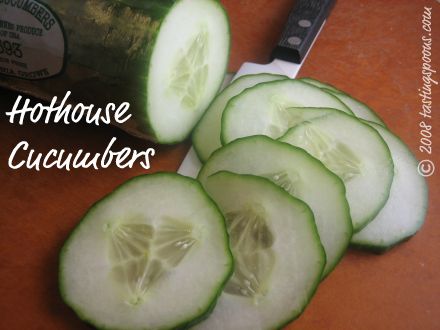
hothouse cucumbers

This is another posting in my series about fruits and vegetables, all using information from Russ Parsons’ book, How to Pick a Peach. Cucumbers, although available here in So. California all year around, are at their peak this time of the year.

What I Learned:

  • It took centuries of breeding to get what we know today as an edible cucumber.
  • Wild cucumbers (from the Himalayan foothills) were impossibly bitter. They’re all part of the Cucurbit family.
  • Basically the flesh of all cuke varieties is the same. It’s the skin that’s different, and the fact that one or more varieties are grown with no seeds (the supposedly burpless, hothouse type). They are grown in “cucumber convents,” so that bees can’t pollinate them, which would create seeds.
  • News to me is that recent studies have shown that it isn’t the seeds at all that cause indigestion. Actually, it’s the bitterness in cukes that causes the indigestion part. That bitterness is mostly in the skin and around the stem. Remove those and you have mostly a burpless cuke.
  • The hotter the weather, the more bitter the cucumber.
  • Georgia and Florida grow about half of the cucumbers we eat, followed by Mexico. [Mine were grown here in California.]

How to Choose & Store:

  • Moisture loss is the biggest problem for a cucumber, so select ones that aren’t shriveled or wilted. If you buy the greenhouse type, cut off what you need and leave the rest sealed in its plastic cocoon.
  • Seal tightly in a plastic bag.
  • Use them quickly.

Parsons included two recipes in this chapter: Cucumber Gazpacho (some stale bread, cukes, sorrel, garlic and yogurt) and a Cucumber, Beet and Feta Salad.

I’ve only posted one recipe using cucumbers – a recent one – for Cucumber Soup. And it’s a really good one, given to me by my friend, Jackie. That’s what made me think of this – I have two large hothouse cukes in the refrigerator now and need to make another batch of that soup. It’s so refreshing since we’re having hot weather here in Southern California.

My mother used to make a simple pickled cucumber – in a refrigerator container she’d put in some water (let’s say about 1/2 cup to 2/3 cup), some cider vinegar (maybe 1-2 T.), a sprinkling of sugar (probably about 1 tsp). She’d taste it and adjust it for sweet/sour balance, add some salt and pepper, then pile in the thinly sliced, peeled cucumbers. The liquid needs to cover the cukes. They would sit, refrigerated, for several hours or overnight having been stirred around a couple of times the first several hours.  If you happen to have dill weed (not seed), throw a bit of that in there too. My dad could just about eat his weight in those. My DH adores these, and I forget to make them. Adding Splenda instead of sugar works just fine.

Posted in Miscellaneous, Miscellaneous sides, on July 24th, 2008.


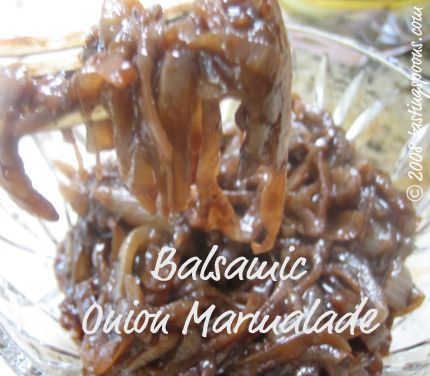
balsamic onion marmalade
Have you ever heard or read about how hard it is to photograph brown and beige things? Hope you can even figure out this is onions! I had to balance some of the onions on a fork with my left hand and try to hold the camera steady AND click the shutter with my right hand. All to show some added depth to the photo. And although this may not look all that appetizing, it’s actually very good. Would I kid you?

After just stating yesterday that I didn’t have any posts waiting in the wings, I looked, and oh yes, I had this one. I hadn’t posted it because I made the onion pepper relish to go with the beef sliders for the 4th of July, and thought the two were too similar. This one is less sweet than the relish – more suited for a slab of grilled meat probably, than the burgers and accompaniments. I still have some of this in the refrigerator (as well as the relish from the 4th), and assume it will keep for another few weeks since it’s “pickled,” so to speak, with the vinegar. Hope so, as it was delicious and very suitable for some meat things. I used it on a sandwich last week too.

We had some friends over for dinner a few weeks ago, and with the pork roast we did on the rotisserie (that I’d brined) I wanted to serve some kind of sauce or salsa, or something. Found a recipe for a pork rib roast with this onion marmalade. It was just a perfect fit. And oh-my-goodness deliciousness. It’s not difficult, although it does take some time (total cooking time about an hour) to sweat down the onions, then to continue to cook them down to a jammy consistency. If you started this first (when about to make a dinner) it would be done by the time you were ready to sit down).

The recipe came from Food & Wine magazine, May 2008. If you want to do the pork roast, just brine it, bake or rotisserie it until it reaches an internal temp of about 133 degrees (still pink in the middle). Remove and let sit for about 5 minutes before slicing and serving with this cold, room temp or hot onion topping. The leftovers will keep for several weeks.
printer-friendly PDF

Balsamic Onion Marmalade

Recipe: Food & Wine, May ’08.
Servings: 8

4 whole onions — peeled, sliced
1 tablespoon vegetable oil
1 pinch ground cloves
1/4 cup dark brown sugar
2/3 cup balsamic vinegar
1 1/2 teaspoons orange zest
salt and pepper to taste

1. In a large pot (large enough to barely hold all the onions) heat the oil until it starts to shimmer. Add the onions and cook over moderate heat until softened, about 20 minutes. Do not let them burn or brown.
2. Season the onions with the ground cloves, salt and pepper. Add the brown sugar and cook over moderately low heat until the skillet is dry, about 10 minutes. Add the balsamic vinegar and orange zest and continue to cook over low heat, stirring occasionally, until the marmalade is very thick, 30 minutes. Transfer the marmalade to a bowl, cover and refrigerate. Reheat, if you prefer it hot, just before serving, or serve cold, or at room temperature.
Per Serving: 65 Calories; 2g Fat (23.0% calories from fat); 1g Protein; 13g Carbohydrate; 1g Dietary Fiber; 0mg Cholesterol; 5mg Sodium.

Posted in Uncategorized, on July 23rd, 2008.

I’ve had very few days since I started this blog when I didn’t have a recipe to post. Uh, that’s today. Having been away for the weekend, I enjoyed preparing a simple meal on Monday night. Yesterday I spent catching up on one thing or another. My 2nd book club met in the morning and we discussed A Kiss From Maddalena, a touching story which takes place in WWII Italy. It was my suggestion we read it, and we all enjoyed it. It’s not really a romance, although from the title you’d think so. Sure, there is a romance in it, but mostly it’s about the hell that happens to the village itself and all its inhabitants during and after the war. The book is a tad bit hard to find. I read about it in Bas Bleu, a book catalog that I so enjoy reading. Sure, I can buy books cheaper at Amazon, but I like to support the little guys too, so at least once a year I order books from their online store. The book is no longer available there, though. What I love about Bas Bleu is the write-ups about books. My other book club is reading another Bas Bleu recommendation for our meeting tonight, The Covenant by Naomi Ragen. Really interesting read about an abduction in a Palestinian neighborhood in Israel. I’m leading the review tonight, so have some homework to do about that. It’s deeply discounted at Amazon, and no longer available at Bas Bleu (just a guess – because the author has been sued or accused by two different people/publishers for possible plagiarism in writing two other books).

Last week I made another batch of the roasted balsamic strawberry ice cream from a couple of weeks ago. That ice cream is so darned addicting. In my first batch I used a product called Tulocay’s Made in Napa Valley Blackberry Balsamic Vinegar with Pear. Having made the ice cream a second time with more pedestrian balsamic, I’m now craving more of this pear balsamic. So far I’ve been unable to find it. I’ve phoned several sources listed on their website, but they don’t carry that particular product. Will have to widen my search, or pony up to have it shipped from the producer. I bought it last year in Healdsburg (wine country) near where it’s made.

A second batch of the Thin & Buttery Chocolate Chip Cookies yielded a different cookie altogether. I made an alteration (know that it’s problematical anytime you make a change in a baked good) by using some Splenda instead of white sugar. I wanted my DH to be able to enjoy some of them. It totally changed the chemistry. Not a great cookie did it make. Although maybe it’s a good thing because I’m not craving them like I did the first, the virgin batch. I suspect, however, that I will make these again using the original recipe. They’re that good.

Last night my DH and I went to Laguna Beach. First it was dinner, at the Sundried Tomato Café, a fabulous restaurant (serendipity, since we didn’t have a plan about where to eat). I had a glass of Ferrari Carano Fume Blanc (one of the few white wines out there – other than champagne – that I truly enjoy, since I’m mostly a red wine drinker), an exceptional Caesar salad and a perfectly ripe avocado stuffed with a spicy-dressed Oregon bay shrimp salad (an appetizer, but was ample as an entrée). We ran into friends, Jackie & Don, as we were leaving. The restaurant is one of their favorites! Then we walked to the Laguna Playhouse to see The Marvelous Wonderettes. That may have been one of the best plays (actually this was a musical) I’ve ever seen there. We both just loved it. It’s all the music from our past – a step back in time to 1958 with four girls who are friends, who are asked to sing at their Senior Prom. In the first half they tell their stories (of love, school, teachers, growing up, etc.) using music of the era. In the second half they have returned for their 10-year reunion, and sing more of the 50’s and 60’s era songs. The costumes were just darling (I can’t believe we wore stuff like that, but sure enough, I did) and the four women had great voices. If you live in Southern California, I highly recommend you try to see this musical. It’s playing through August 31st. (And it’s opening in New York at the end of August.) Go have dinner (at about 5:45 pm, to give yourself ample time to walk back to the theater for the show at 7:30) at the Sundried Tomato over on Forest.

Related Posts Plugin for WordPress, Blogger...