Get new posts by email:

Archives

Currently Reading

Here are the tastingspoons players. I’m in the middle (Carolyn). Daughter Sara on the right, and daughter-in-law Karen on the left. I started the blog in 2007, as a way to share recipes with my family. I’m still doing 99% of the blogging and holding out hope that these two lovely and excellent cooks will participate. They both lead very busy lives, so we’ll see.

– – – – – – – – – – – – – – – – – – – – – –

BOOK READING (from Carolyn):

Music of Bees, Eileen Garvin. Absolutely charming book about a woman in midlife, lonely, who raises bees, also makes unlikely friends. Heart-warming and very interesting about beekeeping.

A Postcard from Paris, Alex Brown. Really cute story. Dual time line, 1940s and present day about renovating an old apartment in Paris, things discovered.

Time of the Child, Niall Williams. Oh such a good book. Very small village in Ireland, 1960s. A baby is left on the doorstep. The town all whispers and helps. I listened to an interview of the author, which made me like him and his books even more.

Sipsworth, Simon Van Booy. If you like animals you’ll swoon. An old woman who really wants to die finds a tiny mouse in her house and befriends it and finds a reason to live. Utterly charming book.

The Forger’s Spell, Edward Dolnick. True story. For seven years a no-account painter named Han van Meegeren managed to pass off his paintings as those of Johannes Vermeer.

If You Lived Here, You’d be Home by Now, Christopher Ingraham. Could hardly put it down – about a journalist who takes on a challenge to move to small town in Minnesota and write about it. He expects to hate it and the people and place, but he doesn’t. Absolutely wonderful true story.

The River We Remember, William Kent Kreuger. 1950s, Minnesota. A murder and the aftermath. Could hardly put it down. Kreuger has such a vivid imagination and writing style.

How the Lights Gets In, Joyce Maynard. An older woman returns to New Hampshire to help care for her brain-injured son. Siblings and family, lots of angst and resentments.

The Filling Station, Vanessa Miller. Every American should read this book. A novelized retelling of the Tulsa massacre in 1921. Absolutely riveting.

The Story She Left Behind, Patti Callahan Henry. Love this author. Based on a true story. A famous author simply vanishes, leaving her husband and daughter behind. She had invented a mystical language no one could translate. Present day, someone thinks he’s solved the riddle, contacts the family. Really interesting read.

The Girl from Berlin, Ronald Balson. Love anything about Tuscany. An elderly woman is being evicted from a villa there, with odd deed provenance. Two young folks go there to help unravel the mystery. Loved it.

The Island of the Colorblind, Oliver Sacks, M.D. Nonfiction. The dr is intrigued by a remote Pacific island where most of the inhabitants are colorblind. He also unravels a mystery on Guam of people born with a strange neurological problem. Medical mysteries unveiled. Very interesting.

The Bookbinder, Pip Williams. Post 1914 London. Two sisters work at a bookbindery. They’re told to not read the books. One does and one doesn’t. One has visions beyond her narrow world; the other does not. Eventually the one gets into Oxford. Lovely story.

The Paris Express, Emma Donoghue. 1895 on a train to Paris, a disaster happens. You’ll delve into the lives of many people who survived and died in the crash.

A Race to the Bottom of Crazy, Richard Grant. This is about Arizona. Author, wife and child move back to Arizona where they once lived. Part memoir, research, and reporting in a quest to understand what makes Arizona such a confounding and irresistible place.

The Scarlet Thread, Francine Rivers. A woman’s life turned upside down when she discovers the handcrafted quilt and journal of her ancestor Mary Kathryn McMurray, a young woman who was uprooted from her home only to endure harsh frontier conditions on the Oregon Trail.

A Place to Hide, Ronald Balson. 1939 Amsterdam, an ambassador has the ability to save the lives of many Jewish children. Heartwarming.

Homeseeking, Karissa Chen. Two young Chinese teens are deeply in love, but in China. Then their families are separated. Jump to current day and the two meet again in Los Angeles.

North River, Pete Hammill. He always writes such a good story. A doctor works diligently healing people from all walks of life. His wife and daughter left him years before. One day his 3-yr old grandson arrives on his doorstep.

A Very Typical Family, Sierra Godfrey. A very messed-up family. Three adult children are given a home in Santa Cruz, Calif, but only if the siblings meet up and live in the house together. A very untypical scenario but makes for lots of messes.

Three Days in June, Anne Tyler. The usual Anne Tyler grit. Family angst. This wasn’t one of my favorites, but it was entertaining and very short.

Saved, Benjamin Hall. Author is a veteran war reporter. Ukraine, 2022, he nearly loses his life to a Russian strike. Riveting story – he survives, barely.

Grey Wolf, Louise Penny. Another Inspector Gamache mystery in Quebec. She is such an incredible mystery writer.

All the Colors of the Dark, Chris Whitaker. A missing person mystery, a serial killer thriller, a love story, a unique twist on each. Could hardly put it down.

Orbital, Samantha Harvey. Winner of 2024 Booker Prize. I don’t usually like those, but I heard the author interviewed and she hooked me. This is not a normal book with a beginning, a story and an end. It’s several chapters of the day in the life of various astronauts at the ISS (Int’l Space Station). All fictional. She’s been praised by several real astronauts for “getting it” about space station everyday life.

The Blue Hour, Paula Hawkins. An island off Scotland. Inaccessible except when the tide is out. Weird goings on. An artist. A present day mystery too.

Iron Lake, William Kent Krueger. A judge is murdered and a boy is missing. Riveting mystery.

Tell the Wolves I’m Home, Carol Ricks Brunt. 1980s. A 14-yr old girl loses her beloved uncle. Yet a new friendship arises, someone she never knew about.

Four Treasures of the Sky, Jenny Zhang. 1880s, a young girl is kidnapped in China and brought to the United States. She survives with many hurdles in the path.

The Boy Who Fell out of the Sky, Ken Dornstein. Memoir, 1988. The author’s brother died in the PanAm flight that went down in Lockerbie, Scotland. A decade later he tries to solve “the riddle of his older brother’s life.”

Worse Care Scenario, T.J. Newman. Oh my. Interesting analysis of what could/might happen if a jet crashed into a nuclear plant. Un-put-downable.

Song of the Lark, Willa Cather. Complicated weave of a story about a young woman in about 1900, who has a gifted voice (singing) and about her journey to success, not without its ups and downs.

Crow Talk, Eileen Garvin. Charming story which takes place at a remote lake in Washington State, about a few people who inhabit it, the friendships made, but also revolving around the rescue of a baby crow.

The Story Collector, Evie Woods. Sweet story about some dark secrets from an area in Ireland, a bit magical, faerie life, but solving a mystery too.

A Sea of Unspoken Things, Adrienne Young. A woman investigates her twin brother’s mysterious death. She goes to a small town in California to figure it out, to figure HIM out.

The King’s Messenger, Susanna Kearsley. 1600s England, King James. About one of his trusted “messengers,” and his relationship with a young woman also of “the court.” Lots of intrigue.

In the Shadow of the Greenbrier, Emily Matchar. Interesting mystery in/around the area of the famous resort in White Sulphur Springs, West Virginia.

Isola, Allegra Goodman. Hard to describe, survival story on an island in the 1600s.

Save the Date, Allison Raskin. Rom-com, witty, LOL funny. Clever.

The Sirens, Emilia Hart. Numerous time-lines, Australia. Mysteries abound, nightmares, abandoned baby, weird allergies.

Red Clay, Charles Fancher. LOVED this book. Mostly post-Civil War story about the lives of slaves in Alabama during Reconstruction.

Stars in an Italian Sky, Jill Santopolo. Dual time line, 1946 and recent time. Love stories and a mystery.

Battle Mountain, C.J. Box. Another one of Box’s riveting mysteries. Love his descriptions of the land.

Something Beautiful Happened, Yvette Corporon. A memoir of sorts in Greece, tiny island of Erikousa, where the locals hid Jews during WWII. All elusive stories told by the author’s grandmother.

The Jackal’s Mistress, Chris Bohjalian. 1860s Virginia, about a woman who saves the life of a Union soldier. Really good story.

Song of the Magpie, Louise Mayberry. Really interesting story about Australia back in the days when it was mostly a penal colony. Gritty strength of a woman trying to thrive with her farm.

The Boomerang, Robert Bailey. A thriller that will have you gripping the book. About a lot of secrets surrounding the president (fictional novel, remember) and his chief of staff and about cancer. A cure. Such a good story.

Care and Feeding, Laurie Woolever. Really interesting memoir of a woman driven to succeed in the restaurant business. She worked for Mario Batali and then Anthony Bourdain. Gritty stories.

Everything is Tuberculosis, John Green. Maybe not a book for everyone. A real deep dive into the deadly tuberculosis infection, its history. I heard the author interviewed and found the book very interesting.

The Book Lovers Library, Madeline Martin. Fascinating read about Boots’ drug stores’ lending library. And the people who worked in them.

The Arrivals, Meg Mitchell Moore. LOL funny, about a middle-aged couple whose children (and their various family members) return to the family home and the chaos that ensues.

My Life as a Silent Movie, Jesse Lee Kercheval. About grief. A big move to Paris, finding herself a new life with a new set of real blood family.

Escape, Carolyn Jessop. Another memoir about a woman really in bondage in Utah, Mormon plural marriage.

 

Tasting Spoons

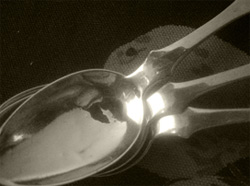
My blog's namesake - small, old and some very dented engraved silver plated tea spoons that belonged to my mother-in-law, and I use them to taste my food as I'm cooking.

Scroll down to the bottom to view my Blogroll

Posted in easy, Salads, on June 10th, 2013.

cabb_cranb_apple_slaw

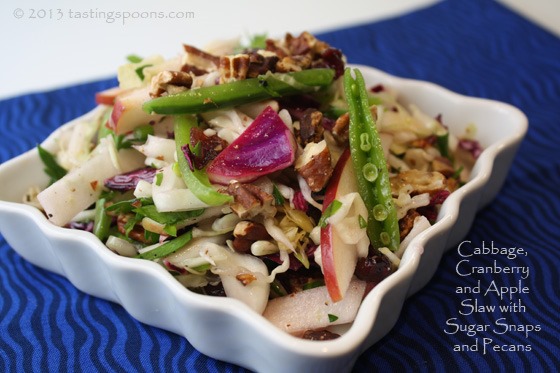
A quick and easy salad that would be perfect for a spring or summer barbecue, or any time of year, really. Ideally it needs to cozy-up in the dressing for a couple of hours, but if time doesn’t allow for that, you’ll still enjoy it.

What I was fixing for dinner was Nuremburg sausages (easy meal) and I had a part of a head of red and white cabbage that surely needed using.  And I did have a recipe from 2003 in my to-try file. The recipe from Cooking Light was quite simple, but I made a few changes: (1) I added julienned sugar snap peas; (2) also added parsley to the mixture; (3) I used seasoned rice wine vinegar, and therefore, (4) had to change the dressing some too, including adding just a bit more olive oil. It was very easy to make.

First I toasted the pecans in my toaster oven – that took about 5 minutes at most. Those were chopped up some and set aside. Meanwhile I thinly sliced the cabbage. If you use red cabbage as I did, put the dried cranberries in the bottom of the bowl (the one you’ll serve in), then add the red cabbage with white cabbage on top of that and drizzle the dressing on top. The recipe indicates to toss the cabbage – if you’ve used a mixture of cabbage you don’t want to toss it, as the red cabbage will bleed. Just drizzle the dressing on top and refrigerate for an hour or two. Then cut up the sugar snap peas, parsley and apples. THEN toss everything and garnish with the toasted pecans. That’s it. Serve!

What’s GOOD: all of it was good – the crunchy, the sweet (from the dried cranberries and sugar or Splenda), and just the overall fresh flavors of it all. Leftovers keep for a day or so, but the cabbage will be a little bit soggy. The pecans keep quite well. Any red cabbage will have bled into the mixture, but it sure tasted fine.
What’s NOT: not a thing!

printer-friendly PDF created using Cute PDF Writer, not Adobe
MasterCook 5+ import file – right click to save file (remember where, run MC, File|Import

* Exported from MasterCook *

Cabbage, Cranberry and Apple Slaw with Sugar Snaps and Pecans

Recipe By: adapted from a Cooking Light recipe, 2003
Serving Size: 8

5 cups cabbage — thinly sliced, part white and part red
1/2 cup dried cranberries
1/3 cup seasoned rice vinegar
3 tablespoons sugar — or Splenda
2 tablespoons white wine vinegar
2 tablespoons olive oil
3/4 teaspoon salt
1/2 teaspoon freshly ground black pepper
2 1/4 cups red apple — thinly sliced or julienned
1/2 cup sugar snap peas — trimmed and sliced lengthwise into 3 pieces each
1/4 cup Italian parsley — finely chopped
1/2 cup chopped pecans — toasted

1. Combine cabbage and cranberries in a large bowl. If using both red and white cabbage, place cranberries on the bottom, red cabbage next, then the white cabbage.
2. Combine vinegar and next 5 ingredients (vinegar through pepper), stirring with a whisk; drizzle over cabbage mixture, tossing gently to coat. If using both white and red cabbage do not stir the cabbage (the red will bleed into the white). Cover and chill 2 hours.
3. Add apple, parsley and sugar snap peas and toss well to combine. Sprinkle with pecans.
Per Serving: 136 Calories; 9g Fat (53.3% calories from fat); 2g Protein; 15g Carbohydrate; 3g Dietary Fiber; 0mg Cholesterol; 212mg Sodium.

Posted in Chicken, on June 8th, 2013.

pecan_crusted_chix_blueberry_corn_salsa

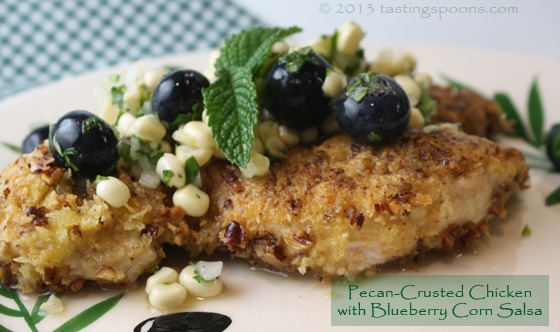
You’ve heard me say it here before – if you trust my judgment – you’ve got to make this chicken dish. It was SO good. I love it when I find a recipe that combines some new flavor combination – who’d have thought corn and blueberries were a match – they are when you combine them with pecan and panko-crusted chicken.

The recipe has been in my to-try file for awhile. I found it over at Charmian Christie’s blog, now called The Messy Baker. I love the photo – the contrast of the dark blueberries and the bright yellow (white) corn. We have fresh corn in our markets now – probably comes from Latin America because I don’t believe local corn is big enough yet to harvest. The corner farm stand, where they grow corn every year is about 4 1/2 feet tall right now, but certainly no corn yet.

Charmian credits this dish, which is called a Milanesa (I changed it from Pecan Milanesa to Pecan Crusted Chicken Breasts, so you’d know from the get-go what it is). In Latin and South America a Milanesa just means a breaded cutlet. It’s not an Italian word, but of Austrian heritage (think: milanese, and weiner schnitzel). Anyway, the recipe comes from a new cookbook Charmian acquired called The New Southern-Latino Table: Recipes that Bring Together the Bold and Beloved Flavors of Latin America and the American South. Charmian gave the book some good kudos, with this recipe being one of the reasons she was loving it. I must be a sucker for salsas. Being raised in Southern California, salsa has been part of my cooking repertoire since I was young.

So here’s what’s involved. Pound the chicken to an even thickness, about 1/3 inch worked for me – don’t pound the thin ends as they’re already thin enough. Set out 3 plates – one for seasoned flour, one for eggs and water mixed up, and the third for finely minced pecans and panko crumbs. The original recipe called for dry bread crumbs – I didn’t have anything but panko and they seemed to work just fine. Dip the chicken in the flour, then eggs, then pecans and fry in a medium-hot pan with olive oil (or canola – I used olive this time because I wanted the flavor) just until browned on both sides. I put this in my toaster oven, actually, at 350° for 10 minutes. I lined the baking pan with foil.

Meanwhile, I mixed up the salsa – the recipe you see below serves 6. I made it to serve 2, so I ended up improvising a little bit on the proportions in the salsa, and I’ve made those minor changes in the recipe you see. I added a bit more sweet (I used agave nectar, not honey), more lime juice (what good is half a lime sitting around?), corn from one medium fresh corn cob, and probably a few more blueberries. I also added some slivered fresh basil – only because we have a thriving bush in our kitchen garden and it’s so flavorful right now. I made a green salad, and that was dinner!

What’s GOOD: everything – but particularly the salsa – bright and tangy from the lime juice (I drizzled all the juice over the top of the chicken breasts too – if you eat it right away it doesn’t make the breading soggy. Also liked the crunchy texture and taste of the pecan crust. The chicken was just perfectly cooked through – tender and so juicy! This is a definite make-again dish – it’ll be going onto my Favs list (see tab at top). It would also make a very good company dish – you just have to do the browning and baking at the last minute, though.
What’s NOT: nothing that I can think of. It’s a keeper.

printer-friendly PDF, created using Cute PDF Writer, not Adobe
MasterCook 5+ import file – right click to save (remember where), run MC, File|Import

* Exported from MasterCook *

Pecan Crusted Chicken Breasts with Blueberry Corn Salsa

Recipe By: adapted slightly from The Messy Baker Blog
Serving Size: 6

CHICKEN:
6 boneless skinless chicken breast halves
1/2 cup all-purpose flour
1/2 teaspoon salt
1/2 teaspoon paprika
1/8 teaspoon freshly ground black pepper
1 1/2 cups pecans — toasted and ground (see note)
1/2 cup dry bread crumbs
2 eggs — lightly beaten
2 tablespoons water
1/2 cup vegetable oil — [I used EVOO]
SALSA:
1 1/2 cups corn kernels
1 cup blueberries
1/4 cup sweet onion
1 small serrano pepper — very finely minced
2 tablespoons fresh cilantro — chopped
2 tablespoons fresh mint — finely minced
2 tablespoons fresh basil — finely sliced [my addition: optional]
3 tablespoons lime juice — approximate
2 tablespoons agave nectar
Salt and freshly ground black pepper — to taste

Note: Toast pecans on a baking sheet in a 350°F oven for 5–8 minutes, or until fragrant. Transfer them to a plate to cool completely. Once toasted, pecans can be frozen in an air-tight container for up to 4 months. Chop them very finely with a sharp knife. The nutrition count includes fat from the nuts, but that’s a healthy fat! If you want to cut some of the fat, use more panko and less pecans for the crust.
1. Preheat the oven to 350°F.
2. Fit a baking sheet with a metal cooling rack; set aside. [I didn’t do this – I just foil-lined a baking sheet; worked fine. The rack just assures the bottom of the chicken is cooked through.]
3. Pound the chicken breasts with a meat mallet to 1/3-inch thickness; set aside. On a plate, combine the flour, salt, paprika, and pepper. On another plate, combine the pecans and bread crumbs. In yet another plate, use a flat whisk to mix the eggs and 2 tablespoons water.
4. Dredge each cutlet in the flour mixture, shaking off the excess, and dip both sides of the cutlet into the eggs. Dip both sides of the cutlet into the pecans, pressing gently so they adhere well. In a large skillet, heat 1/4 cup of the oil over medium-high heat. Working in batches, fry the cutlets for 2–3 minutes per side, or until golden brown (add more oil as needed; reduce the heat if they brown too quickly). Transfer the cutlets to the prepared baking sheet and bake for 10–12 minutes, or until cooked through (no longer pink).
5. In a medium bowl, combine the corn, blueberries, onions, serrano, cilantro, mint, basil, lime juice, and agave and stir until well incorporated; season with salt and pepper. Serve the chicken topped with salsa. Drizzle the lime juice over the chicken as well – if you eat it immediately it won’t make the chicken soggy.
Per Serving (much of the fat comes from the nuts): 622 Calories; 40g Fat (57.3% calories from fat); 35g Protein; 33g Carbohydrate; 5g Dietary Fiber; 139mg Cholesterol; 361mg Sodium.

Posted in Books, Cookbooks, on June 6th, 2013.

dearie

I have such an admiration for Julia Child. So, no surprise that I wanted to read this new biography of her.

The author, Bob Spitz, was an unknown to me. He has made a name for himself in the book world. He published a 1000-page tome of The Beatles: The Biography. He’s written for several magazines as well, and now, with this newest book in his repertoire,  Dearie: The Remarkable Life of Julia Child he’ll likely continue in the genre. BTW, “Dearie” refers to the word Julia used for almost everyone – from waiters to bellhops or close friends. She called almost everyone “dearie.”
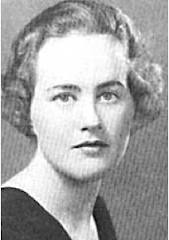
Bob Spitz was a huge fan of Julia Child, which led him to write this book. In the acknowledgements he says:  The genesis of this book sprang from my amazing luck, traveling with Julia Child in Sicily in 1992. For several weeks we crisscrossed the island, eating, of course, but talking every chance we got. She was already a beloved icon, larger than life in so many different ways, but perhaps the most down-to-earth celebrity I’d ever encountered. Inasmuch as I was writing about her for several magazines, we were on the record throughout the trip, but she never held back from speaking her mind, never shied from a tough opinion, never pulled her punches, never blinked She was exactly like her TV persona: warm, funny, outgoing, whip-smart, incorrigible, and most of all, real. If I have to admit to one prejudice confronting this book, it is that I had a powerful crush on her. Sorry. Deal with it.

julia_child_monoprintFrom the first page I found myself picking it up at odd times because I found the story compelling. Bob Spitz writes interesting narratives. He gives you the facts, straight, and yet you can feel the drama behind so many events in Julia’s life. I found the history of Julia McWilliams, from nearby Pasadena, a daughter of a privileged family, quite fascinating. Her father rarely ever gave her an encouraging word – and maybe because from the get-go Julia was a kind of a maverick. She didn’t follow in her father’s ultra-conservative political path, and was forever ridiculed for it. She wasn’t driven to get good grades particularly, never felt herself a scholar, went to Smith College where she spent more time drinking and carousing than she did studying. Yet she graduated. At loose ends after that, she had no direction in her life, and her father, the ever present critic, didn’t encourage her much. Money wasn’t an issue. She did live in New York for awhile, took a menial job (about all she could find), but wasn’t particularly happy. She was a socialite, but not a fluttering butterfly. She wanted some meaning to her life, but just couldn’t quite figure out what or where it was. Her mother died and Julia ended up moving home to Pasadena as a companion to her father and she resumed her socialite role in her home town. He was not ailing, but she and her 2 siblings felt Dad needed some watching over.

julia_and_paulWhen war loomed, she joined the OSS, eventually going to Ceylon (now Sri Lanka). And later to China. She met Paul Child, a very scholarly type, who was also with the OSS. They were friends for a year or more, and then their relationship bloomed. Julia never felt she was Paul’s mental equal. Although he didn’t attend college, he was extremely well read and could debate philosophy, politics, poetry and social culture with the best of them. They married eventually (much to her Dad’s dismay because Paul Child was a social liberal, as was Julia, but Paul more so). These facts rankled Julia’s father until the end of his days. Family dinners were always fraught with argument about politics, so much so that Julia did her best to avoid visiting home at almost all cost. Julia and Paul were devoted to each other for life.

The picture below is Julia’s reconstructed Cambridge kitchen at the Smithsonian (I believe). Note the distinctive pegboard, something she and Paul worked out so they’d always know where everything was kept in every Julia kitchen. julias_kitchen_cambridgeHaving already read Julia’s grand-nephew’s biography of Julia’s years in France, My Life in France, I enjoyed reading this new book, Julia’s full-life history. I’ve come away with so much more respect for Julia. Her years of cooking in Paris, making recipes over and over and over until she felt they were perfect, has to be a testament to her tenacity. And her tendency to be a perfectionist. Actually, last night I went online and ordered the DVD set of The French Chef: Julia Child 10-Disc CollectionTV series Julia did. (It contains an interview with Julia, and supposedly all the recipes that accompanied all the shows.) Having read this new book, and knowing the kind of labor of love she put into the making of the shows – and more importantly – how she revised the long and tedious French recipes from her first book of the 2-book series Mastering the Art of French Cooking (2 Volume Set) I wonder if I’ll be more intrigued to try more of her recipes.  I only own one of her cookbooks, and have cooked very few recipes from it.

Julia was a a fount of energy. Again and again through the book I read of her incredibly long hours in the kitchen from when she began cooking in Paris to her last days, almost. What I found new and interesting were:

  • the life-long feud between Julia and Madeleine Kamman – you can read more about it here; she also didn’t get along all that well with Jacque Pepin either! Even though they co-hosted a series of cooking demonstrations for TV, behind the façade of smiles, they didn’t like each other much;
  • Julia loved-loved men; even in her declining years she had a boyfriend, of sorts, even while her beloved husband Paul resided in a special home where he could be well cared for; whether any hanky-panky went on, I don’t know; this book doesn’t indicate so; Julia adored Paul unflinchingly, yet she craved male companionship once Paul wasn’t around;
  • although most everyone who ever watched Julia knows she had an irreverent side – she could laugh at herself and others, but was a natural in front of the TV camera; she also could use that biting tongue now and then. She had a stubborn streak. So, I didn’t know that Julia walked off the stage of a little cooking segment she did with Regis and Kathy Lee because Kathy Lee refused to get in and help – and get her hands dirty. It was arranged and agreed upon, but once the camera started rolling, Kathy Lee refused. At the break, Julia and her team walked out;
  • learning about her very assertive, abrasive lawyer she hired some way down her career path – she adored him – but oh, he made people mad. Yet he protected Julia’s interests, which was his purpose – I’d never heard about him before;
  • how hard Julia worked (with Paul, and with her editors, and her attorney) to keep her momentum once she reached the pinnacle; Julia was ahead of her time, I think, in knowing and understanding that she had to stay front and center or people (us home cooks) would forget her.

julia_kitchenThe photo at right – I think – was in Julia’s Provence kitchen, where she spent months working on the recipes for the Mastering manuscript. Note her “signature” neck scarf.

The author is a good story-teller, for sure. There were some times that he used colloquialisms that bordered on hip, trite or trendy. They seemed a bit strange in a biography. Since he’s been a magazine journalist, perhaps that’s why. Yet I found the book a page-turner when, in fact, there was nothing about Julia’s life that gave it that kind of intrigue. I found it interesting that many culinary professionals (back in the 60s and 70s) ridiculed Julia for calling herself a chef – she never cooked in a restaurant so she had no right to the title. She never called herself that – the TV show folks devised the title of the show. And yet, I think she was every bit a chef as any restaurant one just because of the dedication to her craft. Her recipes have stood the test of time, obviously!

So overall, I found the book very readable. Am sorry I never took the opportunity to meet Julia Child when I could have at her many book signings or classes. During her 80th birthday celebrations she attended a cooking class in her honor at a restaurant near us, but the tariff was $500 for the privilege. I just couldn’t – wouldn’t – pay that much, as much as I wanted to meet her! But I lived her life vicariously through this very fascinating biography. If you’re anything of a Julia fan, you’ll be glad to have read it.

Posted in Pork, pressure cooker, on June 4th, 2013.

pork_stew_calvados_cream

Another one of those “brown” photos. It’s so very hard to give brown colored food any eye appeal. All I can tell you is that this dish was absolutely sensational. The flavors – oh my goodness yes. I’ll be making this again and again. It would even be good enough for guests. What you see there is browned pork chunks (at top), sweet potatoes (bottom and far right), an organic purple carrot (right side, vertical) and fennel (left). And drizzled over the top is the lightly creamed Calvados and broth which was then topped with chopped chives. Thank goodness for chives!

Out of the freezer came our last package of Berkshire pork. It was pork chunks, and by the time I got into the kitchen to start dinner, it was after 4pm, so I needed to figure out something fast. What I didn’t know was what kind of pork it was – it was labeled pork stew meat, that’s all. It could have been trimmings from pork chops, pork shoulder, tenderloin bits, or pork loin. All needing different cooking times. But oh well, I just had to guess. With time of an essence, I knew I needed to do this in the pressure cooker, so the recipe below is done that way, but you can do this all without one – just cook the meat mixture on the stove until barely cooked through, and cook the vegetables until they’re tender. You can add the Calvados cream ingredients with everything in the pot.

You know about Calvados, right? It’s an apple brandy from the northern part of France. It’s still a brandy. I’ve had my bottle for about 15 years, and with this dish I emptied it. We never drink it – I use it exclusively for cooking. Time for a new one now. Here’s what Wikipedia has to say about it:

Calvados is distilled from cider made from specially grown and selected apples, of which there are over 200 named varieties. It is not uncommon for a Calvados producer to use over 100 specific varieties of apples, which are either sweet (such as the Rouge Duret variety), tart (such as the Rambault variety), or bitter (such as the Mettais, Saint Martin, Frequin, and Binet Rouge varieties), the latter being inedible. The fruit is harvested (either by hand or mechanically) and pressed into a juice that is fermented into a dry cider. It is then distilled into eau de vie. After two years aging in oak casks, it can be sold as Calvados. The longer it is aged, the smoother the drink becomes. Usually the maturation goes on for several years.

Don’t Have a Pressure Cooker?

Just cook the pork low and slow until it’s tender, add the veggies and cook those until just tender and add the Calvados and cream in at the end. The pressure cooker just cut down the cooking times, that’s all.

Here’s what I did: I sprinkled the pork chunks with Herbes de Provence, then browned them until they were caramelized brown on several sides, not crowding the pieces. That took 2 batches. I removed the meat and poured out the fat that had accumulated in the pan. Meat went back in, then I added a 6-ounce (can) of pineapple juice, 1 1/2 cups of water, bay leaves, fresh thyme sprigs, salt and pepper, and Penzey’s soup base (I used pork, but chicken would be fine). I pressure cooked that for about 13 minutes. Cooled it under a cold running tap, and the pork was just perfectly cooked. I removed the meat (because I didn’t want to cook the meat any further – it was perfectly cooked), then I added all the vegetables and apples and those were pressure cooked for 4 minutes. The vegetables were perfectly cooked so I removed them also. With the liquid left in the pan I added the shallot and Dijon mustard and let that simmer for a few minutes until the shallot was cooked. Then I added the cream and heated it through, then in went the Calvados. I cooked that for 2-3 minutes just so it would boil-off the alcohol. Then I added the meat back in and let that simmer for 2-3 minutes so the meat would be piping hot. The veggies stayed hot, so those were divided amongst the wide soup bowls, then I spooned the meat equally between the bowls (there won’t be lots of meat per person – 2 pounds of pork doesn’t end up being all that much, surprisingly) and poured the Calvados cream over them equally as well. Chopped chives went on top and it was ready to serve.

What’s GOOD: Oh, just everything. The meat, the juices, the veggies, the apples and of course, the creamy Calvados sauce I drizzled over the top. You’ll be licking the bowl.
What’s NOT: nothing whatsoever. Unless you don’t like stew. Or meat, or you’re averse to a little bit of cream.

printer-friendly PDF using Cute PDF Writer, not Adobe
MasterCook 5+ import file – right click to save file (remember where), run MC, File|Import

* Exported from MasterCook *

Pork Stew with Fennel, Carrots, Apples, Sweet Potato and Calvados Cream (Pressure Cooker)

Recipe By: My own concoction, 2013
Serving Size: 4

2 pounds pork shoulder — fat trimmed, cut in 1″ chunks
1 1/2 teaspoons Herbes de Provence
2 tablespoons canola oil
6 ounces pineapple juice — or apple juice
1 1/2 cups water
2 whole Turkish bay leaves
6 sprigs fresh thyme — left whole
1 teaspoon Penzey’s chicken soup base — or pork soup base, if you have it
Salt and freshly ground black pepper to taste
VEGETABLES:
1 large fennel bulb — trimmed, quartered
1 large sweet potato — peeled, cut in large pieces
2 small apples — peeled, cored, cut in wedges
10 ounces carrots — peeled, cut in chunks
CALVADOS CREAM:
1 whole shallot — peeled, finely minced
1 1/2 teaspoons Dijon mustard — French style
1/3 cup heavy cream
2 tablespoons Calvados — (apple brandy) or regular brandy
2 tablespoons fresh chives — minced, for garnish

1. Trim the pork of the bigger pieces of fat, if possible. Toss them with the dried herbs.
2. In a tall pressure cooker heat the oil and brown the pork pieces over medium heat. Don’t crowd the pan (do this in 2 batches). Remove pieces to a plate.
3. Drain and discard the fat in the pan. Add pineapple juice, water, Bay leaves, fresh thyme sprigs, soup base and seasonings. Transfer the pork pieces back into the pan.
4. Bring the pressure cooker up to pressure and simmer for 13 minutes. Place under cold water tap to reduce heat quickly. Taste the pork to see that it’s done – it should be just perfectly tender and juicy. If it’s not, continue to pressure cook for 2-3 minuites at a time until the meat is cooked through but not dry. Remove meat from the pan and set aside.
5. Add the fennel, sweet potato, apples and carrots. Bring the pressure cooker back up to pressure and cook for 4 minutes. Again, place under cold running tap to cool quickly. Remove all the vegetables to another plate and set aside. Discard thyme stems.
5. To the liquid in the pan (about a cup) add the shallot and Dijon mustard and cook over medium-high heat until the shallot is tender, about 3-4 minutes. Add heavy cream and cook for about 1 minute at a slow simmer. Add the Calvados brandy and stir in. Continue to heat until the mixture comes to a boil. Add the meat back into the pan and heat the meat slowly for about 2-3 minutes.
6. Divide the vegetables in 4 wide soup bowls. Divide the meat and Calvados cream over each serving and garnish with chopped chives. Serve immediately.
Per Serving (this assumes you eat all the fat, most of which is drained off after you brown the meat): 699 Calories; 45g Fat (59.7% calories from fat); 32g Protein; 37g Carbohydrate; 7g Dietary Fiber; 148mg Cholesterol; 352mg Sodium.

Posted in Cookies, on June 2nd, 2013.

spiced_up_brownies

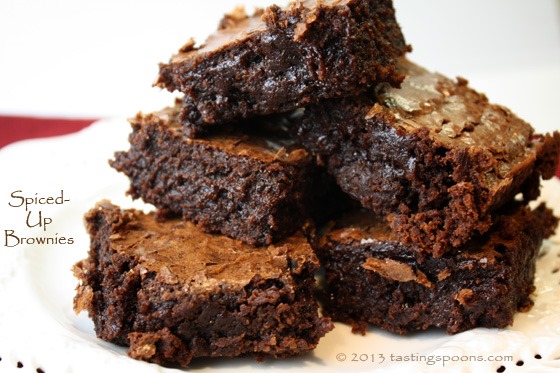
If you’re a chocoholic like I am, then you’ll understand when I say that the other day I just had to – yes, just HAD TO make brownies. I needed that mouth-feel of chocolate with the light texture of cake. Maybe you can tell by looking at the photo that they were super-moist.

Rather than make any of the other brownies (that I’ve already made) in my repertoire, I turned to my to-try file, and this recipe from Smitten Kitchen many years ago was what spoke to me. A brownie that’s not only rich in chocolate, but also with spices added. I can’t say that I’d ever had brownies with cinnamon, cardamom and some heat (either ground chipotle or smoky paprika) in it.

You’ve heard, naturally, about the affinity of chocolate and coffee, right? That whenever you’re baking with chocolate, if you add a little bit of coffee somehow (in this case it was instant espresso powder), it enhances the chocolate flavor. Experts have done taste-tests and our palates like the marriage of chocolate and coffee (like mocha!).

The original brownie recipe came from a cookbook called Baked: New Frontiers in Baking. I’d not heard of the cookbook, either. But the story is long . . . Deb knew someone who worked at Baked, the bakery (from hence the cookbook came) and she had a scribbled list of ingredients for Chipotle Brownies. Deb lost the recipe. Meanwhile the cookbook came out and there was a  brownie recipe in there but it didn’t have the spices and heat. Then she found the older recipe, so she kind of combined it all. Whew! Does all that make sense?

The batter was easy enough to put together – the usual kind of brownie baking stuff – but with the addition of instant espresso powder and the spices. Deb used chipotle chile in her cookies, but she also suggested using smoky paprika instead. I had some of the dry-type chipotle chile powder (not the wet type in adobo sauce), but it was marked “hot.” I was a bit concerned it would be too much heat, so I used the smoked paprika and added in a little tiny bit of the hot chipotle powder. These are to be baked in a glass 9×13 pan, or a very light colored metal pan – I used the glass.

The recipe indicated baking for 30 minutes, or until a toothpick comes out with only a few crumbs attached. Well, at 25 minutes I used my tester and it came out clean, so I was concerned I’d over-baked them. I couldn’t really tell by looking at them – they “looked” done from the top, but I wouldn’t know until I cut into them, which took a couple of hours for them to cool completely. I think they were a tad on the under-done side – the ones I cut from the outside edges were perfect, but the interior bars were really moist. If you like solid brownies with almost a fudgy texture to them, this is your recipe! I think I should have baked them an additional 5 minutes. Since I baked these I found a notation on the ‘net indicating brownies are to be baked to 214°. Most baked goods are done at about 205°, so this is different. Must have to do with the density of the batter.

The spices? Well, when I ate my first bite, I could tell there was something else IN there, but I could not discern the cinnamon, or the cardamom. But once I swallowed that bite, oh-la-la! Heat. Yes, a very light heat on the way down and afterwards. I could not tell it was smoked paprika – in fact I don’t know that I could discern the smoked aspect of it at all. I suppose the chocolate – which this recipe contains in spades – masks those spicy flavors somewhat.

What’s GOOD: if you want extra-chocolaty brownies, these fill the bill. Lots of chocolate flavor; good texture, a perfect balance of sweet to chocolate and spice. Would I make them again? Yes. They were different, that’s for sure. The spices add a big boost of flavor and I liked the little residual heat at the back of the throat as you swallowed them and the heat lingered for several minutes. They certainly satisfied my I-need-brownies-now. The recipe makes a lot – I gave away some and stuck a couple of foil-wrapped packages in the freezer for some day, down the road, when I’m hankering for some chocolate. Everyone who tried this (including my DH who almost never eats sweets) raved about them.
What’s NOT: really nothing. I liked them.  If you like experimenting with heat, do try them!

printer-friendly PDF  created using Cute PDF Writer not Adobe
MasterCook 5+ import file – right click to save (remember where), run MC, File|Import

* Exported from MasterCook *

Spiced-Up Brownies

Recipe By: adapted slightly from Smitten Kitchen blog 9/08
Serving Size: 24

1 1/4 cups all-purpose flour
1 teaspoon salt
2 tablespoons unsweetened cocoa powder
1 1/2 teaspoons smoked paprika — or dry chipotle chile powder
3/4 teaspoon cinnamon
1/4 teaspoon cardamom
1/8 teaspoon cayenne — or hot chipotle chile powder [my addition]
11 ounces dark chocolate — coarsely chopped
1 cup unsalted butter — (2 sticks) cut into 1-inch pieces
1 teaspoon instant espresso powder
1 1/2 cups granulated sugar
1/2 cup firmly packed light brown sugar
5 large eggs — at room temperature
2 teaspoons vanilla extract

Notes: The recipe indicates baking for 30 minutes. I baked 25 minutes and the tester came out clean. I thought they were done, but they were not. I found a reference online that baked brownies need to reach an internal temperature of 214° – that’s higher than most baked goods. Next time I’ll use an instant read thermometer. I used a combination of smoked paprika and dry chipotle chile powder.
1. Preheat the oven to 350° F. Butter the sides and bottom of a 9 x 13 glass or light-colored metal baking pan.
2. In a medium bowl, whisk the flour, salt, cocoa powder and spices (chipotle, cinnamon and cardamom), if you’re using them, together.
3. Put the chocolate, butter, and instant espresso powder in a large bowl and set it over a saucepan of simmering water, stirring occasionally, until the chocolate and butter are completely melted and smooth. Turn off the heat, but keep the bowl over the water and add the sugars. Whisk until completely combined, then remove the bowl from the pan. The mixture should be room temperature.
4. Add 3 eggs to the chocolate mixture and whisk until combined. Add the remaining eggs and whisk until combined. Add the vanilla and stir until combined. Do not overbeat the batter at this stage or your brownies will be cakey.
5. Sprinkle the flour mixture over the chocolate mixture. Using a spatula (not a whisk), fold the flour mixture into the chocolate until just a bit of the flour mixture is visible.
6. Pour the batter into the prepared pan and smooth the top. Bake in the center of the oven for 30 minutes, rotating the pan halfway through the baking time, until a toothpick inserted into the center of the brownies comes out with a few moist crumbs sticking to it. Let the brownies cool completely, then cut them into squares and serve.
7. Tightly covered with plastic wrap, the brownies keep at room temperature for up to 3 days.
Per Serving: 237 Calories; 13g Fat (46.3% calories from fat); 3g Protein; 31g Carbohydrate; 1g Dietary Fiber; 65mg Cholesterol; 108mg Sodium.

Related Posts Plugin for WordPress, Blogger...