Archive for February, 2008

How to Boil Pasta

pasta1.JPG

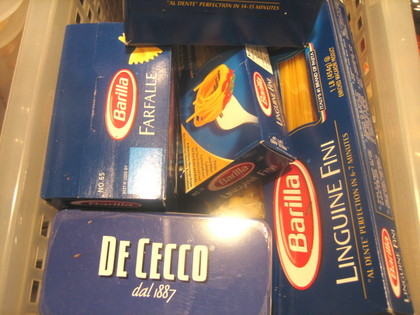
Ralph Waldo Emerson wrote: “Build a better mousetrap and the world will beat a path to your door.” Well, the quote doesn’t exactly fit my purpose here, but close. There are creative people who thrive on finding a different solution, an innovation, to a problem. In the culinary world, chefs need to create on a dime. Every day. Here, we’re talking about pasta. And there’s nothing quite like overcooked pasta. I do like it just barely done - but al dente still. So, instead of guessing and having to remove a strand of lingine from the boiling pot, here’s a foolproof and very Italian method. There really is more than one way to boil pasta. I know, this isn’t exactly a very interesting post subject, but I ran across something in my stack of recipes that I’ve had for years, and used many times. So, I thought I’d share it with you.

The advice came from a cooking instructor. What class, I can’t tell you. It’s something she passed out to all of her class participants, every class she teaches. And it’s a photocopy from the back of a package or box. Agnesi is an Italian company - they do have a website, but it’s all in Italian.

Anyway, the instructor was also a caterer, and she said this is her failsafe method. She uses it always. And as long as I remember, on those occasions when I do make pasta, it’s worked like a charm.

  • The ANGESI Advice for a Better Pasta Cooking Method: cook pasta in boiling water for just 2 minutes. Measure this time from the moment the water returns to a boil after adding the pasta. After the 2 minutes are up, remove pot from the heat, cover with a lid and leave to stand for the cooking time indicated on the box. Drain the pasta and . . . buon appetitto! This is to encourage you to try a new way of cooking pasta. You will see that when the cooking time is over, the water is almost clear. This is because the pasta has retained most of its precious nutrients, some of which are lost during the normal, longer cooking method.”

Quick (Modern) Coq au Vin

Since I Tivo all the America’s Test Kitchen programs, I store them up and watch several at one time. They did one a week or so ago called French Classics. It included this Coq au Vin (coke-aw-vahn, chicken in wine) and a chocolate Pots de Creme. I printed out both recipes, and today you get to hear the results of the chicken.

When I was in my 20’s, and living in Denver, I think it was, I attended one of my first cooking classes, and the teacher prepared the traditional coq au vin. It required many steps, including rendering some salt pork. Salt pork’s not something I see every day, although I suppose it is available at the grocery stores if I sought it out. I have made coq au vin a few times, but never found the chicken all that tender (dry and overcooked) and the gravy was very thin.

The chefs at America’s Test Kitchen came to the rescue. They explained that originally French kitchens used a very elderly boiling chicken, the kind you have to cook and cook to tenderize. These days we have young, tender fryers which don’t require much cooking. They demonstrated a rather rapid coq au vin, and I was intrigued. It used bacon instead of salt pork. I love the richness and suppleness of red wine, cooked down to a thick gravy with the onions and mushrooms. This recipe took about 50 minutes of total cooking time (browning and simmering), with about another 25 of prep. So, I had dinner on the table in a little over an hour. Their recipe said it took 90 minutes.

The secrets of this recipe include reducing the entire bottle of wine and chicken broth to about 3 cups, browning the chicken first, then making the vegie part (mushrooms and onions) and then simmering the dark meat pieces first (for 20 minutes), THEN adding in the chicken breasts later, so they cook only 20 minutes. What a difference that made. The breast meat was tender and juicy. Once the chicken is done you remove it to keep warm and turn the heat up to high and continue reducing the gravy until it’s thick. A tablespoon of butter is added at the very last, along with a tablespoon of the red wine you saved at the beginning, that didn’t get reduced.

Definitely I’d make this again. It was certainly a lot easier than my previous recipe. I might not make it for guests just because it’s, to me anyway, a kind of home comfort food dinner. But, it looked very pretty in my wide soup bowls with the gnocchi pasta in the bottom and the fresh Italian parsley sprinkled on top. We both slurped it up in quick order.

Cook’s Notes: use a light, fruity red wine (they recommend Pinot Noir or a Rhone grenache). Use good, thick bacon (more flavor). If possible use kosher chicken, since it will retain the juice better. Next time I’d use more mushrooms, just because I like them. And if I had my druthers, I’d have more sauce, so that would mean using about a bottle and a half of wine to start with, and would mean measuring a bit more carefully so you reduce each part correctly.

Modern Coq au Vin
Recipe By : America’s Test Kitchen
Serving Size : 6
1 bottle red wine — fruity (pinot noir or Rhone grenache)
2 cups low-sodium chicken broth
10 sprigs fresh parsley
2 tablespoons fresh parsley — minced
2 sprigs fresh thyme
1 bay leaf
4 ounces bacon — thick-cut, cut crosswise into 1/4-inch pieces
2 1/2 pounds chicken pieces — parts or thighs only Table salt and ground black pepper
5 tablespoons unsalted butter
1 cup frozen pearl onions — thawed, drained, and patted dry
8 ounces mushrooms — crimini, wiped clean, stems trimmed, halved if small and quartered if large
2 medium cloves garlic — minced
1 tablespoon tomato paste
2 tablespoons all-purpose flour
1. Bring all but 1 tablespoon wine (reserve for later use), broth, parsley sprigs, thyme, and bay to simmer in large saucepan over medium-high heat. Cook until reduced to 3 cups, about 25 minutes. Discard herbs.
2. Meanwhile, cook bacon in large Dutch oven over medium heat until browned, 7 to 8 minutes. Using slotted spoon, transfer bacon to paper-towel-lined plate. Reserve 2 tablespoons fat in small bowl; discard remaining fat.
3. Lightly season chicken with salt and pepper. Heat 1 tablespoon reserved bacon fat in Dutch oven over medium-high heat until just smoking. Add half of chicken in single layer and cook until lightly browned, about 2 minutes per side. Transfer to plate and repeat with remaining chicken and 1 tablespoon bacon fat.
4. Melt 3 tablespoons butter in now-empty Dutch oven over medium-high heat. When foaming subsides, add pearl onions and mushrooms; cook, stirring occasionally, until lightly browned, 5 to 8 minutes. Reduce heat to medium, add garlic, and cook until fragrant, about 30 seconds. Add tomato paste and flour; cook, stirring frequently, until well combined, about 1 minute.
5. Add reduced wine mixture, scraping bottom of pot with wooden spoon to loosen browned bits; add 1/4 teaspoon pepper. Return chicken, any accumulated juices, and reserved bacon to pot; increase heat to high and bring to boil. Reduce heat to medium-low, cover pot, and simmer until chicken is tender, about 25 minutes, stirring halfway through cooking time.
6. Using slotted spoon, transfer chicken to large bowl; tent with foil to keep warm. Increase heat to medium-high and simmer sauce until thick and glossy and measures 3 cups, about 5 minutes. Off heat, stir in remaining 2 tablespoons butter and reserved 1 tablespoon wine. Season to taste with salt. Return chicken to pot and top with minced parsley. Serve immediately.
Per Serving: 553 Calories; 40g Fat (63.5% calories from fat); 38g Protein; 14g Carbohydrate; 4g Dietary Fiber; 159mg Cholesterol; 493mg Sodium. Exchanges: 0 Grain(Starch); 4 1/2 Lean Meat; 2 Vegetable; 5 Fat.

Printer-friendly recipe, HERE.


Almond Crusted Orange Roughy with Lemony Leek Sauce


Whew! That’s a mouthful of a title, isn’t it? Nah, I didn’t dream it up. Phillis Carey did, and in the cooking class she laughed at herself and how she titles recipes she’s developed. She wants to make sure you know at the outset exactly what kind of good stuff is going to be included in the recipe.

Here’s a shot of the classroom at Great News, in Pacific Beach (San Diego). It’s by far the most glamorous and functional demonstration class kitchen I’ve ever seen. Six large screens are mounted above so you won’t miss anything of the prep going on below.

Here’s another shot of the other side of the classroom. Phillis is the chef up front in red.

So, what’s the deal about this fish dish? The lemon leek sauce is the clincher. Absolutely wonderful. This can be made with any kind of mild white fish. Or even chicken. But the lemony piquant flavor lends itself very well to fish.

Phillis poured a bunch of sliced almonds in a big plastic bag and used her flat pounder to crunch the almonds. Do not use a food processor as it will make the almonds too much like meal. You want chunky, crunchy. You dip the fish in flour, egg, then the almond/parsley/lemon zest mixture, then pan fry it in a tiny bit of oil until done. Meanwhile you will have made the sauce first - leeks, butter, lemon juice and whipping cream. Oh yea. Whipping cream. This is a company-type meal; certainly not something you’d want to serve for everyday family cooking. The leek sauce is pureed in a blender, then you sieve it to remove the leeks. Use a medium gauge sieve; otherwise you’ll never get the sauce to strain through.

Cook’s Notes: be sure to dry off the fish fillets before you start dredging. If using a thicker kind of fish, like halibut, for instance, do the frying process, but just brown the fish, then put them on a parchment-lined pan in a 375 oven for 15 minutes. Thicker fish is harder to cook correctly in a pan saute. You can make the sauce ahead of time, but the dredging and frying have to be done at the last minute. Oh yes, and don’t use a food processor for the almonds. If you are in a hurry to puree the leek sauce, be very careful because a hot sauce will explode right out of the blender. Best advice: puree in two smaller batches instead of just one.

Almond Crusted Orange Roughy with Lemony Leek Sauce
Recipe By: Phillis Carey, author & instructor
Serving Size : 4
2 tablespoons unsalted butter
2 medium leeks — halved, thinly sliced
3 tablespoons lemon juice — fresh
1 cup heavy cream
1 cup sliced almonds — finely chopped
6 tablespoons Italian parsley — chopped
1 1/2 tablespoons grated lemon peel — using a Microplane
4 large orange roughy fillets
2 whole eggs — lightly beaten
3 tablespoons butter — for frying the fish
1. LEEK SAUCE: use only white and light green parts of the leeks, halve them, rinse well, then chop. Cook leeks in 2 T. butter over medium heat until very tender, about 15 minutes. Add the fresh lemon juice and stir until liquid evaporates. Mix in cream. Simmer until mixture is slightly thickened, about 2 minutes, maybe longer. Cool for 10 minutes, then pour in batches into blender and puree until smooth. Strain the sauce, using a coarse strainer, back into the saucepan. Season to taste with salt and pepper.
2. DREDGING MIXTURE: if you’re using sliced almonds, place them in a plastic bag and using a pounder, hit nuts until they’re reduced to a coarse mince. Do not use the food processor for this, as the nuts will be too fine. Mix almonds, parsley, lemon zest, salt and pepper to taste in a pie plate. Place flour on a plate and eggs in another pie plate. Sprinkle fish with salt and pepper. Dredge in flour, shaking off any excess. Dip in egg, then in almond mixture to coat.
3. FISH: Melt half of the butter in a large nonstick skillet over medium heat. Add 2 pieces of fish to pan and cook 3 minutes per side or until cooked in the center and brown on the outside. Repeat with remaining butter and fish. Reheat sauce and spoon a bit over, and the rest around fillets to serve.
Per Serving: 695 Calories; 59g Fat (74.2% calories from fat); 30g Protein; 17g Carbohydrate; 4g Dietary Fiber; 249mg Cholesterol; 233mg Sodium. Exchanges: 1/2 Grain(Starch); 3 1/2 Lean Meat; 1 1/2 Vegetable; 0 Fruit; 0 Non-Fat Milk; 11 Fat.
Printer-friendly recipe, click HERE.


Potato & Onion Cakes


I’m always on the lookout for a new and different side vegetable. One that isn’t too difficult, but is attractive looking (for a company meal) and tastes good. This recipe was one from “the stack” I’ve talked about recently, of recipes I needed to file. It seemed like it would fit well with the grilled dinner we did about a week ago. There were a couple of different techniques in this recipe (using grated potatoes in a muffin tin) and gently smushing a red onion slice into the bottom beforehand.

The recipe is from Martha Stewart Living, November, 2006. It’s not difficult, but does take a bit of fussing just before baking it. I got all the ingredients out, measured out what I’d need and had everything mis en place (ingredients in place, on a tray with everything I’d need) before I started. This must be constructed just before putting it in the oven because potatoes don’t keep once they’re grated. But I did what I could prior to that.

Ideally you need a 6-place large muffin tin. (You could use individual ramekins, no problem.) And since I don’t bake muffins all that often, I was happy to find another use for the tin! First you butter the tin, sprinkle each cup with salt, pepper and a bit of brown sugar (all in the bottom). Then you drizzle a tiny bit of balsamic and red wine vinegars in the bottom of each cup, and artfully arrange a sprig of fresh rosemary across the bottom. Thin slices of red onion go in the bottom next (hopefully just the size of the bottom of the cup), then you grate the potatoes (quick work in the food processor) and toss with salt and pepper, and an egg yolk. Those are pressed firmly into the cup and you dot the top with a bit of butter. Bake for 30 minutes and you’re done. You slide a knife around the edges and lift them out. Or, you could invert the whole pan. But I was concerned they wouldn’t come out cleanly, so did them individually. I had to try several utensils before I found the right one. Very quickly place them on a HOT plate. They cool off quickly because they’re kind of airy (the grated potato) so be ready to sit down to eat or serve them immediately. I’d make these again, just because they’re pretty, and went well with a grilled dinner. These weren’t a “wow” dish, but they were very good, and making some changes (see next paragraph) might make them “wow.”

Cook’s Notes: taste the potato mixture for salt and pepper before you pile them into the cups. Even though raw potatoes don’t taste all that great, you want them to be seasoned right, and there’s no way to do it otherwise. Try to arrange the onion slice “just so” in the bottom, so it looks pretty when you turn it out to serve. Next time I decided I’d add some Parmesan cheese to the potato mixture. And I’d mince up any remaining red onion and toss that in with the potatoes. Pack down the potatoes firmly, otherwise it breaks apart when you try to invert it. And lastly, I might try putting two slices of onion in the bottom if I could. You could also use frozen potatoes for this if you were so inclined.

Potato and Onion Cakes
Recipe By : Martha Stewart Living
Serving Size : 6
2 tablespoons butter
1 tablespoon brown sugar
1 tablespoon balsamic vinegar
1 tablespoon red wine vinegar
2 teaspoons coarse salt
1 teaspoon chopped rosemary — plus 6 sprigs for ramekins
1 small red onion — sliced into six 1/4″ rounds
4 medium Yukon Gold potatoes — grated
1 egg yolk — slightly beaten
1. Preheat oven to 400 degrees.
2. Generously butter a large (six 1-cup) muffin tins. Sprinkle in the bottom of each cup salt, pepper and 1/2 teaspoon of brown sugar; drizzle each cup with 1/2 teaspoon of each vinegar. Place a rosemary sprig in each cup, then cover with an onion round. Can be made ahead to this point, about 2 hours before baking.
3. Shred potatoes in food processor, if possible, then toss with the chopped rosemary and the egg yolk in a medium bowl. Season with 2 teaspoons of salt and pepper to taste. Divide the potatoes amongst the cups, then dot with butter.
4. Bake until potatoes are tender and well browned, about 30-40 minutes. Remove from oven. Let cool 5 minutes. Run a thin knife around edge of each cup to loosen, invert onto a hot plate and serve.
5. Could be made an hour or so before serving, then reheat in a 300 oven.
Per Serving: 107 Calories; 5g Fat (39.5% calories from fat); 2g Protein; 14g Carbohydrate; 1g Dietary Fiber; 46mg Cholesterol; 672mg Sodium. Exchanges: 0 Lean Meat; 1/2 Vegetable; 0 Fruit; 1 Fat; 0 Other Carbohydrates.

Printer-friendly recipe, click HERE.


Warm White Bean & Brie Dip


I know, I can hear it already in your thoughts. What is this? Bean dip? Brie? Huh? What kind of nonsense is this? In a word: EASY. In another word: TASTY. Believe it or not, this is really very good. And ever so easy to make. I’ll insert the full recipe below, but it’s nothing more than a can of bean dip mixed up with little tiny cubes of brie (rind removed), and microwaved for about a minute. Serve.


It does take a little bit of time to cut off the rinds, but that’s the hardest part. You can serve it with tortilla chips, but it makes it a bit more elegant if you serve it with crackers. I made lavash crisps from a post the other day for Coriander Lime Shrimp. Using crackers might make your guests think you didn’t just open a can of bean dip and add cheese.

There’s the photo of it in a ceramic bowl, ready for its minute of melting in the microwave. I didn’t get an after picture, but I have some leftovers, so maybe I’ll add another photo to this post later.

If you are in a hurry and want something really good and really quick, this is your ticket. The recipe came from Andrew Schloss, a chef and author, from his book Almost From Scratch. He taught a cooking class a few years ago. His schtick is about how to make things ahead, and make entertaining easier on yourself. He certainly scored on both counts.

Warm White Bean and Brie Dip
Recipe By : Andrew Schloss, chef & author, from a cooking class
Serving Size : 6
8 ounces Brie — chilled
8 ounces bean dip — canned
1. Remove rind from cheese and chop up into small pieces. Place the cheese and bean dip in a microwave-safe bowl. Microwave at full power for one minute, or until cheese is completely melted. Stir with a fork until well combined.
2. Serve warm with tortilla chips, bread or crackers.
Per Serving: 169 Calories; 12g Fat (62.5% calories from fat); 10g Protein; 6g Carbohydrate; 1g Dietary Fiber; 38mg Cholesterol; 422mg Sodium. Exchanges: 1/2 Grain(Starch); 1 Lean Meat; 1 1/2 Fat.
Printer-friendly recipe, click HERE.


Armenian Parsley & Walnut Salad

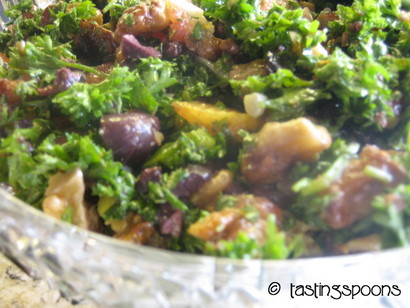
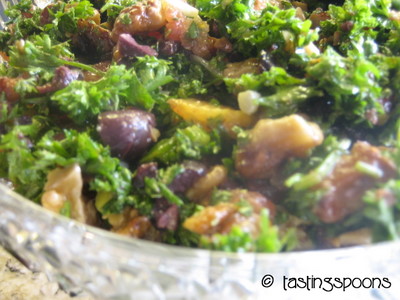
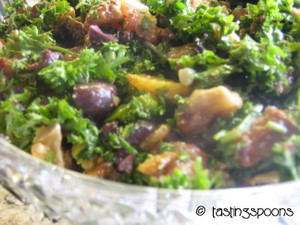
armenian parsley and walnut salad
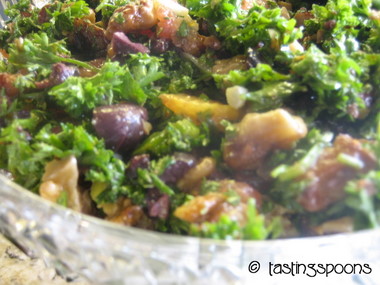
When entertaining last weekend, we did a mixed grill: racks of lamb (3), Sicilian-Italian sausage with cheese in it (about 2 pounds), and some marinated chicken breasts too. We had grilled provolone cheese (I’ll post the recipe soon) and some wonderful coriander lime shrimp as appetizers, so wanted a fairly simple side to serve with the meat. This salad came to mind as it’s just wonderful with grilled meats, and it has a kind of Italian bent with the Mediterranean olives mixed in.

The recipe came from Nicole Aloni, a Hollywood caterer and cookbook author. She taught a cooking class some years ago, and we all enjoyed the food, but her stories about entertaining the celebs in Hollywood was most interesting. She kind of became a caterer to the stars by default - lucky, I guess - but her food is very good. Nothing healthy about it, usually, although this salad isn’t a bad choice. She particularly works at preparing food the day before a party.


The salad is mostly composed of parsley (the curly leafed, not Italian) and toasted walnuts. But it’s accented with Kalamata olives, green onions and fresh tomatoes, then tossed with a cumin, lemony dressing. Oh, and a bit of red chile flakes.


Cook’s Notes: You could easily change the proportions of these items to suit your tastes, but the parsley needs to be the featured green. Ideally, make this one day ahead, but any longer than that and the parsley wilts down to nothing. Once you’ve made the salad, taste it and decide if you’d like to add more tomatoes, or parsley. Or perhaps more olives. Chop the olives fairly small, as they can overpower your taste buds if you get much of it in one bite. And don’t skip the walnut toasting step - they add a wonderful grace note to the flavor in the overall salad.

Armenian Parsley & Walnut Salad
Recipe By : Nicole Aloni, author and caterer
Serving Size : 8
1 cup walnuts — chopped, toasted, or almonds
2 bunches parsley — regular curly, coarsely chopped
3/4 cup kalamata olives — pitted, minced
1/2 cup scallion — minced
1 cup fresh tomatoes — peeled, seeded, chopped
1/3 cup extra virgin olive oil
1/3 cup fresh lemon juice
1/2 teaspoon cumin powder
1/2 teaspoon red pepper flakes
Kosher salt and pepper to taste
1. Toast nuts at 325° for about 10 minutes. Cool completely before using in the recipe.
2. Remove stems from the parsley and coarsely chop. Do not use a food processor for this as they will be too fine.
3. Chop the olives, walnuts and green onions, then combine all ingredients, tossing with the dressing. Add salt and pepper to taste. Chill.
NOTES : If the tomatoes are out of season, add just a teaspoon of sugar to sweeten them. You can also add mint to this salad if that is a flavor you enjoy. Be sure to use regular curly parsley (not Italian flat leaf) as it gives the salad some “lift.” This improves if made a day ahead.
Per Serving: 248 Calories; 24g Fat (82.7% calories from fat); 5g Protein; 7g Carbohydrate; 2g Dietary Fiber; 0mg Cholesterol; 365mg Sodium. Exchanges: 0 Grain(Starch); 1/2 Lean Meat; 1/2 Vegetable; 0 Fruit; 4 1/2 Fat.
Printer-friendly recipe, HERE.


White Lady - an elegant cocktail

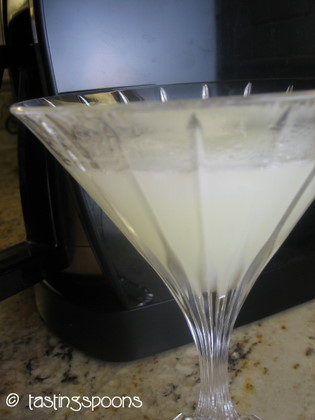
white lady cocktail, gin, lemon juice, egg white
This looks like some sweet cream-based blended cocktail. It’s not. And it’s not really all that sweet, either. What it has in it is egg white (raw) which is shaken with the other ingredients, so when it’s first poured it does have a bit of a cloudy look. This is kind of a martini. Or kind of like a margarita, in a way.


At the dinner party last weekend, we decided to offer not only wine, but a cocktail too. This was yet another recipe that found its way to the top of the “try me” file. And it was scrumptious, if you can describe a cocktail by that word. I’m looking forward to making it again. Even just for myself. The glasses are my friend Cherrie’s. I don’t own any martini type glasses. I need to look for some, but oh, dear. Where in the world am I going to store them? They’re an awkward shape to store with any efficiency.


Several people had two of these cocktails, they were that good. The recipe came from Bon Appetit, January 2006. And it’s a drink concocted by the Pegu Club (bar) in New York City.


I had all the ingredients standing ready, and you could easily make two of them at a time. You need fresh lemons, triple sec (or Cointreau, which is what I had), very good gin (Cherrie brought Bombay Sapphire, which in the opinion of many, the best out there), egg whites (which I very slightly whipped so I could actually use a measuring spoon to dip into it) and some ice. The ingredients go into a shaker and you pour it out. The recipe said to strain out the ice, but this is one gutsy drink, so I left the ice cubes in the drink. Your choice.

White Lady
Recipe By : Bon Appetit, Jan. 2006
Serving Size : 1
1/4 cup gin — Tanqueray, or Bombay Sapphire
2 tablespoons Triple Sec — or Cointreau
1 1/2 tablespoons fresh lemon juice
1 tablespoon egg white
1. Combine all ingredients in a shaker filled with ice cubes. Shake well. Strain into a cocktail or martini glass. Garnish with lemon slice if desired.
Per Serving: 265 Calories; 0g Fat (0.0% calories from fat); 2g Protein; 12g Carbohydrate; trace Dietary Fiber; 0mg Cholesterol; 26mg Sodium. Exchanges: 0 Lean Meat; 0 Fruit.
Printer-friendly recipe, click HERE.


Cream of Cashew Soup with Armagnac


The photo is a bit distorted - the glass isn’t really that bowl shaped at the top. I served the soup in these small 4-ounce glasses, with a small spoon. Even though it was served hot, you could hold onto the bottom or top of the glass without burning your fingers.

My theory must have been, back when I clipped this recipe from Bon Appetit, that it was unusual, therefore, I’d like to try it. Unusual it is. Good? A resounding YES. Perhaps it’s not the right first course for just any dinner, but it made a big hit at our recent dinner party. I made it two days ahead, then reheated it, added the cornstarch thickener (so little of it, I hardly think it mattered) and the Armagnac. The recipe comes from a now-defunct restaurant in Oxford, Maryland, called Mathilda’s.

In case you don’t know about Armagnac, here’s the lowdown from Wikipedia:

  • Armagnac [pronounced ar-mahn-yak] is a distinctive kind of brandy or eau de vie, made of mainly the same grapes as cognac and undergoing the same aging in oak barrels, but mainly with column still distillation (cognac and part of armagnac is distilled in pot stills).

It comes from the mountainous regions in France near the Pyrenees. I always thought Armagnac had some affinity with apples, but no, it’s all grapes. It’s just the method of distillation and barreling that differentiates it. Much of the soil is rocky. Anyway, Armagnac is not an everyday staple in liquor stores, so you may have to seek it out. But you could also use Cognac or brandy instead. Just don’t use some $4.99 bottle of rot-gut. The flavor does come through in this soup.

Cook’s Notes: I didn’t find unsalted cashews, so I used the lightly salted ones from Planter’s. But, I did use low-sodium chicken broth. That way you can add salt if you would like to. If doing the cornstarch thing doesn’t interest you, just eliminate it. I could not discern a bit of difference in the consistency of the soup after adding it. The chives add a nice touch - since the soup is definitely BEIGE, it needs a tad of color.Cream of Cashew Soup with Armagnac
Recipe By: Mathilda’s, Oxford, Maryland (restaurant is now closed), via Bon Appetit
Serving Size : 6
1/4 cup butter
1 tablespoon peanut oil
2 cups cashews — roasted, unsalted
1/3 cup shallots — chopped
28 ounces low-sodium chicken broth
1/4 cup cream sherry
2 cups half and half — or fat-free half and half
1/2 cup heavy cream
2 tablespoons water
1 teaspoon cornstarch
2 tablespoons cognac — or Armagnac (preferred)
2 tablespoons fresh chives — minced
1. Melt butter with oil in heavy, large pot over medium heat. Add cashews and shallots. Cook until shallots are golden brown, stirring occasionally, about 10 minutes. Add broth and Sherry; increase heat to high and bring to a boil. Add the half and half and cream. Reduce heat to medium/low and simmer uncovered, until cashews are tender, about 20 minutes. Allow soup to cool about 20 minutes before continuing.
2. Working in batches, puree soup in blender until VERY smooth. Strain soup into a large saucepan, discarding solids left in strainer.
3. Whisk the water with cornstarch in a small bowl to blend. Bring soup to a boil, whisk cornstarch mixture into soup, stirring until soup thickens, about 2 minutes. Stir in Armagnac. Season with salt and pepper to taste. Divide among soup bowls or short glasses, sprinkle with chopped chives and serve.
Per Serving: 546 Calories; 49g Fat (75.7% calories from fat); 16g Protein; 19g Carbohydrate; 3g Dietary Fiber; 78mg Cholesterol; 148mg Sodium. Exchanges: 1 Grain(Starch); 1 1/2 Lean Meat; 1/2 Vegetable; 1/2 Non-Fat Milk; 9 Fat.
Printer-friendly recipe, click HERE.


Chicken in a Hurry

You know what I mean when it’s 6:00 and you need to get something on the table for dinner? Like right NOW. I have a go-to chicken recipe - it’s not a 4-star winner, but it’s certainly better than okay. My DH always says it’s good, and I think it is too, as long as you know your purpose is to eat quickly.

It’s nothing but this:

This is a can - a spice mix. It’s imported from Hungary, although everything on the can is in English. The brand is “Pride of Szeged,” “The World’s Best Chicken Rub.” It contains garlic, basil, paprika, oregano, salt and “spices.” It can be purchased at some specialty grocery stores. The recipe on the back of the can suggests the following:

  • Mix 1/4 cup of seasoning mix with 4 T. oil. Add 2 T. lemon juice or vinegar. Brush entire mixture on chicken [it doesn’t say how much chicken]. Grill, bake or broil. For best result, refrigerate chicken in seasoning for 2-6 hours.
When I’m in a hurry I do nothing but sprinkle the spice mixture on chicken pieces and pan fry them in a bit of olive oil. That’s it. Sometimes after the chicken has browned on both sides, I’ll pour in a splash of vermouth, or red wine, sometimes a squeeze of lemon juice, as suggested in the above recipe. Then I may put a lid on the pan to just steam the chicken completely. Serve.

This time I had boneless, skinless chicken thighs, and some Siciliana Sauce (a sweet and sour, cold, chunky tomato based sauce I blogged about last year) that is absolutely great with chicken. Our friends, Sue & Lynn, brought some over when they came for dinner a week ago. But I’ve often served the chicken with nothing but this rub.
I bought the chicken rub at a German deli (in 2005), but I’ve seen it other places. And I did find it online also at a mailorder site. There is a website for the product, but it’s not displaying. Don’t know what that means. The company also makes other rubs, but this is the only one I’ve found. I’m not posting a printer friendly recipe for this since it’s so simple. As long as you have the spice mix.
For your information, I served this with brussels sprouts that I cut in half and simmered in a bit of chicken broth and thyme. They were ready at the same time the chicken was ready. From start to finish I had dinner on the table in about 25 minutes.


Sugar Snap Pea Tops/Greens/Tendrils

A week or so ago we visited the farmer’s market by UCI (Univ. of California, Irvine) near us. It’s the largest in our area, but about 6 miles away, so we don’t visit this one very often. I’m glad we did, though. All the vegies I bought that day were so very fresh. Certainly fresher than what I buy at the grocery store. There was a lot of repetition, of course, because of the winter season - lots of carrots, root vegetables, cauliflower, winter squashes, apples, oranges and pears. But at one stand they had all different kinds of greens. The proprietor said, in her halting Asian accented English, that this bunch of green stuff was the tops of sugar snap peas. They were such a beautiful color. I should have snapped a photo of the before picture. A huge bunch was just enough for two servings.

I hadn’t a clue what to do with them. A search on the internet for “sugar snap pea tops” disclosed nary a hit. So, I did what I thought was the best thing: first I washed them thoroughly. The larger stems were big enough that I thought they might be tough, so I pinched them off, leaving me with a huge mound of the pure tops, leaves and tendrils. I thoroughly enjoyed tossing them (for a total of about 3 -4 minutes) in a hot pan with a bit of olive oil, garlic and butter. I hit them with a shot of salt and pepper, and served. We both lapped it up in nothing flat. DH wanted seconds. Sorry, honey, all gone.