


Get new posts by email:

Archives

Currently Reading

Here are the tastingspoons players. I’m in the middle (Carolyn). Daughter Sara on the right, and daughter-in-law Karen on the left. I started the blog in 2007, as a way to share recipes with my family. I’m still doing 99% of the blogging and holding out hope that these two lovely and excellent cooks will participate. They both lead very busy lives, so we’ll see.

– – – – – – – – – – – – – – – – – – – – – –

BOOK READING (from Carolyn):

Music of Bees, Eileen Garvin. Absolutely charming book about a woman in midlife, lonely, who raises bees, also makes unlikely friends. Heart-warming and very interesting about beekeeping.

A Postcard from Paris, Alex Brown. Really cute story. Dual time line, 1940s and present day about renovating an old apartment in Paris, things discovered.

Time of the Child, Niall Williams. Oh such a good book. Very small village in Ireland, 1960s. A baby is left on the doorstep. The town all whispers and helps. I listened to an interview of the author, which made me like him and his books even more.

Sipsworth, Simon Van Booy. If you like animals you’ll swoon. An old woman who really wants to die finds a tiny mouse in her house and befriends it and finds a reason to live. Utterly charming book.

The Forger’s Spell, Edward Dolnick. True story. For seven years a no-account painter named Han van Meegeren managed to pass off his paintings as those of Johannes Vermeer.

If You Lived Here, You’d be Home by Now, Christopher Ingraham. Could hardly put it down – about a journalist who takes on a challenge to move to small town in Minnesota and write about it. He expects to hate it and the people and place, but he doesn’t. Absolutely wonderful true story.

The River We Remember, William Kent Kreuger. 1950s, Minnesota. A murder and the aftermath. Could hardly put it down. Kreuger has such a vivid imagination and writing style.

How the Lights Gets In, Joyce Maynard. An older woman returns to New Hampshire to help care for her brain-injured son. Siblings and family, lots of angst and resentments.

The Filling Station, Vanessa Miller. Every American should read this book. A novelized retelling of the Tulsa massacre in 1921. Absolutely riveting.

The Story She Left Behind, Patti Callahan Henry. Love this author. Based on a true story. A famous author simply vanishes, leaving her husband and daughter behind. She had invented a mystical language no one could translate. Present day, someone thinks he’s solved the riddle, contacts the family. Really interesting read.

The Girl from Berlin, Ronald Balson. Love anything about Tuscany. An elderly woman is being evicted from a villa there, with odd deed provenance. Two young folks go there to help unravel the mystery. Loved it.

The Island of the Colorblind, Oliver Sacks, M.D. Nonfiction. The dr is intrigued by a remote Pacific island where most of the inhabitants are colorblind. He also unravels a mystery on Guam of people born with a strange neurological problem. Medical mysteries unveiled. Very interesting.

The Bookbinder, Pip Williams. Post 1914 London. Two sisters work at a bookbindery. They’re told to not read the books. One does and one doesn’t. One has visions beyond her narrow world; the other does not. Eventually the one gets into Oxford. Lovely story.

The Paris Express, Emma Donoghue. 1895 on a train to Paris, a disaster happens. You’ll delve into the lives of many people who survived and died in the crash.

A Race to the Bottom of Crazy, Richard Grant. This is about Arizona. Author, wife and child move back to Arizona where they once lived. Part memoir, research, and reporting in a quest to understand what makes Arizona such a confounding and irresistible place.

The Scarlet Thread, Francine Rivers. A woman’s life turned upside down when she discovers the handcrafted quilt and journal of her ancestor Mary Kathryn McMurray, a young woman who was uprooted from her home only to endure harsh frontier conditions on the Oregon Trail.

A Place to Hide, Ronald Balson. 1939 Amsterdam, an ambassador has the ability to save the lives of many Jewish children. Heartwarming.

Homeseeking, Karissa Chen. Two young Chinese teens are deeply in love, but in China. Then their families are separated. Jump to current day and the two meet again in Los Angeles.

North River, Pete Hammill. He always writes such a good story. A doctor works diligently healing people from all walks of life. His wife and daughter left him years before. One day his 3-yr old grandson arrives on his doorstep.

A Very Typical Family, Sierra Godfrey. A very messed-up family. Three adult children are given a home in Santa Cruz, Calif, but only if the siblings meet up and live in the house together. A very untypical scenario but makes for lots of messes.

Three Days in June, Anne Tyler. The usual Anne Tyler grit. Family angst. This wasn’t one of my favorites, but it was entertaining and very short.

Saved, Benjamin Hall. Author is a veteran war reporter. Ukraine, 2022, he nearly loses his life to a Russian strike. Riveting story – he survives, barely.

Grey Wolf, Louise Penny. Another Inspector Gamache mystery in Quebec. She is such an incredible mystery writer.

All the Colors of the Dark, Chris Whitaker. A missing person mystery, a serial killer thriller, a love story, a unique twist on each. Could hardly put it down.

Orbital, Samantha Harvey. Winner of 2024 Booker Prize. I don’t usually like those, but I heard the author interviewed and she hooked me. This is not a normal book with a beginning, a story and an end. It’s several chapters of the day in the life of various astronauts at the ISS (Int’l Space Station). All fictional. She’s been praised by several real astronauts for “getting it” about space station everyday life.

The Blue Hour, Paula Hawkins. An island off Scotland. Inaccessible except when the tide is out. Weird goings on. An artist. A present day mystery too.

Iron Lake, William Kent Krueger. A judge is murdered and a boy is missing. Riveting mystery.

Tell the Wolves I’m Home, Carol Ricks Brunt. 1980s. A 14-yr old girl loses her beloved uncle. Yet a new friendship arises, someone she never knew about.

Four Treasures of the Sky, Jenny Zhang. 1880s, a young girl is kidnapped in China and brought to the United States. She survives with many hurdles in the path.

The Boy Who Fell out of the Sky, Ken Dornstein. Memoir, 1988. The author’s brother died in the PanAm flight that went down in Lockerbie, Scotland. A decade later he tries to solve “the riddle of his older brother’s life.”

Worse Care Scenario, T.J. Newman. Oh my. Interesting analysis of what could/might happen if a jet crashed into a nuclear plant. Un-put-downable.

Song of the Lark, Willa Cather. Complicated weave of a story about a young woman in about 1900, who has a gifted voice (singing) and about her journey to success, not without its ups and downs.

Crow Talk, Eileen Garvin. Charming story which takes place at a remote lake in Washington State, about a few people who inhabit it, the friendships made, but also revolving around the rescue of a baby crow.

The Story Collector, Evie Woods. Sweet story about some dark secrets from an area in Ireland, a bit magical, faerie life, but solving a mystery too.

A Sea of Unspoken Things, Adrienne Young. A woman investigates her twin brother’s mysterious death. She goes to a small town in California to figure it out, to figure HIM out.

The King’s Messenger, Susanna Kearsley. 1600s England, King James. About one of his trusted “messengers,” and his relationship with a young woman also of “the court.” Lots of intrigue.

In the Shadow of the Greenbrier, Emily Matchar. Interesting mystery in/around the area of the famous resort in White Sulphur Springs, West Virginia.

Isola, Allegra Goodman. Hard to describe, survival story on an island in the 1600s.

Save the Date, Allison Raskin. Rom-com, witty, LOL funny. Clever.

The Sirens, Emilia Hart. Numerous time-lines, Australia. Mysteries abound, nightmares, abandoned baby, weird allergies.

Red Clay, Charles Fancher. LOVED this book. Mostly post-Civil War story about the lives of slaves in Alabama during Reconstruction.

Stars in an Italian Sky, Jill Santopolo. Dual time line, 1946 and recent time. Love stories and a mystery.

Battle Mountain, C.J. Box. Another one of Box’s riveting mysteries. Love his descriptions of the land.

Something Beautiful Happened, Yvette Corporon. A memoir of sorts in Greece, tiny island of Erikousa, where the locals hid Jews during WWII. All elusive stories told by the author’s grandmother.

The Jackal’s Mistress, Chris Bohjalian. 1860s Virginia, about a woman who saves the life of a Union soldier. Really good story.

Song of the Magpie, Louise Mayberry. Really interesting story about Australia back in the days when it was mostly a penal colony. Gritty strength of a woman trying to thrive with her farm.

The Boomerang, Robert Bailey. A thriller that will have you gripping the book. About a lot of secrets surrounding the president (fictional novel, remember) and his chief of staff and about cancer. A cure. Such a good story.

Care and Feeding, Laurie Woolever. Really interesting memoir of a woman driven to succeed in the restaurant business. She worked for Mario Batali and then Anthony Bourdain. Gritty stories.

Everything is Tuberculosis, John Green. Maybe not a book for everyone. A real deep dive into the deadly tuberculosis infection, its history. I heard the author interviewed and found the book very interesting.

The Book Lovers Library, Madeline Martin. Fascinating read about Boots’ drug stores’ lending library. And the people who worked in them.

The Arrivals, Meg Mitchell Moore. LOL funny, about a middle-aged couple whose children (and their various family members) return to the family home and the chaos that ensues.

My Life as a Silent Movie, Jesse Lee Kercheval. About grief. A big move to Paris, finding herself a new life with a new set of real blood family.

Escape, Carolyn Jessop. Another memoir about a woman really in bondage in Utah, Mormon plural marriage.


Tasting Spoons

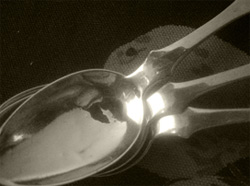
My blog's namesake - small, old and some very dented engraved silver plated tea spoons that belonged to my mother-in-law, and I use them to taste my food as I'm cooking.

Scroll down to the bottom to view my Blogroll

Posted in Pork, on January 31st, 2008.


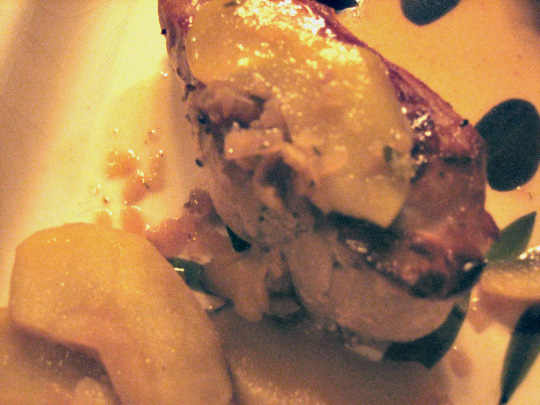
Apologies for the poor picture quality. It’s one thing to take a photo of food when it’s just my DH and myself. He teases me about it, and loves to regale people with examples of when he’s poised over his lovely plate of steaming food and I rush in with my camera and yell “wait!” It’s another when we have a table full of guests and I’m poking around trying to take pictures in front of them. Tacky, tacky. So I snapped this picture on my own plate, as surreptitiously as possible, so it was a bit dark at our candlelit dining table.

As usual, I started my menu plan with the main entree. It needed to be the set of 6 pork chops I had in the freezer from Niman Ranch. I’ve mentioned theis meat producer before – they are a small independent farm that raises livestock the old-fashioned way. No growth hormones. Natural feed, no additives. All that good stuff. I’m on their email notification list, so every time they have a sale, I know about it. Mostly I’ve ordered pork, but also their steaks too. I’m crazy about their bacon, but it’s carried at my local Trader Joe’s at a pretty good price.

Everything I’ve ordered from Niman ranch has been exceptionally good. Worth the price? Well, I guess it’s relative. Compared to grocery chain meat, this is just far and away better. But if you’re on a budget, probably not. I don’t order all my meat from them – just special stuff. If you happen to decide to try them out – do wait for a sale – and make sure they pack in small packages (like 2 pork chops per pkg). That’s why I hadn’t defrosted these before, because I needed to wait for an occasion when I had exactly 6 people.

Because pork is raised so leanly now, there isn’t as much fat to keep the meat moist. So I always brine pork. I’ve tried several recipes, but my current favorite is a mix that I buy at Whole Foods called V Traditional Brining Blend, and V Spicy Brining Blend. They come in 12.7 ounce jars. If you prepare the brine per the instructions you’ll likely use most of a jar. I disregard those instructions and make a much smaller solution. This time I used about 2 tablespoons of brining salt and dissolved it in about a cup of boiling water, then added ice cubes to cool it off quickly. Usually I stick my finger in the brine to taste the saltiness – you want it to be salty, but not overwhelmingly salty, otherwise your meat will become the same. Then I immersed the pork in the brine. If time is of an essence, I’ll put them in my aerator (a plastic container that removes the air by vacuum pump and supposedly increase the marinating ability chop-chop). That I did, and let them rest in the refrigerator for about 6 hours or so. I removed them once and turned them over in the liquid, since the brine didn’t completely cover the chops.

I pan-seared the chops, then used a probe thermometer so I’d know exactly when the meat reached 145 degrees F. Worked like a charm. Result: these chops were just “the best.” And America’s Test Kitchen scored a winner with the sauce recipe. Although, next time I will probably thicken the sauce some with some cornstarch. Even though I reduced it down, it was still a bit thin. But, Niman Ranch scored a touchdown with the meat. One great dinner.
printer-friendly PDF

Pork Chops with Apple Cider Sauce Sauce

Recipe By: America’s Test Kitchen
Servings: 4
NOTES: You might want to thicken the sauce more than the recipe indicates by using a tablespoon of cornstarch and a bit of water. Heat through until thickened.

32 ounces boneless pork top loin chops — 4 chops, about 1 1/2 inches thick
Salt & pepper to taste
APPLE CIDER SAUCE:
1 1/2 cups apple cider — or apple juice
1 cup low-sodium chicken broth
2 teaspoons cider vinegar
1 whole cinnamon stick
4 tablespoons unsalted butter — cut into 4 pieces
2 large shallots — minced, about 1/2 cup
1 whole tart apple — Granny Smith, peeled, cored, sliced
1/4 cup Calvados — or apple flavored brandy
1 teaspoon fresh thyme — minced
Salt and pepper to taste

1. Brine the pork chops with a mixture of your choice.
2. Combine cider, chicken broth, and cinnamon stick in a medium saucepan. Simmer over medium-high heat until the liquid is reduced to one cup, about 10-15 minutes. Remove cinnamon stick and discard. Set aside.
3. Preheat oven to 425. Drain brine from pork chops, dry thoroughly, then season pork chops with pepper. Heat a heavy saute pan and add about 1 tablespoon of olive oil to pan. Quickly sear both sides of the pork until caramelized and golden brown. Remove chops to a heatproof pan, insert meat thermometer and bake until the pork reaches 145 degrees F. Remove from oven and loosely place a piece of foil over the top while finishing the sauce.
4. While pork is baking, in the same skillet you seared the pork, add a tablespoon of butter. Heat under medium-high heat, and when it’s melted and foam subsides, add shallots and apple. Cook, stirring occasionally until softened and beginning to brown. Remove from heat and add the Calvados. Return to heat and cook about one minute, scraping bottom of pan with a wooden spoon to loosen browned bits. Add the reduced cider mixture and simmer until thickened slightly, and reduced to about 1 1/4 cups, about 3-5 minutes. Off heat whisk in remaining 3 tablespoons of butter, and adjust seasonings with salt and pepper.
5. Pour sauce with apples over each piece of pork and serve immediately.
Per Serving: 478 Calories; 22g Fat (44.3% calories from fat); 44g Protein; 19g Carbohydrate; 3g Dietary Fiber; 133mg Cholesterol; 100mg Sodium.

Posted in Veggies/sides, on January 30th, 2008.

mashedpotatoesmascarpone
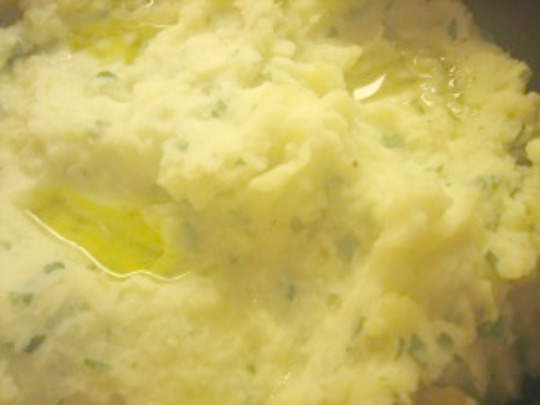
Ah. Mashed potatoes. With some little puddles of melted butter. What’s there not to like, I ask you?

When I was planning the menu for the dinner I did the other night, I wanted something to go with the pork chops and apple cider sauce. Something that would also be a vehicle for the sauce. I could have made plain rice (which I admit, sounded the best), but somehow the cider sauce didn’t sound good with brown rice. I rarely make white rice anymore. I actually don’t make mashed potatoes much either. Last time was Thanksgiving dinner. But, after pondering my menu, I decided mashed potatoes were the best fit. But not just plain mashed potatoes. Once I consulted my recipe collection I knew the mashed potatoes with mascarpone was the right one. It has tons of chopped Italian parsley in it, and of course, an ample amount of mascarpone.

Probably most people think mascarpone is used mostly for desserts. And here in the U.S., I suppose it is. But after all, it’s just a cheese. Something like cream cheese, but made a bit differently. It has a consistency that’s in between sour cream and cream cheese, and it has a very creamy taste. The credit for this recipe goes to Tarla Fallgatter, a cooking instructor here in our part of the world.

You cook the potatoes with the green onions, which flavors the potatoes throughout. Then you mash them by hand (you want a few lumps) and add in the mascarpone, a bit of the water you cooked the potatoes in, and a mound of chopped Italian parsley. Season it, and you’re done. Making this recipe seemed like the right option since I could make this ahead. Once made, I plopped the whole batch into my crockpot and set it to low, then scooped it out into a serving bowl at the last minute. Delicious.
printer-friendly PDF

Mashed Potatoes with Mascarpone

Recipe: Tarla Fallgatter, cooking instructor
Servings: 8
NOTES: Be sure to save a cup of the potato water when you drain the potato and green onion mixture. And be careful adding white pepper – it’s more potent than black pepper.

3 pounds Yukon gold potatoes — scrubbed
2 bunches green onions — coarsely chopped
1 1/2 cups Mascarpone cheese — room temperature
1/4 cup Italian Parsley — chopped
Ground white pepper and salt — to taste
2 tablespoons unsalted butter

1. Cut the potatoes into large chunks if they’re big. Cover with water in a large saucepan and add green onions. Add salt, cover and simmer for about 25 minutes.
2. Drain potatoes, reserving about 1 cup of the cooking water. Return potatoes to the pan and coarsely mash them with a potato masher, add cheese, parsley and some of the cooking liquid if they are too stiff. Add additional liquid to make the right consistency. Season to taste with salt and white pepper. Keep warm in a low oven until ready to serve.
Per Serving: 263 Calories; 13g Fat (43.9% calories from fat); 5g Protein; 31g Carbohydrate; 2g Dietary Fiber; 37mg Cholesterol; 25mg Sodium.

Posted in Veggies/sides, on January 29th, 2008.


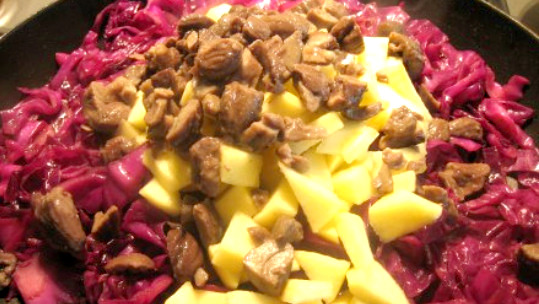
The finished photo of this is a bit blah-looking. You know, cabbage begins to look a little grayish if cooked through. So fortunately I did snap a photo of it when I added the apples and chestnuts, still in the pan. Next time I won’t pop this in the oven, but serve it directly from the range top. I was trying to get some things made ahead, so popped this in the oven to reheat. So the cabbage cooked more than I would have liked. Therefore, don’t do as I did in this case, but cook this just before serving.

We entertained the other night, and I had some wonderful boneless pork chops to serve our guests, and wanted something appropriate to go with. Enter cabbage. I scrounged around the internet trying to find a recipe that suited me. How could I tell? I can’t begin to say – I just read a recipe and either I like the sound of it, or I don’t. I knew I wanted to use red cabbage and apples, probably onions, maybe shallots. So a search produced a bunch of options, and this is the one I chose. I’d make this again, but I’d omit the chestnuts. To me, they didn’t add that much to the dish. Maybe even distracted me. Some people aren’t so fond of chestnuts anyway. But I loved the apples in it, and it’s very low fat and low calorie. As one of our guests said, pure comfort food.

Cook’s Notes: Don’t be tempted to put the apples in early. You want them to still have texture and shape. To be barely cooked. The onions and shallots add a nice character depth. One large head of cabbage will make enough to feed about 10 people. Maybe more. And be sure to make this just before serving. Long cooking only grays the vibrant color of the red cabbage. Overall, this one won’t be a favorite. Maybe it was the chestnuts. Or not quite enough of the sweet/sour stuff. It was just kind of blah altogether.
printer-friendly PDF

Red Cabbage with Apples & (Chestnuts

Recipe: Vegalicious.com
Servings: 10
NOTES: You need a very large pan to make this. Or, divide the recipe into two pans, then combine at the end when the cabbage and onions have reduced down.

2 tablespoons vegetable oil
2 whole shallots — peeled, diced [I added these]
2 whole red onions — thinly sliced
1 head red cabbage — thinly sliced
1/2 cup red wine vinegar — or apple cider vinegar
6 tablespoons water
3 tablespoons sugar — or sugar substitute
1 teaspoon allspice
1 teaspoon ginger
1/2 teaspoon cinnamon
salt and pepper to taste
2 whole Granny Smith apples — cored, peeled, cut in small pieces
8 ounces chestnuts — canned, drained, chopped [or, omit]

1. Heat oil in large frying pan over medium-low heat. Add onions and shallots; saute until soft, about 5 minutes.
2. Add cabbage, vinegar, water and sugar. Add the seasonings Cover; cook until cabbage is tender, stirring occasionally, about 30-40 minutes.
3. Cut the apple into small pieces and add to the cooked cabbage. Add chestnuts; cook until warmed through, about 10 minutes longer. Season with salt and pepper. Serving Ideas : Ideally, serve with sausages or pork of some kind.
Per Serving: 118 Calories; 3g Fat (24.7% calories from fat); 1g Protein; 22g Carbohydrate; 3g Dietary Fiber; 0mg Cholesterol; 4mg Sodium.

Posted in Appetizers, on January 28th, 2008.

herbdip1
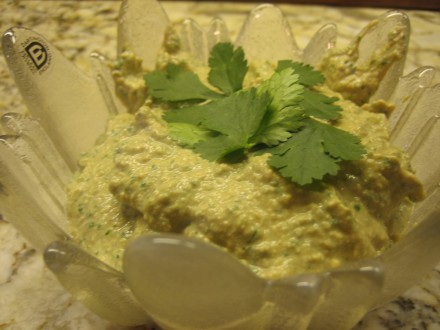
If I were to tell you what the main ingredient was for this dip, you’d probably just scroll right on by, delete this post, turn up your nose perhaps, or laugh. So you’ll have to read down a bit before I divulge.This dip came about because some years ago my DH and I went on a mostly vegetarian diet. DH had a heart attack in 1997. He survived, with minimal heart damage, but the doctor told him afterwards that he needed to lose some weight. So we both went on an extremely low fat, vegetarian diet. We consulted a nutritionist to make sure we were going in the right direction. This, coming from two carnivores here, was a huge – I mean HUGE – divergence for our lifestyle.To say that I struggled with this diet – preparing the food – is a gross understatement. I admit it – I like meat. Even a thick steak now and then, as readers of this blog know. I had cookbooks coming out the ying-yang, as they say, and consulted them all. I read Dean Ornish from cover to cover. I didn’t adhere quite to his recipes, but close. We ate fruit smoothies for breakfast every morning. And some eggs, so I guess that made us omnivores actually. And the weight came off. Off Dave. Not so much off me. I couldn’t believe it. I was so discouraged. I really thought he’d lose 40 pounds, and maybe I’d lose 30.I could go on and on with this story – another time perhaps – but after 6 months DH HAD lost 40 pounds (I’d lost 15). The doctor was very pleased. But DH was anemic. The nutritionist insisted Dave needed to eat chicken and fish. Okay. Added that back into our diet. Tasted GREAT, I might add. Weeks went by and DH was still anemic. The nutritionist told us to eat lean beef at least once a week. That was our undoing, I’m afraid.

During that period of vegetarianism, I tried all kinds of things I’d never have done before. No matter what I did, I couldn’t seem to make most food taste all that good. It was okay, but not more than that. Without cooking with fat, in some form or another, our food just tasted bland. I craved meat. Butter. Cookies. Chocolate (I sneaked a few). I made a big bean salad regularly that DH was supposed to dig into every day (beans are high in iron). He ate apples (also high in iron) every day. But he kept losing weight, and he was still anemic. So when the nutritionist said you’d better have some beef at least once a week, I began introducing beef into our regular fix-at-home diet. I cooked some with a cast iron skillet too, which helped (food cooked in cast iron leeches out some of that iron into our bodies), but it wasn’t enough to get his anemia under control. So, we kind of reverted to our former diet of eating most things. He’s still on the anemic side, but he takes a supplement, and since we eat meat (whether it be chicken, fish, pork, lamb or beef) several, if not 7, nights a week, he doesn’t any longer have a problem.

So back to this post. Trying to find things that had high flavor, but low fat and no meat, was a challenge. I spent more time in the kitchen, cooking (mostly chopping and prepping) than I ever have in my life. And I was always looking for something new and different. This dip fit the bill on all fronts. It came from a cookbook I own called Cal-a-Vie’s Gourmet Spa Cookery. The book is out of print, and this is the only recipe I’ve liked from the book. So now, the secret: tofu. I’m not a fan of tofu. I don’t much like its texture – even in Chinese or Asian stir frys, hot and sour soup, etc. So normally I avoided it whenever possible. I still do if offered it straight away. I mean . . . it’s so blah. And spongy. Not a texture I like except in custard. But, as I learned with this dip, tofu is a “vanilla” substance. It absorbs flavors from the food around it. So, enter: garlic, cilantro, cumin, hot chiles, etc. and you’ve got a wonderful – LOW FAT combo.

Rarely do I tell people what’s in this dip – most people guess it has beans or hummus in it. Nope. Nope. No, no sour cream. No cottage cheese. No, no yogurt either. I don’t believe anyone has ever guessed it.

Cook’s Notes: buy soft or “regular” tofu. I have used nonfat tofu, but the flavor is a bit better with full fat tofu. There’s not a smidgen of other kinds of fat in this dip, and tofu’s fat is all unsaturated, so I go for the gold here. If you don’t like spicy food, reduce – or eliminate – the chile pepper. Be sure to mince up the chile pepper well – scrape down the workbowl to make sure. You can use the finished sauce as a sauce on vegetables, or even on pasta, or over potatoes. But the dip is just the best form, served either with vegetables or crackers. I toasted pita wedges this time.
printer-friendly PDF

Files: MasterCook 5+ and MasterCook 14 (click link to open MC – 14 includes photo)

Hot & Spicy Tofu Dip

Recipe: Cal-a-Vie’s Gourmet Spa Cookery
Servings: 20
NOTES: The recipe says to serve as a dip for artichokes or an array of vegetables. Also works well with crackers, baked pita bread. Could also be used as a topping for plain food (vegetables, grilled chicken) or baked potatoes.

1 pound tofu — soft
5 cloves garlic
1 small jalapeno chile pepper — seeded [I used a serrano]
1 bunch fresh cilantro — rinsed and drained
1 bunch green onions
2 tablespoons fresh lime juice
2 tablespoons orange juice
1 tablespoon ground cumin
1 tablespoon low-sodium soy sauce
1 tablespoon honey — or Splenda, or brown Sugar Twin (and don’t add any more, as this is sweet enough)

1. Have all ingredients ready beside your food processor. Allow tofu to drain a few minutes before beginning. Start the motor and add the jalapeno pepper and allow to mince finely. Add garlic cloves in same manner. Then add cilantro, green onions, juices, cumin, soy sauce and sweetener.
2. Cut tofu into smaller chunks and add to bowl, then process until smooth.
3. Chill for several hours. Will keep for many days.
Per Serving: 25 Calories; 1g Fat (38.5% calories from fat); 2g Protein; 2g Carbohydrate; trace Dietary Fiber; 0mg Cholesterol; 32mg Sodium.

Posted in Uncategorized, on January 27th, 2008.

californiasky1jan08

We very rarely have views like this. Thunderclouds – or big massive cloud formations are more a standard in the midwest than here on the California coastline. But the other day, just after we’d had a couple days of rain, this was the view from our hill. This shot was taken facing northwest. If the visibility had been better, you might have been able to see the skyline of downtown Los Angeles just to the left of the two palm trees. It’s very rare that we can see those far off images since downtown LA is about 45 miles away. But on occasion we do see it.

Posted in Cookies, on January 25th, 2008.

blue chip choc chip cookie
I must admit that when I read this recipe the first time, I thought “it’s just another variation on chocolate chip cookies.” Why fool with a good thing, my mind said. I’ve relied on the good-old Tollhouse (Nestle’s) recipe, and never been unhappy with it. But the further I read into Smitten Kitchen’s blog, the more I became convinced I’d best try this recipe. When you read the list of ingredients you definitely will think this is not all that different. Yes, more chips. And more nuts. But really, what’s that mean but just a more densely populated cookie? But then you read the details, and you find out that there really are some differences:

1. You must start with cold butter

2. The nuts are toasted

3. The nuts are chopped finely so they almost disappear in the cookie

4. The cookies are baked differently – on parchment in a 300 degree F. oven for a long time

And are they a radical change? Well, maybe radical is too strong a word. Are they different? Yes. The texture is different – they’re nicely crumbly and crisp. There is definitely something different about the nuts – besides the fact that there are a LOT of nuts (and chips) in these cookies. But having toasted the walnuts makes a huge difference. I used my food processor to chop the nuts, and did just as the recipe indicates – lots of the nuts were crumbs, but there were some pea-sized pieces in there too. Nothing larger, though. To say that I loved these is putting it mildly. These may be my favorite chocolate chip cookie recipe from henceforth. Smitten’s recipe came from David Liebovitz’s book, The Great Book of Chocolate. I made no alterations to this recipe. My hat’s off to Deb for passing on Liebovitz’s recipe to all of us chocolate chip cookie fans.

Cook’s Notes: Having read some of Smitten’s comments – a couple of people had problems with them – I got everything prepped before I started mixing the cookies. The problems others had, I believe, might have been caused by the butter not being thoroughly chilled when they started making the cookies. Or, it could have been the type of butter used. So, my oven was hot. The dry ingredients were combined. The eggs and vanilla were standing by. The cookie sheets were ready. I chopped up the butter into the 1/2 inch cubes then put them back in the refrigerator while I did all the other prep work. Once I began to mix the cookies they took little more than a minute or two to be ready for plopping onto the parchment-lined cookie sheets. They took longer to bake – the recipe indicates 18 minutes. Mine took about 22, and my oven runs hot, so was surprised. I also have decided these cookies are better when they’re fresh. They don’t seem to have the same magical taste once they’ve been frozen. Don’t know how that can be, but it is. Would welcome anyone else’s opinion about it.
printer-friendly PDF

“Blue Chip” Chocolate Chip Cookies

Original Recipe: The Great Book of Chocolate by David Lebovitz
Source: Deb at the Smitten Kitchen Blog
Servings: 20
NOTES: Make sure the butter is cold. Make sure walnuts are very finely chopped – with some pieces as large as a pea, but with some almost a powder.

1/2 cup granulated sugar — (100 grams)
1/2 cup firmly packed light brown sugar — (120 grams)
8 tablespoons unsalted butter — (115 grams) cold, cut in 1/2 inch pieces
1 large egg
1 teaspoon vanilla extract
1/2 teaspoon baking soda
1 1/4 cups all-purpose flour — (175 grams)
1/4 teaspoon salt — or 1/2 teaspoon flaky sea salt
1 1/2 cups semisweet chocolate chips — (200 grams)
1 cup walnuts — or pecans, (130 grams) toasted and VERY finely chopped

1. Adjust the oven rack to the top third of the oven and preheat to 300F (150C). Line three baking sheets with parchment paper.
2. Beat the sugars and butters together until smooth. Mix in the egg, vanilla, and baking soda.
3. Stir together the flour and salt, then mix them into the batter. Mix in the chocolate chips and nuts.
4. Scoop the cookie dough into 2 tablespoon balls and place 8 balls, spaced 4 inches (10cm) apart, on each of the baking sheets.
5. Bake for 18 minutes, or until pale golden brown. Remove from the oven and cool on a wire rack.
6. Store at room temperature in an airtight container for up to 3 days. (I always freeze my cookies)
Per Serving: 212 Calories; 12g Fat (49.3% calories from fat); 3g Protein; 25g Carbohydrate; 1g Dietary Fiber; 23mg Cholesterol; 66mg Sodium.

Posted in Salads, Veggies/sides, on January 24th, 2008.

carrotgingerslaw
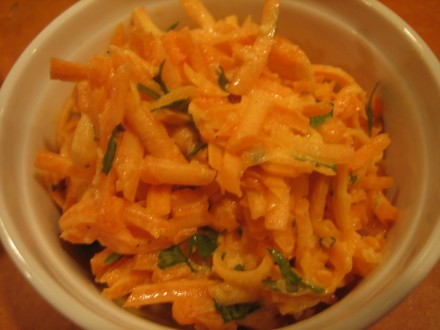
Do you sometimes forget how good vegetables can taste? I forget about all the variations on vegetables. I need a little memory jog now and then to remind myself that there’s more than one way to make cauliflower. Or broccoli. Or zucchini. Or. Or. Or. It could go on and on.

And surely I forget about using carrots – in a raw form, other than eating out of hand. So I was reading Fresh Catering (a blog I read regularly) and Rachael had made this carrot-ginger slaw. Well, my eyes and nose perked up and I immediately printed out the recipe. I had everything on hand except the fresh ginger. But I had some in a bottle, which I’m sure wasn’t AS good, but this salad was so refreshing (next time I really will have the fresh ginger). I have Italian parsley in my garden, but I had an abundance of cilantro in my refrigerator, so I used cilantro instead. DH loved it. So did I. And it took a maximum of about 7 minutes to make it. Literally. That part I liked a lot. And it was better than having another – yet another – green salad. Don’t get me wrong, I love green salads. Really I do. But there’s a tedium about making green salad. And I like homemade dressing too, which adds to the hassle.

When my daughter, Dana, was a little tyke, she first learned how to bake cookies. That’s probably universal in this day and age. Children and cookies just go together like peas in a pod. Or puppies and little boys. Once she got a bit older I began teaching her about knife skills. Probably when she turned 8 or so, and I thought she was mature enough to hold and wield a dull knife.

Initially, she was thrilled with her new-found skills and independence. She liked helping in the kitchen, and was very proud of her accomplishments. But the interest began to wane in the years to follow. I was a working mom, had to get dinner on the table in fast order, so setting the table and making a salad was what helped me the most. She wasn’t old enough or tall enough really to master a spatula and frying pan at the hot stove, or many other things with hot pots and pans, so the salad making was the best choice. As she got older still she began to dislike making a salad unless it was just chopped lettuce. I like lots of vegetables in my salads. Back then it was mostly carrots, celery, green onions, tomatoes and peppers. Now I add lots of other things like fennel, Feta crumbles, sugar snap peas, nuts, even. But she didn’t enjoy the chopping and cutting anymore, probably because it was so repetitive.

Here’s the salad maker now, a picture taken when we were at Dana and Todd’s house over Christmas – she’s 39 now. When I was 39, she was 13, going on 30. But that’s another story. Now she makes salads all the time for her family. And mostly they’re just lettuce. Her kids don’t much like eating raw vegies. They look at salad as merely a vehicle for consuming ranch dressing. But Dana thoroughly enjoys all the homemade dressings. When we talked on the phone the other day she was busily making her favorite of my dressings, the VIP Salad Dressing, which I posted last year. It may have been my very first posting on this-here blog. Or one of the first. And that dressing is still one of my very favorites too.

Last summer Dana’s two children were here to visit for awhile, and the 10-year old, Taylor, was anxious to help me in the kitchen, so I taught her how to make salad. How about that. What goes around, comes around. Dana was a bit in shock when I told her I’d taught Taylor how to use a sharp knife. She did just fine, sweetie! Mom knows all. That’s a bit of an inside family joke if you didn’t get it. Dana reads my blog every day, so am certain I’ll be hearing from her about that! Anyway, I just listened to someone on the radio the other day, that most children, when they reach about 7 or 8, are old enough to learn how to use a knife in the kitchen.So, I’ve rambled on far too long here. Telling family stories. Suffice that this not-green-salad is a good one, a keeper, but probably not one for children to make unless an adult grates the carrots and ginger. Other than that, children could likely do all the rest. If it’s a kid-making deal, maybe start them out with green salad and teach them some knife skills.
printer-friendly PDF

Carrot Ginger Slaw

Recipe: Fresh Approach blog
Servings: 6

6 whole carrots — peeled
1 cup chopped parsley
2 teaspoons vegetable oil
3 tablespoons seasoned rice wine vinegar
1/8 teaspoon ground Szechuan peppercorns
3 tablespoons fresh ginger — grated – use a Microplane
1/4 cup mayonnaise
1 teaspoon sesame oil
Sesame seeds and more parsley for garnish

1. Using the large holes on your box grater (or the shredder disc on a food processor), shred the peeled carrots.
2. Toss that with the parsley.
3. In another bowl, combine the oil, vinegar, Szechuan pepper, ginger (and the juice), mayo and sesame oil. Taste and adjust to your taste.
4. Stir that into the carrots, let rest for a few moments, garnish and serve.
Per Serving: 135 Calories; 10g Fat (64.9% calories from fat); 1g Protein; 11g Carbohydrate; 3g Dietary Fiber; 3mg Cholesterol; 345mg Sodium.
Printer-friendly recipe, click HERE.

Posted in Pork, on January 23rd, 2008.

porkfennel2
You know. It’s January. We’re supposed to be trying to make some lower calorie meals. After the excess of the holidays. But, you know how it is – you get tired of chicken breasts, stir-frys, and salads. So you go to the source – the cookbooks or the files – and find something new. Something more interesting. Something different. It wasn’t hard – I have a huge inventory of cookbooks and folders and folders of clipped recipes. I pulled out one of the diet-type files I have – low-fat entrees – and found about 50 recipes in the file. At least half of them were for pork, which appealed to me. A big shopping spree at Costco, and a couple of hours of putting away stuff and re-proportioning the meat I bought, and I was ready to think about dinner.

For Christmas, at my suggestion, my DH gave me a FoodSaver vacuum packaging system (from Costco). I’d been reluctant to get one, even though a few people had recommended it. I went online and read reviews and settled on the FoodSaver 2940, which got better write-ups than others. I finally unpacked it yesterday, watched the DVD with demonstrations of packaging up all kinds of items. So today I bought a big pork roast and 4 tenderloins. I cut up the roast into 3 pieces and pressed the magic button and wh-o-o-o-p it sucks out all the air. It was FUN. (Sometimes I’m easily amused, especially with any new kitchen toy.) I separated the tenderloins and sucked 3 of those into separate packages. The 4th tenderloin became our dinner. The 2940 doesn’t look exactly like this, but close.

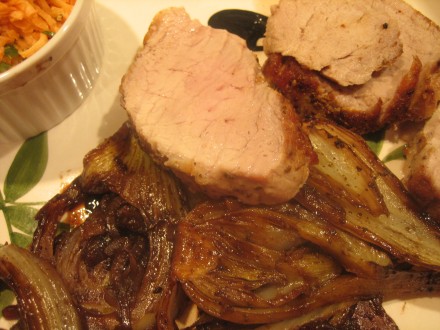
So, I digress talking about my new toy. Back to dinner. I really like fennel. I like it raw – just to eat like celery, and I like it cooked – when it renders itself into silkiness, almost. I’d clipped the original recipe from one of Williams-Sonoma’s catalogs. The recipe resided next to the write-up about “infused” balsamic. A mere 6 ounce bottle for $19.00. I didn’t buy it (aren’t you proud of me?). But I thought the recipe was intriguing, so I substituted, as we cooks are wont to do. I couldn’t find nary a fresh sage leaf in two stores yesterday (I know, they’re out of season, but I still thought the grocery store would have them anyway). Wrong. So I used powdered sage. Surely not the same thing, but the closest I could get. And, I didn’t have this infused vinegar. But I DID have some wonderful fruit-infused balsamic that I thought might work. Indeed it did.

First you brown the pork tenderloin, remove it, then saute the fennel and shallots. I sliced the fennel in about 1/4 inch slabs. Maybe not the right configuration for this dish – next time I’d do what the recipe said – in 1/4 inch strips. The slices of fennel would work well in a baked dish, but this fennel needed to be tossed in the frying pan. A tad difficult with this large pieces. Awkward is all I can say. But, my own fault. Once the fennel is nearly cooked through, you add the balsamic. Put the pork tenderloin on top of this vegetable mixture and bake in a very hot oven until the pork is just pink through (145 degrees F), remove the fennel, then the pork to a cutting board and cover with foil briefly while you whisk the remaining sauce over high heat. The pork was perfectly cooked (pink in the middle) and the fennel (W-S calls it a confit) was kind of like a vegetable relish in a way. Not exactly like a side vegetable, but it was that too. Whatever it was, it was delicious.
printer-friendly PDF

Pan Roasted Pork Tenderloin with Balsamic-Fennel Confit

Recipe: Adapted from a Williams-Sonoma recipe
Servings: 4
NOTES: If you don’t have the Balsamic with Pomegranate, use some other kind fruited balsamic. The original recipe called for “Infused Balsamic Vinegar,” available at Williams-Sonoma. It’s an intense, reduced syrup almost, in either a rosemary or garlic flavor. Be sure to cook the fennel until it’s nearly cooked before adding the vinegar. You want to caramelize the edges of the fennel, which enhances its flavor. And whatever you do, don’t overcook the pork – you want it to be just barely pink in the middle.

24 ounces pork tenderloin — (two loins)
1 tablespoon olive oil
1 tablespoon butter
3 whole fennel bulbs — sliced in 1/4 inch slices
2 whole shallots — sliced
6 tablespoons Balsamic Vinegar with Pomegranate — or infused balsamic vinegar
1 tablespoon fresh sage — chopped
1/2 cup low-sodium chicken broth
salt and pepper to taste

1. Preheat oven to 450.
2. Season pork with salt and pepper. In a large ovenproof frying pan over medium-high heat, warm the oil and butter. When hot, brown pork for 3-4 minutes on each side until the meat has begun to caramelize. Transfer meat to a platter.
3. To the same frying pan add the slices of fennel and shallots. Saute, stirring, until the fennel is tender and golden, 6-10 minutes. Add 2 T. of the balsamic vinegar and cook, stirring, until nearly evaporated, about 2-3 minutes. Season sauce with salt and pepper to taste. Stir in half the sage leaves.
4. Nestle the pork tenderloin on top of the fennel, sprinkle with the remaining sage. Use a meat probe in the center of the meat. Transfer pan to the oven. Bake until the thermometer reaches 145 degrees, about 15-20 minutes, or until done to your liking.
5. Remove from oven and transfer pork to a cutting board. Loosely cover with foil. Allow to sit while you complete the sauce (about 5 minutes).
6. Set pan over medium-high heat. Add broth and 4 T. of the balsamic vinegar and bring to a boil. Cook until liquid is reduced by half, about 4-6 minutes. Slice the pork to about 1/2 inch medallions. Arrange pork slices of fennel on a heated platter and drizzle the top with the pan sauce.
Per Serving: 337 Calories; 13g Fat (33.3% calories from fat); 39g Protein; 18g Carbohydrate; 5g Dietary Fiber; 118mg Cholesterol; 219mg Sodium.

Posted in Uncategorized, on January 21st, 2008.

This is one side of my kitchen. When I designed this new kitchen 2 years ago, I knew I wanted a place where I could sit down with my recipes. My red-topped Dell laptop sits here at all times. I change the message that scrolls across the screensaver now and then. Right now it says “Are you ready for Valentine’s Day?” The background is red, the type in white. This area is also my baking center. Behind those wood backsplashes (behind the laptop) are appliance garages that house my Kitchen Aid mixer, blender, food processor and toaster. The lowest drawers below are a specific height to house my big plastic Tupperware bins of flour and sugar. Above on the left I keep my spices (you already saw the herbs – they live over by the range).

Hanging up above the laptop is a fold-down TV screen (it’s small) and DVD player. Sometimes when I sit here I turn on morning television. I do most of my blogging early in the morning. The laptop houses all of my photography, there’s a convenient USB hookup here for my digital camera, and my main MasterCook cookbook (my own) gets updated here. Sometimes I have stories already composed, and I merely have to press a few keys and it’s posted on those internet highways. Other times, like today, for instance, I didn’t have a story ready and had to write one. Often I write up posts in the evening after I’ve prepared dinner. After the pictures are taken, the last morsel digested. My loving DH always does the dishes, bless his heart, so after I put away any remaining food, I can go upstairs to my home office (where my Tivo lives, another gadget that I adore) and do whatever I want.

family-room1
Our family room, from the kitchen


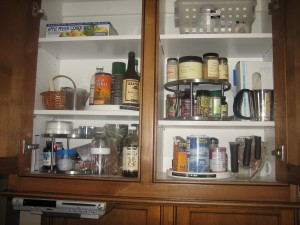
Since there aren’t all that many spices, they are confined in a relatively small space on two lazy susan rounders. I even have a tad of empty space up there on the top shelves. Only reason is that I can’t reach up that far without getting out my kitchen ladder.
spicecupboard
So now, you can picture me perched on the chair, allowing my mind to wander, writing away. Blogging.

Posted in Beef, Pork, on January 20th, 2008.

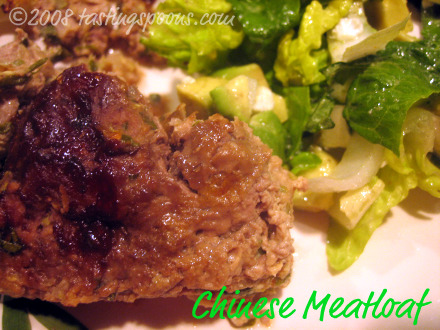
chinesemeatloaf

When my DH was still working – this has been more than 10+ years ago now – Fay was one of the women who worked in the office (DH sold computer chips for Intel). She lived on the outskirts of our county on a small ranch. Her children were young teens then, and the family was active in 4-H. The H’s stand for Head, Heart, Hand, and Health. It’s a youth organization, centered mostly around farming or ranching families, along the lines of Boy Scouts and Girl Scouts, except the kids learn skills for raising livestock (like cows, sheep, chickens, etc.). They do service projects just like scouting does, but still the day to day work is all about farm projects.

Fay had a son who wanted to raise a pig. And usually, the deal is that the kids raise the animals, knowing from the beginning that they’ll be sold at the County Fair. Or at a livestock auction. So Fay offhandedly mentioned to DH that her boys were going to be selling a pig – their pig – at the Fair that summer. She also told us that we’d be paying a fairly premium price for the pig, but would we be interested in buying a half or a whole pig? She explained that the pig was mostly hand raised, and that part of the price is tax deductible somehow. Her son would be caring for it from day one on their ranch, the best feed, exercised well, pens cleaned out, etc. We talked it over, and Cherrie and I agreed to buy a half a pig. Fay would buy the other half. We signed up to buy it in the Fall when the pig was a little piglet. Months and months went by, and I’d forgotten all about this until one day Fay phoned to tell us that the pig was going to the Fair the next day. Oops. And that we would need to pay up in full right away. That’s when we learned how BIG the pig was. Something like 400+ pounds. Somehow I’d pictured a sweet little, demure thing, maybe 100 pounds or so. Ah well. Live and learn. Pigs are not hogs, but they’re gosh darned BIG.

The next day Fay phoned with the price and Cherrie and I mailed our checks immediately. Meanwhile, we needed to decide how we’d like to have the pig butchered – well, not how exactly, but what kind of cuts. We were faxed a page from the butchering firm, and we looked it over carefully to decide on chops, ribs, roasts, breakfast sausage, Italian seasoned sausage, plain ground pork, even hams smoked or raw, and bacon. We needed to specify how much of each. Of course, some things we didn’t know – like how many pounds of baby backs there are in a half a pig. It was quite perplexing figuring that out. We faxed back the page, and they told us to come pick it up a few days hence, depending on the smoke house schedule. The 4-H group used a company almost in Northwest Riverside (that’s about 50 miles away), out in the boonies, to do the butchering.

THEN, we got a note from Fay’s son, including the tax deduction information, and he thanked us for buying PETUNIA. Oh my. Petunia. When we heard her name was Petunia, we wanted to back out. To say no, you can’t have butchered Petunia! How could we possible buy a slaughtered pig with the name of Petunia? Sounds inhuman. Like you’re destroying a famous cartoon character. But we had to – after all, we’d agreed to do this and we’d already paid for it. It was too late, of course.

For several years we bought an animal from Fay’s son and one of us had to drive out to this butcher, with the car filled with ice chests. It was always summertime, so we needed to keep the stuff cold. They did freeze all the meat for us – that is a nice service – and it was all labeled well. Cherrie and I figured out which was which – hers and mine – and we began enjoying the pig. PETUNIA. <very big, sad faces here> I think Petunia was the very best tasting pig we had. For a couple more years we shared another pig. Cherrie bought a half by herself one year. His name was Tootsie Roll. Fay’s sons also raised lambs a couple of times too. Generally, with whatever kind of meat, we used the nice cuts first, seemed like. The chops, the roasts. Even the Italian sausage. Unless we used the ham prior, for a special occasion, it usually waited until Easter to be served. Some years it was too salty for me, so in subsequent years I asked for less smoking, less salt, which the butcher was kind enough to accommodate.

So all of this story is leading up to how this recipe came to be. Cherrie had somehow, one year, ordered a LOT of ground pork. I mean a lot. We learned over the years what we preferred – the chops, roasts, even the ribs, not so much the hams or the numerous packages of seasoned sausage. We could order the ground pork in whatever sized package we wanted – I always ordered in one-pound ones. But they often got rolled to the back of the shelves (the freezer) and began to accumulate. There are only so many recipes you can use with pounds and pounds of ground pork. Unseasoned, fairly lean, but still, it’s ground pork. The only constant was meatloaf. But usually that’s a mixture of beef, veal and pork, or some semblance of such. Veal is not very accessible these days and way too pricey anyway, so basically you’re down to ground beef and ground pork (or you could add ground turkey or chicken too). So, really, how much pork can you use up in ONE meatloaf. Two pounds maybe. When you have perhaps 25 pounds of ground pork in the freezer, that’s a heck of a lot of meatloaf.

So, Cherrie raved about this recipe for Chinese Meatloaf, and she was delighted because the single recipe used a full pound of ground pork. She’d found the recipe in the Los Angeles Times (this has been years and years ago, now, and it’s not available online). She’s changed it just a bit, but mostly it’s the original recipe: ground beef, pork, a lot of Napa cabbage, cilantro, fresh ginger, Asian seasonings, and some Hoisin sauce on top. I’d gone online to see if I could find the recipe, and did, but mostly found recipes for a meatloaf using lots of cream soup cans and bean sprouts. Yuck. This version is ever so much more authentic and tasty.

Cook’s Notes: Cherrie has added another cup of Napa cabbage to her version (the one below), and she likes to put a bit of Hoisin on the top of the meatloaf when it first goes in the oven. Not much, but about 2 tablespoons. You’ll want to use a large baking dish, like an oval or round Pyrex. Mold the meatloaf into the dish so it has space around the sides to exude the juice. The meatloaf generates a lot of liquid, so make sure it’s high enough sided that it doesn’t spill over. Halfway through the baking, you’ll want to pour off the fat. I suspect a lot of the liquid is juice from all the cabbage, but still, you’d like it removed since the fat is swimming in that water anyway. Then when the meatloaf is done, smear the top with a bunch more Hoisin sauce, because that’s the part you crave (like the ketchup part on a traditional American meatloaf). The meatloaf makes a somewhat soft texture (from all the cabbage), so let it cool for a bit before slicing and serving. She serves it with basmati or jasmine rice in which she’s shaved some carrots, and a green salad to which she adds some kind of citrus, like Mandarin oranges from the can, or some wedges of fresh orange or tangerine. Thanks Cherrie, for sharing your great recipe.
printer-friendly PDF and MasterCook file (click link to open recipe)

Chinese Meatloaf

Recipe: adapted from my friend Cherrie S.
Servings: 8
NOTES: The Napa cabbage seems like a lot, and it does generate a lot of liquid, but it adds a wonderful lightness to the meatloaf. Don’t omit it. Serve with rice (white or brown) with some grated carrot in it. Also with a green salad with some citrus in it.

1 pound lean ground beef
1 pound ground pork
3 cups Napa Cabbage — chopped
1/2 cup cilantro — minced
1/4 cup ginger root — minced
1/2 cup green onion — minced
1 tablespoon salt [next time I’ll use less, probably 2 t.]
2 tablespoons hot chili sauce
2 tablespoons sesame oil
1/4 cup soy sauce
2 large eggs — beaten [I might use 3]
4 tablespoons Hoisin sauce

1. Preheat oven to 350.
2. Combine beef, pork, cabbage, cilantro, ginger, green onions, salt, chile sauce, sesame oil, soy sauce and eggs in bowl and mix well. Press into a large baking dish (with sides). Spread about 2 tablespoons of Hoisin sauce on the top of the meatloaf.
3. Bake for 1 hour or up to 90 minutes, removing halfway through to drain off the fat.
4. Remove from oven and brush top and sides with additional Hoisin sauce. Allow to sit for 10-15 minutes before cutting and serving.
Per Serving: 392 Calories; 29g Fat (67.0% calories from fat); 23g Protein; 9g Carbohydrate; 1g Dietary Fiber; 137mg Cholesterol; 1581mg Sodium.

Related Posts Plugin for WordPress, Blogger...