Get new posts by email:

Archives

Currently Reading

Here are the tastingspoons players. I’m in the middle (Carolyn). Daughter Sara on the right, and daughter-in-law Karen on the left. I started the blog in 2007, as a way to share recipes with my family. I’m still doing 99% of the blogging and holding out hope that these two lovely and excellent cooks will participate. They both lead very busy lives, so we’ll see.

– – – – – – – – – – – – – – – – – – – – – –

BOOK READING (from Carolyn):

Music of Bees, Eileen Garvin. Absolutely charming book about a woman in midlife, lonely, who raises bees, also makes unlikely friends. Heart-warming and very interesting about beekeeping.

A Postcard from Paris, Alex Brown. Really cute story. Dual time line, 1940s and present day about renovating an old apartment in Paris, things discovered.

Time of the Child, Niall Williams. Oh such a good book. Very small village in Ireland, 1960s. A baby is left on the doorstep. The town all whispers and helps. I listened to an interview of the author, which made me like him and his books even more.

Sipsworth, Simon Van Booy. If you like animals you’ll swoon. An old woman who really wants to die finds a tiny mouse in her house and befriends it and finds a reason to live. Utterly charming book.

The Forger’s Spell, Edward Dolnick. True story. For seven years a no-account painter named Han van Meegeren managed to pass off his paintings as those of Johannes Vermeer.

If You Lived Here, You’d be Home by Now, Christopher Ingraham. Could hardly put it down – about a journalist who takes on a challenge to move to small town in Minnesota and write about it. He expects to hate it and the people and place, but he doesn’t. Absolutely wonderful true story.

The River We Remember, William Kent Kreuger. 1950s, Minnesota. A murder and the aftermath. Could hardly put it down. Kreuger has such a vivid imagination and writing style.

How the Lights Gets In, Joyce Maynard. An older woman returns to New Hampshire to help care for her brain-injured son. Siblings and family, lots of angst and resentments.

The Filling Station, Vanessa Miller. Every American should read this book. A novelized retelling of the Tulsa massacre in 1921. Absolutely riveting.

The Story She Left Behind, Patti Callahan Henry. Love this author. Based on a true story. A famous author simply vanishes, leaving her husband and daughter behind. She had invented a mystical language no one could translate. Present day, someone thinks he’s solved the riddle, contacts the family. Really interesting read.

The Girl from Berlin, Ronald Balson. Love anything about Tuscany. An elderly woman is being evicted from a villa there, with odd deed provenance. Two young folks go there to help unravel the mystery. Loved it.

The Island of the Colorblind, Oliver Sacks, M.D. Nonfiction. The dr is intrigued by a remote Pacific island where most of the inhabitants are colorblind. He also unravels a mystery on Guam of people born with a strange neurological problem. Medical mysteries unveiled. Very interesting.

The Bookbinder, Pip Williams. Post 1914 London. Two sisters work at a bookbindery. They’re told to not read the books. One does and one doesn’t. One has visions beyond her narrow world; the other does not. Eventually the one gets into Oxford. Lovely story.

The Paris Express, Emma Donoghue. 1895 on a train to Paris, a disaster happens. You’ll delve into the lives of many people who survived and died in the crash.

A Race to the Bottom of Crazy, Richard Grant. This is about Arizona. Author, wife and child move back to Arizona where they once lived. Part memoir, research, and reporting in a quest to understand what makes Arizona such a confounding and irresistible place.

The Scarlet Thread, Francine Rivers. A woman’s life turned upside down when she discovers the handcrafted quilt and journal of her ancestor Mary Kathryn McMurray, a young woman who was uprooted from her home only to endure harsh frontier conditions on the Oregon Trail.

A Place to Hide, Ronald Balson. 1939 Amsterdam, an ambassador has the ability to save the lives of many Jewish children. Heartwarming.

Homeseeking, Karissa Chen. Two young Chinese teens are deeply in love, but in China. Then their families are separated. Jump to current day and the two meet again in Los Angeles.

North River, Pete Hammill. He always writes such a good story. A doctor works diligently healing people from all walks of life. His wife and daughter left him years before. One day his 3-yr old grandson arrives on his doorstep.

A Very Typical Family, Sierra Godfrey. A very messed-up family. Three adult children are given a home in Santa Cruz, Calif, but only if the siblings meet up and live in the house together. A very untypical scenario but makes for lots of messes.

Three Days in June, Anne Tyler. The usual Anne Tyler grit. Family angst. This wasn’t one of my favorites, but it was entertaining and very short.

Saved, Benjamin Hall. Author is a veteran war reporter. Ukraine, 2022, he nearly loses his life to a Russian strike. Riveting story – he survives, barely.

Grey Wolf, Louise Penny. Another Inspector Gamache mystery in Quebec. She is such an incredible mystery writer.

All the Colors of the Dark, Chris Whitaker. A missing person mystery, a serial killer thriller, a love story, a unique twist on each. Could hardly put it down.

Orbital, Samantha Harvey. Winner of 2024 Booker Prize. I don’t usually like those, but I heard the author interviewed and she hooked me. This is not a normal book with a beginning, a story and an end. It’s several chapters of the day in the life of various astronauts at the ISS (Int’l Space Station). All fictional. She’s been praised by several real astronauts for “getting it” about space station everyday life.

The Blue Hour, Paula Hawkins. An island off Scotland. Inaccessible except when the tide is out. Weird goings on. An artist. A present day mystery too.

Iron Lake, William Kent Krueger. A judge is murdered and a boy is missing. Riveting mystery.

Tell the Wolves I’m Home, Carol Ricks Brunt. 1980s. A 14-yr old girl loses her beloved uncle. Yet a new friendship arises, someone she never knew about.

Four Treasures of the Sky, Jenny Zhang. 1880s, a young girl is kidnapped in China and brought to the United States. She survives with many hurdles in the path.

The Boy Who Fell out of the Sky, Ken Dornstein. Memoir, 1988. The author’s brother died in the PanAm flight that went down in Lockerbie, Scotland. A decade later he tries to solve “the riddle of his older brother’s life.”

Worse Care Scenario, T.J. Newman. Oh my. Interesting analysis of what could/might happen if a jet crashed into a nuclear plant. Un-put-downable.

Song of the Lark, Willa Cather. Complicated weave of a story about a young woman in about 1900, who has a gifted voice (singing) and about her journey to success, not without its ups and downs.

Crow Talk, Eileen Garvin. Charming story which takes place at a remote lake in Washington State, about a few people who inhabit it, the friendships made, but also revolving around the rescue of a baby crow.

The Story Collector, Evie Woods. Sweet story about some dark secrets from an area in Ireland, a bit magical, faerie life, but solving a mystery too.

A Sea of Unspoken Things, Adrienne Young. A woman investigates her twin brother’s mysterious death. She goes to a small town in California to figure it out, to figure HIM out.

The King’s Messenger, Susanna Kearsley. 1600s England, King James. About one of his trusted “messengers,” and his relationship with a young woman also of “the court.” Lots of intrigue.

In the Shadow of the Greenbrier, Emily Matchar. Interesting mystery in/around the area of the famous resort in White Sulphur Springs, West Virginia.

Isola, Allegra Goodman. Hard to describe, survival story on an island in the 1600s.

Save the Date, Allison Raskin. Rom-com, witty, LOL funny. Clever.

The Sirens, Emilia Hart. Numerous time-lines, Australia. Mysteries abound, nightmares, abandoned baby, weird allergies.

Red Clay, Charles Fancher. LOVED this book. Mostly post-Civil War story about the lives of slaves in Alabama during Reconstruction.

Stars in an Italian Sky, Jill Santopolo. Dual time line, 1946 and recent time. Love stories and a mystery.

Battle Mountain, C.J. Box. Another one of Box’s riveting mysteries. Love his descriptions of the land.

Something Beautiful Happened, Yvette Corporon. A memoir of sorts in Greece, tiny island of Erikousa, where the locals hid Jews during WWII. All elusive stories told by the author’s grandmother.

The Jackal’s Mistress, Chris Bohjalian. 1860s Virginia, about a woman who saves the life of a Union soldier. Really good story.

Song of the Magpie, Louise Mayberry. Really interesting story about Australia back in the days when it was mostly a penal colony. Gritty strength of a woman trying to thrive with her farm.

The Boomerang, Robert Bailey. A thriller that will have you gripping the book. About a lot of secrets surrounding the president (fictional novel, remember) and his chief of staff and about cancer. A cure. Such a good story.

Care and Feeding, Laurie Woolever. Really interesting memoir of a woman driven to succeed in the restaurant business. She worked for Mario Batali and then Anthony Bourdain. Gritty stories.

Everything is Tuberculosis, John Green. Maybe not a book for everyone. A real deep dive into the deadly tuberculosis infection, its history. I heard the author interviewed and found the book very interesting.

The Book Lovers Library, Madeline Martin. Fascinating read about Boots’ drug stores’ lending library. And the people who worked in them.

The Arrivals, Meg Mitchell Moore. LOL funny, about a middle-aged couple whose children (and their various family members) return to the family home and the chaos that ensues.

My Life as a Silent Movie, Jesse Lee Kercheval. About grief. A big move to Paris, finding herself a new life with a new set of real blood family.

Escape, Carolyn Jessop. Another memoir about a woman really in bondage in Utah, Mormon plural marriage.

 

Tasting Spoons

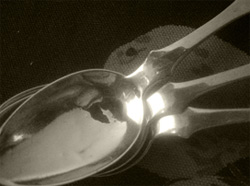
My blog's namesake - small, old and some very dented engraved silver plated tea spoons that belonged to my mother-in-law, and I use them to taste my food as I'm cooking.

Scroll down to the bottom to view my Blogroll

Posted in Lamb, on November 18th, 2012.

lamb_shanks_garlic_madeira_gravy

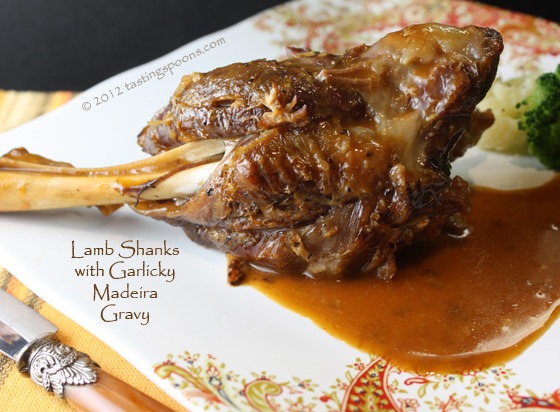
It seems like lamb shanks are a real treat. You don’t see them at Costco, and rarely at a traditional grocery store, either. I never seem to think of making them, although my DH will order them at a restaurant any time he sees them on a menu. The day I made these it was rainy and almost stormy, certainly a fall-like day, so these just sounded so “right.”

Sometimes when lamb is cooking, it isn’t very appealing to me. The smell. I suppose that’s the part that’s almost like mutton. It must be the fat, which has a distinct taste. So I decided I’d make this in the pressure cooker. That way I wouldn’t have to hover over it so much or smell it all that long, either. I’d found a recipe over at www.food.com, and it was really quite easy.

The lamb shanks were well-browned in a skillet first (at least that’s how I did it) in a bit of grapeseed oil. A whole bunch of whole garlic cloves were added later and sizzled just until they were light golden brown. Into the pot went chicken broth, Madeira (the original recipe called for Port, but I didn’t have any), dried rosemary, a bit of tomato paste, salt and pepper. Then the lamb shanks. That’s it. It rattled away for 35 minutes while I did other things. I made a green salad and some steamed broccoli and cauliflower too.

Once the meat was cooked, and the pressure released, I removed the shanks and to the small amount of liquid in the pot (which contained a lot of fat, I’m certain) I added a bit of fig balsamic vinegar. Probably plain balsamic would work too, but I thought a fruity balsamic would enhance the flavor a bit more. With the left overs I poured the sauce into a container, expecting I’d be able to remove the fat. There wasn’t any. I suppose that means the sauce was kind of homogenized, so it didn’t separate. Serve this on heated plates and drizzle the gravy on top and let it pool around the shank. You might want some bread too, to soak up any of that very tasty, garlicky, boozy gravy. Just sayin’.

What’s good: how easy it was to make – the pressure cooker just got dinner on the table in a bit less than an hour. The meat was tasty and meltingly tender. The gravy made itself, really – I didn’t have to reduce it at all – I merely added the balsamic vinegar and it was done. Easy meal beginning to end.

What’s not: if you watch calories and fat, well, you may want to give this one a miss. I was astounded at the statistics in this dish, although I’ll say in my own defense, there probably isn’t more than about a heaping 1/4 cup of meat on a lamb shank. Well, at least the ones we had were quite stingy with the meat. But that made each bite worth savoring.

printer-friendly (Cute PDF Writer) PDF
MasterCook 5+ import file – right click to save file, run MC, then File|Import

* Exported from MasterCook *

Lamb Shanks With Garlicky Madeira Gravy – Pressure Cooker

Recipe By: Adapted from a recipe on food.com
Serving Size: 2
NOTES: You could easily cook this on the stove top – for about 2 1/2 hours, covered, adding more liquid as needed. Don’t allow pan to dry out. The fat didn’t separate when I made this – perhaps the mashed garlic and tomato paste allowed it to homogenize.

2 pounds lamb shanks
salt & freshly ground black pepper to taste
1 tablespoon olive oil
10 whole garlic cloves — peeled and left whole
1/2 cup chicken stock
1/2 cup Madeira — or Port
1 tablespoon tomato paste
1 teaspoon dried rosemary
1 tablespoon balsamic vinegar — fruit type (like fig or orange)

1. Trim excess fat from the lamb shanks and season with salt and pepper.
2. Heat the oil in the pressure cooker. Add the shanks and brown on all sides. (I did this in a wide nonstick skillet).
3. When the shanks are completely browned, remove to a plate and set aside. Add the garlic cloves and stir quickly until they are lightly browned but not burned.
4. To the pressure cooker add the stock, Madeira, tomato paste, and rosemary, stirring so the tomato paste dissolves. Add lamb shanks.
5. Close the pressure cooker and bring up to full pressure (15 pounds).
6. Reduce heat to stabilize pressure and cook for 35 minutes.
7. Remove from heat and let pressure release naturally.
8. Remove the lamb shanks, set aside and cover loosely with foil.
9. If you have a gravy separator (and have the time) allow gravy to sit for 10 minutes so you can drain off the tasty gravy without all the fat. If liquid is more than about 1/2 cup, simmer at a low boil until the mixture has reduced and slightly thickens.
10. Add balsamic vinegar, stir, then mash the garlic cloves with a spoon.
11. Serve the sauce over the lamb. If desired, sprinkle the top with some grated orange peel.
Per Serving (these numbers astound me – it must assume there was a lot more meat on the shanks than we had – or maybe there is something wrong with the numbers – I’m glad I only ate a few bites of it!): 1071 Calories; 68g Fat (62.0% calories from fat); 86g Protein; 8g Carbohydrate; 1g Dietary Fiber; 299mg Cholesterol; 947mg Sodium.

Posted in Beverages, on November 16th, 2012.

clove_scented_sidecar_cocktail

Once in a blue moon I’ll make a cocktail when we’re having dinner guests. Usually it’s just wine we offer, but the other day I was flipping through an old magazine, saw this recipe and decided it sounded interesting. Indeed it is – I liked it a lot. Of our 8 guests, only 4 opted to try it. I did. I tried. I liked. I’ll make it again, maybe real soon. But it’s one of those that could sneak up on you, so be careful and don’t guzzle.

All the ingredients I got out, at-the-ready, and just before guests arrived my friend Cherrie’s hubby, Bud, made these drinks. Now if you are a traditionalist with cocktails – the “give me the straight stuff” kind of person, you probably won’t like this. Maybe too frou-frou. There’s nothing in it, though, other than whiskey (Jack Daniels was what we had), orange and lemon juices, sugar, and then the cloves_sugar_mixtureglasses or tumblers are coated in sugar that’s mixed with ground cloves. A lot of folks, I suppose, wouldn’t want to sully a good shot of Jack Daniels whiskey with sugar! Well, I did, and I liked it.

A sidecar, from its origins in London over 100 years ago was equal parts cognac, Cointreau, and lemon juice, now known as “the French school”. Later, an “English school” of Sidecars emerged, as found in the Savoy Cocktail Book (1930), which calls for two parts cognac and one part each of Cointreau and lemon juice. So, whiskey was never part of a sidecar. Who knew? Certainly not me!

Maybe I’ve mentioned it here before, but the first alcoholic drink I ever tried (I was 20) was Jim Beam bourbon and 7-up. My former father-in-law thought it would be a nice introduction for me to try it – he made a very mild one. I actually didn’t mind it, and even recently when Dave and I were in Las Vegas and went to one of the bars in a casino, I ordered one. I’m not much of a drinker in any case. My parents didn’t drink at all, and when I went to college, drinking just wasn’t “done.” It wasn’t until I was in my late 30’s, when I was single again, my friends Kathy & Peter and I took a 2-3 month course at a local college in wine appreciation, and I began drinking wine now and then. After Dave and I married, I would have a glass of wine (just one) most evenings, usually while I was cooking dinner, but as I’ve gotten older I only drink wine (or anything alcoholic) occasionally. Part of it is because I don’t need the calories. And I’m not very fond of tannic wines anymore, at any time. My DH really likes sharp, tannic wines, and to open a bottle of wine for me alone (a lighter, smoother type) would be silly. It wouldn’t get drunk in a month. But if the sharp part is tempered some – like in Sangria (I do love Sangria, and Trader Joe’s has a great one, called Sangria Ole if you haven’t tried it), well,  I could be more often tempted.

sugared_rimsSo, with this drink – where the sharpness of the alcohol is blunted with something citrusy or sweet, well, I could probably drink one of these sidecars a couple times a week if someone would make them for me! Bud did have to read and re-read the directions a couple of times to make sure he was chunking the lemons and slicing the oranges, muddling some, adding sugar here, not there. Sugar-ing and clove-ing the tumbler rims, etc. He did a great job – if there had been enough for seconds I might have succumbed. But considering the amount of whiskey, well maybe it’s a good thing I didn’t as I might not have gotten dinner on the table! I’m such a lightweight when it comes to alcohol. One drink and I’m a goner almost!

So anyway, these little numbers are fun. The recipe is from Sunset Magazine, in 2010. Tasty. Worth the trouble – but it would be nice if you’re the hostess – if you can get somebody else to do the prep and serve them for you. I’m always a one-armed paperhanger during the last 10 minutes before guests arrive. I used these silver mugs (they’re actually mint julep tumblers) to serve them in. And don’t forget to drop the one clove into each glass or mug before serving. And sip it all around the rim so you can enjoy the ground cloves which enhance the flavor a lot.

What’s good: the citrusy, sweet flavor – a very nice way to cut the sharpness of whiskey. A fun drink all around.
What’s not: probably the time to make it – not all that bad, but you do have to cut, squeeze, slice, mix, muddle, measure, and use a shaker too before you can finally pour out the drink.

printer-friendly (Cute PDF Writer) PDF
MasterCook 5+ import file – right click to save file, run MC, then File|Import

* Exported from MasterCook *

Clove Scented Sidecar

Recipe By: Sunset Magazine, 12/2010
Serving Size: 2

5 tablespoons sugar — divided (you probably won’t use it all)
1/4 teaspoon ground cloves
1 whole lemon — cut into chunks
1 whole orange
Ice
1/2 cup whiskey
2 whole cloves — for garnish

1. Mix 2 tbsp. sugar and ground cloves on a small plate. Rub one lemon chunk around the rims of two cocktail glasses. Turn rims in the clove sugar.
2. Cut orange into two slices about 1/4 in. thick; cut slices in half. Put lemon chunks, orange slices, and 3 tbsp. sugar in a cocktail shaker. Using a wooden spoon, muddle together the fruit and sugar until fruit is broken up.
3. Add about 1 cup ice and whiskey to cocktail shaker. With lid securely fastened, shake vigorously to blend, then strain into the sugared glasses. Garnish each with a whole clove.
Per Serving (not accurate – it assumes you eat all the sugar plus the orange and lemon, which you don’t): 308 Calories; 2g Fat (6.8% calories from fat); 1g Protein; 46g Carbohydrate; 4g Dietary Fiber; 0mg Cholesterol; 18mg Sodium.

Posted in Appetizers, on November 14th, 2012.

sweet_vidalia_onion_dip_closeup

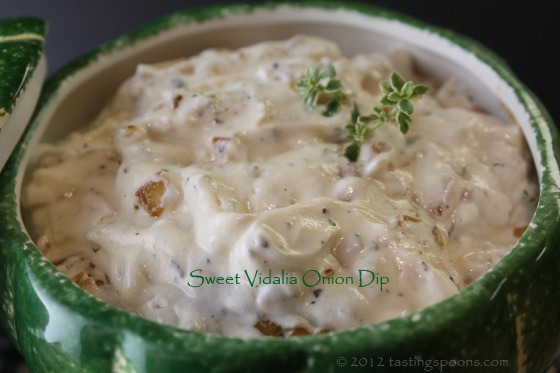
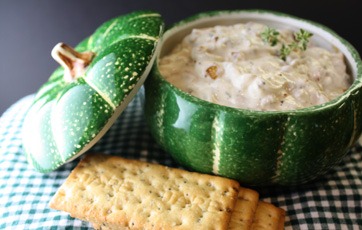
Really, this could be any kind of sweet onion, but Vidalias were the first out there in the race for sweet onions which didn’t happen until about the 1980’s. You can use Maui, Walla Walla, or the more rare Noonday onions from Texas. My friend Joan generously gives me a few of those latter ones each spring and she and I both like to find new ways to use them – Joan, here you go! Anyway – it’s just sweet onions you need. The onions are caramelized to bring out that ultra-sweet flavor, then combined with Greek yogurt (no sour cream here). VERY easy to make.

Did you know that Vidalia onions were first grown in the 1930’s? That was news to me until I read about the different varietals in sweet onions at Wikipedia. In case you’ve forgotten what’s sweet_onion_dip_spatuladifferent about them, it’s that they have a low sulfur content (that’s the stuff that makes our eyes burn) and they contain a lot more water. Hence they don’t keep very long, as you probably have discovered if you’ve left them in your pantry for any length of time.  I don’t keep any in my pantry at all unless I have a specific (read immediate) use for them. Actually I wrote up a post about a caramelized onion dip 3 years ago which uses regular onions. It’s similar . . . but different. It also uses yogurt and it has sour cream in it too. This one surely is healthier (all yogurt). And this one has thyme in it – one of my most favorite herbs. You can see the sprigs of variegated thyme in the photo at top. I prefer the pungency of regular thyme, but the variegated looks pretty in the dip, don’t you think?

vidalia_onion_dip_plateWhat was nice about this one was how quickly the onions caramelized. The recipe, which came from Sunset Magazine, didn’t specifically say to caramelize the onions – to the dark, golden brown state that you might expect, but once those suckers began to brown (in a fairly hot nonstick skillet) I had to stand there stirring often – very often – to keep them from burning. So my dip may be even more caramelized than the recipe intended. I liked it that way.

So, you brown the onions (chopped up in fine dice) in some olive oil, then I added the fresh thyme to help bloom the oils in the herb. It cooled, then the mixture got added to yogurt. The recipe called for low-fat Greek yogurt – I used full fat, but you sure could try it with either low-fat or fat-free Fage – it probably would be fine! Season with salt, pepper, and I added some dried thyme that I scrunched between my palms to open up the flavors of the dried stuff. Make it a day ahead so the flavors have ample time to permeate throughout the yogurt. If you serve it immediately it will taste like you have just mixed up yogurt and onions.

What’s good: the healthy part foremost, and it was a less rich appetizer than, say, cheese and crackers. I made this for a dinner party where I served my Easy Cassoulet (a fairly heavy entrée), so I wanted a lighter nibble beforehand. It had lots of oniony flavor, which is what I was looking for. I served it with sangak bread, actually, not the crackers I used in the photo above. The recipe indicated serving it with potato chips (like with Lipton’s dip) but that didn’t appeal to me at all.
What’s not: merely that it’s not going to taste like Lipton’s dip – just don’t even think of comparing the two, okay?

printer friendly (Cute PDF Writer) PDF
MasterCook 5+ import file – right click to save file, run MC, then File|Import

* Exported from MasterCook *

Sweet Onion and Thyme Dip

Recipe By: Adapted from a Sunset magazine recipe, 2010
Serving Size: 8
Notes: Make ahead up to 4 days, chilled.

2 cups sweet onion — finely chopped Maui or other sweet type, about 12 ounces
2 tablespoons olive oil
2 teaspoons fresh thyme — chopped plus thyme sprigs for garnish
3/4 teaspoon kosher salt
1/4 teaspoon pepper
1 1/2 cups Greek yogurt, full-fat — or use low-fat
1/2 teaspoon dried thyme

1. Cook onion in oil in a large nonstick frying pan over medium heat, stirring often, until golden, 12 to 15 minutes. Watch carefully that it doesn’t burn.
2. Add chopped fresh thyme, salt, and pepper and cook another minute. Let cool.
3. Stir in yogurt and dried thyme that you’ve crushed between your palms. Stir well, taste for seasonings then transfer to a bowl. Chill at least 30 minutes (it’s even better the next day). Garnish with thyme sprigs and serve with potato chips or toasted pita chips.
Per Serving: 96 Calories; 7g Fat (64.7% calories from fat); 2g Protein; 6g Carbohydrate; 1g Dietary Fiber; 18mg Cholesterol; 199mg Sodium.

Posted in Chicken, easy, on November 12th, 2012.

spicy_chipotle_baked_chix

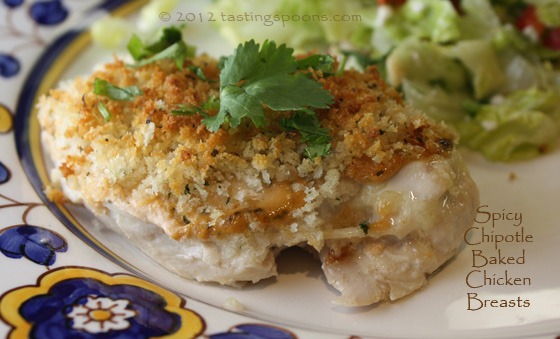
Oh, I’m so tickled to share this recipe – it’s SO easy. And SO tasty. It’s boneless, skinless chicken breasts, pounded a little to make them thinner, topped with a slather of mayo with chipotle chiles, further topped with a panko mixture and baked for about 15 minutes. How’s that for easy?

Over on my list of “Favs,” there aren’t very many that I’d call easy. A few. But this? It’s going on the list. Oh, so easy to make. It may become part of my regular rotation. It’s full of flavor. The chicken is tender and juicy, and it takes about 10-15 minutes of prep time max, and bakes for 15 minutes. I had dinner on the table in about 40 minutes. While the chicken baked I whipped up a green salad, and I had a left over veggie to go with it. Dinner done! Love that.

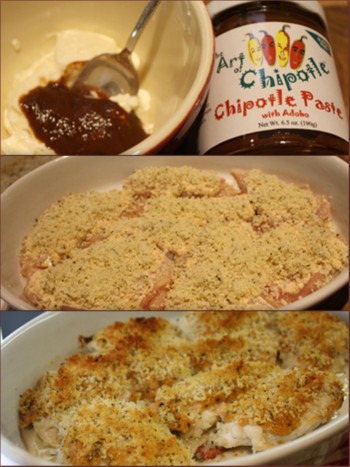
chipotle chickenHere’s the procedure . . . first I opened up this jar you see at left – it’s called The Art of Chipotle, Chipotle Paste with Adobo – found it at my local grocery store – instead of having to open a can of chipotle chiles in adobo, or dig out some of the frozen mush I have, I now have a new condiment (which will take up refrigerator space unfortunately). The paste is pureed, so you don’t have to handle the chiles (which burn my fingers) – just use a spoon to measure out what you need. You can see the chipotle paste in the bowl with the mayo. The original recipe called for up to twice as much chipotle – I tend to under-heat with chipotle – so I used just a tablespoon instead.

After mixing it up, adding dried cilantro (I learned a lesson recently about dried cilantro – it gives a nice punch of citrusy flavor), I slathered the mixture on the chicken breasts that I’d pounded out to 1/2 inch thick. I’d lightly oiled the baking dish so the meat wouldn’t stick. I also made a lightly moistened panko mixture too – moistened with a little bit of oil and added some more of the dried cilantro. The center picture is the chicken ready to bake. The chicken went into a hot oven for about 15 minutes. There you can see the finished dish, nice and golden brown. From start to finish this dinner took me about 40 minutes.

COSTCO CHICKEN POUCHES: Certainly I’ve mentioned before that I buy those pouches of chicken breasts (fresh) at Costco. The  6 pouches (2 per pouch) are separated and then get thrown into the freezer and I pull them out when I want them. DEFROSTING: The pouch goes into a deep bowl of cold water. I put a big wide pasta bowl on top of the chicken (the bowl just fits into the bigger bowl with enough room for my fingers to grab it), then a heavy object goes in the inner bowl (I use a ceramic canister that sits near the kitchen sink – it’s just decorative, doesn’t contain anything – use something that won’t spill, obviously) to weight down the meat. Sometimes as the pouches defrost they’ll move around in the water (air displacement, I suppose), so that’s why the wide bowl on top needs to keep that chicken under water! You don’t want the chicken pouch(es) to float – the poultry needs to stay submerged. It takes about 2 hours or so (maybe 3) to defrost the chicken, depending on how thick the package is. After 2 hours I massage the pouch – if there is still firm/frozen meat in the middle, it stays in the water for another hour. The cold from the frozen pouch keeps the water cold-cold, enough so there’s no chance of salmonella forming, and yet it’s warm enough that it defrosts easily enough.

POUNDING

Okay, so once I have a defrosted pouch of chicken, I have to pound it thin. Those Costco breasts always contain the chicken tender. I remove that (cut or tear it off) and it becomes just another odd shaped piece of chicken I’m preparing. With the pouch I defrosted for this recipe, the 2 breasts inside were absolutely gigantic, so when I pounded the main breast, it was about 8 inches long and nearly 5 inches wide in the center portion. I cut those pieces in half – much more manageable pieces.  I could have served 6 people (moderate appetites) with that one pouch.

We are back singing in our church choir, so  on rehearsal nights I’ve got to be prompt with dinner on the table by 6 pm. With this dish it will be easy to do! The recipe was adapted quite a bit from a Phillis Carey one I found in one of her cookbooks. I added the cilantro (fresh and dried) and the oiled panko crust. So the idea was hers, but I flew off on a tangent when I made it.

What’s good: certainly the ease of making it. It would even be worthy of a company meal. Now that’s saying something for me to have an “easy” dish I’d make for guests. Does that give you any idea how good this is? And FYI, there is just a little HINT of heat – some people might not even notice it.
What’s not: really nothing. It’s a winner of a recipe.

printer-friendly (CutePDF Writer) PDF
MasterCook 5+ import file – right click to save file, run MC, then File|Import

* Exported from MasterCook *

Spicy Chipotle Baked Chicken Breasts with Panko Crust

Recipe By: Adapted from a Phillis Carey recipe
Serving Size: 4

1 pound boneless skinless chicken breast halves — (4 pieces)
Salt and freshly ground black pepper to taste
1/3 cup mayonnaise — use light mayo, but make it Best Foods/Hellman’s
1 tablespoon chipotle chile canned in adobo — finely minced or mashed
1 1/2 cups panko bread crumbs
1 1/2 teaspoons dried cilantro — divided use
2 teaspoons canola oil
2 tablespoons fresh cilantro — chopped for garnish

1. Preheat oven to 450°.
2. Trim chicken breasts and pound pieces between two sheets of plastic wrap to an even 1/2 inch thickness.
3. Arrange chicken breasts on a oil rubbed baking dish just large enough to hold the pieces. Season chicken with salt and pepper.
4. In a small bowl combine the mayo and chipotle with a bit of the dried cilantro. Mix well.
5. In another small bowl combine the panko crumbs, remaining dried cilantro and oil. Mix well so all crumbs are coated in oil.
6. Smear the mayo mixture on top of the chicken pieces, then sprinkle the bread crumbs on top of that, covering evenly.
7. Bake for 12-15 minutes (depending on thickness) until chicken is cooked through and bread crumb mixture is nicely browned. Top with chopped cilantro and serve.
Per Serving: 359 Calories; 20g Fat (49.8% calories from fat); 30g Protein; 16g Carbohydrate; 1g Dietary Fiber; 72mg Cholesterol; 254mg Sodium.

Posted in Chicken, on November 10th, 2012.

murgh_korma_chicken_curry

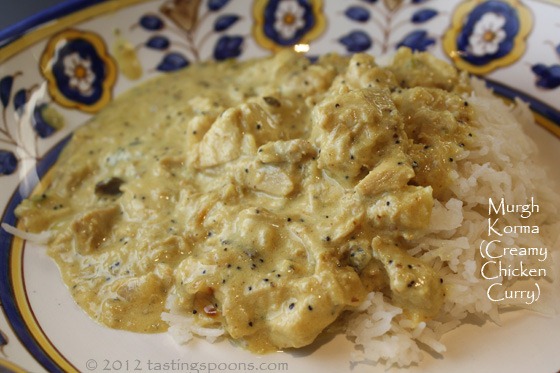
Chicken curry is probably my favorite Indian dish. That’s probably why I have 3 other recipes on my blog for similar dishes. When I had some left over chicken the other night, my first thought was to make it into a curry. I adapted a new recipe for this version, and would definitely make it again. It is more work than some, however. In the mixture above you’ll see some poppy seeds – something I’ve never included in chicken curry before.

The October issue of Saveur magazine contains 150 best recipes from around the world. Recipes that define some regions, countries, cuisines. The article (really it’s almost the entire issue) has loads of lovely photos and brief stories about the recipes. They cover things like Major Grey’s Chutney, Boston Cream Pie, Shepherd’s Pie, Chicken Liver Pate, Mulligatawny Soup, Nasi Goreng, Oxtail Stew, Quiche Lorraine, Felafel, Beef Stroganoff even. And that’s just a smattering of the list. You can peruse all 150 recipes (only 100 made it to the print issue) by clicking on the link above.

This particular recipe is from a restaurant chef (Hemant Mathur from Tulsi in NYC). I did run into a glitch or two just reading the recipe – it wasn’t written with the home cook in mind, I’m guessing, so I’ve re-written it to make it easier (I hope). As I was cooking, I had to look to the recipe dozens of times as the instructions were less than helpful! But I managed. I also adapted the recipe in several ways – I used less heat (fewer serranos); I used already cooked chicken; and I did my best to remove all the whole spices before one of the paste mixtures went into the food processor. Nobody likes to bite into a big chunk of cinnamon bark, a whole allspice or peppercorn. I also used about 1/3 less vegetable oil called for. The recipe also listed rose petals. I didn’t have any without pesticides on them, so I took that out of the recipe completely. I also added a bit more yogurt and cream because I wanted more sauce. I’ve made chicken curries before – here on my blog you’ll find Saffron Chicken Curry, an old Dinah Shore quick curry called Chicken Curry Without Worry, and a 100 Almond Chicken Curry, a delicious one too, using coconut milk. All of these are good. Now I’ve got more competition with this new recipe added to the mix.

As I mentioned above, this took quite a bit more prep time than I’d anticipated just by glancing at the ingredient list (without the little title separators I added in my version below). The first order of business is to get the onions cooking,  since that takes about 45+ minutes. The nut paste can be made while they’re caramelizing. You might get all the spices out and at the ready too. And, mince, chop or slice all the ginger and garlic ahead of time. You need it in several junctures of the recipe preparation. I didn’t caramelize the onions as much as I should have, so my sauce wasn’t as golden brown as the magazine picture. Next time I’ll make more time for the caramelization process.

Most curries are served with rice, and I made some basmati this time. If you read my essay about arsenic in rice, then you already know we should be limiting our intake of rice to 2 half cup servings a week. I did 2 things to improve the odds – I bought Trader Joe’s imported basmati rice from India (which has less arsenic than most) – and I rinsed the rice thoroughly (most of the arsenic is on the outside of each rice grain).  I also measured our servings of rice (I do that anyway for my DH since he must calculate carbs).

What I liked: the all-over-the-map flavors from the variety of spices in this. You’ll be hard pressed to pick out any one spice flavor, however (a good thing). My DH loved it – really loved it. He spoke several superlative words as he was licking his spoon, retrieving every single rice kernel. He even said something like this was one of the best chicken dishes I’ve ever made. I don’t give it that much credit – but yes, he really, really liked it. I did too. I’ll be better organized when I make it next time.
What I didn’t like: well, it’s more labor intensive than I would have wished, but when we tasted the results, it made it all worthwhile.

printer-friendly PDF
MasterCook 5+ import file – right click to save file, run MC, then File|Import

* Exported from MasterCook *

Murgh Korma (Creamy Chicken Curry)

Recipe By: Adapted from Saveur, Oct. 2012 (from Hemant Mathur, Tulsi, NYC)
Serving Size: 8
NOTES: FYI – you need garlic and fresh ginger in some quantity – they are used in more than one place in the recipe. I used left over cooked chicken when I made this, but I added the marinade to the cooked chicken anyway, and didn’t cook the chicken except to warm it through.

CHICKEN:
1 pound boneless skinless chicken breasts — cut into 2″ cubes
1 pound boneless skinless chicken thighs — cut into 2″ cubes
1 tablespoon fresh ginger — minced
1 teaspoon minced ginger
1 tablespoon minced garlic
1 tablespoon fresh lemon juice
Kosher salt to taste
NUT PASTE:
1/4 cup blanched almonds
1/4 cup raw cashews
1 tablespoon poppy seeds
1/3 cup water
ONION PASTE:
1/4 cup canola oil
3 cloves garlic — thinly sliced
1 tablespoon black peppercorns
2 teaspoons fennel seeds
3 whole cardamom — whole pods
2 whole whole cloves
1 whole bay leaf
1/2 stick cinnamon
3 large yellow onions — thinly sliced
One 2-inch piece ginger, sliced
SAUCE:
3 tablespoons canola oil
1 tablespoon fresh ginger — finely minced
2 whole serrano peppers — stemmed and minced
1 teaspoon ground turmeric
1/2 teaspoon paprika
1 1/2 cups yogurt — (I used Greek fat-free)
1/2 cup heavy cream
Salt and freshly ground black pepper to taste
Cooked basmati rice (not included in nutrition info)

1. CHICKEN: Toss chicken with 1 T minced ginger, minced garlic, juice, and salt in a bowl; chill 1 hour. Keep sliced ginger,
2. NUT PASTE: Purée almonds, cashews, poppy seeds, and 1/3 cup water in a blender; set nut paste aside.
3. ONION PASTE: Heat 1/4 cup oil in a 6-qt. saucepan over medium-high heat. Add peppercorns, fennel, cardamom, cloves, bay leaf, and cinnamon; cook until toasted, about 2 minutes.
4. Add sliced ginger, garlic slices, and onions; cook over medium heat until deeply caramelized, about 45 minutes. If cooked over high heat the garlic will burn.
5. Remove and discard all of the whole spices and bay leaf (fennel seeds and cardamom seeds without the shell are okay). Purée onion mixture with 1/3 cup water in food processor or blender; set onion paste aside.
6. SAUCE: Add oil to pot over high heat. Add onion paste, remaining ginger, and chiles; cook until oil separates, about 6 minutes, Add turmeric, paprika, and salt; cook for 1 minute.
7. Add chicken; cook until lightly browned, about 8 minutes. Add 1 cup water; bring to a boil, reduce heat to medium-low; cook, covered, for 15 minutes.
8. Add nut paste and yogurt; cook over low heat until emulsified, about 3 minutes. Stir in cream and heat until bubbling. Taste for seasonings (I added both salt and pepper). Serve with basmati rice.
Per Serving: 420 Calories; 29g Fat (59.4% calories from fat); 29g Protein; 15g Carbohydrate; 4g Dietary Fiber; 102mg Cholesterol; 200mg Sodium.

Posted in Desserts, easy, on November 8th, 2012.

lemon_bundt_cake

If beauty were the only thing needed in a cake, this one would be a winner in my book. Pretty! Carefully drizzled with icing that puddles on the cake stand. Lots of light and dark contrast in the photo. From a blogging point of view, yes, the picture is a good one! And actually, from an eating point of view, it’s tasty also. Not off the charts (because it’s from a boxed mix), but certainly good enough. It was for a church event. I did something a little bad – I cut the cake into about 20 slices, and cut one itty-bitty shred for myself and gently mushed the cake together. I needed to taste it, right? Quality control, for sure!

I’m not going to write up much about this cake – it’s fairly self explanatory – a boxed yellow cake mix, a box of instant lemon pudding, some oil, water, 4 eggs and into a greased and floured bundt lemon_bundt_cake_slicecake pan it went. Once baked and cooled, I mixed up some lemon juice with powdered sugar and when it was thick enough I drizzled it on top. Just after I took that photo I sliced up the whole cake – here’s a picture of the interior. I removed 2 slices just to take the photo, then cut my itty-bitty see-through shred to taste and re-formed the cake on two heavy-duty paper plates.

How did it taste? Like a light, lemony cake from a mix. I do have another lemon cake on my blog that my friend Joan made – if you click on that link, you’ll find an Ina Garten recipe that was sensational some years ago. But also here on my blog I have a Yellow Cake with Fudge Frosting, a wonderful made-from-scratch yellow cake – it’s breathtakingly tender – like a cake mix, but it isn’t. It’s from scratch. Both of those are delish. But in this case I was in a hurry to make something – mostly to be eaten by children, so they wouldn’t know whether it was a mix or home made, so I opted to go quick and easy. And it was.

What I liked: obviously –  it was easy to make. I had a yellow cake mix in my pantry, and the box of lemon instant pudding. Even the icing was simple. And it had delightfully lemony flavor. It would be nice with a scoop of vanilla ice cream, for sure.
What I didn’t like: nothing, really. It’s a cake-mix cake enhanced with lemon. Perfect for what I needed.

Lemon Bundt Cake with Lemony Icing

Combine 1 yellow cake mix (without pudding in the mix), 1 small 3-ounce pkg. of lemon instant pudding, 4 eggs, 2/3 cup vegetable oil, 2/3 cup hot water. Mix well; pour into greased & floured bundt pan and bake at 350° for about 40 minutes. Cool in pan for 15 minutes, then invert on a rack to cool completely. In a small bowl combine about 3 T. lemon juice and about a cup of powdered sugar. Stir and mix until smooth. If not thick enough, add more sugar as needed to get a thick drizzle. Spoon over cake.

Posted in Uncategorized, on November 6th, 2012.

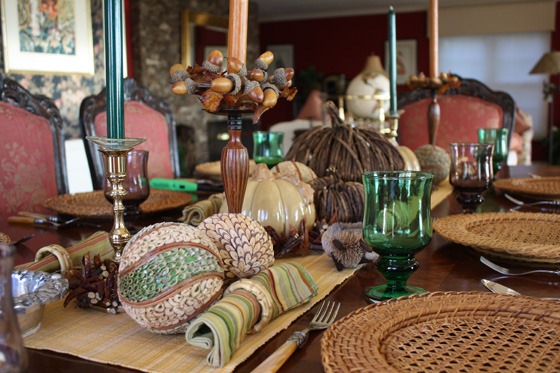
We entertained a few nights ago. I made my easy cassoulet, spinach hummus, a new sweet onion and thyme dip (it will be posted here next week), and one of my favorite sides, baked onions with thyme. Other guests brought a salmon dip (that I loved, and hope to give you a link to Kim’s blog once she posts it) and a delicious sugar-free apple strudel. Another guest helped me by making a cocktail – a clove-scented sidecar. That recipe will be up in another week or so too. I had fun setting the table. Over the years I’ve collected a bunch of Fall and/or pumpkin-oriented stuff that I use on our kitchen island or on the dining room table. Just thought I’d share with you. I don’t know that rattan chargers are “in” any more, but I like them. I’ve had the decorated balls for several years. The ceramic pumpkins I bought a few years ago, along with the rings that go on the candle bases. The big twig pumpkins I bought last year on sale.

fall_dining_table_decor1

fall_dining_table_decor2

Do you suppose anybody noticed that one candle was a little Leaning Tower of Pisa? Hope not! The brownish thing lying on the runner (just above the silver wine holder) that s-curves is a 5-foot long garland, of sorts, of sewn-together cut twigs and red chiles (dark red, so you can hardly see that they’re red, as they’re almost brown). I bought it years and years ago – every time I touch it, almost, a red chile (very dried out, obviously) breaks open and a dozen seeds fall. But I like the texture of it. I store it in a plastic sealing bag the other 11 months of the year!

Posted in Cookies, on November 6th, 2012.

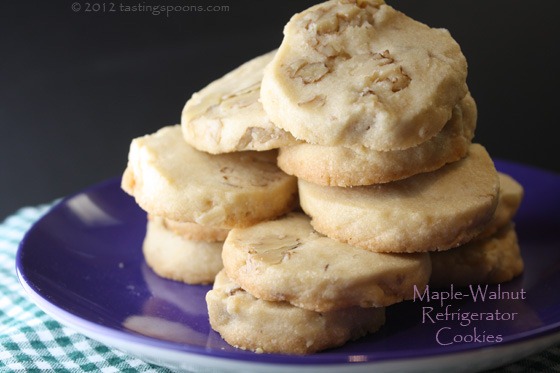
maple_walnut_refrigerator_cookies

If you’re new to my blog (I have a lot more readers these days – maybe because I’m posting some of my food pictures on Pinterest), you don’t know that over the course of my life I’ve collected thousands of recipes. Oh my goodness, have I! It’s almost a sickness, and yet I can’t seem to stop! My mother, back in 1997, when she was within a few months of passing away (and in really good health at that moment) actually handed me a recipe she’d clipped out of a magazine – she said she couldn’t seem to help herself. She didn’t cook at all then (she was 89 and lived in a retirement home), but she thought I might like it. I put it in my purse and it went into the trash later. It didn’t appeal to me at all. I feel guilty about that now! I wish I had that recipe – I’d make it just because it was something she gave me so near to the end of her life. Anyway, on to this recipe.

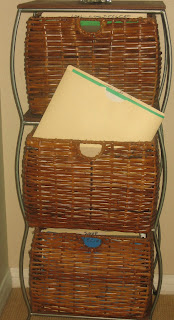
What I have in a hallway in our house (about 15 steps from the kitchen) is a 3-tier storage container (rattan baskets in a stand) that contain the recipes I collected from about 1965-2003. There you can see it at left. In our former house I had a huge – HUGE – set of drawers that housed Pentaflex racks and my recipe files lived there, right in the kitchen. In the house we’re in now, I didn’t have the space for such a thing in the kitchen (prior to the remodeling we did), so I bought this contraption and jamb-packed it with file folders by recipe type. When we did remodel, these just stayed where they are, sitting in a little alcove, out of the way, but there if I need them!

In the ensuing years I’ve really tried to limit the recipes I clip out of magazines and newspapers. I say to myself “Am I really going to make this? Really?” I try to not clip more than 1-3 in any one magazine. Those that make the cut go into 3-ring binders. So yes, I’m still collecting recipes. Occasionally I go to the archives (the baskets) to find something. Some years ago I actually went through the entire thing and got rid of about half of the recipes in there – things I knew I wouldn’t make – like home made phyllo dough, or real croissants, pickling my own sauerkraut, and lots of canning recipes. You know, those kinds of things.

So anyway, I was scouring the files for some old recipe; can’t even remember what it was now, but it was something in the cookie folder. And out flitted a recipe onto the floor. I reached for it. Yes, a cookie recipe. But hmmm, this looked good. Not what I needed that day, but I took it out and put it on my to-make-soon cookbook stand I have right next to this computer. It’s sat there for several weeks, then one day it just said “make me.”

Where this recipe clipping came from, I’m not sure, but when I went searching online for this recipe (only a couple of sources had it, and only one person had written a story about it) someone wrote that it was in the brochure for Jessica’s Biscuit, then a place to order cookbooks (and I did at one time). Nancy Silverton’s book Desserts is called a classic, and it’s popular enough that it’s been reprinted. Anyway, the recipe clip said it’s Nancy Silverton’s recipe – and her comment was that if she ever had to be limited to one slice and bake cookie, this would be it. That’s good enough testimony for me.
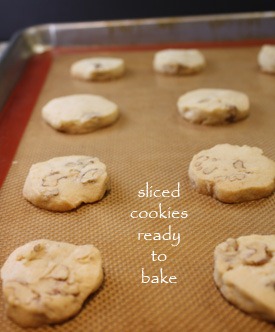
The cookie is easy to mix up. My only difficulty was that I thought I had pecans. I didn’t. So I used walnuts instead. I think pecans would have a bit more flavor, but walnuts were great, don’t get me maple_walnut_cookies_to_bakewrong here! It’s a kind of very tender shortbread cookie and not overly sweet. Love the maple syrup in it, and just one egg yolk. But half a pound of butter. No, not low fat! Ha! The dough is chilled, then formed into cylinders and frozen solid. The next day I baked them, and found that if the rolls sat out for about 10 minutes they were a lot easier to slice. With large walnut pieces in the dough, if my knife hit the nut just so, it broke the slice altogether. But I was able to piece them back together mostly. The recipe said it made 72 – obviously I sliced the cookies a little thicker than 3/8”, so I got about 42 or so. The cookies don’t spread at all (there’s no leavening in the cookie, remember) so you can pack the cookie sheet well. The only caution in the recipe is that the cookie must be baked completely to be tender. If you under bake them, they’re tough, apparently. I didn’t have that difficulty, but I did have to bake my cookies (possibly thicker ones) for 18 minutes to get them just barely golden brown around the edges. I cooled them – promptly ate two (yum) with a cup of tea – and put the remainder in the freezer.

What I liked: the batter was easy-peasy to mix up and chill. Really easy to roll into cylinders too. And relatively easy to slice and bake. Taste: yum. Tender, buttery, and absolutely perfect with a cup of tea I made this afternoon! And these would be wonderful for Christmas. Make them up ahead and keep on hand to bake when needed. Or they’d work great for a cookie exchange too.
What I didn’t like: absolutely nothing. The frozen dough was a little finicky to slice, but not a deterrent to making them!

printer-friendly PDF
MasterCook 5+ import file – right click to save file, run MC, then File|Import

* Exported from MasterCook *

Maple-Pecan or Maple-Walnut Cookies

Recipe By: Nancy Silverton (baking genius) from her book “Desserts,” 1986.
Serving Size: 72
NOTES: I didn’t get 72 cookies – more like about 40-45, so I must have sliced them thicker than I was supposed to. I also had to bake them for 18 minutes – watch carefully – you don’t want them to over bake. Dough cylinders can be frozen for several weeks. When ready to bake, remove from freezer and allow to sit for 10 minutes or so until you can slice them easily.

2 sticks unsalted butter
1/2 cup granulated sugar
1 large egg yolk
2 tablespoons maple syrup — the real stuff (no imitation)
1/2 teaspoon vanilla extract
1 3/4 cups all-purpose flour
1 1/4 cups pecan halves — or walnuts

1. To make dough: Using paddle attachment of electric mixer, beat butter on medium speed for 3 to 5 minutes or until it whitens and holds soft peaks. Add sugar. Beat until well blended. Whisk together egg yolk, maple syrup and vanilla. Beat into butter mixture, scraping down sides of bowl when necessary. Add flour on low speed and mix only until combined. Beat in pecan halves until combined. Wrap dough in plastic wrap. Chill for 30 minutes or until firm.
2. To form dough into logs: Divide dough into 4 sections. Working with one section at a time (and keeping others in refrigerator), roll on floured surface into 1-1/2-inch diameter log. Place on cookie sheet. Freeze for 30 minutes or until firm enough to slice. Repeat with remaining dough.
3. To bake cookies: Preheat oven to 325°. Adjust rack to middle position. Using very sharp knife, slice logs into 3/8-inch-thick rounds. Place 1 inch apart on Silpat or parchment paper lined baking sheet. Bake for 12 to 15 minutes or until firm and lightly browned. (Note: Cookies must be cooked through to be tender.)
Per Serving: 54 Calories; 4g Fat (63.9% calories from fat); 1g Protein; 4g Carbohydrate; trace Dietary Fiber; 10mg Cholesterol; 1mg Sodium.

Posted in Healthy, Pasta, Veggies/sides, on November 4th, 2012.

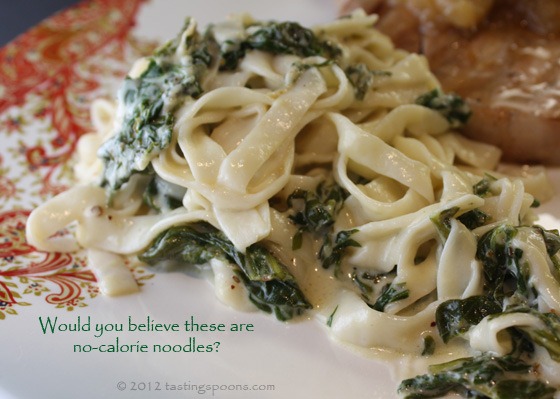
no_calorie_noodles_arugula_spinach

No, I’m not joshing you. And no, these aren’t made of cardboard, either. Cardboard would have carbs perhaps? From tree bark and fiber? Nope, these are made from tofu and some kind of
Asian yam. I’m sure I have some readers who, after just
seeing that word tofu – will not even read further. I might have been one of those some years ago. I don’t eat tofu, as tofu, but if it’s in other things, well, yes I do. These noodles have almost zero calories, nearly zero carbs, zero fat in a single serving.

It’s not news on this blog that we are a family of two try to limit carbs, what with my Type 1 diabetic husband. And certainly I can cut down on them myself. But I’ll tell you true – I miss pasta. Once in awhile – a big splurge for us – I make a huge batch of spaghetti sauce from one of my numerous recipes (my favorite one this year is Ina Garten’s Weeknight Bolognese Sauce). I freeze some of it for other dinner splurges months hence. Well, we’re now going to be able to have all we want because of these fantastic new products.

I’d heard about them several months ago when I got an email from one of the daily deal emails I subscribe to, offering me “Miracle Noodles” for some unbelievably low cost. I knew nothing whatsoever about them. I talked to a friend of mine, a recent Type 2 diabetic, who is struggling with her revised diet, to ask if she’d like to share the box with me. It was 29 packages or some odd number. She said no. Knowing so little, I opted not to buy it, either. Then I visited a local Asian market, thinking that surely they would have them – indeed they did, although it wasn’t the “Miracle” noodle, but Tofu Shirataki (the fettucine and angel hair varieties shown here), and it took the store manager’s involvement to find them in the store. Aha! In the refrigerated area – not really near anything in particular – and they were lying flat, so you couldn’t see the package front very well. FYI: a 4-ounce serving (half of the above package) contains 20 calories, .5 grams of fat, 15 mg of sodium and 3 g of carbs. And 1 g of fiber. As I’m writing this, I haven’t had the Miracle Noodle yet – I’ll probably write up another post after that with more info.

Each package holds about 8 ounces including the fluid – and about 4 ounces of net wet noodles – enough for 2 side servings. And just maybe enough for a small serving of a pasta main dish. These packages need to be refrigerated and they’ll keep for about 6 months. They don’t ever spoil, really, but eventually, the noodle may dissolve into its primary form of glucomannen (that’s the tofu and yam product).

I threw together a side dish to serve them the first time. I had no recipe, but wanted to make it a little special for the first time we’d eat them since I wasn’t certain my DH would eat them – he did and he liked them. He loves pasta too, and encourages me to NOT make it very often since it wreaks havoc with his blood sugar. The thing you need to remember is that these noodles, like most tofu products, don’t have much taste straight out of the package, so you must add flavorful ingredients to them, so they’ll soak up the flavor. Don’t just heat them with a little oil or butter and expect them to have great flavor. They won’t.

The other thing about these noodles is that they’re packed in a rather unappetizing fluid (that you drain off). It smells something like Asian fish sauce. In case you haven’t ever taken a sniff of Asian fish sauce, well, it’s not pleasant – kind of like rotten fish, actually. Tastes great, but doesn’t smell all that nice. So, there is a process of getting the noodles ready to eat. First, drain them, then rinse well under running water. According to the package instructions, I put them on a plate and microwaved them for 60 seconds. You can also “cook” them in a nonstick pan until they make a kind of squeaky sound in the pan, but microwaving is almost easier. I rinsed them again, drained again, then they went into the skillet. They’re already cooked, you see, so they don’t really need further cooking – just heating – but they need to absorb flavor. So I stirred them around, added the dairy stuff, some herbs and cayenne, and let them sit in the pan just barely simmering. I had to add a little water as the creamy ingredients boiled away, tasted it for salt and pepper, added the grated cheese and served it piping hot.

What I liked: the fact that they’re very similar – not identical – to a wheat noodle, but have so few calories and carbs. That’s the logical answer, of course. Why would we bother to eat these unless they were giving us some kind of nutritional boon. Or if I needed to restrict gluten. Obviously these are GF also.
What I didn’t like: if you forced me to say something negative (I’m trying to be at least neutral or unbiased), the texture of these noodles aren’t the same as a wheat pasta fettuccine noodle. It doesn’t have the same kind of “chew” as a wheat noodle – more like a rice noodle to me. But if you know going into it that you’re wanting a vehicle for the SAUCE – it’s the sauce we love, right? – then these noodles absolutely work. All in all, this is a great alternative to a much higher calorie wheat noodle.

printer-friendly PDF
MasterCook 5+ import file – right click to save file, run MC, then File|Import

* Exported from MasterCook *

Shirataki Fettucine with Arugula and Spinach

Recipe By: My own concoction.
Serving Size: 2

2 teaspoons unsalted butter
1 cup arugula — fresh, chopped
1 cup baby spinach — fresh, chopped
8 ounces tofu shirataki — fettucine style (read notes regarding preparation)
1 tablespoon light sour cream
1 tablespoon heavy cream
2 tablespoons goat cheese — crumbled
1/2 teaspoon dried oregano
1/2 teaspoon dried thyme
1 pinch cayenne
1/2 cup Parmigiano-Reggiano cheese — grated
Salt and freshly ground black pepper to taste
water, as needed to keep the mixture fluid

1. TOFU SHIRATAKI PREPARATION: Remove noodles from package and drain. Run under water for 30-40 seconds, lifting and separating. Place noodles on a plate and microwave for about one minute (this parboils them). Remove from microwave and wash under running water again. Drain.
2. Meanwhile, in a large skillet (large enough to hold all of the mixture) melt the butter. Add arugula and spinach and stir over medium heat until greens are cooked. Add tofu shirataki noodles and stir to combine.
3. Add the sour cream, cream, goat cheese, herbs and cayenne. Stir to combine and continue heating over low heat. Add shredded Parm, salt and pepper to taste and add water to the pan if it’s thicker than you want. Serve immediately. Makes enough for a side dish, not a main dish.
Per Serving: 193 Calories; 16g Fat (66.2% calories from fat); 13g Protein; 6g Carbohydrate; 3g Dietary Fiber; 44mg Cholesterol; 432mg Sodium.

Posted in Appetizers, on November 2nd, 2012.

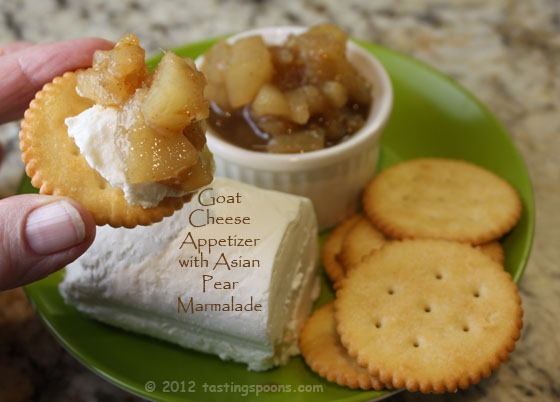
goat_cheese_pear_marmalade_cracker

You may have read before – brown food is hard to photograph. So I put this on a bright green plate, then added the white goat cheese as contrast. How’d I do?  This is a fabulous make-ahead appetizer. It’s worth the effort to make it – do try it. And by the way, those are not Ritz crackers – they’re Trader Joe’s version of them. They’re quite good!

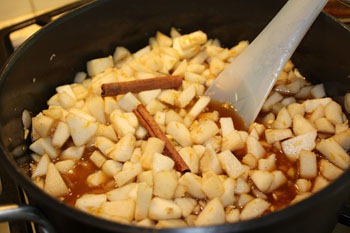
I almost forgot to post this recipe – it was from a cooking class a couple of months ago. I was doing some background admin stuff on my blog  and ran across it – then realized I hadn’t written a story about it or shared the recipe. Every few months I have to transfer all the images from the posts to a CD for long-term safekeeping. So, I go through each image folder (I put all the photos into folders by recipe title, then they go onto a vaguely chronological ordered CD) and delete the extra photos that I chose not to use – wrong angle, bad light, parsley isn’t perky, shadows wrong, too far away – pear_marmalade_cookingyou know, those kinds of things. I had a photo of this from the class, but it was terrible. All brown everywhere. So I needed to make it in order to take a better picture! First I had to buy all the ingredients (didn’t have the pears or five spice powder). Then I had to wait 3 days for the Bartlett pears to ripen. Finally, then, got it made! I didn’t need an appetizer, but I decided to make this now, knowing I’ll be needing some for holiday entertaining. Here at right are the ingredients before I started cooking them. Just chopped,  raw pears, water, orange zest and juice, ginger I whizzed up in the food processor, five spice powder, brown sugar and cinnamon sticks. Oh, and vanilla.

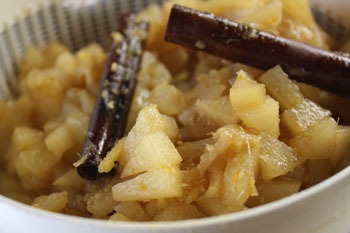
What’s great about this appetizer is that you can make the marmalade several weeks ahead. With all the sugar in the pear mixture, it should keep for awhile. My thought was to make it for sometime over Thanksgiving weekend. I made a double batch, so actually I will freeze half for using in December. The mixture doesn’t have enough sugar that it’s truly a “marmalade” by jam-making standards. So it won’t keep for months on the shelf in the refrigerator. Use this within a week, and freeze what you haven’t eaten. Just don’t invite the same people over more than once! On second thought, I think you’ll like this enough you won’t pear_marmalade_cookedbe concerned to serve this twice, even if it was the same group of friends. Or family.

There’s a photo of the finished marmalade – I left the cinnamon sticks in the picture just for more brown-on-brown contrast. The pears have a lovely, warming bite from the fresh ginger in it. The orange zest and juice add some nice sweet notes. Then it’s also got vanilla, cinnamon (stick) and five-spice powder. The five-spice gives it a real interesting depth. It’s kind of elusive – you might not know what it is unless someone told you. Makes it different. Really different. The pear marmalade needs something to cut the richness (although there’s not a bit of butter or fat in it – I mean the intense flavors), so the goat cheese is the perfect choice.  With a bit of the left overs, I paired it with grilled pork chops. It was lover-ly.

What I liked: the sweet, the bite from the ginger. Loved the Chinese five-spice powder in it. It’s a sweet appetizer – just know that. With some goat cheese to spread on a cracker and the marmalade piled on top? Yummy. This would also make a delightful hostess gift if you’re into making these kinds of things to give to friends. If you wanted to make it complete, give the hostess a log of goat cheese and a tube of crackers.
What I didn’t like: absolutely nothing. It’s a keeper.

printer-friendly PDF
MasterCook 5+ import file – right click to save file, run MC, then File|Import

* Exported from MasterCook *

Goat Cheese with Asian Pear Marmalade

Recipe By: Tarla Fallgatter, caterer and cooking instructor
Serving Size: 8
Notes: I used a mixture of half Asian pears and half Bartlett (something Tarla said was an option).

MARMALADE:
1 2-inch piece ginger, peeled and grated
1/2 cup water grated zest of one orange
2 tablespoons fresh orange juice
1/2 cup brown sugar — packed
1 teaspoon Chinese five-spice powder
1/2 teaspoon vanilla
1 whole cinnamon stick
4 whole Asian pears — peeled, cored, chopped into 1/2″ pieces
ASSEMBLY:
11 ounces goat cheese — log type
1 tablespoon Italian parsley — garnish
plain crackers

1. In a medium saucepan, combine all the marmalade ingredients together. Bring to a boil, reduce heat, cover and simmer for 3 minutes. Uncover and continue cooking, stirring occasionally, for 15 minutes, or until soft and mushy.
2. Remove and discard the cinnamon stick. Let cool to room temperature. Place the log of goat cheese on a platter and spoon some of the marmalade on top. Garnish with Italian parsley and surround with crackers. If you’d like a more sticky hold-together mixture, remove all the pears and drain through a colander, reserving all the fluid. Return the fluid to the pan and reduce it until it’s almost syrupy. Also, I removed about a third of the pears and mashed them, then put them back in. That way there will be some mushy pulp and some pieces.
Per Serving: 243 Calories; 14g Fat (51.1% calories from fat); 12g Protein; 18g Carbohydrate; 3g Dietary Fiber; 41mg Cholesterol; 140mg Sodium.

Related Posts Plugin for WordPress, Blogger...