Get new posts by email:

Archives

Currently Reading

Here are the tastingspoons players. I’m in the middle (Carolyn). Daughter Sara on the right, and daughter-in-law Karen on the left. I started the blog in 2007, as a way to share recipes with my family. I’m still doing 99% of the blogging and holding out hope that these two lovely and excellent cooks will participate. They both lead very busy lives, so we’ll see.

– – – – – – – – – – – – – – – – – – – – – –

BOOK READING (from Carolyn):

Music of Bees, Eileen Garvin. Absolutely charming book about a woman in midlife, lonely, who raises bees, also makes unlikely friends. Heart-warming and very interesting about beekeeping.

A Postcard from Paris, Alex Brown. Really cute story. Dual time line, 1940s and present day about renovating an old apartment in Paris, things discovered.

Time of the Child, Niall Williams. Oh such a good book. Very small village in Ireland, 1960s. A baby is left on the doorstep. The town all whispers and helps. I listened to an interview of the author, which made me like him and his books even more.

Sipsworth, Simon Van Booy. If you like animals you’ll swoon. An old woman who really wants to die finds a tiny mouse in her house and befriends it and finds a reason to live. Utterly charming book.

The Forger’s Spell, Edward Dolnick. True story. For seven years a no-account painter named Han van Meegeren managed to pass off his paintings as those of Johannes Vermeer.

If You Lived Here, You’d be Home by Now, Christopher Ingraham. Could hardly put it down – about a journalist who takes on a challenge to move to small town in Minnesota and write about it. He expects to hate it and the people and place, but he doesn’t. Absolutely wonderful true story.

The River We Remember, William Kent Kreuger. 1950s, Minnesota. A murder and the aftermath. Could hardly put it down. Kreuger has such a vivid imagination and writing style.

How the Lights Gets In, Joyce Maynard. An older woman returns to New Hampshire to help care for her brain-injured son. Siblings and family, lots of angst and resentments.

The Filling Station, Vanessa Miller. Every American should read this book. A novelized retelling of the Tulsa massacre in 1921. Absolutely riveting.

The Story She Left Behind, Patti Callahan Henry. Love this author. Based on a true story. A famous author simply vanishes, leaving her husband and daughter behind. She had invented a mystical language no one could translate. Present day, someone thinks he’s solved the riddle, contacts the family. Really interesting read.

The Girl from Berlin, Ronald Balson. Love anything about Tuscany. An elderly woman is being evicted from a villa there, with odd deed provenance. Two young folks go there to help unravel the mystery. Loved it.

The Island of the Colorblind, Oliver Sacks, M.D. Nonfiction. The dr is intrigued by a remote Pacific island where most of the inhabitants are colorblind. He also unravels a mystery on Guam of people born with a strange neurological problem. Medical mysteries unveiled. Very interesting.

The Bookbinder, Pip Williams. Post 1914 London. Two sisters work at a bookbindery. They’re told to not read the books. One does and one doesn’t. One has visions beyond her narrow world; the other does not. Eventually the one gets into Oxford. Lovely story.

The Paris Express, Emma Donoghue. 1895 on a train to Paris, a disaster happens. You’ll delve into the lives of many people who survived and died in the crash.

A Race to the Bottom of Crazy, Richard Grant. This is about Arizona. Author, wife and child move back to Arizona where they once lived. Part memoir, research, and reporting in a quest to understand what makes Arizona such a confounding and irresistible place.

The Scarlet Thread, Francine Rivers. A woman’s life turned upside down when she discovers the handcrafted quilt and journal of her ancestor Mary Kathryn McMurray, a young woman who was uprooted from her home only to endure harsh frontier conditions on the Oregon Trail.

A Place to Hide, Ronald Balson. 1939 Amsterdam, an ambassador has the ability to save the lives of many Jewish children. Heartwarming.

Homeseeking, Karissa Chen. Two young Chinese teens are deeply in love, but in China. Then their families are separated. Jump to current day and the two meet again in Los Angeles.

North River, Pete Hammill. He always writes such a good story. A doctor works diligently healing people from all walks of life. His wife and daughter left him years before. One day his 3-yr old grandson arrives on his doorstep.

A Very Typical Family, Sierra Godfrey. A very messed-up family. Three adult children are given a home in Santa Cruz, Calif, but only if the siblings meet up and live in the house together. A very untypical scenario but makes for lots of messes.

Three Days in June, Anne Tyler. The usual Anne Tyler grit. Family angst. This wasn’t one of my favorites, but it was entertaining and very short.

Saved, Benjamin Hall. Author is a veteran war reporter. Ukraine, 2022, he nearly loses his life to a Russian strike. Riveting story – he survives, barely.

Grey Wolf, Louise Penny. Another Inspector Gamache mystery in Quebec. She is such an incredible mystery writer.

All the Colors of the Dark, Chris Whitaker. A missing person mystery, a serial killer thriller, a love story, a unique twist on each. Could hardly put it down.

Orbital, Samantha Harvey. Winner of 2024 Booker Prize. I don’t usually like those, but I heard the author interviewed and she hooked me. This is not a normal book with a beginning, a story and an end. It’s several chapters of the day in the life of various astronauts at the ISS (Int’l Space Station). All fictional. She’s been praised by several real astronauts for “getting it” about space station everyday life.

The Blue Hour, Paula Hawkins. An island off Scotland. Inaccessible except when the tide is out. Weird goings on. An artist. A present day mystery too.

Iron Lake, William Kent Krueger. A judge is murdered and a boy is missing. Riveting mystery.

Tell the Wolves I’m Home, Carol Ricks Brunt. 1980s. A 14-yr old girl loses her beloved uncle. Yet a new friendship arises, someone she never knew about.

Four Treasures of the Sky, Jenny Zhang. 1880s, a young girl is kidnapped in China and brought to the United States. She survives with many hurdles in the path.

The Boy Who Fell out of the Sky, Ken Dornstein. Memoir, 1988. The author’s brother died in the PanAm flight that went down in Lockerbie, Scotland. A decade later he tries to solve “the riddle of his older brother’s life.”

Worse Care Scenario, T.J. Newman. Oh my. Interesting analysis of what could/might happen if a jet crashed into a nuclear plant. Un-put-downable.

Song of the Lark, Willa Cather. Complicated weave of a story about a young woman in about 1900, who has a gifted voice (singing) and about her journey to success, not without its ups and downs.

Crow Talk, Eileen Garvin. Charming story which takes place at a remote lake in Washington State, about a few people who inhabit it, the friendships made, but also revolving around the rescue of a baby crow.

The Story Collector, Evie Woods. Sweet story about some dark secrets from an area in Ireland, a bit magical, faerie life, but solving a mystery too.

A Sea of Unspoken Things, Adrienne Young. A woman investigates her twin brother’s mysterious death. She goes to a small town in California to figure it out, to figure HIM out.

The King’s Messenger, Susanna Kearsley. 1600s England, King James. About one of his trusted “messengers,” and his relationship with a young woman also of “the court.” Lots of intrigue.

In the Shadow of the Greenbrier, Emily Matchar. Interesting mystery in/around the area of the famous resort in White Sulphur Springs, West Virginia.

Isola, Allegra Goodman. Hard to describe, survival story on an island in the 1600s.

Save the Date, Allison Raskin. Rom-com, witty, LOL funny. Clever.

The Sirens, Emilia Hart. Numerous time-lines, Australia. Mysteries abound, nightmares, abandoned baby, weird allergies.

Red Clay, Charles Fancher. LOVED this book. Mostly post-Civil War story about the lives of slaves in Alabama during Reconstruction.

Stars in an Italian Sky, Jill Santopolo. Dual time line, 1946 and recent time. Love stories and a mystery.

Battle Mountain, C.J. Box. Another one of Box’s riveting mysteries. Love his descriptions of the land.

Something Beautiful Happened, Yvette Corporon. A memoir of sorts in Greece, tiny island of Erikousa, where the locals hid Jews during WWII. All elusive stories told by the author’s grandmother.

The Jackal’s Mistress, Chris Bohjalian. 1860s Virginia, about a woman who saves the life of a Union soldier. Really good story.

Song of the Magpie, Louise Mayberry. Really interesting story about Australia back in the days when it was mostly a penal colony. Gritty strength of a woman trying to thrive with her farm.

The Boomerang, Robert Bailey. A thriller that will have you gripping the book. About a lot of secrets surrounding the president (fictional novel, remember) and his chief of staff and about cancer. A cure. Such a good story.

Care and Feeding, Laurie Woolever. Really interesting memoir of a woman driven to succeed in the restaurant business. She worked for Mario Batali and then Anthony Bourdain. Gritty stories.

Everything is Tuberculosis, John Green. Maybe not a book for everyone. A real deep dive into the deadly tuberculosis infection, its history. I heard the author interviewed and found the book very interesting.

The Book Lovers Library, Madeline Martin. Fascinating read about Boots’ drug stores’ lending library. And the people who worked in them.

The Arrivals, Meg Mitchell Moore. LOL funny, about a middle-aged couple whose children (and their various family members) return to the family home and the chaos that ensues.

My Life as a Silent Movie, Jesse Lee Kercheval. About grief. A big move to Paris, finding herself a new life with a new set of real blood family.

Escape, Carolyn Jessop. Another memoir about a woman really in bondage in Utah, Mormon plural marriage.

 

Tasting Spoons

My blog's namesake - small, old and some very dented engraved silver plated tea spoons that belonged to my mother-in-law, and I use them to taste my food as I'm cooking.

Scroll down to the bottom to view my Blogroll

Posted in Brunch, Desserts, on November 19th, 2007.


At our brunch on Saturday, my friend Joan L. brought the most delicious, flavorful, lemony cake imaginable. Come to find out it’s Ina Garten’s recipe. From her cookbook, Barefoot Contessa Parties! (which I don’t have), but the internet, being the internet, I found dozens of copies of it on multiple websites. Lots of other food bloggers have done a write-up about this, but my copy came from Oprah, when she had Ina Garten on her show some while back.

It uses the zest from 6-8 lemons plus a LOT of fresh squeezed lemon juice. Not only in the cake, but in the syrup and the frosting. No wonder it’s lemony flavored. And it has the lightest texture. Most likely from the addition of buttermilk. These are made in loaf pans, then you dribble a lemony syrup all over the cakes that sinks in, and once completely cooled you drizzle it with a white icing.

No question, this is a great cake. If you’re blessed with a lemon tree, this is a must-bake for you. Our Meyer lemon tree doesn’t have ripe lemons yet. I have juice in the freezer, but not any zest. And have you seen the price of lemons, even here in Southern California? I think I paid 89 cents apiece for them. Joan, thank you for bringing this wonderful cake!
printer-friendly PDF

Ina Garten’s Lemon Cake

Recipe: Barefoot Contessa Parties!
Serving Size: 16

1/2 pound unsalted butter
2 1/2 cups granulated sugar
4 whole extra large eggs — (at room temperature)
1/3 cup lemon zest — (6 to 8 large lemons)
3 cups all-purpose flour
1/2 teaspoon baking powder
1/2 teaspoon baking soda
1 teaspoon kosher salt
3/4 cup lemon juice — freshly squeezed
3/4 cup buttermilk — at room temperature
1 teaspoon vanilla extract
2 cups powdered sugar
3 1/2 tablespoons lemon juice — freshly squeezed

1. Preheat the oven to 350ºF. Grease two 8 ½ x 4 ½ x 2 ½ -inch loaf pans. Cream the butter and 2 cups granulated sugar in the bowl of an electric mixer fitted with the paddle attachment for about 5 minutes or until light and fluffy. With the mixer on medium speed, add the eggs, one at a time, and the lemon zest.
2. Sift together the flour, baking powder, baking soda and salt in a bowl. In another bowl, combine ¼ cup lemon juice, the buttermilk and vanilla. Add the flour and buttermilk mixtures alternately to the batter, beginning and ending with the flour. Divide the batter evenly between the pans, smooth the tops, and bake for 45 minutes to an hour, until a cake tester comes out clean.
3. Combine ½ cup granulated sugar with ½ cup lemon juice in a small saucepan and cook over low heat until the sugar dissolves and makes a syrup. When the cakes are done, let them cool for 10 minutes, then invert them onto a rack set over a tray, and spoon the lemon syrup over the cakes. Allow the cakes to cool completely.
4. For the glaze, combine the confectioners’ sugar and lemon juice in a bowl, mixing with a wire whisk until smooth. Pour over the top of the cakes and allow the glaze to drizzle down the sides.
Per Serving: 416 Calories; 14g Fat (29.7% calories from fat); 5g Protein; 69g Carbohydrate; 1g Dietary Fiber; 94mg Cholesterol; 259mg Sodium.

Posted in Beverages, Brunch, on November 18th, 2007.


It isn’t very often than I have the occasion to make an alcohol-based punch. We’ve been having quite warm weather here in Southern California; warmer than usual for the season, anyway, so it sounded like a good plan to serve a refreshing drink before the brunch yesterday. I should have checked the weather forecast last week when I was planning – we’ve been having fog and quite cool temperatures the last 2 days. But oh well, I didn’t think anyone would really mind.

Going to my recipe trove, I had sorted through about 10 different punches that I thought appropriate, and this one just sounded right. But, I call it Pink Sangria, instead of the real title, White Zinfandel Sangria. It’s unfortunate that white zin has acquired this reputation for only appealing to little ladies at the book club, or sipping on the porch in the southern summer afternoon. I used to really enjoy white zin – Beringer usually – but my tastes changed about 25 years or so ago, and normally I find white zin too sweet. So, to counter that tendency (to me, anyway), I used Peach Pucker Schnapps in this punch, instead of the usual (sweeter) Peach Schnapps. It definitely has a pucker, but added a really nice depth to the drink. You might taste it before you decide whether you want added sugar, if you use the Peach Pucker Schnapps.

Maybe peaches are in season somewhere in the world, but they’re darned hard to find here. I did spy some at my local grocery store, but they looked terrible, so I decided to use just the lemons and oranges. You marinate the punch for awhile, so it imparts the cinnamon and citrus flavors. Have everything all chilled, then add the club soda at the last, along with ice and you have a really special-occasion drink. The photo above shows it in its marinating stage. I added the club soda just before serving. When I make this again, I’m not going to add as much club soda – it made the punch too thin to me. But use your own discretion on that.
printer-friendly PDF

White Zinfandel (or Pink) Sangria

Recipe: Bon Appetit, July 2001
Servings: 6
NOTES: I call this Pink Sangria, just because lots of people profess to dislike white zinfandel. But with all the other ingredients, it just becomes a nice, light, summer drink. I use Peach Pucker Schnapps (because that’s what I had on hand the first time I made it), which makes the drink a bit more tart than some might like).

750 milliliters wine — white zinfandel, chilled
1/2 cup peach schnapps — or Peach Pucker Schnapps
2 tablespoons Cointreau — or other orange liqueur
2 tablespoons sugar
2 whole cinnamon sticks — broken in half
1 whole lemon — sliced
1 whole orange — sliced
1 whole peach — sliced into wedges
1 bottle club soda — chilled, 10 ounce bottle
Ice cubes

1. Mix first 8 ingredients in tall pitcher. Refrigerate at least 30 minutes to allow flavors to blend. Mix in club soda. Fill 6 wineglasses with ice cubes. Pour sangria over ice and serve.
Per Serving: 152 Calories; trace Fat (2.6% calories from fat); 1g Protein; 17g Carbohydrate; 3g Dietary Fiber; 0mg Cholesterol; 84mg Sodium. (My recipe program doesn’t recognize peach schnapps, so that’s not included in the nutrition summary.)

Posted in Brunch, on November 17th, 2007.


Well, I’m here to tell you that not every quiche is created equal. And despite the fact that men may not admit to eating quiche, they do. And most of them like it too.

For years I used to make a quiche recipe that was good. Very good, actually, but then one day at lunch I ordered quiche at a French restaurant. After a couple of times, I determined that my recipe had to go. So a year or so ago I decided to try a different chemistry for my own home made one. More and different cheese, and whipping cream instead of half and half. Oh my. What a difference. This recipe is just really, really good. I found it on the internet somewhere, tweaked it to my own satisfaction, but I didn’t make any notes, so I don’t know where it came from. Sorry. Thick and creamy (well, yes, with whipping cream instead of milk or half and half). And although I enjoy other varieties of quiche – like broccoli or spinach, or mushroom, my favorite remains Lorraine (bacon).

We had a brunch here at our house today. In doing the menu planning, and after spending about 2-3 hours perusing all kinds of other recipes (to try something different) and building a menu from the entree, I kept going back to the quiche. I hadn’t served it to this group before, so it was “new” to them. DH loves quiche any way, shape or form. Our gourmet gathering is a group of 4-5 couples, and we’ve been meeting for about 5 years or so, on a off and on basis, for a gourmet kind of dinner. We’d never done brunch. The hostess chooses the menu, and assignments are made with each couple bringing some part of the meal, so I only made the entree and the pink sangria (I’ll tell you about that one in a day or so) we sipped on before we sat down to our meal. The other couples brought a soup, a vegie salad and a lettuce salad, a fruit side dish and dessert.

So, this quiche has all the “normal” ingredients of a quiche – cream, eggs, cheese, bacon in a piecrust. What’s different about it? Maybe not much, except a bit of white onion, white pepper, paprika, some garlic, and the types of cheese. I used Gruyere (an imported cheese from Switzerland) and Gouda and real Parmigiano-Reggiano. This one is made in a tart pan, so the piecrust is not high – it’s not a deep dish kind of quiche. I used a removable bottomed tart pan, and shhhh, I cheated and used Pillsbury’s piecrust from the refrigerator case. It was quite lovely, actually. Better than the frozen shells, and very pliable, so it was easy to fit into my two different sized pans. I just trimmed some off one and pressed it into the other one. Simple really. Then you press all the grated cheese into the shells, the bacon, onion, the Italian parsley and kind of press it all down, then you whip up the custard base and pour it on. Quite simple, really. Note: if you use a different kind of pan, or regular pie crusts and traditional pie plates, you’ll probably need more custard, so just add another egg and perhaps another 1/2 cup or more of cream. And another side note: if you use salty bacon, as some brands can be, you’ll want to reduce the amount of salt.

So if a quiche is an appropriate item for a holiday breakfast or dinner, you’ll be very happy to have tried this one. To see the tart shell recipe print out the PDF recipe. I didn’t reproduce it here (below).
printer friendly PDF (including the press-in pastry recipe I usually use)

Quiche Lorraine

Servings: 16

2 Short Crust (Press-In) Tart Shells — or use ready-made
12 ounces bacon
8 ounces Emmental cheese — grated, or Gruyere
5 ounces Gouda cheese — grated
3 ounces Parmesan cheese — grated
2 1/2 cups heavy cream
4 whole eggs
1/2 cup white onion — minced
1 clove garlic — minced
1/2 teaspoon white pepper
1/2 teaspoon paprika
1 teaspoon salt
1/4 cup Italian parsley — minced

1. Prepare the short crust tart shells.
2. Fry bacon pieces until just crispy done, drain on paper towels, then mince into small pieces. Pour off most of the bacon grease, then sauté the onion in the bacon fat until just translucent. Remove and set aside.
3. Preheat oven to 400°. Have all ingredients prepared ahead (grate the cheese, mince the parsley, etc.) before starting to fill the shells, as you do not want the liquid portion to sit very long in the shell.
4. Mix all the cheeses together and sprinkle in the pie shells. Gently press down so cheese is compacted. Sprinkle top with the grated, cooked onion, and the bacon. Press down. In a large bowl combine the eggs, whip them some, then add the cream, garlic, white pepper, paprika, and salt. Gently pour the cream mixture into the pie shells. Fill until the cream mixture comes just barely below the top of the pastry crust. Sprinkle the top with the reserved Italian parsley.
5. Carefully place the quiches in the oven and bake for 15 minutes, then reduce the oven temperature to 325° and bake another 20-25 minutes, until the top of the quiche is golden brown. Remove from the oven and place on a cooling rack. Allow to cool about 10 minutes, or can be served at room temperature. Remove outside rims before placing on a serving platter or pedestal cake plate.
Per Serving : 585 Calories; 48g Fat (73.6% calories from fat); 20g Protein; 19g Carbohydrate; 1g Dietary Fiber; 188mg Cholesterol; 732mg Sodium.

Posted in Miscellaneous, on November 16th, 2007.


Well, I don’t know about you, but I’ve been planning the Thanksgiving menu the last couple of days. We’re excited that we’ll have all three of our children here, with all 5 grandchildren too, who range in age from one infant up to age 13. Plus some other extended family too. That will make a table for 16, which is two more than our table can accommodate, so we’ll probably have to set up a small table for the children nearby.

Everyone is bringing something, so that makes my job easier. I’m grateful for the help. I’ve always thought that Thanksgiving dinner is one of the most labor intensive there is, of the entire year. So much of it has to be done at the last minute – the potatoes, the gravy, the salad, etc. But I heard a suggestion the other day – potatoes hold real well in a crock pot. Just make them several hours ahead, preheat the crock pot and throw the entire batch in, cover, and it will hold for many hours. Sounds like a plan to me.

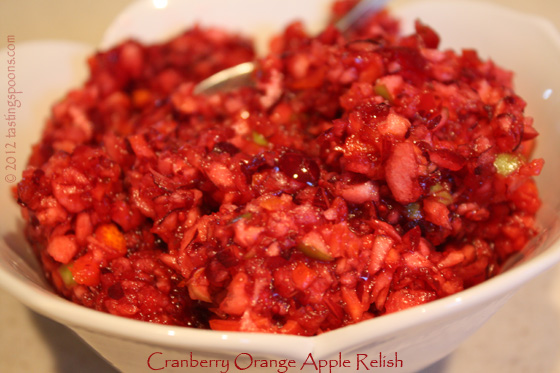
So, listen up . . . that’s the phrase I seem to use when I’m about to share something important. I’m going to give you my prized (well, no, I haven’t really won a prize for it, it’s just prized by me!) recipe for cranberry relish. My mother introduced cranberry relish to our family’s Thanksgiving table back in the late 1950’s I think. It was just the chopped cranberries (and I was often the one who had to sit and hand chop the cranberries – very tedious, I might add), and minced orange, including some of the peel, with sugar. I made it that way for years. Until one year I saw a recipe in a magazine, I think, that mentioned adding apple and ground ginger. I love ginger and what it does for baked goods and other things too. I tried it, and it’s become the regular on my Thanksgiving table ever since. Over the years I’ve tweaked the recipe a bit – reduced the sugar a tad, and added more ginger. And I think the original recipe called for 2 apples, but I preferred the single one. So that’s why I call this a Carolyn original. I have no recollection where I first saw the recipe including the apple and ginger, so I can’t given any credit for it.

This keeps for about a month, and is wonderful added to a turkey sandwich, or as a chutney type side with grilled meat. But it seems to have its strongest affinity to poultry. I can eat this straight out of the container, I like it so much. Just remember to make this a day ahead, if at all possible. It takes several hours for the flavors to blend AND for the sugar to do its magic with the fruit, drawing out the juices.
printer-friendly CutePDF

Files: MasterCook 5+ and MasterCook 14 (click link to open in MC – 14 contains photo)

Cranberry Relish with a Zip

Recipe: This is a Carolyn original
Servings: 10
NOTES: Cranberry relish has always been a favorite of mine, and I’ve made a bunch of different kinds over the years. But, this is my favorite, with just a bit of tartness. It’s also wonderful with grilled meats – pork chops, chicken and even steak.

12 ounces fresh cranberries
1 large apple — cored
1 large orange — with peel, chopped
1 teaspoon ground ginger
3/4 cup sugar

1. You may use fresh cranberries, if available. If you’ve frozen them, just defrost before starting relish.
2. In a food processor, whiz up the cranberries first. Do not allow them to turn to mush. Scrape out into a bowl. Do the same with the apple, leaving the peel on, and add to cranberries. Cut orange into many small pieces, peel and all and do the same. Be careful there aren’t any large pieces left in the workbowl. Add ginger and sugar to the mixture, stir well and refrigerate for a few hours.
2. Will keep for about a month before spoiling.
Per Serving: 90 Calories; trace Fat (1.4% calories from fat); trace Protein; 23g Carbohydrate; 2g Dietary Fiber; 0mg Cholesterol; 1mg Sodium.

Posted in Cookies, on November 15th, 2007.


It may be a bit hard to see here, but those cookies are thin. THIN. Really THIN. But chocolately, rich, just like eating the top off of a rich brownie. Or maybe the very top of a muffin, even.

Usually when we return from a European trip, I’m craving salads and greens, and vegetables. Not so this time because we had ample on the ship. In fact, Lucy and I raved about the quality of the designer lettuces they served at the salad bar every day. Absolutely fresh from the fields that very day. And delicious dressings, all home made. But what I did crave upon our return was chocolate. We had almost none on the trip. A couple of times we had chocolate sauce on vanilla ice cream, and we had something similar at the dinner at Gundel. And one night they offered a chocolate terrine. I was sad to decline that but I knew the caffeine would keep me awake that night. But otherwise, chocolate didn’t figure much in the shipboard menus.

So, since the cookie barrel is empty around here, I decided to make something chocolate. I was leafing through the December issue of Bon Appetit (how come I’m getting the December issue in the first or 2nd week of November, I ask you?), and spotted these chocolate thins.

These are made in a bowl, so quite easy. It couldn’t have taken more than 15 minutes to complete the preparation, and another 20 minutes max to bake them all. Pretty cinchy. And, they are really delicious. But I do warn: they’re very fragile. I’ll have to figure out how to package these carefully so they don’t break – they tend to break in half very easily. But they’re very tasty.

Added note 3 days later: these cookies are so, SO thin, they’re not easy to serve. You pick them up and they break apart, I’m sad to say. So, make them a bit thicker when you pat out the dough, and make sure they are getting browned around the edges. These are soft cookies – there’s nothing crispy about them. But the chocolately taste is wonderful.


You whip these up in a bowl – no mixer needed. I used good Scharffen Berger unsweetened chocolate in these.


There they are on the Silpat before baking. It’s a bit tricky spraying the plastic wrap, laying it over the little blobs of dough, then very gently patting the cookies out thin. I wonder if I made them a tad too thin? Maybe next time I’ll try them a bit thicker just to see. Once you remove the plastic wrap, you add the nuts. I used walnuts because that’s what I had on hand.
printer-friendly PDF

Brownie Thins

Recipe: Andrew Schloss, Homemade in a Hurry via Bon Appetit, Dec. 2007
Servings: 24
NOTES: These taste just like the way the very top layer of a brownie tastes. They’re extremely fragile until they’re cool, and even then, they’re still fragile. Let them cool completely and put waxed paper or plastic wrap between layers.

6 tablespoons unsalted butter
2 ounces unsweetened chocolate — chopped
1/2 cup sugar
1 large egg
3 tablespoons all-purpose flour
1 teaspoon all-purpose flour
1/4 teaspoon vanilla extract
1/4 teaspoon almond extract
1 piece kosher salt
1/4 cup pistachio nut — or walnuts

1. Position rack in lower third of oven. Preheat to 350. Butter 2 baking sheets. (I used a silpat in each).
2. Place butter and chocolate in a microwave-safe medium sized bowl. Microwave on medium-high power until almost completely melted, about one minutes. Whisk until smooth. Add sugar and egg and whisk until smooth, about one minute. Add flour (both quantities), both extracts and salt, stir just to blend. Let batter sit for 10 minutes.
3. Scoop rounded teaspoons batter onto prepared sheets, spacing apart (12 per pan). Spray a sheet of plastic wrap with nonstick spray and place, sprayed side down, on top of cookies. Using your fingers, press each mound into 2 1/2 to 2/3/4 inch rounds. Remove plastic wrap. Sprinkle nuts on top.
4. Bake cookies, one sheet at a time, until slightly darker at edges and firm in center, about 7 minutes. Cool on rack for 2 minutes, then transfer cookies to rack and cool completely. Can be made 5 days ahead and stored at room temperature.
Per Serving: 69 Calories; 5g Fat (62.1% calories from fat); 1g Protein; 6g Carbohydrate; 1g Dietary Fiber; 17mg Cholesterol; 82mg Sodium.

Posted in Desserts, on November 14th, 2007.


One day on the river cruise, the pastry chef, Klaus Ungruh, gave a lecture about apple strudel. The draw, of course, was that we’d all get a slice when it was all said and done. About 60 of us gathered around a table to watch. Frank, the tour director and the chef had a very cute repartee going. As Frank listed the ingredients, the chef pulled them out of a shelf below the table. Into the very large and deep Hobart mixing bowl he placed a plastic bag of flour (sealed up), a full bottle (not pouring, just the bottle) of oil, a round box of salt and he poured in some water and literally threw in an egg – splat… We all laughed. He pretended to mix and knead it inside the bowl, then, as if by magic he reached down into the bottom of the bowl and voila, he pulled out a round disk of dough. Even more laughs. He whisked the rolling pin over the dough about 10 times, turned it over and rolled another 10 times, and the dough was done.

Then he used another bowl and to it were added: apples, raisins, cookie crumbs, cinnamon, rum, hazelnuts, sugar and lemon peel. In about 5 seconds he mounded the filling on the dough, and rolled it up. Done. Off it went to the kitchen, and they brought in an already baked one for us to sample. Delish. Whether I’d really make this or not, I don’t know. I did make strudel once upon a time (when I was very young, with a woman who was a live-in cook for a neighbor), but I thought it an awful lot of work. This version seemed infinitely easier. It was served with a vanilla sauce, warm.

Viking River Cruises Apple Strudel

Dough:
2 cups flour
3 T. oil
1/2 cup water
Dash salt
1 egg
Filling:
10 medium apples, peeled, cored and chopped
1 cup raisins
1/2 pound cookie crumbs (they called it “biscuit), probably like vanilla wafer crumbs
6 T. rum (or more to your taste)
4 T. chopped hazelnuts
1 c. granulated sugar
Peel of one lemon
Dough: mix all the ingredients together. Make a ball and let it rest for 45 minutes at room temperature – 75 to 80 degrees. Roll out the dough on a cloth sprinkled with flour, approximately 16 inches by 16 inches.
Filling: Combine all the ingredients and spread over the dough in a long strip from one edge to the other, about 4-5 inches wide. Using the cloth, gently roll up the strudel. Brush the top of the strudel with some egg and bake for 40 minutes at 356 degree Fahrenheit. Probably served about 10-12.

Posted in Travel, on November 13th, 2007.


Some people might think Budapest is so foreign they might not want to go. Whatever you might have thought, it’s not so. Budapest is a beautiful, small city, situated on both sides of the Danube. The Buda side is the hilly side, where the castle is located (lit up spectacularly at night), and most of the tourist shopping areas, the cathedral and some lovely restaurants. The Pest (pronounced pesh to you non-Hungarians. so it’s Booda- ) side is the flat side, where much of the business and industry is located. More commercial. It’s also where Gundel is located.

Years ago, probably 10, DH and I enjoyed a dinner at Gundel. We were with a small group and the dinner had been pre-arranged. It was spectacular. We even bought some of the Gundel-labeled red wine and brought it home (as we did this time too). Hungarians make some fine wine. Inexpensive. And almost none of it is exported. You’ve probably heard of the label Tokaji (pronounced toe-kai), a line of sweeter wines, from 1 to 5 in sweetness. They’re lovely wines and hard to find here in the U.S. We enjoyed #5 with our dessert the other night. It was really lovely. My DH doesn’t drink much late harvest or sweet wines, so I didn’t buy any, although I really wanted to. But, I’d be drinking it all, so decided not to.

So earlier last week I asked one of the ship’s crew to make a reservation for us at Gundel for Saturday night, our last night there. No problem. We took a taxi – and had the nicest driver – he even came to pick us up at 9:30 at the conclusion of our dinner, AND he picked us up the next morning and drove us to the airport. A very nice man – an Hungarian. With a son in dental school.

Gundel requires men to wear coats (ties not required). It’s a very formal place, but not stuffy, really. I was charmed, even more so this time. Last time we were served in a private room upstairs. I liked eating in the main dining room. The ambiance was not to be missed. Lucy and I just ate it up. From the bottled water to the multiple forks and knives lined up on each side of the plates.

We’d been warned the dinner would be expensive. One guide told us to expect to pay about 80,000 Hungarian florins (approx. $300) apiece. Fortunately, it was nowhere close to that. The 6 course meal, including wine for 5 of the courses, was 82,000 florins. So, about $75 per person. To our minds, it was a bargain, considering the fabulous food we had, and the lovely wines they served along with. Hungary, although in the EU, won’t convert to the euro until 2012. But most places we went accepted euros with no difficulty. They even took American dollars too.

So, here’s what we had:

The Traditional and new

Gundel Creation Dinner:
Torte of foie Gras with Cranberry Kir Royale
Smoked Ham of Z selic Roe-Deer
with Porcini Mushroom Mousse
Belatonbolglari Chardonnay 2006, Legli Otto
Tarragon scented Venison Ragout Soup
with Sour Apple and Chestnut
Slice of River Catfish served with
Pumpkin Seed Strudel and Red Pepper Sauce
Egri Pinot Noir 2002, Gundel Winery
Rack of Mangalic Pork served with
Spinach-Serviettenknodel and colorful onions
Egri Bikaver Gold Selection Barrique 2000, Gundel Winery
The Classic Crepe a la Gundel
Tokaji Aszu 5 butts 2000, Gundel Winery

The foie gras torte. Amazing.

Sinfully delicious soup, with venison, apple and chestnut. Slurp.

The charming table, chock-a-block full of dishes, wine glasses, utensils, little bowls, butter dishes, salt and paprika (no pepper, just paprika), dinner plates and bread plates

The fried catfish in the foreground, with the very different and delicious pumpkin seed strudel at the back.

The amazingly tender pork chops with onions and a spinach strudel.

And, last but not least, this scrumptious crepe filled with a ground and chunky walnut, raisin, rum filling, topped with a dreamy chocolate sauce and powdered sugar. A stunner to look at and to devour.

Here we are, l-r: me, my DH, Lucy and Wayne.

Posted in Travel, on November 12th, 2007.


Doors in Rothenburg, Germany.

It’s wonderful taking vacations. Even the mound of laundry is okay. It’s the flights here to there and back that is so hard. Flying is no fun anymore. Now it’s just something dreadful you have to “get through” in order to enjoy the vacation. We even paid for some upgraded seats on British Airways for this trip, about twice what coach seats would cost. Meals were disgusting. I guess I shouldn’t complain. At least we HAD meals on the plane.

Nevertheless, no matter how long I’m gone, it’s always wonderful arriving home. Tired, dragging, jet lagged, wanting a shower, etc. But it’s wonderful walking into your safe haven. To look at the view out the window. To sit quietly with a fresh cup of espresso.

We had a great time on our trip. Sorry I wasn’t able to upload more comments and photos, but I was limited by the very slow wireless network on the ship, having to share the connection with others using it too. Today I’ll upload a few more photos from the trip. Tomorrow I’m going to upload the photos I took at our last night in Budapest, at the fabulous restaurant, Gundel. So, here are a few more photo reflections from the river cruise from Amsterdam to Budapest. Highly recommended, as long as you like a slow pace.

Outside the Gutenberg Museum (Germany).


Cobblestone streets along the Rhine River.
Paprika peppers and garlic in Budapest.

Building corner in Regensburg, Germany.

Posted in Travel, on November 8th, 2007.

(picture along the Danube yesterday, in Austria)
Location: Vienna
Weather: 46 and overcast
Most people are off on a shore excursion today. We’ve been to Vienna twice, and we’re a hobbling-around couple (there are others also), so decided to stay on board. The ship departs later today for Bratislava, our next port stop.

This ship, the Viking River Cruises “Spirit” has been a good activity level for us. What with my foot that still swells, and Dave’s new artificial leg that hurts him like heck nearly every step he takes, we’ve spent more time relaxing on the ship. Most of the passengers are older folks, like us. One gentleman flew to Amsterdam and when he stood up on arrival, he couldn’t walk. He was in a wheelchair for a week. After seeing a doctor at one of the ports (and with x-rays) he found out he has a broken hip. The ship staff arranged for him to fly home a few days ago, with his wife. We all wanted to know, how could you have a broken hip and not know it? Our companions, Wayne and Lucy, speculated about that. Wayne’s a retired OB/GYN, and he suspects the gentleman has some other health issues, maybe bone cancer, so his bones are very soft. Guess we’ll never know.

We have a contingent of complainers on the ship too. They are the kind of people who give Americans a bad name, like the Ugly American. Nothing is ever right. Or good enough. They complain mostly about the meals. This is a German ship. The captain and chef are German. Although it’s an American based company, everything about what they do is German. The chef does an amazing job with the meals. They’re not as elegant, perhaps, as on a huge mega-sized cruise ship, but having been on their kitchen tour here, I find it amazing that they can produce the quality and quantity of meals in their compact kitchens.

These ugly people want American food. Well, they don’t SERVE American food on this ship. It’s more continental, and a modicum of German food mostly. They complained that a lunch served a day or two ago, that was billed as “Bavarian,” included lasagna. At a question and answer period last night, the Chef humbly apologized, said he’d made a mistake with that one, he was one day early for that dish, as the next day was an Italian day menu. These people have complained so much that they’re eating their own, private menu. No extra charge. Yesterday, however, they all wanted tuna sandwiches on Pita bread. The Chef had to phone several other ships to FIND Pita bread. Finally did, had staff retrieve it, or make an exchange, using a ship launch. Tuna sandwiches were made, and this group of 8 people ate half of one sandwich. The first woman who tried it didn’t like it, so nobody else even tried it. The Chef appears at their table nearly every meal because they’ve complained about something.

The darling waitress, Zuzana (she’s from Slovakia), was nearly in tears yesterday because of their insane requests. All special menus are prepared in a separate kitchen below the main kitchen, and to serve a table for 8, she has to go up and down the kitchen flight of stairs so many, many times to serve a meal, what with each dinner having 4 or 5 courses.

They like this particular waitress. So do we, and try to sit on her station for most meals, if we can. This ship does not have assigned seating. So somebody from the Ugly American group stands outside the dining room door for a looooong time to make sure they get the table they want – only two tables in the dining room seat 8 people – one only with Zuzana. Now, there’s also another contingent of people, mostly from Texas, who have also made some significant waves. They’re also a party of 8, and THEY like this same table, because they like Zuzana too. Last night one from their group pulled a chair from his stateroom and sat for 40 minutes outside the dining room door, in order to get this table. They were excited to have one-upped the Ugly Americans. Although, this other group is quite loud and boisterous. They drink a lot, too. They’re a friendly bunch, though.

When you’re confined to somewhat close quarters, the gossip flies the air. We watch with some amusement, but also some embarrassment too. We feel sorry for the staff. They work very, very hard, about 12 hours a day.

Posted in Travel, on November 6th, 2007.

Were these ever GOOD! In Rothenburg our day trip included a lunch at a local hotel where they served us the Rothenburg sausages, sauerkraut (underneath the sausages) and a heap of mashed potatoes, along with their tasty mustard. We also went through Nurnberg (Nuremburg) where that area specializes in some different kinds of sausages – they look more like our breakfast sausages, but with lots of herbs and spices in them. Why, oh why, can’t we get these at home?
Related Posts Plugin for WordPress, Blogger...