Get new posts by email:

Archives

Currently Reading

Here are the tastingspoons players. I’m in the middle (Carolyn). Daughter Sara on the right, and daughter-in-law Karen on the left. I started the blog in 2007, as a way to share recipes with my family. I’m still doing 99% of the blogging and holding out hope that these two lovely and excellent cooks will participate. They both lead very busy lives, so we’ll see.

– – – – – – – – – – – – – – – – – – – – – –

BOOK READING (from Carolyn):

Music of Bees, Eileen Garvin. Absolutely charming book about a woman in midlife, lonely, who raises bees, also makes unlikely friends. Heart-warming and very interesting about beekeeping.

A Postcard from Paris, Alex Brown. Really cute story. Dual time line, 1940s and present day about renovating an old apartment in Paris, things discovered.

Time of the Child, Niall Williams. Oh such a good book. Very small village in Ireland, 1960s. A baby is left on the doorstep. The town all whispers and helps. I listened to an interview of the author, which made me like him and his books even more.

Sipsworth, Simon Van Booy. If you like animals you’ll swoon. An old woman who really wants to die finds a tiny mouse in her house and befriends it and finds a reason to live. Utterly charming book.

The Forger’s Spell, Edward Dolnick. True story. For seven years a no-account painter named Han van Meegeren managed to pass off his paintings as those of Johannes Vermeer.

If You Lived Here, You’d be Home by Now, Christopher Ingraham. Could hardly put it down – about a journalist who takes on a challenge to move to small town in Minnesota and write about it. He expects to hate it and the people and place, but he doesn’t. Absolutely wonderful true story.

The River We Remember, William Kent Kreuger. 1950s, Minnesota. A murder and the aftermath. Could hardly put it down. Kreuger has such a vivid imagination and writing style.

How the Lights Gets In, Joyce Maynard. An older woman returns to New Hampshire to help care for her brain-injured son. Siblings and family, lots of angst and resentments.

The Filling Station, Vanessa Miller. Every American should read this book. A novelized retelling of the Tulsa massacre in 1921. Absolutely riveting.

The Story She Left Behind, Patti Callahan Henry. Love this author. Based on a true story. A famous author simply vanishes, leaving her husband and daughter behind. She had invented a mystical language no one could translate. Present day, someone thinks he’s solved the riddle, contacts the family. Really interesting read.

The Girl from Berlin, Ronald Balson. Love anything about Tuscany. An elderly woman is being evicted from a villa there, with odd deed provenance. Two young folks go there to help unravel the mystery. Loved it.

The Island of the Colorblind, Oliver Sacks, M.D. Nonfiction. The dr is intrigued by a remote Pacific island where most of the inhabitants are colorblind. He also unravels a mystery on Guam of people born with a strange neurological problem. Medical mysteries unveiled. Very interesting.

The Bookbinder, Pip Williams. Post 1914 London. Two sisters work at a bookbindery. They’re told to not read the books. One does and one doesn’t. One has visions beyond her narrow world; the other does not. Eventually the one gets into Oxford. Lovely story.

The Paris Express, Emma Donoghue. 1895 on a train to Paris, a disaster happens. You’ll delve into the lives of many people who survived and died in the crash.

A Race to the Bottom of Crazy, Richard Grant. This is about Arizona. Author, wife and child move back to Arizona where they once lived. Part memoir, research, and reporting in a quest to understand what makes Arizona such a confounding and irresistible place.

The Scarlet Thread, Francine Rivers. A woman’s life turned upside down when she discovers the handcrafted quilt and journal of her ancestor Mary Kathryn McMurray, a young woman who was uprooted from her home only to endure harsh frontier conditions on the Oregon Trail.

A Place to Hide, Ronald Balson. 1939 Amsterdam, an ambassador has the ability to save the lives of many Jewish children. Heartwarming.

Homeseeking, Karissa Chen. Two young Chinese teens are deeply in love, but in China. Then their families are separated. Jump to current day and the two meet again in Los Angeles.

North River, Pete Hammill. He always writes such a good story. A doctor works diligently healing people from all walks of life. His wife and daughter left him years before. One day his 3-yr old grandson arrives on his doorstep.

A Very Typical Family, Sierra Godfrey. A very messed-up family. Three adult children are given a home in Santa Cruz, Calif, but only if the siblings meet up and live in the house together. A very untypical scenario but makes for lots of messes.

Three Days in June, Anne Tyler. The usual Anne Tyler grit. Family angst. This wasn’t one of my favorites, but it was entertaining and very short.

Saved, Benjamin Hall. Author is a veteran war reporter. Ukraine, 2022, he nearly loses his life to a Russian strike. Riveting story – he survives, barely.

Grey Wolf, Louise Penny. Another Inspector Gamache mystery in Quebec. She is such an incredible mystery writer.

All the Colors of the Dark, Chris Whitaker. A missing person mystery, a serial killer thriller, a love story, a unique twist on each. Could hardly put it down.

Orbital, Samantha Harvey. Winner of 2024 Booker Prize. I don’t usually like those, but I heard the author interviewed and she hooked me. This is not a normal book with a beginning, a story and an end. It’s several chapters of the day in the life of various astronauts at the ISS (Int’l Space Station). All fictional. She’s been praised by several real astronauts for “getting it” about space station everyday life.

The Blue Hour, Paula Hawkins. An island off Scotland. Inaccessible except when the tide is out. Weird goings on. An artist. A present day mystery too.

Iron Lake, William Kent Krueger. A judge is murdered and a boy is missing. Riveting mystery.

Tell the Wolves I’m Home, Carol Ricks Brunt. 1980s. A 14-yr old girl loses her beloved uncle. Yet a new friendship arises, someone she never knew about.

Four Treasures of the Sky, Jenny Zhang. 1880s, a young girl is kidnapped in China and brought to the United States. She survives with many hurdles in the path.

The Boy Who Fell out of the Sky, Ken Dornstein. Memoir, 1988. The author’s brother died in the PanAm flight that went down in Lockerbie, Scotland. A decade later he tries to solve “the riddle of his older brother’s life.”

Worse Care Scenario, T.J. Newman. Oh my. Interesting analysis of what could/might happen if a jet crashed into a nuclear plant. Un-put-downable.

Song of the Lark, Willa Cather. Complicated weave of a story about a young woman in about 1900, who has a gifted voice (singing) and about her journey to success, not without its ups and downs.

Crow Talk, Eileen Garvin. Charming story which takes place at a remote lake in Washington State, about a few people who inhabit it, the friendships made, but also revolving around the rescue of a baby crow.

The Story Collector, Evie Woods. Sweet story about some dark secrets from an area in Ireland, a bit magical, faerie life, but solving a mystery too.

A Sea of Unspoken Things, Adrienne Young. A woman investigates her twin brother’s mysterious death. She goes to a small town in California to figure it out, to figure HIM out.

The King’s Messenger, Susanna Kearsley. 1600s England, King James. About one of his trusted “messengers,” and his relationship with a young woman also of “the court.” Lots of intrigue.

In the Shadow of the Greenbrier, Emily Matchar. Interesting mystery in/around the area of the famous resort in White Sulphur Springs, West Virginia.

Isola, Allegra Goodman. Hard to describe, survival story on an island in the 1600s.

Save the Date, Allison Raskin. Rom-com, witty, LOL funny. Clever.

The Sirens, Emilia Hart. Numerous time-lines, Australia. Mysteries abound, nightmares, abandoned baby, weird allergies.

Red Clay, Charles Fancher. LOVED this book. Mostly post-Civil War story about the lives of slaves in Alabama during Reconstruction.

Stars in an Italian Sky, Jill Santopolo. Dual time line, 1946 and recent time. Love stories and a mystery.

Battle Mountain, C.J. Box. Another one of Box’s riveting mysteries. Love his descriptions of the land.

Something Beautiful Happened, Yvette Corporon. A memoir of sorts in Greece, tiny island of Erikousa, where the locals hid Jews during WWII. All elusive stories told by the author’s grandmother.

The Jackal’s Mistress, Chris Bohjalian. 1860s Virginia, about a woman who saves the life of a Union soldier. Really good story.

Song of the Magpie, Louise Mayberry. Really interesting story about Australia back in the days when it was mostly a penal colony. Gritty strength of a woman trying to thrive with her farm.

The Boomerang, Robert Bailey. A thriller that will have you gripping the book. About a lot of secrets surrounding the president (fictional novel, remember) and his chief of staff and about cancer. A cure. Such a good story.

Care and Feeding, Laurie Woolever. Really interesting memoir of a woman driven to succeed in the restaurant business. She worked for Mario Batali and then Anthony Bourdain. Gritty stories.

Everything is Tuberculosis, John Green. Maybe not a book for everyone. A real deep dive into the deadly tuberculosis infection, its history. I heard the author interviewed and found the book very interesting.

The Book Lovers Library, Madeline Martin. Fascinating read about Boots’ drug stores’ lending library. And the people who worked in them.

The Arrivals, Meg Mitchell Moore. LOL funny, about a middle-aged couple whose children (and their various family members) return to the family home and the chaos that ensues.

My Life as a Silent Movie, Jesse Lee Kercheval. About grief. A big move to Paris, finding herself a new life with a new set of real blood family.

Escape, Carolyn Jessop. Another memoir about a woman really in bondage in Utah, Mormon plural marriage.

 

Tasting Spoons

My blog's namesake - small, old and some very dented engraved silver plated tea spoons that belonged to my mother-in-law, and I use them to taste my food as I'm cooking.

Scroll down to the bottom to view my Blogroll

Posted in Soups, on October 16th, 2007.

Soup season lasts about 8 months around our house. I’ve even been known to make soup in the heat of the summer, although not very often. So now that the weather has really turned cooler (we’ve even had some rain) I was anxious to make some soup this week. My recipe started out with a small package of Italian sausage (bulk grind type) that I found in the freezer, and I just built the recipe from there. I looked on Epicurious and found a leek and sausage soup to start from, then I embellished it with other things from the pantry and the refrigerator. Having made a trip to Costco yesterday, I had a package of pre-cut butternut squash. Some of that went in the soup too as well as a package of fresh chanterelle mushrooms. Once put it front of us, we all just tucked into it with relish. Delicious.

There was only one thing I did differently here, that I’ve never done before: once I chopped up the Kielbasa, I browned the cubes in a hot frying pan with a little olive oil. The sausage rendered out some of its fat, a good thing, and it got browned edges all over them, so not only did the soup have the smoky flavor of the sausage, but the chunks were crispy. I did not cook the Kielbasa in the soup very long. Whenever I do that, it seems like all the flavor is leeched out of the sausage and it doesn’t taste like much. This way, the sausage is still full of flavor. If you like the smoky taste to penetrate all through the soup, add part of the sausage to the soup while it cooks, then add the browned cubes at the last.
printer-friendly PDF

Leek, Kielbasa and Sausage Chowder


Recipe: A Carolyn T, TastingSpoons original
Servings: 10

3 tablespoons butter
2 tablespoons olive oil
8 whole leeks — trimmed and sliced
4 whole shallots — minced
4 whole carrots — chopped
4 stalks celery — chopped
8 cups chicken broth
10 ounces chanterelle mushroom — chopped, or regular white mushrooms
1 pound Kielbasa — cut into 1/2 inch cubes
1/2 pound Italian sausage
1 tablespoon Italian herbs — or mixture of thyme, rosemary, oregano
1/2 teaspoon ground pepper
2 cups butternut squash — cubed (optional)
2 cups potatoes — peeled, cubed
1 cup milk
3 tablespoons flour
1/2 cup whipping cream

1. Prepare all the vegetables. Heat a large, heavy soup pot, add olive oil and butter, then add leeks, celery and shallots. After 5 minutes add the carrots.
2. When the leeks have partially caramelized (browned), add the Italian sausage and continue to cook about 5 minutes. Then add mushrooms and chicken broth. Bring to a boil and reduce to a simmer.
3. Meanwhile, cut up the potatoes and squash and set aside. Add them to the soup pot with the herbs.
4. When the potatoes and squash are nearly cooked, heat up a second flat skillet, add a bit of olive oil, then fry the Kielbasa until the edges are starting to brown all over. Drain fat and add to the soup pot.
5. In a jar combine the milk and flour and shake until no lumps appear. Add to the soup pot and continue to cook for about 5-10 minutes. Add the whipping cream, heat briefly, taste for seasonings. Add ground black pepper. Add salt if desired, but it probably isn’t necessary.
Per Serving: 548 Calories; 32g Fat (51.7% calories from fat); 20g Protein; 49g Carbohydrate; 7g Dietary Fiber; 77mg Cholesterol; 1362mg Sodium.

Posted in Soups, on October 11th, 2007.

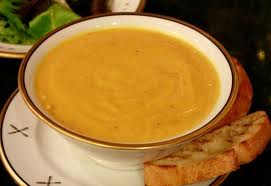
The soup library is running a little low these days. I have 3-4 soups lined up on my freezer shelf, but the one I wanted is all gone. I thought I had some left from last winter, but no such luck. Two recipes for butternut squash soup stand out amongst my recipes. This is one of them. This happens to be the more time consuming one to make. The other one, Butternut with Jalapeno, that I posted back in July, is a quicker soup because it’s made with C&W frozen squash cubes. Nor is that one roasted, as in this case.

This recipe requires you to buy fresh butternut squash, because you roast the squash halves with onions, carrots and apples. So, no short cuts on this one. But, I guarantee you, you’ll be pleased with the results, providing you have the time. I always make this in double quantity (8 pounds of squash to start with) because, well, why not? It’s wonderful leftover and easy to freeze.

Previously I’ve mentioned Penzey’s, the herb and spice company from whom I buy many of mine. If you order from them (or request it) they send out a catalog periodically, and usually there are 3-4 recipes contained in each little brochure. This came from one of those, a few years ago. Credit goes to a cookbook (that I don’t have, in case you’re counting) called The New England Cookbook, by Brooke Dojny. She’s one smart cookie when it comes to soups.

So what’s involved, you ask? You cut the squash in halves, remove seeds, lay them in a large roasting pan (a really big one if you’re making a double batch) and add onions, apples and carrots and some fresh rosemary. Dot it with some butter, brown sugar and add a bunch of APPLE JUICE, cover and roast for about 2 hours. The vegetables become succulent, and somewhat sweet because of the apples and apple juice. Because I’d rather not peel the squash, I leave them unpeeled and scoop out the flesh after it’s baked. Same with the onions – cut in half and remove skins later. The other little trick to this is the fresh rosemary. I do not like the rosemary to remain in the soup for eating, so I try to use a fresh sprig or two or three and leave them intact while baking, then toss it out, retrieving all the little pieces floating in the apple juice. Or, you can strain the whole mess to get them out.

Once the roasted vegetables have cooled a little (and you scoop out the squash flesh, remove onion skins, etc.), you can add it all to a large soup pot and use an immersion blender (or put it in batches in the regular blender or food processor) to puree all of it. Then you add a few other ingredients, taste it for seasonings, simmer briefly, then add milk (I use fat-free half and half) or cream to smooth it out.

If you don’t like soups with a hint of sweet, pass this one by. But if you don’t mind the sweeter flavor from the apples and apple juice, this one’s a winner.
printer-friendly PDF

Roasted Butternut Squash Soup


Recipe: Adapted from the New England Cookbook by Brooke Dojny
Servings: 4
NOTES: The original recipe called for fresh pumpkin or squash, and used 6 Tb of butter. I preferred to have a creamy look to the soup, so add the fat-free half and half. It’s not a necessary ingredient. When I make it, I always double it since it is such a favorite around our house. I just scoop it into plastic freezer bags in serving size portions (about 2 cups per person) and lie flat on a large cookie sheet until frozen solid. The original recipe also added a dollop of sour cream or creme fraiche, but I prefer the minced nuts. I prefer not to have the pieces of rosemary in the soup, so I strain the soup to remove most of it. Or, better yet, if you use fresh rosemary you can just remove the entire sprig. If you want to make the vegetable preparation easier, use a potato peeler on the squash before it’s baked, and remove the garlic from its skins; if you do that, you don’t have to handle the squash at all after it’s baked.

4 pounds butternut squash — or pumpkin
2 tablespoons butter
1/4 cup brown sugar
1 large onion — peeled, chunked
3 large carrots — peeled, chunked
4 large garlic cloves — whole, unpeeled
1 large apple — peeled, chunked
2 teaspoons dried rosemary — or 1 T fresh
8 cups low sodium chicken broth
2 cups apple juice
1 teaspoon ground ginger
1/2 teaspoon ground mace
1/4 cup pecans — minced
salt and pepper
1 cup fat free half-and-half

1. Preheat your oven to 350. Cut the squash in half (I use a rubber mallet to pound the knife blade as the large squashes are usually quite unwieldy to cut). Scoop out the seeds with a spoon. Place the halves cut side up in a very large roasting pan. Divide the butter and brown sugar among the cavities. Arrange the onion, carrots, garlic and apple around the squash. Sprinkle with rosemary, then salt and pepper. Pour 2 cups of the chicken broth and apple juice around the vegetables and cover the pan tightly with foil. Roast in the preheated oven, stirring once or twice (if you remember, that is) until the vegetables are all very sort and somewhat caramelized, about 2 hours.
2. Open up the foil and allow the vegetables to cool at least 15 minutes. Scoop out the squash pulp, being careful not to include any skin. Remove the garlic from their skins. Process all the vegetables and apple mixture in a food processor, in batches if necessary, adding enough remaining chicken broth to achieve a smooth puree. Add the fat free half and half.
3. Toast the pecan pieces in the oven for a short time, or use a nonstick skillet. Don’t burn! Set aside until ready to serve the soup. Transfer the puree to a large saucepan, add the ginger and mace and season with salt and pepper as needed. Bring the soup to a boil, under gentle heat and simmer for a few minutes to meld the spices. Serve the soup in bowls sprinkled with toasted pecans.
Per Serving: 563 Calories; 11g Fat (17.3% calories from fat); 28g Protein; 94g Carbohydrate; 11g Dietary Fiber; 16mg Cholesterol; 1198mg Sodium.

Posted in Soups, on October 1st, 2007.

Okay, friends. Listen up. I’m sharing today one of my very favorite recipes ever. I’ve been making this soup/stew since about 1966. That’s 40 years. Wow. Even surprises me! So why have I waited 6 months to tell you about it, you ask? Simple. It wasn’t soup season. This is one of those dishes that sticks to the ribs. Hearty. Hot. If I had a restaurant, say, Carolyn’s Country Kitchen, this would be at the top of the menu as Carolyn’s signature soup. Or stew. Or stoup, as Rachel Ray calls these kinds of concoctions.

This is so much of a favorite that it’s going onto my Carolyn’s Fav’s , a tab at the top. Now, you need to love soup and stew to like this recipe. And vegetables. And cumin (although you could leave that out). To me, the cumin is an important component, however, even though it wasn’t in the original recipe; that was one of my additions. And you need to like mashed potatoes.

Many of you know how much I like soups, and that I keep a regular stock of soups in my frozen soup library.

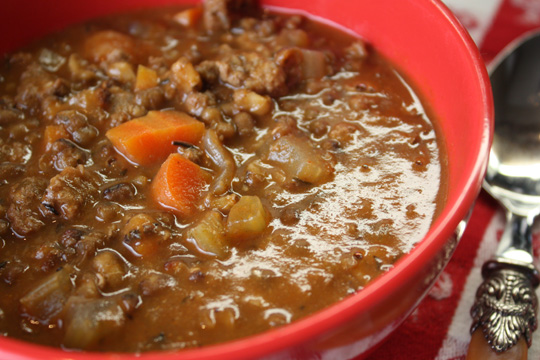
Here it is in the pot, stewing away. Note the thickness to it – I had just added the cabbage. Over the years I’ve adapted it with my own additions (garlic, cumin, shrooms, some heat, etc.) but the basics are the same. A ground beef (or turkey or chicken) and vegetable soup (cabbage, tomatoes, mushrooms, onions and kidney beans) with a mound of buttermilk-enhanced mashed potatoes on top. As you eat it, the mashed potatoes just begin to kind of melt into the soup. This recipe is very forgiving. You don’t like cabbage? Fine, leave it out. Same with mushrooms. Add corn. Or substitute something else or just leave out the things you don’t care for. But, when you prepare it, it needs to have a thick consistency – not a lot of liquid, in other words, but mostly veggies. Here, below, it’s in the bowl, ready for the mound of mashed potatoes. The soup mixture is not thickened (like a creamed soup where you’ve added flour), but it’s “thick” with vegetables.

I make this in a very large quantity when I do it because it’s a real winner for freezing. I make the mashed potatoes too, and pile them into smaller Ziploc freezer bags (doing the same procedure, flattening them out so they freeze and defrost easily), then the soup goes into a larger bag. When I want a quick dinner I just take out one soup and one potato bag to defrost.

Now mashed potatoes become a weird duck when you freeze them. They lose all their form and become mostly a liquid. So just a warning here – don’t be alarmed and think the potatoes are ruined. Once you heat them up, the starch firms them right back up again. Amazing, but true. Sometimes I even put the potato bag (smaller) into the larger Ziploc bag, then pour the soup around it. Then it’s all contained in one package. But then you can’t get so much soup into the larger bag, so I usually separate them.

About 7-8 months ago, before I had my own blog, I was reading Tummy Treasure, Erika’s blog. She was trying to make some thrifty meals, so I emailed her this recipe. She liked it so well she wrote up a blog post about it. I was so thrilled! Wow, my recipe in lights! If you’d like to read it, click
If soup season has arrived at your house, I highly recommend this one. A lot. Our son-in-law, Todd, is visiting us at the moment, and he ate two full bowls last night and would have licked the bottom if he could. My suggestion: you need to order up a bowl right away.
printer-friendly PDF

Cabbage Patch Stew

Recipe: Originally from a Betty Crocker cookbook.
Servings: 8

SOUP:
1 pound ground beef (or chicken, turkey or soy protein chunks)
2 medium onions — sliced thin
1 1/2 c cabbage — shredded or sliced thinly
1 1/2 c celery — diced
2 cloves garlic — minced
2 c kidney beans — canned, undrained
2 c tomatoes — canned, undrained
2 c fresh mushrooms — sliced
2 tsp chili powder — or more to taste
1 tsp ground cumin – – or more to taste (I usually add about 1 T.)
1 tbsp Worcestershire sauce
1/4 c chicken broth – – or water (or vegetable broth)
1 tsp beef broth concentrate — diluted in water (or vegetable concentrate)
salt and pepper to taste
1 1/2 c water
POTATOES:
10 med potatoes
1/2 c buttermilk (or soy milk)
salt & pepper to taste
1 tbsp butter

1. Brown ground beef over medium heat. Add onions, garlic, cabbage and celery and cook until vegetables have lost their raw color. Add beans, mushrooms, tomatoes and seasonings (and some water if it appears to be too thick) and continue to simmer for 15-25 minutes. The original recipe called for the addition of 2 cups of water, but I’d recommend about 1 cup, maybe 1-1/2 cups.
2. Meanwhile, boil potatoes until fork tender and mash them using the butter, buttermilk and salt & pepper to taste
3. Serve about 1 to 1-1/2 cups stew per person in large bowls, then add scoops of hot potatoes on top.
Per Serving: 505 Calories; 18g Fat (30.9% calories from fat); 26g Protein; 63g Carbohydrate; 16g Dietary Fiber; 53mg Cholesterol; 155mg Sodium.

Posted in Soups, on September 26th, 2007.

Who’s he, you ask? Well, Jack Orr was my Dad. And he made an extraordinary soup when the mood struck him. It didn’t strike often, and only when he was away from home. This is the only cooked thing my dad ever made except for grilled hamburgers and hot dogs, and an occasional steak. And those were all on the outdoor grill. At home, if he had a hankering for this soup at home, he insisted my mother had to make it. But when he was on a trip visiting relatives or friends, and it was the right season, he’d offer to make “his” lentil soup.

My Dad was an engineer. He liked things to be lined up just so, whether it was transistors on the workbench, ohmmeter manuals on the shelf, pencils in his pocket (you know, those little plastic sleeves? yep, he had them) or vegetables on the cutting board. When dicing and mincing for this soup, each vegetable also needed to be cut “just so” in size. And he didn’t like to make this alone. He always wanted somebody to be there to fetch things for him. When my parents would come to visit over Christmas, this soup was a standard event one evening for sure. I did my best to have all the ingredients on hand every year. My Dad would pamper this soup for several hours, although once you add the lentils, they do reach a point when the texture of the lentil may go over the hill if it continues to cook.

The first order of business was the bacon. It was minced up fairly small, then allowed to render in a moderately warm pan for awhile. Meanwhile, you began chopping and mincing the onions, celery, carrots and garlic. Part of the fun of making this was the drama my dad made out of it. He really wanted an audience, and because it was my kitchen, that would normally be me as his number one fan club and schlepper. We tasted things often, added this and that, tasted again. Thyme was a necessary addition. I love the herb, so was glad to fetch that. Sometimes a quick trip to the market was required for something – maybe a fresh bag of dried lentils or an additional can of chopped tomatoes. When it was finally done everybody needed to ooh and aah a lot, otherwise my dad’s feelings would be hurt. He wanted his efforts to be recognized. And appreciate them we did.

One visit I decided I’d best write down his recipe. Although I will admit that his recipe was not precise in the least. Unlike the engineer in him, this was adaptable to what you had on hand, or from his whim to add something different.

As the years have gone by I have added the Italian sausage to the soup, and that’s the way I make it all the time. So the recipe below accounts for my tastes (sausage, more dried herbs, always some carrots, sometimes using low sodium chicken broth instead of water).

My daughter Dana doesn’t like soup. Or stew. Still doesn’t particularly like soup or stew, but will eat a few kinds if push comes to shove. When she was young she wouldn’t eat this. My Dad simply couldn’t understand how anybody wouldn’t like his lentil soup. He did everything in his power to cajole Dana to have just a little bit. And maybe she did try a couple of mini-spoons, but she didn’t like doing it. But she’s come around as an adult. Maybe it’s just because it’s her grandpa’s soup. I don’t know, but at least she will eat it now. My Dad has been gone about 11 years now, but his legacy lives on in this recipe. I hope when you make this, somebody will ooh and aah about it. My dad will be smiling from heaven.

Ideally this should be made a day ahead. You know how soups and stews are – they really like to meld their flavors over a 24+ hour period. But most times this was started in the morning and eaten for dinner along with some sourdough rolls. You might want to work this into your fall repertoire so it’s ready for cooler weather when it arrives. Here in So. California it’s going to be 86 today, so I’m not quite ready to slave over a hot stove. But this will be on my list as soon as it turns cooler. I don’t have any left in my freezer, so it needs a new supply.
printer-friendly PDF and MasterCook file (click link to open recipe)

Lentil Soup with Sausage

Source: my dad, Jack Orr
Servings: 12

1/2 pound bacon — chopped
2 whole onions — chopped small
3 stalks celery — with leaves, chopped
2 whole carrots — peeled and diced
1 1/2 pounds Italian sausage — casings removed, crumbled (or may substitute ground beef)
3 cloves garlic — minced
1 pound brown lentils — washed and drained
2 pounds canned tomatoes — with juice
8 ounces tomato sauce
2 tablespoons dried oregano
1 teaspoon dried thyme
1 teaspoon red chili flakes
2 teaspoons salt — or more as needed
3 tablespoons Italian parsley — chopped, for garnish

1. In a large, heavy pot sauté the bacon over medium heat until the fat is rendered. If you are using grocery store bacon, you may want to pour off some of the fat. If using meaty bacon, leave the fat in the pan. Add onions, celery, carrots and Italian sausage and sauté until the vegetables are semi-transparent. If the sausage is full of fat, remove some of that before continuing. Add the garlic and cook for about one minute, then add tomatoes, tomato sauce, herbs and chiles and lentils. Add water to about 1-2 inches above the level of the bean mixture in the pot. You may have to add additional water as the lentils cook.
2. Simmer for about 45 minutes or an hour until the lentils are completely cooked through, adding additional water if needed. Add salt to taste, and add pepper if desired. Garnish with Italian parsley on each serving.

Per Serving: 415 Calories; 22g Fat (46.0% calories from fat); 21g Protein; 36g Carbohydrate; 6g Dietary Fiber; 52mg Cholesterol; 1048mg Sodium; 7g Total Sugars; trace Vitamin D; 80mg Calcium; 5mg Iron; 768mg Potassium; 247mg Phosphorus.

Posted in Soups, on August 19th, 2007.

Do you know what this is? It’s my soup library. We’re not into soup season yet. I look forward to making soups – lots of soups – when the weather turns colder. That certainly hasn’t happened here in Southern California – the weather turning cooler I mean. It’s been hotter in the last couple of days than it’s been all summer. In the 90’s. Sticky. At least it’s sticky for us. Yet I really love soups any time of year. But hearty soups don’t frequent my table when it’s hot. Except yesterday.
Soups are so comforting. Yesterday, my DH was (and still is today) suffering from a reaction to a drug he was taking, so I thought about defrosting some soup that will go down smoothly. His tongue is swollen. He’s itchy all over. Has a sore throat as part of the drug reaction too. So I said, how about I defrost some soup for lunch? He nodded yes since it hurts to talk.

When I make soup I usually make extra. Usually a lot of extra. It’s basically the same amount of work to make a soup for 4 as it is to make it for 10. Maybe a bit more chopping and mincing, but that’s it. But then we’ve got leftovers for a day or two later AND some to freeze.

My standard operating procedure is to pour hot soup out into a large flat pan (one of those quarter sheets) or anything large and flatish. Then I label the Ziploc half gallon size freezer bags (not the kind with a zipper) using a grease pencil, so the writing doesn’t come off in the freezer. I even write the quantity so I know how many each bag will serve. When the soup has cooled enough to handle, usually within 30-60 minutes, I scoop, ladle, or pour it into the bags, trying to portion out the contents – like getting equal amounts of chicken pieces or other chunky ingredients equalized. When I do this task I make sure there’s virtually no air in the bag. This is do-able with some patience by laying the bag flat on the counter and leaving just a corner of the bag open. Holding up that tiny open corner I slide the air bubbles toward the corner, easing air out of the bag before sealing it tight. Then I lay the bags flat on our cool granite countertop for a little longer to cool some more (maybe 20-30 minutes total, usually about 10-15 minutes per side, moving the bags to a different – cool – spot). Then they’re plopped into the refrigerator to cool down completely.

A couple of hours later, using a smallish cookie sheet that’s just the same size as the Ziploc bag, I lay a soup bag on the sheet and place it in a level place in the freezer. The levelness is critical because you don’t want to stand up bags later that are heavier weighted at one end. They cause problems in the “library.” I carefully straighten the bag first, so corners aren’t crinkled (wrinkled corners will sometimes crack in the freezer if you juggle the frozen “flats” around now and then. Once frozen solid, another bag goes onto the sheet and I continue until all bags are frozen. Once frozen the bags stand upright in the “library.” Much easier to handle. Much easier to see. Much easier to remove from the shelf too.
I still have 11 soups lined up in waiting, even after removing one today. We had some tomato soup for lunch. Some of that wonderful cream of tomato soup I made in June from the French bistro cooking class in Sonoma. You can spot the bags of tomato soup in the library – all the same color, all lined up like soldiers. Or sardines in a can. Or books on the shelf.

Posted in Soups, on August 7th, 2007.

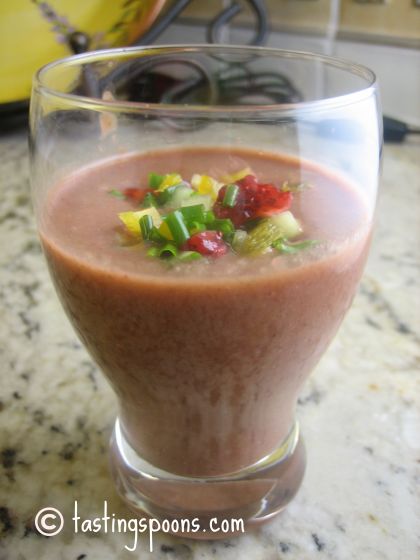
strawberry gazpacho
I know. You’re going to think I’m nuts. Strawberry Gazpacho? What more unlikely combination could there be? Savory tomatoes with sweet, juicy strawberries? Well, trust me on this one. It was served to me at one of the cooking classes I attended in Coto de Caza. And Tarla Fallgatter, the instructor, said we’d really like it. And like it we did. I liked it so much I made a batch the next day. And another batch a week after that. And the week after that.

It makes a lovely little respite on a hot summer night. It’s quite refreshing. It could be served in plastic cups, even, for people to enjoy – standing around before an outdoor meal. Or you could make it a sit-down course, but I like the appetizer idea better. It’s not difficult, although you will likely need to go shopping first – it’s not like you’re going to have all the ingredients on hand. But it’s worth doing so. And this is very low calorie too. Surprising – once you try this, you’ll be surprised too, as it’s very rich tasting.
printer-friendly PDF

Strawberry Gazpacho

Recipe: Tarla Falgatter
Servings: 6
Serving Ideas: If you’re serving this on a warm day, chill the soup ahead, in a bowl that will nest into another bowl that you fill with ice. Then set out the soup on the ice and put the garnish bowl next to it with a ladle and soup bowls and let people help themselves. Be prepared for people to take seconds.
COOK’S NOTES: There are layers of flavors in this soup – you can’t quite pick it out, but it just mellows in your mouth. The riper the strawberries the better. If you use mostly unripe ones the flavors just don’t come through. The overnight marinating is important so don’t skip this step.

SOUP:
1 quart strawberries — lightly crushed
1/2 cup white onions — thinly sliced
1/2 cup red bell pepper — chopped
3/4 cup hothouse cucumber — peeled, seeded, thinly sliced
1/2 whole garlic clove — crushed
1/4 cup fresh tarragon
1/4 cup balsamic vinegar
1/4 cup olive oil salt and pepper to taste
GARNISH:
1/2 cup strawberries — hulled and finely diced
3 tablespoons chives
1/4 cup red bell pepper — minced
1/4 cup hothouse cucumber — peeled, seeded, finely diced
6 sprigs chervil — optional

1. Combine all the soup ingredients except salt and pepper in a plastic or non-reactive bowl (or plastic bag), cover and chill overnight. Place the ingredients in a blender and puree, adding cold water(about 1/4 cup to 1/2 cup, no more) to thin it to a light soup consistency. Season to taste with salt and pepper and chill. Chill the soup bowls, if possible.
2. Mix together the garnish ingredients in a non-reactive bowl. Pour each portion of soup into a small bowl and add the garnish to the center, trying to mound it in the center.
Per Serving : 133 Calories; 10g Fat (60.1% calories from fat); 2g Protein; 12g Carbohydrate; 4g Dietary Fiber; 0mg Cholesterol; 4mg Sodium.

Posted in Soups, on July 23rd, 2007.


Oh, do I have a recipe for you. What’s more summery than a cool bowl of gazpacho? One day soon I’ll post my other, traditional recipe for gazpacho, but this one has a citrus twist. And it’s easier, actually, than the regular one.

Here’s the scoop. Some years ago, on one of the trips I’ve made to Santa Fe, we were a group of 10-12 people on a culinary tour. There were four of us (all gals from Southern California, as it happened) who just hit it off and tried to squeeze in as much fun as possible, in between the spectacular meals, museums, galleries, etc. And we had some really fabulous meals. But eating at Cafe Pasqual’s isn’t something for a group. The restaurant is too small. And maybe they don’t work with groups, even though ours was only about 12 people altogether. So our leader recommended we all go there for some other meal. But if any of you have been there, you know there’s nearly always a line outside the door waiting for a table. Their website says they do take reservations now, for dinner. That would help. They didn’t take them at the time I was there, this particular trip.

Katherine Kagel owns Cafe Pasqual’s, and she’s made a real name for herself with nouvelle Southwestern food. She takes mostly old New Mexican favorites, everything from enchiladas, to stews, to desserts, and gives them her unique touch. So far as I know, she’s never expanded. It’s still the one restaurant, the same, small kitchen they cook in, and the same small dining room. And it’s still going strong. She’s published two cookbooks. (Can you believe it? I don’t own either one of them!) Her first, the earlier book, Cafe Pasqual’s Cookbook, was printed in 1993. I went to the library back then and hunted for this recipe. Nope. That’s why I didn’t buy the book. Plus, we have such good Mexican food here, I rarely cook it myself. I don’t know if the recipe is in her newest book. I may have to order it to find out. It’s Cooking with Cafe Pasqual’s, published in 2006. Address: 121 Don Gaspar, Santa Fe, New Mexico. Later note: the recipe IS in her 2nd book, and it does differ some. I’ll have to post it one of these days.
So anyway, the 4 of us sat down – squeezed around a table really meant for 2 people, and ordered. Two of us decided to try the Citrus Gazpacho. Oh my goodness was it ever good. I got out a piece of paper and a pen and tried my best to figure out what was in it. We all sampled sips, dissecting it as much as possible.

Upon returning home, I tried to recreate it. We think it was made with canned juice, probably V-8 [wrong on that one]. You can make your own base if you would like to, but we thought it had a greater density of flavor than just pureed fresh tomatoes and or canned tomato juice. It had a sweet side to it – we picked out that there was some fruit in it, but when I tried to make it at home, it wasn’t sweet enough with just the fruit and some of the juice squeezed from the pulp and membranes, so I added the apple juice concentrate [wrong on that one too]. Remember to taste as you make this so you don’t add too much concentrate. I did that once, and learned my lesson. We knew what was in the garnish because it was visible, but which kinds of peppers (poblano and serrano?) I couldn’t tell. You could substitute other types. Be cautious about the salt. If you want, buy the low salt V-8 and salt up as you like. Regular V-8 contains a lot of sodium.

So, even though this recipe isn’t really Cafe Pasqual’s version, I’m quite happy with the result.
printer-friendly PDF

Citrus Gazpacho

Recipe: A Carolyn T original recipe
Servings: 8
NOTES: This is based on what was tasted at Cafe Pasqual’s, in Santa Fe, New Mexico about 1990. It’s very similar to traditional, Spanish gazpacho, but with citrus overtones. It’s a tad on the sweet side with the apple juice concentrate in it.

SOUP:
46 ounces V-8® vegetable juice
1/2 cup grapefruit sections — from fresh fruit
1/2 cup orange sections — from fresh fruit
1/2 whole cucumber — hothouse, minced
1/2 whole red onions — minced
1/2 whole red bell pepper — minced
1/2 cup yellow bell pepper — minced
4 whole tomatoes — chopped
3 tablespoons extra virgin olive oil
6 ounces apple juice, frozen concentrate — defrosted
GARNISH:
1/2 whole green bell pepper — minced
4 whole scallions — minced
1 whole serrano pepper — minced
1 whole poblano chile — minced
3 dashes white pepper salt to taste (or not at all)
1/2 cup fresh cilantro — chopped

1. Using a food processor, chop up all the vegetables: cucumber, onions, peppers and tomatoes. If you wish to offer the garnishes in separate bowls, process each of the garnish vegetables separately and refrigerate until ready to serve. In a very large plastic container combine the V-8 juice, the fresh fruit sections (including any juice you can squeeze from the fruit too), cut into small pieces, the food processed vegetables, tomatoes, olive oil. Then add the apple juice concentrate slowly. Do not add it all, but taste the soup for sweetness. Depending on the sweetness of the fruit, you may not want to add all of the juice concentrate. Allow to chill for several hours or overnight.
2. Scoop out servings into bowls and pass the condiments for people to add as they choose. The soup base will keep for about a week.
Per Serving: 152 Calories; 6g Fat (31.0% calories from fat); 3g Protein; 26g Carbohydrate; 4g Dietary Fiber; 0mg Cholesterol; 609mg Sodium.

Posted in Soups, on July 21st, 2007.

It was just within the last 6 months or so that I discovered C&W even offered this package of butternut squash. I don’t know about you, but sometimes just CUTTING a fresh butternut squash is daunting. I have one gigantic curved chef’s style knife that is good for cutting squash, but even with that long and sturdy knife, sometimes I must work at it for 20-30 minutes peeling, cutting, de-seeding, etc. Trader Joe’s sometimes has fresh squash in little packages (maybe 2-3 servings), but the frozen squash sure makes it easy. I haven’t compared prices, but I’d guess the C&W frozen is probably the better buy.

This recipe comes from one of the cooking schools Cherrie and I enjoy attending. I’ve mentioned it before – Our House, South County – located in San Juan Capistrano (where the famous swallows return to the Old California mission every year during one week in March). Cherrie and I both just loved-loved-loved this soup. Sarah, the co-chef of the cooking school, told us about the C&W squash. I think I stopped at the market on the way home that day to buy a bunch of them. I liked this soup so much that when my DH and I had a “kitchen warming” for our newly remodeled kitchen a few weeks later, I served this to all of our guests. The recipe looks like it came from Sunset Magazine (October, 2006). For any of you who don’t live in the Western States of the U.S., you may not know about Sunset. It’s a fabulous monthly magazine which focuses not only the cuisine of the west, but also house projects, landscaping and ideas for living/entertaining unique to our area. It’s a magazine I’ve subscribed to for at least 40 years. I must have missed this recipe, but am so glad Our House, South County decided to serve it to us. Any number of guests asked for the recipe that night I served it. I was happy to share, as I am now.
printer-friendly PDF

Butternut Squash Soup with Jalapeno & Ginger

Recipe from Sunset Magazine
Source: Our House, South County, San Juan Capistrano, California (now closed)
Servings: 8
NOTES: You can buy a fresh squash for this, or buy one-pound bags of frozen cubed butternut squash at the grocery store, C&W brand. If you’re sensitive to hot chiles, you might decrease the amount of it.

2 tablespoons olive oil
6 cloves garlic — minced
2 tablespoons ginger — grated
1 small jalapeno chile pepper — seeded and chopped
1 tablespoon salt
1/4 teaspoon cayenne
4 pounds butternut squash — peeled and cubed (see notes)
3 cups chicken broth
3 cups water
1 tablespoon brown sugar
3 tablespoons heavy cream
3 tablespoons creme fraiche — for garnish

1. Heat olive oil in large stock pot. Add garlic, ginger, jalapeno and salt. Cook, stirring constantly, until fragrant but not yet browned, about 1-2 minutes. Add cayenne and cook for another 30 seconds. Add squash, broth, brown sugar and water. Bring to a boil, lower heat to a simmer and cook, stirring occasionally, until squash is tender, about 30 minutes.
2. In a blender puree the soup in batches until smooth. Be careful not to overfill the blender container as the heat will explode the top off the blender. Pour back into the soup pot and stir in cream and adjust seasonings to taste. Serve hot with a little swirl of creme fraiche, if desired.
Per Serving: 178 Calories; 8g Fat (36.9% calories from fat); 4g Protein; 26g Carbohydrate; 4g Dietary Fiber; 13mg Cholesterol; 1102mg Sodium.

Posted in Soups, on June 16th, 2007.


Remember a couple of weeks ago I posted about my dinner visit to Cindy’s Backstreet Kitchen in St. Helena? And I showed a picture of the soup Cherrie and I had that night that we thought was so terrific – Tomatillo, Poblano and Asiago soup? And I researched on the internet and found a recipe from Stephan Pyles restaurant in Dallas.

Here’s what Cindy’s soup looked like:

Here’s my soup: Well, I’m here to tell you, this is very close if not one and the same. It looks the same. It tastes just about the same. And I’m a very happy camper, because now I can make this soup in a big quantity and freeze it like I do with most of my soups.


So what’s different at all? Well, the waitress at Cindy’s told us they sautéed the tomatillos for one thing. And they use masa to thicken the soup. I hunted all over in my pantry, but didn’t have any. I didn’t have any fine grind corn flour either (other than cornstarch, and I was certain that wasn’t what we wanted here). I did have polenta and cornmeal, but they’re both too coarse. So I used the regular flour called for in the recipe. And she thought there wasn’t any cream in it, but this soup (with milk and a little cream) looks JUST like theirs, so I’d say they did. Make sure you don’t get a single poblano chile seed in the soup – it won’t puree very well.
If I changed anything next time I make it, I will use less cheese. Asiago has a slightly bitter taste on the palate, and I think less would be an improvement. I only had a little over 1/2 pound, and the recipe called for 10 ounces. I think it has ample at that, and could easily be reduced, so I’ve changed the quantity in the recipe below. Asiago melts into the soup well – it’s doesn’t become stringy and difficult as some cheeses can do when added to hot soups. I did quick/flash fry the tomatillos first. A little olive oil, a hot burner and they browned in a hurry. Tomatillos have a lot of water in them, so once that was rendered out, they reduced to small pieces. I also sautéed the onion with the tomatillo, then the poblanos before adding any of the liquid. I’ve changed the recipe to that effect. I also didn’t strain the soup. I think the little bit of texture tastes just fine. I blended it well, though, so it wouldn’t have to be strained.

I can tell you I love simple soups, and this is one. You’re not likely to have all the ingredients on hand, however, but this one is certainly worth a trip to the market to buy the poblanos, the tomatillos, Asiago cheese, spinach and cilantro. Oh, yes, I’ll be making this again. Most definitely. Soon.
Printer friendly PDF and MasterCook file (click link to open recipe)

Roasted Poblano-Asiago Cheese Soup

Recipe adapted from one by: Chef Matthew Dunn,
Stephan Pyles (restaurant), Dallas

Servings: 6  – Makes about 7 cups

5 tablespoons all-purpose flour
4 tablespoons butter — at room temperature
2 whole poblano chiles — roasted, peeled, seeded, chopped
1 whole onion — chopped
3/4 pound tomatillos — husked, rinsed, chopped
3 cloves garlic — chopped
1 1/2 cups chicken stock
1/2 cup heavy cream
2 cups milk
1 cup spinach — cleaned
4 ounces Asiago cheese — grated, or more to taste
1/2 bunch cilantro — chopped
Salt — to taste
Fresh ground pepper — to taste

1. In a mixing bowl, mix the flour and butter with a fork until the flour is totally incorporated.
2. Place the poblanos, onion, tomatillos, garlic, chicken stock, cream and milk in a pan and bring to a boil. Whisk in the flour and butter mixture and continue to whisk until lumps of flour disappear. Cook over medium heat until the mixture thickens. While stirring, add spinach, Asiago cheese and cilantro and continue to cook for 30 seconds. Transfer to a blender in batches and blend until completely smooth.
3. Strain through a medium strainer back into the heavy pan, season with salt and pepper and keep warm. Ladle the soup into warm bowls and garnish with tortilla strips and Pico de Gallo, if desired. Or sprinkle with additional chopped cilantro.

Posted in Soups, on June 7th, 2007.

Ramekins, the cooking school Cherrie and I visited last Saturday and Sunday is in Sonoma. It’s been in existence for a long time, and first came to my attention because Joanne Weir, one of my all-time favorite cooking instructors, mentioned that she occasionally demonstrated there. Also, Tarla Fallgatter, a local Orange County teacher, also taught there in years past. Over the years I’ve looked at Ramekins‘ website and watched who was visiting there to teach, when, etc. One trip to wine country I even dropped by the school and peeked in to see what it was like, and was fortunate to be able to see some of the guest rooms (it’s a B&B also). That’s when I decided that someday I’d go for a class and an overnight.The cooking school is housed in a lovely building about 3 blocks from the main square in downtown Sonoma, just next door to The General’s Daughter, a fabulous restaurant we visited one night last week. Unlike some cooking schools which are side rooms of cookware stores (often cramped), this one was set up to be a cooking demo and participation kitchen. Actually the building also has a very large banquet room (and accompanying commercial kitchen) to seat about 100+ people, and they do large parties, weddings, etc. there. A lovely patio adds to the charm of the place. In the picture, the banquet room is on the left, the kitchen school on the right, the B&B rooms upstairs (which are just lovely) and the delightful patio under those leafy trees.

The cooking school kitchen has ample room for seating or prep tables. Most of Ramekins’ classes are participation style (you are given an overview of the class, then everyone digs in and prepares a part of the meal). We chopped, minced, sautéed, pureed, tossed, etc. whatever our assignment was, then went to tables outside (both days were just beautiful weather, ideal for sitting out under their big shady trees) and the staff served us the meal we’d all fixed.

So, on Saturday, the class was French Bistro favorites. We had the soup (below), a country paté, mussels in broth, steak with Béarnaise sauce, pommes Anna and chocolate soufflés. I doubt I’ll make any of the other dishes, but the tomato soup was outstanding. One point the teacher, Lisa Lavagetto (the cooking school manager), told us was the importance of using only San Marzano canned tomatoes. You may already know about these, but I didn’t, and having tasted them right out of the can today, I can definitely say they’re
far sweeter and more tasty than any canned tomato I’ve ever met before. They’re not at your neighborhood chain grocery – you’ll need to find an upscale grocery or an Italian deli. The 28 ounce cans I bought were $3.69 each, but well worth the expense. The soup isn’t hard to make, at all. You just have to have the ingredients at the ready – onions, carrots, celery, tomato paste, the San Marzano tomatoes, some fresh herbs, chicken broth. Oh, and some heavy cream. This isn’t exactly low calorie or low fat, but a cup of heavy cream for 8 people is only 2 tablespoons per person.
That’s not bad! And this soup will definitely be a staple in my repertoire from now on. I doubled the recipe so I’ll have some to freeze.
Printer friendly PDF
and MasterCook file (click link to open recipe)

Cream of Tomato Soup

Recipe: Lisa Lavagetto, cooking school manager at Ramekins, Sonoma, California
Servings: 8
NOTES: A serving will be about 1 1/2 cups or less. The instructor highly recommended Swanson’s Natural Goodness chicken broth, but it’s too high in sodium for me, so I used Health Valley. The instructor also mentioned that carrots help round out the flavor of tomatoes – she uses them often in any dish that uses a lot of tomatoes.
Serving Ideas: The original recipe called for using puff pastry, cut into squares and rolled out thin, then draped over an ovenproof bowl filled with the soup, then baked at 425° for 10-15 minutes until toasty crisp. We in the class felt that the pastry was very hard to cut – how do you do that with only a spoon, but awkward for sure even with a knife or fork when it’s perched on top of a bowl. So we all decided that making croutons with butter and olive oil would be a better choice.

4 tablespoons butter
2 pieces thick-sliced bacon — diced
1/2 large onion — peeled, diced
1 stick celery — diced
1 medium carrot – – peeled & diced
1/3 cup all-purpose flour
8 tablespoons tomato paste
6 cups chicken broth — or vegetable broth
15 ounces chopped tomatoes — San Marzano brand, with juice
2 sprigs rosemary — fresh
5 sprigs thyme — fresh
1 whole bay leaf kosher salt & freshly ground pepper
1 cup heavy cream
3 cups croutons — homemade, not packaged
1. In a large, heavy bottomed pot melt the better. Add bacon, onion, carrot and celery. Sauté until lightly browned. Mix in the flour, forming a roux, then cook until the mixture resembles a fine sandy texture. Do not burn. Remove from heat and add the tomato paste. Return the pan to the heat and gradually add the 6 cups broth and bring to a boil, stirring constantly to break up any tomato paste chunks.
2. Combine the fresh herbs and bay leaf into a bouquet garni (tie up with a string) and add to the soup. Add tomatoes with juice and season lightly. Simmer for 40-45 minutes, occasionally skimming off any fat that might arise to the top.
3. Meanwhile, prepare the croutons (chunks of white bread drizzled with olive oil and butter, then baked or drizzle olive oil and butter in a frying pan and brown them).
4. Remove the herbs (bouquet garni) from the soup and discard. Use a stick blender (or food processor or blender) and liquidize the soup until smooth. Or, if you prefer to have a bit of texture, just blend the ingredients part way, then return to the pot and add the cream. Adjust the consistency – if the soup is a little too thick, add a bit more broth or cream. If you prefer a very smooth soup you can strain through a conical strainer at this point. Adjust the seasonings again, then ladle into bowls, top with some hot croutons and serve.
Per Serving : 302 Calories; 21g Fat (60.2% calories from fat); 9g Protein; 22g Carbohydrate; 3g Dietary Fiber; 59mg Cholesterol; 911mg Sodium.

Related Posts Plugin for WordPress, Blogger...

Where to Next? Check out these other great cooking blogs