


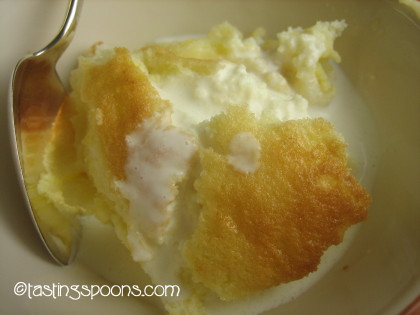
Warm lemon sponge pudding with a bit of heavy cream poured over.
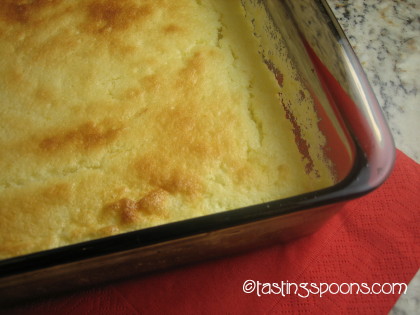
Lemon sponge pudding hot out of the oven.
As probably with many of you, recipes come your way from so many different places. From people you’ve met along the paths of life (as in this case), or from a magazine at the doctor’s office, the grocery store even.
DH and I were fortunate to meet some very dear people, Rita and Roy, many years ago. They’re related to some friends of friends. You know how that goes. They’re from England, but come to the U.S. with some frequency to visit. DH and I were invited to their home in England (actually three different ones over the years) to stay, to use their home as a base for traveling in the area. They always made us so welcome, and we were very grateful for the hospitality.
One year, 1993 to be specific, my friend Cherrie and I decided to take a trip to England together. She’d never been, and since I had some experience driving on the left side of the road, we rented a car at Heathrow and set out on our journey. It’s through Cherrie that we knew Rita and Roy, and they’d kindly offered to let us stay in their home in Reading (pronounced like red-ing).
Every time I get behind the wheel in a right-hand drive car I have to familiarize myself with the mysteries of relearning some but not all of my driving motions. The gear shift is on the left, but the gas pedal is still on the right side. Most cars are stick shift in Europe. Not many people have taken to automatics, like we do here in the United States. That part was fine with me, but it does take a bit more concentration. The turn signal is still on the left side of the steering column, but you have to remember to look at the rear view mirror on the left (inside the car), and the outside mirror on the right. All very confusing. You do get used to it, but the first few days can be very frustrating.
When DH and I travel, he usually drives, and the first few days the passenger is responsible for navigation AND coaching the driver. As when approaching an intersection, reminding the driver to turn right, but keep in the left lane once you make the turn. Like “turn left ahead, but keep left.” Or when entering a roundabout, a reminder that we don’t have right of way. So Cherrie was my navigator and scout. She took on the role well through the whole trip. Only once did I come out of a parking lot where we’d been shopping, shopping, and I got into the right side of the road. Fortunately nobody was coming. She was johnny-on-the-spot to correct my error. We had a wonderful time on this trip, driving all over.
Rita’s sister Sandy lives here in the U.S., and Sandy had always told Cherrie that there wasn’t “anything” to buy in England. So Cherrie went on that trip with nary any space in her suitcase for anything to buy. I’m certain I told Cherrie that wasn’t true, but she trusted Sandy in this case. Hmmm. The second day in England we drove to Salisbury. We had fish and chips at a local stand-up bar. They were absolutely delicious. Since it had taken us a few hours to get to Salisbury, we couldn’t dilly dally, since I wasn’t anxious to drive back to Reading after dark. It was winter when we were there, so there were shorter daylight hours. But, I wanted Cherrie to see the Cathedral in Salisbury, which is so magnificent. She enjoys English history just like I do, so we found a carpark and headed off walking. There was a wide walking street from the carpark to the church, with solid stores left and right. We walked about 30 feet onto this walking street and passed a window of Boots, the well-known “chemist” (drug store) that is all over the United Kingdom. I paused at the window to look at some cute coffee mugs. Cherrie looked over and immediately was looking closely at the window display too. We went inside. Well, what can I tell you other than we never made it to the Cathedral. Cherrie laughed and roared. What in the world did [her friend] Sandy mean there wasn’t any shopping in England? The dollar was worth a whole lot more then, so exchanging dollars for pounds bought us more value than today. We bought things. We shopped. And we shopped some more.
As time went on, on this trip, Cherrie was filling up the boot (the trunk) of the car with her purchases. There were bags and bags in there. Because we were staying with friends, she hadn’t quite figured out what she would do with all this stuff. Eventually we headed off on our own, driving many directions, including to London too. Cherrie had to fit things in her suitcase. Oh, there was trouble in River City. She stuffed. She pried. She pushed and pulled. She found room for a lot of things. She tossed out some things too – some clothes that weren’t new, and some tour data, to make room for more of her purchases. As we approached the last few days of our trip Cherrie was still buying. She still kids me to this day about my remark, but I said to her, Cherrie, if that doesn’t fit in your purse, you can’t buy it. She bought a second small bag of some sort (a carry-on), which was mighty full when we got to Heathrow to fly home. But she managed. How, I don’t know, but she did. She was big-time motivated!
So, I need to get back to this wonderful pudding. This is Rita’s recipe. It was actually Cherrie’s and my second trip to England that Rita had this in the refrigerator waiting for us when we arrived. We got there late on that trip. She had a couple of plates of food saved for us too, which hit the spot. Then she pointed to the dessert and said help ourselves when we were ready. Cherrie and I were jet lagged and way off-schedule. Rita went off to bed and we had a couple cups of tea to calm down. Finally, we scooped out a serving and poured on some light cream (like half and half) on top. Oh yes, was it good. I’m a huge lemon fan anyway, so this hit the spot, as it has every time I’ve made it since.
If you’re not familiar with sponge pudding, it’s kind of a cross between lemon curd, lemon pudding, and a sponge cake. The preparation and baking process makes layers – a lemony pudding layer and a cake layer. So, you get two desserts in one. Thank you, Rita, for sharing the recipe.
printer-friendly PDF
Lemon Sponge Pudding
Recipe: from our friend, Rita A. from England
Servings: 6
2 ounces butter — or margarine
4 ounces caster sugar (use regular granulated)
2 whole lemons — juice and grated rind
2 whole eggs — separated
1 cup milk
2 ounces self-rising flour
1. Preheat oven to 350°.
2. Cream butter (or margarine) and sugar with grated lemon zest until mixture is pale and fluffy. Add egg yolks and beat well. Stir in half of the milk, then the flour. Pour in remaining milk and lemon juice.
3. Whisk egg whites until firm and then fold into the egg mixture.
4. Pour into a greased (buttered) 2 pint glass or ceramic baking dish. Place in a large roasting pan half filled with hot water.
5. Bake in center of oven for 35-40 minutes until golden brown and firm to the touch. Serve hot or warm with ice cream or heavy cream drizzled over.
Per Serving: 226 Calories; 11g Fat (41.3% calories from fat); 5g Protein; 30g Carbohydrate; 1g Dietary Fiber; 97mg Cholesterol; 242mg Sodium.


Leave a Comment!