
Cranberries, everything you’d like to know
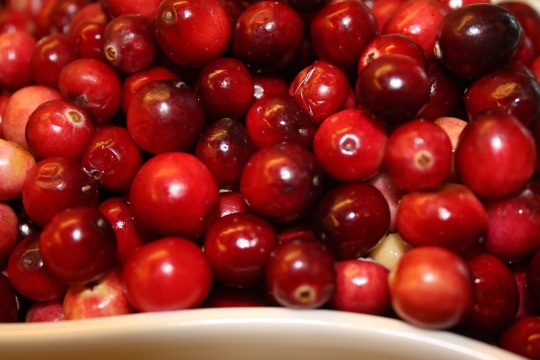
The other day I wrote up a post that started out about cranberries, but ended up being a long story about how I lived in Rhode Island when I was about 14-17. In the process I did read a bunch of information about cranberries, and thought I’d share it.
- Cranberries are from a group of evergreen dwarf shrubs. The word derives from “craneberry,” from European settlers who thought the flower of the cranberry resembled the neck, head and bill of a crane.
- They grow in acidic bogs in the Northern Hemisphere.
- Cranberries are pollinated by honey bees and in any form we eat them, they contain good antioxidants.
- Henry Hall, an American Revolutionary war veteran, was credited as the first cranberry farmer on Cape Cod, about 1816. Wisconsin is now the leading producer of cranberries. Nowadays cranberry bogs are constructed with sand and the surface is laser leveled to provide perfectly even drainage. The bogs are frequently drained.
- A misconception is that the beds/bogs remain flooded throughout the year (like in the Ocean Spray commercials). Not so – they’re only flooded during harvest, or when the temps dip very low (the water protects them from completely freezing). If it does freeze, they drive trucks onto the ice to spread a thin layer of sand to control pests and rejuvenate the vines.
- White cranberry juice is made from fully mature cranberries, but done so before they attain the characteristic bright-red color.
- Fresh cranberries should be frozen in a home freezer for no longer than 9 months. Use the fruit directly without thawing.
- Canned cranberries are generally the below-grade fruit. The cream of the crop are the fresh bags we find in November & December.
- There was a scandal in 1959 when that year’s crop was tainted with traces of aminotriazole, an herbicide. The cranberry market collapsed. In years following, the cranberry industry introduced more year-round products (so they weren’t so dependent on a 2-month selling season) like mixed juices, and more currently dried cranberries.
- Ocean Spray (originally a cooperative with the A.D. Makepeace Company) has been in continuous production since the late 1800’s and is still the world’s largest grower of cranberries.
If this has been fascinating, you might want to look at the following:
University of Wisconsin cranberry website
Wikibooks: Cranberry
Wikipedia’s site
OceanSpray (main site)
OceanSpray’s most popular recipes
– – – – – – – – – – – – – – – – – – – – – – – – – – – – – – –
Two years ago: Gulliver’s Creamed Corn