
Cherries (everything you ever wanted to know)
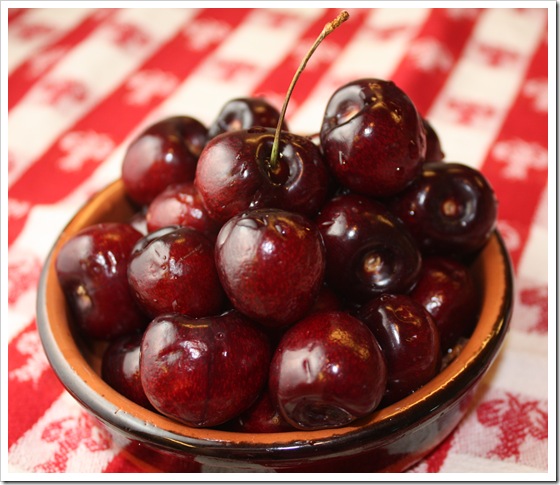
On our recent driving trip through California, Oregon and Washington, we saw a multitude of roadside stands hawking cherries. Bings. A few Rainiers. The season is short, as we probably all know. It wasn’t always that way, apparently. Back in the day (probably the 1800’s) a plentiful variety ripened at different times. But somebody, in their infinite wisdom (?) decided it would be better to choose one variety and have them all harvest at the same time (more efficient . . . they decided). Hence the Bing. Our favorite national cherry.
Well, except in Michigan, where they grow about 240 MILLION pounds of sour cherries. But would you believe that 239 million of them end up in cans? Yup. Only about a million of them end up being eaten fresh, and only in Michigan.
Most cherries are grown on the West Coast (Washington, Oregon and California), and they make up about 65% of the marketable cherries in the U.S. I like how Russ Parsons (all this data comes from his book, How to Pick a Peach) describes the flavor:
- [A Bing] “is about as good as any cherry variety that has ever been grown – crisp on the outside, with a melting center that saves it from being crunchy; dark and sweet, with a nice tart backbone.”
It’s the “tart backbone” that I like. But anyway, so the legend goes, the Bing variety was found in 1875 on the farm of eastern Washington agricultural pioneer Seth Lewelling – by a Chinese workman named Ah Bing. Isn’t that just too cute? Now, there are 4 cherry categories (Bigarreaux (or Black, of which Bing is one), Dukes, Hearts and Sours. Hearts and Dukes are very soft cherries (can’t be shipped) and exist mostly in home gardens. Blacks (Bing, Royal Ann and Rainier) dominate the fresh cherry market. Royal Ann & Rainiers are the ones used to make maraschino cherries.
Interestingly, the Japanese are huge consumers of American cherries. And the “gold rush” of cherry farming is getting the first fruit of the season to the Asian market – jet-freighted to Japan and Hong Kong, where they charge 10x as much as they do here. And marketers, doing what they do, have begun growing Bings further south where the weather patterns aren’t always cherry partners. You see, cherries need at least 700 hours of winter temps at or below 45 degrees. Now THAT is a little factlet you can pop out at your next dinner party, right? But because of the more temperate climate in California, sometimes that doesn’t happen. Without the winter nap, Parsons calls it, the cherry trees simply don’t have enough energy to produce fruit. The other factlet is that cherries don’t like rain (they crack and split). And because winters in California can be rainy, more risk is involved each winter when California farmers attempt to get an early ripening.
In 1988, though, the University of California developed a new cherry – the Brooks (a cross between a Rainier and a Burlat, an heirloom variety). It is more resistant to warm weather flaws and can be picked about 10 days earlier than Bings. As a result of many California farmers shifting to the Brooks, California now grows more than a third of fresh cherries in the U.S.
One of Russ Parsons recommendations is that if you have a batch of cherries that are just barely past their prime, add a nip of balsamic vinegar to them when cooking. That will balance out the flavor. Don’t overdo it, though.
Choosing Cherries: sort through them if you can and choose the darkest – mahogany red – if possible. Make sure they’re shiny. A matte color means they’re over the hill. No shriveling or wilting, of course. Doubles and spurs mean they’ve had too much heat on the tree.
Storing: Plastic bag, coldest part of the refrigerator. Don’t wash until ready to eat. They’ll last 2-3 weeks.
In Parsons’ book he includes 3 recipes: Cold Spiced Cherry Soup, a Red Wine-Poached Cherry Dessert, and Cherry-Almond Cobbler.
A year ago: Supposedly a rendition of KFC’s Cole Slaw (not one of my better recipes)
Two years ago: Sicilian Tuna Salad (a real favorite of mine)