
Chamber Vacuumed Fruit
A week or so ago we spent the weekend up in San Luis Obispo (we stayed at our favorite B&B, the Bridge Creek Inn outside of town) and met up with friends of ours, Russ & Stacey, who live in the Bay Area. San Luis Obispo (SLO for short) is about half way for us and for them. It was a rainy weekend – perfect for sitting inside the Inn’s big living room with a fire going in the fireplace nearly every waking moment. We all had ample time to visit and catch up. The last time we saw them was over three years ago and Russ made a delicious Thai soup for us at their home. This trip we attended a special event wine cave dinner at Eberle Winery. That was fun and tasty.
 Russ got interested in cooking some years ago – he credits me with it because I got him hooked on reading Cook’s Illustrated. Russ is an engineer by education, so the magazine was a sure fit for his kind of interest in the chemistry of cooking. Back then he was a single guy and was game for anything I set him to in our kitchen. We laugh now, but risotto was kind of the in thing back then and I was so happy to set Russ up at the kitchen stove – stirring! Meanwhile, in the ensuing years, he married Stacey and then moved away. We’re still sad about the last part because we don’t get to see them very often! Now, Stacey does most of the day to day cooking for their family, but Russ has very eclectic tastes when it comes to kitchen equipment. When Russ does cook, he goes all out. He was regaling me with stories about his new set of copper core All-Clad (oh, am I envious about that!), and his complete set of Shun knives. And the 2nd green egg (a Japanese hibachi) he bought recently – that’s bigger than the original sized barbecue.
But his passion at the moment is about sous-vide cooking. That’s pronounced sooo-veed. In case you haven’t heard about it – this from wikipedia: it’s a method of cooking food sealed in airtight plastic bags in a water bath for a long time—72 hours is not unusual—at an accurately determined temperature much lower than normally used for cooking, typically around 60 °C or 140 °F. The intention is to maintain the integrity of ingredients. (And therefore it has better, fresher flavor.)
Russ didn’t bring the unit itself, but brought one of the cookbooks which had a lengthy explanation about how sous-vide works and why the food you eat is so extra tasty. To do the cooking you can start with a Food Saver (the food sealing home machine), which is what he did. But then he really got into it and decided to do it right and bought a VacMaster VP210C Dry Piston Pump Chamber Machine, Metallic’ target=_blank>chamber vacuum sealing machine. The Food Saver is great for dry-type foods, even fish or meat, but it doesn’t work well for foods in sauces, for instance. In the chamber vacuum, though, the pouched food sits upright and allows the pouch to be sealed without sucking out any of the sauces or fluid. And it removes all of the air from the food itself and from the pouch.
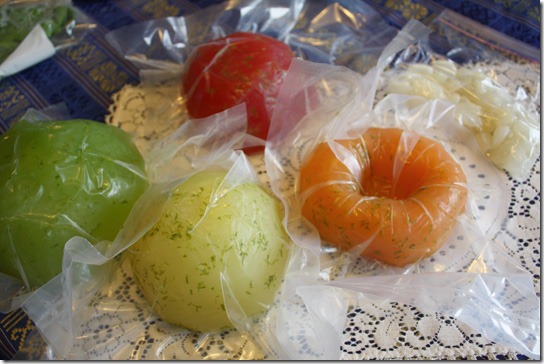
 That now gets us to the focus of the pictures you see here. Several days earlier Russ bought some lovely summer fruit (cantaloupe, honeydew, watermelon and another honeydew-type melon).
And he bought some limes. What you see in the packages and on the fruit is an ample sprinkling of lime zest. He didn’t use any of the juice – just the zest. And he chamber vacuumed all of the different fruits.
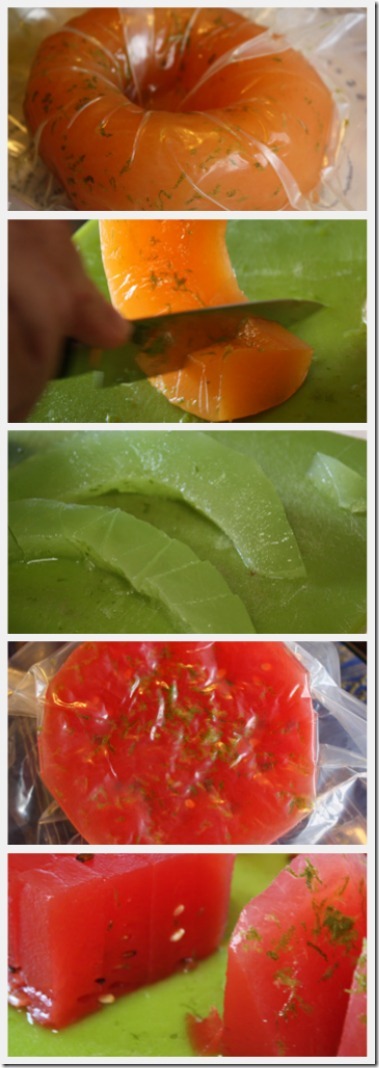
The top photo shows the cantaloupe still sealed up in the plastic. Once opened, he used his fancy Shun knives to cut the fruit into a variety of shapes.
Then there’s the honeydew. Cut up in different shapes too.
The watermelon, though. Oh my goodness, the watermelon was so delicious.
It’s hard to imagine eating watermelon (or any of this fruit) where some of the air has been sucked out of it. You don’t realize how much air there is in fresh fruit, but you can perhaps imagine the watermelon. Each piece of fruit lost about 25% or so of its size once the chamber vacuum had pulled out most of the air. That’s what gives the fruit a kind of translucence. So pretty!
There you can see the lovely compressed fruit being sliced.
Oh, was it ever delicious!
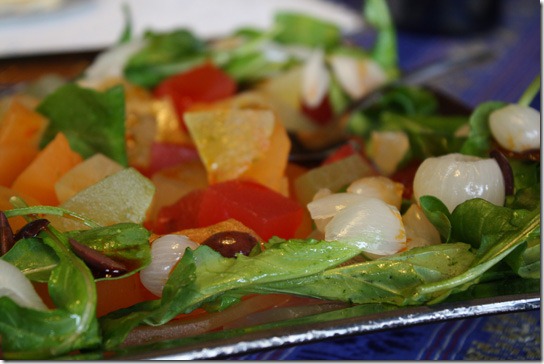
Russ made a salad for us of all the fruits (see picture at top) which came from the Thomas Keller sous-vide cookbook he brought along. He made a dressing of olive oil macerated with hot paprika. He added some lovely tiny onions (the recipe called for cippoline, but he wasn’t able to find any, so used boiling onions). Those were prepared sous-vide and added to the salad. We had fresh arugula around the edges, and some little slivers of nicoise olives. Oh my. Fabulous flavor.
I don’t know that I’m going to buy sous-vide equipment! It’s ferociously expensive. Russ promises me that next time we go to visit them he’ll fix us a complete sous-vide dinner. That should be interesting.
A year ago: French Hamburgers