
Bonorong Wildlife Park and Orphanage (in Tasmania)
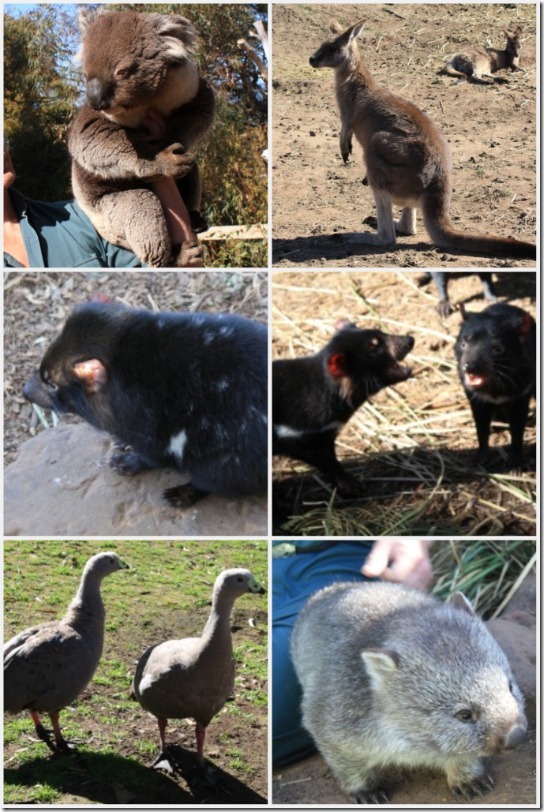
While in central Tasmania we visited a wildlife park called Bonorong. It’s a small place supported only by donations. They rescue abandoned young animals – usually because the mothers were killed by a car. The park personnel try to rehabilitate the animals so they can return to the wild, but that doesn’t always work. They also are raising many young Tasmanian Devils because the population of these animals in the wild is being decimated by an infectious facial tumor/cancer that kills them. Several wildlife parks in Tasmania are raising young that are not infected and will remain in captivity (but isolated) until this awful cancer has run its course. So here were the animals we saw:
Pictures L-R, top to bottom: A aging male koala. Did you know that koalas have a cartilege plate (called a carapace) on their rear ends? No wonder they can sit for hours on end in the fork of a tree? And did you know that koalas are really quite dumb? About all they know how to do is find and chew eucalyptus leaves (that’s all they eat), climb up and down trees, sleep (about 20 hours a day) and mate. The young male koalas sit in trees and wait for the available females to come to them. Hmmm. Bennett’s Wallabies or Kangaroos. Bennett’s are smaller and have a multi-color coat. Young ones were very skittish about taking feed from our hands. I loved feeding the kangaroos – they’re very dainty as they hold down your palm to get at the goodies you have. A young Tasmanian Devil. The group we observed were young and they were just learning their charge and scare tactics. They scream and snarl at one another, although they’re mostly all bluff, we were told. However, don’t ever, EVER get in the way of a Tassie Devil and its food! Because they’re carrion scavengers, they’re usually the lowest in the pecking order, so they’ve adapted to eat bones. That’s just what they do – imagine the strength of those jaws! Tassie Devils screaming at one another. It’s all part of the eating ritual of protecting the food they’re scavenging. Cape Bretton Geese. Nearly all, if not all Australian birds are not winged as they have no natural predators. And lastly, a wombat. These guys, marsupials (and nocturnal) were a favorite at this park – they’re just so cute. But they have almost superhuman strength. If they need to, they can run (scamper, really) at nearly 40mph. They have unbelievably strong teeth (they’re similar to a badger) to chew and cut plants (they’re herbivores). Generally they’re docile with humans, especially if they’ve been raised in captivity. They also have a cartilage carapace (on their rear ends) because their method of avoiding their predators (usually dingoes) is to run into a hollowed log (or a hole) with just their back end sticking out. Predators can’t access any soft tissue and usually give up in frustration. If a predator happens to outlast the wombat, the wombat will allow the predator to climb in on their backs, then the wombat jams and whacks the predator into the top wall of their hole or tree trunk until it’s dead. Wombats are intelligent in case you hadn’t guessed.