
An ode to Popovers
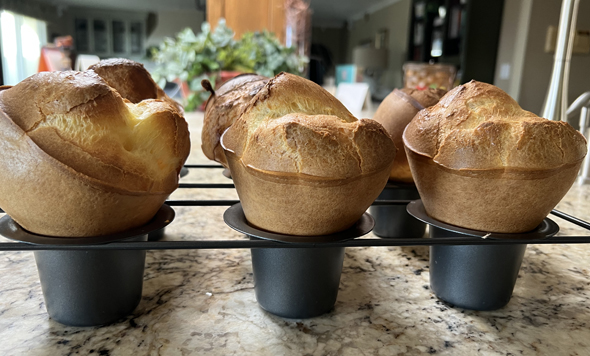
Oh my, oh my. Do I love popovers.
A post from Carolyn. I wish there was an ode, or a poem to the gloriousness of popovers. Alas, I didn’t find any, and I’m not going to write one! You know, of course, that the batter that makes popovers is nearly identical to what’s used to make Yorkshire pudding. A eggy, thin batter (eggs, flour, salt, milk and butter – that’s all that’s in them). Yorkshire pudding traditionally is made in the pan after a big beef roast is removed from the oven to rest, most of the drippings are poured off, then the batter is poured in and it’s baked for 30-40 minutes. A wedge or square of it would be served alongside a big hunk of juicy beef roast.
Years and years ago (we’re talking the late 60s), when I was about 25-26 my then husband and my parents (who were visiting from San Diego) and I drove to British Columbia (I was living in Washington at the time) to visit my dad’s cousins who hailed from a tiny farming community there. I think they raised wheat or soy beans, but don’t quote me. They lived in a very old farmhouse, and Sunday dinner was served at about 2pm. The ladies of the house had been bustling in the kitchen for hours (not enough room for more than 2 people) and finally dinner was served at the huge dining table. Yorkshire pudding was portioned out beside the slice of roast, along with big roasted potatoes (probably also cooked in the pan with the roast). Beyond that I have no recollection of what we ate. Probably a vegetable and dessert. But it was the Yorkshire pudding that captivated me. I wanted to know all about it. They’d mixed it up by hand earlier in a big crockery bowl and let the mixture rest at room temp before it was poured into the large roasting pan of beef drippings (grease). Beyond that I knew nothing.
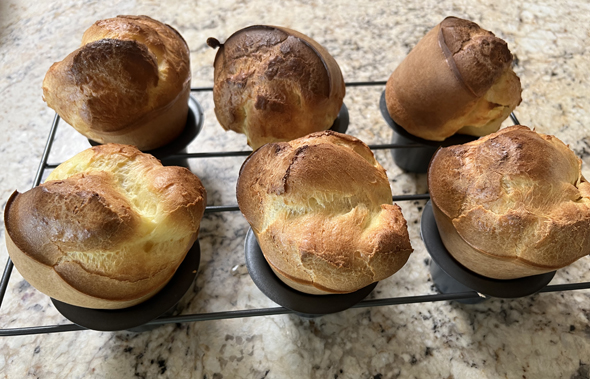 Years later, after I moved to Orange County, CA in the 70s (where I still live) when my mother visited, she and I used to go shopping at a department store, Bullock’s, and they served popovers with the lunch entrees in their restaurant. Loved them. You know and have heard about that Proust-ian moment when you bite into something and it transports you back in time, when memories of the past flood through your brain. With Proust it was madeleines, that lovely little soft French cookie. I was taken back to that day when I’d had Yorkshire pudding. Then I began researching it as best I could. No internet in those days. I bought a popover pan (see above, although the one I had then was not nonstick). I don’t think nonstick existed back then. Over the years I had difficulty with that pan and eventually gave it away because it just was not reliable about the popovers sticking, even though I buttered them well. I didn’t replace it. I THINK my mistake was putting it in the dishwasher. I’ve read since that popover pans should not be put in the dishwasher – even this new nonstick one. Probably because the strong/harsh detergent will eventually damage the nonstick surface. Lesson learned.
More years went by, and then I went on this last trip and had popovers at Kaynes in Nashville. They were absolutely sensational. Again, I was transported – this time not to the Yorkshire pudding days – but to friends my DH and I made in England, and Pamela had made a roast beef and she made popovers. When I got back home from this trip to Nashville, though, I went online to amazon and bought la new Bellemain nonstick popover pan. And since then I’ve been on a mission to make popovers that make me happy. There are lots of nonstick popover pans on amazon – the Bellemain one merely had lots more good reviews. Just don’t ever put it in the dishwasher.
 With my new popover pan in hand, my first recipe iteration was from America’s Test Kitchen. It was the traditional 1 cup flour, 1 cup milk, 2 eggs, a pinch of salt and a tablespoon of melted butter. I made them, and they were okay. Certainly acceptable, but not up to the eggy, rich popover I had at Kaynes. I began researching more recipes and wanting them to be more eggy (so more eggs in ratio). And wanted a richer taste, so I assumed maybe a little more melted butter would be a good addition. My second iteration hit the mark – maybe not quite as rich as Kaynes’, but it’s close. In researching this blog post I came across yet another recipe, purported to be from Cook’s Illustrated that uses even less flour, and a lower oven temp, so I think I’ll need to give that one a try too. I also have a recipe for chocolate popovers – obviously it’s a dessert! I’ll make those one of these days.
This recipe, from King Arthur Flour uses more eggs, less milk and flour, and 3 tablespoons of melted butter. You’re to use warm milk and eggs that have warmed to room temp (or let set in hot water for 10 minutes before cracking them open). They suggest mixing in a bowl with a whisk, but I used the blender, and then just let the batter sit with the lid on, for an hour. This gives time for the batter to lose bubbles that have formed in the mixing. Some recipes insist popover batter needs to rest at room temp for an hour. This particular one did not, but I didn’t think it would hurt. I halved the recipe below as my popover pan has six wells.
RECOMENDATIONS: There are any number of recommendations from seasoned cooks and chefs about making popovers. Warm milk, warmed eggs, let the batter sit for an hour, hydrate the flour (needed), heat the popover pan in the hot oven before pouring in the batter, and cardinal of all, NEVER open the oven door during the baking, or they’ll deflate. Also if your oven is smaller, place the popovers on the lowest shelf possible, leave some space, then slide a cookie sheet on a higher shelf (helps to prevent over-browning).
When you make them, prepare only as many as you think you’ll eat. Although you can eat them warmed up (microwave 10 seconds, turn them over and microwave another 4-6 seconds), they’re just not the same. Reheating in the oven will over-heat/bake that lovely eggy interior.
This recipe calls for using a muffin tin, but I used the popover pan using the same instructions.
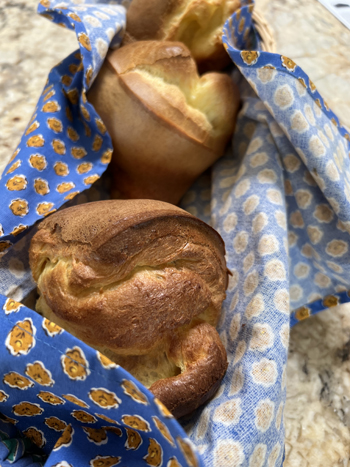
What’s GOOD: that they’re so tender, very eggy and golden, gloriously brown on the outside. So easy to pop out of the pan if you have a nonstick popover pan. And remember what I did in Nashville? Julian recommended we have some cheese (he ordered a cheese platter for the table) with little torn pieces of warm popover. Oh my. So good.
What’s NOT: nothing, really – they’re not that hard to make, even for people who think they are. Mix by hand or in the blender. Either one works well.
printer-friendly PDF and MasterCook file (click link to open recipe)
* Exported from MasterCook *
Popovers – from King Arthur
Recipe By: King Arthur Flour 3/2010
Servings: 6
4 large eggs — warmed in a cup of hot water for 10 minutes before cracking
1 1/2 cups 2% milk — lukewarm, or you can use whole milk
1/2 teaspoon salt
1 1/2 cups all-purpose flour — 6 1/4 ounces
3 tablespoons melted butter
1) Preheat the oven to 450°F. Position a rack on a lower shelf. The top of the fully risen popovers should be about midway up the oven. What you don’t want is for the tops of the popping popovers to be too close to the top of the oven, as they’ll burn.
2) Use a standard 12-cup metal muffin tin or popover pan, one whose cups are close to 2 1/2″ wide x 1 1/2″ deep. Grease the pan thoroughly, covering the area between the cups as well as the cups themselves. Make sure the oven is up to temperature before you begin to make the popover batter.
3) Use a wire whisk to beat together the eggs, milk, and salt. Whisk unil the egg and milk are well combined, with no streaks of yolk showing.
4) Add the flour all at once, and beat with a wire whisk till frothy; there shouldn’t be any large lumps in the batter, but smaller lumps are OK. OR, if you’re using a stand mixer equipped with the whisk attachment, whisk at high speed for 20 seconds. Stop, scrape the sides of the bowl, and whisk for an additional 20 to 30 seconds at high speed, till frothy.
5) Stir in the melted butter, combining quickly.
6) Pour the batter into the muffin cups, filling them about 2/3 to 3/4 full.
7) Make absolutely certain your oven is at 450°F. Place the pan on a lower shelf of the oven .
8) Bake the popovers for 20 minutes without opening the oven door. Reduce the heat to 350°F (again without opening the door), and bake for an additional 10 to 15 minutes, until they’re a deep, golden brown. If the popovers seem to be browning too quickly, position an oven rack at the very top of the oven, and put a cookie sheet on it, to shield the popovers’ tops from direct heat.
9) If you plan on serving the popovers immediately, remove them from the oven, and stick the tip of a knife into the top of each, to release steam and help prevent sogginess. Slip them out of the pan, and serve.
10) If you want the popovers to hold their shape longer without deflating and settling quite as much, bake them for an additional 5 minutes (for a total of 40 minutes) IF you can do so without them becoming too dark. This will make them a bit sturdier, and able to hold their “popped” shape a bit longer.
Per Serving: 243 Calories; 10g Fat (39.1% calories from fat); 10g Protein; 27g Carbohydrate; 1g Dietary Fiber; 144mg Cholesterol; 315mg Sodium; 3g Total Sugars; 1mcg Vitamin D; 99mg Calcium; 2mg Iron; 167mg Potassium; 158mg Phosphorus.