
All About Bell Peppers

If you’re not all that interested in knowing more about bell peppers, well, I understand. Come back in a couple of days and there will be a recipe up again on the blog. The “food scientist” in me wants more info sometimes, just better knowledge about the food products I buy, even if they’re something I’ve been purchasing for decades.
Prior to about 1980, there was only one kind of bell pepper available – GREEN. Which is why I didn’t like them much. My Dad loved stuffed green peppers (filled with a ground beef and rice mixture and served with tomato sauce). I thought these were vile – I could eat the filling, but the pepper part was bitter, acidic. That stuffed pepper style was very popular during the 1950-70 time frame.
Somewhere around 1960 shoppers were offered a choice of colors – and bell pepper sales soared. I do remember when they first began appearing in grocery stores – the ones from Holland. But oh, were they ever expensive – way beyond my food budget. In the 30 years after that our per capita consumption of bell peppers quadrupled. According to the USDA, on any given day, about a quarter of Americans were eating some amount of a bell pepper, which is double the amount we’d eat of a French fry. Well, that’s a good thing! The same percentage increase occurred with chile peppers too, although it’s leveled off in the last 20 years. All the credit is due to the Dutch, who figured out how to outsmart nature. You probably already know this – all peppers start out green, and it’s only because they are left on the bush or vine that the colors develop.
Why do Bell Peppers Turn Color?
The scientific explanation – as fruits begin to mature and develop sugar, the sweetness alters their chemical makeup and the chlorophyll start to break apart, which then permits the underlying colors to develop.
Because peppers are a very tender product, they’re very susceptible to bugs and viruses (who knew? viruses? really?). Only very careful farming can produce a fully ripe and colored bell pepper without it developing blemishes and soft spots. Holland’s farmers raise all of theirs in greenhouses, which is why they’re so pristine (and expensive).
Our taste buds really only recognize two tastes in peppers – sweet or hot. Well, I’ll add a 3rd one – bitter, which is what is in green bells – to me, anyway. There are 22 wild varieties of peppers out there and 5 domesticated ones. Most peppers are grown in California and Florida. Chile peppers mostly come from Mexico, where there are at least 3 varieties that grace nearly every Mexican family’s table with regularity. I’m guessing those are: jalapeno, serrano, and poblano. We can find those at our grocery stores every day here in Southern California.
 What makes a chile pepper hot is capsaisin (cap-SAY-eh-sun), and if you remember nothing else from this little write-up, the heat in peppers comes MOSTLY from the ribs. Not the seeds. That’s not to say that if you bite into a piece of the green of a jalapeno, you won’t taste heat – you will, but the real heat is in the little whitish/yellowish rib membrane inside the pepper. Remove those and you’ll have a much milder pepper experience. Unless, of course, you WANT the heat, in which case leave it in! Different peppers contain different concentrations of capsaicin (like habanero, the hottest, to the bell pepper which has the least) . And the heat is caused by a recessive gene. That was news to me! What’s interesting is that the heat in chiles can vary not only by variety, but also from
 peppers on the same bush. Little Japanese shishito peppers (at left) are the most variable – about one in every dozen will be hot enough to blow off the top of your head. Figuratively, of course.
CHOOSING PEPPERS: With the bell peppers, choose the heaviest ones, the ones that are the most filled out and the darkest in color. They’re the sweetest. The recommendation is to choose the peppers that have the boxiest shape with the flattest sides. And obviously, don’t buy one that has a blemish or a soft spot anywhere. Chile peppers should be average size and also unblemished and definitely firm. No soft ones at all. The best prices on all peppers is in the mid-summer when they are available in abundance.
STORING PEPPERS: They’ll keep best if wrapped well and stored in the refrigerator at about 45°. That’s the temp of most refrigerators. No colder than that, though, or the peppers will start to break down.
Nearly all this information came from Russ Parsons’ book How to Pick a Peach: The Search for Flavor from Farm to Table .
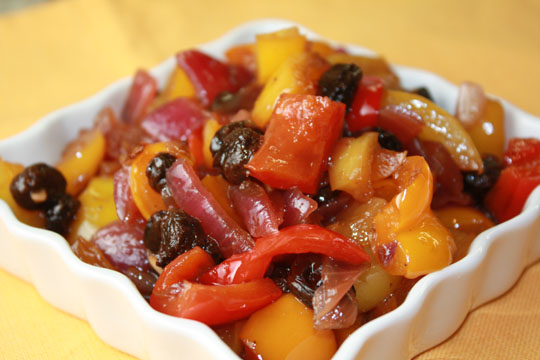 Peppers for Cold Meat – my favorite recipe you’ll find here on my blog that showcases bell peppers – it’s a sweet and sour kind of relish that’s just a match made in heaven for almost any kind of meat. It’s easy to make and keeps for weeks and weeks.