
Apricot Nectar Bundt Cake
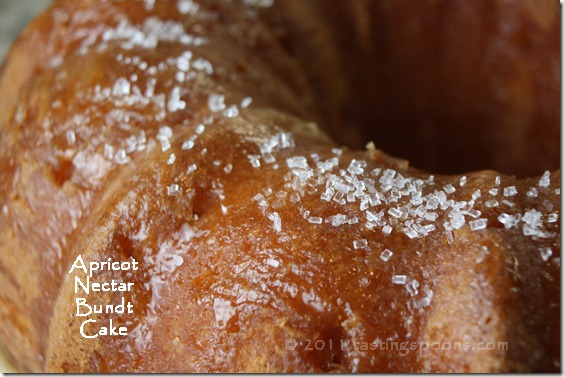
You remember, don’t you, when the first cake-mix bundt cakes were just coming out of every hostess’ kitchen? Unless you’re young and weren’t around in the mid 1970’s. At least I think that’s about when they hit the scene. These are the kinds that mixed in some liquor, or some pudding mixes, even Jell-O. They were – and are – easy to make. And they don’t really taste like cake-mix cakes when you’ve doctored them up with all the additions.
A rum version was one of my favorites. And a chocolate one. And a lemon one. But then, these cakes kind of disappeared from the cooking scene. Or at least something else became the rage instead. But I never really stopped making them. I just don’t make them very often.
In this case I was donating a cake to our church, for the Fall Festival. Mostly it’s for the kids, and they needed some cakes that would appeal to them. Some people made cupcakes, I’m sure. Those are certainly all the rage these days. So I turned to the cookbook The Cake Mix Doctor by Anne Byrn. I can’t say that I’ve made all that many cakes from the cookbook, but when I need one, I need one, and this is the book I turn to. No alcohol for this, since children would be eating it. So I chose one called an Apricot Nectar Cake. I had most of the ingredients on my pantry shelf and it whipped up easily enough.
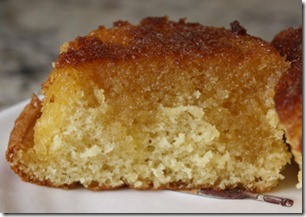 Wanting to taste a little bit of this cake was a problem, though, since I didn’t want to remove a slice just to taste and photograph it. So, instead I poured just a little bit into a cupcake mold (see photo at right) and baked it a shorter time, of course, but treated it the same. After removing the cake (and cupcake) they were cooled slightly, then inverted, holes were poked all over the cake and an apricot nectar, powdered sugar, and lemon juice combination was oozed all over the cake, and hopefully down into the holes.
Oh indeed, this cake is really good. The apricot taste definitely comes through. You can see in the photo of the cupcake above that the apricot nectar did seep into the cake. Not a lot of it reached the bottom, actually. I think I needed to poke the holes a bit deeper. I used one of those baked-potato-nails for this. Using anything thinner just meant the glaze drizzled down the cake sides and pooled on the plate. More definitive action was needed!
What I liked: the taste; the texture; the apricot glaze was really nice.
What I didn’t like: The top part (you can see in the photo) was almost “wet.” So I definitely needed to poke down deeper, but not all the way to the bottom, or the glaze would just ooze out the bottom. But I would make this again, even with that minor issue.
printer-friendly PDF
MasterCook 5+ import file – click to run MC or right click to save file
Apricot Nectar Cake
Recipe By: The Cake Mix Doctor, by Anne Bryn
Serving Size: 16
NOTES: You can add the grated lemon zest to the cake, or to the glaze. Or both. Don’t use a cake mix that already contains “pudding in the mix.” You want just the basic cake mix.
1 package yellow cake mix — (18.25 ounce) (I used a Trader Joe’s vanilla cake mix)
3 1/4 ounces lemon gelatin powder
4 large eggs
3/4 cup vegetable oil
3/4 cup apricot nectar
GLAZE:
3/4 cup powdered sugar
2 tablespoons lemon juice
4 tablespoons apricot nectar
1 teaspoon lemon zest
1. Center an oven rack in the middle of the oven. Preheat to 325°. Grease and lightly flour a Bundt pan. Shake out excess flour and set aside.
2. Mix the cake mix, lemon gelatin, eggs, vegetable oil, and apricot nectar together with electric mixer. Mix on low for one minute, then increase speed to medium. Beat for 2-3 minutes, stopping once or twice to scrape down sides.
3. Pour batter into the prepared pan.
4. Bake cake until it is light brown and springs back when lightly pressed with your finger, about 40 to 42 minutes (mine took about 45 minutes). Remove to a wire rack for 10 minutes. Slide a thin plastic spatula along the sides of the Bundt pan to loosen cake from edges. Carefully invert cake onto plate.
5. GLAZE: Combine the confectioner’s sugar, lemon juice, lemon zest and apricot nectar in a small saucepan. Heat over medium-low heat, stirring, until the sugar has dissolved, about 3-4 minutes.
6. Poke numerous holes all over the top of the cake. [I used a baked potato nail – and do poke the holes almost to the bottom of the cake – otherwise the apricot glaze will just pool in the top half of the cake.] Using a teaspoon, gently pour glaze over cake while it is still warm. Allow to cool completely before cutting and serving. Store the cake, covered in plastic wrap or under cake dome, for up to a week. Or freeze it, wrapped in aluminum foil, for up to 6 months. Thaw the cake overnight on the counter.
Per Serving: 302 Calories; 15g Fat (44.9% calories from fat); 4g Protein; 39g Carbohydrate; trace Dietary Fiber; 54mg Cholesterol; 245mg Sodium.