
Alice Springs, in the Australian Outback
Part of most Australian tours is a side trip to the Outback. Having been down, up and across the eastern half of Australia, I find it easier to describe it this way: picture the entire island of Australia as a desert, then think about a narrow ribbon around the outside edge, but mainly on the eastern side only. That’s Australia. The center (and most of the land mass, actually) is desert-like outback. It’s not flat sand by any means – it’s beautifully contoured and colorful (depending on the time of year you’re there and the status of drought in the land at the time). It’s red. It’s rocky. It’s flat in many places. There are streams and trees and shrubs of many varieties. And this year, with the drought ended, there are abundant wildflowers in the outback. A welcome change for the hearty people who live there.
Now, think back about that ribbon of green – that’s where most of the cities are, on the edges: Melbourne, Sydney, Brisbane, Cairns, Darwin, Perth and Adelaide. We visited all of those except Darwin and Perth. Then you cut across the middle and you come to Alice Springs, kind of in the southern part, center.
We flew into Alice Springs and could see “outback” for 360 degrees. With scrubby shrubs and trees of many varieties. Lots of the aboriginal people live in the outback. They’re assimilated into Australian society. I think our guide, Marilyn, told us that there are very few actual Aboriginal villages anymore. Our group did visit a rural school ( which was mostly aborigines – I couldn’t go because I had a cold and spent the whole day in bed, sniffling). We’d taken some children’s clothing (used) with us and the items were given to the school. There’s not a whole lot to DO in Alice Springs. It’s a quiet little town with a few shops, and several adequate restaurants. Nothing fancy, though. The hotel reminded me of an old Midwestern motel from the 1950’s, actually. Clean enough. Also adequate.
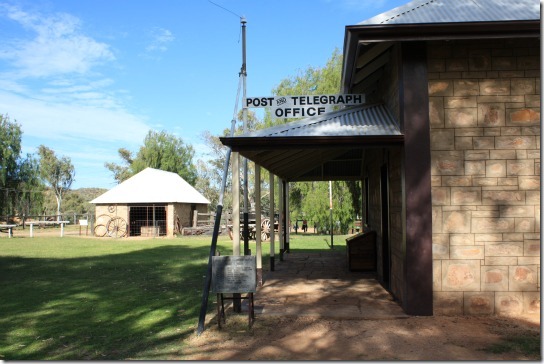
One of the places we visited was the Alice Springs Telegraph Station. It’s outside Alice Springs by a few miles and is the original site of the first European settlement in Alice Springs. It was established in 1872 when the telegraph was first installed in Australia, but this particular connection was from the north (Darwin) to the south (Adelaide), crossing the outback from north to south with 12 similar telegraph stations. British military personnel staffed the station and were generally sent there for an 8-year tour. Our tour guide was Alec Ross, a 74-year old man who was taken from his mother when he was three years old (he was ill and the powers-that-be believed he’d be better off cared for at the Telegraph Station). Alec is a half-breed (half white, half Aborigine). Numerous other half-breed children also grew up at the Station. At the time such children were outcasts. Eventually he was adopted into a white family and grew up a normal child. He’s a very garrulous, handsome man, with a wealth of stories to share about his growing-up years there.
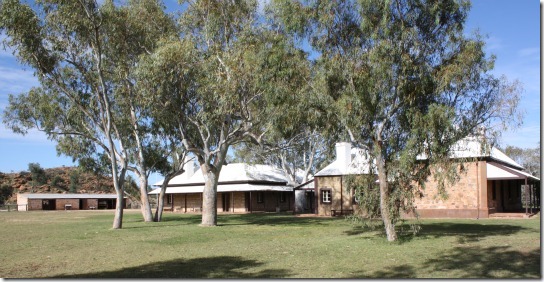
Those are the original buildings of the telegraph station, patched up here and there, with some of the original furniture inside. At the end of our tour Alec picked up a couple of boomerangs and showed us how they’re thrown (he was very good) and let all of us take a turn trying to bring the boomerang back to us. He also had a cattle whip that he expertly cracked, sounding just like gunshot.
The Telegraph Station is now a National Reserve in Australia. It also had a nice little gift shop which many of us utilized. I bought a small, flat fabric purse with an Aborigine design on it. I’ll take a photo of it and post it another day.
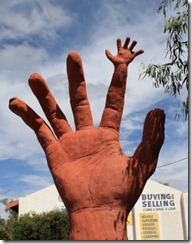
This was a sculpture along one of the thoroughfares in Alice Springs. As we all stood there looking at this thing, Marilyn asked us what we thought it meant. Somebody came up with it (not me) – it’s the sign for a “second hand” store (in the background).
This just tickled my funny bone, so I thought you all needed a laugh too.
Two years ago: Banana Bread
Three years ago: Cranberry Vinaigrette (a salad dressing)