
Hobart, Tasmania
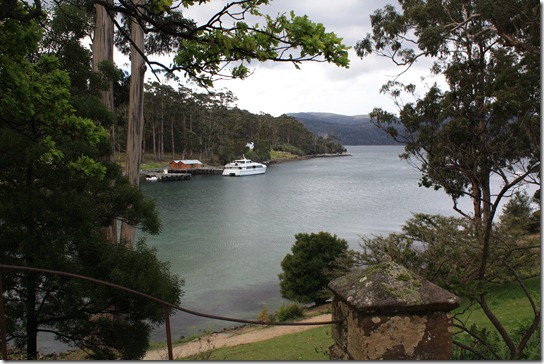
Picture: the small inner harbor at Port Arthur, the 200 year old prison where early prisoners were sent from Britain. Such British prisoners had been sent to America, but because of the American Revolution, the British had to find another destination for its worst felons. First it was Australia, then Tasmania starting in 1803. We took a boat ride on that white boat you see in the distance.
Since I assume most of you don’t know a whole lot about Tasmania, I’ll give you a little history lesson. Hobart is a small city, the capital, at the south end of the island of Tasmania, which is off the southernmost tip of Australia. When we flew from Los Angeles, after 15 1/2 hours we landed in Melbourne, then took another flight to Hobart where we stayed for a few days. We took a long walk around the city itself, visited the Salamanca Market (a once a week event, beloved by the locals), visited the old convict camp, Port Arthur, and toured some of the pristine coastal bays in and around Hobart. Since the island is closer to the Antarctic than the mainland of Australia, it’s cooler there. You can see lots of pine trees in the photo at top.
Originally it was called Van Diemen’s Land. And the books (novels) I’d read in the past all called it such, the name given to it by Abel Tasman in 1642 when he landed on the island. Later it reverted to Tasmania to honor its founder. Aboriginal people lived there, but it was an unknown to the western world at that time. It’s 150 miles long – that’s all.
And I’d suppose not a lot of people go to Tasmania – it’s on some of the extended Australia tours, but it’s not exactly mainstream Australia. Lots of Aussies have never been there. My reason was because of a book I read many years ago, a novel called Morgan’s Run , by Colleen McCullough. It’s about the British prisoners who were sent to Tasmania, there at Port Arthur. It’s about their captivity, about a few of the prisoners, their stories (probably based on fact), but eventually the prisoners were released, the island was developed and grew because of the prisoners and the families they eventually created there.
I vowed that one day, I’d visit Tasmania. Just because. It sounded so unique. And was it ever! Dave and I just loved Tasmania. Not that we’d want to live there – probably not – but it was a glorious place to visit.
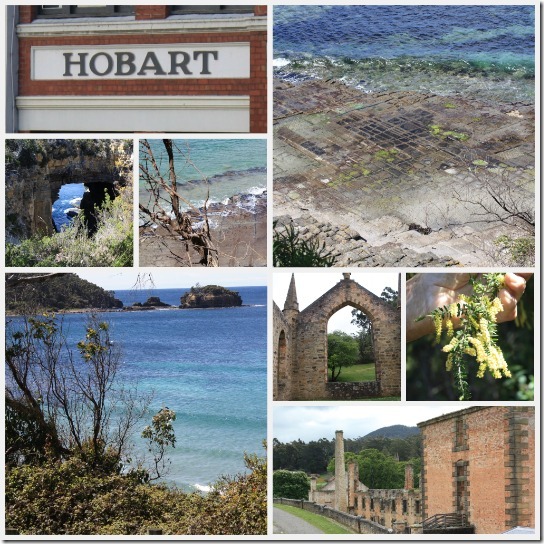
Clockwise from top right: tessellated pavement, a unique geological phenomenon that exists in two places in the world, where flat sedimentary rock erodes as if it’s been carved, like tiles, but it’s natural (see further photo below); remains of the church at Port Arthur; wattleseed flowers; the main prison building remains at Port Arthur; a lovely water view near Port Arthur; a natural ocean arch near Port Arthur; more tessellated pavement.
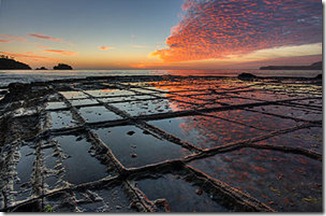 Here’s another photo, a real close-up, of the tessellated pavement which I downloaded from Wikipedia. It’s amazing to me that the creation of this is natural.
More photos and more stories tomorrow or the next day of Tasmania.
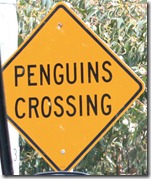 Here’s one more photo that didn’t mean much because we didn’t see any of the penguins while we were there. But because the little guys like to cross the road near this, they put up a nice warning sign to watch for them. Where we come from in Southern California, to even see a sign such as this is just hilarious!