
A cooking class about vanilla
My friend Cathey asked me if I’d like to attend a cooking class with her about vanilla. Hmm. Sounded interesting. Having just read an article in my fav magazine, Cooks Illustrated, about it, I thought I’d learn a lot about the different kinds of vanilla, and why a baker would use one vs. another. If you look in my baking cupboard I must have four different kinds of vanilla. Including the beans themselves too. So, surely I needed some help determining the best choice(s) and reducing my vanilla kitchen footprint.
The class, offered at The Blackmarket Bakery in Irvine, was a group of eight. The bakery, owned by Rachel Klemek, offers occasional classes, mostly in all-things related to baking (candy, cookies, cakes, fondant, puff pastry). Mostly aimed at more novice cooks, or ones who are into fancy cakes, decorating, etc. The classes are all hands-on, meaning the students prepare all the food. At this class we paired up in twos and used the bakery’s professional kitchen to prepare all the vanilla-related recipes Rachel had selected.
Having never cooked in a professional kitchen, I found that part interesting and fun. Some of the cooking things were out and ready for us, but not all things, so Rachel scurried to locate different pans, whisks, bowls, etc. She teaches classes at one of our local community colleges too, so she’s used to keeping an eagle eye on students as they work at the high BTU range, or remove trays of things from the commercial ovens.
Even as a food blogger, I wouldn’t ever post a recipe I hadn’t either made myself or eaten personally. But Rachel was fearless as she gave us a few recipes she’d never made or tasted before. One was a dismal failure (a vanilla souffle), so after starting it, we had to toss it out. Cathey and I started over with Rachel’s familiar Cointreau souffle (substituting vanilla) recipe, which worked perfectly.
Actually, the only thing I learned about vanilla was from a booklet Rachel passed around from Nielsen-Massey (vanilla producers) which says that vanilla bean paste is a vanilla essence (extract) enhanced with “spent” beans. Beans that have already given their essence to something else, and added only for appearance. What a surprise. Guess I won’t be buying any of that stuff again.
In the Cook’s Illustrated article (the article was not anything to do with the class, I’m just sharing it because I learned more about vanilla from the article than from the class) they did a taste test of vanillas mixed with milk. For most cooking, the magazine’s panel thought imitation extract (made with a variety of iffy products related to coal tar – does that sound yukky, or what?) was just fine. The magazine doesn’t recommend the paste or powder (the latter a “don’t bother” product), but did recommend the following (clockwise from top left):
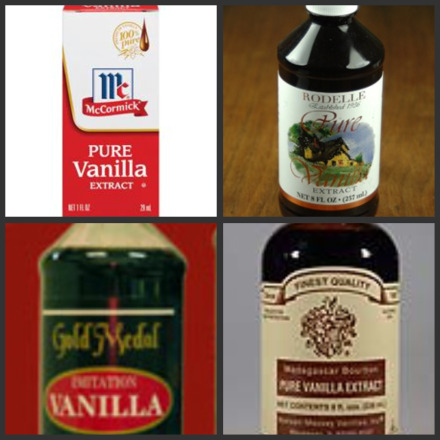
Photos from the individual company’s websites
1. McCormick Pure Vanilla Extract (grocery stores everywhere)
2. Rodelle Pure Vanilla Extract (some specialty markets)
3. Nielsen-Massey Madagascar Bourbon Pure Vanilla Extract (at high end markets)
4. And (the “Best Buy”) Gold Medal Imitation Vanilla Extract (only available at www.cfsauer.com that I could find)
In the vanilla class, Rachel only had vanilla bean paste to use (two types, though), so we didn’t get to do any taste differences. In fact, we didn’t even know which brand we students used, and it wasn’t discussed at the end, unfortunately. I’ll share a few of the recipes in coming days. Cathey and I made three of the recipes: a pear and cranberry vanilla crumble, a roasted peach with vanilla olive oil madeleine, and the vanilla souffle. The other students made a vanilla and white chocolate bread pudding with creme anglaise, vanilla pillows (a cornmeal type of cookie), a rum-enhanced chocolate sauce, and a vanilla creme brulee.
A year ago: Almond Crusted Orange Roughy