


You’ve all seen the big, tall cylindrical boxes of panettone available around holiday time, right? I think our Costco even carries them. And until a few years ago I’d never tried it – because I reasoned – how could any bread be good when it’s made in Italy, shipped across the ocean and kept for likely several months before I buy it. I mean – bread I bake here at home is stale within a day or two, so how could this be any good? Then we were given one as a gift, and I let it sit for a few more months before I finally said, okay, gotta open this thing up, so I can tell the gifter “thank you.” I wanted to be able to say I’d at least tried it. Well, I was quite amazed. It was actually very good. A drier kind of crumb, but still it was quite tasty. It wasn’t stale (how do they DO that, I wonder?), just a bit on the dry side. Then we went to Italy a few years ago and lo and behold I had it there, and it was delicious. And not all that much different than the one I’d had that was shipped across the ocean.
But, I’d never considered making it. Although there are recipes out there, I just wasn’t convinced I’d be successful. Besides, I didn’t have an appropriate pan anyway (I thought). Then, earlier this week I was readiing Baker’s Banter. Detour here to explain. Those of you who are bakers will likely know all about King Arthur Flour. I’m a big fan of their products. I do buy the flour sometimes at my local markets, and I order things from their catalog now and then too. They have superior products, both food and non-food items. They test things. They have a test kitchen. And the bakers who work there in the test kitchen maintain this wonderful blog. There are a couple of people (maybe three?) who provide posts for the blog. They include copious photos. Lots of instructions. And usually very fun stories about what they do. If you are a baker, you definitely should read their blog, updated every day or two.
Okay, so I was reading the blog and they did a long, detailed explanation all about panettone bread. How they’d devised the recipe, what works and why. It was a very interesting read, just by itself. Then and there, I decided to try making this – in my old, dented, but trusty tube pan. The King Arthur recipe was for what they called American-Style Panettone (with the fruitcake kinds of fruit). If any of you have been long-time readers of my blog, you already know I detest usual fruitcake. Can’t abide it. I have yet to make my Bishop’s Bread this year (the one that contains walnuts, maraschino cherries and chocolate chips rather than that icky glaceed fruit stuff). Bought the cardboard pans the other day, but haven’t made the bread itself. I will in coming days. But in the write-up about this panettone, they mentioned another recipe they’d worked on for apricot and crystallized ginger panettone. Wow, that sounded good, I thought. The first recipe calls for an ingredient most people won’t have – Fiori de Sicilia. It’s a vanilla-like essence (means flowers of Sicily). I bought a small bottle of it from King Arthur some years ago to make a sugar cookie (that I’ve not blogged about, but I should). If you don’t have it, don’t not make this because of that. Just add a bit more vanilla instead.
If you click to the Bakers Banter printable recipe for either one, you’ll have a choice of volume or weight (choose weight if you have a kitchen scale). I used the recipe from the American-Style Panettone, but the fruit ideas from the ginger and apricot one. The two recipes are different – in both the sponge and the bread recipe itself, so you choose. I went with the first one, but I added more fruit (golden raisins, some chocolate chips, chopped walnuts, the ginger . . . and I soaked the dried apricots in dark rum). I hoped for a nice bread to make our morning toast.
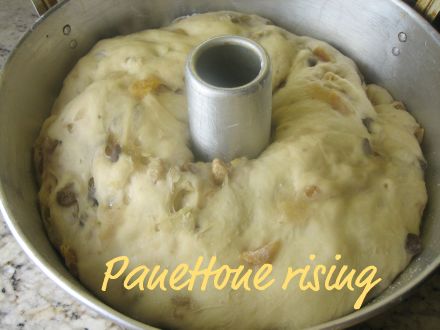
The recipe is not difficult, but it’s certainly more verbiage than a normal recipe. So I’m not going to write it up in total – I’ll just point you (above) on the way to find King Arthur’s recipe. I followed it to the letter – including choosing the version “by weight,” meaning that I measured every ingredient by weight on my kitchen scale, rather than volume. And really, I repeat, it is NOT difficult to make. You start with a biga (a sponge) the night before which I left below my cabinet lighting for the full 12 hours. Then you combine it with other bread ingredients, mix up using your bread machine or stand mixer with dough hook. It is a very sticky dough – nothing like a traditional loaf. Except for sprinkling just a bit of flour on my granite countertop to mold it into the form that will fit in the tube pan, I stuck with the recipe exactly (well, except for the fruit additions). Then it was allowed to rise. That takes awhile, what with all the fruit in it. You’ll want to do this on a day when you’re going to be around home since you can’t just go off and leave it all day. A few hours in strategic places, yes. All day, no. It does take the better part of 24 hours, but well worth it.
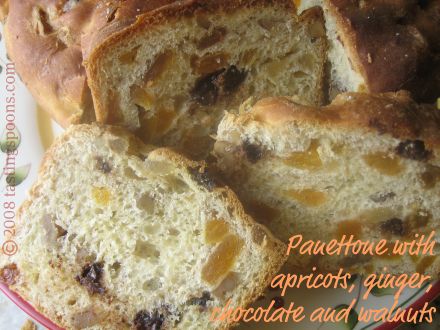
The verdict? What do you think by looking at the photo? This reminds me some of Stollen (which I used to make every year when I baked bread for extra money back years and years ago when my daughter was a baby). Probably Stollen is the German version of Panettone, or vice versa. They’re very similar in texture, but very different in shape. I’m sure there must be a story about that – probably something to do with the Pope’s hat, or something. You think? No, after searching at wikipedia, it’s nothing like that. There are several legends about the bread, but one specific baker decided to make the shape we know, rather than a loaf style. Soaking the fruit in wine is not the custom (oh well, I did anyway, in rum). The traditional panettone is filled with just lemon zest and citron. The perfume in my kitchen was just lovely from the rum.
Here’s the fruit I added to the dough:
- 2 ounces crystallized ginger, minced in tiny pieces
- ½ cup chocolate chips
- ½ cup walnuts, chopped
- 2/3 cup dried apricots, minced with scissors then soaked in about ¼ cup rum (drained after soaking 30 minutes) and tossed with about 2 T. of flour
If none of this interests you, be sure to buy a ready-made Italian panettone loaf this year and try it. Last year I bought one that contained a few bits of chocolate. It was good; that’s why I added chocolate to the panettone I made yesterday. Since making this was so easy (but I’m not intimidated by yeast breads, either) I’ll likely do it again.


PJ Hamel
said on December 7th, 2008:
Carolyn, looks WONDERFUL. Glad the recipe worked out for you. I don’t like those icky fruit peels and candied stuff, either; that’s why I use golden raisins, apricots, and dried pineapple, and maybe dried cranberries. But ginger – YES! Next time… Happy holidays! PJ Hamel, King Arthur Flour baker/blogger
Joan Landers
said on December 12th, 2008:
Carolyn, thanks so much for sharing some of this wonderful panettone with us. It was absolutely wonderful!!!!
Am so glad you enjoyed it. We’re down to our last two small pieces. I may have to make it again – and give you a couple more samples so Tom can have at least one or two pieces. . . . Carolyn
Mimi
said on December 11th, 2009:
I love panetone and yours looks scrumptious!
Thanks, Mimi. It really was good, and I’ll be making it again this Christmas. . . carolyn t
Joanne
said on December 13th, 2009:
Coming from an Italian home, we are usually given MANY loaves of panettone during the holiday season. I love the texture of it, although I don’t like the ones with the glaceed fruit. I prefer the plain versions or the chocolate chip ones. This looks excellent, however! Crystallized ginger and dried apricots are two of my favorite dried fruits/spices. Delicious.
The chocolate chips, dried apricots & crystallized ginger are favorites of mine, too, that’s why I made it with that combination. . . carolyn T