


Get new posts by email:

Archives

Currently Reading

Here are the tastingspoons players. I’m in the middle (Carolyn). Daughter Sara on the right, and daughter-in-law Karen on the left. I started the blog in 2007, as a way to share recipes with my family. I’m still doing 99% of the blogging and holding out hope that these two lovely and excellent cooks will participate. They both lead very busy lives, so we’ll see.

– – – – – – – – – – – – – – – – – – – – – –

BOOK READING (from Carolyn):

Music of Bees, Eileen Garvin. Absolutely charming book about a woman in midlife, lonely, who raises bees, also makes unlikely friends. Heart-warming and very interesting about beekeeping.

A Postcard from Paris, Alex Brown. Really cute story. Dual time line, 1940s and present day about renovating an old apartment in Paris, things discovered.

Time of the Child, Niall Williams. Oh such a good book. Very small village in Ireland, 1960s. A baby is left on the doorstep. The town all whispers and helps. I listened to an interview of the author, which made me like him and his books even more.

Sipsworth, Simon Van Booy. If you like animals you’ll swoon. An old woman who really wants to die finds a tiny mouse in her house and befriends it and finds a reason to live. Utterly charming book.

The Forger’s Spell, Edward Dolnick. True story. For seven years a no-account painter named Han van Meegeren managed to pass off his paintings as those of Johannes Vermeer.

If You Lived Here, You’d be Home by Now, Christopher Ingraham. Could hardly put it down – about a journalist who takes on a challenge to move to small town in Minnesota and write about it. He expects to hate it and the people and place, but he doesn’t. Absolutely wonderful true story.

The River We Remember, William Kent Kreuger. 1950s, Minnesota. A murder and the aftermath. Could hardly put it down. Kreuger has such a vivid imagination and writing style.

How the Lights Gets In, Joyce Maynard. An older woman returns to New Hampshire to help care for her brain-injured son. Siblings and family, lots of angst and resentments.

The Filling Station, Vanessa Miller. Every American should read this book. A novelized retelling of the Tulsa massacre in 1921. Absolutely riveting.

The Story She Left Behind, Patti Callahan Henry. Love this author. Based on a true story. A famous author simply vanishes, leaving her husband and daughter behind. She had invented a mystical language no one could translate. Present day, someone thinks he’s solved the riddle, contacts the family. Really interesting read.

The Girl from Berlin, Ronald Balson. Love anything about Tuscany. An elderly woman is being evicted from a villa there, with odd deed provenance. Two young folks go there to help unravel the mystery. Loved it.

The Island of the Colorblind, Oliver Sacks, M.D. Nonfiction. The dr is intrigued by a remote Pacific island where most of the inhabitants are colorblind. He also unravels a mystery on Guam of people born with a strange neurological problem. Medical mysteries unveiled. Very interesting.

The Bookbinder, Pip Williams. Post 1914 London. Two sisters work at a bookbindery. They’re told to not read the books. One does and one doesn’t. One has visions beyond her narrow world; the other does not. Eventually the one gets into Oxford. Lovely story.

The Paris Express, Emma Donoghue. 1895 on a train to Paris, a disaster happens. You’ll delve into the lives of many people who survived and died in the crash.

A Race to the Bottom of Crazy, Richard Grant. This is about Arizona. Author, wife and child move back to Arizona where they once lived. Part memoir, research, and reporting in a quest to understand what makes Arizona such a confounding and irresistible place.

The Scarlet Thread, Francine Rivers. A woman’s life turned upside down when she discovers the handcrafted quilt and journal of her ancestor Mary Kathryn McMurray, a young woman who was uprooted from her home only to endure harsh frontier conditions on the Oregon Trail.

A Place to Hide, Ronald Balson. 1939 Amsterdam, an ambassador has the ability to save the lives of many Jewish children. Heartwarming.

Homeseeking, Karissa Chen. Two young Chinese teens are deeply in love, but in China. Then their families are separated. Jump to current day and the two meet again in Los Angeles.

North River, Pete Hammill. He always writes such a good story. A doctor works diligently healing people from all walks of life. His wife and daughter left him years before. One day his 3-yr old grandson arrives on his doorstep.

A Very Typical Family, Sierra Godfrey. A very messed-up family. Three adult children are given a home in Santa Cruz, Calif, but only if the siblings meet up and live in the house together. A very untypical scenario but makes for lots of messes.

Three Days in June, Anne Tyler. The usual Anne Tyler grit. Family angst. This wasn’t one of my favorites, but it was entertaining and very short.

Saved, Benjamin Hall. Author is a veteran war reporter. Ukraine, 2022, he nearly loses his life to a Russian strike. Riveting story – he survives, barely.

Grey Wolf, Louise Penny. Another Inspector Gamache mystery in Quebec. She is such an incredible mystery writer.

All the Colors of the Dark, Chris Whitaker. A missing person mystery, a serial killer thriller, a love story, a unique twist on each. Could hardly put it down.

Orbital, Samantha Harvey. Winner of 2024 Booker Prize. I don’t usually like those, but I heard the author interviewed and she hooked me. This is not a normal book with a beginning, a story and an end. It’s several chapters of the day in the life of various astronauts at the ISS (Int’l Space Station). All fictional. She’s been praised by several real astronauts for “getting it” about space station everyday life.

The Blue Hour, Paula Hawkins. An island off Scotland. Inaccessible except when the tide is out. Weird goings on. An artist. A present day mystery too.

Iron Lake, William Kent Krueger. A judge is murdered and a boy is missing. Riveting mystery.

Tell the Wolves I’m Home, Carol Ricks Brunt. 1980s. A 14-yr old girl loses her beloved uncle. Yet a new friendship arises, someone she never knew about.

Four Treasures of the Sky, Jenny Zhang. 1880s, a young girl is kidnapped in China and brought to the United States. She survives with many hurdles in the path.

The Boy Who Fell out of the Sky, Ken Dornstein. Memoir, 1988. The author’s brother died in the PanAm flight that went down in Lockerbie, Scotland. A decade later he tries to solve “the riddle of his older brother’s life.”

Worse Care Scenario, T.J. Newman. Oh my. Interesting analysis of what could/might happen if a jet crashed into a nuclear plant. Un-put-downable.

Song of the Lark, Willa Cather. Complicated weave of a story about a young woman in about 1900, who has a gifted voice (singing) and about her journey to success, not without its ups and downs.

Crow Talk, Eileen Garvin. Charming story which takes place at a remote lake in Washington State, about a few people who inhabit it, the friendships made, but also revolving around the rescue of a baby crow.

The Story Collector, Evie Woods. Sweet story about some dark secrets from an area in Ireland, a bit magical, faerie life, but solving a mystery too.

A Sea of Unspoken Things, Adrienne Young. A woman investigates her twin brother’s mysterious death. She goes to a small town in California to figure it out, to figure HIM out.

The King’s Messenger, Susanna Kearsley. 1600s England, King James. About one of his trusted “messengers,” and his relationship with a young woman also of “the court.” Lots of intrigue.

In the Shadow of the Greenbrier, Emily Matchar. Interesting mystery in/around the area of the famous resort in White Sulphur Springs, West Virginia.

Isola, Allegra Goodman. Hard to describe, survival story on an island in the 1600s.

Save the Date, Allison Raskin. Rom-com, witty, LOL funny. Clever.

The Sirens, Emilia Hart. Numerous time-lines, Australia. Mysteries abound, nightmares, abandoned baby, weird allergies.

Red Clay, Charles Fancher. LOVED this book. Mostly post-Civil War story about the lives of slaves in Alabama during Reconstruction.

Stars in an Italian Sky, Jill Santopolo. Dual time line, 1946 and recent time. Love stories and a mystery.

Battle Mountain, C.J. Box. Another one of Box’s riveting mysteries. Love his descriptions of the land.

Something Beautiful Happened, Yvette Corporon. A memoir of sorts in Greece, tiny island of Erikousa, where the locals hid Jews during WWII. All elusive stories told by the author’s grandmother.

The Jackal’s Mistress, Chris Bohjalian. 1860s Virginia, about a woman who saves the life of a Union soldier. Really good story.

Song of the Magpie, Louise Mayberry. Really interesting story about Australia back in the days when it was mostly a penal colony. Gritty strength of a woman trying to thrive with her farm.

The Boomerang, Robert Bailey. A thriller that will have you gripping the book. About a lot of secrets surrounding the president (fictional novel, remember) and his chief of staff and about cancer. A cure. Such a good story.

Care and Feeding, Laurie Woolever. Really interesting memoir of a woman driven to succeed in the restaurant business. She worked for Mario Batali and then Anthony Bourdain. Gritty stories.

Everything is Tuberculosis, John Green. Maybe not a book for everyone. A real deep dive into the deadly tuberculosis infection, its history. I heard the author interviewed and found the book very interesting.

The Book Lovers Library, Madeline Martin. Fascinating read about Boots’ drug stores’ lending library. And the people who worked in them.

The Arrivals, Meg Mitchell Moore. LOL funny, about a middle-aged couple whose children (and their various family members) return to the family home and the chaos that ensues.

My Life as a Silent Movie, Jesse Lee Kercheval. About grief. A big move to Paris, finding herself a new life with a new set of real blood family.

Escape, Carolyn Jessop. Another memoir about a woman really in bondage in Utah, Mormon plural marriage.


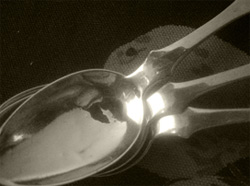
Tasting Spoons

My blog's namesake - small, old and some very dented engraved silver plated tea spoons that belonged to my mother-in-law, and I use them to taste my food as I'm cooking.

Scroll down to the bottom to view my Blogroll

Posted in Soups, on October 11th, 2007.

The soup library is running a little low these days. I have 3-4 soups lined up on my freezer shelf, but the one I wanted is all gone. I thought I had some left from last winter, but no such luck. Two recipes for butternut squash soup stand out amongst my recipes. This is one of them. This happens to be the more time consuming one to make. The other one, Butternut with Jalapeno, that I posted back in July, is a quicker soup because it’s made with C&W frozen squash cubes. Nor is that one roasted, as in this case.

This recipe requires you to buy fresh butternut squash, because you roast the squash halves with onions, carrots and apples. So, no short cuts on this one. But, I guarantee you, you’ll be pleased with the results, providing you have the time. I always make this in double quantity (8 pounds of squash to start with) because, well, why not? It’s wonderful leftover and easy to freeze.

Previously I’ve mentioned Penzey’s, the herb and spice company from whom I buy many of mine. If you order from them (or request it) they send out a catalog periodically, and usually there are 3-4 recipes contained in each little brochure. This came from one of those, a few years ago. Credit goes to a cookbook (that I don’t have, in case you’re counting) called The New England Cookbook, by Brooke Dojny. She’s one smart cookie when it comes to soups.

So what’s involved, you ask? You cut the squash in halves, remove seeds, lay them in a large roasting pan (a really big one if you’re making a double batch) and add onions, apples and carrots and some fresh rosemary. Dot it with some butter, brown sugar and add a bunch of APPLE JUICE, cover and roast for about 2 hours. The vegetables become succulent, and somewhat sweet because of the apples and apple juice. Because I’d rather not peel the squash, I leave them unpeeled and scoop out the flesh after it’s baked. Same with the onions – cut in half and remove skins later. The other little trick to this is the fresh rosemary. I do not like the rosemary to remain in the soup for eating, so I try to use a fresh sprig or two or three and leave them intact while baking, then toss it out, retrieving all the little pieces floating in the apple juice. Or, you can strain the whole mess to get them out.

Once the roasted vegetables have cooled a little (and you scoop out the squash flesh, remove onion skins, etc.), you can add it all to a large soup pot and use an immersion blender (or put it in batches in the regular blender or food processor) to puree all of it. Then you add a few other ingredients, taste it for seasonings, simmer briefly, then add milk (I use fat-free half and half) or cream to smooth it out.

If you don’t like soups with a hint of sweet, pass this one by. But if you don’t mind the sweeter flavor from the apples and apple juice, this one’s a winner.
printer-friendly PDF

Roasted Butternut Squash Soup


Recipe: Adapted from the New England Cookbook by Brooke Dojny
Servings: 4
NOTES: The original recipe called for fresh pumpkin or squash, and used 6 Tb of butter. I preferred to have a creamy look to the soup, so add the fat-free half and half. It’s not a necessary ingredient. When I make it, I always double it since it is such a favorite around our house. I just scoop it into plastic freezer bags in serving size portions (about 2 cups per person) and lie flat on a large cookie sheet until frozen solid. The original recipe also added a dollop of sour cream or creme fraiche, but I prefer the minced nuts. I prefer not to have the pieces of rosemary in the soup, so I strain the soup to remove most of it. Or, better yet, if you use fresh rosemary you can just remove the entire sprig. If you want to make the vegetable preparation easier, use a potato peeler on the squash before it’s baked, and remove the garlic from its skins; if you do that, you don’t have to handle the squash at all after it’s baked.

4 pounds butternut squash — or pumpkin
2 tablespoons butter
1/4 cup brown sugar
1 large onion — peeled, chunked
3 large carrots — peeled, chunked
4 large garlic cloves — whole, unpeeled
1 large apple — peeled, chunked
2 teaspoons dried rosemary — or 1 T fresh
8 cups low sodium chicken broth
2 cups apple juice
1 teaspoon ground ginger
1/2 teaspoon ground mace
1/4 cup pecans — minced
salt and pepper
1 cup fat free half-and-half

1. Preheat your oven to 350. Cut the squash in half (I use a rubber mallet to pound the knife blade as the large squashes are usually quite unwieldy to cut). Scoop out the seeds with a spoon. Place the halves cut side up in a very large roasting pan. Divide the butter and brown sugar among the cavities. Arrange the onion, carrots, garlic and apple around the squash. Sprinkle with rosemary, then salt and pepper. Pour 2 cups of the chicken broth and apple juice around the vegetables and cover the pan tightly with foil. Roast in the preheated oven, stirring once or twice (if you remember, that is) until the vegetables are all very sort and somewhat caramelized, about 2 hours.
2. Open up the foil and allow the vegetables to cool at least 15 minutes. Scoop out the squash pulp, being careful not to include any skin. Remove the garlic from their skins. Process all the vegetables and apple mixture in a food processor, in batches if necessary, adding enough remaining chicken broth to achieve a smooth puree. Add the fat free half and half.
3. Toast the pecan pieces in the oven for a short time, or use a nonstick skillet. Don’t burn! Set aside until ready to serve the soup. Transfer the puree to a large saucepan, add the ginger and mace and season with salt and pepper as needed. Bring the soup to a boil, under gentle heat and simmer for a few minutes to meld the spices. Serve the soup in bowls sprinkled with toasted pecans.
Per Serving: 563 Calories; 11g Fat (17.3% calories from fat); 28g Protein; 94g Carbohydrate; 11g Dietary Fiber; 16mg Cholesterol; 1198mg Sodium.

Posted in Books, on October 10th, 2007.


Yesterday was a red letter day for me . . . I discovered that Ken Follett has written a sequel to one of my favorite-books-of-all-time, Pillars of the Earth. The book, entitled World Without End, is only in hardback at this point, and is 1014 pages long. I bought it at Barnes & Noble (20% off), but it may be at Costco one day soon. I have no doubt it will be a best seller.

What I’m afraid of is that once I start reading it, I may become a book recluse. My family will be forgotten, my other responsibilities. So I’m just going to stare at it for a few days.

As an aside, last night I listened to a Tivo’d program which contained an interview with Ken Follett. For those of you who read my blog and live in the United States, there is a CBS TV program which airs very early on Sundays, aptly named Sunday Morning. It usually starts at 6 or 6:30 am, but the time varies. (That’s why I love Tivo so much . . . I just instruct Tivo to record the program and it knows when it airs.) Mostly, Sunday Morning is about “good news.” There’s a short quip at the beginning about current news, but it’s no more than a minute long. The remainder is a series of short to long segments about esoteric things like inventions, travel here in the U.S., music legends, a good movie, art and artists, photographers, writers (like Follett) and even poets. On every show they end with a one minute segment of nature somewhere in our U.S. of A. Beautiful panoramic views of parks, forests, mountains, streams, rivers, birds. Sound from the location is included, so you hear the katydids, crickets, birds, whatever. I always look forward to that last segment.

Anyway, Ken Follett was interviewed from his London home and office. He talked about how his publisher, Dutton, was very, VERY skeptical about the manuscript for Pillars of the Earth. It was such a divergence for Follett, who had written nothing but [very popular] espionage novels since his first scribblings as a teen. Pillars is mostly a book from the Middle Ages, about a church. Everything you might ever have wanted to know about the concept and building of a church. Follett writes a book similar to Michener, as far as the depth and creativity with the people(s) who inhabit the history. Pillars was wildly popular – has been translated into 51 languages, I believe he said. Some incredible number of the books have been printed.

And, he talked about the folly of trying to write a sequel, and his fear that people will say “oh, it’s okay, but not as good as the first one.” He wants us to like this one even better. We’ll see . . .

Interestingly, Follett’s wife is a politician in England, a member of Parliament. She was briefly interviewed too. She rolled in with Tony Blair’s Labour Party, and is still in office with the new P.M. Ken got into a squabble with Tony Blair about Blair’s proclivity to gossipmongering.

If you haven’t read Pillars, I recommend you read it first. I’ll try to remember to give an update on the sequel once I’ve read it.

Posted in Desserts, on October 9th, 2007.

What? Pound cake and anise? Well, yes. And you need to know that I don’t like licorice. As in licorice candy. Not even one bit. But I like fennel. Which is akin to the anise plant. And I like fennel seed, in moderation, in a few things, like cooked cabbage. And I really like this cake, made with toasted anise seed. Fennel and anise are different plants altogether, although they’re related, like first cousins. They both have licorice overtones; I think the anise has more of it than the fennel.

Probably I mentioned in a previous post that in the late 1980’s I was quite enamored with the cooking of Mark Miller (Coyote Cafe, Santa Fe, New Mexico). He was the first, or one of the first, to introduce “fine cuisine” to the Southwestern food genre. And he was kind of all-over the foodie scene. When I visited the restaurant (in the 80’s) I bought his cookbook, Coyote Cafe. What I found, though, was that most of his dishes are very labor intensive, requiring a sauce for this, a finishing glaze for that, a different marinade, or that most of his dishes needed one or two complicated sides. Everything is made from scratch too, including beans. After making several things, I closed the book and put it on my cookbook shelf, to be opened rarely. But in that interim, I needed a cake for a Southwestern gourmet picnic, and this one fit the bill.

I’ve made this many, many times. It’s a fairly standard pound cake mixture, and the only unusual thing is the toasted anise seed, subsequently ground finely, which is added to the batter. Because it’s toasted seed, it’s mellows out considerably. There’s no harsh licorice flavor, just a little background nuttiness to it. There’s a lot of anise seed in it – four tablespoons – but somehow it doesn’t seem like anywhere near that much. It peppers the batter, though, so you know it’s something different.

A few years ago I altered the recipe – it called for 1 full pound of butter. Somehow that seemed obscene to me to use that much in one cake, even though it served approximately 18 people. The batter is very heavy besides. So, even though I’m not much of an experimenter when it comes to baking (there’s too much science attached), I put in much, much less butter, and I separated the eggs to lighten the batter.

Serve this with some fresh summer fruit – either peaches, apricots, or berries. My favorite is strawberries, sliced thinly. And top with either whipped cream or vanilla ice cream.
printer-friendly PDF

Anise Pound Cake

Recipe: adapted from the Coyote Cafe cookbook (Mark Miller)
Servings: 18
NOTES: This has been adapted slightly from the original – I use less butter, add some baking powder and separate the eggs.

3 cups all-purpose flour
1/4 teaspoon salt
14 ounces unsalted butter
2 cups sugar
1 tablespoon baking powder
1 teaspoon vanilla
4 tablespoons anise seed — roasted, ground
5 whole eggs — separated
2/3 cup sour cream

1. Preheat oven to 350°. Grease and flour a 10-inch tube pan. Sift together flour and salt, then set aside.
2. Cream the butter with sugar, vanilla and anise seed until light. Whip the egg whites and set aside. Add the egg yolks, one at a time, mixing well after each addition. Then add dry ingredients alternately with the sour cream. Scrape the bowl well and mix until blended. Then fold in the egg whites until mixed in and there are only a few streaks of white visible. (This is a bit difficult because the batter is thick.)
3. Pour into prepared pan and bake for approximately 50-60 minutes, until the cake is golden brown and springs back to the touch.
4. Serve in small slices with fresh, sliced summer fruit (peaches, strawberries, other berries) and whipped cream or vanilla ice cream on top.
Per Serving: 365 Calories; 21g Fat (52.2% calories from fat); 5g Protein; 40g Carbohydrate; 1g Dietary Fiber; 111mg Cholesterol; 138mg Sodium.

Posted in Breads, on October 8th, 2007.

It was just a couple of weeks ago I mentioned how FUN it is (for me, anyway) when I discover a new method for making some heretofore ordinary dish. That was the green beans with garlic and olive oil. So, now, I have a great new recipe for you. This one is compliments of Cooks Illustrated, the bi-monthly magazine. I’ve subscribed to this gem for many years. And I think I’ve mentioned before (also) that I truly enjoy reading the long treatises on individual subjects. It could be gravy for pork chops, or just the right texture for fudgy brownies. You get the drift.

The subject of this article was : “The Best Drop Biscuit,” by Sandra Wu. The writer (food developer) explained the steps and stages she used to refine a favorite, the lowly drop biscuit. I don’t make drop biscuits very often. Why? I don’t know . . . I think I prefer the kind that you knead just a little bit, then pat out the dough and cut with a biscuit cutter. Plus, they’re perhaps a bit easier to break apart without falling apart. And sometimes drop biscuits are unevenly baked because they’re not all the same size or shape. An inherent problem with a drop biscuit. But this new method solves most of those problems.

The only thing you need for this recipe is butter (the real stuff) and buttermilk. (Although, to be fair, the recipe does indicate how to make clabbered milk instead of buttermilk.) I try to have buttermilk on hand. Once I’ve used whatever I needed it for, I freeze it in 1-cup freezer cups. My scones require exactly one cup. So do these biscuits, which will now become part of my regular repertoire. Now, whether this method for drop biscuits would work with defrosted buttermilk, I’m not sure. So, for now I won’t recommend that until I try it. Once defrosted, buttermilk gets a bit watery. It works fine for my scones, but, as I explain below, it might not work for these biscuits.

I won’t belabor all the explanation the author went through to finally GET to the final product. I found it very interesting. You might not. But, what’s unusual is: you pour slightly cooled, but melted butter INTO the one cup of buttermilk before adding that to the dry ingredients. Who woulda thunk that coulda make such a difference? Certainly not me! Here’s a picture of the clumpy buttermilk.

The writer is enough of a baking chemist to know that you need to stabilize – or equalize the temperatures of the butter and the usually cold buttermilk. She kept getting this clumpy mass (see picture), and probably threw away countless efforts of that combination. But one time she decided to go ahead and use that clumpy mess in the biscuit anyway. Voila! As you stir the moderately warm/hot butter into the cold buttermilk the little clumps in buttermilk that are there naturally attach themselves to all the little molecules of butter. And you have this heaping cup full of lumps. It’s such an incongruous pile of stuff.

But anyway, you pour all that into the dry ingredients, stir just until mixed thoroughly (no kneading) and you’re ready to make quick drop biscuits. She recommended using a greased 1/4-cup measuring cup. I used cooking spray, which didn’t work all that well, I must say. Keep the waxed paper the butter is wrapped in and grease the measuring cup with that. The 2nd time I made these I used a narrow metal sandwich spreader to kind of scoop out the batter. Buttering the 1/4-cup measure didn’t work any better than cooking spray. Whichever method you use, you scoop equal 1/4-cup measures of the batter and drop onto parchment on a baking sheet. Then you gently reshape any that aren’t uniform.

Now, there’s a side story (a sidebar) in the article about the use of parchment vs. a Silpat. I have bunches of and I use them constantly. In the usual Cooks Illustrated’s style, they did a study of these biscuits using both. They far prefer parchment because they believe silicone mats (silpats or others) can impart some off-flavors. Mostly that wouldn’t bother me, but since biscuits are such a delicate flavored item, I took their advice and used paper. Then, I straightened all of the biscuits on the sheet – to make sure none were too high, or short, etc. That made a big difference – all the biscuits were perfectly, evenly browned.

Need I say they were a big hit? A BIG hit. These biscuits are so very light and tender. The master recipe is for a plain biscuit, but they also gave variations for both Black Pepper and Bacon Biscuits, and Rosemary and Parmesan Biscuits. I made the bacon and pepper version. We had leftovers of soup last night, and made the biscuits again, but also added some sharp cheddar cheese, at my son-in-law’s request. Any way you make them, they’re good.
printer-friendly PDF

Best Drop Biscuits

Recipe: Sandra Wu, Cooks Illustrated
Servings: 12

2 cups all-purpose flour — unbleached, if possible
2 teaspoons baking powder
1/2 teaspoon baking soda
1 teaspoon sugar
3/4 teaspoon salt
1 cup buttermilk — COLD
8 tablespoons unsalted butter — melted and cooled slightly
2 tablespoons butter — melted, for brushing tops

Bacon/Pepper Variation: cut 6 slices bacon into small pieces and fry until crisp. Crumble. Add bacon and 1 tsp. coarsely ground pepper to the dry mixture in step 1.
Rosemary/Parmesan Variation: add 3/4 cup grated Parmesan cheese and 1/2 tsp. minced rosemary to the flour mixture in step 1.
1. Adjust oven rack to middle position and heat oven to 475. Whisk flour, baking powder, baking soda, sugar and salt in a large bowl. (Or, you can sift it together.)
2. In a medium bowl (at least 1 1/2 cups or larger) combine the cold buttermilk and the melted and slightly cooled butter. Stir until buttermilk forms clumps.
3. Add buttermilk mixture to dry ingredients and stir with rubber spatula until just incorporated and batter pulls away from side of the bowl.
4. Using a greased 1/4-cup measure, scoop level amounts of batter and drop onto a parchment-lined baking sheet, approximately 2 1/4 inches across and 1 1/4 inches high. Repeat with remaining batter, spacing biscuits about 1 1/2 inches apart. Bake until tops are golden brown and crisp, approximately 12-14 minutes.
5. Brush biscuit tops with remaining 2 T. melted butter. Transfer to a wire rack to cool, or serve immediately.
Per Serving: 171 Calories; 10g Fat (52.4% calories from fat); 3g Protein; 17g Carbohydrate; 1g Dietary Fiber; 27mg Cholesterol; 309mg Sodium.

Posted in Beef, on October 7th, 2007.

Why would you think a soup would be named Tuscan CHICKEN Soup when there isn’t any chicken in it? Beats me! But, I’m being true to the original recipe, which called it Tuscan Chicken Soup. Even though it has beef in it.

When the instructor, Patty Padawar, explained this soup, she must have had some kind of explanation, but it’s nothing that stuck in my head, nor did I write anything on my notes. My only recollection is that it’s a traditional peasant soup from Tuscany. Whether it’s chicken or beef, it’s just a plain old good soup.

This recipe came from a cooking class at Sur la Table, and was a compilation of some of the cooking school’s “favorites.” How could I not go to a class that culled through hundreds of cooking class recipes and pulled out the best of the best? Only one of the recipes was one where I’d attended the class (that was Joanne Weir’s Sicilian Tuna Salad, which I’ve already posted here on my blog).

I’m a real sucker for soups. I’ve loved them always, but over the last 10 years or so I’ve found them to be such a time saver and they make a very full, tasty and easy meal. We don’t eat many bean soups just because neither of us need the packed carbs at our age. But, I love vegetable soups, chicken soups, beef soups, squash soups too.

This one is a mixture of ground beef, escarole, fresh fennel, onions, and orzo pasta. A nice combination. If you don’t know if you like fennel, trust me on this – fennel once cooked is very mellow. There isn’t even an inkling of anise flavor in this soup once it’s been simmered awhile. And, as always, this soup is much better the next day if you can plan ahead!

The soup also has one added touch that I’d never seen done before: just before serving you slice a plank of Parmigiano-Reggiano cheese, using a cheese plane, and place it in the bottom of the soup bowl. Then you ladle the hot soup on top and within a minute the cheese is mostly melted, although it doesn’t “stir” into the soup at all. It’s best when your spoon just lifts a little bit of the cheese with a bite of soup. Be sure to tell guests so they don’t scrape the bottom and get an entire mouthful of cheese.

Actually, this time I used some ground chicken (a third) to this soup in addition to ground beef (two thirds). And I added some celery too, just, well, because. The soup is low in calorie, although I don’t think this serves as many as the recipe indicates. We eat about 1 & 1/2 cups per serving, and I think the recipe assumes less. I made a double batch so I’d have leftovers. And this soup freezes well to join others in my soup library. That is, if there are any by the time we finish tonight’s dinner.
printer-friendly PDF

Tuscan Chicken (no, it’s Beef) Soup

Recipe: Patty Padawar, cooking instructor
Servings: 8
NOTES: To make cheese planks: use a cheese plane or sharp vegetable peeler. If you have leftovers, taste it when you reheat it as you may need to add additional water or broth.

3/4 pound lean ground beef — or veal
1 small fennel bulb — chopped
1 medium onion — chopped
2-3 whole cloves garlic — minced
4 cups low sodium chicken broth
2 cups low sodium beef broth
2 cups water
1/2 teaspoon dried oregano — crushed
2 whole bay leaves
1/2 teaspoon black pepper
1/2 cup orzo
4 cups escarole — shredded
4 ounces Parmesan cheese — shaved in planks
salt — to taste

1. In a large saucepan or pot, cook the ground beef, onions, fennel and garlic over high heat, stirring as needed for about 5 minutes, until meat is browned and vegetables are softened. Drain off excess fat.
2. Add broths, water and seasonings and simmer for 10 minutes. Bring up to a gentle boil, add the orzo and cook 10 more minutes, stirring twice.
3. Remove bay leaves, add the escarole and remove from the heat. Taste and add salt if needed, or more pepper. Stir to blend in. Divide the cheese planks into serving bowls, ladle the hot soup on the cheese and serve.
Per Serving: 275 Calories; 13g Fat (43.8% calories from fat); 24g Protein; 14g Carbohydrate; 2g Dietary Fiber; 43mg Cholesterol; 586mg Sodium.

Posted in Salads, on October 4th, 2007.

It’s fall. Time for some fall-type salads. Soups. Stews. Pumpkin. If it would just get below 80 degrees here in southern California I’d feel more like it. Soon. But, because it is October, I’m ready. Therefore, I went through my salad recipe collection looking for something different.

I make just regular green salads all the time. Probably all of you do, too. My mother was a great one for incorporating lots of veggies in salads, so I have continued the tradition. Green salads must have some other stuff like radishes, cucumber, tomatoes, celery, bell peppers, carrots, sugar snaps. That kind of thing. Just a way for us to get more of those healthful in our diet. And when you wrap those in silky salad dressing, they sure do go down easier. And I like . Today’s salad, though, isn’t one of those. It’s a pure greens salad but with an opportunity to give the apple a star billing. And escarole, of course.

So, this salad came from one of the cooking classes I took with Joanne Weir. I think I’ve mentioned before she’s probably my very favorite cooking instructor ever. She’s just so witty and funny. And bursting with lots of helpful hints. This class was no exception. Remember my adage: if you come home with one recipe you make regularly, the class is worthwhile and money was well spent. This class provided one good recipe AND a very good helpful hint that I’ve used over and over.

The hint: when making a salad dressing on the spot, once it’s mixed up (using a whisk always) take a piece of the lettuce from your already prepared greens and dip it into the dressing. Use it in proportion – you don’t want it saturated with dressing, just a bit. Taste it for balance (oil vs. vinegar) and seasonings (salt and pepper). And know that you need it to be saltier than it should be from that one little bite, because once the dressing is tossed all over the salad, the salt will be dispersed.

So now, onto the actual salad. Escarole isn’t a green I normally purchase. It’s not as bitter as curly endive (which was what I found at the market yesterday and is shown in the photo), and it’s easier to eat than curly endive too. Escarole is actually chicory (the green, and also the root that’s added to coffee in the south). It is part of the bitter greens family. Belgian Endive is another one of those I purchase occasionally and is in the same family as escarole/chicory. I’ve learned though, that the longer I hold Belgian Endive, the more bitter it gets. Ever noticed that? So I try to use it up right away.

Some years ago when my DH and I visited France and stayed with a friend in Paris, she made a Belgian Endive salad, just tossed with a little bit of olive oil and lemon juice. It was sweet and oh-so tasty. I’d had B.E. before, but it never tasted as good as I had it there. Once home I determined I’d use it more. I was so disappointed when I bought half a dozen of them to make a similar salad. It was so bitter we couldn’t eat it, even though it was fresh from the grocery store.

In looking up the nutritional information about B.E. I learned that it turns bitter as it oxidizes (exposed to light). So, I guess from the moment it’s plucked from the ground it begins to turn bitter. No wonder I have such a problem. A little bit of that bitterness goes a long ways. Probably U.S. growers have developed varieties that can have a long shelf life, but the taste is obviously compromised. I wish some of the growers here could taste B.E. in France to see the significant difference.

So, this salad combines bitter greens with a bit of sweet from the apple. The original dressing didn’t have any sugar in it, but I find that the dressing is also quite tart, so the addition of just a little bit of sugar helps it a lot. But I’ve also learned from making this salad several times that the acidity of sherry wine vinegar can vary from brand to brand. So I also have to add, sometimes, a bit more oil to the dressing than it calls for. That’s another reason for using the dunk-the-leaf-in-the-dressing technique. I do that once before I add salt and pepper and again after to make sure it’s the right chemistry.

This salad may not appeal to everyone. You need to like that spark of bitter. If you want more sweetness, though, try using a sweeter apple, and add a bit more sugar to the dressing. Granny Smith’s are certainly on the tart side themselves! But, this is a great way to showcase some wonderful fall apples that are just coming into the markets here. And maybe you’ll be lucky to find some escarole too.
printer-friendly PDF

Escarole, Apple, Almonds and Shaved Parmigiano Salad

Recipe: adapted from a Joanne Weir recipe
Servings: 6
NOTES: Do not use the outer dark green parts of the escarole.
Serving Ideas : Instead of a traditional salad bowl, serve this on a large platter.

1 head escarole — in 1 1/2 inch pieces
2 whole Belgian Endive — leaves separated
2 stalks celery — sliced thin on the diagonal
1 1/2 tablespoons sherry vinegar — or white wine vinegar
4 tablespoons extra virgin olive oil
salt and pepper to taste
1/4 teaspoon sugar
1 whole Granny Smith apple — halves, cored, thinly sliced
1/2 cup almonds — toasted
1/3 cup Parmigiano-Reggiano Cheese — shaved

1. In a bowl toss together the escarole, endive and celery. Place in the refrigerator until close to serving time.
2. In a small bowl whisk together the vinegar, sugar and olive oil. Season to taste with salt and pepper. Will probably need extra salt as once you add it to the greens, you’ll lose the saltiness altogether.
3. Dip one leaf of escarole into the whisked dressing to taste for salt and pepper. Toss the greens, vinaigrette, almonds and Parmigiano Reggiano. Add apple slices and toss again. Place one or two apple slices on the top decoratively. Serve immediately.
Per Serving: 170 Calories; 15g Fat (78.6% calories from fat); 3g Protein; 7g Carbohydrate; 2g Dietary Fiber; 0mg Cholesterol; 17mg Sodium.

Posted in Breads, on October 3rd, 2007.

Today’s posting is going to involve a bit of history trivia about me. This is a traditional yeast bread recipe. To date I haven’t posted any of those to my blog yet. Eventually I’ll probably post several yeast breads, but here’s the first regular type. I wrote up the No-Knead bread recently, but that hardly counts.

Some cooks get stage fright when the subject of yeast is even mentioned. I guess I was too young or naive to listen to such wives’ tales. I just dug in and did it. I started making bread regularly in the mid 60’s, when I was in my early 20’s. In fact, once I learned the techniques, and found several recipes that I really liked, I began making all of my own bread. Sandwich bread (mostly buttermilk), cornmeal bread (a raised version), and a wheat bread too. At Christmas I made Stollen, and a few times a year I made this Portuguese Sweet Bread.

Growing up, we had a Portuguese family living across the street from us. Point Loma, a peninsula and a suburb in San Diego, is the home to thousands of Portuguese families, most of whom make their living by deep sea fishing. Although we didn’t ever know this family well, one year the matriarch brought over a round globe of this bread on Good Friday. Maybe it was a silent peace offering because their dog barked incessantly, hour upon hour morning to night and during the night. Whatever the reason, it was nice that she shared a loaf with us. We enjoyed it.

Portuguese Sweet Bread is traditional only at Easter, apparently. I asked her about the recipe one day when she was chasing her barking dog in the street, but she seemed disinclined to share it. A few years later I saw a Portuguese cookbook at the library and sure enough, there was a recipe!

So in the early 1970’s I was a stay-at-home mother of a very young child. Money was tight. So I began baking bread and selling it to friends. Most of my hard-earned money was used for babysitting, so I could get out a little bit. Many of my mother’s friends were kind enough to buy bread from me every week. Bless them! My recollection is that I charged about $1.00 a loaf for the buttermilk type. Up to $2.00 for the richer breads and a bit more for Stollen. Every week my kitchen heated up for hours on end as I made what seemed like endless loaves of bread. I bought 100 pound bags of flour through a local bakery and kept it in a special trash can in the garage (lined with a two layers of heavy-duty plastic bags and sealed very tight).

I didn’t have a business, a license, or any of that kind of thing; it was just word of mouth. I bought one pound blocks of fresh yeast (the cube, cake kind) from the same bakery and froze it in small batches. And I bought 1000-piece boxes of bread-sized clear plastic bags (the kind bakeries use). I still have what was left of the last box I bought, believe it or not. Those bags are over 40 years old and they’re still just fine. Amazing. No wonder we have problems with our landfills and plastic grocery bags.

The buttermilk bread was the hands-down favorite of all my customers. But every few weeks I made this bread too. Usually only a few loaves. These take more time to make (longer rising times) and can be a bit temperamental if not given the right rising environment. But if the signs are right and the gods smile, you’ll be blessed with a wonderfully fragrant loaf of soft, eggy bread. It would be ideal for the Pineapple French Toast I posted recently (click here) if you don’t have the King’s Hawaiian Bread used in that recipe.

In those days of busy bread baking, I combed through lots of bread cookbooks from the library and gathered ideas from anywhere I could find them. In my own recipe archives I have a funny shaped envelope that still contains all of my yeast recipes from those bread-baking days, with notes about costs, all written on 3×5 or 4×6 cards. And in some book – no recollection where – I read a long dissertation about the molecular action of yeast. I’ve never forgotten those words of advice about how yeast needs to climb, but if it’s mixed only in water the molecules are slippery and have a hard time doing their job. So, this book recommended making the first yeast mixture (where you proof the yeast) with a little addition of sugar and ground ginger. I decided to try it, and believed then, as I do now, that that step does a lot for yeast. Now I use dry, granulated yeast, but it’s the same process. No change, just dry yeast for cubed, fresh yeast.

A word about proofing. Maybe some of you have never even heard the expression of “proofing the yeast.” The goal is to PROVE that the yeast is good, viable, and that it’s working; therefore, proof that the yeast is alive and well. You will always want to do that step.

If you use a bread machine, that step is skipped. You don’t want the yeast to be dissolved in liquid in a bread machine recipe as the machine process relies on the use of dry, granular yeast which dissolves slowly, and some not at all during the mix and sit, mix and sit series. I have a bread machine that I don’t use very often anymore. It was a great timesaver when I was working, but I was never very satisfied with the wheat varieties I made in the machine. We rarely eat white bread anymore, so the machine has been relegated to a shelf in the laundry room.

Don’t attempt to make this bread in a bread machine – it won’t work because the dough needs longer rising periods. Now if you want to tinker with the yeast (adding more) to make it rise faster, either conventionally, or in the bread machine, by all means try it. Or if you just want to use the bread machine to accomplish the first mixing and kneading, that’s fine.

So, back to Portuguese Sweet Bread. This bread is a sweet dough. And if you’re a bread novice, you need to know that when you add some sugar to bread, it helps the yeast to grow (rise), but the sweeter the dough, the longer it will take to rise. Don’t, under any circumstances, be in a hurry when you make this. This bread needs long, slow rising times (actually two) and if it doesn’t rise nearly double in volume it probably wasn’t kneaded enough. Because this bread contains so much sugar, the yeast struggles to do its job – to double in volume. That’s why it’s temperamental and if the yeast molecules aren’t dispersed and kneaded well enough in the beginning, it just won’t rise sufficiently. Then you’ll be left with a kind of heavy, leaden bread. Not tasty at all.

You can try rising it in a slightly higher temperature (turn the oven on for a few minutes, then turn it off and put the dough in the oven to continue to rise). But when it’s done and you slice into this, you’ll be amazed at the perfume. Glorious. And you don’t have to wait until Easter to make it.
printer-friendly PDF

Portuguese Sweet Bread

Recipe Source: unknown
Servings: 20
NOTES: You can make this more festive by putting it into a large springform pan (full recipe) and after the second rising, brush with egg white and sprinkle with granulated sugar. Bake for about 45-50 minutes at 350°.
Serving Ideas: In Portuguese homes, this is served on Easter morning as part of a traditional breakfast.

1/2 cup evaporated milk
1/4 cup water
4 tablespoons butter
2 packages dry yeast
1 teaspoon sugar
1/4 teaspoon ground ginger
1/2 cup warm water
3/4 cup sugar
1 teaspoon salt
3 whole eggs
5 cups bread (hard wheat) flour

1. In a saucepan, melt the butter with the evaporated milk and water. In a large bowl place the 3/4 cup sugar, salt and eggs. Pour in the milk/butter mixture and stir to dissolve the sugar. Allow to cool while gathering the other ingredients for the bread. In a small, glass measuring cup, combine the warm water, ground ginger, sugar and add the packages of yeast. Stir briefly and set aside for only about 5-10 minutes. (Do not do this step ahead).
2. When the egg and sugar mixture is cool, add about one cup of flour and stir. Add the yeast once it has become bubbly, then stir in additional flour. The mixture may take a bit more flour than the ingredient list shows since adding flour to yeast bread is never an exact science. But, be careful you don’t add too much. Sweet breads can sometimes take more flour, but then the bread will be heavy and tough. Only add as much flour as you must to keep the stickiness under control. Roll the dough out onto a floured board and knead until the dough is elastic and smooth. Put into a greased bowl and allow to rise in a warm place until double in bulk. My notes say this takes about 2 hours.
3. Punch the dough down and pour out onto the floured board again and knead until there are no air bubbles in the dough. Cut in half and shape into bread shapes, place in bread pans and allow to rise again. This dough does not rise very fast, so wait until it’s nearly ready before you preheat the oven. You can also mold these into rounds – and use round cake pans.
4. Heat oven to 375°. Bake bread for 25 minutes. Remove from oven, cover the pans lightly with foil, then reduce temperature to 350° and bake an additional 8-10 minutes.
5. Remove bread from the oven and IF it’s stable enough, set loaves out on a rack to cool. If made correctly, this bread is very tender, so it may require cooling for 10-15 minutes in the pans before you remove them to a rack.
Per Serving: 196 Calories; 4g Fat (19.1% calories from fat); 6g Protein; 34g Carbohydrate; trace Dietary Fiber; 40mg Cholesterol; 149mg Sodium.

(photo from maryssweetbread.com)

Posted in Desserts, on October 2nd, 2007.

Before they’re all gone, I wanted to have just a few more peaches. We didn’t eat them out of hand in the first couple of days, so I decided to try a new recipe for Peach Cobbler. Now, I like cobbler in nearly every form imaginable. Apple probably is my favorite, but lots of other fruits can stand in and make me happy.

But, it was a week or so ago I was reading one of my favorite blogs, Culinary Concoctions by Peabody, and she wrote up a detailed post about marrying a southern gent, and how she’s collected cobbler recipes for a long time. She liked some things about one recipe, but other things about another. Finally, she found one with the right texture, worked with it and subsequently came up with her own version combining all of the recipes from a bunch of “southern ladies,” she said. With that write-up (kind of like the home kitchen answer to the Cook’s Illustrated treatises on recipes), I had to try it. I don’t think I had quite enough peaches, but she mentioned that the recipe is forgiving that way. I’ve simplified the directions just a little bit and hope I haven’t changed the recipe significantly.

Her blog has an error about the amount of cinnamon (one teaspoon vs. one tablespoon), so I just had to improvise and use my best judgment. She doesn’t have an email address to contact her, and somebody else posted a comment asking about the error, but she hasn’t answered or fixed it yet. So, that’s why I had to just make a management decision. That meant using 1 tablespoon of cinnamon. Which is a lot. Plus, I couldn’t find the pecans in my freezer, so used walnuts instead. Pecans would certainly be more southern, but there are very few nuts in this dessert anyway.

Peabody mentioned that before she married her southern gent, what she knew about peach cobbler was just peaches, some kind of topping, then bake. But this has a kind of cake to it, and the peach slices slide down into it somewhat. I really liked the edges of the cake – a little bit crunchy, then with the smooth, moist cobber and peaches in the middle. I’d suggest each serving get a little bit of the edges (less peaches there).

Now, I must interject here, that I do like cinnamon. A lot, actually. But I’m very particular about what I use. No store bought for me. (You can, this is just picky me who thinks she knows a lot more about cinnamon than the average cook. I really may not know more, but I know what I like and don’t like, that’s all.) I buy my cinnamon from Penzey’s. Have for years. Cassia cinnamon is what you usually find in the grocery stores. But I’ll tell you, Penzey’s cassia is one strong cinnamon. I use their Indonesian Korintje Cassia mostly. A few years ago I bought their Vietnamese cinnamon, which I believe Penzey’s says is the highest quality and the “best.” I didn’t care for it at all. I also have Ceylon cinnamon from Penzey’s too, which has citrus overtones, but is less strong tasting than cassia. In this cobbler I used the Indonesian Korintje Cassia because I knew the cinnamon taste would be a welcome highlight. If cinnamon is going to be a minor flavor, I use the Ceylon. Otherwise, it’s the Korintje type. And because Penzey’s cinnamon is so much stronger tasting than store-bought, I reduced the amount called for in the recipe – by about 1/5 I’d guess. If using regular cinnamon, just use the full tablespoon. Oh, and by the way, Penzey’s does have some stores around the country. Mostly they’re in the northeast, but there’s now a store here in California, in Torrance. Thanks to my friend Cathy for that tidbit. Next time I’m driving that direction I’ll definitely stop in there.

My recovering foot was so tired by the time I got this made I didn’t take time to whip any heavy cream, so I just drizzled it with the heavy cream instead. It was fine. More than fine. Delicious, in fact. I’d make this again, no question.
printer-friendly PDF

Southern Peach Cobbler

Recipe: adapted a little from Culinary Concoctions by Peabody (blog)
Servings: 8

1/2 cup unsalted butter
1 cup granulated sugar
3 tablespoons granulated sugar
1 cup all-purpose flour
1 tablespoon cinnamon (or less, to suit your taste)
1 tablespoon baking powder
3/4 cup milk
2 1/2 cups peaches — peeled, sliced
1/3 cup brown sugar — packed
1/4 cup chopped nuts — pecans or walnuts

1. Preheat oven to 350.
2. Place butter in an 8×8 pan and put into the oven until it’s completely melted. If it happens to get brown (not burned, mind you) that’s fine too. That takes about 4-5 minutes. Remove from oven while you gather the other ingredients.
3. In a medium sized bowl combine the 3 T. of sugar and the cinnamon. Stir until they’re thoroughly mixed. Then add: the one cup of sugar, flour, baking powder. Stir until combined, then add the milk. Stir until it’s thoroughly mixed with no streaks of flour showing. Spoon the batter on top of the melted better but do NOT stir it in. Just scoop in and make it as even as possible.
4. Place the sliced peaches on top as evenly as possible.
5. Combine the brown sugar and nuts and sprinkle that over the top.
6. Bake for 40 minutes, or until the top turns a golden brown. Serve warm or at room temperature, with vanilla ice cream or whipped cream.
Per Serving: 363 Calories; 15g Fat (35.9% calories from fat); 4g Protein; 56g Carbohydrate; 2g Dietary Fiber; 34mg Cholesterol; 199mg Sodium.

Posted in Soups, on October 1st, 2007.

Okay, friends. Listen up. I’m sharing today one of my very favorite recipes ever. I’ve been making this soup/stew since about 1966. That’s 40 years. Wow. Even surprises me! So why have I waited 6 months to tell you about it, you ask? Simple. It wasn’t soup season. This is one of those dishes that sticks to the ribs. Hearty. Hot. If I had a restaurant, say, Carolyn’s Country Kitchen, this would be at the top of the menu as Carolyn’s signature soup. Or stew. Or stoup, as Rachel Ray calls these kinds of concoctions.

This is so much of a favorite that it’s going onto my Carolyn’s Fav’s , a tab at the top. Now, you need to love soup and stew to like this recipe. And vegetables. And cumin (although you could leave that out). To me, the cumin is an important component, however, even though it wasn’t in the original recipe; that was one of my additions. And you need to like mashed potatoes.

Many of you know how much I like soups, and that I keep a regular stock of soups in my frozen soup library.

Here it is in the pot, stewing away. Note the thickness to it – I had just added the cabbage. Over the years I’ve adapted it with my own additions (garlic, cumin, shrooms, some heat, etc.) but the basics are the same. A ground beef (or turkey or chicken) and vegetable soup (cabbage, tomatoes, mushrooms, onions and kidney beans) with a mound of buttermilk-enhanced mashed potatoes on top. As you eat it, the mashed potatoes just begin to kind of melt into the soup. This recipe is very forgiving. You don’t like cabbage? Fine, leave it out. Same with mushrooms. Add corn. Or substitute something else or just leave out the things you don’t care for. But, when you prepare it, it needs to have a thick consistency – not a lot of liquid, in other words, but mostly veggies. Here, below, it’s in the bowl, ready for the mound of mashed potatoes. The soup mixture is not thickened (like a creamed soup where you’ve added flour), but it’s “thick” with vegetables.

I make this in a very large quantity when I do it because it’s a real winner for freezing. I make the mashed potatoes too, and pile them into smaller Ziploc freezer bags (doing the same procedure, flattening them out so they freeze and defrost easily), then the soup goes into a larger bag. When I want a quick dinner I just take out one soup and one potato bag to defrost.

Now mashed potatoes become a weird duck when you freeze them. They lose all their form and become mostly a liquid. So just a warning here – don’t be alarmed and think the potatoes are ruined. Once you heat them up, the starch firms them right back up again. Amazing, but true. Sometimes I even put the potato bag (smaller) into the larger Ziploc bag, then pour the soup around it. Then it’s all contained in one package. But then you can’t get so much soup into the larger bag, so I usually separate them.

About 7-8 months ago, before I had my own blog, I was reading Tummy Treasure, Erika’s blog. She was trying to make some thrifty meals, so I emailed her this recipe. She liked it so well she wrote up a blog post about it. I was so thrilled! Wow, my recipe in lights! If you’d like to read it, click

If soup season has arrived at your house, I highly recommend this one. A lot. Our son-in-law, Todd, is visiting us at the moment, and he ate two full bowls last night and would have licked the bottom if he could. My suggestion: you need to order up a bowl right away.
printer-friendly PDF

Cabbage Patch Stew

Recipe: Originally from a Betty Crocker cookbook.
Servings: 8

SOUP:
1 pound ground beef (or chicken, turkey or soy protein chunks)
2 medium onions — sliced thin
1 1/2 c cabbage — shredded or sliced thinly
1 1/2 c celery — diced
2 cloves garlic — minced
2 c kidney beans — canned, undrained
2 c tomatoes — canned, undrained
2 c fresh mushrooms — sliced
2 tsp chili powder — or more to taste
1 tsp ground cumin – – or more to taste (I usually add about 1 T.)
1 tbsp Worcestershire sauce
1/4 c chicken broth – – or water (or vegetable broth)
1 tsp beef broth concentrate — diluted in water (or vegetable concentrate)
salt and pepper to taste
1 1/2 c water
POTATOES:
10 med potatoes
1/2 c buttermilk (or soy milk)
salt & pepper to taste
1 tbsp butter

1. Brown ground beef over medium heat. Add onions, garlic, cabbage and celery and cook until vegetables have lost their raw color. Add beans, mushrooms, tomatoes and seasonings (and some water if it appears to be too thick) and continue to simmer for 15-25 minutes. The original recipe called for the addition of 2 cups of water, but I’d recommend about 1 cup, maybe 1-1/2 cups.
2. Meanwhile, boil potatoes until fork tender and mash them using the butter, buttermilk and salt & pepper to taste
3. Serve about 1 to 1-1/2 cups stew per person in large bowls, then add scoops of hot potatoes on top.
Per Serving: 505 Calories; 18g Fat (30.9% calories from fat); 26g Protein; 63g Carbohydrate; 16g Dietary Fiber; 53mg Cholesterol; 155mg Sodium.

Related Posts Plugin for WordPress, Blogger...