




Not every book I read ends up as an actual blog post. Most of them flit through my sidebar over on the left on my home page. Lots of books get an honorable mention and a short write-up there and I don’t necessarily mention them here. So if you don’t actually GO to my website you’d not even know that I’ve read 5 books since Christmas. And this book I’m telling you about today isn’t one of the best written of books I’ve ever read, but it’s interesting. It’s about a subject you’d not find on very many blogs. But obviously, if I’m writing a blog post about it I found it noteworthy.
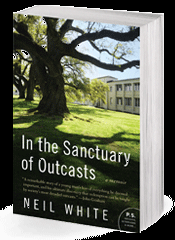 Neil White, the author of In the Sanctuary of Outcasts
The author, prior to being sentenced to a year at this prison, was a highly successful entrepreneur. A college graduate. Smart. Likely he has some charisma thrown in too. The son of very successful parents. He was a hard worker. He was married with two young children. He led the kind of life lots of people would aspire to – he had a beautiful home, went on lavish vacations, had nice cars, dined out regularly in the best restaurants, and was well recognized in his town – lots of people wanted to know him. He thrived on the attention and accolades. He saw himself as a rising “star” in the media world. After starting up a newspaper in a medium-sized southern city (it failed, actually) he decided to become a magazine publisher. He was good at that. He was able to sell advertising – he was exceedingly good with people. There’s that charisma thing, I’m sure, although he never mentions that word. He’s an idea man too. Always thinking about where he’s going to make his name, where he’d make his “big break,” to get into the big time. He was never quite satisfied with where he was (career-wise). One more magazine, one more something. All requiring more cash to start and run. He borrowed money. He asked friends and family members to invest in his dream. They did. They believed in him. Saw no red flags.
Obviously, he wasn’t quite as good at looking at the bottom line. A few people (companies) couldn’t quite pay their advertising bills. The problem was, Neil had already spent or used the money. He factored his income in the publishing business (a common enough tactic for small companies, although not always wise); he borrowed money from Peter to pay Paul. I’d not realized until I read this book what “kiting checks” really meant (it’s fraud). He’d write checks from one account to pay another, and likewise that one to pay yet another. When you do it with different banks, it may take awhile for someone to catch on, especially since he’d do most of the transacting minutes before the close of the day. He’d convinced himself he wasn’t doing anything wrong. He got caught (rightly so) and was sentenced to a year in this low-level, minimum security prison called Carville, in Louisiana. He lost absolutely everything.
To say that Neil White had a big ego is an understatement. When he reported for his year of incarceration, he still had a pretty big ego going. He was embarrassed about what happened. He felt badly for his wife and children (and on the advice of a therapist he and his wife decided to tell their two children that Daddy was going to “camp”). He had duped a lot of people, many family members included, who all lost money in their misguided belief in him. In prison he felt like he didn’t belong – the business-dandy that he was, was “above” these uneducated prisoners from all walks of life. He never had worn an un-ironed shirt. He had been obsessive about cologne and cleanliness. He had to adjust to wrinkled uniforms, no privacy, no doors anywhere, lights on 24-hours a day. Yet within days he was already mentally scheming how he was going to do an exposé about prison life at Carville. How would he do that? Well, he discovered right off, that this prison also housed (not imprisoned) the last survivors in the United States who have Hansen’s Disease (leprosy).
Because I think you should read this book, I don’t want to give away everything about the story. Here I’ve shared quite a bit about the author’s background. And hardly anything about the facts of leprosy, its progression, the medication now used to stop its advancement. Or about the people who live at Carville. I am telling you about the author’s abhorrence of catching the disease had him holding his breath sometimes – this, when we first arrived at the prison. And yet, eventually, with time, he learns more about the disease and befriends several of the patients and inmates in the prison. (There are inmates – like him – and patients like those with leprosy – and also there were inmate patients – prisoners who were too ill to be in some other prisons). There was a separation between the groups, but because it was a minimum security prison, it wasn’t too difficult to figure out ways to get around the rules about not fraternizing. Most of the inmates wanted nothing to do with the Hansen’s patients. They stayed clear of them for fear they’d “catch” it.
During the year, Neil White learns a whole lot about himself. Discovers how much he cares about these people – the Hansen’s patients, particularly a few special ones. They teach him a lot about life; they make him look into himself for answers; fortunately for him, he listens to them, although he’s hard-headed. It would be easy to dismiss this book as an ex-con’s way of making a living after his release, but you’d be missing the gist of the story, which is about Hansen’s Disease and what happens to all of the people who live there. These people who have no other home. It’s a story that needed telling, even if it is cloaked in a small book about one man’s prison journey. If you don’t read this book you’ll miss out on the redeeming value this book offers you, a friend, or someone in your family, perhaps, who has made a wrong-turn in life. In the process you’ll learn a whole lot about leprosy, which is something everyone should better understand. If you go to Neil White’s website, you can see a few photos of the prison. This book may not be for everyone. And, of course, since it’s a memoir, there’s no way of knowing whether everything he recounts in the book, is true. Neil White talks about that in the book – about how he was told by several people to not believe what both inmates and Hansen’s patients had told him. That they embellish or outright lie. Since truth became an important word to Neil White during his year, I’d like to think this book speaks it. I’m very glad I read it.
National Hansen’s Disease Museum (Wikipedia)
Karen’s Orphans and Forgotten Residents


Leave a Comment!